Notice of Meeting:
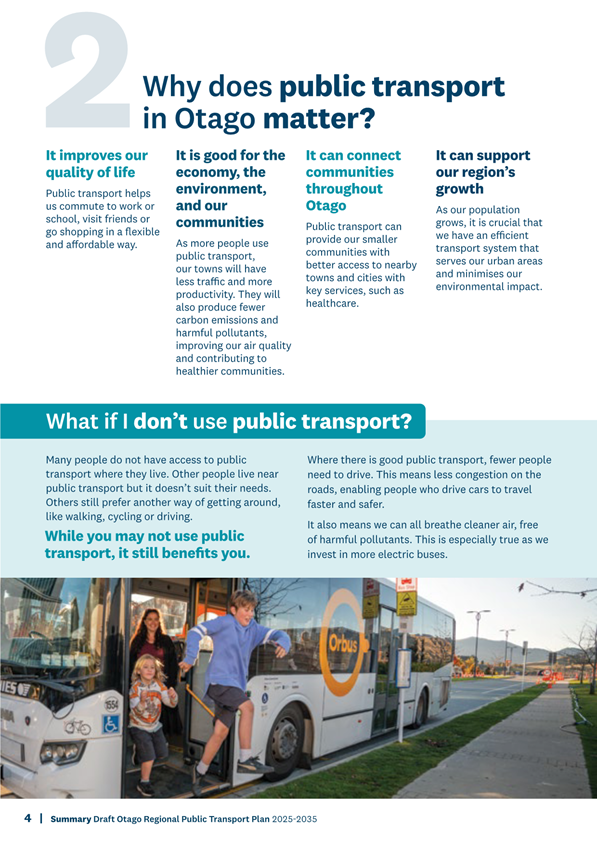
I hereby give notice that an ordinary meeting of the Dunedin
City Council will be held on:
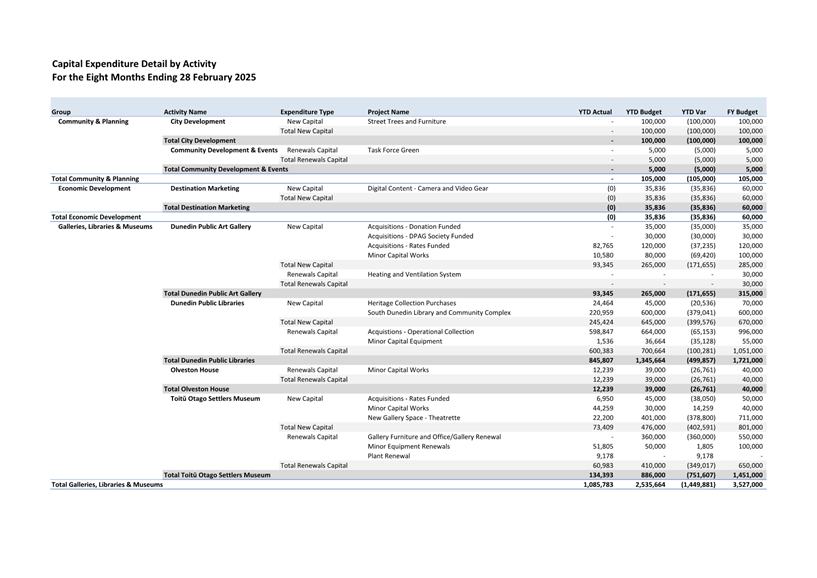
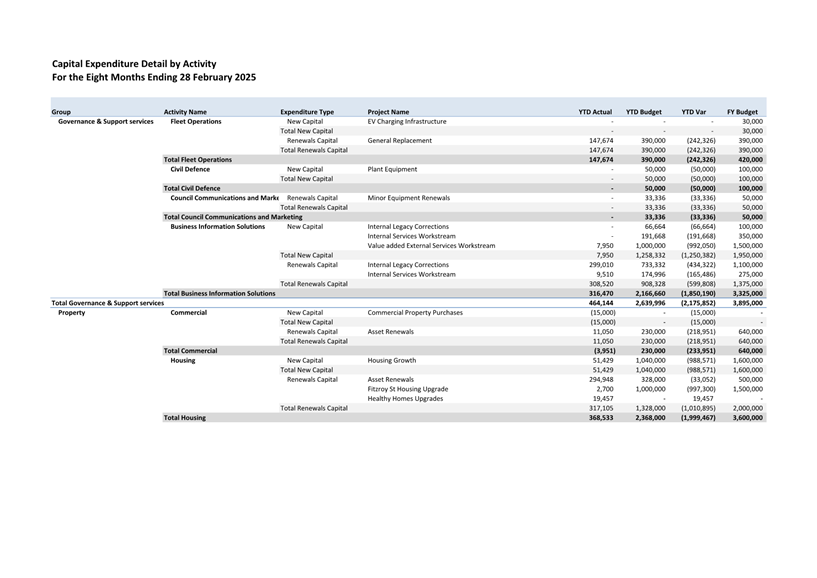
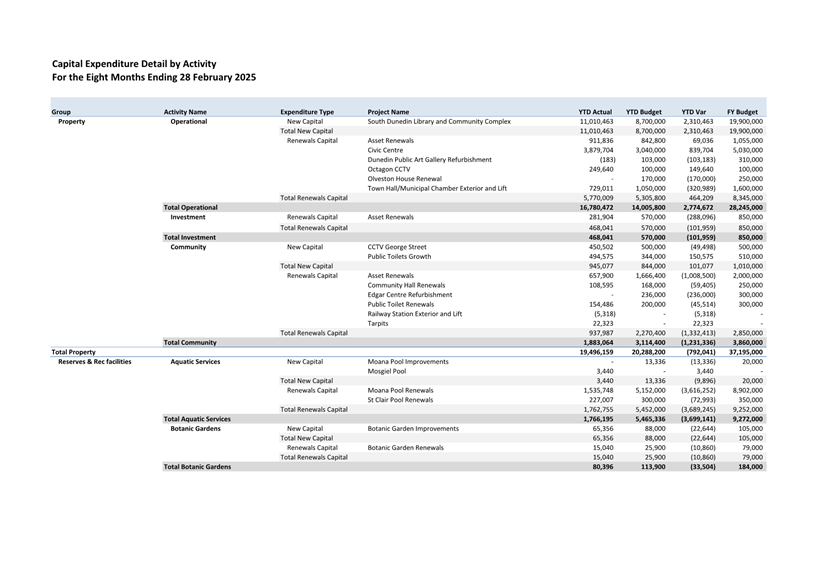
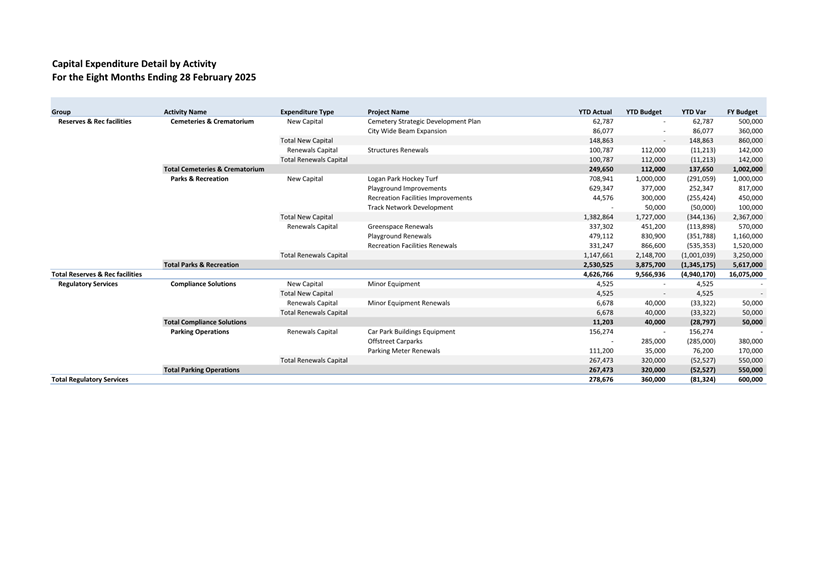
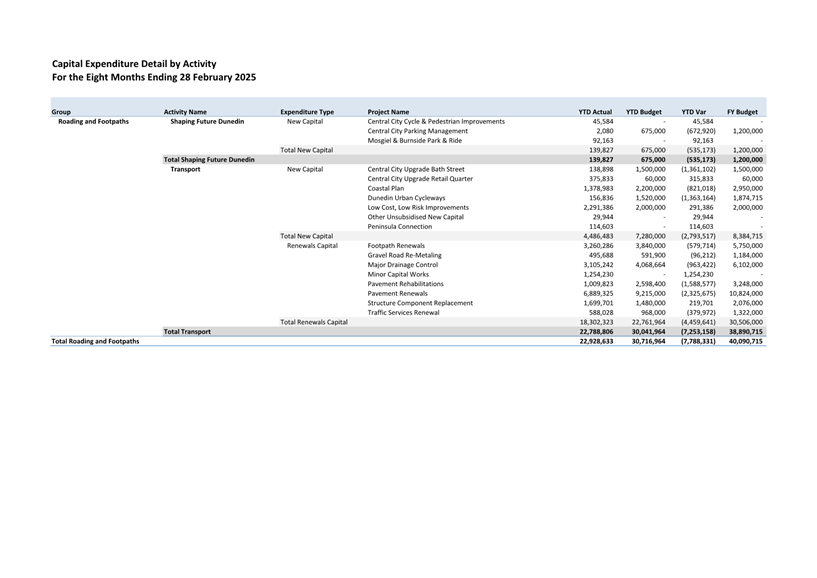
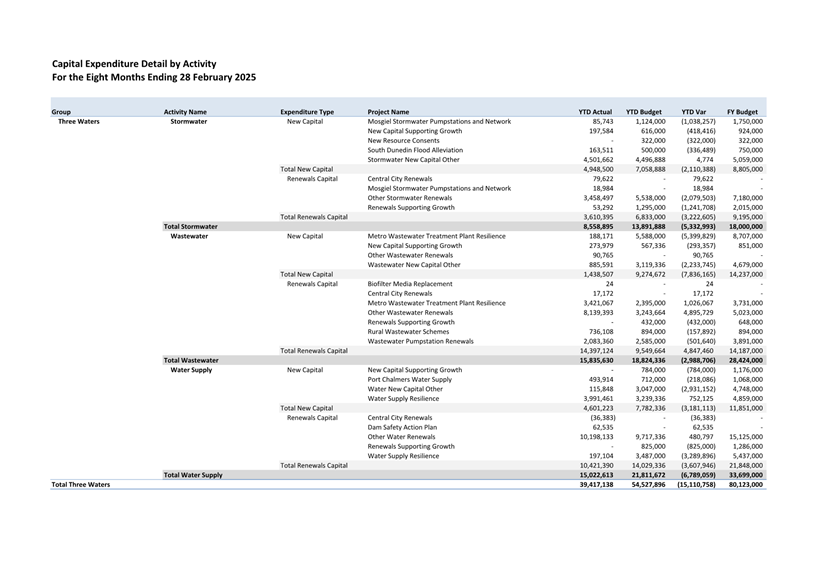
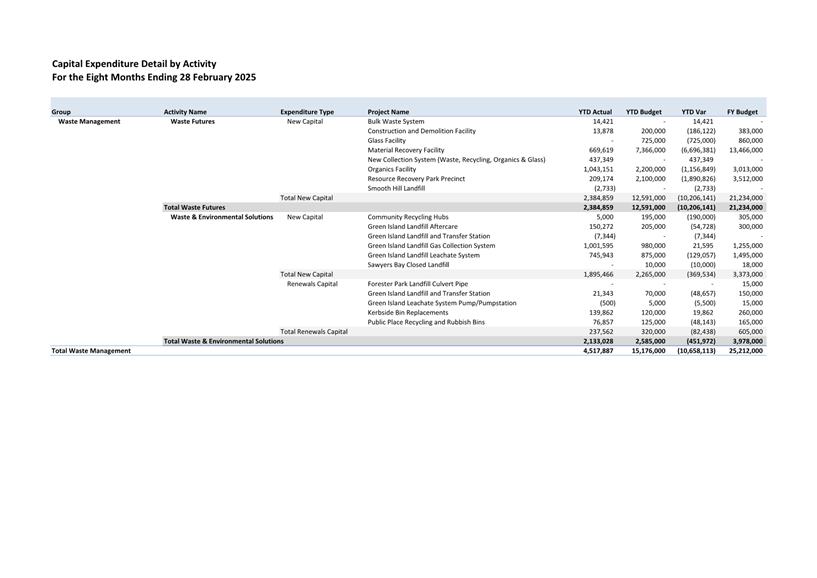
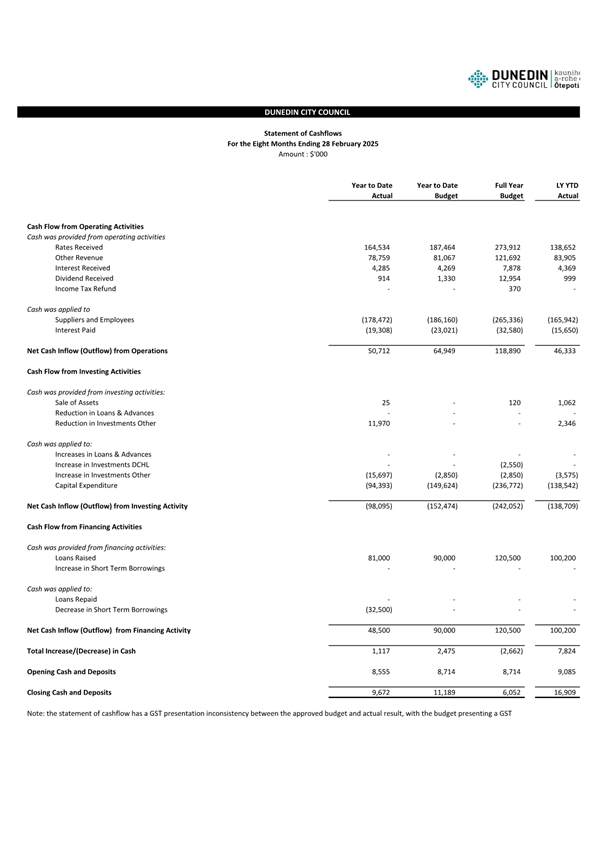
Date: Tuesday
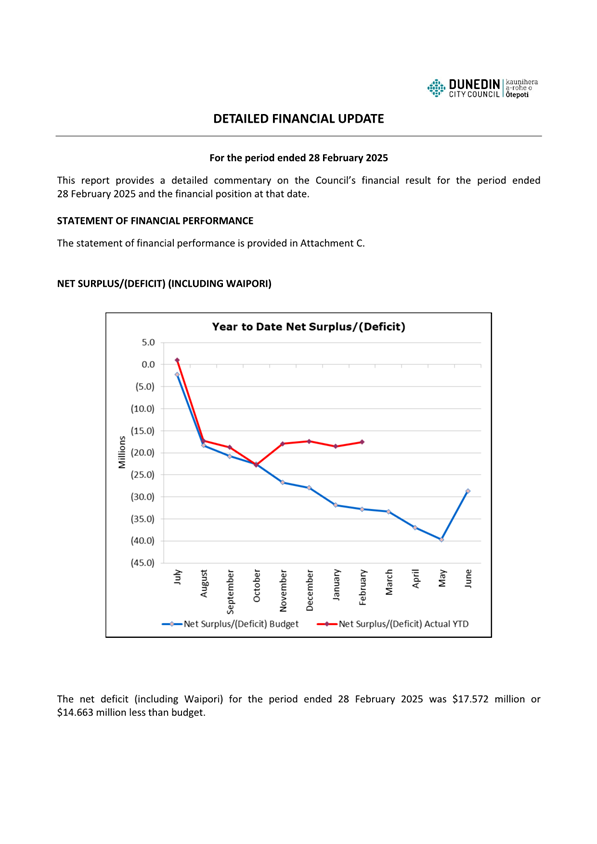
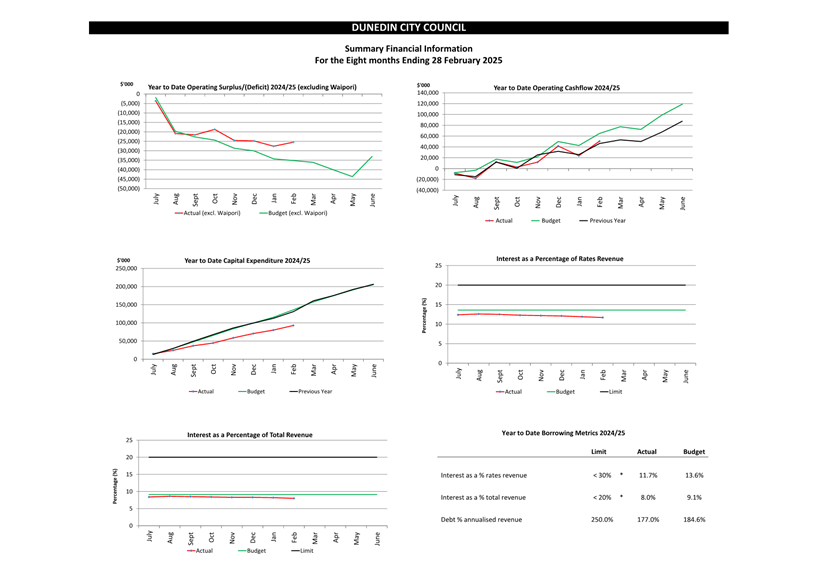
15 April 2025
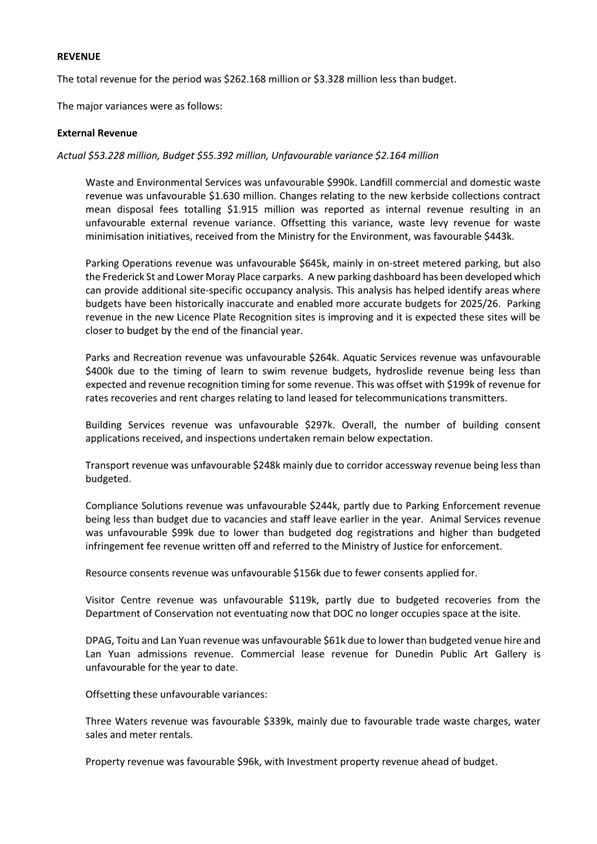
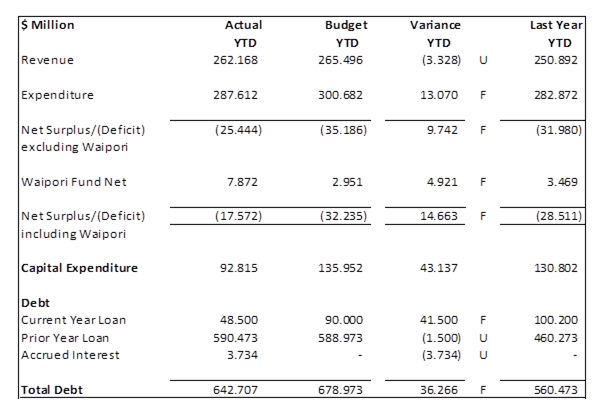
Time: 9:00
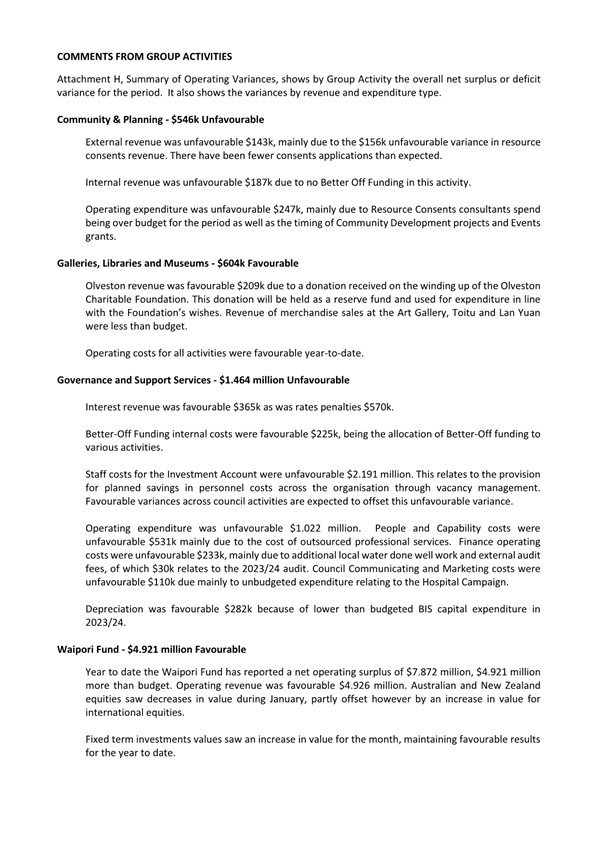
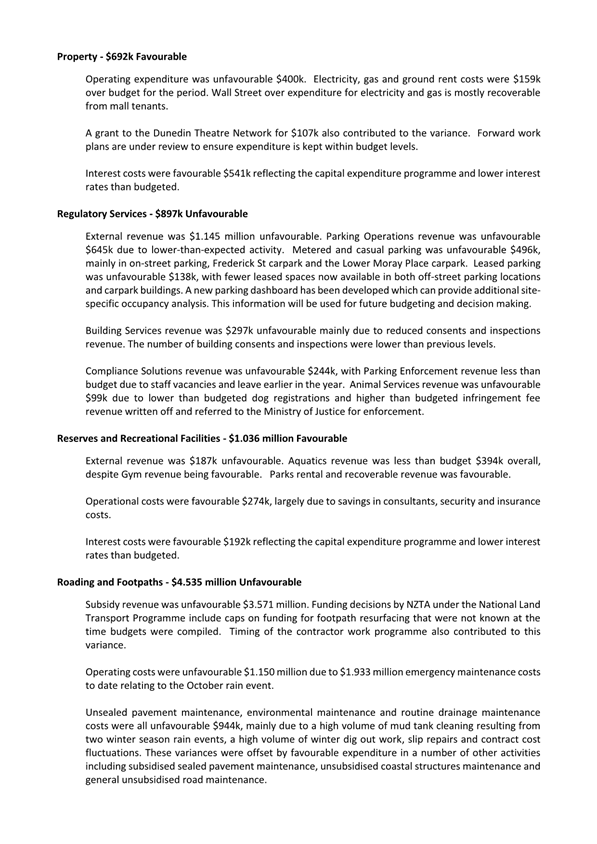
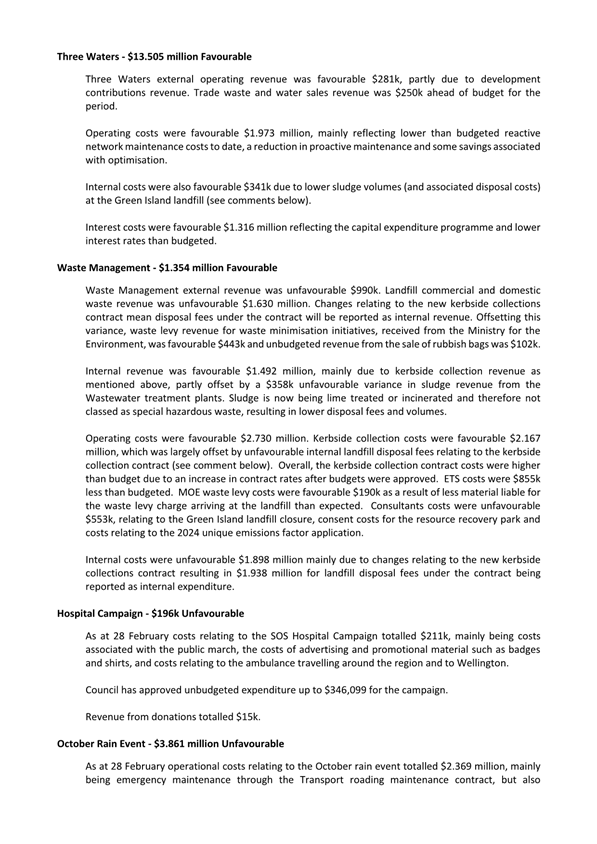
a.m.
Venue: Council
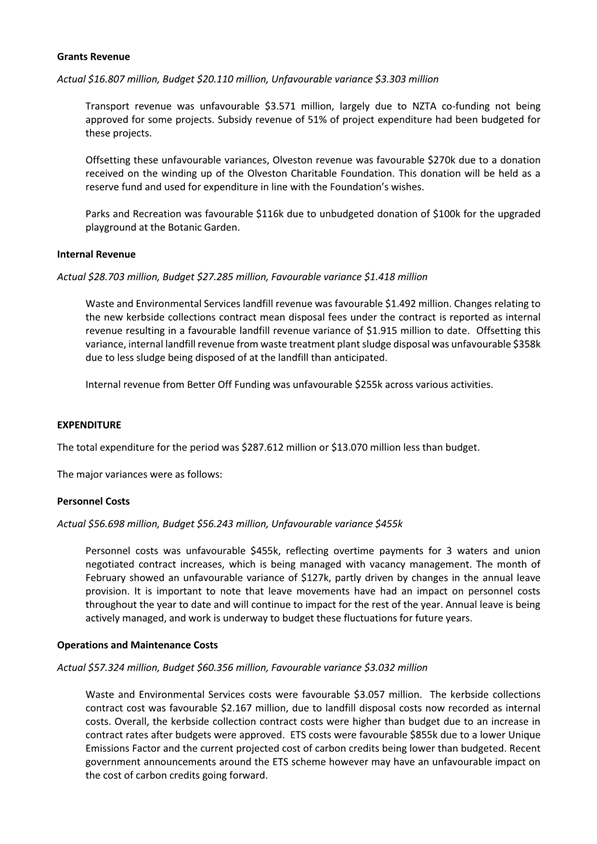
Chamber, Dunedin Public Art Gallery, The Octagon, Dunedin
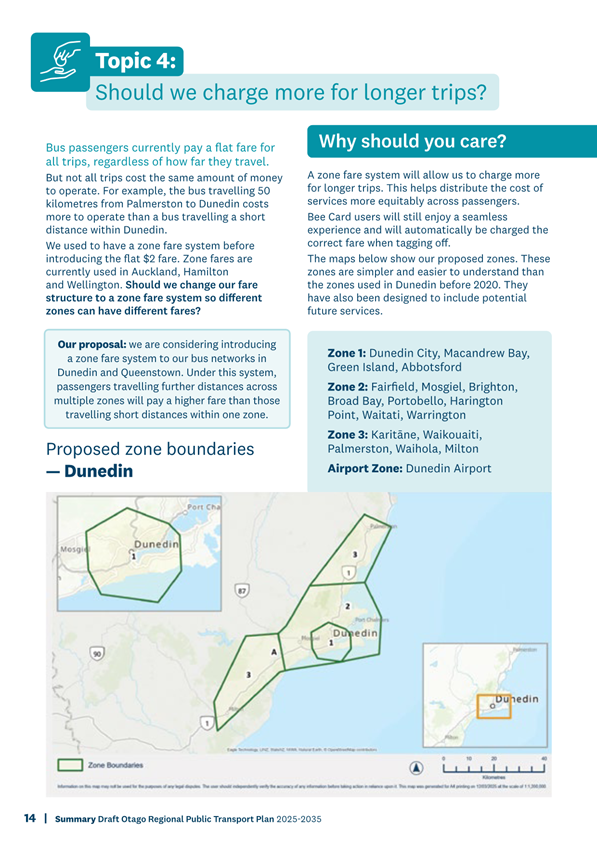
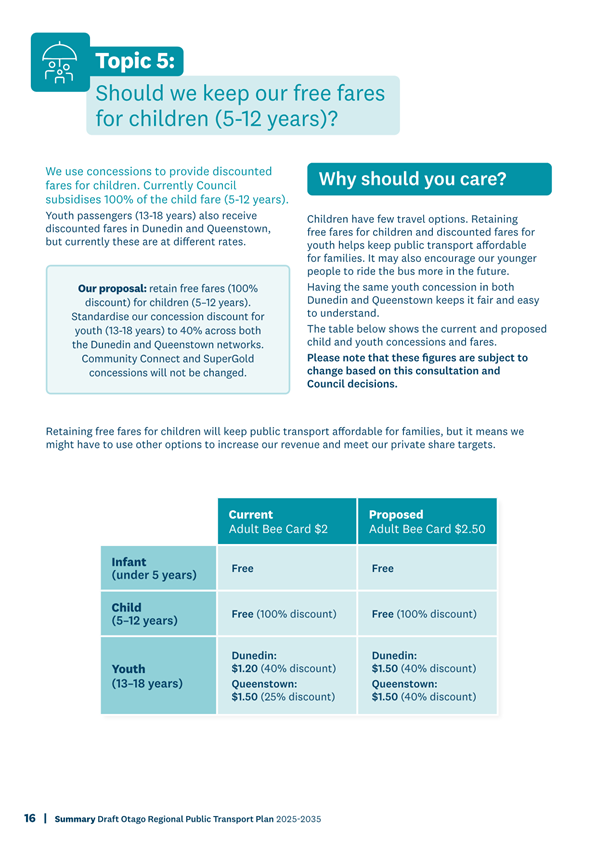
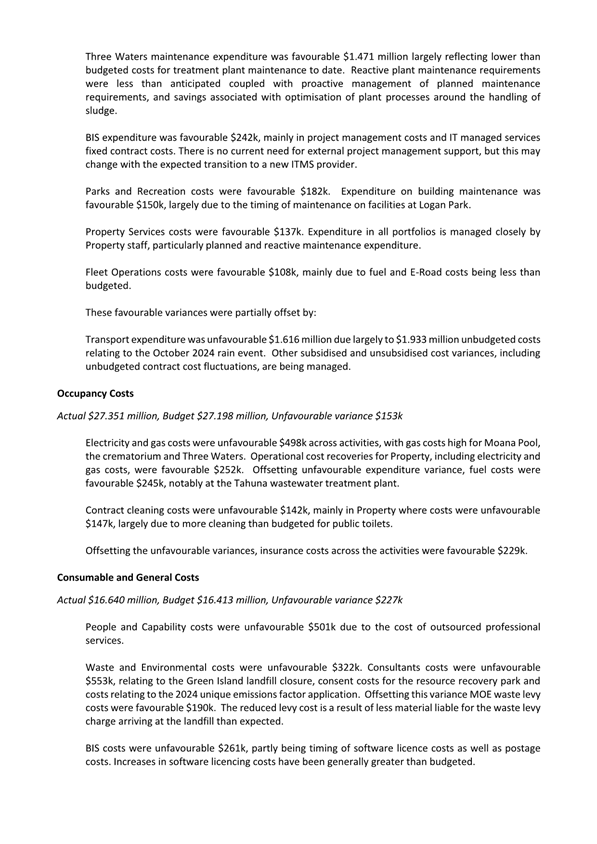
Sandy Graham
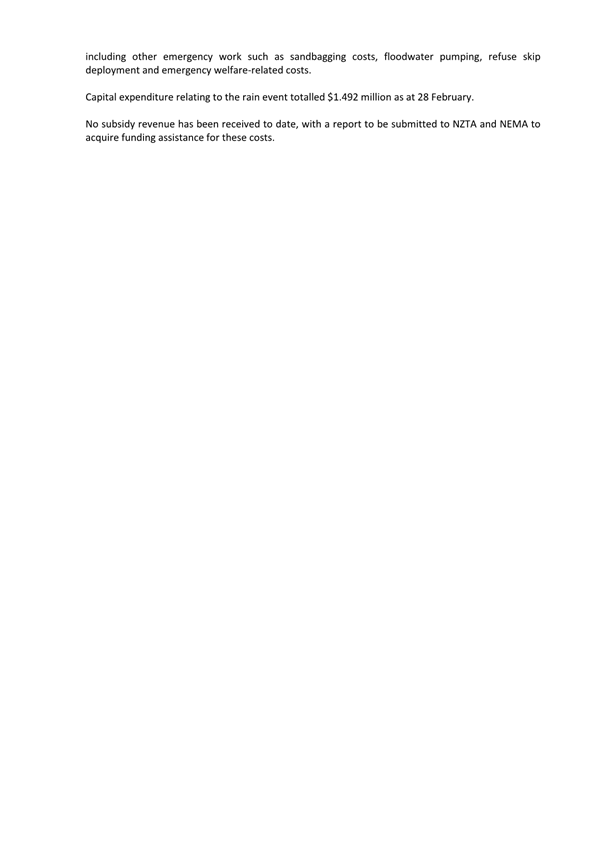
Council
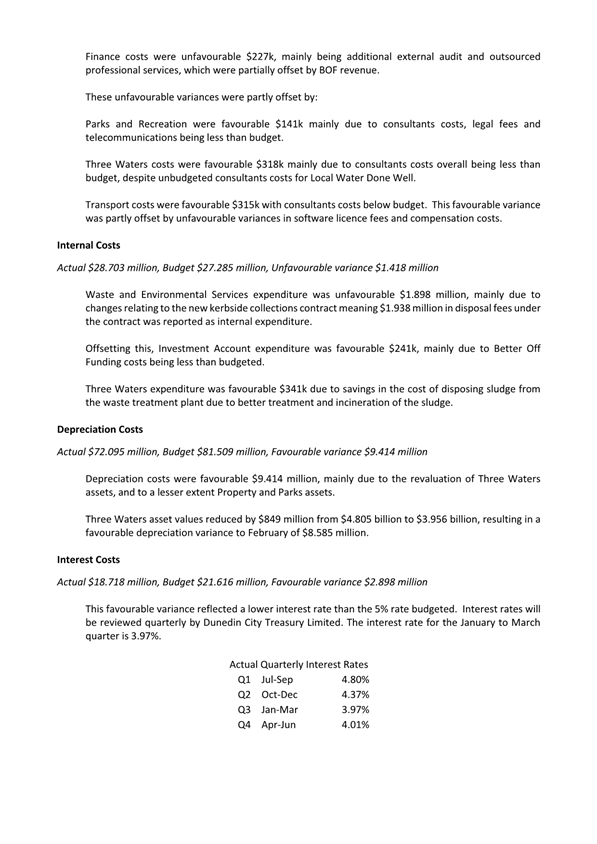
PUBLIC AGENDA
|
Mayor
|
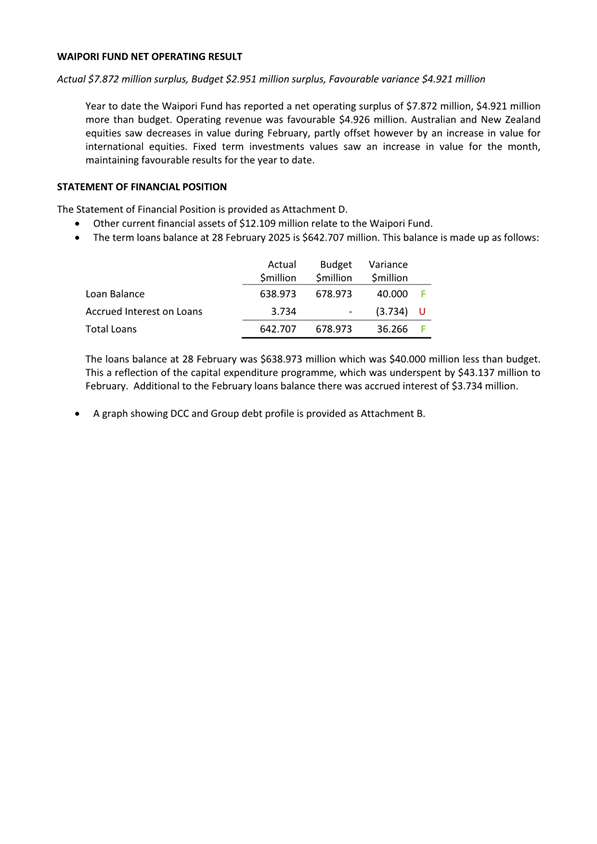
Mayor Jules Radich
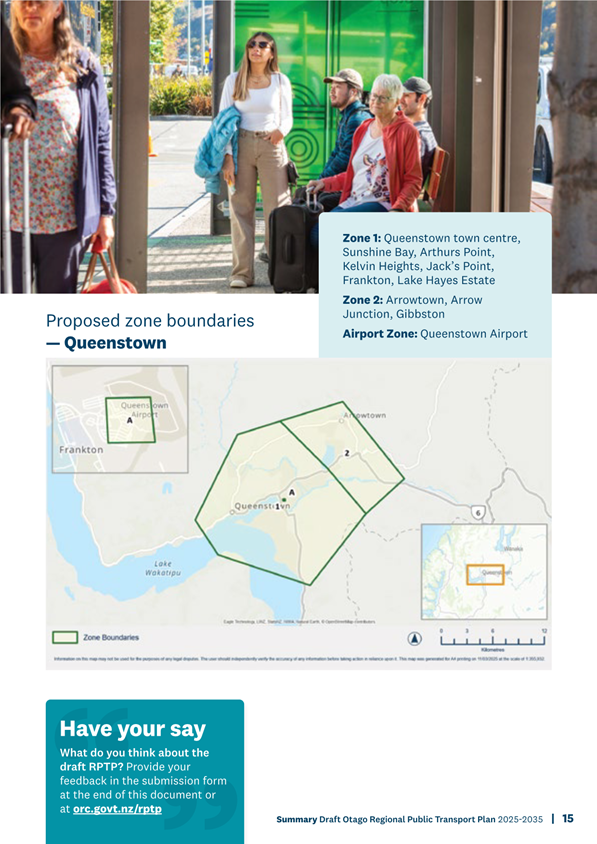
|
|
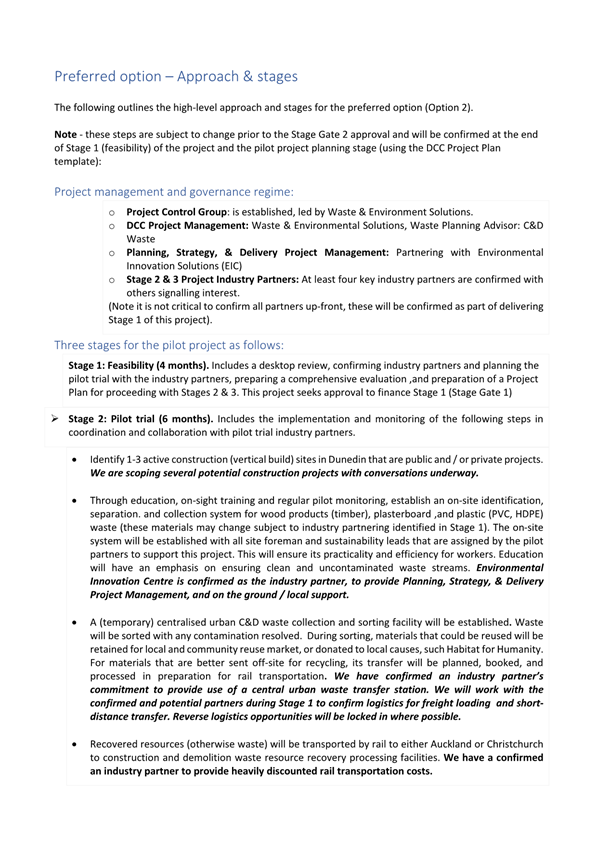
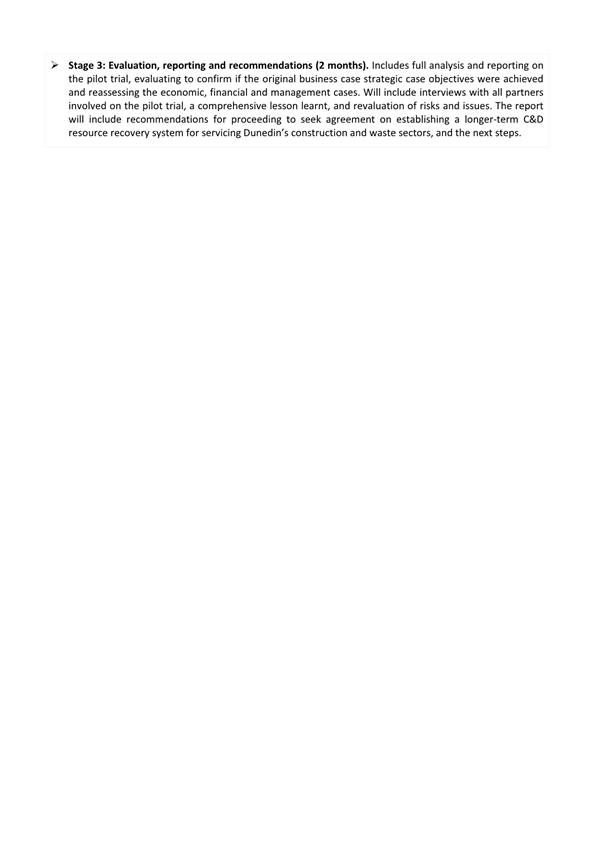
|
Deputy Mayor
|
Cr Cherry Lucas
|
|
|
Members
|
Cr Bill Acklin
|
Cr Sophie Barker
|
|
|
Cr David Benson-Pope
|
Cr Christine Garey
|
|
|
Cr Kevin Gilbert
|
Cr Carmen Houlahan
|
|
|
Cr Marie Laufiso
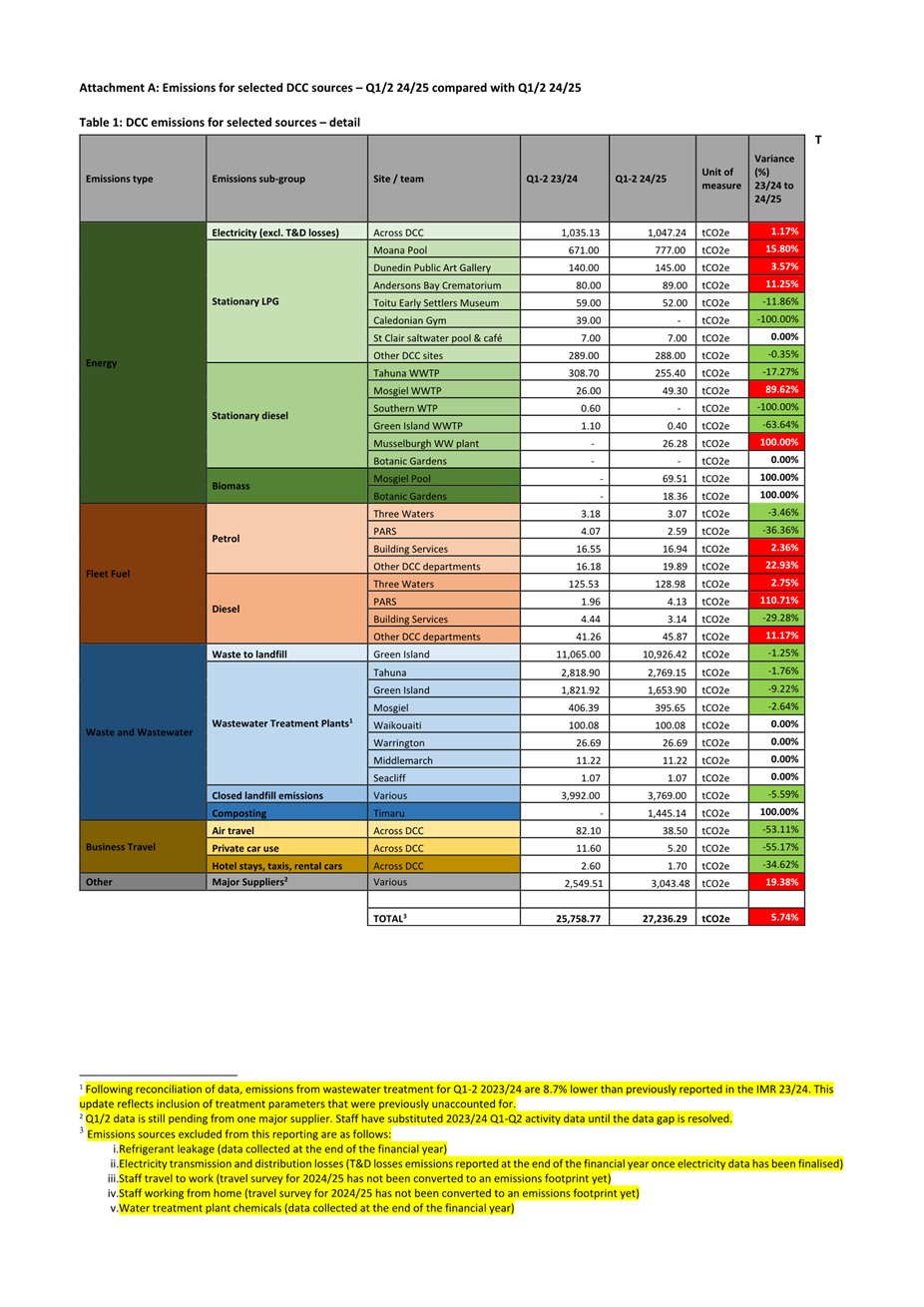
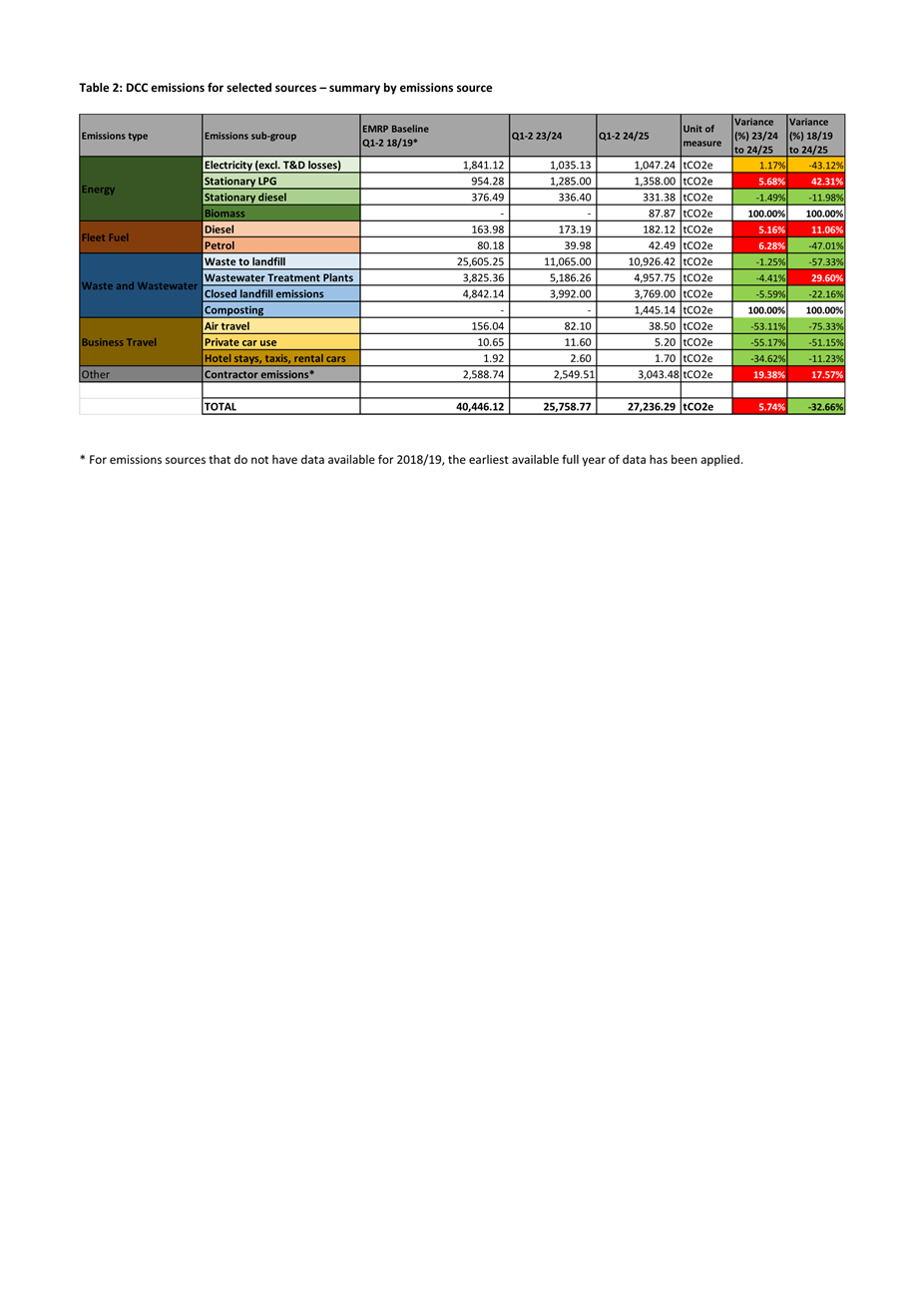
|
Cr Mandy Mayhem
|
|
|
Cr Jim O'Malley
|
Cr Lee Vandervis
|
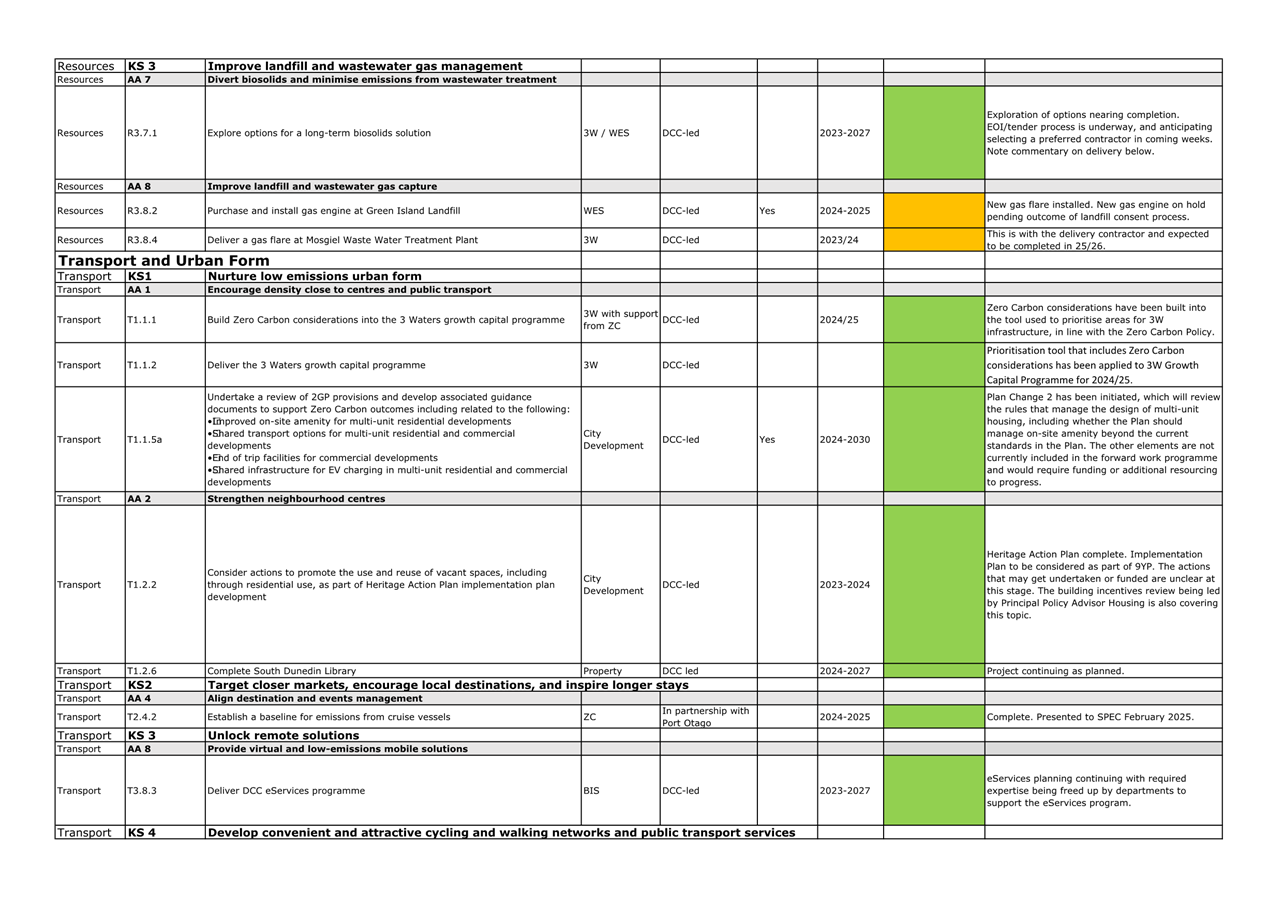
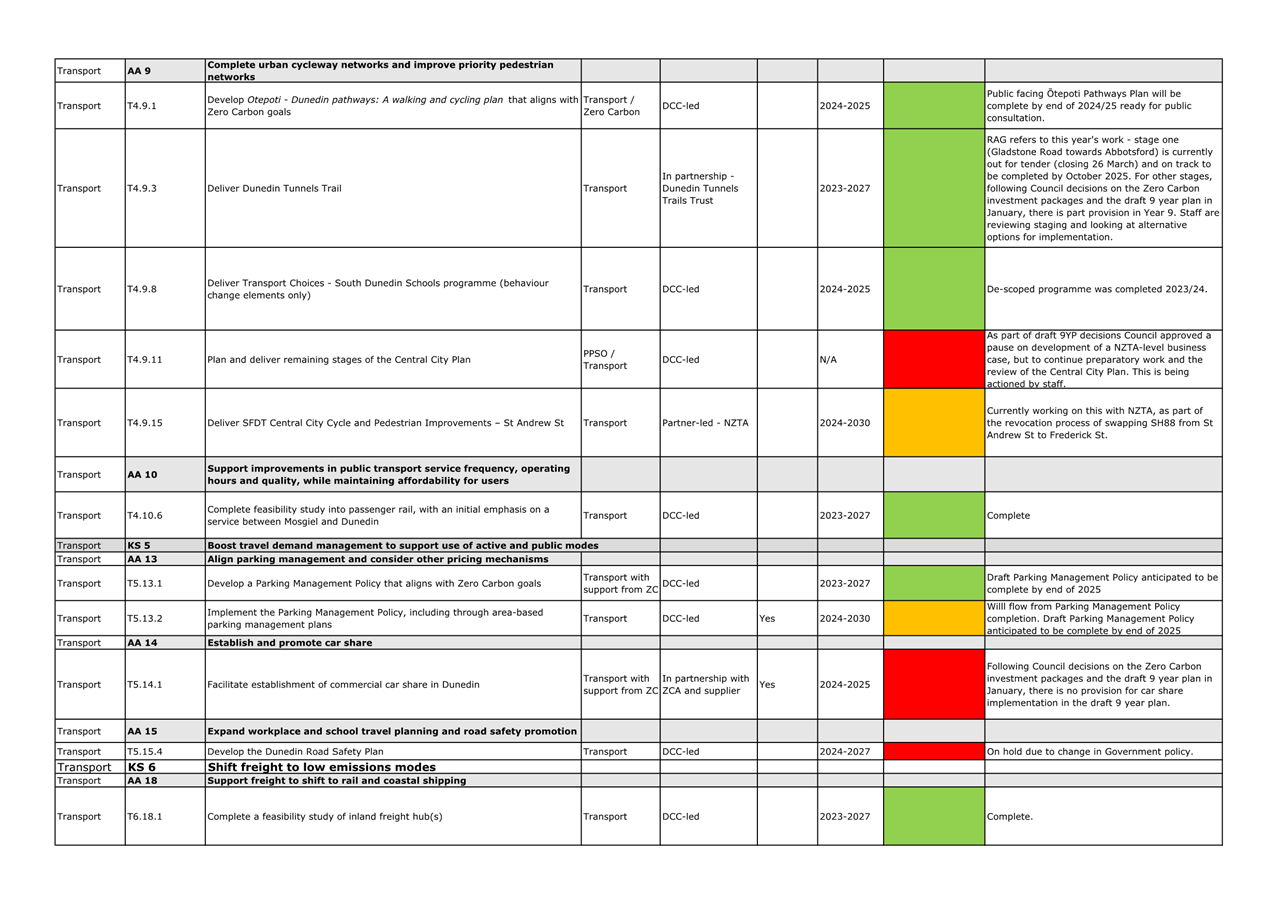
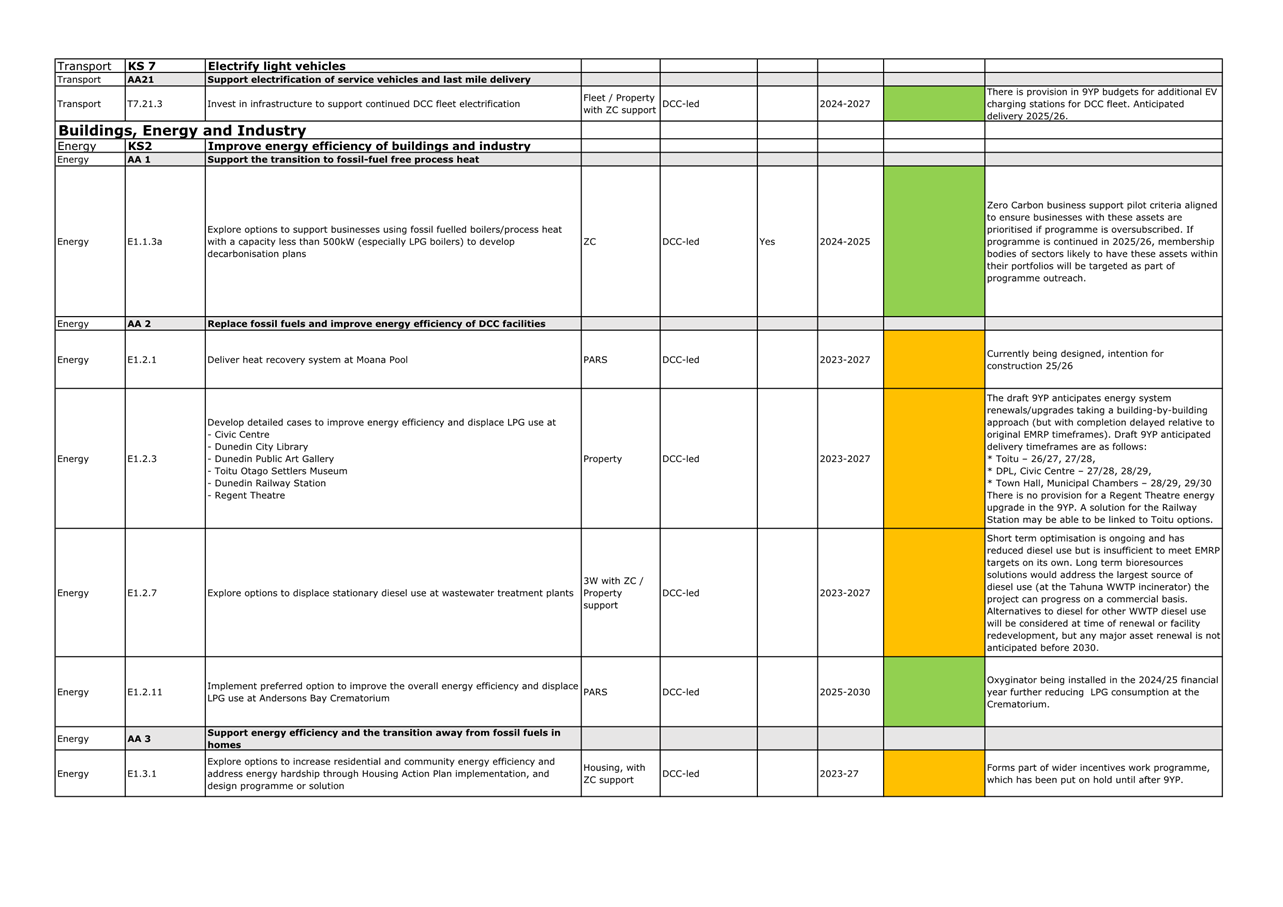
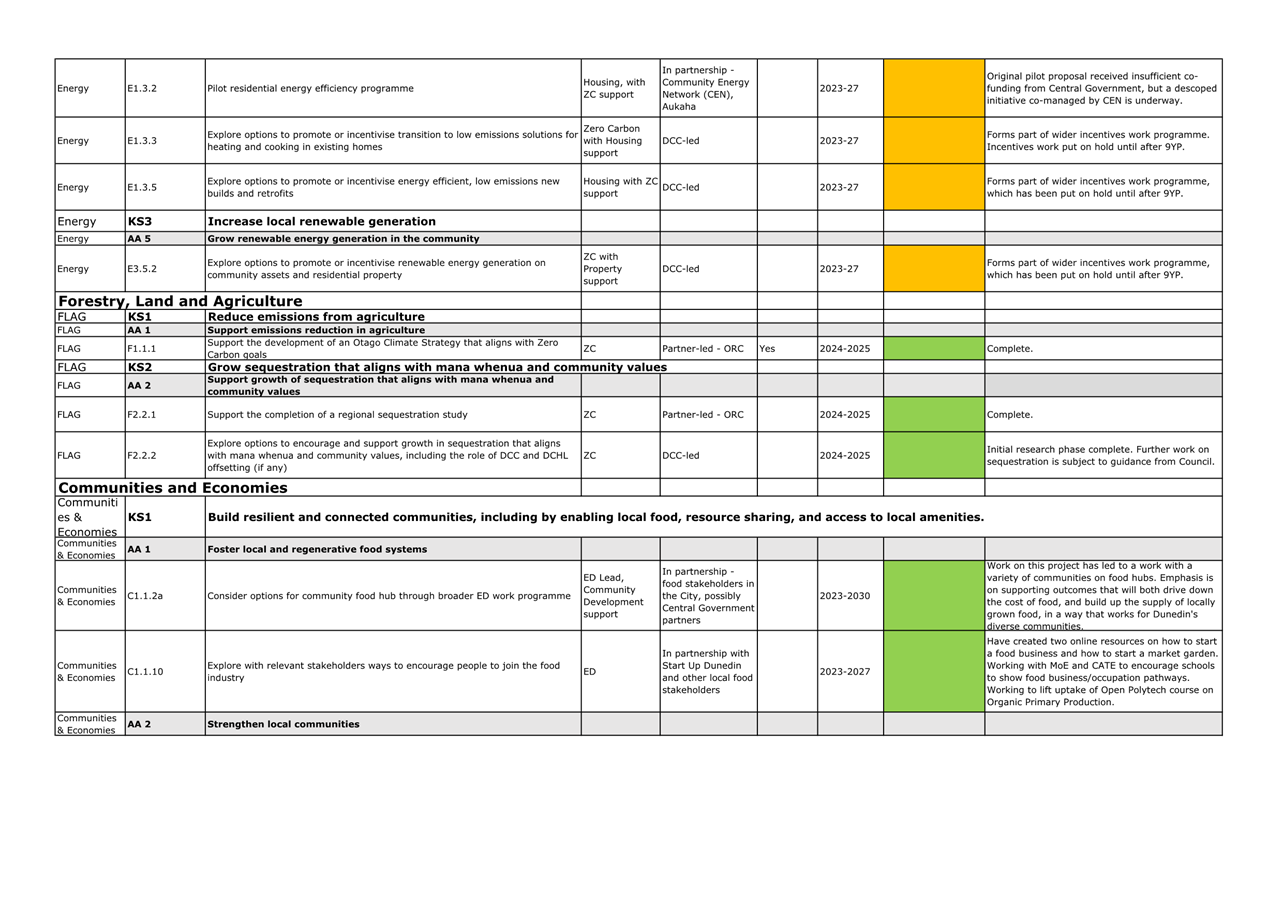
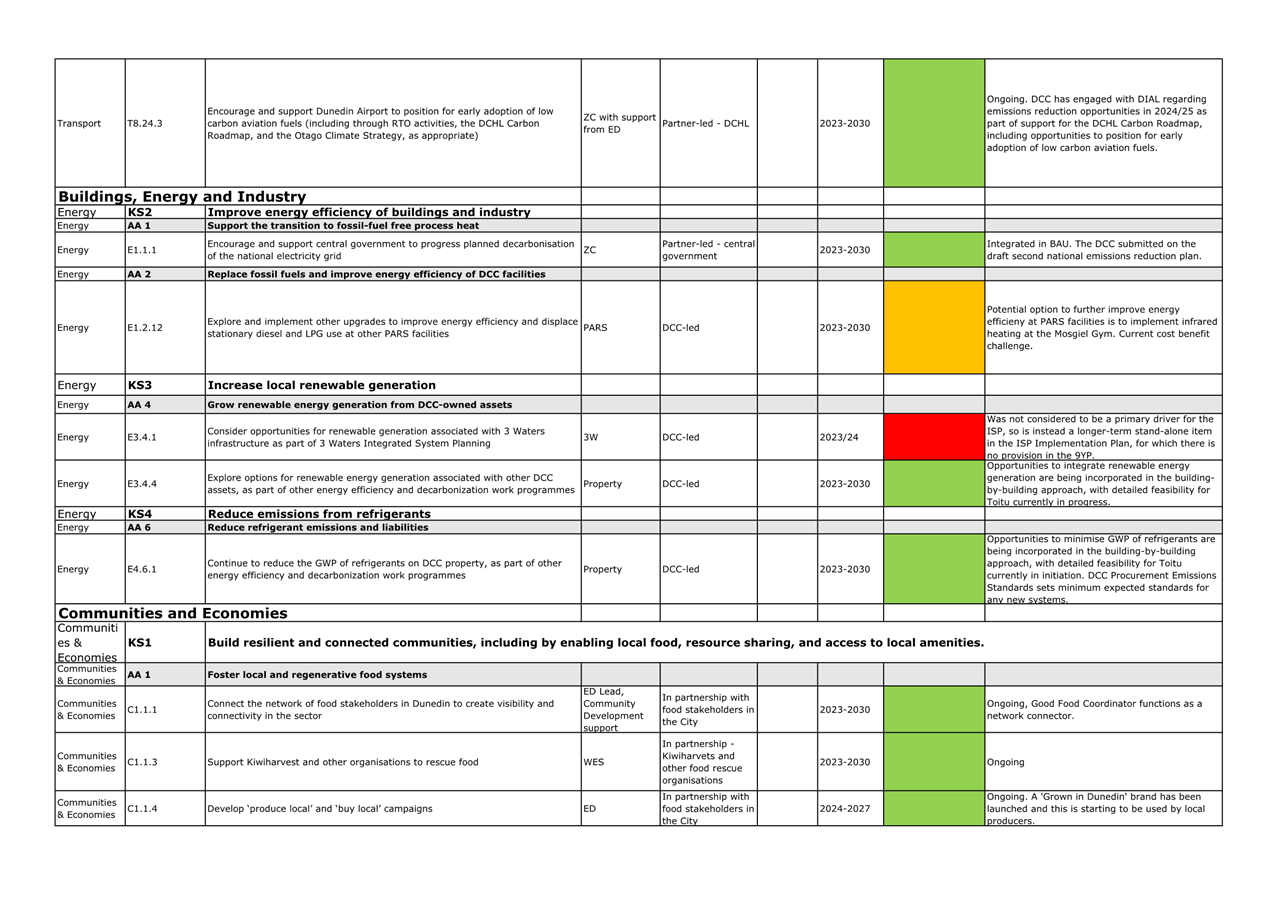
|
|
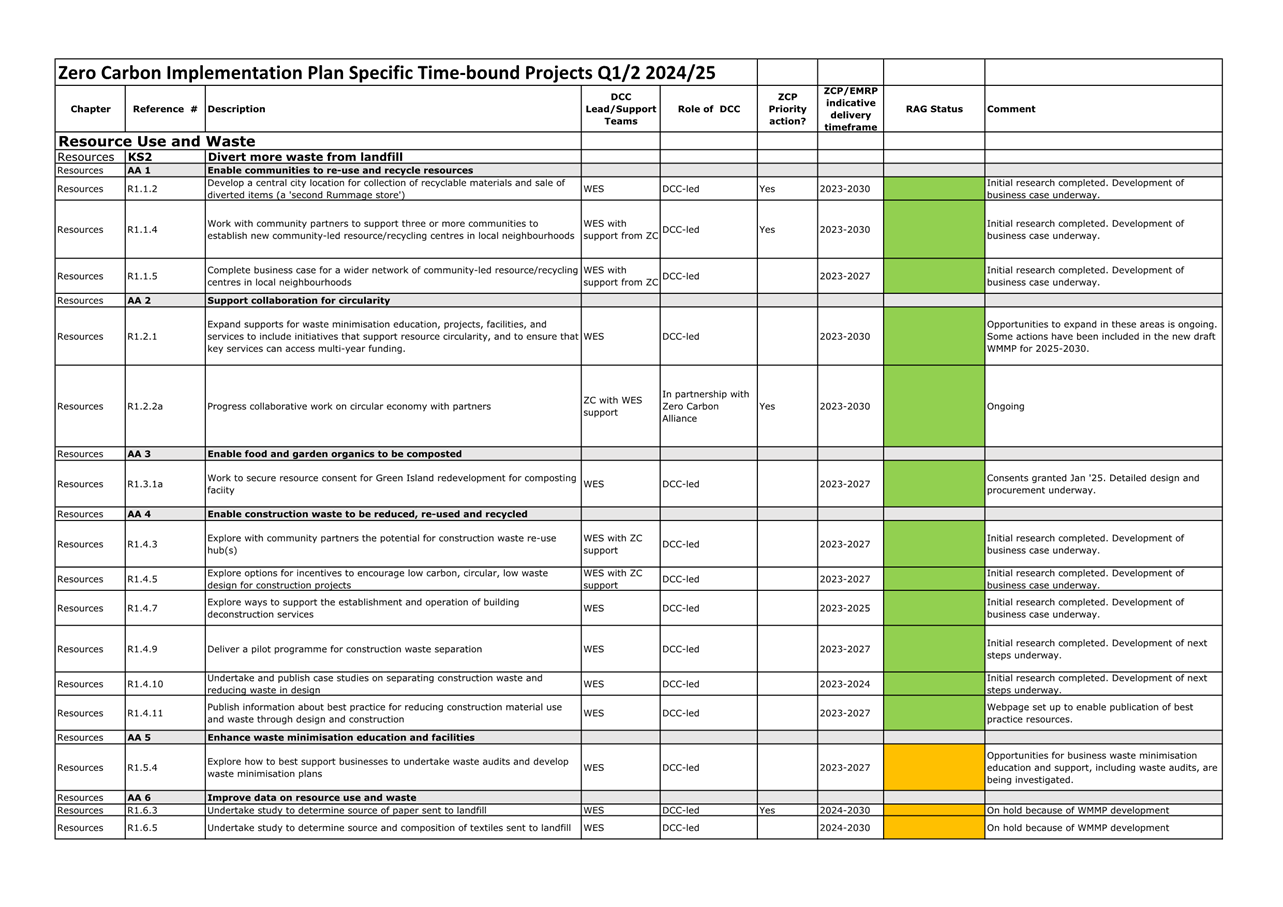
Cr Steve Walker
|
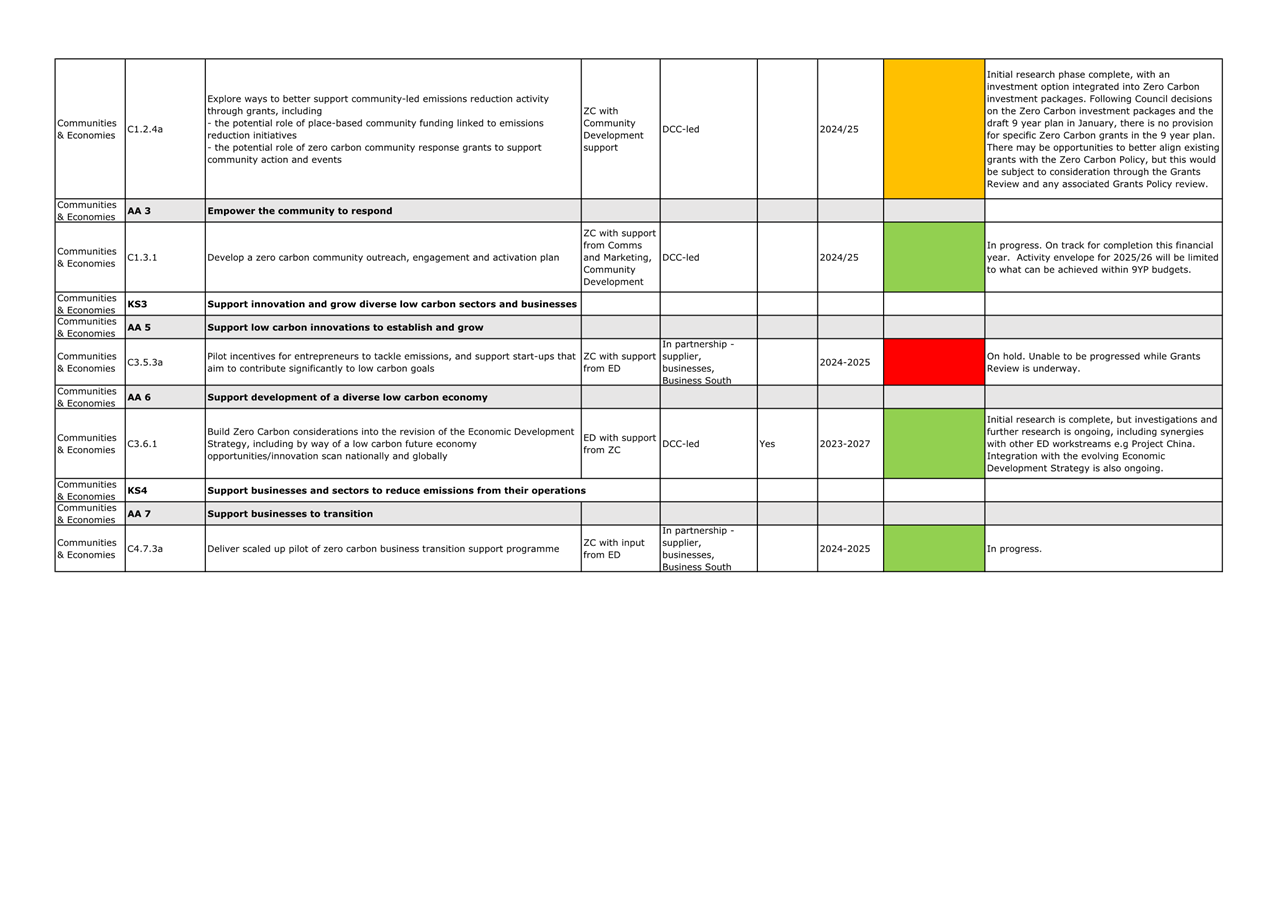
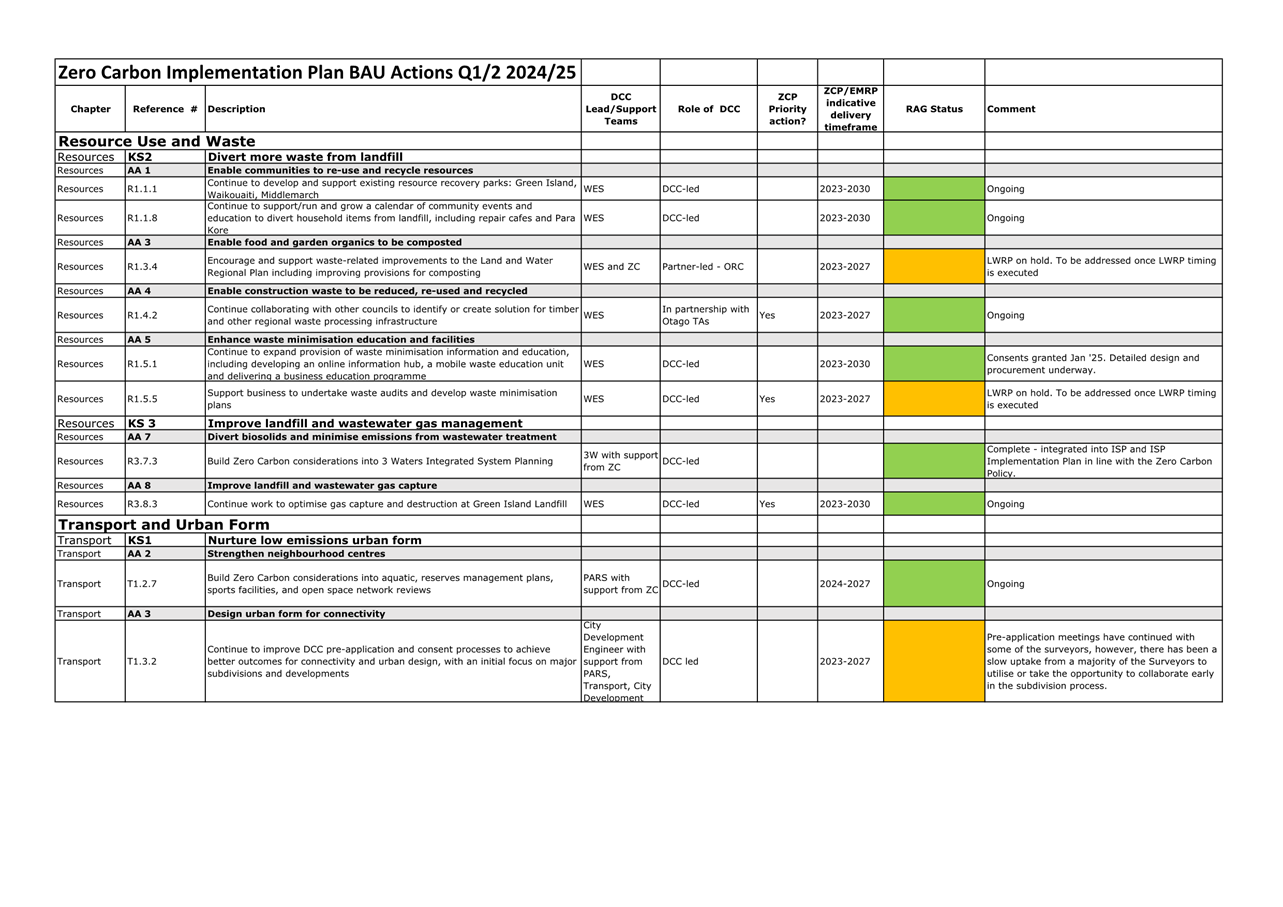
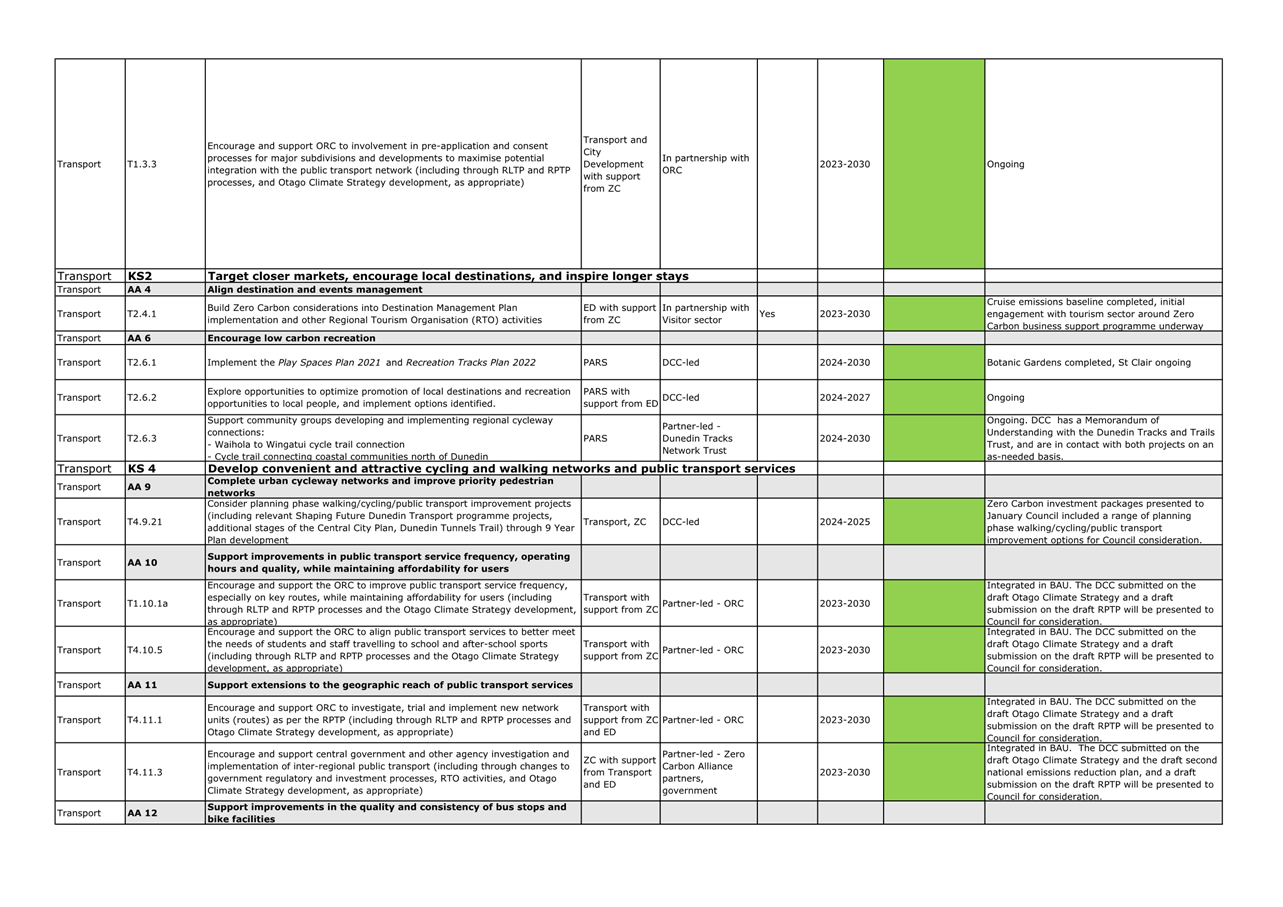
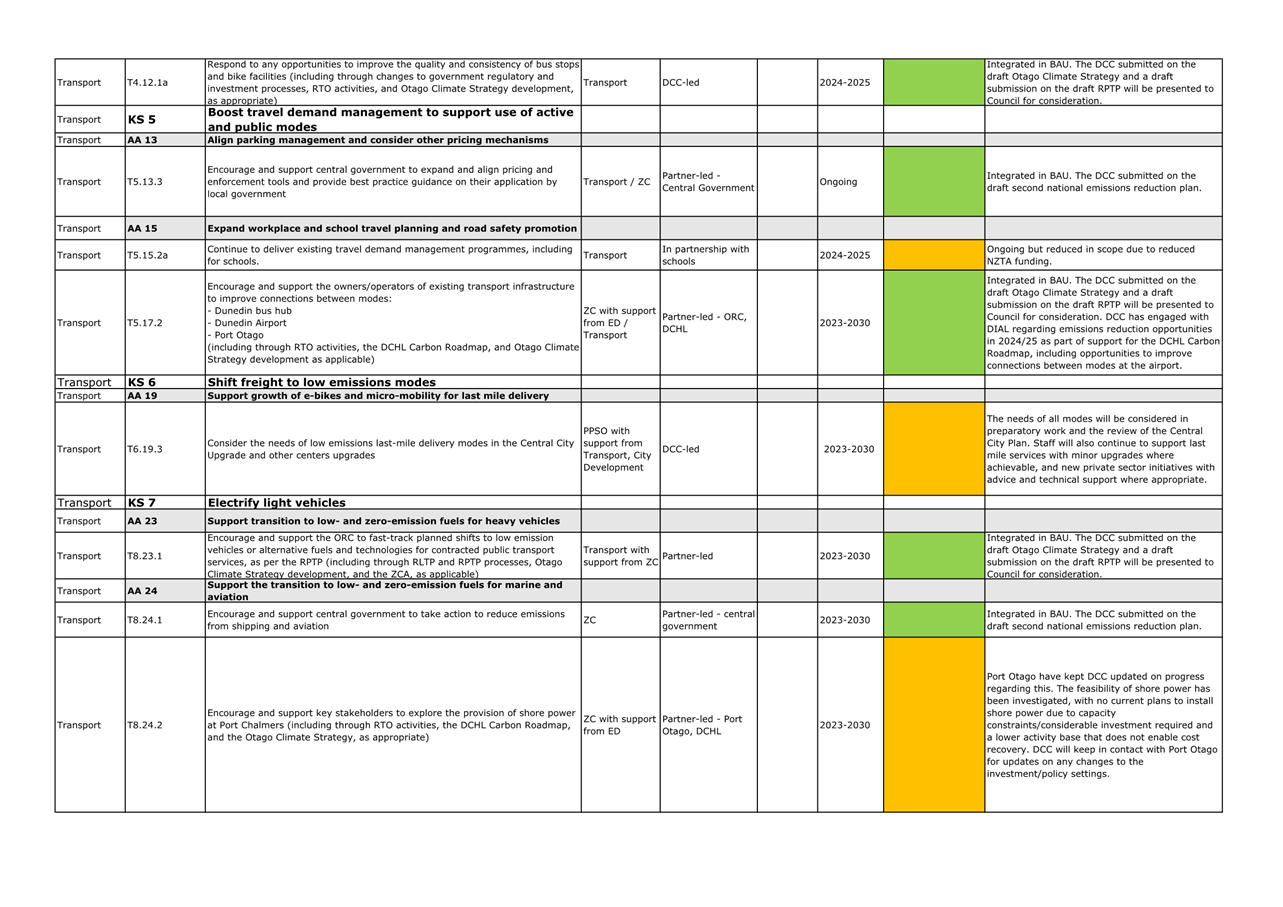
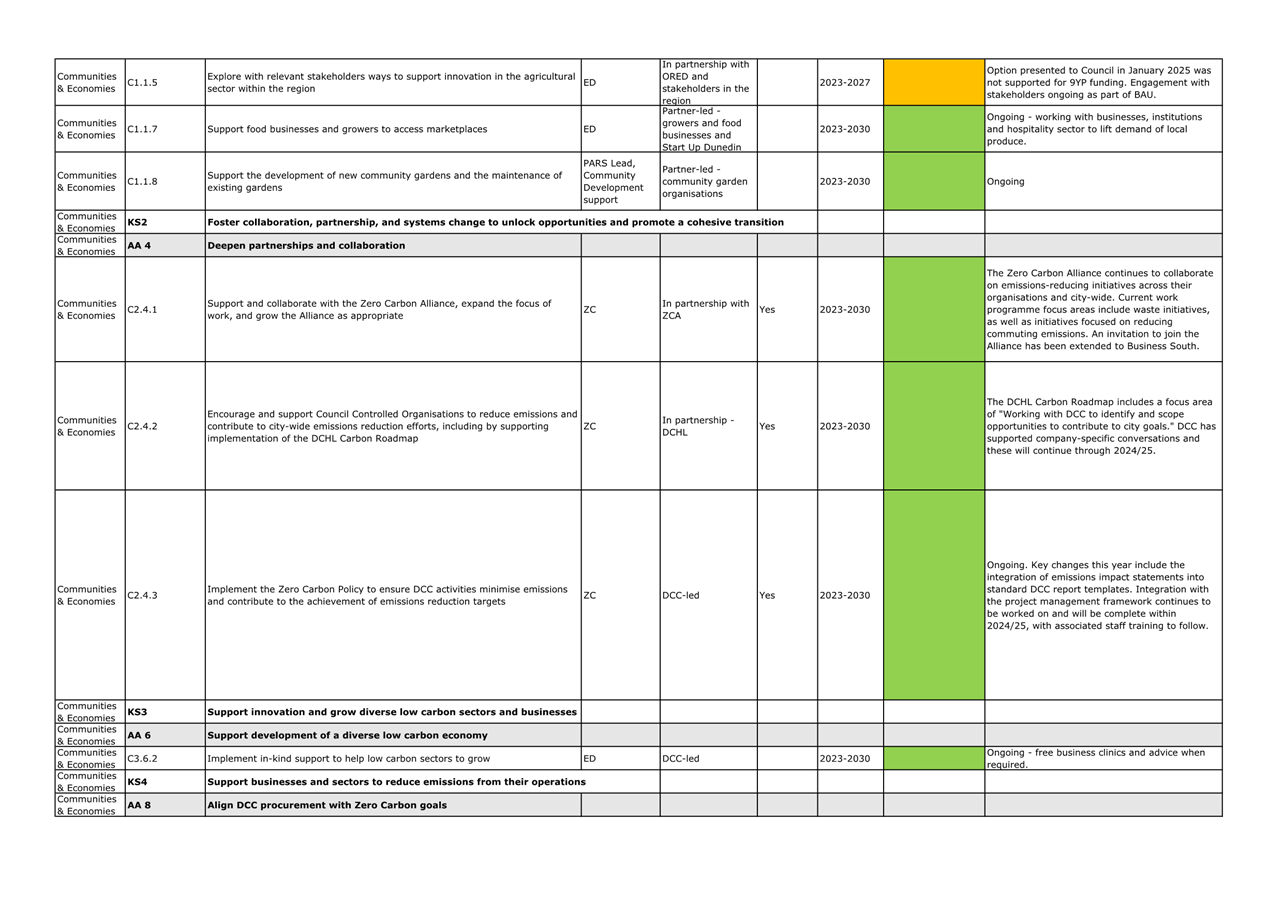
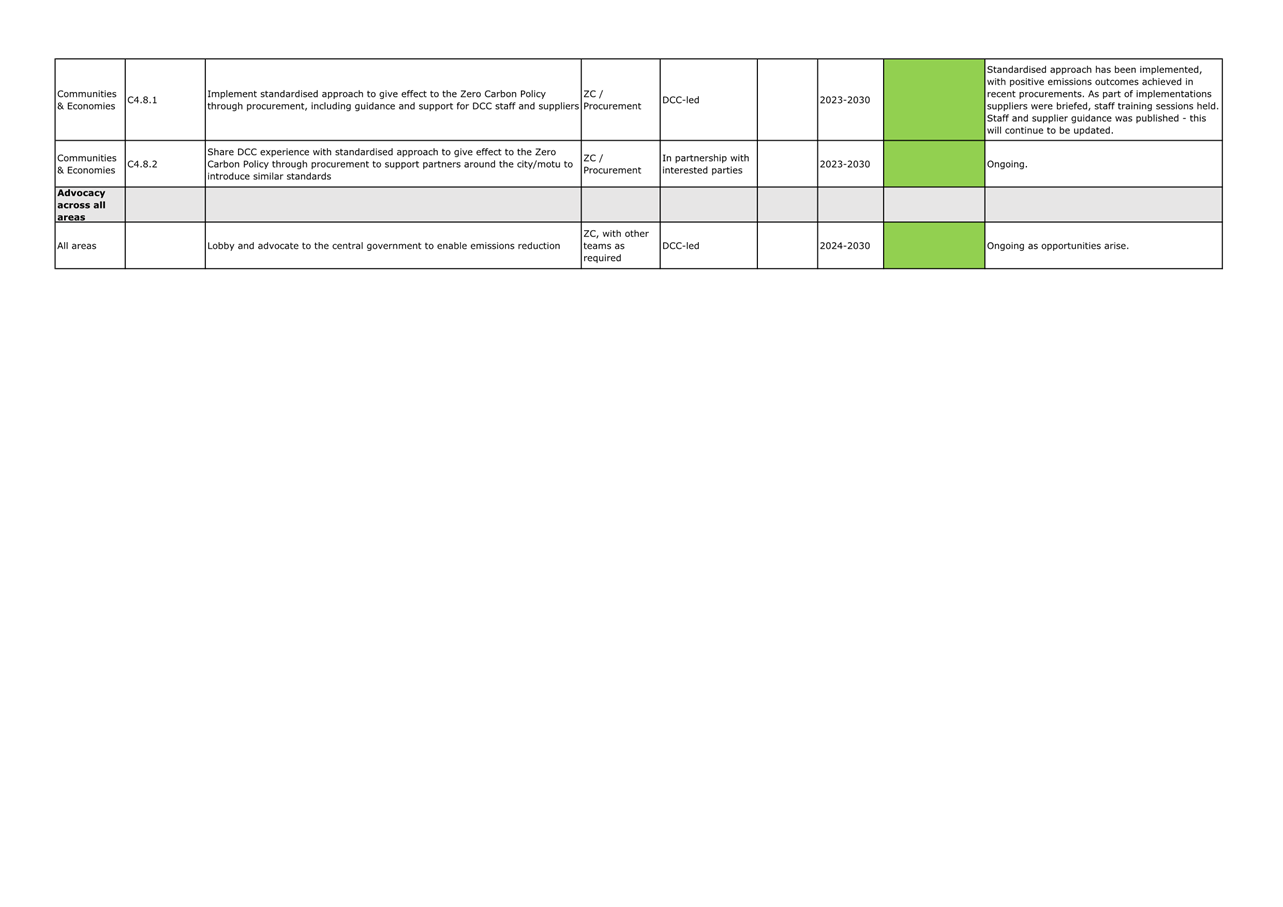
Cr Brent Weatherall
|
|
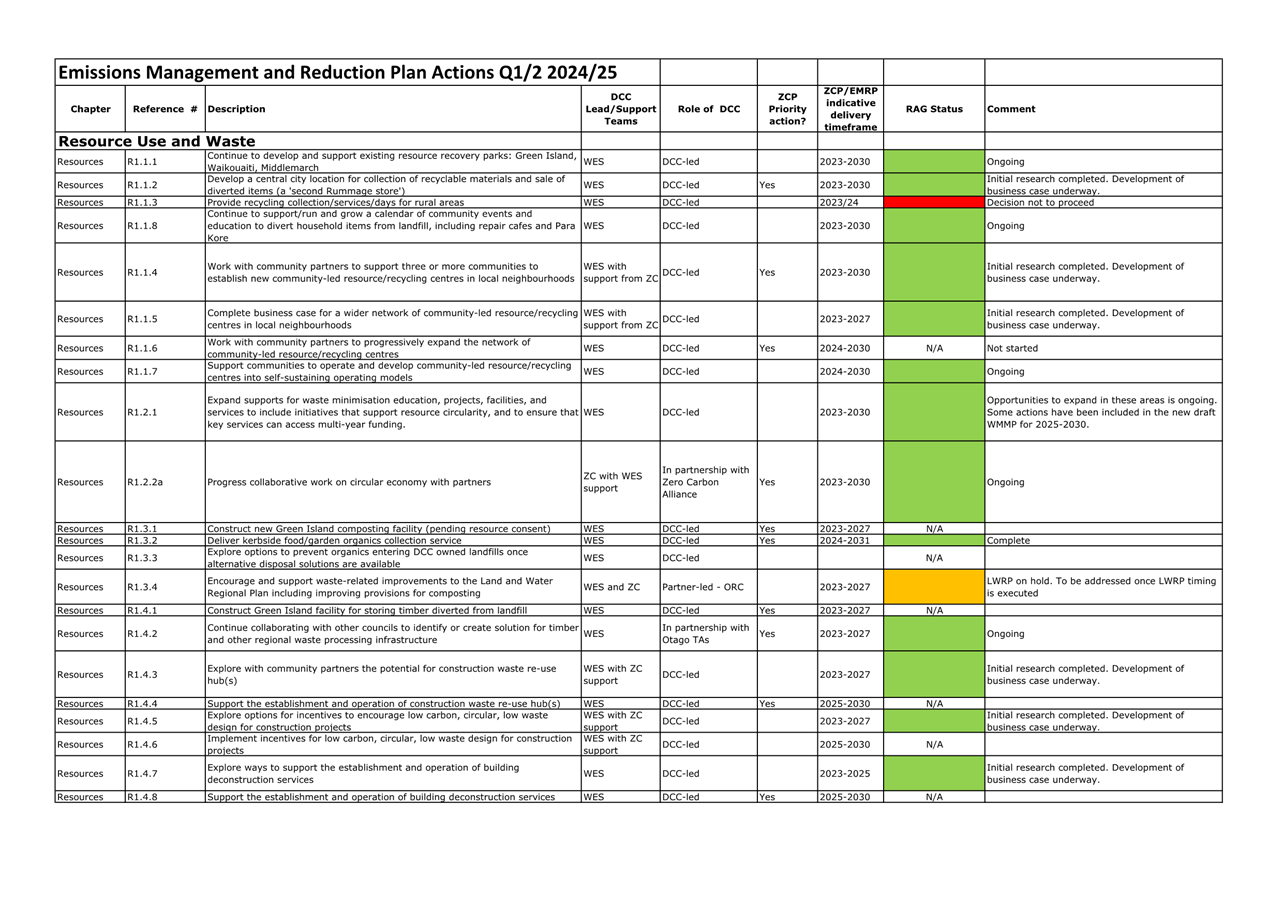
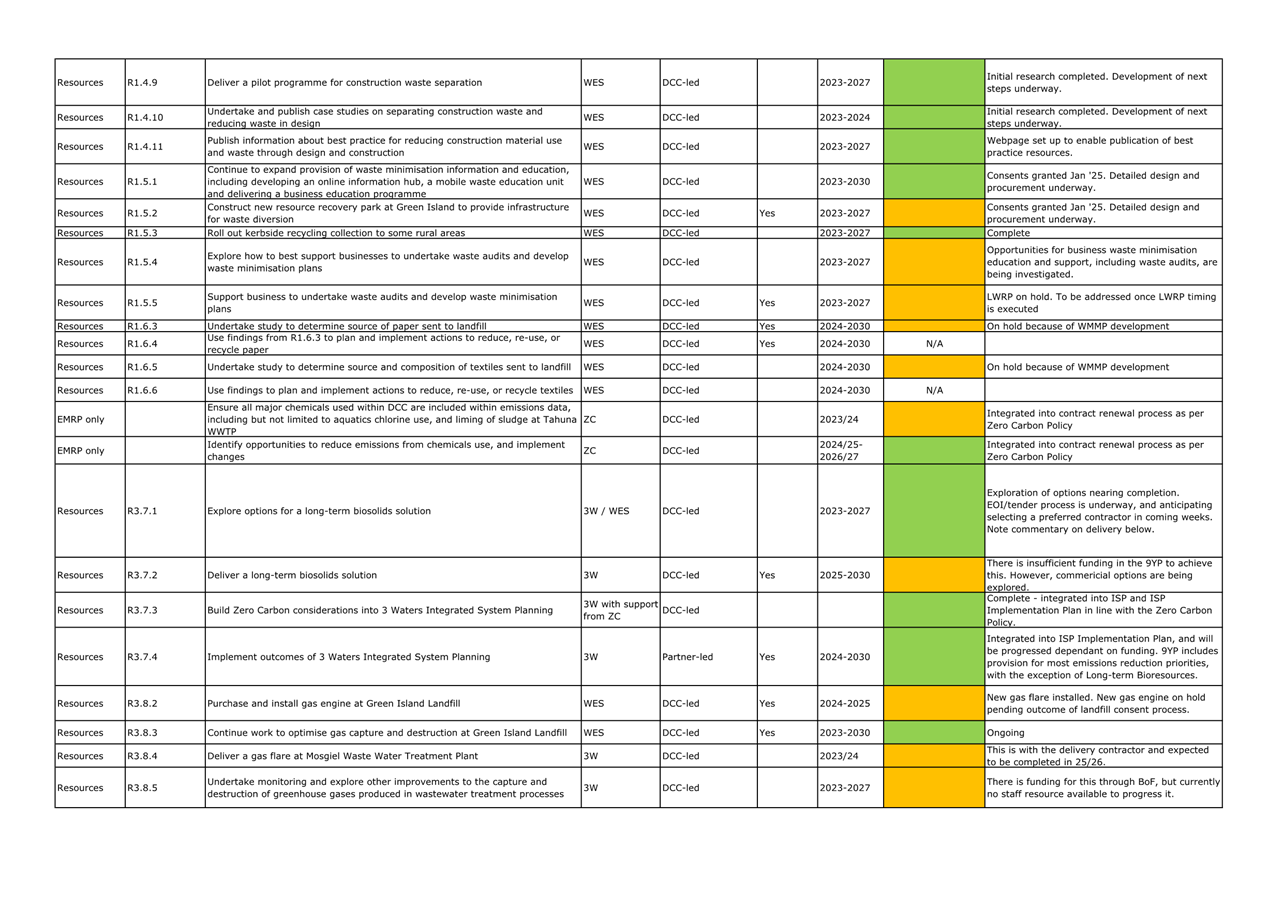
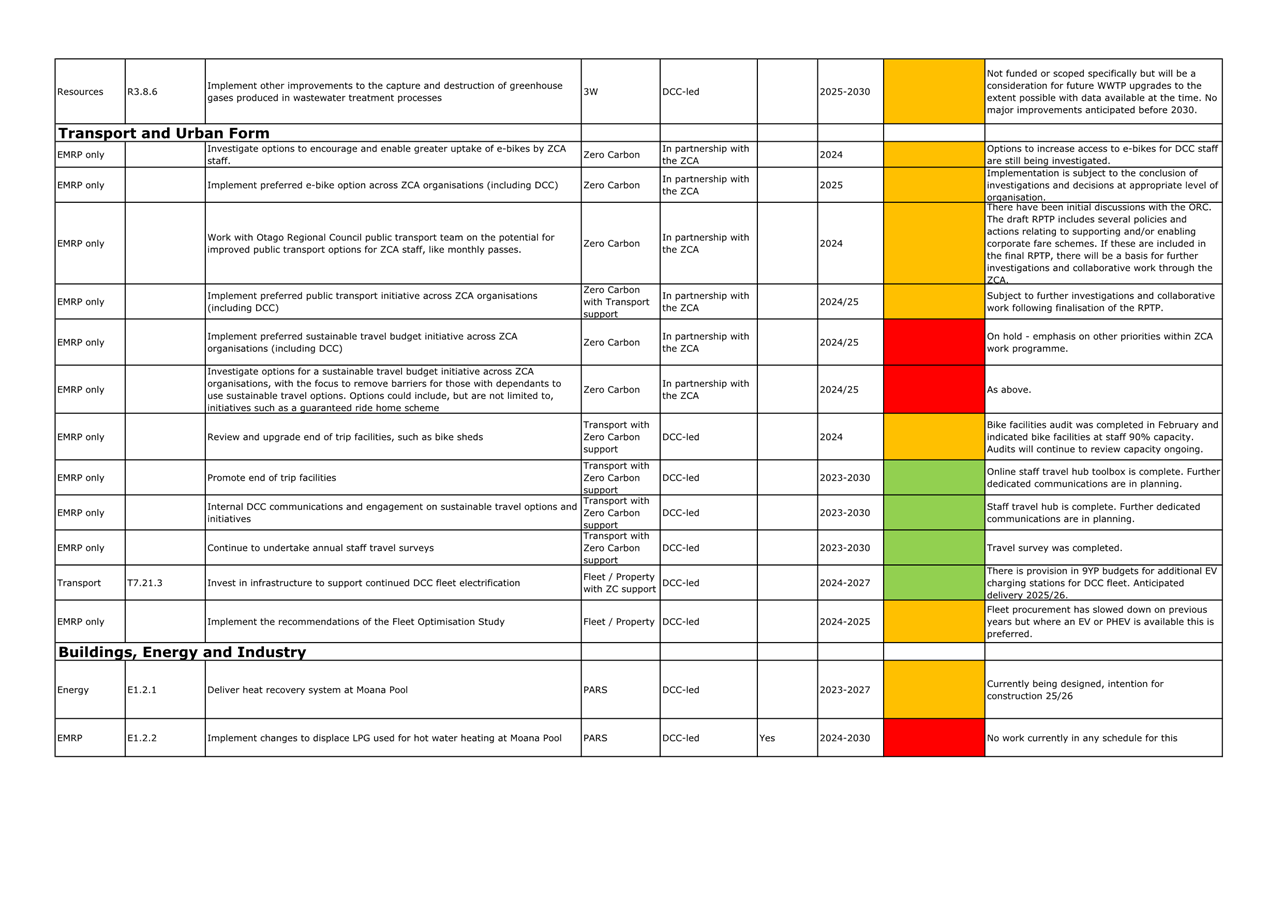
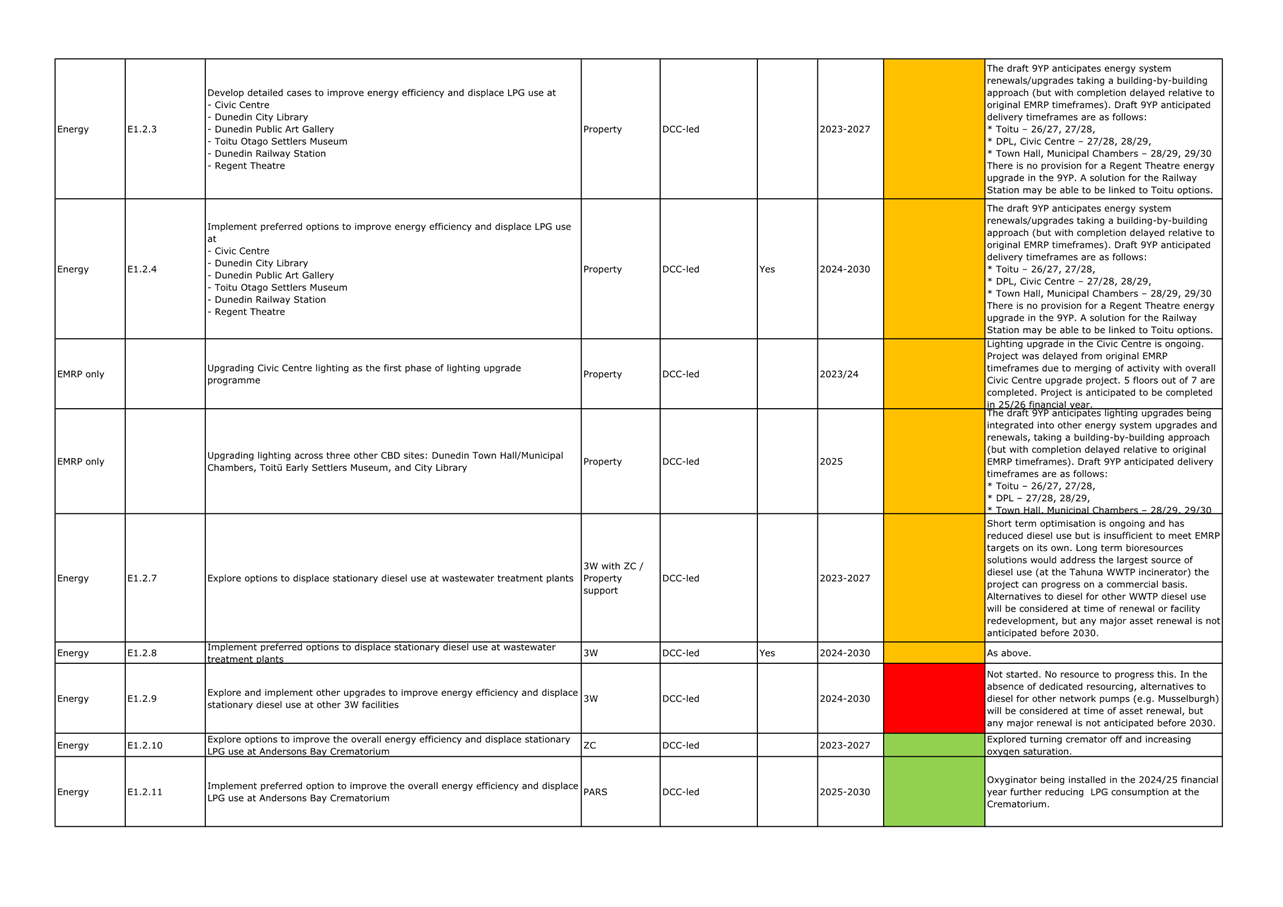
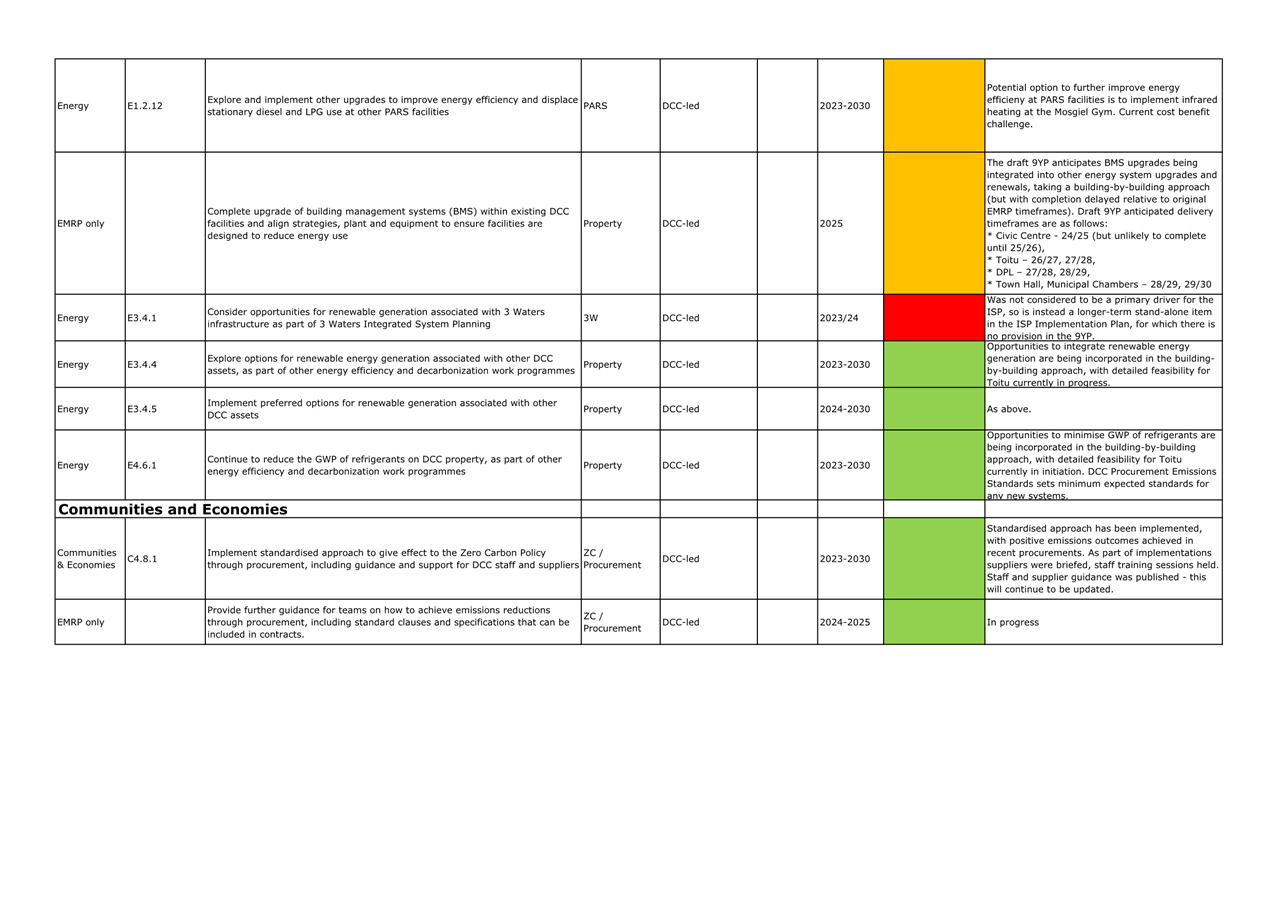
|
Cr Andrew Whiley
|
|
Senior Officer Sandy
Graham, Chief Executive Officer
Governance Support Officer Lynne
Adamson
Lynne Adamson
Governance Support Officer
Telephone: 03 477 4000
governance.support@dcc.govt.nz
www.dunedin.govt.nz
Note: Reports
and recommendations contained in this agenda are not to be considered as
Council policy until adopted.
|

|
Council
15 April 2025
|
ITEM TABLE OF CONTENTS PAGE
1 Apologies 4
2 Confirmation
of Agenda 4
3 Declaration
of Interest 5
Reports
4 DCC
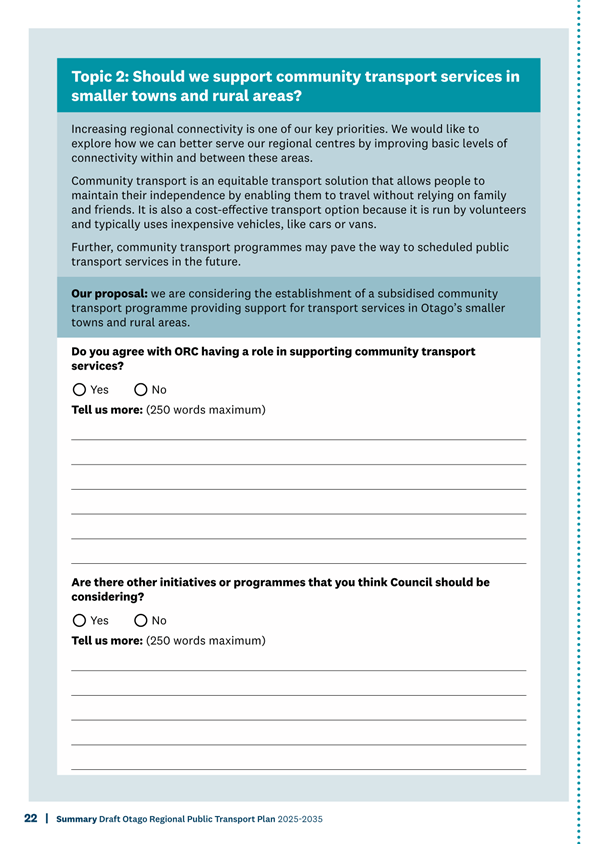
Submission on ORC Regional Public Transport Plan 2025-2035 17
5 DCC
Emissions Management and Reduction Plan & Zero Carbon implementation plan
2024/25 - Q1/2 reporting 54
6 Pilot
for a construction and demolition resource recovery system 85
7 Financial
Report - Period ended 28 February 2025 95
Resolution to Exclude the Public 125
|

|
Council
15 April 2025
|
1 Apologies
At the close of the agenda no
apologies had been received.
2 Confirmation
of agenda
Note:
Any additions must be approved by resolution with an explanation as to why they
cannot be delayed until a future meeting.
|
|
Council
15 April 2025
|
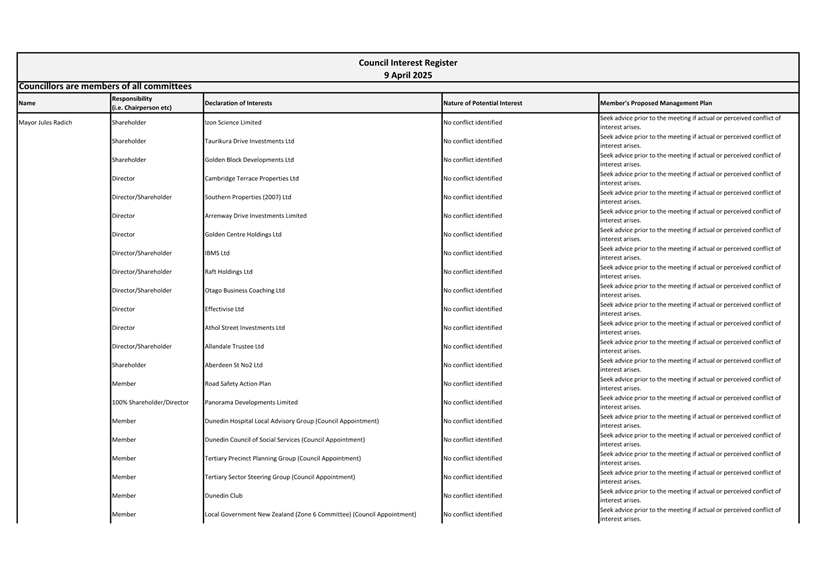
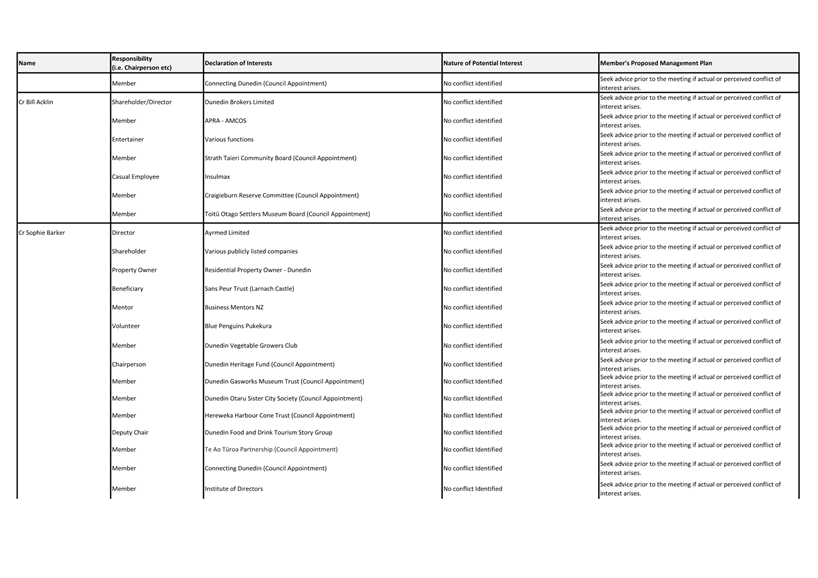
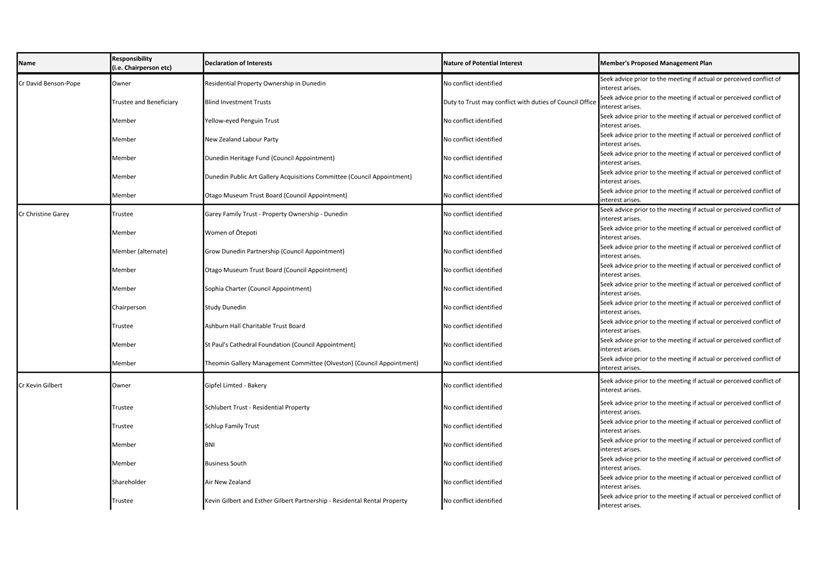
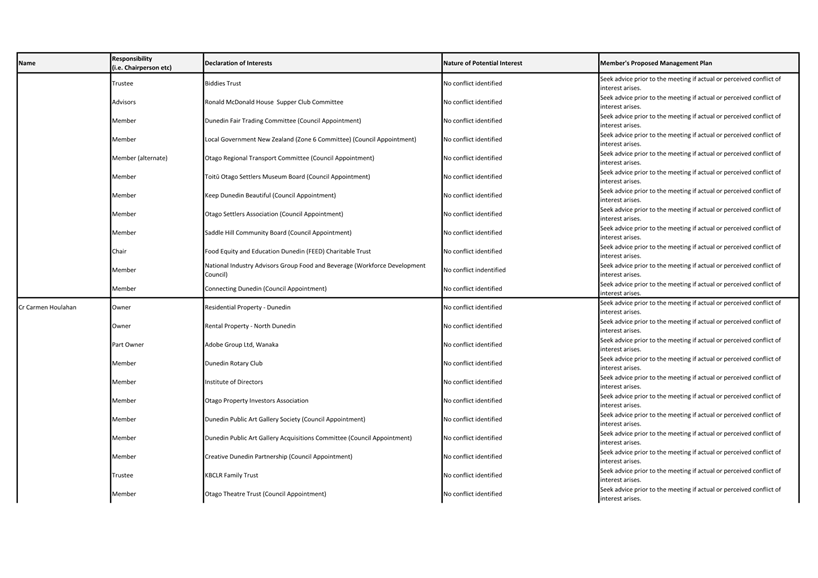
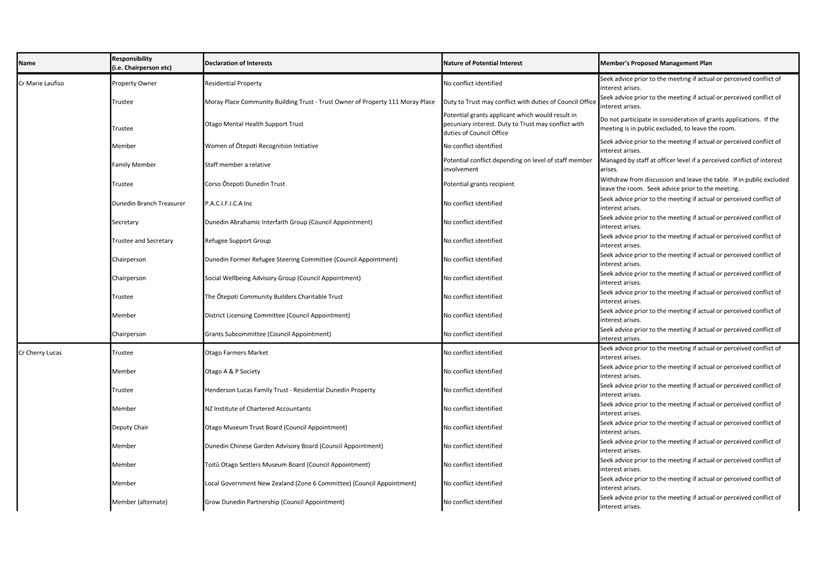
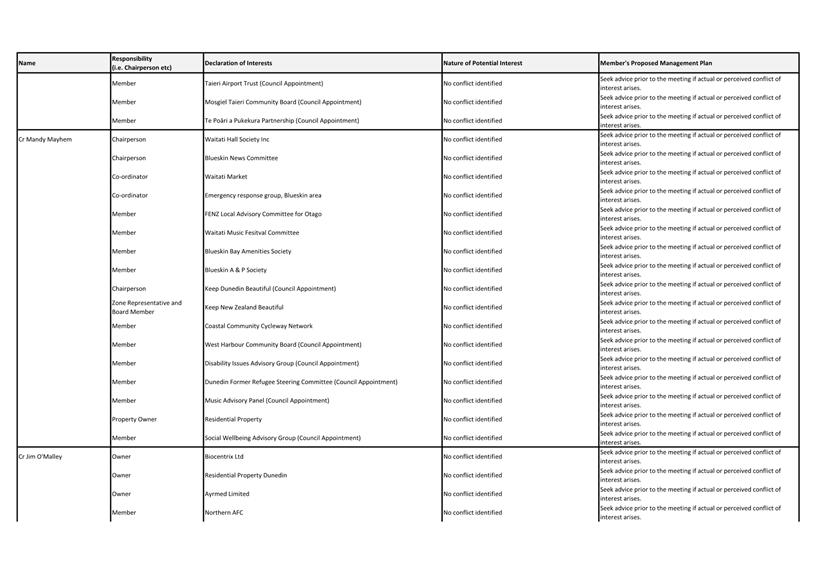
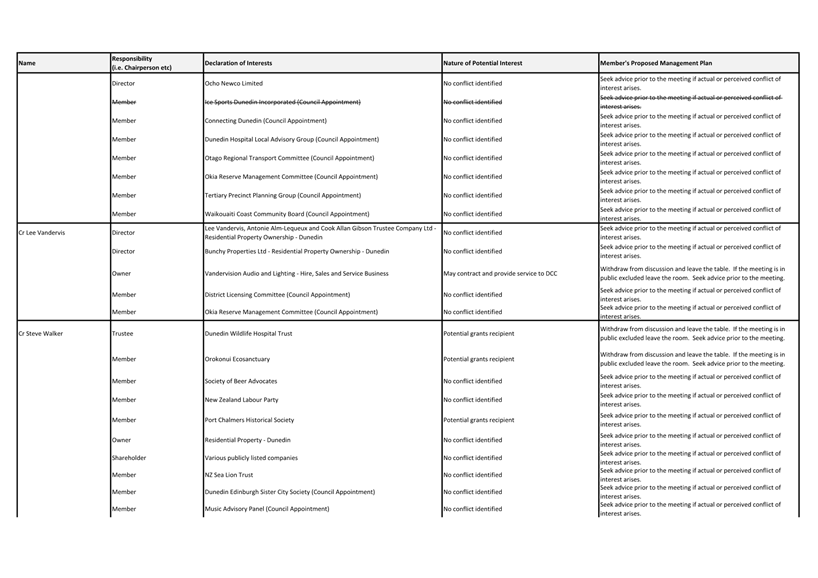
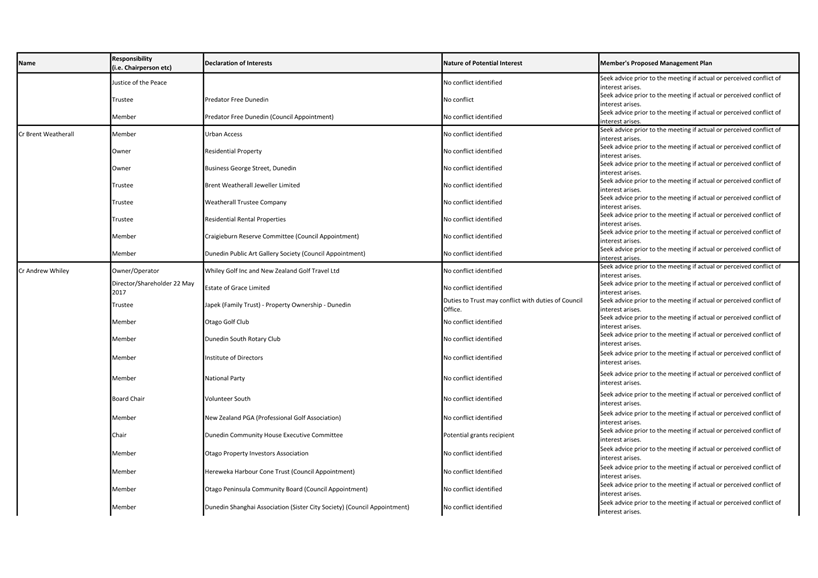
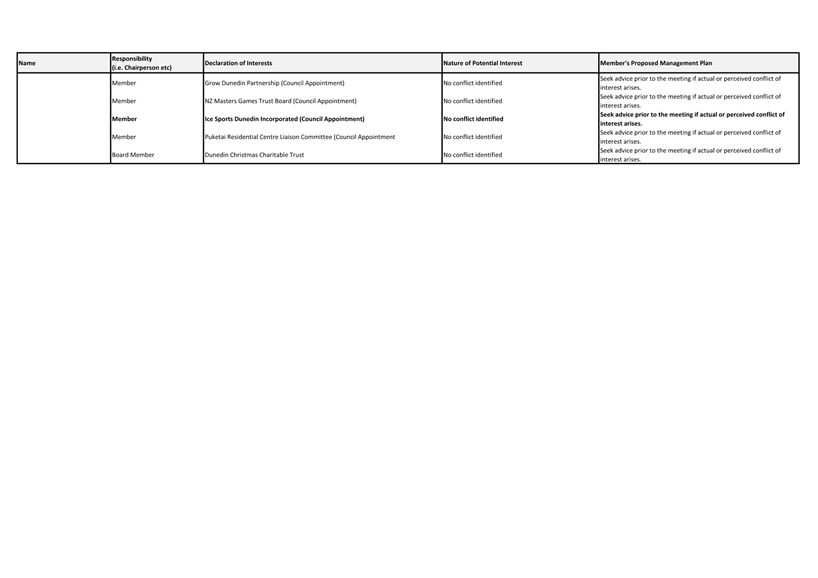
Declaration of Interest
EXECUTIVE SUMMARY
1. Members
are reminded of the need to stand aside from decision-making when a conflict
arises between their role as an elected representative and any private or other
external interest they might have.
2. Elected
members are reminded to update their register of interests as
soon as practicable, including amending the register at this meeting if
necessary.
3. Staff members are
reminded to update their register of interests as soon as practicable.
RECOMMENDATIONS
That the Council:
a) Notes/Amends if
necessary the Elected Members' Interest Register attached as Attachment A; and
b) Confirms/Amends the
proposed management plan for Elected Members' Interests.
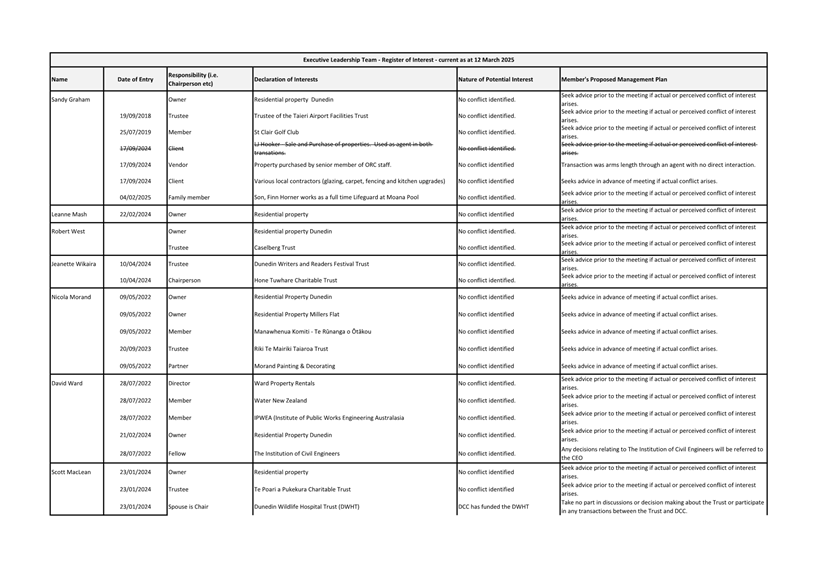
c) Notes the proposed
management plan for the Executive Leadership Team’s Interests.
Attachments
|
|
Title
|
Page
|
|
⇩a
|
Councillor Interest
Register
|
6
|
|
⇩b
|
ELT Interest Register
|
15
|
|
|
Council
15 April 2025
|
|
|
Council
15 April 2025
|
Reports
DCC Submission on ORC Regional Public Transport Plan
2025-2035
Department: Transport
EXECUTIVE SUMMARY
1 This
report seeks Council approval for a Dunedin City Council (DCC) submission
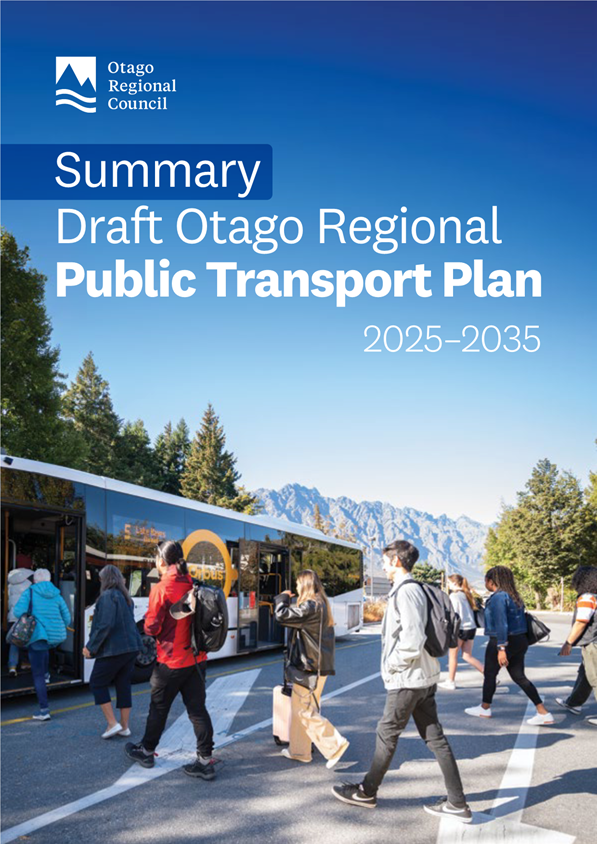
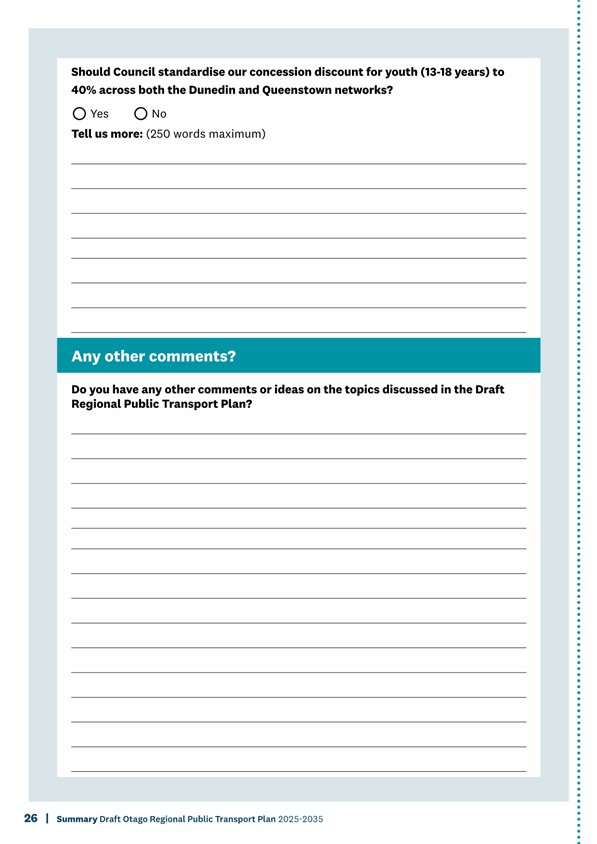
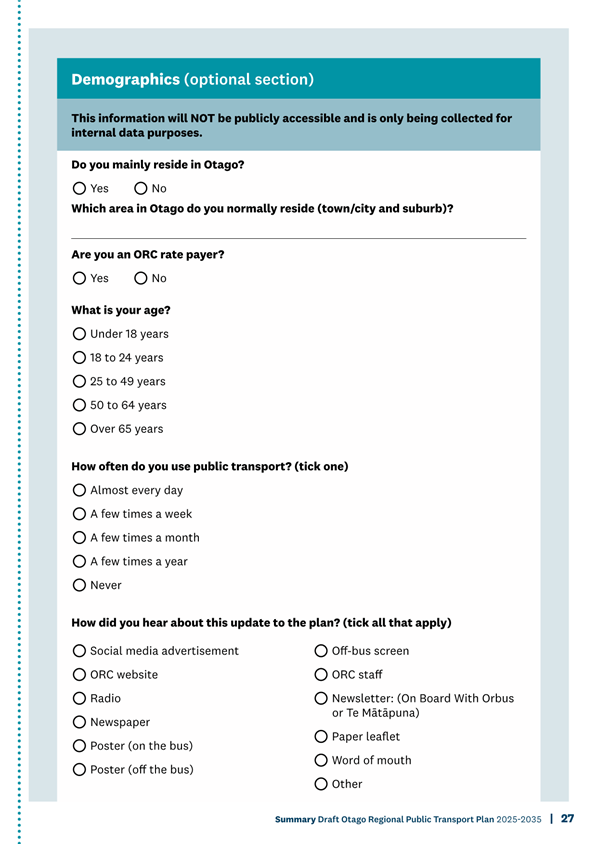
(Attachment A) on the draft Otago Regional Public Transport Plan (RPTP)
2025-2035.
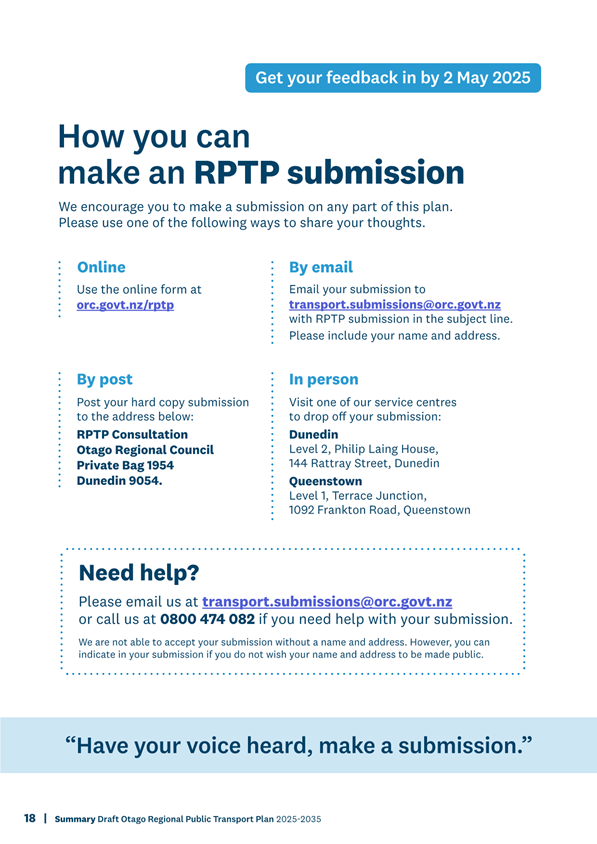
2 The
RPTP is the statutory document that sets high level strategic direction for
public transport activity in the region.
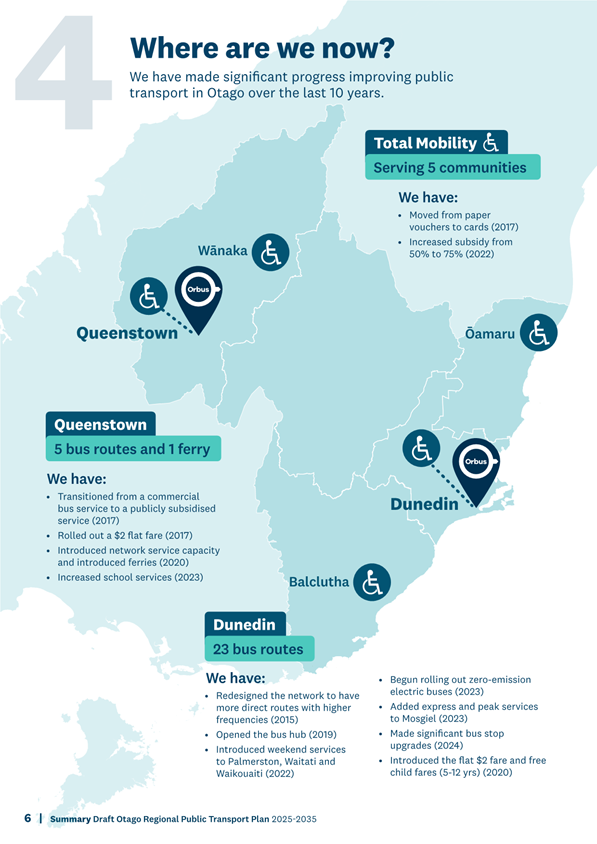
3 The
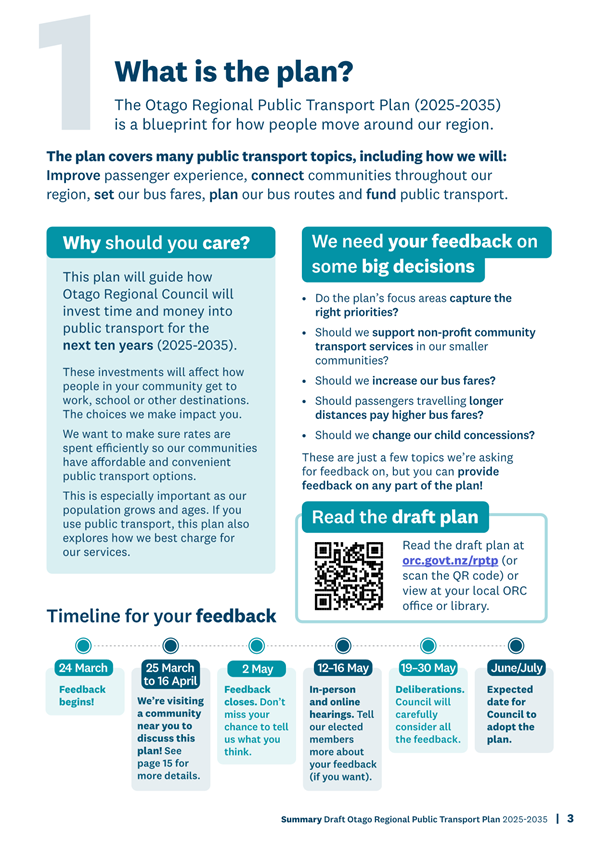
key points raised in the submission relate to:
a) DCC’s
view that a network and service review be included in the RPTP and
b) DCC’s
view that there should be greater emphasis on the promotion of public and
active transport in the RPTP.
RECOMMENDATIONS
That the Council:
a) Approves, with any
amendments, the DCC submission on the draft Otago Regional Public Transport Plan (RPTP)
2025-2035
b) Authorises the Chief Executive to make any minor
editorial changes to the submission if required.
c) Authorises the Mayor
or his delegate to speak to the submission
BACKGROUND
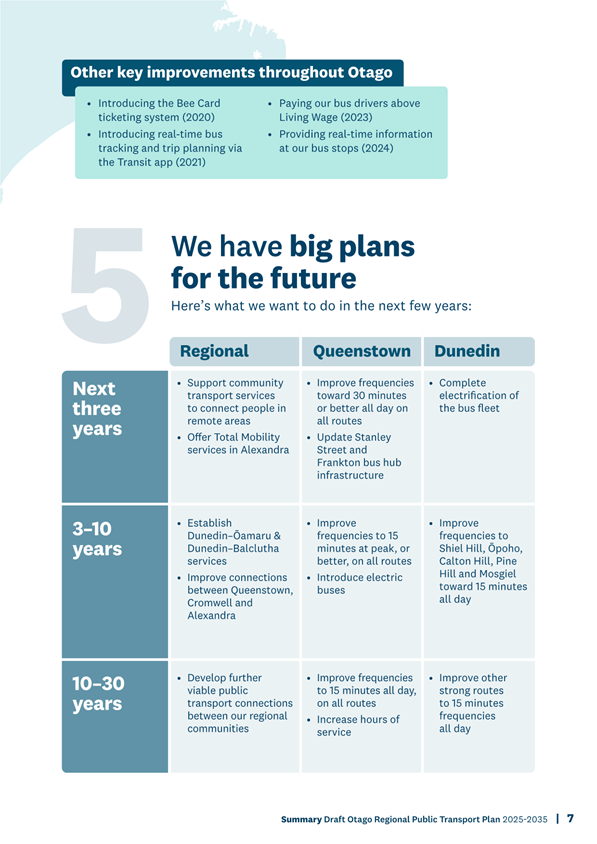
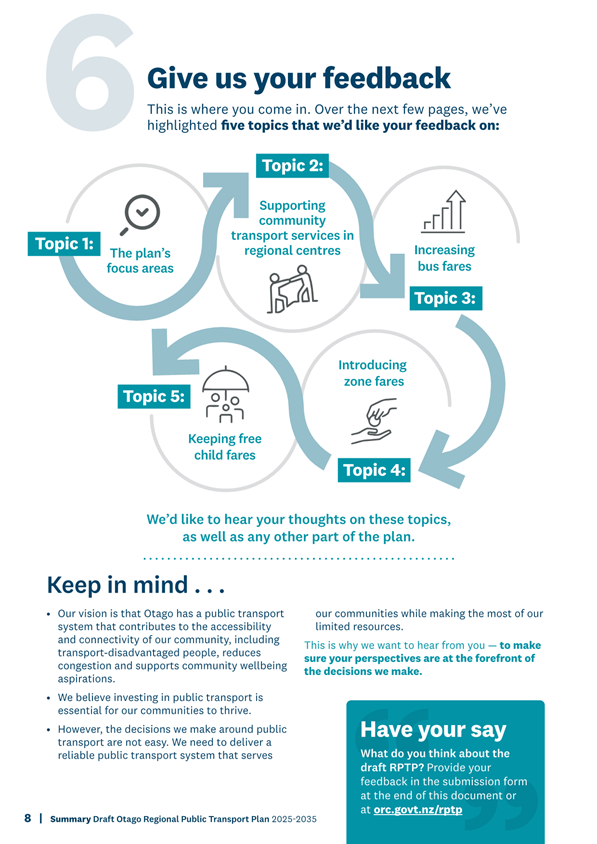
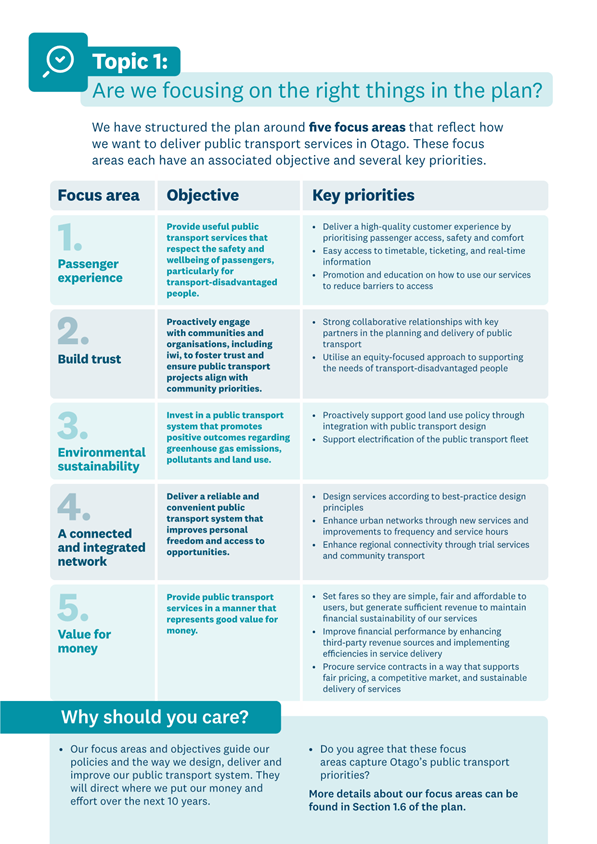
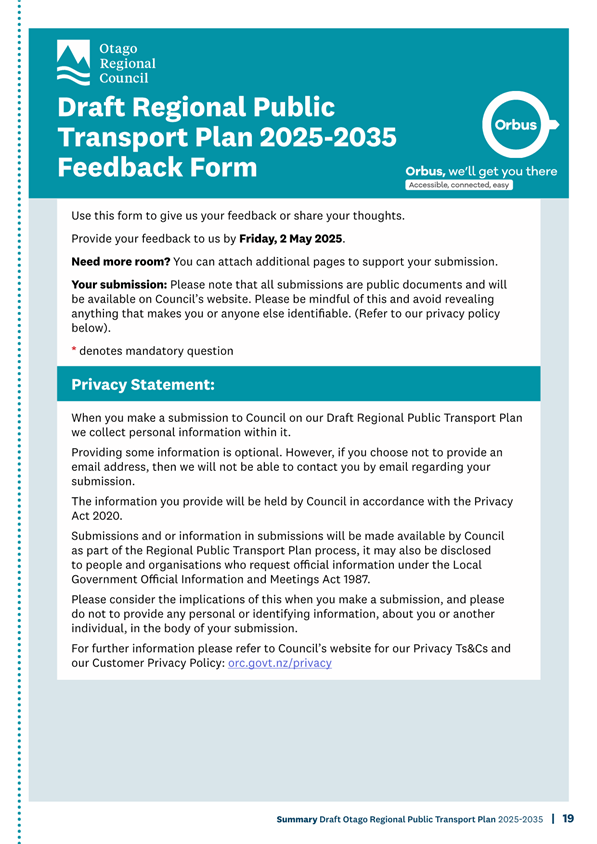
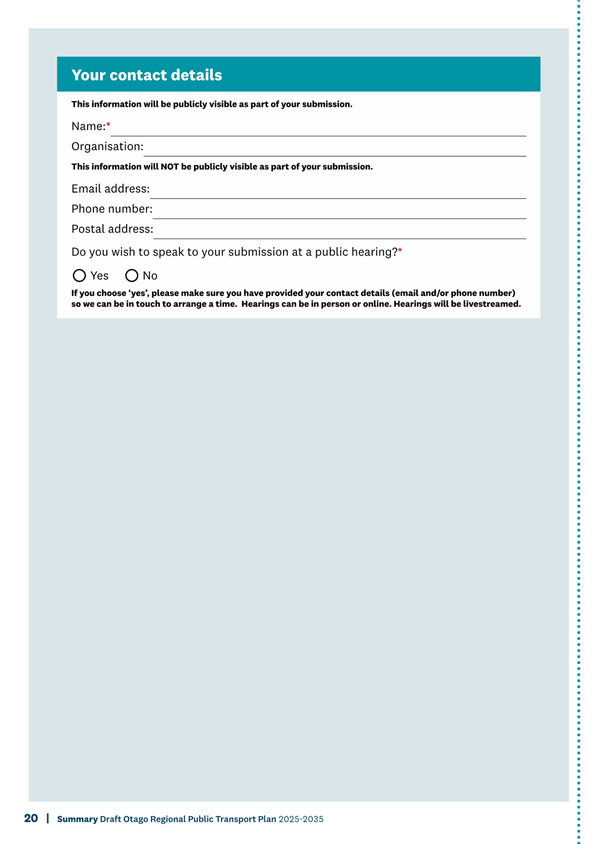
4 On
24 March 2025, Otago Regional Council (ORC) released the draft Regional Public
Transport Plan (RPTP) 2025-35 for consultation. Consultation closes on 2 May
2025. A summary of the document is provided as Attachment B. The full draft
RPTP is available from ORC.
5 The
draft RPTP 2025-35 will replace the 2021 RPTP. The document guides how Otago
Regional Council will invest time and money into public transport for the next
ten years (2025-2035). The plan aims to provide public transport solutions that
are easy to understand and meet communities’ diverse needs.
6 RPTPs
are required to be prepared under part 5 of the Land Transport Management Act
2003. Their purpose is to encourage Regional Councils and operators to
work together, engage with the public on network design & operation, and to
provide information about policies, services, information and infrastructure.
7 The
new ORC RPTP will be given effect through ORC’s Long Term and Annual
Plans, but at the time of adoption it does not commit to or provide funding.
DISCUSSION
8 DCC
staff were invited to collaborate throughout the drafting process of this RPTP,
with significant feedback provided at the 50% and 90% drafts of the document.
9 Changes
in strategic priorities from Central Government, including a requirement for
increased private share revenue for public transport, have played an important
role in shaping the document. Examples within the document include discussion
on:
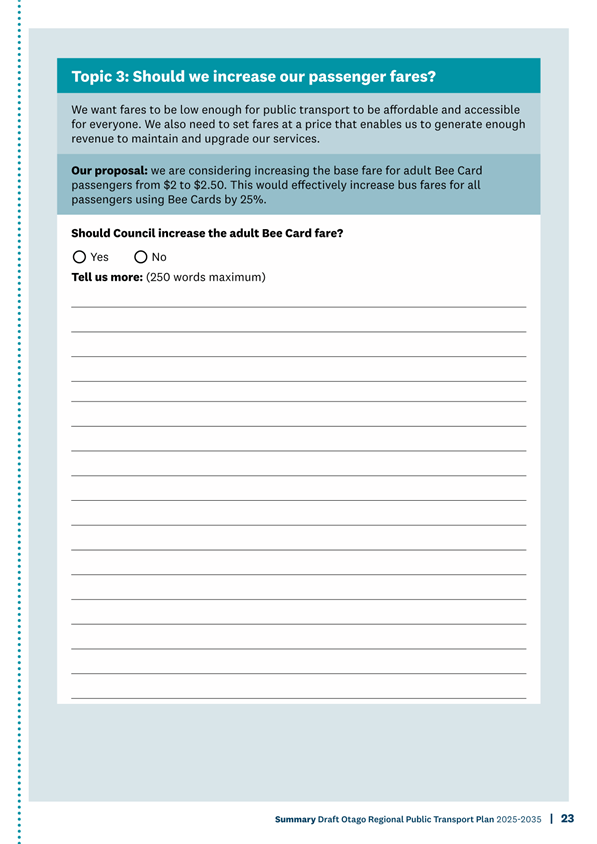
a) Increasing
the adult fare from $2.00 to $2.50
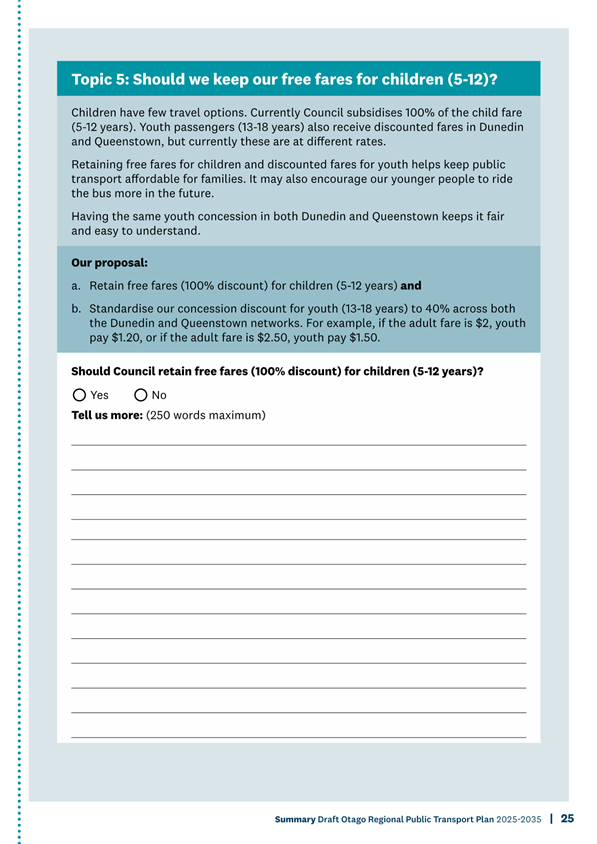
b) Retaining
free fares for 5–12-year-olds
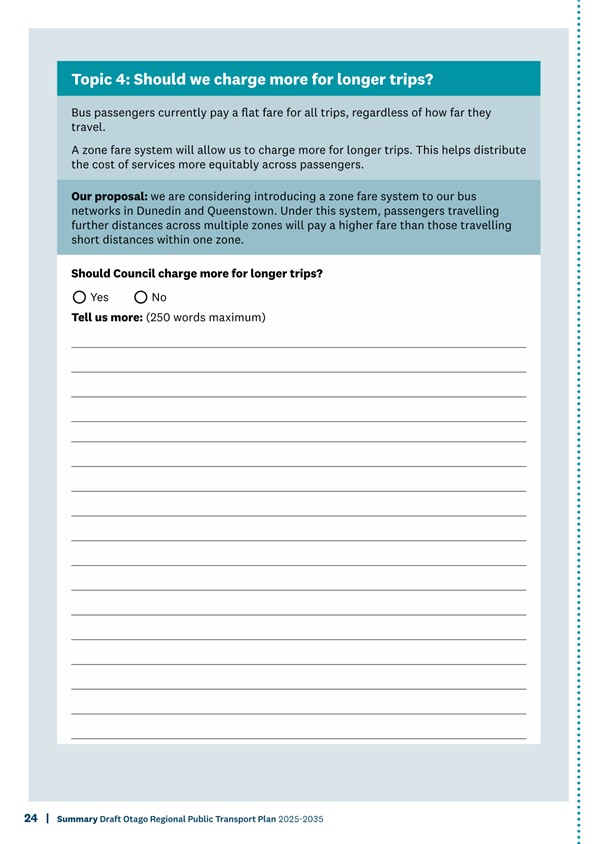
c) Charging
higher fares for longer distances
10 Applications
by ORC for funding public transport improvements in Dunedin were not successful
and have not been included in the National Land Transport Programme 2024-2027
(NLTP).
11 Staff have drafted
a final submission in line with current Council strategies and policies.
OPTIONS
Option One – Recommended Option – Approve the
DCC submission, with any amendments, on the ORC’s draft 2025-35 RPTP
Impact assessment
12 There is no
impact on debt, rates or DCC emissions.
13 Public
transport has the potential to reduce city-wide emissions, however this
submission does not have a direct impact.
Debt
· No
debt funding is required for this option.
Rates
· There
are no impacts on rates.
Zero carbon
· There
is likely to be no impact on DCC’s emissions as a result of this
submission.
· The
principles outlined in the Draft RPTP, and the points raised in the submission
align with DCC’s Zero Carbon Implementation plan.
Advantages
· Opportunity
to show support and highlight pathways for working with the ORC, one of the
DCC’s major strategic partners.
· Provide
feedback on public transport provision in Dunedin, which is relevant to the
DCC’s strategic and operational work.
Disadvantages
· There
are no identified disadvantages for this option.
Option Two – Do not approve the submission
Impact assessment
14 There is no
impact on debt, rates or DCC emissions.
Debt
· No
debt funding is required for this option.
Rates
· There
are no impacts on rates.
Zero carbon
· Not
submitting on the RPTP would have no direct impact on DCC’s or the
city’s emissions.
Advantages
· There
are no advantages to this option.
Disadvantages
· Missed
opportunity to show support and highlight pathways for working with the ORC,
one of the DCC’s major strategic partners.
· Missed
opportunity to provide feedback on public transport provision in Dunedin, which
is relevant to the DCC’s strategic and operational work.
NEXT STEPS
15 If Council
approves this submission, the submission, with any amendments, will be
finalised and submitted to ORC by 2 May 2025.
16 If DCC
wishes to speak to the submission, hearings will be held in May, and the Mayor
or his delegate will attend.
17 DCC staff
will continue working collaboratively with ORC staff on public transport in
Dunedin.
Signatories
|
Author:
|
Abbey Chamberlain - Senior Transport Planner
|
|
Authoriser:
|
David Ward - General Manager, 3 Waters and Transition
Jeanine Benson - Group Manager Transport
|
Attachments
|
|
Title
|
Page
|
|
⇩a
|
Draft DCC Submission on
RPTP
|
23
|
|
⇩b
|
RPTP Summary Document
|
26
|
|
SUMMARY OF CONSIDERATIONS
|
|
Fit with purpose of Local Government
This decision enables democratic local
decision making and action by, and on behalf of communities.
This decision promotes the social
well-being of communities in the present and for the future.
This decision promotes the economic
well-being of communities in the present and for the future.
This decision promotes the environmental
well-being of communities in the present and for the future.
This decision promotes the cultural
well-being of communities in the present and for the future.
|
|
Fit with strategic framework
|
|
Contributes
|
Detracts
|
Not applicable
|
|
Social Wellbeing Strategy
|
☐
|
☐
|
☐
|
|
Economic Development Strategy
|
☐
|
☐
|
☐
|
|
Environment Strategy
|
☐
|
☐
|
☐
|
|
Arts and Culture Strategy
|
☐
|
☐
|
☐
|
|
3 Waters Strategy
|
☐
|
☐
|
☐
|
|
Future Development Strategy
|
✔
|
☐
|
☐
|
|
Integrated Transport Strategy
|
✔
|
☐
|
☐
|
|
Parks and Recreation Strategy
|
☐
|
☐
|
☐
|
|
Other strategic projects/policies/plans
|
✔
|
☐
|
☐
|
The RPTP helps shape public transport in the city, which
is an important part of the transport system. Supporting public transport
enables better access for the community, and improved transport outcomes.
|
|
Māori Impact Statement
There are no known impacts for Māori as a result of
DCC’s submission. ORC are engaging separately with mana whenua.
|
|
Sustainability
The RPTP helps contribute positively to sustainability
goals of the city.
|
|
Zero carbon
There is
likely to be no impact on DCC’s emissions as a result of this
submission. The principles outlined in the Draft RPTP, and the points raised
in the submission align with DCC’s Zero Carbon Implementation plan.
|
|
LTP/Annual Plan / Financial Strategy /Infrastructure
Strategy
There are no implications.
|
|
Financial considerations
There are no financial implications for consideration.
|
|
Significance
The submission is not significant. ORC has consulted
extensively on the draft document.
|
|
Engagement – external
There has been no external engagement on the submission.
|
|
Engagement - internal
Feedback from Parks and Recreation Services, Events, Zero
Carbon and Transport has been incorporated into the draft RPTP, and the
submission.
|
|
Risks: Legal / Health and Safety etc.
There are no identified risks.
|
|
Conflict of Interest
There are no conflicts of interest.
|
|
Community Boards
There are no implications for Community Boards, however
they can independently submit on the RPTP during the consultation period.
|
|
|
Council
15 April 2025
|
Draft DCC Submission on ORC’s draft Regional
Public Transport Plan 2025-2035
April 2025
RPTP Submissions
Otago Regional Council
Private Bag 1954
Dunedin 9054
Kia ora
Draft Otago Regional Public
Transport Plan 2025-2035
1 Dunedin
City Council (DCC) welcomes the opportunity to provide feedback on the draft
Otago Regional Public Transport Plan (RPTP) 2025-2035. Dunedin is the largest
population centre in Otago and an important destination for the wider
region. Dunedin has the highest number of public transport trips in the
region and is host to multiple key regional services including tertiary
institutions and the largest hospital in the lower South Island.
2 The
DCC supports the priorities and principles within the document and acknowledges
the collaborative approach that the Otago Regional Council (ORC) has taken in
developing the document, with DCC and the other territorial authorities across
Otago.
3 The
DCC has identified two aspects where we are seeking further consideration
within the RPTP.
a) The
DCC believes there should be greater emphasis placed on network and service
planning in Dunedin, including considerations around the Bus Hub and existing
transport infrastructure.
b) The
DCC would like to see greater action and emphasis on increasing patronage,
through promotion and marketing of the services.
Network and Service Planning in
Dunedin
4 The
Draft RPTP lists Dunedin as a medium-to low-growth city with a mature public
transport network, and notes that any changes relating to this network will be
focused on enhancing existing service areas. It is DCC’s view that this
commentary does not reflect the demand on the network in Dunedin or the
potential for further patronage growth, and the RPTP is instead focusing on serving
the growth in Central Otago.
5 It
is DCC’s view that there should be a stronger focus on network and
service planning within Dunedin, addressing the challenges and limitations of
the existing network, as well as opportunities for improvement.
6 For
example, the Edgar Centre does not currently have any public transport
connections but is a key hub for after school sports and activities. Lack of
transport choice also restricts mode choice for parents; the need to transport
others (particularly children) is a key reason why many employees drive to
work.
7 The
DCC has invested heavily in improving public transport infrastructure in recent
years. To acknowledge the work undertaken and enable ongoing improvements, DCC
recommends a network review be undertaken, to provide certainty about future
routes and bus stops.
a) Undertaking
a network review would provide a holistic understanding of where changes should
be made to benefit the community, and the efficiency of the network.
b) A
network review could be undertaken on a route basis, making incremental changes
over a longer period, rather than trying to identify all issues on the network
at one time. This could be managed through the procurement process when
tendering new contracts.
8 The
DCC recommends reviewing the Dunedin Bus Hub to identify potential constraints
with location or capacity, with the forecast changes presented in the
RPTP. As part of reviewing the bus hub, the DCC recommends consideration
of how timetable modifications may impact operations.
Promotion
9 The
DCC notes that there are limited actions relating to promotion of the service
across the region. While DCC acknowledges the challenging funding environment
that currently exists, promotion of public transport is paramount in growing patronage,
reducing emissions, and reducing reliance on private vehicles.
10 As
part of promoting public transport, DCC recommends additional actions be
included around collaboration with DCC. This is an important aspect of our
Connecting Dunedin partnership and DCC would like to see stronger initiative
from ORC working with DCC’s sustainable travel team on public transport
initiatives.
General Consultation
Questions
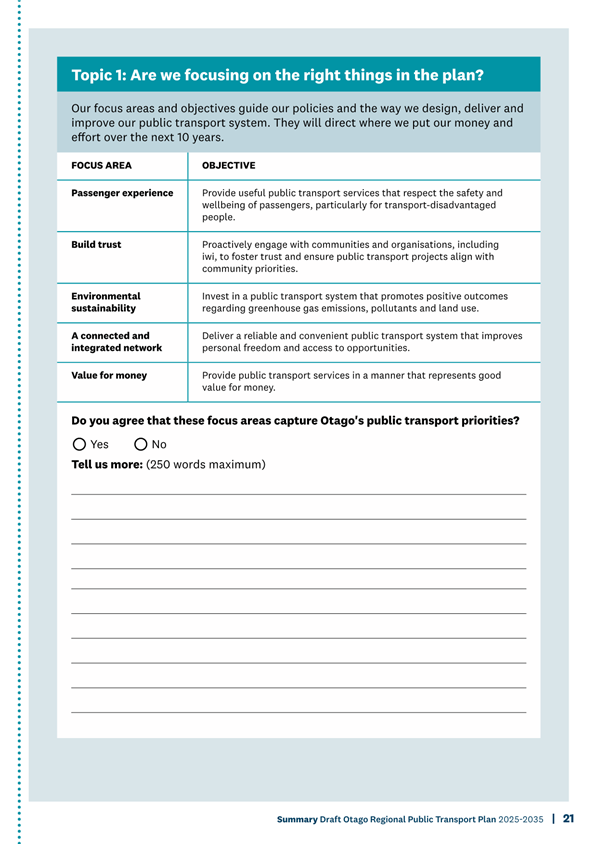
Topic 1: Are we focusing on the right
things in the plan?
11 The
DCC agrees that the focus areas within the plan capture Otago’s transport
priorities.
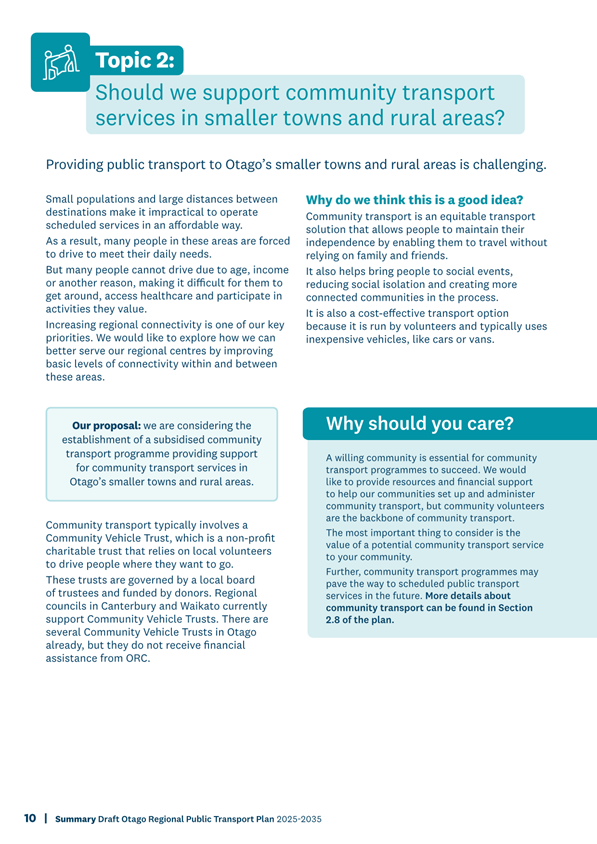
Topic 2: Should we support
community transport services in smaller towns and rural areas?
12 The
DCC agrees that ORC should have a role in supporting regional community
transport services.
13 Dunedin
is a primary centre for the smaller towns and rural areas, and providing access
to essential services is something important for ORC to support. Currently many
people in regional centres need to access healthcare in Dunedin, but have
limited transport options to do so, with most people reliant on private
transport.
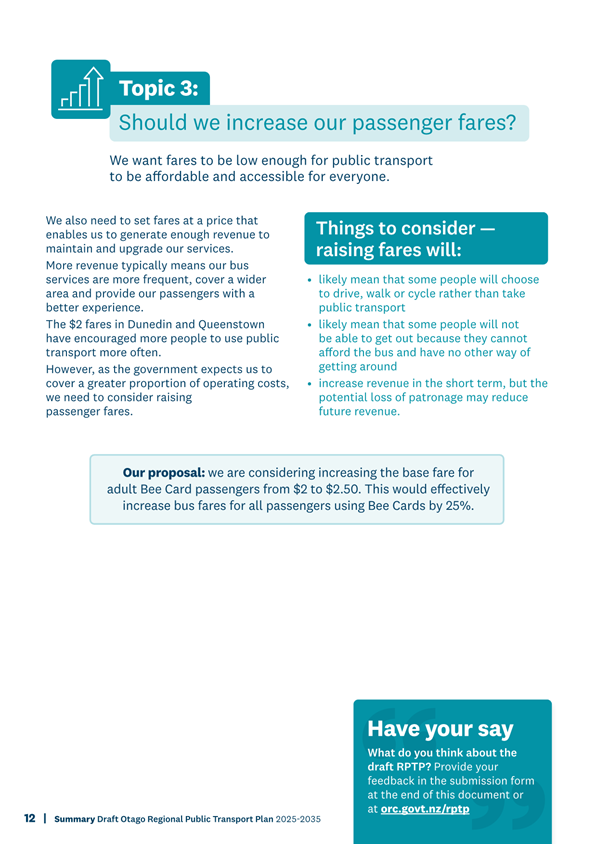
Topic 3: Should we increase
our passenger fares?
14 The
DCC acknowledges there is pressure from central government around Public
Transport Authorities (PTAs) increasing their private share contribution.
15 The
DCC wants to work with ORC to keep fares low, which aligns with DCC targets for
lowering emissions and increasing mode shift. Fares are a key driver for mode
shift, and keeping low fares helps make public transport affordable and
equitable.
Topic 4: Should we charge
more for longer trips?
16 The
DCC supports ORC charging a higher fare for longer trips.
17 Charging
a greater fare for longer distances travelled provides a greater parity for
users on the network and will help reduce the cost of running the service to
outlying areas. Resident of some outlying areas are disadvantaged in terms of
transport options. To ensure they can still access essential services; we
support continuing concessionary schemes to maintain affordability of fares.
Topic 5: Should we keep our
free fares for children (5-12 years)?
18 The
DCC supports ORC retaining free fares for children ages 5-12 years.
19 Enabling
and promoting children to use the bus from a young age helps foster confidence
with using public transport and is likely to build lifelong habits. Supporting
children to travel on public transport can reduce pressure on caregivers,
helping reduce reliance on private vehicles at school gates (as an example).
20 The
DCC supports ORC standardising the concession discount for youth aged 13-18
years.
Conclusion
21 The
DCC appreciates the opportunity to provide feedback on the draft RPTP
2025-2035. We encourage ORC to consider the points raised in this submission,
to help enable the ongoing growth and success of the Dunedin Public Transport
network.
22 The
DCC looks forward to continuing its collaboration with ORC to deliver on the
actions outlined in the draft RPTP.
|
|
Council
15 April 2025
|
DCC Emissions Management and Reduction Plan & Zero
Carbon implementation plan 2024/25 - Q1/2 reporting
Department: Sustainability Group
EXECUTIVE SUMMARY
22 This report
presents for Council:
b) DCC’s
organisational emissions (for sources with data available) for the period July
2024 – December 2024 (Q1/2), and
c) progress
reporting for actions in the DCC Emissions Management and Reduction Plan and Zero
Carbon implementation plan 2024/25 over the same period.
23 DCC
emissions reporting for the period is based on preliminary data and excludes a
number of emissions sources that are monitored on an annual basis. It is a
provisional snapshot of trends for the sources reported, rather than a complete
and final picture of DCC emissions for the period.
24 Overall,
the provisional data suggests DCC emissions from the sources included are 33%
lower than the same period in baseline year, and 6% higher than the same period
last year.
25 Q1/2
progress on actions in the Zero Carbon implementation plan 2024/25 and the EMRP
is separately assessed and presented, to enable progress at each scale to be
separately considered by Council.
26 Progress on
each action in both plans has been assessed with reference to anticipated
delivery timeframes at time of Zero Carbon Plan and/or EMRP adoption.
27 Overall,
72% of Zero Carbon implementation plan 2024/25 actions, and 51% of commenced
EMRP actions, are on track to deliver emissions reduction objectives and be
completed as scheduled. For most other actions anticipated emissions reductions
are still likely to be fully or partially realised, albeit on a slower track.
28 Common
reasons for projects that are subject to delays, scope contractions or
discontinuation include Council activity/decisions, Government policy change,
changes in other stakeholders’ priorities/timelines and resource or
capacity pressures.
RECOMMENDATIONS
That the Council:
a) Notes DCC’s Q1/2 2024/25 organisational emissions, and
b) Notes the Q1/2 2024/25
reporting for the DCC Emissions Management and Reduction Plan, and the Zero
Carbon implementation plan 2024/25.
BACKGROUND
The
DCC’s Zero Carbon Policy directs that the organisation measure and aim to
reduce emissions at two scales
29 In July
2022 Council adopted the Zero Carbon Policy (CNL/2022/049). The Policy
formalises DCC’s intention to pursue emissions reduction at two scales
– organisational (DCC emissions), and Dunedin-wide (city emissions).
30 As most of
the DCC’s activities occur within the Dunedin boundary, there is overlap between
DCC and city emissions. However, the key emissions sources, profile, and
quantity of emissions differ significantly between the DCC and city scales.
31 This report
provides reporting on:
a) DCC
emissions for Q1/Q2 2024/25 and
b) Progress on
actions to address both DCC and city emissions over the same period.
The Zero Carbon implementation plan 2024/25 set
outs DCC actions to reduce Dunedin’s emissions
32 Council resolutions over several years led to the
development of a draft Zero Carbon Plan 2030 (the Plan). The Plan was adopted
in September 2023 (CNL/2023/210).
33 The Plan sets out the overall shifts Dunedin will need to
make to become a Zero Carbon city, and within that, action areas for the
Dunedin City Council. Achieving the city’s targets will involve a wide
range of government, community and business stakeholders: DCC leadership is
essential, but partnerships and community activation are also critical to
success.
34 A Zero Carbon implementation plan for the 2024/25 financial
year was noted by Council in October 2024 (CNL/2024/194). This comprised of
actions that could be progressed within existing budgets only (i.e. a subset of
the indicative action list presented to Council at time of Zero Carbon Plan
adoption in 2023).
DCC emissions are monitored and reported using a standard
organisational methodology
35 DCC’s
Zero Carbon Policy states that ‘the DCC will monitor, measure, report,
manage, verify and publicly report DCC emissions on a regular basis in line
with the requirements of ISO 14064’.
36 The scope
of the DCC emissions managed and reported on are determined using the
‘operational control’ methodology. This includes activities
undertaken by DCC staff (such as driving fleet cars, electricity usage) and
emissions from DCC assets or services (such as LPG burnt at DCC pools, landfill
gas from Green Island Landfill). It also includes emissions generated by
significant suppliers undertaking work on behalf of the DCC, and emissions
associated with some goods/consumables used in the course of DCC activity (e.g.
chemicals for water treatment).
The DCC’s
Emissions Management and Reduction Plan 2024-2031 sets out DCC emissions
reduction targets and actions to reduce DCC emissions
37 The DCC
maintains an Emissions Management and Reduction Plan (EMRP) which sets
organisational targets and lays out how DCC intends to reduce emissions
(actions for the period required to achieve targets). The DCC also produces an
annual Inventory Management Report (IMR), which reports on the
organisation’s annual emissions, along with progress against EMRP
actions.
38 In June
2024, the Executive Leadership Team (ELT) adopted DCC’s EMRP for 2023/24
- 2030/31. Council noted the DCC’s EMRP at its 31 July 2024 meeting
(CNL/2024/133).
39 The DCC’s
‘baseline year’ (the year against which progress is measured) is
2018/19.
The DCC’s organisational emissions reduction targets (as set out in the
EMRP) are relative to baseline and are as follows:
b) a 2026/27
interim emissions target of a 30% reduction in annual tCO2e emissions compared
with baseline year; and
c) a
2030/31 target of a 42% reduction in emissions compared with baseline year.
40 Because DCC
emissions sources usually form part of the city’s emissions, there is a
high degree of integration and overlap between the Zero Carbon Plan and the
EMRP, with 90% of EMRP actions also reflected in the Zero Carbon Plan.
41 For
example, waste entering Green Island landfill is a source of approximately 4%
of Dunedin’s emissions. Because the DCC owns and manages Green Island
landfill waste to landfill is also the DCC’s largest emissions source.
Zero Carbon Plan actions to reduce the city’s waste are mirrored in the
EMRP because they will also directly reduce DCC emissions.
The DCC has
made progress on organisational emissions reduction, but sustained effort will
be required to meet EMRP targets
42 Emissions
modelling completed in early 2024 estimated that completion of all EMRP
projects would deliver a 38% reduction in emissions to 2030/31.
43 Data for
the 2023/24 financial year shows DCC achieved a 29.75% reduction in overall
emissions compared to 2018/19. This reduction represented significant
progress towards the 2026/27 interim emissions target, with the DCC falling
only 208 tCO2e short of achieving it in 2023/24.
44 Modelling
is currently being updated to reflect draft 9 year plan decisions and other
changes in context, with the results due to be reported back to Council in May
2025.
Adherence
to the EMRP is a condition of participation in the Local Government Financing
Agency’s (LGFA) Climate Action Loans programme
45 The
DCC’s Zero Carbon Policy EMRP and annual Inventory Management Report are
submitted to the Local Government Financing
Agency’s (LGFA) Climate Action Loans programme to enable borrowing at
a discounted rate. Remaining on track to achieve EMRP targets (and
demonstrating this through annual and more in-depth three-yearly LGFA reviews)
is a prerequisite to maintaining access to the programme.
DISCUSSION
Provisional DCC emissions data Q1/Q2 2024/25
46 Attachment
A presents a summary of DCC’s emissions (for sources with data available)
over the first two quarters of 2024/25 financial year, broken down by emissions
source. Where possible, performance is compared with the same period in both
the baseline year and the 2023/24 financial year.
47 This
reporting is based on preliminary data and excludes a number of emissions
sources that are monitored on an annual basis. Ministry for the Environment
(MfE) emissions factors have been used – once 2025 factors are released,
these will be applied and are likely to materially change results for some
emissions sources (e.g. electricity consumption). The data presented is
therefore a provisional snapshot of trends for the sources reported, rather
than a complete and final picture of DCC emissions for the period.
Summary of emissions trends from sources included
48 Overall, the
provisional data suggests DCC emissions from the sources included are:
a) 33%
lower than the same period in baseline year
b) 6% higher
than the same period last year
49 Significant
sources that are trending down relative to baseline, and either down or very
similar relative the same period in 2023/24 include:
a) Waste
to Landfill emissions (57% lower than in 2019/20; 1.3% down compared with
same period 2023/24). An expanded kerbside collection service began on 1 July
2024, including offering weekly organics collection and a switch from rubbish
bags to red wheelie bins for general waste. This change in kerbside service
increased the number of households using DCC kerbside waste collections, with a
3% increase in the tonnage of waste to Green Island landfill in July to
December 2024 compared with July to December 2023. Despite a higher tonnage
received at the landfill in 2024/25 compared to the same period in 2023/24,
improved collection and destruction of landfill gas resulted in lower emissions
in the first six months of this reporting period.
b) Closed
landfill emissions (22% lower than 2019/20; 5.6% down compared with the
same period 2023/24). Emissions from closed landfills will continue to reduce
without active intervention.
c) Stationary
diesel emissions (12% lower than 2018/19; 1.5% down compared with the same
period 2023/24). Ongoing optimisation of the incinerator at the Tahuna
wastewater treatment plant resulted in less stationary diesel consumption in
the first six months of the 2024/25 reporting period. This was somewhat offset
by a greater number of wet weather events triggering use of diesel-powered
pumps elsewhere in the 3 Waters network, relative to the 2023/24 year.
d) Emissions
from electricity consumption (43% lower than in 2018/19; 1.2% up
compared with the same period 2023/24). Emissions from this source are a
function of DCC electricity usage and the proportion of renewables in the
national grid – results will change once MfE emissions factors are
updated. Electricity usage is slightly up on the same period last year, and 24%
lower than baseline.
50 More minor
sources that are also trending down relative to both baseline and the same
period in 2023/24 include:
a) Air
travel emissions (75% lower than 2018/19; 53% down compared with the same
period 2023/24).
b) Private
car use emissions (51% lower than 2018/19; 55% down compared with the same
period 2023/24).
c) Emissions
from hotel stays, taxis and rental cars (11% lower than 2020/21; 35%
down compared with the same period 2023/24).
51 Significant
sources that are increasing or remain materially higher than in baseline year
include:
a) Stationary
LPG emissions (42% higher than in 2018/19; 5.7% up compared with the same
period 2023/24). Key drivers for the variance relative to Q1/2 2023/24 include
the heat recovery system at Moana Pool being offline for a portion of Q1
2024/25 as well as an increased demand for cremations.
b) Emissions
from the biological treatment of wastewater (not comparable with 2019/20
baseline due to a change in methodology; 4.4% down compared with the same
period 2023/24). The methodology used to account for emissions changed in
2023/24 leading to an overall increase compared to the same period in the baseline
year (more accurate time series data). Recently, staff identified some data
relating to the amount of sludge removed from wastewater during the treatment
process was missing from the calculations in 2023/24. This led to a relative
decrease in emissions for 2023/24 once this data was backfilled.
c) Emissions from activity undertaken by major suppliers
(18% higher than in 2021/22; 19% up compared with the same period 2023/24). The
main causes of this increase are significantly higher emissions associated with
kerbside waste, recycling and organics collections (in part due to the short-term
requirement to truck organics to Timaru), and an increase in roading
maintenance emissions compared with 2023/24.
52 Other minor
emissions sources are trending as follows:
a) Emissions
from diesel fleet fuel (11% higher than in 2018/19; 5.2% up compared
with the same period 2023/24)
b) Emissions
from petrol fleet fuel (47% lower than in 2018/19; 6.3% up compared with
the same period 2023/24)
Additions to the DCC’s emissions inventory
53 Two new
emissions sources have been introduced into reporting during the period:
a) The
addition of emissions from composting reflects the introduction of the
DCC’s kerbside food and garden collection service, which since 1 July 2024
is being composted at a Timaru facility. While there are some emissions
associated with composting food and garden waste, these are significantly lower
than if the same material was deposited in landfill, and ensures the organic
material can be beneficially re-used. The emissions associated with trucking
this material from Dunedin to Timaru are reported in the Major Suppliers
emissions.
b) The
addition of emissions from biomass recognises that with the opening of
Te Puna o Whakaehu Mosgiel Pool, this emissions source has become more
significant in the DCC’s inventory (previously having only been used at
the Botanic Gardens). Both sites are now reporting consumption data.
Overall approach to progress reporting for actions to
reduce emissions
54 Due to the
considerable overlap between actions in the Zero Carbon implementation plan
2024/25 and the EMRP, 6 month reporting for both plans been developed in
tandem. However, in this section progress on each plan is separately assessed
and presented, to enable progress at each scale to be separately considered by
Council.
55 Each action
in both plans has been assessed using the following RAG criteria (applied with
reference to anticipated delivery timeframes at time of Zero Carbon Plan and/or
EMRP adoption):
|
Green
|
Amber
|
Red
|
|
Project is on track to deliver any emissions
reduction objectives, and to be completed as scheduled.
|
Project is not on track to meet emissions reduction
objectives, and/or project is subject to minor delays or reduction in scope.
|
Emissions are likely to be significantly higher than
predicted for this project, and/or project is subject to major delays or
reduction in scope.
|
56 Where
emissions reductions from a project are now considered unlikely to be realised
by 2030/31 (the target year at both scales), it is reported as red.
Progress against the Zero Carbon implementation plan
2024/25
57 The Zero Carbon
Plan implementation plan 2024/25 includes 104 actions, split across Specific
Timebound Projects (57 actions) and BAU (47 actions). Most actions were planned
to span several years, but all were anticipated to be at least partially
progressed within 2024/25.
58 The
implementation plan included 13 actions classified as ‘priority
actions’ in the Zero Carbon Plan due to these having relatively higher
potential to contribute to emissions reduction than other projects under the
relevant action area. Priority actions in the 2024/25 implementation plan
include:
a) Improving
Green Island gas capture
b) Working
with community, business partners on resource recovery and circular economy
c) Building
Zero Carbon considerations into the Economic Development Strategy and
implementation of the Destination Management Plan
d) Facilitating
car share, and development of a Parking Management Policy
e) Implementing
the Zero Carbon Policy and procurement approach
f) Working
with partners, including the ORC, DCHL companies, and the Zero Carbon Alliance.
59 Appendix B sets
out the status and provides commentary on all Zero Carbon implementation plan
2024/25 actions, split into ‘Specific Time-bound Projects’ and
‘BAU actions’ in line Zero Carbon Plan Advisory Panel direction.
Within each, actions are presented by Zero Carbon Plan action area. The status
is assessed based on the criteria set out in paragraph 55, above.
60 Overall, 75
actions (72%) are rated as green, 24 (23%) as amber and 5 (5%) as red.
Proportionately more BAU actions meet green criteria, as follows:
|
|
Green
|
Amber
|
Red
|
|
Specific Time-bound Projects
|
37 (65%)
|
16 (28%)
|
4 (7%)
|
|
BAU actions
|
38 (81%)
|
8 (17%)
|
1 (2%)
|
Progress against the EMRP 2024-2031
61 The EMRP includes
76 actions.
Most actions were planned to span several years. Some were completed in
2023/24, and some are not scheduled to commence until 2025/26 or beyond,
however the majority were anticipated to be at least partially progressed
within 2024/25.
62 Attachment C
sets out the status and provides commentary on the actions linked to the DCC
Emissions Management and Reduction Plan. The status is assessed based on the
criteria set out in paragraph 55, above.
63 9 actions
have not yet commenced. Of the 67 that have, 34 (51%) actions are rated as
green, 27 (40%) as amber and 6 (9%) as red.
Commentary on actions subject to delays or scope
contractions
64 Amber/red
ratings generally reflect actions slowing, changing or stopping (either
temporarily or permanently) due to:
· Council
activity/decisions (e.g. draft 9 year plan decisions, Grants Review)
· Government policy
changes (e.g. new Government Policy Statement Land Transport)
· Changes in other
stakeholders’ priorities/timelines (e.g. delays to the Land & Water
Plan, ZCA work programme priorities)
· Resource or
capacity pressures (e.g. insufficient staff resource, other work programme
priorities, insufficient funding to realise the original scope)
65 In most
cases, anticipated emissions reductions are still likely to be fully or
partially realised, albeit on a slower track.
OPTIONS
66 As this
report is for noting only, there are no options.
NEXT STEPS
Full year reporting
67 DCC’s
full year organisational emissions will be independently audited and presented
to Council in the annual Inventory Management Report in late 2025. A full year
report on the Zero Carbon implementation plan 2024/25 will be presented to
Council at the same time.
EMRP implementation
68 A report is
being prepared for May Council updating both Zero Carbon Plan (Dunedin) and
EMRP (DCC) emissions modelling to reflect Council decisions on the draft 9 year
plan and other changes in context.
69 The EMRP and Zero Carbon Plan implementation plans for
2025/26 onwards are subject to Council decisions on the upcoming 9 Year Plan. Both
will be finalised following decisions of Council on the final shape of the 9
year plan.
Signatories
|
Author:
|
Carsten Dortans - Senior Policy Analyst - Zero Carbon
Rory McLean - Senior Policy Analyst
Jinty MacTavish - Principal Policy Advisor Sustainability
|
|
Authoriser:
|
Scott MacLean - General Manager, Climate and City Growth
|
Attachments
|
|
Title
|
Page
|
|
⇩a
|
DCC emissions report -
Q1/2 24/25
|
65
|
|
⇩b
|
Zero Carbon
implementation plan 2024/25 Q1/2 update
|
67
|
|
⇩c
|
Emissions Management
and Reduction Plan Q1/2 update
|
79
|
|
SUMMARY OF CONSIDERATIONS
|
|
Fit with purpose of Local Government
Implementation of the Zero Carbon Plan
and EMRP promotes the social, economic and environmental wellbeing of
communities in the present and for the future, by facilitating the transition
to a low carbon economy.
|
|
Fit with strategic framework
|
|
Contributes
|
Detracts
|
Not applicable
|
|
Social Wellbeing Strategy
|
✔
|
☐
|
☐
|
|
Economic Development Strategy
|
✔
|
☐
|
☐
|
|
Environment Strategy
|
✔
|
☐
|
☐
|
|
Arts and Culture Strategy
|
☐
|
☐
|
✔
|
|
3 Waters Strategy
|
✔
|
☐
|
☐
|
|
Future Development Strategy
|
✔
|
☐
|
☐
|
|
Integrated Transport Strategy
|
✔
|
☐
|
☐
|
|
Parks and Recreation Strategy
|
☐
|
☐
|
✔
|
|
Other strategic projects/policies/plans
|
✔
|
☐
|
☐
|
Zero Carbon Plan, DCC Emissions Management and Reduction
Plan, Zero Carbon Policy
|
|
Māori Impact Statement
A critical Treaty of Waitangi analysis was prepared
previously as part of the Zero Carbon work programme. This indicated that, in
general, taking action to reduce emissions is aligned with Treaty of Waitangi
obligations because a wide range of taonga are at risk from climate change. However,
individual projects will need to consider Te Taki Haruru and incorporate mana
whenua and mātāwaka inputs when delivered.
|
|
Sustainability
Climate change mitigation/emissions reduction efforts are
considered key to sustainability. ‘Climate Action’ is one of the
United Nation’s Sustainable Development Goals, reflecting the
centrality of action on climate change to the achievement of sustainable
development. Without significant cuts to emissions, climate change impacts
will further accelerate, with commensurate negative impacts on the social,
environmental, cultural and economic wellbeing of New Zealand communities.
Conversely, actions to reduce emissions generally have significant
co-benefits in terms of community wellbeing.
|
|
Zero carbon
The
report presents an update on implementation of the DCC Emissions Management
and Reduction Plan and the Zero Carbon Plan. The plans are designed to reduce
emissions at both DCC and city scales.
|
|
LTP/Annual Plan / Financial Strategy /Infrastructure
Strategy
There are no implications from this report for the LTP or
Annual Plan.
|
|
Financial considerations
There are no financial implications.
|
|
Significance
This report is considered low significance in terms of the
Council’s Significance and Engagement Policy.
|
|
Engagement – external
There has been no external engagement as part of
developing this report.
|
|
Engagement - internal
There has been extensive internal engagement in the
preparation of this report. All lead teams have been consulted to develop the
reporting status and associated commentary.
|
|
Risks: Legal / Health and Safety etc.
As stated in the report, remaining on track to achieve
EMRP targets is a prerequisite to maintaining access to the Local Government
Financing Authority’s Climate Action Loan programme.
|
|
Conflict of Interest
No conflicts of interest have been identified
|
|
Community Boards
No implications for Community Boards have been identified.
|
|
|
Council
15 April 2025
|
Pilot for a construction and demolition resource recovery
system
Department: Waste and Environmental Solutions
EXECUTIVE SUMMARY
1 Enabling
construction waste to be reduced, re-used, and recycled is an action area in
the Zero Carbon Plan 2030, and is supported by proposed actions in the draft
Waste Management and Minimisation Plan 2025.
2 This
report updates the Council on a proposed pilot for a construction and
demolition resource recovery system in Dunedin. The proposal was established by
the Environmental Innovation Centre, in partnership with industry, to service
Dunedin construction and waste sectors. Approval is sought for a financial
contribution towards the feasibility study.
RECOMMENDATIONS
That the Council:
a) Supports in principle the proposed pilot
construction and demolition resource recovery system.
b) Approves the
allocation of $33,000 from 2024/2025 waste levy funding to support the
feasibility stage of the pilot project.
c) Notes the outcomes of
the feasibility study will be reported back to Council to consider whether to
support and provide funding for the full pilot project.
BACKGROUND
3 An
update on the Community Led Resource Recovery and Construction Industry Waste
Reduction work was presented to Council at its meeting of 10 December 2024
–
Moved (Cr Jim O'Malley/Cr
Mandy Mayhem):
That the Council:
Notes the Community Led Resource Recovery and Construction Industry Waste
Reduction Update.
Motion carried (CNL/2024/241)
4 The
10 December 2024 report outlined the intention to prepare Business Cases for
the two linked projects and to present these to the Infrastructure Services
Committee before the end of June 2025.
5 In
early 2025, an opportunity was identified to work with industry operators,
materials manufacturers, and KiwiRail on a pilot construction waste diversion
project in Dunedin. This would test methods of diverting construction
materials, prioritising local reuse and recycling. As there are not local
reprocessing options for treated timber, plasterboard, and construction related
plastics, the pilot would test the logistics of diverting these materials to
other onshore locations via rail, utilising freight containers that would
otherwise be returning north empty.
DISCUSSION
6 Construction
and Demolition (C&D) waste comprises multiple waste streams, many of which
have the potential for being reusable or recyclable resources. C&D waste
disposal and / or poor waste management can have a negative impact on the
environment, such as rapidly filling up landfills, resource use that is linear
rather than circular, and the release of plastics and other harmful or
potentially hazardous wastes into the environment. It can also contribute to
our greenhouse gas (GHG) emissions, as both increased embodied carbon in
building materials when sent to landfill, and from building materials degrading
in landfilling conditions, especially wood product waste.
7 Across
New Zealand there is increasing impetus for council and local industry led
solutions. Through engagement with local industry stakeholders, and across the
country, there is an acknowledgement of the challenges faced in Dunedin and an
appetite by businesses to reduce their C&D waste. Much of this waste
comprises wood products, plasterboard, and plastics.
8 In
Dunedin, there are minimal resource recovery options to separate and recover
these waste streams, and limited markets for recycling them. Even if these
materials are separated and diverted from landfill (which could be done on a
construction site and consolidated at a dedicated resource recovery facility),
there is a lack of local and South Island wide reprocessing infrastructure.
9 Long-haul
trucking of materials to locations which have the necessary infrastructure is
logistically challenging, economically unviable, and environmentally harmful -
mainly due to the high amount of transport emissions. There are also missed
opportunities to support the local economy and growth. Therefore, the practice
of separating these construction wastes to divert them from landfill is currently
ineffectual in Dunedin (and for much of the South Island).
10 The Green
Island resource recovery park will eventually incorporate a C&D sorting
area, with delivery planned in 2027. However, without market pathways for the
various materials, this will not in itself deliver meaningful diversion from
landfill. Community based re-use and repurposing is the priority objective, but
there will still be materials that cannot be re-used and need to be sent
elsewhere for recycling.
11 During
2024, the Waste and Environmental Solutions team supported in principle a Waste
Minimisation Fund application to develop sustainable options for timber re-use,
recycling, and biofuel. This involved transporting hard to recycle C&D
waste by rail, using containers that otherwise return north empty. The fund
application was submitted by the Environmental Innovation Centre but supported
by a range of industry partners. Although intended to be New Zealand wide, it
involved a Dunedin-based resource recovery trial.
12 Ultimately,
the project was declined funding by the Ministry for the Environment as it did
not meet their revised investment criteria. The industry partners have however remained
supportive and wish to pursue a pilot project focused on Dunedin. They have identified
opportunities to move treated timber, plasterboard, and plastics such as PVC
pipes, north by rail for reprocessing. Depending on the material, it would
either go to Christchurch or on to Auckland.
13 The
Environmental Innovation Centre is an independent, science-based consultancy
that has a track record of building partnerships with industry, government, and
academia to find practical and viable solutions to construction waste. For
example, through government investment via the Plastics Innovation Fund, they
partnered with Aliaxis (Marley) and WMNZ (Waste Management) and worked to find
solutions to plastics waste. One of the outputs of that project was a web-based
resource called Wastehub.
14 Recovering
and reprocessing wood waste, plasterboard, and construction plastics enhances
both local and nationwide resource efficiency. Central government investment
through the Waste Minimisation Fund also prioritises C&D resource recovery
infrastructure and systems.
15 A pilot
C&D resource recovery project would provide proof of concept to support the
planned C&D sorting area at the Green Island resource recovery park and
assist with planning for a central resource recovery hub site. If successful,
the rail-based system could be extended to Otago and Southland, and to other
areas of the country. The findings would help to inform the council’s
longer-term approach to construction waste reduction, ensuring that the wider
C&D project plan is robust and deliverable.
16 The
overarching desired outcome of the pilot project is to enable Dunedin’s
construction and waste sectors to reduce C&D waste and related greenhouse
gas emissions, and to stimulate circular economy opportunities. This is in line
with DCC’s strategic direction and priorities set in the Zero Carbon Plan
2023, the 10-year Plan 2021-2031, and the proposed draft Waste Management and Minimisation
Plan 2025.
17 The
following eight investment criteria will be used to ensure that the overarching
outcome is achievable at both Stage Gate reviews:
i. Is
a feasible, deliverable, cost-effective and value-for-money solution,
achievable in long-term resource recovery and waste planning for DCC and the
communities it serves.
ii. Meets
the requirements of the waste disposal levy provisions for local authority
spending in the Waste Minimisation Act 2008, and DCC policy on investment,
procurement, and spending.
iii. Meets all
applicable local district and regional plans, regulation, and overarching
legislation.
iv. Will provide the
information and data-driven evidence to ensure a significant, sustainable
long-term, and measurable reduction in C&D waste going to landfill and
stimulating a circular economy.
v. Will
incorporate Te Ao Māori perspectives where possible and consult with key
stakeholders including iwi/hapū as relevant.
vi. Will support and
enable local industry, businesses, the public sector, and the community that
interact with activities in the C&D and waste sectors to reduce C&D
waste and enhance behaviour change.
vii. Will identify and
enable promotion of good practice in C&D waste and emissions reduction and
show regional and nationwide leadership.
viii. Direct action to help
implement the Zero Carbon Plan 2023, the 10-year Plan 2021-2031, and the
proposed draft Waste Management and Minimisation Plan 2025.
18 The pilot
is proposed to commence on 1 July 2025 and projected to take a year to
complete, in three stages:
|
Task
|
Estimated
duration
|
Estimated
completion
|
|
Stage 1 – Feasibility/desktop analysis
|
4 months
|
31 October 2025
|
|
Stage 2 - Pilot trial
|
6 months
|
30 April 2026
|
|
Stage 3 - Evaluation, reporting, recommendations
|
2 months
|
30 June 2026
|
19 The pilot
project is expected to deliver valuable information about what level of
diversion is practicable for C&D waste from Dunedin construction sites,
which in turn will assist future DCC and industry investment decisions. Attachment
A sets out more detail about the proposed approach and stages for the full
pilot project.
20 A rough estimated
order of total cost (+/-30%) for the full three-stage pilot project is $290,000,
with the total contribution by Council likely to be approximately one third of
this, subject to the partnering arrangements determined in the Stage 1
(feasibility) portion of the project.
21 To date, four
reputable private businesses and public agencies from the construction,
transport, and waste sectors have confirmed their commitment to be pilot
project industry partners. At present, there is a commitment to contribute a
total of $115,000 towards the full 3-stage project, either as a financial contribution
or in kind. Further contributions are anticipated, with at least $25,000
additional financial contribution currently being discussed.
22 Decisions
will be required on the following Stage Gates:
a) Stage
Gate 1: for approval by Council - for in principle agreement to the three-stage
pilot study project and approval of $33,000 from 2024-2025 waste levy funding
to complete the first stage (feasibility / desk top analysis) as recommended in
this paper.
b) Stage Gate
2: Consideration to proceed and fund a project plan for Stages 2 & 3 - for
determination by Council, having reviewed the outcomes of Stage 1 (expected in
October) against the following criteria:
i) Confirmation of the
proposed sites for waste transfer and loading.
ii) Agreement between the local
delivery partners to how this would work on the ground – the proposed
process for moving the containers, loading the waste products, and returning
them to the rail network.
iii) Proposed method of recording the
type, volume and weight of materials entering the rail network – how will
impact be evaluated?
iv) Demonstration of viable end uses
for the hard to recycle materials and how they will be tracked to the
reprocessing facility(s).
v) Confirmation of the main
industry partners and other contributors – written agreements in place.
vi) Short-list of construction sites
that will be active during the full pilot and agreement to be included in the
pilot.
vii) Proposals for separating out the
materials that can be reused and reprocessed locally, prior to determining what
requires rail transportation.
23 A
successful feasibility study will refine the scope and costings for pilot
stages 2 and 3 and should help to bring additional industry partners on board.
It is proposed that Council considers the outcomes of the feasibility study
once complete and, if appropriate, approves the release of a further
contribution from waste levy funding. The waste levy funding available in
2025/2026 is sufficient to cover the anticipated DCC contribution toward the
full pilot project.
24 It is
proposed the financial contribution to the Stage 1 feasibility study will be in
the form of a non-contested grant, and subject to completion of a memorandum of
understanding (MoU). Any further contribution made towards the pilot trial and
evaluation stages (2 and 3) will require agreement by Council and a
comprehensive MoU, as there will be a wider range of contributing partners.
This will be confirmed at the Stage Gate 2 approval process.
OPTIONS
Option One – Recommended option – In principle
agreement for a three-stage pilot project for a construction and demolition
resource recovery system and approval for $33,000 to deliver the feasibility
study.
Impact assessment
25 This option
will help to identify the full benefits, risks, and estimated costs associated
with an effective and connected C&D waste recovery, transportation, and
waste reprocessing system.
Debt
Rates
Zero carbon
· Emissions
are likely to decrease.
Advantages
· The
pilot will provide robust evidence and information, and help to build
collaborative partnerships with industry partners, before committing to any
system change, or significant future planning and investment.
· The
pilot will lay the foundation for future commitment and investment from all
interested parties in Dunedin’s waste and resource recovery system,
including central government.
Disadvantages
· No
disadvantages have been identified.
Option Two – Status Quo
Impact assessment
26 This option
incorporates already planned and committed expenditure for delivery of the
C&D sorting facility at Green Island.
Debt
Rates
Zero carbon
· Emissions
are likely to decrease.
Advantages
· The
Waste Futures project is already being delivered, with a Resource Recovery Park
which will serve as a large consolidation point for C&D resource recovery.
Disadvantages
· Construction
of the C&D sorting facility at Green Island will not be completed until
2027 and will not provide a centrally located consolidation point near rail
connected transportation, to support transfer of Dunedin’s treated
timber, plasterboard, and construction related plastics to other parts of the
country to be reprocessed.
· If
the pilot project does not proceed, there will be a gap in the information and
data-driven evidence to support a significant, sustainable long-term, and
measurable reduction in C&D waste going to landfill.
NEXT STEPS
27 If Council
approves in principle support for the pilot study, and a financial contribution
to the feasibility stage, a memorandum of understanding will be prepared. This
will incorporate the criteria listed under paragraph 21 (b) points i) to vii)
for evaluation of the feasibility stage.
28 The
outcomes from the feasibility stage will be reported back to Council in October
and help inform the council’s project plan for the wider strategic
C&D work.
Signatories
|
Author:
|
Karen Gadomski - Waste Planning Advisor, Construction and
Demolition
|
|
Authoriser:
|
Chris Henderson - Group Manager Waste and Environmental
Solutions
Scott MacLean - General Manager, Climate and City Growth
|
Attachments
|
|
Title
|
Page
|
|
⇩a
|
Preferred option -
approach and stages
|
93
|
|
SUMMARY OF CONSIDERATIONS
|
|
Fit with purpose of Local Government
This decision promotes the economic
well-being of communities in the present and for the future and promotes the
environmental well-being of communities in the present and for the future.
|
|
Fit with strategic framework
|
|
Contributes
|
Detracts
|
Not applicable
|
|
Social Wellbeing Strategy
|
✔
|
☐
|
☐
|
|
Economic Development Strategy
|
✔
|
☐
|
☐
|
|
Environment Strategy
|
✔
|
☐
|
☐
|
|
Arts and Culture Strategy
|
☐
|
☐
|
✔
|
|
3 Waters Strategy
|
☐
|
☐
|
✔
|
|
Future Development Strategy
|
✔
|
☐
|
☐
|
|
Integrated Transport Strategy
|
✔
|
☐
|
☐
|
|
Parks and Recreation Strategy
|
☐
|
☐
|
✔
|
|
Other strategic projects/policies/plans
|
✔
|
☐
|
☐
|
Other: fits with Zero Carbon Policy, Zero Carbon Plan, DCC
Emissions Management & Reduction Plan, and the draft Waste Management and
Minimisation Plan 2025.
|
|
Māori Impact Statement
The C&D resource recovery pilot project will seek to
incorporate Te Ao Māori perspectives at the feasibility stage and
identify how iwi and hapū could participate in the full pilot study.
|
|
Sustainability
The C&D resource recovery pilot project aims to increase
environmental resilience through reduced emissions and a circular approach to
using C&D materials. This will support and enable the reuse of
C&D materials by local businesses and communities. It will assist the
council and its Zero Carbon Alliance partners to achieve long-term economic
and environmental gains.
|
|
Zero carbon
A
decrease in greenhouse gas emission will be achieved through the diversion of
methane emitting materials from landfill, and the transport of treated
timber, plasterboard, and construction related plastics via rail rather than
road.
|
|
LTP/Annual Plan / Financial Strategy /Infrastructure
Strategy
There are no implications for current levels of service or
performance measures.
|
|
Financial considerations
The current estimate for delivery of the three-stage
C&D resource recovery pilot project is $290,000, although this figure
will be refined during the feasibility stage. There will be no impact on
ratepayers, as any DCC contributions will be taken from waste levy funding.
|
|
Significance
This decision is considered to be of medium significance
in terms of the Council’s Significance and Engagement Policy.
|
|
Engagement – external
To date, engagement has been with construction industry
stakeholders, who have offered financial and in-kind support for the C&D
resource recovery pilot project.
|
|
Engagement - internal
There has been no internal engagement to date.
|
|
Risks: Legal / Health and Safety etc.
A Memorandum of Understanding will need to be prepared, to
support the appropriate and effective use of waste levy funding.
|
|
Conflict of Interest
No conflict of interest has been identified.
|
|
Community Boards
There are no implications for Community Boards.
|
|
|
Council
15 April 2025
|
Financial Report - Period ended 28 February 2025
Department: Finance
EXECUTIVE SUMMARY
1 This
report provides the financial results for the period ended 28 February 2025 and
the financial position as at that date.
2 As
this is an administrative report only, there are no options or Summary of
Considerations.
Financial
Overview
For the period
ended 28 February 2025
RECOMMENDATIONS
That the Council:
a) Notes the Financial
Performance for the period ended 28 February 2025 and the Financial Position as
at that date.
BACKGROUND
3 This
report provides the financial statements for the period ended 28 February 2025. It includes reports on financial performance, financial
position, cashflows and capital expenditure. Summary information is
provided in the body of this report with detailed results attached. The
operating result is also shown by group, including analysis by revenue and
expenditure type.
DISCUSSION
4 This report includes a high-level summary of the financial
information to 28 February 2025. Please refer to
Attachment I for the detailed financial update.
Statement of Financial Performance
5 Revenue
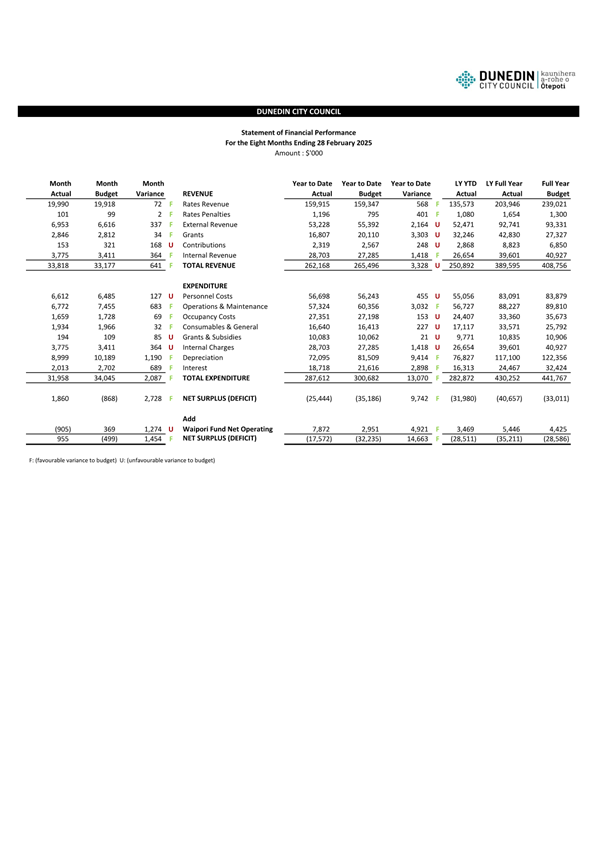
was $262.168 million for the period or $3.328 million less than budget.
6 Operating
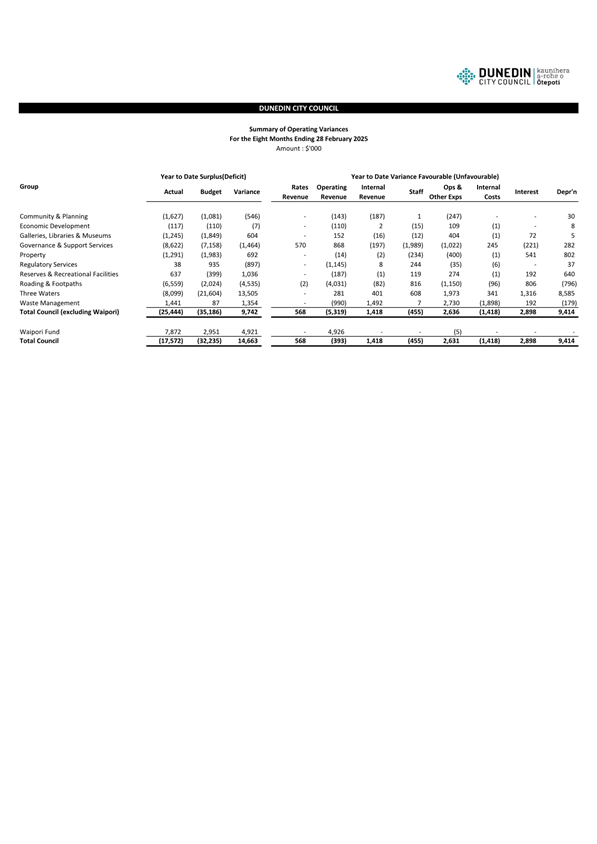
revenue (external and internal combined) was unfavourable $746k mainly due to lower-than-expected
revenue from the Parking Services, Aquatic Services, Resource Consents and
Building Services activities.
7 Grants
revenue was unfavourable $3.303 million reflecting funding decisions by NZTA
under the National Land Transport Programme, and timing of the transport
contractor work programme.
8 Expenditure
was $287.612 million for the period, or $13.070 million less than budget.
9 Personnel costs was unfavourable $455k, reflecting overtime payments
for 3 waters and union negotiated contract increases, which is being managed
with vacancy management. The month of February showed an unfavourable variance
of $127k, partly driven by changes in the annual leave provision.
10 Operations
and maintenance expenditure was favourable $3.032 million; however, this
favourable variance was offset by an unfavourable $1.418 million variance in
internal costs, largely due largely to landfill disposal costs for kerbside
collections now recorded as internal costs. Unfavourable Transport maintenance
costs are more than offset by under expenditure in other activities, including
Three Waters and Waste and Environmental Services. Transport costs
included emergency works totalling $1.933 million associated with the October
rain event.
11 Depreciation
costs were favourable $9.414 million, mainly due to the revaluation of Three
Waters assets, and to a lesser extent Property and Parks assets.
12 Interest
costs were favourable $2.898 million, reflecting a lower interest rate than
budgeted and the timing of new loan advances.
13 Year to date the Waipori Fund has reported a net operating surplus
of $7.872 million, $4.921 million more than budget. Operating revenue was
favourable $4.926 million. Australian and New Zealand equities saw decreases in
value during February, partly offset however by an increase in value for
international equities. Fixed term investments values saw an increase in value
for the month, maintaining favourable results for the year to date.
Statement of Financial Position
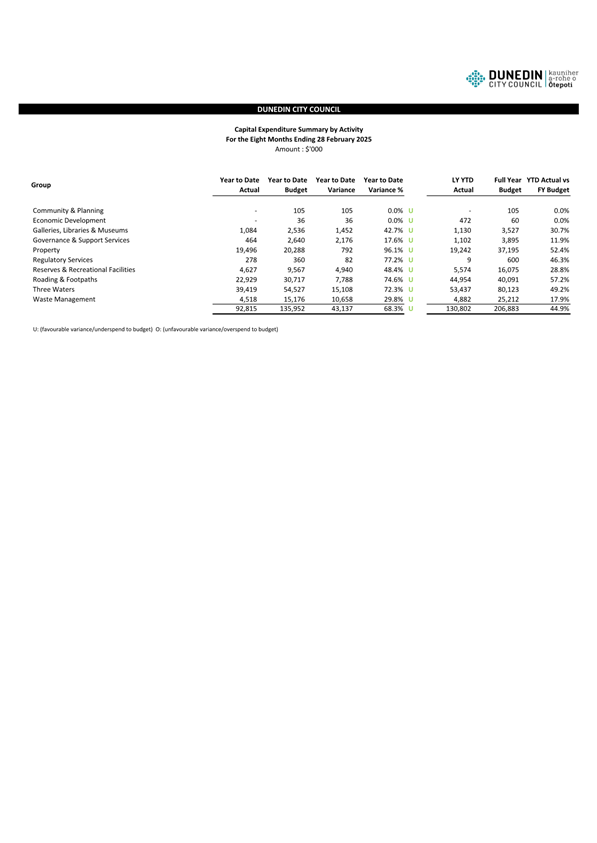
14 Capital
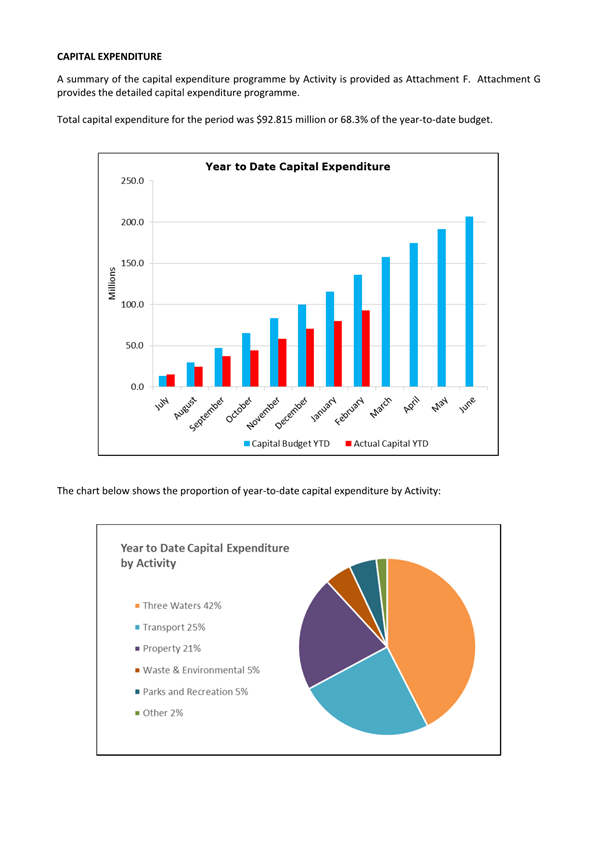
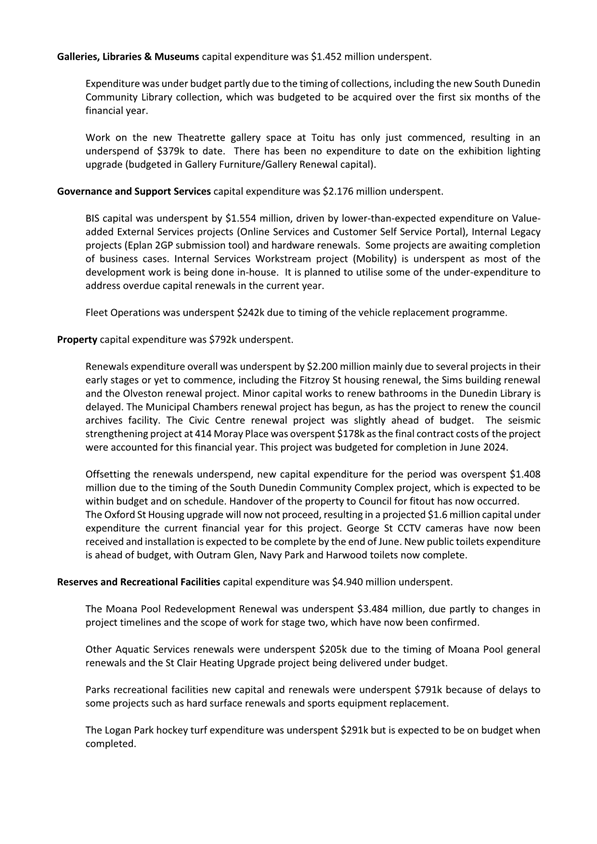
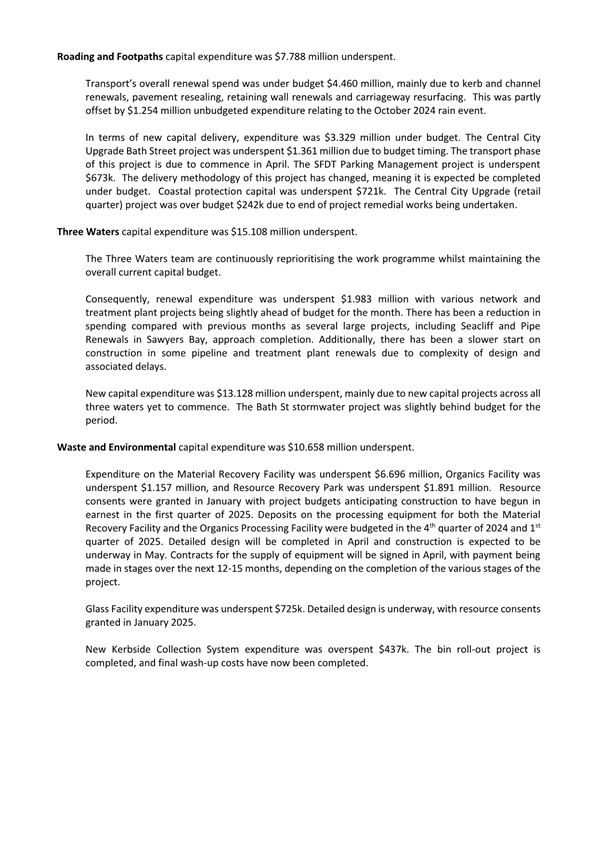
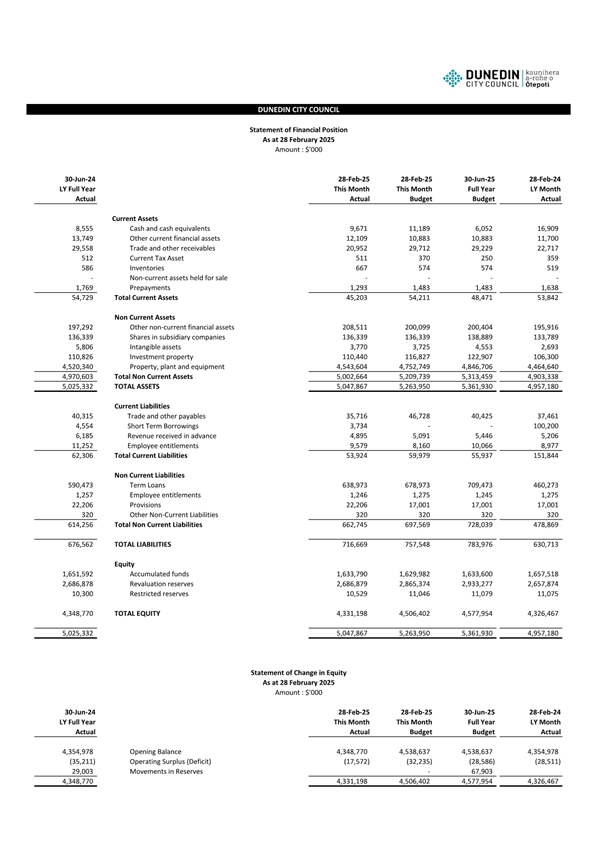
expenditure was $92.815 million or 68.3% of the year-to-date budget. Capital
expenditure in most activities was generally within budget for the period.
15 The loans
balance at 28 February was $638.973 million which was $40.000 million less than
budget. This a reflection of the capital expenditure programme, which was
underspent by $43.137 million to February. Additional to the February
loans balance there was accrued interest of $3.734 million.
16 Attachment
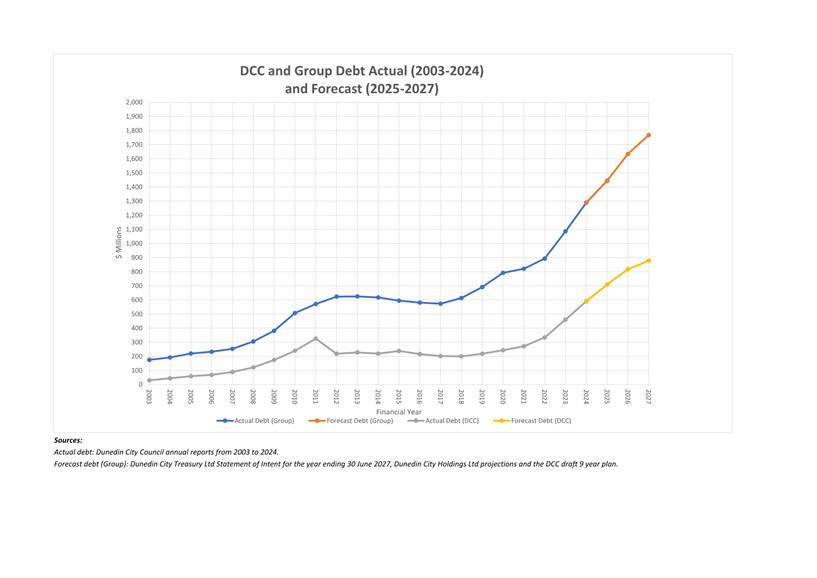
B includes a chart showing actual group and DCC debt for the years ending June
2003-2024. It provides forecast information for the years ending June 2024-2027
based on the current Statements of Intent (SOI), and the first two years of the
draft 9-year plan.
OPTIONS
17 As this is an administrative report only, there are no options
provided.
NEXT STEPS
18 Financial
Result Reports continue be presented to future meetings of either the Finance
and Council Controlled Organisation Committee or Council.
Signatories
|
Author:
|
Hayden McAuliffe - Financial Services Manager
|
|
Authoriser:
|
Carolyn Allan - Chief Financial Officer
|
Attachments
|
|
Title
|
Page
|
|
⇩a
|
Dashboard Summary
Financial Information
|
98
|
|
⇩b
|
Debt Graph
|
99
|
|
⇩c
|
Statement of Financial
Performance
|
100
|
|
⇩d
|
Statement of Financial
Position
|
101
|
|
⇩e
|
Statement of Cashflows
|
102
|
|
⇩f
|
Capital Expenditure
Summary
|
103
|
|
⇩g
|
Capital Expenditure
Detailed Programme
|
104
|
|
⇩h
|
Operating Variances
|
111
|
|
⇩i
|
Detailed Financial
Update
|
112
|
|
|
Council
15 April 2025
|
|
|
Council
15 April 2025
|
|
|
Council
15 April 2025
|
|
|
Council
15 April 2025
|
|
|
Council
15 April 2025
|
|
|
Council
15 April 2025
|
|
|
Council
15 April 2025
|
|
|
Council
15 April 2025
|
Resolution to Exclude the
Public
That the Council excludes
the public from the following part of the proceedings of this meeting (pursuant
to the provisions of the Local Government Official Information and Meetings Act
1987) namely:
|
General subject of the matter to be considered
|
Reasons
for passing this resolution in relation to each matter
|
Ground(s) under
section 48(1) for the passing of this resolution
|
Reason for
Confidentiality
|
|
C1
BIS Report
|
S7(2)(b)(ii)
The
withholding of the information is necessary to protect information where the
making available of the information would be likely unreasonably to prejudice
the commercial position of the person who supplied or who is the subject of
the information.
S7(2)(i)
The
withholding of the information is necessary to enable the local authority to
carry on, without prejudice or disadvantage, negotiations (including
commercial and industrial negotiations).
|
S48(1)(a)
The public conduct of
the part of the meeting would be likely to result in the disclosure of
information for which good reason for withholding exists under section 7.
|
|
This resolution is made in
reliance on Section 48(1)(a) of the Local Government Official Information and
Meetings Act 1987, and the particular interest or interests protected by
Section 6 or Section 7 of that Act, or Section 6 or Section 7 or Section 9 of
the Official Information Act 1982, as the case may require, which would be
prejudiced by the holding of the whole or the relevant part of the proceedings
of the meeting in public are as shown above after each item.