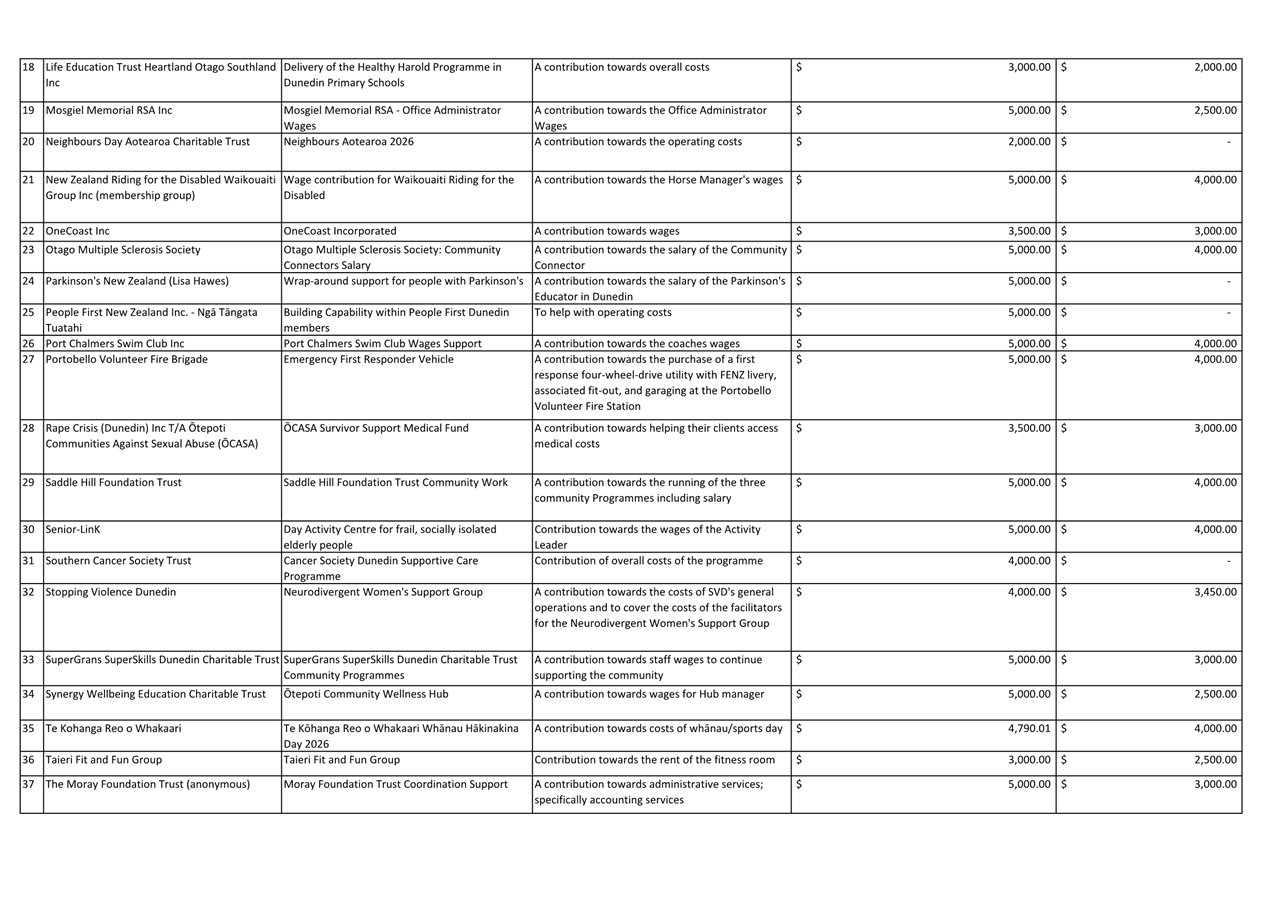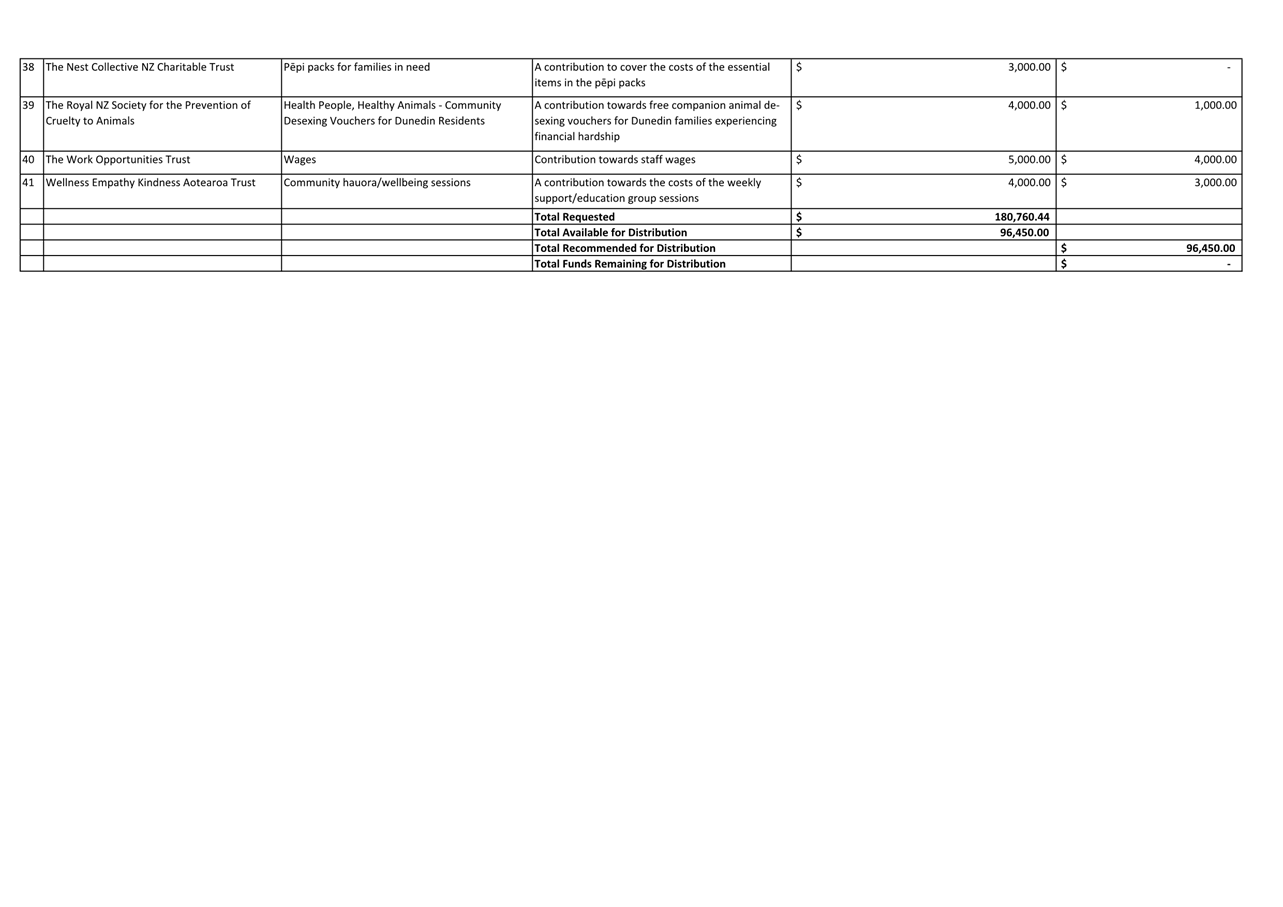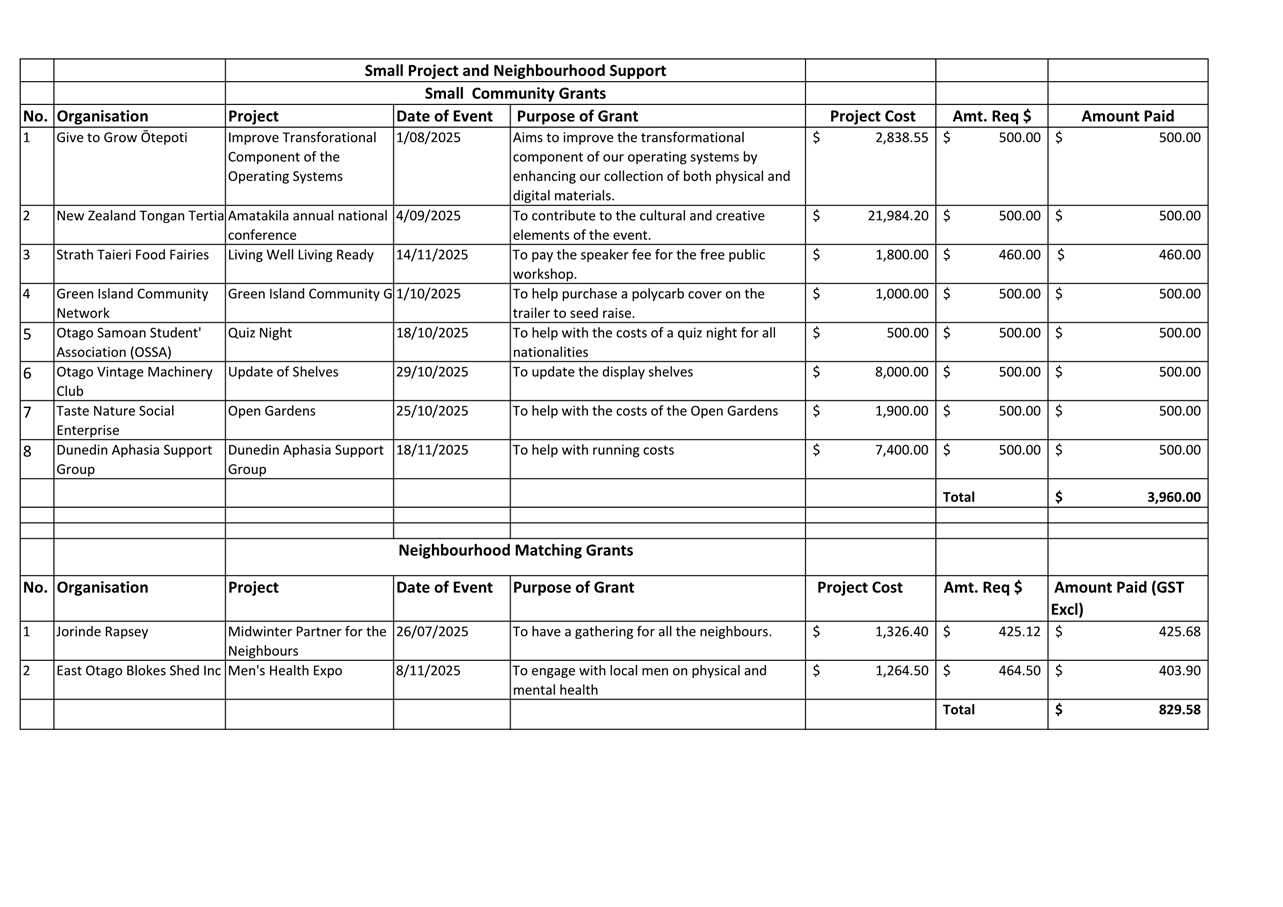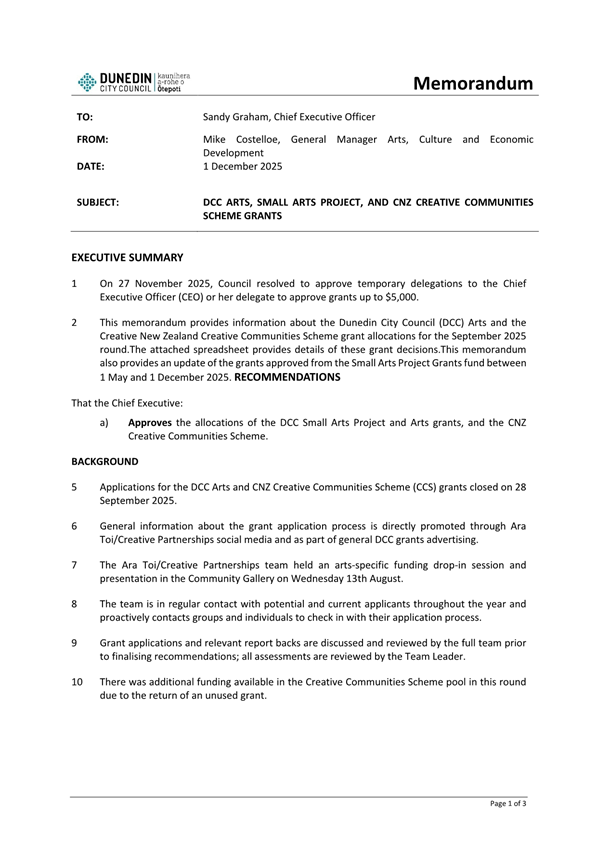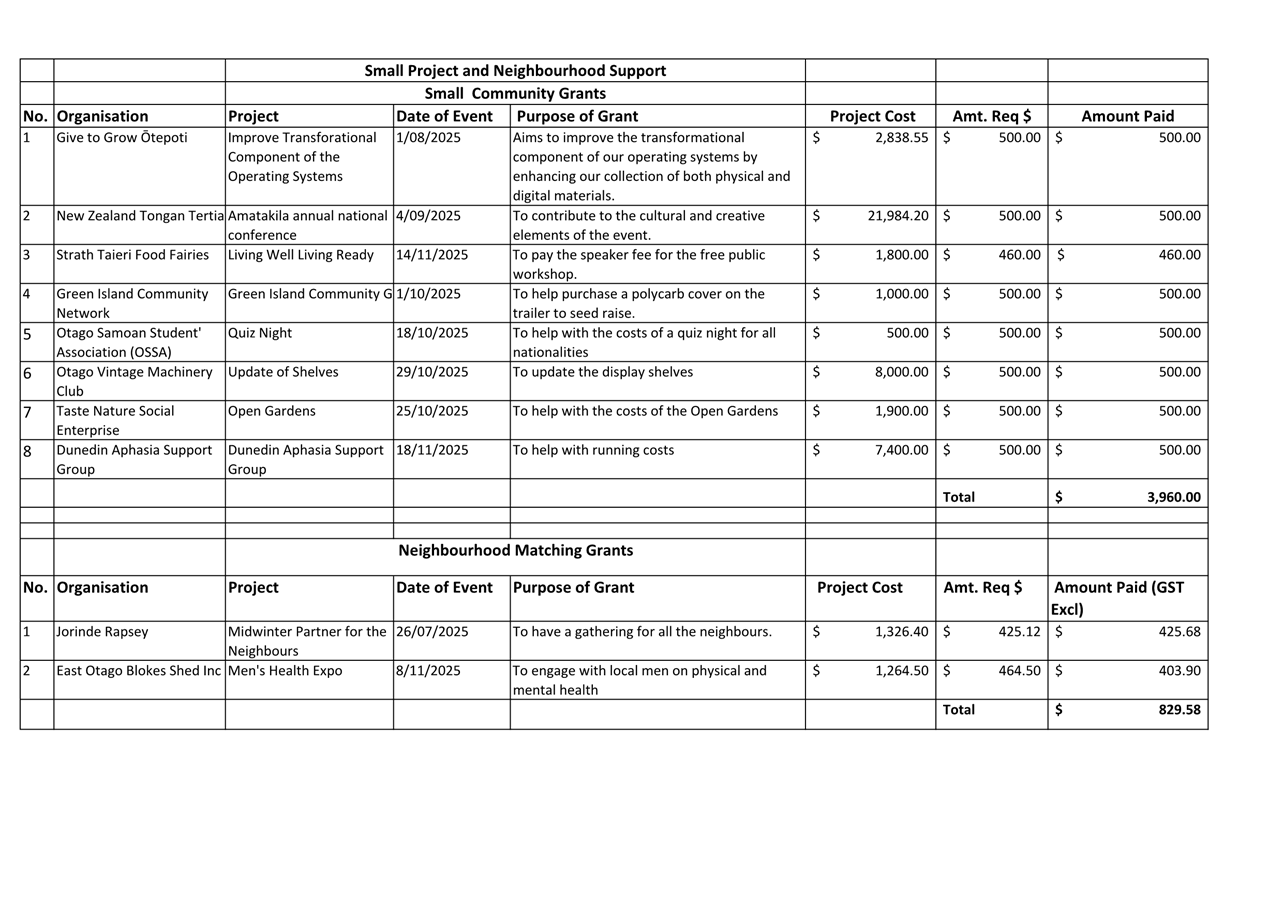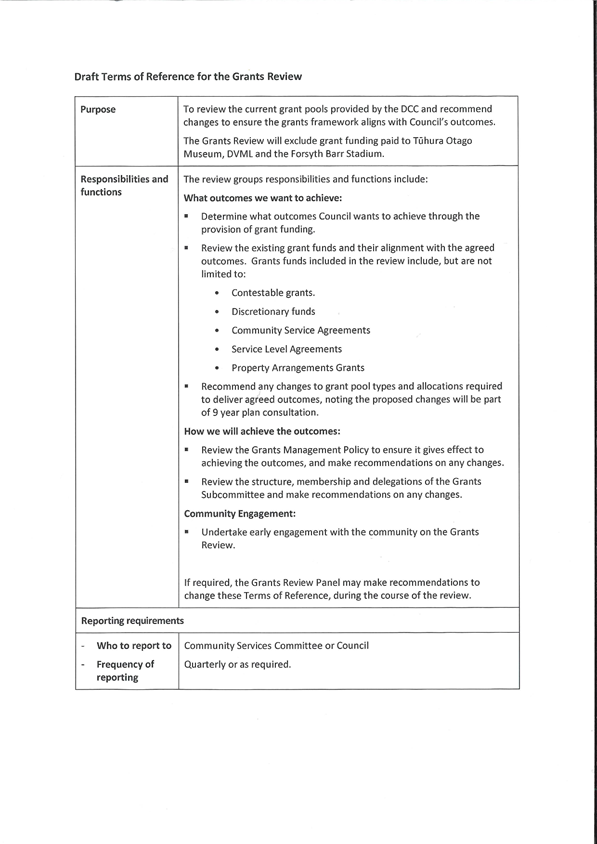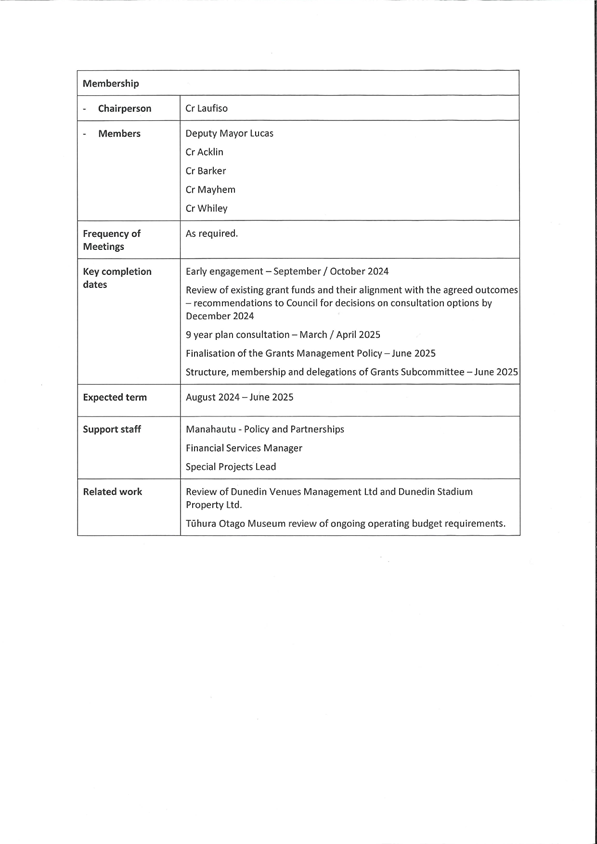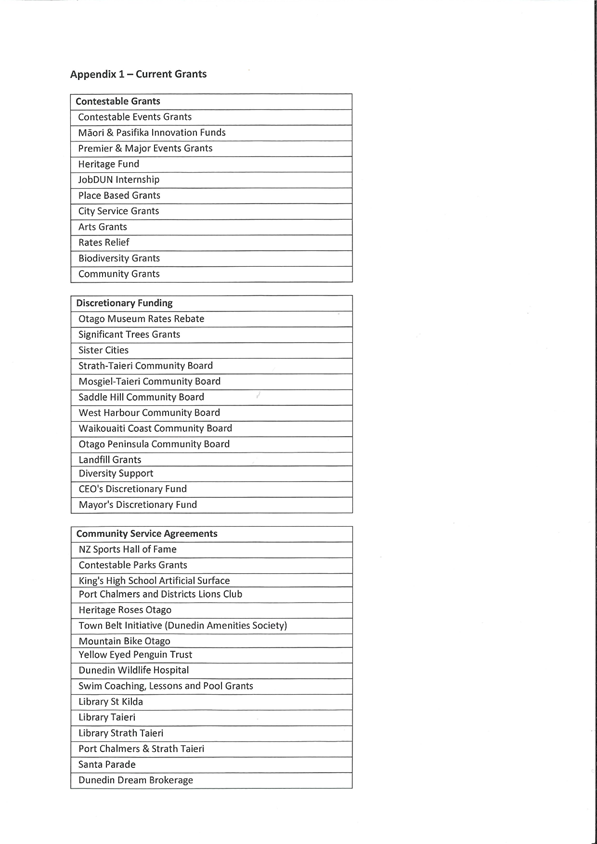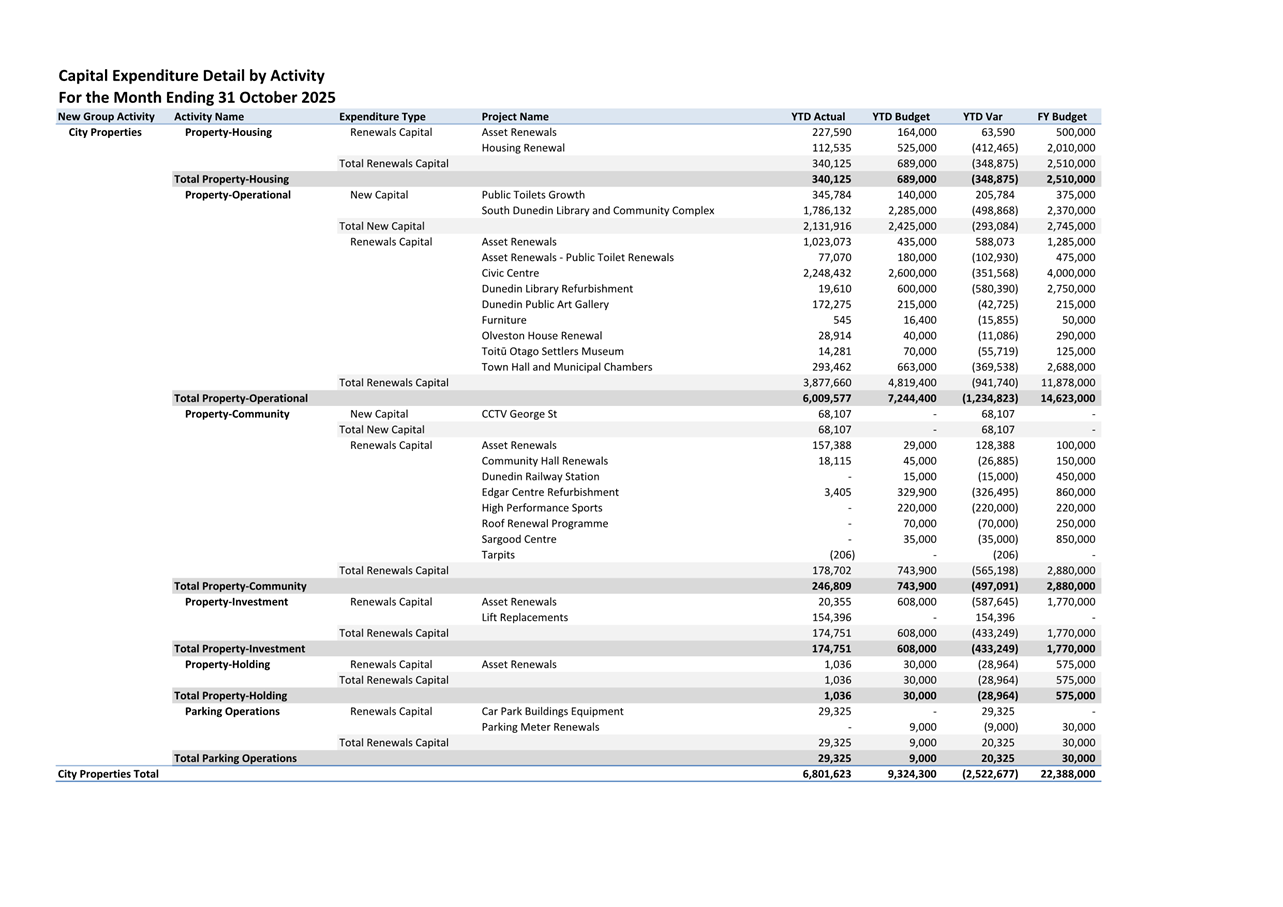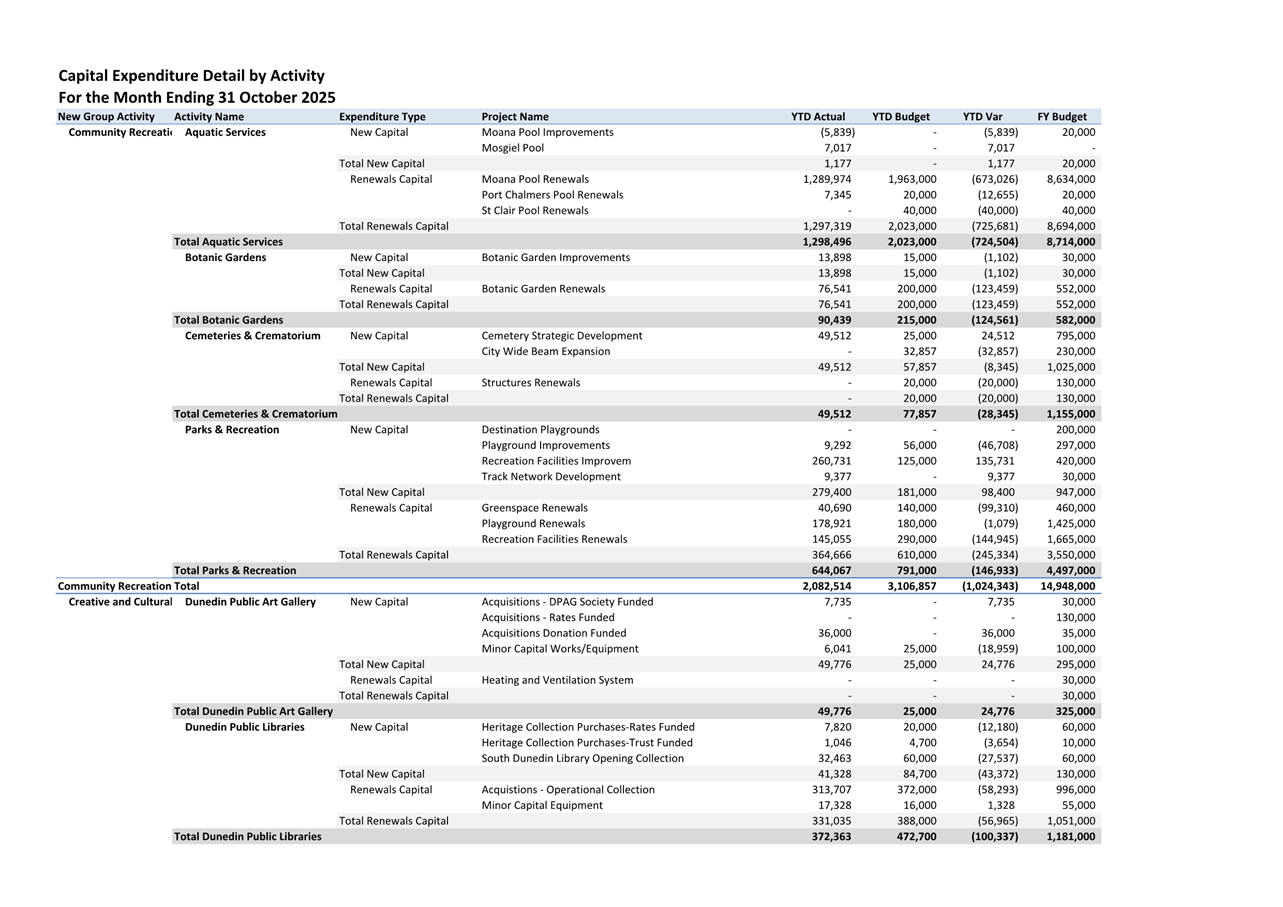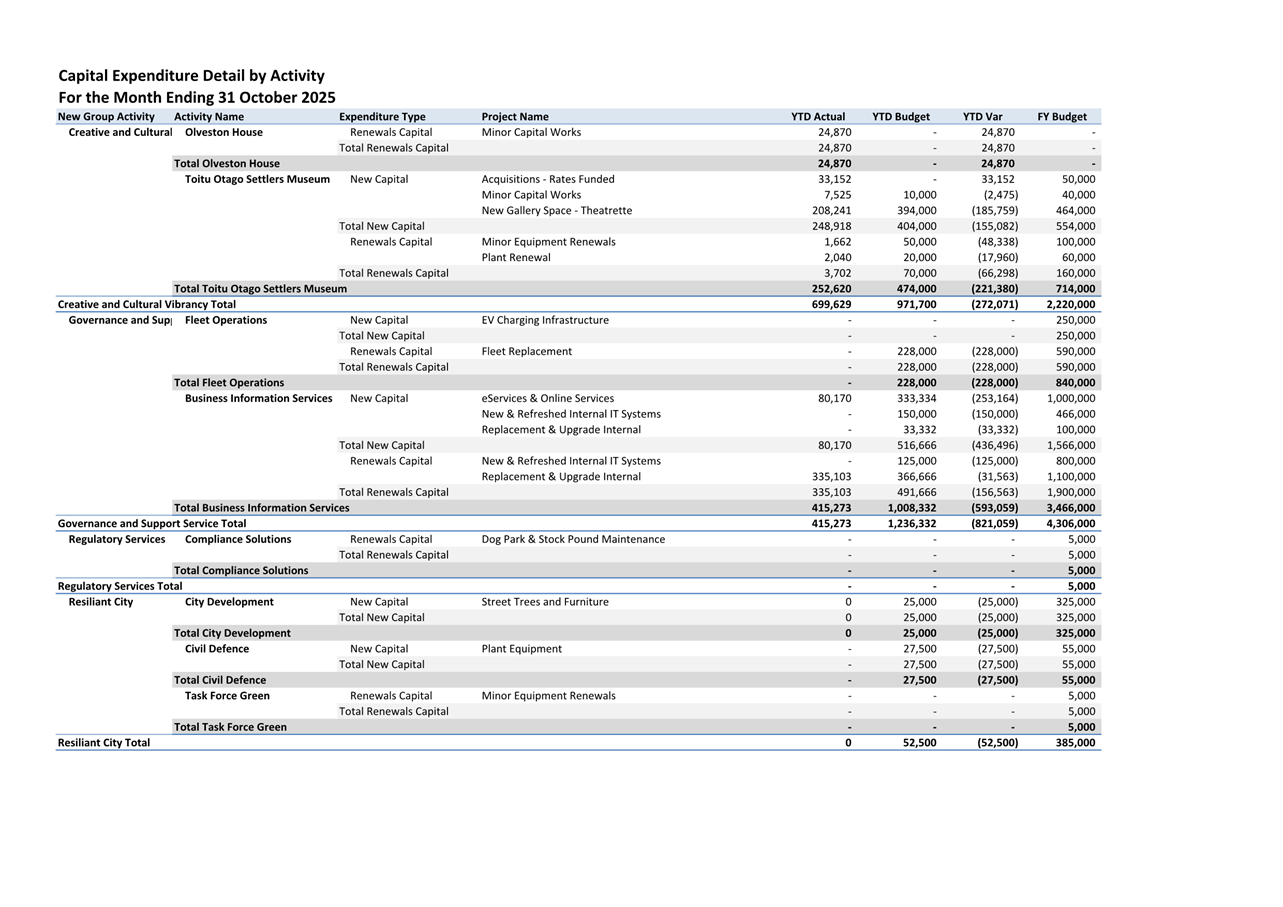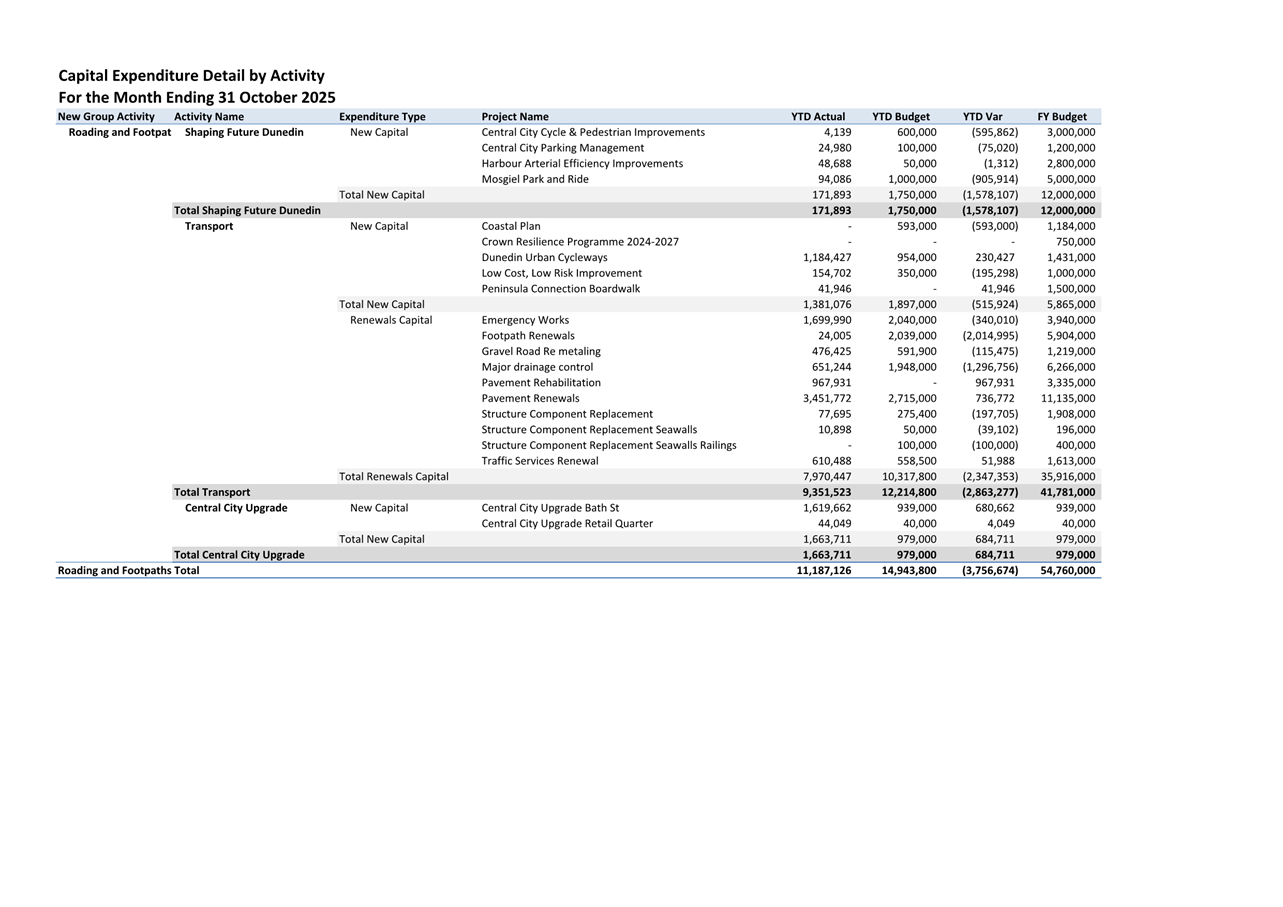
Notice of Meeting:
I hereby give notice that an ordinary meeting of the Dunedin
City Council will be held on:
Date: Thursday
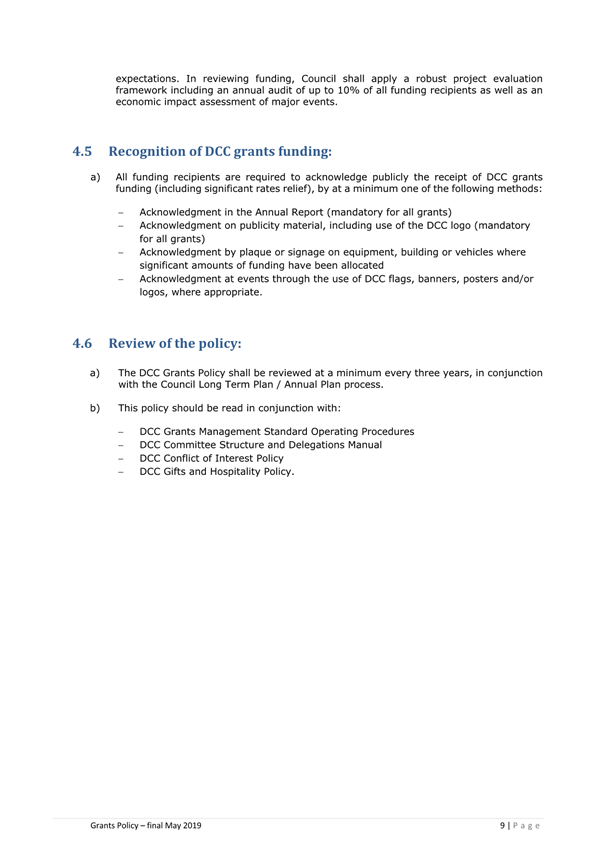
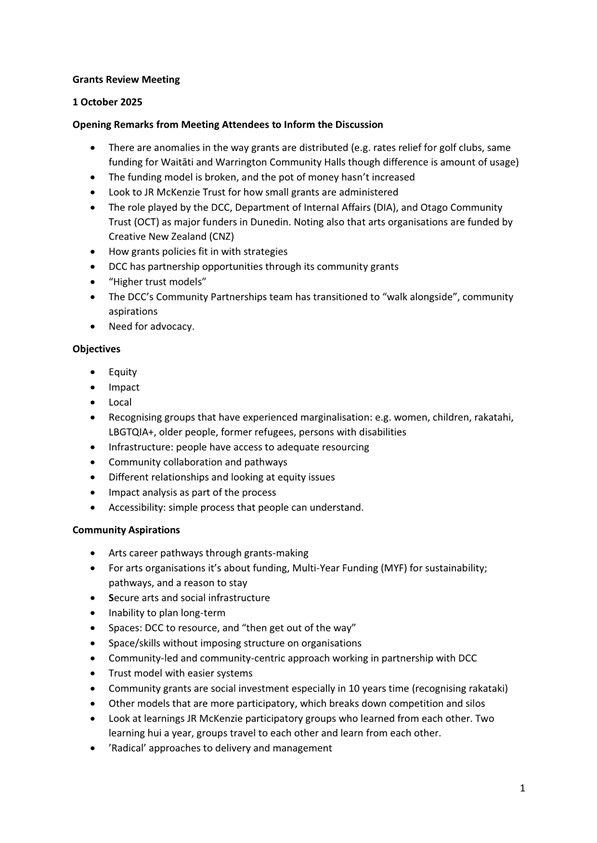
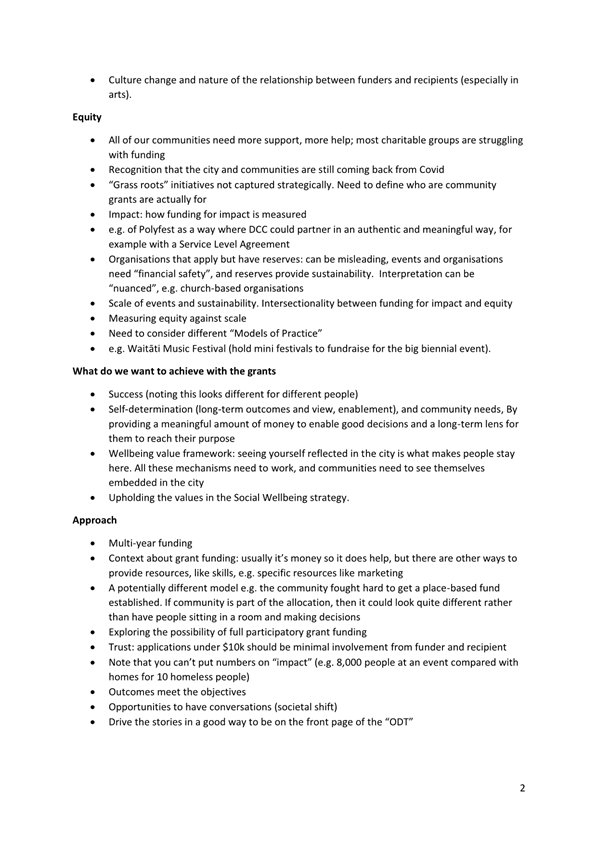
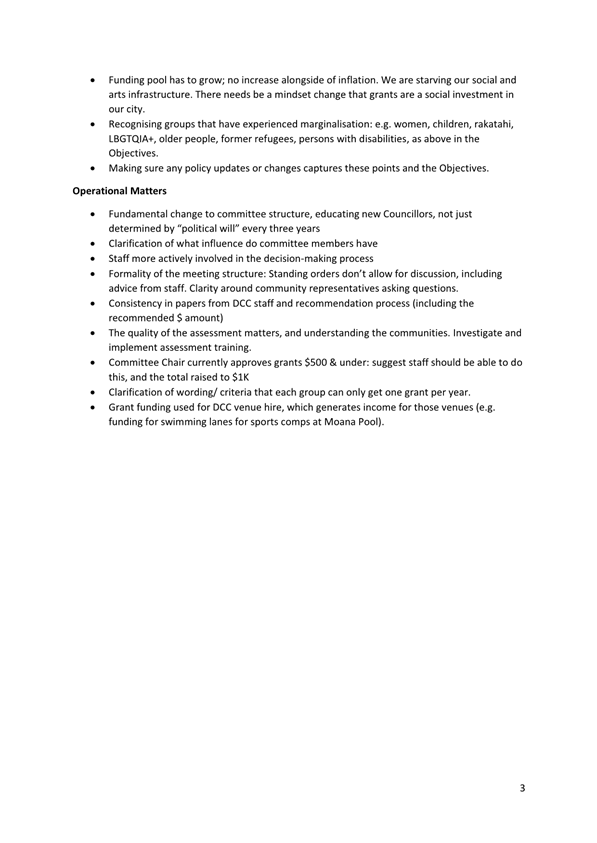
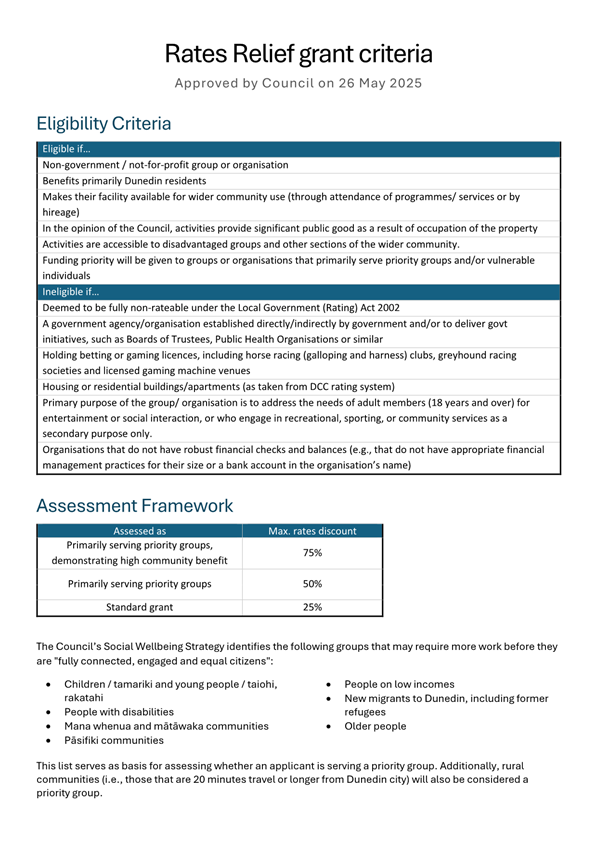
11 December 2025
Time: 09:00
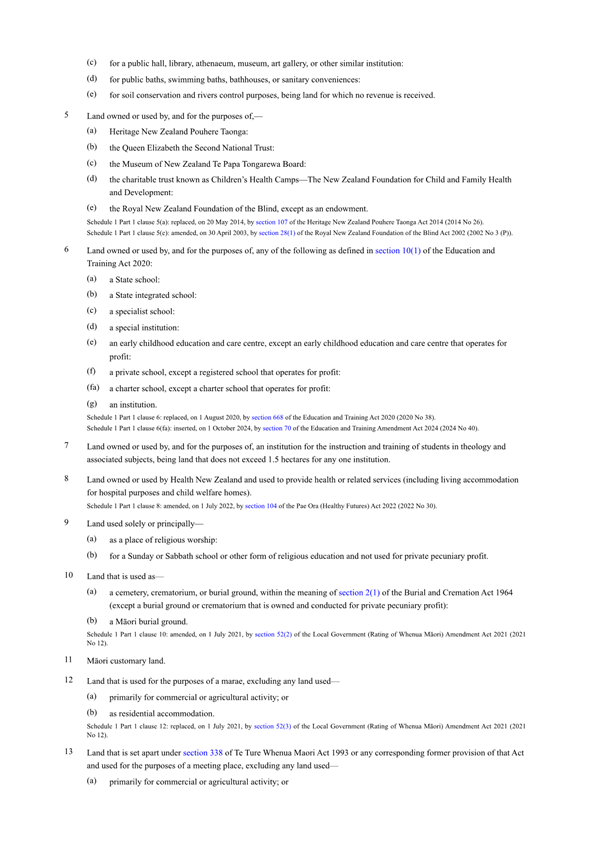
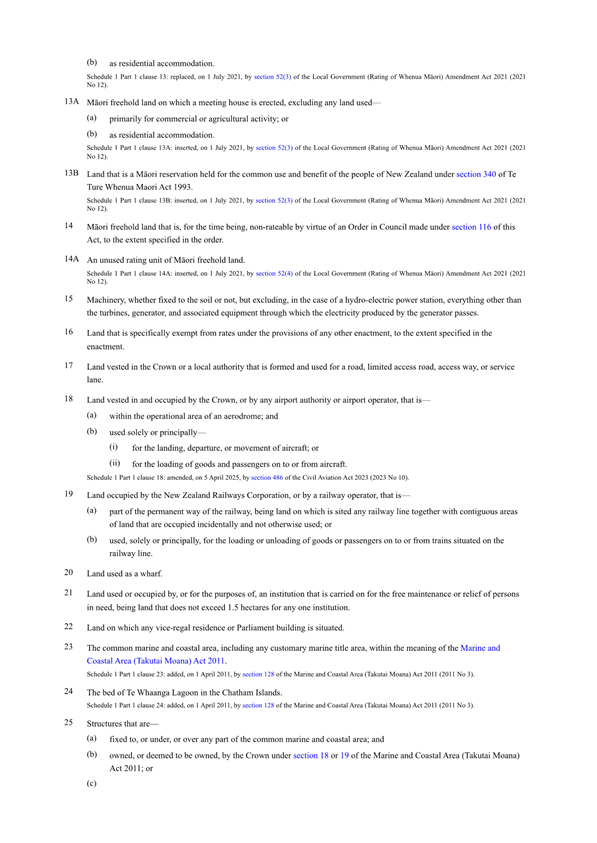
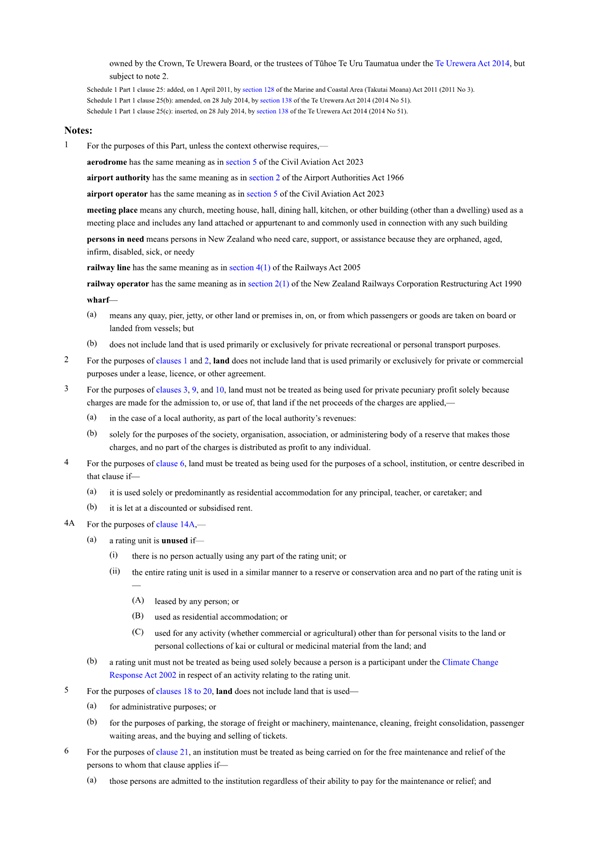
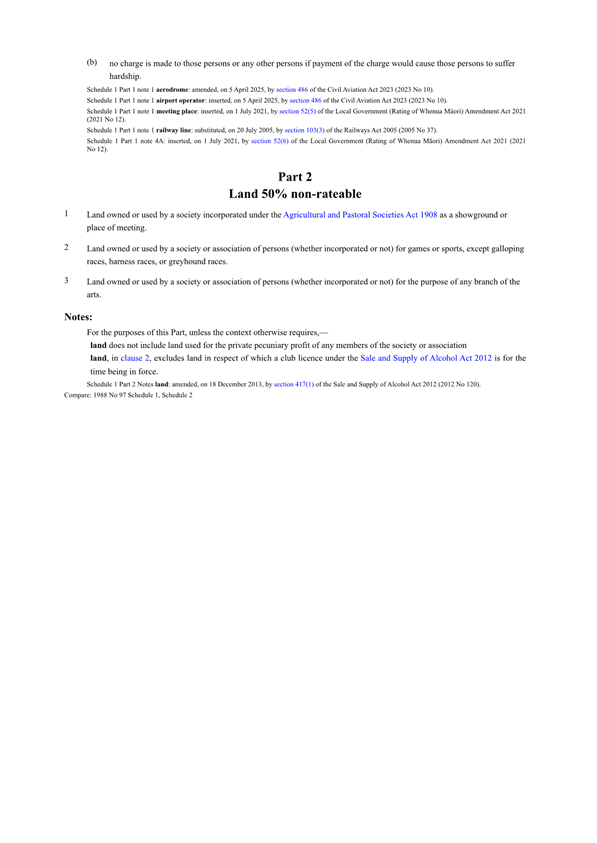
a.m.
Venue: Council
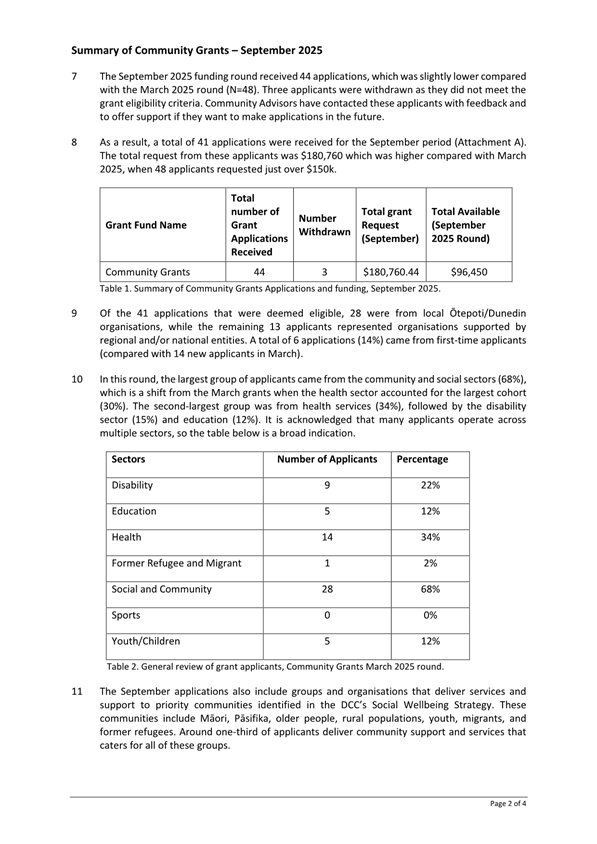
Chamber, Dunedin Public Art Gallery, the Octagon, Dunedin
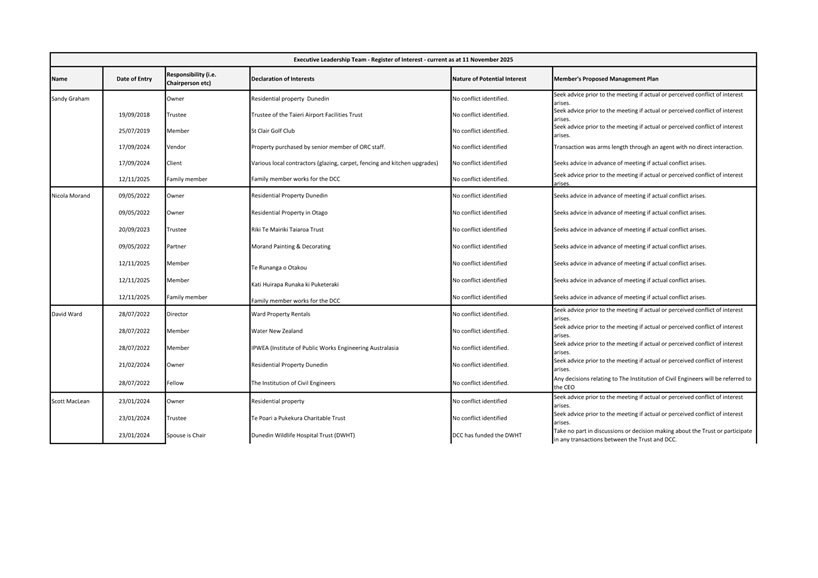
Sandy Graham
Council
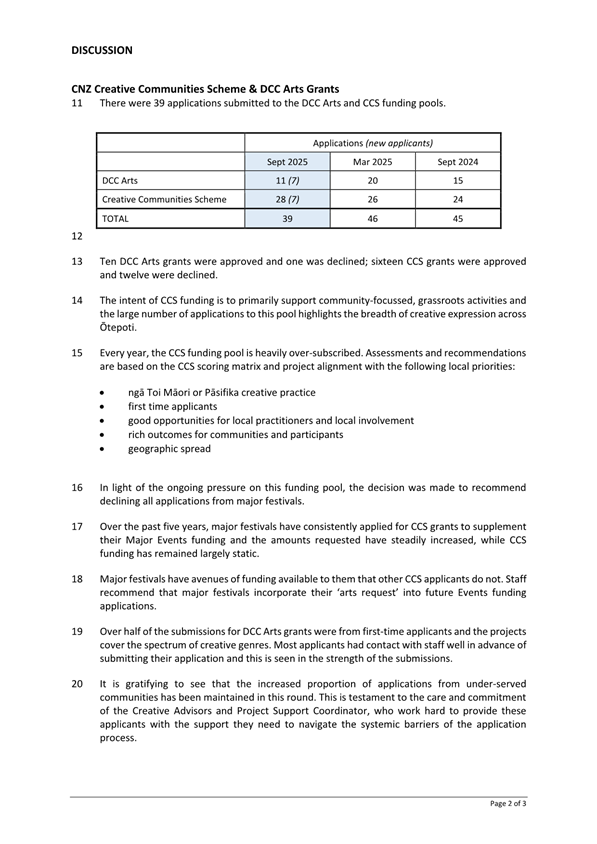
PUBLIC AGENDA
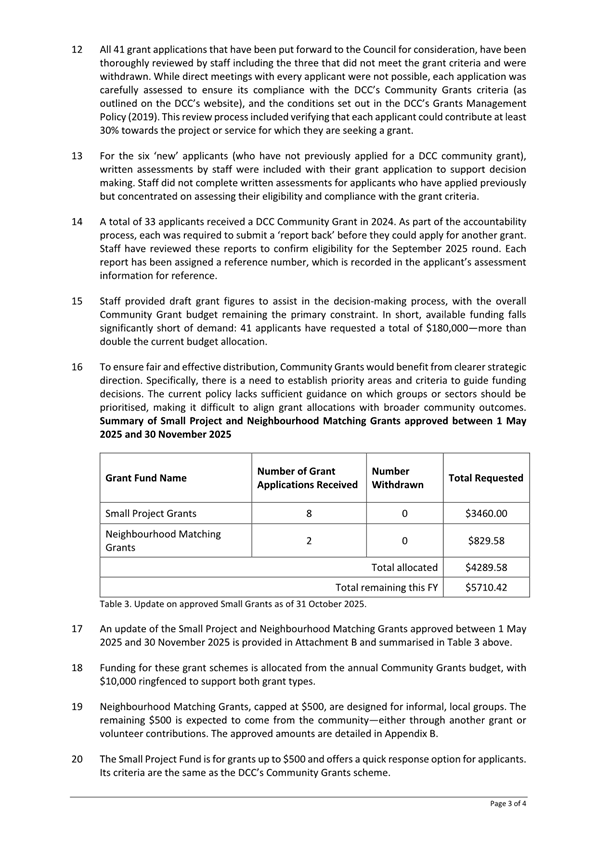
|
Mayor
|
Mayor Sophie Barker
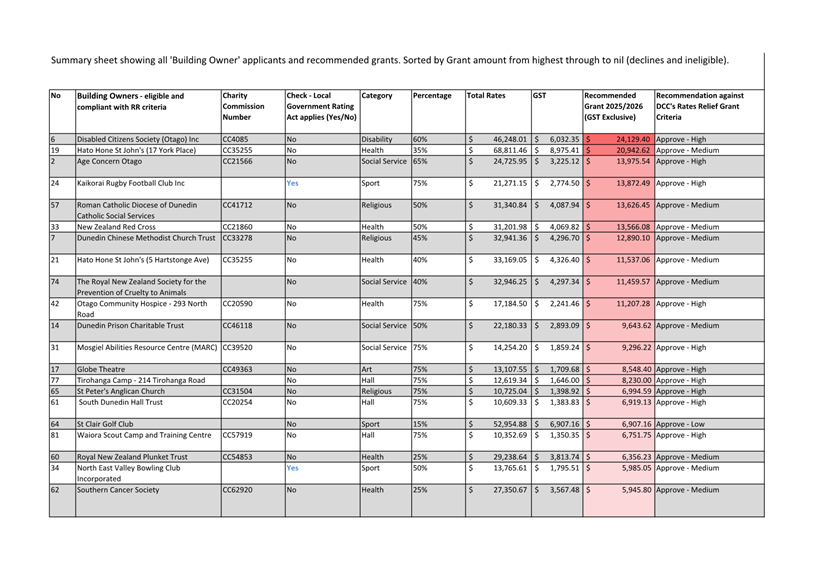
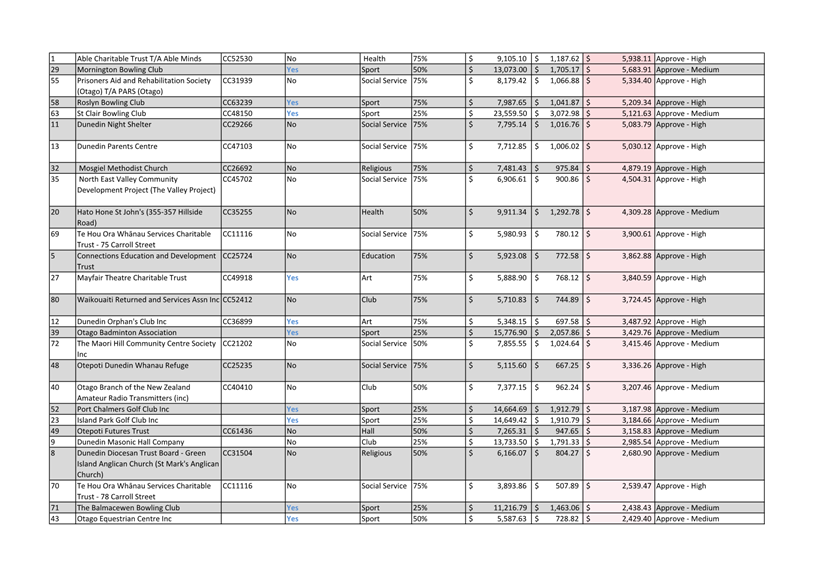
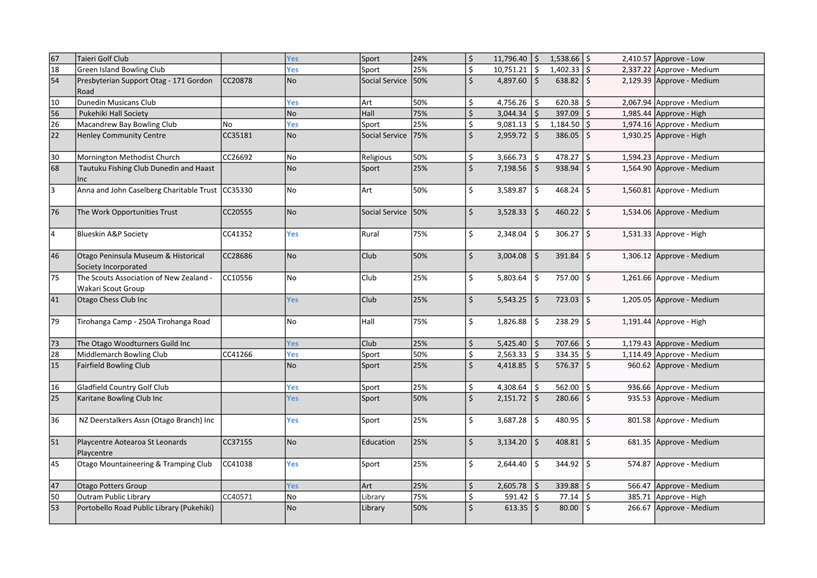
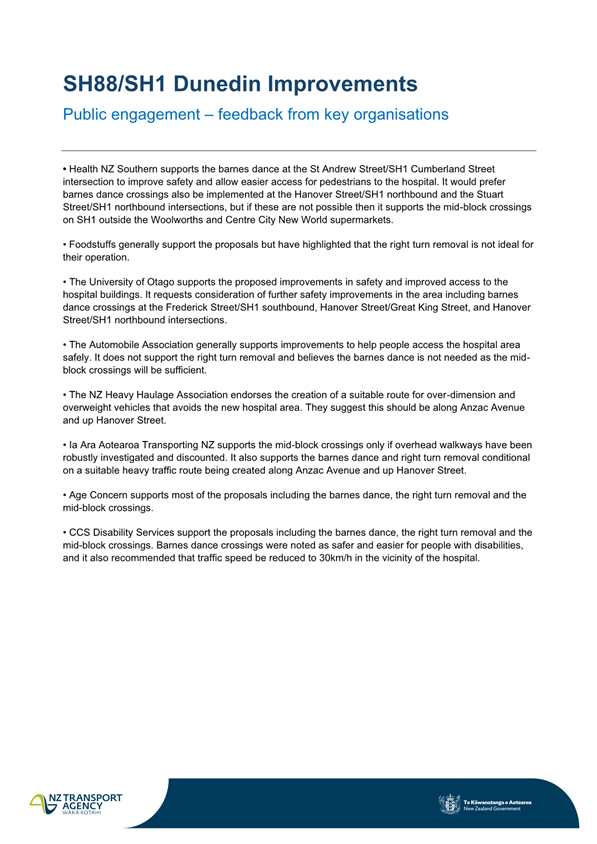
|
|
|
Deputy Mayor
|
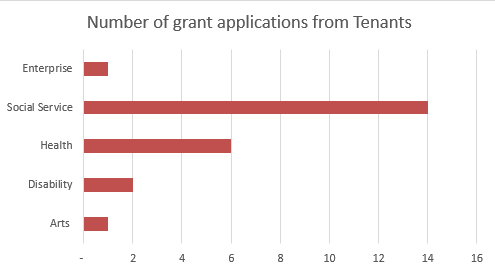
Cr Cherry Lucas
|
|
|
Members
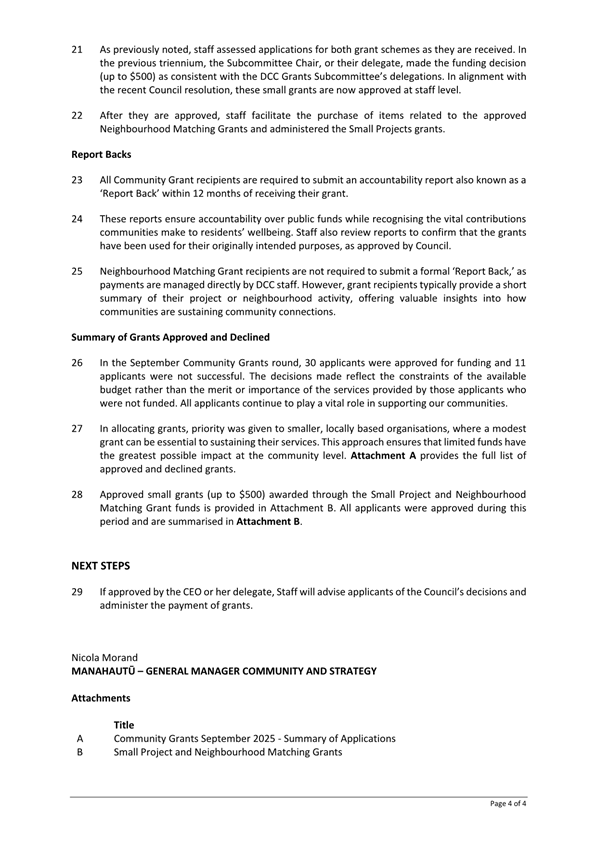
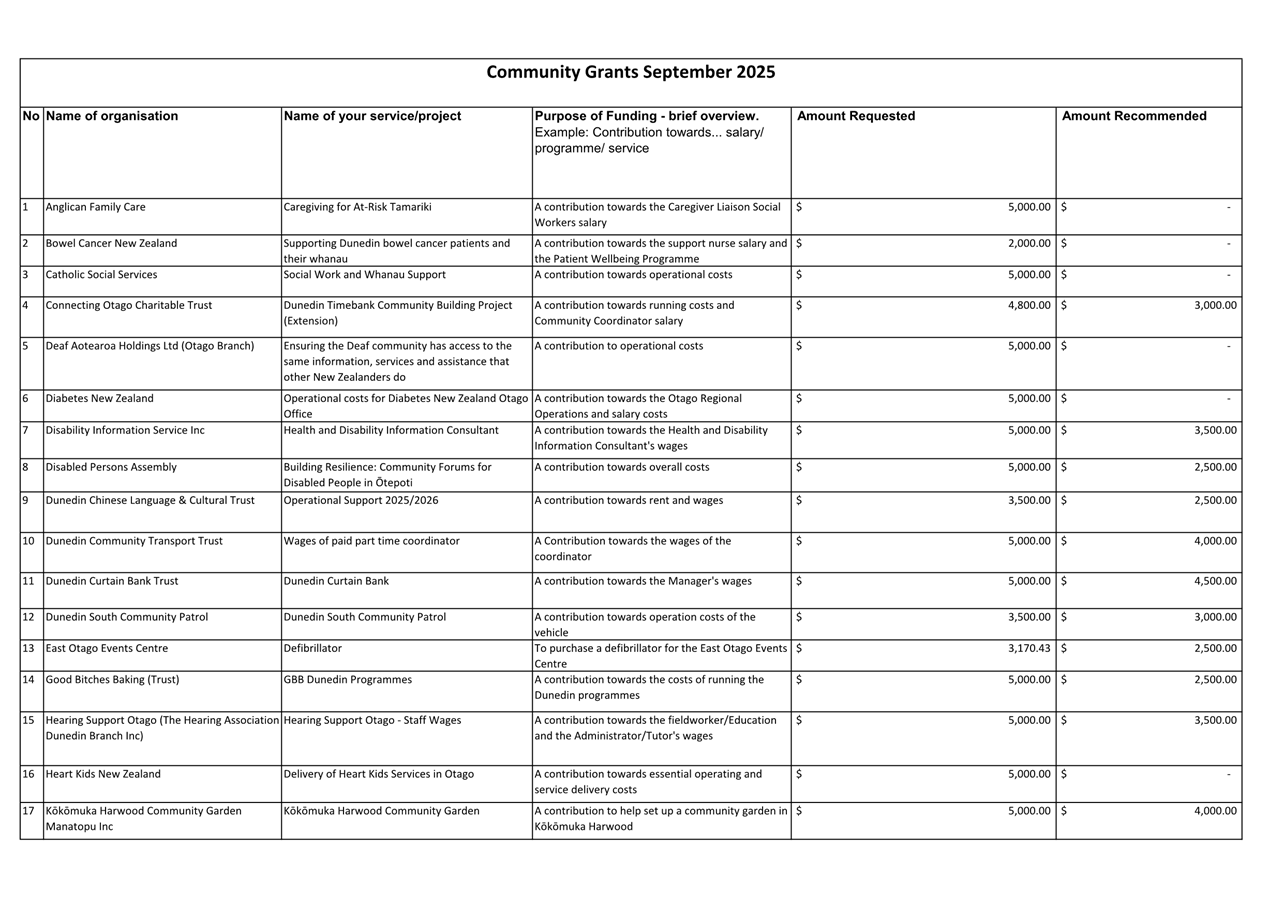
|
Cr John Chambers
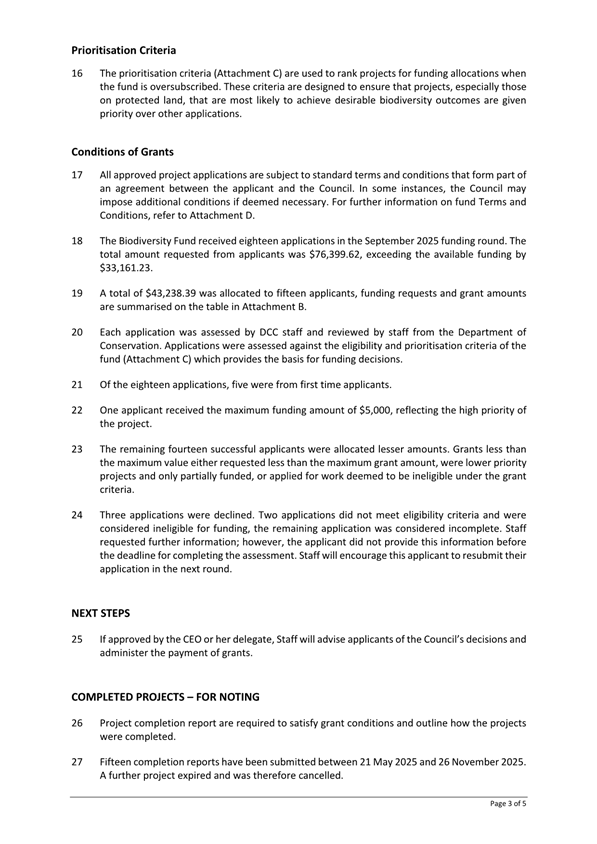
|
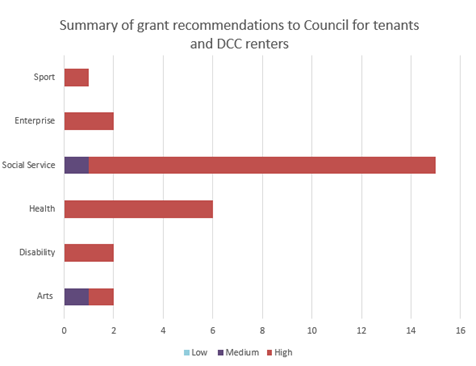
Cr Christine Garey
|
|
|
Cr Doug Hall
|
Cr Marie Laufiso
|
|
|
Cr Russell Lund
|
Cr Mandy Mayhem
|
|
|
Cr Benedict Ong
|
Cr Jules Radich
|
|
|
Cr Andrew Simms
|
Cr Mickey Treadwell
|
|
|
Cr Lee Vandervis
|
Cr Steve Walker
|
|
|
Cr Brent Weatherall
|
|
Senior Officer Sandy
Graham, Chief Executive
Governance Support Officer Lynne
Adamson
Lynne Adamson
Governance Support Officer
Telephone: 03 477 4000
governance.support@dcc.govt.nz
www.dunedin.govt.nz
Note: Reports
and recommendations contained in this agenda are not to be considered as
Council policy until adopted.
|

|
Council
11 December 2025
|
ITEM TABLE OF CONTENTS PAGE
1 Opening 4
2 Public
Forum 4
3 Apologies 4
4 Confirmation
of Agenda 4
5 Declaration
of Interest 5
6 Confirmation
of Minutes 16
6.1 Ordinary Council
meeting - 27 November 2025 16
Reports
7 NZTA
State Highway response to the New Dunedin Hospital 35
8 DCC
Rates Relief Grants 44
9 Waste
Minimisation Innovation and Development (Commercial) Grants Applications 64
10 Grants
Allocated $5K and under 73
11 Grants
Review Update 111
12 Dunedin
City Holdings Limited Group Update - Quarterly Report to 30 September 2025 135
13 2025
Annual Reports for the Dunedin City Holdings Ltd Group 147
14 DCHL
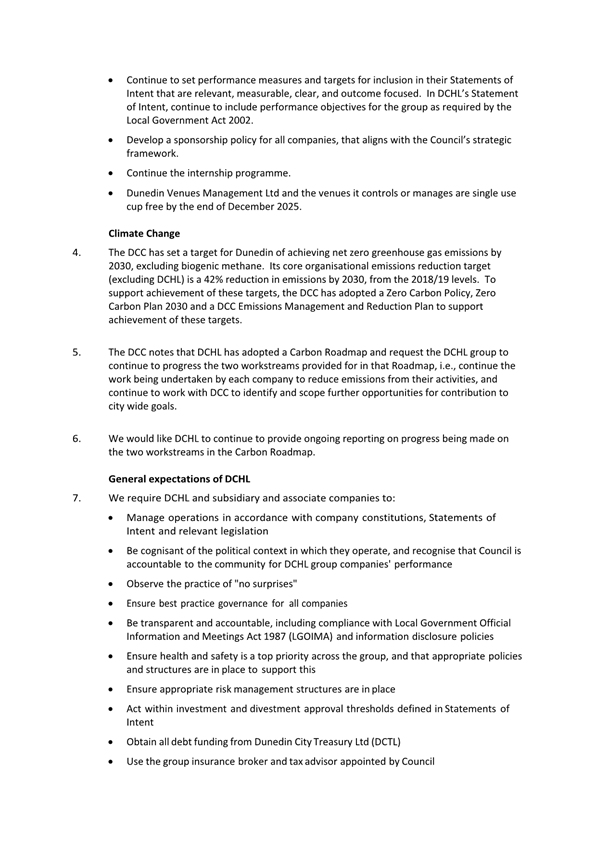
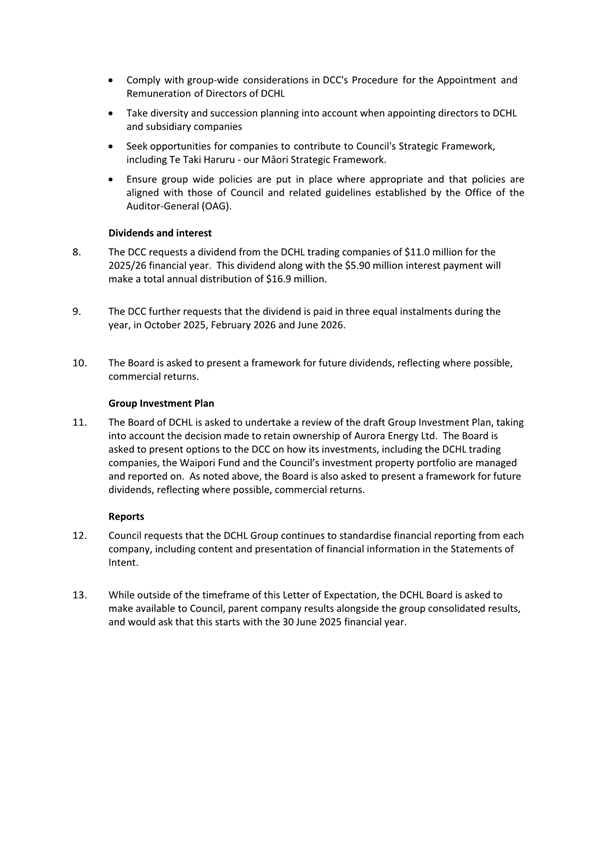
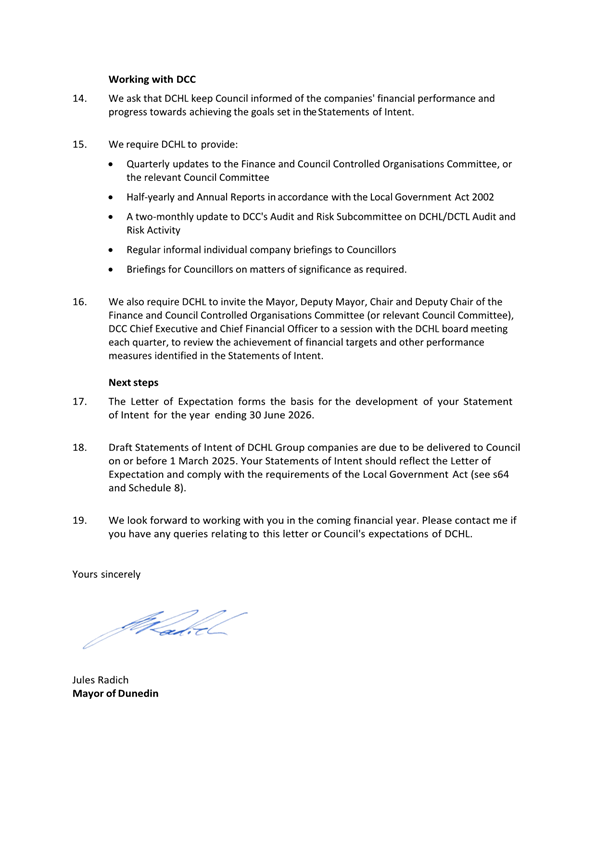
Letter of Expectation for the year ended 30 June 2027 149
15 Lead
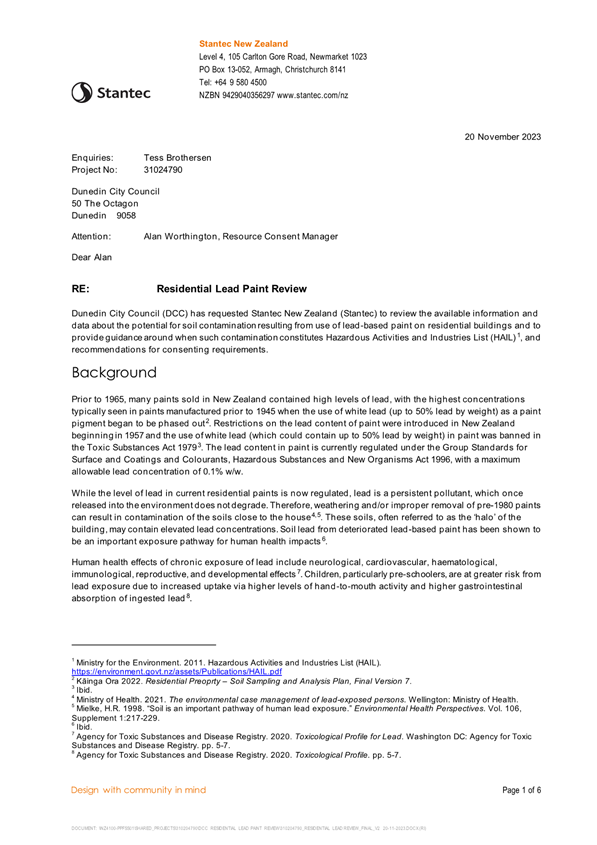
in Soil Update 163
16 Sports
Ground Management Plan Review 181
17 Town
Belt Active Travel Trial 217
18 Reserve
Management Plan Review Schedule 236
19 Proposed
Data Collection Approach and Content for the Census Submission 246
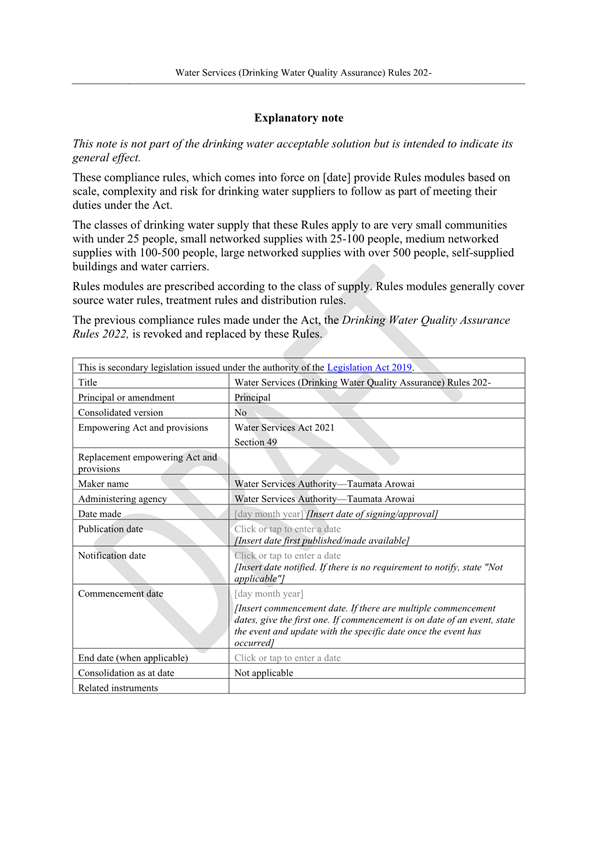
20 Drinking
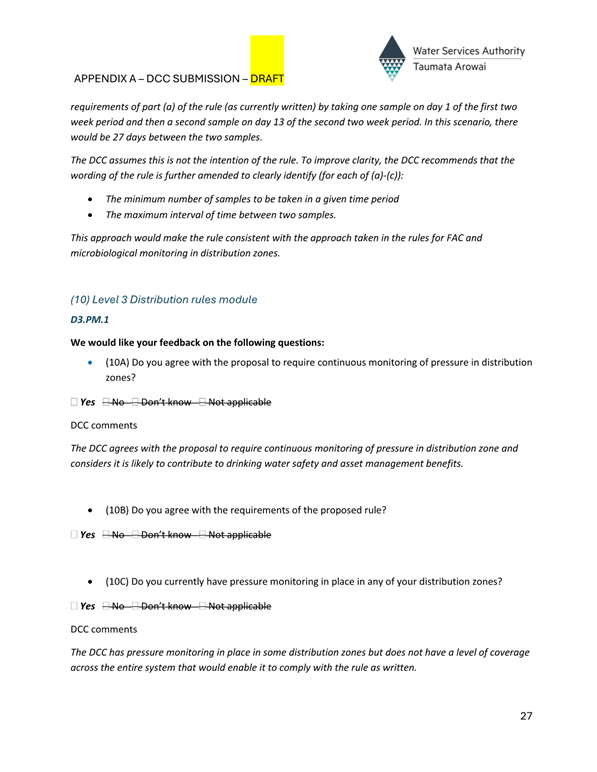
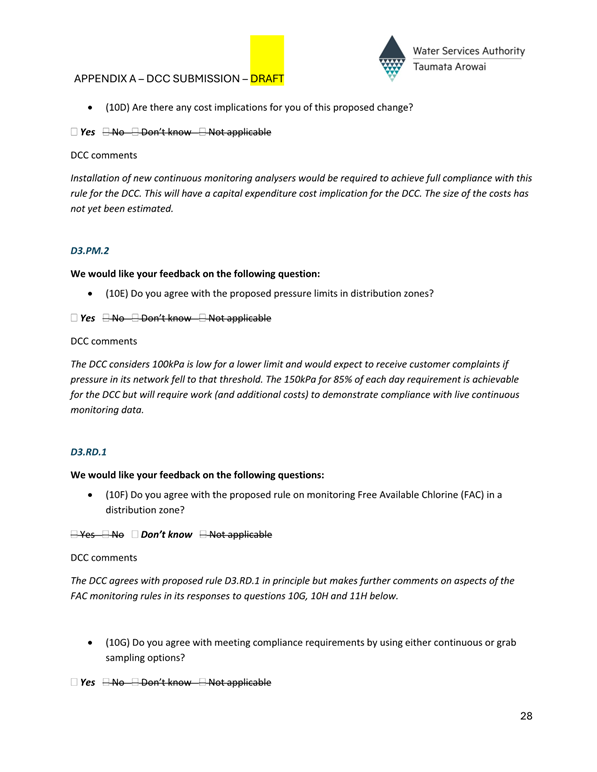
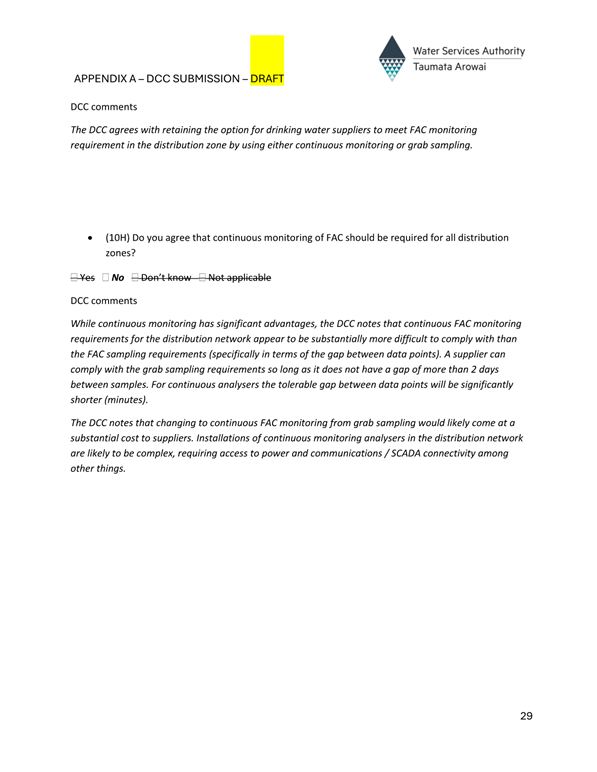
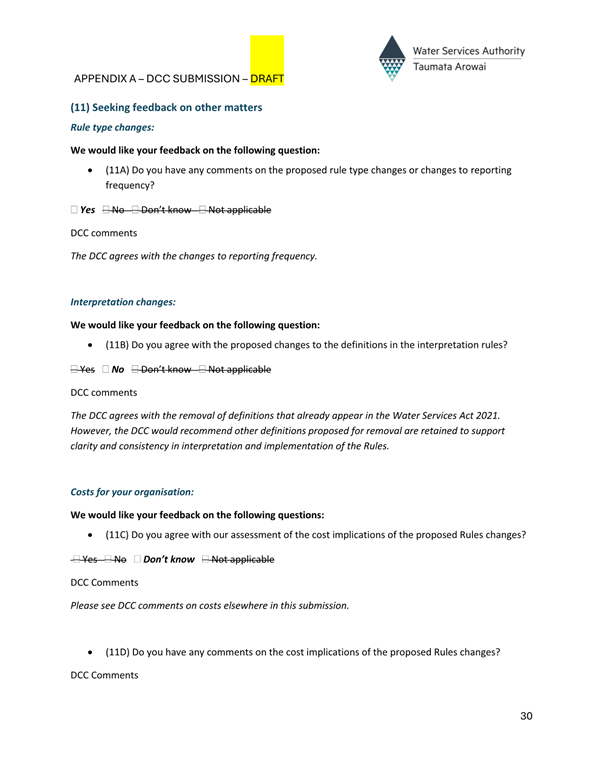
Water Quality Assurance Rules (Large Supplies) - Rules Review 2025 - Submission 277
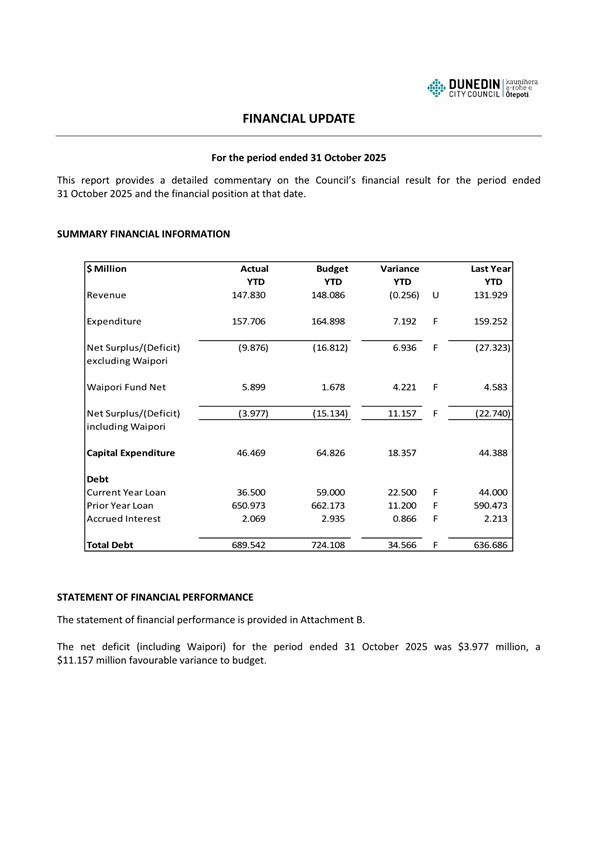
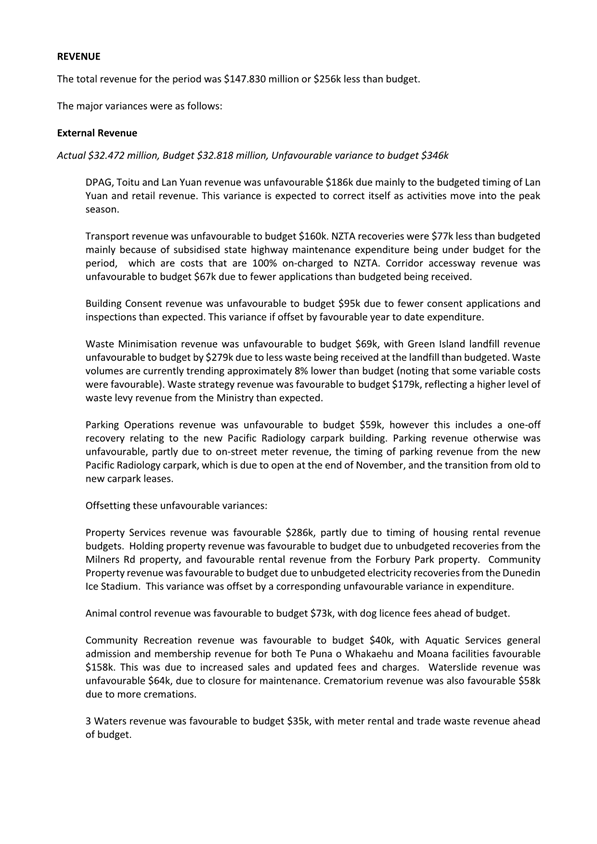
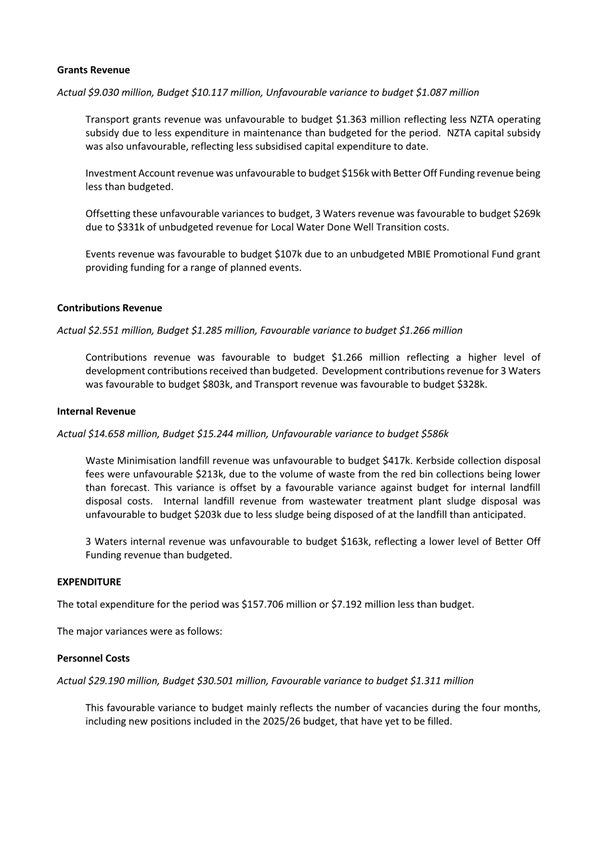
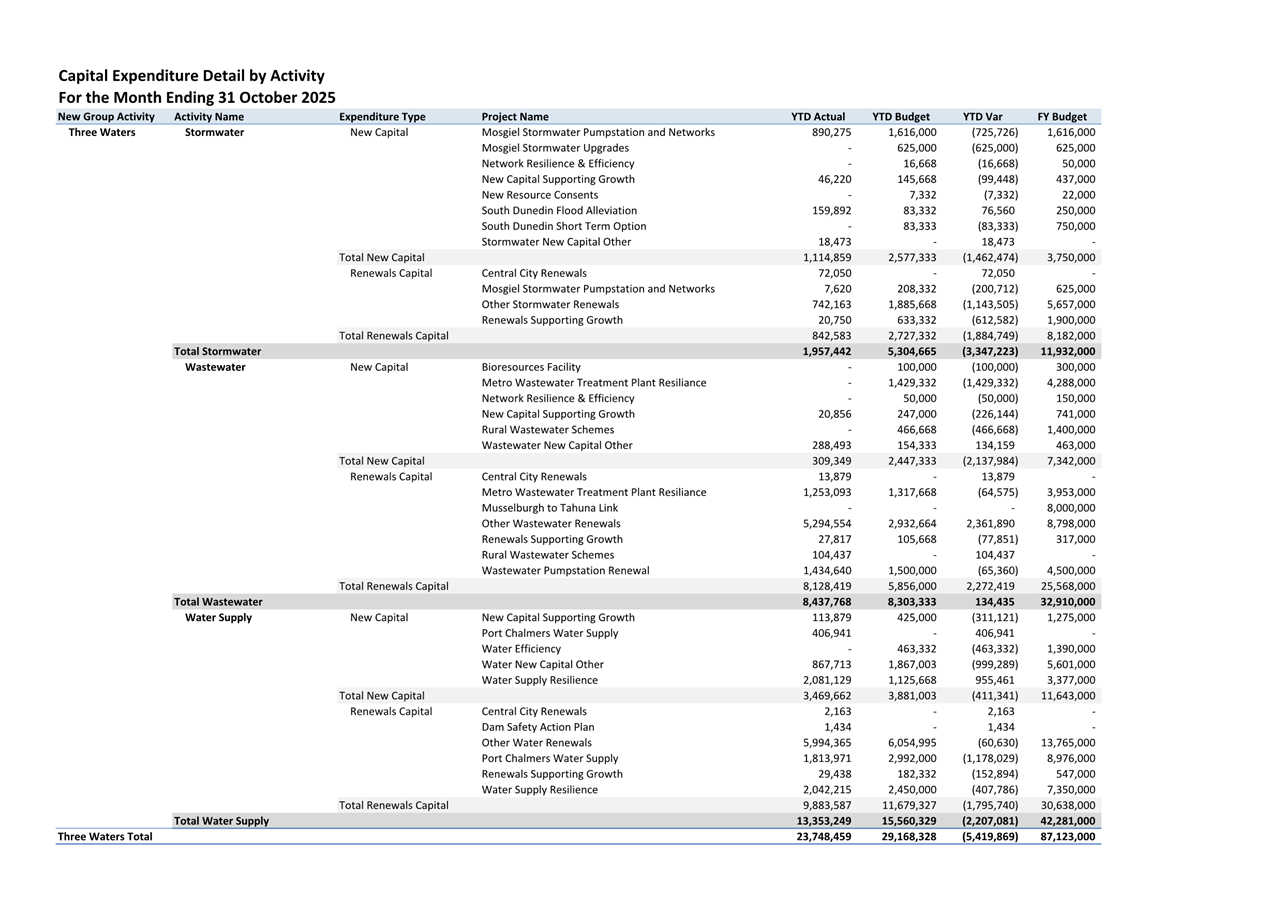
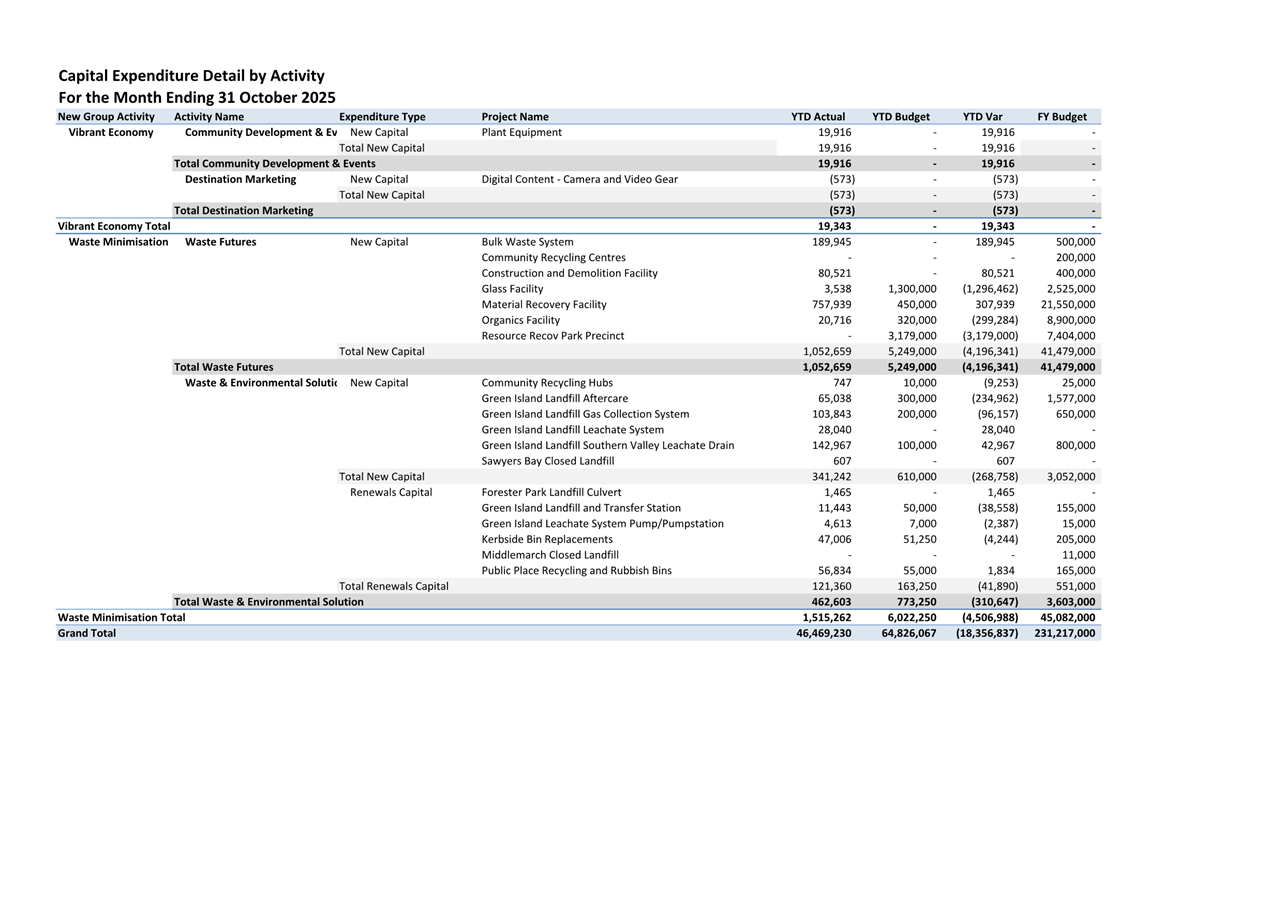
21 Financial
Report - Period ended 31 October 2025 410
22 Remuneration
and Governance Update 435
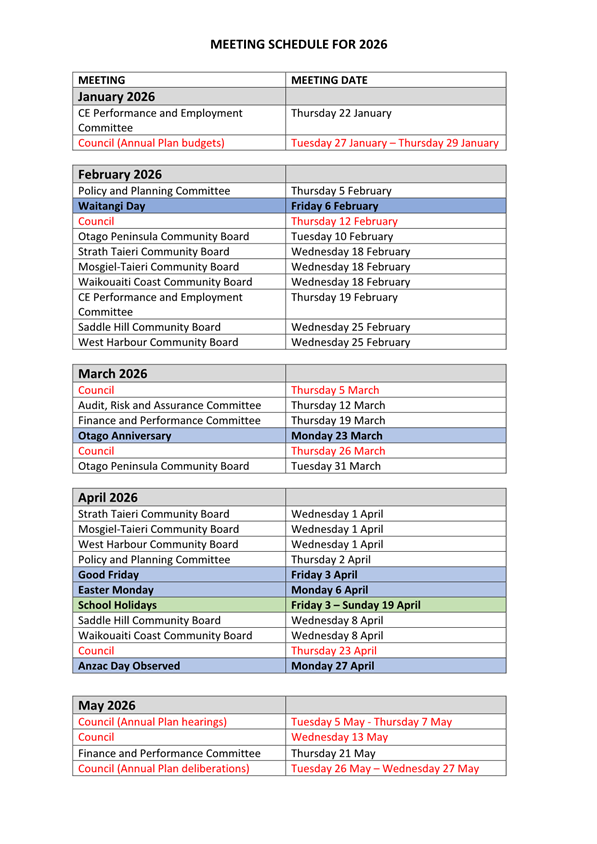
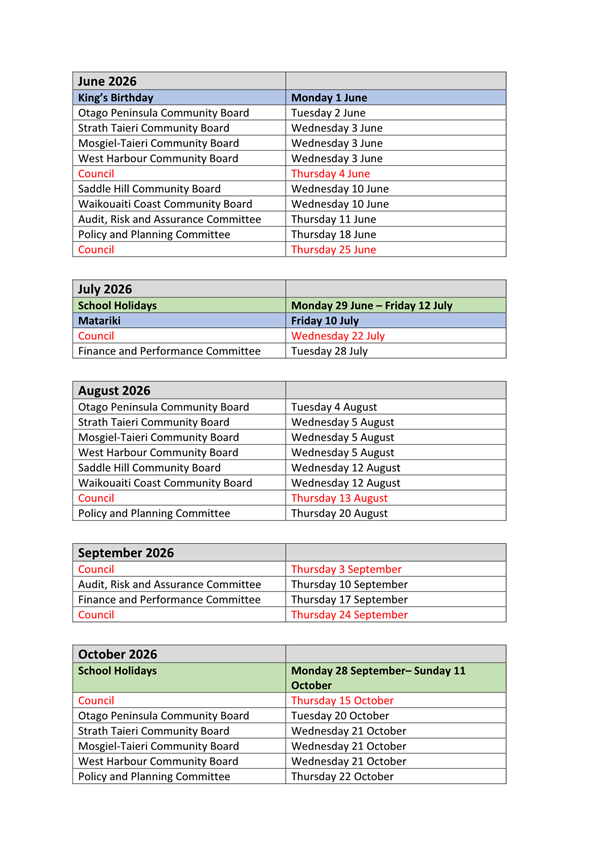
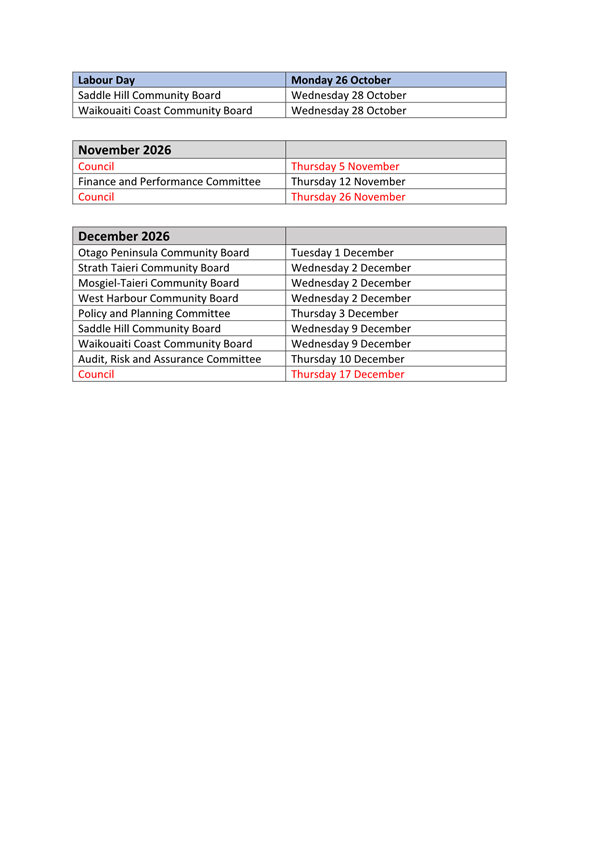
23 Meeting
Schedule for 2026 442
24 Proposed
Event Road Closures 449
Resolution to Exclude the Public 459
|

|
Council
11 December 2025
|
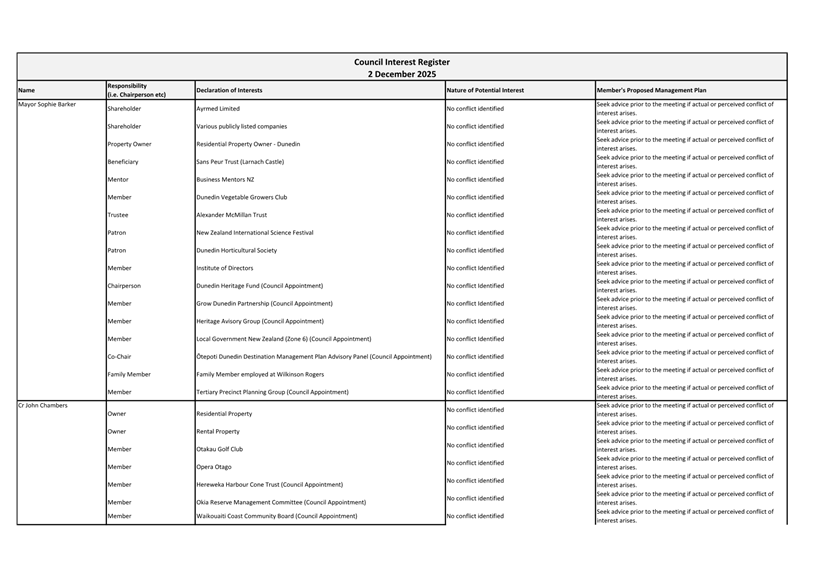
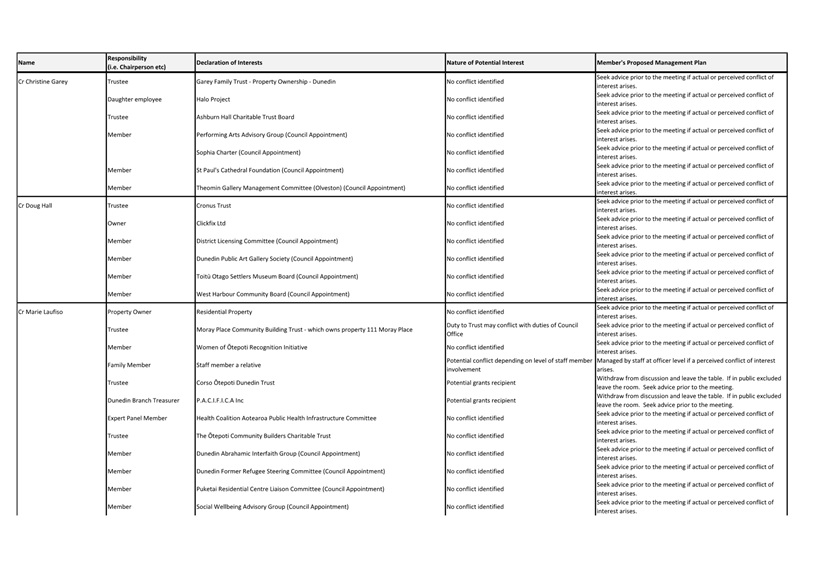
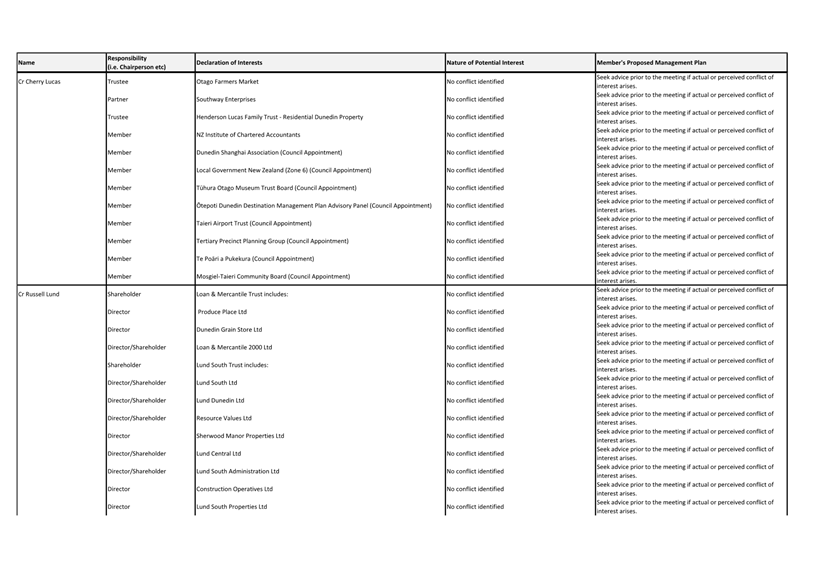
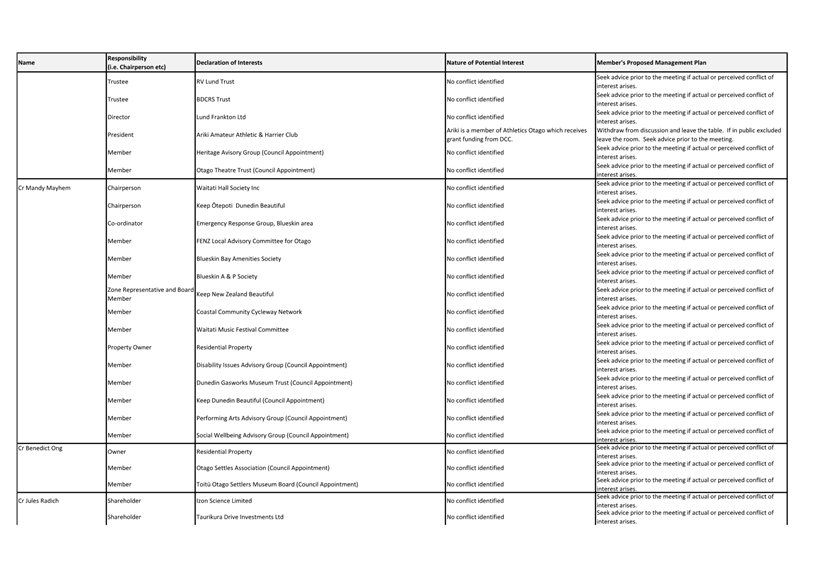
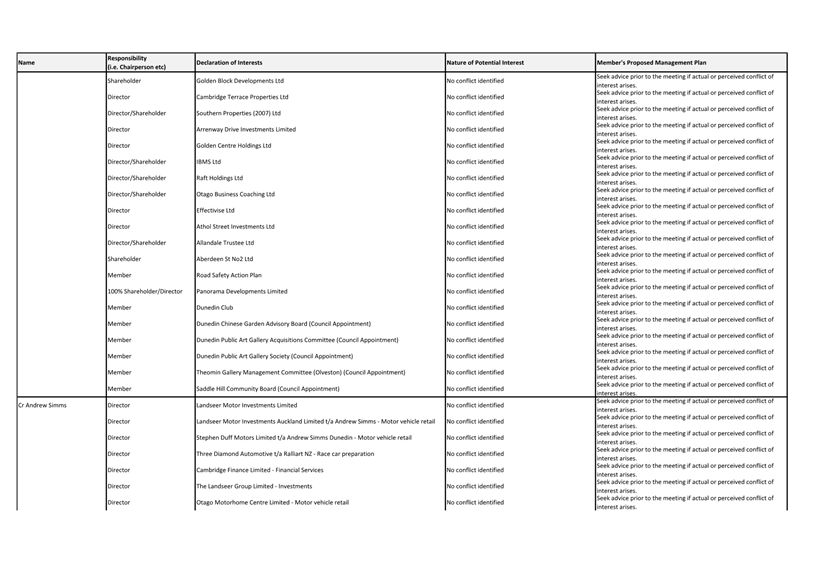
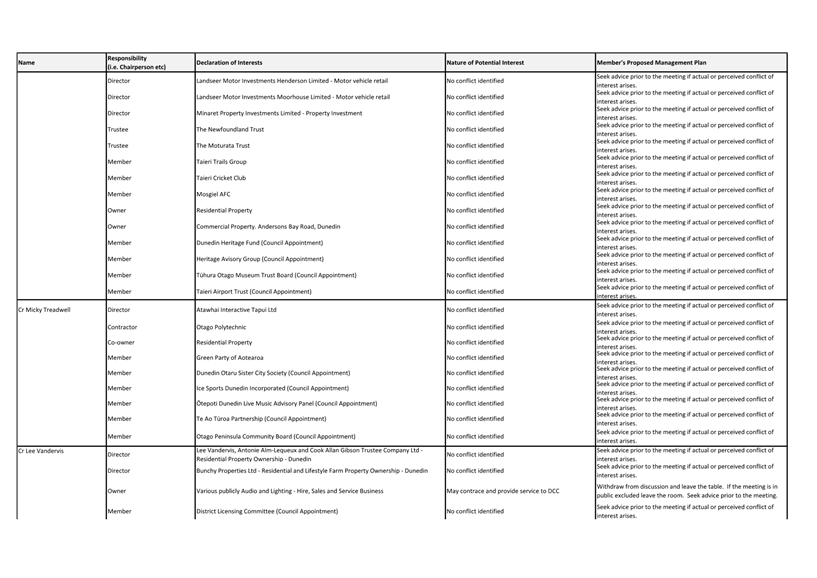
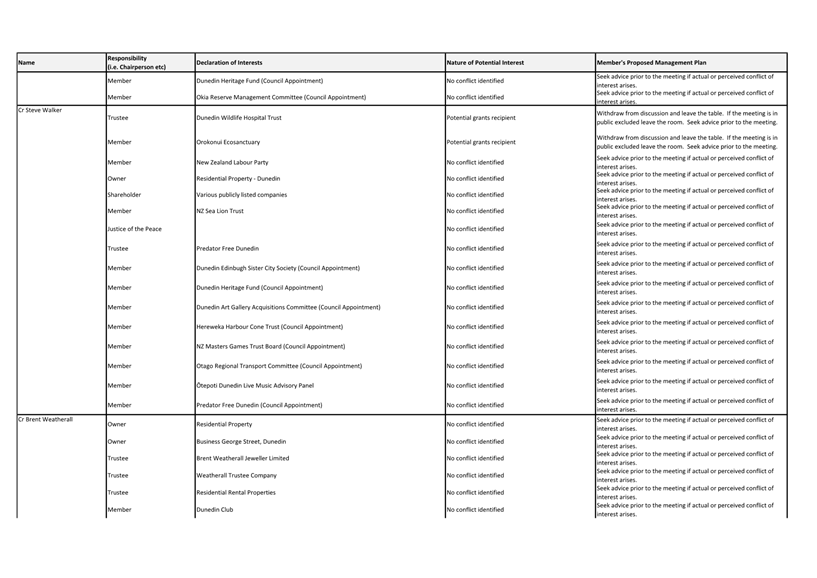
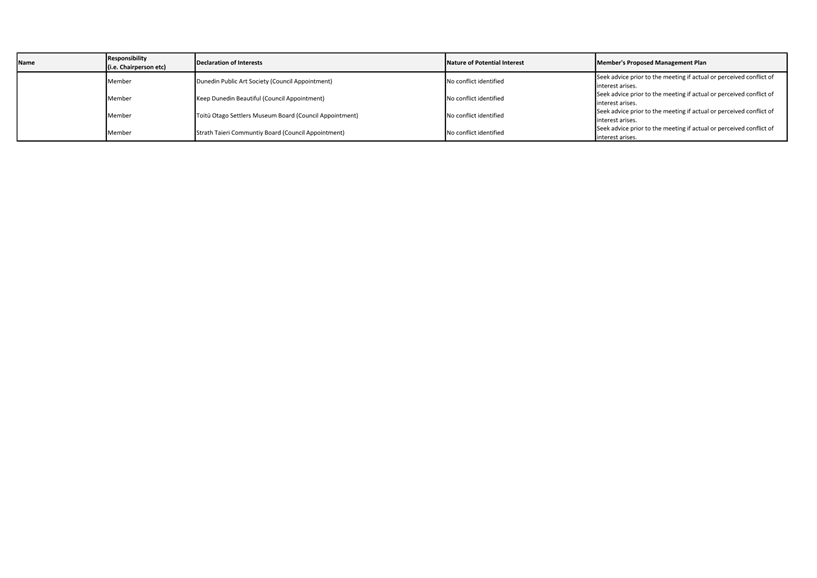
Declaration of Interest
EXECUTIVE SUMMARY
1. Members
are reminded of the need to stand aside from decision-making when a conflict
arises between their role as an elected representative and any private or other
external interest they might have.
2. Elected
members are reminded to update their register of interests as
soon as practicable, including amending the register at this meeting if
necessary.
3. Staff members are
reminded to update their register of interests as soon as practicable.
RECOMMENDATIONS
That the Council:
a) Notes/Amends if
necessary the Elected Members' Interest Register attached as Attachment A; and
b) Confirms/Amends the
proposed management plan for Elected Members' Interests.
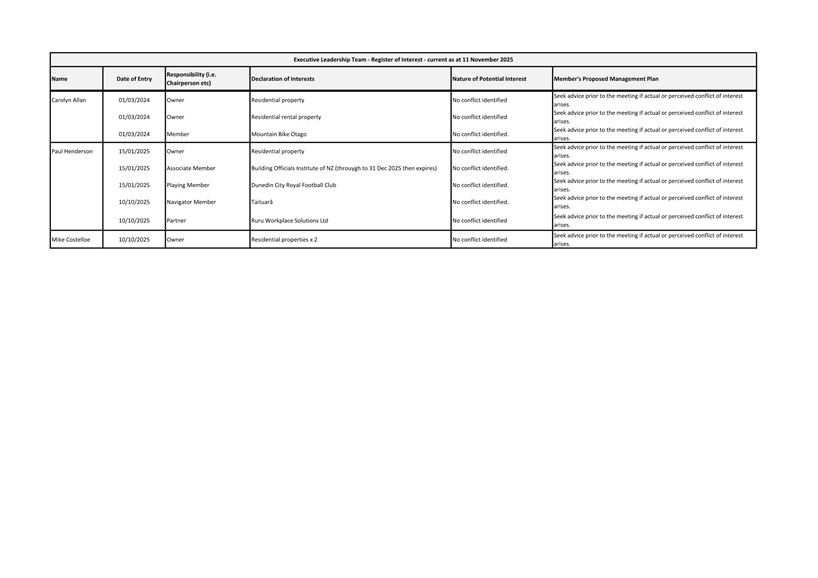
c) Notes the proposed
management plan for the Executive Leadership Team’s Interests.
Attachments
|
|
Title
|
Page
|
|
⇩a
|
Council Interest
Register
|
6
|
|
⇩b
|
Executive Leadership
Team Interest Register
|
14
|
|

|
Council
11 December 2025
|
Confirmation
of Minutes
Ordinary
Council meeting - 27 November 2025
RECOMMENDATIONS
That the Council:
a) Confirms the public
part of the minutes of the Ordinary Council meeting held on 27 November 2025 as
a correct record.
Attachments
|
|
Title
|
Page
|
|
A⇩
|
Minutes of Ordinary
Council meeting held on 27 November 2025
|
17
|
|

|
Council
11 December 2025
|

Council
MINUTES
Minutes of an ordinary
meeting of the Dunedin City Council held in the Council Chamber, Dunedin Public
Art Gallery, the Octagon, Dunedin on Thursday 27 November 2025, commencing at
10:00 a.m.
PRESENT
|
Mayor
|
Mayor Sophie Barker
|
|
|
Deputy Mayor
|
Cr Cherry Lucas
|
|
|
Members
|
Cr John Chambers
|
Cr Christine Garey
|
|
|
Cr Doug Hall
|
Cr Marie Laufiso
|
|
|
Cr Russell Lund
|
Cr Mandy Mayhem
|
|
|
Cr Benedict Ong
|
Cr Jules Radich
|
|
|
Cr Andrew Simms
|
Cr Mickey Treadwell
|
|
|
Cr Lee Vandervis
|
Cr Steve Walker
|
|
|
Cr Brent Weatherall
|
|
|
IN ATTENDANCE
|
Sandy Graham (Chief Executive),
Carolyn Allan (Chief Financial Officer), Scott MacLean (General Manager City
Services), David Ward (General Manager 3 Waters, Property and Urban
Development), Nicola Morand (Manahautū - General
Manager Community and Strategy), Paul Henderson (General Manager
Corporate and Regulatory Services), (Lisa Wilkie Kaiārahi – Team
Leader Creative Partnerships), Sian Sutton (Manager, Enterprise Dunedin),
Gina Hu’akau (Community Partnerships Manager), Simon Spiers (Team
Leader Regulation Management), Abbey Chamberlain (Senior Transport Planner),
Corporate Policy Manager (Nadia Wesley-Smith), Gill Brown (Principal Policy
Advisor Housing), Anna Nilsen (Group Manager Property), Janet Young
(Sustainable Travel Co-ordinator), Dr Berkley Kochak), Paula Dickel
(Strategic Property Advisor) and Jackie Harrison (Manager Governance).
|
Governance Support Officer Lynne
Adamson
1 Opening
Mrs Ruth Groffman opened the meeting with a prayer on
behalf of the Dunedin Jewish Community.
2 Public
Forum
There were five speakers for
Public Forum.
2.1 Aaron
Hawkins
Mr Hawkins, Strategic Lead of the
Otago Housing Alliance spoke in support of an outreach service in the city and
the requirement for this to be urgently addressed. He commented on need for
more public housing and greater support in general for whanau experiencing
homelessness.
Mr Hawkins responded to
questions.
2.2 David
Bainbridge-Zafar
Mr Bainbridge-Zafar spoke in
support of the introduction of fare free public transport for Dunedin. He
commented on the benefits cities across the world had experienced following
implementation of the scheme and urged Councillors to consider this for
Dunedin. Mr Bainbridge-Zafar requested the item be included in the next
Annual Plan for consultation.
Mr Bainbridge-Zafar responded to
questions.
2.3 Suzanne
Menzies-Culling
Ms
Menzies-Culling spoke on the importance of Waitangi Day celebrations in
Dunedin. She commented on her disappointment at recent city run treaty
festivals and that she would like to see better offerings in the future.
Ms
Menzies-Culling spoke of need to honour the memory of those who signed the
Treaty of Waitangi and observe the importance of the day. Dunedin had
many nationalities and cultures ant this was a chance to enhance the depth and
richness to all our communities..
Ms
Menzies-Culling responded to questions.
2.4 David
McKenzie
Mr McKenzie thanked Council for
the continued support for the Night Shelter and commented on the recent upgrade
to the property. He commented on the increase in service provided to
those who used the shelter, for example connecting people with agencies.
Mr McKenzie commented on the
necessity for a dedicated outreach worker and responded to questions.
Moved (Mayor Sophie/Cr Cherry
Lucas):
That the Council:
Extends
the Public Forum beyond 30 minutes.
Motion
carried
Mayor Sophie apologised for any
stress caused by the oversight of the establishment of the Grants Committee.
2.5 Lois
Scott-Muir and Joy Davis
Ms Scott-Muir and Ms Davis spoke
on behalf of Ōtepoti Community Builders. They explained the work of
the organisation and commented that it was an informal, volunteer run network
of organisations, groups and people from across the community sector in
Ōtepoti .
They commented that the grants
review had been underway for some time and they would like to see it
completed. Ms Scott-Muir and Ms Davis spoke of the importance of having
community representation on the grants committee and requested it be reinstated
with the full community representation.
Ms Scott-Muir and Ms Davis
responded to questions.
Crs Marie Laufiso and Mickey Treadwell left the meeting at
10.48 am
|
3 Apologies
|
|
|
There were no apologies.
|
|
4 Confirmation
of agenda
|
|
|
Moved (Mayor Sophie Barker/Cr Cherry Lucas):
That the Council:
Confirms the agenda
without addition or alteration.
Motion
carried (CNL/2025/315)
|
5 Declarations
of interest
Members were
reminded of the need to stand aside from decision-making when a conflict arose
between their role as an elected representative and any private or other
external interest they might have.
There were
no new declarations of interest.
Moved
(Mayor Sophie Barker/Cr Cherry Lucas):
That
the Council:
a) Notes the Elected Members' Interest Register; and
b) Confirms the proposed management plan for Elected Members'
Interests.
c) Notes the proposed management plan for the Executive Leadership
Teams’ Interests.
Motion
carried
6 Confirmation
of Minutes
|
6.1 Ordinary
Council meeting - 11 November 2025
|
|
|
Moved (Mayor Sophie Barker/Cr Cherry Lucas):
That the Council:
a) Confirms the public part of the minutes of the
Ordinary Council meeting held on 11 November 2025 as a correct record with
minor editorial changes.
Motion
carried (CNL/2025/316)
|
Reports
|
7 Actions
From Resolutions of Council Meetings
|
|
|
A report from Civic provided
an update on the implementation of resolutions made at Council
meetings.
|
|
Cr Marie Laufiso and Mickey Treadwell returned to the
meeting at 10.51 am.
|
|
|
The Chief Executive (Sandy Graham) and General Manager
City Services (Scott MacLean) and (General Manager Corporate and Regulatory
Services) Paul Henderson responded to questions.
|
|
|
Moved (Mayor Sophie Barker/Cr Cherry Lucas):
That the Council:
a) Notes
the Open and Completed Actions from resolutions of Council meetings.
Motion carried (CNL/2025/317)
|
|
8 Council
Forward Work Programme
|
|
|
A report from Civic provided
the updated Council forward work programme for the 2025 year.
|
|
|
The Chief Executive (Sandy Graham) responded to questions.
|
|
|
Moved (Mayor Sophie Barker/Cr Cherry Lucas):
That the Council:
a) Notes the updated Council forward work programme.
Motion
carried (CNL/2025/318)
|
|
9 Amendment
to Road Naming Policy
|
|
|
A report from Transport
sought approval for an amendment to the Road Naming Policy document adopted
by Council in 2016.
Staff recommend that changes
were made to the application of the Road Naming Policy to allow developers to
use pre-approved names from the Road Name Register, without requiring a
second road naming report to be submitted to Council or a delegated Committee.
|
|
|
The General Manager, City Services (Scott MacLean); Team Leader Regulation Management (Simon Spiers)
and Senior Transport Planner (Abbey Chamberlain) spoke to the report and
responded to questions.
|
|
Moved (Mayor Sophie/Cr Cherry Lucas):
That the Council:
Adjourns
the meeting.
Motion
carried
The meeting adjourned at 11.33 am and reconvened at 11.37
am.
Cr Jules Radich left the meeting at 11.33 am
|
|
|
Moved (Cr Mandy Mayhem/Cr Steve Walker):
That the Council:
a) Approves the proposed amendments to the Road
Naming Policy.
Motion
carried (CNL/2025/319)
|
|
10 Traffic
and Parking Bylaw Review Update
|
|
|
A report from Transport
provided an update on the review of the Traffic and Parking Bylaw and
outlined the next steps which included development of draft documents and
consultation on any proposed changes and timeframes.
|
|
Crs Benjamin Ong and Jules Radich returned to the meeting
at 11.40 am.
|
|
|
The General Manager, City Services (Scott MacLean); Team
Leader Regulation Management (Simon Spiers) and Senior Transport Planner
(Abbey Chamberlain) spoke to the report and responded to questions.
|
|
|
Moved (Mayor Sophie Barker/Cr Mandy Mayhem):
That the Council:
a) Notes the Traffic and Parking Bylaw review update.
Motion
carried (CNL/2025/320)
|
|
11 Taieri
Mouth Road Speed Limit Change Consultation
|
|
|
A report from Transport
proposed an upcoming consultation on a proposed speed limit change on Taieri
Mouth Road between Brighton and Taieri Mouth.
A speed limit reduction from
100km/h to 80km/h along Taieri Mouth Road had been proposed in the draft
Speed Management Plan that the Dunedin City Council consulted on in
2023. During that consultation, 20 Kuri Bush residents signed a
submission which supported an 80km/h speed limit on Taieri Mouth Road through
the Kuri Bush settlement.
Following the release of the
Land Transport Rule: Setting of Speed Limits 2024 the Dunedin City Council
was unable to proceed with the draft Speed Management Plan as the process for
setting speed limits had changed.
Public consultation on the
proposal to reduce the Taieri Mouth Road speed limit from 100km/h to 80km/h
in accordance with the Setting of Speed Limits Rule 2024, would occur in
early 2026.
|
|
|
The General Manager, City Services (Scott MacLean), Team
Leader Regulation Management (Simon Spiers) and Safe and Sustainable Travel Co-ordinator (Janet Young) spoke
to the report and responded to questions.
|
|
|
Moved (Mayor Sophie Barker/Cr Mandy Mayhem):
That the Council:
a) Notes the Taieri Mouth Road Speed Limit Change Consultation
report.
Motion
carried (CNL/2025/321)
|
|
12 Resolution
to Stop Part of Glengyle Street, Vauxhall
|
|
|
A report from Property sought
approval for a road stopping process for 158m2 of land adjoining 42 Glengyle
Street, Vauxhall, as the public notification process has been completed and
no objections were received.
|
|
|
The General Manager 3 Waters, Property and Urban
Development (David Ward), Group Manager Property
(Anna Nilsen) and Strategic Property Advisor (Paula Dickel) spoke to the
report and responded to questions.
|
|
|
Moved (Mayor Sophie Barker/Cr Cherry Lucas):
That the Council:
a) Resolves that under Section 342 of the Local
Government Act 1974 the part of unformed road described as Section 1 SO
610112 is stopped.
b) Notes that no objections were submitted during the public
notice period.
c) Authorises a public notice declaring that the road
is stopped.
Motion
carried (CNL/2025/322)
|
|
13 Lower
Value Grants - process amendment
|
|
|
A report from Civic and
Corporate Policy sought approval for an amendment to the Chief Executive
Officer’s delegations to enable staff assessment and approval of
applications for grants of up to $5,000 (excluding Rates Relief grants) that
were funded and administered by the Dunedin City Council.
The report noted that in
order to satisfy Council’s granting procedures, and to enable
applicants to meet project and event deadlines, it was necessary to make
decisions on grant categories before the end of 2025.
|
|
|
The Chief Executive (Sandy Graham) and Manahautū
(General Manager Community and Strategy) (Nicola Morand) spoke to the report
and responded to questions.
|
|
Moved (Mayor Sophie/Cr Cherry Lucas):
That the Council:
Adjourns
the meeting for 45 minutes.
Motion
carried
The meeting adjourned at 12.18 pm and reconvened at 1.01
pm.
Cr Jules Radich entered the meeting at 1.04 pm.
Cr Benedict Ong entered the meeting at 1.09 pm.
|
|
|
Moved (Cr Marie Laufiso/Cr Christine Garey):
That the Council:
a) Amends the Chief Executive Officer’s
delegations to enable approval of Dunedin City Council–funded and
administered grant applications (excluding Rates
Relief) valued at $5,000 or less, as follows:
1 The
Chief Executive is delegated the power to approve or decline applications
for grants that are funded and administered by the Council, provided that:
i) The grant was
within an approved budget; and
ii) The maximum
possible grant value awarded to an applicant does not exceed $5,000; and
iii) The power to approve or decline the grant
has not been reserved to the Council under this Manual or by resolution.
2 The
Chief Executive may sub-delegate this authority to any other officer of the
Council, subject to:
i) The
sub-delegation being in writing and suitably recorded; and
ii) The grant
being signed off by the relevant General Manager.
3 This delegation would
expire on 31 December 2025
b) Notes that staff will provide a report to the 11 December 2025
Council meeting on the allocation of the grants funding.
Division
The Council voted by division
For: Crs
John Chambers, Christine Garey, Doug Hall, Marie Laufiso, Cherry Lucas, Mandy
Mayhem, Benedict Ong, Jules Radich, Mickey Treadwell, Steve Walker, Brent
Weatherall and Mayor Sophie Barker (12).
Against: Crs
Russell Lund, Andrew Simms and Lee Vandervis (3).
Abstained: Nil
The
division was declared CARRIED by 12 votes to 3
Motion
carried (CNL/2025/323)
|
|
14 Housing
Outreach Service Proposal
|
|
|
A report from Policy and
Partnerships responded to Council’s agreement in principle to establish
a Council-led housing outreach service and outlined the associated
implications and costs.
It sought direction from
Council on whether to fund the service as an unbudgeted overspend in the
current financial year to enable immediate establishment, or to defer
establishment until it could be considered through the annual plan budgeting
process.
|
|
|
The Manahautū (General Manager Community and
Strategy) (Nicola Morand) and Principal Policy
Advisor Housing (Gill Brown) spoke to the report and responded to
questions.
|
|
Moved (Mayor Sophie/Cr Cherry Lucas):
That the Council:
Adjourns
the meeting for five minutes.
Motion
carried
The meeting adjourned at 2.01 pm and reconvened at 2.09
pm.
|
|
During discussion Cr Mandy Mayhem left the meeting at 2.37
pm and returned at 2.39 pm.
It was agreed that resolution a) would be taken
separately.
|
|
|
Moved (Cr Andrew Simms/Cr Russell Lund):
That the Council:
a) Confirms
its commitment to establishing and funding a Housing Outreach service in the
city;
Motion
carried (CNL/2025/324)
|
|
|
Moved (Cr Andrew Simms/Cr Russell Lund):
That the Council:
b) Authorises
the CEO to develop the terms for the service as an Expression of Interest
(EOI) for an outreach service noting that the terms would include:
i) an
initial 3 year service beginning in April 2026,
ii) performance
measures and community outcomes
iii) annual reporting requirements.
c) Directs
staff to undertake an EOI process to seek proposals from community providers
to deliver the outreach service;
d) Reports
back to Council on the EOI outcome, alongside the in-house option, for a
decision on the preferred provider/model and confirmation of the final
funding for the first three years of the service.
Division
The
Council voted by division
For: Crs
Cherry Lucas, Russell Lund, Benedict Ong, Jules Radich, Andrew Simms, Lee
Vandervis, Brent Weatherall and Mayor Sophie Barker (8).
Against: Crs
John Chambers, Christine Garey, Doug Hall, Marie Laufiso, Mandy Mayhem,
Mickey Treadwell and Steve Walker (7).
Abstained: Nil
The division was declared CARRIED by 8 votes to 7
Motion
carried (CNL/2025/325)
|
Mayor Sophie Barker/Cr Cherry Lucas:
That the Council:
Adjourns
the meeting for 10 minutes.
Motion
carried
The meeting adjourned at 3.05 pm and reconvened at 3.16 pm.
Crs Russell Lund and Brent Weatherall returned to the
meeting at 3.17 pm.
|
15 Ōtepoti
Youth Action Plan (ŌYP) – update
|
|
|
A report from Community
Services sought Councils’ approval to develop an Ōtepoti Youth
Action Plan (ŌYP), aligned with the Ōtepoti Youth Vision
(ŌYV), and informed by youth engagement, survey data, and youth sector
collaboration.
The report also provided an
update on youth-related work undertaken by the Dunedin City Council, in
relation to the two Council resolutions which Directed staff to develop a
draft Ōtepoti Rakatahi Taiohi Young People’s Action Plan in
consultation with Māori and Pasifika agencies and Directed staff to work
with the Dunedin Youth Council and Mirror Services to identify a suitable
site for a Youth Hub.
|
|
|
The Manahautū (General Manager Community and
Strategy) (Nicola Morand) and Community Partnerships
Manager (Gina Hu’akau) spoke to the report and responded to
questions.
|
|
|
Moved (Cr Mickey Treadwell/Cr Steve Walker):
That the Council:
a) Notes
the progress update on youth-related activities and resolutions.
b) Notes
the attached Summary of Youth Survey Findings (2024).
c) Approves
the process to develop the Ōtepoti Youth Action Plan (ŌYP),
aligned with the Ōtepoti Youth Vision (ŌYV), and informed by
engagement with youth stakeholders and partners.
Motion
carried (CNL/2025/326)
|
|
16 Residents'
Opinion Survey Quarterly Update: July - September
2025
|
|
|
A
report from Corporate Policy provided a summary of the Residents’
Opinion Survey quarterly results for Quarter One 2025-2026 (July-September
2025).
The
Quarterly results showed a comparison between the fourth quarter of the last
financial year (April-June 2025), and the first quarter of the current year
(July-September 2025).
|
|
|
The Manahautū (General Manager Community and
Strategy) Nicola Morand and Corporate Policy Manager
(Nadia Wesley-Smith) spoke to the report and responded to questions.
|
|
|
Moved (Mayor Sophie Barker/Cr Cherry Lucas):
That the Council:
a) Notes the Residents’ Opinion Survey quarterly results
for the period of July-September 2025 (Quarter One 2025/26).
b) Notes the previous contract for the Residents’
Opinion Survey expired on 31 August 2025 with no further extensions.
The open market procurement plan has now been completed and a new contract
has been signed.
c) Notes the ROS questionnaire has been updated to reflect the
measures for LoS statements as adopted by Council in the 9 Year Plan 2025-34.
Motion
carried (CNL/2025/327)
|
Moved (Mayor Sophie/Cr Mandy Mayhem):
That the Council:
Extends
the meeting beyond 6 hours.
Motion
carried
|
17 New
Zealand Masters Games Statement of Intent and Service Level Agreement 2025 -
2027
|
|
|
A report from Events
presented the Statement of Intent (SOI) and Service Level Agreement (SLA) for
the Dunedin (New Zealand) Masters Games Trust for approval.
|
|
|
The Manager, Enterprise Dunedin (Sian Sutton) and Masters
Games Manager (Vicki Kestila) spoke to the report and responded to
questions..
|
|
|
Moved (Cr Steve Walker/Cr Mandy Mayhem):
That the Council:
a) Approves the 2025 – 2027 Dunedin (New
Zealand) Masters Games Trust Statement of Intent.
b) Approves the 2025 – 2027 Dunedin (New
Zealand) Masters Games Trust Service Level Agreement.
Motion
carried (CNL/2025/328)
|
|
18 2026
New Zealand Masters Games Operational and Financial Update
|
|
|
A report from Events and
Finance provided an update on the operational and financial status of the
biennial New Zealand Masters Games to be held in Dunedin (31 January –
8 February 2026).
Financially the 2026 New
Zealand Masters Games was on track with 88.31% of budgeted revenue confirmed.
Registrations, opened since 9 September 2025, were currently slightly behind
those received at the same time for the 2024 Games.
The Manager, Enterprise Dunedin
(Sian Sutton) and Masters Games Manager (Vicki Kestila) spoke to the
report and responded to questions..
|
|
|
Moved (Cr Steve Walker/Cr Mandy Mayhem):
That the Council:
a) Notes the New Zealand Masters Games operational and financial
update.
b) Approves the 2026 New Zealand Masters Games
proceeding.
Motion
carried (CNL/2025/329)
|
|
19 Dunedin
City Council submission on the Otago Regional Council Indigenous Biodiversity
Strategy 2025
|
|
|
A report from Corporate
Policy sought consideration and approval of a draft submission to the Otago
Regional Council (ORC) on the ORC Indigenous Biodiversity Strategy 2025.
The consultation seeks
feedback on the need for and design of the Strategy, which included:
· a
long-term vision for the region and shorter-term outcomes to aim for between
now and 2040
· ORC’s
approach to supporting and strengthening the collective effort of mana
whenua, communities, landowners, businesses, central government, and local
councils
· How
the ORC delivers on its responsibilities and meets community expectations to
care for Otago’s native biodiversity.
|
|
|
The General Manager, City Services (Scott MacLean) and Policy Analyst (Dr Berkley Kochak) spoke to the
report and responded to questions.
Councillors briefly discussed the Government’s
proposal to restructure regional councils and agreed to send a letter of
support to the Otago Regional Council regarding the proposal.
|
|
|
Moved (Cr Steve Walker/Cr Mickey Treadwell):
That the Council:
a) Approves the draft Dunedin City Council
submission, with minor editorial amendments, on the Otago Regional Council’s
Indigenous Biodiversity Strategy 2025.
b) Authorises the Chief Executive to make any minor
editorial amendments to the submission .
c) Notes that the Mayor or delegate will speak to the
submission at any hearings.
Motion
carried (CNL/2025/330)
|
|
Resolution to Exclude the Public
|
|
Moved (Mayor Sophie Barker/Cr Steve Walker):
That the Council:
Pursuant
to the provisions of the Local Government Official Information and Meetings
Act 1987, exclude the public from the following part of the proceedings of
this meeting namely:
|
General
subject of the matter to be considered
|
Reasons for
passing this resolution in relation to each matter
|
Ground(s) under
section 48(1) for the passing of this resolution
|
Reason for
Confidentiality
|
|
C6
DCC Professional Theatre Fund Grants Applications
|
S7(2)(b)(ii)
The withholding of
the information is necessary to protect information where the making
available of the information would be likely unreasonably to prejudice the
commercial position of the person who supplied or who is the subject of the
information.
|
S48(1)(a)
The public conduct of
the part of the meeting would be likely to result in the disclosure of
information for which good reason for withholding exists under section 7.
|
|
This resolution is made in
reliance on Section 48(1)(a) of the Local Government Official Information and
Meetings Act 1987, and the particular interest or interests protected by
Section 6 or Section 7 of that Act, or Section 6 or Section 7 or Section 9 of
the Official Information Act 1982, as the case may require, which would be
prejudiced by the holding of the whole or the relevant part of the
proceedings of the meeting in public are as shown above after each item.
Adjourns the meeting for 5 minutes.
Motion
carried (CNL/2025/331)
|
The meeting moved into confidential and adjourned at 4.21 pm
and Cr Lee Vandervis left the meeting.
The meeting resumed in public at 4.46 pm.
|
20 DCC
Theatre Fund Grants
|
|
|
A report from Ara Toi
summarised grant applications and included applicant data and funding
recommendations to the Dunedin City Council (DCC) Professional Theatre Fund
for the September 2025 round.
|
|
|
The Manahautū - General Manager, Community and
Strategy (Nicola Morand) and Kaiārahi –
Team Leader Creative Partnerships (Lisa Wilkie) spoke to the
applications.
|
|
|
Moved (Cr Cherry Lucas/Mayor Sophie Barker):
That the Council:
a) Declines DCC Professional Theatre Funding to
HicSunt Dracones Productions (under auspice of Stage South Charitable Trust);
and
b) Declines DCC Professional Theatre funding to
Stage South Charitable Trust.
Motion
carried (CNL/2025/332)
|
|
|
Moved (Cr Cherry Lucas/Mayor Sophie Barker):
That the Council:
a) Approves
DCC Professional Theatre funding of:
i) $8,474.00
to Afterburner (under auspice of WOW! Productions)
ii) $15,000.00
to Birds of a Feather (under the auspice of He Waka Eke Noa Charitable
Trust)
iii) $14,000.00
to Carol Brown Dances and Collaborations
iv) $16,000.00
to Curiouser & Curiouser (under auspice of Stage South Charitable Trust)
v) $14,000
to Dunedin Summer Shakespeare (under auspice of Castle Charitable Trust)
vi) $9,826.00
to Glorious Ruins (under the auspice of Stage South Charitable Trust)
vii) $6,000.00
to Improsaurus Incorporated
viii) $14,900.00
to Stage South Charitable Trust
Motion
carried (CNL/2025/333)
|
|
Resolution to Exclude the Public
|
|
Moved (Mayor Sophie Barker/Cr Cherry Lucas):
That the Council:
Pursuant
to the provisions of the Local Government Official Information and Meetings
Act 1987, exclude the public from the following part of the proceedings of
this meeting namely:
|
General
subject of the matter to be considered
|
Reasons for
passing this resolution in relation to each matter
|
Ground(s) under
section 48(1) for the passing of this resolution
|
Reason for Confidentiality
|
|
C1
Confidential Council Action List Update
|
S7(2)(b)(ii)
The withholding of
the information is necessary to protect information where the making
available of the information would be likely unreasonably to prejudice the
commercial position of the person who supplied or who is the subject of the
information.
S7(2)(g)
The withholding of
the information is necessary to maintain legal professional privilege.
S7(2)(h)
The withholding of
the information is necessary to enable the local authority to carry out,
without prejudice or disadvantage, commercial activities.
S7(2)(i)
The withholding of
the information is necessary to enable the local authority to carry on,
without prejudice or disadvantage, negotiations (including commercial and
industrial negotiations).
|
S48(1)(a)
The public conduct of
the part of the meeting would be likely to result in the disclosure of
information for which good reason for withholding exists under section 7.
|
|
|
C2
Confidential Council Forward Work Programme
|
S7(2)(a)
The withholding of
the information is necessary to protect the privacy of natural persons,
including that of a deceased person.
S7(2)(d)
The withholding of
the information is necessary to avoid prejudice to measures protecting the
health and safety of members of the public.
S7(2)(g)
The withholding of
the information is necessary to maintain legal professional privilege.
S7(2)(h)
The withholding of
the information is necessary to enable the local authority to carry out,
without prejudice or disadvantage, commercial activities.
S7(2)(i)
The withholding of
the information is necessary to enable the local authority to carry on,
without prejudice or disadvantage, negotiations (including commercial and
industrial negotiations).
|
S48(1)(a)
The public conduct of
the part of the meeting would be likely to result in the disclosure of
information for which good reason for withholding exists under section 7.
|
|
|
C3
Investment Property Portfolio - Quarter ending 30 September 2025
|
S7(2)(b)(ii)
The withholding of
the information is necessary to protect information where the making
available of the information would be likely unreasonably to prejudice the
commercial position of the person who supplied or who is the subject of the
information.
|
S48(1)(a)
The public conduct of
the part of the meeting would be likely to result in the disclosure of
information for which good reason for withholding exists under section 7.
|
|
|
C4
Ōtepoti Performing Arts Advisory Panel Membership
|
s48(1)(d)
Check to make report confidential.
|
s48(1)(d)
The exclusion of the
public from the part of the meeting is necessary to enable the local
authority to deliberate in private on its decision or recommendation.
|
This report and its
attachments include details of individuals that may be discussed by Council
members. Confidentiality is required to protect the privacy of applicants
for positions on the Performing Arts Advisory Panel..
|
|
C5
Appointment to Otago Museum Trust Board
|
S7(2)(a)
The withholding of
the information is necessary to protect the privacy of natural persons,
including that of a deceased person.
|
S48(1)(a)
The public conduct of
the part of the meeting would be likely to result in the disclosure of
information for which good reason for withholding exists under section 7.
|
|
This resolution is made in reliance on Section
48(1)(a) of the Local Government Official Information and Meetings Act 1987,
and the particular interest or interests protected by Section 6 or Section 7
of that Act, or Section 6 or Section 7 or Section 9 of the Official
Information Act 1982, as the case may require, which would be prejudiced by
the holding of the whole or the relevant part of the proceedings of the
meeting in public are as shown above after each item.
Motion
carried (CNL/2025/334)
|
The meeting moved into confidential at 4.20 pm and resumed
in public at 5.43 pm.
|
20
a) DCC Professional Theatre Fund Grants CONTINUED
|
|
|
It was noted that the application from Dunedin Summer
Shakespeare (under the auspice of Castle Charitable Trust)) had been inadvertently
missed off the resolutions of the DCC Professional Theatre Funding Grants
considered earlier in the meeting.
|
|
|
Moved (Cr Cherry Lucas/Cr Mandy Mayhem):
That the Council:
a) Pursuant
to Standing Orders 23.5, alters Resolution (CNL/2025/333) as follows:
Approves DCC Professional Theatre Funding
of:
i) $8,474.00
to Afterburner (under auspice of WOW! Productions);
ii) $15,000
to Birds of a Feather (under auspice of He Waka Eke Noa Charitable Trust)
iii) $14,000.00
to Carol Brown Dances and Collaborations
iv) $16,000.00
to Curiouser & Curiouser (under auspice of Stage South Charitable Trust)
v) $14,000.00
to Dunedin Summer Shakespeare (under auspice of Castle Charitable Trust)
vi) $9,826.00
to Glorious Ruins (under auspice of Stage South Charitable Trust)
vii) $6,000.00
to Improsaurus Incorporated
viii) $14,900.00
to Stage South Charitable Trust.
Motion
carried (CNL/2025/335)
|
The meeting moved into confidential at 4.56 pm
..............................................
MAYOR
|

|
Council
11 December 2025
|
Reports
NZTA State Highway response to the New Dunedin Hospital
Department: Transport
EXECUTIVE SUMMARY
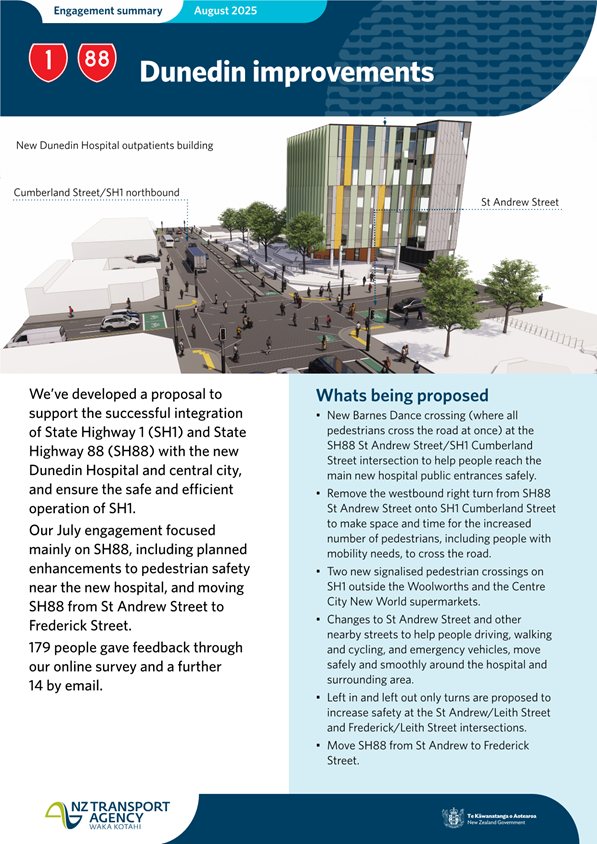
1 The
NZ Transport Agency Waka Kotahi (NZTA) consulted on its State Highway 88
project and proposed changes on State Highway 1 near the New Dunedin Hospital
in July 2025.
2 The
main changes proposed are:
· A new Barnes Dance
crossing at the corner of St Andrew Street and Cumberland Street
· Removal of
westbound right turn from St Andrew Street to Cumberland Street
· Two new signalised
pedestrian crossings on State Highway 1 near Woolworths and Centre City New
World
· Street changes to
support movement for all modes, including emergency vehicles
· Left-in/left-out
turns at St Andrew/Leith and Frederick/Leith streets
· Shifting of the
State Highway from St Andrew Street to Frederick Street.
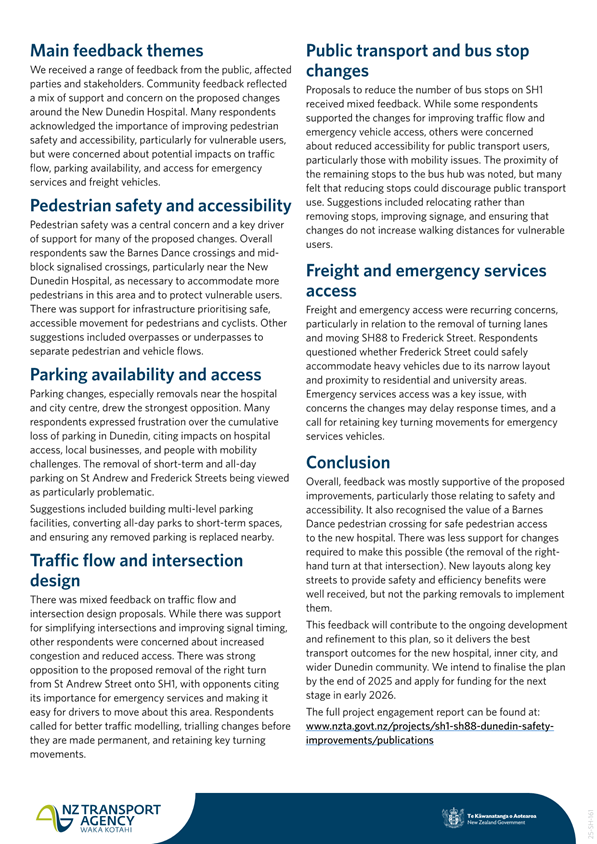
3 The
purpose of this paper is to present Council with the key themes from the State
Highway 88 consultation in order to progress to the next phase of the project.
4 The
proposed changes provide investment into Dunedin to improve safety and
accessibility in the central city for all users.
5 While
Council involvement supports a more coordinated outcome, NZTA may still
progress the project independently as it relates to a State Highway under their
management.
RECOMMENDATIONS
That the Council:
a) Considers if it wishes
to support the NZTA proposal to move to the
next stage of the project which includes the revocation process to move
State Highway 88 from St Andrew Street and parts of Anzac Avenue to Frederick
Street.
BACKGROUND
6 In
response to the announcement of the New Dunedin Hospital location, the Dunedin
City Council (DCC), the Otago Regional Council, and NZ Transport Agency Waka
Kotahi (NZTA) formed the Connecting Dunedin Partnership and developed a joint
programme of work. This included proposed changes to State Highway 1 (SH1) and
State Highway 88 (SH88).
7 The
National Land Transport Programme 2024-2027 indicatively allocated $20m for SH1
changes (including wider changes to SH1 between Andersons Bay and Pine Hill)
and $12.4m for SH88. These improvements would be 100% funded by NZTA.
8 The
NZTA SH88 project is intended to support access, safety, and travel options
around the New Dunedin Hospital. The project includes moving SH88 from St Andrew
Street and parts of Anzac Avenue to Frederick Street.
9 Proposed
changes are:
· A new Barnes Dance
crossing at the SH88 St Andrew Street/SH1 Cumberland Street intersection to
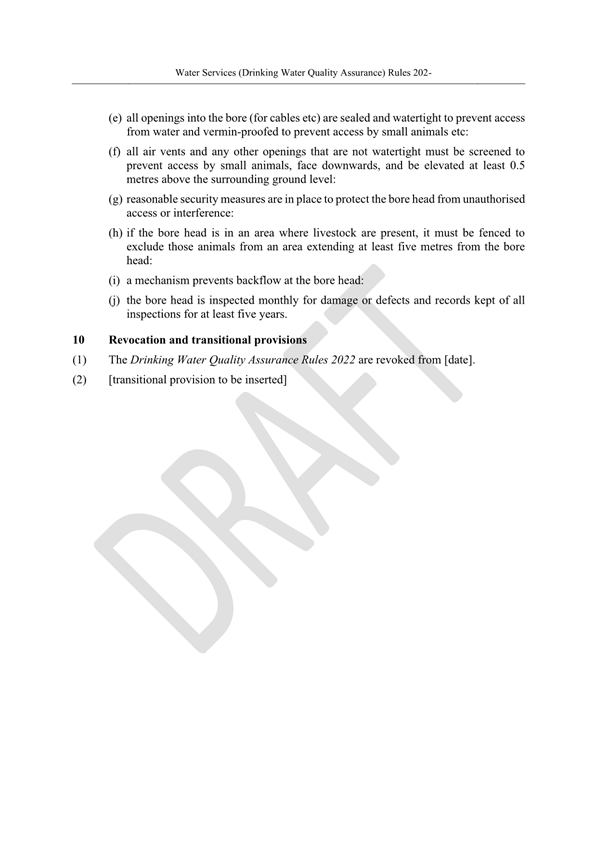
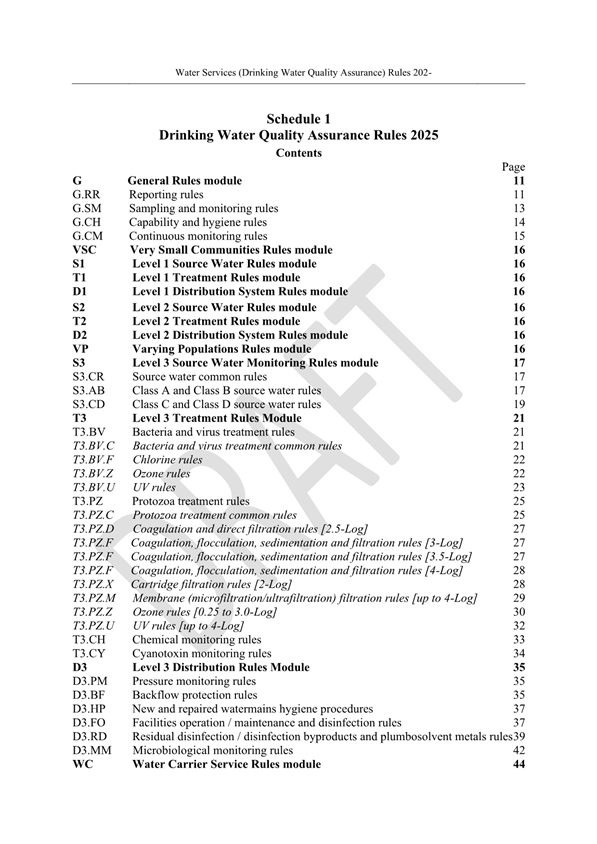
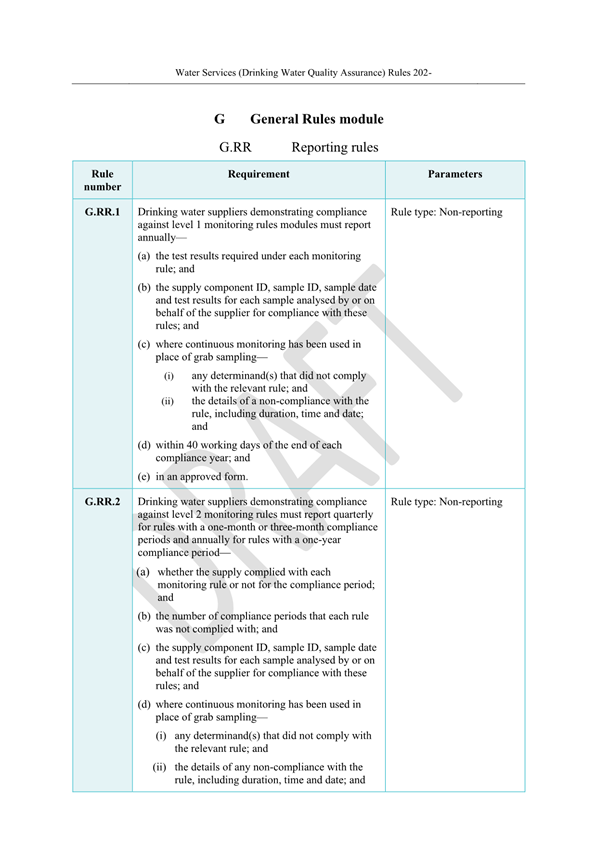
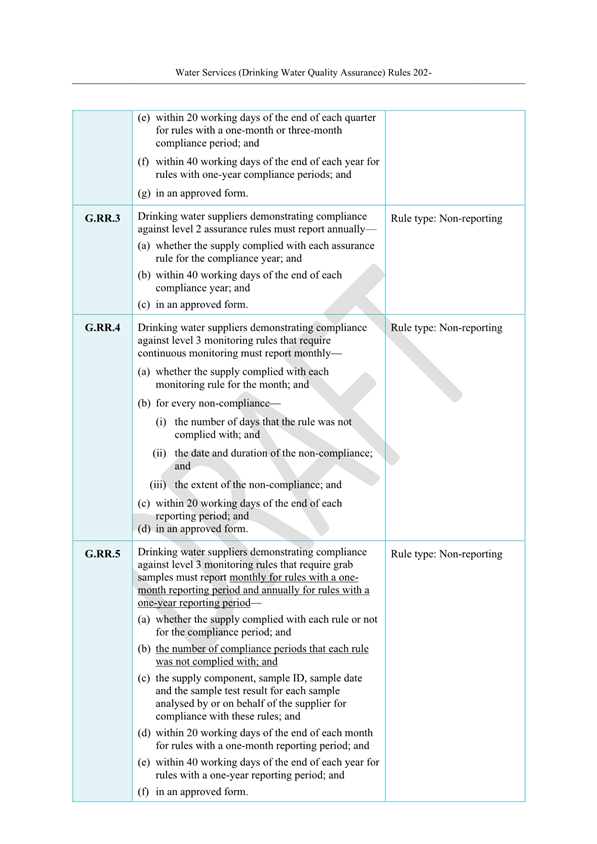
help people access and move between the two hospital buildings. Included
at this intersection is the removal of the westbound right turn from SH88 St
Andrew Street onto SH1 Cumberland Street to create space and time for the
predicted increased numbers of pedestrians, including people with disabilities,
to cross the road.
· Two new signalised
pedestrian crossings on SH1 outside the Woolworths and Centre City New World
supermarkets (mid-block crossings).
· Changes to St
Andrew Street and other nearby streets to help people drive, walk and cycle,
and to allow emergency vehicles to move safely and easily around the hospital
and surrounding area.
· Left in, and left
out, only turns to increase safety at the St Andrew/Leith Street and
Frederick/Leith Street intersections.
· The movement of SH88
from St Andrew Street to Frederick Street through a formal revocation process.
It is anticipated approximately 14 parks would be lost on Frederick Street as a
result of the change in status of this road.
10 Current
traffic volumes on Great King Street, in front of the existing hospital
entrance, are approximately 4,000 vehicles per day. Cumberland Street, near the
New Dunedin Hospital site, sees around 18,000 vehicles per day.
11 On
30 April 2025, NZTA briefed the Council on its proposed changes and advised
that it was in the process of preparing for public consultation.
|
|
Moved (Mayor Jules Radich/Cr Cherry Lucas):
That the Council:
a) Notes that
the NZTA was preparing to consult on its State Highway 88 project and
proposed changes near the New Dunedin Hospital on SH1
Motion
carried (CNL/2025/001) with Cr Lee Vandervis recording his vote
against
|
DISCUSSION
12 Daily
pedestrian movements at the Cumberland Street/St Andrews Street intersection
are projected to grow from 1,000 currently to between 10,000 and 12,000 in the
future.
13 Presently
St Andrew Street accommodates about 7,000 vehicles per day (between the SH1
one-way pair). This is expected to decrease to approximately 5,000 vehicles
daily following the proposed intersection modifications.
14 NZTA’s
consultation on the proposed changes closed on 28 July 2025.
15 A
total of 193 submissions were received, including 12 from large organisations
and 181 from individuals.
16 A
draft summary of feedback can be found in Appendix A.
17 NZTA
will consider the feedback and liaise with the DCC and other key stakeholders
on what changes will be made to the original proposal.
18 NZTA
is preparing to submit a business case and seek funding for the proposed
changes. As part of this process, it is engaging with Council to ensure
alignment and shared understanding of the project’s objectives. While Council support helps enable a more coordinated
outcome, NZTA may still consider progressing the project if that support is not
provided.
19 Following
funding approval for proposed changes, NZTA will initiate a state highway
revocation process to transfer ownership of St Andrew Street and parts of Anzac
Avenue to the DCC as well as transferring ownership of Frederick Street to
NZTA.
OPTIONS
Option One
20 The
Council supports NZTA’s SH88 project including the revocation process and
proposed changes for St Andrew Street enabling NZTA to move forward with the
business case process and into detailed design.
Advantages
· Investment
in the Central City and the New Dunedin Hospital area at no cost to the DCC.
· Improved
safety and accessibility for the New Dunedin Hospital and Central City for all
modes.
Disadvantages
· Driving
routes through the Central City will change for some people and commercial
operators, which can be seen as inconvenient.
Option Two – Status Quo
21 The
Council does not support NZTA’s SH88 project including the revocation
process and proposed changes for St Andrew Street.
Advantages
· People
don’t need to change their driving route when accessing the Central City.
Disadvantages
· There
would be safety and accessibility issues for people travelling to the New
Dunedin Hospital and between the inpatient and outpatient buildings.
· NZTA
may not proceed with the project. The city may miss out on investment in the
Central City and the New Dunedin Hospital area.
NEXT STEPS
22 If
the DCC supports NZTA’s SH88 project including the revocation process and
proposed changes to St Andrew Street, NZTA will:
a) Complete
the business case and apply for funding (early 2026)
b) Initiate
the state highway revocation process once funding has been approved (mid 2026)
c) Start
detailed design (mid 2026)
d) Undertake
construction (estimated 2027 to 2030).
Signatories
|
Author:
|
Simone Handwerk - Transport Planning Team Leader
Helen Chapman - Senior Transport Planner
|
|
Authoriser:
|
Simon Spiers - Acting Transport Strategy Manager
Jeanine Benson - Group Manager Transport
|
Attachments
|
|
Title
|
Page
|
|
⇩a
|
SH88 Dunedin
improvements engagement summary
|
41
|
|
⇩b
|
SH88 Dunedin
improvements feedback from key organisations
|
43
|
|
SUMMARY OF CONSIDERATIONS
|
|
Fit with purpose of Local Government
This decision enables democratic local
decision making and action by, and on behalf of communities.
This decision promotes the social well-being
of communities in the present and for the future.
This decision promotes the economic
well-being of communities in the present and for the future.
This decision promotes the environmental
well-being of communities in the present and for the future.
|
|
Fit with strategic framework
|
|
Contributes
|
Detracts
|
Not applicable
|
|
Social Wellbeing Strategy
|
✔
|
☐
|
☐
|
|
Economic Development Strategy
|
✔
|
☐
|
☐
|
|
Environment Strategy
|
☐
|
☐
|
☐
|
|
Arts and Culture Strategy
|
☐
|
☐
|
☐
|
|
3 Waters Strategy
|
☐
|
☐
|
☐
|
|
Future Development Strategy
|
✔
|
☐
|
☐
|
|
Integrated Transport Strategy
|
✔
|
☐
|
☐
|
|
Parks and Recreation Strategy
|
☐
|
☐
|
☐
|
|
Other strategic projects/policies/plans
|
☐
|
☐
|
☐
|
Investment in SH88 and SH1 contributes to the Social
Wellbeing Strategy, the Economic Development Strategy, Future Development
Strategy, Integrated Transport Strategy
|
|
Māori Impact Statement
|
|
Sustainability
Potential long-term implications for sustainability are
that people will have more transport choice and are able safely walk, cycle,
drive and take the bus to/from the New Dunedin Hospital and the Central City
|
|
Zero carbon
City-wide emissions are
likely to stay the same or decrease slightly.
|
|
LTP/Annual Plan / Financial Strategy /Infrastructure
Strategy
There are no financial implications for DCC
|
|
Financial considerations
There is no cost to DCC
|
|
Significance
The overall significance is medium.
|
|
Engagement – external
This project is led by NZTA, they have engaged with the
DCC and other partners and key stakeholders throughout the project.
|
|
Engagement - internal
NZTA has engaged with the DCC at staff and governance
level.
|
|
Risks: Legal / Health and Safety etc.
If the Council does not support proposed changes to SH88
and on SH1 near the New Dunedin Hospital, NZTA may put the project on hold
and not invest in safety and accessibility improvements near the New Dunedin
Hospital and Central City.
|
|
Conflict of Interest
There is no conflict of interest.
|
|
Community Boards
There are no implications for Community Boards.
|
|

|
Council
11 December 2025
|
|

|
Council
11 December 2025
|
DCC Rates Relief Grants
Department: Civic and Community Services
EXECUTIVE SUMMARY
1 This
report summarises grant applications, including applicant data and funding
recommendations, to the Dunedin City Council (DCC) Rates Relief grant fund for
the 2025/26 round.
2 The
Council is responsible for allocating grant funding in line with the
DCC’s Committee Structure and Delegations Policy and the DCC’s
grants budget. This report includes applicant data for the 2025/26 Rates Relief
grants round in Attachments C and D.
RECOMMENDATIONS
That the Council:
a) Decides the grants to
be allocated from the DCC’s Rates Relief grant fund.
BACKGROUND
3 In
2023, a request was made by Council to undertake a review of grants, to support
the preparation of what was then the 10-year plan 2024-34. Work on the review
is ongoing and most contestable grant pools have been rolled over in the interim.
4 ‘Rates
Relief’ is a contestable grant that is included in the Grants Review. At
its meeting on 26 May 2025, Council reviewed and amended Rates Relief grant
eligibility and assessment criteria. Grant approval responsibility also shifted
from staff to the Council.
5 With
the amendment to the grant criteria, it was expected that some organisations
that have been recipients of Rates Relief grants in the past, will no longer be
eligible. Based on this assumption, the Rates Relief fund was reduced from $711k
to $542k in May 2025. The updated criteria for the Rates Relief grants as
approved by Council are at Attachment A.
6 Schedule
1 of the Local Government (Rating) Act 2002 (Attachment B) identifies certain
types of land that is either fully non-rateable, or is 50% non-rateable. Some
of the applicants to the current Rates Relief funding round are 50%
non-rateable under the Act.
7 Rates
Relief grants are designed to support non-government and not-for-profit groups
that make their property available to help improve the community’s
wellbeing. This includes social, educational, recreational, cultural, and
environmental activities. Application information and grant recommendations can
be seen in Attachments B and C.
8 The
DCC is one of the few local authorities that offer Rates Relief grants to
community groups and organisations. Other Councils offer rates rebates, or have
rates relief for specific organisations such as sports or art groups.
9 Where
an organisation receives other funding from the DCC, it does not preclude their
ability to apply for Rates Relief.
DISCUSSION
Application
Process
10 Rates
Relief grant applications opened on 1 October 2025 and closed on 31 October
2025.
11 Since
May 2025, staff shared communications with past recipients of the Rates Relief
grant to inform them of changes to the criteria and application process. Media
releases were also issued to the public, promoting the grant and highlighting
key dates.
12 Staff
noted that a few past recipients did not apply in this round. Reasons included
some groups no longer being eligible under the updated criteria, or being
unaware of the changes due to personnel changes within their organisations,
resulting in missed deadlines. Staff also observed that new groups applied for
the first time, which was a positive outcome as it demonstrated the
grant’s reach to a wider range of groups.
13 Approximately
10 organisations requested to submit late applications. Staff maintained
consistency by adhering to the advertised closing date, ensuring fairness and
consistency in the grant assessment process.
14 In
total, 108 applications were received during this round. Of these, three were
deemed ineligible, resulting in 105 eligible applicants.
15 Each
eligible applicant was thoroughly assessed by staff. This process included
verifying their non‑profit
status, reviewing their purpose against the DCC’s Rates Relief grant
criteria and Grants Management Policy, examining financial accounts to ensure
they were a ‘going concern’, and checking that their DCC rates
account was not in arrears.
16 For
sport and art applicants (building owners), staff also checked whether their
rating account was subject to a discount under the Local Government (Rating)
Act 2002 before applying a recommended grant amount for Council’s
consideration. Applicants to whom this applies are identified in Attachment B.
Applicants’ data
17 All
applications received to the DCC’s Rates Relief Grant are accessible to
Councillors via the Fund Consult portal. In the portal are each applicant’s
application form, their financial accounts and any other relevant documents
they submitted to support their application.
18 To
assist Councillors in their grant decisions, staff also conduct analysis of
applicants which is summarised below.
19 All
of the eligible applicants were categorised into three categories: building
owners (N=78), tenants (N=24) and DCC renters (N=3).
20 In
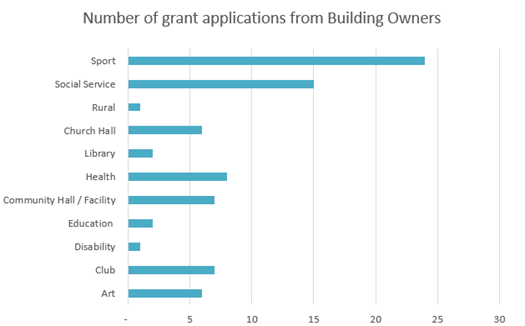
the ‘building owners’ category, the largest cohort that applied for
rates relief grants were from sports groups, followed by social service and
health organisations.
Figure
1: Number of grant applications from Building Owners.
21 In
the ‘tenants’ category, the largest cohort was from social service
groups followed by health organisations. One application was classified as
‘enterprise’ as it is an “Op-shop” whose primary
purpose is to generate revenue to support the organisation’s charitable
activities.
Figure
2: Number of grant applications from Tenants
22 In
total, there were three applications in the ‘DCC renters’ category,
one each from sports, arts and social service sectors.
23 In
total, the 105 eligible applicants account for $1,381,597.32 in rates.
24 Among
building owners, the range of rate accounts showed the lowest at $591 and the
highest at just over $90,000.
25 The
rate accounts from tenants were confirmed by staff through letters issued by
their landlords, which specified the portion of rates the tenant is obligated
to pay under their lease agreements. The range of tenant rate accounts was
between $1,783.00 and $29,817.19.
26 The
rate accounts from DCC renters were identified directly by the relevant DCC
staff member responsible for overseeing the rental of DCC buildings.
Assessment Process to Identify Recommended Grant
Amounts
27 To
assist Council in its decision, staff assessed each application against the
updated Rates Relief grant criteria and categorised the results into four broad
outcomes, as shown below.
|
Outcome after assessment
|
Interpretation
|
% applied to rate account to identify grant amount
|
|
Decline
|
Did not meet the Rates Relief Grant Criteria in
demonstrating their facility supports the wider community or priority groups
|
0%
|
|
Approve - Low
|
Meets the Rates Relief Grant Criteria in
demonstrating they support the community or priority groups but in a limited
way. Their focus is primarily on servicing their own members.
|
1-25%
|
|
Approve - Medium
|
Meets the Rates Relief Grant Criteria in
demonstrating they support the community and/or priority groups.
|
26-50%
|
|
Approve - High
|
Meets the Rates Relief Grant Criteria in
demonstrating they support the community and/or priority groups demonstrating
high community benefit.
|
51-75%
|
28 After
the assessment was completed, the results were checked and moderated by senior
staff before being submitted to Council for consideration, as summarised in
Attachments B and C. As with all DCC grants, the overall budget remained the
primary constraint in determining the final outcomes.
29 A
summary of the recommended grants across the different categories is presented
in Figures 3 and 4 below. Staff continued to distinguish between building
owners and tenants/renters, as their contexts differ. In particular, some
building owners also receive a 50% non‑rateable
discount on their land (as explained in point 15).
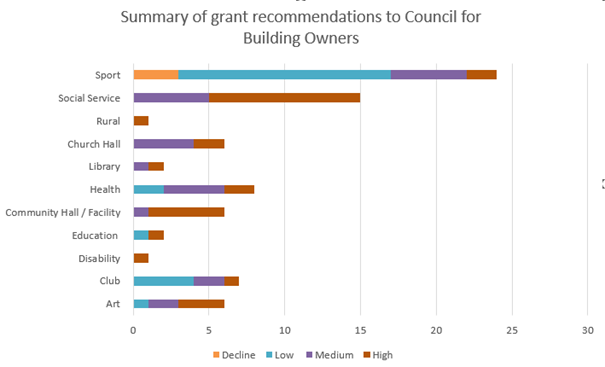
Figure 3: Summary of grant recommendations to Council
for Building Owners
Figure
4: Summary of grant recommendations to Council for Tenants and DCC Renters
30 A
summary of the recommended grant amounts for Building Owners, from highest to
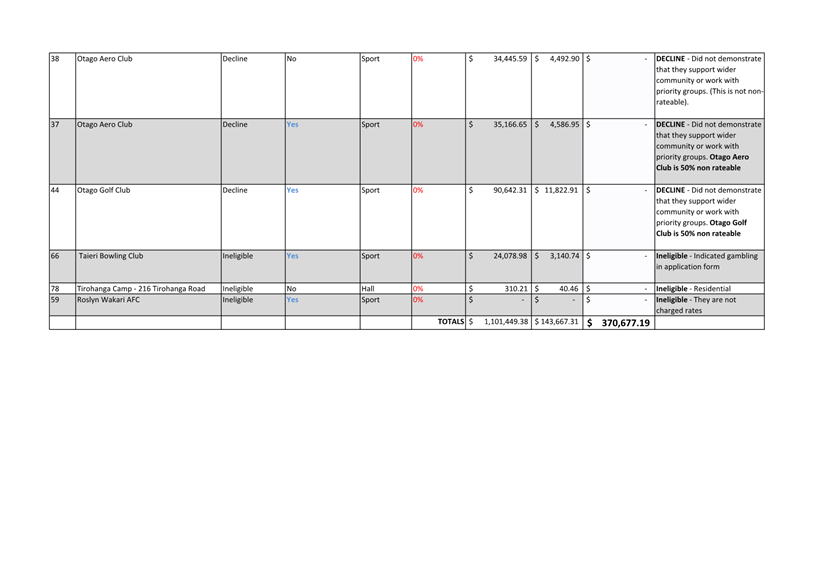
lowest, is provided in Attachment B. In total, three applicants have been
recommended for decline to Council as their applications did not demonstrate a
wider community contribution. Of these, two applicants hold a 50% non‑rated status in accordance
with the Local Government (Rating) Act 2002.
31 A
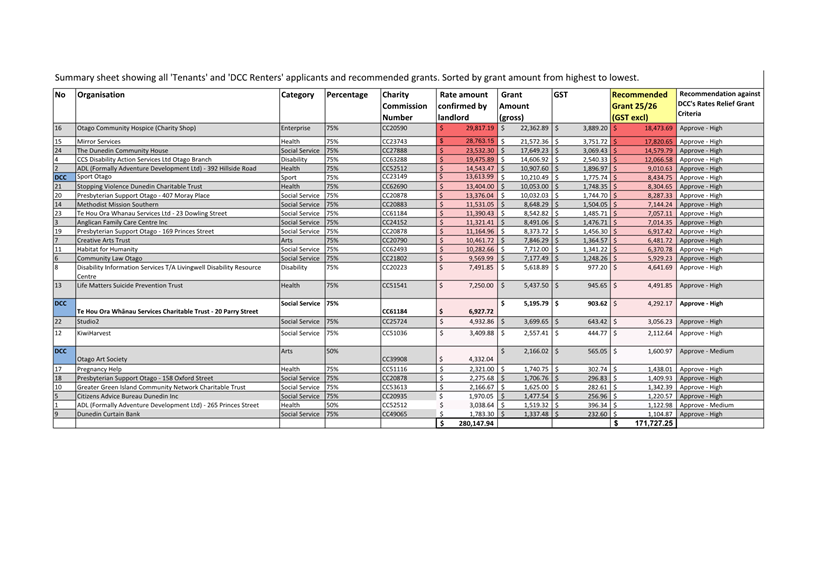
summary of the recommended grant amounts for Tenants and DCC Renters, from
highest to lowest, is provided in Attachment C. All applicants have been
recommended for approval at the High level, with only two applicants
recommended for approval at the Medium level.
32 In
summary, the total amount recommended to be granted from the Rates Relief
budget for 2025/2026 is summarised below:
|
Total recommended grants – Building Owners
|
$ 370,677.19
|
|
Total recommended grants – Tenants and DCC
Renters
|
$ 171,727.25
|
|
DCC Budget for Rates Relief for 2025/2026
|
$ 542,481.00
|
|
Unallocated
|
$ 76.56
|
33 Staff
recommend that that unallocated amount is allocated to an applicant of the
Council’s choice that demonstrates a high community benefit.
34 For
noting – one tenant has indicated they may be changing premises and, if
successful, requested that payment be made in two instalments over the year.
This approach assists DCC staff in managing public funds prudently. The
applicant was thanked for being upfront and understands that the DCC may seek
reimbursement depending on whether, and when, they move.
OPTIONS
Option One – Decide Funding Allocations (Recommended Option)
35 This
option proposes that the Council decides the grants to be allocated from the
Rates Relief fund, either as recommended by staff, or with amendment.
Advantages
· Supports
the Council’s social, economic, arts and environmental strategies.
· Supports
organisations that benefit the community, ensuring that services and activities
remain available and accessible.
· Gives
certainty to applicants, allowing them to effectively budget and allocate
resources.
Disadvantages
· There
are no identified disadvantages.
Option Two – Status Quo
36 Under
this option, the Council would not decide grants to be allocated from the Rates
Relief fund.
Advantages
· There
are no identified advantages.
Disadvantages
· Reduced
support for organisations that align with the Council’s wellbeing
strategies, and which benefit the community.
· Lack
of certainty for applicants, many of whom are reliant on funding to meet
operational costs.
NEXT STEPS
37 Staff
will advise applicants of the Council’s decisions and will administer the
payment of grants.
38 The
next Rates Relief funding round will be in 2026, with applications dates yet to
be determined.
Signatories
|
Author:
|
Janet Fraser - Corporate Planner
Gina Hu'akau - Community Partnerships Manager
|
|
Authoriser:
|
Nicola Morand - Manahautū (General Manager Community
and Strategy)
|
Attachments
|
|
Title
|
Page
|
|
⇩a
|
Rates Relief grant
eligibility and assessment criteria
|
53
|
|
⇩b
|
Schedule 1 - Local
Government (Rating) Act 2002
|
54
|
|
⇩c
|
Recommended grants for
building owners
|
59
|
|
⇩d
|
Recommended Grants for
Tenants and DCC Renters
|
63
|
|
SUMMARY OF CONSIDERATIONS
|
|
Fit with purpose of Local Government
This decision promotes the social,
economic, environmental and cultural wellbeing of communities in the present
and for the future.
|
|
Fit with strategic framework
|
|
Contributes
|
Detracts
|
Not applicable
|
|
Social Wellbeing Strategy
|
✔
|
☐
|
☐
|
|
Economic Development Strategy
|
✔
|
☐
|
☐
|
|
Environment Strategy
|
✔
|
☐
|
☐
|
|
Arts and Culture Strategy
|
✔
|
☐
|
☐
|
|
3 Waters Strategy
|
☐
|
☐
|
✔
|
|
Future Development Strategy
|
☐
|
☐
|
✔
|
|
Integrated Transport Strategy
|
☐
|
☐
|
✔
|
|
Parks and Recreation Strategy
|
✔
|
☐
|
☐
|
|
Other strategic projects/policies/plans
|
✔
|
☐
|
☐
|
Grants funding contributes to many of the objectives and
priorities of the DCC’s strategies.
|
|
Māori Impact Statement
The distribution of DCC grants has been used to support
and give effect to the Council’s commitment to Māori and to its
obligations under the Treaty of Waitangi. The adoption of Te Taki Haruru
outlines the DCC’s commitment to mana whenua.
|
|
Sustainability
DCC grants have been used to support and give effect to
the Council’s commitment to sustainability.
|
|
LTP/Annual Plan / Financial Strategy /Infrastructure
Strategy
Rates Relief grants are provided for in the broader grants
budget in the 9 year plan 2025-34.
|
|
Financial considerations
There is existing budget of $542k for Rates Relief grants.
|
|
Significance
This report is considered of low significance in terms of
the Council’s Significance and Engagement Policy.
|
|
Engagement – external
There has been a community consultation period for the 9
year plan, which included consultation on the Grants Review.
|
|
Engagement - internal
Relevant staff have been consulted in the development of
this report.
|
|
Risks: Legal / Health and Safety etc.
There may be legal and reputational risk if changes to
grants are not delivered or managed well. The Grants Review Work Programme
will actively manage these risks by ensuring appropriate consultation is
undertaken, and that any recommendations for change align with Council’s
strategic outcomes.
|
|
Conflict of Interest
There are no known conflicts of interest among decision
makers. One staff member indicated a conflict of interest with one applicant
and withdrew themselves from the assessment and recommendation.
|
|
Community Boards
There are no identified implications for Community Boards.
|
|

|
Council
11 December 2025
|
|

|
Council
11 December 2025
|
|
|
Council
11 December 2025
|
Waste Minimisation Innovation and Development (Commercial)
Grants Applications
Department: Waste and Environmental Solutions
EXECUTIVE SUMMARY
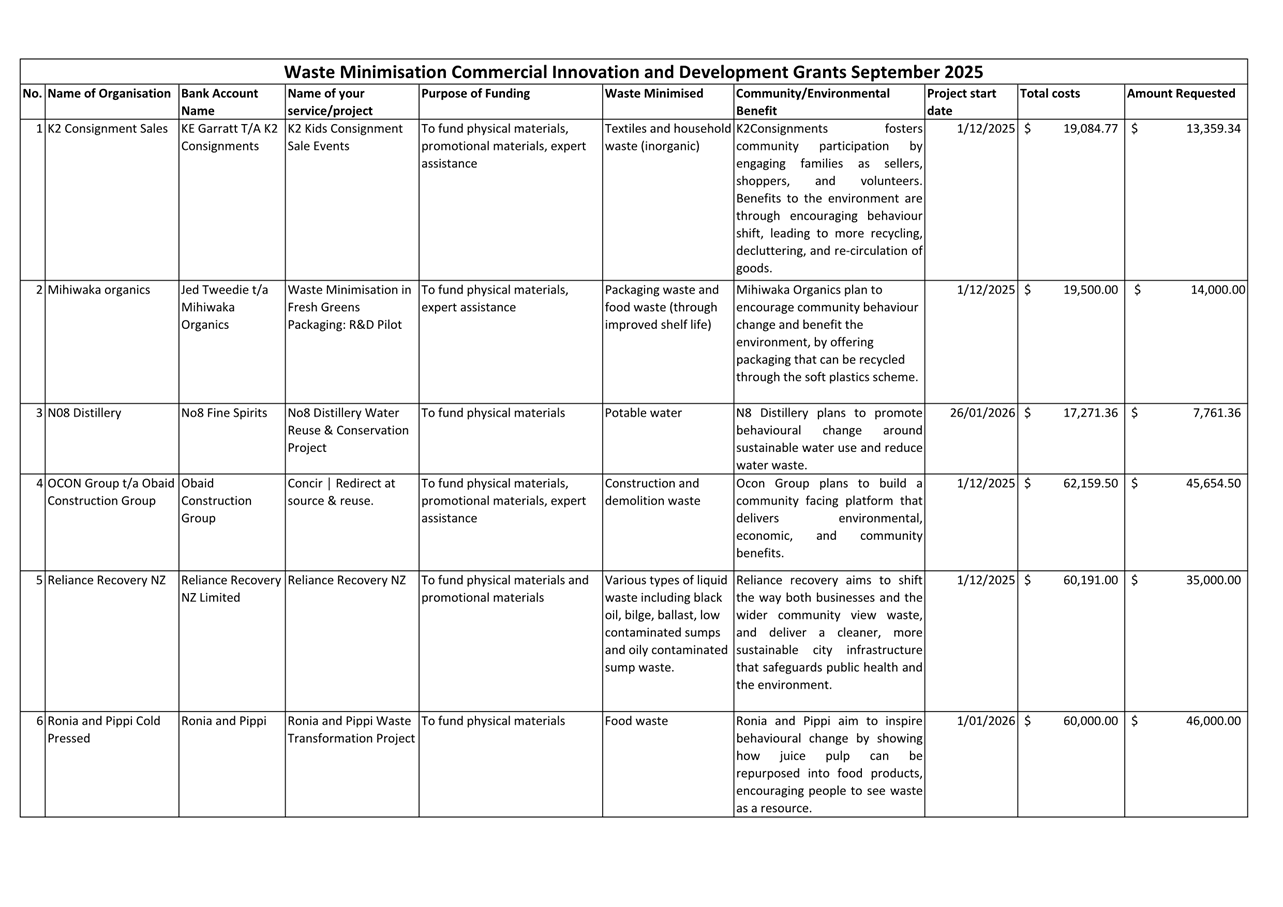
1 This
report summarises applications received during September 2025 for the Waste
Minimisation Innovation and Development (Commercial) Grants funding round.
2 The
purpose of this report is to assist the Councillors in considering applications
and allocating funding by providing a summary of the funding criteria,
applications received, amount of funding requested and the amount available.
|
RECOMMENDATIONS
That the Subcommittee:
a) Decides the grants
funding to be allocated to applicants from the Waste Minimisation Innovation
and Development (Commercial) Grants fund.
|
BACKGROUND
3 Waste
Minimisation Innovation and Development (Commercial) Grants are available once
a year to support commercial waste minimisation projects that build local
capability and capacity in the reuse or resource recovery sector. They are
intended to support innovations, achieve local economic benefit and employment
opportunities, and enable design solutions that retain the value of materials
and/or minimises waste.
Eligibility
a) Registered
New Zealand businesses
b) For projects that take place
within the DCC administrative boundary.
c) Meets some or all WMMP
objectives
d) Applicants provide a 30%
contribution to the total project cost which can be in-kind.
4 Activities
which can’t be applied for:
a) Subsidising
the cost of waste to landfill;
b) Individuals working on
private projects;
c) Debt servicing;
d) Activities which take place
outside of Dunedin;
e) Activities which duplicate
other pilot projects;
f) Research and
development support of gaining a qualification, and;
g) Travel (including
transportation), food (unless otherwise specified) and/or accommodation.
5 Waste
minimisation grants are also available to fund consenting costs e.g., permitted
composting processing, to enable regulated waste minimisation activities.
Accountability Reports
6 Over
the six-month period, from May 2025 to the end of October 2025, staff have
received 13 accountability reports from all previous waste minimisation funding
recipients. Of the recipients to date, there are 21 accountability reports that
are not yet due, having been awarded within the last 12 months.
7 Any
overdue accountability reports are being actively pursued by Council staff.
DISCUSSION
Waste Minimisation Innovation and Development
(Commercial) Grants
Summary of Applications
8 A
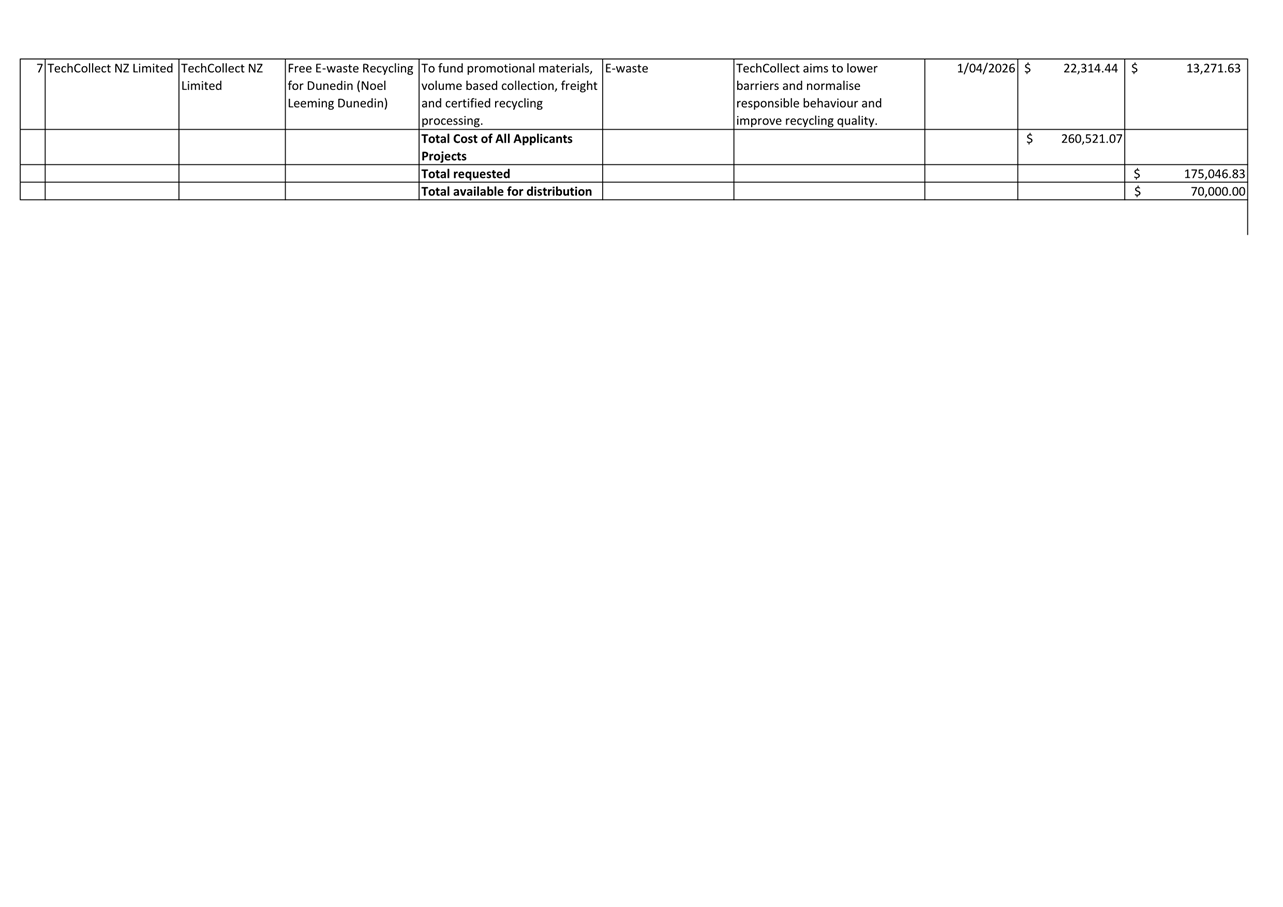
summary of applications for the Waste Minimisation Innovation and Development
(Commercial) Grants which closed at 5pm, Sunday 28 September 2025 is attached (Attachment
A).
9 For
this round of funding, $70,000.00 is available for the Waste Minimisation
Commercial Grants.
10 Both
before and during the September grants application period, email notifications
were provided by Council staff to raise awareness of the grants available and
the application criteria. Advertising in community newsletters, public notices,
local newspapers, and social media was undertaken. Potential applicants were
encouraged to communicate with staff before applying so that additional advice
and information could be provided.
11 Applicants
who had submitted project start dates before the receipt of funding have been
contacted to confirm revised project start dates (1 December 2025 or later).
This is to avoid the funding of projects retrospectively. Subsequent
communication from staff to applicants has advised that their applications will
be considered by Council on 11 December 2025.
12 The
Waste Minimisation Commercial Grant had two applicants consult at length with
staff and another two whose ideas or situations were not suitable for an
application and therefore did not submit. Five further applications were
received from businesses who had not contacted staff prior to submitting. In
some cases, this resulted in applications which were not eligible, or required staff
to seek considerably more information during the assessment period.
13 The
application close off was extended from 5pm, Friday 26 September 2025 to 5pm,
Sunday 28 September 2025. The extension was necessary due to access disruption caused
by an unexpected shutdown of the application portal during the web platform
migration project.
14 Applications
that were submitted after the close off date have not been assessed as per the
Grants Management Policy 2019.
15 Seven
applications for the Waste Minimisation Commercial Grants fund have been
received. The total funding requested from the seven applicants was $175,046.83.
|
Grant Fund Name
|
Number of Applications Received
|
Number Withdrawn
|
Total Requested
|
Total Available (September 2025 round)
|
|
Waste Minimisation Commercial
|
7
|
0
|
$175,046.83
|
$70,000.00
|
Waste
Management and Minimisation Plan 2025 (WMMP)
16 On 30 April
2025, Council adopted the Waste Management and Minimisation Plan 2025 (the
Plan) following public consultation:
Moved
(Cr Jim O'Malley/Cr Mandy Mayhem):
That the Council:
a)
Adopts the Waste Management and Minimisation
Plan 2025 as amended.
b)
Approves a review of the Waste Minimisation Grants
Framework to be completed in time for the 2026/27
Financial Year.
c)
Notes the Summary of Results from Submissions
and the Summary of Recommendations from the Hearings Committee.
d)
Notes that the Hearings Committee has
heard and considered submissions on the Draft WMMP 2025.
e)
Notes the minutes of the Hearings
Committee.
Motion
carried (CNL/2025/100) with Cr Vandervis
recording his vote against.
17 The
Plan includes objectives informed by recurring themes set to achieve the Plan’s
vision, plus the waste minimisation grants framework.
Waste Minimisation Grants
Framework
18 Under the
Waste Minimisation Act, Territorial Authorities can provide grants using waste
levy funding, to encourage and enable waste minimisation in accordance with
their WMMP. If the Territorial Authority wishes to provide grants, the WMMP
must provide the framework for doing so (WMA s43 (2d)).
19 These
following paragraphs outline the structure and guidelines for distributing
contestable and non-contestable grants to organisations and projects. It
ensures transparency, fairness, and effective allocation of grants.
20 These grants
are to enable waste minimisation action by external organisations, in
accordance with the guiding principles, vision, goals, objectives, and actions
in the WMMP.
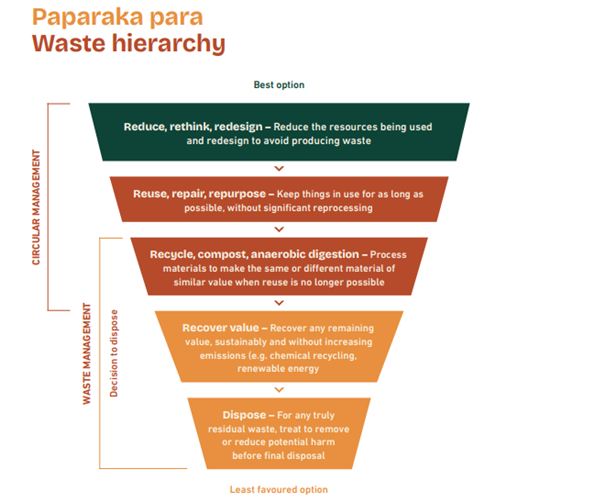
21 Decisions on
the award of grants will be based on the following priorities:
a) Top
of the waste hierarchy - enable residents or businesses to avoid waste, reuse,
or repair items. (Source; The Waste Hierarchy. Ref. Ministry for the
Environment).
b) Waste streams - alignment
with the material diversion targets in the Plan and the Zero Carbon Plan 2030 (organics – food, garden, timber, paper, and
textiles).
c) Delivery - the
applicant’s ability to deliver their project, expand local capability,
and achieve strong waste minimisation outcomes.
d) Expand opportunities for
diversion – increase the variety of sustainable waste minimisation
solutions available and develop new capabilities in Ōtepoti Dunedin.
e) Scale - The quantity and
volume of material that will be minimised from reaching landfill by an
applicant’s project.
22 The DCC’s Grants Management Policy also applies to
the management of waste minimisation grants.
23 Other
considerations could include collaborative and joint applications (i.e.,
between businesses or between community organisations), whether the
organisation is local, creates equity for Māori, Pacifica, and new migrant
communities, and whether the project contributes towards social, economic,
environmental, and cultural outcomes. Also, health and safety planning will be
required where appropriate, such as for public events.
24 OPTIONS
There are no options as the Council has the necessary delegations as per the
recommendations of this report.
NEXT STEPS
25 Staff
will communicate Council’s decisions to all applicants in writing within
two weeks of the Council meeting. Where grants have been approved, payments
will be arranged for the applicants.
26 The
next Commercial funding round will be in September 2026.
Signatories
|
Author:
|
Catherine Gledhill - Waste Minimisation Supervisor
|
|
Authoriser:
|
Chris Henderson - Group Manager Waste and Environmental
Solutions
Scott MacLean - General Manager, City Services
|
Attachments
|
|
Title
|
Page
|
|
⇩a
|
Waste Minimisation
Innovation and Development (Commercial) Grants Overview Spreadsheet
|
71
|
|
SUMMARY OF CONSIDERATIONS
|
|
Fit with purpose of Local Government
This decision promotes the social
well-being, economic well-being, environmental well-being and the cultural
well-being of communities in the present and for the future.
|
|
Fit with strategic framework
|
|
Contributes
|
Detracts
|
Not applicable
|
|
Social Wellbeing Strategy
|
☒
|
☐
|
☐
|
|
Economic Development Strategy
|
☒
|
☐
|
☐
|
|
Environment Strategy
|
☒
|
☐
|
☐
|
|
Arts and Culture Strategy
|
☐
|
☐
|
☒
|
|
3 Waters Strategy
|
☐
|
☐
|
☒
|
|
Spatial Plan
|
☐
|
☐
|
☒
|
|
Integrated Transport Strategy
|
☐
|
☐
|
☒
|
|
Parks and Recreation Strategy
|
☐
|
☐
|
☒
|
|
Other strategic projects/policies/plans
|
☒
|
☐
|
☐
|
This report supports the Council’s Waste Management
and Minimisation Plan 2025
|
|
Māori Impact Statement
Staff are working to develop relationships with the
Māori community and ensure DCC grants are accessible and supportive of
the needs of the Māori community.
|
|
Sustainability
Waste Minimisation Grants provide community with a funding
opportunity for new waste minimisation projects and initiatives.
|
|
LTP/Annual Plan / Financial Strategy /Infrastructure
Strategy
Budget is set aside from the Waste Levy for waste
minimisation grants in accordance with the Dunedin City Council Waste
Management and Minimisation Plan 2025. This money is received from the
Ministry for the Environment and has been approved to use for grants funding
in accordance with section 47 of the Waste Minimisation Act.
|
|
Financial considerations
Grants will be expended from the Waste Minimisation Funds
within approved budgets.
|
|
Significance
This decision is considered to be of low significance in
terms of Council’s Significance and Engagement Policy.
|
|
Engagement – external
A variety of newsletters, social media, Otago Access
Radio, as well as advertising in local media were used to promote these
grants.
|
|
Engagement - internal
Internal engagement was carried out with other grant
funding departments to check applicants were not doubling up on
applications. Departments relevant to the organisations applying for
funding were also engaged to check on the best fits in funding criteria for
applicants.
|
|
Risks: Legal / Health and Safety etc.
By funding consenting costs for applicants, the risk of
funding non-compliant activity can be managed.
|
|
Conflict of Interest
No conflict of interests have been identified.
|
|
Community Boards
Funded waste minimisation projects may be developed in
community board areas.
|
|

|
Council
11 December 2025
|
Grants Allocated $5K and under
Department: Corporate Policy
EXECUTIVE SUMMARY
1 This
report provides details of the grants that have been awarded under the Chief
Executive’s delegation in the November 2025 round. This is in
accordance with the Council resolution from the 27 November 2025 Council
meeting.
Background
2 On
27 November 2025 a report to Council sought approval for an amendment to the
Chief Executive Officer’s delegations to enable staff assessment and
approval of applications for grants of up to $5,000 (excluding Rates Relief
grants) that were funded and administered by the Dunedin City Council.
3 The
report noted that to satisfy Council’s granting procedures, and to enable
applicants to meet project and event deadlines, it was necessary to make
decisions on grant categories before the end of 2025.
Moved (Cr Marie Laufiso/Cr
Christine Garey):
That the Council:
a) Amends
the Chief Executive Officer’s delegations to enable approval of Dunedin
City Council–funded and administered grant applications (excluding Rates
Relief) valued at $5,000 or less, as follows:
1) The Chief Executive is delegated the power
to approve or decline applications for grants that are funded and administered
by the Council, provided that:
i) The grant was
within an approved budget; and
ii) The maximum possible
grant value awarded to an applicant does not exceed $5,000; and
iii) The power to approve or decline the grant
has not been reserved to the Council under this Manual or by resolution.
2) The Chief Executive may sub-delegate this
authority to any other officer of the Council, subject to:
i) The sub-delegation
being in writing and suitably recorded; and
ii) The grant being signed off
by the relevant General Manager.
3) This delegation would expire on 31
December 2025
b) Notes
that staff will provide a report to the 11 December 2025 Council meeting on the
allocation of the grants funding.
Division
The
Council voted by division
For: Crs
John Chambers, Christine Garey, Doug Hall, Marie Laufiso, Cherry Lucas, Mandy
Mayhem, Benedict Ong, Jules Radich, Mickey Treadwell, Steve Walker, Brent
Weatherall and Mayor Sophie Barker (12).
Against: Crs
Russell Lund, Andrew Simms and Lee Vandervis (3).
Abstained: Nil
The
division was declared CARRIED by 12 votes to 3
Motion
carried (CNL/2025/323)
4 The
Chief Executive under delegation has approved the grants as outlined in the
attached memoranda for each category assessed.
RECOMMENDATIONS
That the Council:
a) Notes the grants that
have been allocated under delegation for the November 2025 round.
Signatories
|
Author:
|
Nicola Morand - Manahautū (General Manager Community
and Strategy)
|
|
Authoriser:
|
Sandy Graham - Chief Executive
|
Attachments
|
|
Title
|
Page
|
|
⇩a
|
Community Grants
|
77
|
|
⇩b
|
DCC Arts, Small Arts
Project and CNZ Creative Communities Scheme Grants
|
85
|
|
⇩c
|
Dunedin Biodiversity
Fund Grants
|
90
|
|
⇩d
|
Community Events
|
104
|
|
SUMMARY OF CONSIDERATIONS
|
|
Fit with purpose of Local Government
This decision enables democratic local
decision making and action by, and on behalf of communities.
This decision promotes the social,
economic, environment and cultural well-being of communities in the present
and for the future.
|
|
Fit with strategic framework
|
|
Contributes
|
Detracts
|
Not applicable
|
|
Social Wellbeing Strategy
|
✔
|
☐
|
☐
|
|
Economic Development Strategy
|
✔
|
☐
|
☐
|
|
Environment Strategy
|
✔
|
☐
|
☐
|
|
Arts and Culture Strategy
|
✔
|
☐
|
☐
|
|
3 Waters Strategy
|
☐
|
☐
|
✔
|
|
Future Development Strategy
|
☐
|
☐
|
✔
|
|
Integrated Transport Strategy
|
☐
|
☐
|
✔
|
|
Parks and Recreation Strategy
|
✔
|
☐
|
☐
|
|
Other strategic projects/policies/plans
|
✔
|
☐
|
☐
|
The grant decisions directly support community groups to
deliver on projects, services and activities that support local
residents’ wellbeing and contributes to many of the DCC’s
strategies and plans.
|
|
Māori Impact Statement
Te Taki Haruru, the DCC’s Māori Strategic
Framework outlines the aspirations for Māori living in Ōtepoti
Dunedin. Many of the grant applications contribute to these aspirations by
way of the services and activities that they deliver on.
|
|
Sustainability
There are no negative implications for sustainability,
with some grant applications positively contributing to sustainable goals for
their local community.
|
|
LTP/Annual Plan / Financial Strategy /Infrastructure
Strategy
Grants are part of the DCCs levels of service and are
included in the DCCs long term and annual plans
|
|
Financial considerations
There are no financial considerations as grants are
allocated according to the DCC’s grants budget approved by Council.
|
|
Significance
The significance of the decisions related to grants has
been assessed as ‘low’.
|
|
Engagement – external
No internal or external engagement has taken place related
to grants. Internal checks by staff from relevant DCC teams has occurred to
ensure that applicants have not applied to more that one grant fund.
|
|
Engagement - internal
Where appropriate, teams consulted with each other to
better understand grant applications, for example, with the Events, Ara Toi
and Waste Minimisation teams.
|
|
Risks: Legal / Health and Safety etc.
The risks related to grants is considered low as
applicants must provide financial and group information to be eligible to
apply.
|
|
Conflict of Interest
No Conflicts of Interest have been noted by staff in
accordance to the DCC’s Conflict of Interest policy. The Council
manages its Conflicts of Interest in accordance to the DCC’s Conflict
of Interest policy.
|
|
Community Boards
There are no implications for Community Boards. There are
some applicants who are located within the Community Boards areas.
|
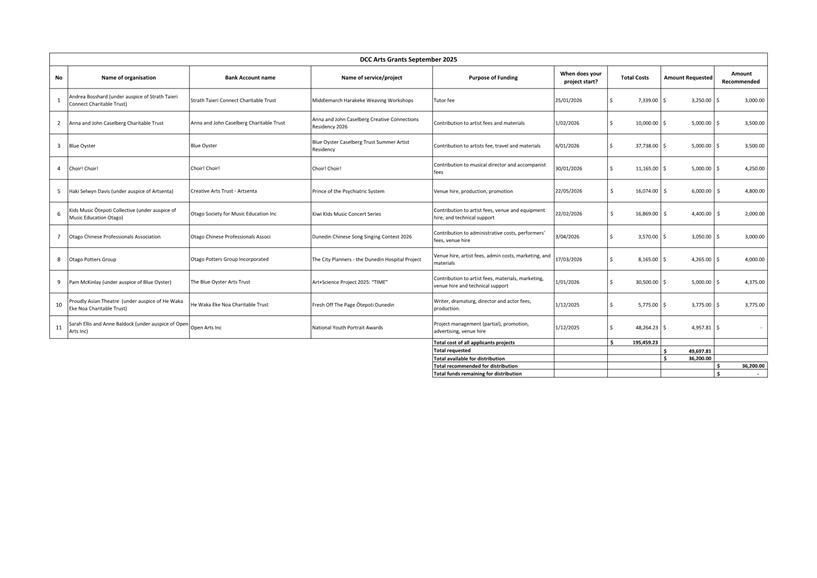
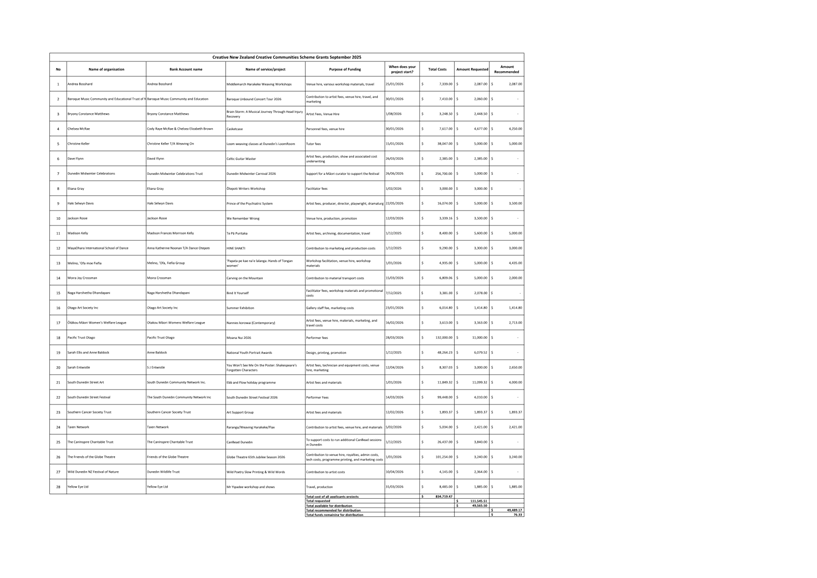
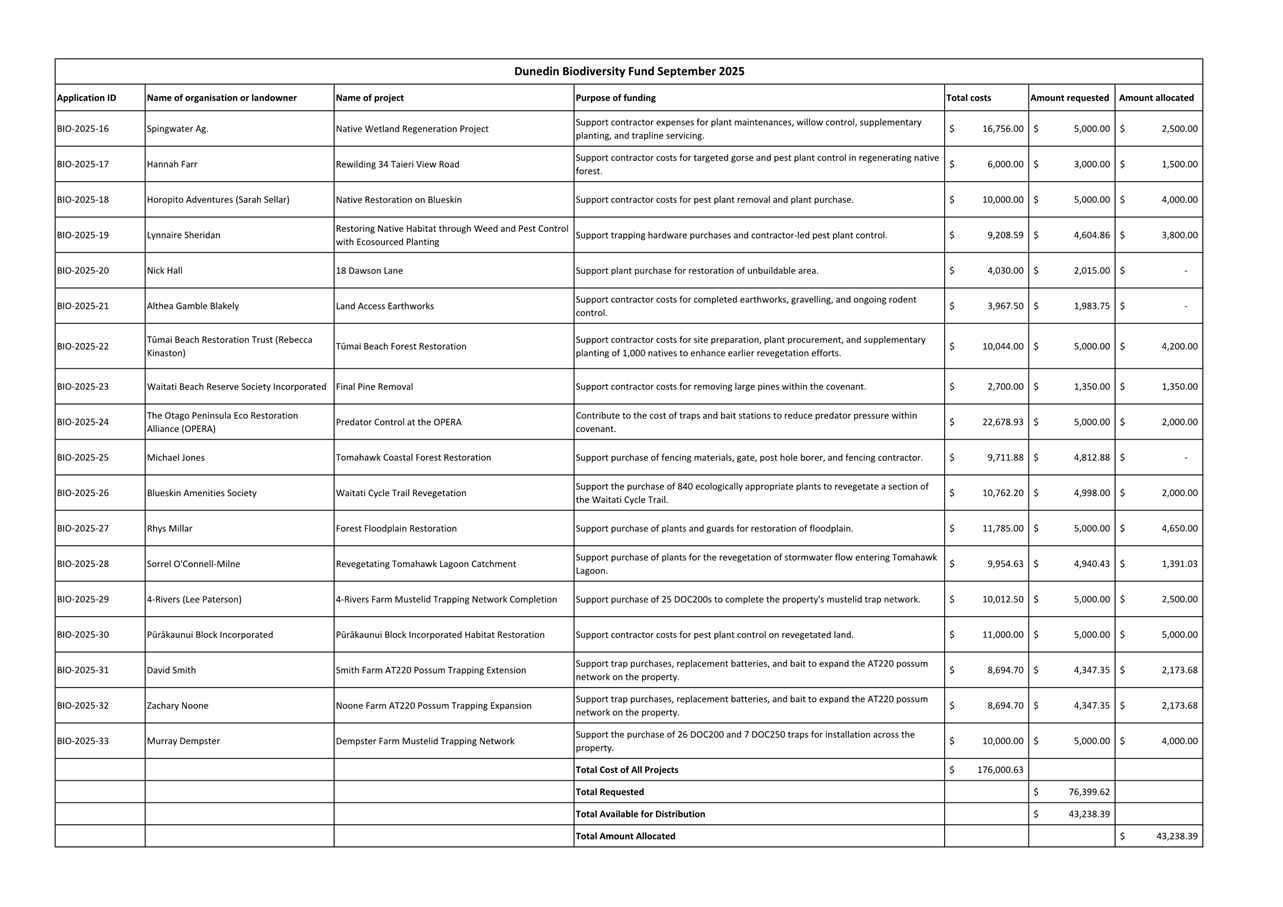
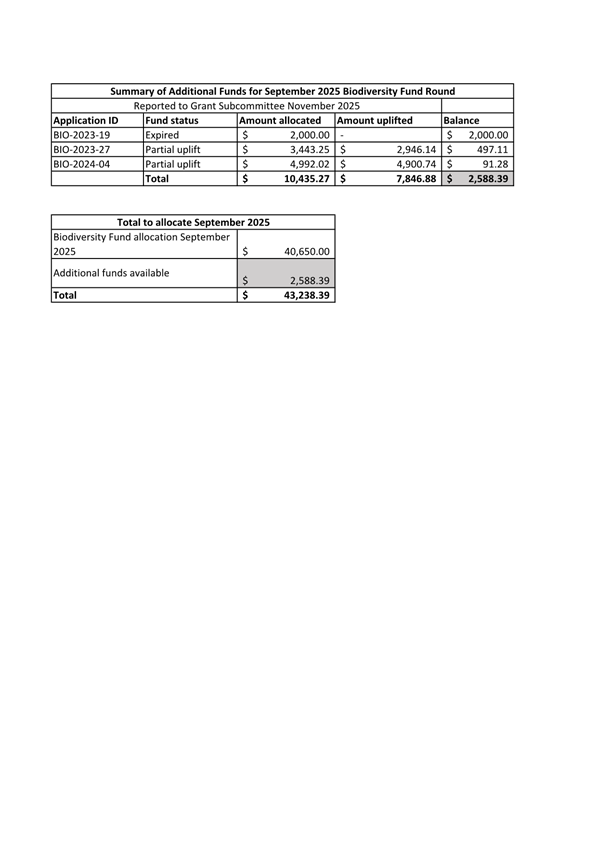
|

|
Council
11 December 2025
|
Grants Review Update
Department: Community Services
EXECUTIVE SUMMARY
1 This
report provides Council with an update of the Grants Review (the review) work
commenced in the previous triennium, including community stakeholder feedback
gathered through hui, a survey, and a facilitated meeting in October 2025.
2 The
report seeks Council’s direction on progressing the next phase of the
review, including further development of options relating to:
· determining
the annual quantum of funding available for grants
· identifying
and confirming the grant pools
· agreeing
the governance and decision-making structure for allocating grants
· approval
to progress procurement of a new grants management system, or alternatively, to
defer this until decisions on the organisation-wide financial system are made.
3 Subject
to Council’s direction, staff will return with a detailed options paper
to Council in January, and will update the Grants Management Policy to
operationalise any agreed approach.
RECOMMENDATIONS
That the Council:
a) Notes the contents of
the Grants Review Update paper
b) Determines how it
wishes to proceed, including whether to:
i) Direct staff to continue
the Grants Review and prepare options for Council’s consideration on:
· the
preferred approach to determining the annual quantum of grants funding
· the
grant pools to be offered
· the
governance and decision-making structure for allocating grants
· whether
procurement of a new grants management system should proceed now or be aligned
with future financial systems or;
ii) Direct staff to
discontinue the Grants Review and the review of the Grants Management Policy.
BACKGROUND
4 In
2023, a request was made by Council to undertake a review of Dunedin City
Council (DCC) grants, to support the preparation of the 10-year plan 2024-34. A
Grants Workstream was established to undertake the review as part of the
long-term planning process.
5 In
September 2023, a report was presented to Council that provided an overview of
the DCC grant categories, budgets, and expenditure. The report identified
the need for more work to be undertaken, to look at and understand grants from
an across-Council perspective. It also noted that the DCC’s Grants
Management Policy (Attachment B) was due for review in 2024.
6 At
its meeting on 27 February 2024, Council decided to proceed with an Annual Plan
2024/25, followed by a 9-year plan 2025-34.
7 A
report was presented to the 12 March 2024 Council meeting, providing an update
of the work completed by the Grants Workstream as part of the 9-year planning
process. The report noted that the next steps included the need to define
the grant review process to complete the review.
8 A
draft Terms of Reference (ToR) was developed that sets out the purpose of the
review and the work that needed to be undertaken to complete the review.
This was led by Councillors with DCC staff support.
On 31 July 2024, a report
from the Civic Affairs Committee sought approval of a draft ToR for the
continuation of the grants review that commenced in 2023 (Attachment A).
|
Moved (Mayor Jules Radich/Cr Bill Acklin):
That the Council:
a) Approves the draft Terms of Reference for the Grants Review.
b) Notes that updates on the review would be as required and
to either the Community Services Committee or Council.
Motion carried
(CNL/2024/001)
|
DISCUSSION
9 Since
August 2024 a number of combined hui have been held with staff and elected
members, as well as hui involving elected members only.
Topics
discussed at combined hui, as noted by staff, have included:
a) the
need to clarify what constitutes a grant and why some are delivered through
Service Level Agreements (SLAs), Memorandums of Understanding (MoUs), rates
relief, or the Annual Plan process
b) understanding the
purpose of some contestable grants
c) broad
support for a more efficient and fit-for-purpose grants system, including the
need for an online platform
d) the
need to standardise and streamline the DCC’s approach to rates relief
e) recognition
that some SLAs have developed inconsistently across the organisation and
require alignment.
10 In
addition, elected members held their own hui to progress the review.
Survey Findings
11 In
June 2025, the Chair of the Grants Subcommittee proposed a facilitated meeting
and preliminary survey to inform the next stage of the review.
12 The
survey invited Councillors and external appointees to the Grants Subcommittee
to identify issues, alignment with strategy, transparency, accessibility, and
values underpinning the grants system.
13 Main
themes from the survey responses were:
· The need for a
clear vision and purpose for the DCC’s grants funding, and the definition
of what a grant is
· the need for
grants funding to operate under a high trust model — encouraging
collaboration and partnership between the DCC and the communities and
organisations it funds
· assurance that the
grants are equitable, and that different groups in the community are aware that
DCC grants funding is available
· commissioning
voluntary and community organisations for services, rather than through a
contestable application process
· implementing
multi-year funding arrangements for organisations that regularly receive funding
· simplifying
application and administration processes. For example, delegating
decision-making about small grants to DCC staff to reduce the amount of time
and resourcing involved in the granting process
· increased
transparency around DCC grants, for example the assessments and discussions
undertaken as part of the decision-making process are publicly available
· the need for
grants funding to reflect actual costs, such as rates increases and cost of
living increases.
Facilitated Meeting (1 October 2025)
14 An
externally facilitated meeting was held on 1 October 2025 with elected members
and external representatives from the Grants Subcommittee. A summary of notes
(anonymised) from the meeting is attached as Attachment C.
15 Discussion
on the current state highlighted:
· inconsistent use
of the term “grants”
· administrative
burden on recipients and staff
· the role grants
can play in strengthening equity across the city
· the need for
increased funding to meet rising demand.
16 Participants
identified key objectives: impact, equity, Treaty of Waitangi commitments,
alignment with DCC strategies, and providing funding that enables long-term
planning.
17 Community
aspirations raised included a desire for better infrastructure, multi-year
funding, collaboration, and investment in rangatahi and arts pathways.
18 Equity
discussions recognised perceived power imbalances and tensions around ongoing
funding for some groups versus access by emerging or smaller groups.
19 The
group explored ways of measuring impact, including community-defined indicators
and collaboration with other funders.
20 Participants
described a future system (10-year timeframe) built on trust, collaboration,
equity, sustainability, and accessibility.
21 The
notion of “funding for success” was discussed, acknowledging the
need to co-define what success means with communities.
22 Operational
ideas included: more staff delegation for smaller grants, potential changes to
the Grants Subcommittee structure, clearer criteria, larger grant amounts, and
less formal meeting processes.
Current State
23 In
October 2025, the DCC’s Grants Subcommittee was disestablished, with
grants reverting to Council.
24 On
27 November 2025, Council agreed to an interim arrangement for pending grants
applications to a maximum of $5000 each to be decided by DCC staff, until 31
December 2025.
Progressing the Grants Review and Review of the Grants
Management Policy
25 Staff
propose continuing the Grants Review to ensure the DCC processes are robust,
equitable and fit-for-purpose.
26 Staff
also propose reviewing the Grants Management Policy in tandem with the review
to ensure alignment of operational practice and strategic intent.
OPTIONS
Option One – Continuation of the Grants Review and
the review of the Dunedin City Council Grants Management Policy
Advantages
· Enables completion of work already underway
· Allows development of options on funding quantum,
grant pools, governance structures, and system procurement
· Supports a consistent, transparent, and equitable
grants approach
· Recognises the value and impact of DCC grants across
the community.
Disadvantages
· There
are no identified disadvantages to this option.
Option Two – Discontinue the Grants Review and the
review of the Dunedin City Council Grants Management Policy
Advantages
· There
are no identified advantages to this option.
Disadvantages
· Loss
of progress made to date.
· Missed
opportunity to modernise systems and improve equity, transparency, and
efficiency.
· Continued
operational inconsistencies.
NEXT STEPS
27 Following
direction from Council if Option One is approved, DCC staff will:
a) Prepare
an options paper for the Council’s January meeting, seeking direction on
funding quantum, grant pool structure, governance arrangements and procurement
pathways.
b) Continue
work on the Grants Review
c) Progress
the review of the Grants Management Policy.
Signatories
|
Author:
|
Gina Hu'akau - Community Partnerships Manager
|
|
Authoriser:
|
Nicola Morand - Manahautū (General Manager Community
and Strategy)
|
Attachments
|
|
Title
|
Page
|
|
⇩a
|
Attachment A: DCC
Grants Review Terms of Reference July 2024
|
119
|
|
⇩b
|
Attachment B: DCC
Grants Management Policy
|
123
|
|
⇩c
|
Attachment C:Summary
Notes -Grants Review Meeting 1 October 2025
|
132
|
|
SUMMARY OF CONSIDERATIONS
|
|
Fit with purpose of Local Government
This decision enables democratic local
decision making and action by, and on behalf of communities.
It promotes the social, economic,
environmental, and cultural well-being of communities in the present and for
the future.
|
|
Fit with strategic framework
|
|
Contributes
|
Detracts
|
Not applicable
|
|
Social Wellbeing Strategy
|
✔
|
☐
|
☐
|
|
Economic Development Strategy
|
✔
|
☐
|
☐
|
|
Environment Strategy
|
✔
|
☐
|
☐
|
|
Arts and Culture Strategy
|
✔
|
☐
|
☐
|
|
3 Waters Strategy
|
☐
|
☐
|
☐
|
|
Future Development Strategy
|
✔
|
☐
|
☐
|
|
Integrated Transport Strategy
|
☐
|
☐
|
☐
|
|
Parks and Recreation Strategy
|
✔
|
☐
|
☐
|
|
Other strategic projects/policies/plans
|
✔
|
☐
|
☐
|
|
|
Māori Impact Statement
Te Taki Haruru, the DCC’s Māori Strategic
Framework, demonstrates Council’s commitment to mana whenua and to its
obligations under the Treaty of Waitangi. Mana whenua have been represented
in the decision-making process of the Grants Subcommittee, and in the
contestable granting process such as the Hapori Fund which is targeted at Māori
and Pacific business initiatives.
|
|
Sustainability
Sustainability is
factored into the decision-making process for DCC grants, for example in the
consideration of applications for Waste Minimisation Community Grants.
|
|
Zero carbon
There
is no impact on city-wide and DCC emissions.
|
|
LTP/Annual Plan / Financial Strategy /Infrastructure
Strategy
Grants are included in the 9 Year Plan 2025-2034. They are
approved in the following Level of Service: “The DCC provides grants to
the community to support community wellbeing”.
|
|
Financial considerations
There are no financial implications.
|
|
Significance
This decision is considered low in terms of the
Council’s Significance and Engagement Policy.
|
|
Engagement – external
There has been ongoing engagement with external
representatives across the community since the commencement of the Grants
Review.
|
|
Engagement – internal
There has been ongoing internal engagement across DCC
teams since the commencement of the Grants Review.
|
|
Risks: Legal / Health and Safety etc.
There are no identified risks.
|
|
Conflict of Interest
There is no identified conflict of interest.
|
|
Community Boards
There are potential implications from this decision as
grants funding activities occur in Community Board areas.
|
|

|
Council
11 December 2025
|
Dunedin City Holdings Limited Group Update - Quarterly
Report to 30 September 2025
Department: Finance
EXECUTIVE SUMMARY
1 This
report provides a quarterly update for the period ended 30 September 2025 for
the Dunedin City Holdings Limited (DCHL) Group.
RECOMMENDATIONS
That the Council:
a) Notes the Dunedin City
Holdings Limited Group Quarterly Report for the period ended 30 September 2025.
DISCUSSION
2 The
attached DCHL Quarterly report for the period ended 30 September 2025 provides
an update for Councillors on the following:
· Quarter
1 financial results
· Areas
of focus/activity for each company this quarter
· Progress
towards achieving Statement of Intent measures
· Financial
performance of the group
· Group funding
OPTIONS
3 As
this is a noting report, no options are provided.
4 As
this is an administrative report, the Summary of Considerations is not
required.
NEXT STEPS
5 A
quarterly update for the period ended 31 December 2025 for the Dunedin City
Holdings Limited (DCHL) Group will be presented at a future meeting.
Signatories
|
Authoriser:
|
Carolyn Allan - Chief Financial Officer
|
Attachments
|
|
Title
|
Page
|
|
⇩a
|
DCHL Quarterly Report
to Council - 30 September 2025
|
137
|
|

|
Council
11 December 2025
|
2025 Annual Reports for the Dunedin City Holdings Ltd Group
Department: Finance
EXECUTIVE SUMMARY
1 This
report provides the 2025 Annual Reports of Dunedin City Holdings Ltd (DCHL)
Group companies.
RECOMMENDATIONS
That the Council:
a) Notes the 2025 Annual
Reports of:
- Dunedin
City Holdings Limited
- Dunedin
City Treasury Limited
- Aurora
Energy Limited
- City
Forests Limited
- Delta
Utility services Limited
- Dunedin
International Airport Limited
- Dunedin
Railways Limited
- Dunedin
Stadium Property Limited
- Dunedin
Venues Management Limited
BACKGROUND
2 The
subsidiaries and associate companies of DCHL are required to prepare and
deliver an Annual Report to Council for noting.
DISCUSSION
3 The
annual report for DCHL was completed and received audit signoff on 30 September
2025, along with the annual reports for the group companies. These are
now presented to Council for noting.
4 As
this report is for administrative and statutory reporting purposes, a summary
of considerations and options is not required.
OPTIONS
5 Not
applicable.
Signatories
|
Author:
|
Sharon Bodeker - Financial Accounting Manager
|
|
Authoriser:
|
Sandy Graham - Chief Executive
|
Attachments
|
|
Title
|
Page
|
|
⇨a
|
Aurora Energy Ltd
Annual Report 2025 (Under Separate Cover 1)
|
|
|
⇨b
|
City Forests Ltd Annual
Report 2024 (Under Separate Cover 1)
|
|
|
⇨c
|
Dunedin City Holdings
Ltd Annual Report 2025 (Under Separate Cover 1)
|
|
|
⇨d
|
Dunedin City Treasury
Ltd Annual Report 2025 (Under Separate Cover 1)
|
|
|
⇨e
|
Delta Utility Services
Ltd Annual Report 2025 (Under Separate Cover 1)
|
|
|
⇨f
|
Dunedin International
Airport Ltd Annual Report 2025 (Under Separate Cover 1)
|
|
|
⇨g
|
Dunedin Railways Ltd
Annual Report 2025 (Under Separate Cover 1)
|
|
|
⇨h
|
Dunedin Stadium
Property Ltd Annual Report 2025 (Under Separate Cover 1)
|
|
|
⇨i
|
Dunedin Venues
Management Ltd Annual Report 2025 (Under Separate Cover 1)
|
|
|

|
Council
11 December 2025
|
DCHL Letter of Expectation for the year ended 30 June 2027
Department: Civic
EXECUTIVE SUMMARY
1 The
purpose of this report is to consider a draft Letter of Expectation (the
Letter) for the Dunedin City Holdings Limited (DCHL) Board. The draft
Letter is at Attachment A.
2 The
Letter provides Council's direction to DCHL, roles and responsibilities, and
the future plans of the Shareholder. The Letter will assist DCHL and the
wider group in developing their Statements of Intent (SOI) documents for
2026/27.
RECOMMENDATIONS
That the Council:
a) Considers the draft
Letter of Expectation to the Board of Dunedin City Holdings Ltd from the
Council, as Shareholder.
b) Authorises the CEO to
make any changes to the Letter of Expectation following Council’s
feedback.
c) Authorises the Mayor
to sign the Letter of Expectation on behalf of the Council as
Shareholder.
BACKGROUND
3 The
Council and DCHL are aware of the importance of the Letter of
Expectation. The Letter is a governance and accountability tool that
communicates what outcomes the Council, as Shareholder, wants from its
Council-controlled Organisations (CCOs).
4 Council
sends an annual Letter of Expectation to DCHL with the intention that this
information will be discussed and implemented within the wider Council Group.
5 The
expectations are, where appropriate, included in the Group’s draft
Statements of Intent (SoI) which are due to Shareholders by 1 March 2026.
6 The
most recent Letter of Expectation was issued to DCHL on 13 December 2024 and a
copy is at Attachment B.
7 Content
on a draft Letter was informally discussed at a Council workshop on 2 December
2025.
DISCUSSION
8 The
attached draft Letter for the 2026/27 financial year details the expectations of
Council under the following headings:
· Focus for the
2026/27 financial year
· Climate change
· General expectations
of DCHL
· Dividends and interest
· Group Investment
Plan
· Reports
· Working with DCC
· Next steps.
9 The
draft Letter is seeking to have strategic alignment between DCC and DCHL,
through enhanced communications and engagement.
10 The
draft Letter acknowledges the commitment of DCHL to address climate change, and
invites the group to continue working with the DCC in this
area.
11 The
letter requests a dividend from the DCHL Trading companies of $9.0 million for
the 2026/27 financial year. This dividend, along with the $5.9 million interest
payment, will make a total annual distribution of $14.9 million. It asks
that the dividend be paid in three equal instalments throughout the year.
12 Additionally,
the letter requests that any unspent balance of the $2 million per annum
provided to Dunedin Railways Ltd, for renewals of the Taieri Gorge Line rail
corridor, be returned to the DCC as a dividend.
13 The
draft Letter notes the current period of significant
reform for local government, including the possible introduction of rates caps,
and requests that DCHL continue to look at ways of generating increased
dividends to Council.
OPTIONS
14 This
report is seeking feedback on the content of the Letter of Expectation prior to
finalisation and issuing to DCHL.
NEXT STEPS
15 Once
agreed, the Letter of Expectation will be signed by the Mayor on behalf of the
Shareholder and sent to the Board of DCHL for action.
Signatories
|
Author:
|
Janet Fraser - Corporate Planner
|
|
Authoriser:
|
Carolyn Allan - Chief Financial Officer
Sandy Graham - Chief Executive
|
Attachments
|
|
Title
|
Page
|
|
⇩a
|
Draft DCHL Letter of
Expectation for the year ended 30 June 2027
|
154
|
|
⇩b
|
DCHL Letter of
Expectation for the year ended 2026
|
159
|
|
SUMMARY OF CONSIDERATIONS
|
|
Fit with purpose of Local Government
This decision enables democratic local
decision making, and promotes the social, economic, environmental and
cultural wellbeing of communities in the present and for the future.
|
|
Fit with strategic framework
|
|
Contributes
|
Detracts
|
Not applicable
|
|
Social Wellbeing Strategy
|
☐
|
☐
|
✔
|
|
Economic Development Strategy
|
☐
|
☐
|
✔
|
|
Environment Strategy
|
☐
|
☐
|
✔
|
|
Arts and Culture Strategy
|
☐
|
☐
|
✔
|
|
3 Waters Strategy
|
☐
|
☐
|
✔
|
|
Future Development Strategy
|
☐
|
☐
|
✔
|
|
Integrated Transport Strategy
|
☐
|
☐
|
✔
|
|
Parks and Recreation Strategy
|
☐
|
☐
|
✔
|
|
Other strategic projects/policies/plans
|
☐
|
☐
|
✔
|
The performance of the companies helps Council deliver
across the strategic framework, but this report has no direct contribution.
|
|
Māori Impact Statement
There has been no engagement with Māori in the
preparation of the draft Letter of Expectation.
|
|
Sustainability
Sustainability expectations of the DCHL Group are outlined
in the draft Letter of Expectation, and specifically in relation to climate
change and waste minimisation.
|
|
LTP/Annual Plan / Financial Strategy /Infrastructure
Strategy
Dividend expectations are provided for in the Letter of
Expectation.
|
|
Financial considerations
Dividend expectations are provided for in the Letter of
Expectation.
|
|
Significance
This report is of low significance in terms of the
Council’s Significance and Engagement Policy.
|
|
Engagement – external
There has been informal engagement with the DCHL Board.
|
|
Engagement - internal
The final letter will incorporate feedback from Elected
Members.
|
|
Risks: Legal / Health and Safety etc.
There are no identified risks.
|
|
Conflict of Interest
There are no known conflicts of interest.
|
|
Community Boards
There are no implications for Community Boards.
|
|

|
Council
11 December 2025
|
Lead in Soil Update
Department: Community and Planning
EXECUTIVE SUMMARY
1 This
report responds to the Council motion seeking clarification from the Ministry
for the Environment (MfE).
2 The
clarification concerns how Dunedin City Council (DCC) applies the Resource
Management (National Environmental Standard for Assessing and Managing
Contaminants in Soil to Protect Human Health) Regulations 2011 (NES‑CS).
3 The
focus is on lead contamination from legacy paint on residential sites.
RECOMMENDATIONS
That the Council:
a) Notes the responses
received from the MfE.
b) Notes, based on the
MfE responses, expert technical, legal advice and data collected to date, DCC
should continue its existing approach in line with the Regulations.
BACKGROUND
4 The
NES-CS is a national regulation administered by territorial authorities to
ensure land with potentially contaminated soil is identified and managed to
protect human health. It applies to activities such as:
a) Subdivision
applications
b) Land
use changes
c) Soil
disturbance activities.
5 To
clarify how the NES-CS should be applied with respect to potential
contamination from lead paint on residential sites, Stantec New Zealand Ltd (Stantec)
was commissioned in 2023 to:
a) Review
data on lead contamination from historic paint use.
b) Advise
when contamination constitutes a HAIL (Hazardous Activities and Industries
List) activity.
c) Recommend
appropriate consenting requirements.
6 The
report from Stantec (attachment A – Stantec NZ Residential lead Review
November 2023) and other information about the regulation and lead is on the
DCC web site. View here https://www.dunedin.govt.nz/services/resource-consents/hail-and-lead-from-paint.
7 Findings
from the Stantec report include:
a) Prior
to 1945, white lead paint contained up to 50% lead by weight.
b) Lead
is a persistent pollutant and does not degrade in the environment.
c) Human
health effects of chronic exposure of lead include neurological,
cardiovascular, haematological, immunological, reproductive, and developmental
effects [1].
Children, particularly pre-schoolers, are at greater risk from lead exposure
due to increased uptake via higher levels of hand-to-mouth activity and higher
gastrointestinal absorption of ingested lead.
d) Testing
of surface soils (0-0.1m depth) within 2m of buildings is recommended to
determine HAIL category I status.
8 Following
the Stantec report, a legal opinion from Anderson Lloyd was sought which
supports DCC’s approach for implementing the NES-SC.
9 With
the expert technical and legal advice, DCC is on notice as to possible
contamination at sites with pre 1945 painted buildings.
Data collected to date
10 A
total of 1,791 land use and subdivision resource consent applications have been
received between 2024 and 30 November 2025. In many instances, an application
for subdivision consent is accompanied by a corresponding application for land
use consent.
11 The
current record shows that soil samples have been undertaken at 61 sites or
properties within the halo of existing or former buildings. The data primarily
covers the period from early 2024 to November 2025, with a small number of
samples recorded between July 2023 and early 2024. For completeness, sampling
data from outside the halo has also been recorded.
12 Of
the 61 sites we have not recorded whether sampling was requested by DCC or
proactively provided by the owner.
13 Of
the 61 sites, 68.9% (42 properties) had soil sampling results which exceeded
the Ministry for the Environment defined acceptable residential limit of 210
mg/kg for lead in soil, with the highest recorded level of 7,000 mg/kg.
14 A
level of 68.9% of properties exceeding acceptable limits, is above the 50%
threshold. This outcome meets the definition in Regulation 5(7)(c) of the NES-CS,
where land is considered ‘more likely than not’ to have been
subject to a release of a hazardous substance in sufficient quantity to pose a
risk to human health or the environment. On this basis, the requirement to
continue requesting soil testing where it meets the criteria is supported to
ensure compliance with the regulation and to appropriately manage potential
risks.
Development Community Feedback
15 Concerns
have been raised by members of the development community who feel that the
DCC’s approach:
a) Is
unique apart from one other council,
b) Imposes
high costs on the development of new housing and the alterations to existing
housing,
c) Is
an overreaction to the risk posed by legacy lead paint in residential settings,
d) Is
not supported by the Ministry for the Environment (MfE).
council notice of motion
16 On
26 August 2025, Councillor Whiley sought a notice of motion.
Moved (Cr Andrew Whiley/Cr Carmen Houlahan):
That the Council:
a) Notes the concerns regarding
the Council’s current interpretation of the Resource Management (National
Environmental Standard for Assessing and Managing Contaminants in Soil to
Protect Human Health) Regulations 2011 (NESCS) as it relates to lead in soil
for residential development.
b) Requests staff to seek urgent
formal guidance from the Ministry for the Environment on how the Council should
interpret and apply the NESCS.
c) Request an urgent Council
report on the application of the Ministry for the Environment guidance to
residential development across Dunedin City.
Division
The Council voted by division,
For: Crs
Sophie Barker, Kevin Gilbert, Carmen Houlahan, Cherry Lucas, Mandy Mayhem, Jim
O'Malley, Brent Weatherall, Andrew Whiley and Mayor Jules Radich (9).
Against: Crs
David Benson-Pope, Christine Garey, Marie Laufiso and Steve Walker (4).
Abstained: Nil
The division
was declared CARRIED by 9 votes to 4.
Motion carried (CNL/2025/263)
17 A
letter was sent to the Ministry for the Environment on 3 September 2025 (attachment
B), including the full notice of motion and requesting clarification on the
interpretation of the NES-CS in relation to the use of lead paint on
residential sites.
ministry for the environment
18 The
MfE initially responded on the 9 October 2025 (attachment C) indicating
‘councils are responsible for implementing the Resource Management
(National Environmental Standard for Assessing and Managing Contaminants in
Soil to Protect Human Health) Regulations 2011 (NESCS) in so far as it applies
to land within their districts. This includes seeking any legal or other
professional advice required to assist councils in their interpretation and
application of the NESCS and any documents incorporated by reference’.
19 To
better understand the DCC process, a subsequent Teams meeting with MfE was held
on 31 October 2025. Following this meeting MfE indicated they would provide a
further response which has now been received dated 1 December 2025 (attachment
D).
20 The
1 December 2025 MfE response does not indicate:
a) This
is an overreaction to the risk posed by legacy lead paint in residential
settings and,
b) That
MfE opposes DCC’s approach.
NEXT STEPS
OPTIONS
21 As
this is an update for the Council there are no options.
NEXT STEPS
22 The
Ministry has not provided new information that challenges DCC’s current
process. The second response from MfE ended with the sentence “The Ministry is comfortable that DCC is not using HAIL
category I as a means to make a bulk addition of pre-1945 buildings
to the Otago Regional Council HAIL register.”
23 The
data captured to date confirms it is considered ‘more likely than
not’ that sites with pre-1945 painted wooden or roughcast houses could
pose a risk to human health or the environment given the lead in soil results
which exceed the Ministry for the Environment defined acceptable residential
limits.
24 Given
the MfE responses, expert technical and legal advice, data collected to date,
the DCC’s current process aligns to the Regulations, and should therefore
continue its existing approach.
25 Staff
will engage with the development community to look at possible mitigation
options.
Signatories
|
Author:
|
Alan Worthington - Resource Consents Manager
|
|
Authoriser:
|
Paul Henderson - General Manager Corporate and Regulatory
Services
|
Attachments
|
|
Title
|
Page
|
|
⇩a
|
Stantec NZ Residential
lead Review November 2023
|
170
|
|
⇩b
|
Request to MfE 4 Sept
2025 re interpretation of the NES-CS
|
176
|
|
⇩c
|
MfE response 9 Oct 2025
- re Interpretation of the NES-CS
|
179
|
|
⇩d
|
MfE response 1 Dec 2025
- re Interpretation of the NES-CS
|
180
|
|
SUMMARY OF CONSIDERATIONS
|
|
Fit with purpose of Local Government
This decision promotes the environmental
well-being of communities in the present and for the future.
|
|
Fit with strategic framework
|
|
Contributes
|
Detracts
|
Not applicable
|
|
Social Wellbeing Strategy
|
☐
|
☐
|
✔
|
|
Economic Development Strategy
|
☐
|
☐
|
✔
|
|
Environment Strategy
|
✔
|
☐
|
☐
|
|
Arts and Culture Strategy
|
☐
|
☐
|
✔
|
|
3 Waters Strategy
|
☐
|
☐
|
✔
|
|
Future Development Strategy
|
☐
|
☐
|
✔
|
|
Integrated Transport Strategy
|
☐
|
☐
|
✔
|
|
Parks and Recreation Strategy
|
☐
|
☐
|
✔
|
|
Other strategic projects/policies/plans
|
☐
|
☐
|
✔
|
The statutory process of implementing NES-CS contributes
in a small part towards maintain the natural environment.
|
|
Māori Impact Statement
Assessment of the impact to Māori has not occurred,
however Te Taki Haruru – the Māori Strategic Framework states that
a key focus for mana whenua is that the environment is regenerated, and a
sustainable future is secured. Thereby the contamination of land and
appropriate management is of high importance to Māori.
|
|
Sustainability
There are no implications for sustainability.
|
|
LTP/Annual Plan / Financial Strategy /Infrastructure
Strategy
There are no implications.
|
|
Financial considerations
There are no financial implications. The Council
implementation of the NES-CS occurs as part of a resource consent application
process.
|
|
Significance
The significance is low because the report is noting a
response from the Ministry for the Environment to a specific motion of
Council, which is associated with the undertaking the statutory processing
applications for resource consent.
|
|
Engagement – external
No external engagement was required.
|
|
Engagement - internal
No internal
engagement was required other than discussion about a Māori
impact statement.
|
|
Risks: Legal / Health and Safety etc.
Professional care is required when undertaking the
statutory requirements of the implementing the Resource Management Act,
National Environmental Standards, and the District Plan. Environmental and
legal risks are present when undertaking the statutory resource consent
processes and generally administering the District Plan and national
regulations.
|
|
Conflict of Interest
There are no conflicts of interest.
|
|
Community Boards
There are no implications for community boards.
|
|

|
Council
11 December 2025
|
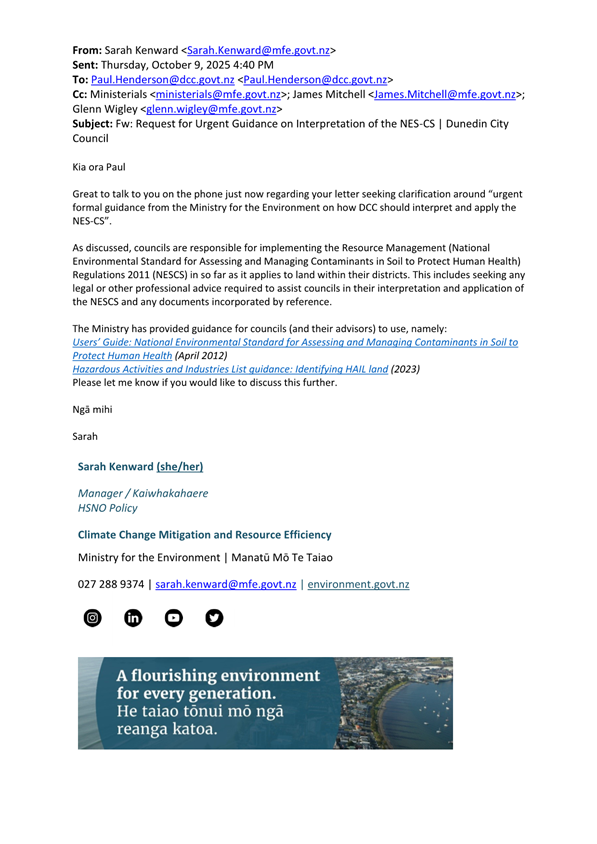
|

|
Council
11 December 2025
|
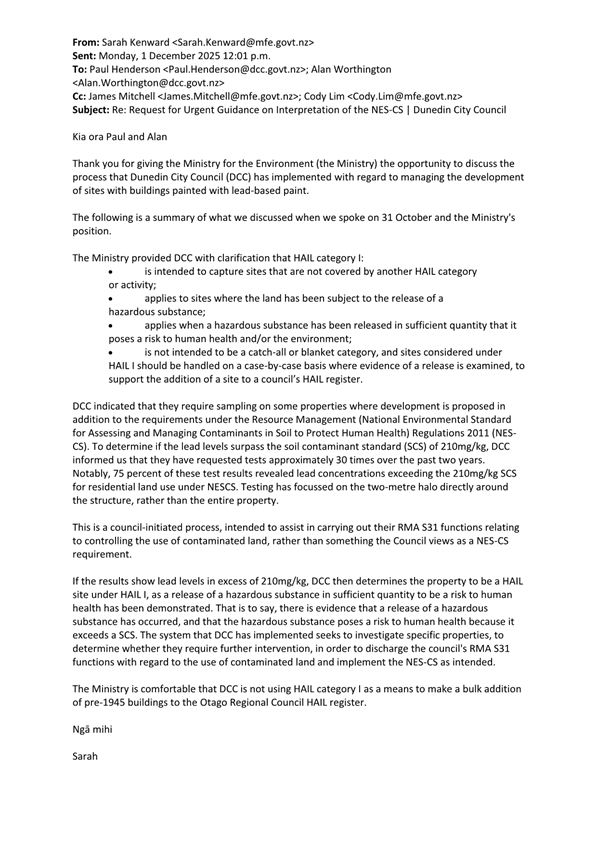
|

|
Council
11 December 2025
|
Sports Ground Management Plan Review
Department: Parks and Recreation
EXECUTIVE SUMMARY
1 The
Sports Ground Management Plan was adopted in 1999, it is now to be reviewed.
This report seeks to commence the public consultation
process required by s. 41(5) of the Reserves Act 1977 (the Act), to enable
the review of the Sports Ground Management Plan.
2 The
Sports Ground Management Plan (1999 Plan) sets objectives and policies for
Dunedin sports ground facilities. Council owns and maintains 50 outdoors
sports grounds. This includes 156 grass playing fields and 4 artificial
surfaces.
3 It
is a requirement under the Act to consult with the public when a reserve
management plan is being created or reviewed.
4 The
Statement of Proposal has been prepared, detailing the proposed review of the 1999
Plan and proposed public engagement. This Statement of Proposal and the Sports
Ground Management Plan Feedback Form is at Attachment A. The
Sports Ground Management Plan (1999) is at Attachment B.
RECOMMENDATIONS
That the Council:
a) Approves the Statement
of Proposal and Sports Ground Management Plan Feedback Form
b) Authorises the
commencement of the public consultation process required by s. 41(5) of
the Reserves Act 1977 as outlined in Option One below.
BACKGROUND
5 Sportsground
development in Dunedin began as early as the mid-1800s as early British
settlers brought their traditional outdoor games.
6 Initially,
low lying swamp land was developed as playing fields, including North Ground
(developed by The Caledonian Society), The Oval and Carisbrook.
7 As
Dunedin grew beyond its central city in the late 19th and early 20th centuries,
suburban areas like Mosgiel, Taieri, and South Dunedin began to establish their
own recreational spaces.
8 The
Sports Ground Management Plan was adopted in 1999 and is due for review.
9 The
Act requires an administering authority keep reserve management plans under
continuous review pursuant to s. 41(4). Therefore, a review is required to
update the current Sports Ground Management Plan.
10 While
not all sportsgrounds are classified as reserves, for sake of efficiency and
consistency, the 1999 Plan includes all the city’s sports grounds
regardless of their classification and staff will follow the procedure
specified in subsections (5) and (6) of s. 41 of The Act.
11 The
review will allow Council to respond to trends and adopt best practice models
regarding participation and management.
12 It
is a requirement of The Act that the public is consulted when a reserve
management plan is being created or reviewed.
13 Community
engagement is undertaken in two stages. The first stage seeks community input
on both proposed and existing plans under review.
14 Staff
have allocated 20 working days for this initial engagement period for the 1999
Plan. Feedback provided will guide the review and drafting of the new Sports
Ground Management Plan (the 2026 Plan).
15 The
second stage of engagement allows the public to provide feedback based on a
draft version of the 2026 Plan. Feedback provided during stage two of
engagement is considered by the Hearings Committee and, where appropriate,
feedback is included into a final plan.
16 This
report seeks approval of the Statement of Proposal and approval to commence
Stage 1 of community engagement.
DISCUSSION
17 Dunedin’s
sports grounds have evolved significantly since the city’s founding in
1848, closely intertwined with the development of the Town Belt, which was
envisaged to serve the role as a place for residents to enjoy nature and
recreation.
18 Dunedin’s
sports grounds have grown from informal playing fields in the mid-19th century
to a well-organized network of facilities supporting a wide range of sports.
19 Early grounds
like Montecillo and Carisbrook played key roles in the city’s sporting
history, hosting cricket, rugby, and horse racing.
20 Over
time, the city expanded its provision of sports fields to meet growing demand
from schools, clubs, and the public.
21 Dunedin
City Council currently manages 50 sportsgrounds across the city. These are used
extensively by local sports clubs for training and competition, covering sports
such as rugby, football, cricket, athletics, and softball.
22 Clubs
book fields through a formal system, and many grounds are shared between
multiple codes.
23 Recent
improvements to surfaces, lighting, facility upgrades, and the development of
artificial playing surfaces have made significant improvements to the
city’s sports grounds.
24 As
well as formal use by sports clubs, these spaces are open to the public for
casual recreation—walking, jogging, informal games, dog walking and
community events.
25 Understanding
trends and current need will help the review process.
26 The
1999 Plan provides policies to manage a range of issues and activities
including allocation of sports fields, bookings, charges, non- sporting use of
sports grounds, provision and maintenance of facilities, upgrades and
renovations of grounds and commercial activities on sports grounds.
27 It
is likely that the community will provide a range of views that will be useful
for developing new policies and aims.
28 Specifically,
the trending towards casual and short format games over organised traditional
sports, a stronger focus on accessibility for all, the need to cater for more
diversity, heightened environmental awareness, the impacts of climate change on
sports grounds and increasing costs (for both provision and participation) are
expected to be themes during stage 1 consultation.
OPTIONS
Option One – Recommended Option
29 That
the Council approves the proposal to publicly notify its intention to prepare a
Management Plan for Dunedin Sports Grounds and initiates the Stage One
engagement process, as required by s. 41(5) of the Act.
Advantages
· Staff
can begin the public consultation process, as required by s. 41(5) of the Act,
allowing interested persons and organisations to provide written suggestions on
the proposal.
Disadvantages
· There
are associated costs for Council involved in the public consultation process
required by s. 41(5) of the Act. The costs are related to staff time
while managing the consultation process.
Option Two – Status Quo
30 That
Council does not support the proposal to publicly notify its intention to
prepare a Management Plan for Dunedin sports grounds and does not initiate a
public consultation process.
Advantages
· Costs,
including staff time associated with the public notification, and subsequent
preparation of a Management Plan are not required.
Disadvantages
· The
Dunedin sports grounds would continue to be managed under the Sports Ground
Management Plan 1999 and the General Policies Reserve Management Plan. This
would result in policies that are not relevant and development of the sports
grounds that does not reflect community aspirations.
· The
public and key stakeholders would not have an opportunity to provide feedback
through a formal public consultation process.
NEXT STEPS
31 If
approved, staff would follow the public consultation process required by s. 41(5)
of the Act.
Signatories
|
Author:
|
Peter Christos - Parks and Recreation Planner
John Brenkley - Planning and Partnerships Manager
|
|
Authoriser:
|
Heath Ellis - Group Manager Parks and Recreation
Scott MacLean - General Manager, City Services
|
Attachments
|
|
Title
|
Page
|
|
⇩a
|
SOP and Feedback Form
|
187
|
|
⇩b
|
Sports Ground
Management Plan 1999
|
191
|
|
SUMMARY OF CONSIDERATIONS
|
|
Fit with purpose of Local Government
This decision enables democratic local
decision making and action by, and on behalf of communities.
|
|
Fit with strategic framework
|
|
Contributes
|
Detracts
|
Not applicable
|
|
Social Wellbeing Strategy
|
✔
|
☐
|
☐
|
|
Economic Development Strategy
|
☐
|
☐
|
☐
|
|
Environment Strategy
|
✔
|
☐
|
☐
|
|
Arts and Culture Strategy
|
☐
|
☐
|
☐
|
|
3 Waters Strategy
|
☐
|
☐
|
☐
|
|
Future Development Strategy
|
✔
|
☐
|
☐
|
|
Integrated Transport Strategy
|
✔
|
☐
|
☐
|
|
Parks and Recreation Strategy
|
✔
|
☐
|
☐
|
|
Other strategic projects/policies/plans
|
☐
|
☐
|
☐
|
The city’s sports grounds contribute to the
wellbeing of the community, beyond organised sports. Management plans
provide opportunities to support councils’ strategic directions by
aligning with other departments policies and goals, wherever possible.
Sports grounds provide public spaces for social engagement and can be
important spaces when planning development and transportation infrastructure.
|
|
Māori Impact Statement
The city’s sports grounds are located at a variety
of sites, including coastal environments. Mana whenua will be involved from
the outset in the development of this management plan. Aukaha will be
approached early in the development of new Sports Ground Management Plan with
the hope of input from Te Rūnanga o Ōtākou and Kāti
Huirapa Rūnaka ki Puketeraki.
|
|
Sustainability
Sustainability, Climate Change effects and the
Council’s Zero Carbon Policy has been considered through the process of
this project and will be considered in the management and operation of the
sports grounds.
|
|
LTP/Annual Plan / Financial Strategy /Infrastructure
Strategy
There are no implications on the plans and strategies for
preparing and engaging on reserve management plans.
|
|
Financial considerations
Community engagement on the draft and any revisions or
amendments to it prior to it being adopted can be resourced from within the
existing Parks and Recreation Services operating budget for 2025/26 year. The
majority of costs relate to staff time managing the review process.
|
|
Significance
The Sports Ground Management Plan is considered low in
terms of the Council’s Significance and Engagement Policy.
|
|
Engagement – external
The Reserves Act 1977 requires DCC to consult with the
public when a reserve management plan is being created or reviewed.
|
|
Engagement - internal
Internal engagement will be undertaken with various
departments as part of Stage 1 engagement. This will continue in the
preparation of the first draft and final review of the management plan.
|
|
Risks: Legal / Health and Safety etc.
There are no known risks
|
|
Conflict of Interest
There are no known conflicts of interest.
|
|
Community Boards
Community Boards will be approached for comment during the
engagement period.
|
|

|
Council
11 December 2025
|
Town Belt Active Travel Trial
Department: Parks and Recreation
EXECUTIVE SUMMARY
1 The
purpose of this report is to seek Council approval for the proposed Town Belt
Active Travel Trial, which will temporarily close a section of Queens Drive
between 12 January 2026 and 19 April 2026.
2 The
trial is designed to give effect to the Dunedin Town Belt Reserve Management
Plan (RMP), specifically policies supporting shared path development and safer,
non-vehicular transport through the Reserve.
3 Council
endorsement will enable staff to deliver the trial and return with
evidence-based findings to inform future decisions on the project’s next
steps.
4 Council
adopted the Dunedin Town Belt Reserve Management Plan on August 12th,
2025, which included an implementation plan.
5 The
Dunedin Town Belt Reserve Management implementation plan included the action to
“Investigate the adaptation of Queens Drive to enable resident only
access and to establish a shared pathway route through the length of the Town
Belt”.
6 Staff
have investigated options and have proposed a trial project to give effect to
that action.
7 The
Town Belt Active Travel Trial (the trial) is a time-bound closure that will
convert part of Queens Drive into a safe, people-focused corridor connecting
Roslyn and Mornington.
8 The
section of the Town Belt chosen for the trial connects the hill suburbs to the
cluster of schools near Rattray Street and the central city.
9 The
trial directly advances the Town Belt RMP objectives around transport safety,
non-vehicular transport modes, reduction of illegal parking and dumping and
zero carbon outcomes.
10 The
trial aligns with the draft Ōtepoti Pathways Plan. This plan focuses on
fixing gaps in the city’s cycling and walking network to give people more
transport options.
11 Data
gathered during the trial will be used to assess the benefits of the shared
path concept using the NZTA Reshaping Streets regulatory framework.
12 The
trial will be delivered within existing budgets, supplemented by modest
partnership support (e.g. Sport Otago and NZTA). The estimated costs to
set up the trial is $15,100.
13 Staff
will return to Council following the trial with robust monitoring data,
community feedback, and an evaluation of outcomes to inform next steps.
RECOMMENDATIONS
That the Council:
a) Approves the approach
outlined in this report to implement the Town
Belt Active Travel Trial.
b) Notes that the trial
is the first step in delivering on the Town Belt Reserve Management
Plan’s objectives and implementation plan.
c) Notes that at the
conclusion of the trial staff will report back to Council on the results of the
trial, including community feedback.
BACKGROUND
14 The
Dunedin Town Belt Reserve Management Plan was adopted on August 12th,
2025, and published online, 14th October 2025.
Moved (Cr Andrew Whiley/Cr
Steve Walker):
That the Council:
a)
Notes that the Hearings Committee had
heard and considered submissions on the draft Dunedin
Town Belt Reserve Management Plan 2025.
b)
Adopts the Dunedin Town Belt Reserve
Management Plan 2025.
Motion
carried (CNL/2025/218) with Cr Lee Vandervis recording his vote against
15 The
Dunedin Town Belt is one of the city’s most significant green spaces,
providing recreation, biodiversity, and cultural values. However, its
recreational potential is currently undermined by roads that prioritise
vehicles, create safety risks, and facilitate illegal car parking and dumping.
16 Spanning
approximately 202 hectares, the Town Belt forms a continuous green corridor
around Dunedin’s central city, offering residents and visitors access to
native bush, recreational areas, and scenic viewpoints.
17 For
context, the Town Belt is nearly 1.5 times the size of Hyde Park in London
(142 hectares) and roughly half the size of Central Park in New York City (341
hectares), highlighting both its substantial scale and its potential as a major
urban recreational asset.
18 This
comparison underscores the opportunity to unlock the Town Belt’s full
potential by prioritising pedestrian and cycling access, enhancing safety, and
creating spaces that encourage active recreation and community engagement.
19 The
Dunedin Town Belt RMP provides clear direction to improve transport safety and
investigate shared path options. Specifically:
Opportunities Section:
· 6.10 Identify and mitigate safety risks
throughout the Reserve, specifically, improving transport safety outcomes.
· 6.11 Identify a suitable location for a shared
path route, which includes provision for mobility needs, along the length of
the Reserve where impact on the status quo is minimal.
Policies Section:
· 8.10.1.12 Council shall
consider the adaptation of Queens Drive to enable resident only access, and to
establish a pedestrian cycleway route through the length of the Town Belt.
Striving to achieve the:
• Promotion of transport safety
• Promotion of non-vehicular transport modes
• Reduction of illegal carparking
• Reduction in the ability to illegally dump rubbish
• Promotion of zero carbon outcomes.
20 Transport
engineers have reviewed vehicle use along Queens Drive. Their analysis shows
that the majority of traffic in the area uses Māori Road or Highgate
instead. See Attachment 1 for a comparison of traffic
volumes for vehicles using Highgate, Queens Drive and Maori Road.
21 This
data indicates that Queens Drive is not a critical transport connection within
the wider network, and that any impacts from a temporary closure are expected
to be minor — a key outcome the trial will help to inform.
22 Speed
monitoring has identified a clear mismatch between the intended use of the
corridor and current driver behaviour.
23 The
legal speed limit on Queens Drive is 50 km/h, the surrounding environment
— including the Town Belt’s recreational areas and the road’s
geometry — makes a speed of no more than 30 km/h more appropriate.
24 Monitoring
shows that nearly all vehicles are exceeding this safe speed, with some
reaching up to 80–90 km/h. These findings indicate that Queens Drive is
currently functioning as a high-speed cut-through rather than a local access road
supporting recreation and community use of the Town Belt.
25 During
consultation on the draft
Dunedin Town Belt Reserve Management Plan, a total of 60 submitters
provided feedback.
26 The
most frequently discussed theme was the proposal for a pedestrian and cycleway
through the Town Belt, raised by 36 submitters. Of those, 75% expressed support
for the concept, 11% opposed it, and 14% held a neutral position, generally
raising design-related concerns.
DISCUSSION
27 The
most effective way to deliver on these objectives outlined in the Background
section above, is to test a trial road closure and monitor its impacts.
28 The
Town Belt Active Travel Trial will temporarily close a section of Queens Drive
between Braid Road and Preston Crescent, and the section of Braid Road that
connects to Ross Street to through-traffic. See Attachment 2 for
plans and drawings.
29 Vehicle
access for residents and essential services will be maintained, while bollards
and signage will define the trial closure points. Black bollards have been
selected over standard orange traffic cones to create a more intentional design
that enhances the look and feel of the space.
30 The
trial will run from 12 January 2026 to 19 April 2026, deliberately timed to
capture both the busy summer holiday season and the return to school, giving a
representative picture of how the space is used by families, commuters, and the
wider community.
31 During
the trial period, the closed section of Queens Drive will function as a shared
path for walking, cycling, and mobility users, providing a safe and continuous
route along the edge of the Town Belt.
32 The
closure will be supported with baseline monitoring of traffic, pedestrian, and
cyclist numbers, including new AI monitoring technology attached to
streetlamps. This data will be supplemented with community feedback gathered
through engagement activities.
33 The
project team is also drawing on existing partnerships to enhance the trial
space. Opportunities include installing simple street furniture, temporary
signage aligned with the 28 Birds project at Jubilee Park, and
small-scale activations supported by Sport Otago to encourage families,
schools, and community groups to use the space.
34 The
costs for setup, line marking, traffic management, signage and monitoring are
being covered internally by Transport and are estimated to be $12,000.
There will also be 7 existing planter boxes currently in storage from previous
projects that will be used at various locations such as access points to
provide interest and colour. The cost for Parks and Recreation to freight
the planter boxes to site and fill them with growing media and plants is
estimated to be $3,100 giving a total cost of $15,100.
35 In
house communications and marketing will leverage existing DCC channels to
ensure broad awareness.
36 The
trial will run for a fixed period, after which results will be reported back to
Council. Staff will present monitoring data, community feedback, and lessons
learned, so Council can make an informed decision about whether to:
a) Make
the road closure permanent and begin developing a long-term shared path along
Queens Drive; or
b) Make
changes to how the road functions; or
c) Revert
to the status quo if the trial demonstrates insufficient benefits.
This approach ensures the trial is achievable within
existing budgets, while still testing how Queens Drive could function as the
spine of a future shared path through the Town Belt.
37 The
Town Belt Reserve Management Plan (RMP) sets a clear direction for transport
and safety outcomes in the reserve. The trial provides a practical way to give
effect to these provisions.
38 The
trial will test whether Queens Drive can be safely and successfully adapted for
active travel, while enabling the collection of evidence on safety,
accessibility, and community use.
39 In
doing so, it directly supports the RMP’s objectives of promoting
non-vehicular transport modes, reducing illegal parking and dumping, and
contributing to zero-carbon outcomes.
40 The
Reshaping Streets regulatory changes introduced by Waka Kotahi NZTA
create a national framework that enables councils to implement street trials
such as this. These reforms:
a) Provide
clear powers for councils, as Road Controlling Authorities, to pilot street
changes for up to two years.
b) Enable
modal filtering and traffic restrictions to prioritise active modes and
community use.
c) Streamline
administrative processes, allowing councils to respond more quickly to
community aspirations and safety needs.
d) Align
local initiatives with national priorities of climate action, mode shift,
health, and liveability.
41 The
Town Belt Active Travel Trial is a direct expression of this framework in
action. By trialling a new use of Queens Drive, the project tests how
national-level regulatory tools can be applied locally to facilitate the Town
Belt RMP’s vision.
42 In
this way, the trial sits at the intersection of national policy and local
planning: enabled by Reshaping Streets and delivering on the outcomes sought in
the RMP.
43 Staff
have selected this specific section of Queens Drive not only because it enables
the frameworks and policies of the Town Belt Reserve Management Plan and wider
strategic commitments, but also because of the unique opportunity it offers to
reimagine the Town Belt itself.
44 By
trialling a closure here, the space can be experienced as a cohesive, enjoyable
area of reserve land, rather than as a road corridor. This creates immense
recreation and amenity value in its own right, transforming the Town Belt from
a highway that divides, into a destination that connects.
45 The
Town Belt Active Travel Trial will be evaluated against a set of clearly
defined objectives and metrics to ensure we can assess its effectiveness and
inform any future decisions regarding permanent changes. See Attachment 3
which identifies how success will be measured.
46 Key
areas of focus include user experience and satisfaction, usage levels,
perceived safety, environmental outcomes such as litter reduction, community
support and engagement, activation of the space through recreational features,
and overall feasibility and scalability of the trial. The questionnaire
is included in Attachment 4.
47 While
the trial period is relatively short (January 2026 – April 2026), the
approach is designed to provide robust, actionable information.
48 An
example is automated and manual counts will capture the number of pedestrians
and cyclists using the corridor, while surveys and feedback tools (including a
QR code on-site) will gather qualitative data on community experience and
perceptions of safety.
49 Environmental
monitoring, such as litter audits, will also help identify improvements in
amenity and reduce illegal dumping.
50 Biodiversity
outcomes are acknowledged as a longer-term measure and are unlikely to show
measurable changes over the four-month trial period. However, staff will
conduct pre- and post-trial bird counts and visual observations to record any
notable changes, ensuring that the ecological values of the Town Belt are
considered.
51 The
full set of proposed metrics and methods is provided as an attachment to this
report. This framework will allow the trial to be evaluated comprehensively,
capturing both quantitative and qualitative insights, and providing a strong
evidence base for Council to consider permanent implementation or wider shared
path opportunities through the Town Belt.
Recreation, Waste and Amenity elements
52 During
a recent Keep Dunedin Beautiful campaign, Parks Planning staff walked the
Queens Drive route through the Town Belt (beginning from Māori Road,
following behind Otago Boys’ High School to end at Moana Pool) and
collected 14 bags of rubbish and 6 bags of recycling.
53 Most
of this litter was concentrated in areas where illegal parking or vehicle
stopping commonly occurs along the steep banks. This suggests that reducing
vehicle access through the trial area could help decrease roadside dumping and
litter accumulation, improving the overall amenity and environmental quality of
the Town Belt
54 While
this report focuses largely on the current challenges associated with vehicle
use along Queens Drive, it is equally important to emphasise what the proposed
trial seeks to create.
55 The
trial is an opportunity to reimagine this section of the Town Belt as an
active, people-focused space — a place to enjoy the reserve as a park,
rather than a thoroughfare.
56 The
trial would allow the introduction of features such as food truck zones,
outdoor games like table tennis, active play areas, and enhanced native
biodiversity.
57 Together,
these outcomes will help activate the Town Belt and strengthen its role as a
vibrant community and ecological corridor.
OPTIONS
Option One – Recommended Option
58 Approve
the Town Belt Active Travel Trial
Advantages
· Enables
delivery on the intent of the recently adopted Town Belt RMP.
· Provides
an evidence-based, low risk way to trial a road closure and gather robust monitoring
data.
· Creates
opportunities for safe, active connections and reserve amenity across the Town
Belt.
· Builds
community understanding and feedback on future shared path options.
Disadvantages
· May
cause some short-term inconvenience for the small proportion of drivers who
currently use this route, requiring adjustment to alternative routes.
Option Two – Status Quo
59 Do
not proceed with trial.
Advantages
· Maintains
current road access for all drivers, avoiding any disruption or adjustment to
traffic patterns.
Disadvantages
· Would
not give effect to the Town Belt Reserve Management Plan objectives or
policies.
· Retains
current safety risks, illegal parking, and dumping issues.
· Loses
an opportunity to test and demonstrate low-cost, evidence-based approaches to
active transport.
NEXT STEPS
60 Subject
to Council approval, staff will deliver the trial with core funding from
Transport and Parks, supported by additional resources from City Development
(recycled street furniture), NZTA (recycled concrete transport infrastructure)
and Sport Otago (stencils for play street).
61 Baseline
monitoring of current traffic, pedestrian, and cyclist numbers will be
completed prior to the trial, including use of new AI streetlamp monitoring.
62 The
trial will be implemented and promoted in collaboration with Sport Otago, NZTA,
and community partners.
63 Staff
will report back to Council with the results of monitoring and community
engagement, alongside an evaluation of outcomes to inform decisions on any
future changes or investment.
Signatories
|
Author:
|
Katie Eglesfield - Parks and Recreation Planner
|
|
Authoriser:
|
Heath Ellis - Group Manager Parks and Recreation
Scott MacLean - General Manager, City Services
|
Attachments
|
|
Title
|
Page
|
|
⇩a
|
Transport Data for Town
Belt Trial
|
227
|
|
⇩b
|
Town Belt Active Travel
Trial Activation Plan
|
231
|
|
⇩c
|
Measuring Success -
Town Belt Active Travel Trial Metric Framework
|
233
|
|
⇩d
|
Questions for Town Belt
Trial Engagement
|
234
|
|
SUMMARY OF CONSIDERATIONS
|
|
Fit with purpose of Local Government
This decision enables democratic local
decision making and action by, and on behalf of communities.
This decision promotes the social
well-being of communities in the present and for the future.
This decision promotes the environmental
well-being of communities in the present and for the future.
This decision promotes the cultural
well-being of communities in the present and for the future.
|
|
Fit with strategic framework
|
|
Contributes
|
Detracts
|
Not applicable
|
|
Social Wellbeing Strategy
|
✔
|
☐
|
☐
|
|
Economic Development Strategy
|
☐
|
☐
|
✔
|
|
Environment Strategy
|
✔
|
☐
|
☐
|
|
Arts and Culture Strategy
|
✔
|
☐
|
☐
|
|
3 Waters Strategy
|
☐
|
☐
|
✔
|
|
Future Development Strategy
|
✔
|
☐
|
☐
|
|
Integrated Transport Strategy
|
✔
|
☐
|
☐
|
|
Parks and Recreation Strategy
|
✔
|
☐
|
☐
|
|
Other strategic projects/policies/plans
|
✔
|
☐
|
☐
|
The trial project aligns strongly with Dunedin City
Council’s strategic direction, particularly in relation to active
transport, recreation, environmental outcomes, and community safety. It
provides a practical way to test policies and objectives already embedded in
key guiding documents. The two most relevant are Ōtepoti Pathways
– A Walking and Cycling Plan for Dunedin and the Dunedin Town
Belt Reserve Management Plan (RMP) and Implementation Plan.
|
|
Māori Impact Statement
Parks will contact and engage with Mana whenua
about opportunities to incorporate cultural
narrative and storytelling into the corridor
through signage or promotional events.
Initial conversations have indicated that Mana
Whenua will likely want to be involved in the wider
long term project, but at this point
involvement in the trial is considered high labour, low reward, and
too soon for existing
timeframes.
|
|
Sustainability
Zero Carbon outcomes, by encouraging non-vehicular transport modes
and
sustainable recreation.
Specifically, the project relates to the
following city key shifts and DCC action areas of the Zero Carbon Plan:
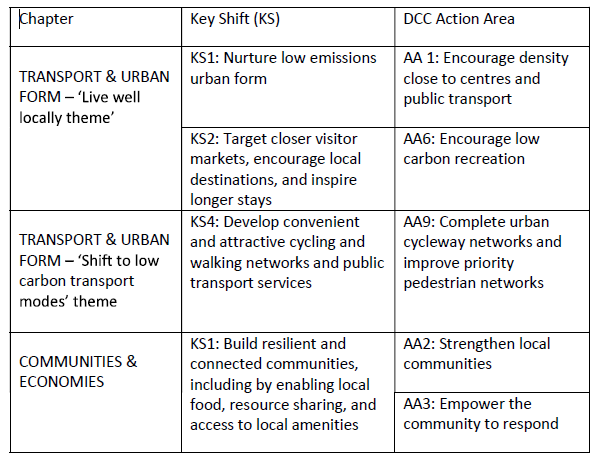
Likely to have no material impact on emissions
in the short term due to the small scale/ short timeframe of the trial. However,
it has the potential to lead to city transport emissions reduction in the
longer term if it becomes permanent or inspires other similar trials.
Supports the community to take climate positive actions; aligns with the Zero
Carbon Plan.
|
|
LTP/Annual Plan / Financial Strategy /Infrastructure
Strategy
The current trial is enabled through existing budget,
however specific LTP funding has been allocated from Y4 to enable long term
shared path changes in the Town Belt. This is therefore the beginning of
enabling long term plan outcomes.
|
|
Financial considerations
Core delivery is funded through existing PARs and
Transport budgets, with Sport Otago contributions enhancing non-essential but
high-value assets.
|
|
Significance
While the infrastructure changes are minimal, the project
has been classified as a Tier 2 project due to its level of significance to
the wider community.
|
|
Engagement – external
Initial discussions with Town Belt Kaitiaki, Local Schools
and Sport Otago have been undertaken to understand initial support for the
project and to help in project planning.
Discussions
with the Dunedin Amenities Society are ongoing. While there are numerous
external stakeholders to engage, the following list represents a selection of
key, though not exhaustive, stakeholders:
Dunedin Amenities Society
Birds NZ
Taskforce Green
Southern Youth Development Bikes@Syd programme
Spokes
Local Residents
Belleknowes Golf Club
Sport Otago
Town Belt Kaitiaki
Schools / childcare
centres in the area (Trinity College, Otago Boys High School, Arthur Street,
St Joseph's Cathedral School, City Heights Montessori, Pioneers Russell
Street Nursery, Russell Street early childhood centre, Elm Row Early
Childhood Centre Ross Street Otago Childcare, Otago Girls High School).
|
|
Engagement - internal
This is a combined project between Transport and PARS,
wider initial consultation has included, City Sanctuary, City Planning, Arts
and Culture teams, Taskforce Green, Keep Dunedin Beautiful (City
Partnerships), Communications Marketing and Design, and the Māori
Partnerships Team.
|
|
Risks: Legal / Health and Safety etc.
No identified risks.
|
|
Conflict of Interest
No conflict of interest.
|
|
Community Boards
No implications for Community Boards. Central city
location.
|
|

|
Council
11 December 2025
|
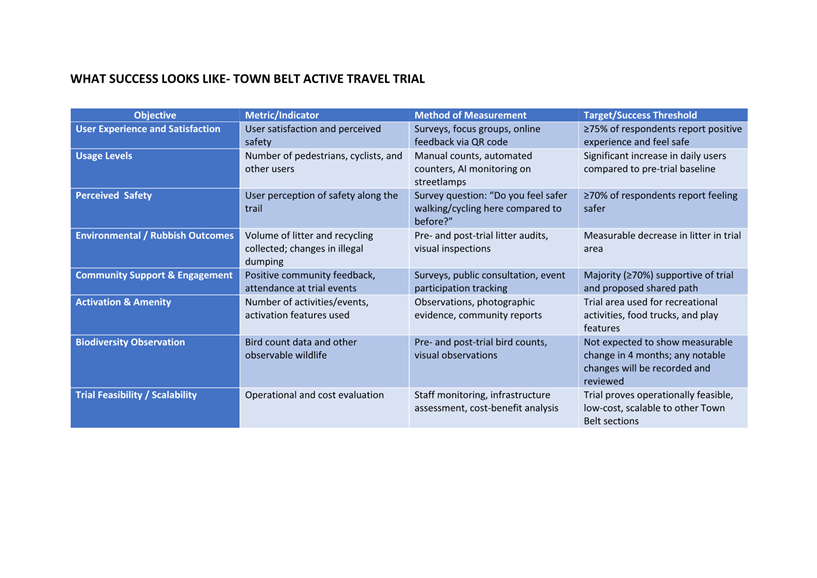
|

|
Council
11 December 2025
|
Reserve Management Plan Review Schedule
Department: Parks and Recreation
EXECUTIVE SUMMARY
1 This
report presents a forward work programme for the review of all reserve
management plans (RMPs) that are administered by Dunedin City Council (DCC) as
administering body under the Reserves Act 1977 (the Act).
2 The
Act requires DCC as the administering body to keep RMPs under continuous review
so that the RMPs are adapted to changing circumstances or in accordance with
increased knowledge.
3 Under
the Act, where the administering body of any reserve resolves to undertake a
comprehensive review of its management plan, the administering body shall
follow the procedure specified in subsections (5) and (6) of Section 41 as if
the review were the preparation of a management plan.
4 The
process of reviewing the DCC’s RMPs commenced with the Truby King Reserve
Management Plan being approved and adopted by Council in June 2021.
A further 5 RMPs have recently been reviewed and adopted by Council.
5 Following
review of the existing RMPs and the creation of two new RMPs, there will be
17 operative DCC RMPs.
6 Factors
that have influenced the order of priority for the review of RMPs includes the
age of the current RMP, change in circumstances and trends since any original
plans were written, and any alignment required with the Parks and Recreation
Strategy.
7 The
Reserve Management Plan Schedule was presented to Strategy, Planning and
Engagement Committee in October 2024.
8 The
revised Reserve Management Plan schedule (at Attachment A) shows the review
priorities in the approved order with updated timelines for those that have
been reviewed recently.
RECOMMENDATIONS
That the Council:
a) Approves the attached
Reserve Management Plan Schedule
BACKGROUND
9 DCC
is the administering body appointed to control and manage reserves under the
Act within the city to ensure the use, enjoyment, development, maintenance,
protection and preservation, as the case may require of the reserve for the
purpose for which it is classified.
10 Section
41 of the Act requires the administering body to prepare and approve RMPs for
the reserves under its control, management, or administration (except local
purpose reserves).
11 The
purpose of an RMP is to provide for and ensure the use, enjoyment, maintenance,
protection, and preservation as the case may require, and to the extent that
resources permit, the development of the reserve for the purpose which it is
classified.
12 The
Act requires continuous review of RMPs by the administering body to keep RMPs
adapted to changing circumstances, or in accordance with increased
knowledge.
13 Where
a reserve is vested in a local authority, or a local authority is appointed to
control or manage a reserve, the local authority can approve RMPs for those
reserves.
14 DCC
follows the process under sections 41(5) and 41(6) of the Act for preparing and
reviewing RMPS. This process usually involves a two-stage public notification
and consultation process as well as a hearing if there are submitters who wish
to be heard.
15 RMPs
may be prepared for individual reserves or groups of reserves. These RMPs that
cover more than one reserve are called Omnibus RMPs.
16 An
example of an omnibus RMP is the Hill Reserves Management Plan, that applies to
13 Council reserves on the first line of hills surrounding the urban core of
Dunedin City. This is to ensure consistency in terms of management of
these reserves.
17 There
are currently three groups/types that make up the DCC suite of RMPs.
These are:
· General
Policies;
· Omnibus;
and
· Individual
Reserve Management Plans.
18 This
provides a streamlined approach to reserve management planning (providing a
coherent overview of all reserves managed by Council) and reduces repetition
and duplication of costs.
19 This
is achieved through having a Reserves Management Plan General Policies document
to cover day to day decisions about reserves, with RMPs for individual or
groups of reserves where greater planning detail is required.
20 The
previous reserve management Plan Schedule was presented to SPEC in October
2024.
Moved
(Cr Sophie Barker/Cr Mandy Mayhem):
That
the Committee:
a)
Approves the attached Reserve Management Plan Schedule with the following amendments:
Hereweka/Harbour
Cone Reserve Management Plan to be item 8; and
Sports
Ground Management Plan 1999 to be item 9
Motion
carried (SPEC/2024/052)
DISCUSSION
21 Given review
of RMPs is required under the Act, DCC has commenced the review process.
The proposed plan is to retain the current suite of general policies, omnibus,
and individual RMPs.
22 This
structure allows a consistent approach to the day-to-day decisions about
management of these reserves.
23 The
review of the Truby King Reserve Management Plan, Signal Hill Reserve
Management Plan, Reserves Management Plan General Policies, Dunedin Town Belt
Reserve Management Plan, the Otago Harbour Reserves Management Plan and the
Mosgiel Recreation Area Reserve Management Plan are now complete.
24 The
Otago Boat Harbour Recreation Reserves Management Plan has been incorporated
into the Otago Harbour Reserves Management Plan.
25 The
second stage of engagement on the Draft Logan Park Management Plan has recently
finished. The next stage is to hold hearings for people who wish to speak
to their submission. The plan will be updated based on the Hearings Panel
consideration of submissions and then later, presented to Council for approval.
26 Logan
Park is not a gazetted reserve under the Act. However, the process that
is required to create and review reserve management plans under the Act is
being used to create the Logan Park Management Plan.
27 The
Hereweka Harbour Cone Management Plan is currently under review. The
first stage of engagement is complete, and a draft Hereweka Harbour Cone
Management plan is being written.
28 Hereweka
Harbour Cone is not a gazetted reserve under the Act. However, the
process that is required to create and review reserve management plans under
the Act is being used to create the Hereweka Harbour Cone Management Plan.
29 Staff
will take a consistent approach in RMP review methodology, which will involve
early engagement with iwi, community boards, and community stakeholder groups.
30 The
work programme is based on several RMP reviews being in progress at any given
time, and staff estimate that each RMP will take approximately 12 months to
review. Timelines will vary slightly dependant on the reserve and other
engagement activities underway by Council throughout the year.
31 Factors
that have influenced the order of priority for the review of RMPs include the
age of the current RMP, changes in circumstances, and trends since any original
plans were written, and any alignment required with the Parks and Recreation
Strategy.
32 As
part of the review process, staff will investigate whether some RMPs could be
incorporated into omnibus plans. For example:
a) The
Waikouaiti Domain Reserve Management Plan 1986 may be incorporated into the
Coastal Dunes Reserve Management Plan omnibus.
b) The
Caversham Valley Forest Management Plan 1986 may be incorporated into the Hill
Reserves Management Plan.
33 Any
decisions regarding the incorporation of management plans into omnibus reserve
management plans will be subject to the public consultation process.
However, staff have scheduled the review of some individual RMPs so that the
potential for incorporation can be fully considered.
34 In
some cases, review and management plan implementation has been delayed allowing
for completion of related work that could impact the management plan itself:
a) Review
of the Botanic Garden Reserve Management Plan has been delayed until the
Botanic Garden Plan has been adopted by Council.
b) Review
of the Ocean Beach Reserve Management Plan has been delayed while investigative
work is completed on the historic landfill beneath Kettle Park and next steps
regarding site remediation are undertaken.
c) The
timing of an Octagon Reserve Management Plan will be aligned with the Central City
Plan.
35 Following
review of existing RMPs and creation of new plans (Logan Park Management Plan
and the Octagon Reserve Management Plan), staff anticipate there will be 17
operative RMPs.
36 There
are some documents that have been identified as “Statements of Management
Intent”. These documents do not appear to be RMPs as they have not
been through the statutory process required for RMPs. However, because
they may relate to land that is held under the Act, the Reserves Management
Plan – General Policies 2025 will apply to them.
37 Examples
of such documents include: Aramoana Reserves (1998), Kew Park (1999) and
Craigieburn Reserve Management Guidelines (1996). These documents were
considered as part of the review process for the Reserves Management Plan
– General Policies 2025, and the omnibus RMPs.
38 Legal
advice on the creation of new and replacement of current RMPs has been sought to
ensure that staff follow appropriate statutory processes.
OPTIONS
Option One – Recommended Option: Council approves the
attached Reserve Management Plan Schedule.
39 The
attached Reserve Management Plan Schedule is based on the schedule approved by
SPEC in October 2024.
Advantages
· Staff
will continue with the current schedule to review RMPs based on age and
currently available information relating to the management of the
reserves.
Disadvantages
· The
schedule may need to change if new circumstances or trends emerge.
Option Two – The Council approves the attached
Reserve Management Plan Schedule with amendments that will reprioritise the
timing of RMP reviews to create a new Reserve Management Plan Schedule.
40 Any
changes to the attached reserve management Plan Schedule will be based on new
circumstances or trends that have become evident within the previous year.
Advantages
· Council
has input into the scheduling of RMP reviews.
Disadvantages
· The
current schedule has several RMPs that have not been reviewed for over 10 years
and any changes will delay their review even further.
NEXT STEPS
41 Staff
will implement the reserve management plan review schedule.
Signatories
|
Author:
|
John Brenkley - Planning and Partnerships Manager
|
|
Authoriser:
|
Heath Ellis - Group Manager Parks and Recreation
Scott MacLean - General Manager, City Services
|
Attachments
|
|
Title
|
Page
|
|
⇩a
|
Reserve Management Plan
Review Schedule December 2025
|
243
|
|
SUMMARY OF CONSIDERATIONS
|
|
Fit with purpose of Local Government
This decision enables democratic local
decision making and action by, and on behalf of communities.
|
|
Fit with strategic framework
|
|
Contributes
|
Detracts
|
Not applicable
|
|
Social Wellbeing Strategy
|
✔
|
☐
|
☐
|
|
Economic Development Strategy
|
☐
|
☐
|
✔
|
|
Environment Strategy
|
✔
|
☐
|
☐
|
|
Arts and Culture Strategy
|
☐
|
☐
|
✔
|
|
3 Waters Strategy
|
☐
|
☐
|
✔
|
|
Future Development Strategy
|
✔
|
☐
|
☐
|
|
Integrated Transport Strategy
|
☐
|
☐
|
✔
|
|
Parks and Recreation Strategy
|
✔
|
☐
|
☐
|
|
Other strategic projects/policies/plans
|
☐
|
☐
|
✔
|
The city’s parks and reserves contribute to the
wellbeing of the community. Reserve management plans provide opportunities
to work with other departments to consider linkages and connections in terms
of movement and association. The public consultation process for
preparing a new reserve management plan enables the community to provide
input into the management of reserves. Reserve management plans are
also an opportunity to evaluate biodiversity and ecological values and
support improvements to the environment.
|
|
Māori Impact Statement
Mana whenua, through Aukaha, will be invited to advise on
the review and drafting of the RMPs. The reviews will allow for
recognition and mana whenua cultural identity, values, and narratives.
|
|
Sustainability
The RMP review process provides an opportunity to ensure
reserve management practices are in alignment with environmental objectives,
including biodiversity, climate change adaptation and carbon reduction goals.
|
|
LTP/Annual Plan / Financial Strategy /Infrastructure
Strategy
There are no implications on the plans and strategies for
preparing and engaging on reserve management plans, but upon their adoption,
projects may be generated which may have implications on the future
operational and capital budgets.
|
|
Financial considerations
The RMP reviews will be funded from within existing PARS
budgets.
|
|
Significance
This report is considered of low significance in terms of
the Council's Significance and Engagement Policy.
|
|
Engagement – external
The Reserves Act 1977 requires DCC to consult with the
public when a reserve management plan is being created or reviewed.
|
|
Engagement - internal
The In-House Legal team has provided guidance on this
report and the process required under the Reserves Act 1977.
|
|
Risks: Legal / Health and Safety etc.
Legal risks will be appropriately managed through ensuring
that the process required by section 41 of the Reserves Act 1977 is properly
followed.
|
|
Conflict of Interest
There are no identified conflicts of interest.
|
|
Community Boards
Community Board will have an interest in the policies
which affect the management of reserves within their administrative
areas. Community Boards will be invited to provide feedback input
during review and drafting of RMPs.
|
|

|
Council
11 December 2025
|
Proposed Data Collection Approach and Content for the
Census Submission
Department: Corporate Policy
EXECUTIVE SUMMARY
1 This
report seeks approval of a draft Dunedin City Council (DCC) submission to Stats
NZ Tatauranga Aotearoa (Stats NZ) on its consultation on the proposed data
collection approach and content for the census (the consultation). The draft
DCC submission is attached as Attachment A.
2 The
purpose of the consultation is to seek feedback on a new approach which will
modernise the New Zealand census (the census). The proposed approach is built
on three key components:
· administrative
(admin) data: using more of the information that is already collected by
government agencies when people use public services.
· a new annual
sample survey (Census Attribute Survey): a year-round survey completed by a
small percentage of the population each year, which will help verify the
accuracy of admin data and collect additional information not provided by admin
data.
· tailored
solutions: working with Stats NZ partners, customers, and priority communities
to develop tailored solutions for their data needs.
3 The
Census Attribute Survey will begin in 2027. The next census will now take place
in 2030, subject to legislative amendments.
4 The
DCC submission speaks to the discussion document for the consultation. The
summary document is attached as Attachment B.
5 This
consultation closes on 19 December 2025.
RECOMMENDATIONS
That the Council:
a) Approves the draft
Dunedin City Council submission, with any amendments, to Stats NZ Tatauranga
Aotearoa on the Proposed data collection approach and content for the census.
b) Authorises the Chief
Executive to make any minor editorial amendments to the submission.
c) Notes that the Mayor or delegate will speak to any hearings in
regard to this submission.
BACKGROUND
Data
collection and usage at the Dunedin City Council
6 The
DCC currently uses census data to inform its work in city planning, community
development, housing, and transport planning.
7 In
addition to the census, the DCC informs its work through several other data
sources.
8 The
Quality of Life (QoL) Survey provides a valuable source of information on
lifestyles in the major metropolitan areas of New Zealand. This survey is led
by the Auckland, Wellington, Christchurch and Dunedin City Councils with other
councils participating from time to time.
9 The
QoL Survey is undertaken every two years and is a survey of residents'
perceptions of quality of life in their city. The topics covered by the QoL Survey
include: public transport; housing; economic wellbeing; physical and mental
health; and community, cultural and social networks. It also includes questions
about council processes.
10 The
Residents Opinion Survey (ROS) is conducted by an independent research company
on behalf of the DCC. Over a 12-month period starting on 1 July each year, survey invitations are sent to a random sample of
residents aged 18 years and over, sourced from the electoral roll.
11 Topics in the
ROS include: satisfaction with DCC facilities and services such as libraries
and kerbside recycling; infrastructure management, such as traffic flow and the
condition of footpaths; and the performance of Mayor and Councillors.
12 Council’s 9 Year Plan 2025-2034 includes Levels of
Service (LoS) across the DCC which are used to measure its performance. The LOS
statements are linked to performance measures with targets that are reported on
at stated points during the course of the plan. The LoS cover a range of DCC
services and activities such as community housing and recreation, and some
mandatory measures for 3 Waters and Roading which are required by the
Department of Internal Affairs.
13 The
DCC also commissions and uses data from other sources and providers, for
example economic datasets from Infometrics.
14 In
addition, the DCC uses data collected and made available by government agencies
such as Health New Zealand (the annual New Zealand Health Survey) and the
Social Investment Agency (Community Insights Explorer tool).
DISCUSSION
The DCC submission
Proposed
approach in the consultation
15 Overall,
the DCC submission welcomes the changes proposed in the consultation,
including:
· collecting data
which enhances the information from its own data collection methods
· delaying the full
census, currently scheduled for 2028, until 2030 while the new approach is
introduced in stages.
16 The DCC
submission expresses concern and seeks reassurance on:
· the spatial
resolution of the data collected using the new approach, and whether this will
affect the scale of available data based on population groups (i.e. 100-200
people) or will only provide reliable statistics based on the total population
of the city (TA level).
· that important
data which informs the DCC’s work, for example health indicators and
dwelling quality indicators, will not be missed through the new data collection
approach
· the implementation
of the new data collection approach, including data safety measures.
17 The
DCC submission recognises the new approach as an opportunity to collect data
about its student populations, and requests that Stats NZ considers this, from
primary through to tertiary level.
Iwi
Māori
18
The DCC submission supports Stats NZ in its work collecting information to
provide insights into needs and outcomes for Māori.
19 Staff
from the DCC’s Mana Ruruku team reviewed the consultation document as
part of the submission preparation. It was identified that there was no
feedback needed on question 3 (Māori descent) at this stage.
20 In
regard to question four in the consultation document about collection data on
iwi affiliation, the DCC recommends contacting rūnaka/hapū or iwi
whakapapa/registration teams to uncover the number of registered members.
Housing
and Dwellings
21 The
DCC’s work in housing, including with Ōtepoti Dunedin’s
homeless whānau, is underpinned by its Housing Plan 2022. The DCC already
uses data provided by the census to inform the implementation of this plan.
22 The
DCC submission suggests that data collection around homelessness be expanded to
include subcategories such as “without shelter” and
“temporary accommodation” and an additional question around the
time spent being homeless.
23 The
DCC submission notes that it could use responses to questions about
“dwelling coldness” to inform longer-term planning for the
provision of increased insulation in housing and dwellings. It suggests that a
related question about the availability of heating would also be useful for
this work.
Priority Communities
24 The
DCC submission notes that these priority communities align with the priority
groups in the DCC’s strategies and approach to community engagement.
25 The
DCC submission welcomes working with Stats NZ to ensure census data and content
include the uniqueness and diversity of Ōtepoti Dunedin’s population.
25 The
DCC submission notes that DCC staff are already working with Stats NZ on
ethnicity data.
26 The
DCC submission recommends that Stats NZ engages with the DCC’s Disability
Issues Advisory Group on the new approach for collecting data about
disabled people and how it can be utilised in Ōtepoti Dunedin.
27 The
DCC submission supports the Future Census Independent
Evaluation Panel’s recommendation to run the Household Disability Survey
more frequently than every 10 years. The next survey is currently scheduled for
2033.
Quality of Life Indicators
28 The
DCC submission recommends that Stats NZ work with the six local authorities
involved in the QoL survey project team on a co-design approach for the
census quality of life indicators. This may address potential issues such as
duplication of questions/data, to ensure that the resulting statistics are
reliable at a TA level.
Proposed updates to current census content
29
The consultation proposes expanding on existing questions in the census.
30 Cigarette
smoking behaviour: the DCC is currently undertaking a review of Dunedin’s
Smokefree Policy, using available census data. The DCC submission requests that
vaping be included in the census, so that this data can be collected at a local
level to inform approaches to behaviour change around both smoking and vaping
in Ōtepoti Dunedin.
31 Access to
telecommunication systems: the DCC submission supports the proposal to
collecting information on access to a cellphone at the individual level rather
than at the household level only. This will assist the DCC in addressing where
barriers to digital inclusion can disproportionately affect some residents,
and, potentially in the long-term, include more residents in the democratic
process (e.g. online voting).
32 Main
means of travel to work and workplace address: the DCC submission notes that census
journey to work data and education data is one of the key components informing
DCC’s transport modelling. It supports continuing to ask questions on
this topic, including around working from home, and the potential to expand on
these questions.
OPTIONS
Option One – Approve the Dunedin City Council
submission on the proposed data collection approach and content for the
census
Advantages
· Opportunity to
provide input into the modernisation of the New Zealand census which benefits
the residents of Ōtepoti Dunedin
· Opportunity to
input into and access data which can inform the Dunedin City Council’s
strategic directions and operational activities
· Opportunity to
have access to data which reflects the uniqueness and diversity of the
population of Ōtepoti Dunedin.
Disadvantages
· There are no
identified disadvantages to this option.
Option Two – Does not approve the Dunedin City
Council submission on the proposed data collection approach and content for the
census
Advantages
· There are no
identified advantages to this option.
Disadvantages
· Missed opportunity
to provide input into the modernisation of the New Zealand census which
benefits the residents of Ōtepoti Dunedin
· Missed opportunity
to input into and access data which can inform the Dunedin City Council’s
strategic directions and operational activities
· Missed opportunity
to have access to data which reflects the uniqueness and diversity of the
population of Ōtepoti Dunedin.
NEXT STEPS
33 If the
submission is approved DCC staff will submit it to Stats NZ Tatauranga Aotearoa
by 19 December 2025.
Signatories
|
Author:
|
Danielle Tolson - Policy Analyst
|
|
Authoriser:
|
Nadia Wesley-Smith - Corporate Policy Manager
Nicola Morand - Manahautū (General Manager Community
and Strategy)
|
Attachments
|
|
Title
|
Page
|
|
⇩a
|
Attachment A: Draft
Dunedin CityCouncil submission on the Proposed data collection approach and
content for the census
|
253
|
|
⇩b
|
Attachment B"
Summary discussion document for the Proposed data collection approach and
content for the census
|
258
|
|
SUMMARY OF CONSIDERATIONS
|
|
Fit with purpose of Local Government
This decision enables democratic local
decision making and action by, and on behalf of communities.
This decision promotes the social and
economic well-being of communities in the present and for the future.
|
|
Fit with strategic framework
|
|
Contributes
|
Detracts
|
Not applicable
|
|
Social Wellbeing Strategy
|
✔
|
☐
|
☐
|
|
Economic Development Strategy
|
✔
|
☐
|
☐
|
|
Environment Strategy
|
☐
|
☐
|
✔
|
|
Arts and Culture Strategy
|
☐
|
☐
|
✔
|
|
3 Waters Strategy
|
☐
|
☐
|
✔
|
|
Future Development Strategy
|
✔
|
☐
|
☐
|
|
Integrated Transport Strategy
|
✔
|
☐
|
☐
|
|
Parks and Recreation Strategy
|
☐
|
☐
|
✔
|
|
Other strategic projects/policies/plans
|
✔
|
☐
|
☐
|
The outcomes of this consultation are relevant to the
DCC’s Housing Implementation Plan; Te Taki Haru, its Māori
Strategic Framework; and future strategic planning for priority communities,
housing, and transport.
|
|
Māori Impact Statement
ThrouT
Through Te Taki Haruru, it’s Māori Strategic Framework, the DCC
demonstrates its commitment to iwi Māori and to the Treaty of
Waitangi. The DCC supports Stats NZ in its work collecting information to
provide insights into needs and outcomes for Māori. In regard to
collecting data on iwi affiliation, the DCC recommends contacting
rūnaka/hapū or iwi whakapapa/registration teams to uncover the
number of registered members. It notes that while its recommended approach
will not encompass all Māori who affiliate to that iwi, iwi may be able
to provide a more accurate approximate or expected number of all iwi members.
The DCC notes the Te
Kupenga I Māori Wellbeing Survey proposed for 2028, and welcomes any
opportunity to be involved in the development and dissemination of this
survey.
|
|
Sustainability
There are no implications for sustainability.
|
|
LTP/Annual Plan / Financial Strategy /Infrastructure
Strategy
There are no implications for the Long-Term Plan/Annual
Plan.
|
|
Financial considerations
There are no financial implications.
|
|
Significance
This decision is considered low in terms of the
Council’s Significance and Engagement Policy.
|
|
Engagement – external
The DCC has discussed the quality of life component of its
submission with other councils that participate in the Quality of Life survey.
Members of the DCC’s Transport team consulted with colleagues in the
New Zealand Modelling User Group on the transport modelling questions in the
consultation document.
|
|
Engagement – internal
This submission has been prepared by the Corporate Policy
team, with input from the City Development, Community Partnerships, Housing,
Manu Ruruku, and Transport teams.
|
|
Risks: Legal / Health and Safety etc.
There are no identified risks.
|
|
Conflict of Interest
There is no conflict of interest.
|
|
Community Boards
Census data is collected in Community Board areas and
residents are affected by decisions made using information collected in the
census.
|
|

|
Council
11 December 2025
|
Drinking Water Quality Assurance Rules (Large Supplies) -
Rules Review 2025 - Submission
Department: 3 Waters
EXECUTIVE SUMMARY
1 This
report seeks the Council’s approval of a draft Dunedin City Council (DCC)
submission (Attachment A) to the Water Services Authority – Taumata
Arowai on proposed changes to the Drinking Water Quality Assurance Rules
(DWQAR) for large drinking water supplies.
2 The
proposals are set out in ‘Consultation on Drinking Water Quality
Assurance Rules (Large Supplies): Rules Review 2025 – Discussion
Document’, published on 10 November 2025 (discussion document). The
discussion document is attached to this report as Attachment B. The proposed
revised DWQAR are attached to this report as Attachment C.
3 The
discussion document, proposed revised DWQAR and additional information
(including FAQs and change comparison tables) are available online at:
korero.taumataarowai.govt.nz/regulatory/rules-review-large-supplies/.
4 The
deadline for submissions is 5pm on 19 December 2025.
5 The
feedback provided in the draft DCC submission relates to:
a) The
proposed change to the DWQAR annual reporting period from the calendar year to
the financial year;
b) Recommendations
to refine the proposed changes to existing rules and proposed new rules to improve
clarity and remove ‘grey areas’, in support of consistent
implementation of the DWQAR across supplies, suppliers and the regulator; and
c) Comments
on anticipated cost implications.
RECOMMENDATIONS
That the Council:
a) Approves the draft DCC
submission to the Water Services Authority – Taumata Arowai on proposed
changes to the Drinking Water Quality Assurance Rules (DWQAR) for large
drinking water supplies at Attachment A.
b) Authorises the Mayor
and/or her delegate to speak to the submission.
c) Authorises the Chief
Executive to make any minor editorial changes if needed.
BACKGROUND
The
DWQAR
6 The
DWQAR are the compliance rules that regulate the supply of drinking water in
New Zealand. They have been in force since November 2022. They are made under
the Water Services Act 2021 and sit alongside the Water Services (Drinking
Water Standards for New Zealand) Regulations 2022. The Water Services Authority
– Taumata Arowai is the regulator responsible for the DWQAR.
7 The
DWQAR contain two different types of rules:
a) Monitoring
rules: rules that prescribe the monitoring required to demonstrate
compliance with the Water Services (Drinking Water Standards for New Zealand)
Regulations 2022.
b) Assurance
rules: rules that cover planning, assurance and other quality control
activities that drinking water suppliers must undertake to contribute to the
provision of safe drinking water.
8 The
DWQAR are divided into different size-based ‘levels’, with
different rules for different sizes of drinking water supplies. The current
consultation is about the ‘level 3’ rules, which are the rules for
drinking water supplies serving 501 or more people.
9 The
DCC owns and operates four drinking water supplies: Dunedin City (DUN001),
Outram (OUT002), Waikouaiti (WAI015) and West Taieri (WES002). The Dunedin
City, Outram and Waikouaiti drinking water supplies serve more than 501 people
and are subject to the DWQAR level 3 rules. The registered population of the
West Taieri supply is 450. However, as the West Taieri supply provides drinking
water to a substantial population of staff and visitors at Dunedin Airport, DCC
has elected to also monitor and report compliance against the DWQAR level 3
rules for the West Taieri supply.
10 The
DWQAR are also divided into four rule modules tailored to different aspects of
the drinking water supply system:
a) General
rules
b) Source
water rules
c) Treatment
rules
d) Distribution
rules.
11 Within
each module, drinking water suppliers must identify and comply with the rules
that are relevant to the source water, treatment processes, and distribution
systems used in their supplies.
12 Drinking
water suppliers currently report monthly on compliance with a specified sub-set
of DWQAR level 3 monitoring rules. Compliance with the remaining monitoring
rules and all assurance rules is reported annually. The annual reporting period
is currently the calendar year (January to December).
Consultation on proposed changes to DWQAR level 3
rules
13 According
to the Water Services Authority – Taumata Arowai, the purpose of the
proposed changes to the DWQAR is to improve clarity and – as a result
– to make it easier for suppliers to understand and meet their legal
responsibilities while continuing to ensure the safe and reliable supply of
drinking water for consumers.
14 The
proposed changes can be split into two broad categories:
a) Reporting
changes, including a proposal to change the ‘compliance year’ and
associated annual compliance reporting period from the calendar year (current)
to the financial year, and a proposal to make monthly reporting on all
monitoring rules mandatory (NB. compliance with some monitoring rules is
currently reported annually only).
b) Rule
changes, including revisions to the formatting, numbering and wording of the
DWQAR to improve clarity, and introduction of new rules and requirements.
Examples of new requirements include increasing the frequency of some existing
water quality monitoring requirements, and new rules requiring continuous
monitoring of water pressure in the drinking water networks.
15 The
Water Services Authority – Taumata Arowai indicates the changes would
come into effect in 2027.
DISCUSSION
16 The
draft DCC submission at Attachment A is in two parts:
a) A
DCC submission letter, providing a high-level summary of the DCC submission
points; and
b) A
technical submission prepared on a submission template provided by the Water Services
Authority – Taumata Arowai, to be appended to the DCC submission letter.
17 The
Water Services Authority – Taumata Arowai’s preferred method of
receiving feedback is via an online survey form. Staff have prepared the draft
DCC technical submission on a template version of the online form provided by
the Water Services Authority – Taumata Arowai. Providing DCC’s
detailed technical feedback on this template will support the efficient review
and processing of the feedback.
18 The
draft technical submission provides responses to the consultation questions
posed in the discussion document from the perspective of the DCC as a large
drinking water supplier. The technical submission only comments on those rules
that are relevant to the DCC’s four registered drinking water supplies.
It does not provide comment on changes to other rules that relate to water
sources and treatment processes that the DCC does not use: questions about
those rules are marked ‘not applicable’.
19 The
draft DCC submission expresses general support for the proposed changes to the
DWQAR. In particular, the draft DCC submission agrees
with the proposal to change the DWQAR aannual reporting period from the
calendar year to the financial year. This will
align the DWQAR annual compliance reporting period with the annual reporting
periods for other compliance and performance reporting requirements relevant to
water services providers, including annual reporting on Network Environmental
Performance Measures, DIA non-financial performance measures, and resource
consent compliance. Aligning the reporting periods will make it simpler for
water services providers and their stakeholders (including consumers) to
compare compliance and performance trends year-to-year across different
compliance rules and performance measures.
20 The
draft submission identifies constructive feedback points on proposed rule
changes, including proposed new rules. The feedback points are intended to help
the Water Services Authority – Taumata Arowai to further refine the DWQAR
to improve clarity and remove ‘grey areas’,
in support of consistent implementation across supplies, suppliers and the
regulator. The draft DCC technical submission includes recommendations on
the following topics:
a) Rules
relating to cyanobacteria and cyanotoxin monitoring
b) Continuous
monitoring rules
c) Source
water classification rules
d) Recycling
rules
e) Membrane
filtration rules
f) Chemical
monitoring rules
g) Monitoring
rules for FAC, plumbosolvent metals and disinfection by-products in the
distribution zone
h) Accreditation
for DWQAR compliance reporting systems.
21 The
proposed changes are likely to lead to the following new up-front costs and
increased on-going costs for drinking water suppliers:
a) Up-front
costs: changes to compliance monitoring and reporting software systems to
reflect the changes to the rules; installation of new continuous monitoring
analysers for network pressure (where not currently in place).
b) Ongoing
costs: costs of additional water quality monitoring (eg. costs of sampling and
laboratory analysis).
22 The
draft DCC submission comments on cost implications likely to arise from the
proposed changes. The costs of modifying the DCC’s electronic compliance reporting
system to address all rule changes covered by this proposal, including minor
changes such as revisions to the rule numbering system that are administrative
in nature and are unlikely to have a material impact on drinking water safety
outcomes for consumers, is estimated to be in the tens of thousands of dollars.
23 The
draft DCC submission includes a recommendation that the Water Service Authority
– Taumata Arowai considers how it can offset the up-front costs for
suppliers to update their electronic compliance reporting systems to reflect
the changes to the rules and proposes that this cost is funded by Water Service
Authority – Taumata Arowai using existing levies.
OPTIONS
Option One – submit on proposed changes to DWQAR for
large supplies (Recommended Option)
24 Approve,
with any suggested amendments, the draft submission to the Water Services
Authority – Taumata Arowai on proposed changes to the DWQAR for large
drinking water supplies (Attachment A).
25 This
submission does not have a direct impact on debt, rates, and city-wide and DCC
emissions.
Advantages
· Opportunity
to provide feedback on and influence the review of the DWQAR for large drinking
water supplies.
Disadvantages
· There
are no identified disadvantages for this option.
Option Two – Do not submit on proposed changes to
DWQAR for large supplies
26 Do
not approve the draft DCC submission (Attachment A).
Advantages
· There
are no identified advantages for this option.
Disadvantages
· Missed
opportunity to provide feedback on and influence the review of the DWQAR for
large drinking water supplies.
NEXT STEPS
27 If
approved, the draft submission will be finalised and sent to Taumata Arowai by
19 December 2025.
Signatories
|
Author:
|
Scott Campbell - Regulation and Policy Team Leader
|
|
Authoriser:
|
John McAndrew - Group Manager, 3 Waters
David Ward - General Manager, 3 Waters, Property and Urban
Development
|
Attachments
|
|
Title
|
Page
|
|
⇩a
|
Draft DCC submission to
the Water Services Authority - Taumata Arowai
|
284
|
|
⇩b
|
Consultation on
Drinking Water Quality Assurance Rules (Large Supplies): Rules Review 2025 -
Discussion Document
|
327
|
|
⇩c
|
Proposed revised
Drinking Water Quality Assurance Rules
|
365
|
|
SUMMARY OF CONSIDERATIONS
|
|
Fit with purpose of Local Government
This decision enables democratic local
decision making and action by, and on behalf of communities.
|
|
Fit with strategic framework
|
|
Contributes
|
Detracts
|
Not applicable
|
|
Social Wellbeing Strategy
|
☐
|
☐
|
✔
|
|
Economic Development Strategy
|
☐
|
☐
|
✔
|
|
Environment Strategy
|
☐
|
☐
|
✔
|
|
Arts and Culture Strategy
|
☐
|
☐
|
✔
|
|
3 Waters Strategy
|
✔
|
☐
|
☐
|
|
Future Development Strategy
|
☐
|
☐
|
✔
|
|
Integrated Transport Strategy
|
☐
|
☐
|
✔
|
|
Parks and Recreation Strategy
|
☐
|
☐
|
✔
|
|
Other strategic projects/policies/plans
|
✔
|
☐
|
☐
|
This report has been prepared with reference to
Dunedin’s strategic framework.
|
|
Māori Impact Statement
There are no known specific impacts for Māori related
to this report and the decision to approve a DCC submission on proposed
changes to the DWQAR for large drinking water supplies.
|
|
Sustainability
There are no known
specific long-term implications for sustainability related to this
report and the decision to approve a DCC submission on proposed changes to
the DWQAR for large drinking water supplies.
|
|
LTP/Annual Plan / Financial Strategy /Infrastructure
Strategy
This report and the decision to approve a draft DCC
submission have no direct implications for these plans and strategies. Compliance with the DWQAR underpins DCC
reporting against the ‘safety of drinking water’ level of service
and associated performance measure identified in the DCC long-term plan. Any
changes to the DWQAR will also impact this performance monitoring and
reporting.
|
|
Financial considerations
There are no known
specific financial implications related to this report and
the decision to approve a DCC submission on proposed changes to the DWQAR for
large drinking water supplies. Potential financial
impacts for the DCC if the proposed changes are implemented are addressed in
the DCC submission and the body of this report.
|
|
Significance
The decision to approve a draft DCC submission is
considered low in terms of the Council’s Significance and Engagement
Policy.
|
|
Engagement – external
3 Waters Group staff have participated in an online
information session with the Water Services Authority – Taumata Arowai
on the proposed changes to the DWQAR for large drinking water supplies.
|
|
Engagement - internal
Staff from across the 3 Waters Group were involved in the
development of the draft DCC submission.
|
|
Risks: Legal / Health and Safety etc.
There are no identified risks directly related to a DCC
submission on proposed changes to the DWQAR for large drinking water
supplies.
|
|
Conflict of Interest
There is no known conflict of interest.
|
|
Community Boards
Community Boards are likely to be interested in the DCC
submission on proposed changes to the DWQAR for large drinking water
supplies.
|
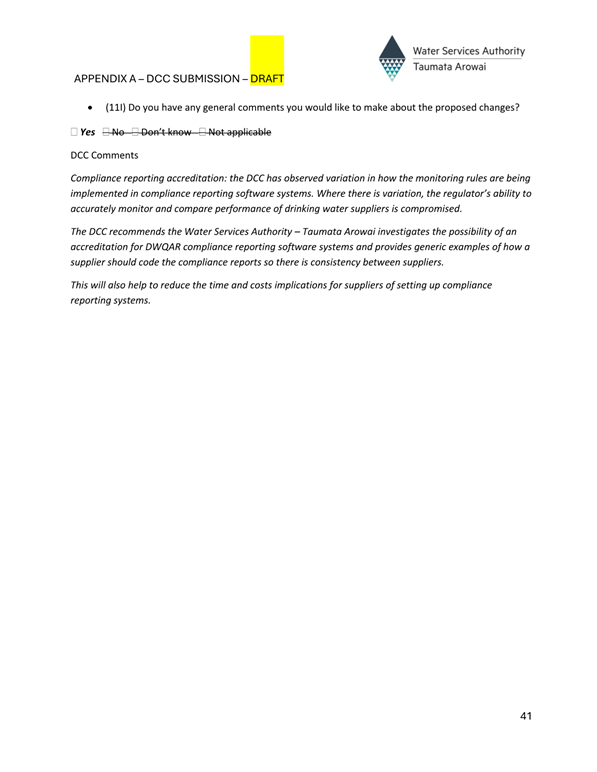
|

|
Council
11 December 2025
|
Financial Report - Period ended 31 October 2025
Department: Finance
EXECUTIVE SUMMARY
1 This report
provides the financial results for the period ended 31 October 2025 and the
financial position as at that date.
2 As
this is an administrative report only, there are no options or Summary of
Considerations.
RECOMMENDATIONS
That the Council:
a) Notes the Financial
Performance for the period ended 31 October 2025 and the Financial Position as
at that date.
BACKGROUND
3 This
report attaches a financial update and financial statements for the period
ended 31 October 2025.
DISCUSSION
4 The
net deficit (including Waipori) for the period ended 31 October 2025 was $3.977 million,
an $11.157 million favourable variance to budget. A detailed commentary is provided in Attachment A (Financial Update). In summary, the
following variances were recorded:
a) Revenue was $147.830
million for the period, or $256k unfavourable to budget.
b) Expenditure
was $157.706 million for the period, or $7.192 million favourable to budget.
c) The
Waipori Fund has reported a net operating surplus for the period of $5.899
million, $4.221 million favourable to budget.
5 Capital
expenditure was $46.469 million for the period ended 31 October 2025 or 71.7%
of the year-to-date budget.
6 The
total loan balance at 31 October 2025 was $687.473 million which was $33.700 million
less than budget.
OPTIONS
7 As
this is an administrative report only, there are no options provided.
NEXT STEPS
8 Month
end financial reports continue be presented to future Council meetings.
Signatories
|
Author:
|
Lawrie Warwood - Financial Analyst
|
|
Authoriser:
|
Hayden McAuliffe - Financial Services Manager
Carolyn Allan - Chief Financial Officer
|
Attachments
|
|
Title
|
Page
|
|
⇩a
|
Financial Update
|
412
|
|
⇩b
|
Statement of Financial
Performance
|
423
|
|
⇩c
|
Statement of Financial
Position
|
424
|
|
⇩d
|
Statement of Cashflows
|
425
|
|
⇩e
|
Capital Expenditure
Summary
|
426
|
|
⇩f
|
Captital Expenditure
Detailed
|
427
|
|
⇩g
|
Statement of Operating
Variances
|
433
|
|
⇩h
|
Debt Graph
|
434
|
|

|
Council
11 December 2025
|
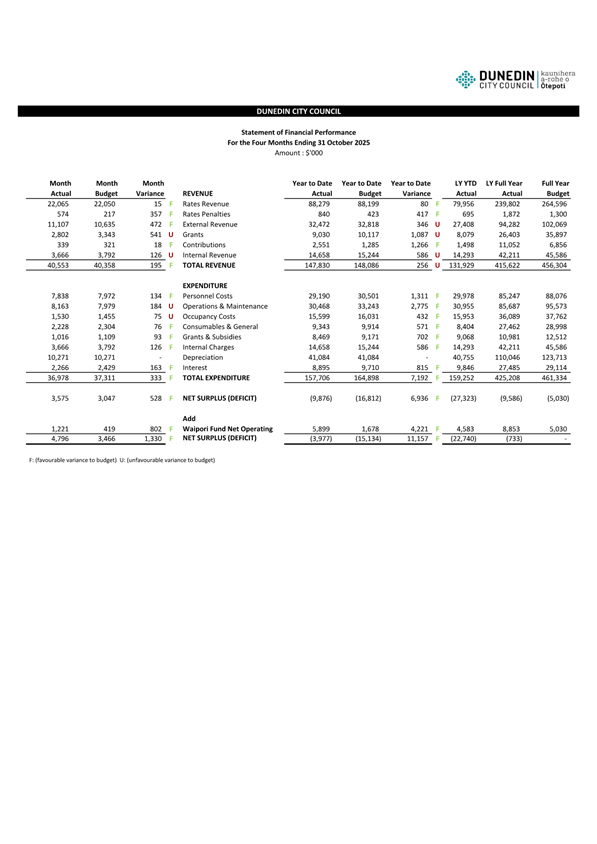
|

|
Council
11 December 2025
|
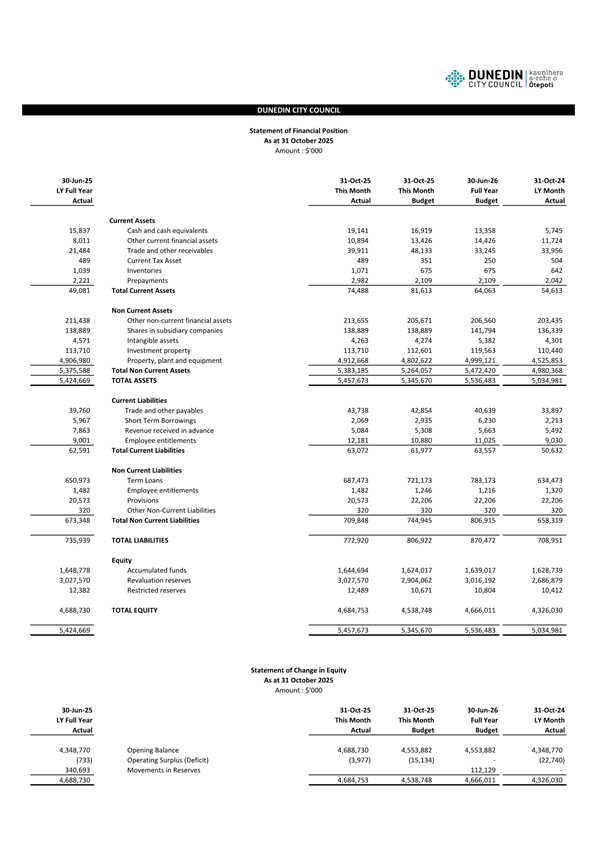
|

|
Council
11 December 2025
|
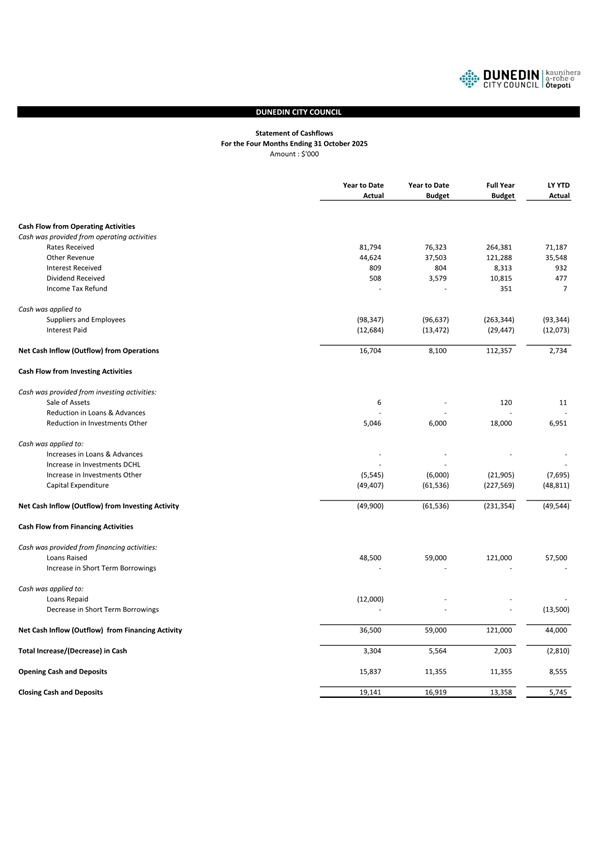
|
|
Council
11 December 2025
|
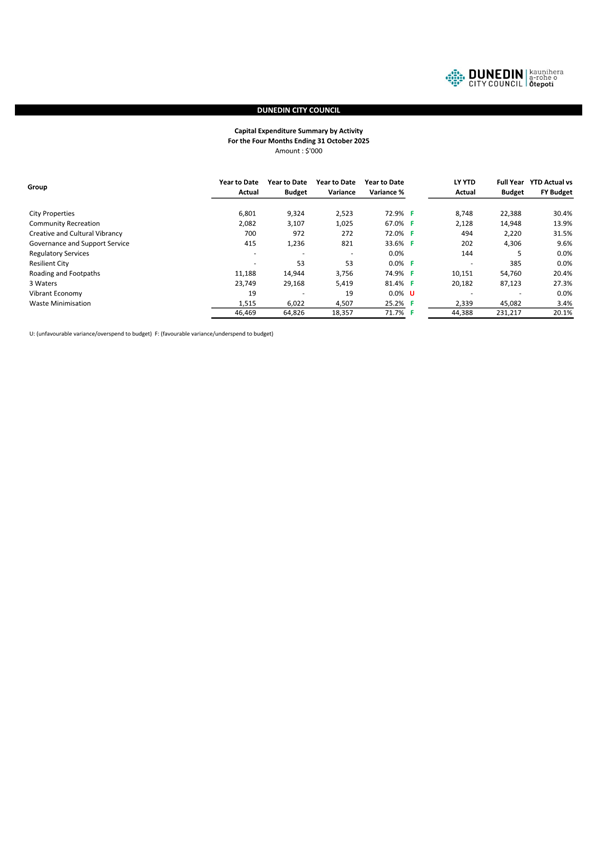
|

|
Council
11 December 2025
|
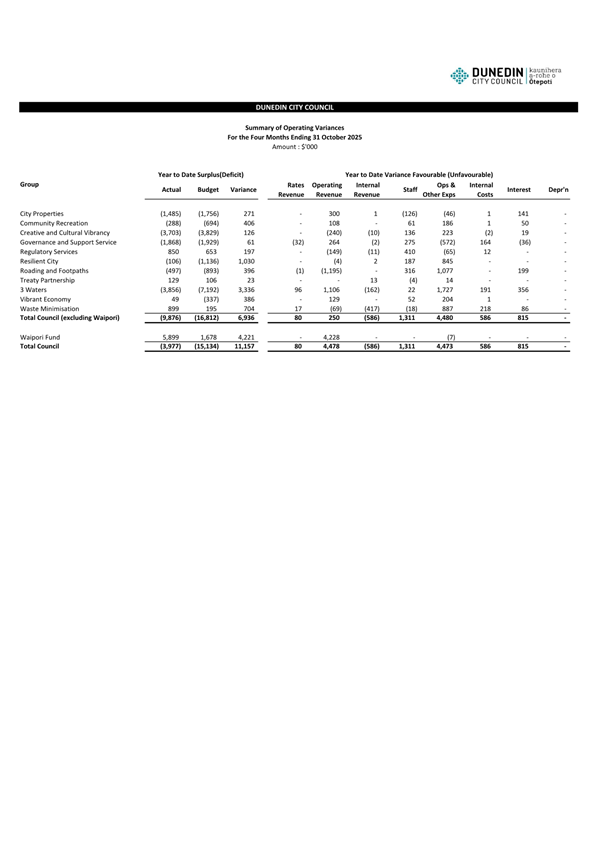
|
|
Council
11 December 2025
|
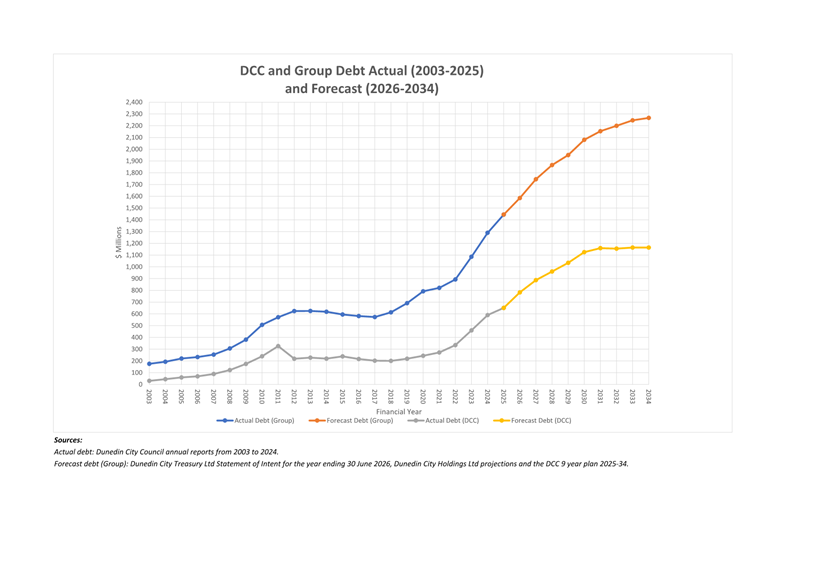
|
|
Council
11 December 2025
|
Remuneration and Governance Update
Department: Civic
EXECUTIVE SUMMARY
1 The
Local Government Act 2002 (LGA) gives the Remuneration Authority (the
Authority) responsibility for setting remuneration for local government elected
members.
2 The
Authority allocates a base salary for each councillor and a pool for additional
responsibilities. This governance pool (the pool) determines the total
remuneration available for councillors, excluding the Mayor, whose remuneration
is set directly by the Authority. The current determination takes effect
following the election.
3 This
paper seeks approval to amend the DCC remuneration proposal adopted at the
Council meeting on 11 November 2025.
|
RECOMMENDATIONS
That the Council:
a) Approves annual
remuneration of $145,008 for the Deputy Mayor.
b) Approves annual
remuneration of $99,340 for Councillors.
c) Notes Councillor
Vandervis’ new positions of responsibility.
d) Notes an updated
remuneration proposal will be resubmitted to the Authority for approval.
e) Notes Councillors
will initially be paid in accordance with the first gazette notice (expected
by 18 December 2025) and that following the amended determination in
early March 2026, a recalculation and adjustments will be required.
f) Notes the
establishment and delegations of the Chief Executive Performance and
Employment Committee.
|
BACKGROUND
4 On
11 November 2025, Council approved remuneration for Councillors based on the
Authority’s guidelines, and a proposal was submitted for inclusion in the
pre-Christmas determination.
|
Position
|
Number of Councillors
|
Base Rem
|
Additional Rem
|
Total Rem per Councillor
|
Total Annual Rem
|
|
Deputy Mayor
|
1
|
$84,496
|
$60,512
|
$145,008
|
$145,008
|
|
Councillor
|
12
|
$84,496
|
$16,081
|
$100,577
|
$1,206,924
|
|
Councillor (no additional
responsibilities)
|
1
|
$84,496
|
-
|
$84,496
|
$84,496
|
|
Total
|
14
|
|
|
|
$1,436,428
|
5 Subsequent
to the meeting on 11 November 2025, changes have been made to Councillors
positions of responsibility.
6 As
all Councillors now hold additional responsibilities, remuneration needs to be
adjusted and resubmitted to the Authority.
DISCUSSION
Remuneration
7 Councillor
Vandervis has accepted additional responsibilities as Co-Chair of the Finance
and Performance Committee and as lead for the additional portfolio of Council
Controlled Organisations. In addition, Councillor Weatherall has taken on the
role of portfolio deputy lead for Infrastructure.
8 Councillors
are currently being paid at the minimum rate of $84,496. Once the
December gazette notice is published, Council is legally required to pay
Councillors at that rate until the amended determination is published in March.
9 The
proposed amended remuneration is detailed in the table below:
|
Position
|
Number of Councillors
|
Base Rem
|
Additional Rem
|
Total Rem per Councillor
|
Total Annual Rem
|
|
Deputy Mayor
|
1
|
$84,496
|
$60,512
|
$145,008
|
$145,008
|
|
Councillor
|
13
|
$84,496
|
$14,844
|
$99,340
|
$1,291,420
|
|
Total
|
14
|
|
|
|
$1,436,428
|
10 This
proposal fully allocates the pool as required by the determination.
Delegations
11 Under
Section 41A of the Local Government Act 2022 the Mayor has the authority to
establish the membership and powers of the Chief Executive Performance
Committee. The Council will constitute the Chief Executive Performance and
Employment Committee in accordance with delegations outlined in Attachment A.
OPTIONS
12 The
Council must allocate the full pool of $1,436,428 as reflected in this report.
NEXT STEPS
13 The
updated roles of responsibility and remuneration rates will be submitted to the
Authority by 30 January 2026 to meet the deadline for the second amending
determination scheduled for gazetting in early March 2026.
14 Following
the March gazette notice, staff will make all the necessary adjustments to ensure
that Councillors are being paid at the correct rate and ensure the pool has
been correctly and fully allocated.
Signatories
|
Authoriser:
|
Nicola Morand - Manahautū (General Manager Community
and Strategy)
|
Attachments
|
|
Title
|
Page
|
|
⇩a
|
Chief Executive
Performance and Employment Committee Delegations
|
440
|
|
SUMMARY OF CONSIDERATIONS
|
|
Fit with purpose of Local Government
This decision enables democratic local
decision making and action by, and on behalf of communities.
|
|
Fit with strategic framework
|
|
Contributes
|
Detracts
|
Not applicable
|
|
Social Wellbeing Strategy
|
☐
|
☐
|
☐
|
|
Economic Development Strategy
|
☐
|
☐
|
☐
|
|
Environment Strategy
|
☐
|
☐
|
☐
|
|
Arts and Culture Strategy
|
☐
|
☐
|
☐
|
|
3 Waters Strategy
|
☐
|
☐
|
☐
|
|
Spatial Plan
|
☐
|
☐
|
☐
|
|
Integrated Transport Strategy
|
☐
|
☐
|
☐
|
|
Parks and Recreation Strategy
|
☐
|
☐
|
☐
|
|
Other strategic projects/policies/plans
|
☒
|
☐
|
☐
|
|
|
Māori Impact Statement
This has not been assessed in preparing this report.
|
|
Sustainability
The level of remuneration being proposed is above the base
level remuneration for all Councillors and is aimed to provide a more
sustainable income recognising the mahi that will be required from all
elected members.
|
|
LTP/Annual Plan / Financial Strategy /Infrastructure
Strategy
There are no implications as the increase in the
remuneration pool was included in the Annual Plan.
|
|
Financial considerations
The increase in remuneration was included in the Civic
budget
|
|
Significance
The decision is considered low in terms of the
Council’s Significance and Engagement Policy
|
|
Engagement – external
There has been no external engagement.
|
|
Engagement - internal
There have been discussions with Councillors about
possible levels of remuneration.
|
|
Risks: Legal / Health and Safety etc.
There are no identified risks.
|
|
Conflict of Interest
There are no identified conflicts of interest
|
|
Community Boards
Community Board remuneration is dealt with separately by
the Authority and is not part of the pool.
|
|

|
Council
11 December 2025
|
Chief
Executive Performance and Employment Committee
Under
Section 41A Local Government Act 2022 I establish the membership and powers of
the Chief Executive Performance and Employment Committee as follows:
REPORTING TO: Council
CHAIRPERSON: Mayor Barker
DEPUTY CHAIRPERSON Deputy Mayor Lucas
CONSTITUTION AND MEMBERS: Councillor
Walker, Councillor Chambers and Councillor Treadwell
QUORUM: Three members
MEETING FREQUENCY: Three
monthly with additional meetings as required by the Chairperson
Area of responsibility and delegations
1 Set
annual key performance indicators for the Chief Executive.
2 Provide
feedback and support to the Chief Executive and undertake performance reviews,
all consistent with the process and timeline in the relevant employment
agreement.
3 Report
the outcome of the annual review of the Chief Executive’s performance and
make recommendations to Council on the outcome of that review for approval.
4 Review
the Chief Executive’s remuneration and package in accordance with the
employment agreement and make recommendations to the Council for approval.
5 Monitor
and provide updates on any performance issues and progress to Council at other
times and on request.
6 The
Chairperson or the Committee can engage relevant external advice including
independent legal advice to assist the Committee with all or any of the matters
relating to its delegations.
7 Recommend
to Council for approval when required, a recruitment, selection and appointment
process for a Chief Executive.
8 Oversee
the Chief Executive recruitment and selection, and recommend candidates and
proposed remuneration to Council for approval.
9 Conduct
and complete a review of employment at least 6 months prior to the end of the
Chief Executive’s first term of employment (Local Government Act 2002,
Schedule 7, clause 35) and recommend to Council whether or not the Chief
Executive should be appointed for a second term of up to two years or that the
position be advertised as vacant (Local Government Act 2002, Schedule 7, clause
34).
10 Negotiate
an initial performance agreement, subsequent agreements and any variations with
the Chief Executive and recommend to Council for approval.
|
|
Council
11 December 2025
|
Meeting Schedule for 2026
Department: Civic
EXECUTIVE SUMMARY
1 The
report seeks the adoption of a meeting schedule for 2026, in accordance with
Clause 19(6)(a) of Schedule 7 of the Local Government Act 2002.
2 The
proposed meeting schedule, appended as Attachment A, covers the period from
January 2026 through to 31 December 2026.
RECOMMENDATIONS
That the Council:
a) Approves the proposed
meeting schedule for 2026 as attached to the report or advises alternate meeting
dates.
b) Notes that the
Community Boards will confirm their meeting dates at their next meetings.
BACKGROUND
3 Every
year Council adopts a schedule of meetings for the year ahead to provide some
certainty in programming work and reporting.
4 Public
and school holidays have been considered in setting the schedule, and
additional meetings will be provided for as required.
5 Council
meetings will be held on Thursdays at three-week intervals commencing with
public forum at 9.00 am. Council meetings that conflict with other sector
meetings will be held on a Wednesday.
6 Committees
and Council Workshops will also meet on Thursdays.
7 On
the information currently available, important dates in the Council’s
programme of business are:
· Annual
Plan:
i) Council
is to consider options and budget reports towards the development of the draft
Annual Plan in January 2026 and consider a document for consultation in
February 2026.
ii) Submission
hearings and deliberations will take place in May 2026.
8 Meetings
for Te Pae Māori are still to be scheduled.
9 Hearings
panels, working groups and sub-committees will be scheduled as required during
the triennium.
10 As
this report is for administrative purposes only, options and the summary of
considerations are not required.
NEXT STEPS
11 If
approved, the Council diary will be updated.
Signatories
|
Author:
|
Jackie Harrison - Manager Governance
|
|
Authoriser:
|
Nicola Morand - Manahautū (General Manager Community
and Strategy)
|
Attachments
|
|
Title
|
Page
|
|
⇩a
|
2026 Meeting Schedule
|
444
|
|
⇩b
|
2026 Meeting Calendar
|
447
|
|

|
Council
11 December 2025
|
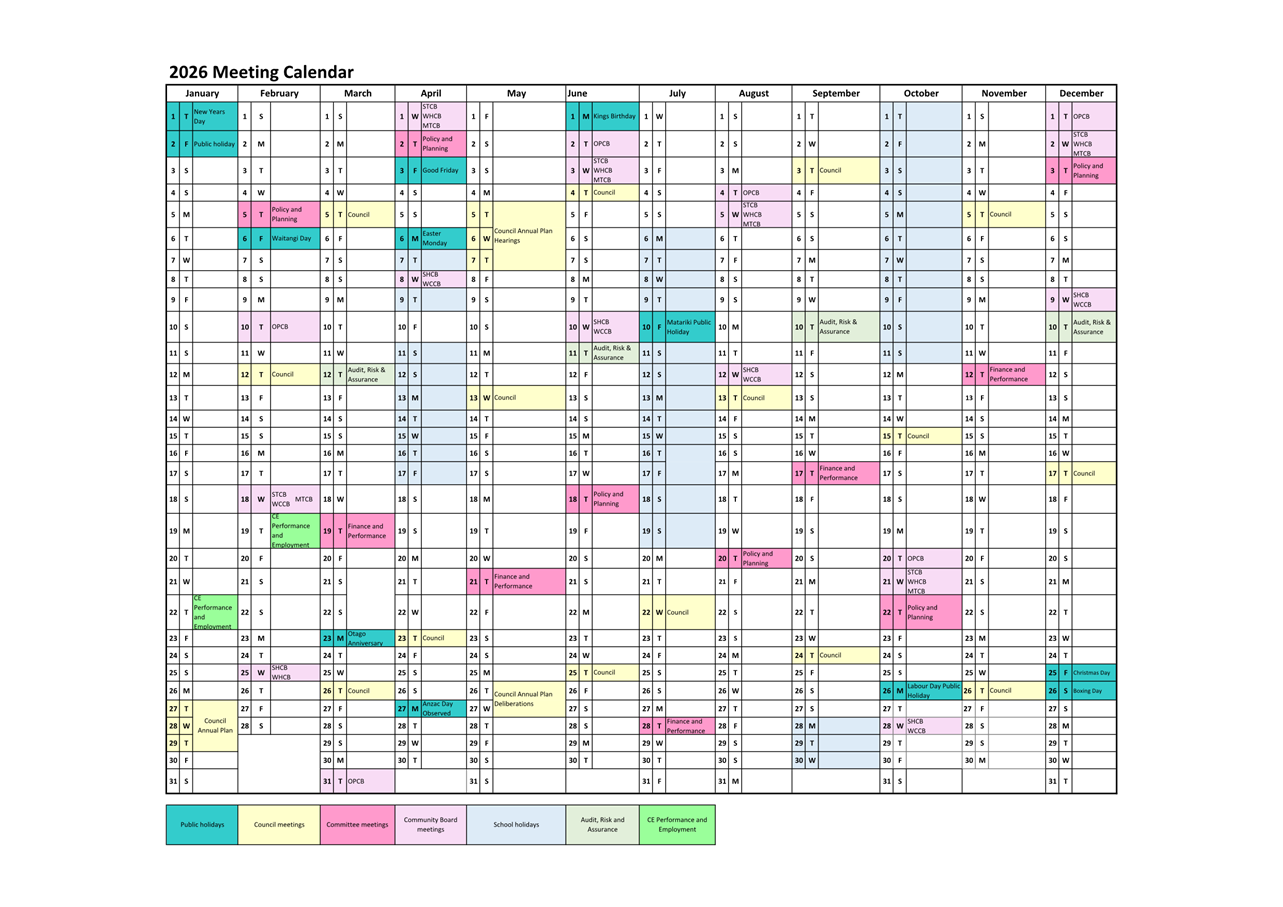
|

|
Council
11 December 2025
|
Proposed Event Road Closures
Department: Transport
EXECUTIVE SUMMARY
1 The
DCC has received temporary road closure applications relating to the following
events:
i) Royal
NZ Pipe Band Association Otago Centre Competitions
2 This
report recommends that Council approves the temporary closure of the affected
roads.
RECOMMENDATIONS
That the Council:
a) Resolves to close the
roads detailed below (pursuant to Section 319, Section 342, and Schedule 10
clause 11(e) of the Local Government Act 1974 (LGA
1974)):
i) Royal NZ Pipe Band Association Otago
Centre Competitions
|
Saturday, 28 February 2026
|
8.30am to 10.00am
|
· Moray Place, between View Street and Burlington
Street
|
|
8.30am to 4.30pm
|
· The entire Octagon
· George Street, between the Octagon and Moray Place
· Upper and Lower Stuart Street, between the Octagon
and Moray Place
· Princes Street, between the Octagon and Moray Place
|
|
Sunday, 1 March 2026
|
9.00am to 4.00pm
|
· Dundas Street, between Great King Street North and
Cumberland Street
|
BACKGROUND
3 Council’s
Dunedin Festival and Events Plan supports the goal of a successful city with a
diverse, innovative, and productive economy and a hub for skill and
talent.
4 The
areas proposed to be used for these events are legal roads and can therefore be
temporarily closed to normal traffic if statutory temporary road closure
procedures are followed. The procedures are set out in Section 319 of the LGA
1974 and give Council the power to stop or close any road (or part of a road)
within the parameters of Section 342 and Schedule 10 of the LGA 1974 (Schedule
10 is included as Attachment A).
5 These
procedures include:
· Consultation
with the New Zealand Transport Authority Waka Kotahi and the Police.
· Public
notice being given of the proposal to close any road (or part of a road), and public
notice of a decision to close the road.
· Council
being satisfied that traffic is not likely to be unreasonably impeded.
6 A
resolution of Council is required where a proposal to temporarily close a road
relates to public functions.
7 Council
is required to give public notice of its decision. This notice will be
published after this meeting and prior to the event, if approved.
DISCUSSION
Consultation and Notification
8 The
Police and the New Zealand Transport Authority Waka Kotahi have no objections
to the proposed road closures.
9 On
Wednesday, 3 December 2025 the proposed temporary road closures will be advertised
in the Otago Daily Times with a deadline for feedback.
10 Schedule 10
clause 11(e) states a road cannot be closed more than 31 days in the
aggregate in any one year. This limit will not be exceeded by the
approval of the proposed temporary road closures.
Traffic Impacts
11 The
event locations of these events have had identical road closures for the same,
or similar event(s) in prior years without causing unreasonable delays to the
travelling public.
12 Emergency
services and public transport services will be managed through the temporary
traffic management process.
13 The
Temporary Traffic Management Plan process ensures that other issues such as
temporary relocation of certain parking (e.g. taxi, mobility and Authorised
Vehicles Only) are managed.
OPTIONS
14 Note
any amendment to this report’s recommendations cannot be implemented
without further consultation with the affected parties, New Zealand Transport
Agency Waka Kotahi, the Police, and verifying that traffic impacts are
acceptable.
Option One – Recommended Option
15 That
the Council closes the sections of road as recommended in this report.
Advantages
· Roads
can be closed, and the event will be able to proceed.
· The
closures will assist in realising the economic, social, and cultural benefits
associated with the events.
Disadvantages
· There
will be temporary loss of vehicular access through the closed areas. However,
there are detours available, and safety can be assured using temporary traffic
management.
Option Two – Status Quo
16 That
the Council decides not to close the roads in question.
Advantages
· There
would be no detour required for the travelling public, and the roads would be
able to be used as normal.
Disadvantages
· The
events would not be able to go ahead, and the benefits of the events would be lost.
NEXT STEPS
17 Should
the resolution be made to temporarily close the roads, Council staff will
accept the temporary traffic management plans that have been received for the
events and notify the public of the closures.
Signatories
|
Authoriser:
|
Jeanine Benson - Group Manager Transport
Scott MacLean - General Manager, City Services
|
Attachments
|
|
Title
|
Page
|
|
⇩a
|
Local Government Act
1974, Schedule 10
|
454
|
|
SUMMARY
OF CONSIDERATIONS
|
|
Fit with purpose of Local Government
This decision promotes the social
well-being of communities in the present and for the future.
|
|
Fit with strategic framework
|
|
Contributes
|
Detracts
|
Not applicable
|
|
Social Wellbeing Strategy
|
✔
|
☐
|
☐
|
|
Economic Development Strategy
|
✔
|
☐
|
☐
|
|
Environment Strategy
|
☐
|
☐
|
✔
|
|
Arts and Culture Strategy
|
✔
|
☐
|
☐
|
|
3 Waters Strategy
|
☐
|
☐
|
✔
|
|
Future Development Strategy
|
☐
|
☐
|
✔
|
|
Integrated Transport Strategy
|
☐
|
☐
|
✔
|
|
Parks and Recreation Strategy
|
☐
|
☐
|
✔
|
|
Other strategic projects/policies/plans
|
✔
|
☐
|
☐
|
Events contribute to the Strategic Framework. Events
contribute to the Economic Development Strategy, the Social Wellbeing
Strategy. There is a Festival and Events Plan 2018-2023.
|
|
Māori Impact Statement
Mana whenua have not been directly engaged with in
relation to these road closures.
|
|
Sustainability
There are no implications for sustainability.
|
|
LTP/Annual Plan / Financial Strategy /Infrastructure
Strategy
There are no implications, as the decision is a regulatory
one and there are no direct costs to Council.
|
|
Financial considerations
There are no financial implications. The cost of the
proposed road closure is not a cost to Council.
|
|
Significance
This decision is considered low in terms of the
Council’s Significance and Engagement Policy.
|
|
Engagement – external
There has been external engagement (as required by the LGA
1974), with the Police and New Zealand Transport Agency Waka Kotahi. Affected
parties were notified and provided a time period for feedback.
|
|
Engagement - internal
There has been engagement with DCC Events and
Transport. There is support for the events to proceed.
|
|
Risks: Legal / Health and Safety etc.
There are no identified risks should the recommended
resolution be made.
|
|
Conflict of Interest
There are no known conflicts of interest.
|
|
Community Boards
There are no implications for Community Boards.
|
|

|
Council
11 December 2025
|
Resolution to Exclude the
Public
That the Council excludes
the public from the following part of the proceedings of this meeting (pursuant
to the provisions of the Local Government Official Information and Meetings Act
1987) namely:
|
General subject of the matter to be considered
|
Reasons
for passing this resolution in relation to each matter
|
Ground(s) under
section 48(1) for the passing of this resolution
|
Reason for
Confidentiality
|
|
C1
Confirmation of the Confidential Minutes of Ordinary Council meeting -
27 November 2025 - Public Excluded
|
S7(2)(b)(ii)
The
withholding of the information is necessary to protect information where the
making available of the information would be likely unreasonably to prejudice
the commercial position of the person who supplied or who is the subject of
the information.
S7(2)(g)
The
withholding of the information is necessary to maintain legal professional
privilege.
S7(2)(h)
The
withholding of the information is necessary to enable the local authority to
carry out, without prejudice or disadvantage, commercial activities.
S7(2)(i)
The
withholding of the information is necessary to enable the local authority to
carry on, without prejudice or disadvantage, negotiations (including
commercial and industrial negotiations).
S7(2)(a)
The
withholding of the information is necessary to protect the privacy of natural
persons, including that of a deceased person.
S7(2)(d)
The
withholding of the information is necessary to avoid prejudice to measures
protecting the health and safety of members of the public.
s48(1)(d)
Check
to make report confidential.
|
.
|
|
|
C2
Budget Update Process Report
|
S7(2)(a)
The
withholding of the information is necessary to protect the privacy of natural
persons, including that of a deceased person.
|
S48(1)(a)
The public conduct of
the part of the meeting would be likely to result in the disclosure of
information for which good reason for withholding exists under section 7.
|
|
This resolution is made in
reliance on Section 48(1)(a) of the Local Government Official Information and
Meetings Act 1987, and the particular interest or interests protected by
Section 6 or Section 7 of that Act, or Section 6 or Section 7 or Section 9 of
the Official Information Act 1982, as the case may require, which would be
prejudiced by the holding of the whole or the relevant part of the proceedings
of the meeting in public are as shown above after each item.