Notice of Meeting:
I hereby give notice that an ordinary meeting of the Dunedin
City Council will be held on:
Date: Wednesday
22 July 2026
Time: 9.00
am
Venue: Council
Chamber, Dunedin Public Art Gallery, the Octagon, Dunedin
Sandy Graham
Council
PUBLIC AGENDA
|
Mayor
|
Mayor Sophie Barker
|
|
|
Deputy Mayor
|
Cr Cherry Lucas
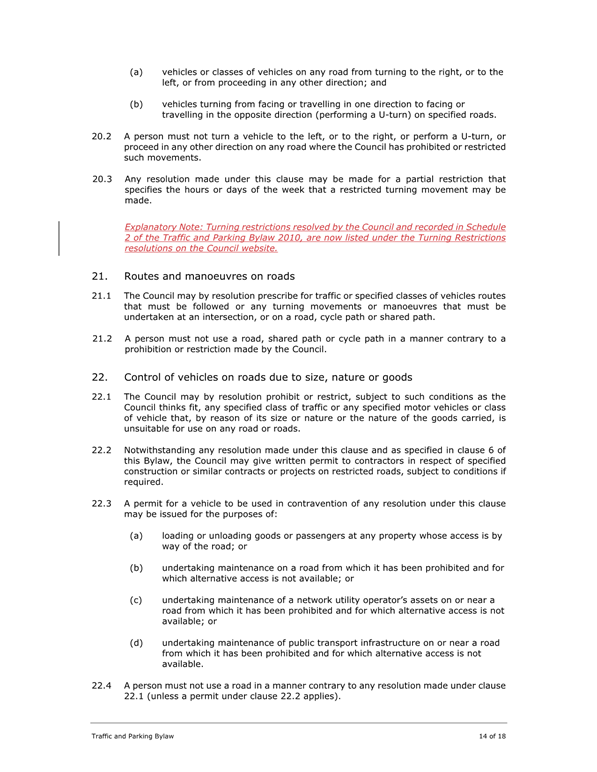
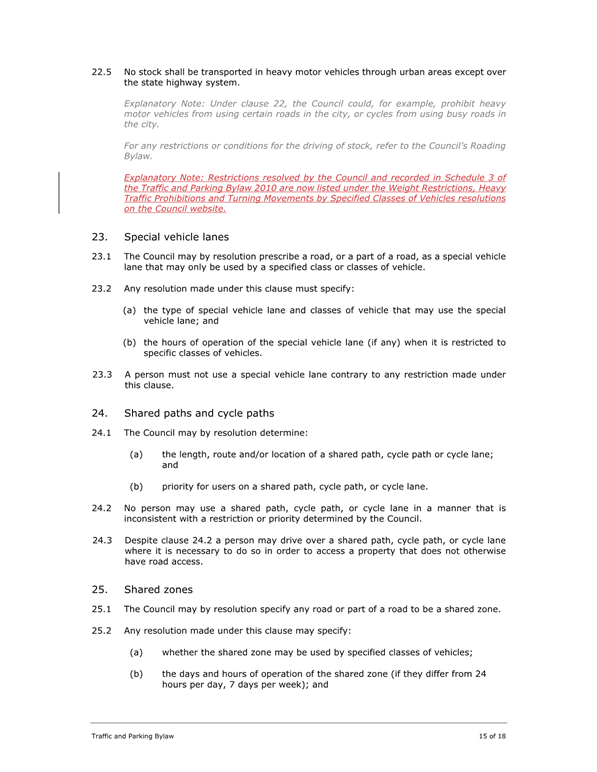
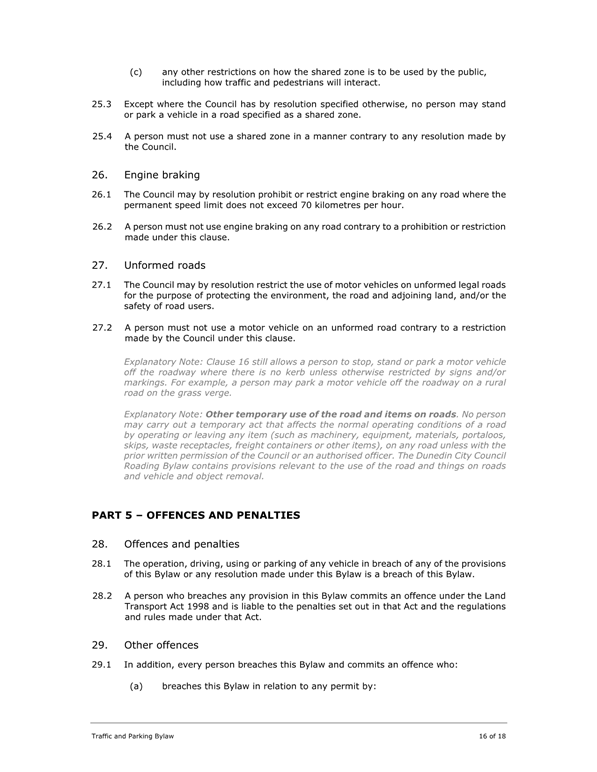
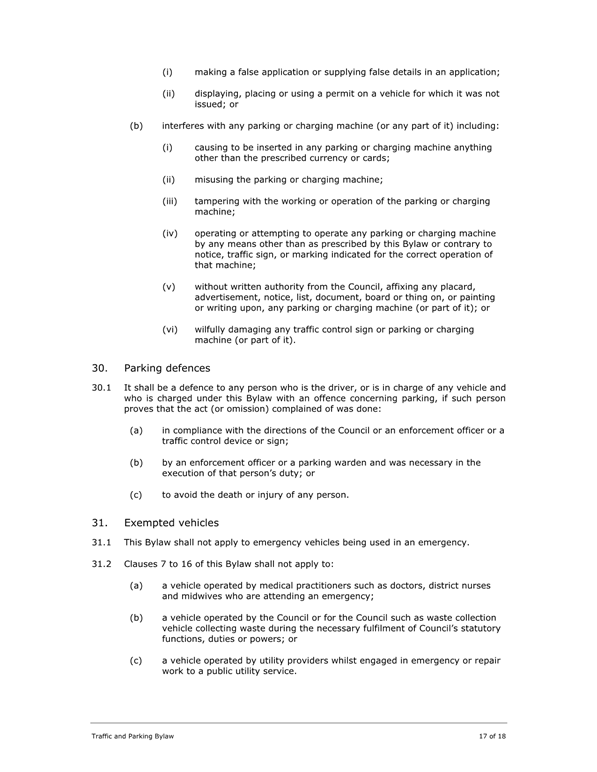
|
|
|
Members
|
Cr John Chambers
|
Cr Jo Galer
|
|
|
Cr Christine Garey
|
Cr Doug Hall
|
|
|
Cr Marie Laufiso
|
Cr Russell Lund
|
|
|
Cr Mandy Mayhem
|
Cr Benedict Ong
|
|
|
Cr Andrew Simms
|
Cr Mickey Treadwell
|
|
|
Cr Lee Vandervis
|
Cr Steve Walker
|
|
|
Cr Brent Weatherall
|
|
Senior Officer Sandy
Graham, Chief Executive
Governance Support Officer Lynne
Adamson
Lynne Adamson
Governance Support Officer
Telephone: 03 477 4000
governance.support@dcc.govt.nz
www.dunedin.govt.nz
The meeting
will be live streamed on the Council’s YouTube Channel:
https://www.youtube.com/watch?v=c03FYDrpIQA
Note: Reports
and recommendations contained in this agenda are not to be considered as
Council policy until adopted.
|

|
Council
22 July 2026
|
ITEM TABLE OF CONTENTS PAGE
1 Opening 4
2 Public
Forum 4
3 Apologies 4
4 Confirmation
of Agenda 4
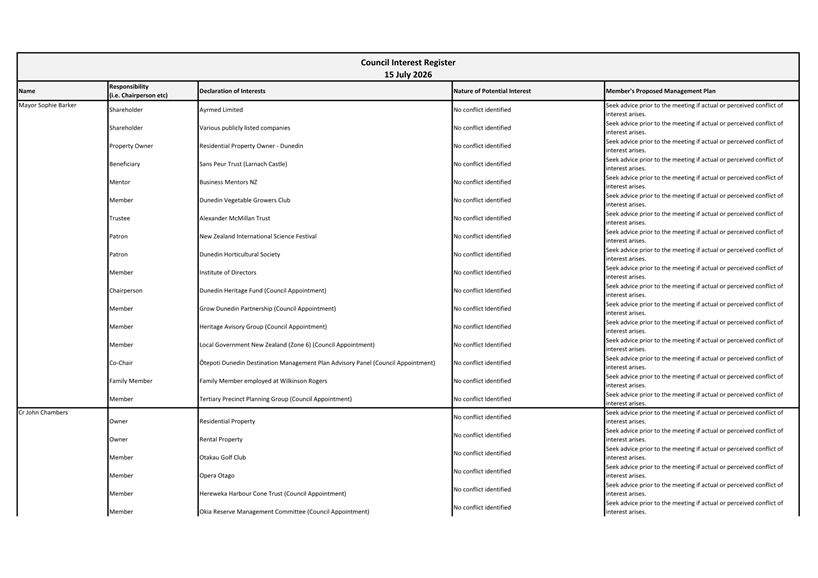
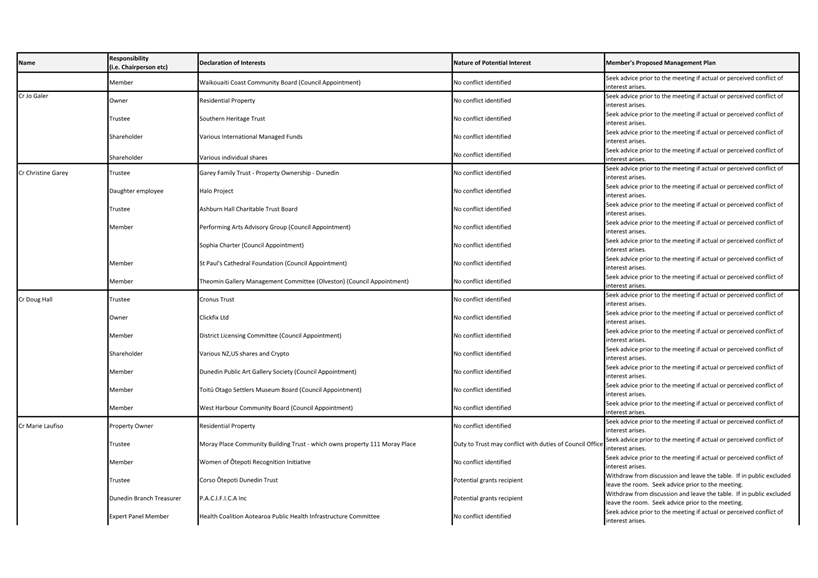
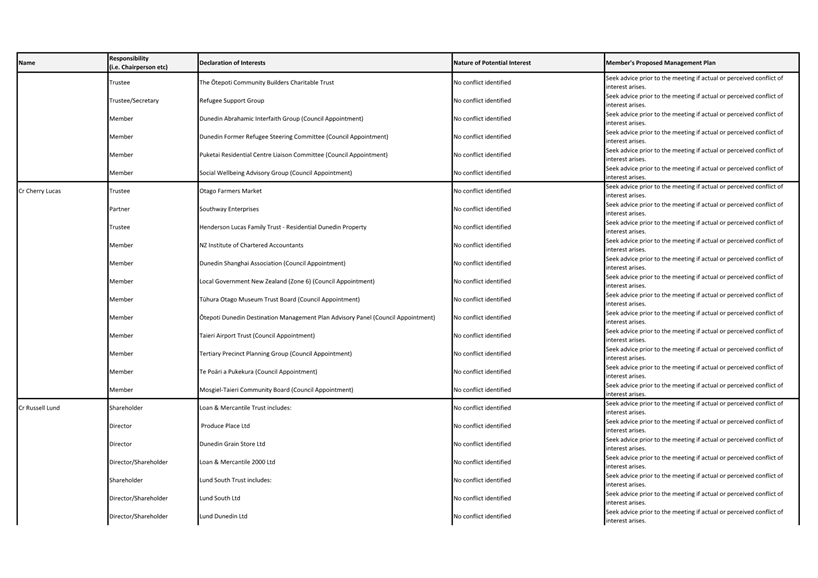
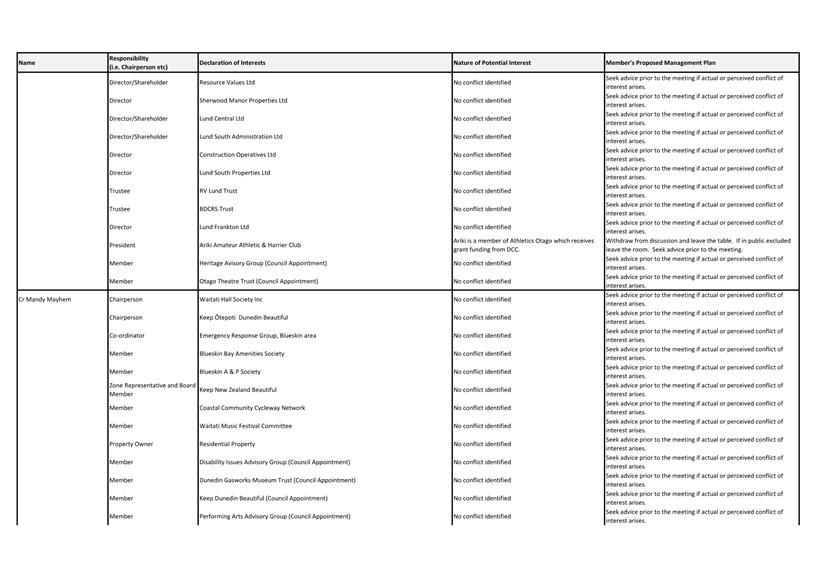
5 Declaration
of Interest 5
6 Confirmation
of Minutes 15
6.1 Ordinary Council
meeting - 25 June 2026 15
6.2 Ordinary Council
meeting - 13 May 2026 58
Reports
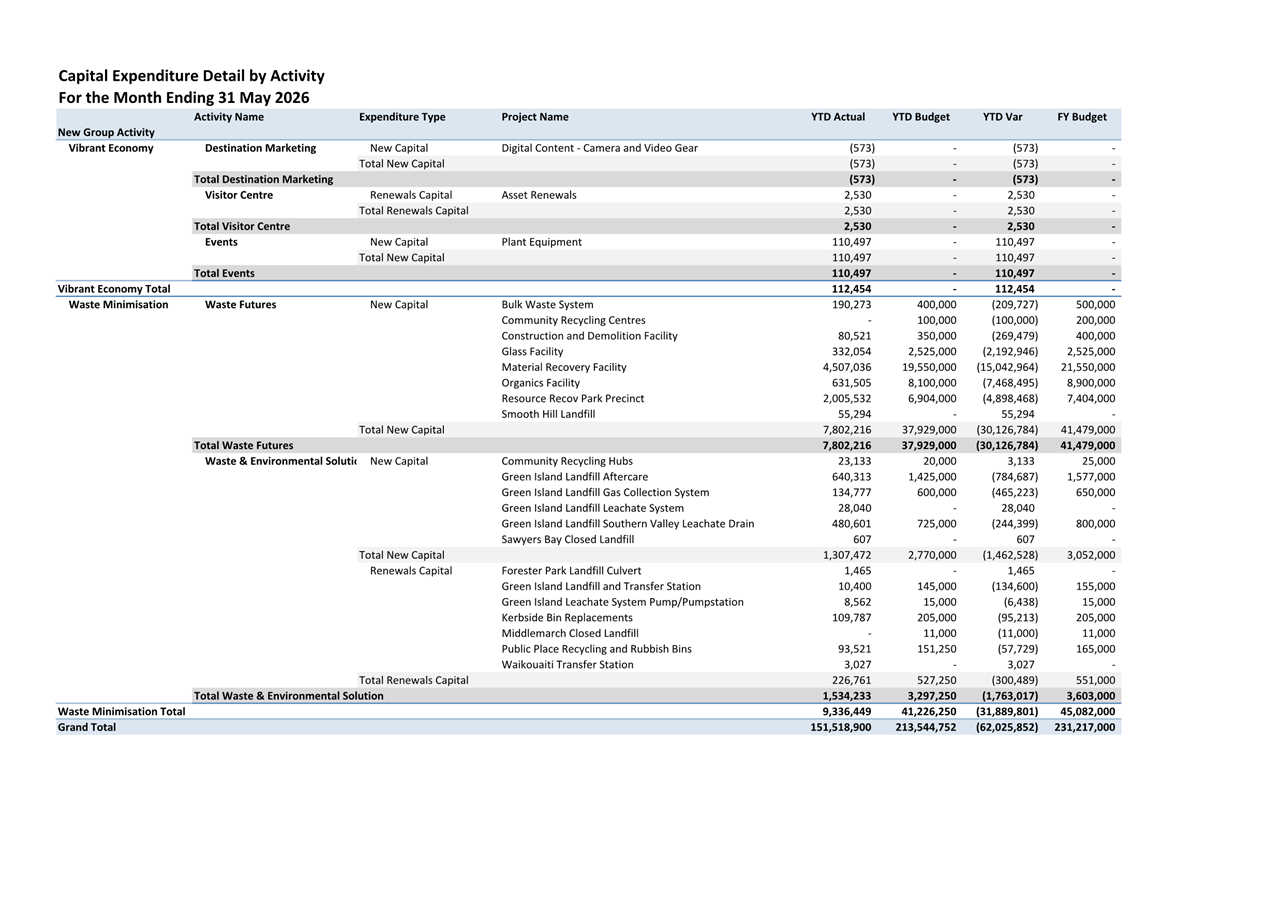
7 Financial
Report - Period ended 31 May 2026 71
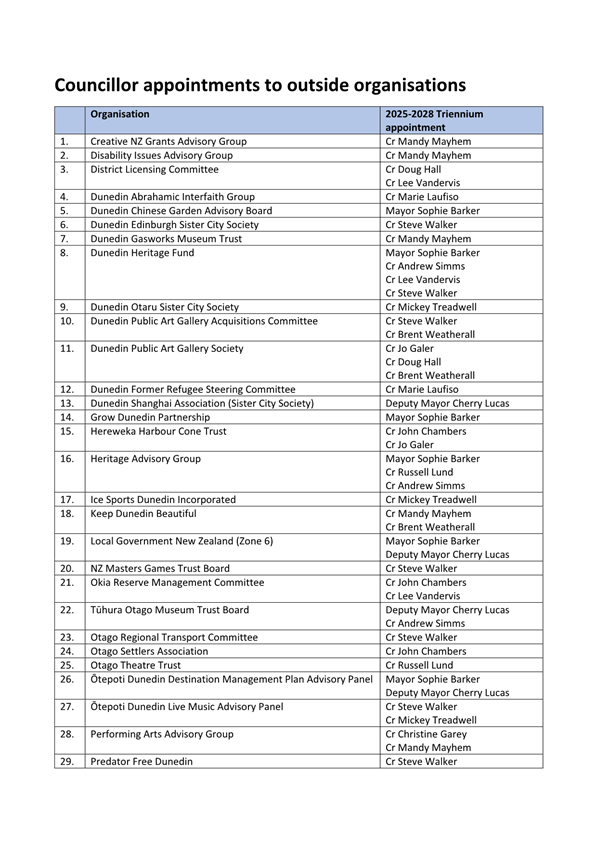
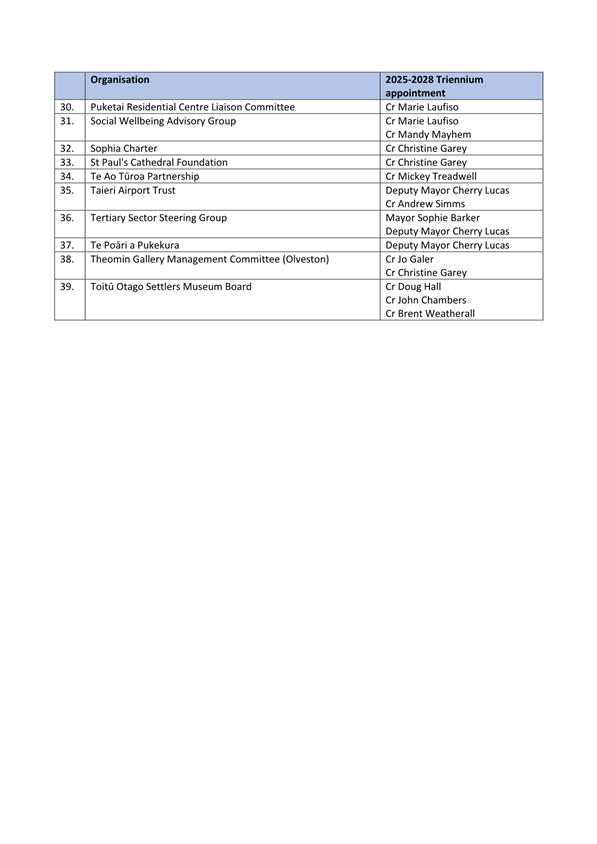
8 Governance
and Councillor Appointments to Outside Organisations Updates 100
9 Notice
of Motion - Opposing removal of Final-Year Fee Free Policy 105
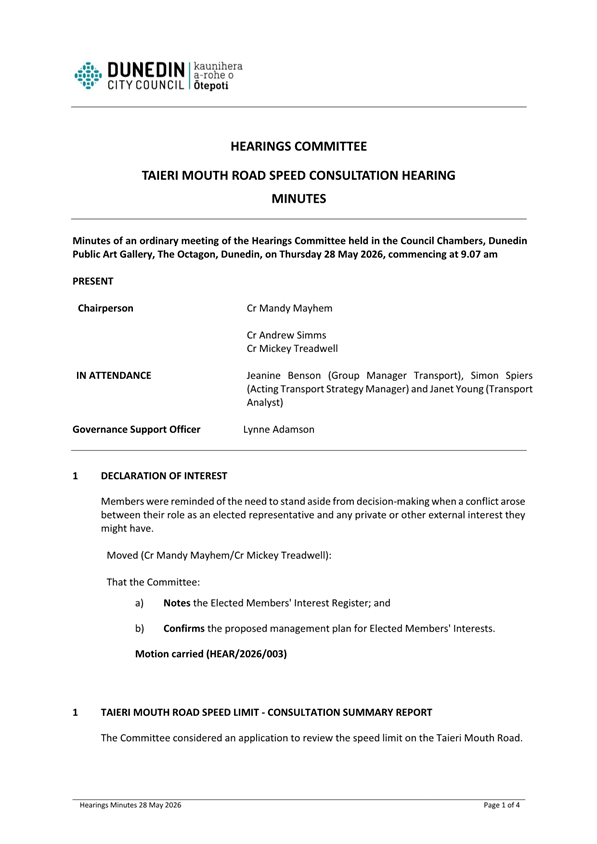
10 Hearings
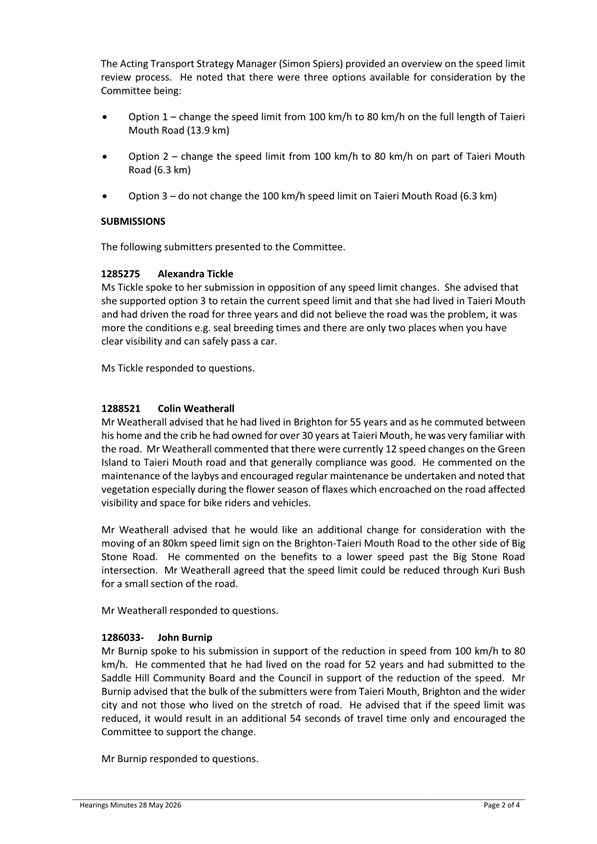
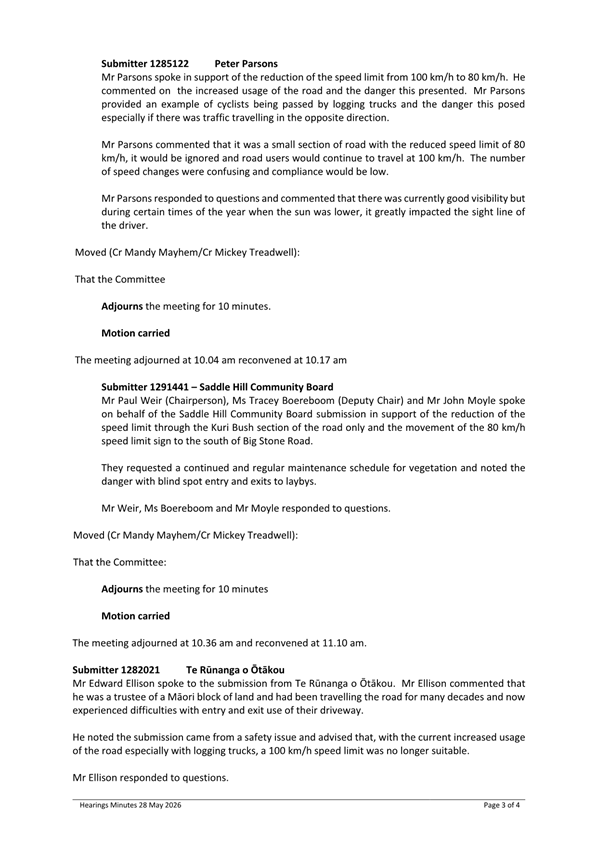
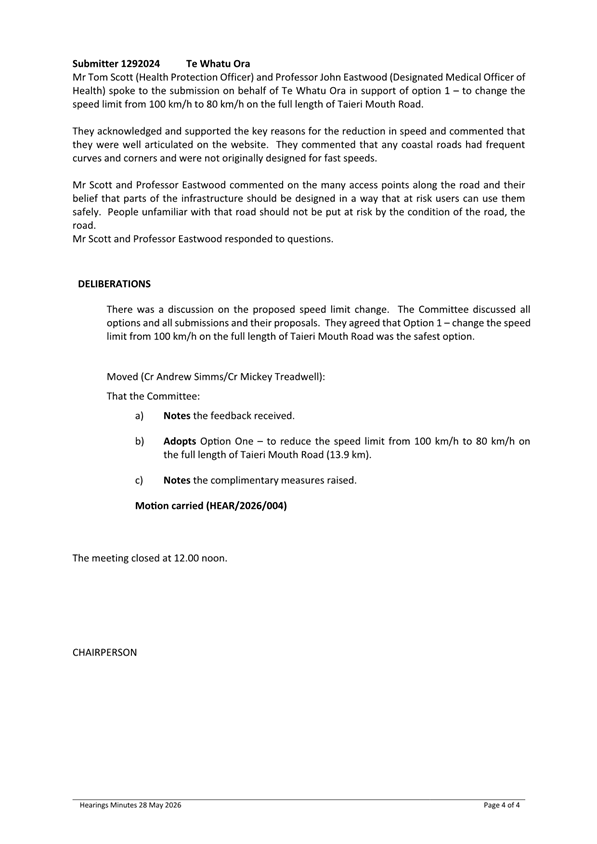
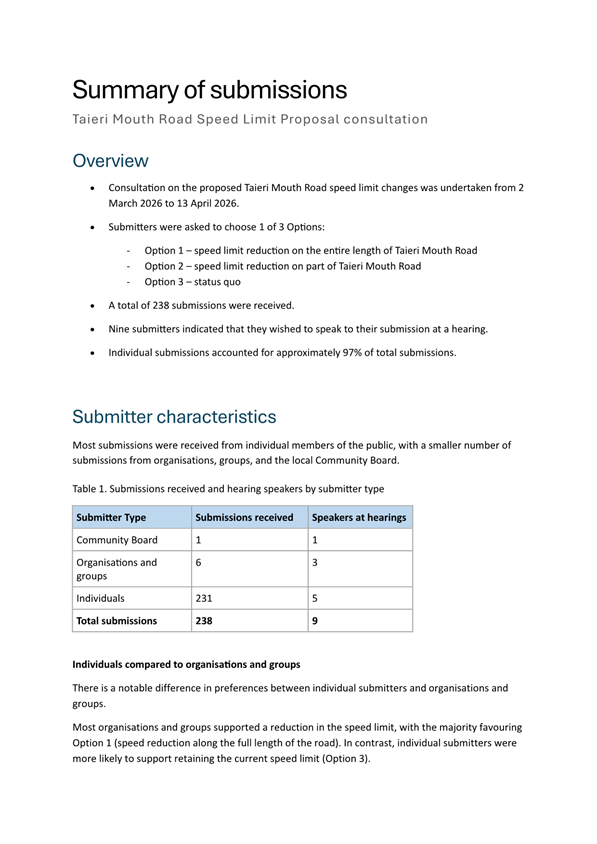
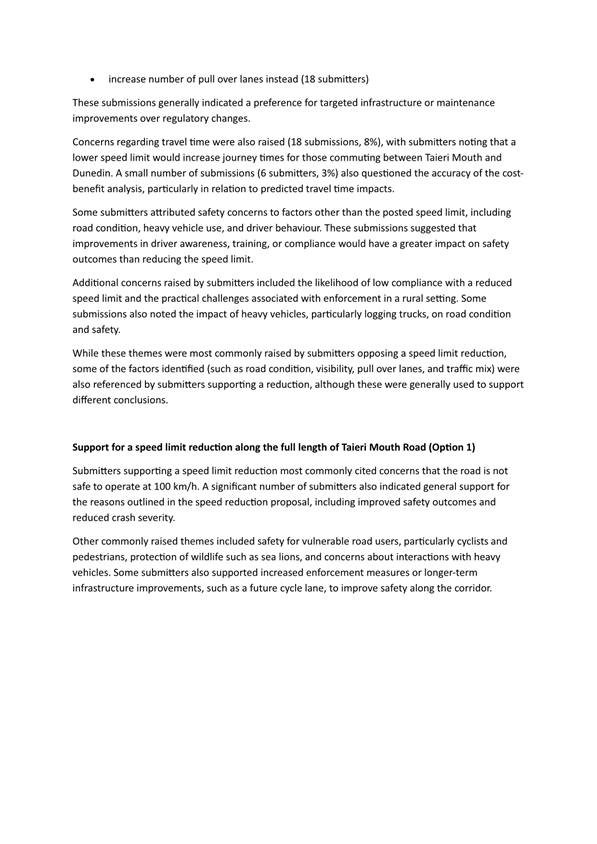
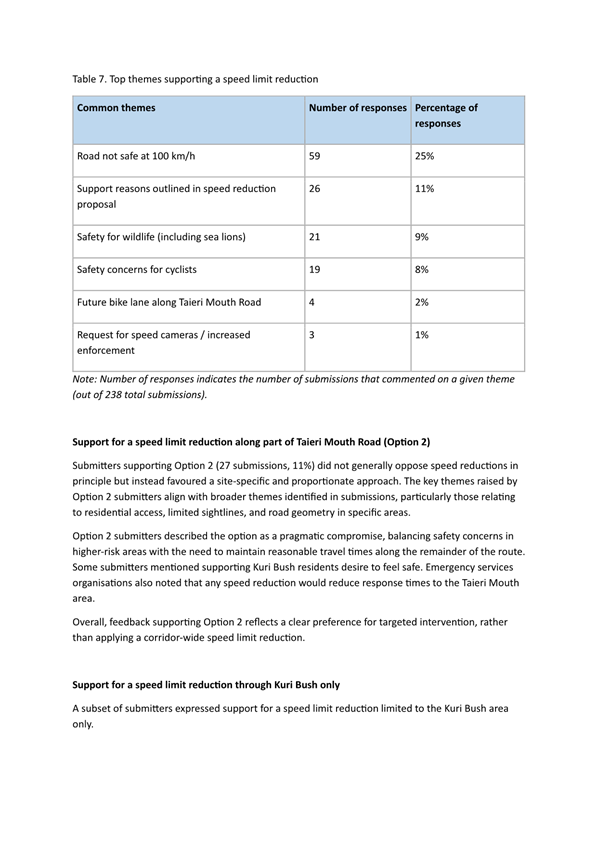
Committee Recommendation - Taieri Mouth Road Speed Limit 107
11 Hearings
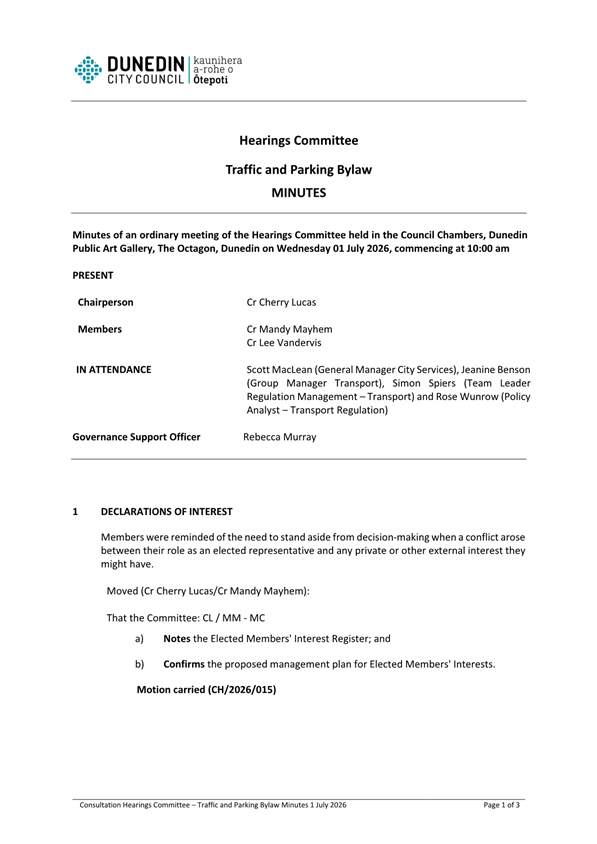
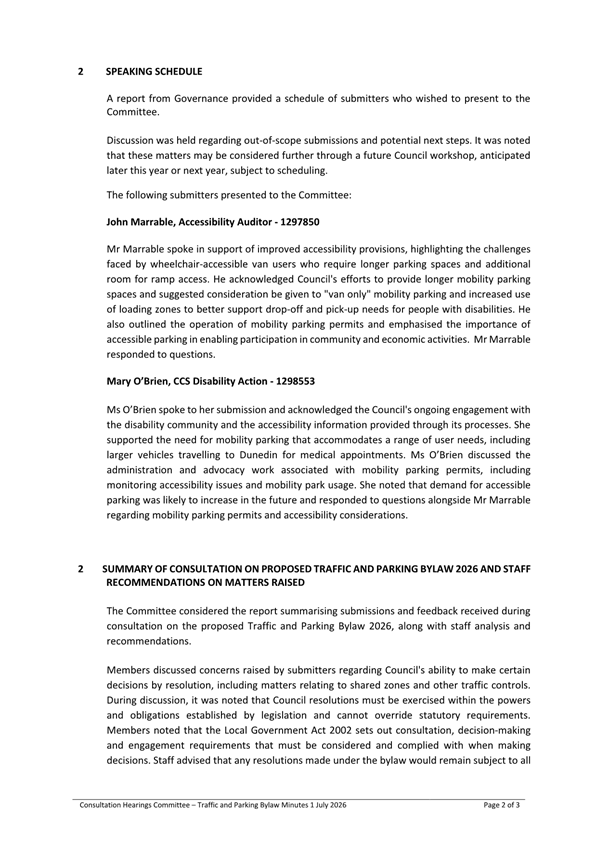
Committee Recommendations on the Proposed Traffic and Parking Bylaw 2026 126
12 Hearings
Committee Recommendations on Proposed Parking Changes - June 2026 187
13 Development
of the 10 Year Plan 2027-37 229
14 Water
Services Strategy 2027-37 development 239
15 Proposed
Event Road Closures 246
16 City-wide
emissions target refresh options 257
Notice of Motion
17 Notice
of Motion - Positioning Dunedin to Benefit from the New Zealand-India FTA by
attracting Medical Specialists from India 285
Resolution to Exclude the Public 291
|

|
Council
22 July 2026
|
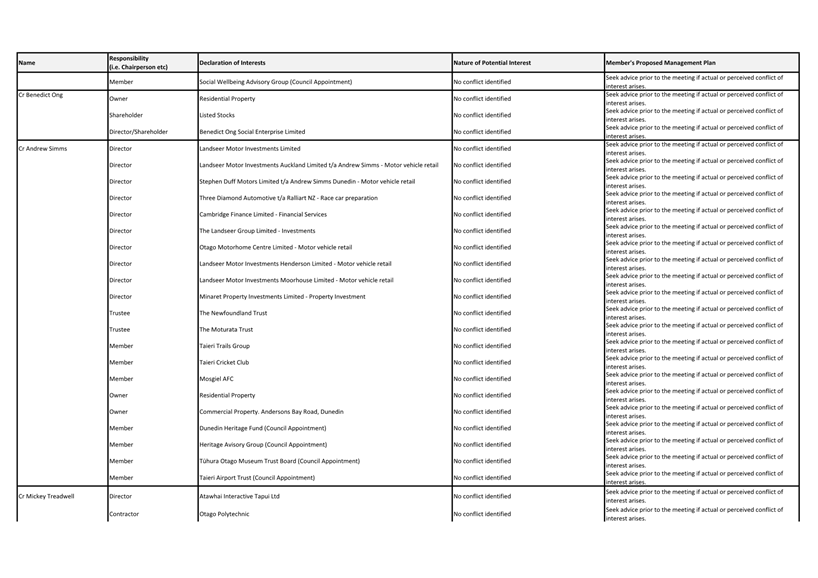
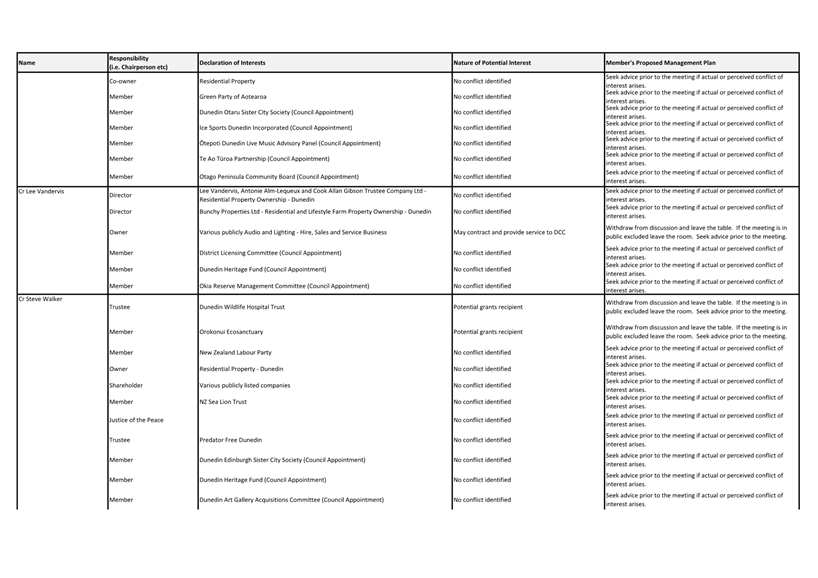
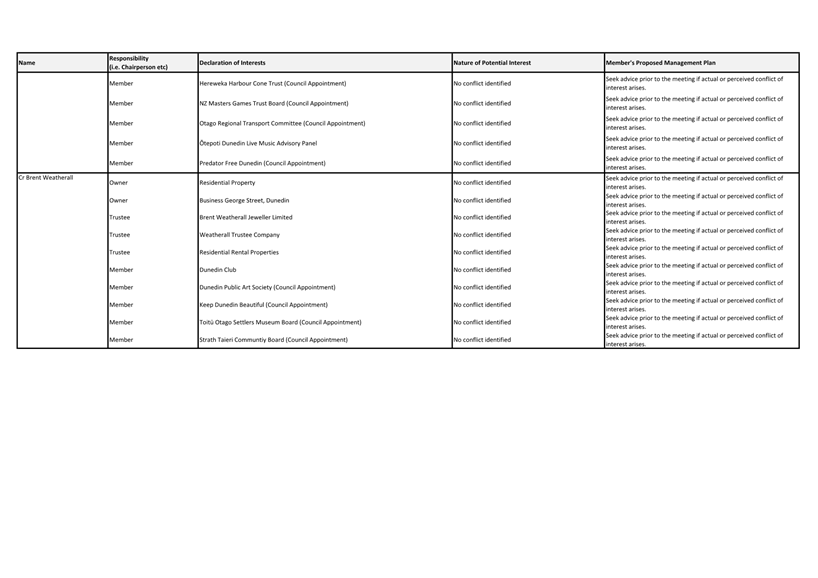
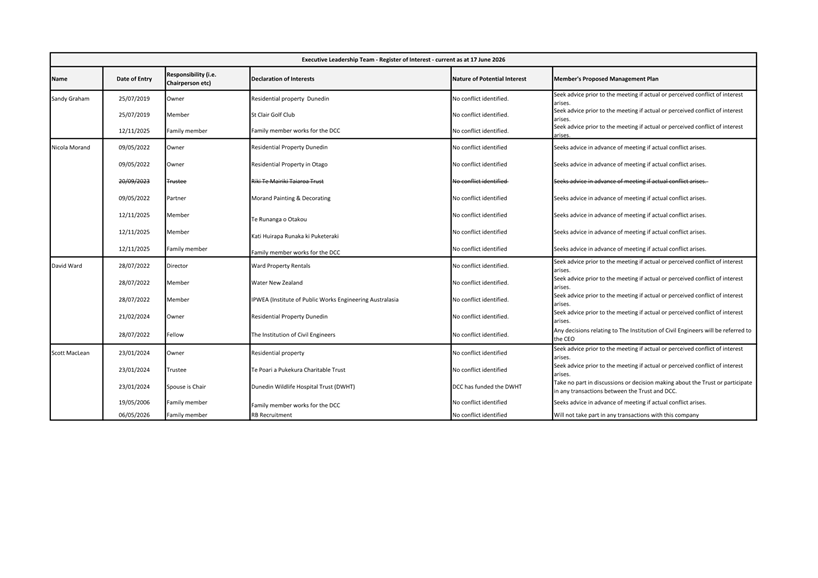
Declaration of Interest
EXECUTIVE SUMMARY
1. Members
are reminded of the need to stand aside from decision-making when a conflict
arises between their role as an elected representative and any private or other
external interest they might have.
2. Elected
members are reminded to update their register of interests as
soon as practicable, including amending the register at this meeting if
necessary.
3. Staff members are
reminded to update their register of interests as soon as practicable.
RECOMMENDATIONS
That the Council:
a) Notes/Amends if
necessary the Elected Members' Interest Register attached as Attachment A; and
b) Confirms/Amends the
proposed management plan for Elected Members' Interests.
c) Notes the proposed
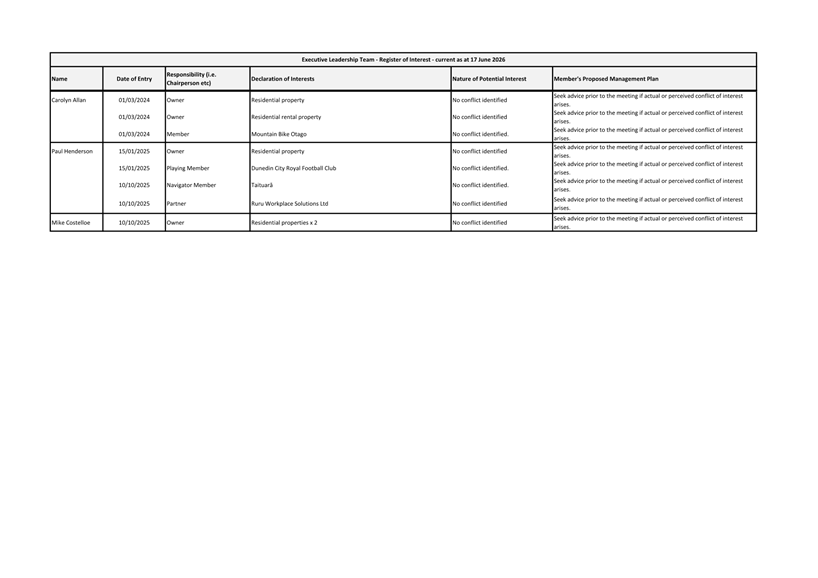
management plan for the Executive Leadership Teams’ interests.
Attachments
|
|
Title
|
Page
|
|
⇩a
|
Elected Member Interest
Register
|
6
|
|
⇩b
|
ELT Interest Register
|
13
|
|

|
Council
22 July 2026
|
Confirmation
of Minutes
Ordinary
Council meeting - 25 June 2026
RECOMMENDATIONS
That the Council:
a) Confirms the public
part of the minutes of the Ordinary Council meeting held on 25 June 2026 as a
correct record.
Attachments
|
|
Title
|
Page
|
|
A⇩
|
Minutes of Ordinary
Council meeting held on 25 June 2026
|
16
|
|

|
Council
22 July 2026
|

Council
MINUTES
Minutes of an ordinary
meeting of the Dunedin City Council held in the Council Chamber, Dunedin Public
Art Gallery, the Octagon, Dunedin on Thursday 25 June 2026, commencing at 8.30
am.
PRESENT
|
Mayor
|
Mayor Sophie Barker
|
|
|
Deputy Mayor
|
Cr Cherry Lucas
|
|
|
Members
|
Cr John Chambers
|
Cr Jo Galer
|
|
|
Cr Christine Garey via
zoom audio visual link
|
Cr Doug Hall
|
|
|
Cr Marie Laufiso
|
Cr Russell Lund
|
|
|
Cr Mandy Mayhem
|
Cr Benedict Ong
|
|
|
Cr Andrew Simms
|
Cr Mickey Treadwell
|
|
|
Cr Lee Vandervis
|
Cr Steve Walker
|
|
|
Cr Brent Weatherall
|
|
|
IN ATTENDANCE
|
Sandy Graham (Chief Executive), Carolyn Allan (Chief
Financial Officer), Scott MacLean (General Manager City Services), David Ward
(General Manager 3 Waters, Property and Urban Development), Nicola Morand
(Manahautū - General Manager Community and Strategy), Paul Henderson
(General Manager Corporate and Regulatory Services), Mike Costelloe (General
Manager, Arts, Culture and Economic Development), Cam McCracken (Director
DPAG, Lan Yuan and Olveston), Karilyn Canton (Chief In-House Legal Counsel), Jonathan
Rowe (Programme Manager, South Dunedin Future), Emma Christmas (Team Leader
Planning), Scott Campbell (Regulation and Policy Team Leader, 3 Waters),
Katherine Quill (Policy Analyst), Hayden McAuliffe (Financial Services
Manager), Janet Fraser (Corporate Planner), Peter Hocking (General Manager,
Dunedin City Holdings Limited), Michael Garbett (Anderson Lloyd) and Robyn
Dillon (Manager Governance)
|
Governance Support Officer Lynne
Adamson
1 Opening
Mrs Amy Armstrong, will open the meeting with
a prayer on behalf of the Dunedin Catholic Diocese.
Cr Mandy Mayhem entered the meeting at 8.33 am.
2 Public
Forum
There were four presenters to
the Public Forum.
2.1 South
Dunedin Future
Julian Doorey spoke to his
pre-circulated information on South Dunedin Future. He commented that he
believed the climate change issues had been dealt with but a five year flood
protection had yet to be addressed and urged Council to retain homes where possible.
Cr Lee Vandervis entered the meeting at 8.40 am.
Mr
Doorey responded to questions.
Cr Benedict Ong entered the meeting at 8.43 am
2.2 South
Dunedin Future
Lynne Newell spoke on behalf of
the South Dunedin Stormwater Justice Group on the proposed plans for South
Dunedin Future.
Ms
Newell responded to questions.
2.3 South
Dunedin Future
Dr
Alex Macmillan, Tom Scott (Health Protection) and Dr Eleanor Baxter (Public
Health Registrar) spoke to their pre-circulated information on the Health Effects
of the South Dunedin Future Shortlisted Futures. They encouraged Council
to proceed with the work and commented that further delays would harm the
residents.
Dr
Macmillan responded to questions.
2.4 Thelma
Greer
Ms
Greer commented that she lived in South Dunedin and raised her concerns about
building and resource consents continuing to be issued to areas prone to
flooding.
Ms
Greer responded to questions.
PETITION
Deputy
Mayor Cherry Lucas presented the Taieri Mouth to Brighton Speed Limit Petition
under standing
orders 16.3 – Petition from Louise Farmer.
|
3 Apologies
|
|
|
There were no apologies.
|
|
4 Confirmation
of agenda
|
|
|
Moved (Mayor Sophie Barker/Cr Cherry Lucas):
That the Council:
Confirms the agenda
without addition or alteration.
|
|
Moved (Mayor Sophie/Cr Cherry Lucas)
That the Council:
Adjourns
the meeting.
Motion
carried
The meeting adjourned at 9.09 am and resumed at 9.14 am
Moved (Cr Steve Walker/Cr Mickey Treadwell):
That the Council:
Adjourns
the meeting.
Motion
carried
The meeting adjourned at 9.17 am and reconvened 9.18 am
|
|
|
|
|
|
A Procedural Motion was moved (Cr Lee Vandervis/Cr Jo
Galer):
That the Council:
Lays
Item 7 – South Dunedin Future – 3 Proposed Adaptation Futures on
the table and not
discuss it further at this meeting.
Division
The
Council voted by division
For: Crs
Jo Galer, Russell Lund, Benedict Ong, Andrew Simms and Lee Vandervis (5).
Against: Crs
John Chambers, Christine Garey, Doug Hall, Marie Laufiso, Cherry Lucas, Mandy
Mayhem, Mickey Treadwell, Steve Walker, Brent Weatherall and Mayor Sophie
Barker (10).
Abstained: Nil
The division was declared LOST by 10 votes to 5
|
|
|
The substantive motion was then moved (Mayor Sophie
Barker/Cr Cherry Lucas):
That the Council:
Approves
the agenda without addition or alteration.
Motion
carried (CNL/2026/097) with Crs Russell Lund and Lee
Vandervis
recording
their votes against.
|
5 Declarations
of interest
Members were
reminded of the need to stand aside from decision-making when a conflict arose
between their role as an elected representative and any private or other
external interest they might have.
|
|
Moved (Mayor Sophie Barker/Cr Cherry Lucas):
That the Council:
a) Notes the Elected Members' Interest Register; and
b) Confirms the proposed management plan for
Elected Members' Interests.
c) Notes the proposed management plan for the Executive
Leadership Teams’ interests.
Motion
carried (CNL/2026/099)
|
6 Confirmation
of Minutes
|
6.1 Ordinary
Council meeting - 27 May 2026
|
|
|
Moved (Mayor Sophie Barker/Cr Cherry Lucas):
That the Council:
a) Confirms the public part of the minutes of the
Ordinary Council meeting held on 27 May 2026 as a correct record.
Motion
carried (CNL/2026/100)
|
|
6.2 Ordinary
Council meeting - 4 June 2026
|
|
|
Moved (Mayor Sophie Barker/Cr Cherry Lucas):
That the Council:
a) Confirms the public part of the minutes of the
Ordinary Council meeting held on 04 June 2026 as a correct record.
Motion
carried (CNL/2026/101)
|
Reports
|
7 South
Dunedin Future - 3 Proposed Adaptation Futures
|
|
|
A report from Climate and
City Growth provided an outline and update on the joint Otago Regional
Council/Dunedin City Council - South Dunedin Future (SDF) programme,
presented the latest technical reports and related to the three Proposed
Adaptation Futures for South Dunedin, and sought approval of Councils to
engage with affected communities and other stakeholders.
The report noted that at this
stage, Councils had committed to completing the SDF programme only, with any
future decisions on land use, infrastructure, and implementation subject to
further consideration by Councils through long-term planning and financial
processes.
The three adaptation future
proposals for consideration included:
· Future 3 –
Protect (Keep the land dry – raise land and pump water)
· Future 4 –
Restore (Make space for water – waterways and wetlands)
· Future
5 – Reshape (Move out of harm’s way – raised land and green
spaces)
|
|
|
The General Manager, 3 Waters, Property and Urban
Development (David Ward), General Manager City Services (Scott MacLean) and
Programme Manager, South Dunedin Future (Jonathan Rowe) spoke to the report
and responded to questions.
|
|
During discussion Cr Brent Weatherall left the meeting at
9.44 am and returned at 9.46 am
|
|
|
Questions continued on the South Dunedin proposed
adaptation future proposal options with the inclusion of the options for
information on keeping the status quo and the inclusion of Future 2 – a
pipes and pumps option to align with the recommendation approved at the Otago
Regional Council the previous day.
|
|
Moved (Mayor Sophie/Cr Cherry Lucas)
That the Council:
Adjourns
the meeting for 15 minutes.
Motion
carried
The meeting adjourned at 10.03 am and reconvened at 10.17
am
Cr Steve Walker returned to the meeting at 10.18 am
Cr Andrew Simms returned to the meeting at 10.19 am
Cr Benedict Ong returned to the meeting at 10.20 am
|
|
|
Ms Karilyn Canton, Chief In-House responded to
questions on the Public Works Act and explained the process for land
acquisition. She commented that the Public Works Act was designed to be
fair to landowners and assured that should this be used, the Council would
ensure it was followed. Ms Canton explained that the landowners would
be protected and emphasised that this was not a situation that they would be
disadvantaged.
|
|
Cr Mickey Treadwell left the meeting at 10.40 am and
returned at 10.41 am
|
|
|
The discussion and questions continued.
|
|
Cr Doug Hall left the meeting at 10.55 am and returned at
10.58 am
Cr Benedict Ong left the meeting at 11.20 am and returned
at 11.22 am.
|
|
|
Moved (Mayor Sophie Barker/Cr Cherry Lucas):
That the Council:
a) Notes the work undertaken since the previous report to
Council in September 2025.
b) Notes the resolution of the ORC on 24 June 2026 to include
an additional costed option of an engineered South Dunedin flood protection
system.
c) Decides to consult on the South Dunedin Future
programme using a Special Consultative Procedure based on the following
options:
· The status quo
· Future 2 -pipes and pumps
· Future 3 - protect
· Future 4 - restore
· Future 5 - reshape
d) Notes the development of Future 2 (pipes and pumps) was
likely to take at least 4 months and will incorporate the ORC resolution.
e) Notes staff would report back to Councils on the proposed
consultation process once the work on Future 2 (pipes and pumps) has been
completed.
f) Notes the report back to Councils will include draft consultation
material on the 5 options, and will seek Councils’ approval of the
draft consultation material.
Division
The Council voted by division
For: Crs
John Chambers, Jo Galer, Christine Garey, Doug Hall, Cherry Lucas, Russell
Lund, Mandy Mayhem, Andrew Simms, Mickey Treadwell, Lee Vandervis, Steve
Walker, Brent Weatherall and Mayor Sophie Barker (13).
Against: Crs
Marie Laufiso and Benedict Ong (2).
Abstained: Nil
The division
was declared CARRIED by 13 votes to 2
Motion
carried (CNL/2026/102)
|
Moved (Mayor Sophie/Cr Steve Walker
That the Council:
Adjourns
the meeting until 1.05 pm.
Motion
carried
The meeting adjourned at 12.19 pm and reconvened at 1.07 pm.
|
Agenda Amendment
|
|
|
Moved (Mayor Sophie Barker/Cr Cherry Lucas):
That the Council:
a) Amends
the agenda to be taken in the following order:
That Item 8 - South Dunedin
Natural Hazards Plan Review; Item 9 – Simplifying Local Government
Update; Item 10 – Keeping of Animals Bylaw Review; Item 11 –
Hearings Committee Recommendations on Submissions to the proposed Water
Supply Bylaw 2026; Item 13 – Adoption of the Annual Plan 2026/27; Item
14 – Setting of Rates for the 2026/27 Financial Year; Item 15 –
Dunedin City Holdings Group Companies – Statements of Intent 2026/27; Item
16 – Interim Regional Spatial Planning Governance Group and Item 19
Proposed Event Road Closures then Items C2 – Development Contribution
Matter and C4 Dunedin City Holdings Group – Director Appointment
Reappointment;
And
That Item 17
– Financial Report – Period Ended 30 April 2026, Item 18 –
Governance and Councillor Appointments to Outside Organisations Updates and
Item 20 – Notice of Motion – Opposing Removal of Final-Year Fee
Free Policy be deferred to a later meeting.
Motion
carried (CNL/2026/103)
|
|
8 South
Dunedin Natural Hazards Plan Review
|
|
|
A report from City
Development presented the outcome of the South Dunedin Natural Hazards Plan
Review and sought a decision on whether to initiate a plan change to the
Second Generation District Plan for Dunedin (2GP) in response to that review.
The report noted that the
review had been undertaken because updated hazard and risk information for
South Dunedin was now available, and because new national and regional
direction for natural hazards management had taken effect. The review found
that the current 2GP provisions for South Dunedin no longer reflected the
best available understanding of natural hazard risk and were not effectively
managing that risk for new development.
|
|
|
The General Manager, 3 Waters, Property and Urban
Development (David Ward) and Team Leader Planning (Emma Christmas) and
Michael Garbett (Anderson Lloyd) spoke to the report and responded to
questions.
|
|
Cr Benedict Ong returned to the meeting at 1.17 pm.
During discussion Mayor Sophie left the meeting at 1.24 pm
and Deputy Mayor Cherry Lucas assumed the Chair.
Mayor Sophie returned to the meeting at 1.28 pm and
resumed the Chair.
|
|
|
Moved (Cr Cherry Lucas/Mayor Sophie Barker):
That the Council:
a) Notes the findings of the South Dunedin Natural Hazards
Plan Review Report, and the associated South Dunedin Natural Hazards
Qualitative Risk Assessment prepared by Otago Regional Council.
b) Decided not to initiate a plan change to the
Second Generation District Plan for Dunedin at this time.
c) Directs staff to continue to manage natural
hazard risk in South Dunedin through existing statutory and resource consent
processes, where available.
Motion
carried (CNL/2026/104)
|
|
9 Simplifying
Local Government Update
|
|
|
A report from Corporate
Policy provided an update on the Otago Mayoral Forum's regional programme
investigating local government reform options in response to the Government's
Simplifying Local Government programme. The work included independent
analysis and financial modelling by Morrison Low Advisory.
|
|
|
Mayor Sophie spoke to the report and commented on updates
from the Otago Mayoral Forum’s regional programme.
|
|
During discussion Cr Doug Hall left the meeting at 1.52 pm
and returned at 1.56 pm.
Cr Jo Galer left the meeting at 2.25 pm and returned at
2.28 pm.
|
|
During discussion, it was moved (Mayor Sophie/Cr Cherry
Lucas):
That the Council:
Extends
the meeting beyond 6 hours.
Motion
carried
Cr Benedict Ong left the meeting at 2.34 pm and returned
at 2.37 pm.
|
|
|
Moved (Mayor Sophie Barker/Cr Cherry Lucas):
That the Council:
a) Notes the work currently underway through the Otago
regional local government reform programme.
b) Notes that no decisions had been made regarding any
preferred reform option or
potential Head Start proposal.
Motion carried (CNL/2026/105) with Crs Benedict Ong and Russell Lund
recording their votes against
|
Moved (Mayor Sophie/Cr Steve Walker):
That the Council:
Adjourns
the meeting
Motion
carried
The meeting adjourned at 2.58 and reconvened at 3.11 pm.
|
10 Keeping
of Animals Bylaw review
|
|
|
A report from Corporate and
Regulatory sought approval of the draft Keeping of Animals Bylaw (the
Bylaw) and draft statement of proposal for formal consultation using the
special consultative procedure which was a requirement of the Local Government
Act 2002 (the Act).
|
|
|
The General Manager Corporate and Regulatory Services
(Paul Henderson), Team Leader Environmental Health and Alcohol Licensing
(Tanya Morrison), Manager Compliance Services (Bonnie Wright) and Team Leader
Animal Services (Cazna Sewell) spoke to the report and responded to
questions.
|
|
|
Moved (Cr Cherry Lucas/Cr Mandy Mayhem):
That the Council:
a) Notes the results of early engagement.
b) Approves the draft Keeping of Animals Bylaw, for
consultation purposes, subject to any amendment.
c) Adopts the statement of proposal, for
consultation purposes, subject to any amendment.
d) Resolves that the proposed draft Keeping of
Animals Bylaw meets the requirements of section 155 of the Local Government
Act 2002, in that:
i) the proposed Bylaw is the most
appropriate form of Bylaw
ii) the proposed Bylaw does not give rise to
any implications under the New Zealand Bill of Rights Act 1990.
e) Notes that Councillor Lucas would appoint members of a Hearings
Committee to hear submitters, consider submissions and make recommendations
to the Council.
Motion
carried (CNL/2026/106)
|
|
11 Hearings
Committee Recommendations on Submissions to the proposed Water Supply Bylaw
2026
|
|
|
A report from Civic presented
findings of the Hearings Committee (the Committee) on the submissions to the
proposed Water Supply Bylaw 2026 (the proposed Bylaw).
The report noted that after
consideration of the submissions received, the Committee recommended some
amendments to the proposed Bylaw and recommended that the Council adopt the
proposed Bylaw with a date of effect of 1 July 2026.
|
|
|
Cr John Chambers (Chairperson) spoke to the report.
The General Manager 3 Waters, Property and Urban
Development (David Ward); Regulation and Policy Team Leader, 3 Waters (Scott
Campbell); Policy Analyst (Katherine Quill) responded to questions.
|
|
|
Moved (Cr John Chambers/Cr Brent Weatherall):
That the Council:
a) Notes the 25 written submissions received on the proposed
Water Supply Bylaw 2026.
b) Notes the minutes of the Hearings Committee and its
recommended amendments to the consultation version of the Bylaw.
c) Notes the Boundary Backflow Prevention Policy.
d) Confirms that the proposed Bylaw, including the
recommended amendments, was the most appropriate way of regulating use of the
DCC’s water supply network, was the most appropriate form of bylaw, and
did not give rise to any implications under the New Zealand Bill of Rights
Act 1990.
e) Adopts the Water Supply Bylaw 2026.
f) Approves a date of effect for the Water Supply
Bylaw 2026 of 1 July 2026.
g) Revokes the Water Bylaw 2011 from 1 July 2026.
Motion
carried (CNL/2026/107) with Crs Jo Galer, Russell Lund and Lee Vandervis
recording their votes against
|
|
13 Adoption
of the Annual Plan 2026/27
|
|
|
A report from Civic
recommended adoption of the Annual Plan 2026/27 (the Annual Plan) and
approval of matters associated with the Annual Plan.
|
|
|
The Chief Financial Officer (Carolyn Allan), Financial
Services Manager (Hayden McAuliffe) and Corporate Planner (Janet
Fraser) spoke to the report and responded to questions.
|
|
|
Moved (Mayor Sophie Barker/Cr Cherry Lucas):
That the Council:
a) Adopts the Annual Plan 2026/27.
b) Authorises the Chief Executive to make any minor
editorial changes resulting from quality checks prior to the final printing
of the Annual Plan 2026/27 document.
c) Authorises the Chief Executive to drawdown debt up
to total debt of $815 million in the 2026/27 year.
Division
The
Council voted by division
For: Crs
John Chambers, Christine Garey, Doug Hall, Marie Laufiso, Cherry Lucas, Mandy
Mayhem, Mickey Treadwell, Steve Walker and Mayor Sophie Barker (9).
Against: Crs
Jo Galer, Russell Lund, Benedict Ong, Andrew Simms, Lee Vandervis and Brent
Weatherall (6).
Abstained: Nil
The division was declared CARRIED by 9 votes to 6
Motion
carried (CNL/2026/108)
|
Crs Steve Walker and Lee Vandervis left the meeting at 4.43
pm.
Cr Steve Walker returned to the meeting at 4.44 pm.
Cr Benedict Ong left the meeting at 4.44 pm and returned at
4.50 pm.
|
14 Setting
of Rates for the 2026/27 Financial Year
|
|
|
A report from Finance advised
that following adoption of the Annual Plan 2026/27,
the Council needed to set the rates as provided for in the Funding Impact
Statement for the 2026/27 year.
|
|
|
The Chief Financial Officer (Carolyn Allan) and Financial
Services Manager (Hayden McAuliffe) spoke to the report and advised of two
changes to the resolution:
Under Differential Matters and Categories b) water
services utilities was added and under the bullet point on differential
categories based on land use - commercial, or water services utilities was
added.
They responded to questions.
|
|
|
Moved (Mayor Sophie Barker/Cr Cherry Lucas):
That the Council:
a) Sets the
following rates under the Local Government (Rating) Act 2002 on rating units
in the district for the financial year commencing 1 July 2026 and ending on
30 June 2027.
1.
General Rate
A
general rate set under section 13 of the Local Government (Rating) Act 2002
made on every rating unit, assessed on a differential basis as described
below:
· A rate of 0.3231 cents in the dollar
(including GST) of capital value on every rating unit in the
"residential" category.
· A rate of 0.3070 cents in the dollar
(including GST) of capital value on every rating unit in the
"lifestyle" category.
· A rate of 0.8078 cents in the dollar
(including GST) of capital value on every rating unit in the
"commercial" category.
· A rate of 0.5654 cents in the dollar
(including GST) of capital value on every rating unit in the
"residential heritage bed and breakfasts" category.
· A rate of 0.2585 cents in the dollar (including
GST) of capital value on every rating unit in the "farmland"
category.
· A rate of 0.0534 cents in the dollar
(including GST) of capital value on the “stadium: 10,000+ seat
capacity” category.
· A rate of 0.4330 cents in the dollar
(including GST) of capital value on the “water services
utilities” category.
2.
Community Services Rate
A
targeted rate for community services, set under section 16 of the Local
Government (Rating) Act 2002, assessed on a differential basis as follows:
· $124.30 (including GST) per separately
used or inhabited part of a rating unit for all rating units in the
"residential, residential heritage bed and breakfasts, lifestyle and
farmland" categories.
· $124.30 (including GST) per rating unit
for all rating units in the "commercial, stadium: 10,000+ seat capacity
and water services utilities" categories.
3.
Kerbside Collection Rate
A
targeted rate for kerbside collection, set under section 16 of the Local
Government (Rating) Act 2002, assessed on a differential basis as follows:
· $348.00 (including GST) per separately
used or inhabited part of a rating unit for rating units in the
"residential, residential heritage bed and breakfasts, lifestyle and
farmland" categories.
· $348.00 (including GST) per rating unit
for rating units in the "commercial" category.
4.
Drainage Rates
A
targeted rate for drainage, set under section 16 of the Local Government
(Rating) Act 2002, assessed on a differential basis as follows:
· $1,000.00 (including GST) per separately
used or inhabited part of a rating unit for all rating units in the
"residential, residential heritage bed and breakfasts, lifestyle and
farmland" categories and which are "connected" to the public
sewerage system.
· $500.00 (including GST) per separately
used or inhabited part of a rating unit for all rating units in the
"residential, residential heritage bed and breakfasts, lifestyle and
farmland" categories and which are "serviceable" by the public
sewerage system.
· $1,000.00 (including GST) per rating
unit for all rating units in the "commercial, residential institutions,
schools and stadium: 10,000+ seat capacity" categories and which are
"connected" to the public sewerage system.
· $500.00 (including GST) per rating unit
for all rating units in the "commercial, residential institutions and
schools" categories and which are "serviceable" by the public
sewerage system.
· $102.25 (including GST) per rating unit
for all rating units in the "church" category and which are
"connected" to the public sewerage system.
Rating
units which are not "connected" to the scheme, and which are not
"serviceable" will not be liable for this rate. Drainage is a
combined targeted rate for sewage disposal and stormwater. Sewage
disposal makes up 76% of the drainage rate, and stormwater makes up
24%. Non-rateable land will not be liable for the stormwater component
of the drainage targeted rate. Rates demands for the drainage targeted
rate for non-rateable land will therefore be charged at 76%.
5. Commercial Drainage Rates – Capital Value
A
targeted rate for drainage, set under section 16 of the Local Government
(Rating) Act 2002, assessed on a differential basis as follows:
· A rate of 0.3377 cents in the dollar
(including GST) of capital value on every rating unit in the "commercial
and residential institution" category and which are
"connected" to the public sewerage system.
· A rate of 0.1689 cents in the dollar
(including GST) of capital value on every rating unit in the
"commercial" category and which are "serviceable" by the
public sewerage system.
· A rate of 0.2533 cents in the dollar
(including GST) of capital value on every rating unit in the
"school" category and which are "connected" to the public
sewerage system.
· A rate of 0.1267 cents in the dollar
(including GST) of capital value on every rating unit in the
"school" category and which are "serviceable" by the
public sewerage system.
· A rate of 0.0195 cents in the dollar
(including GST) of capital value on the “stadium: 10,000+ seat
capacity” category.
This
rate shall not apply to properties in Karitane, Middlemarch, Seacliff,
Waikouaiti and Warrington. This rate shall not apply to churches.
Drainage is a combined targeted rate for sewage disposal and
stormwater. Sewage disposal makes up 76% of the drainage rate, and
stormwater makes up 24%. Non-rateable land will not be liable for the
stormwater component of the drainage targeted rate. Rates demands for
the drainage targeted rate for non-rateable land will therefore be charged at
76%.
6.
Water Rates
A targeted
rate for water supply, set under section 16 of the Local Government (Rating)
Act 2002, assessed on a differential basis as follows:
· $810.00 (including GST) per separately
used or inhabited part of any "connected" rating unit which
receives an ordinary supply of water within the meaning of the Dunedin City
Bylaws excepting properties in Karitane, Merton, Rocklands/Pukerangi,
Seacliff, Waitati, Warrington, East Taieri, West Taieri and North Taieri.
· $405.00 (including GST) per separately
used or inhabited part of any "serviceable" rating unit to which
connection is available to receive an ordinary supply of water within the
meaning of the Dunedin City Bylaws excepting properties in Karitane, Merton,
Rocklands/Pukerangi, Seacliff, Waitati, Warrington, East Taieri, West Taieri
and North Taieri.
· $810.00 (including GST) per unit of
water being one cubic metre (viz. 1,000 litres) per day supplied
at a constant rate of flow during a full 24 hour period to any
"connected" rating unit situated in Karitane, Merton, Seacliff,
Waitati, Warrington, West Taieri, East Taieri or North Taieri.
· $405.00 (including GST) per separately
used or inhabited part of any "serviceable" rating unit situated in
Waitati, Warrington, West Taieri, East Taieri or North Taieri. This
rate shall not apply to the availability of water in Merton, Karitane or
Seacliff.
7.
Fire Protection Rates
A
targeted rate for the provision of a fire protection service, set under
section 16 of the Local Government (Rating) Act 2002, assessed on a
differential basis as follows:
· A rate of 0.1017 cents in the dollar
(including GST) of capital value on all rating units in the
"commercial" category. This rate shall not apply to churches.
· A rate of 0.0763 cents in the dollar
(including GST) of capital value on all rating units in the "residential
institutions" category.
· A rate of 0.0079 cents in the dollar
(including GST) of capital value on the “stadium: 10,000+ seat
capacity” category.
· $243.00 (including GST) for each
separately used or inhabited part of a rating unit within the
"residential, residential heritage bed and breakfasts, lifestyle and
farmland" category that is not receiving an ordinary supply of water
within the meaning of the Dunedin City Bylaws.
8.
Water Rates – Quantity of Water
A
targeted rate for the quantity of water provided to any rating unit fitted
with a water meter, being an extraordinary supply of water within the meaning
of the Dunedin City Bylaws, set under section 19 of the Local Government
(Rating) Act 2002, according to the following scale of charges (GST
inclusive):
|
|
Annual Meter Rental Charge
|
|
20mm nominal diameter
|
$194.78
|
|
25mm nominal diameter
|
$250.06
|
|
30mm nominal diameter
|
$277.71
|
|
40mm nominal diameter
|
$314.54
|
|
50mm nominal diameter
|
$636.99
|
|
80mm nominal diameter
|
$787.02
|
|
100mm nominal diameter
|
$830.46
|
|
150mm nominal diameter
|
$1,193.69
|
|
300mm nominal diameter
|
$1,549.04
|
|
70mm Hydrant Standpipe
|
$771.23
|
|
Reconnection Fee – includes the removal of
water restrictors installed due to non-compliance of the water bylaw
|
$542.86
|
|
Special Reading Fee
|
$73.77
|
|
|
Backflow Prevention Charge
|
|
Backflow Preventer
Test Fee
|
$154.15
|
|
Rescheduled Backflow
Preventer Test Fee
|
$92.01
|
|
Backflow Programme - incomplete application fee
(hourly rate)
|
$54.12
|
|
|
Water Charge
|
|
Merton, Hindon and individual farm supplied Bulk
Raw Water Tariff
|
$0.17 per cubic metre
|
|
All other treated water per cubic metre
|
$2.94 per cubic metre
|
|
|
Network Contributions
|
|
Disconnection of Water Supply – AWSCI to excavate
|
$302.31
|
|
Disconnection of Water Supply – DCC
contractor to excavate
|
$1,184.48
|
Where
the supply of a quantity of water is subject to this Quantity of Water
Targeted Rate, the rating unit will not be liable for any other targeted rate
for the supply of the same water.
9.
Allanton Drainage Rate
A
targeted rate for the capital contribution towards the Allanton Wastewater
Collection System, set under section 16 of the Local Government (Rating) Act
2002, of $411.00 (including GST) per rating unit, to every rating unit paying
their contribution towards the scheme as a targeted rate over
20 years. Liability for the rate is on the basis of the provision
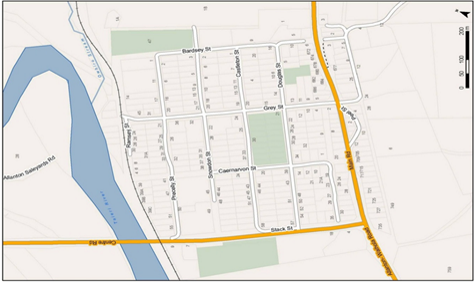
of the service to each rating unit. The Allanton area was shown in the
map below:
10.
Blanket Bay Drainage Rate
A
targeted rate for the capital contribution towards the Blanket Bay Drainage
System, set under section 16 of the Local Government (Rating) Act 2002, of
$636.00 (including GST) per rating unit, to every rating unit paying their
contribution towards the scheme as a targeted rate over 20 years.
Liability for the rate is on the basis of the provision of the service to
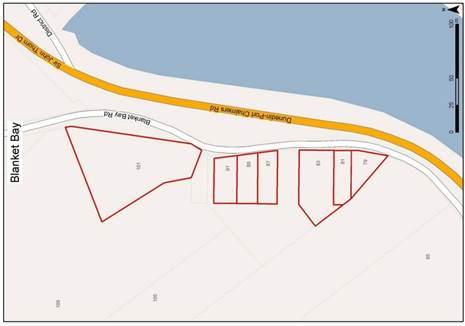
each rating unit. The Blanket Bay area is shown in the map below:
11. Curles Point Drainage Rate
g) A targeted
rate for the capital contribution towards the Curles Point Drainage System,
set under section 16 of the Local Government (Rating) Act 2002, of $749.00
(including GST) per rating unit, to every rating unit paying their
contribution towards the scheme as a targeted rate over 20 years.
Liability for the rate is on the basis of the provision of the service to
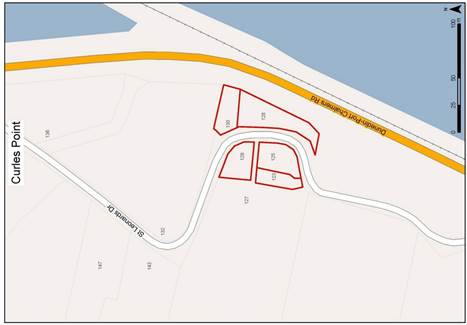
each rating unit. The Curles Point area is shown in the map below:
12. Warm Dunedin Targeted Rate Scheme
A targeted rate for the Warm Dunedin Targeted Rate
Scheme, set under section 16 of the Local Government (Rating) Act 2002, per
rating unit in the Warm Dunedin Targeted Rate Scheme.
The targeted rate scheme provides a way for homeowners to
install insulation and/or clean heating. The targeted rate covers the
cost and an annual interest rate. The interest rates have been and will
be:
Rates commencing 1 July 2013 and 1 July 2014 8%
Rates commencing 1 July 2015 and 1 July 2016 8.3%
Rates commencing 1 July 2017 7.8%
Rates commencing 1 July 2018 7.2%
Rates commencing 1 July 2019 6.8%
Rates commencing 1 July 2020 5.7%
Rates commencing 1 July 2021 4.4%
13. Private Street Lighting Rate
A
targeted rate for the purpose of recovering the cost of private street
lights, set under section 16 of the Local Government (Rating) Act 2002,
assessed on a differential basis as follows:
· $156.80 (including GST) per private
street light divided by the number of separately used or inhabited parts of a
rating unit for all rating units in the "residential and lifestyle"
categories in the private streets as identified in the schedule below.
· $156.80 (including GST) per private
street light divided by the number of rating units for all rating units in
the "commercial" category in the private streets as identified in
the schedule below.
The
private street light addresses are as follows:
1 Achilles
Avenue
1 Alton
Avenue
2 Alton
Avenue
2A Alton
Avenue
3 Alton
Avenue
4 Alton
Avenue
5 Alton
Avenue
6 Alton
Avenue
7 Alton
Avenue
8 Alton
Avenue
9 Alton
Avenue
7 Angle
Avenue
9 Angle
Avenue
11 Angle
Avenue
20 Angle
Avenue
22 Angle
Avenue
24 Angle
Avenue
43 Arawa
Street
47 Arawa
Street
17 Awa
Toru Drive Fairfield
19 Awa
Toru Drive Fairfield
21 Awa
Toru Drive Fairfield
23 Awa
Toru Drive Fairfield
25 Awa
Toru Drive Fairfield
27 Awa
Toru Drive Fairfield
29 Awa
Toru Drive Fairfield
31 Awa
Toru Drive Fairfield
33 Awa
Toru Drive Fairfield
35 Awa
Toru Drive Fairfield
37 Awa
Toru Drive Fairfield
39 Awa
Toru Drive Fairfield
41 Awa
Toru Drive Fairfield
43 Awa
Toru Drive Fairfield
45 Awa
Toru Drive Fairfield
47 Awa
Toru Drive Fairfield
49 Awa
Toru Drive Fairfield
51 Awa
Toru Drive Fairfield
60 Balmacewen
Road
60B Balmacewen
Road
62 Balmacewen
Road
64 Balmacewen
Road
1 Balmoral
Avenue Mosgiel
2 Balmoral
Avenue Mosgiel
3 Balmoral
Avenue Mosgiel
4 Balmoral
Avenue Mosgiel
5 Balmoral
Avenue Mosgiel
6 Balmoral
Avenue Mosgiel
7 Balmoral
Avenue Mosgiel
8 Balmoral
Avenue Mosgiel
9 Balmoral
Avenue Mosgiel
10 Balmoral
Avenue Mosgiel
11 Balmoral
Avenue Mosgiel
12 Balmoral
Avenue Mosgiel
17 Balmoral
Avenue Mosgiel
19 Barclay
Street
211 Bay
View Road
211A Bay
View Road
211B Bay
View Road
1 Beaufort
Street
3 Beaufort
Street
119 Belford
Street
12 Bell
Crescent Green Island
14 Bell
Crescent Green Island
24 Bell
Crescent Green Island
26 Bell
Crescent Green Island
12 Bewley
Avenue Macandrew Bay
14 Bewley
Avenue Macandrew Bay
21 Birchfield
Avenue
7 Bishop
Verdon Close Mosgiel
9 Bishop
Verdon Close Mosgiel
10 Bishop
Verdon Close Mosgiel
11 Bishop
Verdon Close Mosgiel
12 Bishop
Verdon Close Mosgiel
8 Bonnington
Street
8a Bonnington
Street
10 Bonnington
Street
20K Brighton
Road Green Island
20J Brighton
Road Green Island
20H Brighton
Road Green Island
20G Brighton
Road Green Island
20F Brighton
Road Green Island
20E Brighton
Road Green Island
20D Brighton
Road Green Island
20C Brighton
Road Green Island
20B Brighton
Road Green Island
20A Brighton
Road Green Island
20 Brighton
Road Green Island
34 Burgess
Street Green Island
36 Burgess
Street Green Island
38 Burgess
Street Green Island
40 Burgess
Street Green Island
42 Burgess
Street Green Island
44 Burgess
Street Green Island
46 Burgess
Street Green Island
48 Burgess
Street Green Island
50 Burgess
Street Green Island
8 Burkes
Drive Ravensbourne
10 Burkes
Drive Ravensbourne
181 Burt
Street
183 Burt
Street
185 Burt
Street
7 Bush
Road Mosgiel
80 Caldwell
Street
82 Caldwell
Street
1 Campbell
Lane Mosgiel
4 Campbell
Lane Mosgiel
5 Campbell
Lane Mosgiel
6 Campbell
Lane Mosgiel
7 Campbell
Lane Mosgiel
8 Campbell
Lane Mosgiel
9 Campbell
Lane Mosgiel
10 Campbell
Lane Mosgiel
11 Campbell
Lane Mosgiel
12 Campbell
Lane Mosgiel
13 Campbell
Lane Mosgiel
14 Campbell
Lane Mosgiel
15 Campbell
Lane Mosgiel
30 Cardigan
Street North East Valley
32 Cardigan
Street North East Valley
34 Cardigan
Street North East Valley
36 Cardigan
Street North East Valley
3 Carnea
Heights Mosgiel
4 Carnea
Heights Mosgiel
5 Carnea
Heights Mosgiel
6 Carnea
Heights Mosgiel
7 Carnea
Heights Mosgiel
8 Carnea
Heights Mosgiel
10 Carnea
Heights Mosgiel
12 Carnea
Heights Mosgiel
22 Centennial
Avenue Fairfield
24 Centennial
Avenue Fairfield
26 Centennial
Avenue Fairfield
28 Centennial
Avenue Fairfield
150 Chapman
Street
150A Chapman
Street
152 Chapman
Street
12 Clearwater
Street Broad Bay
14 Clearwater
Street Broad Bay
16 Clearwater
Street Broad Bay
18 Clearwater
Street Broad Bay
20 Clearwater
Street Broad Bay
22 Clearwater
Street Broad Bay
24 Clearwater
Street Broad Bay
26 Clearwater
Street Broad Bay
28 Clearwater
Street Broad Bay
30 Clearwater
Street Broad Bay
32 Clearwater
Street Broad Bay
34 Clearwater
Street Broad Bay
36 Clearwater
Street Broad Bay
22 Cole
Street
11 Corstorphine
Road
11A Corstorphine
Road
13 Corstorphine
Road
15 Corstorphine
Road
17 Corstorphine
Road
21 Corstorphine
Road
23 Corstorphine
Road
25 Corstorphine
Road
11 Craighall
Crescent
15 Craighall
Crescent
1 Dalkeith
Road Port Chalmers
2 Dalkeith
Road Port Chalmers
4 Dalkeith
Road Port Chalmers
6 Dalkeith
Road Port Chalmers
8 Dalkeith
Road Port Chalmers
10 Dalkeith
Road Port Chalmers
12 Dalkeith
Road Port Chalmers
21 Davies
Street
22 Davies
Street
1 Devon
Place Mosgiel
2 Devon
Place Mosgiel
3 Devon
Place Mosgiel
4 Devon
Place Mosgiel
5 Devon
Place Mosgiel
6 Devon
Place Mosgiel
7 Devon
Place Mosgiel
9 Devon
Place Mosgiel
10 Devon
Place Mosgiel
11 Devon
Place Mosgiel
12 Devon
Place Mosgiel
13 Devon
Place Mosgiel
14 Devon
Place Mosgiel
15 Devon
Place Mosgiel
16 Devon
Place Mosgiel
17 Devon
Place Mosgiel
18 Devon
Place Mosgiel
19 Devon
Place Mosgiel
20 Devon
Place Mosgiel
21 Devon
Place Mosgiel
20 District
Road Roseneath
24 District
Road Roseneath
24A District
Road Roseneath
139b Doon
Street
139a Doon
Street
139 Doon
Street
141 Doon
Street
143 Doon
Street
145 Doon
Street
149 Doon
Street
151 Doon
Street
5 Dorset
Street
7 Dorset
Street
10 Dorset
Street
11 Dorset
Street
12 Dorset
Street
14 Dorset
Street
15 Dorset
Street
16 Dorset
Street
18 Dorset
Street
20 Dorset
Street
21 Dorset
Street
17 Duckworth
Street
19 Duckworth
Street
21 Duckworth
Street
35 Duckworth
Street
37 Duckworth
Street
39 Duckworth
Street
39a Duckworth
Street
41 Duckworth
Street
47 Duckworth
Street
49 Duckworth
Street
53 Duckworth
Street
Dunedin
Airport
1–31 Eastbourne
Street
2–31 Eastbourne
Street
3–31 Eastbourne
Street
4–31 Eastbourne
Street
5–31 Eastbourne
Street
6–31 Eastbourne
Street
7–31 Eastbourne
Street
8–31 Eastbourne
Street
9–31 Eastbourne
Street
10–31 Eastbourne
Street
11–31 Eastbourne
Street
12–31 Eastbourne
Street
13–31 Eastbourne
Street
14–31 Eastbourne
Street
15–31 Eastbourne
Street
16–31 Eastbourne
Street
17–31 Eastbourne
Street
18–31 Eastbourne
Street
19–31 Eastbourne
Street
20–31 Eastbourne
Street
21–31 Eastbourne
Street
22–31 Eastbourne
Street
23–31 Eastbourne
Street
24–31 Eastbourne
Street
25–31 Eastbourne
Street
26–31 Eastbourne
Street
27–31 Eastbourne
Street
28–31 Eastbourne
Street
29–31 Eastbourne
Street
30–31 Eastbourne
Street
31–31 Eastbourne
Street
32–31 Eastbourne
Street
33–31 Eastbourne
Street
34–31 Eastbourne
Street
35–31 Eastbourne
Street
36–31 Eastbourne
Street
37–31 Eastbourne
Street
38–31 Eastbourne
Street
39–31 Eastbourne
Street
40–31 Eastbourne
Street
41–31 Eastbourne
Street
42–31 Eastbourne
Street
43–31 Eastbourne
Street
46–31 Eastbourne
Street
47–31 Eastbourne
Street
50–31 Eastbourne
Street
51–31 Eastbourne
Street
16 Easther
Crescent
16A Easther
Crescent
18 Easther
Crescent
20 Easther
Crescent
22 Easther
Crescent
24 Easther
Crescent
26 Easther
Crescent
8 Echovale
Avenue
10 Echovale
Avenue
12 Echovale
Avenue
45 Eglinton
Road
2 Elbe
Street
202 Elgin
Road
204 Elgin
Road
206 Elgin
Road
208 Elgin
Road
1 Eton
Drive Mosgiel
4 Eton
Drive Mosgiel
5 Eton
Drive Mosgiel
6 Eton
Drive Mosgiel
7 Eton
Drive Mosgiel
8 Eton
Drive Mosgiel
9 Eton
Drive Mosgiel
10 Eton
Drive Mosgiel
11 Eton
Drive Mosgiel
12 Eton
Drive Mosgiel
13 Eton
Drive Mosgiel
14 Eton
Drive Mosgiel
15 Eton
Drive Mosgiel
16 Eton
Drive Mosgiel
17 Eton
Drive Mosgiel
18 Eton
Drive Mosgiel
19 Eton
Drive Mosgiel
20 Eton
Drive Mosgiel
2 Everton
Road
3 Everton
Road
4 Everton
Road
64 Every
Street
66 Every
Street
68 Every
Street
70 Every
Street
76 Every
Street
7 Fern
Road Ravensbourne
9 Fern
Road Ravensbourne
11 Fern
Road Ravensbourne
13 Fern
Road Ravensbourne
15 Fern
Road Ravensbourne
17 Fern
Road Ravensbourne
19 Fern
Road Ravensbourne
21 Fern
Road Ravensbourne
19 Ferntree
Drive
21 Ferntree
Drive
23 Ferntree
Drive
25 Ferntree
Drive
43 Forfar
Street
45 Forfar
Street
47 Forfar
Street
47a Forfar
Street
49 Forfar
Street
51 Forfar
Street
53 Forfar
Street
53a Forfar
Street
2–80 Formby
Street Outram Street
3–80 Formby
Street Outram Street
4–80 Formby
Street Outram Street
5–80 Formby
Street Outram Street
6–80 Formby
Street Outram Street
7–80 Formby
Street Outram Street
8–80 Formby
Street Outram Street
10–80 Formby
Street Outram Street
12–80 Formby
Street Outram Street
13–80 Formby
Street Outram Street
14–80 Formby
Street Outram Street
15–80 Formby
Street Outram Street
16–80 Formby
Street Outram Street
17–80 Formby
Street Outram Street
18–80 Formby
Street Outram Street
19–80 Formby
Street Outram Street
20–80 Formby
Street Outram Street
239 Fryatt
Street
41 Fulton
Road
43 Fulton
Road
43A Fulton
Road
45 Fulton
Road
45A Fulton
Road
47 Fulton
Road
47A Fulton
Road
49 Fulton
Road
49A Fulton
Road
51 Fulton
Road
51A Fulton
Road
53 Fulton
Road
248 George
Street
559 George
Street
150A Gladstone
Road North Mosgiel
150B Gladstone
Road North Mosgiel
150C Gladstone
Road North Mosgiel
150D Gladstone
Road North Mosgiel
150E Gladstone
Road North Mosgiel
152B Gladstone
Road North Mosgiel
152C Gladstone
Road North Mosgiel
152D Gladstone
Road North Mosgiel
152E Gladstone
Road North Mosgiel
154A Gladstone
Road North Mosgiel
214 Gladstone
Road North Mosgiel
216 Gladstone
Road North Mosgiel
218 Gladstone
Road North Mosgiel
220 Gladstone
Road North Mosgiel
222 Gladstone
Road North Mosgiel
224 Gladstone
Road North Mosgiel
226 Gladstone
Road North Mosgiel
228 Gladstone
Road North Mosgiel
230 Gladstone
Road North Mosgiel
232 Gladstone
Road North Mosgiel
234 Gladstone
Road North Mosgiel
39 Glenbrook
Drive Mosgiel
41 Glenbrook
Drive Mosgiel
45 Glenbrook
Drive Mosgiel
47 Glenbrook
Drive Mosgiel
49 Glenbrook
Drive Mosgiel
51 Glenbrook
Drive Mosgiel
57 Glenbrook
Drive Mosgiel
1 Glenfinnan
Place
3 Glenfinnan
Place
4A Glenfinnan
Place
4B Glenfinnan
Place
5 Glenfinnan
Place
6 Glenfinnan
Place
7 Glenfinnan
Place
8A Glenfinnan
Place
8B Glenfinnan
Place
9A Glenfinnan
Place
9B Glenfinnan
Place
10A Glenfinnan
Place
10B Glenfinnan
Place
1 Glengarry
Court Mosgiel
2 Glengarry
Court Mosgiel
3 Glengarry
Court Mosgiel
4 Glengarry
Court Mosgiel
5 Glengarry
Court Mosgiel
6 Glengarry
Court Mosgiel
7 Glengarry
Court Mosgiel
8 Glengarry
Court Mosgiel
9 Glengarry
Court Mosgiel
10 Glengarry
Court Mosgiel
11 Glengarry
Court Mosgiel
12 Glengarry
Court Mosgiel
13 Glengarry
Court Mosgiel
14 Glengarry
Court Mosgiel
15 Glengarry
Court Mosgiel
16 Glengarry
Court Mosgiel
17 Glengarry
Court Mosgiel
18 Glengarry
Court Mosgiel
19 Glengarry
Court Mosgiel
20 Glengarry
Court Mosgiel
21 Glengarry
Court Mosgiel
22 Glengarry
Court Mosgiel
23 Glengarry
Court Mosgiel
24 Glengarry
Court Mosgiel
48 Glenross
Street
50 Glenross
Street
54 Glenross
Street
56 Glenross
Street
58 Glenross
Street
60 Glenross
Street
110 Glenross
Street
114 Glenross
Street
116 Glenross
Street
230 Gordon
Road Mosgiel
229 Gordon
Road Mosgiel
34 Grandview
Crescent
8 Grant
Dalton Street North Taieri
12 Grant
Dalton Street North Taieri
14 Grant
Dalton Street North Taieri
15 Grant
Dalton Street North Taieri
16 Grant
Dalton Street North Taieri
17 Grant
Dalton Street North Taieri
18 Grant
Dalton Street North Taieri
19 Grant
Dalton Street North Taieri
20 Grant
Dalton Street North Taieri
21 Grant
Dalton Street North Taieri
22 Grant
Dalton Street North Taieri
26 Grant
Dalton Street North Taieri
27 Grant
Dalton Street North Taieri
28 Grant
Dalton Street North Taieri
29 Grant
Dalton Street North Taieri
10 Halsey
Street
1 Hampton
Grove Mosgiel
2 Hampton
Grove Mosgiel
3 Hampton
Grove Mosgiel
4 Hampton
Grove Mosgiel
5 Hampton
Grove Mosgiel
6 Hampton
Grove Mosgiel
7 Hampton
Grove Mosgiel
8 Hampton
Grove Mosgiel
9 Hampton
Grove Mosgiel
10 Hampton
Grove Mosgiel
11 Hampton
Grove Mosgiel
12 Hampton
Grove Mosgiel
14 Hampton
Grove Mosgiel
15 Hampton
Grove Mosgiel
16 Hampton
Grove Mosgiel
17 Hampton
Grove Mosgiel
18 Hampton
Grove Mosgiel
19 Hampton
Grove Mosgiel
20 Hampton
Grove Mosgiel
21 Hampton
Grove Mosgiel
22 Hampton
Grove Mosgiel
23 Hampton
Grove Mosgiel
24 Hampton
Grove Mosgiel
25 Hampton
Grove Mosgiel
26 Hampton
Grove Mosgiel
4 Harold
Street
12 Harold
Street
215a Helensburgh
Road
217a Helensburgh
Road
217b Helensburgh
Road
219 Helensburgh
Road
219a Helensburgh
Road
219b Helensburgh
Road
221 Helensburgh
Road
223 Helensburgh
Road
49 Highcliff
Road
49A Highcliff
Road
51 Highcliff
Road
57 Highcliff
Road
295 Highcliff
Road
297 Highcliff
Road
313 Highcliff
Road
315a Highcliff
Road
315b Highcliff
Road
317 Highcliff
Road
16 Highgate
18 Highgate
20 Highgate
34a Highgate
34 Highgate
216 Highgate
218 Highgate
144A Highgate
144B Highgate
146 Highgate
146A Highgate
148 Highgate
2 Hill
Road Warrington
26 Ings
Avenue
26A Ings
Avenue
26B Ings
Avenue
364 Kaikorai
Valley Road
366 Kaikorai
Valley Road
368 Kaikorai
Valley Road
372 Kaikorai
Valley Road
374 Kaikorai
Valley Road
9 Kilgour
Street
11 Kilgour
Street
15 Kilgour
Street
20 Kinvig
Street
22 Kinvig
Street
2 Koremata
Street Green Island
4 Koremata
Street Green Island
12 Koremata
Street Green Island
32 Koremata
Street Green Island
34 Koremata
Street Green Island
6 Langham
Terrace
3 Lawson
Street
4 Leithton
Close
6 Leithton
Close
9 Leithton
Close
10 Leithton
Close
11 Leithton
Close
14 Leithton
Close
15 Leithton
Close
18 Leithton
Close
19 Leithton
Close
21 Leithton
Close
22 Leithton
Close
23 Leithton
Close
26 Leithton
Close
27 Leithton
Close
28 Leithton
Close
29 Leithton
Close
32 Leithton
Close
33 Leithton
Close
36 Leithton
Close
5 Leven
Street
2 Leyden
Terrace
21 Lock
Street
1–23 London
Street
2–23 London
Street
3–23 London
Street
4–23 London
Street
5–23 London
Street
6–23 London
Street
7–23 London
Street
8–23 London
Street
9–23 London
Street
10–23 London
Street
11–23 London
Street
12–23 London
Street
13–23 London
Street
14–23 London
Street
15–23 London
Street
16–23 London
Street
17–23 London
Street
18–23 London
Street
19–23 London
Street
25 London
Street
1–25 London
Street
2–25 London
Street
3–25 London
Street
8 Lynwood
Avenue
10 Lynwood
Avenue
12 Lynwood
Avenue
12a Lynwood
Avenue
12c Lynwood
Avenue
14 Lynwood
Avenue
3 McAllister
Lane Mosgiel
5 McAllister
Lane Mosgiel
7 McAllister
Lane Mosgiel
9 McAllister
Lane Mosgiel
11 McAllister
Lane Mosgiel
13 McAllister
Lane Mosgiel
15 McAllister
Lane Mosgiel
17 McAllister
Lane Mosgiel
19 McAllister
Lane Mosgiel
210 Main
South Road Green Island
1 Mallard
Place Mosgiel
2 Mallard
Place Mosgiel
3 Mallard
Place Mosgiel
4 Mallard
Place Mosgiel
5 Mallard
Place Mosgiel
6 Mallard
Place Mosgiel
7 Mallard
Place Mosgiel
8 Mallard
Place Mosgiel
9 Mallard
Place Mosgiel
10 Mallard
Place Mosgiel
11 Mallard
Place Mosgiel
12 Mallard
Place Mosgiel
13 Mallard
Place Mosgiel
14 Mallard
Place Mosgiel
15 Mallard
Place Mosgiel
11 Malvern
Street
15 Malvern
Street
17a Malvern
Street
30 Marne
Street
32 Marne
Street
42 Marne
Street
44 Marne
Street
46 Marne
Street
48 Marne
Street
50 Marne
Street
2 Meldrum
Street
10 Meldrum
Street
33 Melville
Street
14 Middleton
Road
16 Middleton
Road
18 Middleton
Road
20 Middleton
Road
22 Middleton
Road
24 Middleton
Road
26 Middleton
Road
28 Middleton
Road
30 Middleton
Road
37 Middleton
Road
37a Middleton
Road
39 Middleton
Road
43 Middleton
Road
47a Middleton
Road
19 Montague
Street
21 Montague
Street
23 Montague
Street
29 Moray
Place
407 Moray
Place
29 Musselburgh
Rise
31 Musselburgh
Rise
33 Musselburgh
Rise
35 Musselburgh
Rise
35A Musselburgh
Rise
35B Musselburgh
Rise
72 Newington
Avenue
51G North
Road
51H North
Road
51I North
Road
51J North
Road
51K North
Road
51L North
Road
53 North
Road
57A North
Road
57B North
Road
57C North
Road
57D North
Road
57E North
Road
57F North
Road
59A North
Road
59B North
Road
59C North
Road
59D North
Road
59E North
Road
59F North
Road
59G North
Road
59H North
Road
59I North
Road
59J North
Road
59K North
Road
59L North
Road
59M North
Road
37 Norwood
Street
41 Norwood
Street
1 Pembrey
Street
2 Pembrey
Street
3 Pembrey
Street
4 Pembrey
Street
5 Pembrey
Street
6 Pembrey
Street
7 Pembrey
Street
8 Pembrey
Street
10 Pembrey
Street
11 Pembrey
Street
264 Pine
Hill Road
264A Pine
Hill Road
266A Pine
Hill Road
266B Pine
Hill Road
268A Pine
Hill Road
268B Pine
Hill Road
270 Pine
Hill Road
272 Pine
Hill Road
274 Pine
Hill Road
278A Pine
Hill Road
278B Pine
Hill Road
390 Pine
Hill Road
409 Pine
Hill Road
11 Pine
Hill Road
5 Pinfold
Place Mosgiel
6 Pinfold
Place Mosgiel
8 Pinfold
Place Mosgiel
9 Pinfold
Place Mosgiel
10 Pinfold
Place Mosgiel
11 Pinfold
Place Mosgiel
12 Pinfold
Place Mosgiel
13 Pinfold
Place Mosgiel
14 Pinfold
Place Mosgiel
15 Pinfold
Place Mosgiel
30 Puketai
Street
36 Puketai
Street
38 Puketai
Street
19 Queen
Street
19A Queen
Street
1 Rata
Court Mosgiel
2 Rata
Court Mosgiel
3 Rata
Court Mosgiel
4 Rata
Court Mosgiel
5 Rata
Court Mosgiel
6 Rata
Court Mosgiel
223 Ravensbourne
Road Ravensbourne
1 Rimu
Court Mosgiel
2 Rimu
Court Mosgiel
3 Rimu
Court Mosgiel
4 Rimu
Court Mosgiel
5 Rimu
Court Mosgiel
87 Riselaw
Road
89 Riselaw
Road
89A Riselaw
Road
91 Riselaw
Road
91A Riselaw
Road
93 Riselaw
Road
93A Riselaw
Road
21 Rosebery
Street
42 Roy
Crescent
44 Roy
Crescent
46 Roy
Crescent
48 Roy
Crescent
50 Roy
Crescent
54 Roy
Crescent
58 Roy
Crescent
60 Roy
Crescent
62 Roy
Crescent
64 Roy
Crescent
16 Selkirk
Street
11 Shand
Street Green Island
14 Sheen
Street
6 Silver
Springs Boulevard Mosgiel
8 Silver
Springs Boulevard Mosgiel
10 Silver
Springs Boulevard Mosgiel
12 Silver
Springs Boulevard Mosgiel
14 Silver
Springs Boulevard Mosgiel
16 Silver
Springs Boulevard Mosgiel
20 Silver
Springs Boulevard Mosgiel
22 Silver
Springs Boulevard Mosgiel
24 Silver
Springs Boulevard Mosgiel
26 Silver
Springs Boulevard Mosgiel
28 Silver
Springs Boulevard Mosgiel
1–27 St
Albans Street
2–27 St
Albans Street
3–27 St
Albans Street
4–27 St
Albans Street
5–27 St
Albans Street
6–27 St
Albans Street
7–27 St
Albans Street
8–27 St
Albans Street
9–27 St
Albans Street
10–27 St
Albans Street
11–27 St
Albans Street
12–27 St
Albans Street
13–27 St
Albans Street
4 Stanley
Square Mosgiel
5 Stanley
Square Mosgiel
6 Stanley
Square Mosgiel
7 Stanley
Square Mosgiel
8 Stanley
Square Mosgiel
9 Stanley
Square Mosgiel
10 Stanley
Square Mosgiel
11 Stanley
Square Mosgiel
12 Stanley
Square Mosgiel
365 Stuart
Street
367 Stuart
Street
367A Stuart
Street
55 Sunbury
Street
57 Sunbury
Street
59 Sunbury
Street
59A Sunbury
Street
67 Tahuna
Road
67A Tahuna
Road
67B Tahuna
Road
69 Tahuna
Road
69A Tahuna
Road
69B Tahuna
Road
69C Tahuna
Road
1 Taupo
Lane Ravensbourne
2 Taupo
Street Ravensbourne
1 Thomas
Square Mosgiel
2 Thomas
Square Mosgiel
3 Thomas
Square Mosgiel
4 Thomas
Square Mosgiel
5 Thomas
Square Mosgiel
6 Thomas
Square Mosgiel
7 Thomas
Square Mosgiel
8 Thomas
Square Mosgiel
9 Thomas
Square Mosgiel
4A Totara
Street Ravensbourne
44 Turnbull
Street
46 Turnbull
Street
85A Victoria
Road St Kilda
85B Victoria
Road St Kilda
85C Victoria
Road St Kilda
85D Victoria
Road St Kilda
85G Victoria
Road St Kilda
85H Victoria
Road St Kilda
85I Victoria
Road St Kilda
85J Victoria
Road St Kilda
85K Victoria
Road St Kilda
85L Victoria
Road St Kilda
85M Victoria
Road St Kilda
85N Victoria
Road St Kilda
85P Victoria
Road St Kilda
85Q Victoria
Road St Kilda
85R Victoria
Road St Kilda
85T Victoria
Road St Kilda
146 Victoria
Road St Kilda
44 Waimea
Avenue
46 Waimea
Avenue
48 Waimea
Avenue
50 Waimea
Avenue
58 Waimea
Avenue
62 Waimea
Avenue
60 Wallace
Street
18 Warwick
Street
23 Warwick
Street
1 Wenlock
Square Mosgiel
2 Wenlock
Square Mosgiel
3 Wenlock
Square Mosgiel
4 Wenlock
Square Mosgiel
5 Wenlock
Square Mosgiel
6 Wenlock
Square Mosgiel
7 Wenlock
Square Mosgiel
8 Wenlock
Square Mosgiel
9 Wenlock
Square Mosgiel
10 Wenlock
Square Mosgiel
11 Wenlock
Square Mosgiel
12 Wenlock
Square Mosgiel
14 Wenlock
Square Mosgiel
15 Wenlock
Square Mosgiel
17 Wenlock
Square Mosgiel
18 Wenlock
Square Mosgiel
19 Wenlock
Square Mosgiel
20 Wenlock
Square Mosgiel
21 Wenlock
Square Mosgiel
72 Wesley
Street
19 Woodside
Terrace
20 Woodside
Terrace
22 Woodside
Terrace
23 Woodside
Terrace
24 Woodside
Terrace
25 Woodside
Terrace
25A Woodside
Terrace
26 Woodside
Terrace
27 Woodside
Terrace
29 Woodside
Terrace
Differential Matters and Categories
b) Adopts the following differential categories for the
2026/27 financial year.
The differential categories are determined in
accordance with the Council's land use codes. The Council's land use
codes are based on the land use codes set under the Rating Valuation Rules
2008 and are set out in Attachment A. In addition, the Council has
established categories for residential institutions, residential heritage bed
and breakfasts, the stadium: 10,000+ seat capacity, water service utilities,
churches, and schools.
1.
Differentials Based on Land Use
The
Council uses this matter to:
· Differentiate the General rate.
· Differentiate the Community Services
rate.
· Differentiate the Kerbside Collection
rate.
· Differentiate the Private Street
Lighting rate.
· Differentiate the Fire Protection rate.
The
differential categories based on land use are:
· Residential – includes all rating
units used for residential purposes including single residential, multi-unit
residential, multi-use residential, residential special accommodation,
residential communal residence dependant on other use, residential
bach/cribs, residential carparking and residential vacant land.
· Lifestyle – includes all rating
units with Council's land use codes 2, 20, 21, 22 and 29.
· Commercial – includes all rating
units with land uses not otherwise categorised as Residential, Residential
Heritage Bed and Breakfasts, Lifestyle, Farmland, Stadium: 10,000+ seat
capacity, or water services utilities.
· Farmland - includes all rating units
used solely or principally for agricultural or horticultural or pastoral
purposes.
· Residential Heritage Bed and Breakfasts
– includes all rating units meeting the following description:
· Bed and breakfast establishments; and
· Classified as commercial for rating purposes due to the
number of bedrooms (greater than four); and
· Either:
· the majority of the establishment is at least 80 years old,
or
· the establishment has Heritage New Zealand Pouhere Taonga
Registration, or
· the establishment is a Dunedin City Council Protected
Heritage Building as identified in the District Plan; and
· The bed and breakfast owner lives at the facility.
· Stadium: 10,000+ seat capacity –
this includes land at 130 Anzac Avenue, Dunedin, Assessment 4026695,
Valuation reference 27190-01403.
· Water Services Utilities
– this includes rating units with council land use codes 64 and 65.
2.
Differentials Based on Land Use and Provision or Availability of Service
The
Council uses these matters to differentiate the drainage rate and the
commercial drainage rate.
The
differential categories based on land use are:
· Residential – includes all rating
units used for residential purposes including single residential, multi-unit
residential, multi-use residential, residential special accommodation,
residential communal residence dependant on other use, residential
bach/cribs, residential carparking and residential vacant land.
· Lifestyle - includes all rating units
with Council's land use codes 2, 20, 21, 22 and 29.
· Farmland - includes all rating units
used solely or principally for agricultural or horticultural or pastoral
purposes.
· Commercial – includes all rating
units with land uses not otherwise categorised as Residential, Residential
Heritage Bed and Breakfasts, Lifestyle, Farmland, Residential Institutions,
Stadium: 10,000+ seat capacity, Churches or Schools.
· Stadium: 10,000+ seat capacity –
this includes land at 130 Anzac Avenue, Dunedin, Assessment 4026695,
Valuation reference 27190-01403.
· Residential Heritage Bed and Breakfasts
– includes all rating units meeting the following description:
· Bed and breakfast establishments; and
· Classified as commercial for rating purposes due to the
number of bedrooms (greater than four); and
· Either:
• the
majority of the establishment is at least 80 years old or
• the
establishment has Heritage New Zealand Pouhere Taonga Registration or
• the
establishment is a Dunedin City Council Protected Heritage Building as
identified in the District Plan; and
· The bed and breakfast owner lives at the facility.
· Residential Institutions - includes only
rating units with the Council's land use codes 95 and 96.
· Churches – includes all rating
units used for places of religious worship.
· Schools - includes only rating units
used for schools that do not operate for profit.
The
differential categories based on provision or availability of service are:
· Connected – any rating unit that
is connected to a public sewerage drain.
· Serviceable – any rating unit that
is not connected to a public sewerage drain but is capable of being connected
to the sewerage system (being a property situated within 30 metres of a
public drain).
3.
Differentials Based on Provision or Availability of Service
The
Council uses this matter to differentiate the water rates.
The
differential categories based on provision or availability of service are:
· Connected – any rating unit that
is supplied by the water supply system.
· Serviceable – any rating unit that
is not supplied but is capable of being supplied by the water supply system
(being a rating unit situated within 100 metres of the nearest water supply).
Minimum Rates
c) Approves that where the total amount of rates
payable in respect of any rating unit is less than $5.00 including GST, the
rates payable in respect of the rating unit shall be such amount as the
Council determines but not exceeding $5.00 including GST.
Low Value Rating Units
d) Approves that rating units with a capital value
of $8,500 or less will only be charged the general rate.
Land Use Codes
e) Approves that the land use codes attached to
this report are adopted as the Council's land use codes for the purpose of
the rating method.
Separately Used or Inhabited Part of a Rating Unit
f) Adopts the following definition of a separately used or
inhabited part of a rating unit:
"A
separately used or inhabited part of a rating unit includes any portion
inhabited or used by the owner/a person other than the owner, and who has the
right to use or inhabit that portion by virtue of a tenancy, lease, licence,
or other agreement.
This
definition includes separately used parts, whether or not actually occupied
at any particular time, which are provided by the owner for rental (or other
form of occupation) on an occasional or long term basis by someone other than
the owner.
For the
purpose of this definition, vacant land and vacant premises offered or
intended for use or habitation by a person other than the owner and usually
used as such are defined as 'used'.
For the
avoidance of doubt, a rating unit that has a single use or occupation is
treated as having one separately used or inhabited part."
Lump Sum Contributions
g) Approves that no lump sum contributions will be
sought for any targeted rate.
Rating
by Instalments
h) Approves the following schedule of rates to be
collected by the Council, payable by four instalments.
The City is divided into four areas based on Valuation Roll
Numbers, as set out below:
|
Area 1
|
Area 2
|
Area 3
|
Area 3 continued
|
|
Valuation Roll
Numbers:
|
|
26700
|
26990
|
26500
|
27550
|
|
26710
|
27000
|
26520
|
27560
|
|
26760
|
27050
|
26530
|
27600
|
|
26770
|
27060
|
26541
|
27610
|
|
26850
|
27070
|
26550
|
27760
|
|
26860
|
27080
|
26580
|
27770
|
|
26950
|
27150
|
26590
|
27780
|
|
26960
|
27350
|
26620
|
27790
|
|
26970
|
27360
|
26640
|
27811
|
|
26980
|
27370
|
26651
|
27821
|
|
27160
|
27380
|
26750
|
27822
|
|
27170
|
27500
|
26780
|
27823
|
|
27180
|
27510
|
27250
|
27831
|
|
27190
|
27520
|
27260
|
27841
|
|
27200
|
27851
|
27270
|
27871
|
|
|
27861
|
27280
|
27911
|
|
|
27880
|
27450
|
27921
|
|
|
27890
|
27460
|
27931
|
|
|
27901
|
27470
|
27941
|
|
|
28000
|
|
|
|
|
28010
|
|
|
|
|
28020
|
|
|
Area
4 comprises ratepayers with multiple assessments who pay on a schedule.
Due Dates for Payment of Rates
i) Approves the due dates for all rates with the
exception of water rates, which are charged based on water meter consumption,
will be payable in four instalments due on the dates below:
|
|
Area 1
|
Area 2
|
Area 3
|
Area 4
|
|
Instalment 1
|
28/08/2026
|
11/09/2026
|
25/09/2026
|
11/09/2026
|
|
Instalment 2
|
20/11/2026
|
04/12/2026
|
18/12/2026
|
04/12/2026
|
|
Instalment 3
|
19/02/2027
|
26/02/2027
|
12/03/2027
|
26/02/2027
|
|
Instalment 4
|
14/05/2027
|
21/05/2027
|
04/06/2027
|
21/05/2027
|
Water meter invoices are sent separately from other
rates. Where water rates are charged based on metered consumption using
a meter other than a Smart Water Meter, invoices are sent on a quarterly or
monthly basis and the due date for payment shall be on the 20th of the month
following the date of the invoice as set out in the table below:
|
Date of Invoice
|
Date for Payment
|
Date for Penalty
|
|
July
2026
|
20
August 2026
|
21
August 2026
|
|
August
2026
|
20
September 2026
|
21
September 2026
|
|
September
2026
|
20
October 2026
|
21
October 2026
|
|
October
2026
|
20
November 2026
|
21
November 2026
|
|
November
2026
|
20
December 2026
|
21
December 2026
|
|
December
2026
|
20
January 2027
|
21
January 2027
|
|
January
2027
|
20
February 2027
|
21
February 2027
|
|
February
2027
|
20
March 2027
|
21
March 2027
|
|
March
2027
|
20
April 2027
|
21
April 2027
|
|
April
2027
|
20
May 2027
|
21
May 2027
|
|
May
2027
|
20
June 2027
|
21
June 2027
|
|
June
2027
|
20
July 2027
|
21
July 2027
|
Penalties
j) Resolves to charge the following penalties on
unpaid rates:
1 A
charge of 10% of the unpaid rates instalment will be added to the amount of
any instalment remaining unpaid the day after the instalment due date set out
on the table above. The penalties will be applied on the dates below:
|
|
Area 1
|
Area 2
|
Area 3
|
Area 4
|
|
Date for Penalty Inst
1
|
29/08/2026
|
12/09/2026
|
26/09/2026
|
12/09/2026
|
|
Date for Penalty Inst
2
|
21/11/2026
|
05/12/2026
|
19/12/2026
|
05/12/2026
|
|
Date for Penalty Inst
3
|
20/02/2027
|
27/02/2027
|
13/03/2027
|
27/02/2027
|
|
Date for Penalty Inst
4
|
15/05/2027
|
22/05/2027
|
05/06/2027
|
22/05/2027
|
2 Where
a ratepayer has not paid the first instalment by the due date of that
instalment, and has paid the total rates and charges in respect of the rating
unit for the 2026/27 rating year by the due date of the second instalment,
the 10% additional charge for the first instalment shall be remitted.
3 For
amounts assessed in any previous financial year and which remain unpaid on
1 October 2026, 10% of that sum shall be charged on 1 October 2026,
including additional charges (if any).
4 For
amounts levied in any previous financial year and which remain unpaid on
1 April 2027, 10% of that sum shall be charged on 1 April 2027,
including additional charges (if any).
Assessing and Recovering Rates
k) Approves
that the Chief Executive Officer, Chief Financial Officer, Revenue Lead, and
Rates Lead be authorised to take all necessary steps to assess and recover
the above
rates.
Motion
carried (CNL/2026/109)
|
|
15 Dunedin
City Holdings Group Companies - Statements of Intent 2026/27
|
|
|
A report from Civic sought
approval for the 2026/27 Statements of Intent of Dunedin City Holdings Ltd
(DCHL). The report noted that they had been adopted by their respective
boards and endorsed by the board of DCHL.
|
|
|
The General Manager, Dunedin City Holdings Limited (Peter
Hocking) spoke to the Statements of Intents and responded to questions.
|
|
During discussion Cr Mickey Treadwell left the room at
4.53 pm and returned at 4.56 pm.
|
|
|
Moved (Cr Cherry Lucas/Mayor Sophie Barker):
That the Council:
a) Agrees to the completed 2026/27 Statements of
Intent of Dunedin City Holdings Ltd and its subsidiary and associate
companies.
Motion
carried (CNL/2026/110)
|
|
16 Interim
Regional Spatial Planning Governance Group
|
|
|
A report from City
Development sought approval to nominate two elected member representatives to
the Interim Regional Spatial Planning Governance Group, a cross-council
governance body being established to provide early elected member oversight
of regional spatial planning across Otago.
|
|
|
The General Manager 3 Waters, Property and Urban
Development (David Ward) and Team Leader Planning (Emma Christmas) spoke to
the report and responded to questions.
|
|
During discussion Cr Brent Weatherall left the meeting at
5.12 pm.
|
|
|
Moved (Mayor Sophie Barker/Cr Mandy Mayhem):
That the Council:
a) Approves the nomination of two elected member
representatives to the Interim Regional Spatial Planning Governance Group,
being Deputy Mayor Lucas and Councillor Walker.
b) Delegates authority to the Interim Regional
Spatial Planning Governance Group to appoint an independent Chair at its
first meeting.
c) Notes that Kā Rūnaka will be invited to nominate
representatives for the Interim Group, should this be their preference, at
the Te Rōpū Taiao Otago hui on 3 July 2026.
Motion
carried (CNL/2026/111)
|
|
19 Proposed
Event Road Closures
|
|
|
A report from Transport sought
approval for temporary road closure applications relating to the following
event:
i) Motorsport
Event
|
|
|
Moved (Cr Mandy Mayhem/Cr Andrew Simms):
That the Council:
a) Resolves to close the roads detailed below
(pursuant to Section 319, Section 342, and Schedule 10 clause 11(e) of the
Local Government Act 1974 (LGA 1974)):
i) Motorsport Event
|
Sunday, 28 June 2026
|
8.00am to 6.00pm
|
· Stedman Road, between Dukes Road North and 66 Stedman
Road
· Odlins Place, from Stedman Road to the end Odlins
Place
|
Motion
carried (CNL/2026/112)
|
RESOLUTION TO EXCLUDE THE PUBLIC
|
Moved (Mayor Sophie Barker/Cr Mandy Mayhem):
That the Council:
Pursuant
to the provisions of the Local Government Official Information and Meetings
Act 1987, exclude the public from the following part of the proceedings of
this meeting namely:
|
General
subject of the matter to be considered
|
Reasons for
passing this resolution in relation to each matter
|
Ground(s) under
section 48(1) for the passing of this resolution
|
Reason for
Confidentiality
|
|
C1
Ordinary Council meeting - 27 May 2026 - Public Excluded
|
S7(2)(i)
The withholding of
the information is necessary to enable the local authority to carry on,
without prejudice or disadvantage, negotiations (including commercial and
industrial negotiations).
|
.
|
|
|
C2
Ordinary Council meeting - 4 June 2026 - Public Excluded
|
S7(2)(h)
The withholding of
the information is necessary to enable the local authority to carry out,
without prejudice or disadvantage, commercial activities.
S7(2)(a)
The withholding of
the information is necessary to protect the privacy of natural persons,
including that of a deceased person.
|
.
|
|
|
C3
Development Contribution Matter
|
S7(2)(b)(ii)
The withholding of
the information is necessary to protect information where the making
available of the information would be likely unreasonably to prejudice the
commercial position of the person who supplied or who is the subject of the
information.
|
S48(1)(a)
The public conduct of
the part of the meeting would be likely to result in the disclosure of
information for which good reason for withholding exists under section 7.
|
|
|
C4
Dunedin City Holdings Group - Director Appointment and Re-appointment
|
S7(2)(a)
The withholding of
the information is necessary to protect the privacy of natural persons,
including that of a deceased person.
|
S48(1)(a)
The public conduct of
the part of the meeting would be likely to result in the disclosure of
information for which good reason for withholding exists under section 7.
|
|
This resolution is made in
reliance on Section 48(1)(a) of the Local Government Official Information and
Meetings Act 1987, and the particular interest or interests protected by
Section 6 or Section 7 of that Act, or Section 6 or Section 7 or Section 9 of
the Official Information Act 1982, as the case may require, which would be
prejudiced by the holding of the whole or the relevant part of the
proceedings of the meeting in public are as shown above after each item; and
That Michael Garbett (Anderson
Lloyd) be permitted to remain in the room for Item C3 – Development
Contribution Matter. His knowledge would be of assistance in relation to
the matters discussed.
Adjourns the meeting for 5 minutes.
Motion
carried (CNL/2026/113)
|
The meeting moved into confidential at 5.16 pm and ended at
..............................................
MAYOR
|

|
Council
22 July 2026
|
Ordinary Council meeting - 13 May 2026
RECOMMENDATIONS
That the Council:
a) Confirms the public
part of the minutes of the Ordinary Council meeting held on 13 May 2026 as a
correct record.
Attachments
|
|
Title
|
Page
|
|
A⇩
|
Minutes of Ordinary
Council meeting held on 13 May 2026
|
59
|
|

|
Council
22 July 2026
|

Council
MINUTES
Minutes of an ordinary
meeting of the Dunedin City Council held in the Council Chamber, Dunedin Public
Art Gallery, the Octagon, Dunedin on Wednesday 13 May 2026, commencing at 9.00
am
PRESENT
|
Deputy Mayor
|
Cr Cherry Lucas
|
|
|
Members
|
Cr John Chambers
|
Cr Christine Garey
|
|
|
Cr Doug Hall
|
Cr Marie Laufiso
|
|
|
Cr Russell Lund
|
Cr Mandy Mayhem
|
|
|
Cr Benedict Ong
|
Cr Andrew Simms
|
|
|
Cr Mickey Treadwell
|
Cr Lee Vandervis
|
|
|
Cr Steve Walker
|
Cr Brent Weatherall
|
|
IN ATTENDANCE
|
Scott MacLean (General Manager
City Services), Carolyn Allan (Chief Financial Officer), David Ward (General
Manager 3 Waters, Property and Urban Development), Nicola Morand
(Manahautū - General Manager Community and Strategy), Paul Henderson
(General Manager Corporate and Regulatory Services) and Mike Costelloe
(General Manager, Arts, Culture and Economic Development) and Janet Fraser
(Corporate Planner)
|
Governance Support Officer Lynne
Adamson
|
1 Apologies
|
|
|
Moved (Deputy Mayor Cherry Lucas/Cr Mandy Mayhem):
That the Council:
Accepts the apology
from Mayor Sophie Barker.
Motion
carried (CNL/2026/090)
|
|
2 Confirmation
of agenda
|
|
|
Moved (Cr Russell Lund/Cr Mandy Mayhem):
That the Council:
Confirms the agenda
without addition or alteration.
Motion
carried (CNL/2026/091)
|
3 Declarations
of interest
Members were
reminded of the need to stand aside from decision-making when a conflict arose
between their role as an elected representative and any private or other
external interest they might have.
|
|
Moved (Deputy Mayor Cherry Lucas/Cr Mandy Mayhem):
That the Council:
a) Notes the Elected Members' Interest Register; and
b) Confirms the proposed management plan for
Elected Members' Interests.
c) Notes the proposed management plan for the Executive
Leadership Teams’ Interests.
Motion
carried (CNL/2026/092)
|
Reports
|
4 Hearings
scheduled for the Annual Plan and late submissions
|
|
|
A report from provided the
Council with a schedule of submitters wishing to present their views at the
Annual Plan hearings to be and sought approval whether or not to accept late
submissions received.
|
|
|
The Chief Financial Officer (Carolyn Allan) and Corporate
Planner (Janet Fraser) spoke to the report and responded to questions.
|
|
|
Moved (Deputy Mayor Cherry Lucas/Cr Steve Walker):
That the Council:
a) Accepts the late submissions.
Motion
carried (CNL/2026/093)
|
Cr Benedict Ong entered the meeting at 9.04 am.
SUBMISSIONS
|
1293873
|
Paul Weir, Saddle Hill Community Board
|
|
|
Mr Weir (Chairperson) spoke in
support of the Saddle Hill Community Board submission and thanked Council for
its ongoing support.
He highlighted a number of
projects, including the Youth Ambassador Award, and spoke positively about
the recipients and their achievements to date.
Mr Weir advised that a goal of
the Board was to ensure that a shared pathway was provided from Green Island
to Brighton. He spoke of the work undertaken in the past and advised
that the next stage of the project was to complete the walkway from Waldronville
to Westwood and Ocean View. He commented that he did not have current costs
however three years ago the estimated cost for the walkway was
$800,000. He commented on the need for further vegetation clearance and
drainage works, and referred to flooding issues on Old Brighton Road, which
had taken 18 months to resolve. Mr Weir also raised concerns
about McMaster Road, and advised that approximately 500 vehicles per day
travelled on the road and advocated for it to be tar sealed noting that this
was a high priority for the Board.
In addition, Mr Weir spoke of
the issues with coastal erosion and spoke of the damage which had occurred on
the Brighton – Taieri Mouth Road and requested a coastal erosion
assessment be undertaken.
In response to questions, Mr Weir
advised that maintenance on Old Brighton Road was now carried out regularly,
with drains cleared and vegetation cut back.
|
|
|
|
|
1294235
|
Alasdair Morrison - Waikouaiti
Coast Community Board
|
|
|
Mr Morrison (Chairperson) spoke to the Waikouaiti Coast Community
Board submission and reiterated the key points raised.
He emphasised the need for a new wastewater treatment plan, which
had been required since the existing resource consents at Warrington were
issued. Mr Morrison also highlighted concerns around the
promotion of increased housing by Council and the implications for the
coastline. He requested further details on the Coastal Strategy,
including what actions were planned and what assistance the Board could
provide.
Mr Morrison spoke of the need for the public toilet facilities to
be upgraded at the Truby King Reserve.
Mr Morrison advocated for greater use of skilled local people to
undertake projects in the area. He advised that using capable local
contractors for small jobs could improve efficiency and reduce costs.
He noted that this approach was not intended to take work away from others,
but rather to ensure issues were addressed quickly and cost-effectively,
drawing on local knowledge and expertise.
Mr Morrison responded to questions.
|
|
|
|
|
1293853
|
Terina Geddes (Chair) - Strath Taieri Community Board
|
|
|
Ms Geddes (Chairperson) spoke to the
Strath Taieri Community Board submission and expressed the Boards’
appreciation for the reroofing work at the Strath Taieri Community Centre.
Ms Geddes advised that the Board
supported the general rate differential for 3 Waters utilities.
However, she commented that the size of the revaluation raised broader
concerns about the consistency and accuracy of asset valuations across the
district. She explained that for Middlemarch, the concerns were
heightened by the condition of their local water and wastewater
infrastructure which was outdated. Ms Geddes provided an example citing
the 2018 flooding event where stormwater overwhelmed the wastewater network
and caused sewage to overflow onto the road and requested that Council
provide essential infrastructure and timely maintenance for the district.
Ms Geddes acknowledged the value Forsyth
Bar Stadium and the Dunedin Centre bought to the city but advised that the
Board did not support more funding for Dunedin Stadium Property Ltd when
maintenance across the community did not occur.
Ms Geddes spoke of the issues with the
Middlemarch Railway Station which she believed became a Dunedin City Council
asset in 1992. She commented how they would like to see it in use again
as the building was currently unusable, with the floor having a bow in it and
windows that leaked.
Ms Geddes responded to questions.
|
|
|
|
|
1294056
|
Jarrod Hodson - West Harbour Community Board
|
|
|
Mr Hodson (Chairperson) reiterated the key points in the West
Harbour Community Board submission. He commented that many West Harbour
footpaths were substandard and very unsafe in winter, particularly around
Ravensbourne and Maia. Mr Hodson advised that the slump at Wanaka
Street in Ravensbourne presented a significant safety hazard and needed to be
fixed.
Mr Hodson explained that many West Harbour communities were
vulnerable to extreme weather. The Board would like more effort to be
put into local mitigation and emergency response to protect vulnerable slip
prone and low lying communities with better preparation for more frequent
severe weather events.
Mr Hodson spoke in support of the eradication of sycamores in the
West Harbour area. He requested an extension of hours for the Port Chalmers
Pool with it finishing in April. He requested traffic calming safety
improvements on the Peninsula Beach Road such as judder bars for the safety
of pedestrians and dog walkers. Mr Hodson spoke of the retention
of the local dams which were well used recreational sites; concerns over
litter and requested more bins with increased maintenance and emptying and
tour bus parking safety.
Mr Hodson responded to questions.
|
|
|
|
|
1293847
|
Rebecca Shepherd - Mosgiel-Taieri Community Board
|
|
|
Ms Shepherd (Chairperson) and Mr Steve Wilson (Member) spoke to
their PowerPoint presentation on behalf of the Mosgiel Taieri Community
Board. They advised that the Board supported efforts to minimise
overall rates increases; they urged Council not to lose focus on a
Destination Playground and Mosgiel Stadium upgrade.
Ms Shepherd and Mr Wilson spoke of the traffic issues in Mosgiel
which was an urgent issue, caused grave concern for the community and needed
to be addressed. They commented on the growth of Mosgiel and the impact
this had on traffic.
Ms Shepherd requested that the proposed Mosgiel Park and Ride
facility proceed without further delay. They commented on the inland
port and the request for the Council to advocate for the Mosgiel community.
Ms Shepherd and Mr Wilson responded to questions.
|
|
|
|
|
1293765
|
Paul Pope and Hoani Langsbury - Otago Peninsula Community
Board
|
|
|
Mr Paul Pope (Chairperson) and Mr Hoani Langsbury (Deputy
Chairperson) spoke to the Otago Peninsula Community Board submission.
They requested the completion of section one of the Te Awa
Ōtākou/Peninsula Connection project. They explained that
there were three sections yet to be completed with the focus of their
submission being Section One – Ōtākou Bus Stop
(Ellison’s Corner) around the Fisheries corner. Messrs Pope and
Langsbury provided a summary of the history of the project and noted that
during the consenting process mana whenua agreed to extensive reclamation of
the harbour which was necessary for the project to proceed. While the
three remaining sections at the Ōtākou end of the Peninsula were
due to be completed first, back in 2015 there was a need for Council to
change the sequence, these three sections became last in the order.
They advised that there had been no resolution from Council to alter the work
and it should proceed.
Messrs Pope and Langsbury explained that the number of visitors to
the area exceeded 300,000 per annum which generated over $220 million to the
local economy, the international exposure as a global tourism attraction was
reliant on that piece of infrastructure which was also essential for safety
purposes.
Messrs Pope and Langsbury responded to questions.
|
|
|
|
|
1293759
|
Hoani Langsbury
|
|
|
Mr Langsbury spoke to his presentation which emphasised issues
with buses on blind corners on the peninsula road, crossing the centre line
and posing a danger to oncoming traffic. He commented that this was
separate to the Te Awa Ōtākou/Peninsula Connection project and
requested that work be undertaken to ease this safety issue as the road was
widely used especially during the tourism season.
Mr Langsbury responded to questions.
|
|
|
|
|
Moved (Deputy Mayor Cherry Lucas/Cr Mandy Mayhem):
That the Council:
Adjourns
the meeting until 11.00 am.
Motion
carried
The meeting adjourned at 10.24 am and Cr Benedict Ong left
the meeting.
The meeting reconvened at 11.00 am.
|
|
1293962
|
Phil Dowsett - Otago Settlers Association
|
|
|
Mr Dowsett spoke to the submission from the Otago Settlers
Association and in particular the need for an Archivist at Toitu Otago
Settlers Museum. He commented that the role had been vacant for the
last two and a half years which had resulted in essential work being
suspended.
He requested that an Archivist be appointed followed by the
appointment of an Assistant Archivist to enable the full programme of
outstanding work be scheduled.
Mr Dowsett responded to questions.
|
|
Cr Benedict Ong returned to the meeting at 11.12 am.
|
|
1293966
|
Lynne Newell - South Dunedin Stormwater Justice Group
|
|
|
Ms Newell and Mr Julian Doorey spoke to their handout on behalf of
the South Dunedin Stormwater Justice Group. They spoke of the flooding
events in 2015 and 2024 , the anguish it caused residents and outlined the
issues and frustration of the community waiting for infrastructure work to be
undertaken.
They urged Council to start urgent flood prevention works
beginning with pipes and pumps to make South Dunedin flood-free and to stop
the sewage overflows in Surrey Street.
Ms Newell and Mr Doorey responded to
questions.
|
|
|
|
|
1293883
|
Melanie McNatty (Co-Chair) and Lee-Anne Michelle
(Community Development Worker) on behalf of Ben McKenzie Greater Green Island
Community Network
|
|
|
Ms McNatty and Ms Michelle spoke to the submission from the
Greater Green Island Community Network. They sought continued
investment from Council and outlined achievements for the community due to
their support over the past year.
They advocated for public toilets to be built at the Green Island
playground and spoke of the safety issues at the Burnside underpass. Ms
McNatty and Ms Michelle also commented that Greater Green Island Community
Network would like to be involved and support and help Council work out
outcomes for local community groups.
Ms McNatty and Ms Michelle responded to questions.
|
|
|
|
|
1293835
|
Edward Ellison and Nadia Wesley-Smith on behalf of
Paulette Tamati-Elliffe - Te Rūnanga o Ōtākou Inc
|
|
|
Mr Ellison and Ms Wesley-Smith spoke to key points in the
submission from Te Rūnanga o
Ōtākou Inc and in particular water and the three waters
infrastructure. They spoke of the necessity to upgrade and improve
infrastructure going forward and advised that manawhenua would like to be
involved in the Council’s water strategy and working groups.
Mr Ellison and Ms Wesley-Smith reiterated the importance
of the completion of section one of the Te Awa
Ōtākou/Peninsula Connection project.
Mr Ellison responded to questions.
|
|
Cr Mickey Treadwell left the meeting at 11.45 am and returned at
11.47 am.
|
|
1294363
|
Michael Eathorne-Gould, Dunedin
Gymnastic Academy
|
|
|
Mr Michael Eathorne-Gould and Ms Marian Maxwell spoke to the
Dunedin Gymnastic Academy submission. They commented that they had more
than 3,000 attend either the gym or school holiday programmes annually and
they needed a fit for purpose facility to support the children.
They commented that they had a location which they were unable to
currently disclose and advised the costs involved which included building
upgrades of up to $400k annually over three years. Mr Eathorne-Gould
and Ms Maxwell requested the Council consider assisting the Dunedin Gymnastic
Academy with an annual payment of $100k to cover the shortfall of funding for
10-15 years until the loa was paid off.
They responded to questions on buildings they had looked at and
corporate partnerships.
|
|
|
|
|
1293915
|
Robyn Zink - Our Food Network
|
|
|
Ms Zink spoke to the Our Food Network submission and thanked
Council for the funding provided over the past two years. She requested
that Council considered the allocation of 5 – 10% of the horticulture
budget to support local food production.
Ms Zink responded to questions.
|
|
Cr Doug Hall left the meeting at 11.59 am and returned at 12.05
pm.
Moved (Deputy Mayor Cherry Lucas/Cr Mandy Mayhem):
That the Council:
Adjourns
the meeting for 5 minutes
Motion
carried
The meeting adjourned at 12.07 pm and reconvened at 12.15
pm.
|
|
1293980
|
Amy Souquet - Com2Tech
|
|
|
Ms Souquet and Ms Belinda Lehever spoke to their PowerPoint
presentation on Investment in Community-Led Circular Economy
Infrastructure. They commented on the current digital e-waste
collections and distribution to community groups by Com2Tech and the
subsidised internet it provided. They requested support from Council to
find suitable premises.
Ms Souquet and Ms Lehever responded to questions.
|
|
|
|
|
Moved (Deputy Mayor Cherry Lucas/Cr Mickey Treadwell).
That the Council:
Adjourns
the meeting until 1.20 pm.
Motion
carried
The meeting adjourned at 12.27 pm and reconvened at 1.20 pm.
|
|
1293909
|
John Marrable, Access for All Otago Facilitator
|
|
|
Mr Marrable supported the submissions from members requesting free
pool entry for people with disabilities. He spoke of his journey, that
he had become a paraplegic at the age of 10 and the importance swimming
played in his rehabilitation. Mr Marrable commented that swimming was
one of the few exercises someone with a disability could do, how it got
muscles moving and strengthened, reduced pressure on the joints and
bones. He commented on the benefits of social connect to all the
community whether their disability was physical or mental and noted that
approximately 25% of Dunedin’s population suffered from some sort of
disability.
Mr Marrable responded to questions.
|
|
|
|
|
1293310
|
Emma Ferry via zoom audio visual link
|
|
|
Ms Ferry spoke in support of free pool entry for people with
disabilities. She commented that she loved Te Puna o Whakaehu (Mosgiel
Pool) and went twice a week with a carer providing support and her need for
the pool would increase as her disability worsened.
Ms Ferry explained that she had been on holiday recently in
Tauranga and had gone swimming. They had the initiative that all pools
were free to those with a disability, she was extremely impressed and would
like Dunedin to provide the same support. Ms Ferry commented that she
was no longer able to work full time and had to give up her primary school
teaching career, this has resulted in it being hard to meet the cost of
living. Due to her reduction in income, she had significantly reduced
her visits to the pool. She commented that the pool was a safe place
for those with disabilities with long term gain, working on strength and
muscle movement and for her personally, it had improved her fitness and she
felt a lot healthier. She hoped one of the long term benefits would
reduce time spent in hospital.
In closing, Ms Ferry advised that she had seen first hand the
benefits of intellectually disabled children using the pool. She said that in
day to day life, she used a walking frame in life but in the water she felt
free.
Ms Ferry responded to questions.
|
|
|
|
|
1293975
|
Robyn Vintiner
|
|
|
Ms Vintiner to her submission on water issues and the proposed
rates increase and responded to questions.
|
|
|
|
|
1293887
|
Nigel Billings on behalf of Eleanor Linscott, Federated
Farmers Otago Incorporated
|
|
|
Mr Billings spoke to the submission from Federated Farmers Otago
Incorporated on the impact of the 3 waters costs. He commented that
they would prefer the Council increase the targeted rates instead of general
rates, especially for ratepayers in urban areas. Mr Billings requested
Council ensure the rate increase for farmland did not exceed that of the
urban residential rate increase when doing a like for like comparison.
Mr Billings responded to questions.
|
|
Moved (Deputy Mayor Cherry Lucas/Cr Mandy Mayhem):
That the Council:
Adjourns
the meeting until 2.10 pm.
Motion
carried
The meeting adjourned at 1.59 pm and reconvened at 2.09 pm.
|
|
1293869
|
Nicole Devereux, Presbyterian Support Otago Incorporated
|
|
|
Ms Devereux, General Manager of Family Works – Presbyterian
Support Otago spoke of the long standing close working relationship they
enjoyed with Council. She commented on the hardship the majority of their
clients were facing with costs including the proposed rates increase,
acknowledged the work undertaken to keep rates increases as low as possible
and requested the increase be kept as low as possible.
Ms Devereux responded to questions.
|
|
|
|
|
1293844
|
Dr Ohad Dar and Julie Pearse (MNZM) Residents of McMaster
Road Working Group
|
|
|
Dr Dar and Ms Pearse spoke to their PowerPoint presentation on
behalf of the residents of the McMaster Road Working Group about the state of
McMaster Road. They commented that they believed the Ottoseal trial had
been a failure and it was inappropriate material and advocated for the
sealing of McMaster Road.
Dr Dar and Ms Pearse commented that the speed limit was also a
concern for the residents as it was a 100km whereas the residents travelled
the road at 40-60km which was a more appropriate speed. The dust
obscured pedestrians and cyclists and put them at risk. They commented
that they had held discussions with the Saddle Hill Community Board and the
DCC transport department and whilst they had had regular meetings, they felt
this needed to be presented to Council for consideration.
Dr Dar and Ms Pearse responded to questions and commented that a
speed reduction to 60km would help and noted that the sealed roads in the
area had a speed limit of 80km with McMaster Road being the only one with a
100km speed limit.
|
|
|
|
|
1293993
|
James Nation, Sport Otago
|
|
|
Mr Nation spoke to the Sport Otago submission and commented that
investment was needed in roading and infrastructure projects that supported
the activation of people. He commented on playground upgrades and noted
that play was a crucial component of children’s physical activity
development. Mr Nation that there were playgrounds that wouldn’t
need a lot of money to be upgraded but would greatly benefit from the work.
Mr Nation spoke on fees and charges across sports grounds and
advised that whilst they were necessary, he requested that any fee increases
be as minimal as possible and requested that early consultation be undertake
for any proposal for grounds increases or fees.
Mr Nation responded to questions and commented that he supported
the Town Belt trial, there needed a balance of letting car movement go and
keeping people safe.
|
|
|
|
|
1293640
|
Judy Martin, OneCoast
Incorporated
|
|
|
Ms Martin spoke to the submission from One Coast
Incorporated and commented that it was a Resource Recovery Centre. She
commented that waste levy funds must be used to promote waste minimisation
practices and requested that a small proportion of the money be provided to
the Waikouaiti community to fund a weatherproof building on the DCC owned
platform that OneCoast operated from. She said that it would reduce
waste and transport costs as each round trip to the skip was 100km.
Ms Martin responded to questions.
|
|
1293658
|
Brent Irving, Dunedin Tunnels Trail Trust (DTTT)
Chairperson
|
|
|
Mr Irving (Chairperson) spoke to the Dunedin Tunnels Trail Trust
submission. He advised that stage one of the tunnel was now open with
approximately 350 users per day. Mr Irving spoke of the popularity of
trails and that stages 2 and 3 were now well advanced and that they had
secured $2 million from MBIE.
Mr Irving did not seek funding from Council but rather support and
formal recognition of the Dunedin Tunnels Trail as a strategic, city-shaping
transport and recreation corridor.
Mr Irving responded to questions.
|
|
|
|
|
Moved (Deputy Mayor Cherry Lucas/Cr Mandy Mayhem):
That the Council:
Extends
the meeting beyond 6 hours.
Motion
carried
|
|
1293305
|
Paul Coffey, Dunedin Tracks Network Trust
|
|
|
Mr Coffey and Ms Jo Cushen spoke to their PowerPoint presentation
in support of the Dunedin Tracks Network Trust submission and the desire to
extend the trail to ultimately link Oamaru to Waihola.
They thanked Council for the $50,000 funding provided and
requested this continue to advance trail planning, technical assessments,
consent processes, and landowner agreements. Mr Coffey commented that they
strongly supported prioritising the Tunnels Trail and reopening of the
Caversham Tunnel to improve connectivity, resilience, and economic
opportunities. The Trust also continued progressing the Clutha Gold Trail
extension and advocated for sustained investment in parks, tracks, and trails
to support community wellbeing and regional growth.
|
|
|
|
|
Moved (Deputy Mayor Cherry Lucas/Cr Mandy Mayhem):
That the Council:
Adjourns
the meeting until 3.30 pm.
Motion
carried
The meeting adjourned at 3.15 pm and Cr Lee Vandervis left the
meeting.
The meeting reconvened at 3.30 pm.
Deputy Mayor Cherry Lucas noted an apology for early departure
from Cr Lee Vandervis.
|
|
|
|
|
1293195
|
Robyn West on behalf of Nathan
Kershaw, Spokes Dunedin
|
|
1293911
|
Robyn West
|
|
|
Ms West spoke on behalf of Nathan Kershaw, Spokes Dunedin and to her
private submission in support or the Dunedin Tunnels Trails Trust and
reopening the Caversham tunnel.
Ms West commented that Spokes and herself supported cyclists and a
safer more connected infrastructure. She noted that the issues with the
Caversham Tunnel were the utility pipes especially wastewater which needed to
be made safe and ensure the reopening of the Caversham Tunnel.
|
|
Cr Doug Hall returned to the meeting at 3.36 pm.
|
|
|
Ms West responded to questions.
|
|
|
|
|
1293833
|
Dr Ian Griffin, Tūhura Otago Museum and Dr Gerard
O’Regan
|
|
|
Drs Griffin and O’Regan spoke to their PowerPoint
presentation in support of the submission from Tūhura Otago Museum.
They commented that they would seek, as part of the next Long Term
Plan process, Council support for two major capital projects. These
projects were the redevelopment of the Tangata Whenua Gallery which would be
developed in partnership with manawhenua and would ensure that the cultural
narratives at the heart of Otago were represented with authenticity, depth
and contemporary relevance. The other project was the restoration of
the Ross Building which was one of Dunedin’s significant heritage
interiors.
Drs Griffin and O’Regan responded
to questions.
|
|
|
|
|
Cr Russell Lund left the meeting at 3.50
pm and returned at 3.53 pm.
|
|
|
|
|
1292013
|
Hamish Barrell
|
|
|
Mr Barrell spoke to his submission and provided handouts
on the benefit of having a 200L Rain Water Tank. He commented that the
tank offered a practical solution and would provide residents with as
reliable emergency water supply during critical situations.
Mr Barrell responded to questions.
|
|
|
|
|
1294061
|
Tom Riley, ARANZ Archives and Records Association of NZ
|
|
|
Tom Riley (Branch Chair); Stuart Strachan and Mr Miller
spoke to the Archives and Records Association of NZ submission requesting the
reinstatement of an archivist at Toitū Otago Settlers Museum
(TOSM).
They advised that since 2023, the role of the TOSM
Archivist had been vacant which resulted in severely restricted access to the
archives. The TOSM archive contained an invaluable collection of social
history material relating to the history of Dunedin and Otago which were very
significant for the lives of people living in New Zealand and Dunedin in
particular.
Messrs Riley, Strachan and Miller responded to questions.
|
|
|
|
|
1293457
|
Samantha Lay Yee via zoom and Bruce Goodger - Property Council New Zealand
|
|
|
Ms Lay Yee and Mr Goodger spoke to the submission from
the Property Council New Zealand submission. They commented on their
main concerns which were rate increases, rating differentials, fees and
charges and Forsyth Barr Stadium Funding. In particular they wanted the
differential rates for commercial properties removed entirely and spoke of a
proposal for a new Three Waters utilities differential.
Ms Lay Yee and Mr Goodger responded to questions.
|
The meeting closed at 4.20 pm.
..............................................
DEPUTY MAYOR
|

|
Council
22 July 2026
|
Reports
Financial Report - Period ended 31 May 2026
Department: Finance
EXECUTIVE SUMMARY
1 This
report provides the financial results for the period ended 31 May 2026 and the
financial position as at that date.
2 As
this is an administrative report only, there are no options or Summary of
Considerations.
RECOMMENDATIONS
That the Council:
a) Notes the Financial
Performance for the period ended 31 May 2026 and the Financial Position as at
that date.
BACKGROUND
3 This
report attaches a financial update and financial statements for the period
ended 31 May 2026.
DISCUSSION
4 The
net surplus (including Waipori) for the period ended 31 May 2026 was $1.049
million, a $11.347 million favourable variance to budget. A detailed
commentary is provided in Attachment A (Financial Update). In
summary, the following variances were recorded:
a) Revenue
was $407.224 million for the period, or $2.032 million unfavourable to budget.
b) Expenditure
was $412.200 million for the period, or $11.968 million favourable to budget.
c) The
Waipori Fund has reported a net operating surplus for the period of $6.025
million, $1.411 million favourable to budget.
5 Capital
expenditure was $151.519 million for the period ended 31 May 2026 or 71.0% of
the year-to-date budget.
6 The
total loan balance at 31 May 2026 was $693.273 million which was $82.900 million
less than budget.
NEXT STEPS
7 Month
end financial reports will continue to be presented to future Council or
Finance and Performance Committee meetings.
Signatories
|
Author:
|
Lawrie Warwood - Management Accountant
|
|
Authoriser:
|
Stephanie Freeman - Management Accountant Lead
Carolyn Allan - Chief Financial Officer
|
Attachments
|
|
Title
|
Page
|
|
⇩a
|
Financial Update
|
73
|
|
⇩b
|
Statement of Financial
Performance
|
87
|
|
⇩c
|
Statement of Financial
Position
|
88
|
|
⇩d
|
Statement of Cashflows
|
89
|
|
⇩e
|
Capital Expenditure
Summary
|
90
|
|
⇩f
|
Capital Expenditure
Detailed
|
91
|
|
⇩g
|
Statement of Operating
Variances
|
97
|
|
⇩h
|
Debt Graph
|
99
|
|

|
Council
22 July 2026
|
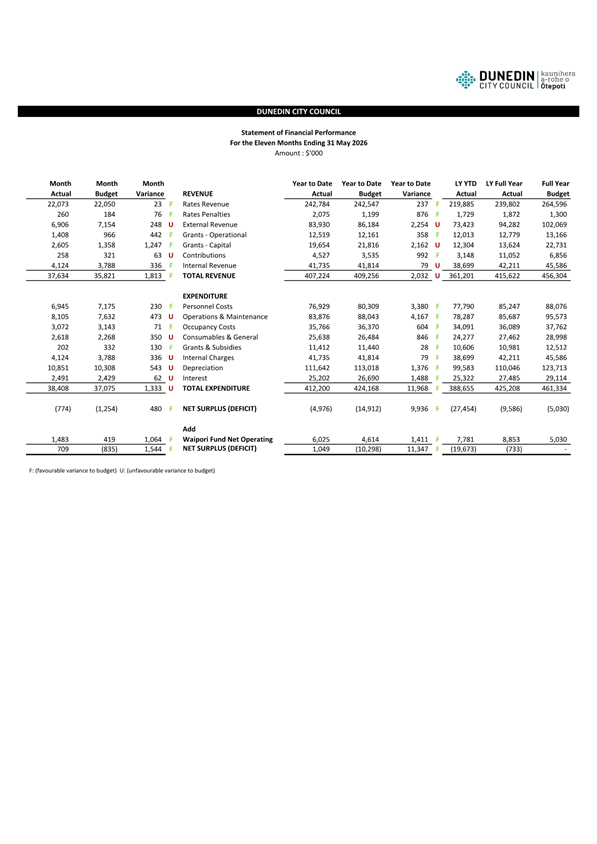
|

|
Council
22 July 2026
|
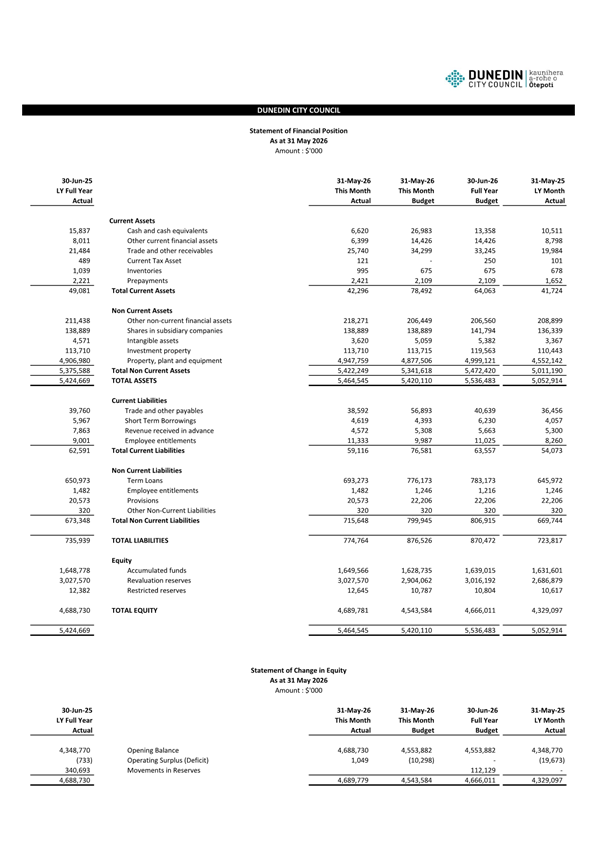
|
|
Council
22 July 2026
|
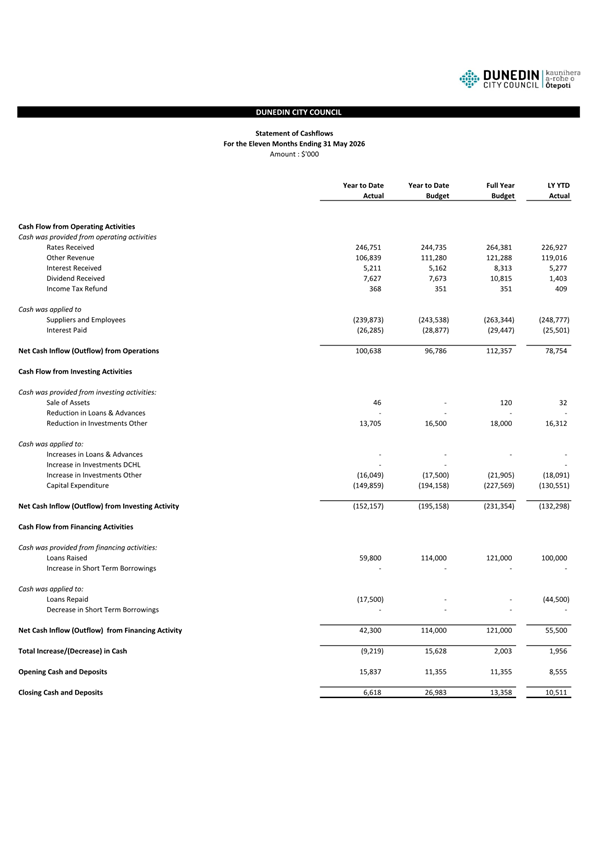
|
|
Council
22 July 2026
|
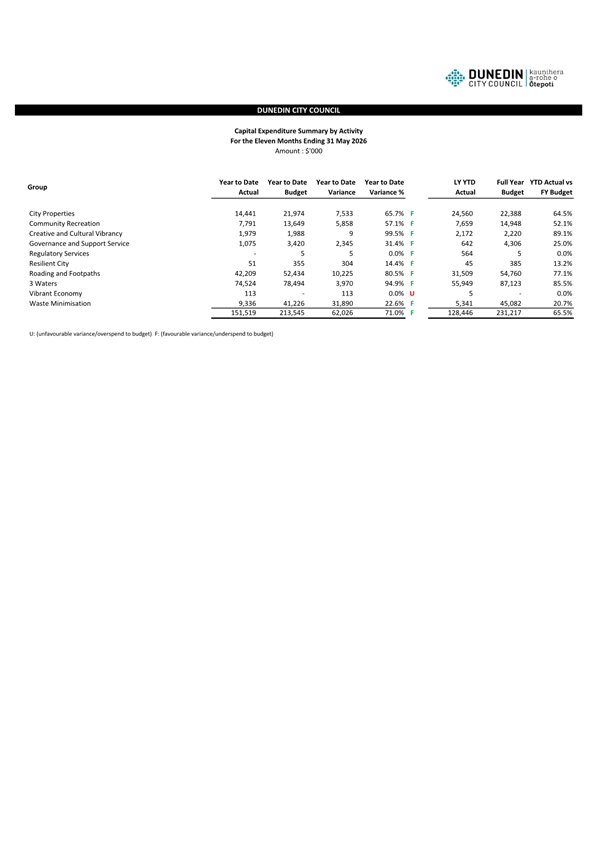
|

|
Council
22 July 2026
|
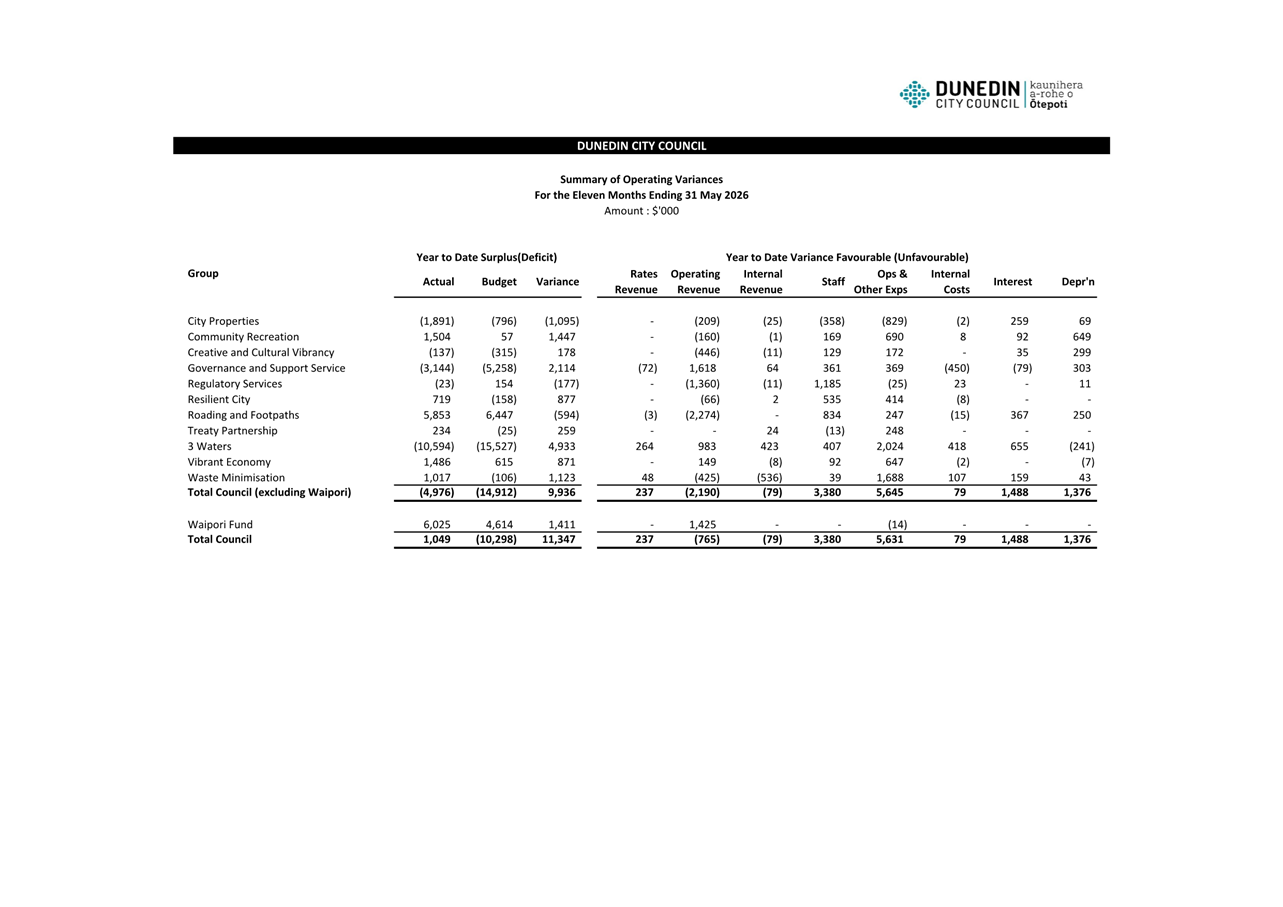
|

|
Council
22 July 2026
|
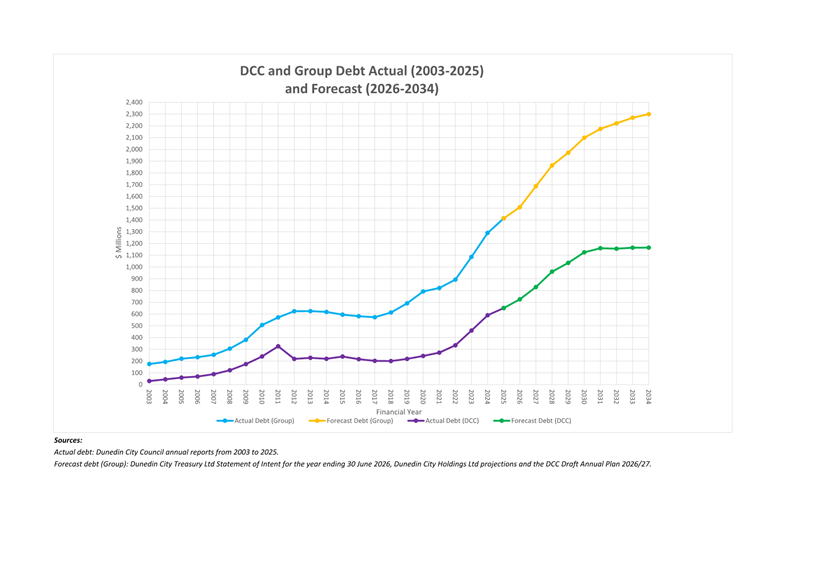
|

|
Council
22 July 2026
|
Governance and Councillor Appointments to Outside
Organisations Updates
Department: Civic
EXECUTIVE SUMMARY
1 The
purpose of this report is to advise the Council that the Mayor has exercised
her discretionary power under Section 41A(3) of the Local Government Act 2002
(LGA) to appoint newly elected Councillor Joanne Galer to the role of Portfolio
Co-Lead – Heritage.
2 In
addition, this report also recommends appointments to existing external
organisations and to two new organisations: the Creative Dunedin Advisory Group
and Creative New Zealand Grants Advisory Group.
3 This
report also notes amendments to Councillors portfolio responsibilities.
4 As
this is an administration report, there are no summary of considerations.
RECOMMENDATIONS
That the Council:
a) Notes Cr Joanne
Galer’s appointment as the Portfolio Co-Lead – Heritage.
b) Notes Cr Galer’s
annual remuneration remains as previously approved by Council and gazetted by
the Remuneration Authority being $100,577.
c) Notes Deputy Mayor Cherry
Lucas’s appointment as the Portfolio Deputy – Infrastructure.
d) Notes the
Infrastructure portfolio now includes Future Development Strategy as a
strategic area.
e) Notes Cr Marie
Laufiso’s appointment as the Council representative on the Saddle Hill
Community Board.
f) Approves Cr Joanne
Galer as the Council representative on the Dunedin Public Art Gallery Society,
the Hereweka Harbour Cone Trust and the Theomin Gallery Management Committee
(Olveston).
g) Approves the removal
of Cr Steve Walker from the Hereweka Harbour Cone Trust.
h) Approves Mayor Sophie
Barker as the Council representative on the Dunedin Chinese Garden Advisory
Board.
i) Approves Cr Brent
Weatherall as the Council representative on the Dunedin Public Art Gallery
Acquisitions Committee.
j) Approves Cr Mandy
Mayhem as the Council representative of Creative New Zealand Grants Advisory
Group.
BACKGROUND
5 At
its meeting on 11 December 2025, Council approved remuneration for Councillors
in accordance with the Remuneration Authority’s guidelines, and a
proposal was submitted to the Authority for approval. Approval was given
and gazetted in March 2026.
DISCUSSION
6 An
updated schedule with proposed appointed is appended as Attachment A.
7 For
reference an updated portfolio of appointments is appended as Attachment B.
OPTIONS
8 There
are no options.
NEXT STEPS
9 The
Councillors’ Register of Interest will be updated to reflect the new
appointments.
Signatories
|
Authoriser:
|
Nicola Morand - Manahautū (General Manager Community
and Strategy)
|
Attachments
|
|
Title
|
Page
|
|
⇩a
|
Portfolio's updated 22
July 2026
|
102
|
|
⇩b
|
Councillors appointed
to outside organisations 22 July 2026
|
103
|
|

|
Council
22 July 2026
|
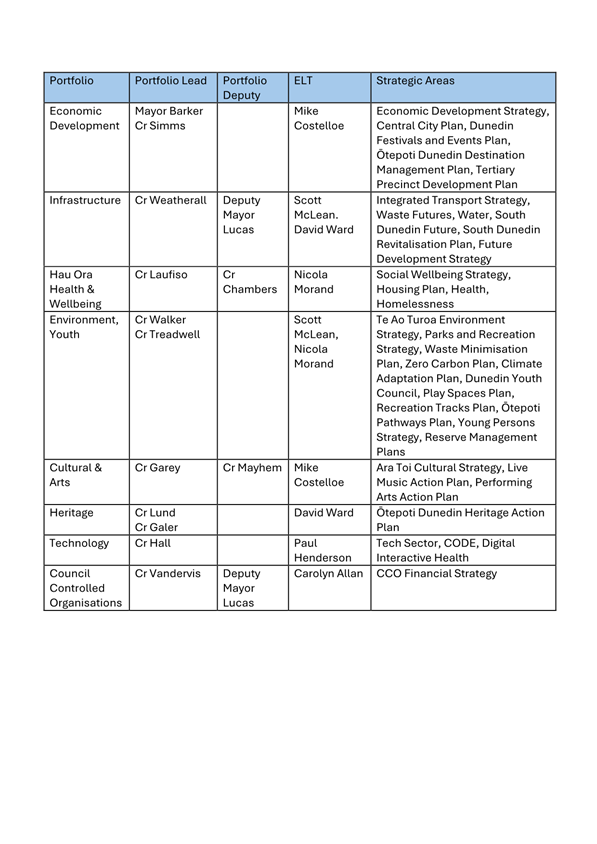
|

|
Council
22 July 2026
|
Notice of Motion - Opposing removal of Final-Year Fee Free
Policy
Department: Civic
EXECUTIVE SUMMARY
1 In
accordance with Standing Order 26.1, the following Notice of Motion has been
received from Cr Benedict Ong for
inclusion on the agenda for the meeting being held on Wednesday, 22 July
2026:
RECOMMENDATIONS
That the Council:
a) Receives the Notice of
Motion.
b) Opposes the removal of the final-year Fees-Free policy and requests
that the Government reconsider the decision, noting the importance of tertiary
education to student participation, the University of Otago, Otago Polytechnic
and our Dunedin’s economic and social wellbeing.
Attachments
|
|
Title
|
Page
|
|
⇩a
|
Notice of Motion
|
106
|
|
|
Council
22 July 2026
|
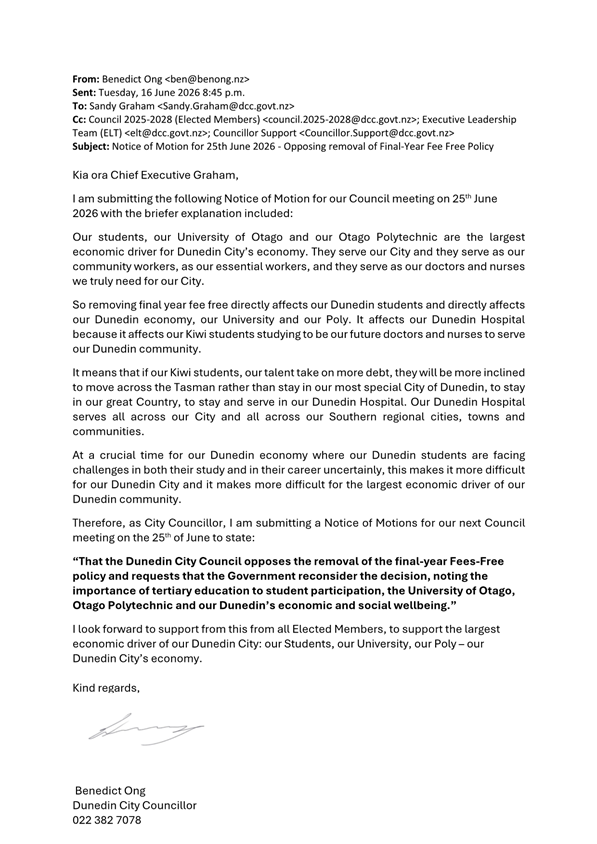
|

|
Council
22 July 2026
|
Hearings Committee Recommendation - Taieri Mouth Road Speed
Limit
Department: Civic
EXECUTIVE SUMMARY
1 This
report presents the recommendation of the Hearings Committee (the Committee)
following its consideration of submissions on the proposed speed limit
reduction for Taieri Mouth Road at the Committee meeting held on 28 May 2026.
The minutes are attached to this report at Attachment A – Minutes of
Hearings Committee meeting.
2 Public
consultation was undertaken from 2 March 2026 to 13 April 2026 on a proposal to
reduce the speed limit on Taieri Mouth Road, in accordance with the Land
Transport Rule: Setting of Speed Limits 2024 (the Rule). Three options were
presented:
· Option
1 – reduce the speed limit from 100 km/h to 80 km/h along the full length
of Taieri Mouth Road (13.9 km)
· Option
2 – reduce the speed limit from 100 km/h to 80 km/h on part of the road
of Taieri Mouth Road (6.3 km)
· Option
3 – do not reduce the 100 km/h speed limit on Taieri Mouth Road (status
quo)
3 A
total of 238 submissions were received. While most submitters (56%) supported
retaining the current speed limit, 44% supported some form of speed reduction,
with organisations and groups more likely to support Option 1 or 2.
4 After
considering all submissions, the Committee recommends that Council adopts Option
1 – reduce the speed limit from 100 km/h to 80 km/h along the full length
of Taieri Mouth Road (13.9 km), on the basis that it provides the most
appropriate response to safety risks and is a more appropriate speed limit for
the design and function of the road.
RECOMMENDATIONS
That the Council:
a) Notes that the
Hearings Committee has considered submissions on the proposed Taieri Mouth Road
speed limit reduction;
b) Adopts Option 1
– reduce the speed limit from 100 km/h to 80 km/h along the full length
of Taieri Mouth Road (13.9 km);
c) Notes that
implementation will be undertaken in accordance with the Land Transport Rule:
Setting of Speed Limits 2024, including updates to the National Speed Limit
Register and installation of signage; and
d) Notes that
complementary measures raised through consultation, including road maintenance,
vegetation management, signage improvements, and enforcement, will continue to
be considered as part of the corridor management on Taieri Mouth Road.
BACKGROUND
Taieri Mouth Road context
5 Taieri
Mouth Road is a rural connector route linking Brighton, Kuri Bush, Taieri
Beach, and Taieri Mouth, and forms part of the Southern Scenic Route.
6 The
road serves multiple transport functions, including commuter travel, freight
movement (including logging), tourism, recreation, and access for residents and
farming activities. It also accommodates cyclists, pedestrians, and wildlife.
7 The
current posted speed limit is 100 km/h, with average travel speeds between 88
km/h and 92 km/h.
8 Safety
concerns relating to road geometry, visibility, access, and vulnerable road users
have been raised through previous engagement and consultation processes,
including on the 2023 draft Speed Management Plan.
Consultation Overview
9 Consultation
was undertaken in accordance with the Rule, including a six-week public
consultation period.
10 A total of
238 submissions were received from individuals, community members, and
organisations including emergency services, iwi, a health organisation, a
wildlife organisation, and the Saddle Hill Community Board.
11 Submitters
were asked to provide feedback on three options: Option 1 - a full speed
reduction (13.9 km), a partial speed reduction (6.3 km), or Option 3 - no
change (status quo).
DISCUSSION
12 Of the 238
submissions received:
· 78
(33%) supported Option 1 (full reduction)
· 27
(11%) supported Option 2 (partial reduction)
· 133
(56%) supported Option 3 (status quo)
13 While the
majority of individual submitters supported retaining the existing speed limit,
organisations and groups were more likely to support a reduction, particularly
Option 1 (full reduction).
14 Submitter
preferences also varied geographically, with Taieri Mouth and Taieri Beach
residents more likely to support retaining the current speed limit and
submitters from the wider Dunedin area more likely to support a reduction.
Key Themes Raised
15 Submitters
opposing a speed limit reduction generally considered the road to be safe at
its current speed and raised concerns about increased travel times and
potential unsafe overtaking.
16 Submitters
who supported a full speed limit reduction highlighted a range of safety
concerns, including road design and visibility, risks to vulnerable users,
mixed road use, wildlife hazards, and population growth at Taieri Mouth
contributing to these issues.
17 Submitters
supporting a partial speed limit reduction generally viewed this as a
compromise, addressing higher-risk sections while maintaining travel
efficiency.
18 Additional
themes included concerns about emergency response times, logging truck
activity, and the need for complementary safety measures such as maintenance
and signage.
Committee Considerations/Findings
19 At its
meeting on 28 May 2026, the Committee heard from seven speakers. One additional
submitter, who was unable to attend, provided a written submission instead. Of
the speakers, three appeared in an individual capacity, while four represented
organisations or groups: the Kuri Bush community, the Saddle Hill Community
Board, Health New Zealand, and Te Rūnaka o Ōtākou.
20 Attachment
B contains the summary of submissions presented to the Committee.
21 The
Committee carefully considered all submissions, including the balance between
community preference and safety risks to all road users.
22 The
Committee acknowledged that while a majority of submitters supported retaining the
existing speed limit, a significant proportion (44%) supported some form of
speed limit reduction, indicating a clear level of concern regarding road
safety.
23 The
Committee also gave weight to submissions from organisations and stakeholders
with expertise in safety, health, and emergency response, which were more
likely to support a speed limit reduction.
24 The
Committee considered the function and characteristics of Taieri Mouth Road as a
mixed-use rural connector road with:
· Varying road
geometry and constrained sightlines
· High
recreational and tourist use
· Presence of
vulnerable users
· Logging truck
activity
25 The
Committee noted that higher-speed environments are associated with increased
crash severity and that a reduction in speed provides the most effective means
of reducing the likelihood of fatal and serious injury outcomes.
26 The
Committee considered Option 2 (partial reduction) but determined that a partial
reduction would not address safety risks along the full corridor and could
introduce inconsistency and driver confusion.
27 The
Committee therefore considers that Option 1 (full reduction) provides the most
appropriate and consistent approach to managing speed along the entire route.
OPTIONS
Option One – Full Speed Limit Reduction –
Recommended Option
28 Reduce the
speed limit from 100 km/h to 80 km/h along the full length of Taieri Mouth Road
from the Clutha District Council boundary to just north of the intersection
with Big Stone Road, a 13.9 km stretch of road.
Advantages
· Addresses safety concerns across
the full corridor
· Improves safety outcomes for all
road users, including vulnerable users
· Aligns with submissions from
organisations and groups
· Reduces crash risk and severity
Disadvantages
· Does not align with the preference
of the majority of submitters
· May increase travel times (by approximately
54 seconds from the Clutha District boundary to just north of the Big Stone
Road intersection)
Option Two – Partial Speed Limit Reduction
29 Reduce the
speed limit from 100 km/h to 80 km/h on part of Taieri Mouth Road from the
Clutha District Council boundary to MacLeods Lagoon, a stretch of 6.3 km of
road.
Advantages
· Targets the more residential area
along Taieri Mouth Road
· Balances safety and travel time
Disadvantages
· Does not address safety across the
full route
· May reduce consistency for drivers
· Limited submitter support
· May increase travel times (by approximately
25 seconds from the Clutha District boundary to MacLeod’s Lagoon)
Option Three – Status
quo
30 Retain the
existing speed limit of 100 km/h on the entire length of Taieri Mouth Road,
from the Clutha District Council boundary to the north of Big Stone Road.
Advantages
· Aligns with the majority of
submissions
· Maintains current travel times
· No implementation cost
Disadvantages
· Does not address safety across the
full route
· Retains higher crash risk
environment
NEXT STEPS
31 If Council
adopts the Committee’s recommendation, staff will implement the speed
limit change in accordance with the Land Transport Rule: Setting of Speed
Limits 2024.
32 Implementation
will include updating the National Speed Limit Register, installing signage,
and notifying stakeholders and the community.
33 Post-implementation
monitoring may be undertaken to assess the effectiveness of the change.
Signatories
|
Authoriser:
|
Mandy Mayhem - Chairperson, Hearings Committee
|
Attachments
|
|
Title
|
Page
|
|
⇩a
|
Hearing Minutes
|
114
|
|
⇩b
|
Summary of Submissions
|
118
|
|
SUMMARY OF CONSIDERATIONS
|
|
Fit with purpose of Local Government
This decision enables democratic local
decision making and action by, and on behalf of communities.
This decision promotes the social
well-being of communities in the present and for the future.
This decision promotes the environmental
well-being of communities in the present and for the future.
|
|
Fit with strategic framework
|
|
Contributes
|
Detracts
|
Not applicable
|
|
Social Wellbeing Strategy
|
✔
|
☐
|
☐
|
|
Economic Development Strategy
|
✔
|
☐
|
☐
|
|
Environment Strategy
|
✔
|
☐
|
☐
|
|
Arts and Culture Strategy
|
☐
|
☐
|
✔
|
|
3 Waters Strategy
|
☐
|
☐
|
✔
|
|
Future Development Strategy
|
☐
|
☐
|
✔
|
|
Integrated Transport Strategy
|
✔
|
☐
|
☐
|
|
Parks and Recreation Strategy
|
✔
|
☐
|
☐
|
|
Other strategic projects/policies/plans
|
☐
|
☐
|
✔
|
The proposed speed limit reduction supports the
Council’s strategic framework by improving safety outcomes, maintaining
efficient transport connections, and protecting the natural environment, with
no direct impact on other strategies.
|
|
Māori Impact Statement
Engagement with Te Rūnaka o Ōtākou has been
undertaken, and the proposed speed limit reduction supports improved safety
outcomes for all road users, including Māori who are disproportionately
represented in road trauma statistics.
|
|
Sustainability
The proposed speed limit reduction supports sustainability
by improving safety for all road users, including cyclists and pedestrians,
and contributing to a safer and more inclusive transport system.
|
|
LTP/Annual Plan / Financial Strategy /Infrastructure
Strategy
There is no impact on the Long-Term Plan, Annual Plan, or
Infrastructure Strategy, as implementation will be delivered within existing
budgets.
|
|
Financial considerations
The estimated cost of implementation is approximately $18,600
(Option 1) or $9,800 (Option 2) and will be funded through the existing
Transport budget.
|
|
Significance
The decision is of low significance, as it relates to a
localised speed limit change with minimal financial impact and was subject to
public consultation in accordance with the Rule.
|
|
Engagement – external
External engagement was undertaken through a six-week
public consultation process, supported by targeted stakeholder engagement
including iwi, emergency services, and key road users.
|
|
Engagement - internal
Internal engagement included communication through the
Council intranet, inviting staff who were not directly involved in the
project to provide feedback.
|
|
Risks: Legal / Health and Safety etc.
The proposed speed limit change is intended to reduce the
severity of crashes and improve overall road safety outcomes along Taieri
Mouth Road.
|
|
Conflict of Interest
There are no known conflicts of interest.
|
|
Community Boards
Taieri Mouth Road is in the Saddle Hill Community Board
area. The Saddle Hill Community Board provided a submission in support of a
partial speed limit reduction and participated in the consultation process.
|
|

|
Council
22 July 2026
|
Hearings Committee Recommendations on the Proposed Traffic
and Parking Bylaw 2026
Department: Transport
EXECUTIVE SUMMARY
1 This
report presents the findings of the Hearings Committee (the Committee) on the submissions
to the proposed Traffic and Parking Bylaw 2026 (the proposed Bylaw).
2 After
considering submissions received in their meeting of 1 July 2026 (Attachment
A), the Committee recommends some amendments to the proposed Bylaw as
notified. The Committee recommends that Council adopt the proposed Bylaw (Attachment
B) with a date of effect of 1 August 2026.
3 A
marked-up version of the proposed Bylaw showing the Committee’s
recommended amendments to the proposed Bylaw as notified is included as (Attachment
C).
4 Under
clause 2.2 in Attachment B, an additional explanatory note has been proposed by
officers to meet new requirements of the Regulatory Standards Act 2025 (the RSA
2025) that came into effect on 1 July 2026, and which now apply to proposed or
existing secondary legislation. The Dunedin City Council Chief Executive
confirms that the proposed Bylaw is predominantly consistent with the
principles of responsible regulation in the RSA 2025 with one partial
inconsistency identified, as set out in the Consistency Accountability
Statement, Statement of Reasons, and Summary of Underpinning Analysis (Attachment
D).
RECOMMENDATIONS
That the Council:
a) Notes the Hearings
Committee has considered 31 submissions on the proposed Traffic and Parking
Bylaw 2026,
b) Notes the minutes of
the Hearings Committee and the Committee’s recommended amendments to the
consultation version of the proposed Bylaw (Attachment B),
c) Confirms that the
proposed Bylaw, including the recommended amendments, is the most appropriate
way of regulating traffic and parking; is the most appropriate form of Bylaw;
and does not give rise to any implications under the New Zealand Bill of Rights
Act 1990,
d) Adopts the Traffic and
Parking Bylaw 2026 (Attachment B),
e) Approves a date of
effect of the Traffic and Parking Bylaw 2026 of 1 August 2026,
f) Revokes the Traffic
and Parking Bylaw 2010 from 1 August 2026.
BACKGROUND
Purpose of the Traffic and Parking Bylaw 2026
5 The
Dunedin City Council is a Road Controlling Authority (RCA) under the Land
Transport Act 1998 (LTA). As an RCA, the Council exercises control over local
roads within the territorial authority (including regulatory powers to manage
traffic and parking), and over state highways for which the Council has
received delegated responsibility from the New Zealand Transport Agency (NZTA)
Waka Kotahi.
6 Section
22AB of the LTA provides that an RCA may make bylaws for purposes including
prohibiting or restricting parking, prescribing the use of parking places and
transport stations (areas used by transport services,
e.g. bus hubs or layovers), and regulating other road-related matters. The
LTA also enables the Minister of Transport to amend, replace, or disallow any
bylaw in certain cases (e.g. if a bylaw conflicts with land transport
legislation).
7 The
Council’s Traffic and Parking Bylaw came into effect on 1 March 2010, and
sets out the requirements for parking and control of vehicle or other traffic
on any road under Council authority, including state highways where control has
been delegated to the Council.
8 The Bylaw enables the Council to regulate,
control or prohibit any matter for all classes of vehicles or traffic using a
road, greenspace adjoining the road, building, or transport station under the
control of the Council, for any specified period of time. The Bylaw then
enables the Council to make any subsequent changes to these matters. Overall,
the Bylaw ensures that mechanisms are in place to support and improve the
safety, accessibility and efficiency of the transport network for all road
users.
9 The current traffic and parking restrictions
adopted by the Council are made publicly available in a Geographic Information
Systems (GIS) bylaw database on the Council website: Parking
regulations - Dunedin City Council. The Council regularly consults with the
public on proposed parking changes in the city, progresses proposed changes to
a Hearings Committee and Council for approval, and subsequently updates the
bylaw database with any changes.
Proposed
Traffic and Parking Bylaw 2026
10 Since
the Bylaw came into effect in 2010, changes to the technological, legislative
and social context mean that the Bylaw needs to be updated to be fit for
purpose for today and the future. An up-to-date Bylaw will also support the
delivery of a Dunedin City Parking Strategy which will be in development
starting in the second half of 2026.
11 Proposed
changes to the Bylaw are minor, and do not affect how current traffic and
parking restrictions are operating on the ground. Proposed changes to the Bylaw
broadly fit into three categories:
· Inserting new
clauses to improve flow and provide clearer guidance (e.g. a new section 2 on
resolutions and permits to clarify how resolutions are made, and requirements
for certain types of permits);
· Updating clauses
to be more specific, provide exemptions and to add a new parking defence (i.e.
under clause 30, adding “to avoid the death or injury of any
person” to the list of parking defences); and
· Minor changes to
update terminology and improve clarity (e.g. adding more definitions to clause
4 to clarify how terms are defined, adding explanatory notes throughout the
Bylaw to provide additional clarity on how parts of the Bylaw work in practice,
and removing out-of-date references like “pay and display”).
12 The
detailed list of changes is set out in the statement
of proposal included in the materials for public consultation.
Consultation
on the proposed Traffic and Parking Bylaw
13 At its 25
March 2026 meeting, the Council approved a Statement of Proposal and draft
proposed Traffic and Parking Bylaw 2026 for public consultation purposes: Minutes
of Council - Wednesday, 25 March 2026. The Council also resolved that the
proposed Bylaw meets the requirements of section 155 of the Local Government
Act 2002, and does not give rise to any implications under the New Zealand Bill
of Rights Act 1990.
14 Public
consultation followed for one month, beginning on 27 April and ending on 27 May
2026.
15 Methods
used to inform the public about the proposal and the opportunity to make
submissions included information on the Council website, two social media posts
on the Council Facebook page, information on the Dunedin City Council Public
Noticeboard published in the Otago Daily Times on two occasions, and two
rounds of targeted emails to a range of partners and stakeholders including the
New Zealand Transport Agency Waka Kotahi, the Automobile Association, all
Community Board chairs, freight companies, Transporting NZ, the University of
Otago, Hato Hone St John’s, New Zealand Police, Fire and Emergency New
Zealand, Emergency Management Otago, Kāti Huirapa Rūnaka ki
Puketeraki, Te Rūnanga o Ōtākou, Āraiteuru marae, Access
for All, Disabled Persons Assembly, CCS Disability Action, and the Dunedin
Tracks and Trails Trust.
16 The Otago
Daily Times and The Star also published a story on the review of the
Traffic and Parking Bylaw on 30 April 2026, with a link to public consultation
information.
17 The public
could submit on the proposed Bylaw via an online form on the Council’s
website, via email, or via a print form. Submitters were asked whether they
agreed with the proposed Traffic and Parking Bylaw overall; why or why not; and
to provide any general comments with references to the specific clause in the
Bylaw, the change they would recommend, and why the recommended change is important.
The consultation documents included the statement of proposal with the detailed
list of proposed changes, a full text draft of the proposed Traffic and Parking
Bylaw 2026, and the current Traffic and Parking Bylaw 2010.
18 Throughout
this consultation period, 31 submissions were received in total, comprising:
· 28
submissions from individuals, and
· Organisation
submissions from the New Zealand Defence Force, the Otago Regional Council, and
CCS Disability Action.
19 The full
original submissions can be viewed at: Proposed
Traffic and Parking Bylaw 2026 - Dunedin City Council.
20 Two of the
submissions agreed with the proposed Bylaw without any changes; three agreed
with the proposed Bylaw and recommended changes; 25 did not agree with the
proposed Bylaw; and one submission was neutral and also recommended changes.
21 Two
submitters were heard by the Hearings Committee.
New requirements under the Regulatory Standards Act
2025
22 To meet
statutory requirements of the Regulatory Standards Act 2025 (RSA 2025) that
came into effect on 1 July 2026 for existing secondary legislation, local
government chief executives must evaluate secondary legislation for consistency
with the principles of responsible regulation as set out in section 9, and
modified by section 19, of the RSA 2025.
23 The Dunedin
City Council Chief Executive’s confirmation that the proposed Bylaw is
predominantly consistent with the principles of responsible regulation is set
out in the Dunedin City Council’s Consistency Accountability Statement
and Statement of Reasons, with one partial inconsistency identified in that
traffic and parking controls limit freedom of movement. The Summary of
Underpinning Analysis sets out the analysis of consistency against each of the
RSA 2025 principles, noting that some of these principles do not apply (see
Attachment C).
24 A new
explanatory note has been proposed under clause 2.2 of the proposed Bylaw to
confirm that the Bylaw is consistent with the principles of the RSA 2025 and to
provide links to the Consistency Accountability Statement, Statement of
Reasons, and Summary of Underpinning Analysis, as required by the Ministry of
Regulation.
DISCUSSION
25 In its
meeting of 1 July, the Committee considered the points raised by submitters and
staff recommendations to address the points raised, which were presented in
full in Attachment A to the agenda: Agenda
of Consultation Hearings - Wednesday, 1 July 2026.
26 Key issues
raised in submissions included:
a) Clause
5 (Resolutions made under this Bylaw) and clause 24 (Shared paths and cycle
paths) of the proposed Bylaw (20 submissions received) – in particular,
concerns that the revisions proposed in these two clauses would allow the
Council to implement network changes such as road closures or cycle lanes
without requiring public consultation, and
b) Clause 14
(Other reserved parking) of the proposed Bylaw – in particular,
recommending that the Council add “wheelchair accessible van” to
the list of vehicle classes for the purpose of designating longer mobility
parks as wheelchair accessible van (WAV)-only parks (4 submissions).
27 A number of
submissions raised topics that are outside of the scope of the Traffic and
Parking Bylaw 2026, but which may benefit from further consideration in the
context of developing the upcoming Dunedin City Council Parking Strategy. Staff
will ensure that submitters on the Bylaw are notified when opportunities for
engagement on the Parking Strategy arise.
28 On
reviewing the feedback received and staff analysis that was reviewed by
external legal counsel with expertise in traffic and parking bylaws, the
Committee recommends making the following changes to the draft Bylaw as
redlined in Attachment B:
a) To
resolve the concerns raised about whether clause 5 and clause 24 remove
requirements for public consultation, add an explanatory note after clause
5.1(d) to clarify that there are no changes to public consultation
requirements, as these are set elsewhere in legislation and must be adhered to
prior to a Council resolution being made:
Explanatory Note: Before the
Council makes a resolution under this Bylaw it will comply with the
decision-making requirements of the Local Government Act 1974 and 2002, as
applicable to the decision.
Under the proposed Bylaw,
traffic and parking changes that require public consultation as per the
requirements of the Local Government Act, will continue to progress through
public consultation and the standard Traffic and Parking Hearings Committee
process before being recommended to Council for resolution.
b) Add
“wheelchair accessible vans” as a class of vehicle for which the
Council could resolve to create a reserved parking area under clause 14.2(i),
noting that this does not change current traffic and parking restrictions and a
change to enable WAV-only mobility parks would need to progress through the
standard Traffic and Parking Hearings Committee and Council resolution process.
c) Add
in explanatory notes under clauses 19 (One-way roads), 20 (Left or right turns
and U-turns), and 22 (Control of vehicles on roads due to size, nature or
goods) to specify that the relevant restrictions already resolved by the
Council are made available on the Council website in schedules 1, 2 and 3
respectively.
29 Officers
will contact all submitters to respond to their feedback and notify them of the
changes to the proposed Bylaw.
OPTIONS
Option One – Accept the recommendations of the
Committee and the proposed explanatory note under clause 2.2 (Recommended
Option)
Advantages
· Incorporates
the feedback raised by submitters to the Hearings Committee meeting of 1 July
2026.
· Aligns
with the advice provided by external legal counsel with expertise in traffic
and parking bylaws.
· Provides
an updated Bylaw that reflects both current legislative and regulatory
provisions and current and emerging technology.
· Meets
the statutory requirements of the Regulatory Standards Act 2025 for secondary
legislation adopted after 1 July 2026.
Disadvantages
· No
disadvantages are identified.
Option Two – Refer the proposed Bylaw back to the
Committee for further consideration
30 Should the
Council consider there are outstanding matters of concern that are not
satisfactorily addressed by advice provided in this report, the Council may
request that the Hearings Committee further evaluate those concerns and develop
additional recommended responses.
Advantages
· Provides
additional time for concerns of the Council to be addressed.
Disadvantages
· Delays
the process for adopting the new Traffic and Parking Bylaw 2026.
NEXT STEPS
31 If the
Council approves the Committee recommendations per Option One, the Traffic and
Parking Bylaw 2026 will come into effect on 1 August 2026 and staff will
implement it from that day forward.
32 The
Consistency Accountability Statement and Summary of Underpinning Analysis will
be published on the Council website (once final information has been added to
the yellow-highlighted sections in the Summary of Underpinning Analysis), and
the relevant webpage links will be added to the explanatory note under clause
2.2 of the final Bylaw.
33 Per the
requirements of section 22AB(4) of the Land Transport Act 1998, a copy of the
final Bylaw will be sent by the Council to the Minister of Transport, the
Honourable Christopher Bishop.
Signatories
|
Authoriser:
|
Cr Cherry Lucas - Chairperson
|
Attachments
|
|
Title
|
Page
|
|
⇩a
|
Hearings Committee -
Traffic and Parking Bylaw Minutes for 1 July 2026
|
134
|
|
⇩b
|
Dunedin City Council
Traffic and Parking Bylaw 2026
|
137
|
|
⇩c
|
Recommended changes to
the Proposed Dunedin City Council Traffic and Parking Bylaw 2026
|
157
|
|
⇩d
|
Consistency
Accountability Statement, Statement of Reasons and Underpinning Analysis
|
177
|
|
SUMMARY OF CONSIDERATIONS
|
|
Fit with purpose of Local Government
This decision enables democratic local
decision making and action by, and on behalf of communities.
This decision promotes the social
well-being of communities in the present and for the future.
This decision promotes the economic
well-being of communities in the present and for the future.
|
|
Fit with strategic framework
|
|
Contributes
|
Detracts
|
Not applicable
|
|
Social Wellbeing Strategy
|
✔
|
☐
|
☐
|
|
Economic Development Strategy
|
✔
|
☐
|
☐
|
|
Environment Strategy
|
☐
|
☐
|
✔
|
|
Arts and Culture Strategy
|
☐
|
☐
|
✔
|
|
3 Waters Strategy
|
☐
|
☐
|
✔
|
|
Future Development Strategy
|
✔
|
☐
|
☐
|
|
Integrated Transport Strategy
|
✔
|
☐
|
☐
|
|
Parks and Recreation Strategy
|
✔
|
☐
|
☐
|
|
Other strategic projects/policies/plans
|
✔
|
☐
|
☐
|
Traffic and parking restrictions support
a safe, efficient and accessible transport network, support
the social and economic wellbeing of Dunedin communities, and support the efficient
integration of transport and land use.
The review of the Bylaw also supports the efficient
management of parking supply which the Dunedin City Parking Strategy
(currently in development) will target.
|
|
Māori Impact Statement
Mana whenua have expressed support for a safe and
efficient transport network through previous consultations. Kāti Huirapa
ki Puketeraki and Ōtākou rūnaka, as well as Āraiteuru
marae, were invited to submit on the proposed Bylaw.
The Bylaw, and the consultation process, align with three
key directions of Te Taki Haruru, the Council’s Māori Strategic
Framework. Alignments are across three of the strategy’s pou –
Autūroa, Autikaka, and Autakata – in line with the cultural key
direction for Autūroa and Autikaka, and the social key direction for
Autakata.
|
|
Sustainability
Parking
control changes can improve
efficiency and access
to the transport network for all vehicle types, including more carbon efficient
vehicles like cycles, micro-mobility devices, electric vehicles, and car
share vehicles.
|
|
LTP/Annual Plan / Financial Strategy /Infrastructure
Strategy
The implementation of traffic and parking controls in
Dunedin supports levels of service set out in the 9 Year Plan, e.g.
“The DCC provides the transport network that facilitates safe
travel.”
|
|
Financial considerations
There are no implications as management of the Bylaw is
carried out within existing budgets.
|
|
Significance
The review of the Traffic and Parking Bylaw 2026 followed
the special consultative procedure as required under the section 22AB of the
Land Transport Act 1998.
|
|
Engagement – external
An external legal review has been completed of the
proposed recommended changes to the Traffic and Parking Bylaw 2026.
The report sets out the organisations contacted with
notification of public consultation being open.
|
|
Engagement - internal
There has been internal engagement with Transport,
Compliance Solutions, Parks and Recreation, Corporate Policy, Governance,
Mana Ruruku, and Communications and Marketing.
|
|
Risks: Legal / Health and Safety etc.
There are no identified risks. The draft Bylaw has been
reviewed by external legal counsel.
The Consistency Accountability Statement and Summary of
Underpinning Analysis have been reviewed by Senior In-House Legal Counsel.
|
|
Conflict of Interest
Councillor Lund provided a written submission on the
proposed Bylaw during public consultation and will sit back from the
discussion at Council.
|
|
Community Boards
All Community Board chairs were invited to submit on the
proposed Traffic and Parking Bylaw.
|
|

|
Council
22 July 2026
|
Hearings Committee Recommendations on Proposed Parking
Changes - June 2026
Department: Civic
EXECUTIVE SUMMARY
1 This
report presents recommendations of the Hearings Committee meetings (Attachment A - Minutes of Hearings Committee meeting)
held on 12 June 2026 on proposed changes and corrections to parking
restrictions.
2 The
Hearings Committee (the Committee) recommends that the proposed parking
restrictions presented in this report be approved.
3 If
approved by Council, the changes recommended by the Hearings Committee will be
included in the Council’s GIS bylaw database and become part of the
Dunedin City Traffic and Parking Bylaw.
4 The
proposed changes in parking and traffic restrictions are presented in two
sections:
a) minor
general parking changes – this section includes parking changes arising
from requests from the public and businesses to change parking restrictions and
other general changes, safety and infrastructure changes,
b) corrections to parking restrictions to ensure that the GIS database
matches the parking controls on the ground and clarifications of
markings on the road to reflect restrictions in the Land Transport (Road User)
Rule 2004, where safety concerns or repeated issues highlight a need for
clarifications to be made.
5 Where
required, consultation has been undertaken separately for the minor general
parking changes. Seventy-four submissions were received from the public on
proposed changes. These are presented in full in Attachment B.
6 Overall,
proposed parking changes in this report would install 19 restricted car parks,
five unrestricted car parks, and change the restrictions on 36 car parks.
RECOMMENDATIONS
That the Council:
a) Adopts the proposed
changes to traffic and parking restrictions shown in the June 2026 update of
the Dunedin City Council's traffic and parking restrictions database: June
2026 Proposed Parking Changes,
b) Notes that Council
staff will undertake follow-up actions for some of the proposed parking changes
(with actions described in paragraphs 35, 37, and 40),
c) Notes that the
Hearings Committee has considered feedback from consultation on the proposed
changes relating to changes and restrictions,
d) Notes that all parking
restrictions previously approved by the Council remain unchanged.
BACKGROUND
Traffic and parking controls
7 Traffic
and parking controls contribute to the objectives of the Dunedin Integrated
Transport Strategy 2013 and the
Dunedin City Council 9 Year Plan 2025-2034 by supporting a safe, efficient, and
accessible transport network.
8 The
Council maintains a Geographic Information System (GIS) map bylaw database of
traffic and parking restrictions (the database) that reflects all on-street
parking restrictions that are implemented with markings and/or
signs.
9 Parking
controls are made under the Dunedin City Council Traffic and Parking Bylaw. The
Committee has the delegation to consider changes
to parking controls
and to make recommendations to
Council, which subsequently approves traffic
restrictions and parking
controls.
Context for proposed changes
10 The
Council often receives requests from individuals and businesses to change
parking restrictions. When considering these requests, officers assess a range
of factors including safety concerns, commuters’ needs, commercial
users’ needs, road width and topography, traffic flow, neighbouring
on-street parking spaces, visibility concerns and crash statistics. Where a
proposed change is supported by officers, consultation is undertaken with
affected residents, businesses, and property owners to assess their level of
support for the requested change.
11 The
proposed changes in parking and traffic restrictions are presented in two
sections:
a) minor
general parking changes that include requests from residents, property owners,
or business owners; changes made to enhance safety or amenity; and recommendations
from officers. These changes include:
i. changes
to time restrictions to encourage more parking turnover, supporting better
access to local businesses and recreation areas for communities,
ii. improvements
to enable more efficient public transport services, and
iii. introduction
of various no stopping areas following safety assessments
b) corrections
to the bylaw database to ensure that it matches existing markings, parking
restrictions, and signage, and clarifications of markings on the road to
reflect restrictions in the Land Transport (Road User) Rule 2004.
12 Consultation
on proposed minor general parking changes occurred on a rolling basis from March-May
2026. The 74 submissions received related to 11 of the proposed parking changes
(including two proposed changes that have been withdrawn on the recommendation
of the Committee) and represent 48 individuals, 17 businesses, and the West
Harbour Community Board.
DISCUSSION
13 The
proposed general parking changes are shown in June
2026 Proposed Parking Changes and are set out in Attachment B –
Minor General Parking Changes. The GIS layer
includes a bookmark feature that links the proposed changes and the reference
numbers shown in the Attachment B tables showing their specific location.
14 Submissions
received during consultation undertaken with affected parties, including
owners, residents and businesses, are presented in full in Attachment C
– Feedback Received. In addition to the parking changes submission
form being made available online, officers mailed and delivered consultation
letters to affected residents and property owners where necessary.
15 Officers
followed up on actions from the previous Hearings Committee meeting on 20 March
as follows (Minutes
of Hearings Committee - Friday, 20 March 2026):
a) For 1
Fern Road Maia, Transport staff have reached out to Dunedin Rudolf Steiner
School to request that they remind parents and staff about appropriate parking
when picking up and dropping off students.
b) Parking
enforcement officers have added in a short-term patrol around the school during
pick-up and drop-off hours to increase the enforcement of appropriate parking
during these times (noting however that continuous patrols are not possible
based on limited staffing numbers).
c) In
terms of wider parking changes in the area, Transport staff will continue to
follow up with the school and request a time to discuss where other
opportunities for regulatory improvement may arise, including a site visit to
the school to review potential locations for a pick up and drop off area.
Transport staff have followed up with the speaker at the March Committee with
this update.
d) For
165 Eglinton Road, Transport officers have reviewed the area and consider that
the current number of short-term parks in front of the Night ‘n Day is
sufficient and on par with short-term parking amenity near similar businesses.
Other businesses near 165 Eglinton Road provide services that require
longer-stay parking to be available, e.g. for veterinarian hair appointments
and grocery shopping. As a result, Transport staff do not recommend converting
any more sixty-minute parks to short-term parks. Transport staff have followed
up with the speaker at the March Committee with this update and a request that
evidence be provided if the short-term parking amenity proves to be
insufficient.
e) For
Macandrew Road (Careys Bay), Transport officers have brought a renewed proposal
to this Hearings Committee for consideration, after an additional period of
consultation and additional safety assessments.
Minor General Parking
Changes – Traffic or Parking Change (TPC-55) (Attachment B)
Changes to support public transport efficiency
16 Effective
30 June 2025, Otago Regional Council (ORC) implemented changes for some Dunedin
bus routes and timetables. These changes provide better connections for
passengers from southeastern areas of the city into South Dunedin, along with
timetable changes to other routes to improve reliability, and are summarised in
full on the ORC website: Changes
to Dunedin bus routes after 30 June 2025.
17 To ensure
that parking restrictions formally reflect where these public transport changes
have made bus stops redundant or require new stops, proposed changes would replace
10 redundant bus stops with 21 car parks (with a mix of restrictions reflecting
customer and business needs in the surrounding area) and no stopping lines (see
the diagrams under PC #7 in Attachment B). The temporary bus stop near 203 King
Edward Street would become permanent, formally replacing five five-minute (P5)
car parks. Two submissions were received in support of the proposed bus stop
changes.
18 The
Hearings Committee reviewed the proposal to convert the redundant bus stop near
482 Andersons Bay Road to two sixty-minute (P60) car parks and recommended
changing the restriction to two thirty-minute (P30) car parks to provide
greater variety of time restrictions in the area. The proposal in Attachment B
and in the mapping link has been updated with the Committee’s
recommendation.
19 Other
proposed parking changes that contribute to improved public transport
efficiency and safety are:
a) Installing
a new bus stop and shelter in the road reserve near 6 Coast Road to serve route
1 bus services, which will stop in Warrington from October 2026 (PC#9 in
Attachment B). Currently, there is no northbound bus stop in Warrington for
passengers travelling from Dunedin or Waitati, and installing one on the
northbound side of the state highway presents feasibility and safety issues. No
feedback was received from the adjacent residents and property owners.
b) Converting
a redundant bus stop near 574 Andersons Bay Road to two unrestricted car parks
and three metres of no stopping lines (to provide adequate visibility near a
crossing point) (PC#5 in Attachment B).
20 The Otago
Regional Council and Dunedin City Council ran a consultation on a proposal to
extend the bus stop at 237A Main South Road (Green Island) to a double capacity
stop with associated improvements. Twenty-two submissions were received, with
nineteen submissions opposed from both businesses and individuals who cited
concerns about safety and property access. The feedback highlighted the
popularity of the nearby stop near the Runciman Street path. On reviewing
feedback, the ORC and DCC agreed that more investigation was needed to
understand wider public transport needs in the area, and to be able to address
community concerns. The proposal has been withdrawn from this Hearings
Committee and will undergo further scoping and analysis before progressing
further.
Changes to better serve local businesses and
communities
21 Most
proposed parking changes in this report involve changing the time restrictions
on parks to better serve businesses and communities. Reducing the time
restriction on a park supports more parking turnover, meaning more people can
use the park to access local businesses and amenities. Changes to parking time
restrictions are proposed near 205 Andersons Bay Road, 428 Andersons Bay Road,
Bond Street between Jetty and Police Street, Hanover Street (near Dunedin
Hospital Early Childhood Centre), Queens Gardens and Cumberland Street, 214
Main South Road (Green Island), Leith Street (near 135 Frederick Street), and
Opoho Road and Great King Street North (near the Dunedin Botanic Gardens).
22 At 205
Andersons Bay Road (PC#1), the proposed parking change would replace five
unrestricted car parks with five two-hour (P120) car parks. This change will
support better access to surrounding businesses in an area frequently occupied
by trailers and other vehicles left in the road reserve for long periods of
time. No feedback was received on this proposal.
23 Near 428
Andersons Bay Road (PC#2), the proposed parking change responds to a request
from a local business, and would replace two sections of three unrestricted car
parks with two sections of thirty-minute (P30) car parks (6 total parks),
improving access to a dense section of shops along that stretch of road. Eight
submissions were received on this proposal, with six in support of the change.
24 On Bond
Street between Jetty Street and Police Street (PC#3), 10 unrestricted car parks
are frequently occupied all day or longer. This was confirmed by site
monitoring conducted by Transport staff. The original proposal would replace
these parks with 10 paid P120 parks to align with the parking restrictions on
the opposite side of Bond Street, providing more opportunity for other vehicles
to use these parks when visiting nearby businesses and residences. Ten
submissions were received on this proposal, with 8 against. The original
proposal is included below.
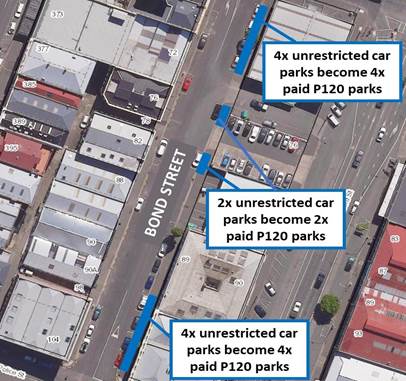
25 On
reviewing feedback, the Hearings Committee recommended removing the four parks
closest to Police Street from the proposal leaving those four parks as
unrestricted. The updated proposal is presented in Attachment B and would
convert six unrestricted car parks to paid P120 parks, rather than the 10
originally proposed.
26 On Hanover
Street near the Dunedin Hospital Early Childhood Centre (ECE) (PC#4), Transport
staff have worked with Health NZ to propose a new parking configuration and
provide safer short-term parking for parents picking up and dropping off their
children at the ECE. Currently, two vehicle crossings on Hanover Street provide
access to an off-street parking bay in front of the ECE. To improve safety and
reduce congestion, the proposal would close off the parking bay and remove the
no stopping lines currently in place around the vehicle crossings. Four
five-minute (P5) car parks would be installed in front of the ECE, and an
existing section of two paid P60 car parks would shift six metres further down
Hanover Street (see Attachment B for the diagram). Four submissions were
received, with two in support and two opposed.
27 At Queens
Gardens and Cumberland Street (PC#8), Transport staff originally consulted on a
proposal to replace 21 paid all-day car parks to 21 paid P240 car parks along
Queens Gardens, and to replace two unrestricted car parks with two P30 parks on
Cumberland Street Gardens (original consultation diagram below). This change
was proposed to standardise the parking restrictions around Queens Gardens.
Twenty-three submissions were received on the proposal, with 21 submissions
opposing the change to the all-day car parks. Transport staff reviewed feedback
and based on the level of need from commuters using the all-day parks, have
withdrawn the proposal to change the restriction on the 21 all-day car parks
(see Attachment B for the updated diagram). The updated proposal therefore only
proposes to replace the two unrestricted car parks on Cumberland Street with
two P30 parks.
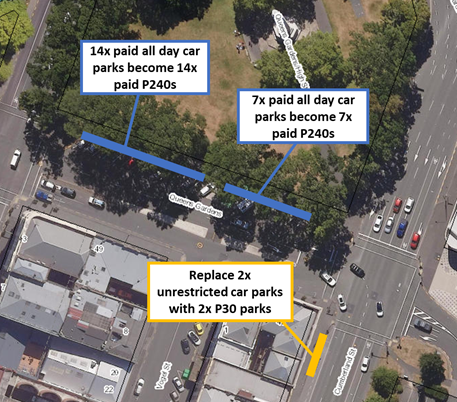
28 At 214 Main
South Road (PC#12), the proposed parking change responds to a request from a
local dairy owner, and would replace three fifteen-minute (P15) car parks with
three P5 parks to improve parking turnover and support more short trips to the
dairy. No feedback was received on this proposal.
29 On Leith
Street adjacent to 135 Frederick Street (PC#15), the proposed change originally
would replace one unrestricted car park with one P30 car park to support better
access to a local cafe and other nearby businesses. Three online submissions
were received in support of the change. In addition, Transport staff delivering
the consultation letters to the nearby businesses received two requests to
convert the unrestricted park in front of 177 Leith Street to a P30 park. The proposal
has therefore been updated to propose replacing two unrestricted parks with P30
parks (see Attachment B for the updated diagram, and below for the original
proposal).
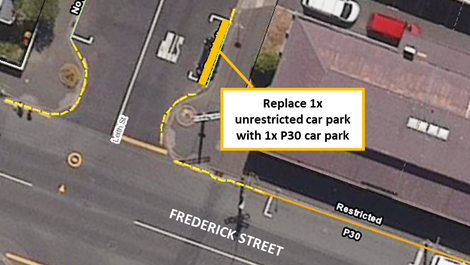
30 On Opoho
Road and Great King Street North (PC#16), proposed changes would convert:
a) seven
unrestricted parks on Great King Street North to P120 parks;
b) one
unrestricted park adjacent to 21 Opoho Road to one P120 park;
c) where
the Book Bus stop is, two unrestricted parks to P120 parks (outside of the Book
Bus stop’s hours of operation, which are from 11am-12:15pm on Friday);
d) two
unrestricted parks near 17 Opoho Road (which are erroneously marked as having
no stopping lines on the Bylaw layer) to P120s; and
e) near 21
Opoho Road, converting two unrestricted parks to P120 parks (outside of the
school bus stop’s hours of operation, which are from 9am-3pm, Monday to
Friday).
31 These
changes would improve parking turnover and availability in an area with a large
amount of unrestricted parking. Eleven submissions were received on the
proposal, with eight submissions against, citing the impact on staff working in
the area needing access to all-day parking. On reviewing the feedback received,
Transport staff have not proposed an amendment to the original proposal in
Attachment B, based on the significant number of unrestricted car parks that
will remain in the area (particularly on Great King Street North pictured
below, where more than 20 unrestricted car parks would remain available).
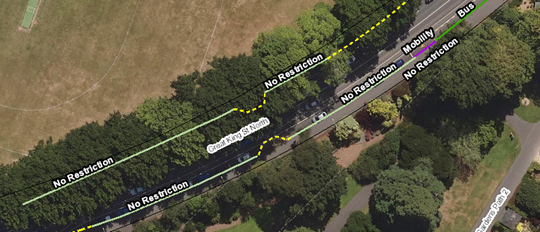
32 One speaker
spoke against the proposed changes and highlighted areas where other parking
changes may be desirable, e.g. infrastructure changes that could support angled
parking on adjacent streets. However, infrastructure changes are outside of the
scope of the regulatory changes considered by the Committee, and would require
budget commitment from the Council to progress.
33 Two
proposed changes that would provide better access for people with disabilities
and mobility permit holders have been withdrawn from this report on the
recommendation of the Committee and will be brought back to the Committee later
after further staff analysis. The proposed changes relate to installing
mobility parks on Dunbar Street (Dunedin City) and near 297 Highgate (Roslyn
Village), after requests made by the community.
34 On Dunbar
Street (PC#10), the original proposal would replace two paid four-hour (P240)
car parks with a two-hour (P120) mobility park located across from the
accessible entrance to the Dunedin Ōtepoti District Court. The original
diagram provided with the consultation stated that the P240 parks would be
replaced with two P120 mobility parks, and this was corrected in the diagram in
Attachment B to clarify that the park is one area that would extend over both
spaces and provide enough room for one larger vehicle, such as a wheelchair
accessible van, or two standard-sized vehicles. Two submissions were received
in support of the change (including from one speaker to the Hearings Committee),
with one submission opposed.
35 After
considering the feedback presented and the proposed location of the mobility
park, the Committee requested that officers re-evaluate the location and
consider surrounding streets (e.g. Stuart and Cumberland) to see whether a
suitable alternative location for the mobility park could be identified, with
more visibility for road users rather than being on a side street. The proposal
has therefore been noted as removed in Attachment B and the parking change mapping
link, and a proposal will be brought back to a future Committee meeting for
consideration.
36 In Roslyn
Village (PC#6), the original proposal would replace one P30 car park in front
of 297 Highgate with one P120 mobility park and (to offset the change to
short-term parking amenity for delivery vehicles, couriers, etc.) would install
an authorised vehicle only (AVO) park near the pedestrian crossing, shifting an
existing section of P30s closer to 287 Highgate. Five submissions were received
(three opposed, two in support, with two speakers at the Hearings Committee).
37 Discussion
at the Hearings Committee meeting highlighted that while there is an identified
need for a mobility park in Roslyn Village, a broader review of mobility
parking options in Roslyn Village is needed before progressing the proposed
change. The Committee recommended deferring the proposed changes until the
September Committee meeting and requested that officers bring back more
analysis of potential locations for the mobility park (including consideration
of locating the park on the other side of the street closer to the roundabout),
and also identify any other locations where parking availability could be
maximised. The proposal has therefore been noted as removed in Attachment B and
the parking change mapping link, and a proposal will be brought back to a
future Committee meeting for consideration. Officers will also follow up on
concerns about vegetation control in Roslyn Village raised by one of the
speakers to the Committee.
Changes as a result of safety assessments
38 As a result
of the recommendation of the Hearings Committee on 20 March to provide an
additional safety assessment and consultation, Transport safety officers
re-assessed the proposal to install two sections of no stopping lines along
Macandrew Road near the Port of Otago and the intersection with Cemetery Road
(PC#13).
39 Based on
the narrow width of the live lane (which measures only three metres wide) and
the solid white centre line on this section of Macandrew Road, Transport safety
officers note that the proposal to install no stopping lines at the location
indicated in Attachment B is rather a clarification that the traffic lane is
not wide enough to allow parking and safe passing, and is a dangerous place to
park. Solid white centre lines indicate hazards such as corners, intersections,
and crossings, and all three of these are present along this stretch of
Macandrew Road. The installation of no stopping lines would therefore be
classed not as a removal of unrestricted parking, but as a clarification of
section 6.1 of the Land Transport (Road User) Rule 2004, which sets out that
vehicles must be parked with due care and consideration.
40 One
submission was received in support of the proposed change from a representative
of the West Harbour Community Board, who provided a recommendation to further
extend the proposed no stopping lines past the entrance of the Port of Otago.
The Committee maintained the original recommendation as set out in Attachment B
to balance the demands on the road reserve in the area but recommended that
officers install heavy vehicle crossing signs on the approach to the port to
encourage drivers to reduce speed from both directions. Officers have since
confirmed that a truck crossing sign has already been installed at this
location and will review if another is needed.
41 A safety
proposal would install no stopping lines over a vehicle crossing on Dunbar
Street (adjacent to 252 Cumberland Street) as a clarification of section
6.9 (Obstructing vehicle entrances and exits) of the Land Transport (Road User)
Rule 2004 (PC#11). Based on the vehicle crossing appearing to no longer be in
use and the frequency of cars parking across the entrance, Transport staff
originally consulted on a proposal to convert the redundant vehicle crossing to
a paid P240 car park. On consulting with the property owner and discovering the
vehicle crossing is still used, Transport staff updated the proposal to install
no stopping lines as a clarification that vehicles cannot park in front of the
crossing, as mapped in Attachment B.
42 A new 24/7
NPD Fuel station has opened at 184 Gordon Road in Mosgiel (PC#14). A condition
of the resource consent granted by the Council to the developer was that two
sections of no stopping lines be installed near the new vehicle crossing on Tay
Road, so that fuel tankers could safely enter and exit the crossing. The
developer has now installed the no stopping lines (to the removal of two
unrestricted car parks), and the proposal mapped in Attachment B would
formalise regulating these no stopping lines through the Bylaw.
Parking counts for minor general parking changes
43 Proposed
minor general parking changes presented in this report will result in the gain
of 19 restricted car parks, the gain of 5 unrestricted car parks, and
restriction changes for 40 car parks. The detailed breakdown is presented in
Table A.
|
TABLE A - PARKING COUNTS
|
|
MINOR GENERAL PARKING CHANGES – TPC 55
|
|
|
Restricted car parks
|
Unrestricted car parks
|
Restriction change only
|
|
Changes to support public transport efficiency
|
16
|
7
|
N/A
|
|
Changes to better serve local businesses & communities
|
3
|
N/A
|
36
|
|
Changes as a result of safety assessments
|
N/A
|
-2
|
N/A
|
|
TOTAL
|
19
|
5
|
36
|
44 The proposed
changes to install no stopping lines on Dunbar Street over the vehicle crossing
and to install no stopping lines along Macandrew Road (Careys Bay) are not
included as a parking change in Table A, as they represent clarifications that
no parking should occur as per the Land Transport (Road User) Rule 2004.
Corrections and
Clarifications – TPC-56 (Attachment D)
45 Corrections
of parking restrictions to the bylaw database are detailed in Attachment D
– Corrections and Clarifications. They do not change current parking
restrictions, but make corrections to the database to accurately reflect the parking restrictions
and markings which are on the ground.
46 Two
corrections listed (numbers 22 and 24 in Attachment D) would update the variable
restrictions adjacent to 56-66 Princes Street and 233-237 Moray Place to
reflect the signs and restrictions on the ground. While these were historically
restricted as variable so that they could be designated as temporary coach
stops on an as-needed basis, these areas have not been used as coach stops for
years. Correcting these two areas will make the bylaw database a clearer
reflection of the restrictions in place.
47 Clarifications
of parking restrictions are also detailed in Attachment D. They do not
change parking restrictions on the ground, but install markings and update the
bylaw database to clarify for road users where restrictions apply as per the
Land Transport (Road User) Rule 2004, in areas where safety concerns or
repeated issues highlight a need for clarifications to be made.
OPTIONS
Option One –
Approve some or all of the proposed parking changes (recommended)
48 That
the Council approves some or all of the proposed changes to the traffic and
parking bylaw database.
Advantages
· Improves the efficiency of public transport services and
infrastructure by enabling enough capacity for buses and ensuring that they can
safely enter and exit bus stops.
· Contributes to achieving an integrated, affordable, responsive, and effective
transport network, by ensuring the right parking time restrictions and parking
amenity are in place to support local communities and businesses.
· Improves the safety of the transport network by preventing
obstructive parking, increasing visibility, and making existing parking
controls clearer.
Disadvantages
· Business as usual costs of implementing the parking changes (e.g.
installation of markings and signage).
Option Two – Status
quo
49 Retain
current parking restrictions without amendment.
Advantages
· The costs of
implementing parking changes can be allocated elsewhere.
Disadvantages
· Does not improve
the efficiency of public transport services and infrastructure.
· Does not meet the
expressed parking needs of local communities and businesses, nor contribute to
the goals of the Integrated Transport Strategy.
· Does not improve
the safety of the network, nor reduce conflict points.
NEXT STEPS
50 If the Council approves the recommended changes to parking
restrictions, these will be implemented through appropriate signs and
road markings and restrictions will be enforced under the Traffic and Parking Bylaw.
Signatories
|
Authoriser:
|
Cr Cherry Lucas - Chairperson
|
Attachments
|
|
Title
|
Page
|
|
⇩a
|
Attachment A - Minutes
of Hearings Committeee, Friday 12 June
|
200
|
|
⇩b
|
Attachment B - Minor
General Parking Changes
|
203
|
|
⇩c
|
Attachment C - Feedback
Received
|
213
|
|
⇩d
|
Attachment D -
Corrections and Clarifications
|
228
|
|
SUMMARY OF CONSIDERATIONS
|
|
Fit with purpose of Local Government
This decision enables democratic local
decision making and action by, and on behalf of communities.
This decision promotes the social
well-being of communities in the present and for the future.
|
|
Fit with strategic framework
|
|
Contributes
|
Detracts
|
Not applicable
|
|
Social Wellbeing Strategy
|
✔
|
☐
|
☐
|
|
Economic Development Strategy
|
✔
|
☐
|
☐
|
|
Environment Strategy
|
☐
|
☐
|
✔
|
|
Arts and Culture Strategy
|
☐
|
☐
|
✔
|
|
3 Waters Strategy
|
☐
|
☐
|
✔
|
|
Future Development Strategy
|
☐
|
☐
|
✔
|
|
Integrated Transport Strategy
|
✔
|
☐
|
☐
|
|
Parks and Recreation Strategy
|
✔
|
☐
|
☐
|
|
Other strategic projects/policies/plans
|
✔
|
☐
|
☐
|
Improvements to traffic and parking
restrictions supports a safe, efficient and accessible transport network, and supports the social and economic wellbeing of Dunedin communities.
|
|
Māori Impact Statement
Mana whenua have expressed support for a
safe and efficient transport network through previous consultations with the
Dunedin City Council.
|
|
Sustainability
Parking
control changes improve
efficiency and access
to the transport network, which contribute to sustainability
goals.
|
|
LTP/Annual Plan / Financial Strategy/Infrastructure
Strategy
The implementation of traffic and parking controls in
Dunedin supports the levels of service set out in the 9 Year Plan, e.g.
“The DCC provides the transport network that facilitates safe
travel.”
|
|
Financial considerations
Costs for implementing the proposed changes
are covered by existing budgets.
|
|
Significance
The report is considered of low
significance in terms of the Council’s Significance and Engagement Policy.
|
|
Engagement – external
There has been engagement with
affected parties, including
residents, property owners and business owners adjacent to proposed parking
changes.
Engagement has occurred with Otago Regional Council with
regard to proposed changes on the public transport network.
|
|
Engagement - internal
Engagement has occurred on the proposed
parking changes with Transport and Parking Services officers.
|
|
Risks: Legal / Health and Safety etc.
Many of the proposed changes aim to
improve safety of vulnerable users of the transport network.
|
|
Conflict of Interest
Cr Andrew Simms was a submitter to this
hearing and will sit back from the discussion at Council.
|
|
Community Boards
The chair of the Waikouaiti Coast Community Board was
informed of the proposal to install a new bus stop and shelter at 6 Coast
Road. The West Harbour Community Board submitted on the proposed change on
Macandrew Road in Careys Bay.
|
|

|
Council
22 July 2026
|
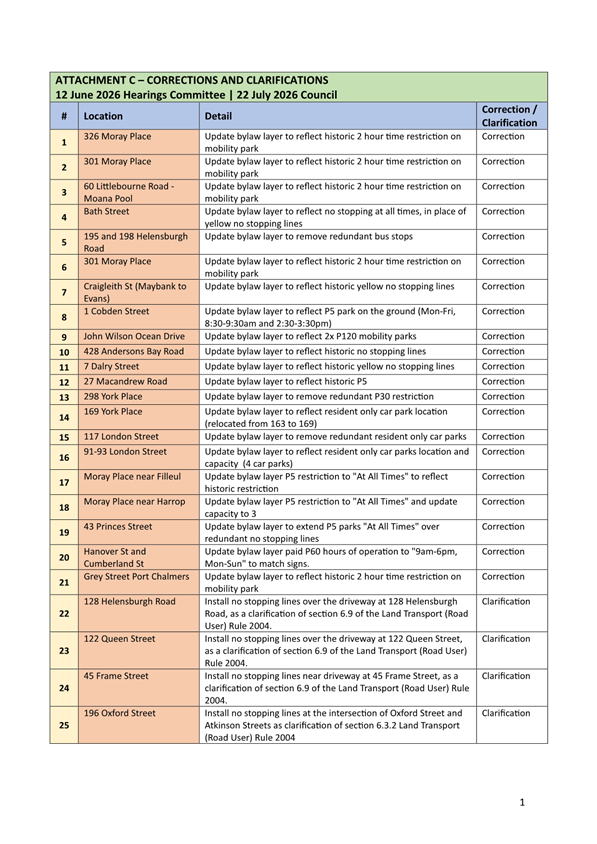
|
|
Council
22 July 2026
|
Development of the 10 Year Plan 2027-37
Department: Civic
EXECUTIVE SUMMARY
1 This
report provides the Council with an update on the development of the 10 Year
Plan 2027-37 (10 Year Plan).
2 The
10 Year Plan is being developed in parallel with Council’s inaugural
Water Services Strategy 2027-37 (Water Services Strategy), which is the subject
of a separate report.
3 The
development of the 10 Year Plan will be challenging, primarily due to the scale
and pace of ongoing legislative reform. Details of major proposals, including
rate capping, regulatory changes and amalgamation, are not yet confirmed or
enacted, creating substantial uncertainty for long-term planning.
4 Despite
the uncertainty, the Council is required to develop and adopt a 10 Year Plan
under the Local Government Act 2002 (LGA).
RECOMMENDATIONS
That the Council:
a) Notes the Development
of the 10 Year Plan 2027-37 report.
BACKGROUND
About the 10 Year Plan
5 Under
the LGA, the Council is required to adopt a 10 year plan every three years. Section
93(6) of the LGA provides that the purpose of the Plan is to:
a) describe
the Council’s activities;
b) describe
the community outcomes for Dunedin;
c) provide
integrated decision-making and co-ordination of resources;
d) provide a
long-term focus for the decisions and activities of the Council; and
e) provide a
basis for accountability of the Council to the community.
6 The
10 Year Plan describes what the Council aims to deliver for the community over
the 10 year period from 1 July 2027 to 30 June 2037. The document sets out
services and activities the Council will provide, the community outcomes those
services and activities are intended to achieve, how much they will cost and
how they will be paid for.
7 The
10 Year Plan is a basis for accountability and transparency to the community.
It provides information about how decisions were made and enables the community
to hold the Council to account for those decisions.
8 Schedule
10 of the LGA specifies that the minimum information and content that must be
included in the Plan is:
a) Community
outcomes;
b) Groups of
activities (including capital expenditure, levels of service and funding impact
statements);
c) A statement
on any variations between proposals outlined in the Plan and our assessment of
sanitary services, and waste management and minimisation plans;
d) Council
controlled organisations (including activities provided and key performance
targets);
e) A statement
on the development of Māori capacity to contribute to decision making
processes;
f) A Financial
Strategy;
g) An Infrastructure
Strategy;
h) A Revenue
and Financing Policy;
i) A
Significance and Engagement Policy;
j) Financial
information, including financial statements, a balanced budget statement, funding
impact statements, rating base information and reserve funds; and
k) Significant
forecasting assumptions.
9 Previously,
water services information was included as part of a council’s Long Term
Plan, where relevant. However, from 1 July 2027, detailed water services
information will not be included in the 10 year plan but must instead be
covered in a separate Water Services Strategy document.
10 Following
the completion of the 9 Year Plan 2025-34 (9 Year Plan) in 2025, there was a
debrief session with Councillors to identify lessons learned and ways to
improve the process for the next long term plan. Feedback from that session has
been incorporated into 10 year plan project planning.
Consultation and Audit of the 10 Year Plan
11 Community
consultation using the Special Consultative Procedure is mandatory under the LGA.
A consultation document that fairly reflects the content and key issues of the
draft 10 Year Plan must be prepared and made available for this process, rather
than the draft Plan itself.
12 It is also
a legislative requirement that the 10 Year Plan and its consultation document
are audited. Boths audits will be conducted by the Audit Office (formerly Audit
NZ).
Legislative reforms
13 The
development of the 10 Year Plan is expected to be significantly more
challenging than in previous cycles due to the scale and pace of ongoing
legislative reform. Major proposals, including rate capping and amalgamation,
are not yet confirmed or enacted, creating substantial uncertainty for
long-term planning.
14 The Local
Government (Systems Improvements) Bill proposes changes to the LGA, which would
affect decision making considerations for the 10 Year Plan. In particular, the
Bill proposes changes to the purpose of local government, and identifies core
services (see Table 1).
Table 1: Selected proposed changes - Local Government
(Systems Improvements) Bill
|
Current (LGA)
|
Proposed (Systems Improvements)
|
|
s10
The purpose of local government is—
(a) to
enable democratic local decision-making and action by, and on behalf of,
communities; and
(b) to promote the social, economic, environmental, and
cultural well-being of communities in the present and for the future.
|
s10
The purpose of local government is—
(a) to
enable democratic local decision-making and action by, and on behalf of,
communities; and
(b) to meet the current and future needs of communities for
good-quality, cost-effective, and local—
(i) infrastructure; and
(ii) public services; and
(iii) performance of regulatory functions; and
(c) to support local economic growth and development by
fulfilling the purpose set out in paragraph (b).
|
|
(core services not currently identified in LGA)
|
s11A In performing its role, a local authority must
have particular regard to the contribution that the following core services
make to its communities:
(a) network infrastructure:
(b) public transport services:
(c) waste management and minimisation:
(d) civil defence emergency management:
(e) libraries, museums, reserves, and other
community and recreational facilities.
|
15 Also as
part of the Local Government (System Improvements) Bill, proposed mandatory
Groups of Activity for planning and reporting have been released (see Table 2).
Note that under current legislation, the only mandatory Group of Activity in a
long term plan of a territorial authority is ‘Roading and
Footpaths’.
16 The goal of
this proposed change is to provide better visibility of a council’s
performance through consistency of reporting, and to enable easier comparison
with other councils.
Table 2: Proposed mandatory
groups of activity for council planning and reporting
|
#
|
Group of activities
|
Activities and description
|
|
1
|
Adaptation and
emergency management
|
· Adaptation actions,
including flood protection, and emergency management.
· Implementation of
National Adaptation Framework: coastal protection, flood protection and
control works, other adaptation and climate-related planning and actions e.g.
drought and fire protection; emergency planning and management.
· The adaptation and
emergency management group should be reserved for expenses that do not
directly align with other activities. For example: flood protection,
slope stabilisation warning systems should be included in this
category.
· Improvements or
upgrades to accommodate climate impacts, such as road elevations, upsizing of
stormwater pipes to accommodate deluges and water reservoirs to accommodate
dryer periods, should be recorded against the activities to which they most
directly relate.
|
|
2
|
Community and
recreational facilities
|
· Libraries, museums,
galleries, other recreational and sport facilities, including swimming pools,
community, heritage and village halls, community centres, stadia, marine
recreational facilities. Cemeteries and crematoria, public toilets.
|
|
3
|
Governance, planning
and reporting
|
· Council, committees,
and financial matters related to the elected council and community boards,
corporate services.
· Includes long-term
plans, annual plans and reports, infrastructure and management strategies,
district and regional plans, urban planning, financial and funding
strategies, reporting on CCOs community and economic development plans, water
services strategies, iwi liaison, marketing and communications, and the
development and review of bylaws and other council policies.
|
|
4
|
Parks and reserves
|
· Parks and reserves and
all associated land-based activities. This may include sports fields and
changing rooms, mountain biking tracks, car parks, playgrounds, walking
tracks, plant collections, and camping grounds.
· Community facilities
located on reserve land for the purpose of using the reserve, for example:
public toilets, clubrooms and pavilions, are included in this group.
· Community facilities,
not part of the use of the reserve or park such as community centres, indoor
sports centres, swimming pools, and crematoria, should be recorded as part of
the ‘community and recreational facilities’ group.
|
|
5
|
Public regulatory
services
|
· Public services and
activities related to the performance of regulatory functions, including
environmental protection.
· Building control,
resources consent/planning compliance, environmental health, animal and dog
control, bylaw enforcement, alcohol licensing, hazardous substances/nuisance
complaints, marine safety, LIMS and LGOIMA information requests.
· Air and water quality,
pest and plant management, biodiversity and biosecurity, management of land
for environmental protection purposes, partnerships with iwi Māori for
land management decisions.
|
|
6
|
Roading and
transport
|
· Provision, management,
renewal, and upkeep of the local road network, including roads, footpaths,
bridges, traffic controls, and roadside drainage.
· Includes routine
works, inspections, vegetation control, drainage cleaning, minor repairs,
response to weather events.
· Planning,
construction, maintenance, and management of roads and related transport
infrastructure. Actual road operation handled by councils.
· Public transport:
rail, bus, ferry, tram.
· On-road parking and
council-owned carparks and carparking buildings (including those managed by
others).
· Abandoned vehicles.
|
|
7
|
Waste management and
minimisation
|
· Street and roadside
rubbish bins and recycling. Kerbside rubbish collection. Recycling centres,
aftercare of landfill sites, landfill operations, reusable materials depots,
recycling collection and recovery. Kerbside organic collection, transport,
composting and re-use.
|
|
8
|
Other activities
|
· Community and economic
development, grants (not related directly to another activity),
sustainability, international relations, events and festivals, forestry,
social housing, commercial and heritage property, community safety, tourism.
|
17 The
proposed ‘other activities’ group is designed to be used for
activities that are not considered to be core services.
18 The
government is currently seeking feedback on the proposed Groups. If confirmed,
they would shape how the 10 Year Plan is structured. Budgets for individual
Council activities would be consolidated into broader Group-level budgets. Levels
of Service (LOS), along with their associated performance measures and targets,
would be clustered together depending on the Group they related to.
19 Other
significant reforms include proposed simplification of local government and
rate capping, though legislation for these has not yet been introduced.
DISCUSSION
Roles and responsibilities
20 The 10 Year
Plan is a significant piece of work that requires input from elected members,
staff and the community.
21 Elected
members, through Council, play a central role throughout the 10 Year Plan
process. This involves:
· Providing
strategic direction and priorities for the next ten years.
· Providing
input into the development of long term plan policies and strategies, and then
considering and approving draft documents.
· Considering
options reports, and making decisions on which projects are included in the
draft budget, which will be consulted on.
· Deciding
on specific topics for community consultation.
· Involvement
in community consultation, including hearing the community’s views at
consultation events and formal hearings.
· Receiving
community feedback, deliberating and decision making on the final Plan.
22 The Council
is also responsible for adopting the consultation document and its supporting
information, and adopting the final 10 Year Plan.
23 Staff are
working within a project framework to develop the 10 Year Plan. The Executive
Leadership Team have oversight of the process as the Project Steering Group.
24 Workstreams
are in place to develop different parts of the Plan. Regular reports to Council
will provide updates on progress and will present draft material for
consideration.
25 A Finance
and Performance Committee workshop was held on 15 June, where the Committee
provided early direction on the Financial Strategy and Infrastructure Strategy.
This direction is being used to guide the development of draft budgets.
Milestones and timeframes
26 Key
milestones are shown in Table 3.
Table 3: 10 Year Plan project milestones
|
Milestone
|
Date
|
|
Development of draft
strategies and policies
|
Now-Nov 2026
|
|
Budget options reports are
presented to Council
|
Now-Sep 2026
|
|
Council budget meeting
|
December 2026
|
|
Adoption of the 10 Year Plan
Consultation Document
|
March 2027
|
|
Community consultation period
(Special Consultative Procedure)
|
April 2027
|
|
Hearings
|
May 2027
|
|
Council deliberations
|
May 2027
|
|
Adoption of the 10 Year Plan 2027-37
|
By 30 June 2027
|
27 Budget
option reports will be brought to Council on a regular basis between now and September.
28 With
proposed rate capping signalled by central government, and in line with early
Council direction on the Financial Strategy, options reports will include:
· Projects
previously decided by Council and included in the 9 Year Plan, so they can be
re-confirmed (for example, Smooth Hill landfill).
· Where
appropriate, staff may also present alternative options for projects included
in the 9 year plan.
· Proposed
‘New Capital’ budget items not included in the 9 Year Plan will be
presented to Council for consideration.
29 Decisions
on options reports will be built into the draft budget, which will be
considered in full at the Council budget meeting on 7-10 December. The timing
of this meeting is different than usual based on Councillor feedback.
30 Two 10 Year
Plan workshops will be scheduled each month for the remainder of 2026. Topics
of upcoming workshops are:
a) 20
July: Rating method (including general rate differentials), Rating Policies
and the Revenue and Financing Policy
b) 17
August: 10 Year Plan budget update (non-public)
31 Topics of
remaining workshops will be confirmed in due course.
32 Timeframes
are subject to change as the project progresses, particularly in response to
ongoing legislative reform.
OPTIONS
33 Council
is required to develop and adopt a long term plan so, on this basis, there are
no options.
NEXT STEPS
34 Council
workshops that relate to the development of the 10 Year Plan will be scheduled.
35 Updates and
options reports on 10 year plan matters will be brought to Council or a
Committee of Council on a regular basis.
36 The 10 Year
Plan draft budgets will be presented to Council at its budget meeting on 7-10
December 2026.
Signatories
|
Author:
|
Janet Fraser - Corporate Planner
|
|
Authoriser:
|
Carolyn Allan - Chief Financial Officer
|
Attachments
There are no attachments for
this report.
|
SUMMARY OF CONSIDERATIONS
|
|
Fit with purpose of Local Government
This report supports democratic local
decision making and action by, and on behalf of communities.
It promotes the social, economic,
environmental and cultural well-being of communities in the present and for
the future.
|
|
Fit with strategic framework
|
|
Contributes
|
Detracts
|
Not applicable
|
|
Social Wellbeing Strategy
|
✔
|
☐
|
☐
|
|
Economic Development Strategy
|
✔
|
☐
|
☐
|
|
Environment Strategy
|
✔
|
☐
|
☐
|
|
Arts and Culture Strategy
|
✔
|
☐
|
☐
|
|
3 Waters Strategy
|
✔
|
☐
|
☐
|
|
Future Development Strategy
|
✔
|
☐
|
☐
|
|
Integrated Transport Strategy
|
✔
|
☐
|
☐
|
|
Parks and Recreation Strategy
|
✔
|
☐
|
☐
|
|
Other strategic projects/policies/plans
|
✔
|
☐
|
☐
|
This report discusses the development of the 10 Year Plan,
which contributes to the objectives and priorities of the above strategies.
|
|
Māori Impact Statement
The adoption of Te Taki Haruru – Māori
Strategic Framework signals Council’s commitment to mana whenua and to
its obligations under the Treaty of Waitangi. Mana whenua and mātāwaka
have not contributed to this report but will have an opportunity to engage on
the draft 10 Year Plan 2027-37.
|
|
Sustainability
There are no sustainability implications in this report.
However, the 10 year plan will embed relevant strategies, activities and
performance targets to give effect to the Council’s commitment to
sustainability and its Zero Carbon policy.
|
|
LTP/Annual Plan / Financial Strategy /Infrastructure
Strategy
This report provides an overview of the development
process for the 10 Year Plan 2027-37.
|
|
Financial considerations
This report provides an overview of the development
process for the 10 Year Plan 2027-37, which includes financial information,
including financial statements.
|
|
Significance
This administrative report is of low significance under
Council’s Significance and Engagement Policy. However, the 10 Year Plan
is significant and will be consulted on using the Special Consultative
Procedure, as required under the Local Government Act 2002.
|
|
Engagement – external
While there has been no external engagement on this
report, there will be extensive community engagement on the 10 Year Plan,
including on draft budgets and content in early 2027.
|
|
Engagement - internal
This report has been developed with input from relevant
staff.
|
|
Risks: Legal / Health and Safety etc.
There are no identified risks.
|
|
Conflict of Interest
There are no known conflicts of interest.
|
|
Community Boards
This report has no implications for Community Boards. They
will have an opportunity to participate during the consultation phase of the
process.
|
|

|
Council
22 July 2026
|
Water Services Strategy 2027-37 development
Department: Civic and 3 Waters
EXECUTIVE SUMMARY
1 This
report provides the Council with an update on the development of the inaugural
Water Services Strategy 2027-37 (Water Services Strategy).
2 The
Water Services Strategy is being developed in parallel with Council’s 10
Year Plan 2027-37, which is the subject of a separate report.
3 The
development of the Water Services Strategy will be challenging, primarily due
to the scale and pace of ongoing legislative reform. Details of major
proposals, including rate capping and amalgamation, are not yet confirmed or
enacted, creating substantial uncertainty for long-term planning.
RECOMMENDATIONS
That the Council:
a) Notes the Water
Services Strategy 2027-37 development report.
BACKGROUND
Changes to 3 Waters long term planning
4 Under
the Local Government (Water Services) Act 2025 (LGWSA), the Council is required
to adopt a water services strategy every three years.
5 Previously,
water services information was included as part of a council’s Long Term
Plan (i.e., a 10 year plan or 9 year plan), where relevant. However, from 1
July 2027, detailed water services information must not be included in the 10
year plan but must instead be covered in a Water Services Strategy document.
6 The
Water Services Strategy includes budgets covering ten years, and infrastructure
management covering 30 years. The Strategy serves a similar planning and
accountability function for water services as the 10 Year Plan does for Council
activities more broadly. Together they form an integrated planning framework,
with the Water Services Strategy providing the detailed long-term planning and
financial information required specifically for water services.
7 The
enactment of the LGWSA as part of the Government’s Local Water Done Well
reform introduced new planning and reporting requirements for water services
providers. In addition to preparing a Water Services Strategy and a separate
Water Services Annual Report, water services providers must also prepare a
Strategic Asset Management Plan, Asset Management Plans, and an Investment and
Delivery Plan for the Commerce Commission.
8 The
LGWSA made amendments to the Commerce Act 1986 to provide that the Commerce
Commission is now the economic regulator for water services. The Commerce
Commission has many tools to monitor and regulate water services providers,
including information disclosure requirements, as well as financial
ringfencing, and price and quality regulation.
About the Water Services Strategy
9 Section
232(1) of the LGWSA provides that the purpose of the Water Services Strategy is
to:
a) Describe
water services activities it intends to carry out;
b) Provide a
basis for accountability of the local authority to the community; and
c) Present
information relating to costs and investment, proposed charges, levels of
service and performance, financial forecasting, and long-term infrastructure
planning for transparency and to support decision making.
10 The Water
Services Strategy sets out the Council’s intended approach to the
provision of water services for the period from 1 July 2027 to 30 June 2037. It
describes the water services to be delivered, the levels of service and
outcomes intended to be achieved, and the associated costs and funding
arrangements.
11 The Water
Services Strategy forms a basis for accountability and transparency to the
community. It provides information about how decisions were made and enables
the community to hold the Council to account for those decisions. The document
also provides information about expected rates, levels of service and approach
to addressing challenges.
12 Schedule
3 of the LGWSA specifies that the minimum information and content that must be
included in the Water Services Strategy is:
a) Groups of water services activities, including relevant
community outcomes;
b) Strategic matters, including strategic priorities,
regulatory requirements and factors that are expected to have a significant
impact on the water services provider, such as changes to population or land
use;
c) Operational matters, including the nature and scope of
activities, significant work proposed by the water services provider, intended
levels of service and performance measures;
d) Information on how feedback will be sought from water
services consumers;
e) Financial matters, including budgeted operational and
capital expenditure, fees and charges, financial statements, and funding impact
statements;
f) Water services infrastructure, including how infrastructure
assets will be managed over a 30 year period; and
g) Additional information and requirements, including
significant forecasting assumptions.
13 The Commerce
Commission’s Water Services Information Disclosure Determination 2026
requires the periodic disclosure of key asset management and planning
information, including strategic asset management content. The Water Services
Strategy needs to be supported by a set of related planning documents,
including a Strategic Asset Management Plan, Asset Management Plans, and an
Investment and Delivery Plan. Together, these documents provide an integrated
framework linking strategic direction, asset management practice, and investment
planning.
14 Community
consultation using the Special Consultative Procedure is mandatory for the
Water Services Strategy under the legislation, though this may be combined into
one process with the 10 Year Plan. The Water Services Strategy requires a
‘Summary of Major Matters’ for the consultation process, to outline
the key water services issues, options and trade-offs facing the community in
an accessible format, similar to the Consultation Document used for the 10 Year
Plan.
15 Audit of
the Water Services Strategy and its Summary of Major Matters is not required,
though an audit may be requested by either the Council or the Secretary for
Local Government.
16 From the
2027/28 financial year onwards, the Council’s performance against the
Water Services Strategy will be reported on in a separate Water Services Annual
Report, as required by the LGWSA. The report will compare forecast financial
and service performance with actual results for the relevant year.
DISCUSSION
17 The Water
Services Strategy development is a significant piece of work that requires
input from elected members, staff and the community. It is being delivered as a
workstream within the wider ‘10 Year Plan 2027-37 and Water Services
Strategy 2027-37’ programme.
18 Elected
members, through Council, play a central role throughout the Water Services
Strategy process. This involves:
· Providing
strategic direction and priorities for the next ten years.
· Providing
input into the development of components of the Water Services Strategy, and
then considering and approving draft documents.
· Considering
options reports, and making decisions on which projects are included in the
draft budget, which will be consulted on.
· Deciding
on specific topics for community consultation.
· Involvement
in community consultation, including hearing the community’s views at
consultation events and formal hearings.
· Receiving
community feedback, deliberating and decision making on the final Water
Services Strategy.
19 The Council
is also responsible for adopting the Summary of Major Matters and the final Water
Services Strategy.
Workstream delivery
20 The Water
Services Strategy workstream will be delivered within a broader long term
planning project framework that will also develop the 10 Year Plan. The
Executive Leadership Team have oversight of the process as the Project Steering
Group.
21 Key
deliverables of the workstream include the Water Service Strategy, a Strategic
Asset Management Plan, Asset Management Plans for water supply, wastewater and
stormwater, and an Investment and Delivery Plan.
a) The
Water Services Strategy sets the long-term strategic direction, service
outcomes, and financial framework.
b) The
Strategic Asset Management Plan provides a longer-term view of asset management
objectives, system performance, investment intent, and key risks across the
water services portfolio.
c) Asset
Management Plans sit beneath the Strategic Asset Management Plan and provide
detailed, asset-level information on asset condition, performance, lifecycle
management strategies, and capital and operational expenditure requirements.
These plans provide the evidential base for investment decisions and levels of
service included in the Water Services Strategy.
d) The
Investment and Delivery Plan translates strategic intent and asset management
requirements into a prioritised, deliverable programme of capital and
operational investment, aligned with funding and financing constraints and
informed by regulatory expectations.
22 Together,
these documents support the objectives of the LGWSA by promoting reliable,
resilient, cost-effective, financially sustainable, and transparent water
services, with clear accountability to communities and regulators.
23 Delivery
of the Water Services Strategy has interdependencies with other programme
workstreams including:
a) financial information such as operating and capital
budgets, fees and charges and financial strategy;
b) levels of service and groups of activity information;
c) infrastructure planning inputs and assumptions; and
d) engagement and consultation processes and materials.
24 These
interdependencies will be closely coordination to ensure alignment between
strategic direction, asset planning, and financial decisions.
Milestones and timeframes
25 The Water
Services Strategy is being developed alongside the 10 Year Plan, with key
activities running in parallel across workstreams. Key project milestones are
shown in Table 1.
Table 1: Water Services
Strategy project milestones
|
Milestone
|
Date
|
|
Development of draft
strategies and policies
|
Now-Nov 2026
|
|
Budget options reports are
presented to Council
|
Now-Sep 2026
|
|
Council budget meeting
|
December 2026
|
|
Adoption of the Summary of
Major Matters
|
March 2027
|
|
Community consultation period
(Special Consultative Procedure)
|
April 2027
|
|
Hearings
|
May 2027
|
|
Council deliberations
|
May 2027
|
|
Adoption of the Water
Services Strategy 2027-37
|
By 30 June 2027
|
26 Budget
option reports will be brought to Council on a regular basis between now and September.
27 Decisions
on options reports will be built into the draft budget, which will be
considered in full at the Council budget meeting on 7-10 December. The timing
of this meeting is different than usual based on Councillor feedback.
28 Timeframes may
change as the project progresses, particularly in response to ongoing
legislative reform.
OPTIONS
29 Council is
required to develop and adopt a Water Services Strategy so, on this basis,
there are no options.
NEXT STEPS
30 The project
team will progress the Water Services Strategy project as detailed in this
report.
31 Options
reports relating to the Water Services Strategy budgets will be regularly
presented to Council, or a Committee of Council, from now until the end of
September 2026.
32 The Water
Services Strategy draft budgets will be presented to Council at its budget
meeting on 7-10 December 2026.
Signatories
|
Author:
|
Janet Fraser - Corporate Planner
Jared Oliver - Planning Manager
Sarah Stewart - Asset Planning Team Leader
|
|
Authoriser:
|
John McAndrew - Head of 3 Waters
David Ward - General Manager, 3 Waters, Property and Urban
Development
|
Attachments
There are no attachments
for this report.
|
SUMMARY OF CONSIDERATIONS
|
|
Fit with purpose of Local Government
This decision enables democratic local
decision making and action by, and on behalf of communities.
It promotes the social, economic,
environmental and cultural well-being of communities in the present and for
the future.
|
|
Fit with strategic framework
|
|
Contributes
|
Detracts
|
Not applicable
|
|
Social Wellbeing Strategy
|
✔
|
☐
|
☐
|
|
Economic Development Strategy
|
✔
|
☐
|
☐
|
|
Environment Strategy
|
✔
|
☐
|
☐
|
|
Arts and Culture Strategy
|
✔
|
☐
|
☐
|
|
3 Waters Strategy
|
✔
|
☐
|
☐
|
|
Future Development Strategy
|
✔
|
☐
|
☐
|
|
Integrated Transport Strategy
|
✔
|
☐
|
☐
|
|
Parks and Recreation Strategy
|
✔
|
☐
|
☐
|
|
Other strategic projects/policies/plans
|
✔
|
☐
|
☐
|
The Groups of Activities in the 10 Year Plan and Water
Services Strategy contribute to the objectives and priorities of the above
strategies.
|
|
Māori Impact Statement
Council budgets impact broadly across all Dunedin
communities, including Māori. The adoption of Te Taki Haruru –
Māori Strategic Framework signals Council’s commitment to mana
whenua and to its obligations under the Treaty of Waitangi. Mana whenua
and mātāwaka will have an opportunity to engage on the 10 Year Plan
2027-37 and the Water Services Strategy 2027-37.
|
|
Sustainability
The 10 year plan and Water Services Strategy embed
relevant strategies, activities and performance targets to give effect to the
Council’s commitment to sustainability and its Zero Carbon policy.
|
|
LTP/Annual Plan / Financial Strategy /Infrastructure
Strategy
This report provides an overview of the development
process for the 10 Year Plan 2027-37 and the Water Services Strategy 2027-37.
|
|
Financial considerations
Financial information, including financial statements, is
a key component of both the 10 Year Plan and Water Services Strategy.
|
|
Significance
The 10 Year Plan and the Water Services Strategy will be
consulted on using the Special Consultative Procedure, as required under the
Local Government Act 2002 and Local Government (Water Services) Act 2025
respectively.
|
|
Engagement – external
There will be extensive community engagement on the 10
Year Plan and Water Services Strategy, including on draft budgets and content
in early 2027.
|
|
Engagement - internal
The 10 Year Plan and Water Services Strategy will be
developed with input from elected members and staff from across the
organisation.
|
|
Risks: Legal / Health and Safety etc.
There are legal, reputational, financial and strategic
risks if the development of the 10 Year Plan and Water Services Strategy is
not well executed, or if the public do not trust that the Council is showing
prudent strategic and operational leadership. The development plan attached to
this report is an approach to mitigate this risk.
|
|
Conflict of Interest
There are no known conflicts of interest.
|
|
Community Boards
Community Boards will have an opportunity to propose
projects and items for inclusion in the draft documents, and will also have
an opportunity to participate during the consultation phase of the process.
|
|
|
Council
22 July 2026
|
Proposed Event Road Closures
Department: Transport
EXECUTIVE SUMMARY
1 The
DCC has received temporary road closure applications relating to the following
events:
i) Graduation
Parade
ii) Special Rigs for
Special Kids
iii) 2026 Emerson’s Dunedin
Marathon
iv) Vintage Car Run
2 This
report recommends that Council approves the temporary closure of the affected
roads.
RECOMMENDATIONS
That the Council:
a) Resolves to close the
roads detailed below (pursuant to Section 319, Section 342, and Schedule 10
clause 11(e) of the Local Government Act 1974 (LGA 1974)):
i) Graduation Parade
|
Saturday, 22 August 2026
|
11.00am to 11.45am
|
· Great King Street, between Frederick Street and
Albany Street
|
|
11.10am to 12.00pm
|
· Frederick Street, between Great King Street and
George Street
· George Street, between Frederick Street and Moray
Place
|
|
11.10am to 12.15pm
|
· Intersection of George Street and Moray Place
|
|
11.10am to 12.30pm
|
· Moray Place, between George Street and Upper Stuart
Street
· Filleul Street, between Moray Place and St Andrew
Street
|
ii) Special Rigs for Special Kids
|
Sunday, 30 August 2026
|
6.00am to 6.00pm
|
· Midland Street, between Timaru Street and Portsmouth
Drive
· Otaki Street, between Turakina Road and Teviot
Street
|
|
· Teviot Street, between Portsmouth Drive and Timaru
Street, will be temporarily closed for 20 minutes to allow the convoy to
leave
|
iii) 2026 Emerson’s Dunedin Marathon
|
Saturday, 12 September 2026
|
5.00pm to 11.59pm
|
· Ward Street overbridge - entire length
|
|
Sunday, 13 September 2026
|
12midnight to 5.00pm
|
·
| 8.30am to 1.00pm |
· Portobello Road, between Shore Street and 430
Portobello Road (Glenfalloch)
· Marne Street, between Portobello Road and Larnach
Road
· Doon Street, between Portobello Road and Glengyle
Street
· Fryatt Street – full length
· Wickliffe Street – full length
· Kitchener Street – full length
· Birch Street – full length
· Anzac Avenue, between Union Street East and
Ravensbourne Road,
· Logan Park Drive - full length
· Butts Road, between Dundas Street and Anzac Avenue
|
iv) Vintage Car Run
|
Saturday, 23 January 2027
|
9.30am to 12.00pm
|
· Octagon Central Carriageway, between Princes Street
and George Street
|
BACKGROUND
3 Council’s
Dunedin Festival and Events Plan supports the goal of a successful city with a
diverse, innovative, and productive economy and a hub for skill and
talent.
4 The
areas proposed to be used for these events are legal roads and can therefore be
temporarily closed to normal traffic if statutory temporary road closure
procedures are followed. The procedures are set out in Section 319 of the LGA
1974 and give Council the power to stop or close any road (or part of a road)
within the parameters of Section 342 and Schedule 10 of the LGA 1974 (Schedule
10 is included as Attachment A).
5 These
procedures include:
· Consultation
with the New Zealand Transport Authority Waka Kotahi and the Police.
· Public
notice being given of the proposal to close any road (or part of a road), and public
notice of a decision to close the road.
· Council
being satisfied that traffic is not likely to be unreasonably impeded.
6 A
resolution of Council is required where a proposal to temporarily close a road
relates to public functions.
7 Council
is required to give public notice of its decision. This notice will be
published after this meeting and prior to the event, if approved.
DISCUSSION
Consultation and
Notification
8 The
Police and the New Zealand Transport Authority Waka Kotahi have no objections
to the proposed road closures.
9 On
Saturday, 13 June 2026 the proposed temporary road closures were advertised in
the Otago Daily Times (Attachments B) with a deadline for feedback.
10 Schedule
10 clause 11(e) states a road cannot be closed more than 31 days in the
aggregate in any one year. This limit will not be exceeded by the
approval of the proposed temporary road closures.
Traffic Impacts
11 The event
locations of these events have had identical road closures for the same, or
similar event(s) in prior years without causing unreasonable delays to the
travelling public.
12 Emergency
services and public transport services will be managed through the temporary
traffic management process.
13 The
Temporary Traffic Management Plan process ensures that other issues such as
temporary relocation of certain parking (e.g. taxi, mobility and Authorised
Vehicles Only) are managed.
OPTIONS
14 Note any
amendment to this report’s recommendations cannot be implemented without
further consultation with the affected parties, New Zealand Transport Agency Waka
Kotahi, the Police, and verifying that traffic impacts are acceptable.
Option One – Recommended Option
15 That the Council
closes the sections of road as recommended in this report.
Advantages
· Roads
can be closed, and the event will be able to proceed.
· The
closures will assist in realising the economic, social, and cultural benefits
associated with the events.
Disadvantages
· There
will be temporary loss of vehicular access through the closed areas. However,
there are detours available, and safety can be assured using temporary traffic
management.
Option Two – Status Quo
16 That the
Council decides not to close the roads in question.
Advantages
· There
would be no detour required for the travelling public, and the roads would be
able to be used as normal.
Disadvantages
· The
events would not be able to go ahead, and the benefits of the events would be
lost.
NEXT STEPS
17 Should the
resolution be made to temporarily close the roads, Council staff will accept
the temporary traffic management plans that have been received for the events
and notify the public of the closures.
Signatories
|
Authoriser:
|
Jeanine Benson - Group Manager Transport
Scott MacLean - General Manager, City Services
|
Attachments
|
|
Title
|
Page
|
|
⇩a
|
Local Government Act
1974, Schedule 10
|
251
|
|
⇩b
|
ODT Advert - 13 June
2026
|
256
|
|
SUMMARY
OF CONSIDERATIONS
|
|
Fit with purpose of Local
Government
This decision
promotes the social well-being of communities in the present and for the
future.
|
|
Fit with strategic
framework
|
|
Contributes
|
Detracts
|
Not applicable
|
|
Social Wellbeing Strategy
|
✔
|
☐
|
☐
|
|
Economic Development
Strategy
|
✔
|
☐
|
☐
|
|
Environment Strategy
|
☐
|
☐
|
✔
|
|
Arts and Culture Strategy
|
✔
|
☐
|
☐
|
|
3 Waters Strategy
|
☐
|
☐
|
✔
|
|
Future Development
Strategy
|
☐
|
☐
|
✔
|
|
Integrated Transport
Strategy
|
☐
|
☐
|
✔
|
|
Parks and Recreation
Strategy
|
☐
|
☐
|
✔
|
|
Other strategic projects/policies/plans
|
✔
|
☐
|
☐
|
Events contribute to the
Strategic Framework. Events contribute to the Economic Development Strategy,
the Social Wellbeing Strategy. There is a Festival and Events Plan 2018-2023.
|
|
Māori Impact
Statement
Mana whenua have not been
directly engaged with in relation to these road closures.
|
|
Sustainability
There are no implications
for sustainability.
|
|
LTP/Annual Plan /
Financial Strategy /Infrastructure Strategy
There are no implications,
as the decision is a regulatory one and there are no direct costs to Council.
|
|
Financial considerations
There are no financial
implications. The cost of the proposed road closure is not a cost to
Council.
|
|
Significance
This decision is considered
low in terms of the Council’s Significance and Engagement Policy.
|
|
Engagement –
external
There has been external
engagement (as required by the LGA 1974), with the Police and New Zealand
Transport Agency Waka Kotahi. Affected parties were notified and provided a
time period for feedback.
|
|
Engagement - internal
There has been engagement
with DCC Events and Transport. There is support for the events to
proceed.
|
|
Risks: Legal / Health and
Safety etc.
There are no identified
risks should the recommended resolution be made.
|
|
Conflict of Interest
There are no known
conflicts of interest.
|
|
Community Boards
There are no implications
for Community Boards.
|
|
|
Council
22 July 2026
|
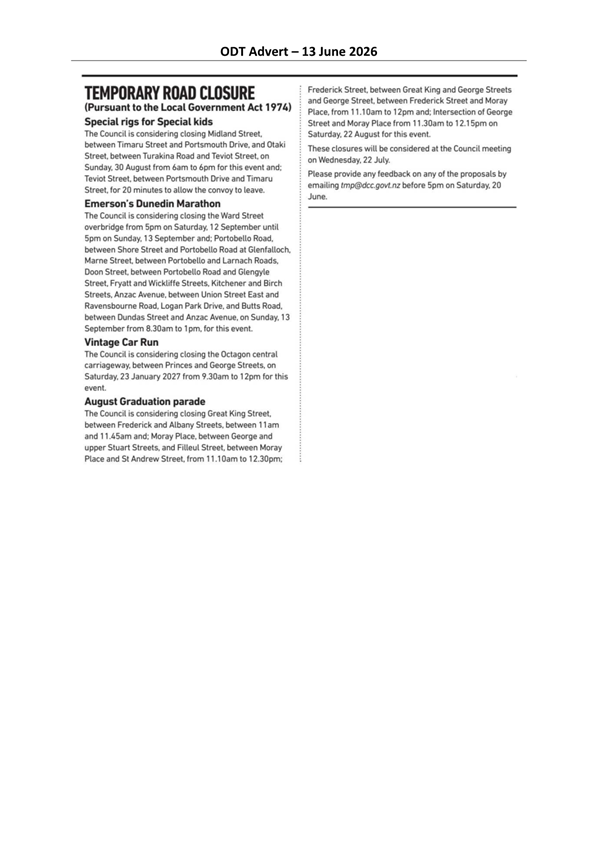
|
|
Council
22 July 2026
|
City-wide emissions target refresh options
Department: Zero Carbon
EXECUTIVE SUMMARY
1 The
purpose of this report is for Council to consider whether to refresh the
existing city emissions targets set in 2019, and if Council wish to refresh the
existing targets, determine the type of target.
2 If
Council decides to refresh the city-wide emissions target, staff will present
options for the level of ambition of a refreshed target in a subsequent report.
3 Dunedin’s
current city-wide emissions target, adopted in 2019, is highly unlikely to be
achieved. While progress has been made in reducing emissions, changes in
national policy settings, economic conditions, and updated data mean the
existing “net zero by 2030” target is no longer considered
achievable.
4 An
overview of best practice for setting city/district level targets, and a
comparison of peer cities confirms that:
a) It is
viable to have a split-gas approach under the latest climate science and
guidance, provided the target is explicit, transparently reported, and where
methane reductions are ambitious and science-aligned.
b) A target
with science-aligned ambition, consistent with best practice guidance, is very difficult
for Dunedin to achieve.
c) Action
to reduce emissions and adapt to climate change in the short term has
transition risks in a New Zealand local government context, however decisive
action in the next 5 to 10 years is expected to lead to the lowest transition
risks and physical hazards overall.
d) There are a
range of target options used by local authorities within New Zealand, and by
local authorities internationally with a similar emissions profile to Dunedin.
5 While
the three emissions modelling scenarios for Dunedin reconfirms advice from May
2025 that the “net zero by 2030” target is not considered
achievable, under all scenarios Dunedin is anticipated to achieve net zero
emissions for all greenhouse gases other than biogenic methane earlier than New
Zealand’s 2050 target.
RECOMMENDATIONS
That the Council:
a) Decides whether to
retain the existing Zero Carbon 2030 targets, or adopt refreshed targets
b) If Council decides to adopt refreshed targets in (a), decides which of the
following types of target for Dunedin:
i) A single year net zero target OR
ii) A single year gross emissions reduction target, with no net
zero claim OR
iii) A budget envelope approach defining an emissions limit over
a defined period; OR
iv) A two stage target, with a near term gross emissions focus,
and a long-term net zero target
c) If Council decides to adopt refreshed targets in (a),
decides whether to:
i) Include biogenic methane in one overall target OR
ii) Have separate biogenic methane and all other greenhouse
gases targets
d) Notes that if Council
decides to refresh a target, staff will present options for Council to consider
the level of ambition of a refreshed target later
in 2026
BACKGROUND
6 This
report refers to emissions in tonnes of carbon dioxide equivalents (tCO2e).
This is a measure used to standardise the climate effects of different
greenhouse gases. A summary of the global warming potentials of three main
greenhouse gases (carbon dioxide, methane, and nitrous oxide) is included in Attachment
A.
The DCC is
seeking to manage and reduce greenhouse gas emissions at both the city and DCC
scale
7 The
DCC is seeking to manage and reduce emissions at two scales, as directed by the
Zero Carbon Policy: city (Dunedin emissions) and organisational (DCC
emissions).
8 The
DCC’s Zero Carbon Policy provides that all DCC activities, including
renewals, should seek to minimise emissions and contribute to achieving both
city-wide and DCC emissions reduction targets.
9 At
the city scale, in 2019 the Council declared a climate emergency and adopted a
‘Zero Carbon 2030’ city emissions reduction target in 2019 (CNL/2019/154),
which is in two parts:
a) net
zero emissions of all greenhouse gases other than biogenic methane by 2030, and
b) 24% to 47%
reduction below 2017 biogenic methane emissions by 2050, including 10%
reduction below 2017 biogenic methane emissions by 2030.
10 Net zero
means that greenhouse gas emissions (excluding biogenic methane) are balanced
by the amount of carbon dioxide removed from the atmosphere by trees, also
known as sequestration.

The Zero Carbon Plan mapped out a path to achieve
the city’s target
11 In
September 2023, Council adopted an emissions reduction plan for Dunedin: The
Zero Carbon Plan 2030. The Zero Carbon Plan set out a pathway to achieve the
city’s target, building on trends already underway.
12 The
modelling underpinning the Zero Carbon Plan reflected the policy and economic context
at the time, including emissions reduction targets and commitments made by
government and other entities, as well as planned DCC actions. It concluded
that achieving the city’s targets would require coordinated action across
government, community, and business stakeholders to pull all available levers
as hard as credibly possible.
13 The Zero
Carbon Plan outlines how emissions reductions could be achieved through five interconnected
areas: resource use and waste; transport and urban form; buildings, energy and
industry; forestry, land use and agriculture; and communities and economies.
14 As well as identifying
a pathway to net zero, the Zero Carbon Plan describes the broader shifts required
for Dunedin to become a Zero Carbon city.
15 It also
identifies the DCC’s role in supporting the transition to zero carbon, with
action areas for the DCC prioritised according to their emissions reduction
potential. The Zero Cabon Plan recognises that many actions required to reduce
emissions will reduce costs in the medium term, but there will be upfront costs
especially for owners of assets/infrastructure.
16 Despite
changes in the wider context since the Plan was adopted, the key shifts identified
in the Plan remain valid. Updated modelling confirms that the same fundamental
actions will still be required to reduce emissions, particularly significant
changes in the transport sector.
17 Staff do
not expect changes to the city-wide emissions target to require significant
amendments to the Zero Carbon Plan, the key shifts for the city, or the
DCC’s action areas.
There have been significant changes in context since 2023
18 Since 2023
there have been changes in context across all five Zero Carbon Plan chapters.
Primarily these changes relate to significant shifts in central government
policy following the 2023 election. In addition, DCC modelling has incorporated
improved data, and there is progress and momentum in local emissions-related
partnerships and some DCC-led projects.
19 Updated
city emissions modelling was presented to Council in May 2025 (CNL/2025/131),
using the 2021/22 Dunedin city emissions inventory to inform projections. The modelling found that:
a) achieving
net zero emissions for all greenhouse gases other than biogenic methane by 2030
is very unlikely; and
b) the city’s separate
biogenic methane target is likely to be achieved by 2030.
20 The May
2025 modelling presented a BAU Scenario broadly following national level
trajectories, and an Accelerated Ambition scenario which relied on some
changes in central government policy and additional local investment. Modelling
presented in May 2025 projected neither the BAU or Accelerated
Ambition scenario would achieve ‘net zero’ of all gases other
than biogenic methane by 2030:
a) BAU
Scenario net emissions were estimated to be 410,000 tCO2e by 2030/31
b) Accelerated
Ambition Scenario net emissions were estimated to be 372,000 tCO2e by 2030/31
21 Council
noted the modelling, and noted “that staff would further update
modelling and provide advice on city emissions target options following
completion of the 2024/25 Dunedin emissions inventory” (CNL/2025/131,
part (h)).
Updated
Dunedin 2025 emissions inventory
22 An updated
Dunedin emissions inventory up to 2024/25 was presented to the Policy and
Planning Committee in April 2026, showing that Dunedin’s gross
emissions reduced 13% between 2018/19 and 2024/25 (PAPCC/2026/012). The
key findings from the 2024/25 emissions inventory are summarised below.
23 The pie graph below shows Dunedin’s 2024/2025 gross
annual emissions profile broken down by source.
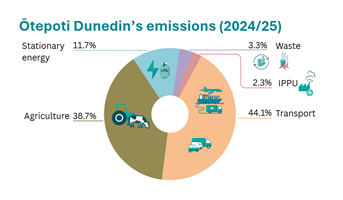
24 The
Zero Carbon Plan uses the 2018/19 financial year as the baseline for measuring city-wide
emissions. Between 2018/19 and 2024/25:
a) Dunedin’s total
gross emissions reduced 13%, from 1,619,536 tCO2e in 2018/19 to
1,416,010 tCO2e in 2024/25.
b) Dunedin’s total
net emissions reduced 11%, from 1,258,198 tCO2e in 2018/19 to
1,119,876 tCO2e.
c) Dunedin’s
total net emissions (excluding biogenic methane) reduced
9%, from 704,845 tCO2e in 2018/19 to 641,057 tCO2e in 2024/25.
d) Dunedin’s
total biogenic methane emissions reduced 13%, from 553,353 tCO2e in
2018/19 to 478,819 tCO2e in 2024/25.
25 Key
drivers of the trends from 2018/19 to 2024/25 by sector were as follows:
a) Emissions
from Transport decreased by 8% between 2018/19 and 2024/25,
from 677,210tCO2e to 624,128tCO2e. This reduction was mainly driven by a 7%
reduction in marine freight emissions, a 30% reduction in cruise ship
emissions, and 32% reduction in air travel emissions over this period. There
was also a small 2% reduction in on-road transport emissions.
b) Emissions from Waste decreased by 50%
between 2018/19 and 2024/25, from 92,661tCO2e to 46,092tCO2e. This was driven
by a reduction in annual emissions from landfill due to improvements to
landfill gas capture, the gradual decrease in emissions from closed landfill
sites, and to a lesser extent diversion of some organic material from landfill
via kerbside green waste composting services.
c) Emissions from Stationary Energy decreased
by 19% between 2018/19 and 2024/25, from 204,735 tCO2e to 165,894 tCO2e. This
was driven by a 70% reduction in emissions from burning coal, and a 12%
reduction in emissions associated with electricity consumption. Reductions in
electricity consumption emissions were due to an 11% reduction in the emissions
per kWh of electricity generated. Actual electricity consumption increased 2%
between 2018/19 and 2024/25. The reduction in coal use was primarily due to boiler
conversions from coal to biomass at the Dunedin Energy Centre, along with
reductions due to all coal school boilers converting to biomass or electric
heating by 2024/25 as part of the Ministry of Education’s School Coal
Boiler Replacement Programme.
d) Emissions from Agriculture decreased 9%
between 2018/19 and 2024/25, from 600,515 tCO2e to 547,303 tCO2e. This decrease
was mainly due to an estimated 10% reduction in sheep numbers and 16% reduction
in dairy cattle numbers over the period.
e) Emissions from Industrial Processes and Product Use
(IPPU) decreased 27% between 2018/19 and 2024/25, from 44,415 tCO2e to
32,593 tCO2e. This was driven by an ongoing trend towards using less
emissions-intensive refrigerants and air conditioning gases in appliances.
f) Net Forestry sequestration
decreased 18% between 2018/19 and 2024/25 (18% less carbon dioxide was
absorbed), from -361,337 tCO2 to -296,134 tCO2. The reduction in net forestry
sequestration over this period is due to an increase in forestry harvested in
2024/25 compared with 2018/19. Sequestration from indigenous vegetation
remained the same throughout 2018/19 to 2024/25. Sequestration from exotic
commercial forestry is variable from year to year. Some years have more
harvesting and some years more forest growth, depending on the age of trees and
market conditions. The extent of the exotic commercial forestry estate in
Dunedin City actually increased over this period, from 16,087 hectares in
2018/19 to 17,298 hectares. All other factors being equal, this suggests the
average forestry sequestration for Dunedin will increase over the coming years,
as recently planted trees reach maturity.
Changes in gross emissions
between 2018/19 and 2024/25 are shown in Table 1, split by emissions source.
Table 1 – Gross
Emissions changes from 2018/19 to 2024/25 by emissions source
|
Sector / Emissions Source.
|
Emissions (tCO2e)
|
Percentage Change 18/19 – 24/25 (%)
|
|
2018/19
|
2024/25
|
|
Transport
|
On-Road
|
330,316
|
322,938
|
-2%
|
|
Rail
|
4,559
|
3,797
|
-17%
|
|
Air travel
|
43,354
|
29,512
|
-32%
|
|
Marine
|
251,240
|
219,763
|
-13%
|
|
Off-Road
|
47,741
|
48,118
|
1%
|
|
Stationary Energy
|
Electricity Consumption
|
100,366
|
87,957
|
-12%
|
|
Stationary Diesel and Petrol Use
|
26,416
|
26,617
|
1%
|
|
LPG
|
29,197
|
28,778
|
-1%
|
|
Coal
|
44,077
|
13,329
|
-70%
|
|
Biofuel
|
4,650
|
9,140
|
97%
|
|
Biogas
|
27
|
73
|
168%
|
|
Waste
|
Solid Waste (Landfill)
|
80,279
|
33,535
|
-58%
|
|
Wastewater Treatment
|
12,383
|
12,556
|
1%
|
|
IPPU
|
Refrigerant and Air Conditioning Gases
|
41,330
|
29,959
|
-28%
|
|
Other Industrial Gases
|
3,085
|
2,634
|
-15%
|
|
Agriculture
|
Agriculture
|
600,515
|
547,303
|
-9%
|
|
Total Gross Emissions
|
1,619,536
|
1,416,010
|
-13%
|
DISCUSSION
26 The updated
city-wide emissions modelling and the 2024/25 emissions inventory, outlined
above, indicate that the biogenic methane target is on track to be achieved.
However, the 2030 net zero target for all other greenhouse gases is now
considered very unlikely to be met.
27 In light of
this updated evidence, Council may choose to consider whether the existing city
emissions targets remains appropriate, or whether a refreshed target framework
should be adopted.
28 The
following sections summarise the key considerations to support that decision,
including:
a) best
practice on community/city level emissions target setting, including advice on
how to consider biogenic methane in targets;
b) city/district
level targets of other New Zealand cities, and local governments of other
countries with similar emissions profiles to Dunedin;
c) context
on national targets, including new methane reduction targets adopted by central
government since 2019; and
d) what is
plausible, using three different emissions modelling scenarios.
29 This report
outlines five options for Council to consider on the type of city level
emissions target:
a) Retain
the current targets;
b) Adopt a new
single year net zero target (in line with the current target format, but adopt
a new target year)
c) A
single year gross emissions reduction target, with no net zero claim
d) A budget envelope
approach, defining an emissions limit over a defined period; and
e) A two stage
target, with a near term gross emissions focus, and a long-term net zero target
30 A decision
is also sought from Council on whether to include biogenic methane emissions in
one overall target, or to keep biogenic methane separate in line with the
current Dunedin emissions targets.
Best
Practice Guidance and Frameworks
31 This
section summarises international guidance and frameworks that are relevant to
setting city-wide emissions targets.
Intergovernmental Panel on
Climate Change (IPCC) Sixth Assessment Report (AR6)
32 The IPCC
AR6 synthesis report sets out core principles to define a scientifically robust
target. Key findings include:
a) Every
increment of warming increases risks, and methane is a major driver of
near-term warming.
b) Rapid
methane reductions deliver climate benefits within years, not decades, due to
methane’s short lifespan in the atmosphere compared to other greenhouse
gases.
c) Limiting
warming to 1.5°C or 2°C will require deep cuts in all gases,
particularly methane.
d) Net-zero
carbon dioxide alone is insufficient. Other greenhouse gases must also decline
sharply.
e) 1.5°C
compatible pathways require approximately 34% methane reductions by 2030 (from 2019
levels).
f) AR6
does not prescribe whether biogenic methane should be included in an overall
target, or whether it can be separate to an all other gases net zero target.
Instead, it provides scientific parameters for a target to meet.
33 For setting
a Dunedin emissions target, IPCC’s AR6 synthesis report confirms:
a) A
split-gas approach is scientifically valid, but only if methane ambition is
high. Methane is a short lived greenhouse gas, and AR6 supports treating it
separately to other long lived greenhouse gases like carbon dioxide and nitrous
oxide, provided the methane reduction pathway is front-loaded (i.e a focus on
significantly reductions over the next 5-10 years), and aligned with global
benchmarks.
b) Methane
reductions matter immediately at the city-scale, and as such there should be a
focus on short-term actions such as maximising landfill gas capture, wastewater
methane management, and reducing landfilling of materials with high organic
content (such as food, garden, and timber waste).
c) Net-zero
all other gases does not remove the need for significant reductions in biogenic
methane. AR6 is explicit that climate stabilisation requires:
i) Deep
and sustained reductions in carbon dioxide reaching net-zero
ii) Significant
reductions in methane and other non-carbon dioxide gases
The Global Protocol for Community-Scale Greenhouse
Gas Emissions Inventories (GPC)
34 As directed
by the Zero Carbon Policy, emissions in the Dunedin City Territorial Area are
estimated using the production-based Global Protocol for Community-Scale
Greenhouse Gas Emissions Inventory (GPC) methodology. This method covers the
key sectors of Transport, Stationary Energy, Waste, Industrial Processes and
Product Use (IPPU), Agriculture, and Forestry. Production-based approaches
exclude global emissions relating to consumption, such as the emissions used
elsewhere to produce products used/consumed within Dunedin. The GPC methodology
is the global standard for estimating emissions within a territorial area.
35 The GPC
methodology requires cities to account for all greenhouse gases within their
territorial boundaries. This means Dunedin’s targets must be based on the
full inventory to comply with the GPC methodology.
36 The key
implications for Dunedin emissions targets are:
a) Methane
can be treated differently, but not hidden. The GPC methodology allows
flexibility about how targets are formulated, provided the approach is
explicit, transparent, and consistent with the inventory boundary.
b) Any target
must align with the inventory scope, including the same gases, sources and
boundaries as used in the city-wide emissions inventory.
Science-Based Targets for Cities (Guide)
37 The
Science-Based Targets Network is a science-led initiative founded by a group of
global Non-governmental Organisations (NGOs) to define what is necessary for
cities to do enough to stay within planetary limits. The Science-Based Targets
Network (SBTN) have issued guidance on how cities can set science-based targets.
The SBTN guide states that a target is considered science-based if it:
a) Aligns
with the IPCC 1.5°C pathways
b) Includes a
clear 2030 milestone
c) Is
net-zero by 2050 at the latest
d) Follows a
reduction pathway rather than a single end point
38 The guide
provides an indication of what level of ambition a city should have when
setting their emissions reduction targets, based on a “fair share”
approach where higher emitting and higher income cities reduce their emissions
more than lower emitting and lower income cities. Under the SBTN guide Dunedin
is considered a high income city with high emissions, having more than 5.1tCO2e
emissions per capita, and GDP per capita above NZ$25,000.
The SBTN guide recommends targets with the following level of ambition for high
emissions and high income cities:
a) 2030:
A 70-75% reduction in emissions compared with 2015 levels
b) 2050: Net
zero emissions
39 The key
implications for Dunedin emissions targets are:
a) To
align with the SBTN guide, any updated target needs to have a near term 2030
target and a long-term target no later than 2050.
b) Under the
SBTN guide, the 2030 target should reflect Dunedin’s fair share of
halving global emissions by 2030. The level of reduction required to meet
Dunedin’s fair share under the SBTN guide far exceeds what is possible
under any of the three emissions modelling scenarios covered later in this
report.
Global
Covenant of Mayors for Climate and Energy
40 Dunedin has
been a signatory to the Global Covenant of Mayors for Climate and Energy (GCoM)
since 2015. Cities in GCoM pledge to set “targets at least as ambitious
as their country’s Nationally Determined Contributions under the United
Nations Framework Convention on Climate Change (UNFCCC).”
41 This does
not provide specific guidance on the form a target should take, rather affirms
that for Dunedin to remain a signatory to GCoM, a city level target of some
form is required, with a level of ambition at least equivalent to that set
nationally.
Local
Government Funding Agency – Local Government Sector Climate Scenarios
42 In
September 2025, the Local Government Funding Agency (LGFA) released their Local
Government Sector Climate Scenarios
(LGFA Climate Scenarios). The LGFA Climate Scenarios illustrate how
climate change could impact the local government sector under different
plausible climate futures. While these scenarios do not provide guidance on how
to set a district level target, they do provide guidance on the likely impacts
to local government and the communities local government support.
43 There are
three scenarios included in the LGFA Climate Scenarios report:
a) Scenario
1: Acting now for our mokopuna – based on coordinated global climate
action from the late 2020s, driving a transition to a low-carbon, climate
resilient economy, and limiting global warming to 1.7°C above
pre-industrial levels by 2100.
b) Scenario
2: Leaving it to the next generation – Global climate action is
delayed until the mid-2030s, with a rapid disorderly transition to a low-carbon
economy. This leads to high economic and social costs for Aotearoa New Zealand.
Global warming of 2.7°C above pre-industrial levels by 2100.
c) Scenario
3: Inheriting a broken world – Global climate action falters due to
geopolitical tensions. Global warming of 3.9°C above pre-industrial levels
by 2100.
44 Each of the
scenarios leads to differences in the timing and severity of transition risks
and physical hazards. As stated on page 7 of the LGFA Climate Scenarios report
“[r]educing emissions or building resilience creates transition risk,
whilst higher temperatures cause physical risk…Acting early leads to
higher short-term transition risk, but reduces longer-term exposure to physical
impacts. Conversely, not reducing emissions leads to physical risks rising
exponentially to 2100 and beyond.”
45 This is
illustrated below, in terms of the extent of the transition risks and physical
risks under each scenario, as well as the impacts of each scenario over time:
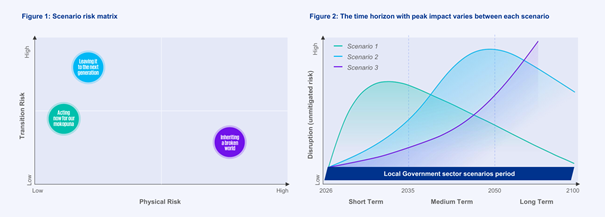
Peer Cities Emissions Reduction Targets
46 A
comparison of the Hamilton, Palmerston North and Christchurch district level
targets is shown below in Table 2. While there are some similarities between
Dunedin and these cities, for all three agriculture makes up a smaller share of
their city emissions compared with Dunedin (agriculture made up 39% of
Dunedin’s emissions in 2024/25). Similarly, because of Dunedin’s
large territorial boundaries, there are higher rates of forestry sequestration
in Dunedin than places like Hamilton which are largely urban. This can help
explain why Hamilton have set ambitious gross emissions reduction targets for
2050, without setting an overall net zero emissions target for Hamilton city.
Table 2 – Comparative
New Zealand District Level Targets
|
NZ Peer District
|
Target Statement
|
District Target Years (Gross or Net)
|
Biogenic Methane Treatment
|
|
Palmerston North City Council
|
A central part of our goal to be an eco-city is
achieving a 30% reduction in Palmy’s greenhouse gas emissions by 2031.
This target is our part of a national effort to make the whole of New Zealand
carbon neutral by 2050.
|
Gross target for 2031.
Reference to 2050 national net-zero target.
|
Included in 2031 target.
(Agriculture was 17% of Palmerston North city gross emissions in 2021)
|
|
Christchurch City Council
|
Our targets for Christchurch are to halve emissions
by 2030, compared with 2016-2017 levels, and to achieve net zero greenhouse
gas emissions by 2045, with at least a 50% reduction in methane emissions by
2045.
|
Gross target for 2030.
Net Zero 2045
|
Separate target – 50% reduction in biogenic
methane by 2045
(Agriculture was 16% of Christchurch city gross emissions in 2023)
|
|
Hamilton City Council
|
By 2030 our city's emissions are reduced by at least
30%. By 2050 our city's emissions are reduced by at least 82%.
|
Gross target for 2030 and 2050.
No net zero community target.
|
Included in overall targets.
(Agriculture was 1% of Hamilton city gross emissions in 2022)
|
47 Given
Dunedin’s relatively high share of agriculture emissions compared with
other comparable New Zealand districts, staff have provided an assessment of
the types of approaches used when setting district level targets in Irish and
Scottish areas, given the similarities in the emissions footprints between
Dunedin and these districts. As shown below in Table 3, the Irish counties and
Highland Council in Scotland refer to contributing towards national targets
rather than set district level targets. Dumfries and Galloway Council
(Scotland) set district targets exceeding the ambition of Scotland’s
national level targets.
Table 3
– Comparative Scottish and Irish District Level Targets
|
Peer District
|
Target Statement
|
District Target Years (Gross or Net)
|
Biogenic Methane Treatment
|
|
Mayo, Kerry, and Cork County Councils (Ireland)
|
All three Irish County Councils refer to national
climate goals and agriculture targets:
· 25% reduction in agricultural (biogenic) methane by
2030
· National climate neutrality by 2050
|
Contribute to Ireland’s national targets
|
Separate biogenic methane target at national level.
(Agriculture was 38% of Ireland’s overall emissions in 2023)
|
|
Highland Council (Scotland)
|
As a public body, we are legally required to
contribute to Scotland’s Net Zero target by 2045.
|
Contribute to Scotland’s Net Zero 2045 Target
|
Included in overall Scotland target.
(Agriculture was 26% of net Highlands and Islands emissions in 2019)
|
|
Dumfries and Galloway Council (Scotland)
|
We support the
region to:
· become a net zero region on or before 2040
· transition to a carbon negative region by 2045 to
align with the wider aspiration outlined by South of Scotland Enterprise
|
Net zero 2040
Net negative 2045
|
Included in overall target.
(Agriculture was 55% of Dumfries and Galloway District gross emissions in
2018)
|
New
Zealand emissions targets
48 Central
Government have set the following emissions reductions targets for New Zealand
to meet, under the Climate Change Response Act:
a) Net
zero emissions of all greenhouse gas emissions other than biogenic methane by
2050.
b) 14% to 24%
reduction below 2017 biogenic methane emissions by 2050, including 10%
reduction below 2017 biogenic methane emissions by 2030.
49 The 2050
biogenic methane emissions target was amended in December 2025, having
previously been a target of a 24% to 47% reduction below 2017 biogenic methane
emissions by 2050.
50 The New
Zealand targets exclude international shipping and aviation emissions, which
are included within Dunedin’s emissions inventory and targets.
51 Central
Government have also set the first and second Nationally Determined
Contributions (NDCs) under the Paris Agreement covering 2021-2030 (NDC1) and
2031-2035 (NDC2). The NDC1 target is to reduce net greenhouse gas emissions to
50% below 2005 levels by 2030. This target can be met by domestic emissions
reductions (reductions within New Zealand) and also by emissions reductions
occurring offshore but paid for by New Zealand.
Summary of
emissions modelling scenarios
52 This report
seeks a decision on the preferred form of Dunedin’s emissions reduction
target, rather than its level of ambition. To support that decision, three
emissions modelling scenarios are summarised below to provide context on the
achievability of the current Zero Carbon 2030 target and potential future
pathways.
53 The
emissions modelling presented to Council in May 2025 (CNL/2025/131) projected
emissions through to 2035 and assessed the achievability of the existing Zero
Carbon 2030 target. That work considered two emissions scenarios: a business as
usual (BAU) scenario broadly aligned with the Second National Emissions
Reduction Plan 2026-2030, and an Accelerated Ambition scenario reflecting
additional policy and investment interventions.
54 To support
Council’s consideration for a refreshed city emissions target, emissions
have now been modelled through to 2050 to provide longer-term context:
a) A
BAU scenario, which broadly follows national level trajectories included in
the modelling underpinning the Second National Emissions Reduction Plan
(2026-2030)
b) An
Accelerated Ambition scenario, which requires some changes in central government
policy (but not a complete reversal), as well as some additional local
investment; and
c) A
High Ambition scenario which would require significant changes in central
government policy, and higher levels of local investment into a transition to becoming
a lower carbon city.
55 The key
differences in the different emissions scenarios through to 2030, and what was
modelled in 2023 when the Zero Carbon Plan was adopted, are included under Attachment
B. Should Council decide to adopt refreshed targets, further information will
be provided on each of the scenarios beyond 2030 at a subsequent Council
meeting.
56 Under all
scenarios, Dunedin does not achieve the existing 2030 net zero greenhouse gases
other than biogenic methane target. The modelled emissions for 2030 under each
scenario are shown below in Table 4, along with when net zero is projected to
be achieved for each scenario. All values are rounded to the nearest 1000 tCO2e.
Table 4 – Emissions Modelling
for net zero greenhouse gases excluding biogenic methane
|
Emissions Scenario
|
Actual
|
Modelled
|
|
2018/19 net emissions
(tCO2e)
|
2024/25 net emissions
(tCO2e)
|
2030 net emissions
(tCO2e)
|
Year net zero is
projected to be achieved
|
|
BAU
|
705,000
|
641,000
|
370,000
|
~2047
|
|
Accelerated Ambition
|
336,000
|
~2044
|
|
High Ambition
|
303,000
|
~2042
|
57 Emissions
for biogenic methane have also been modelled through to 2050. This shows
Dunedin is on track to meet the current target to reduce biogenic methane
emissions by 10% by 2030 (with emissions modelling indicating a 16% reduction
by 2030).
58 If Council
resolves to retain a net zero greenhouse gases target, and to include biogenic
methane within an overall target rather than have a separate biogenic methane
reduction target, no emissions modelling scenario achieves a net zero all
greenhouse gases target by 2050.
Summary
59 The
information presented in this report confirms that Dunedin has made measurable
progress in reducing greenhouse gas emissions since the adoption of the current
city-wide emissions targets in 2019. However, updated emissions modelling
indicates the existing 2030 net zero target for all greenhouse gases other than
biogenic methane is now very unlikely to be achieved. The table below
summarises the key findings that underpin the options presented to Council and
the decision sought through this report.
|
Key question
|
Summary
|
|
Has Dunedin reduced emissions?
|
Yes. Gross emissions have reduced by 13% between
2018/19 and 2024/25.
|
|
Is the current 2030 net zero target likely to be
achieved?
|
Updated modelling indicates it is very unlikely.
|
|
Is the biogenic methane target on track?
|
Yes. The 2030 methane target has effectively been
achieved based on the 2024/25 inventory.
|
|
Does the Zero Carbon Plan remain relevant?
|
Yes. The key shifts and action areas remain
appropriate despite changes in context.
|
|
What decision is Council being asked to make?
|
Whether to retain the current target or adopt a
refreshed approach. This report seeks a decision on the type of target only;
a future report will address the level of ambition.
|
OPTIONS
60 This report
presents five main options on the type of Dunedin emissions target for Council
to consider:
a) Retain
the current targets
b) A single
year net zero target (in line with the current target format, new target year)
c) A
single year gross emissions reduction target, with no net zero claim
d) A budget
envelope approach, defining an emissions limit over a defined period; and
e) A two stage
target, with a near term gross emissions focus, and a long-term net zero target
61 A decision
is also sought on whether to keep a separate biogenic methane target.
Overall Target: Option One – Retain existing targets
62 Council
adopted the following emissions targets for Dunedin in 2019:
a) net
zero emissions of all greenhouse gases other than biogenic methane by 2030, and
b) 24% to 47%
reduction below 2017 biogenic methane emissions by 2050, including 10%
reduction below 2017 biogenic methane emissions by 2030.
63 Council
could resolve to retain the existing targets, rather than consider adopting a
refreshed target.
64 While many
city/district level targets elsewhere have aimed for net zero emissions later
than 2030, the Mayor of London previously set a target for London to be net
zero by 2030. London faces similar challenges to Dunedin in terms of the
achievability of their net zero 2030 target.
Advantages
· The
existing targets are embedded into current strategies, including the Zero
Carbon Plan
· The
existing targets have a clear target date and ambition, and explicitly
recognise the different warming impacts of methane by having a separate
biogenic methane target
· The
existing targets for biogenic methane were previously aligned with New
Zealand’s national methane policy, however those targets have since been
amended by Central Government
Disadvantages
· A
single target year is very sensitive to single year timing effects,
particularly relating to forestry harvesting cycles
· Focus
on a single target year suggests Dunedin either passes or fails depending on
whether the target is met. In reality every tonne of greenhouse gas emissions
avoided helps the global effort to reduce the impact of climate change
· Emissions
modelling shows Dunedin is highly unlikely to meet the 2030 net zero all
greenhouse gases other than biogenic methane part of the target. This creates
credibility risks continuing to refer to an unachievable target
· A
single year target, which splits out biogenic methane, is less aligned with
emerging international best practice than other target options (emerging best
practice avoids gas specific, single year targets)
Overall Target: Option Two - A single year net zero target
65 While the
net zero all other gases part of the current 2030 targets is highly unlikely to
be met, Council could decide to adopt an amended target year but follow the
same format (have a single year net zero target).
66 A single
year net zero target is relatively common, with the following examples used in
New Zealand:
a) Christchurch
City Council – has a Net Zero 2045 target for Christchurch, with a
separate biogenic methane target
b) Far North
District Council – has set a Net Zero 2050 target for the Far North, in
line with New Zealand’s overall target
Advantages
· This
option has similar advantages to Option One.
· This
option has the advantage over Option One that a refreshed target year can be
selected based on what emissions modelling shows is a plausible target to aim
for
Disadvantages
· This
option has similar disadvantages to Option One.
Overall Target: Option Three – Single Gross Emissions
Reduction Target (with no net zero claim)
67 While the
current target seeks to balance all greenhouse gases emitted in Dunedin
(excluding biogenic methane) by 2030, a refreshed target could focus on
reducing gross emissions only.
68 This option
would involve Council specifying a gross emissions reduction target by a
specified year. It could include all gases, and not separate out biogenic
methane. Adopting a target in this form would mean making no commitment to a
long-term net zero greenhouse gases position for Dunedin.
69 Hamilton
City Council have adopted a target in this format, aiming to reduce gross
emissions 82% by 2050.
Advantages
· This
type of target is very clear and intuitive.
· A
gross reduction target encourages tangible action to reduce emissions from
stationary energy, transport, industry, and waste.
· Mitigates
the risk of over-reliance on forestry sequestration, or future technologies to
remove greenhouse gases from the atmosphere.
Disadvantages
· May
appear less ambitious than a net zero commitment.
· Does
not explicitly plan for or encourage carbon removals, which will likely be
necessary to address residual emissions long-term, and absorb current emissions
in the transition to becoming a low carbon city
· Poorly
aligned with international “net zero” emissions narratives.
· Does
not account for the significant levels of carbon sequestration already
occurring within Dunedin’s territorial area
Overall Target: Option Four – A budget-envelope
(carbon budget) approach
70 Under this
option, Council would adopt cumulative emissions budgets over a defined period
(for example, five, 10, or 15 years). This could be a budget for the total
gross emissions over a specified period, or it could be a measure of the total
net emissions (gross emissions minus sequestration from things like forestry).
71 Performance
would be measured against cumulative emissions over time, rather than emissions
in a single year.
72 This
approach is not currently used by local authorities in New Zealand, however it
is used as a framework to set five yearly emissions budgets for New Zealand
nationally. It is used internationally by local authorities, including but not
limited to London, Oslo, and Stockholm County.
73 An example
of a territorial budget envelope target is Stockholm’s emissions budget
for 2024-2040, which allows a maximum of 9 million tCO2e in that period (net
emissions).
Advantages
· Strong
alignment with climate science (as cumulative emissions matter more than
hitting a target in one year)
· Handles
uncertainty and volatility better than single year targets
· Supported
by international best practice, including C40 and Leading Cities
· Reduces
end year loading/reliance on offsets close to a single target year
· Well
suited to forestry harvest cycles and large land areas (such as Stockholm
County)
· Aligns
with New Zealand’s national emissions budget framework
Disadvantages
· Less
intuitive for public audiences
· Requires
strong governance to monitor performance over time
· Has
a higher communications and capability burden than a single target year
· Not
yet used by other New Zealand territorial authorities
Overall Target: Option Five – A Two Stage Target:
Near-term gross emissions reduction, long-term net zero
74 The final
option presented is to adopt a near-term gross emissions reduction target and a
long-term net zero ambition target. A two-stage target would prioritise gross
emissions reductions in the short term, with carbon removals balancing residual
emissions over the longer term.
Advantages
· Provides
clear framing to focus on gross emissions reductions now, and to balance
remaining emissions in the longer term
· Mirrors
global best practice, particularly for organisations (having a short-term focus
on gross emissions reductions)
· Reduces
short term dependence on carbon removals
· Allows
long-term planning for sequestration
· Mirrors
the format of DCC’s organisational emissions reduction targets
· Strongly
aligned with climate science, in that efforts to reduce emissions over the next
5 to 10 years are crucial to limit the effects of climate change
Disadvantages
· Has
the potential to make the net zero portion of the target seem less urgent, due
to the target being “far away”
· Requires
careful monitoring to ensure that the short-term gross emissions target is not
weakened by expectations around future removals
Biogenic Methane: Option One – Keep Separate from all
other greenhouse gases target
75 The current
Dunedin emissions targets keep biogenic methane separate from all other
greenhouse gases. Council could decide to keep biogenic methane separate in
refreshed city-wide targets.
Advantages
· Consistent
with national level targets
· Recognises
that methane has a different warming impact on the atmosphere to long lived
greenhouse gases like carbon dioxide and nitrous oxide
· Consistent
with current target structure
Disadvantages
· Less
aligned with some international best practice guidance, which avoids having gas
specific targets
Biogenic Methane: Option Two – Include in overall
target
76 Council
could decide to include biogenic methane within one overall emissions reduction
target for Dunedin.
Advantages
· Better
aligned with some international best practice guidance than a split biogenic
methane target
Disadvantages
· Does
not align with New Zealand policy on having a separate biogenic methane
reduction target
· If
biogenic methane is included within an overall emissions target, this does not
acknowledge the short-lived warming impact of methane compared with other long
lived greenhouse gases
· Does
not align with the current target structure, so may have a higher
communications burden than keeping biogenic methane separate
NEXT STEPS
77 Following
council decisions on the preferred type of Dunedin’s city-wide target,
options for the level of ambition of the type of target chosen will be
presented to Council for consideration at a subsequent Council meeting in 2026.
Signatories
|
Author:
|
Rory McLean - Senior Policy Analyst - Zero Carbon
|
|
Authoriser:
|
Scott MacLean - General Manager, City Services
|
Attachments
|
|
Title
|
Page
|
|
⇩a
|
Attachment A - Global
Warming Potentials Summary
|
278
|
|
⇩b
|
Attachment B - Summary
of city emissions modelling changes since 2023
|
281
|
|
SUMMARY OF CONSIDERATIONS
|
|
Fit with purpose of Local Government
Implementation of the Zero Carbon Policy,
Zero Carbon Plan and DCC’s Emissions Management and Reduction Plan promotes the
economic, social and environmental wellbeing of communities in
the present and for the future, by facilitating the transition to a
low carbon economy.
|
|
Fit with strategic framework
|
|
Contributes
|
Detracts
|
Not applicable
|
|
Social Wellbeing Strategy
|
✔
|
☐
|
☐
|
|
Economic Development Strategy
|
✔
|
☐
|
☐
|
|
Environment Strategy
|
✔
|
☐
|
☐
|
|
Arts and Culture Strategy
|
☐
|
☐
|
✔
|
|
3 Waters Strategy
|
✔
|
☐
|
☐
|
|
Future Development Strategy
|
✔
|
☐
|
☐
|
|
Integrated Transport Strategy
|
✔
|
☐
|
☐
|
|
Parks and Recreation Strategy
|
☐
|
☐
|
✔
|
|
Other strategic projects/policies/plans
|
✔
|
☐
|
☐
|
Other relevant strategies/plans include Zero Carbon Plan,
DCC Emissions Management and Reduction Plan, Zero Carbon Policy. As noted
within the report, while the Zero Carbon Plan maps out a path for Dunedin to
achieve net zero emissions by 2030, and this report considers options for a
refreshed target, the key shifts required for Dunedin to become a low/zero
net emissions city, and the action areas for DCC to support that transition,
remain unchanged.
|
|
Māori Impact Statement
A Treaty of Waitangi analysis was prepared previously as
part of the Zero Carbon work programme. This indicated that, in
general, taking action to reduce emissions is aligned
with Treaty of Waitangi obligations because a wide range of taonga are at
risk from climate change. However, individual projects will need to
consider Te Taki Haruru and incorporate mana whenua
and mātāwaka inputs when delivered.
|
|
Sustainability
Climate change mitigation/emissions
reduction efforts are considered key to sustainability. ‘Climate
Action’ is one of the United Nation’s Sustainable Development
Goals, reflecting the centrality of action on climate change to the
achievement of sustainable development. Without significant cuts to
emissions, climate change impacts will further accelerate,
with commensurate negative impacts on the social,
environmental, cultural and economic wellbeing of New Zealand
communities. Conversely, actions to reduce emissions generally
have significant co-benefits in terms of community wellbeing, resilience
of the local economy, and environmental indicators such as improved air
quality.
|
|
LTP/Annual Plan / Financial Strategy /Infrastructure
Strategy
References to the 2030 Zero Carbon targets are embedded
throughout the 9 Year Plan 2025-2034. If Council decides to adopt new Dunedin
emissions reduction targets, reference to these new targets will be
incorporated into the Long Term Plan 2027-2037.
|
|
Financial considerations
There are no direct financial implications of this
decision. Council decisions on actions to support reducing Dunedin emissions
will be considered as part of Long Term Plan processes.
|
|
Significance
This decision is considered low significance as the
proposed changes seek to give effect to existing resolutions of Council, and as
noted in the report staff have assessed that should Council decide on
adopting refreshed targets, this does not fundamentally change the priority
action areas for DCC as outlined in the Zero Carbon Plan. Any changes to the
emissions targets Council set for Dunedin will be incorporated into
consultation on the Long Term Plan 2027-2037 for community engagement and
feedback.
|
|
Engagement – external
There was significant external engagement during 2023 in
the development of the Zero Carbon Plan. There has been limited external
engagement in relation to options to refresh Dunedin’s emissions
targets, given adopting refreshed targets does not fundamentally change the
key shifts needed for Dunedin to reduce its emissions, and the priority
action areas for DCC to support emissions reduction at the city level.
DCC’s Zero Carbon team have engaged with Zero Carbon
Alliance partners on target refresh options, given the Memorandum of
Understanding for the Zero Carbon Alliance includes direct reference to the
2030 city emissions targets. Should Council resolve to adopt refreshed
targets, this is not anticipated to change the overall purpose of the Zero
Carbon Alliance, or the level of urgency required for both organisational and
city-wide emissions reduction efforts across the 6 partners.
|
|
Engagement - internal
A range of teams have been informed that Council will be
considering refreshed Dunedin emissions targets, with specific engagement as
necessary to update emissions modelling scenarios assumptions (for instance,
engagement with Transport).
|
|
Risks: Legal / Health and Safety etc.
There may be reputational risks for the DCC associated
with perceptions of non-delivery on emissions reduction ambitions, given the
net zero 2030 target adopted by Council in 2019 is considered unachievable.
|
|
Conflict of Interest
No conflict of interest has been identified.
|
|
Community Boards
There are no direct implications identified for Community
Boards relating to this decision.
|
|

|
Council
22 July 2026
|
Notice
of Motion
Notice
of Motion - Positioning Dunedin to Benefit from the New Zealand-India FTA by
attracting Medical Specialists from India
EXECUTIVE SUMMARY
1 In accordance with Standing Order 26.1, the following Notice of
Motion has been received from Cr Benedict Ong for inclusion on the agenda for the meeting being held on Wednesday,
22 July 2026:
RECOMMENDATIONS
That the Council:
a) Receives the Notice of
Motion.
b) Notes the
continuing shortage of medical and specialist medical practitioners serving
Dunedin Hospital and the wider Southern region and recognises that this
shortage is contributing to unacceptable waiting times for elective procedures
and poorer health outcomes for patients.
c) Notes that the
New Zealand–India Free Trade Agreement establishes new mobility pathways
for skilled professionals, including occupations within specialist health
services, creating a significant opportunity for New Zealand and Dunedin to
attract internationally trained medical specialists.
d) Recognises Dunedin’s
unique competitive advantages as New Zealand’s leading medical education
city, home to the University of Otago’s medical campus, Dunedin Hospital,
and internationally respected health research institutions.
e) Requests that the
Chief Executive, through Enterprise Dunedin, work with Health New Zealand, the
University of Otago, Immigration New Zealand, Health Workforce New Zealand, the
Ministry of Foreign Affairs and Trade, relevant medical colleges, and other
appropriate agencies to develop opportunities to position Dunedin as New
Zealand’s preferred destination for internationally trained specialist
clinicians, with particular focus on opportunities arising from the New
Zealand–India Free Trade Agreement.
f) Requests that a
report be presented to Council within three months outlining:
i. opportunities arising from the New
Zealand–India Free Trade Agreement;
ii. potential partnerships with government,
health sector and tertiary institutions;
iii. options for a coordinated international
specialist medical workforce attraction and retention strategy for Dunedin; and
iv. recommendations on actions the Council could
undertake to support these initiatives.
Attachments
|
|
Title
|
Page
|
|
⇩a
|
Positioning Dunedin to Benefit
from the New Zealand-India
|
287
|
|

|
Council
22 July 2026
|
Resolution to Exclude the
Public
That the Council excludes
the public from the following part of the proceedings of this meeting (pursuant
to the provisions of the Local Government Official Information and Meetings Act
1987) namely:
|
General subject of the matter to be considered
|
Reasons
for passing this resolution in relation to each matter
|
Ground(s) under
section 48(1) for the passing of this resolution
|
Reason for
Confidentiality
|
|
C1
Confirmation of the Confidential Minutes of Ordinary Council meeting -
25 June 2026 - Public Excluded
|
S7(2)(b)(ii)
The
withholding of the information is necessary to protect information where the
making available of the information would be likely unreasonably to prejudice
the commercial position of the person who supplied or who is the subject of
the information.
S7(2)(a)
The
withholding of the information is necessary to protect the privacy of natural
persons, including that of a deceased person.
|
.
|
|
|
C2
Mixed recycling facility
|
S7(2)(h)
The
withholding of the information is necessary to enable the local authority to
carry out, without prejudice or disadvantage, commercial activities.
S7(2)(i)
The
withholding of the information is necessary to enable the local authority to
carry on, without prejudice or disadvantage, negotiations (including
commercial and industrial negotiations).
|
S48(1)(a)
The public conduct of
the part of the meeting would be likely to result in the disclosure of
information for which good reason for withholding exists under section 7.
|
|
This resolution is made in
reliance on Section 48(1)(a) of the Local Government Official Information and
Meetings Act 1987, and the particular interest or interests protected by
Section 6 or Section 7 of that Act, or Section 6 or Section 7 or Section 9 of
the Official Information Act 1982, as the case may require, which would be
prejudiced by the holding of the whole or the relevant part of the proceedings
of the meeting in public are as shown above after each item.