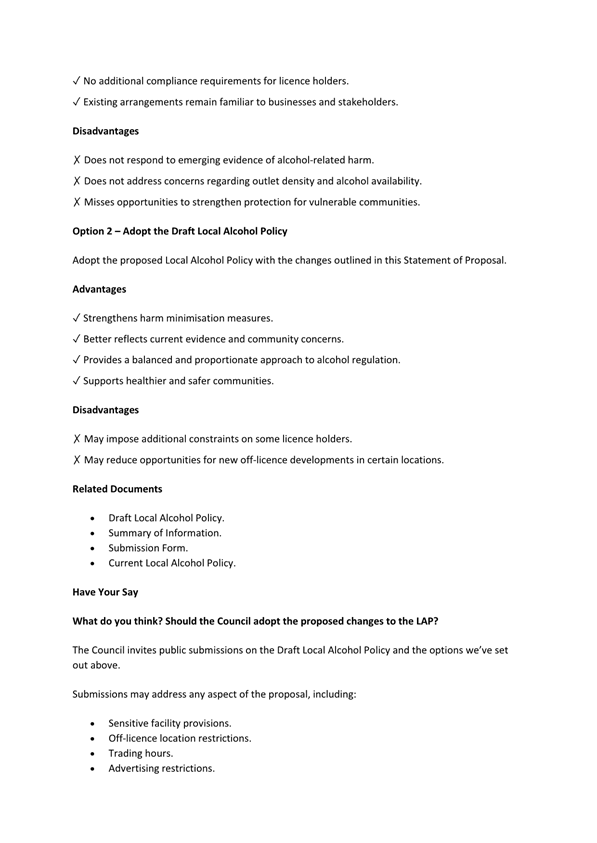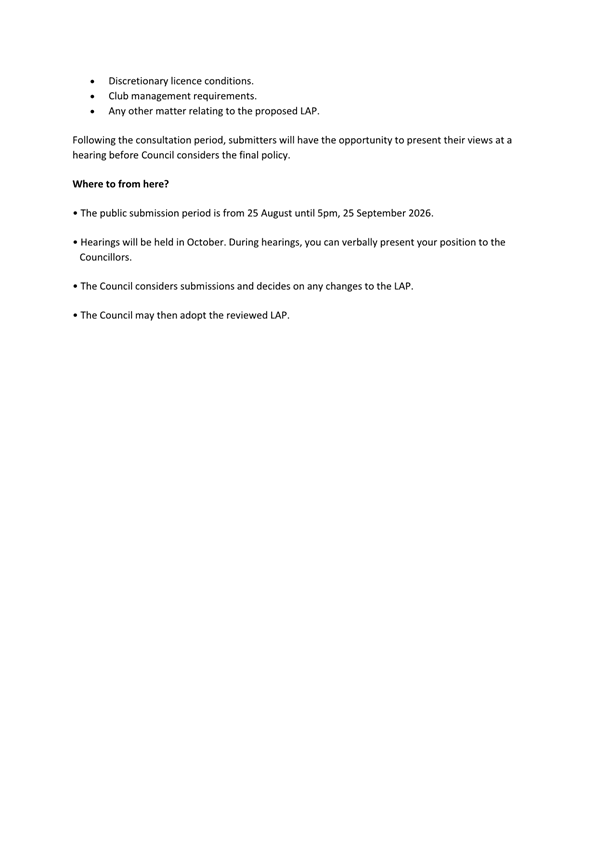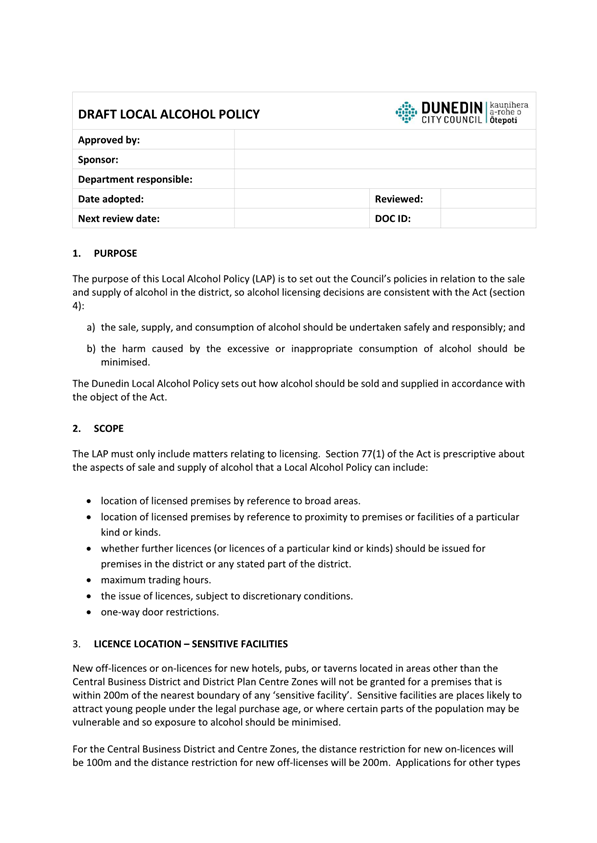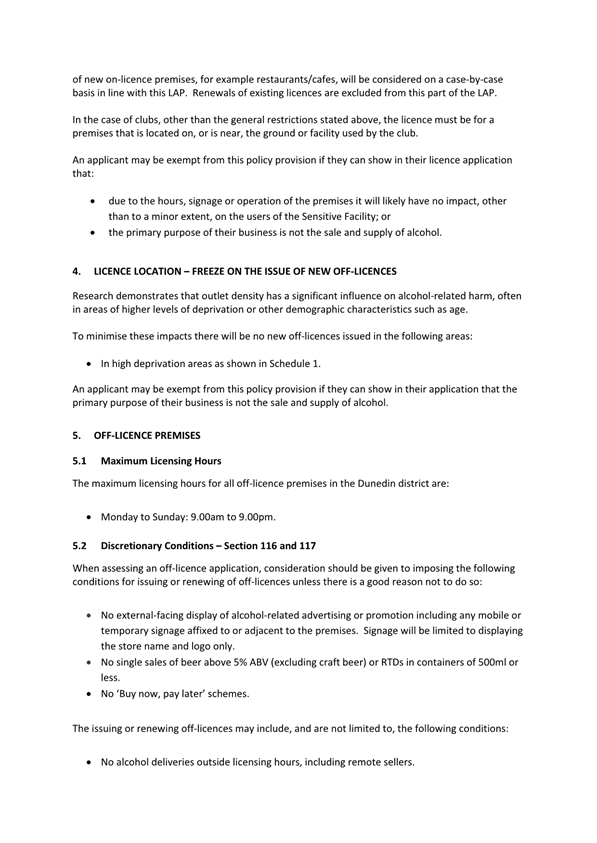
Notice of Meeting:
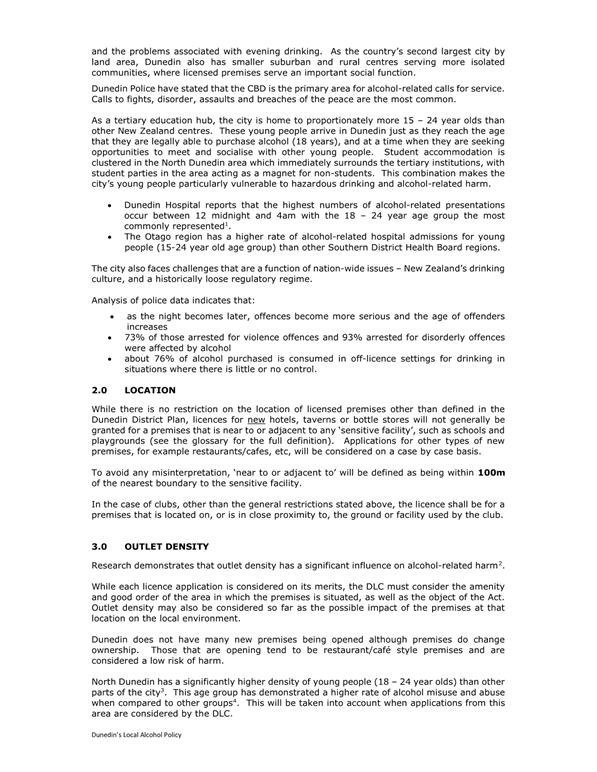
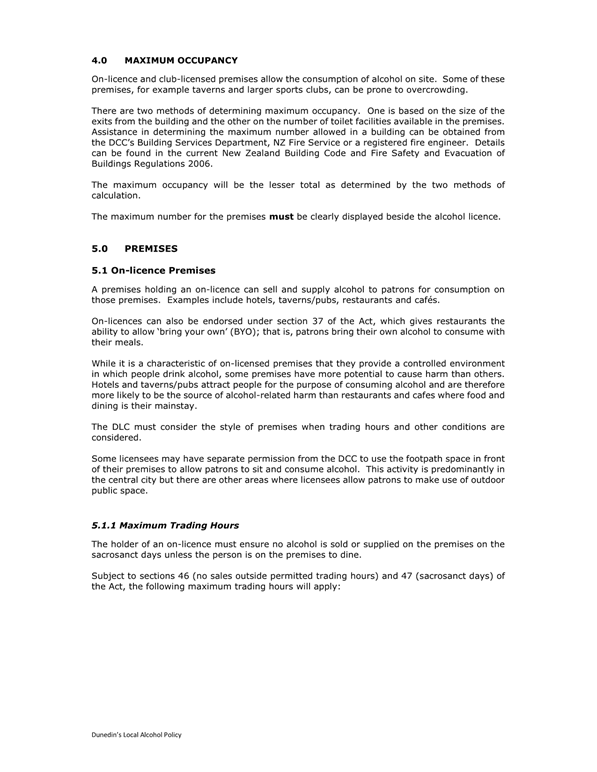
I hereby give notice that an ordinary meeting of the Dunedin
City Council will be held on:
Date: Thursday
13 August 2026
Time: 9.00
am
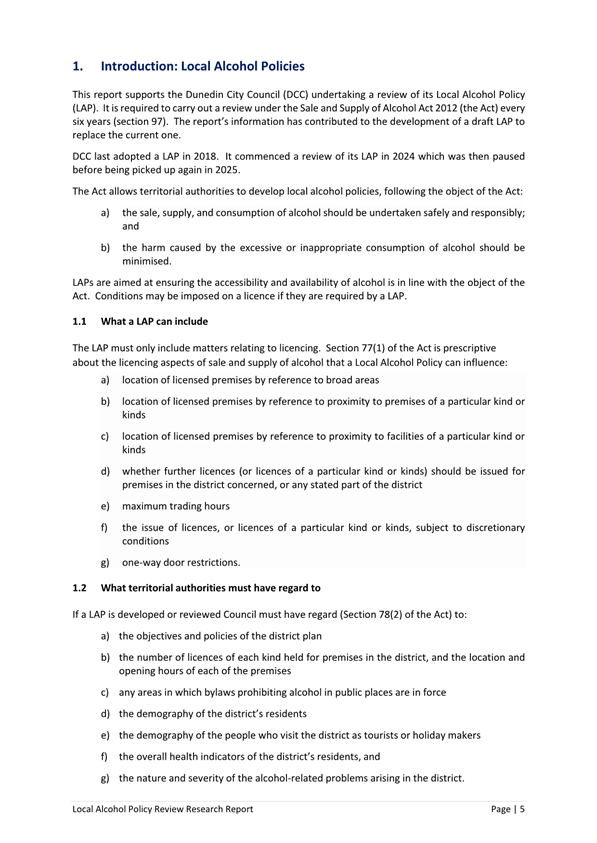
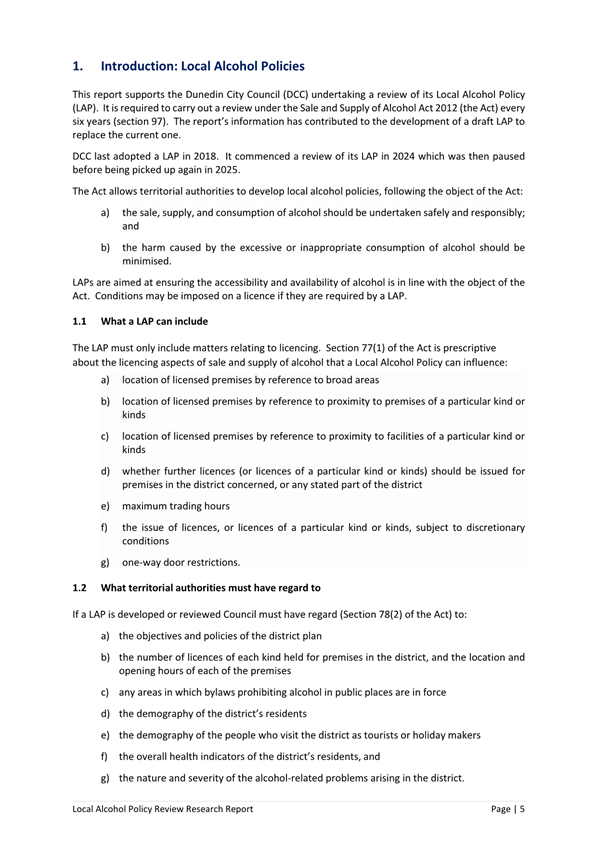
Venue: Council
Chamber, Dunedin Public Art Gallery, the Octagon, Dunedin
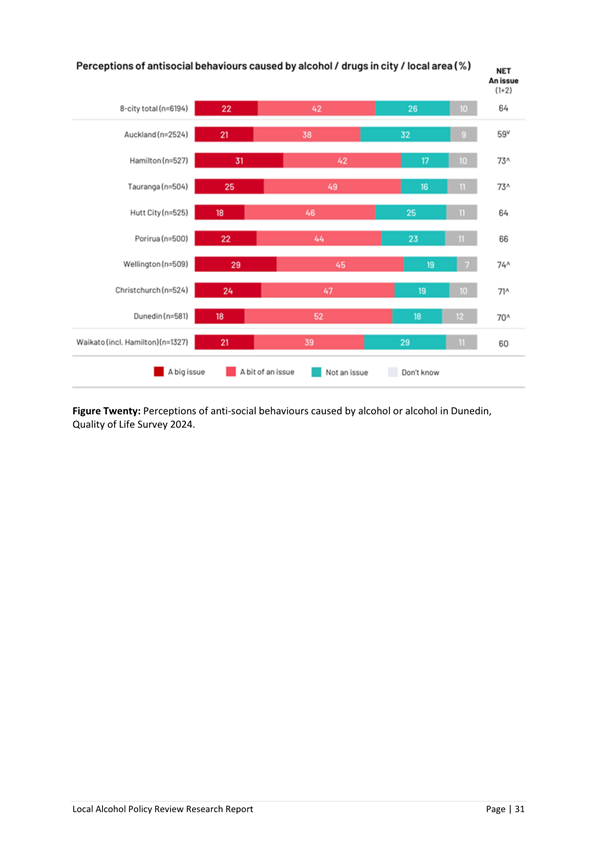
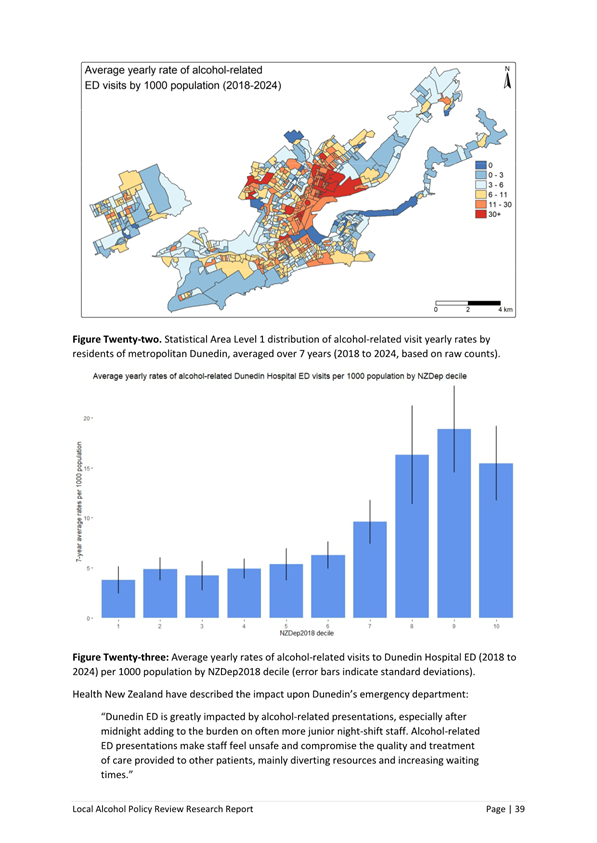
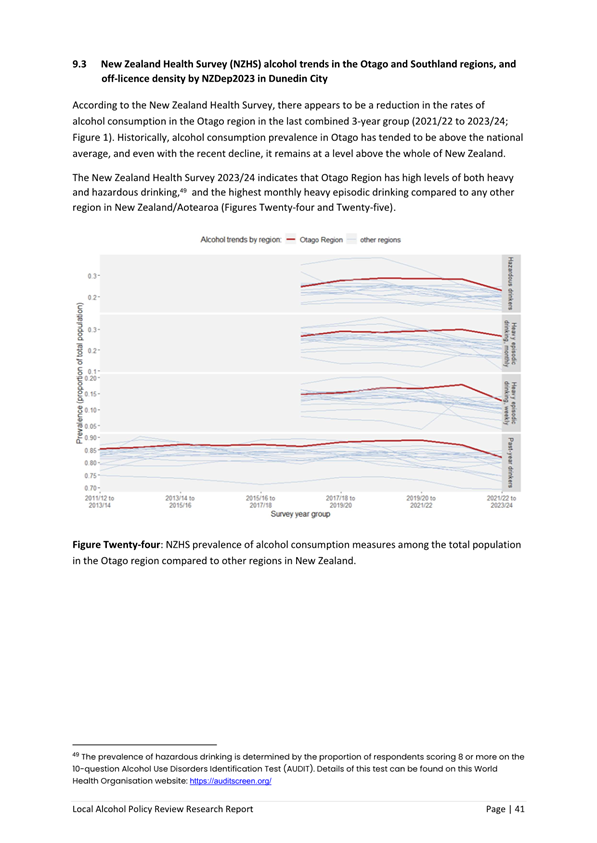
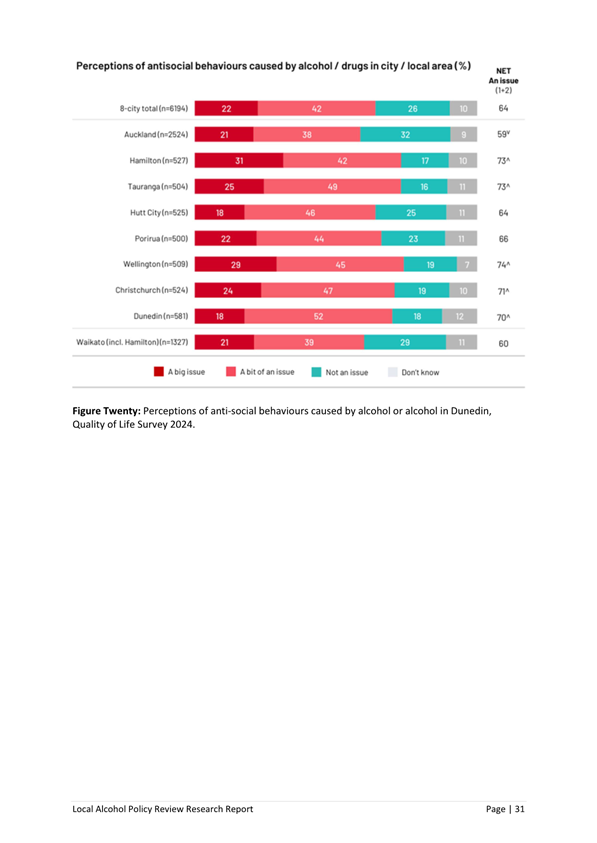
Sandy Graham
Council
PUBLIC AGENDA
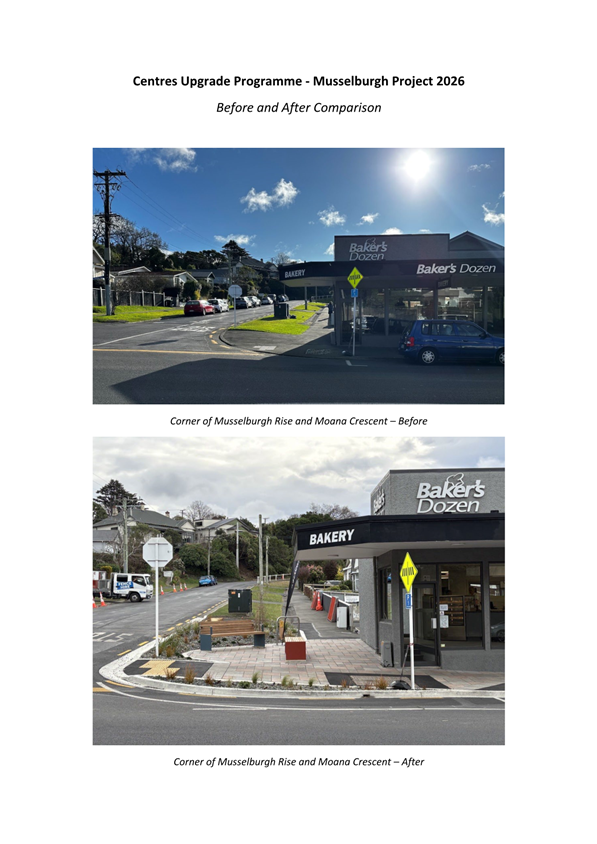
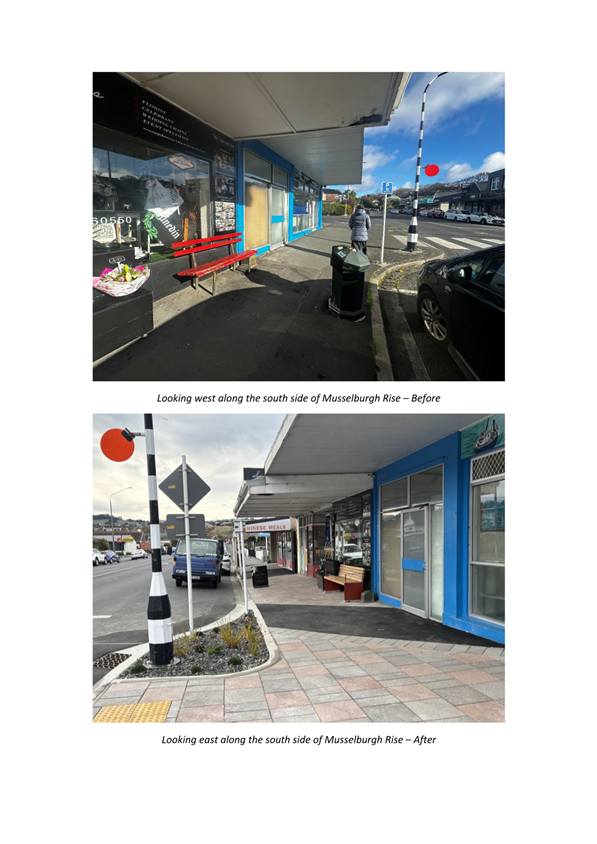
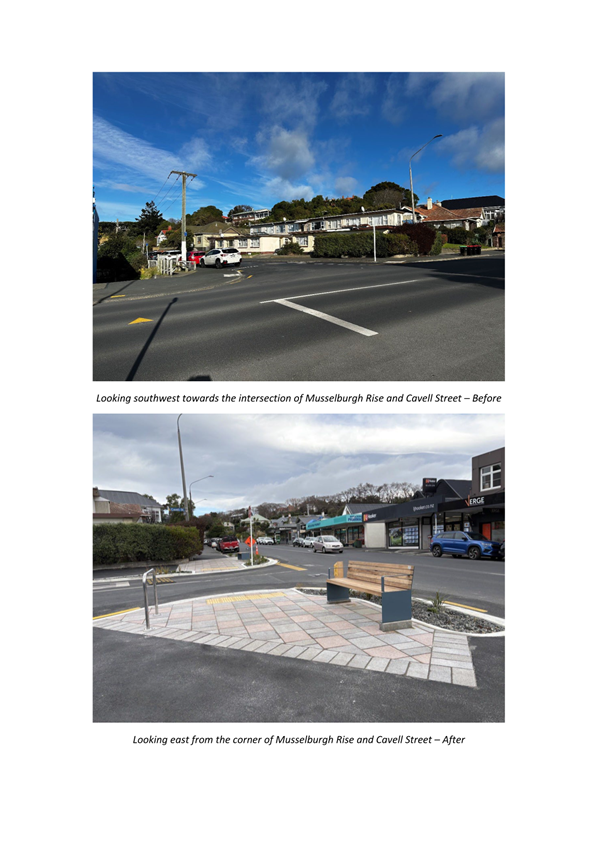
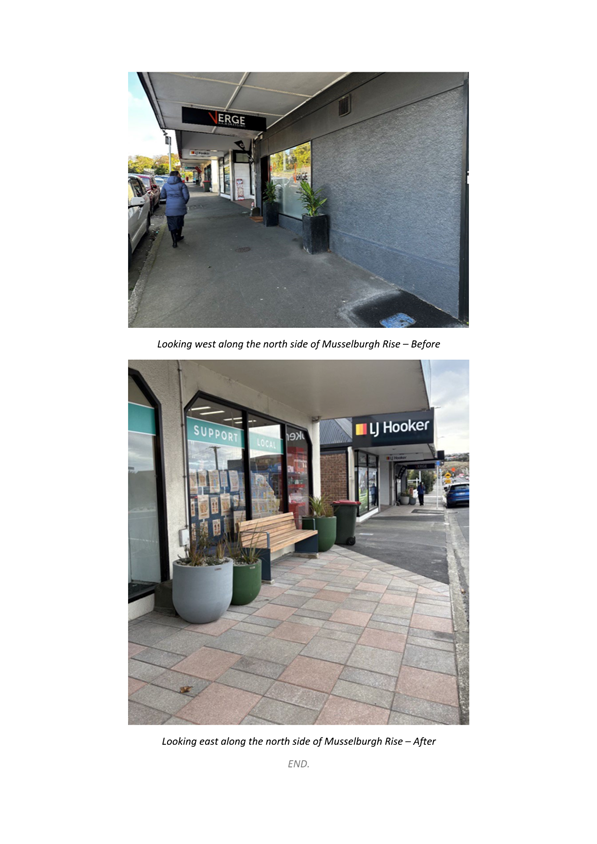
|
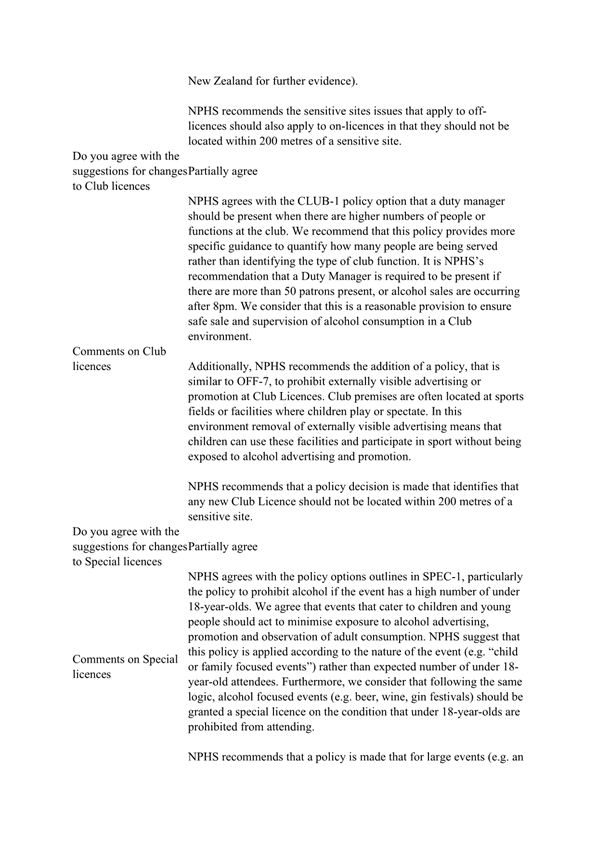
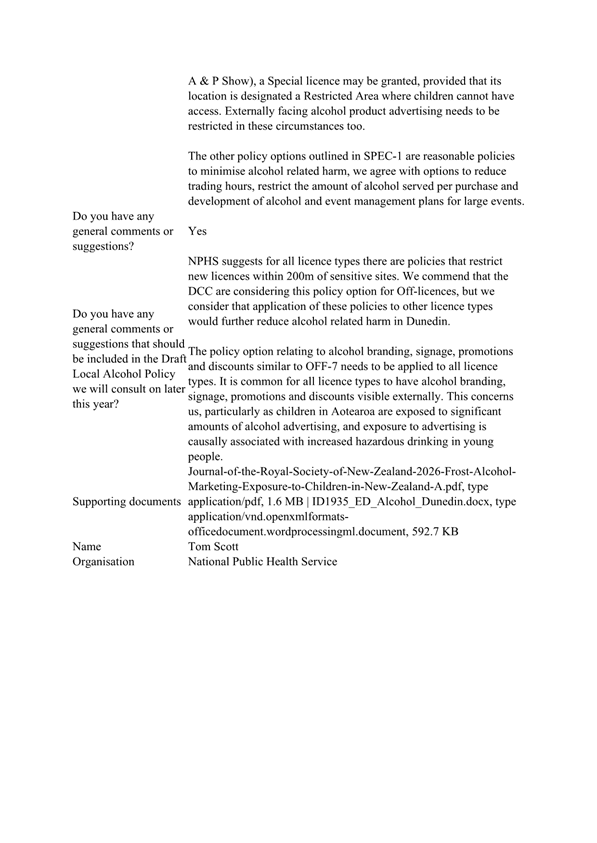
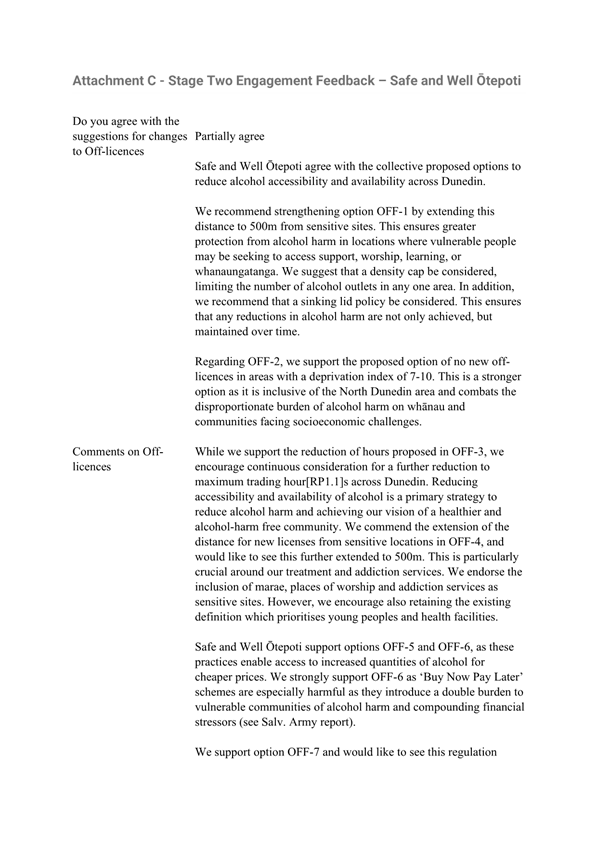
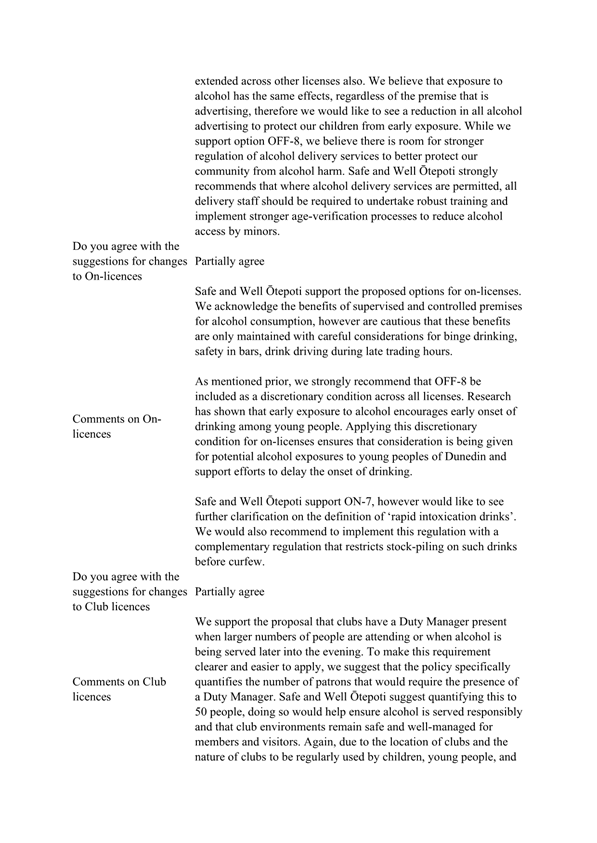
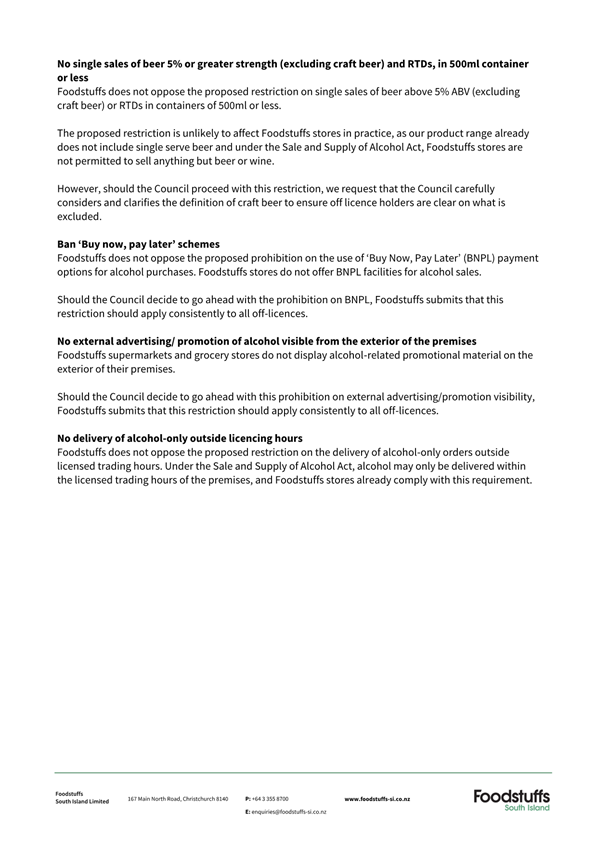
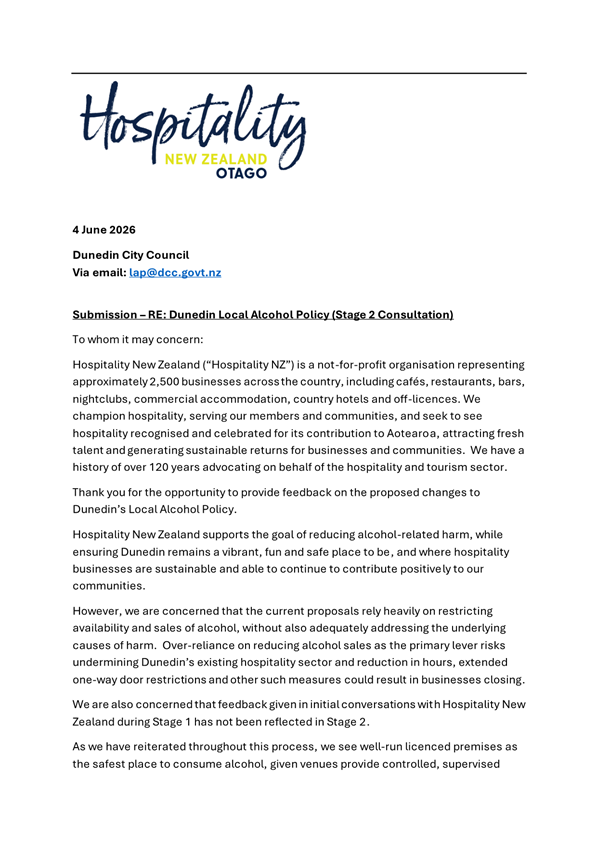
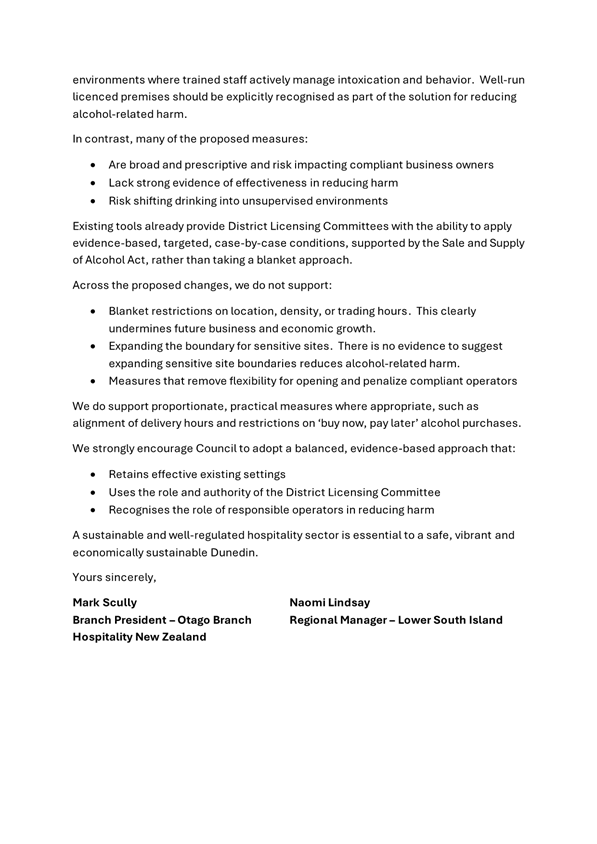
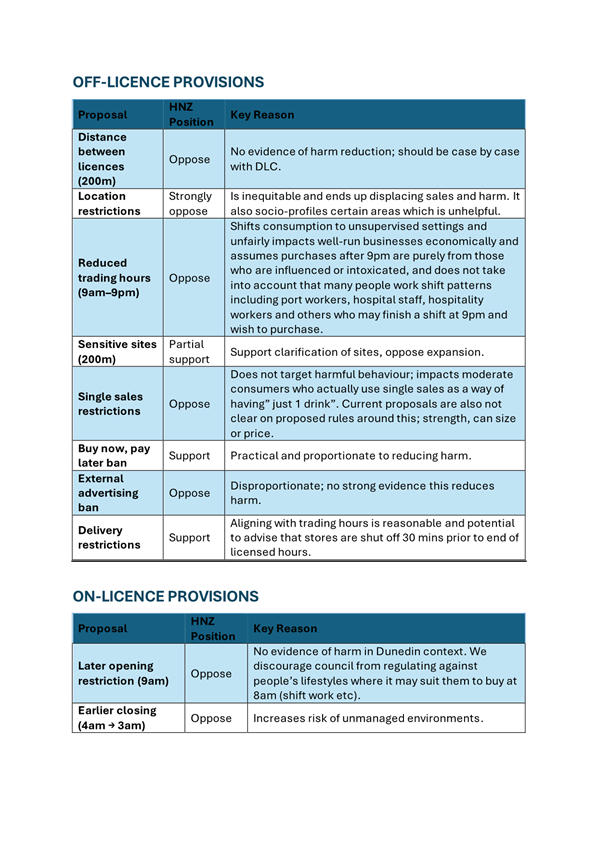
Mayor
|
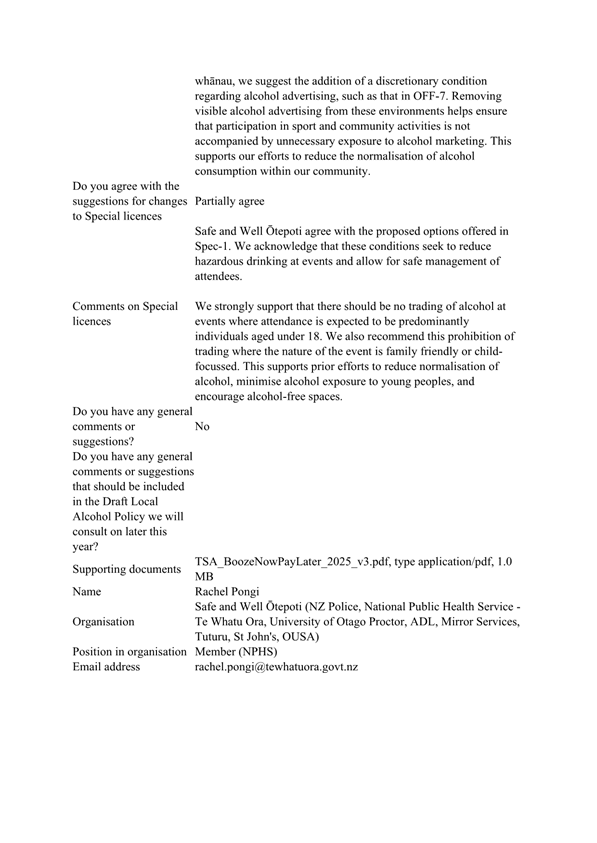
Mayor Sophie Barker
|
|
|
Deputy Mayor
|
Cr Cherry Lucas
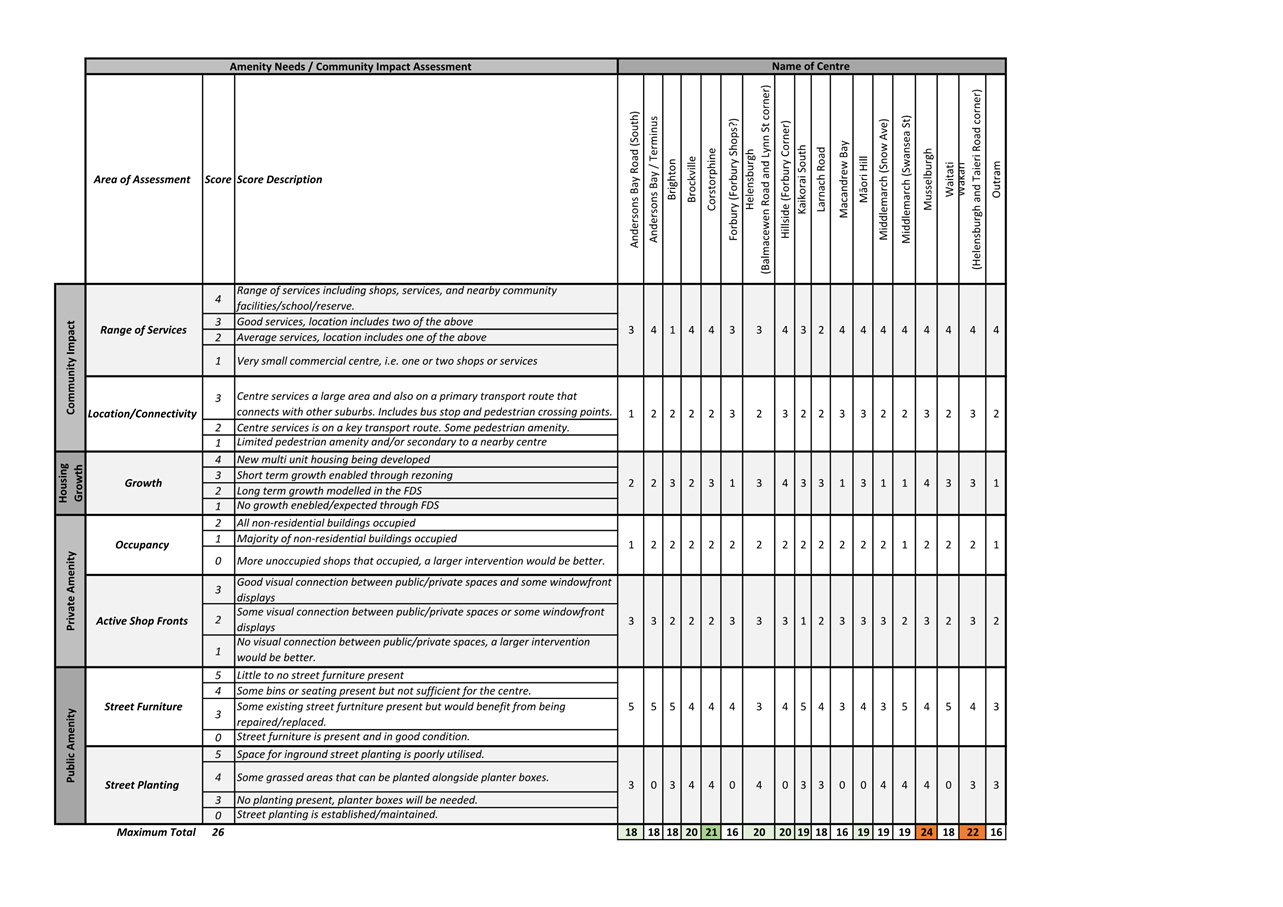
|
|
|
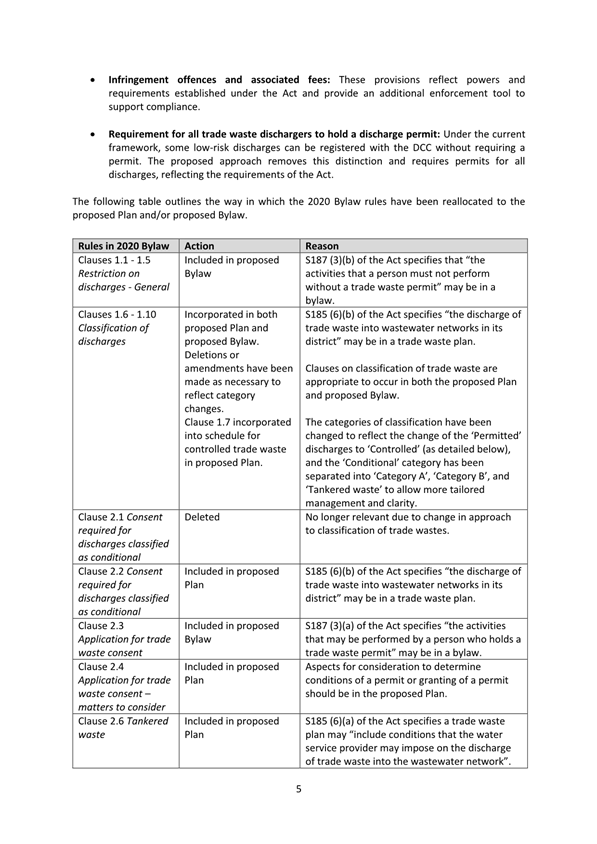
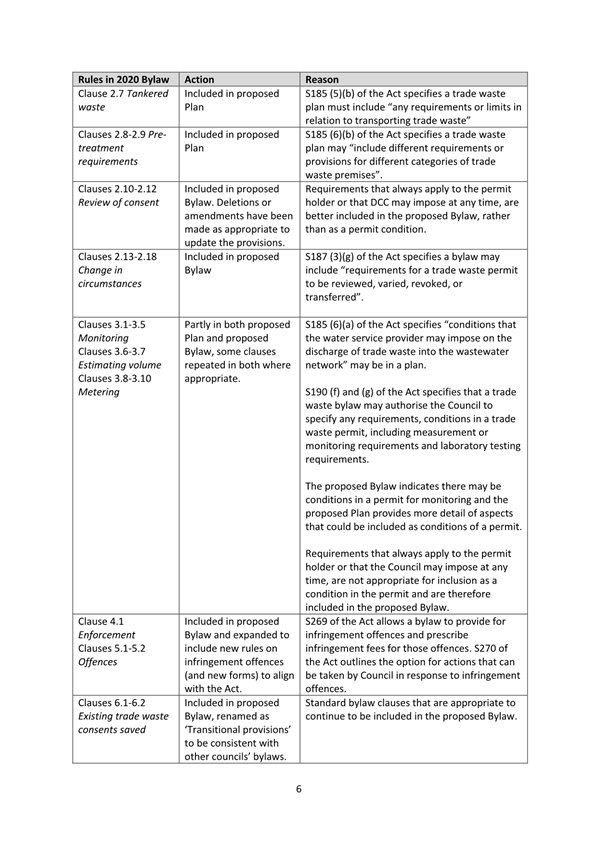
Members
|
Cr John Chambers
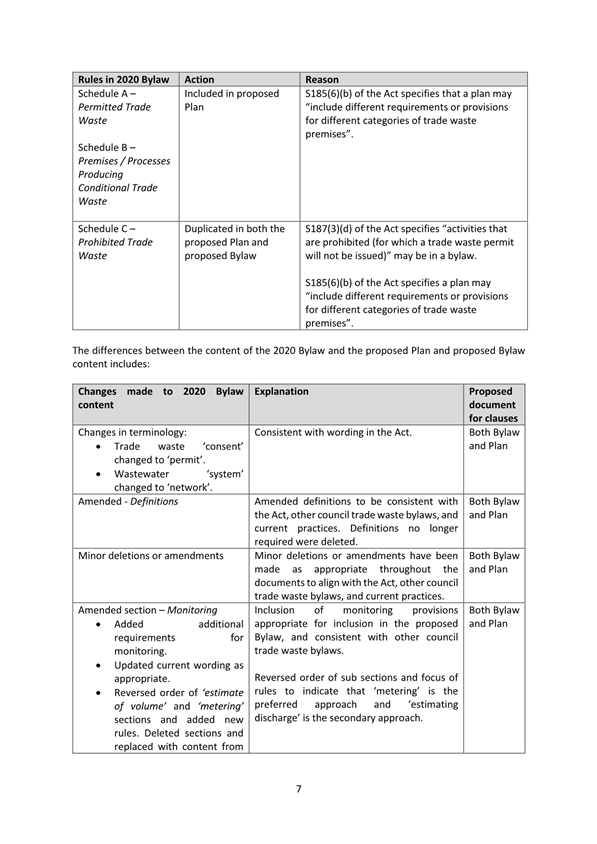
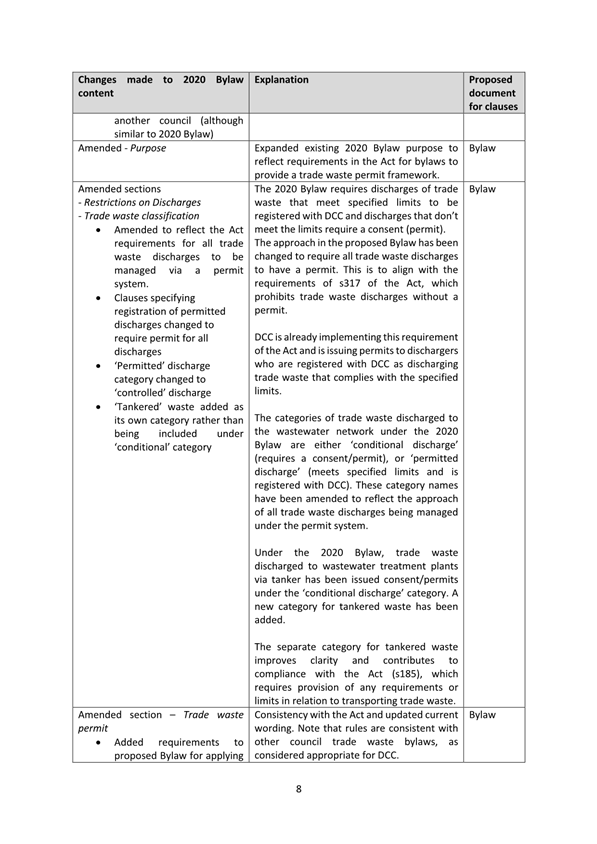
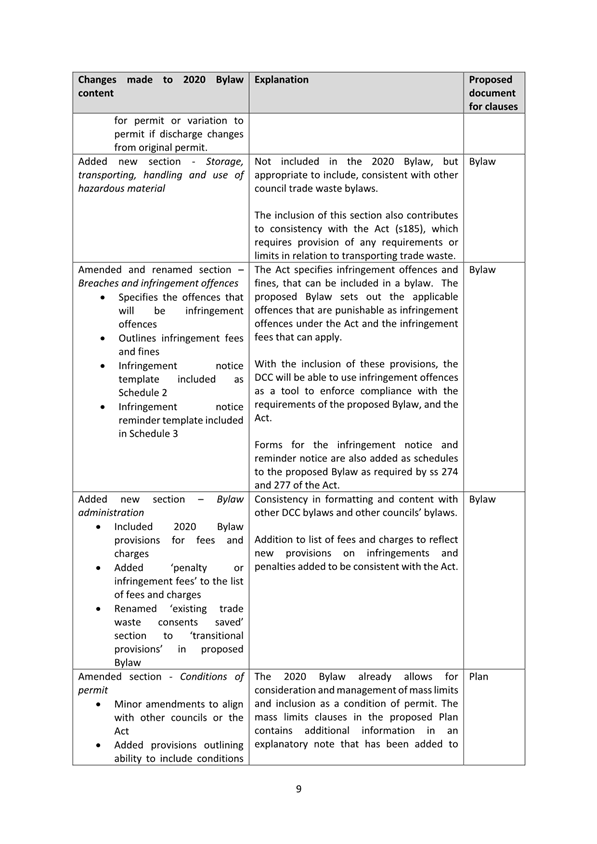
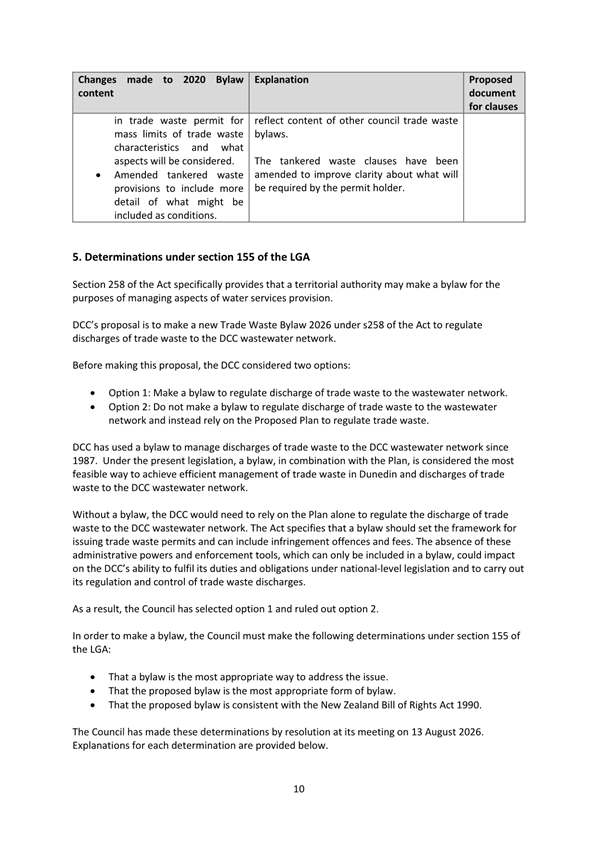
|
Cr Jo Galer
|
|
|
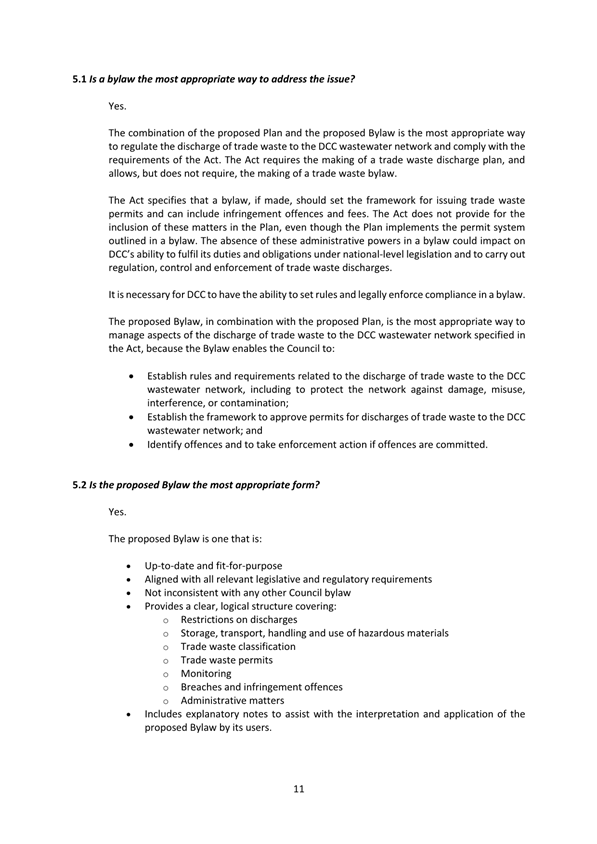
Cr Christine Garey
|
Cr Doug Hall
|
|
|
Cr Marie Laufiso
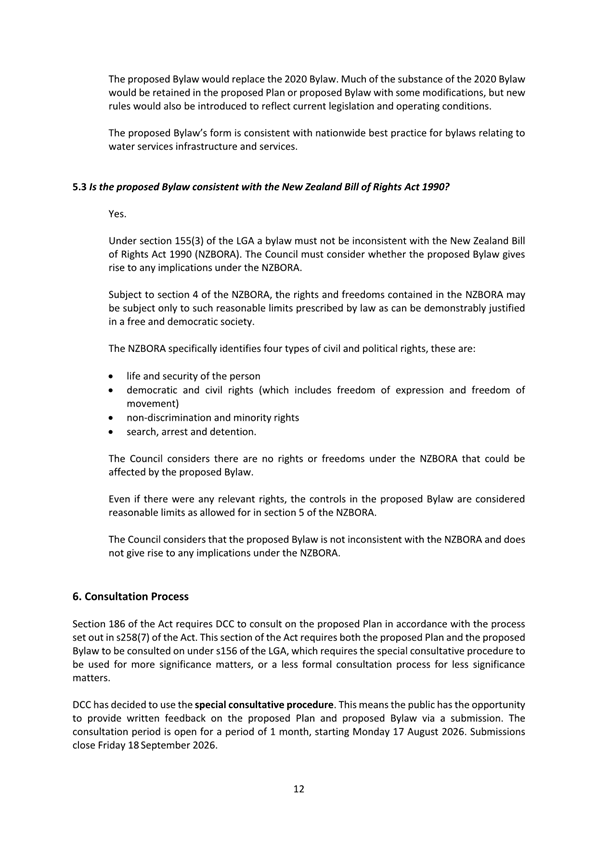
|
Cr Russell Lund
|
|
|
Cr Mandy Mayhem
|
Cr Benedict Ong
|
|
|
Cr Andrew Simms
|
Cr Mickey Treadwell
|
|
|
Cr Lee Vandervis
|
Cr Steve Walker
|
|
|
Cr Brent Weatherall
|
|
Senior Officer Sandy
Graham, Chief Executive
Governance Support Officer Lynne
Adamson
Lynne Adamson
Governance Support Officer
Telephone: 03 477 4000
governance.support@dcc.govt.nz
www.dunedin.govt.nz
Note: Reports
and recommendations contained in this agenda are not to be considered as Council
policy until adopted.
|

|
Council
13 August 2026
|
ITEM TABLE OF CONTENTS PAGE
1 Opening 4
2 Public
Forum 4
3 Apologies 4
4 Confirmation
of Agenda 4
5 Declaration
of Interest 5
Reports
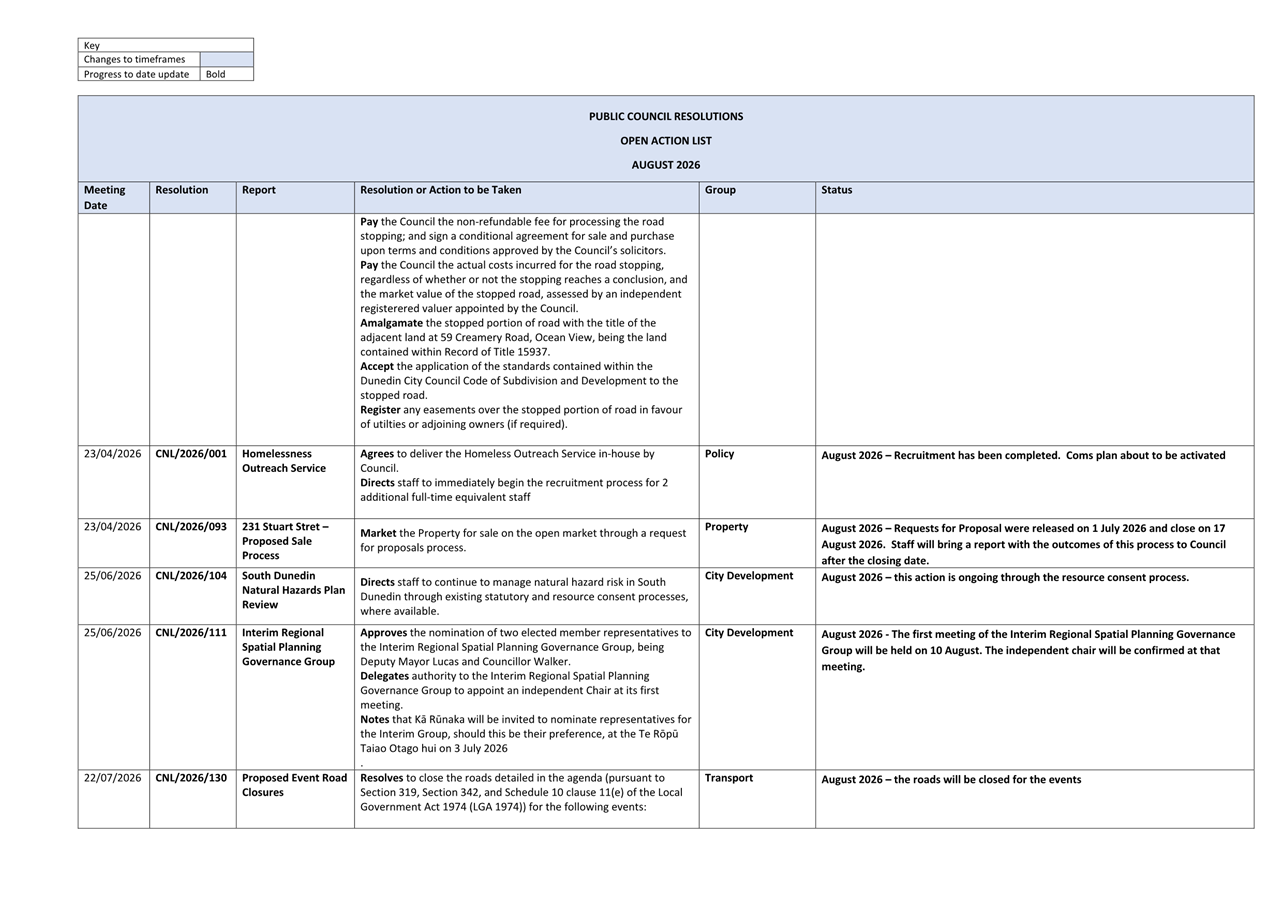
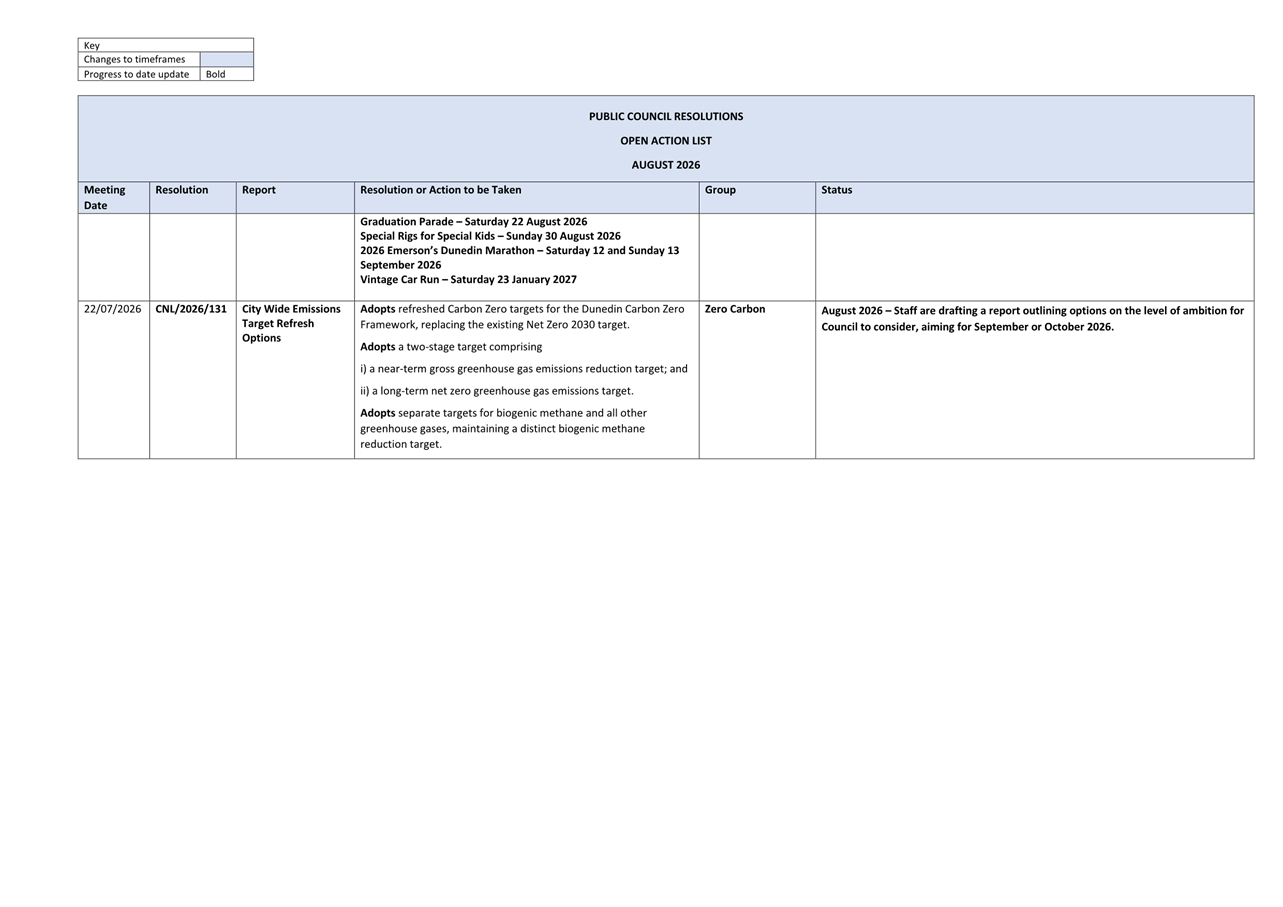
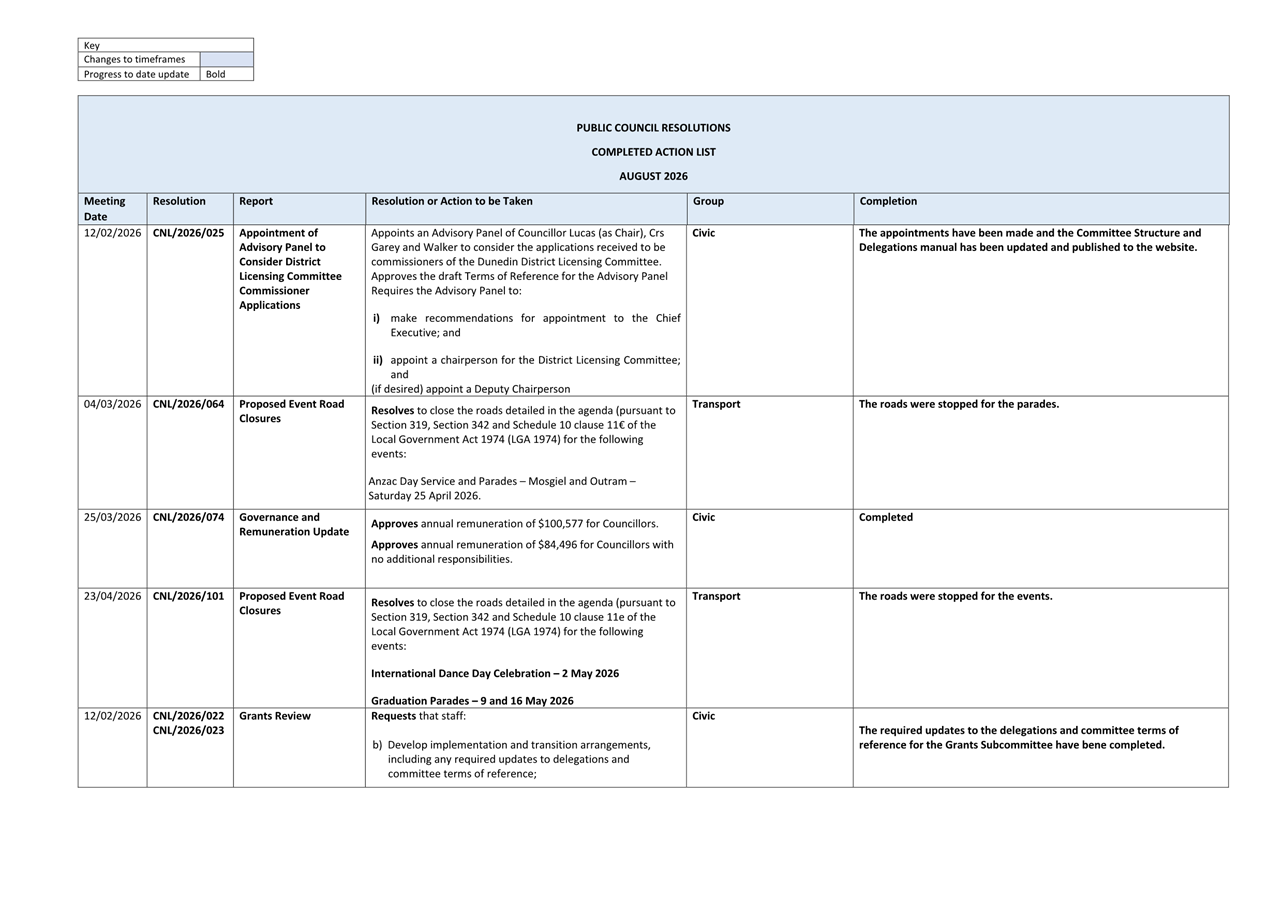
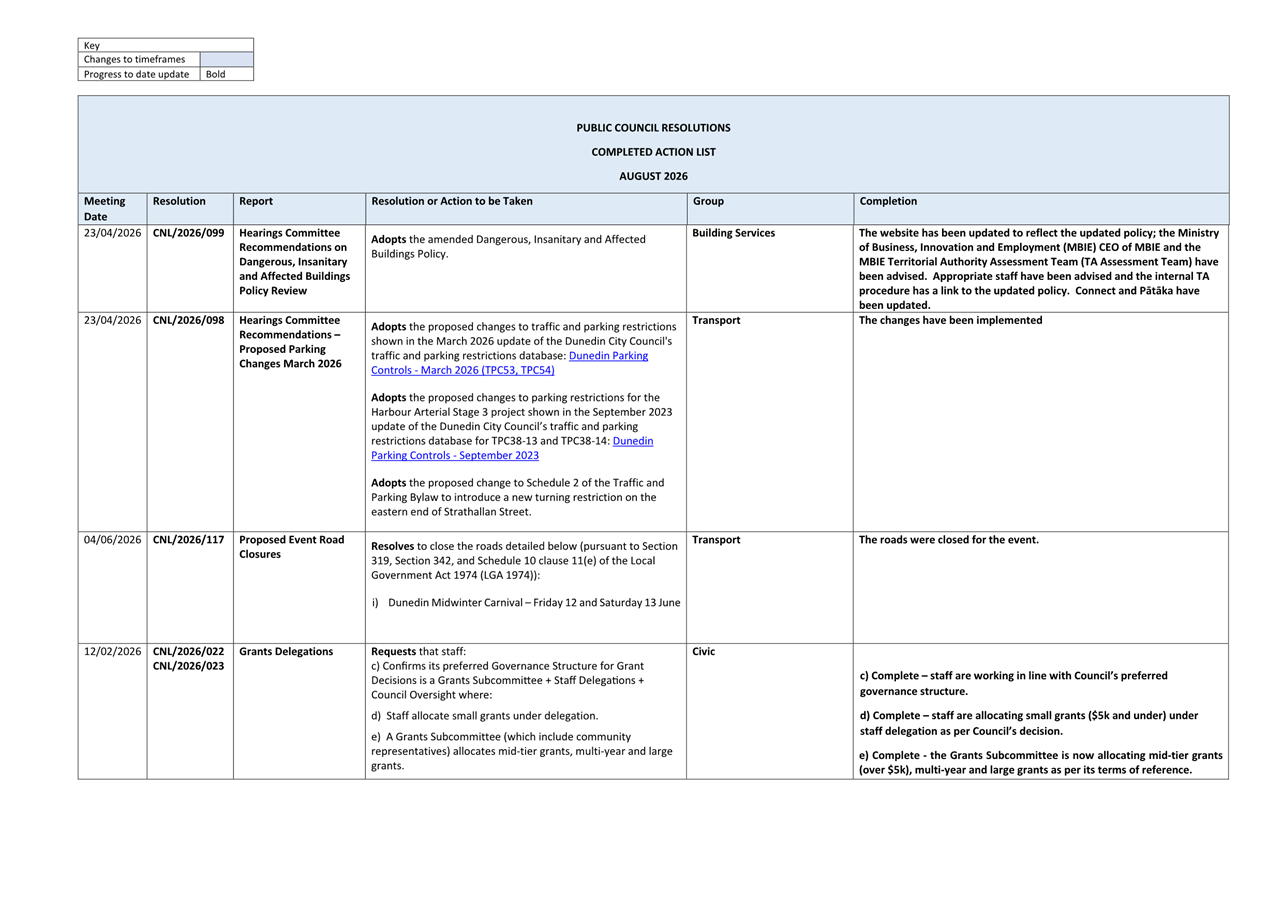
6 Actions
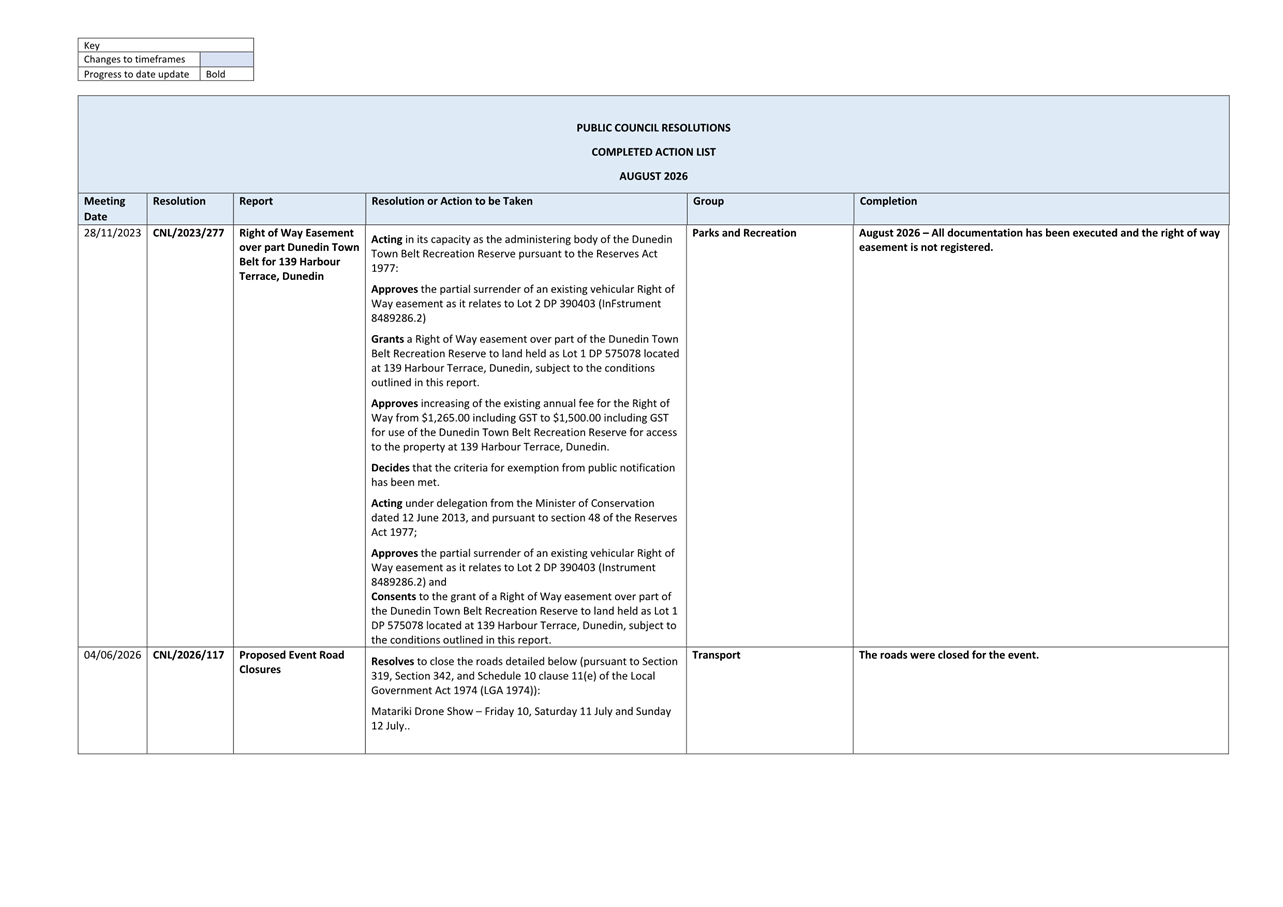
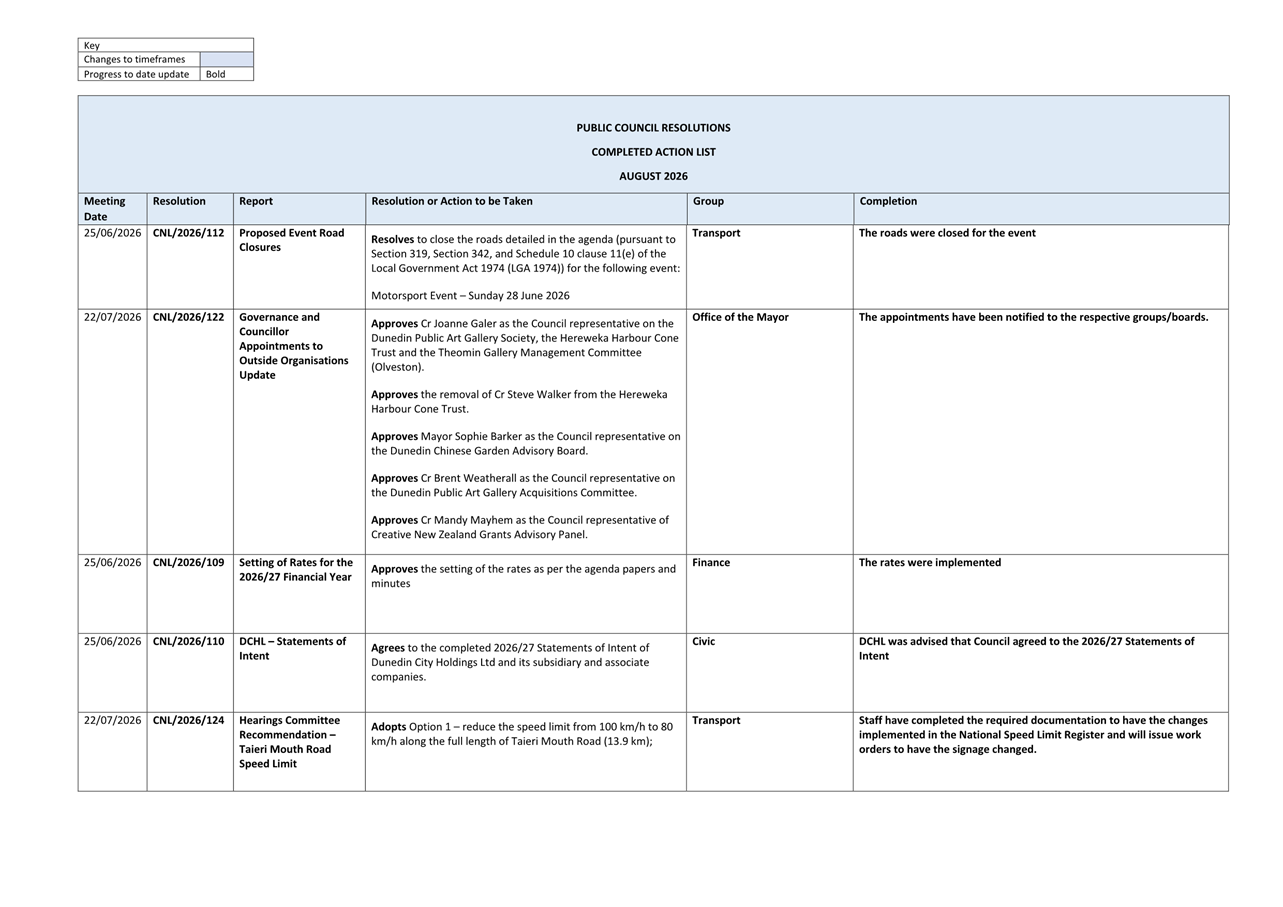
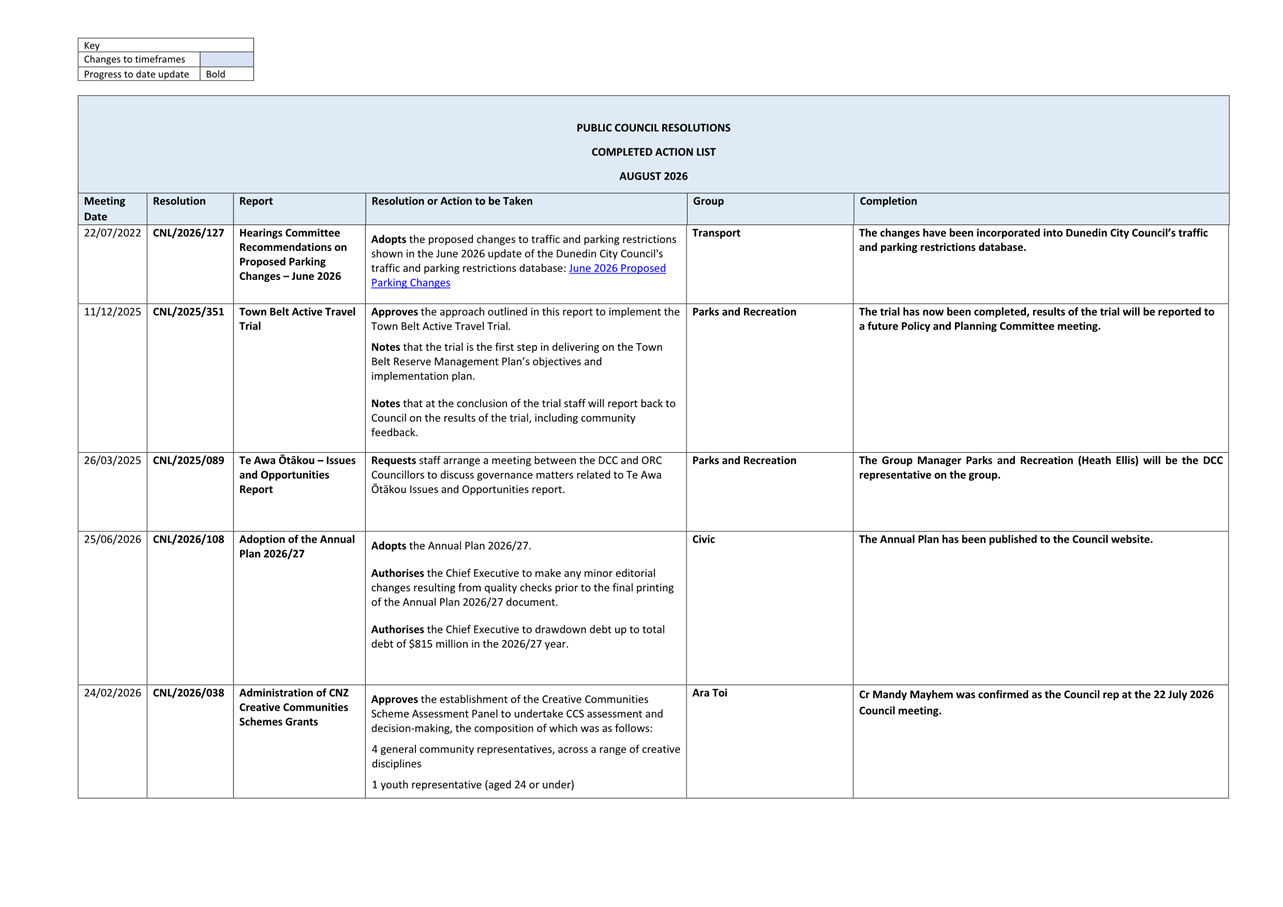
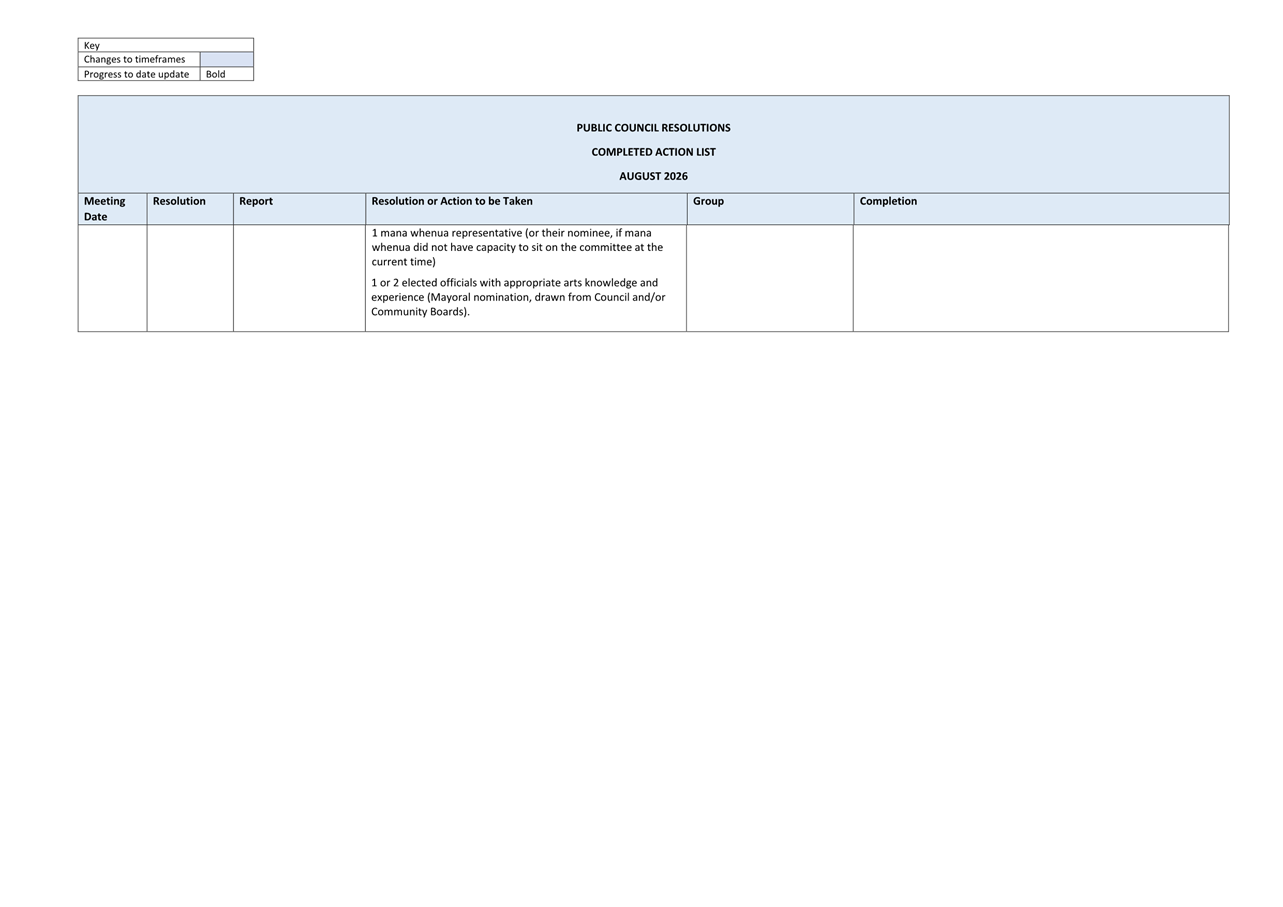
From Resolutions of Council Meetings 16
7 Centres
Upgrade Programme 27
8 Proposed
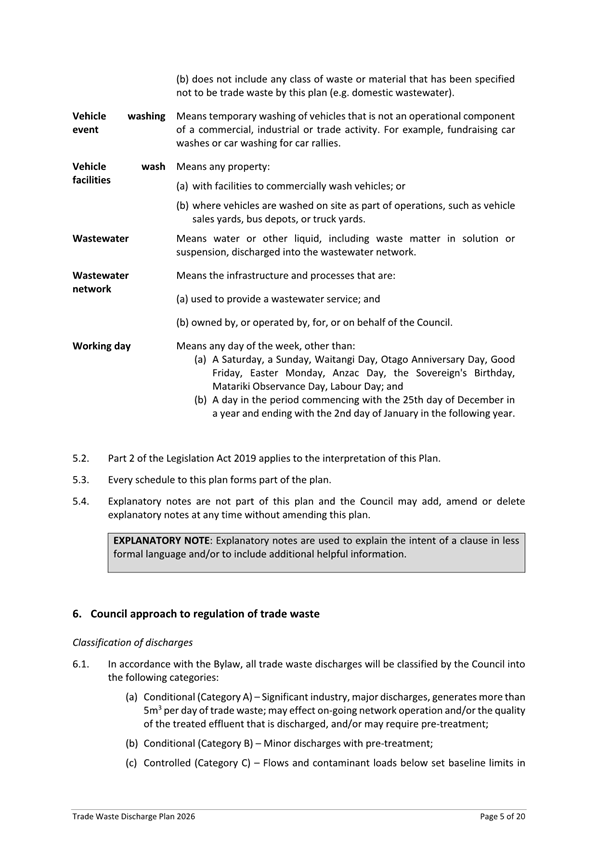
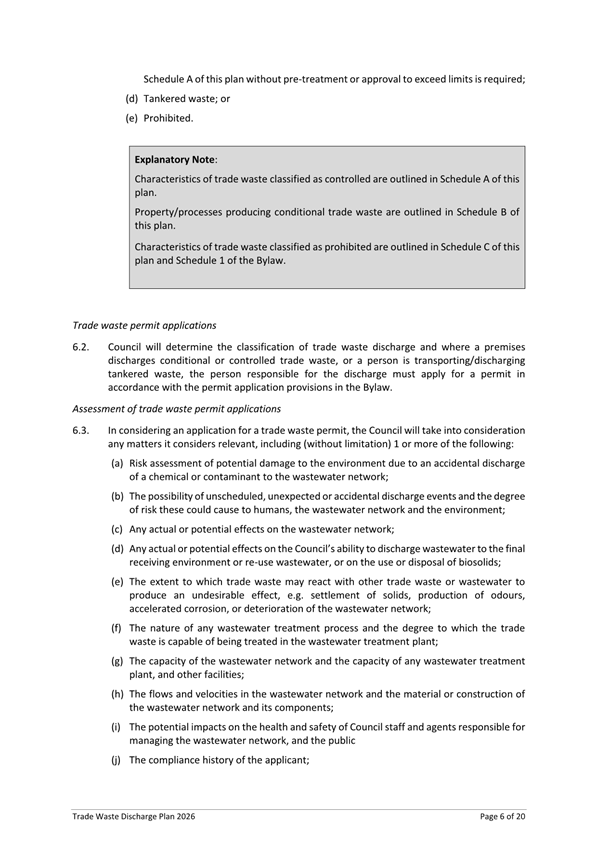
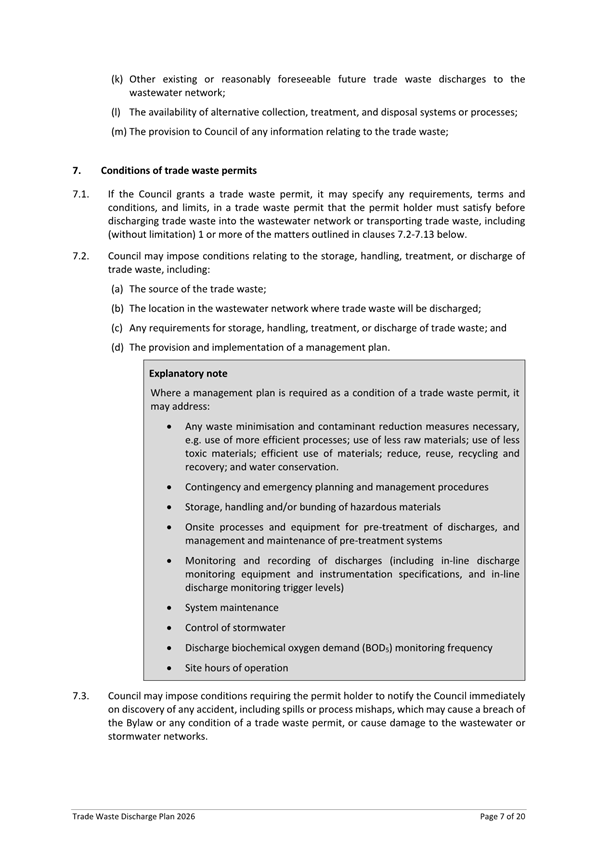
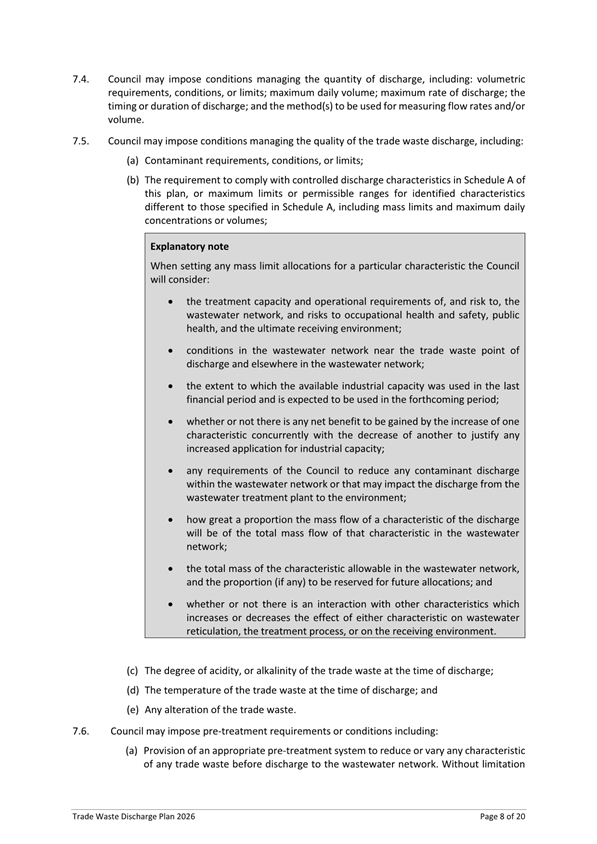
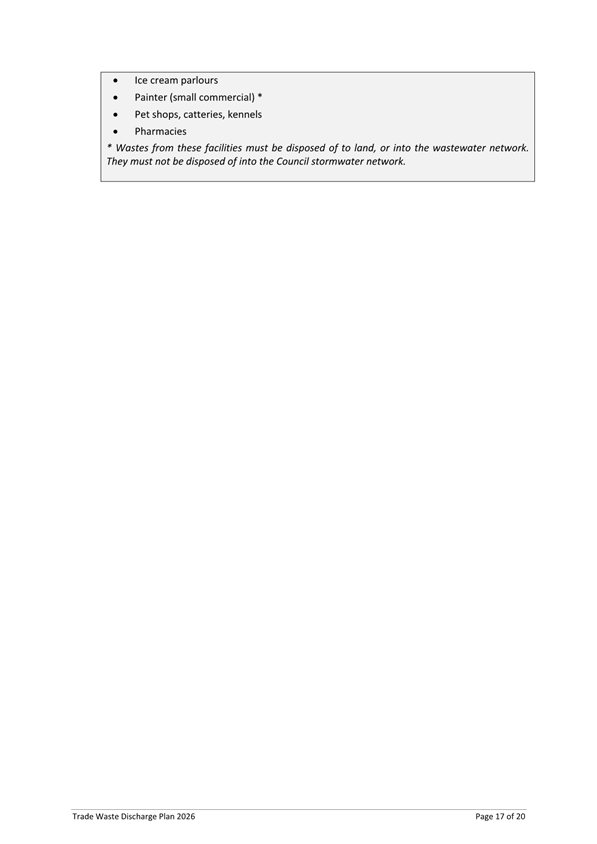
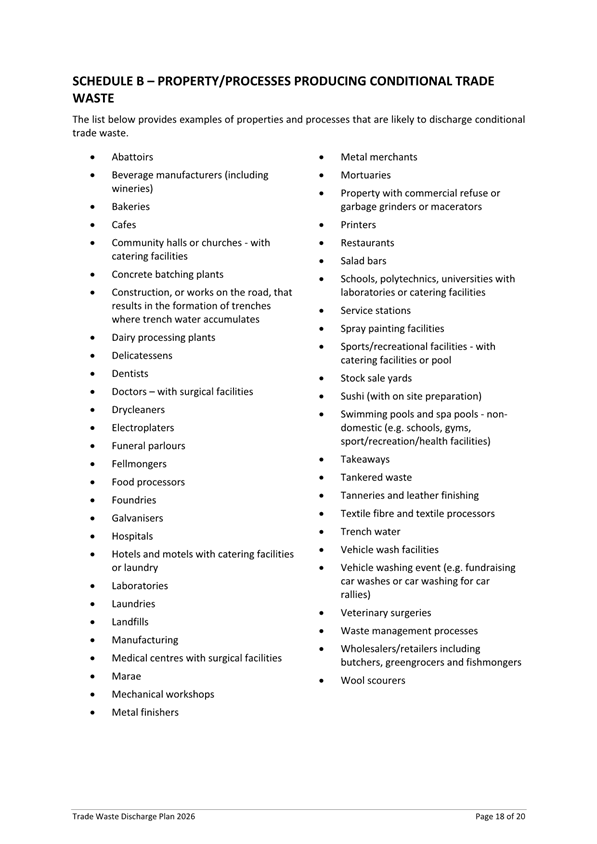
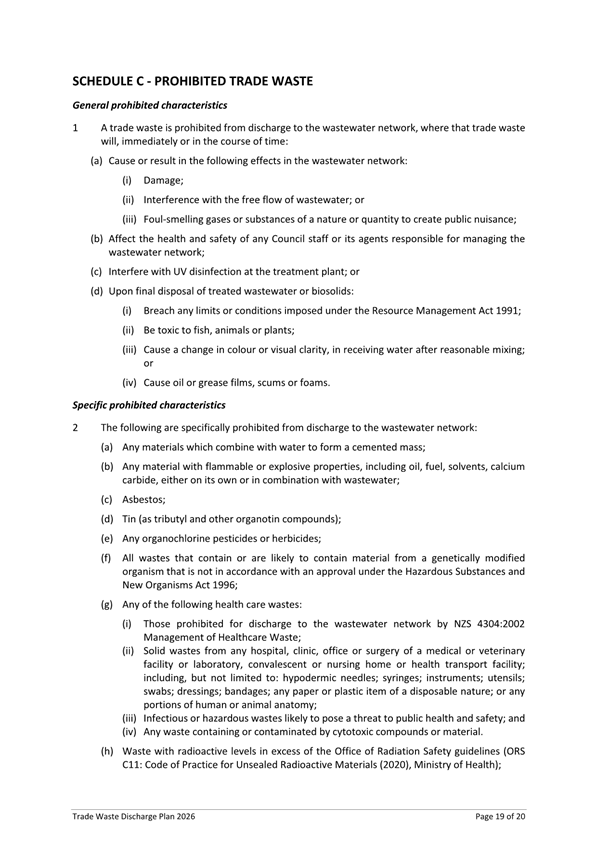
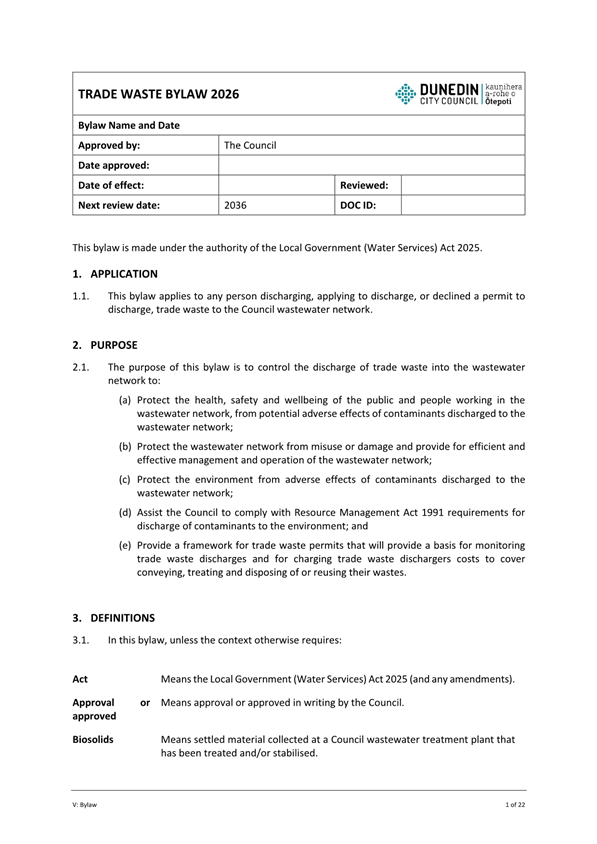
Trade Waste Discharge Plan 2026 and Proposed Trade Waste Bylaw 2026 45
9 Draft
Local Alcohol Policy 115
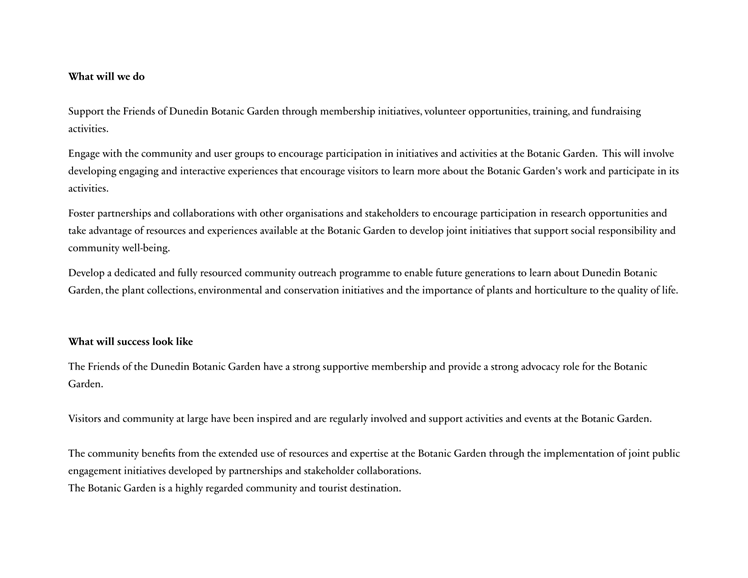
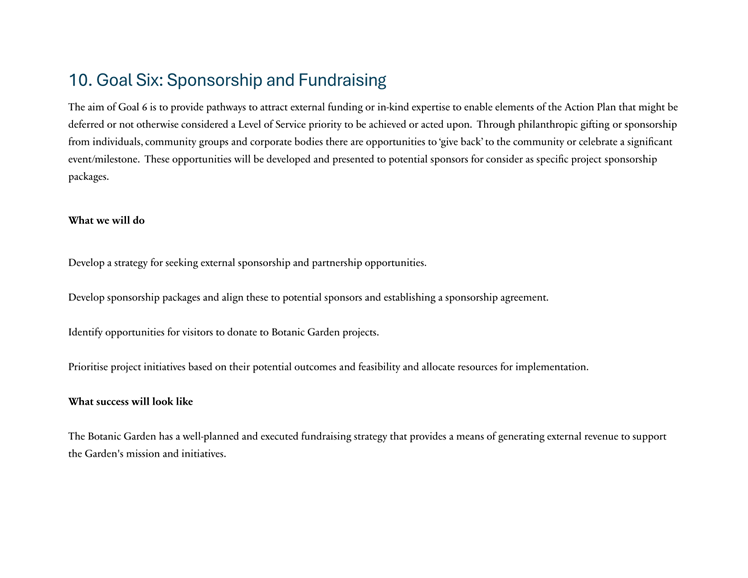
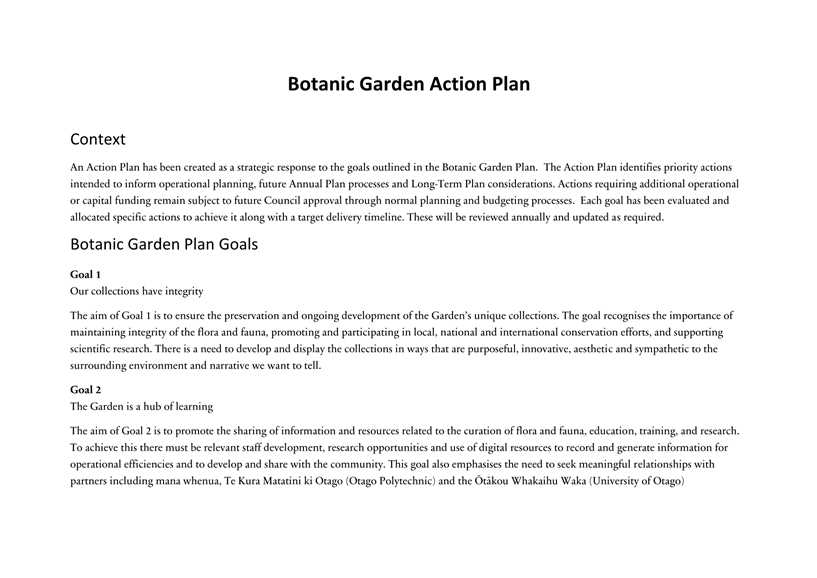
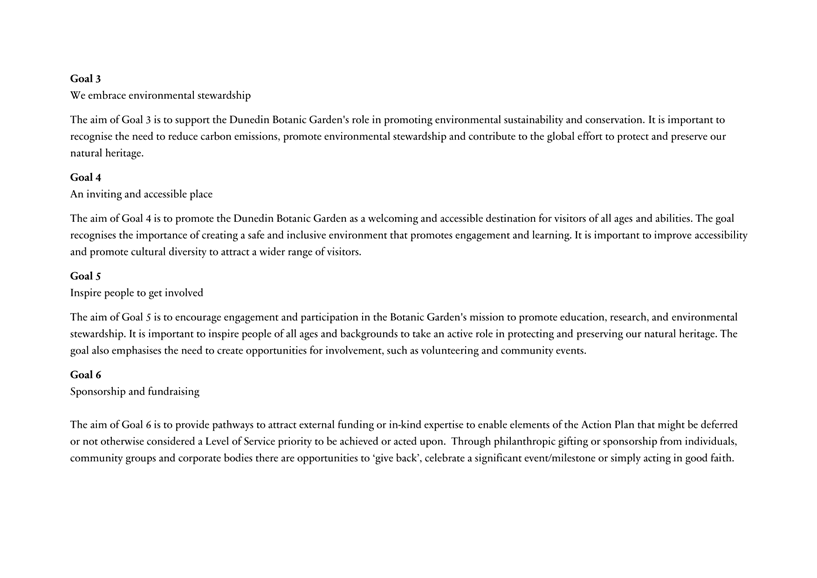
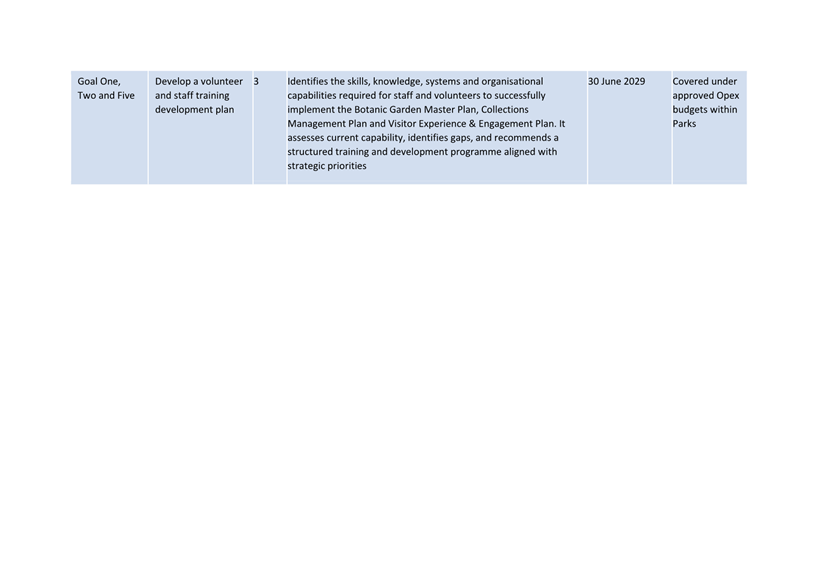
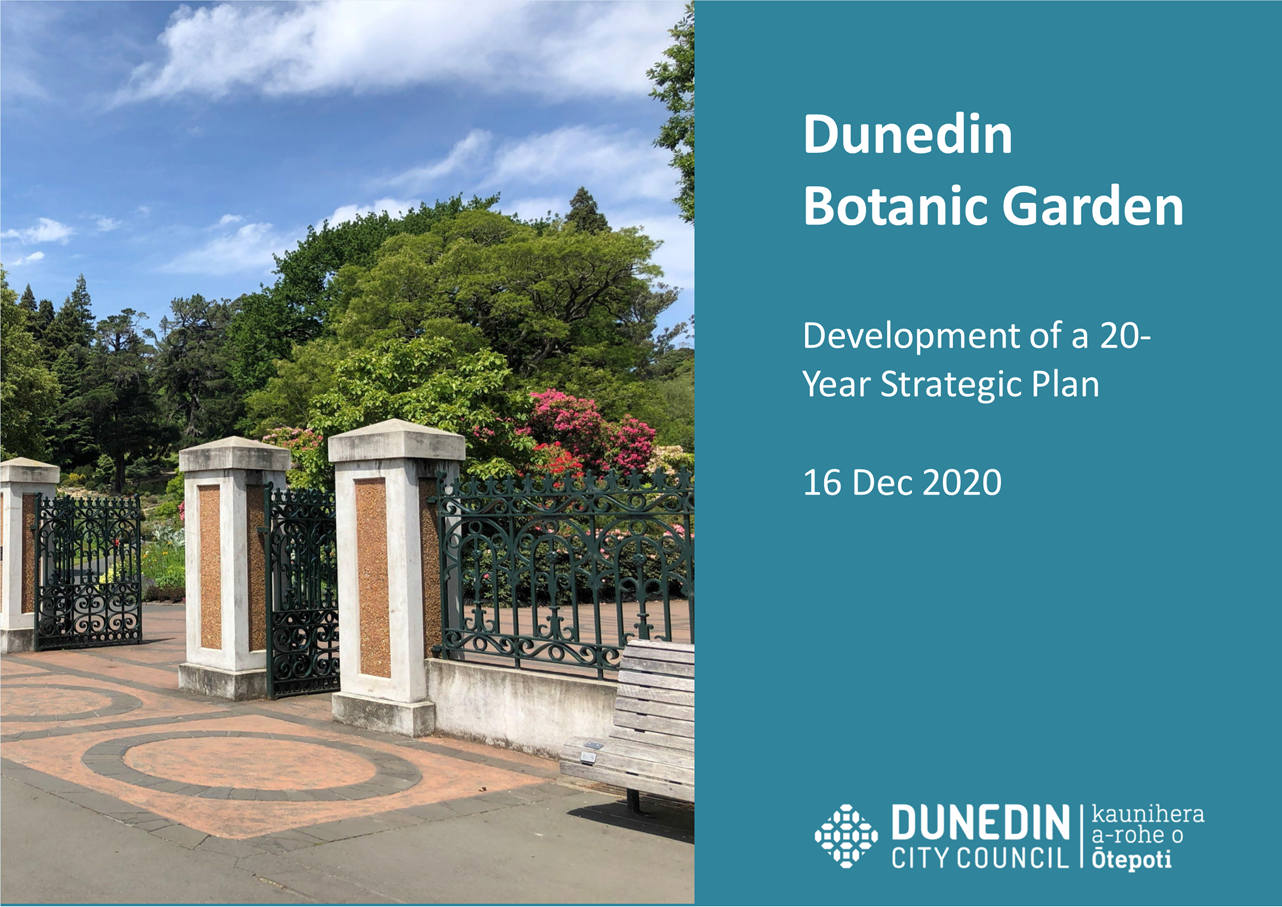
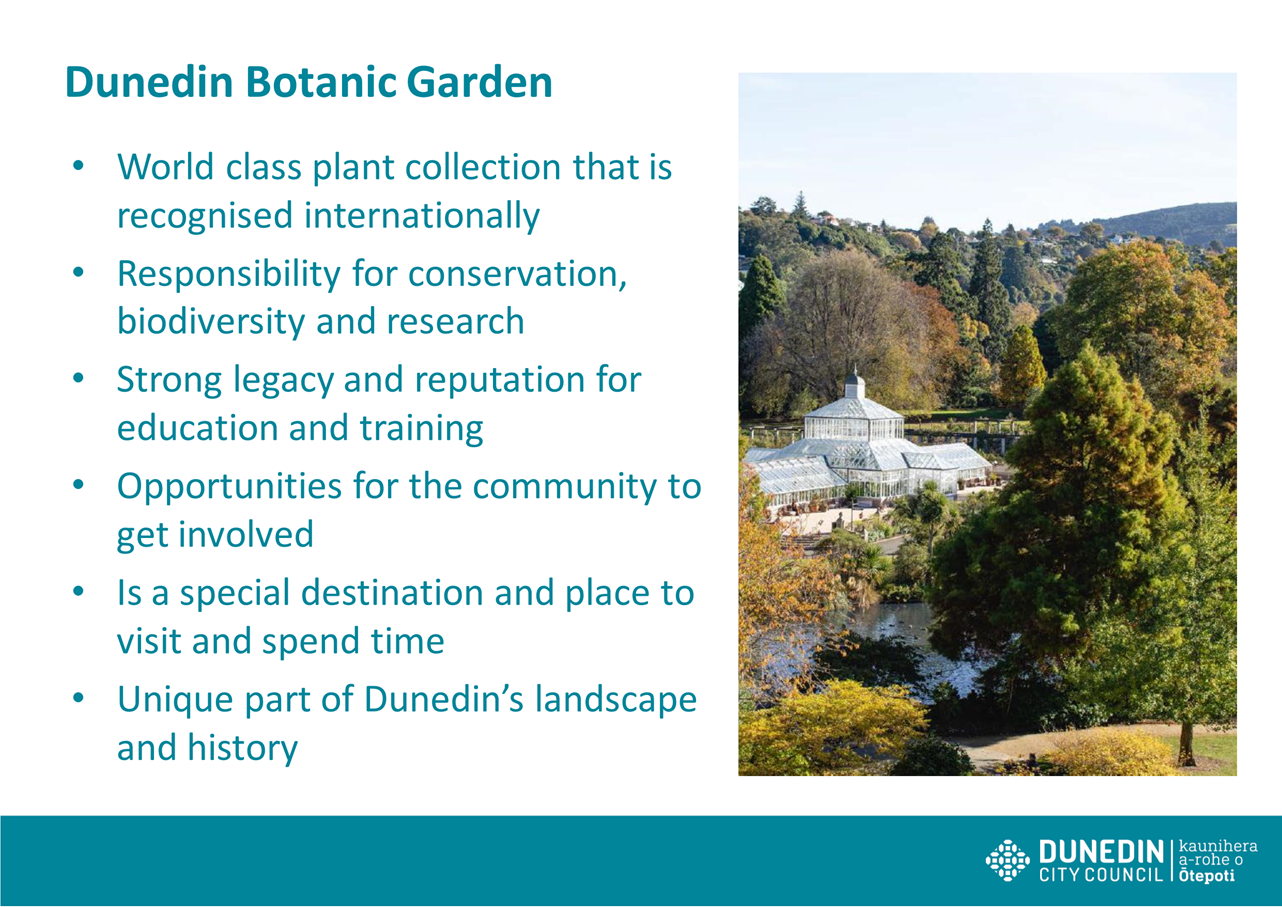
10 Botanic
Garden Plan 270
11 Future
Development Strategy Implementation Plan update 2026 324
12 Proposed
Event Road Closures 350
Notice of Motion
13 Notice
of Motion - Community Housing 360
Resolution to Exclude the Public 362
|

|
Council
13 August 2026
|
1 Opening
Haizal Mohd Husssaini
and Mohammed Rizwan will open the meeting with a prayer on behalf of the Muslim
community.
2 Public
Forum
At the close of the agenda,
registrations for the Public Forum were still being received. Speakers
will be confirmed once registrations close, which is 24 hours prior to the
meeting – at 9.00 am on Wednesday 12 August 2026.
3 Apologies
An apology has been received
from Cr Cherry Lucas.
That the Council:
Accepts the apology from
Cr Cherry Lucas.
4 Confirmation
of agenda
Note:
Any additions must be approved by resolution with an explanation as to why they
cannot be delayed until a future meeting.
|

|
Council
13 August 2026
|
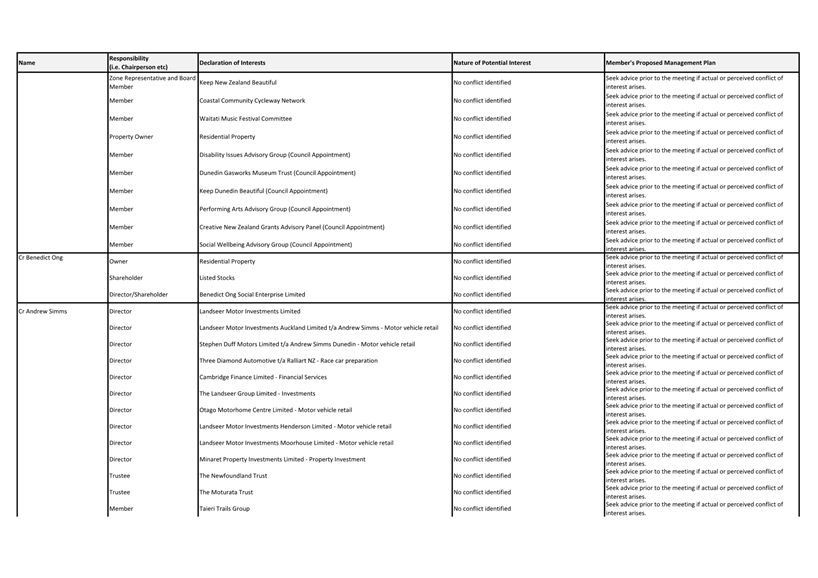
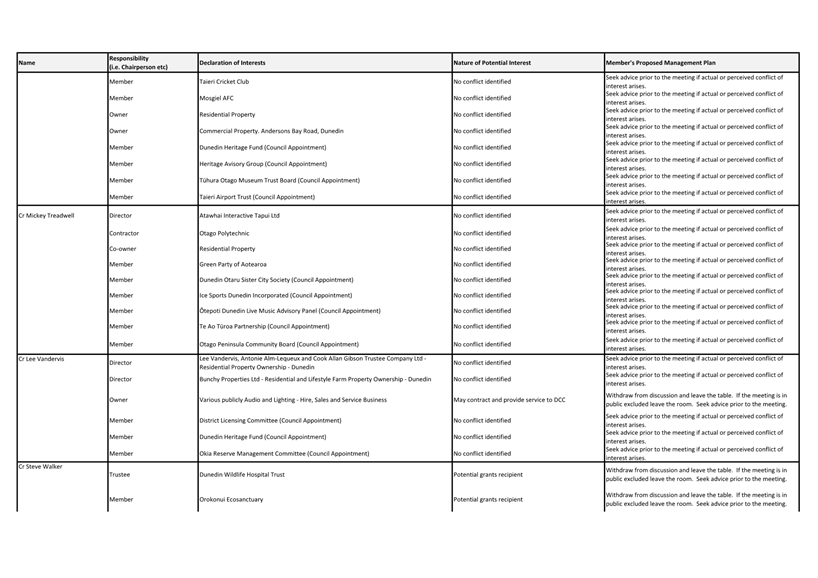
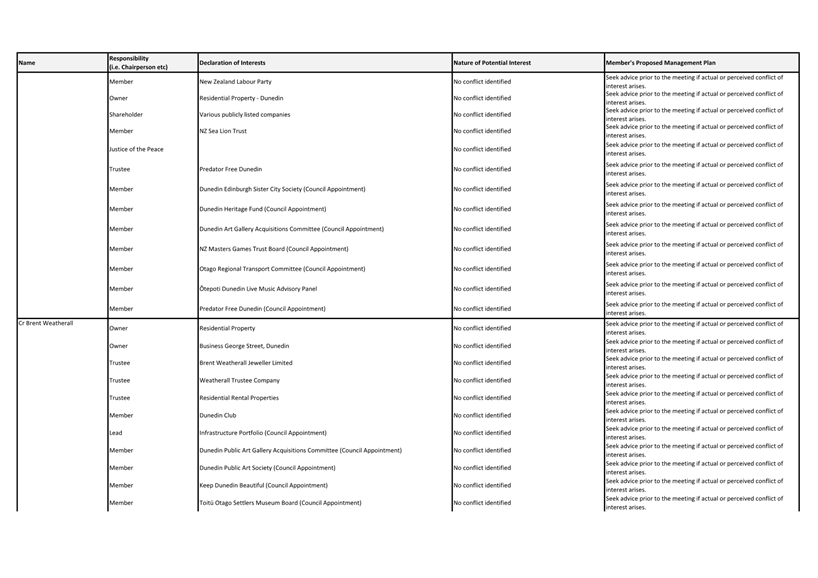
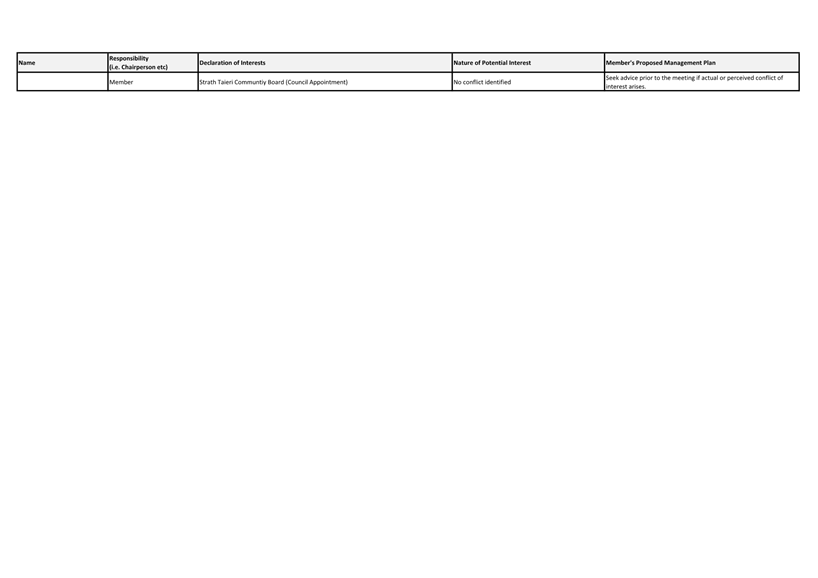
Declaration of Interest
EXECUTIVE SUMMARY
1. Members
are reminded of the need to stand aside from decision-making when a conflict
arises between their role as an elected representative and any private or other
external interest they might have.
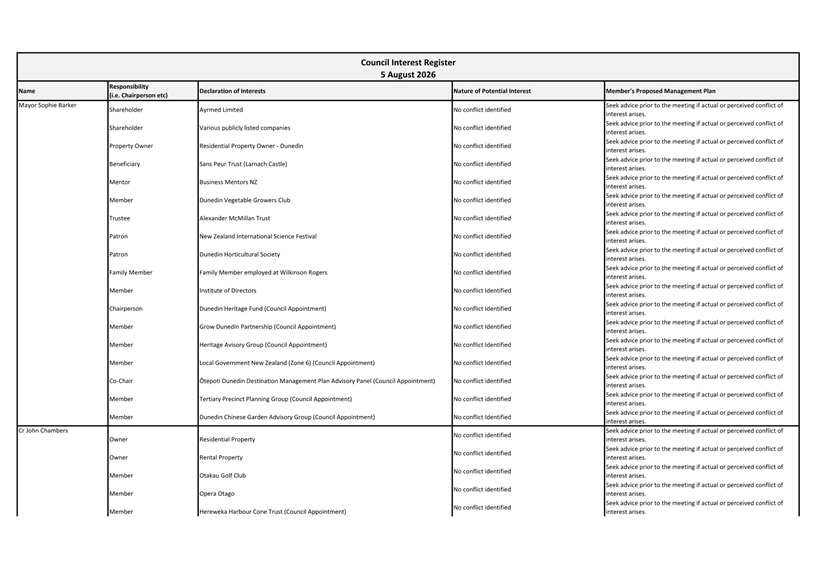
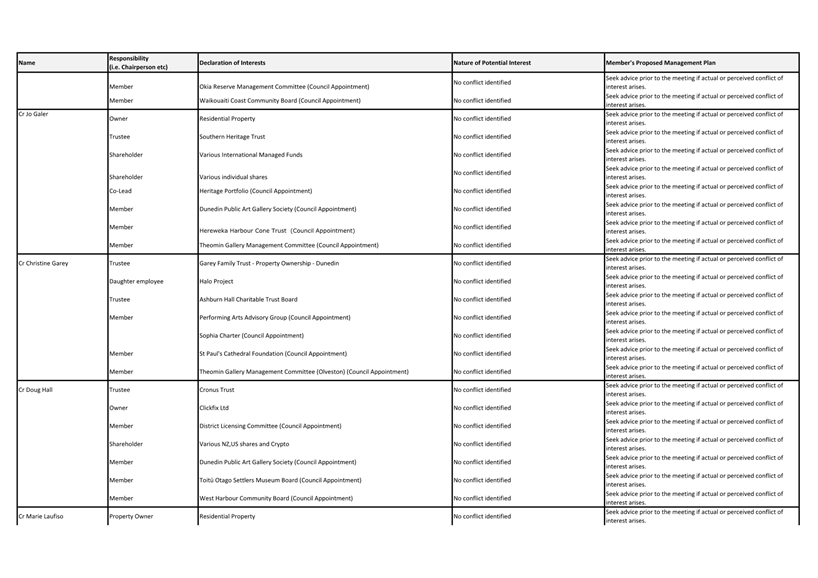
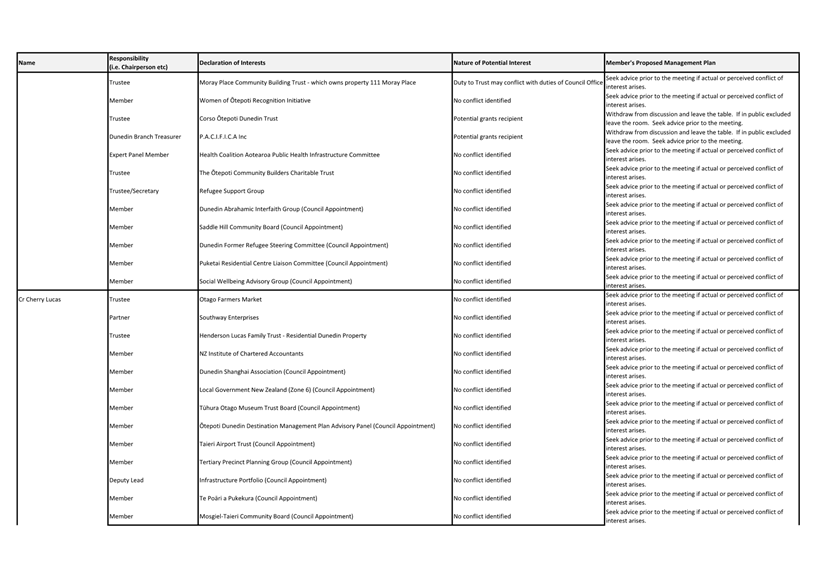
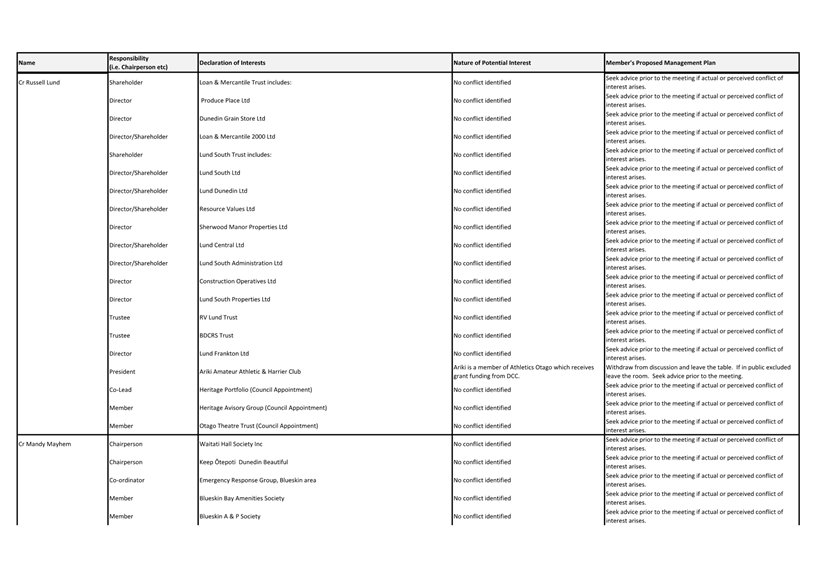
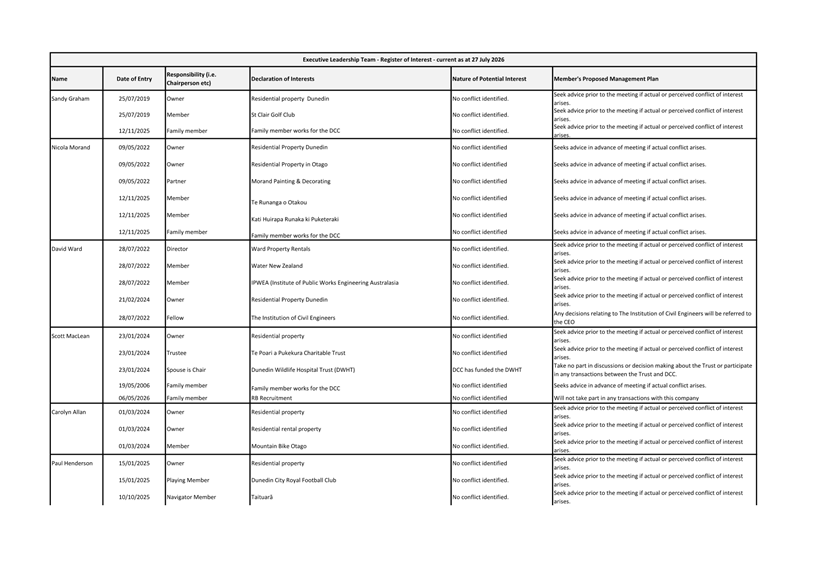
2. Elected members are reminded to update their register of interests as soon as
practicable, including amending the register at this meeting if necessary.
3. Staff members are
reminded to update their register of interests as soon as practicable.
RECOMMENDATIONS
That the Council:
a) Notes/Amends if
necessary the Elected Members' Interest Register attached as Attachment A; and
b) Confirms/Amends the
proposed management plan for Elected Members' Interests.
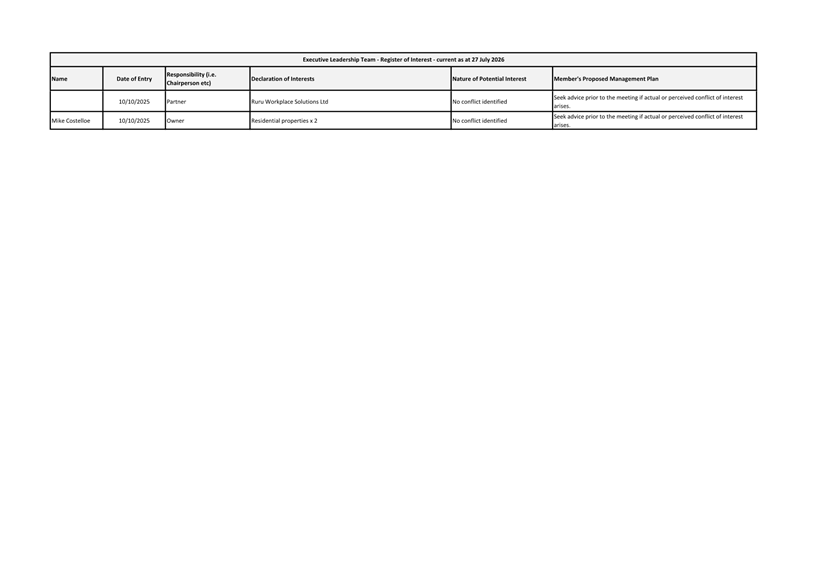
c) Notes the proposed
management plan for the Executive Leadership Teams’ interests.
Attachments
|
|
Title
|
Page
|
|
⇩a
|
Councillor Interest
Register
|
6
|
|
⇩b
|
ELT Interest Register
|
14
|
|

|
Council
13 August 2026
|
Reports
Actions From Resolutions of Council Meetings
Department: Civic
EXECUTIVE SUMMARY
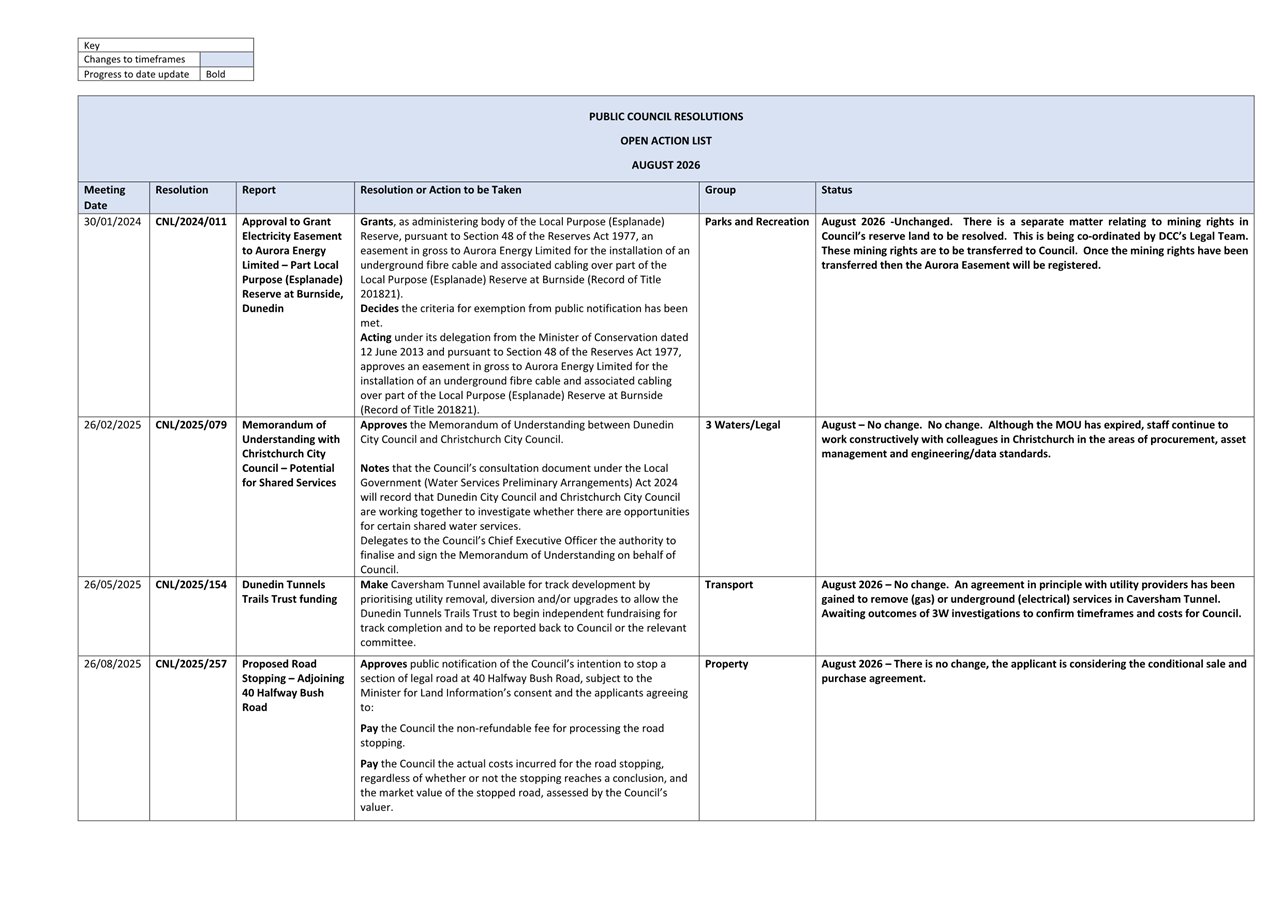
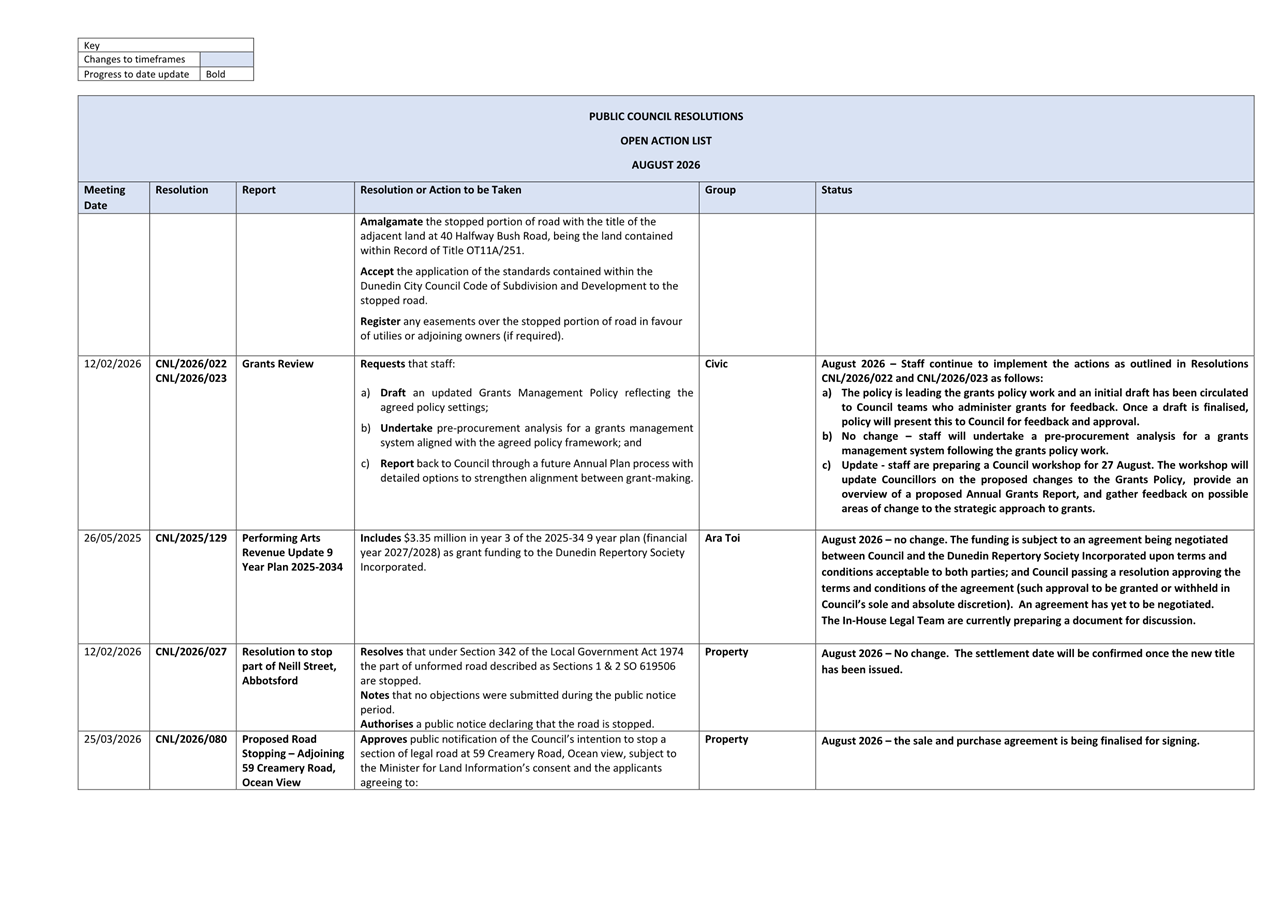
1 The
purpose of this report is to show progress on implementing resolutions made at
Council meetings.
2 As
this report is an administrative report only, there are no options or Summary
of Considerations.
|
RECOMMENDATIONS
That the Council:
a) Notes
the Open and Completed Actions from resolutions of Council meetings as
attached.
|
discussion
3 This
report also provides an update on resolutions that have been actioned and
completed since the last Council meetings. Note that items on the Forward
Work Programme are not included in the attached schedules.
NEXT STEPS
5 Updates
will be provided at future Council meetings.
Signatories
|
Author:
|
Lynne Adamson - Governance Support Officer
|
|
Authoriser:
|
Robyn Dillon - Manager Governance
|
Attachments
|
|
Title
|
Page
|
|
⇩a
|
Open Action list
|
17
|
|
⇩b
|
Completed Action List
|
21
|
|

|
Council
13 August 2026
|
Centres Upgrade Programme
Department: City Growth and Advisory Services
EXECUTIVE SUMMARY
1 The
Centres Upgrade and Minor Amenity Improvements Programme aims to upgrade
Dunedin’s neighbourhood centres by delivering amenity upgrades that
enhance the suburban commercial areas for communities and to support local
businesses.
2 Funding
for the programme was allocated for each year of the 2025-2034 LTP. In July
2025 Council approved amenity upgrades for both Musselburgh and Wakari. The
upgrade to the Musselburgh centre has recently been completed.
3 In
April 2026 staff wrote to business and building owners in Wakari who are likely
to be affected by the proposed work. Some business owners, members of the
Citizens Association, and residents met with members of the Urban Design team
to voice their concerns regarding the proposed amenity upgrades. Concerns
primarily centred around existing social issues and the likelihood that new
seating and planted areas may exacerbate these social issues. The cost of the
work was cited as a concern and the necessity to upgrade the centre also
questioned. Some business owners were supportive of the work.
4 Staff
propose to substitute Wakari with Brighton and are requesting Council approve
this change in location.
5 Staff
have identified a potential opportunity for cost saving. Staff consider that
the scope of the upgrade work in an area such as Brighton can be completed for
less than the allocated budget.
6 Staff
are also requesting direction from Council to help prepare a report ahead of
the 10YP. Identifying a preferred approach for selecting centres for 2027/28
and 2028/29 will allow staff to scope and cost the proposed upgrades.
RECOMMENDATIONS
That the Council:
a) Notes the completion
of the proposed amenity upgrade in Musselburgh.
b) Confirms to substitute
of Wakari with Brighton as the small-scale centre to be
upgraded 2026/27
c) Decides the preferred approach for selecting the larger centre in 2028/29.
d) Notes Staff will bring
a report to Council, ahead of the LTP, to confirm the funding allocation and
selected centres for 2027/28 and 2028/29.
e) Notes the Centres
Upgrade Programme report.
BACKGROUND
7 The
Centres Upgrade and Minor Amenity Improvements Programme (CUP) aims to ensure
Dunedin’s suburban/neighbourhood centres are great places for their
communities and local businesses. The programme will deliver amenity upgrades
to the public spaces in Dunedin’s commercial centres outside of the CBD.
8 The
programme was established to revitalise the commercial areas outside of the CBD
to improve the overall look, feel and usability of the neighbourhood centres.
Work will typically include renewing or adding street furniture (seating, waste
and recycling bins), planting and landscaping, and renewing footpaths utilising
small areas of paving to highlight key pedestrian zones.
9 Council
approved the selection of Musselburgh and Wakari for the first two years of the
CUP at the meeting 30 July 2025. The resolution is reproduced below.
Moved
(Mayor Jules Radich/Cr Cherry Lucas):
That the
Council:
a) Notes
that the Musselburgh and Wakari neighbourhood centres had been selected for the
first two years (2025/26 and 2026/27) of the Centres Upgrade and Minor Amenity
Improvements Programme.
b) Notes
that a report would be presented to Council in 2026 to confirm the centres that
would be upgraded in the following two years of the 9 year plan period (2027/28
and 2028/29) to cover the triennium from 2025 to 2028.
Funding in
the 2025-2034 LTP
10 Funding for
the CUP was allocated for each year of the 2025-2034 LTP. The programme will be
funded through a combination of the Minor Amenities Improvements budget and the
Centres Upgrade Programme budget as itemised in Table 1.
11 DCC
Transport holds budget specifically for transport improvements in priority
suburban centres. This work can complement the proposed amenity upgrades. This
funding is itemised in Table 1 below and is from year three of the LTP.
|
|
2025/26
|
2026/27
|
2027/28
|
2028/29
|
2029/30
|
2030/31
|
2031/32
|
2032/33
|
2033/34
|
|
City Growth
and Advisory Services (formerly City Development)
|
CUP
|
-
|
-
|
-
|
990
|
990
|
990
|
990
|
-
|
-
|
|
MAI
|
300
|
300
|
300
|
-
|
-
|
-
|
-
|
300
|
300
|
|
Transport
|
|
|
500
|
500
|
1,000
|
1,000
|
|
|
|
|
Total
|
300
|
300
|
800
|
1,490
|
1,990
|
1,990
|
990
|
300
|
300
|
Completed
Musselburgh Upgrade
12 The upgrade
to the Musselburgh centre has recently been completed. The upgrade included new
planting, new street furniture and the renewal of some exiting seating, and new
paving at the intersection and crossing points. Photographs of the completed
work are included as (Attachment A).
13 The cost
for the amenity aspects of the upgrade was approx. $260k including a 10%
contingency. The urban design staff have taken a pragmatic design approach to
balance community outcomes with financial prudence. The project has been
completed under budget with a saving saving of approx. 35k.
14 The overall
upgrade was complemented by safety improvement work funded by DCC Transport.
This work delivered safety improvements that had been previously identified and
designed as part of the Safer Streets programme. Combining these projects
sought to minimise disruption for both business and residents.
15 Construction
work within the road corridor has inevitably caused a degree of disruption,
however, the work is relatively small scale, and the contractor was able to
undertake work outside of business hours to minimise the disruption to affected
businesses. While some businesses expressed frustration over the disruption,
staff also received positive feedback from owners of nearby businesses and
residents.
· From a business
owner - I think that looks great. Raised crossing a great idea as too many
drivers speeding through that area. Hope you get more positive feedback.
· From a resident - I
just wanted to say well done for your street upgrade at the Musselburgh village
shops. I go there often and it looks and feels great. I hope you are going to
do upgrades at other village shopping areas around Dunedin in the near future.
Again, well done.
Planned
Wakari Upgrade
16 In April
2026 staff wrote to business and building owners in Wakari who are likely to be
affected by the physical work. Some business owners, members of the Citizens
Association, and residents met with members of the Urban Design team to voice
their concerns regarding the proposed amenity upgrades. Concerns primarily
centred around existing social issues and the likelihood that new seating and
planted areas may exacerbate these social issues. The cost of the work was
cited as a concern and the necessity to upgrade the centre also questioned.
17 Not all
affected business and building owners were against the proposed amenity
upgrade, however, staff consider there is not a high level of support for this
work. Staff considered that the most appropriate course of action is to pivot
the programme to focus identify centres where there is a higher degree of
community support.
18 Staff have
actioned some issues identified by the community e.g. no parking lines to be
installed in a location where illegal parking was causing issues for the
intersection (completed) and replacing the exiting waste bin with a combined
rubbish and recycling bin as part of budgeted replacements (underway).
DISCUSSION
19 Staff
request a decision from Council to either proceed with the Wakari upgrade as
planned, or to pivot the programme to another neighbourhood centre. The centre
for the current 2026/27 financial year will be progressed under the existing
LTP.
20 Additionally,
the July 2025 resolution noted that staff would request a decision from Council
for the centres to be upgraded in 2027/28 and 2028/29. These financial years
will be within the next 10YP. Staff will bring a report to Council, ahead of
the LTP, to confirm the funding allocation beyond this financial year.
21 Staff are
requesting direction from Council for the centres for to be upgraded in 2027/28
preferred approach for selecting the larger centre in 2028/29. Identifying a
preferred approach will allow staff to scope and estimate the cost of upgrade
work in the next few years.
Financial Year 2026/27 & 2027/28
– Small Scale Centres
22 LTP funding
for the next two years has been scaled to deliver only small-scale centres. The
initial decision in July 2025 to select Musselburgh (complete) and Wakari was
based on a matrix (Attachment B) that balanced suitability and impact.
23 Brighton,
Middlemarch, and Outram have been identified as appropriate small-scale centres
for the next two years. Other small centres have been deprioritised for a
variety of reasons, including:
· Recent works to
the road corridor have already improved the amenity of the centre, or, the
centre already demonstrates an acceptable degree of amenity without any recent
intervention.
· DCC Transport have
identified that changes to a primary intersection are necessary, however, this
work is currently unfunded. Any amenity improvements are likely to be affected
by future changes.
· Below ground
infrastructure upgrades are required in the near future. Again, any amenity improvements
are likely to be affected by future changes.
· The centre is
identified for improvements with funding allocated through the Future
Development Strategy. Amenity improvements will be achieved by alternative
funding source.
24 For
Brighton, there is an opportunity to create greater amenity on Brighton Road
near the dairy, café, and boat hire to the north of the bridge over the
Otokia creek. There is potential to consider courtesy crossings that would
enable safer pedestrian connections between the shops and the reserve/beach. It
is anticipated that upgrade work in Brighton can be delivered for 80% of the
allocated budget.
25 For
Middlemarch, there are two centres: one on Snow Ave near to the Railway Station
and the other in the proximity of the Strath Taieri Community Centre on the
intersection of Swansea (State Highway 87) and Aberafon Streets. Staff intend
to use the budget for one year/one centre for both centres noting that the
extent of work will be reduced to account for a larger project area. It is
anticipated that the full budget allocation will be needed.
26 The Parks
and Reserves team are planning upgrades to the playground near the Strath
Taieri Community Centre in Middlemarch. Staff report that the local community
have been positive about the proposal to upgrade the playground; the
streetscape amenity upgrades will complement the investment in the playground.
27 For Outram,
there is an opportunity to create greater amenity along the state highway near
the retail and hospitality businesses. It is anticipated that upgrade work in
Outram would likely require the full budget allocation.
28 It is
preferential to start with Brighton to allow more time to liaise with NZTA
around the restrictions relating to the State Highway in Middlemarch and
Outram.
29 Staff have
written to business and building owners who are likely to be affected by any
physical work. We have received no positive or negative responses from affected
business and building owners in either the Brighton or Middlemarch, however,
the Community Board chairs of both are supportive of the proposal.
30 A resident
in Middlemarch contacted staff to express their support for the proposed
amenity upgrades. A local group undertook beautification work ahead of the 2026
annual cavalcade celebrations that were hosted in Middlemarch in March this
year.
Financial
Year 2028/29 – Larger Centre
31 Funding to
upgrade a large centre is included in the LTP for the four years from 2028/29
through to 2031/32. Staff request Council identify a method for selecting the
centre to allow staff prepare a report for Council, ahead of the LTP, to assist
selecting the centre to be upgraded in 2028/29 as outlined in the July 2025
resolution.
32 One method
for selecting a centre is to align the CUP with planned traffic safety
improvement work in suburban centres. Projects can be delivered combining the
work programme of the urban design and transport teams to achieve separate, but
closely related, objectives. However, this approach relies on maintaining the
existing LTP budgets and may not be possible if either is reduced or removed.
33 An
alternate method for selecting a centre is to prioritise centres where the
community is actively advocating for improvements in their neighbourhood
centre. Where a location is identified through both criteria it can be
progressed in the initial years of the overall programme.
34 DCC
Transport is at present assessing the prioritisation of their forward work
programme. Centres likely to be prioritised for safety improvements include
Caversham, Mornington and Māori Hill. Aligning the programme with DCC
Transport’s work programme has benefits and efficiencies, specifically:
· Costs for traffic
management can be shared between the two departments and reduce the overall
project cost when compared to two separate projects,
· Engagement and
consultation can be completed simultaneously,
· Disruption during
the physical work stage can be minimised for local business and residents.
35 The
alternative is to partner with community groups. Staff are aware of a several
community groups that are actively advocating or planning to improve their
town/neighbourhood centres.
· POWA (Progress of
Waikouaiti Area) has requested support from DCC to revitalise the main centre
of Waikouaiti and the DCC Urban Design team have met with the group to share
ideas relating to private land/buildings. The community has been working with
the Otago Polytech School of Architecture students to develop a vision.
· Future Caversham
is understood to be a community group comprising approximately 40 residents who
are seeking ways to improve the amenity of the main street. A high number of
vacant and dilapidated buildings have been described as ‘rundown,
dilapidated, neglected and embarrassing’.
· It is understood
that residents of Port Chalmers have in the past also contacted elected members
to request amenity improvements along George Street.
· There may be other
community groups who have contacted staff and/or elected members that the Urban
Design team are unaware of.
36 Staff note
that Caversham features under both options, aligning with planned transport
safety improvement work and also active community groups. It may be prioritised
as a result of this overlap, however, to facilitate transparent decision making
three options for selecting the centre to be upgraded in 2028/29 have been
provided:
· Align the CUP with
planned traffic safety improvement work in suburban centres,
· Partner with
community groups actively advocating for improvements in their neighbourhood
centre,
· Prioritise
centre/s that align with both options above.
37 Based on
Council’s decision, staff will scope and cost amenity improvements for a
centre to be detailed in a CUP LTP report later in 2026. If alignment with
Transport is necessary, it is intended that this report will follow a LTP
report detailing future Transport budgets.
38 Under the
allocated LTP funding, it is possible to alternative approaches over the four
years. The large centres to be upgraded after 2028/29 will be subject to a
future report in the new triennium.
OPTIONS
Selection of Small-Scale Centre for Financial Year 2026/27:
39 The options
below relate to the programme for 2026/27. This work will be progressed under
the existing LTP funding.
40 This decision
will either confirm or substitute Wakari as the centre selected by Council in
July 2025. The option to substitute Wakari has been proposed by staff after
community feedback. Brighton has been selected as substitute to allow more time
to liaise with NZTA around the restrictions relating to the State Highway in
Middlemarch and Outram.
41 If the
decision is to proceed with Wakari, staff will confirm Brighton, Middlemarch,
or Outram as the preferred centre for upgrading in 2027/28. Staff will scope
and cost the preferred centre for 2027/28 in a report ahead of the 10YP.
42 Based off
the completed work in Musselburgh, staff anticipate that amenity improvements
in Wakari or Brighton can be delivered for approx. 80% of the allocated budget.
Option One – Substitute Wakari for Brighton in
2026/27
Advantages
· Staff
and the local community are likely to have a more positive experience working
together during the design and delivery phases.
· The
individual upgrades are likely to be more successful where staff,
business/building owners, and the community are proactively working together.
· Provisional
selections will allow staff to scope and cost work to inform the 10YP report.
Disadvantages
· Business/building
owners in Wakari, who supported the amenity upgrades, may be disappointed that
the work is not proceeding.
Option Two – Complete Wakari in 2026/27
Advantages
· The
recently announced closure of Ward 10A at Wakari Hospital is likely to
alleviate some of the social concerns identified in the early engagement phase.
· Provisional
selections will allow staff to scope and cost work to inform the 10YP report.
Disadvantages
· Staff
are likely to face opposition from some business/building owners during the
design and delivery phases.
Method for selecting a Larger Centre for Financial Years
2028/29:
43 Staff will scope
and cost a preferred centre for upgrading in 2028/29 in a report ahead of the 10YP.
Option One – Identify Caversham as the preferred
centre for upgrading in 2028/29 for its alignment with both other methods for
selecting a centre.
44 This option
proposes combining the work programme of the urban design and transport teams
to achieve separate, but closely related, objectives. It relies on maintaining
the existing LTP budgets and is compromised if either is reduced or removed.
Advantages
· Caversham
has an active community group advocating for improving the amenity in their
local neighbourhood.
· Concept
designs for traffic safety improvements have been developed for South Road.
· A
project combining transport improvements with amenity upgrades is likely to
generate the biggest positive impact for local businesses and communities. Investment
in the public space (i.e. the road reserve) is likely to support investment in
private property in the immediate area.
· Staff
can begin engaging with the local community.
Disadvantages
· The
prioritisation exercise currently being undertaken by DCC Transport may not
identify Caversham as the preferred centre. This decision would override their
prioritisation exercise.
· Investment
in the public space (i.e. the road reserve) does not guarantee investment in
private property.
· The
scope of work will be greater and may extend disruption during the physical
work stage.
Option Two – Select the centre for upgrading in 2028/29
to align with planned transport safety improvement work, including but not
limited to Caversham.
45 Again, this
option relies on maintaining the existing LTP budgets and is compromised if
either the CUP or Transport budgets are reduced or removed.
Advantages
· Disruption
to building/business owners is minimised by coordinating transport safety
improvements with amenity upgrades into a single project.
· The
project related costs are reduced by sharing preliminary and general costs
(i.e. traffic management) across a combined project.
· The
transport projects create design opportunities for the amenity upgrades i.e.
the kerb buildouts near intersections can be used for low-level planting.
· A
project combining transport improvements with amenity upgrades is likely to
generate the biggest positive impact for local businesses and communities.
Disadvantages
· The
scope of work will be greater and likely extend the period of disruption during
the physical work stage.
· There
may be community resistance to the amenity aspects if the project scope
includes changes to on street parking (time limits and potentially parking
spaces) and vehicle movements.
· The
prioritised centre may demonstrate an acceptable degree of amenity without any
improvements. The work may be targeted to areas of the city where the CUP can
deliver the biggest impact.
Option Three – Select the centre for upgrading in 2028/29
to align with active community groups, including but not limited to Future
Caversham.
Advantages
· The
programme supports active community groups who have requested DCC to support
them with revitalising their local community.
· The
individual upgrades are likely to be more successful where the local community
are actively engaged during the design and delivery phases.
· Disruption
to local business/building owners is likely to be lessened as a result of a smaller
budget/scope.
· Staff
can begin engaging with the local community.
Disadvantages
· The
scope and budget will limit the ability for staff to make changes beyond
amenity improvements that may be identified in the engagement stage. This may
present a challenge where traffic issues or state highways are known to be a
concern for residents.
· The
CUP is not funded to make traffic safety improvements and may need to avoid
areas where traffic safety improvements are required. This will be necessary to
avoid spending money on improvements that may need to be removed to enable the
improvements.
NEXT STEPS
46 Staff will
start work on the amenity upgrades for the centre selected for the 2026/27.
47 Staff will
bring a report to Council, ahead of the LTP, to confirm the funding allocation
beyond this financial year.
48 Unless the
budget profile is varied, the LTP report will identify small scale centre to be
upgraded in 2027/28 and a large centre for 2028/29.
Signatories
|
Author:
|
Mark Mawdsley - Team Leader Advisory Services
|
|
Authoriser:
|
Mike Cartwright - City Growth and Advisory Services
Manager
David Ward - General Manager, 3 Waters, Property and Urban
Development
|
Attachments
|
|
Title
|
Page
|
|
⇩a
|
Before and after photos
of the Musselburgh amenity upgrades
|
39
|
|
⇩b
|
Matrix analysis of
small centres
|
43
|
|
SUMMARY OF CONSIDERATIONS
|
|
Fit with purpose of Local Government
This decision enables democratic local
decision making and action by, and on behalf of communities.
This decision promotes the social,
economic, environmental, and cultural well-being of communities in the
present and for the future.
|
|
Fit with strategic framework
|
|
Contributes
|
Detracts
|
Not applicable
|
|
Social Wellbeing Strategy
|
✔
|
☐
|
☐
|
|
Economic Development Strategy
|
✔
|
☐
|
☐
|
|
Environment Strategy
|
☐
|
☐
|
✔
|
|
Arts and Culture Strategy
|
✔
|
☐
|
☐
|
|
3 Waters Strategy
|
✔
|
☐
|
☐
|
|
Future Development Strategy
|
✔
|
☐
|
☐
|
|
Integrated Transport Strategy
|
✔
|
☐
|
☐
|
|
Parks and Recreation Strategy
|
☐
|
☐
|
✔
|
|
Other strategic projects/policies/plans
|
☐
|
☐
|
✔
|
|
|
Māori Impact Statement
The CUP, in particular the large centres where the budget,
scope, and timeframes are greater, provide an opportunity, for DCC to engage
with mana whenua and incorporate a te ao Māori perspective in the
individual upgrade projects.
An
overall cultural narrative for the Centres Upgrade Programme will be worked
through with mana whenua. Additionally, any site-specific opportunities will
be identified.
|
|
Sustainability
There
will be a focus on sustainability as part of the project outcomes. Options of
how to reduce the environmental impacts of the construction elements will be
considered.
|
|
LTP/Annual Plan / Financial Strategy /Infrastructure
Strategy
The programme is allocated funded through the LTP, the
purpose of this report is to select the locations to be upgraded with the
allocated funding.
|
|
Financial considerations
The programme is allocated funded through the LTP.
|
|
Significance
The programme is allocated funded through the LTP, the
purpose of this report is to select the locations to be upgraded with the
allocated funding.
|
|
Engagement – external
Staff have written to a small number of affected
business/building owners in Wakari, Brighton, Middlemarch. No engagement has
been undertaken with Caversham residents or ‘Future Caversham’
group. Staff have met with the Waikouaiti community, particularly the
Progress of ‘Waikaouaiti Area’ group.
|
|
Engagement - internal
The Urban Design team have liaised with DCC Transport to
identify alignment in separate work programmes.
|
|
Risks: Legal / Health and Safety etc.
There are no identified risks.
|
|
Conflict of Interest
No conflict of interest has been identified.
|
|
Community Boards
Staff have contacted the chairs of both the Strath Taieri
and Saddle Hill Community Boards.
|
|

|
Council
13 August 2026
|
|

|
Council
13 August 2026
|
Proposed Trade Waste Discharge Plan 2026 and Proposed Trade
Waste Bylaw 2026
Department: 3 Waters
EXECUTIVE SUMMARY
1 The
Local Government (Water Services) Act 2025 (LGWSA) requires a territorial
authority to prepare and issue a trade waste discharge plan no later than 26
August 2027. The trade waste discharge plan must set out the territorial
authority’s approach to regulating trade waste in its district and
discharges of trade waste into the wastewater network. The plan may include
proposals for the territorial authority to make a trade waste bylaw.
2 At
present, the DCC Trade Waste Bylaw 2020 (2020 Bylaw) is in force. The 2020
Bylaw was last reviewed and updated in 2020.
3 This
report proposes making a trade waste discharge plan and new bylaw to manage
trade waste in Dunedin and the discharge of trade waste to the wastewater
network, in response to the new LGWSA requirements.
4 Staff
have developed a draft proposed Trade Waste Discharge Plan 2026 (attached to
this report as Attachment A), a draft proposed Trade Waste Bylaw 2026 (attached
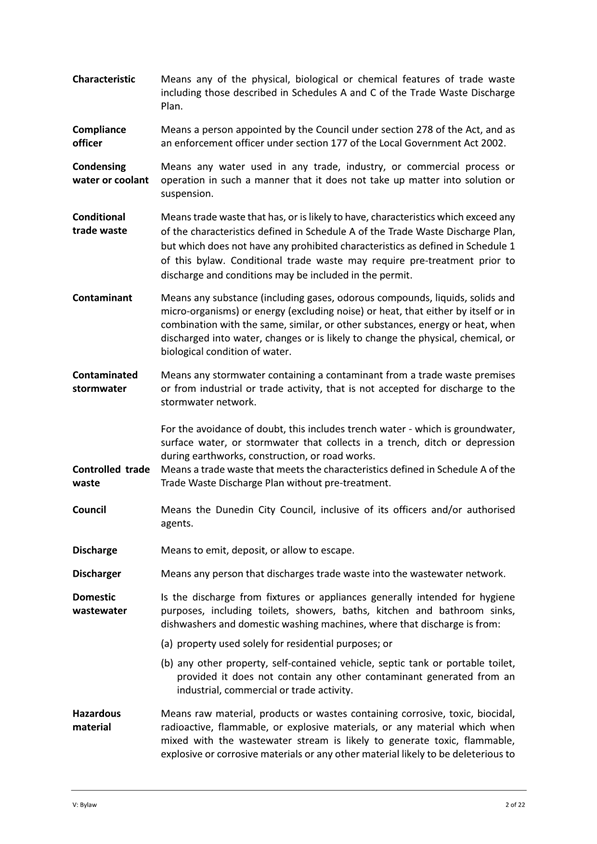
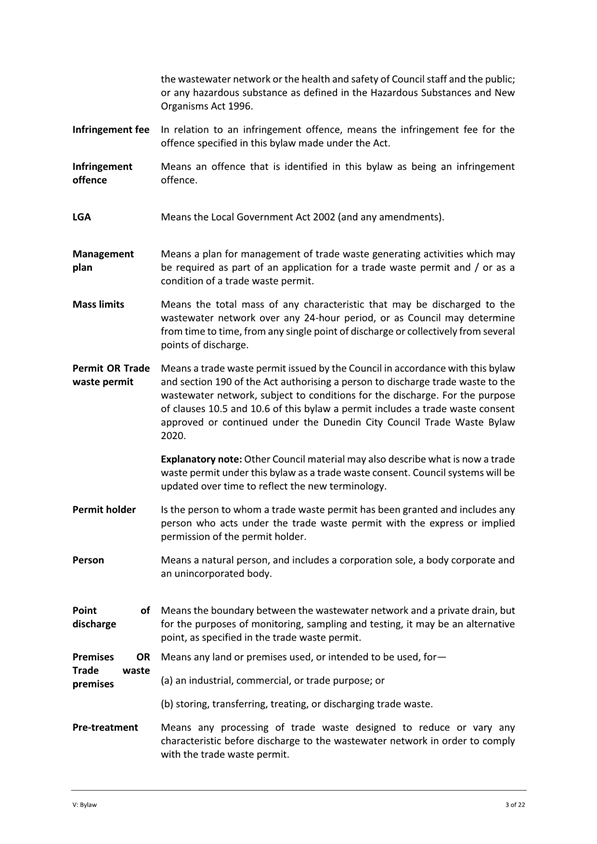
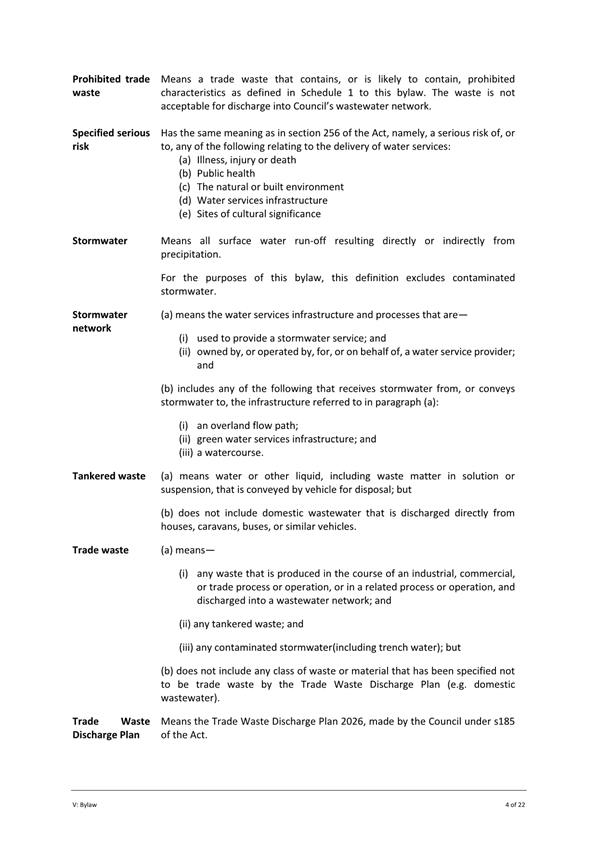
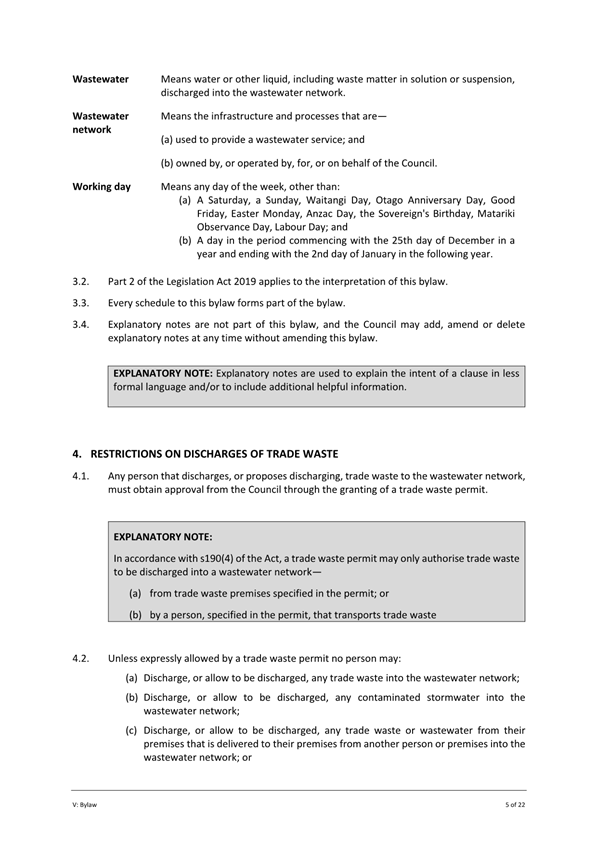
to this report as Attachment B) and a draft Statement of Proposal (attached to
this report as Attachment C) for the Council’s consideration.
5 Although
the proposed Plan and proposed Bylaw would be made under the LGWSA, aspects of
the bylaw-making process requirements set out in the Local Government Act 2002
(LGA) still apply. This report recommends that the Council makes the
determinations required by section 155 of the LGA, which are that:
a) A bylaw is the most appropriate way to manage trade waste
in Dunedin and the discharge of trade waste to the wastewater network;
b) The proposed Bylaw is the most appropriate form of bylaw;
and
c) The proposed Bylaw does not give rise to any implications under,
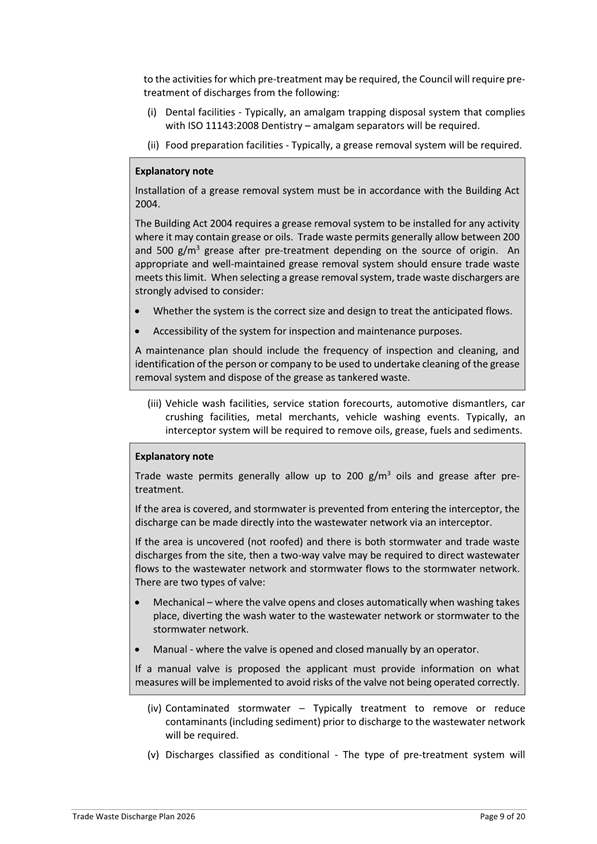
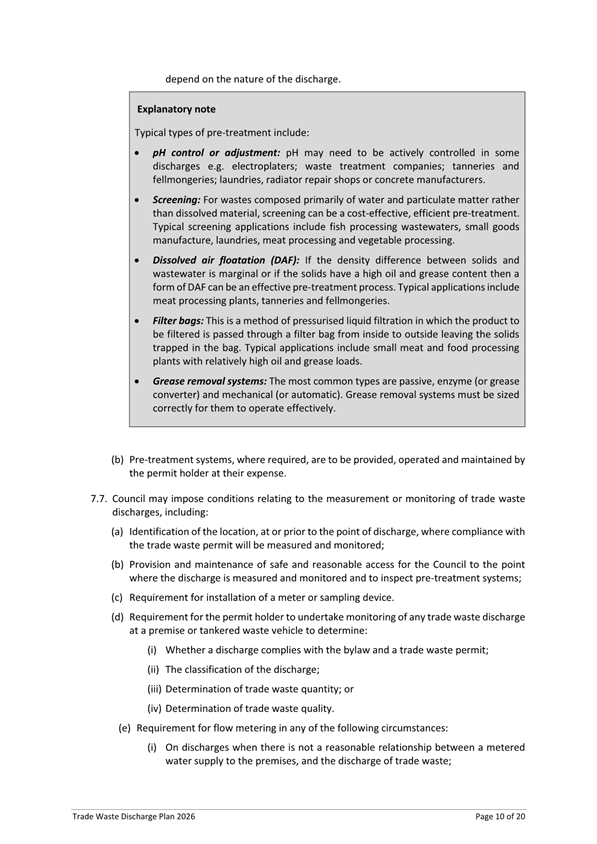
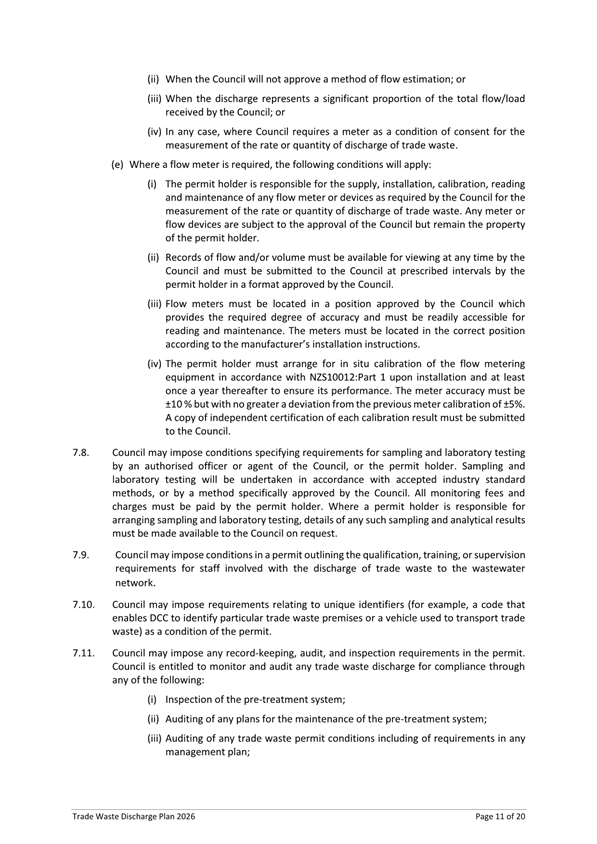
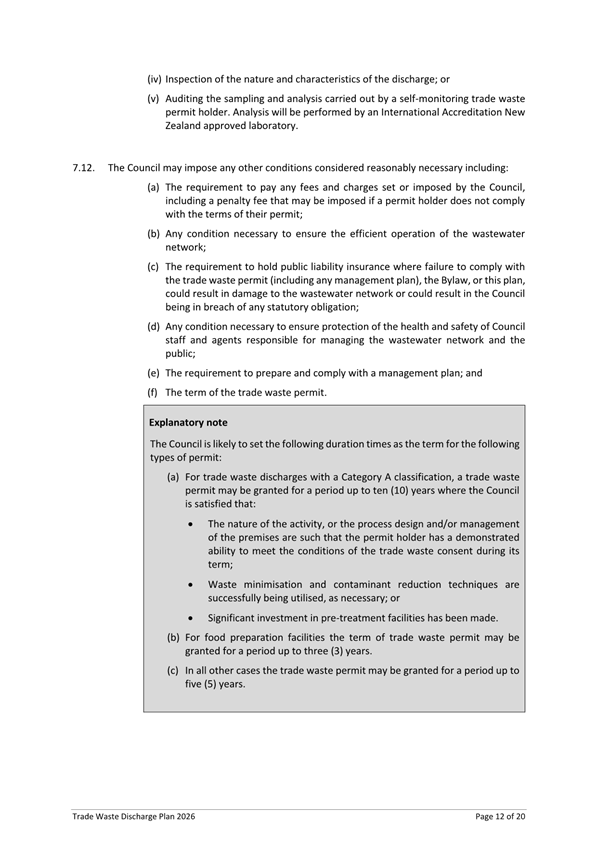
and is not inconsistent with, the New Zealand Bill of Rights Act 1990.
6 This
report also recommends the Council approves the draft proposed Trade Waste
Discharge Plan 2026, the draft proposed Trade Waste Bylaw 2026 and the
associated draft Statement of Proposal for notification for public
consultation, using the special consultative procedure set out in the
LGA.
RECOMMENDATIONS
That the Council:
a) Determines that a
bylaw, in conjunction with the Trade Waste Discharge Plan, is the most
appropriate way to manage trade waste in Dunedin and the discharge of trade
waste to the wastewater network.
b) Determines that the
draft proposed Trade Waste Bylaw 2026 at Attachment B is the most appropriate
form of bylaw.
c) Determines that the
draft proposed Trade Waste Bylaw 2026 at Attachment B does not give rise to any
implications under the New Zealand Bill of Rights Act 1990 and is not
inconsistent with that Act.
d) Determines that the
special consultative procedure, in accordance with the Local Government Act
2002, be used as part of the process to make the proposed Trade Waste Discharge
Plan 2026 and proposed Trade Waste Bylaw 2026.
e) Approves the draft
proposed Trade Waste Discharge Plan 2026 at Attachment A, the draft proposed Trade
Waste Bylaw 2026 at Attachment B and the draft Statement of Proposal at
Attachment C to be notified for public consultation.
f) Authorises the Chief
Executive to make any minor editorial changes to the proposed Trade Waste
Discharge Plan 2026, proposed Trade Waste Bylaw 2026 and the Statement of
Proposal prior to consultation opening.
BACKGROUND
7 Trade
waste is any discharge into the wastewater network that is not domestic
wastewater. Trade waste includes waste transported to wastewater treatment plants
by tanker and contaminated stormwater created on a trade waste premises or by
industrial or trade activity.
8 Domestic
wastewater is the wastewater produced from residential premises, self-contained
vehicles, septic tanks, portable toilets or other premises, provided it does
not contain any other contaminant generated from an industrial or trade
activity. It is wastewater generated from fixtures or appliances generally
intended for hygiene purpose (eg. toilets, bathrooms and kitchens).
9 The
quality and quantity of domestic wastewater discharged into the wastewater
network is generally known and / or is considered as posing a low-risk to
the wastewater network and treatment plant. As a result, discharges of domestic
wastewater to the wastewater network required different management responses to
trade waste and are more appropriately addressed through other methods.
10 The
DCC’s activities as a water services provider managing the wastewater
network are directed by and regulated under national-level legislation
including the LGWSA and the Resource Management Act 1991.
11 The DCC and
other councils across New Zealand use bylaws to set local rules and
requirements to regulate the discharge of trade waste to their wastewater
networks. This is to protect the networks themselves, to protect the health and
safety of those who use these networks, and to support councils to take the
necessary actions to fulfil their duties and obligations under national-level
legislation.
12 At present,
the DCC Trade Waste Bylaw 2020 (2020 Bylaw) is in force. The 2020 Bylaw was last
reviewed and updated in 2020.
Trade waste
discharge plan and bylaw-making requirements, powers and procedure
13 The review of
the 2020 Bylaw has been undertaken earlier than the previously anticipated 2030/31
bylaw review timeframe as a direct response to changes introduced through the LGWSA.
14 Section 185
of the LGWSA requires a territorial authority to prepare and issue a trade
waste discharge plan no later than 26 August 2027. The trade waste discharge
plan must set out the territorial authority’s approach to regulating
trade waste in its district and discharges of trade waste into the wastewater
network. The plan may include proposals for the territorial authority to make a
trade waste bylaw.
15 Section 187
of the LGWSA requires the territorial authority to consider a proposal for a
bylaw made in a trade waste discharge plan and make the trade waste bylaw if
satisfied that the bylaw would be consistent with the LGWSA.
16 Sections
185 and 187 of the LGWSA also outline what matters must, or may, be included in
a trade waste discharge plan and a trade waste bylaw, respectively.
17 Section 258
of the LGWSA specifically provides that a territorial authority may make a
bylaw for the purposes of managing aspects of water services provision,
including regulation of discharges of trade waste to the wastewater network.
When the LGWSA was enacted, the equivalent provisions providing for such bylaws
to be made under the LGA were repealed.
18 Section 258
of the LGWSA also provides that a bylaw may authorise a water service provider
to grant and administer permits (including charging fees for permits) for trade
waste discharges.
19 The DCC and
other territorial authorities in New Zealand use bylaws to manage discharges of
trade waste to the wastewater networks. Under the present law, a bylaw,
in conjunction with a trade waste discharge plan, is the most feasible way to
manage discharges of trade waste to the wastewater network efficiently and
effectively.
20 The LGA
sets out the nature and procedure for the making and review of bylaws. Section
155 of the LGA requires the local authority to determine that a bylaw is the
most appropriate way of addressing the perceived problem (which in this case is
the management of trade waste discharges to the wastewater network), a proposed
bylaw is the most appropriate form of bylaw, and that a proposed bylaw is not
inconsistent with the New Zealand Bill of Rights Act 1990 (NZBORA).
21 In
addition, the LGA and the LGWSA require local authorities to consult the public
prior to making a bylaw. The LGWSA also requires consultation on a trade waste
discharge plan to be undertaken in accordance with the requirements for
consultation on making a bylaw.
22 In
accordance with the requirements of the LGWSA, if a new bylaw and the trade
waste discharge plan are made, the territorial authority is required to review
these documents no later than 10 years after the date on which they are made.
DISCUSSION
23 A trade
waste bylaw has been used to manage the discharge of trade waste to the
wastewater network in Dunedin since 1987. The draft proposed Bylaw would be the
fourth iteration of Dunedin’s trade waste bylaw.
Overview of
the draft proposed Trade Waste Discharge Plan and draft proposed Trade Waste
Bylaw
24 The draft proposed
Plan sets out the approach that the Council will take to regulate trade waste in Dunedin and the discharge of trade waste
into the wastewater network.
25 Staff
review of the 2020 Bylaw found the provisions of the 2020 Bylaw remain relevant
for the regulation of trade waste discharges to the wastewater network in
Dunedin. As a result, the provisions of the 2020 Bylaw have not been
substantially modified during the preparation of the proposed Plan and proposed
Bylaw. As the 2020 Bylaw provided for comprehensive regulation of trade waste,
the rules and appendices from the 2020 Bylaw have been reallocated between the
proposed Plan and proposed Bylaw in accordance with the requirements of the
LGWSA.
26 The purpose
of the draft proposed Bylaw is to control and monitor the discharge of trade
waste into the wastewater network to:
(a) Protect the health, safety and wellbeing
of the public and people working in the wastewater network, from potential
adverse effects of contaminants discharged to the wastewater network;
(b) Manage, regulate and protect the
wastewater network from misuse or damage and provide for efficient and
effective management and operation of the wastewater network;
(c) Protect the environment from
adverse effects of contaminants discharged to the wastewater network;
(d) Assist the Council to comply with
Resource Management Act 1991 requirements for discharge of
contaminants to the environment; and
(e) Provide a framework for trade waste
permits that will provide a basis for monitoring trade waste discharges and for
charging trade waste dischargers costs to cover conveying, treating, and
disposing of, or reusing, their wastes.
27 To do this,
the proposed Plan and proposed Bylaw:
(a) Establish clear requirements for the classification
and discharge of trade waste to the wastewater network.
(b) Create a framework and processes for
obtaining trade waste permits and the conditions that may be included in
permits.
(c) Set enforceable obligations for
customers relating to discharge of trade waste to the wastewater network and
transporting of trade waste.
Summary of
changes
28 Generally,
the provisions of the 2020 Bylaw are working well and continue to be relevant
for the regulation of trade waste discharges to the wastewater network. The
existing provisions have not been substantially modified during the preparation
of the proposed Plan and proposed Bylaw. The review of the 2020 Bylaw and the
subsequent reorganisation of the provisions between the proposed Plan and
proposed Bylaw is directly in response to the requirements of the LGWSA,
primarily being the requirement for the preparation of the proposed Plan. Minor
deletions or amendments have been made as appropriate throughout the documents
to align with the LGWSA, other councils’ trade waste bylaws, and current
practices.
29 The 2020
Bylaw requires discharges of trade waste that meet specified limits to be
registered with DCC (classified as permitted trade waste), while discharges
that exceed those limits require a consent/permit (classified as conditional
trade waste). The approach in the proposed Bylaw has been amended to require
all trade waste discharges to have a permit. This key change is to align the
proposed Bylaw with the approach in the LGWSA. DCC is already implementing this
requirement of the LGWSA and is issuing permits to customers with permitted
trade waste discharges who are registered with DCC.
30 In the
proposed Bylaw, the category name of ‘permitted trade waste’ has
been changed to ‘controlled trade waste’ to reflect the approach of
all trade waste discharges being managed under the permit system. There will be
little difference in the actual process customers are required to undertake to
gain approval from DCC for a controlled trade waste discharge than from the
existing process under the 2020 Bylaw.
31 The other
key change to the proposed Bylaw is the introduction of infringement offences
and associated fines. The LGWSA specifies infringement offences and fines
related to discharges of trade waste and provides the ability for these to be
included in the proposed Bylaw. The offences that are punishable as
infringement offences are set out in the LGWSA and have been reflected in the
proposed Bylaw for clarity. With the inclusion of these provisions, the DCC
will be able to use infringement offences as a tool to enforce compliance with
trade waste discharge requirements.
Analysis: determinations
under section 155 of the LGA
32 The
following paragraphs provide analysis to support the Council to consider the
recommended determinations, which section 155 of the LGA requires the council
to make before making a new bylaw.
Section
155(1): Is a bylaw the most appropriate way to address the perceived problem?
33 The LGWSA
requires the development of a trade waste discharge plan, and allows, but does
not require, the development of a bylaw.
34 The DCC has
used a bylaw to manage discharges of trade waste to the wastewater network
since 1987. Under the present legislation, a bylaw, in combination with
the Plan, is the most feasible and appropriate way to achieve efficient
management of trade waste in Dunedin and discharges of trade waste to the
wastewater network, and to comply with the requirements of the LGWSA.
35 The LGWSA
specifies that a bylaw, if developed, should set the framework for issuing
trade waste permits and can include infringement offences and fines. The LGWSA
does not provide for the inclusion of these matters in the trade waste discharge
plan, even though a plan implements the permit system outlined in a bylaw.
Reliance on a plan by itself, without the support of these administrative
powers provided by a bylaw, could impact on the DCC’s ability to fulfil
its duties and obligations under national-level legislation and to enforce
compliance with trade waste discharge requirements. It is necessary for the DCC
to have the ability, provided by a bylaw, to set rules and legally enforce
compliance.
36 A bylaw is
the most appropriate way to manage aspects of the discharge of trade waste to
the wastewater network because it enables the Council to:
(a) Establish
rules and requirements related to the discharge of trade waste to the
wastewater network, including to protect the network against damage, misuse,
interference, or contamination;
(b) Establish
the framework to approve permits for discharges of trade waste to the
wastewater network; and
(c) Identify
offences and to take enforcement action if offences are committed.
Section
155(2)(a): Is the proposed bylaw the most appropriate form of bylaw?
37 The
proposed Bylaw is one that is:
(a) Up-to-date
and fit-for-purpose
(b) Aligned
with all relevant legislative and regulatory requirements
(c) Not
inconsistent with any other Council bylaw
(d) Provides
a clear, logical structure covering:
(i) Restrictions on discharges of trade
waste to the wastewater network
(ii) Storage,
transport, handling and use of hazardous materials
(iii) Trade
waste classification
(iv) Trade
waste permit processes and requirements
(v) Trade
waste monitoring
(vi) Enforcement,
breaches and infringement offences
(vii) Administrative
matters
(e) Includes
explanatory notes to assist with the interpretation and application of the
bylaw by its users.
38 The
proposed Bylaw would replace the 2020 Bylaw. Much of the substance of the 2020
Bylaw would be retained in the proposed Plan and proposed Bylaw with some
modification, but new requirements would also be introduced to reflect current
legislation and current operating conditions.
39 The
proposed Bylaw’s form is consistent with nationwide best practice for
bylaws relating to water services infrastructure and services.
Section 155
(2)(b): Is the proposed Bylaw consistent with the NZBORA?
40 Under
section 155(3) of the LGA a bylaw must not be inconsistent with the New Zealand
Bill of Rights Act 1990 (NZBORA). The Council must consider whether the
proposed Bylaw gives rise to any implications under the NZBORA.
41 Subject to
section 4 of the NZBORA, the rights and freedoms contained in the NZBORA may be
subject only to such reasonable limits prescribed by law as can be demonstrably
justified in a free and democratic society.
42 The NZBORA
specifically identifies four types of civil and political rights, these are:
(a) life
and security of the person
(b) democratic
and civil rights (which includes freedom of expression and freedom of movement)
(c) non-discrimination
and minority rights
(d) search,
arrest and detention.
43 There are
no rights or freedoms under the NZBORA that could be affected by the proposed
Bylaw.
44 Even if
there were any relevant rights, the controls in the proposed Bylaw are
considered reasonable limits as allowed for in section 5 of the NZBORA.
45 The
proposed Bylaw is not inconsistent with NZBORA and does not give rise to any
implications under the NZBORA.
Special
Consultative Procedure
46 In
accordance with section 188 of the LGWSA, consultation on a trade waste bylaw
that is proposed in a trade waste discharge plan must occur in conjunction with
the consultation on the trade waste discharge plan. This means that the
consultation on the proposed Plan and proposed Bylaw is to be undertaken
together.
47 Sections
186 and 258 of the LGWSA require consultation on a trade waste discharge plan
to be the same as required for a bylaw under section 156 of the LGA.
48 Section 156
of the LGA requires local authorities to use the special consultative procedure
when making a bylaw (and, in this case, a trade waste discharge plan) if:
(a) the proposed bylaw (and proposed plan) concerns a matter
identified in the local authority’s significance and engagement policy;
or
(b) the local authority considers the proposed bylaw (and
proposed plan) is likely to have a significant impact on the public.
49 The rules
in the proposed Bylaw and proposed Plan will directly impact current and
future trade waste customers. For this reason, use of the special consultative
procedure as part of the process to make the proposed Plan and proposed Bylaw
is appropriate and recommended.
50 As part of
the special consultative procedure, the Council must adopt a draft of the
proposed Plan, proposed Bylaw and the Statement of Proposal. The Council must
make these available for public feedback for a period of not less than one
month.
51 This report
recommends the Council adopts the draft proposed Plan attached to this report
as Attachment A, draft proposed Bylaw attached to this report as Attachment B
and the draft Statement of Proposal attached to this report as Attachment C for
public consultation.
52 If
approved, public consultation on the proposed Plan, proposed Bylaw and the Statement
of Proposal, will be open from Monday 17 August 2026 to Friday 18 September
2026. Provision will be made for members of the public to view the consultation
material both online (via the DCC website) and at DCC libraries and service
centres. Provision will be made for written submissions to be provided online
and via other channels (e.g. by post).
53 Arrangements
will be made for hearings if requested by submitters. A Hearings Panel will be
convened for the purpose of considering submissions, and for the purpose of
hearings if required. Hearings would likely take place in late October or
November 2026.
OPTIONS
Option One – Make the recommended determinations and
adopt the attached draft proposed Plan, draft proposed Bylaw and draft
Statement of Proposal for consultation (Recommended Option)
54 This option
involves making the recommended LGA determinations and proceeding with public
consultation on the attached draft proposed Bylaw, draft proposed Plan and
draft Statement of Proposal, as part of the process towards making a trade
waste discharge plan and new trade waste bylaw for Dunedin.
Advantages
· Complies
with the statutory requirements for bylaw (and trade waste discharge plan)
making and associated public consultation
· Enables
the DCC to progress towards making a new bylaw and trade waste discharge plan
to manage the discharge of trade waste to the wastewater network that reflects
current legislative and regulatory provisions
Disadvantages
· None
identified.
Option Two – Do not make the recommended
determinations and/or do not adopt the attached draft proposed Plan, draft
proposed Bylaw, and draft Statement of Proposal for consultation
55 This option
could involve either:
a) not
progressing towards making a trade waste discharge plan and new bylaw to manage
the discharge of trade waste to the DCC wastewater network; or
b) asking
staff to make changes to the draft proposed Plan, draft proposed Bylaw and
draft Statement of Proposal before returning to Council for LGA determinations
and approvals at a later date.
Advantages
· Enables
the Council to request further analysis prior to making decisions
Disadvantages
· Delays
progress towards DCC putting in place a trade waste discharge plan and new
trade waste bylaw that reflects current legislative and regulatory provisions
· May
have implications for DCC in meeting the LGWSA deadline (August 2027) for
preparation of a trade waste discharge plan if delayed for a significant period
of time.
NEXT STEPS
56 If the
Council approves the recommended option, the proposed Plan, proposed Bylaw and Statement
of Proposal will be notified for public consultation in accordance with the
requirements of the LGA. The consultation will be open from Monday 17 August 2026
to 18 September 2026.
57 Staff will
summarise feedback received and prepare a report for consideration by the
Hearings Committee. Staff will arrange hearings if requested by submitters.
58 After any
hearings, the Hearings Committee will report to the Council with their
recommendations and a final proposed Plan and proposed Bylaw (incorporating any
recommended amendments) for the Council’s confirmation of the
recommendations and approval to make the Bylaw and Plan operative.
Signatories
|
Author:
|
Jacinda Baker - Policy Analyst
|
|
Authoriser:
|
Scott Campbell - Regulation and Policy Team Leader
John McAndrew - Head of 3 Waters
|
Attachments
|
|
Title
|
Page
|
|
⇩a
|
Draft Proposed Trade
Waste Discharge Plan 2026
|
56
|
|
⇩b
|
Draft Proposed Trade
Waste Bylaw 2026
|
76
|
|
⇩c
|
Draft Statement of Proposal
|
98
|
|
SUMMARY OF CONSIDERATIONS
|
|
Fit with purpose of Local Government
This decision enables democratic local
decision making and action by, and on behalf of communities and promotes the
environmental well-being of communities in the present and for the future.
|
|
Fit with strategic framework
|
|
Contributes
|
Detracts
|
Not applicable
|
|
Social Wellbeing Strategy
|
☐
|
☐
|
✔
|
|
Economic Development Strategy
|
☐
|
☐
|
✔
|
|
Environment Strategy
|
✔
|
☐
|
☐
|
|
Arts and Culture Strategy
|
☐
|
☐
|
✔
|
|
3 Waters Strategy
|
✔
|
☐
|
☐
|
|
Future Development Strategy
|
☐
|
☐
|
✔
|
|
Integrated Transport Strategy
|
☐
|
☐
|
✔
|
|
Parks and Recreation Strategy
|
☐
|
☐
|
✔
|
|
Other strategic projects/policies/plans
|
✔
|
☐
|
☐
|
This report has been prepared with reference to
Dunedin’s strategic framework.
|
|
Māori Impact Statement
There are no known specific impacts for Māori related
to this report and the decisions sought. Māori individuals and
organisations will have the opportunity to provide feedback on the proposed
Plan and proposed Bylaw via the public consultation process. DCC staff have
provided information about the development of the draft proposed Plan and
draft proposed Bylaw to staff at Aukaha.
|
|
Sustainability
The proposed Plan and proposed Bylaw are intended to
enable the DCC to manage discharge of trade waste to the wastewater network
in a manner that supports the long-term sustainability of the wastewater
network and the environment.
|
|
LTP/Annual Plan / Financial Strategy /Infrastructure
Strategy
This report and the recommended decisions have no
immediate direct implications for these plans and strategies. However, the
proposed Plan and proposed Bylaw are intended to enable the DCC to manage discharge
of trade waste to the wastewater network in a manner that supports the DCC to
achieve the objectives set out in these plans and strategies.
|
|
Financial considerations
There are no known
specific financial implications related to this report and
the recommended decisions. The costs of public consultation and immediate
implementation of the proposed Plan and proposed Bylaw (if subsequently
adopted) can be met from existing budgets. Additional funding (if required)
for longer-term implementation activities would be sought through budgets
included in a future Water Services Strategy.
|
|
Significance
This report and the recommended decisions have been
assessed as medium significance in terms of the Council’s Significance
and Engagement Policy.
|
|
Engagement – external
The draft proposed Plan, draft proposed Bylaw and draft
Statement of Proposal have been reviewed by an external legal reviewer.
|
|
Engagement - internal
Staff from the following departments have contributed to
the development of this report and/or the attached draft proposed Plan, draft
proposed Bylaw and draft Statement of Proposal: 3 Waters, Governance and
Council Communications and Marketing.
|
|
Risks: Legal / Health and Safety etc.
None identified.
|
|
Conflict of Interest
None identified
|
|
Community Boards
There are no known specific impacts for Community Boards
related to this report and the decisions sought. Community Boards and their
constituents will have the ability to provide feedback on the proposed Plan
and proposed Bylaw via the public consultation process.
|
|

|
Council
13 August 2026
|
Draft Local Alcohol Policy
Department: Corporate Policy
EXECUTIVE SUMMARY
1 The
purpose of this report is to update Council on the Stage Two engagement of the
review of the DCC’s Local Alcohol Policy (LAP), and to seek Council approval for formal consultation on a
Draft LAP.
2 Council
resolved in April 2026 further
stakeholder and public engagement on a range of possible LAP content options as
part of a three-stage engagement process for its LAP review.
3 This
engagement has been carried out and analysed, along with earlier engagement and
research to form a Draft LAP.
4 The
Draft LAP contains several changes and amendments to the current LAP including:
· Location
limitations for new licences with regard to sensitive facilities.
· A freeze on the
issue of new off-licences in certain areas of Dunedin.
· On-licence
discretionary conditions to improve safety and assist licencing inspections.
· No issuing of
special licences for events focused on children and young people.
RECOMMENDATIONS
That the Council:
a) Notes the results of
the Stage Two engagement for the Local Alcohol Policy Review
b) Approves the Draft
Local Alcohol Policy for public consultation using the Special Consultative
Procedure subject to any amendment
c) Adopts the attached
Statement of Proposal for consultation subject to any amendment
d) Appoints members for a
Hearings Committee to hear consultation submissions
BACKGROUND
5 Council
recommenced the review of its current LAP in 2025, approving a three-stage
engagement and consultation process. Stage One – reviewing
evidence, engaging with key stakeholders and identifying possible LAP content
options – was completed in April this year, with Council approving on 23
April 2026 wider Stage Two engagement to further develop a draft LAP:
Moved (Cr Doug Hall/Cr
Christine Garey):
That the Council:
a) Approves
further stakeholder and public engagement on a range pf possible Local Alcohol
Policy content options noted in this report.
b) Notes
that the engagement would inform the draft Local Alcohol Policy to formally
consult on later this year.
Motion
carried (CNL/2026/097) with Crs Brent Weatherall and Benedict Ong
recording their votes against.
6 This
report outlines the feedback and analysis from Stage Two and seeks Council
approval for Stage Three, i.e. consultation on the draft LAP using the Special
Consultative Process including receiving submissions and holding hearings, for
Council to then adopt the reviewed LAP.
Developing a
LAP
7 The
Sale and Supply of Alcohol Act 2012 (the Act) allows territorial authorities to
develop local alcohol policies, following the object of the Act:
a) the sale, supply, and consumption of
alcohol should be undertaken safely and responsibly; and
b) the harm caused by the excessive or
inappropriate consumption of alcohol should be minimised.
8 The
LAP must only include matters relating to licencing under section 77(1) of the
Act. When a LAP is developed, the Act requires Council to have regard to
certain matters under section 78(2) of the Act. These matters are noted
in Attachment A.
9 A
supporting research report in respect of section 78(2) is contained in
Attachment B. The report emphasises matters of the overall health
indicators of the district’s residents and the nature and severity of the
alcohol-related problems arising in the district. Some key points are:
a) The
NZ Quality of Life Survey in 2024 found that 70% of respondents perceive
alcohol and drug problems, or antisocial behaviours caused by alcohol or drugs,
to have been an issue in Dunedin in the last 12 months, up from 66% in 2020.
b) North
Dunedin comprises 7-8% of the total Dunedin population yet has contributed
between 23% and 27% of all alcohol-related ED visits during the 2018-2024 period.
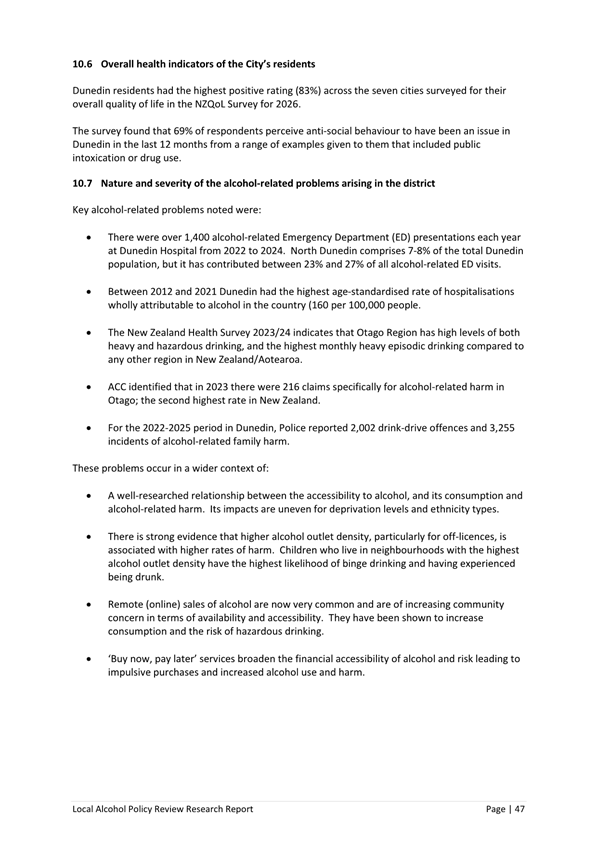
c) For the 2022-2025 period in Dunedin, Police reported 2,002
drink-drive offences and 3,255 incidents of alcohol-related family harm.
10 It is a
statutory requirement under the Act that Council must consult with the Police,
Medical Officer of Health, and Alcohol Licensing Inspectors (the
‘tri-agencies’) before the draft LAP is released for public
consultation. Council has previously advised that the tri-agencies (and
other affected parties) are actively engaged throughout the review process,
with the research report drawing on their input.
11 From a
recent Supreme Court decision (Woolworths NZ Ltd v Auckland Council, Supreme
Court, [2023] 1NZLR 113) the following observations regarding LAPs have been
drawn:
a) LAPs
can legitimately be policy decisions based on community preferences, and so do
not need to be strictly ‘evidence based’ in every facet.
b) Councils
can take a precautionary approach to a LAP, meaning there is no requirement to
be sure that conditions will minimise alcohol-related harm; it is sufficient
that there is a reasonable likelihood that they will do so.
c) Any appeals
or judicial reviews of LAPs become largely focused on soundness of review
process, and if any contested conditions are reasonable in light of the Act,
such as whether a condition is a proportionate limit on the sale and supply of
alcohol.
DISCUSSION
Stage Two engagement on possible LAP options
12 Thirty-eight
organisations across a range of sectors were contacted and invited to respond
via email or an online survey on the Council’s website on twenty-one
possible new LAP content options which are noted in Table One. The public were also made aware of the online survey via
media releases, posts on the Council’s website, Facebook and Instagram
pages, newspaper advertising (print and online), and posters in the
libraries and the civic building.
|
OFF-LICENCES
|
|
Option
|
Current
LAP condition
|
Possible option for Draft LAP
|
|
OFF-1
|
No distance restrictions for new licences in relation
to existing licences.
|
200m
distance for new licence to an existing one.
|
|
OFF-2
|
No location restrictions or limits for new off-licences
outside Second Generation Plan limitations.
|
a) No
new off-licences in North Dunedin area from Moray Place to Botanic Gardens to
University Oval.
|
|
b) No
new off-licences in NZ Deprivation Areas 7-10.
|
|
OFF-3
|
Trading hours 7am-10pm.
|
Trading
hours 9am-9pm (9am same as on-licences option).
|
|
OFF-4
|
Sensitive area location restrictions – 100m from
educational or recreational facilities for new licences.
|
200m
distance for new licences: to also apply to marae, places of worship,
addiction services.
|
|
Discretionary conditions – should include in an Off-licence
|
|
OFF-5
|
No
restrictions on off-licence single sales.
|
No
single sales of beer 5% or greater strength (excluding craft beer) and RTDs,
in 500ml container or less.
|
|
OFF-6
|
No
restriction on ‘Buy now, pay later’.
|
Ban
‘Buy now, pay later’ schemes.
|
|
OFF-7
|
No
restrictions on external advertising.
|
No
external advertising/ promotion of alcohol visible from the exterior of the
premises.
|
|
Discretionary conditions – may include in an Off-licence
|
|
OFF-8
|
No
restriction on alcohol delivery.
|
No
delivery of alcohol-only outside licencing hours.
|
|
ON-LICENCES
|
|
Option
|
Current LAP condition
|
Possible option for Draft LAP
|
|
ON-1
|
Opening time from 8am.
|
Opening time 9am (same as
off-licence option).
|
|
ON-2
|
CBD entertainment venues close
by 4am.
|
CBD entertainment venues close
by 3am (same as other CBD on-licences).
|
|
ON-3
|
CBD One Way Door applies
2.30am.
|
CBD One Way Door applies 2am.
|
|
Discretionary conditions – should include in an On-licence
|
|
ON-4
|
Security requirements (CCTV,
lighting, outside areas).
|
Include broader Crime
Prevention Through Environmental Design principles.
|
|
ON-5
|
Preventing intoxication.
|
Maintain an incident register.
|
|
ON-6
|
Staffing requirements.
|
Maintain staff training
records.
|
|
Discretionary conditions – may include in an On-licence
|
|
ON-7
|
No time limit on serving rapid
intoxication drinks.
|
No sales of rapid intoxication
drinks after 12am.
|
|
CLUB LICENCES
|
|
Option
|
Current LAP condition
|
Possible option for Draft LAP
|
|
CLUB-1
|
No
duty manager requirement.
|
Duty
manager must be present where higher numbers of people are expected when
hosting tournaments or holding club functions.
|
|
SPECIAL LICENCES
|
|
Option
|
Current LAP condition
|
Possible option for Draft LAP
|
|
SPECIAL-1
|
Special licence requirements
(several elements noted in current LAP).
|
a) Include midnight cut-off time.
|
|
b) Include limit of two drinks per serve for
events over 1000 people.
|
|
c) Include alcohol and event management
plan for large events, i.e. over 400 people.
|
|
d) Include no sale of alcohol if high number of
under 18 year olds.
|
Table One:
Possible Local Alcohol Policy Options.
Stage Two
engagement feedback
13 Forty-eight
responses were received, with twenty-seven from organisations and twenty-one
from individuals or as anonymously. A breakdown is shown in Table
Two. Some key organisations that responded were the National Public
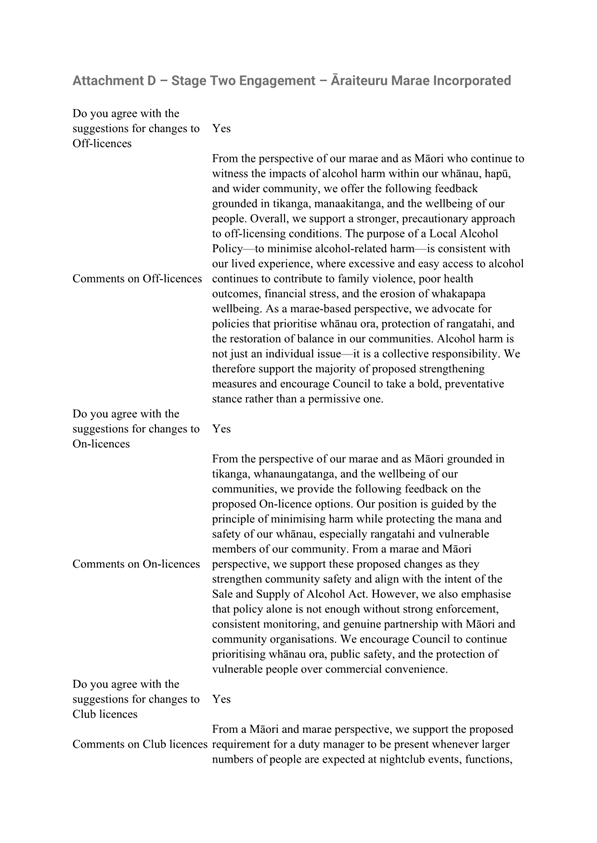
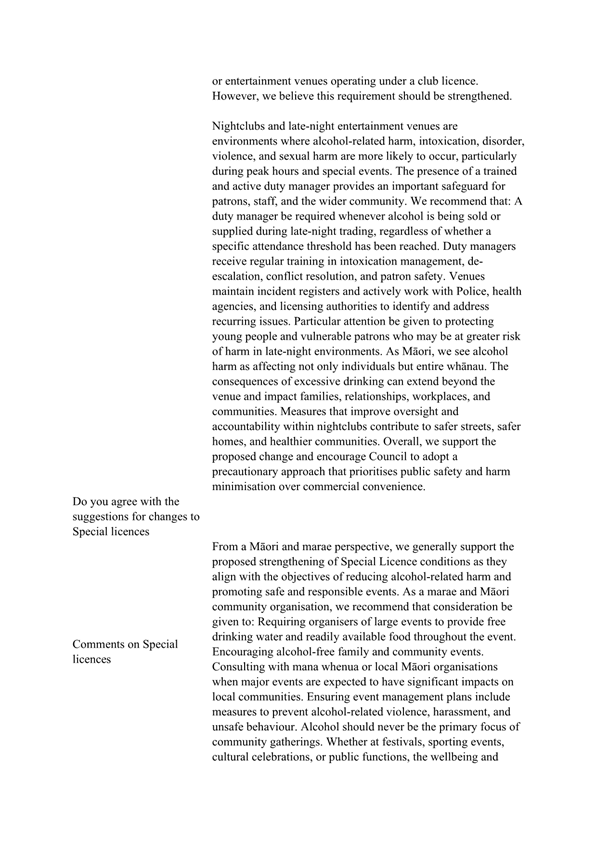
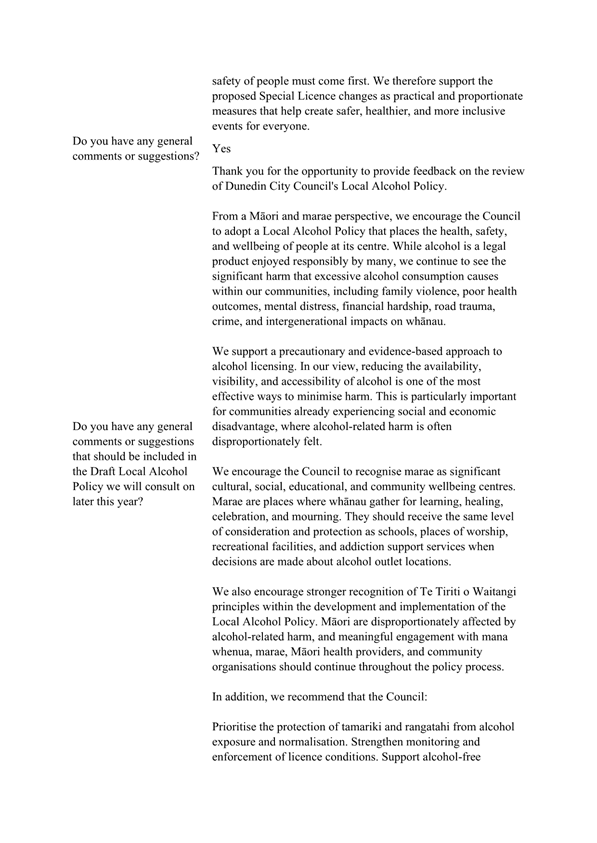
Health Service (Te Whatu Ora), Safe and Well Ōtepoti, Āraiteuru
Marae, Foodstuffs South Island, and Hospitality New Zealand Otago. For a
representation of the feedback received, these are included as Attachments C,
D, E, F and G.
|
Feedback Type
|
Responses
|
|
Off-licence
|
2
|
|
On-licence
|
12
|
|
Club
|
7
|
|
Public Sector
|
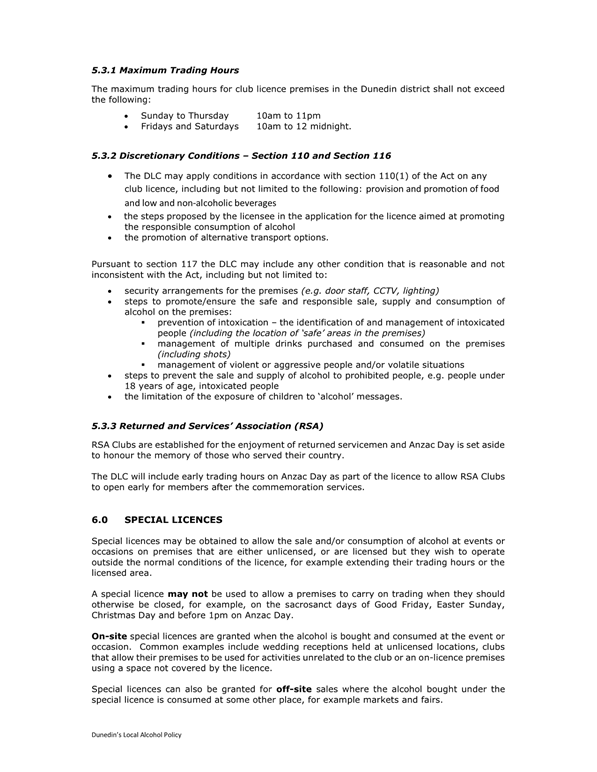
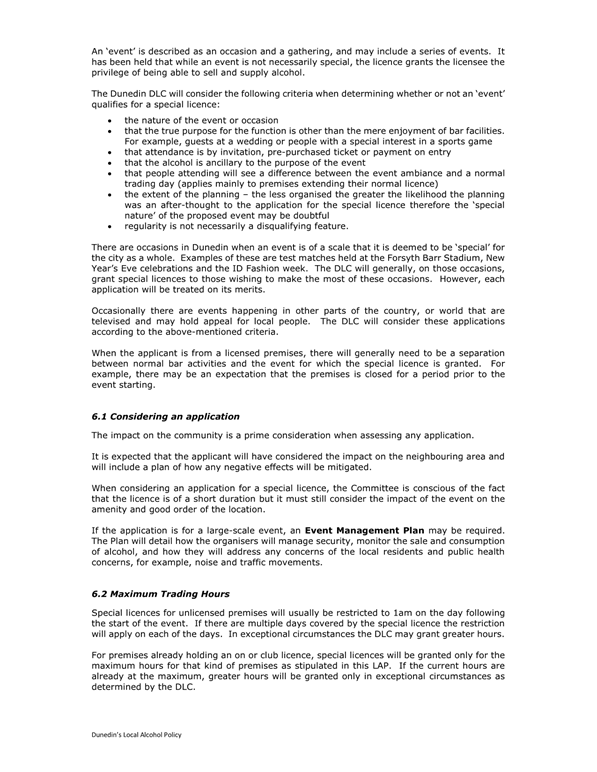
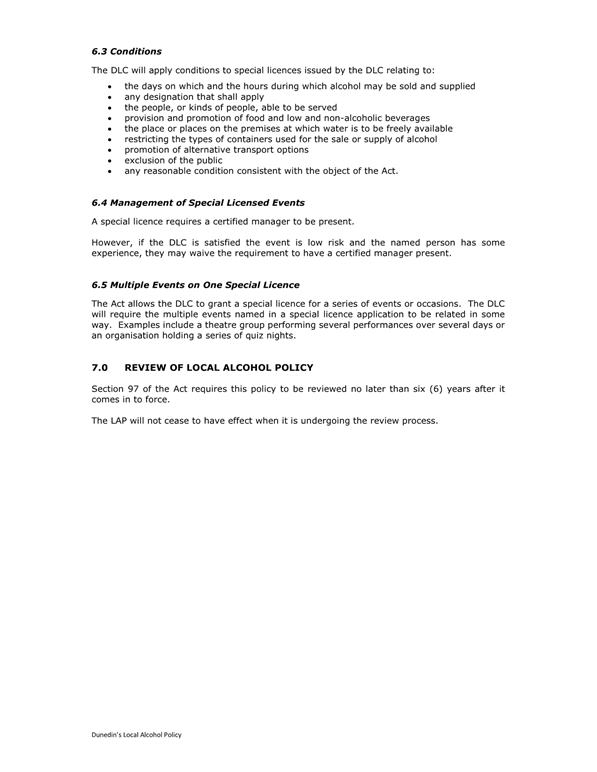
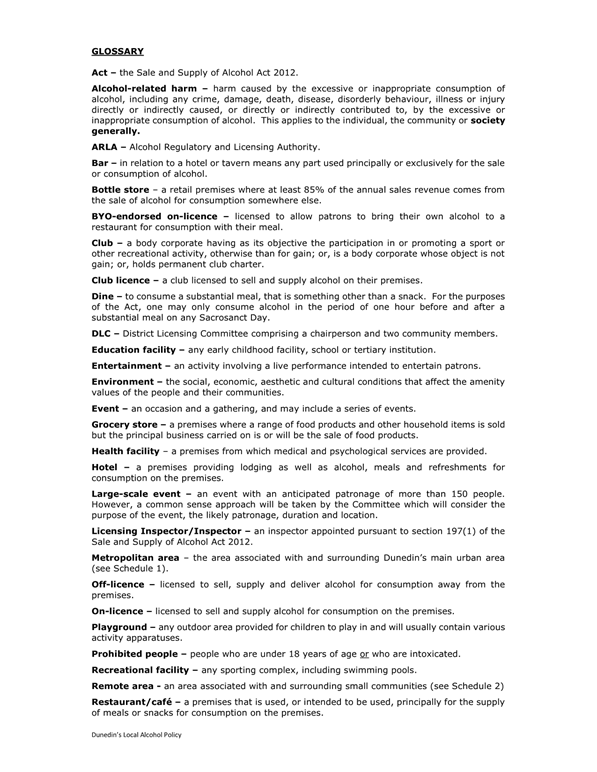
2
|
|
NGO
|
4
|
|
Individual
|
16
|
|
Anonymous
|
5
|
|
Total
|
48
|
Table Two:
Breakdown of type of Options feedback.
14 A count
summary for responses to overall questions on the licence type options is shown
in Table Three. This shows that there were mixed responses on the
options, which were often along sector lines within organisations and
businesses. Partially agreeing with the overall type of options was
common, e.g. 21 in total for off-licences.
|
Feedback
|
Response
|
Off-licence Options Overall
|
On-licence Options Overall
|
Club-licence Options Overall
|
Special licence Options Overall
|
|
Organisations/ Businesses
|
Yes
|
5
|
7
|
6
|
4
|
|
No
|
7
|
12
|
9
|
9
|
|
Partially Agree
|
12
|
5
|
10
|
10
|
|
Individual/ Anonymous
|
Yes
|
3
|
3
|
9
|
3
|
|
No
|
8
|
9
|
9
|
10
|
|
Partially Agree
|
9
|
8
|
3
|
4
|
|
Total
|
Yes
|
8
|
10
|
15
|
7
|
|
No
|
15
|
21
|
18
|
19
|
|
Partially Agree
|
21
|
13
|
13
|
14
|
Table Three:
Overall Options responses by type of feedback.
15 Public
sector organisations favoured most if not all options. They wanted some
options to go further, e.g. Off-2 and Off-7 in Table One (extending the
sensitive site and advertising restrictions to on-licences) and seeking earlier
closing or operating times for On-2 and On-3. This was also the case for
non-governmental organisations who showed near universal support for the
options, with some exception to On-2 and On-3 which some thought should have
earlier closing or operating hours.
16 Private
sector organisations were more resistant to the options presented, with some
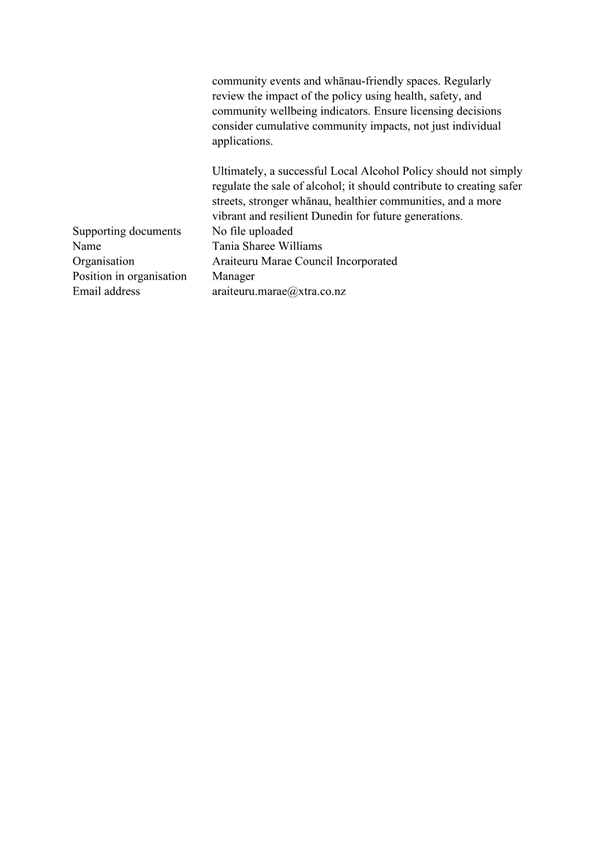
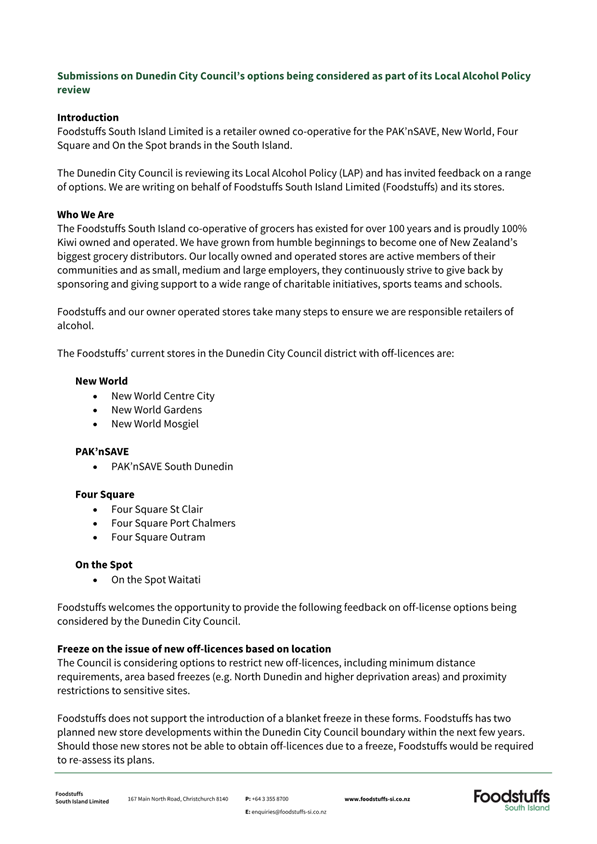
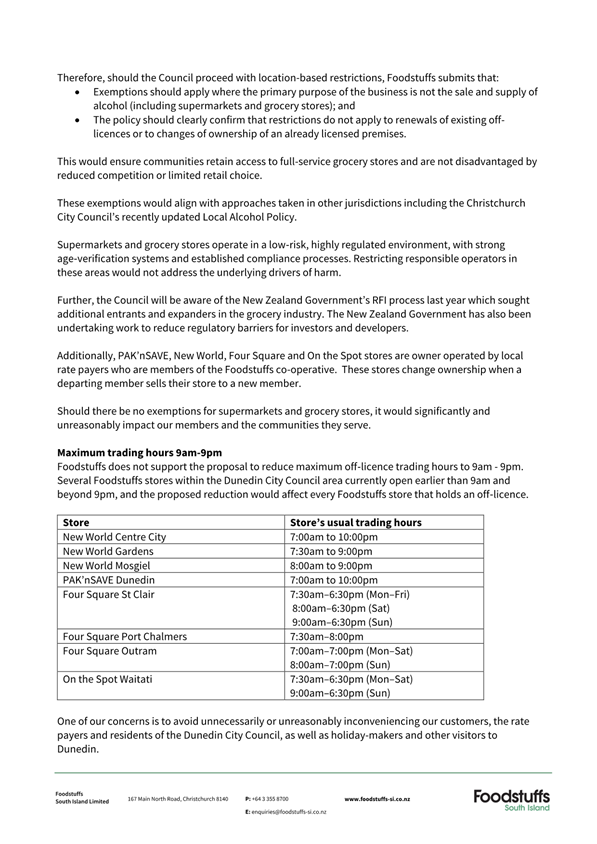
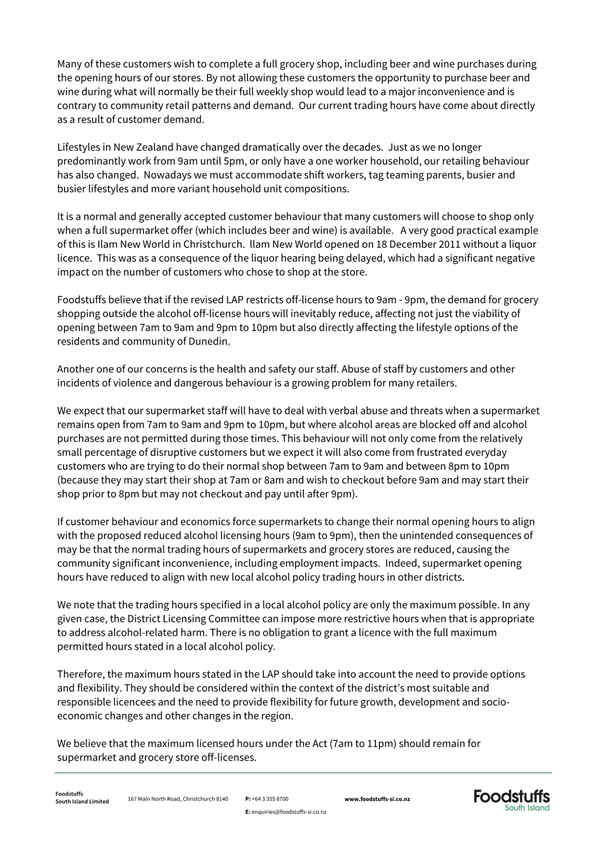
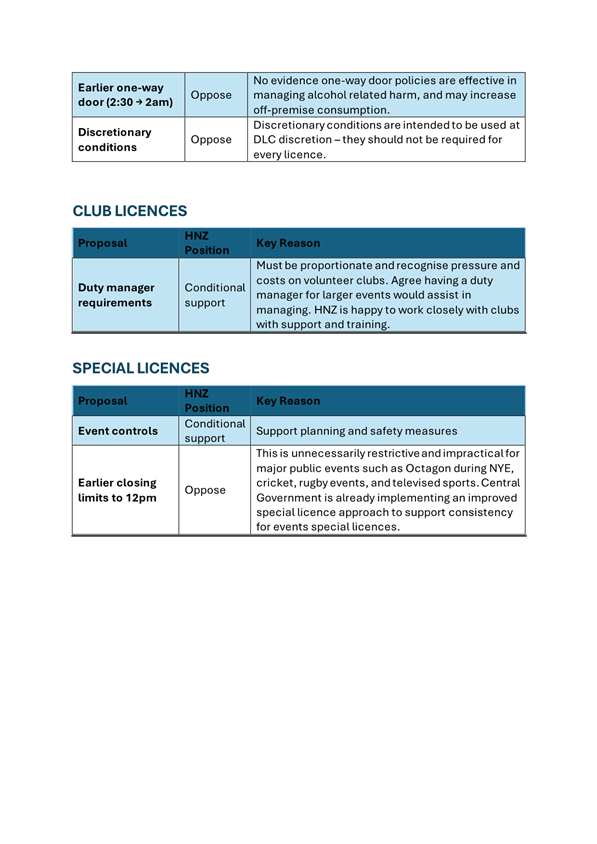
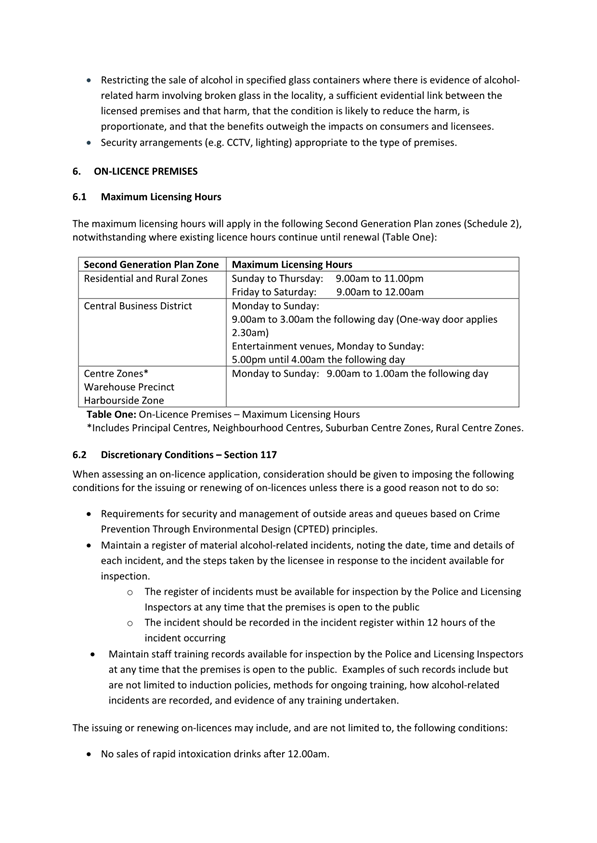
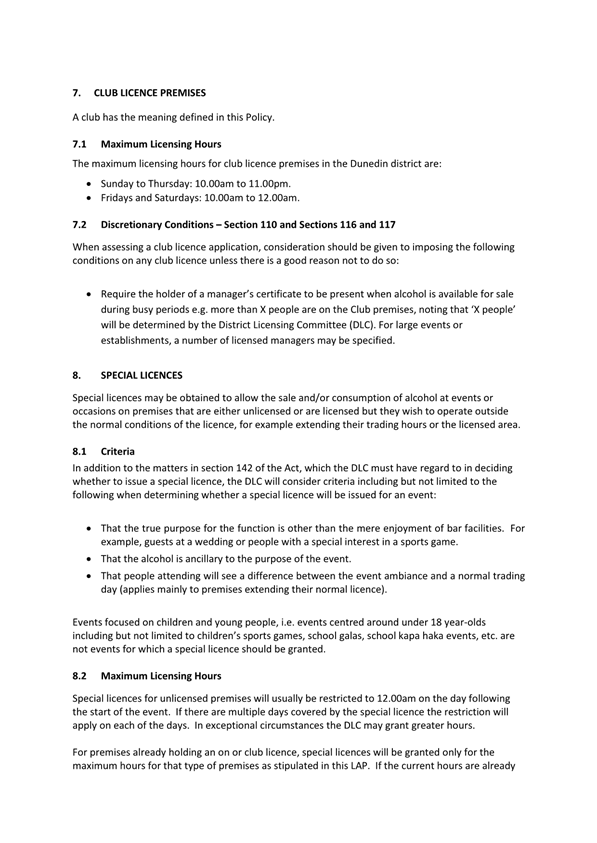
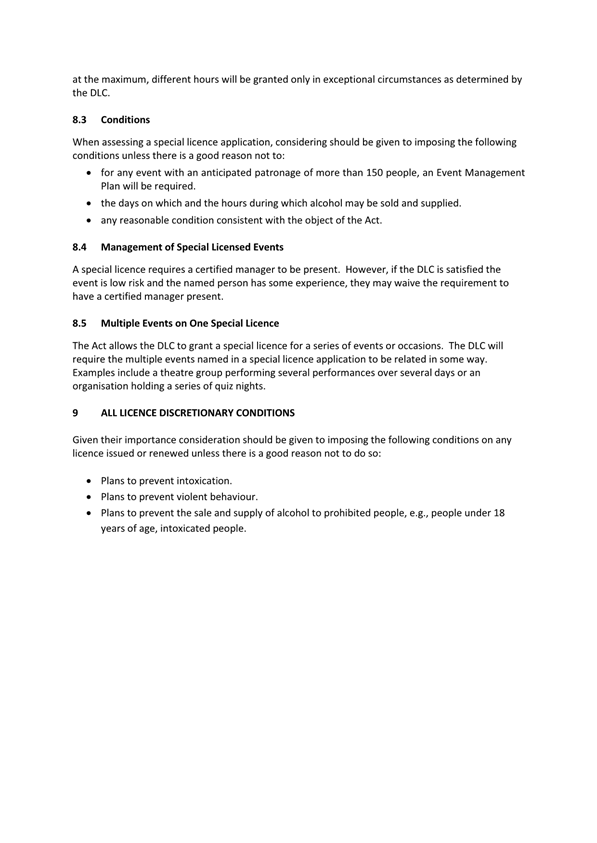
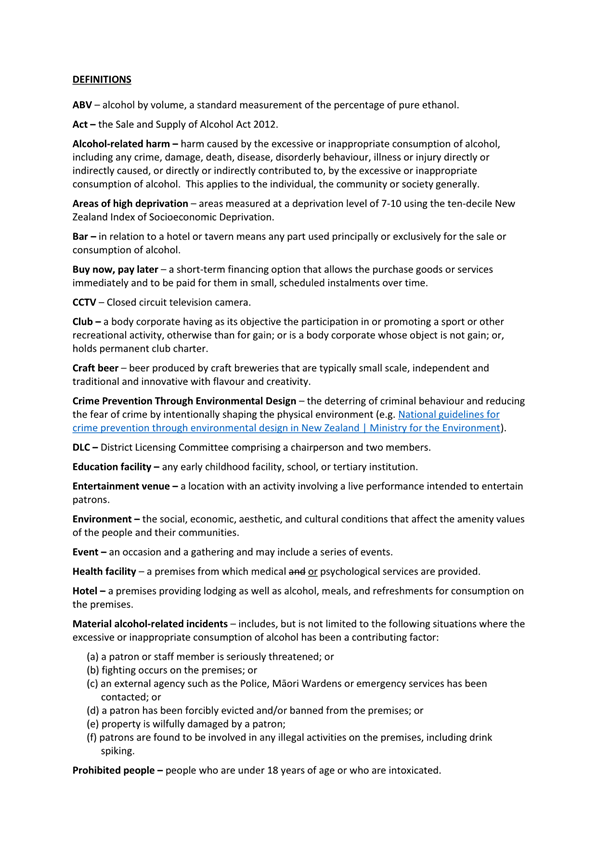
not in favour of any of them. Opposition was strongest for Off-5
(‘impacts moderate drinkers’), Off-7 (‘blanket
restrictions’), On-3 (‘a safety risk’) and On-7 (‘a
staff responsibility’). Some of the private sector organisations
accepted that several options were worth progressing, e.g. those with
on-licences showed some support for options Off-1, Off-2 and Off-6.
17 Some of the
feedback concerned clarifying or defining some of the options better (e.g.
Off-1, Off-2 and Off-7), and a perception that licence renewals would not be
exempt from location restrictions (they would be). On-licences were
concerned that some off-licence options would be extended to them, e.g. Off-7.
18 Clubs
tended to be more in favour of most options apart from mixed support for single
sales restrictions (Off-5). Their main concern was that whilst they
tended to support the intent of the duty manager requirement (Club-1) they felt
that it could be too onerous as worded and sought a more flexible application.
19 Several
responses opposed some discretionary condition options as their responses
indicated that they may have thought that these were fixed conditions like
those for location and trading hours. This may have been due to some
discretionary condition options being placed in the off- and on-licence
categories during engagement for ease of survey completion.
20 The special
licence option contained four matters with mixed feedback. Midnight
cut-off times and two drinks per serve at larger events were considered by some
to be too restrictive. There was more overall support for alcohol and
event management plans for large events and for no alcohol sales for events
with high numbers of minors, although it was suggested that better
clarification would assist the latter matter.
Proposed
Draft LAP
21 A Draft LAP
has been developed taking into account the Stage One and Two research and
engagement, relevant case law noted above, and established principles to
minimising alcohol harm as supported by the evidence cited in the research
report (i.e. the availability, accessibility and marketing of alcohol).
22 Table Four
provides a summary of the changes and amendments to the twenty-one LAP options
engaged upon for the Draft LAP. Seven options have been retained as they
were, four have been better defined (e.g. external advertising, club manager
requirement), seven have had amendments (e.g. sensitive site distances and
exemptions) and three have been deleted (e.g. changing the CBD One Way Door
times).
23 For the two
location area restriction options, the North Dunedin area is a subset of the
high deprivation area option. Given reasonable support for both options
that are underpinned by an evidential foundation, it is proposed to just retain
the high deprivation option.
|
OFF-LICENCES
|
|
Option
|
Post-Engagement
Remark
|
Proposed for Draft LAP
|
|
OFF-1
|
Emphasise in consultation that renewals are exempt.
|
Retain
option.
|
|
OFF-2
|
The North Dunedin area is a subset of the wider defined
deprivation area.
Emphasise in consultation that renewals are exempt.
|
Retain there
being no new off-licences in the cited deprivation area option and delete the
North Dunedin restriction area option.
Amend to
allow an exemption if primary purpose of business is not the sale and supply of
alcohol.
|
|
OFF-3
|
Possible inconvenience for morning purchases.
|
Retain
option.
|
|
OFF-4
|
Issue of bus interchange and impacts on new on-licences
in the City.
|
Retain
and amend to:
· Include Dunedin
Central City Bus Hub.
· 100m distance for on-licences in CBD and Centre Zones.
· Exempt if primary
purpose of business is not the sale and supply of alcohol.
|
|
Discretionary conditions – should include in an Off-licence
|
|
OFF-5
|
Mixed
feedback and possible impacts.
|
Retain
option.
|
|
OFF-6
|
Reasonable
support.
|
Retain
option.
|
|
OFF-7
|
Clarity
on whether store name and logo and if interior displays are excluded.
|
Retain
and re-define: ‘No external-facing
display of alcohol-related advertising or promotion including any mobile or
temporary signage affixed to or adjacent to the premises. Signage
will be limited to displaying the store name and logo only’.
|
|
Discretionary conditions – may include in an Off-licence
|
|
OFF-8
|
Note
that remote sellers are included.
|
Retain
and amend: ‘No alcohol deliveries
outside licencing hours, including remote sellers’.
|
|
ON-LICENCES
|
|
Option
|
Post-Engagement Remark
|
Proposed for Draft LAP
|
|
ON-1
|
Possible impact on breakfast bookings.
|
Retain option.
|
|
ON-2
|
Currently only one venue.
|
Delete option.
|
|
ON-3
|
Safety issues raised.
|
Delete option.
|
|
Discretionary conditions – should include in an On-licence
|
|
ON-4
|
A well-established safety
measure.
|
Retain and amend: ‘Include broader Crime
Prevention Through Environmental Design principles for security and the management of outside areas and
queues’.
|
|
ON-5
|
Tri-agency request for
licencing inspections.
|
Retain and amend: ‘Maintain an incident register available for inspection’.
|
|
ON-6
|
Tri-agency request for
licencing inspections.
|
Retain and amend: ‘Maintain staff training records available for inspection’.
|
|
Discretionary conditions – may include in an On-licence
|
|
ON-7
|
Mixed support, need to define
clearly.
|
Retain option – use
accepted research definition.
|
|
CLUB LICENCES
|
|
Option
|
Post-Engagement Remark
|
Proposed for Draft LAP
|
|
CLUB-1
|
Better
support if more pragmatically defined.
|
Retain
and re-define: ‘Require the holder of
a manager’s certificate to be present when alcohol is available for
sale during busy periods e.g. more than X people are on the Club premises,
noting that ‘X people’ will be determined by the District
Licencing Committee’.
|
|
SPECIAL LICENCES
|
|
Option
|
Post-Engagement Remark
|
Proposed for Draft LAP
|
|
SPECIAL-1
|
Midnight cut-off time.
|
Retain option –
DLC to decide on a case by case basis.
|
|
Limit of two drinks per serve
for events over 1000 people.
|
Delete option – often
happens as events progress.
|
|
Include alcohol and event
management plan for large events, i.e. over 400 people.
|
Retain option – an
appropriate safety measure.
|
|
Include no sale of alcohol if
high number of under 18 year olds.
|
Retain and better define:
‘Special licences will not
be granted for events focused on children and young people, i.e. events
centred around under 18 year-olds including but not limited to
children’s sports games, school galas, school kapa haka events, etc’.
|
Table Four:
Changes and amendments to the Stage Two engagement options for the Draft LAP.
24 A
discretionary condition on restricting off-licence alcohol sales in glass
containers was not included in Stage Two engagement as staff were still working
through legal advice on the matter. The tri-agencies and the Sophia
Charter support such a restriction. The proposed off-licence
discretionary condition on glass container sales for the Draft LAP is:
· Restricting
the sale of alcohol in specified glass containers where there is evidence of
alcohol-related harm involving broken glass in the locality, a sufficient
evidential link between the licensed premises and that harm, is likely to
reduce the harm, is proportionate, and that the benefits outweigh the impacts
on consumers and licensees.
25 Other
general changes and amendments include:
· Aligning
on-licence locations with the Second Generation Plan for consistency.
· Removing
repetition and content from the LAP that is part of the Act.
· Including
a section on a discretionary condition applying to all licences on plans to
prevent intoxication, violent behaviour and the sale of alcohol to prohibited
people.
· Updating
definitions.
26 Retained
content from the current LAP includes:
· On-licence
hours in residential zones.
· Off-licence
security conditions.
· Club
licence trading hours.
· Some
special licence application criteria.
27 The
proposed Draft LAP is contained in the Special Consultative Procedure’s
Statement of Proposal in Attachment H. The current LAP is contained in
Attachment I.
Legislative Considerations
28 The Sale
and Supply of Alcohol (Improving Alcohol Regulation) Amendment Bill 2026 (the
Bill) proposes to amend parts of the licensing framework, although it does not
repeal, replace, or suspend a LAP made under the Act.
29 Were there
to be any inconsistency between an adopted LAP and the Act (as ultimately
amended by the Bill), the provisions of the Act will apply, and the LAP
inconsistency becomes void by operation of law, and the LAP will not need to be
formally amended.
OPTIONS
Option One – Carry out public consultation on the
Draft Local Alcohol Policy using the Special Consultative Procedure
30 The Council
consults on the Draft LAP using the Special Consultative Procedure.
Advantages
· Continues
the review of the LAP that builds on previous engagement.
· Carries
out a formal requirement to review a LAP.
Disadvantages
· There
are no disadvantages with this option to progress the LAP review.
Option Two – Do not carry out public consultation on
the Draft Local Alcohol Policy using the Special Consultative Procedure
31 The Council
does not consult on the Draft LAP using the Special Consultative Procedure.
Advantages
· There
are no advantages with this option if Council wishes to retain a LAP.
Disadvantages
· Delays
the review of the LAP given a SCP is a legislative requirement.
· Risks
disappointment and disinterest from those engaged with to date during the
review.
· Delays
may mean some parts of the current LAP become outdated.
NEXT STEPS
32 If Council
adopts Option One, staff will implement the following steps and approximate
timeframes during 2026:
· Draft
LAP consultation using the Special Consultative Process – late August to
late September.
· Hearings
and deliberations – October.
· Report to
Council to approve new LAP – November.
33 If Council
adopts Option Two, staff will seek direction from Council to determine the next
steps.
Signatories
|
Author:
|
Paul Cottam - Senior Policy Analyst
|
|
Authoriser:
|
Bonnie Wright - Manager Compliance Solutions
Paul Henderson - General Manager Corporate and Regulatory
Services
|
Attachments
|
|
Title
|
Page
|
|
⇩a
|
Local Alcohol Policy
Legislative Matters
|
127
|
|
⇩b
|
DCC LAP Review Research
Report July 2026
|
174
|
|
⇩c
|
Stage Two Engagement
Feedback – National Public Health Service
|
221
|
|
⇩d
|
Stage Two Engagement
Feedback – Safe and Well Ōtepoti
|
225
|
|
⇩e
|
Stage Two Engagement
Feedback – Āraiteuru Marae Incorporated
|
228
|
|
⇩f
|
Stage Two Engagement
Feedback - Foodstuffs South Island
|
232
|
|
⇩g
|
Stage Two Engagement
Feedback - Hospitality NZ Otago
|
236
|
|
⇩h
|
Local Alcohol Policy
Statement of Proposal
|
240
|
|
⇩i
|
Dunedin Local Alcohol
Policy 2018
|
258
|
|
SUMMARY OF CONSIDERATIONS
|
|
Fit with purpose of Local Government
This
decision enables democratic local decision making and action by, and on
behalf of communities.
This decision promotes the social
well-being of communities in the present and for the future.
|
|
Fit with strategic
framework
|
|
Contributes
|
Detracts
|
Not applicable
|
|
Social Wellbeing Strategy
|
✔
|
☐
|
☐
|
|
Economic Development Strategy
|
☐
|
☐
|
✔
|
|
Environment Strategy
|
☐
|
☐
|
✔
|
|
Arts and Culture Strategy
|
☐
|
☐
|
✔
|
|
3 Waters Strategy
|
☐
|
☐
|
✔
|
|
Future Development Strategy
|
☐
|
☐
|
✔
|
|
Integrated Transport Strategy
|
☐
|
☐
|
✔
|
|
Parks and Recreation Strategy
|
☐
|
☐
|
✔
|
|
Other strategic projects/policies/plans
|
☐
|
☐
|
✔
|
The proposal to
undertake consultation on the LAP aligns with the Social Wellbeing strategic
priorities of vibrant and cohesive communities, and safe and healthy people.
|
|
Māori Impact Statement
Local rūnaka will continue to have the opportunity
to contribute to the LAP review via consultation and have been engaged with
during Stage One and Two. The research report notes alcohol’s
uneven impact on Māori and the Draft LAP contains measures to offset
harm, in so doing helping to meet the social equity aspect of Te Taki Haruru.
|
|
Sustainability
There are no implications for sustainability.
|
|
LTP/Annual Plan / Financial Strategy /Infrastructure
Strategy
There are no identified implications for the LTP/Annual
Plan, Financial or Infrastructure Strategies.
|
|
Financial considerations
There are no financial considerations identified.
|
|
Significance
Although the LAP is an
important document that has a statutory basis, this decision to approve
consultation is considered to be low significance in terms of the
Council’s Significance and Engagement Policy.
|
|
Engagement – external
Twenty-seven
organisations and twenty-one individuals replied during Stage Two engagement,
building on the thirteen organisations engaged with during Stage One
engagement.
|
|
Engagement - internal
DCC’s regulatory and legal teams have been engaged
with.
|
|
Risks: Legal / Health and Safety etc.
DCC’s Legal Team and external lawyers are providing
legal advice as the review progresses.
|
|
Conflict of Interest
There are no known conflicts of interest.
|
|
Community Boards
There are no implications for Community Boards.
|
|

|
Council
13 August 2026
|
Botanic Garden Plan
Department: Parks and Recreation
EXECUTIVE SUMMARY
1 To
adopt the Draft Dunedin Botanic Garden Plan 2026, which establishes a 20-year
vision, mission and goals for the Dunedin Botanic Garden.To note the Draft
Botanic Garden Action Plan 2026-2030, which identifies a programme of priority
actions to inform future operational planning, annual plan processes and
10-Year Plan considerations.The purpose of the Botanic Garden Plan is to
provide a clear direction for the future development and management of the
Garden. It outlines the goals and initiatives to guide the Garden's activities
over the next twenty years, and reflects the feedback and input received from partners
and stakeholders.
2 The
Plan has six goals which will give direction for preserving and enhancing the
garden's unique collections, promoting conservation and sustainability,
fostering community engagement and education, supporting scientific research,
and ensuring the Garden's long-term success and sustainability while
maintaining its high standard of horticulture and amenity values.
3 The
Plan can be viewed in Appendix A.
4 To
support delivery of the Plan, staff have developed a three-year Action Plan
that identifies priority actions and sequencing. The Action Plan will inform
future operational planning and budget considerations; however, implementation
of actions requiring additional funding will remain subject to Council approval
through Annual Plan and 10-Year Plan processes.
5 The
Draft Dunedin Botanic Garden Action Plan can be viewed in Appendix B.
RECOMMENDATIONS
That the Council:
a) Adopts the Dunedin
Botanic Garden Plan 2026
b) Notes that the Dunedin
Botanic Garden Plan 2026 replaces the Dunedin Botanic Garden Development Plan 2007, as the non-statutory
planning document for the Garden.
c) Notes the Dunedin
Botanic Garden Action Plan 2026-2030 as a prioritised programme of actions to
inform future planning and budgeting processes.
BACKGROUND
6 The
Garden is part of the Dunedin Town Belt and is gazetted as a recreation reserve
under the Reserves Act 1977.
7 In
recognition of the Garden’s unique values, it is managed under a
site-specific management plan, the Dunedin Botanic Garden Reserve Management
Plan 2000. This is a statutory document prepared under the Reserves Act
1977 and outlines the policies that the Garden will be managed under.
8 The
physical development of the Garden over the last 20 years has been influenced
by the non-statutory Dunedin Botanic Garden Development Plan 2007.
9 The
Dunedin Botanic Garden Plan 2026 (the Plan) is intended to replace the Dunedin
Botanic Garden Development Plan 2007 as the non-statutory planning document for
the Garden.
10 The Botanic
Garden Development Plan 2007 (the Development Plan) proposed several projects,
including the creation of a new road through the Garden with a new main
entranceway to the upper garden. It proposed a new information centre,
education and training lecture theatre and restaurant). Additionally, the
Development Plan proposed the construction of new propagation and nursery
facility and administration buildings on the perimeter of the garden.
11 Three
projects proposed in the Development Plan were funded and implemented in
subsequent years. The first was the creation of the Mediterranean Garden in
2010, the second was the construction of a specialised propagation and nursery
facility in 2015 and the third was the Children’s Playground
redevelopment constructed in 2024.
12 The
Mediterranean Garden and Children’s Playground were co-funded by the
Friends of the Dunedin Botanic Garden.
DISCUSSION
13 The Dunedin
Botanic Garden Development Plan 2007 no longer provides an adequate framework
for guiding the Garden's future development.
14 Since its
adoption, some key projects have been completed, Council's strategic framework
has changed, and expectations relating to mana whenua partnerships,
accessibility, sustainability and visitor experience have evolved.
15 While the
Garden continues to operate successfully, development priorities have
increasingly been considered through individual projects rather than within an
updated strategic framework.
16 The Plan
provides long-term direction and establishes priorities to guide future
planning and investment decisions.
17 The Plan has been developed within the context of Te Taki Haruru.
18 Staff reviewed key policy documents, Council's strategic framework
and the statutory context to inform development of the Plan.
19 Engagement
with partners and stakeholders together with the feedback from the Garden staff
has been essential to guide the development of the Plan. Partners and
stakeholders were invited to themed workshops based on their interest areas.
20 Development
of the Plan commenced in late 2020. The process spanned several years due to the
impacts of COVID-19, changes in Botanic Garden management, and the opportunity
to align the document with Council's evolving strategic framework, including Te
Taki Haruru.
21 To ensure
the Plan continued to reflect current views, staff undertook a further phase of
stakeholder engagement in 2023. Feedback from this engagement informed and
validated the current version of the Plan.
22 The process
of engagement started in December 2020 with a series of workshops at the
Garden.
23 Workshop
themes were Social Wellbeing, Growing Our Economy, Stewardship / Kaitiakitanga,
Curation, Education and Research. An example of the workshop engagement
material can be viewed in Appendix C.
24 In January
2021 there was a second series of meetings where several other stakeholder
groups were invited to individual workshops, for example Otago University,
Otago Polytechnic and DCC staff.
25 Staff
engaged with a broad range of stakeholders representing mana whenua,
conservation, education, accessibility, community wellbeing, environmental,
tourism, research and local government interests.
26 Participants
included local Rūnaka, government agencies, tertiary institutions,
community organisations, environmental groups, partner agencies and relevant
Council departments. Feedback from these groups informed the development of the
Plan.
27 Feedback
from stakeholders has been reviewed alongside analysis from Dunedin’s
Resident Opinion Surveys, census statistics and research into other Botanic
Gardens in New Zealand and overseas to understand how they have planned their
strategic direction.
28 As each
draft was produced it was taken back to the Garden staff for review and
comments incorporated accordingly.
29 A second
round of stakeholder engagement was held in 2023 with as many of the original
stakeholders being contacted as possible. The Plan was sent to by email
to stakeholders and feedback was received in face to face meetings, Teams
meetings and by email response.
30 The current
Plan aims to align with the principles, values, key intents and key directions
of Te Taki Haruru. The plan’s alignment to Te Taki Haruru is demonstrated
in the tables included in Appendix D. A mana whenua statement including
cultural narrative and mana whenua interests has also been included in the
current version of the Plan.
31 The main
themes that emerged from the engagement process were:
Collections: Preserve the
Garden's unique plant and bird collections and maintain horticultural and
botanical integrity, promote conservation, and support scientific research. The
feedback emphasised the importance of the management and preservation of the
collections.
Sustainability:
Prioritise sustainability and create strategies for reducing carbon emissions,
promote environmental stewardship and contribute to the global effort to
protect and preserve our natural heritage.
Partnerships: Collaborate
with other organisations and institutions to promote conservation and
sustainability.
Education: Integrate
education into all aspects of the garden's work. Improve educational
programs and resources.
Interpretation: Connect
people and plants and promote environmental resilience. Improve
interpretation and messaging at the garden.
Accessibility: Improve
physical accessibility within the garden and provide more information on how to
access and enjoy the garden.
Visitor engagement:
Engage visitors through storytelling, educational programs and recreational
activities.
Inclusion:
Investigate ways to improve inclusivity and diversity at the garden.
32 Based
on the themes that emerged from the engagement process 6 goals were created.
|
Goal
|
Purpose
|
|
Goal 1
|
Our collections have integrity
|
|
Goal 2
|
The Garden is a hub of
learning
|
|
Goal 3
|
We embrace environmental Stewardship
|
|
Goal 4
|
An inviting and accessible
place
|
|
Goal 5
|
Inspire people to get
involved
|
|
Goal 6
|
Sponsorship and fundraising
|
33 The
goals were developed from the themes identified through stakeholder engagement
and provide the strategic framework for the Plan. A detailed description of
each goal is provided in Appendix A.
34 The
Action Plan takes the goals from the Plan and prioritises the initial actions
needed to be taken.
35 Most
Year One actions focus on planning, policy review and investigation work and
can be delivered within existing operational budgets.
36 Actions
that require additional operational or capital funding will be considered
through future Annual Plan and 10-Year Plan processes.
37 Adoption
of the Plan does not commit Council to funding future projects identified
through implementation.
38 The
proposed first year projects will be:
· Undertake a
strategic review of the Aviary to assess its ongoing role, relevance and
alignment with the purpose of the Dunedin Botanic Garden and Council's
strategic priorities. The review will consider community views, operational
requirements, costs, opportunities and risks, and evaluate whether the
continued provision of an aviary remains an appropriate Council activity. Any
future investment or service changes arising from the review would be subject
to separate Council consideration and approval.
· Review the
Collections Policy which governs the acquisition, documentation, care, and
removal of plant species, aligning them with the institution’s mission
for conservation, education, and scientific research. It ensures the
authenticity and value of living collections (often focusing on wild-provenance
plants) while providing strategic guidance on climate resilience,
sustainability, and public display. This work will be carried out by
existing staff within current budgets.
· Review and
evaluate aviary and plant collections management practices and develop living
collections plan to investigate how modern sustainability and environmental
stewardship principles could be incorporated into collection management and
maintenance whilst upholding our high standards of aviculture, amenity and
horticultural values. The development of a Living Collections Plan will be the
operational arm to the Botanic Garden’s Collection Policy and will also
include an outline of the narrative we want our collections to tell the
public. This work will be carried out by existing staff within current
budgets.
OPTIONS
Option One – Recommended Option
39 Approve
the Draft Dunedin Botanic Garden Plan 2026 and the Draft Dunedin Botanic Garden
Action Plan 2026-2030.
Advantages
· Responds
to stakeholder, community and mana whenua feedback received during plan
development.
· Provides
an updated strategic framework to guide future planning, development and
management of the Garden.
· Informs future operational planning, Annual Plan processes and Long
Term Plan considerations.
· Provides
clear delivery objectives that align with Council’s statutory and
strategic obligations.
· Identifies
opportunities to pursue external funding, sponsorship and partnerships.
· Ensures
that the Botanic Garden continues to be a valuable asset for the local and visiting
population.
Disadvantages
· Dependence
on collaborative partnerships and additional funding to deliver the goals and
objectives identified in the plan.
Option Two – Status Quo
40 The
Draft Dunedin Botanic Garden Plan 2026 and the Draft Dunedin Botanic Garden
Action Plan 2026-2030 are not approved.
Advantages
· No
additional planning or implementation activity would be required at this time.
Disadvantages
· Future
planning and development decisions would continue to rely on the 2007 Development
Plan and individual project assessments.
· Future
development priorities would continue to be considered on a project-by-project
basis rather than through an updated strategic framework.
NEXT STEPS
41 Commence
Year One actions that can be delivered within existing operational budgets.
42 Consider
any additional operational or capital funding requirements identified through
implementation as part of future Annual Plan and Long Term Plan processes.
Signatories
|
Author:
|
Catherine Bradley - Botanic Gardens Manager
|
|
Authoriser:
|
Heath Ellis - Group Manager Parks and Recreation
Scott MacLean - General Manager, City Services
|
Attachments
|
|
Title
|
Page
|
|
⇩a
|
Botanic Garden Plan
|
278
|
|
⇩b
|
Botanic Garden Action
Plan
|
304
|
|
⇩c
|
Engagement Content
|
311
|
|
⇩d
|
Te Taki Haruru
Strategic Alignment
|
321
|
|
SUMMARY OF CONSIDERATIONS
|
|
Fit with purpose of Local Government
This decision promotes the social
well-being of communities in the present and for the future.
This decision promotes the economic
well-being of communities in the present and for the future.
This decision promotes the environmental
well-being of communities in the present and for the future.
This decision promotes the cultural
well-being of communities in the present and for the future.
|
|
|
|
Māori Impact Statement
There have been a number of meetings with a representative
from Ōtakou throughout the process of writing the plan and these
meetings will continue into the future. Through the engagement process there
were a number of discussions about incorporating mana whenua history into the
Garden through interpretive information signage, adopting bilingual signage
and having gardens showcasing Māori cultural practices such as
preparation and use of medicinal plants.
|
|
Sustainability
The Dunedin Botanic Garden Plan has existing values as a
destination for local people and visitors, the intention is to increase
visitor numbers and make the Garden priority for people to visit. Many
submitters indicated that the Dunedin Botanic Garden is a strong social
aspect to its appeal and the Plan has a goal to be a welcoming, accessible
and engaging place to visit. Environmental stewardship was a theme that
came through very strongly in the engagement feedback. The intention is
to use the Garden as a place where visitors can see best practice examples of
sustainability and use them in their own situations.
|
|
LTP/Annual Plan / Financial Strategy /Infrastructure
Strategy
There is currently no new capital funding for the
implementation of the Dunedin Botanic Garden Plan in the Annual Plan.
|
|
Financial considerations
Indicative costs have been identified for several future
actions within the Action Plan; however, detailed business cases and final
cost estimates have not yet been developed. Any future funding requirements
will be considered through Annual Plan and Long Term Plan processes.
Initial actions are planning focused and will be covered using existing opex
budget. Masterplan development and Visitor and engagement plans will require
capex budget. These costings will be identified for the next LTP. These two
planning documents will identify future development and associated investment
requirements. A complementary sponsorship and fundraising strategy will be
created to identify potential external funding sources to reduce Council investment
requirements.
|
|
Significance
|
|
Engagement – external
There has been significant external engagement in the
writing of the Dunedin Botanic Garden Plan. The 6 goals in the Plan
have been derived from stakeholder feedback
|
|
Engagement - internal
There has been internal engagement in the writing of the
Dunedin Botanic Garden Plan. The Dunedin Botanic Garden staff have
provided feedback on 3 draft versions of the Plan. There has been
feedback from Mana Ruruku, Parks and Recreation staff, Enterprise Dunedin,
Transport, 3 Waters, Events, City Sanctuary and Corporate Policy.
|
|
Risks: Legal / Health and Safety etc.
There are no identified risks. Implementation of capital
projects identified in the Plan will require Council approval through LTP and
Annual Plan processes.
|
|
Conflict of Interest
There are no conflicts of interest
|
|
Community Boards
The Dunedin Botanic Garden is a destination for people
living in all Community Board areas in Dunedin and while the Garden is not
located in any one Community Board area there will be Community Board
interest in the Dunedin Botanic Garden Plan.
|
|

|
Council
13 August 2026
|
Future Development Strategy Implementation Plan update 2026
Department: City Development
EXECUTIVE SUMMARY
1 The
purpose of this report is present the Future Development Strategy (FDS)
Implementation Plan 2026 (Attachment 1).
2 The
Future Development Strategy Implementation Plan describes how the Dunedin
Future Development Strategy (FDS) will be implemented over the short (1-3
years), medium (4-10 years) and the long (11-30 years) term, based on funding
included in DCC’s 2025-2034 9 Year Plan and ORC’s 2024-34 Long Term
Plan and related infrastructure strategies. The Implementation Plan supports
delivery of the FDS and fulfils the requirements of the National Policy
Statement on Urban Development 2020 (NPS-UD).
3 The
FDS Implementation Plan 2026 updates the FDS Implementation Plan published in
2025, and has been prepared to capture any changes that have occurred since
that time.
RECOMMENDATIONS
That the Council:
a) Notes the Future
Development Strategy Implementation Plan 2026.
BACKGROUND
4 The
Dunedin City Council (DCC) and Otago Regional Council (ORC) jointly prepared
the Dunedin Future Development Strategy 2024 – 2054 in April 2024, as
required under the National Policy Statement for Urban Development 2020
(NPS-UD).
5 The
Future Development Strategy (FDS) describes how Dunedin will deliver a well-functioning
urban environment and provide enough development capacity to meet the long-term
housing and business land needs, based on the business land capacity assessment
for Dunedin undertaken in 2022, and the housing capacity assessment for Dunedin
undertaken in 2023.
6 The
FDS assists the integration of land use planning decisions with infrastructure
planning and funding decisions. It identifies the infrastructure needed to
support projected growth over the short, medium and long-term.
7 The
NPS-UD requires DCC and ORC to jointly prepare an Implementation Plan for the
FDS, which must be updated annually. The first FDS Implementation Plan was
noted by Council at its meeting on 26 August 2025, and by the ORC’s
Environmental Strategy and Planning Committee on 27 August 2025. It was based
on the funding included in DCC’s 2025-2034 9 Year Plan and ORC’s
2024-34 Long Term Plan and related infrastructure strategies.
DISCUSSION
8 The
Future Development Strategy Implementation Plan 2026 is an update of the 2025
implementation plan, and captures changes made in delivery programmes since
that time. This includes changes to project timing, sequencing, scope and
funding. This maintains an up-to-date and coordinated view of the
infrastructure and development projects required to support the growth outcomes
identified in the FDS.
9 Delivery
of actions identified in the FDS continues to progress, with delivery of
infrastructure projects, including transport, 3 waters, flood protection and
recreation improvements, continuing broadly in line with planned programmes.
Several projects have been completed since the 2025 implementation plan was
published, including playground upgrades, 3 waters servicing assessments, the
South Dunedin Library and Community Complex, and Stage 1 of the Tunnels Trail.
A small number of new actions have been added to respond to emerging
priorities.
10 The 2026
update identifies several projects where delivery timeframes have been revised,
including as a result of dependencies on other strategic programmes. For
example, several 3 waters projects are on hold pending the outcome of the South
Dunedin Future programme and wastewater optimisation studies. Strategic
planning initiatives, including future reviews of the FDS and some planning
projects, are affected by resource management reform.
11 Overall,
implementation of the FDS remains broadly on track and continues to align with
the priorities identified in the FDS.
Resource
Management Reform and future FDS implementation
12 The
Government is currently reforming the resource management legislation and will
enact a new Planning Bill within the next few months. On 20 July, the
Environment Committee released its select committee report on the Planning
Bill. The amendments made by the Environment Committee include an exemption for
local authorities from compliance with ongoing requirements for Future
Development Strategy implementation plans. This exemption takes effect one month
following enactment (i.e. approximately October 2026). There will therefore no
longer be a requirement to produce implementation plans in future years.
13 Under the
proposed new resource management system, the FDS will be replaced by a Regional
Spatial Plan (RSP), which must be notified within 21 months of enactment of the
Planning Bill (i.e. by mid-2028). The bill outlines that RSPs will set the
strategic direction for growth and change in a region for at least 30 years.
They will identify priority locations for growth and change, and existing and
future infrastructure that is significant for the region. An RSP implementation
plan will be required once the RSP is finalised.
14 Until
the RSP is prepared, monitoring of FDS capital projects will take place through
DCC Annual Reports.
OPTIONS
15 No options.
NEXT STEPS
16 The FDS
Implementation Plan 2026 will be presented to the ORC Environmental Strategy
and Planning Committee for noting on 26 August 2026.
17 Initial
work is commencing on the Regional Spatial Plan.
Signatories
|
Author:
|
Emma Christmas - Team Leader Planning
|
|
Authoriser:
|
Glen Hazelton - Project Director
Scott MacLean - General Manager, City Services
|
Attachments
|
|
Title
|
Page
|
|
⇩a
|
Future Development
Strategy Implementation Plan 2026
|
329
|
|
SUMMARY OF CONSIDERATIONS
|
|
Fit with purpose of Local Government
The FDS Implementation Plan reports on
progress delivering actions in the FDS that are intended to support community
well-being and future growth. It provides information that will be useful for
local decision making and action.
|
|
Fit with strategic framework
|
|
Contributes
|
Detracts
|
Not applicable
|
|
Social Wellbeing Strategy
|
✔
|
☐
|
☐
|
|
Economic Development Strategy
|
✔
|
☐
|
☐
|
|
Environment Strategy
|
✔
|
☐
|
☐
|
|
Arts and Culture Strategy
|
☐
|
☐
|
✔
|
|
3 Waters Strategy
|
✔
|
☐
|
☐
|
|
Future Development Strategy
|
✔
|
☐
|
☐
|
|
Integrated Transport Strategy
|
✔
|
☐
|
☐
|
|
Parks and Recreation Strategy
|
✔
|
☐
|
☐
|
|
Other strategic projects/policies/plans
|
☐
|
☐
|
✔
|
The FDS Implementation Plan is required under the National
Policy Statement for Urban Development (NPS-UD 2020). The Implementation Plan
reports on the status of FDS actions, most of which are also related to other
strategies within the framework.
|
|
Māori Impact Statement
The FDS Implementation Plan is a reporting document with
no known impacts for Māori.
|
|
Sustainability
The FDS Implementation Plan is a reporting document with
no implications for sustainability.
|
|
LTP/Annual Plan / Financial Strategy /Infrastructure
Strategy
The FDS Implementation Plan 2026 update is a reporting
document with no implications for current levels of service. It is a
requirement of the NPS-UD (2020).
|
|
Financial considerations
The FDS Implementation Plan 2026 update is a reporting
document and does not create any additional financial implications. It
reflects funding decisions made through DCC’s 2025–34 9-Year
Plan, ORC’s Long-Term Plan, and any changes as a result of the recent
annual plans.
|
|
Significance
This decision is considered to be low significance in
terms of the Council’s Significance and Engagement Policy.
|
|
Engagement – external
The FDS Implementation Plan 2026 update was prepared
jointly with ORC. Other external infrastructure providers and organisations
responsible for implementation of FDS actions were contacted for a progress
update.
|
|
Engagement - internal
DCC 3 Waters, Transport, Waste, Property, City Development
and Parks and Recreation departments were engaged and provided input to the
FDS Implementation Plan 2026 update.
|
|
Risks: Legal / Health and Safety etc.
The FDS Implementation Plan 2026 update is a reporting
document with no identified risks.
|
|
Conflict of Interest
There are no conflicts of interest.
|
|
Community Boards
The FDS Implementation Plan 2026 update is a reporting
document with no implications for Community Boards.
|
|

|
Council
13 August 2026
|
Proposed Event Road Closures
Department: Transport
EXECUTIVE SUMMARY
1 The
DCC has received temporary road closure applications relating to the following
events:
i) George
Street Mile
2 This
report recommends that Council approves the temporary closure of the affected
roads.
RECOMMENDATIONS
That the Council:
a) Resolves to close the
roads detailed below (pursuant to Section 319, Section 342, and Schedule 10
clause 11(e) of the Local Government Act 1974 (LGA
1974)):
i) George Street Mile
|
Saturday, 12 September 2026
|
2.00pm to 7.00pm
|
· The Octagon, entire area within Moray Place
|
|
3.00pm to 6.00pm
|
· George Street, between Frederick Street and The
Octagon
|
|
3.30pm to 6.00pm
|
· Every side street along George Street, between The
Octagon and Frederick Street
· Bath Street will be exit only
|
BACKGROUND
3 Council’s
Dunedin Festival and Events Plan supports the goal of a successful city with a
diverse, innovative, and productive economy and a hub for skill and
talent.
4 The
areas proposed to be used for these events are legal roads and can therefore be
temporarily closed to normal traffic if statutory temporary road closure
procedures are followed. The procedures are set out in Section 319 of the LGA
1974 and give Council the power to stop or close any road (or part of a road)
within the parameters of Section 342 and Schedule 10 of the LGA 1974 (Schedule
10 is included as Attachment A).
5 These
procedures include:
· Consultation
with the New Zealand Transport Authority Waka Kotahi and the Police.
· Public
notice being given of the proposal to close any road (or part of a road), and public
notice of a decision to close the road.
· Council
being satisfied that traffic is not likely to be unreasonably impeded.
6 A
resolution of Council is required where a proposal to temporarily close a road
relates to public functions.
7 Council
is required to give public notice of its decision. This notice will be
published after this meeting and prior to the event, if approved.
DISCUSSION
Consultation and
Notification
8 The
Police and the New Zealand Transport Authority Waka Kotahi have no objections
to the proposed road closures.
9 On
Saturday, 4 July 2026 the proposed temporary road closures were advertised in
the Otago Daily Times (Attachments B) with a deadline for feedback.
10 Schedule
10 clause 11(e) states a road cannot be closed more than 31 days in the
aggregate in any one year. This limit will not be exceeded by the
approval of the proposed temporary road closures.
Traffic Impacts
11 The event
locations of these events have had identical road closures for the same, or
similar event(s) in prior years without causing unreasonable delays to the
travelling public.
12 Emergency
services and public transport services will be managed through the temporary
traffic management process.
13 The
Temporary Traffic Management Plan process ensures that other issues such as
temporary relocation of certain parking (e.g. taxi, mobility and Authorised
Vehicles Only) are managed.
OPTIONS
14 Note any
amendment to this report’s recommendations cannot be implemented without
further consultation with the affected parties, New Zealand Transport Agency Waka
Kotahi, the Police, and verifying that traffic impacts are acceptable.
Option One – Recommended Option
15 That the Council
closes the sections of road as recommended in this report.
Advantages
· Roads
can be closed, and the event will be able to proceed.
· The
closures will assist in realising the economic, social, and cultural benefits
associated with the events.
Disadvantages
· There
will be temporary loss of vehicular access through the closed areas. However,
there are detours available, and safety can be assured using temporary traffic
management.
Option Two – Status Quo
16 That the
Council decides not to close the roads in question.
Advantages
· There
would be no detour required for the travelling public, and the roads would be
able to be used as normal.
Disadvantages
· The
events would not be able to go ahead, and the benefits of the events would be
lost.
NEXT STEPS
17 Should the
resolution be made to temporarily close the roads, Council staff will accept
the temporary traffic management plans that have been received for the events
and notify the public of the closures.
Signatories
|
Authoriser:
|
Jeanine Benson - Group Manager Transport
Scott MacLean - General Manager, City Services
|
Attachments
|
|
Title
|
Page
|
|
⇩a
|
Local Government Act
1974, Schedule 10
|
354
|
|
⇩b
|
ODT Advert - 4 July
2026
|
359
|
|
SUMMARY
OF CONSIDERATIONS
|
|
Fit with purpose of Local
Government
This decision
promotes the social well-being of communities in the present and for the
future.
|
|
Fit with strategic
framework
|
|
Contributes
|
Detracts
|
Not applicable
|
|
Social Wellbeing Strategy
|
✔
|
☐
|
☐
|
|
Economic Development
Strategy
|
✔
|
☐
|
☐
|
|
Environment Strategy
|
☐
|
☐
|
✔
|
|
Arts and Culture Strategy
|
✔
|
☐
|
☐
|
|
3 Waters Strategy
|
☐
|
☐
|
✔
|
|
Future Development
Strategy
|
☐
|
☐
|
✔
|
|
Integrated Transport
Strategy
|
☐
|
☐
|
✔
|
|
Parks and Recreation
Strategy
|
☐
|
☐
|
✔
|
|
Other strategic projects/policies/plans
|
✔
|
☐
|
☐
|
Events contribute to the
Strategic Framework. Events contribute to the Economic Development Strategy,
the Social Wellbeing Strategy. There is a Festival and Events Plan 2018-2023.
|
|
Māori Impact
Statement
Mana whenua have not been
directly engaged with in relation to these road closures.
|
|
Sustainability
There are no implications
for sustainability.
|
|
LTP/Annual Plan /
Financial Strategy /Infrastructure Strategy
There are no implications,
as the decision is a regulatory one and there are no direct costs to Council.
|
|
Financial considerations
There are no financial
implications. The cost of the proposed road closure is not a cost to
Council.
|
|
Significance
This decision is considered
low in terms of the Council’s Significance and Engagement Policy.
|
|
Engagement –
external
There has been external
engagement (as required by the LGA 1974), with the Police and New Zealand
Transport Agency Waka Kotahi. Affected parties were notified and provided a
time period for feedback.
|
|
Engagement - internal
There has been engagement
with DCC Events and Transport. There is support for the events to
proceed.
|
|
Risks: Legal / Health and
Safety etc.
There are no identified
risks should the recommended resolution be made.
|
|
Conflict of Interest
There are no known
conflicts of interest.
|
|
Community Boards
There are no implications
for Community Boards.
|
|

|
Council
13 August 2026
|
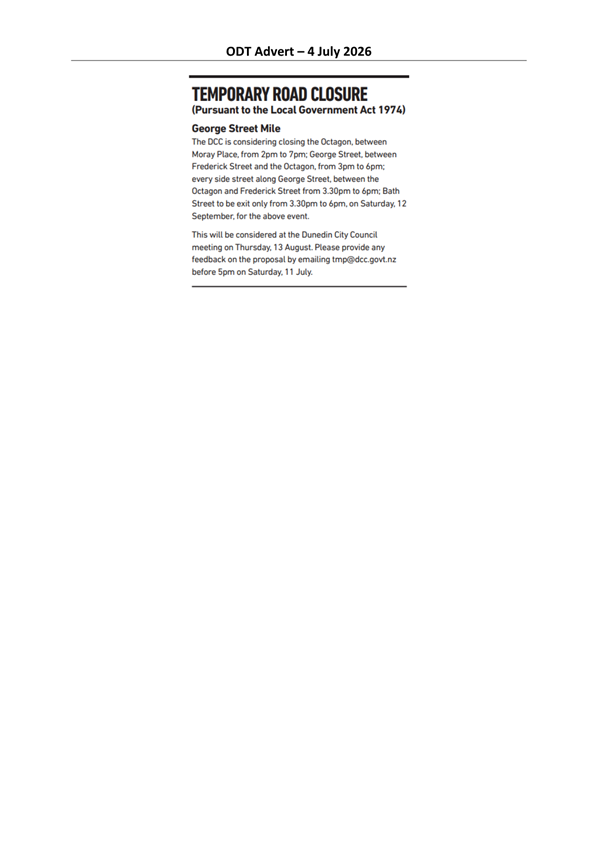
|

|
Council
13 August 2026
|
Notice of Motion - Community Housing
EXECUTIVE SUMMARY
1 In
accordance with Standing Order 26.1, the following Notice of Motion has been
received from Cr Marie Laufiso for inclusion on the
agenda for the meeting being held on Thursday, 13 August 2026:
RECOMMENDATIONS
That the Council:
a) Receives the Notice of
Motion.
b) Asks staff to explore
options for the development of community
housing on undeveloped land owned by either Kāinga Ora or the Dunedin City
Council;
c) Requests a report, to be considered as part of the Draft 2027-2037
Long Term Plan, that addresses the financial and strategic implications of
these options to council; and
d) Requests that staff prepare a
Briefing for Incoming Ministers on this issue.
e) Requests that a
strategy for the planning and operation of council's existing community housing
portfolio be developed.
Attachments
|
|
Title
|
Page
|
|
⇩a
|
Cr Laufiso Notice of
Motion
|
361
|
|

|
Council
13 August 2026
|
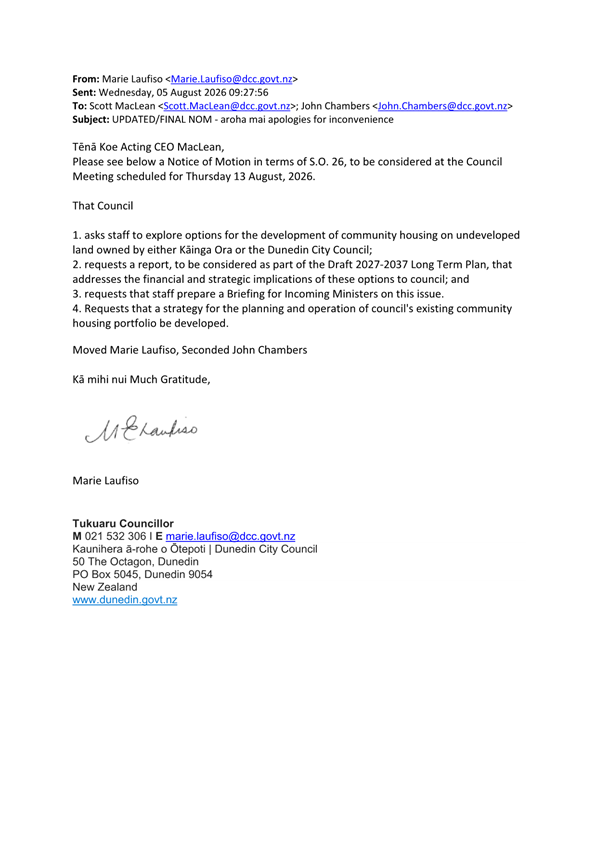
|

|
Council
13 August 2026
|
Resolution to Exclude the
Public
That the Council excludes
the public from the following part of the proceedings of this meeting (pursuant
to the provisions of the Local Government Official Information and Meetings Act
1987) namely:
|
General subject of the matter to be considered
|
Reasons
for passing this resolution in relation to each matter
|
Ground(s) under
section 48(1) for the passing of this resolution
|
Reason for
Confidentiality
|
|
C1
Confidential Council Action List Update
|
S7(2)(b)(ii)
The
withholding of the information is necessary to protect information where the
making available of the information would be likely unreasonably to prejudice
the commercial position of the person who supplied or who is the subject of
the information.
S7(2)(g)
The
withholding of the information is necessary to maintain legal professional
privilege.
S7(2)(h)
The
withholding of the information is necessary to enable the local authority to
carry out, without prejudice or disadvantage, commercial activities.
S7(2)(i)
The
withholding of the information is necessary to enable the local authority to
carry on, without prejudice or disadvantage, negotiations (including
commercial and industrial negotiations).
|
S48(1)(a)
The public conduct of
the part of the meeting would be likely to result in the disclosure of
information for which good reason for withholding exists under section 7.
|
|
|
C2
Dunedin City Holdings Group - Director Appointment and Re-appointment
|
S7(2)(a)
The
withholding of the information is necessary to protect the privacy of natural
persons, including that of a deceased person.
|
S48(1)(a)
The public conduct of
the part of the meeting would be likely to result in the disclosure of
information for which good reason for withholding exists under section 7.
|
|
This resolution is made in reliance
on Section 48(1)(a) of the Local Government Official Information and Meetings
Act 1987, and the particular interest or interests protected by Section 6 or
Section 7 of that Act, or Section 6 or Section 7 or Section 9 of the Official
Information Act 1982, as the case may require, which would be prejudiced by the
holding of the whole or the relevant part of the proceedings of the meeting in
public are as shown above after each item.