Notice of Meeting:
I hereby give notice that an ordinary meeting of the Dunedin
City Council will be held on:
Date: Wednesday
2 September 2026
Time: 9:00
a.m.
Venue: Council
Chamber, Dunedin Public Art Gallery, the Octagon, Dunedin
YouTube
Link: 2
September 2026
https://youtube.com/live/kqR792IKlLo?feature=share
3
September 2026
https://youtube.com/live/Ve7nYuGpJiU?feature=share
Sandy Graham
Council
PUBLIC AGENDA
|
Mayor
|
Mayor Sophie Barker
|
|
|
Deputy Mayor
|
Cr Cherry Lucas
|
|
|
Members
|
Cr John Chambers
|
Cr Jo Galer
|
|
|
Cr Christine Garey
|
Cr Doug Hall
|
|
|
Cr Marie Laufiso
|
Cr Russell Lund
|
|
|
Cr Mandy Mayhem
|
Cr Benedict Ong
|
|
|
Cr Andrew Simms
|
Cr Mickey Treadwell
|
|
|
Cr Lee Vandervis
|
Cr Steve Walker
|
|
|
Cr Brent Weatherall
|
|
Senior Officer Sandy
Graham, Chief Executive
Governance Support Officer Rebecca
Murray
Rebecca Murray
Governance Support Officer
Telephone: 03 477 4000
governance.support@dcc.govt.nz
www.dunedin.govt.nz
Note: Reports
and recommendations contained in this agenda are not to be considered as
Council policy until adopted.
|

|
Council
2 September 2026
|
ITEM TABLE OF CONTENTS PAGE
1 Opening 4
2 Public
Forum 4
3 Apologies 4
4 Confirmation
of Agenda 4
5 Declaration
of Interest 5
6 Confirmation
of Minutes 15
6.1 Ordinary Council
meeting - 22 July 2026 15
6.2 Ordinary Council
meeting - 3 August 2026 31
6.3 Ordinary Council
meeting - 13 August 2026 36
Reports
7 Climate
Adaptation and Resilience Programme Options Report 48
8 Dunedin
City Emissions Targets Options Report 62
9 Carbon
Removals Partnership Pilot 97
10 Review
of Alcohol (Control of Alcohol in Public Places) Bylaw 109
11 Submission
- Residential Tenancies (Registration of Boarding House Landlords) Amendment
Bill 181
12 Notice
of Intent - Draft Hereweka Harbour Cone Management Plan 189
13 Notice
of Intent - Consultation on Proposed Speed Limit Changes 197
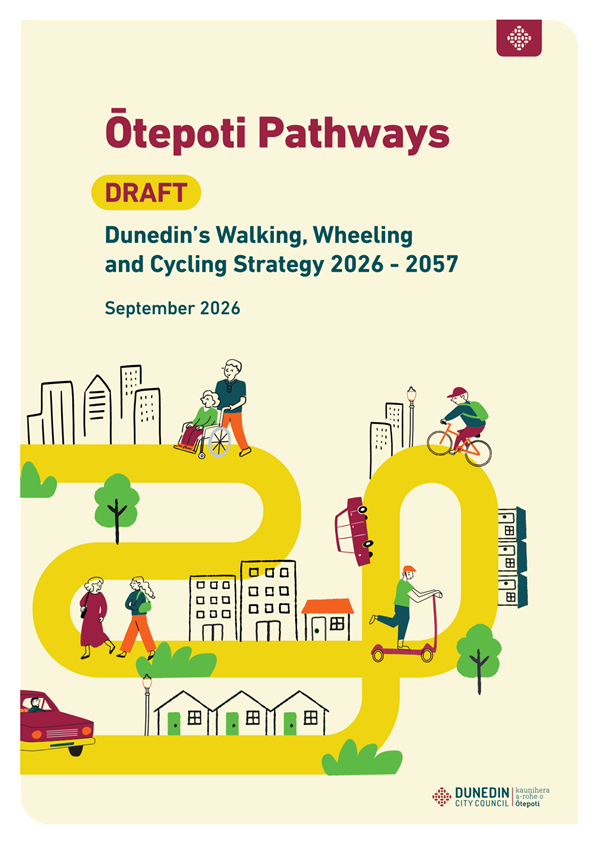
14 Ōtepoti
Pathways - DRAFT Dunedin’s Walking, Wheeling and Cycling Strategy 2026 -
2057 - Upcoming Public Consultation 210
15 New
Road Names Assigned from Road Name Register 256
16 Proposed
Event Road Closures 265
Notice
of Motion
17 Notice
of Motion - Exploring a Strategic Partnership with an Indian city. 271
18 Notice
of Motion - Social Housing 273
Resolution to Exclude the Public 275
|

|
Council
2 September 2026
|
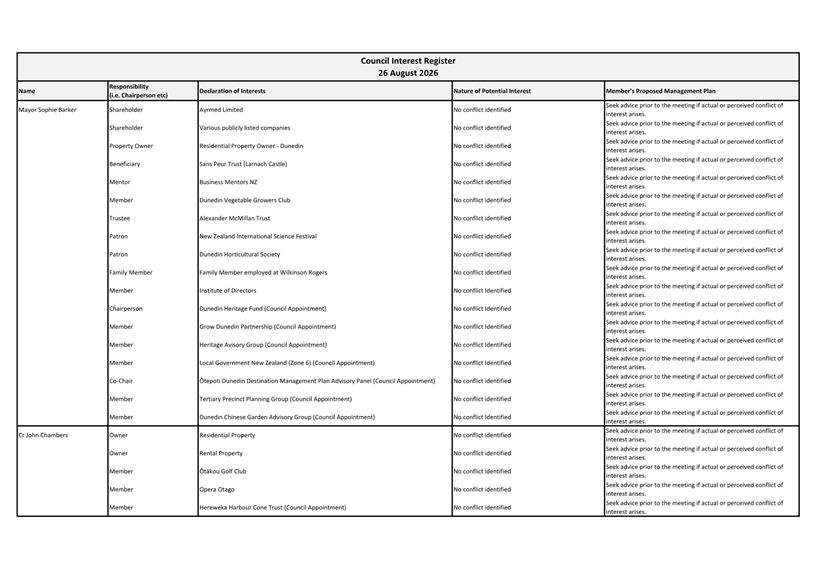
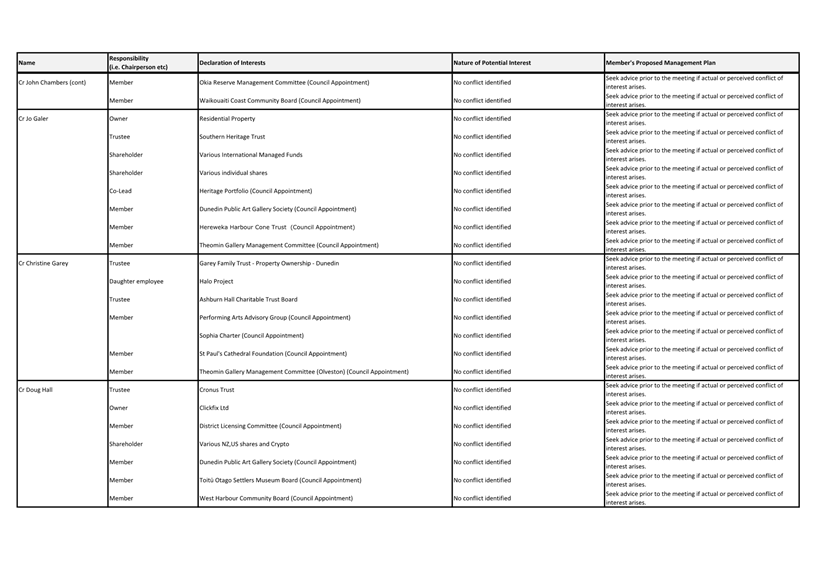
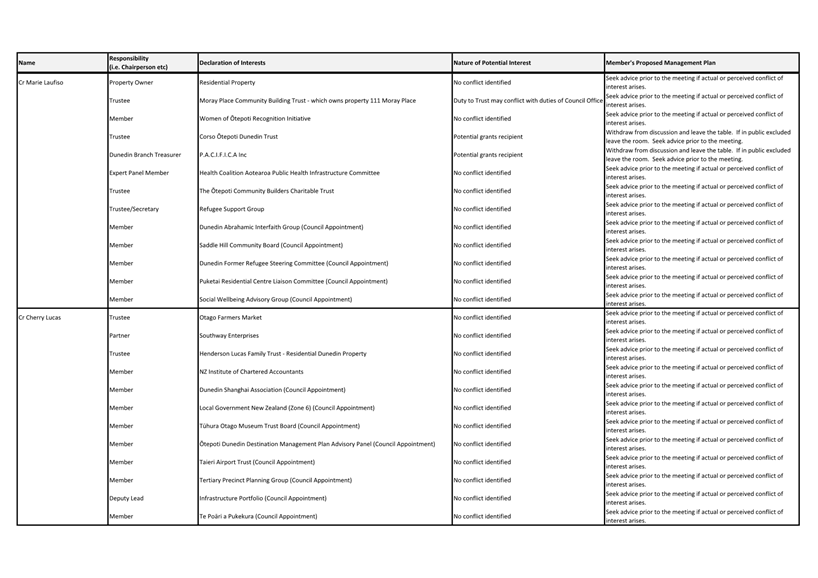
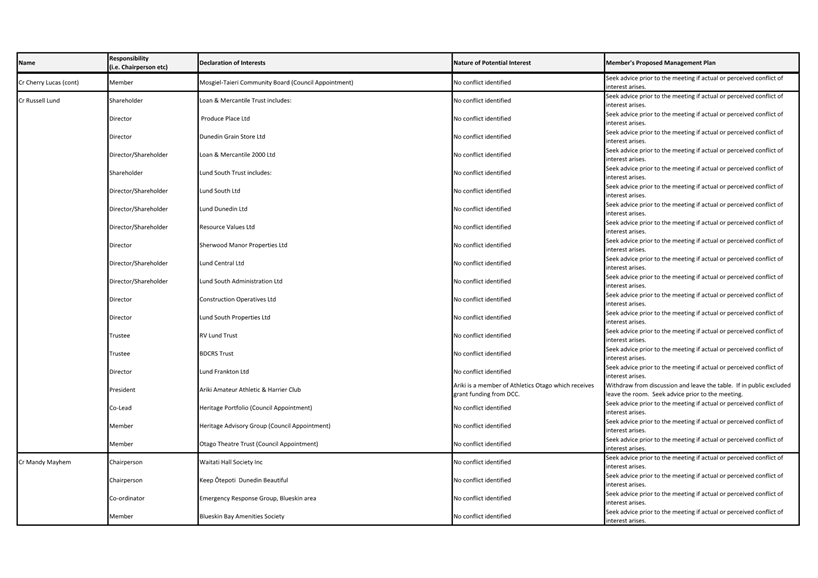
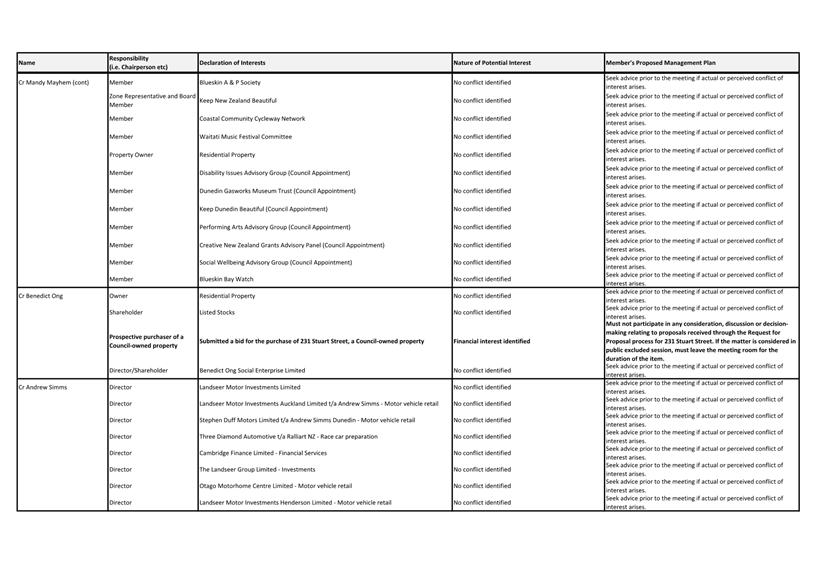
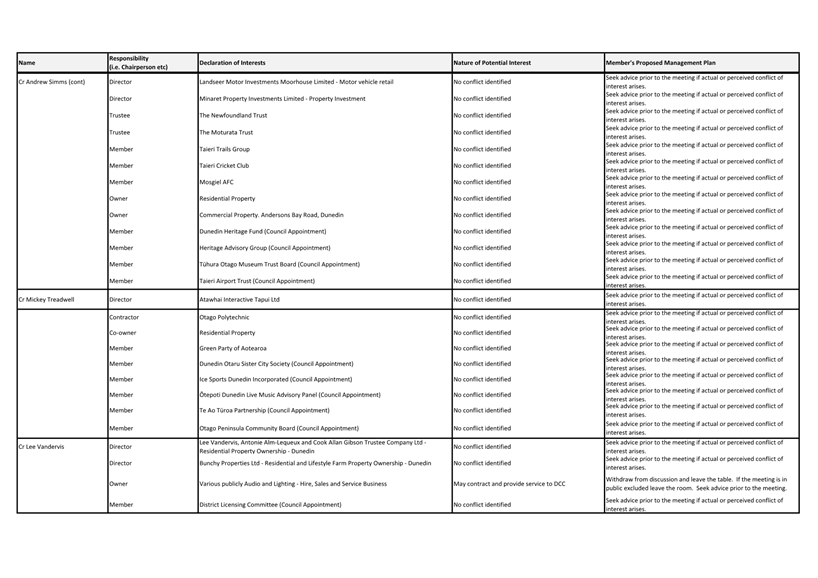
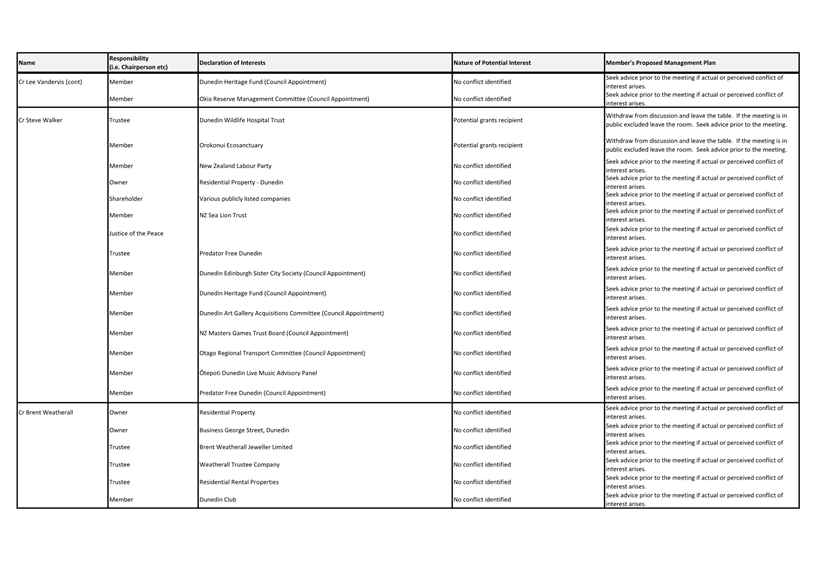
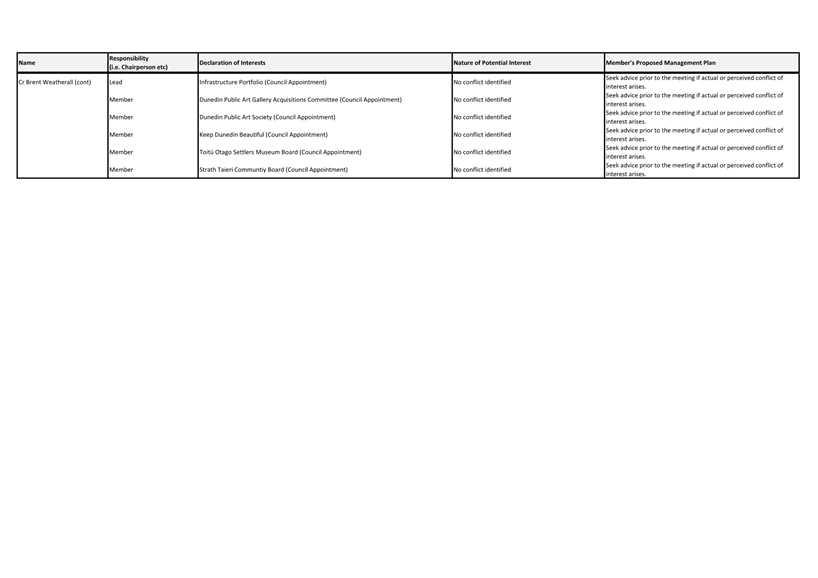
Declaration of Interest
EXECUTIVE SUMMARY
1. Members
are reminded of the need to stand aside from decision-making when a conflict
arises between their role as an elected representative and any private or other
external interest they might have.
2. Elected
members are reminded to update their register of interests as
soon as practicable, including amending the register at this meeting if
necessary.
3. Staff members are
reminded to update their register of interests as soon as practicable.
RECOMMENDATIONS
That the Council:
a) Notes/Amends if
necessary the Elected Members' Interest Register attached as Attachment A; and
b) Confirms/Amends the
proposed management plan for Elected Members' Interests.
c) Notes the proposed
management plan for the Executive Leadership Teams’ interests.
Attachments
|
|
Title
|
Page
|
|
⇩a
|
Elected Members'
Register of Interest
|
6
|
|
⇩b
|
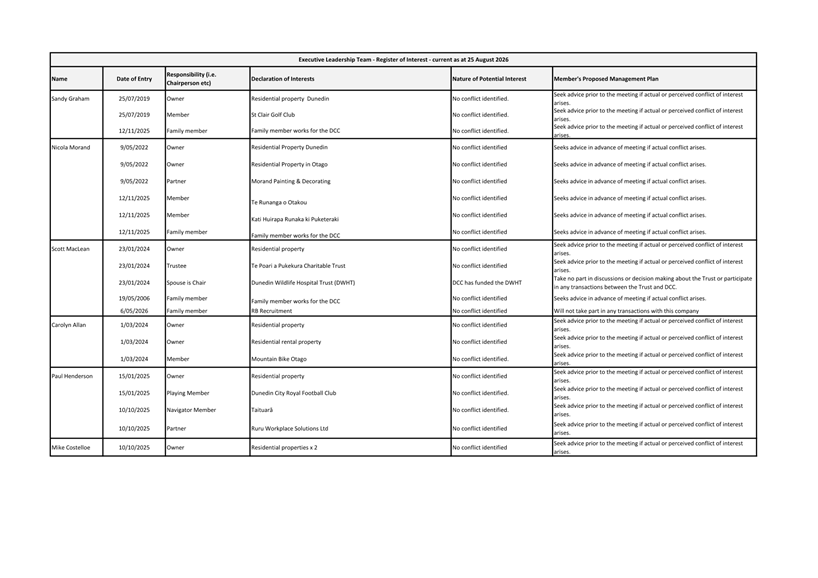
Executive Leadership
Teams' Register of Interest
|
14
|
|

|
Council
2 September 2026
|
|

|
Council
2 September 2026
|
Confirmation
of Minutes
Ordinary
Council meeting - 22 July 2026
RECOMMENDATIONS
That the Council:
a) Confirms the public
part of the minutes of the Ordinary Council meeting held on 22 July 2026 as a
correct record.
Attachments
|
|
Title
|
Page
|
|
A⇩
|
Minutes of Ordinary
Council meeting held on 22 July 2026
|
16
|
|

|
Council
2 September 2026
|

Council
MINUTES
Minutes of an ordinary
meeting of the Dunedin City Council held in the Council Chamber, Dunedin Public
Art Gallery, the Octagon, Dunedin on Wednesday 22 July 2026, commencing at 9.01
am
PRESENT
|
Mayor
|
Mayor Sophie Barker
|
|
|
Deputy Mayor
|
Cr Cherry Lucas
|
|
|
Members
|
Cr John Chambers
|
Cr Jo Galer
|
|
|
Cr Christine Garey via
zoom audio visual link
|
Cr Doug Hall
|
|
|
Cr Marie Laufiso via
zoom audio visual link
|
Cr Russell Lund
|
|
|
Cr Mandy Mayhem
|
Cr Benedict Ong
|
|
|
Cr Andrew Simms
|
Cr Mickey Treadwell
|
|
|
Cr Lee Vandervis
|
Cr Steve Walker via
zoom audio visual link
|
|
|
Cr Brent Weatherall
|
|
|
IN ATTENDANCE
|
Sandy Graham (Chief Executive),
Carolyn Allan (Chief Financial Officer), Jeanine Benson (Acting General
Manager City Services), David Ward (General Manager 3 Waters, Property and
Urban Development), Nicola Morand (Manahautū - General Manager Community
and Strategy), Paul Henderson (General Manager Corporate and Regulatory
Services), Mike Costelloe (General Manager, Arts, Culture and Economic
Development), Anna Nilsen (Group Manager Property), Simon Spiers (Team Leader
Regulation Management), Ian Martin (Principal Advisor Road Safety), Janet
Young (Transport Analyst), Rose Wunrow (Policy Analyst – Transportation
Regulation), Janet Fraser (Corporate Planner), John McAndrew (Head of 3
Waters), Rory McLean (Senior Policy Analyst) and Robyn Dillon (Manager
Governance).
|
Governance Support Officer Lynne
Adamson
1 Opening
Bishop Anne van Gend (Anglican Bishop of
Dunedin) opened the meeting with a prayer.
Crs Jo Galer and Russell Lund entered
the meeting at 9.05 am.
2 Public
Forum
There were 10 speakers in the
Public Forum.
Cr Benedict Ong entered the meeting at 9.06 am.
2.1 Mike
Taylor
Mr Taylor, Firefighter and
Secretary of the Dunedin Branch of New Zealand Professional Firefighters Union
spoke of the ongoing strikes by firefighters, the issues that they were raising
and how they affected Dunedin. He was gathering support for a petition
asking for accountability from FENZ and the Government.
Mr Taylor responded to questions.
2.2 Peter
Foster
Mr Foster spoke of the Zero Carbon
work and commented that he believed there was no need for the work to continue
as he believed there was evidence that there has been no increase in any form
of extreme weather.
2.3 John
Burnip
Mr Burnip spoke on the petition
which requested a speed limit reduction on the Brighton - Taieri Mouth
Road. He commented on the methods used to gain signatures and that they
were far in excess of those who lived on the road or in Taieri Mouth and he
questioned if any had travelled the road at the proposed speed limit.
Mr Burnip responded to questions
and thanked Councillors and staff for their support.
2.4 Raewynne
Pedofski
Ms Pedofski spoke to her
pre-circulated information on the proposed reorganisation of Local Government
Entities. She commented that as the largest city in the South Island, and
the one who has made significant progress in 3 Waters, Dunedin could go it
alone if necessary.
Ms Pedofski responded to
questions.
2.5 Robyn
Vintiner
Ms Vintiner spoke on the
amalgamation process of Local Government Entities. She then spoke about
the South Dunedin flooding issues and requested that the Otago Regional Council
and the Dunedin City Council urgently proceed with a pipes and pumps drainage
investigation for South Dunedin.
Ms Vintiner requested that
research undertaken on the amalgamation be shared with the community.
Ms Vintiner responded to
questions.
2.6 Dr
Jen Purdie
Dr Purdie (University of Otago
Climate Scientist) outlined her background and research she had undertaken and
the results. She spoke on climate action and thanked Council for the work
undertaken to date. Dr Purdie encouraged the council to remain ambitious
in its emissions reduction targets.
Dr Purdie responded to questions.
Moved (Mayor Sophie/Cr Cherry
Lucas):
That the Council:
Extends
the Public Forum
Motion
carried
2.7 Bridie
Lonie
Ms Lonie advised that she was a
member of the organisation Senior’s Climate Action Network which ran
monthly presentations on climate change and its implications which were
published to their website. Ms Lonie said councillors needed to show leadership
on climate change action.
Ms Lonie responded to questions.
2.8 Matt
Greene
Mr Green spoke on the Zero Carbon Plan. He commented
that net zero emissions alone would not stabilise the long term damages, global
emissions would need to become net-negative and remain so for centuries
according to recent studies. Mr Green provided statistical information in
support of his comments and urged Councillors to take all steps needed to
deliver the strongest possible Zero Carbon Plan.
Mr Greene responded to questions.
2.9 Matt
Jenks
Mr Jenks spoke on the Changes to
the Zero Carbon 2030 Target. He commented that the Zero Carbon target was
more than just emissions, it was immediate health benefits for Dunedin
residents and spoke of the need to shift from cars to walking, cycling and
buses to help reduce emissions.
Mr Jenks responded to questions.
2.10 Rosemary
Penwarden
Ms Penwarden spoke of the urgency
to understand and act on climate breakdown and commented on the changes she had
made over the past 15 years to reduce her carbon footprint. She urged
Councillors to make the city liveable for future generations.
Ms Penwarden responded to
questions.
PETITION
Mr Tony Cummings, Deputy Chair
– Dunedin Area Citizens Assn Inc presented a petition calling for Pumps
and Pipes in South Dunedin. He commented that when the petition had been
sent, there were 1,344 signatures however it had now been signed by over 2,000
people.
Mr Cummings spoke of the flooding
over the past few years and commented that in June 2018, Council had delivered
an update to every resident in South Dunedin and advised they had a $7m
commitment to help fix the problem yet to date, nothing has happened. He
noted that Council had also advised they would invest $44m to update the Green
Island Waste Water Treatment Plan which was yet to be completed. In
closing Mr Cummings said they were not asking for anything new, they just
wanted Council to do what they had promised.
|
3 Apologies
|
|
|
There was an apology from Cr Steve Walker for lateness.
|
|
|
Moved (Mayor Sophie Barker/Cr Cherry Lucas):
That the Council:
Approves
the apology for lateness from Cr Steve Walker.
Motion
carried (CNL/2026/116)
|
|
4 Confirmation
of agenda
|
|
|
Moved (Mayor Sophie Barker/Cr Cherry Lucas):
That the Council:
Confirms the agenda
without addition or alteration.
Motion
carried (CNL/2026/117)
|
5 Declarations
of interest
Members were
reminded of the need to stand aside from decision-making when a conflict arose
between their role as an elected representative and any private or other
external interest they might have.
|
|
Moved (Mayor Sophie Barker/Cr Cherry Lucas):
That the Council:
a) Notes the Elected Members' Interest Register; and
b) Confirms the proposed management plan for
Elected Members' Interests.
c) Notes the proposed management plan for the Executive
Leadership Teams’ interests.
Motion
carried (CNL/2026/118)
|
6 Confirmation
of Minutes
|
6.1 Ordinary
Council meeting - 25 June 2026
|
|
|
Moved (Mayor Sophie Barker/Cr Cherry Lucas):
That the Council:
Confirms the public part of the minutes of the
Ordinary Council meeting held on 25 June 2026 as a correct record.
Motion
carried (CNL/2026/119)
|
|
6.2 Ordinary
Council meeting - 13 May 2026
|
|
|
Moved (Mayor Sophie Barker/Cr Cherry Lucas):
That the Council:
Confirms the public part of the minutes of the
Ordinary Council meeting held on 13 May 2026 as a correct record.
Motion
carried (CNL/2026/120)
|
Reports
|
7 Financial
Report - Period ended 31 May 2026
|
|
|
A report
from Finance provided the financial results for the period ended 31 May 2026
and the financial position as at that date.
|
|
|
The Chief Financial Officer (Carolyn Allan) and Group
Manager Property (Anna Nilsen) spoke to the report and responded to
questions.
|
|
During discussion Cr Mickey Treadwell left the meeting at
10.08 am and returned at 10.10 am; Cr Doug Hall left the meeting at 10.09 am
and returned at 10.11 am and Cr Benedict Ong left at 10.15 am and returned at
10.19 am.
|
|
|
Moved (Cr Cherry Lucas/Cr Lee Vandervis):
That the Council:
Notes
the Financial
Performance for the period ended 31 May 2026 and the Financial Position as at
that date.
Motion
carried (CNL/2026/121) with Cr Benedict Ong recording his vote
against
|
Moved (Mayor Sophie/Cr Cherry Lucas)
That the Council:
Adjourns
the meeting for 10 minutes
Motion
carried
The meeting adjourned at 11.06 am and reconvened at 11.23
am.
|
8 Governance
and Councillor Appointments to Outside Organisations Updates
|
|
|
A report from Civic advised
the Council that the Mayor had exercised her discretionary power under
Section 41A(3) of the Local Government Act 2002 (LGA) to appoint newly
elected Cr Joanne Galer to the role of Portfolio Co-Lead – Heritage.
In addition, the report also
recommended appointments to existing external organisations and to two new
organisations: the Creative Dunedin Advisory Group and Creative New Zealand
Grants Advisory Group.
|
|
|
Mayor Sophie spoke to the report and responded to
questions.
|
|
|
Moved (Mayor Sophie Barker/Cr Mandy Mayhem):
That the Council:
a) Notes Cr Joanne Galer’s appointment as the Portfolio
Co-Lead – Heritage along with Cr Russel Lund.
b) Notes Cr Galer’s annual remuneration remains as
previously approved by Council and gazetted by the Remuneration Authority
being $100,577.
c) Notes Deputy Mayor Cherry Lucas’s appointment as the
Portfolio Deputy – Infrastructure.
d) Notes the Infrastructure portfolio now includes Future
Development Strategy as a strategic area.
e) Notes
Cr Brent Weatherall’s appointment as Lead of the Infrastructure
Portfolio.
f) Notes Cr Marie Laufiso’s appointment as the Council
representative on the Saddle Hill Community Board.
g) Approves Cr Joanne Galer as the Council
representative on the Dunedin Public Art Gallery Society, the Hereweka
Harbour Cone Trust and the Theomin Gallery Management Committee (Olveston).
h) Approves the removal of Cr Steve Walker from the
Hereweka Harbour Cone Trust.
i) Approves Mayor Sophie Barker as the Council
representative on the Dunedin Chinese Garden Advisory Board.
j) Approves Cr Brent Weatherall as the Council
representative on the Dunedin Public Art Gallery Acquisitions Committee.
k) Approves Cr Mandy Mayhem as the Council
representative of Creative New Zealand Grants Advisory Panel.
Division
The
Council voted by division
For: Crs
John Chambers, Jo Galer, Christine Garey, Doug Hall, Marie Laufiso, Cherry
Lucas, Mandy Mayhem, Andrew Simms, Mickey Treadwell, Brent Weatherall and
Mayor Sophie Barker (11).
Against: Crs
Russell Lund, Benedict Ong and Lee Vandervis (3).
Abstained: Nil
The division was declared CARRIED by 11 votes to 3
Motion
carried (CNL/2026/122)
|
|
9 Notice
of Motion - Opposing removal of Final-Year Fee Free Policy
|
|
|
In
accordance with Standing Order 26.1, the following Notice of Motion was
received from Cr Benedict Ong for consideration.
|
|
|
Cr Ong advised that he wished to
table an amended motion under standing orders 26.4 with the agreement of the
meeting.
|
|
|
Moved (Cr Benedict Ong/Cr Russell Lund):
That the Council:
a) Approves
the amended motion for Opposing Removal of Final Year Fee Free policy as
circulated.
Division
The
Council voted by division
For: Crs
Jo Galer, Russell Lund and Benedict Ong (3).
Against: Crs
John Chambers, Christine Garey, Doug Hall, Marie Laufiso, Cherry Lucas, Mandy
Mayhem, Andrew Simms, Mickey Treadwell, Lee Vandervis, Brent Weatherall and
Mayor Sophie (11).
Abstained: Nil
The division was declared LOST by 11 votes to 3
|
|
|
The original Notice of Motion was then considered.
|
|
|
Moved (Cr Benedict Ong/Cr Russell Lund):
That the Council:
a) Receives the Notice of Motion.
b) Opposes the removal of the final-year
Fees-Free policy and requests that the Government reconsider the decision,
noting the importance of tertiary education to student participation, the
University of Otago, Otago Polytechnic and our Dunedin’s economic and
social wellbeing.
Division
The Council voted by division
For:
Crs
John Chambers, Jo Galer, Christine Garey, Doug Hall, Marie Laufiso, Russell
Lund, Benedict Ong, Andrew Simms and Mickey Treadwell (9).
Against:
Crs Cherry Lucas, Mandy Mayhem,
Lee Vandervis, Brent Weatherall and Mayor Sophie Barker (5).
Abstained: Nil
The division was declared
CARRIED by 9 votes to 5
Motion carried (CNL/2026/123)
|
|
10 Hearings
Committee Recommendation - Taieri Mouth Road Speed Limit
|
|
|
|
A report from Transport
presented the recommendation of the Hearings Committee following its
consideration of submissions on the proposed speed limit reduction for Taieri
Mouth Road at the Committee meeting held on 28 May 2026.
|
|
|
|
The Chairperson (Cr Mandy Mayhem) summarised the meeting,
the considerations of the submissions and reasons the Committee reached the
decision to reduce the speed limit on Brighton-Taieri Mouth Road. Cr
Mayhem responded to questions.
The Team Leader Regulation
Management (Simon Spiers), Principal Advisor Road Safety (Ian Martin) and
Transport Analyst (Janet Young) provided background information and
support answering questions.
|
|
|
|
Moved (Cr Mandy Mayhem/Cr Andrew Simms):
That the Council:
a) Notes that the Hearings Committee has considered
submissions on the proposed Taieri Mouth Road speed limit reduction;
b) Adopts Option 1 – reduce the speed limit
from 100 km/h to 80 km/h along the full length of Taieri Mouth Road (13.9
km);
c) Notes that implementation will be undertaken in accordance
with the Land Transport Rule: Setting of Speed Limits 2024, including updates
to the National Speed Limit Register and installation of signage; and
d) Notes that complementary measures raised through
consultation, including road maintenance, vegetation management, signage
improvements, and enforcement, will continue to be considered as part of the
corridor management on Taieri Mouth Road.
Division
The
Council voted by division
For: Crs
John Chambers, Jo Galer, Christine Garey, Doug Hall, Marie Laufiso, Cherry
Lucas, Mandy Mayhem, Benedict Ong, Andrew Simms, Mickey Treadwell and Mayor
Sophie Barker (11).
Against: Crs
Russell Lund, Lee Vandervis and Brent Weatherall (3).
Abstained: Nil
The division was declared CARRIED by 11 votes to 3
Motion
carried (CNL/2026/124)
|
|
|
Moved (Mayor Sophie Barker/Cr Cherry Lucas):
That the Council:
a) Pursuant to the provisions of the
Local Government Official Information and Meetings Act 1987, exclude the
public from the following part of the proceedings of this meeting namely:
|
General
subject of the matter to be considered
|
Reasons for
passing this resolution in relation to each matter
|
Ground(s) under
section 48(1) for the passing of this resolution
|
Reason for
Confidentiality
|
|
C1
Ordinary Council meeting - 25 June 2026 - Public Excluded
|
S7(2)(b)(ii)
The withholding of
the information is necessary to protect information where the making
available of the information would be likely unreasonably to prejudice the
commercial position of the person who supplied or who is the subject of the
information.
S7(2)(a)
The withholding of
the information is necessary to protect the privacy of natural persons,
including that of a deceased person.
|
.
|
|
This
resolution is made in reliance on Section 48(1)(a) of the Local Government
Official Information and Meetings Act 1987, and the particular interest or
interests protected by Section 6 or Section 7 of that Act, or Section 6 or
Section 7 or Section 9 of the Official Information Act 1982, as the case may
require, which would be prejudiced by the holding of the whole or the
relevant part of the proceedings of the meeting in public are as shown above
after each item; and
b) Adjourns the meeting for 45
minutes.
Motion
carried (CNL/2026/125)
|
The meeting adjourned at 12.30 pm and reconvened in public
at 2.45 pm.
|
11 Hearings
Committee Recommendations on the Proposed Traffic and Parking Bylaw 2026
|
|
Cr Russell Lund withdrew from
this item and left the meeting at 2.47 pm.
|
|
|
A report from Transport
presented the findings of the Hearings Committee (the Committee) on the
submissions to the proposed Traffic and Parking Bylaw 2026.
|
|
|
The Chairperson (Cr Cherry Lucas) spoke to the
recommendations and responded to questions.
The Team Leader Regulation Management (Simon Spiers) and Rose Wunrow (Policy Analyst – Transport
Regulation) provided support and responded to questions.
|
|
Cr Steve Walker entered the meeting at 3.04 pm (via zoom
audio visual link).
|
|
|
Moved (Cr Cherry Lucas/Cr Mandy Mayhem):
That the Council:
a) Notes the Hearings Committee has considered 31 submissions
on the proposed Traffic and Parking Bylaw 2026,
b) Notes the minutes of the Hearings Committee and the
Committee’s recommended amendments to the consultation version of the
proposed Bylaw (Attachment B),
c) Confirms that the proposed Bylaw, including the
recommended amendments, is the most appropriate way of regulating traffic and
parking; is the most appropriate form of Bylaw; and does not give rise to any
implications under the New Zealand Bill of Rights Act 1990,
d) Adopts the Traffic and Parking Bylaw 2026.
e) Approves a date of effect of the Traffic and
Parking Bylaw 2026 of 1 August 2026,
f) Revokes the Traffic and Parking Bylaw 2010 from
1 August 2026.
Motion
carried (CNL/2026/126) with Cr Jo Galer registering her vote against
|
|
12 Hearings
Committee Recommendations on Proposed Parking Changes - June 2026
|
|
Cr Andrew Simms after withdrawing from this item, left the meeting at
3.11 pm and returned at 3.14 pm.
|
|
|
A report from Transport
presented recommendations of the Hearings Committee meetings held on 12 June
2026 on proposed changes and corrections to parking restrictions.
|
|
|
The Chairperson (Cr Cherry Lucas) spoke to the
recommendations and responded to questions.
The Team Leader Regulation Management (Simon Spiers) and
Policy Analyst – Transport Regulation (Rose Wunrow) provided support
and responded to questions.
|
|
|
Moved (Cr Cherry Lucas/Cr Mandy Mayhem):
That the Council:
a) Adopts the proposed changes to traffic and parking
restrictions shown in the June 2026 update of the Dunedin City Council's
traffic and parking restrictions database: June 2026 Proposed Parking Changes,
b) Notes that Council staff would undertake follow-up actions
for some of the proposed parking changes (with actions described in
paragraphs 35, 37, and 40),
c) Notes that the Hearings Committee has considered feedback
from consultation on the proposed changes relating to changes and
restrictions,
d) Notes that all parking restrictions previously approved by
the Council remain unchanged.
Motion
carried (CNL/2026/127) with Cr Jo Galer recording vote against
|
|
13 Development
of the 10 Year Plan 2027-37
|
|
|
A report from Finance
provided the Council with an update on the development of the 10 Year Plan
2027-37.
The 10 Year Plan was being
developed in parallel with Council’s inaugural Water Services Strategy
2027-37, which was the subject of a separate report.
|
|
Cr Doug Hall left the meeting at 3.28 pm and returned at
3.31 pm.
Cr Christine Garey left the meeting at 3.36 pm and
returned at 3.39 pm.
|
|
|
The Chief Financial Officer (Carolyn Allan) and Corporate
Planner (Janet Fraser) spoke to the report and responded to questions.
|
|
|
Moved (Mayor Sophie Barker/Cr Cherry Lucas):
That the Council:
a) Notes the Development of the 10 Year Plan 2027-37 report.
Motion
carried (CNL/2026/128)
|
Moved (Mayor Sophie/Cr Cherry Lucas):
That the Council:
Extends
the meeting beyond 6 hours
Motion
carried
|
14 Water
Services Strategy 2027-37 development
|
|
|
A report from Civic and 3
Waters provided the Council with an update on the development of the
inaugural Water Services Strategy 2027-37.
The Water Services Strategy
was developed in parallel with Council’s 10 Year Plan 2027-37, which is
the subject of a separate report.
|
|
|
The General Manager, 3 Waters, Property and Urban
Development (David Ward), Head of 3 Waters (John McAndrew) and Corporate
Planner (Janet Fraser) spoke to the report and responded to questions.
|
|
|
Moved (Cr Brent Weatherall/Cr Mickey Treadwell):
That the Council:
a) Notes the Water Services Strategy 2027-37 development
report.
Motion
carried (CNL/2026/129)
|
|
15 Proposed
Event Road Closures
|
|
|
A report from Transport
advised that the DCC had received temporary road closure applications
relating to the following events:
i) Graduation
Parade
ii) Special
Rigs for Special Kids
iii) 2026
Emerson’s Dunedin Marathon
iv) Vintage Car
Run
|
|
|
Mayor Sophie noted that this was the final Council meeting
attended by Ms Jeanine Benson, Group Manager Transport, prior to her
departure from the Dunedin City Council. The Mayor acknowledged and thanked
Ms Benson for her extensive knowledge, her honest and straightforward advice,
and her significant contribution to the Council during her years of service.
Councillors Garey and Walker also paid tribute to Ms
Benson, noting the high regard in which she was held, her calm and considered
manner, and their admiration for her professionalism, skills, and leadership.
The Mayor and Councillors extended their best wishes to Ms
Benson for the future and acknowledged her outstanding service with a round
of applause, noting that whomever was to be her new employer would be
fortunate to benefit from her expertise and experience.
|
|
|
Moved (Mayor Sophie Barker/Cr Cherry Lucas):
That the Council:
a) Resolves to close the roads detailed below
(pursuant to Section 319, Section 342, and Schedule 10 clause 11(e) of the
Local Government Act 1974 (LGA 1974)):i) Graduation
Parade
|
Saturday, 22 August 2026
|
11.00am to 11.45am
|
· Great King Street, between Frederick Street and
Albany Street
|
|
11.10am to 12.00pm
|
· Frederick Street, between Great King Street and
George Street
· George Street, between Frederick Street and Moray
Place
|
|
11.10am to 12.15pm
|
· Intersection of George Street and Moray Place
|
|
11.10am to 12.30pm
|
· Moray Place, between George Street and Upper
Stuart Street
· Filleul Street, between Moray Place and St Andrew
Street
|
ii) Special Rigs for Special
Kids
|
Sunday, 30 August 2026
|
6.00am to 6.00pm
|
· Midland Street, between Timaru Street and
Portsmouth Drive
· Otaki Street, between Turakina Road and Teviot
Street
|
|
|
· Teviot Street, between Portsmouth Drive and Timaru
Street, will be temporarily closed for 20 minutes to allow the convoy to
leave
|
iii) 2026 Emerson’s Dunedin Marathon
|
Saturday, 12 September 2026
|
5.00pm to 11.59pm
|
· Ward Street overbridge - entire length
|
|
Sunday, 13 September 2026
|
12midnight to 5.00pm
|
·
| 8.30am to 1.00pm |
· Portobello Road, between Shore Street and 430
Portobello Road (Glenfalloch)
· Marne Street, between Portobello Road and Larnach
Road
· Doon Street, between Portobello Road and Glengyle
Street
· Fryatt Street – full length
· Wickliffe Street – full length
· Kitchener Street – full length
· Birch Street – full length
· Anzac Avenue, between Union Street East and
Ravensbourne Road,
· Logan Park Drive - full length
· Butts Road, between Dundas Street and Anzac Avenue
|
iv) Vintage Car Run
|
Saturday, 23 January 2027
|
9.30am to 12.00pm
|
· Octagon Central Carriageway, between Princes
Street and George Street
|
Motion
carried (CNL/2026/130)
|
Moved (Mayor Sophie/Cr Cherry Lucas
That the Council:
Adjourns
the meeting for 5 minutes
Motion
carried
The meeting adjourned at 4.17 pm and reconvened at 4.23 pm.
|
16 City-wide
emissions target refresh options
|
|
|
A report from Zero Carbon
sought a decision for Council to consider whether to refresh the existing
city emissions targets set in 2019, and if Council wished to refresh the
existing targets, determine the type of target.
|
|
|
The Acting General Manager City Services (Jeanine Benson)
and Senior Policy Analyst – Zero Carbon (Rory McLean) spoke to the
report and responded to questions.
|
|
Cr Jo Galer left the meeting at 4.27 pm.
Cr Lee Vandervis left the meeting at 4.43 pm.
Mayor Sophie left the meeting at 4.51 pm and Deputy
Mayor Cherry Lucas assumed the Chair.
|
|
|
Moved (Cr Mickey Treadwell/Cr Doug Hall):
That the Council:
a) Adopts
refreshed Carbon Zero targets for the Dunedin Carbon Zero Framework,
replacing the existing Net Zero 2030 target.
b) Adopts
a two-stage target comprising
i) a
near-term gross greenhouse gas emissions reduction target; and
ii) a
long-term net zero greenhouse gas emissions target.
c) Adopts
separate targets for biogenic methane and all other greenhouse gases,
maintaining a distinct biogenic methane reduction target.
d) Notes that
staff will present a future report for Council to consider the level of
ambition, including proposed target years and emissions reduction pathways,
for the refreshed targets.
Division
The Council voted by
division
For: Crs
John Chambers, Christine Garey, Doug Hall, Marie Laufiso, Cherry Lucas, Mandy
Mayhem, Andrew Simms, Mickey Treadwell and Steve Walker (9).
Against: Crs
Benedict Ong and Brent Weatherall (2).
Abstained:
Nil
The
division was declared CARRIED by 9 votes to 2
Motion
carried (CNL/2026/131)
|
The meeting closed at 5.26 pm
.............................................. ……………………………………………….
MAYOR DEPUTY
MAYOR
|

|
Council
2 September 2026
|
Ordinary Council meeting - 3 August 2026
RECOMMENDATIONS
That the Council:
a) Confirms the public
part of the minutes of the Ordinary Council meeting held on 03 August 2026 as a
correct record.
Attachments
|
|
Title
|
Page
|
|
A⇩
|
Minutes of Ordinary
Council meeting held on 3 August 2026
|
32
|
|

|
Council
2 September 2026
|

Council
MINUTES
Minutes of an ordinary
meeting of the Dunedin City Council held in the Council Chamber, Dunedin Public
Art Gallery, the Octagon, Dunedin on Monday 03 August 2026, commencing at 10.01
am
PRESENT
|
Mayor
|
Mayor Sophie Barker
|
|
|
Deputy Mayor
|
Cr Cherry Lucas
|
|
|
Members
|
Cr John Chambers
|
Cr Jo Galer
|
|
|
Cr Christine Garey
|
Cr Doug Hall
|
|
|
Cr Marie Laufiso
|
Cr Russell Lund
|
|
|
Cr Mandy Mayhem
|
Cr Benedict Ong
|
|
|
Cr Andrew Simms
|
Cr Mickey Treadwell
|
|
|
Cr Lee Vandervis
|
Cr Steve Walker
|
|
|
Cr Brent Weatherall
|
|
|
IN ATTENDANCE
|
Scott MacLean (Acting Chief
Executive/General Manager City Services),Carolyn Allan (Chief Financial
Officer), David Ward (General Manager 3 Waters, Property and Urban
Development), Nicola Morand (Manahautū - General Manager Community and
Strategy), Paul Henderson (General Manager Corporate and Regulatory
Services), Mike Costelloe (General Manager, Arts, Culture and Economic
Development), Gina Hu’ akau (Community Partnerships Manager), Berkay
Kocak (Policy Analyst), Danielle Tolson (Policy Analyst)
|
Governance Support Officer Lynne
Adamson
1 Public
Forum
There was no Public Forum.
|
2 Apologies
|
|
|
There were no
apologies.
|
|
3 Confirmation
of agenda
|
|
|
Moved (Mayor Sophie Barker/Cr Cherry Lucas):
That the Council:
Confirms the agenda
without addition or alteration.
Motion
carried (CNL/2026/113)
|
4 Declarations
of interest
Members were
reminded of the need to stand aside from decision-making when a conflict arose
between their role as an elected representative and any private or other
external interest they might have.
|
|
Moved (Mayor Sophie Barker/Cr Cherry Lucas):
That the Council:
a) Notes the Elected Members' Interest Register attached as
Attachment A; and
b) Confirms the proposed management plan for
Elected Members' Interests.
c) Notes the proposed management plan for the Executive
Leadership Teams’ interests.
Motion
carried (CNL/2026/114)
|
Reports
|
5 Simplifying
Local Government Decision Making Report
|
|
|
A report from Community
Services and Corporate Policy sought Council's direction on both its
preferred strategic direction for local government reform in Otago and how
the Dunedin City Council (DCC) would participate in the Government's
Simplifying Local Government (SLG) reform programme. It outlined the
implementation pathways established by the Government, summarises the
regional work undertaken through the Otago Mayoral Forum (OMF), and
considered the strategic implications for Dunedin.
|
|
|
The Manahautū (General Manager Community and
Strategy) (Nicola Morand) and Community Partnerships Manager (Gina
Hu’akau) spoke to the report and responded to questions.
|
|
Cr Brent Weatherall left the meeting at 10.07 am and
returned at 10.09 am.
Moved (Mayor Sophie Barker/Cr Cherry Lucas):
That the Council:
Adjourns
the meeting
Motion
carried
The meeting adjourned at 10.17 am and reconvened at 10.19
am
Cr Benedict Ong returned to the meeting at 10.20 am.
During discussion it was moved (Mayor Sophie Barker/Cr
Cherry Lucas):
That the Council:
Adjourns
the meeting for 5 minutes.
Motion
carried
The meeting adjourned at 10.22 am and reconvened at 10.23
am.
Cr Benedict Ong left the meeting at 10.23 am.
Cr Jo Galer entered the meeting at 10.46 am.
Cr Russell Lund entered the meeting at 10.47 am.
|
|
|
|
|
|
Moved (Mayor Sophie Barker/Cr Cherry Lucas):
That the Council:
a. Agrees to work with
Queenstown Lakes District Council to develop and, subject to the agreement of
both councils, submit a Head Start proposal in support of a Two Unitary
Catchment Based model comprising:
i) Inland
Otago Unitary Authority; and
ii) Coastal
Otago Unitary Authority,
with regional council functions supported through an
appropriate shared services arrangement.
b. Requests staff to develop the
Head Start proposal in conjunction with Queenstown Lakes District Council
staff.
c. Authorises the Mayor to
sign and submit the Head Start proposal, following circulation of the final
draft to all Councillors.
d. Notes that submission of the
Head Start proposal was contingent on the agreement and joint participation
of Queenstown Lakes District Council.
e. Notes that participation in the
Government's Head Start process enables Council to contribute to and
influence the future design of local government reform in Otago.
f. Notes that the Mayor will
continue to engage with the Mayors of Otago and Southland as discussions
regarding local government reform progress.
g. Notes that Dunedin City Council
will continue to partner with Ngāi Tahu throughout the development of
the proposal and any subsequent detailed design processes.
h. Notes that participation in the
development and submission of a Head Start proposal does not commit Council
to a final local government structure or governance model, which would remain
subject to further design, engagement, statutory processes, and future decisions
of the participating councils and the Government.
Division
The Council voted by division
For: Crs
John Chambers, Christine Garey, Doug Hall, Cherry Lucas, Mandy Mayhem, Mickey
Treadwell, Steve Walker, Brent Weatherall and Mayor Sophie Barker (9).
Against: Crs
Jo Galer, Russell Lund, Andrew Simms and Lee Vandervis (4).
Abstained: Cr Marie Laufiso (1).
The division was declared CARRIED by 9
votes to 4
Motion
carried (CNL/2026/115)
|
The Mayor acknowledged Dave
Ward's departure from the Council and thanked him for his contribution to
Council projects and water reform work. Councillors noted his expertise,
professionalism, and strong community engagement. Mr Ward was thanked with applause.
|
Resolution to Exclude the Public
|
|
Moved (Mayor Sophie Barker/Cr Cherry Lucas):
That the Council:
a) Pursuant to the provisions of the
Local Government Official Information and Meetings Act 1987, exclude the
public from the following part of the proceedings of this meeting namely:
|
General subject of the matter to be considered
|
Reasons for passing this resolution in relation to
each matter
|
Ground(s) under section 48(1) for the passing of
this resolution
|
Reason for Confidentiality
|
|
C1 Property matter - natural hazards
|
S7(2)(g)
The withholding of the information is necessary to
maintain legal professional privilege.
|
S48(1)(a)
The public conduct of the part of the meeting
would be likely to result in the disclosure of information for which good
reason for withholding exists under section 7.
|
|
This resolution is made in
reliance on Section 48(1)(a) of the Local Government Official Information and
Meetings Act 1987, and the particular interest or interests protected by
Section 6 or Section 7 of that Act, or Section 6 or Section 7 or Section 9 of
the Official Information Act 1982, as the case may require, which would be
prejudiced by the holding of the whole or the relevant part of the
proceedings of the meeting in public are as shown above after each item.
b)
Adjourns for the meeting for 5 minutes.
Motion
carried (CNL/2026/116)
|
The meeting moved into confidential at 11.46 am
..............................................
MAYOR
|

|
Council
2 September 2026
|
Ordinary Council meeting - 13 August 2026
RECOMMENDATIONS
That the Council:
a) Confirms the public
part of the minutes of the Ordinary Council meeting held on 13 August 2026 as a
correct record.
Attachments
|
|
Title
|
Page
|
|
A⇩
|
Minutes of Ordinary
Council meeting held on 13 August 2026
|
37
|
|

|
Council
2 September 2026
|

Council
MINUTES
Minutes of an ordinary
meeting of the Dunedin City Council held in the Council Chamber, Dunedin Public
Art Gallery, the Octagon, Dunedin on Thursday 13 August 2026, commencing at
9.00 a.m.
PRESENT
|
Mayor
|
Mayor Sophie Barker
|
|
|
Members
|
Cr John Chambers
|
Cr Jo Galer
|
|
|
Cr Christine Garey
|
Cr Doug Hall (via zoom
audio visual link)
|
|
|
Cr Marie Laufiso
|
Cr Russell Lund
|
|
|
Cr Mandy Mayhem
|
Cr Benedict Ong
|
|
|
Cr Andrew Simms
|
Cr Mickey Treadwell
|
|
|
Cr Lee Vandervis
|
Cr Steve Walker
|
|
|
Cr Brent Weatherall
|
|
|
IN ATTENDANCE
|
Sandy Graham (Chief Executive),
Carolyn Allan (Chief Financial Officer), Nicola Morand (Manahautū -
General Manager Community and Strategy), Paul Henderson (General Manager
Corporate and Regulatory Services), Mike Costelloe (General Manager, Arts, Culture
and Economic Development), Mr McAndrew (Acting GM 3 Waters), Monique Devereux
(Head of Communications and Engagement)
|
Governance Support Officer Lauren
Riddle
1 Opening
Haizal Mohd Hussaini and Mohammed Rizwan opened the meeting
with a prayer on behalf of the Muslim community.
2 Public
Forum
There were 6 people speakers in
the Public Forum.
2.1 Mike
Hammond and Rose Dickie, South Dunedin Community Network
Mr
Mike Hammond (Chairperson) and Ms Dickie (Community, Engagement and Operations
Manager) affirmed the South Dunedin Community Network’s long-standing
role in supporting and advocating for the people of South Dunedin in relation
to flooding, sea level rise, climate adaptation and amenities in the South
Dunedin area.
Mr Hammond advised that the South
Dunedin community sought vibrant and resilient green spaces, designed for
recreation to support positive mental, social and physical well-being
outcomes. He emphasized the importance of robust communication and public
consultation by Council.
Ms Dickie reiterated the
importance of community engagement to inform the South Dunedin community and
the provision of accurate information.
Mr Hammond and Ms Dickie responded
to questions.
2.2 Charlie
Hurley
Mr Hurley spoke on the current
state of Dunedin skateboarding facilities. He considered the facilities as
being outdated and presented images of the current skateboard facilities.
Mr Hurley sought that development of future skateboarding facilities in Dunedin
be led by research informed design as a standard. He requested that a new
destination skate park be included in the 10 Year Plan 2027-2037.
Mr Hurley
responded to questions.
2.3 Elliot
Phillips
Mr Phillips spoke on skateboarding
from an arts and cultural influence perspective and its impact on the
city. He spoke of the talent within the skateboarding community and its
influence on the New Zealand art and fashion scene. Mr Phillips highlighted
that it has been 23 years since the establishment of the Thomas Burns
destination skate park and sought Council support to develop fit for purpose
facilities to support skateboarding.
Mr Phillips
responded to questions.
2.6 Duncan
Eddy, West Harbour Community Board
Mr Eddy spoke on behalf of the
West Harbour Community Board in support of Council assessing options for social
housing development on the vacant Kāinga Ora land in Port Chalmers and
provision of a briefing on the issue for central government ministers.
Mr Eddy spoke to the number of
people on the social housing waiting list (he advised as being 394), while he
considered there was social housing land available for development. He
talked of the impact to the local economy and community due to the cancelled
development of 11 new state houses in Albertson Avenue, Port Chalmers by
Kāinga Ora. He advised the site has remained empty since mid- 2023,
with no sale yet having been completed by Kāinga Ora. He advised he
considered the social value of land exceeded the commercial value.
Mr Eddy
responded to questions.
Moved (Mayor
Sophie/Cr Andrew Simms)
That the
Council
Extends
Public Forum beyond 30 minutes.
Motion
Carried
2.7 Alan
Somerville, Chair – Abbeyfield Dunedin (Inc)
Mr Somerville spoke about the
support Council could provide for community housing in the city. He supported
Council exploring the use of land within the city for community housing and the
need for more affordable and healthy housing for elderly people in Dunedin.
Mr Somerville spoke about the
Abbeyfield communal housing facility model in supporting elderly people to
remain living independently with good nutrition being provided and regular
social connection, which he considered as one of the most important determinants
of continued good health in old age.
Mr Somerville urged Council to
pursue models for the development of communal living (over individual housing
units) for any future social housing projects. He sought Council support
for community housing providers through the use of suitable land within the
city
He thanked Council for their role
in providing social housing in the city and encouraged this to continue.
Mr
Somerville responded to questions.
2.9 Tony
Cummings
Mr Cummings spoke in support of
Brighton substituted for Wakari as the small scale centre to be upgraded in the
2026/27 financial year. He gave his perspective as a shopkeeper in the Wakari
shopping centre and considered the installation of seating and planting at the
shopping centre as having a negative impact for the community.
Mr Cummings
responded to questions.
|
3 Apologies
|
|
|
Moved (Mayor Sophie Barker/Cr Andrew Simms):
That the Council:
Accepts the apology from
Cr Cherry Lucas for absence and Cr Lee Vandervis for early departure.
Motion
carried (CNL/2026/116)
|
|
4 Confirmation
of agenda
|
|
|
Sandy Graham (Chief Executive) advised that two reports
were withdrawn from the meeting agenda.
Item 10 – the Botanic Garden Plan report and
Item 13 – Notice of Motion for Community Housing.
Cr Marie Laufiso confirmed her withdrawal of Item 13
Notice of Motion.
|
|
|
Moved (Mayor Sophie Barker/Cr Andrew Simms):
That the Council:
Confirms the agenda with
the withdrawal of the following items:
· Item
10 – Botanic Garden Plan report, and
· Item
13 – Notice of Motion for Community Housing.
Motion
carried (CNL/2026/117)
|
5 Declarations
of interest
Members were
reminded of the need to stand aside from decision-making when a conflict arose
between their role as an elected representative and any private or other
external interest they might have.
Cr Mandy Mayhem advised she is a
member of the Blueskin Bay Watch.
|
|
Moved (Mayor Sophie Barker/Cr Andrew Simms):
That the Council:
a) Amends Elected Members' Interest Register; and
b) Amends the proposed management plan for Elected Members'
Interests.
c) Notes the proposed management plan for the Executive
Leadership Teams’ interests.
Motion
carried (CNL/2026/118)
|
Reports
|
6 Actions
From Resolutions of Council Meetings
|
|
|
A report from Civic showed
progress on implementing resolutions made at Council meetings.
|
|
|
The Chief Executive (Sandy Graham) spoke to the report and
advised it was the first iteration of the new format reporting. Ms Graham
advised that staff would be working further on details for inclusion in the
report for future Council meetings.
Ms Graham responded to questions.
|
|
|
Moved (Mayor Sophie Barker/Cr Andrew Simms):
That the Council:
a) Notes
the Open and Completed Actions from resolutions of Council meetings as
attached.
Motion
carried (CNL/2026/119)
|
|
7 Centres
Upgrade Programme
|
|
|
A report from City Growth and
Advisory Services noted that the Centres Upgrade and Minor Amenity
Improvements Programme aimed to upgrade Dunedin’s neighbourhood centres
by delivering amenity upgrades that enhance the suburban commercial areas for
communities and to support local businesses.
Approval
was sought for the change of location to substitute Wakari with Brighton,
noting that the scope of the upgrade work in an area such as Brighton could
be completed for less than the allocated budget. Direction was also
sought for a preferred approach for selection of centres for 2027/28 and
2028/29 which would allow staff to scope and cost the proposed upgrades.
|
|
|
The General Manager Arts, Culture and Economic Development
(Mike Costelloe) and Team Leader Advisory Services (Mark Mawdsley) spoke to
the report and responded to questions.
|
|
|
Moved (Mayor Sophie Barker/ Cr Andrew Simms)
That the Council:
Adjourns
the meeting for five minutes.
Motion
carried
The meeting adjourned at 10:06 a.m. and reconvened at
10:07 a.m.
|
|
|
Discussion was held on the matrix used for assessment of
amenities for upgrade and the importance of Community Boards having any
amenity upgrades sought for the board area included in their Community Plans.
|
|
|
Moved (Mayor Sophie Barker/ Cr Andrew Simms)
That the Council:
Adjourns
the meeting for 15 minutes.
Motion
carried
The meeting adjourned at 10:36 a.m. and reconvened at
10:56 a.m.
|
|
|
Moved (Mayor Sophie Barker/Cr Brent Weatherall):
That the Council:
a) Notes the completion of the amenity upgrade in Musselburgh.
b) Substitutes Brighton for Wakari in the Centres
Upgrade Programme for 2026/27.
c) Commences community engagement and design work for Middlemarch Centres
Upgrade Programme in 2026/27.
d) Notes that a report including a prioritisation
matrix for future years of the Centres
Upgrade Programme (including both small and large centres) will be
included for consideration in the Ten Year Plan 2027-37.
Division
The
Council voted by division
For: Crs
John Chambers, Jo Galer, Christine Garey, Doug Hall, Marie Laufiso, Mandy
Mayhem, Andrew Simms, Mickey Treadwell, Steve Walker, Brent Weatherall and
Mayor Sophie Barker (11).
Against: Cr
Russell Lund, Cr Lee Vandervis (2).
Abstained: Nil
The division was declared CARRIED by 11 votes to 2
.Motion
carried (CNL/2026/120)
|
|
8 Proposed
Trade Waste Discharge Plan 2026 and Proposed Trade Waste Bylaw 2026
|
|
|
A report from 3 Waters sought
approval for the draft proposed Trade Waste Discharge Plan 2026; the draft
proposed Trade Waste Bylaw 2026 and the associated draft Statement of
Proposal for notification for public consultation, using the special
consultative procedure set out in the LGA.
|
|
|
The Head of 3 Waters (John McAndrew), Regulation and
Policy Team Leader (Scott Campbell) and Policy Analyst (Jacinda Baker) spoke
to the report and responded to questions.
|
|
Cr Christine Garey left the meeting at 11:38 a.m. and
returned to the meeting at 11:40 a.m.
Cr Mickey Treadwell left the meeting at 11:48 a.m. and
returned to the meeting at 11:50 a.m.
|
|
|
Moved (Mayor Sophie Barker/Cr Lee Vandervis):
That the Council:
a) Determines that a bylaw, in conjunction with the
Trade Waste Discharge Plan, is the most appropriate way to manage trade waste
in Dunedin and the discharge of trade waste to the wastewater network.
b) Determines that the draft proposed Trade Waste
Bylaw 2026 at Attachment B is the most appropriate form of bylaw.
c) Determines that the draft proposed Trade Waste
Bylaw 2026 at Attachment B does not give rise to any implications under the
New Zealand Bill of Rights Act 1990 and is not inconsistent with that Act.
d) Determines that the special consultative procedure,
in accordance with the Local Government Act 2002, be used as part of the
process to make the proposed Trade Waste Discharge Plan 2026 and proposed
Trade Waste Bylaw 2026.
e) Approves the draft proposed Trade Waste Discharge
Plan 2026 at Attachment A, the draft proposed Trade Waste Bylaw 2026 at
Attachment B and the draft Statement of Proposal at Attachment C to be
notified for public consultation.
f) Authorises the Chief Executive to make any minor
editorial changes to the proposed Trade Waste Discharge Plan 2026, proposed
Trade Waste Bylaw 2026 and the Statement of Proposal prior to consultation
opening.
Motion
carried (CNL/2026/121)
|
Cr Lee Vandervis left the meeting at 11:59 a.m.
|
9 Draft
Local Alcohol Policy
|
|
|
A report from Corporate
Policy provided an update on the Stage Two engagement of the review of the
DCC’s Local Alcohol Policy (LAP), and sought approval for formal
consultation on a Draft LAP.
|
|
|
The General Manager Corporate and Regulatory Services
(Paul Henderson), Manager Compliance Solutions (Bonnie Wright) and Senior
Policy Analyst (Paul Cottam) spoke to the report and responded to questions.
Moved (Mayor Sophie/Cr Steve Walker)
That the Council:
Adjourns
the meeting for five minutes.
Motion
carried
|
|
|
The meeting adjourned at 12:21 p.m. and reconvened at
12:28 p.m. with a ruling on a Point of Order against Cr Benedict Ong.
Moved (Mayor Sophie/Cr Andrew Simms)
That the Council:
Adjourns
the meeting.
Motion
carried
|
|
The meeting adjourned at 12:32 p.m. Cr Benedict Ong left
the meeting during the adjournment.
The meeting reconvened at 12:35 p.m.
|
|
Moved (Mayor Sophie Barker/Cr Andrew Simms):
That the Council:
a) Notes the results of the Stage Two engagement for the Local
Alcohol Policy Review
b) Approves the Draft Local Alcohol Policy for
public consultation using the Special Consultative Procedure subject to any
amendment
c) Adopts the attached Statement of Proposal for
consultation subject to any amendment
d) Notes that the Hearings Committee for the Local Alcohol
Policy will be appointed at a future Council meeting.
Division
The
Council voted by division
For: Crs
John Chambers, Jo Galer, Christine Garey, Doug Hall, Marie Laufiso, Russell
Lund, Mandy Mayhem, Andrew Simms, Mickey Treadwell, Steve Walker, Brent
Weatherall and Mayor Sophie Barker (12).
Against: Nil
Abstained: Nil
The division was declared CARRIED by 12 votes to 0
Motion
carried (CNL/2026/122)
|
|
|
Moved (Mayor Sophie/Cr
Andrew Simms)
That the Council:
Adjourns
the meeting for 50 minutes.
Motion
carried
The meeting adjourned at 1:08
p.m. and reconvened at 2:00 p.m.
Cr Russell Lund and Mayor
Sophie made an apology for absence and left the meeting during the
adjournment.
Cr Andrew Simms assumed the
Chair at 2:00 p.m. from Mayor Sophie.
|
|
|
10 Botanic
Garden Plan
|
|
The Item was withdrawn.
|
|
11 Future
Development Strategy Implementation Plan update 2026
|
|
|
A report from City
Development presented an update on the Future Development Strategy (FDS)
Implementation Plan 2026.
|
|
|
General Manager Arts, Culture and Economic Development
(Mike Costelloe), Project Director (Glen Hazelton) and Team Leader Planning
(Emma Christmas) spoke to the report and responded to questions.
Emma Christmas advised of a correction to the report
attachment, Table 7 of Future Development Strategy Implementation Plan (page
339 of the agenda), which omitted the 2026 updates for the 3 Waters section
of the table . She advised the table would be revised ahead of release
of the Future Development Strategy Implementation Plan.
|
|
|
Moved (Cr Steve Walker/Cr Jo Galer):
That the Council:
a) Notes the Future Development Strategy Implementation Plan
2026.
Motion
carried (CNL/2026/123)
|
|
12 Proposed
Event Road Closures
|
|
|
A report from Transport sought
approval of temporary road closure for the George Street Mile event.
|
|
|
Moved (Cr Andrew Simms/Cr Mandy Mayhem):
That the Council:
a) Resolves to close the roads detailed below
(pursuant to Section 319, Section 342, and Schedule 10 clause 11(e) of the
Local Government Act 1974 (LGA 1974)):
i) George Street Mile
|
Saturday, 12 September 2026
|
2.00pm to 7.00pm
|
· The Octagon, entire area within Moray Place
|
|
3.00pm to 6.00pm
|
· George Street, between Frederick Street and The
Octagon
|
|
3.30pm to 6.00pm
|
· Every side street along George Street, between The
Octagon and Frederick Street
· Bath Street will be exit only
|
Motion
carried (CNL/2026/124)
|
|
13 Notice
of Motion - Community Housing
|
|
|
The
Item was withdrawn.
|
|
Resolution to Exclude the Public
|
|
Moved (Cr Andrew Simms/Cr Mandy Mayhem):
That the Council:
Pursuant
to the provisions of the Local Government Official Information and Meetings
Act 1987, exclude the public from the following part of the proceedings of
this meeting namely:
|
General
subject of the matter to be considered
|
Reasons for
passing this resolution in relation to each matter
|
Ground(s) under
section 48(1) for the passing of this resolution
|
Reason for
Confidentiality
|
|
C1
Confidential Council Action List Update
|
S7(2)(b)(ii)
The withholding of
the information is necessary to protect information where the making
available of the information would be likely unreasonably to prejudice the
commercial position of the person who supplied or who is the subject of the
information.
S7(2)(g)
The withholding of
the information is necessary to maintain legal professional privilege.
S7(2)(h)
The withholding of
the information is necessary to enable the local authority to carry out,
without prejudice or disadvantage, commercial activities.
S7(2)(i)
The withholding of
the information is necessary to enable the local authority to carry on,
without prejudice or disadvantage, negotiations (including commercial and
industrial negotiations).
|
S48(1)(a)
The public conduct of
the part of the meeting would be likely to result in the disclosure of
information for which good reason for withholding exists under section 7.
|
|
|
C2
Dunedin City Holdings Group - Director Appointment and Re-appointment
|
S7(2)(a)
The withholding of
the information is necessary to protect the privacy of natural persons,
including that of a deceased person.
|
S48(1)(a)
The public conduct of
the part of the meeting would be likely to result in the disclosure of
information for which good reason for withholding exists under section 7.
|
|
This resolution is made in
reliance on Section 48(1)(a) of the Local Government Official Information and
Meetings Act 1987, and the particular interest or interests protected by
Section 6 or Section 7 of that Act, or Section 6 or Section 7 or Section 9 of
the Official Information Act 1982, as the case may require, which would be
prejudiced by the holding of the whole or the relevant part of the
proceedings of the meeting in public are as shown above after each item.
Motion
carried (CNL/2026/125)
|
The public meeting closed at 2:22 p.m. and moved into Public
Excluded session and 2:24 p.m.
..............................................
MAYOR
|

|
Council
2 September 2026
|
Reports
Climate Adaptation and
Resilience Programme Options Report
Department: Climate and City Growth
EXECUTIVE SUMMARY
1 This
report seeks Council direction on a Climate Adaptation and Resilience programme
for inclusion in the 10 year plan 2027-37. Four service level options have been
developed for Council’s consideration, spanning a minimum viable approach
for meeting anticipated legislative requirements, through to a participatory
approach that maximises community engagement. The options differ in their cost,
quality of outputs, level of community involvement, and support for
implementation of adaptation actions, community resilience activities and
climate capability within council.
2 Natural
hazards are already affecting Ōtepoti Dunedin including flooding, coastal
erosion, shallow groundwater and landslides. With climate change, many of these
hazards are expected to increase in frequency, severity and extent, presenting
growing risks to council services, infrastructure and the communities we
serve.
3 Council
has commenced significant work under the current 9-Year Plan to improve
understanding of climate risks and establish the foundations for adaptation
planning, including development of the Climate Adaptation Policy, Climate
Resilience Framework, Resilience Roadmap, Resilience Explorer platform and
Citywide Climate Risk Assessment.
4 National
policy and legislative settings for climate adaptation continue to evolve.
Current reform proposals signal an increasing role for local government in
climate adaptation and legislatively mandated adaptation planning in locations
facing significant climate risks. While final requirements remain uncertain,
climate adaptation is increasingly expected to become an enduring local
government function.
5 Staff
consider Option Four – Participatory Delivery provides the greatest level
of community participation and engagement and best delivers on the Climate
Adaptation Policy and Climate Resilience Framework. It combines participatory
adaptation planning with implementation support, community resilience
initiatives, climate capability development and climate mainstreaming across
DCC. It reduces reliance on consultant-led planning and builds capability
within DCC. It provides a pathway from climate risk information and adaptation
planning to resilient outcomes for our communities, infrastructure and
services.
RECOMMENDATIONS
That the Council:
a) Notes the information
in this report.
b) Decides a preferred
option for
inclusion in the draft 10 year plan 2027-37.
c) Notes that final
funding decisions will be made through the 10 year
plan 2027-37 process following community consultation.
BACKGROUND
6 Council
has been considering the impacts of climate change and adaptation responses for
more than 15 years. In 2010, Council adopted a Climate Change Adaptation
Project Plan following consideration of the Climate Change Impacts on Dunedin
report prepared by University of Otago Professor Blair Fitzharris. The plan
promoted an approach based on risk assessment, adaptation mainstreaming, hazard
information, community engagement and integration of climate considerations
into Council planning and decision-making. It also identified South Dunedin as
a priority area for adaptation planning and recommended further vulnerability
assessments for other high-risk locations and critical infrastructure.
7 Over
subsequent years, climate change considerations were progressively incorporated
into a range of council strategies, plans, projects and asset management
activities. Significant work has been undertaken through the South Dunedin
Future programme, which has improved understanding of natural hazards, exposure
and risk, and potential response options.
8 In
2023, Council considered the long-term implications of climate change for
infrastructure investment decisions, including discussion of the potential
impacts of sea-level rise on DCC assets. Council resolved to add preparation of
a Climate Adaptation Plan to its forward work programme and requested further
work on a citywide approach to climate resilience.
9 In
January 2025, Council approved staged implementation of a citywide Climate
Resilience Framework and associated funding through the 9 year plan 2025-34.
The proposed Climate Adaptation and Resilience programme represents the next
stage of this work, building on previous adaptation initiatives and providing
Council with options for how climate adaptation planning, resilience-building
activities and implementation support may be delivered across Dunedin over the
next 10 years.
DISCUSSION
Climate Adaptation Context
10 Climate
change is already affecting Ōtepoti Dunedin through more frequent and
intense rainfall, flooding, coastal erosion, rising groundwater and landslides.
These hazards are damaging assets, disrupting services and increasing costs for
council and communities across the district. As climate risks increase, the
frequency and consequences of these impacts are expected to grow. Some changes,
including rising temperatures and sea level rise, will continue regardless of
future global emissions reductions.
11 Adapting to
climate change is a long-term challenge that requires ongoing assessment of
climate hazards and risks, collaboration with mana whenua, communities and
infrastructure providers, and integration of climate considerations into
planning, infrastructure investment and service delivery. Adaptation will
require communities and organisations to make decisions in the face of
uncertainty and balance environmental, social, cultural and economic
considerations over long timeframes.
Progress Since the Current Long-Term Plan
12 Since the
adoption of the current 9 year plan 2025-34, council has taken steps to improve
understanding of climate risks, establish the foundations for long-term
adaptation planning and integrate climate risk considerations into Council
decisions and investments. Key achievements include:
· Climate
Adaptation Policy (adopted June 2026)
· Climate
Resilience Framework and Roadmap (delivered June 2026)
· Citywide
risk assessment and Resilience Explorer platform (anticipated delivery
early-2027)
· Citywide
Climate Adaptation Plan (anticipated adoption late-2027)
13 The South
Dunedin Future programme has also made significant progress towards delivery of
an adaptation masterplan for South Dunedin, which is expected in 2027.
Emerging Legislative, National Policy and Strategic
Direction
14 National
policy and legislative settings for climate adaptation are continuing to
evolve, with a clear direction toward increasing expectations on local
government to assess climate risks, undertake adaptation planning, and embed
resilience into planning, infrastructure, and investment decisions. This is
reflected in the National Adaptation Plan, National Adaptation Framework and
wider government reforms.
15 Proposed
amendments to the Climate Change Response Act are expected to establish a
national adaptation planning framework, with regional spatial plans identifying
priority areas facing significant climate risks and requiring local adaptation
plans within set timeframes, potentially requiring initial plans in Dunedin to
be completed by 2032. Adaptation is also increasingly recognised in local
government planning and reporting requirements, with both adaptation and
emergency management identified as distinct areas of focus and climate change
highlighted as a priority consideration in 10 year plan audits.
From Planning to Resilience Outcomes
16 Climate
adaptation is a long-term and ongoing challenge that requires sustained effort
across risk assessment, community engagement, planning, funding and
implementation. There is strong recognition across the district, including from
communities, organisations, utilities, businesses, Community Boards and Te Pae
Māori, of the need to better understand climate risks and identify
appropriate adaptation responses.
17 While
adaptation planning helps identify risks and response options, its real value
is realised when it informs investment decisions, infrastructure and asset
planning, operational activities and community action. The approach taken to
adaptation planning is also important, with participatory processes often
strengthening community understanding, ownership and support for implementation,
alongside achieving technical and statutory outcomes.
Components of the Adaptation and Resilience Programme
18 The Climate
Resilience Framework provides a structure for understanding climate risks,
undertaking adaptation planning and supporting resilience-building activities
across the district. The framework is structured around five interdependent
workstreams:
· Natural
Hazards. Improving and maintaining information about climate-related
hazards such as flooding, coastal inundation, erosion, drought, wildfire and
land instability.
· Climate
Risk Assessment. Maintaining a citywide understanding of how climate
hazards affect communities, infrastructure, natural environments, businesses
and other assets.
· Adaptation
Planning and Responses. Undertaking adaptation planning for priority
places, infrastructure networks and sectors, and identifying appropriate
adaptation pathways and responses.
· Adaptation
Actions and Mainstreaming. Supporting the progression of adaptation
responses from planning through to implementation, building community
resilience, and integrating climate resilience considerations into Council
planning, decision-making, asset management, policies, standards and investment
processes.
· Adaptation
Plan and Policy. Maintaining the strategic direction, priorities,
monitoring and reporting framework needed to guide coordinated adaptation
activities over time.
19 These
workstreams operate as a continuous cycle rather than a linear process.
Improved hazard information informs risk assessments, risk assessments inform
adaptation planning, adaptation planning informs investment and implementation
decisions.
Role of the Adaptation and Resilience Function
20 Climate
adaptation is a shared responsibility across DCC. The adaptation and resilience
function provides coordination, technical advice and support for adaptation
planning and resilience-building activities. Responsibility for funding and
delivering most adaptation actions will remain with the relevant asset owners,
service providers, communities, infrastructure operators and partner
organisations. The function supports, influences and coordinates adaptation
activity, helps build partnerships, and improves access to technical expertise,
funding opportunities and coordinated adaptation outcomes.
Adaptation Planning Approach
21 In many
cases, climate risks can be managed through existing council planning, asset
management, operational and investment processes. Embedding climate resilience
into these processes will remain the primary approach to adaptation. However,
more detailed adaptation planning may be required where risks are significant,
affect multiple stakeholders, require long-term adaptation pathways, have
substantial social, cultural, environmental or economic implications, or are
subject to statutory planning requirements.
22 Adaptation
planning can be undertaken using a range of approaches. At one end of the
spectrum, adaptation plans can be developed primarily through technical
assessments supplemented by statutory consultation requirements. At the other
end, communities, mana whenua, infrastructure providers and other stakeholders
can play an active role in identifying issues, evaluating options and shaping
preferred adaptation pathways. The options presented in this report reflect
different approaches to engagement and participation, ranging from consult,
through involve, to collaborate, consistent with Council’s Significance
and Engagement Policy and the International Association for Public
Participation (IAP2) spectrum.
Delivering Adaptation Outcomes
23 Implementation
of adaptation actions requires coordination, partnership development, community
engagement, technical advice, business case development, and integration with
Council planning and investment processes. Without these activities, there is a
risk that adaptation plans identify actions but do not result in meaningful
changes on the ground. The options presented in this report differ in the level
of support provided to translate planned responses into actions that deliver
resilience outcomes.
Managing Future Uncertainty
24 Climate
adaptation requires decisions to be made in the face of uncertainty. Future
climate impacts, community preferences, funding arrangements and adaptation
requirements will continue to evolve over time. Many adaptation decisions also
involve long implementation timeframes and require coordination across multiple
organisations. An adaptive management approach allows council to respond to new
information, changing risks and evolving community expectations over time. The
options presented in this report differ in their ability to provide flexibility
in the face of future uncertainty.
Determining an Appropriate Service Level
25 Council has
$9.035 million allocated to climate adaptation in the 9 year plan 2025-34. That
funding currently supports South Dunedin Future and development of the Climate
Resilience Framework, both of which conclude in June 2027. The options
presented move climate adaptation from a series of discrete projects to an
ongoing business-as-usual function with a defined level of service and
long-term funding commitment.
26 Each option
represents a different level of service. The options have been developed using
the Climate Resilience Framework, experience from previous adaptation projects,
anticipated legislative requirements and existing adaptation funding and
resources. They range from a minimum viable approach focused on statutory
adaptation planning through to a comprehensive programme that supports
implementation, community resilience, organisational capability and long-term
resilience outcomes.
Key Considerations
Fit with strategic framework
27 Climate
adaptation planning contributes to the Environment Strategy, particularly the
objective of creating a future that is resilient to climate change. It also
supports the Future Development Strategy, 3 Waters Strategy, Integrated
Transport Strategy and other strategies that rely on long-term, risk-informed
planning and investment decisions. There are no identified conflicts or
inconsistencies with Council’s Strategic Framework.
Māori Impact Statement
28 Climate
change has been identified as a priority issue by Te Pae Māori. The recommended
option supports continued partnership with mana whenua in climate adaptation
planning and resilience-building activities. The approach supports
consideration of long-term climate risks and adaptation responses that may
affect whenua, taonga, community wellbeing and intergenerational outcomes. It
also supports Council’s commitments under Te Taki Haruru and provides
opportunities for mana whenua and Māori to contribute to future adaptation
planning and decision-making.
Legislative reforms
29 The
proposed programme supports the purpose of local government by helping DCC meet
current and future community needs through risk-informed planning,
infrastructure decision-making and climate resilience activities. It aligns
most closely with the proposed core function of civil defence and emergency
management, while also supporting Council’s broader infrastructure and
planning responsibilities. The programme would be funded through rates and is
expected to be subject to any future rate cap requirements.
Sustainability, climate mitigation (Zero Carbon),
adaptation and resilience
30 Climate
adaptation planning has positive long-term social, economic and environmental
implications. It is intended to support risk-informed decision-making, reduce
long-term climate risks, improve community resilience and help avoid future
costs associated with infrastructure damage, service disruption and emergency
response.
31 This work
is not expected to have a material direct impact on citywide or council
greenhouse gas emissions. However, climate adaptation activities may generate
indirect emissions reduction co-benefits by supporting resilient
infrastructure, avoiding repeated asset replacement and reducing emissions
associated with emergency response and post-event recovery.
OPTIONS
32 Four
service level options for implementing a Climate Adaptation and Resilience
programme have been developed for Council’s consideration. These span a
minimum viable approach for meeting anticipated legislative requirements,
through to a participatory approach that maximises community engagement.
Assumptions
33 The options
presented in this report are based on the following assumptions:
· Climate
change will continue to increase hazards and risks to communities,
infrastructure, natural systems and DCC services across Ōtepoti Dunedin
over the 10 year plan 2027-37 period and beyond.
· Current
proposals to amend the Climate Change Response Act will require councils to
undertake adaptation planning for priority locations identified through
regional spatial planning and climate risk assessment processes.
· Adaptation
planning will be required in some parts of the district during the
2027–37 period, although the number of priority areas, timing of planning
requirements and final legislative obligations remain uncertain.
· Council
included $9.035 million in the 9 year plan to fund climate adaptation planning
in the 9 year plan 2025-34. Of that, $6.63 million is currently included
in FYs 27/28 through 33/34.
34 No specific
climate scenario has been used to differentiate between options. Rather, all
options assume that Council will need to respond to increasing exposure to
flooding, coastal hazards, groundwater rise, landslides and other
climate-related risks.
Financial Comparison
The table below compares options against ongoing annual operational
costs on completion of the project:
|
$000s
|
FTE required
(compared to current 3.8 FTE)
|
Operating costs (A)
|
Interest costs (B)
|
Depreciation costs (C)
|
Total opex costs (A+B+C)
|
Non-rates operational funding
|
Rates funding
|
|
Option One
|
1 (-2.8)
|
$6,720
|
-
|
-
|
$6,720
|
-
|
$6,720
|
|
Option Two
|
3 (-0.8)
|
$7,550
|
-
|
-
|
$7,550
|
-
|
$7,550
|
|
Option Three
|
4 (+0.2)
|
$9,140
|
-
|
-
|
$9,140
|
-
|
$9,140
|
|
Option Four
|
5 (+1.2)
|
$11,590
|
-
|
-
|
$11,590
|
-
|
$11,590
|

35 The options
represent different service levels for a business-as-usual adaptation planning
function within DCC, with higher-cost options providing greater organisational
capacity:
· Option
One is the lowest-cost option because adaptation planning is largely
limited to statutory compliance.
· Option
Two increases costs through retention of a dedicated adaptation team and
associated policy, monitoring and coordination functions.
· Option
Three increases costs further through maintenance of citywide climate risk
information, implementation support, community engagement and
resilience-building activities.
· Option
Four has the highest cost because it fully delivers the Climate Adaptation
Policy and Climate Resilience Framework, including participatory planning,
implementation support, community resilience initiatives, climate capability
development and climate mainstreaming activities.
Other Decision Criteria
In addition to financial considerations above, the table
below compares options against additional decision criteria:
|
|
Long-term value for
money
|
Service Level Impact
|
Statutory /
Compliance Drivers
|
Capacity and
readiness
|
Timebound? (e.g. by
reform) Y/N
|
|
Option One
|

|

|

|

|
Y
|
|
Option Two
|
|
|
|
|
Y
|
|
Option Three
|

|

|

|

|
Y
|
|
Option Four
|
|
|
|

|
Y
|
Key
|

|
Favourable
|

|
Neutral / mixed
|

|
Unfavourable
|

|
Not applicable
|
36 The options
differ in the level of service provided, the approach to adaptation planning
and community involvement, and the level of support for implementation,
community resilience and climate capability within DCC.
Summary Comparison
37 The four
options represent progressively higher levels of service, capability and
support for climate adaptation and resilience. The key differences are
summarised below:
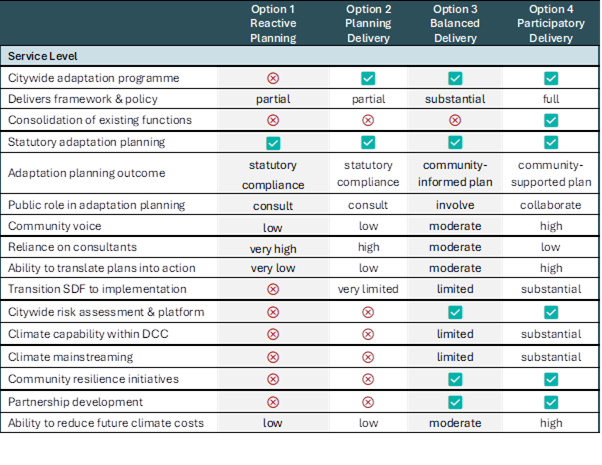
Option One – Reactive Planning
Description
· Adaptation
planning undertaken only when required by legislation or specific Council
decisions
· Single
adaptation coordinator supported by consultant-led planning and technical
assessments
· Focus
on statutory adaptation planning and maintenance of the Citywide Adaptation
Plan and Policy
· No
dedicated implementation support, community resilience initiatives, public
education, partnership development or climate capability activities
· Estimated
10-year cost of $6.72 million
Option
Assessment
Advantages
· Lowest
10-year cost option
· Meets
anticipated statutory adaptation planning requirements
· Flexible,
demand-driven approach
· Consultant
support procured only when required
Disadvantages
· Lowest
cost is due to delayed plan production, which does not start until Year 3,
after which annual costs are higher than Option Two
· No
dedicated citywide climate adaptation and resilience function
· Risk
assessments are static, one-off reports and adaptation planning remains
reactive and consultant-led
· No
implementation support, community resilience initiatives or climate capability
development
· No
transition support for South Dunedin Future
· No
citywide risk assessment capability or Resilience Explorer platform
Risks
· Limited
public engagement may reduce community understanding, support and ownership of
adaptation plans
· Fragmented
responses to climate risks across DCC
· Future
adaptation planning requirements may require rapid expansion of staffing or
consultant budgets
· Loss
of organisational knowledge through heavy dependence on consultants
Opportunities
· Defers
significant investment until legislative requirements become clearer
· Allows
future adaptation services to be redesigned once regulatory settings are
confirmed
Option Two – Planning Delivery
Description
· Dedicated
3-person adaptation team focused on coordinating and delivering statutory
adaptation planning requirements
· Adaptation
planning remains largely consultant-based
· Maintains
adaptation policy, monitoring and reporting functions
· Limited
implementation support during the transition of South Dunedin Future
· Estimated
10 year programme cost of $7.55 million
Option
Assessment
Advantages
· Maintains
a dedicated adaptation function within DCC
· Retains
organisational knowledge and continuity
· Provides
sufficient capability to coordinate anticipated statutory planning requirements
· Transitional
support for South Dunedin Future
· Lower
short-term cost than options providing ongoing implementation support and
resilience activities
Disadvantages
· Adaptation
planning remains largely consultant-based
· Uses
a technical planning process with limited community participation
· No
dedicated community resilience, public education or climate capability
programme
· Risk
assessments are static, one-off reports with no ongoing citywide risk
assessment capability or Resilience Explorer platform
Risks
· Planning
outcomes may not progress into funded implementation projects
· Future
planning requirements may exceed programme capacity
· Continued
consultant dependence may increase long-term costs and reduce capability
retention
Opportunities
· Establishes
and retains dedicated adaptation planning capability within DCC
· Provides
a platform that can be expanded if future legislative requirements become more
demanding
· Maintains
continuity between adaptation planning projects and future planning obligations
· Allows
Council to increase implementation support, community resilience activities or
climate capability development in future long-term plans if required
Option Three – Balanced Delivery
Description
· Dedicated
4-person adaptation team supporting planning, implementation and resilience
activities
· Maintains
the Citywide Climate Risk Assessment and Resilience Explorer
· Community-informed
planning process with opportunities for engagement
· Provides
moderate implementation support, public education, partnership development and
climate capability activities
· Estimated
10 year programme cost of $9.14 million
Option
Assessment
Advantages
· Maintains
citywide risk assessment capability
· Stronger
connection between adaptation planning and implementation, including transition
support for South Dunedin Future
· Supports
community resilience, partnerships and climate capability development
· Balances
internal expertise with targeted consultant support
Disadvantages
· Higher
cost than Options One and Two
· Continues
to rely on consultants for specialist planning and technical inputs
· Provides
only moderate support for implementation and mainstreaming
· Limited
capacity for organisation-wide climate capability development
Risks
· Future
adaptation planning demand may exceed programme capacity
· Community
expectations may exceed available implementation resources
· Limited
mainstreaming support may reduce influence on investment and asset management
decisions
Opportunities
· Strengthens
community and partner relationships
· Increases
the likelihood that adaptation priorities influence future long-term plans and
investment decisions
· Can
be expanded if adaptation requirements increase
Option Four – Participatory Delivery
Description
· Fully
delivers the Climate Adaptation Policy, Climate Resilience Framework and
associated business case objectives
· Adaptation
planning delivered primarily in-house using a participatory planning approach
· Dedicated
support for implementation, community resilience, climate capability and
climate mainstreaming
· Maintains
citywide risk assessment capability and delivers a proactive hazard data
improvement programme
· Estimated
10-year programme cost of $11.59 million
Option
Assessment
Advantages
· Fully
delivers the Climate Adaptation Policy and Climate Resilience Framework
· Highest
level of community participation and ownership
· Strongest
support for implementation of adaptation actions, including sustained support
for South Dunedin Future
· Reduces
reliance on consultant-based planning
· Builds
climate capability across DCC
· Provides
the strongest pathway from planning to resilience outcomes
Disadvantages
· Highest
cost option
· Requires
a greater long-term organisational commitment
· Participatory
planning processes require more time and resources
· Continues
to require specialist consultant expertise for hazards and technical
assessments
Risks
· Extensive
community engagement may generate expectations that exceed available funding or
delivery capacity
· Adaptation
priorities may not be reflected in future Council investment decisions
· Failure
to integrate climate resilience across DCC functions may reduce the value of
the additional investment
Opportunities
· Establish
climate adaptation as an enduring DCC function
· Improve
community trust and ownership of adaptation decisions
· Increase
the likelihood that adaptation priorities transition to funded and deliverable
projects
· Improves
access to external funding and partnership opportunities
· Delivers
the strongest long-term resilience outcomes for communities, infrastructure and
DCC services
NEXT STEPS
38 Subject to
Council’s decisions through the 10 year plan 2027-37 process, staff will:
· Incorporate
the approved service level and associated budget into the draft 10 year plan
2027-37
· Deliver
the Citywide Climate Adaptation Plan and Citywide Climate Risk Assessment in
2027
· Establish
governance, staffing and delivery arrangements consistent with Council’s
preferred option
· Commence
implementation of Council’s preferred option from 1 July 2027, following
the adoption of the 10 year plan
Signatories
|
Author:
|
Brandy Saxton - Senior Advisor - Climate Adaptation and
Resilience, South Dunedin Future
|
|
Authoriser:
|
Jonathan Rowe - Programme Manager, South Dunedin Future
Scott MacLean - General Manager, City Services
|
Attachments
There are no attachments for
this report.
|
Other CONSIDERATIONS
|
|
Fit with purpose of Local Government
The decision promotes the social, economic and
environmental well-being of communities in the present and for the future.
The proposed Climate Adaptation and Resilience programme supports
communities, infrastructure and the local economy to anticipate, prepare for
and respond to climate risks, helping to maintain wellbeing and resilience
over the long term.
|
|
LTP / Financial Strategy /Infrastructure Strategy/ Water
Services Strategy
Council currently funds climate adaptation through a range
of project-based activities and initiatives. The proposed Climate Adaptation
and Resilience programme establishes an ongoing business-as-usual function
with a defined service level and funding arrangement. Consequently, there are
no existing programme levels of service or performance measures against which
the options can be assessed.
|
|
Financial considerations
All options are funded through rates and do not require
borrowing or capital expenditure. The financial implications of each option
are set out in the Options section of this report.
|
|
Significance
This decision is considered medium significance in terms
of Council’s Significance and Engagement Policy. The proposed programme
is important to Dunedin because it establishes a new citywide climate
adaptation and resilience activity and has implications for future climate
adaptation planning, implementation and resilience outcomes. The proposal is
strongly aligned with existing Council policy and strategic direction but
requires Council to determine an appropriate service level and operating budget
for the programme. Community interest is expected to be moderate to high
given the growing impacts of climate change and the role of adaptation
planning in local communities.
|
|
Engagement – external
The programme and options have not been subject to
specific public consultation. Public consultation on the preferred option
would occur through the 10 year plan 2027-37 process.
The options presented in this report reflect different
future approaches to community engagement and participation in adaptation
planning, ranging from statutory consultation requirements through to
community-informed and participatory planning processes consistent with
Council’s Significance and Engagement Policy.
|
|
Engagement - internal
Development of the programme and service level options was
informed by engagement with staff across DCC through the Climate Resilience
Framework project and wider project group. Feedback focused on future
adaptation planning requirements, implementation support, community
involvement, climate capability and organisational readiness. No significant
concerns were raised.
|
|
Risks: Legal / Health and Safety etc.
The principal risk associated with this decision is that
the service level selected may not align with future adaptation planning
requirements, community expectations or climate risks. These risks are
partially managed through the adaptive management approach proposed in the
report, which allows priorities and programme activities to be reviewed and
adjusted over time.
No specific legal, health and safety or conflict of
interest issues have been identified.
|
|
Conflict of Interest
There are no known conflicts of interest associated with
this report.
|
|
Community Boards
Community Boards have identified climate risks and
adaptation planning as issues of interest and concern in previous submissions
and hearings. The programme will also support future adaptation planning
activities in locations where Community Boards have identified climate change
and natural hazards as issues of concern.
|
|

|
Council
2 September 2026
|
Dunedin City Emissions Targets Options Report
Department: Zero Carbon
EXECUTIVE SUMMARY
1 The
purpose of this report is for Council to consider new city emissions targets,
following the decision in July to replace the 2030 city-wide emissions targets.
2 Council
resolved in July 2026 to adopt the following target structure for
Dunedin’s city-wide emissions:
a) For
all greenhouse gases excluding biogenic methane:
i) A
near term gross emissions reduction target; and
ii) A
long-term net zero emissions target
b) Separate
gross emissions reduction targets for biogenic methane
3 For
the near-term gross emissions reduction target (all gases excluding biogenic
methane), this report presents two options for Council to consider:
a) A 30%
reduction in gross emissions by 2030/31, compared with a 2018/19 baseline
b) A 25%
reduction in gross emissions by 2030/31, compared with a 2018/19 baseline
4 For
the long-term net zero emissions target, this report presents three options for
Council to consider, based on the extent of emissions reduction considered
plausible under three different modelling scenarios:
a) Net
zero emissions (excluding biogenic methane) by 2040
b) Net zero
emissions (excluding biogenic methane) by 2045
c) Net
zero emissions (excluding biogenic methane) by 2050
5 For
biogenic methane, staff recommend retaining the existing target to reduce gross
biogenic methane emissions 10% by 2030.
6 This
report includes three options for a 2050 biogenic methane emissions reduction
target:
a) Retain
the target of a 24-47% reduction in biogenic methane emissions by 2050,
compared with 2017 levels (set in 2019, in line with Government direction at
that time)
b) Adopt the
Climate Change Commission’s 2024 recommendation to reduce biogenic
methane emissions 35-47% by 2050, compared with 2017 levels
c) Adopt
the current New Zealand government target to reduce biogenic methane 14-24% by
2050, compared with 2017 levels
7 An
overview of best practice for setting city/district level targets, and a
comparison of peer cities confirms that:
a) Action
to reduce emissions and adapt to climate change in the short term has
transition risks in a New Zealand local government context, however decisive
action in the next 5 to 10 years is expected to lead to the lowest transition
risks and physical hazards overall.
b) There are a
range of target options used by local authorities within New Zealand.
c) A
target with science-aligned ambition, is very difficult for Dunedin to achieve.
Should Council seek to adopt a target as close as practicable to best practice
guidance, the most ambitious targets presented in this report would be adopted.
RECOMMENDATIONS
That the Council:
a) Decides on a Dunedin short-term
gross emissions reduction target (excluding biogenic methane) for 2030/31:
i) A 30% reduction by 2030/31, compared with 2018/19; or
ii) A 25% reduction by 2030/31, compared with 2018/19
b) Decides on a Dunedin long-term
net zero emissions target (excluding biogenic methane):
i) Net zero emissions by 2040; or
ii) Net zero emissions by 2045; or
iii) Net zero emissions by 2050
c) Decides to retain the
existing Dunedin 2030 biogenic methane target of a 10% reduction against 2017
levels
d) Decides on a 2050
Dunedin biogenic methane reduction target:
i) A 24-47% reduction compared with 2017 levels; or
ii) A 35-47% reduction compared with 2017 levels; or
iii) A 14-24% reduction compared with 2017 levels
e) Notes that staff will
incorporate new Dunedin emissions targets into the Long Term Plan 2027-2037,
and will undertake a light refresh of the Zero Carbon Plan to incorporate the
new targets.
f) Notes that decisions
on the level of Dunedin City Council funding towards Dunedin city-wide
emissions reduction will be considered throughout Long Term Plan deliberation
processes.
BACKGROUND
8 This
report refers to emissions in tonnes of carbon dioxide equivalents (tCO2e).
This is a measure used to standardise the climate effects of different
greenhouse gases. A summary of the global warming potentials of three main
greenhouse gases (carbon dioxide, methane, and nitrous oxide) is included in Attachment
A.
9 This
report also refers to gross emissions and net emissions. Total gross
emissions refers to all emissions released into the atmosphere within an
organisational or city boundary. It does not include emissions removed from the
atmosphere from forestry (known as sequestration). Total net emissions
refers to total gross emissions less emissions removed from the atmosphere.
10 Total gross/net
emissions excluding biogenic methane refers to all emissions less biogenic
methane emissions.
11 Biogenic
methane refers to methane emissions produced by living things and
processes. The majority of Dunedin’s biogenic methane emissions come from
ruminant animals in agriculture (approx. 80%), with the remainder from organic
waste decaying in landfill and wastewater.
The DCC is
seeking to manage and reduce greenhouse gas emissions at both the city and DCC
scale
12 The DCC is
seeking to manage and reduce emissions at two scales, as directed by the Zero
Carbon Policy: city (Dunedin emissions) and organisational (DCC
emissions).
13 The
DCC’s Zero Carbon Policy provides that all DCC activities, including
renewals, should seek to minimise emissions and contribute to achieving both
city-wide and DCC emissions reduction targets.
14 Throughout
the 2027-2037 10 Year Plan deliberations, Council will make decisions which
have implications for achieving both city-wide and DCC emissions reduction
targets. The emissions implications of these decisions will be outlined in
relevant options reports for Council’s consideration.
Council
resolved to replace the Zero Carbon 2030 targets
15 At the city
scale, in 2019 the Council declared a climate emergency and adopted a
‘Zero Carbon 2030’ city emissions reduction target (CNL/2019/154),
which was in two parts:
a) net
zero emissions of all greenhouse gases other than biogenic methane by 2030,
b) and a 24%
to 47% reduction below 2017 biogenic methane emissions by 2050, including 10%
reduction below 2017 biogenic methane emissions by 2030.
16 On 22 July
2026, Council resolved to replace the 2030 Dunedin emissions targets, noting
staff would present a report on proposed target years and emissions reduction
pathways:
Moved (Cr Mickey Treadwell/Cr
Doug Hall):
That the Council:
a) Adopts
refreshed Carbon Zero targets for the Dunedin Carbon Zero Framework, replacing
the existing Net Zero 2030 target.
b) Adopts
a two-stage target comprising
i) a
near-term gross greenhouse gas emissions reduction target; and
ii) a
long-term net zero greenhouse gas emissions target.
c) Adopts
separate targets for biogenic methane and all other greenhouse gases,
maintaining a distinct biogenic methane reduction target.
d) Notes
that staff will present a future report for Council to consider the level of
ambition, including proposed target years and emissions reduction pathways, for
the refreshed targets.
Division
The Council voted by division
For: Crs
John Chambers, Christine Garey, Doug Hall, Marie Laufiso, Cherry Lucas, Mandy
Mayhem, Andrew Simms, Mickey Treadwell and Steve Walker (9).
Against: Crs
Benedict Ong and Brent Weatherall (2).
Abstained: Nil
The division was declared
CARRIED by 9 votes to 2
Motion carried (CNL/2026/131)
The Zero Carbon Plan outlines the changes needed for
Dunedin to become a net zero city
17 In
September 2023, Council adopted the Zero Carbon Plan 2030, which established a
pathway for achieving the city’s emissions target, building on existing
trends.
18 The Zero
Carbon Plan outlines how emissions reductions could be achieved through five
interconnected areas: resource use and waste; transport and urban form;
buildings, energy and industry; forestry, land use and agriculture; and
communities and economies.
19 As well as
identifying a pathway to net zero, the Zero Carbon Plan describes the broader
shifts required for Dunedin to become a Zero Carbon city.
20 It also
identifies the DCC’s role in supporting the transition to zero carbon,
with action areas for the DCC prioritised according to their emissions
reduction potential. The Zero Carbon Plan recognises that many actions required
to reduce emissions will reduce costs in the medium term, but there will be
upfront costs especially for owners of assets/infrastructure.
21 The Zero
Carbon Plan’s key shifts remain unchanged despite the contextual changes
since the Plan was adopted, and the resulting increase in projected emissions
for 2030. To become a city with ‘net zero emissions’ at any stage,
Dunedin will still need to take the same steps to reduce emissions. Modelling
reconfirms that, in particular, unlocking shifts in transport is fundamental to
achieving ‘net zero carbon’.
22 Priority
action areas for DCC also remain the same. Action areas that are likely to have
a high or very high emissions reduction potential are:
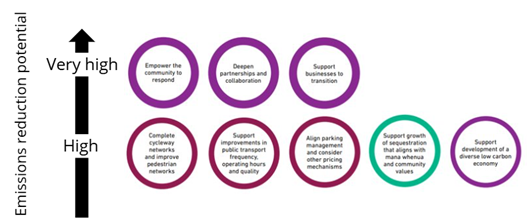
23 Staff do
not expect the changes to the city-wide emissions targets to require
significant amendments to the Zero Carbon Plan, the key shifts for the city, or
the DCC’s action areas.
24 Despite
headwinds, Dunedin is still comparatively well placed to tackle the challenge
of reducing greenhouse gas emissions:
· Strong
partnerships in place with major institutions/employers, including the Zero
Carbon Alliance
· Significant
growth in public transport patronage (outperforming other centres of a similar
size and bucking national trends)
· About
double the national average for walking to work or education, and recent growth
in cycle mode share
· Urban
densification in inner city continuing
· Phasing
down coal well underway
· Reducing
waste emissions underway
· Growing
uptake of rooftop solar
· The
cost of electric vehicles, solar panels, hot water heat pumps, and other
technologies continues to decline over time
Dunedin’s
emissions have reduced between 2018/19 and 2024/25
25 An updated
Dunedin emissions inventory up to 2024/25 was presented to the Policy and
Planning Committee in April 2026, showing that Dunedin’s gross emissions
reduced 13% between 2018/19 and 2024/25 (PAPCC/2026/012).
26 The Zero Carbon Plan uses the
2018/19 financial year as the baseline for measuring city-wide emissions.
Between 2018/19 and 2024/25:
a) Dunedin’s total gross emissions reduced
13%, from 1,619,536 tCO2e in 2018/19 to 1,416,010 tCO2e in 2024/25.
b) Dunedin’s total net
emissions reduced 11%, from 1,258,198 tCO2e in 2018/19 to 1,119,876
tCO2e.
c) Dunedin’s total net
emissions (excluding biogenic methane) reduced 9%, from 704,845 tCO2e in
2018/19 to 641,057 tCO2e in 2024/25.
d) Dunedin’s total biogenic
methane emissions reduced 13%, from 553,353 tCO2e in 2018/19 to
478,819 tCO2e in 2024/25.
27 Changes
in gross emissions between 2018/19 and 2024/25 are shown in Table 1, split by
emissions source:
Table 1
– Gross Emissions changes from 2018/19 to 2024/25 by emissions source
|
Sector / Emissions Source
|
Emissions (tCO2e)
|
Percentage Change 18/19 – 24/25
(%)
|
|
2018/19
|
2024/25
|
|
Transport
|
On-Road
|
330,316
|
322,938
|
-2%
|
|
Rail
|
4,559
|
3,797
|
-17%
|
|
Air travel
|
43,354
|
29,512
|
-32%
|
|
Marine
|
251,240
|
219,763
|
-13%
|
|
Off-Road
|
47,741
|
48,118
|
1%
|
|
Stationary Energy
|
Electricity Consumption
|
100,366
|
87,957
|
-12%
|
|
Stationary Diesel and Petrol Use
|
26,416
|
26,617
|
1%
|
|
LPG
|
29,197
|
28,778
|
-1%
|
|
Coal
|
44,077
|
13,329
|
-70%
|
|
Biofuel
|
4,650
|
9,140
|
97%
|
|
Biogas
|
27
|
73
|
168%
|
|
Waste
|
Solid Waste (Landfill)
|
80,279
|
33,535
|
-58%
|
|
Wastewater Treatment
|
12,383
|
12,556
|
1%
|
|
IPPU
|
Refrigerant and Air Conditioning Gases
|
41,330
|
29,959
|
-28%
|
|
Other Industrial Gases
|
3,085
|
2,634
|
-15%
|
|
Agriculture
|
Agriculture
|
600,515
|
547,303
|
-9%
|
|
Total Gross Emissions
|
1,619,536
|
1,416,010
|
-13%
|
DISCUSSION
28 To help
inform Council’s decision on the level of ambition for Dunedin’s
emissions targets, the following sections summarise key considerations
including:
a) What
is plausible for all greenhouse gases excluding biogenic methane, using three
different emissions modelling scenarios;
b) Emissions
modelling for biogenic methane, along with Climate Change Commission advice on
what is possible by 2050;
c) Best
practice on community/city level emissions target setting;
d) City/district
level targets of other New Zealand cities; and
e) New Zealand
targets
Dunedin
Emissions Modelling to 2050
Summary of
emissions modelling scenarios
29 To support
Council’s consideration for a refreshed city emissions target, emissions
have been modelled through to 2050 to provide longer-term context:
a) A
BAU scenario, which broadly follows national level trajectories included in
the modelling underpinning the Second National Emissions Reduction Plan
2026-2030 (ERP2)
b) An Accelerated
Ambition scenario, which requires some changes in central government policy
(but not a complete reversal), as well as some additional local investment; and
c) A High
Ambition scenario which would require significant changes in central
government policy, and higher levels of local investment into a transition to
becoming a lower carbon city.
30 As directed
by the Zero Carbon Policy, emissions in the Dunedin City Territorial Area are estimated
using the production-based Global Protocol for Community-Scale Greenhouse Gas
Emissions Inventory (GPC) methodology. This method covers the key sectors of
Transport, Stationary Energy, Waste, Industrial Processes and Product Use
(IPPU), Agriculture, and Forestry. Production-based approaches exclude global
emissions relating to consumption, such as the emissions used elsewhere to
produce products used/consumed within Dunedin. The GPC methodology is the
global standard for estimating emissions within a territorial area.
31 Council is
considering the level of ambition for three targets:
a) a
near-term gross greenhouse gas emissions reduction target (excluding biogenic
methane);
b) a long-term
net zero greenhouse gas emissions target (excluding biogenic methane); and
c) separate
biogenic methane reduction targets.
32 Emissions
modelling to inform Council’s decision for each of these targets is
presented below.
33 The key
differences in the emissions scenarios through to 2050 are included under Attachment
B, showing the impact of different levels of change across transport,
stationary energy, Industrial Processes and Product Use (IPPU), agriculture
(nitrous oxide), and carbon sequestration through to 2050.
34 The
differences in the emissions modelling scenarios relate to the all greenhouse
gases excluding biogenic methane targets. For biogenic methane, staff have only
modelled one scenario based on changes in Dunedin between 2018/19 and 2024/25,
local investment and action on waste diversion, and the ERP2 modelling for
agriculture through to 2050.
35 It is worth
noting that all scenarios, including the BAU scenario, involve
significant changes between now and 2050. The BAU scenario refers to
Dunedin following similar changes to those anticipated nationally in the ERP2,
rather than assuming the level of emissions in 2024/25 carry through to 2050.
Near-term
gross greenhouse gas emissions reduction target (excluding biogenic methane)
36 Table 2
below shows Dunedin’s gross emissions (excluding biogenic methane) under
each of the three scenarios through to 2030/31, with the level of emissions
reduction compared against a baseline year of 2018/19 in line with the Zero
Carbon Plan. This shows a range of between 24%-30% gross emissions reduction by
2030/31.
Table 2
– Gross emissions to 2030/31 under each scenario (excluding biogenic
methane)
|
Emissions Scenario
|
Actual gross emissions (tCO2e)
|
Modelled gross emissions (tCO2e)
|
|
2018/19
|
2024/25
|
2030/31
|
% reduction against 2018/19
|
|
BAU
|
1,066,000
|
937,000
|
807,000
|
24%
|
|
Accelerated Ambition
|
775,000
|
27%
|
|
High Ambition
|
742,000
|
30%
|
Longer-term
gross greenhouse gas emissions reduction target (excluding biogenic methane)
37 Table 3
below shows the net emissions (excluding biogenic methane) under each of the
three scenarios through to 2050. Under each scenario, net zero emissions are
achieved before 2050, with Dunedin becoming a net negative city by 2050
(excluding biogenic methane). This means that more carbon dioxide is absorbed
by plants and forests than greenhouse gases emitted into the atmosphere.
38 Net zero
emissions (excluding biogenic methane) are achieved in different timeframes
across the three scenarios:
a) BAU
Scenario – net zero by 2047
b) Accelerated
Ambition Scenario – net zero by 2044
c) High
Ambition Scenario – net zero by 2042
Table 3 - Net Emissions to 2050 under each scenario
(all gases excluding biogenic methane)
|
Emissions Scenario
|
Actual net emissions (tCO2e)
|
Modelled net emissions (tCO2e)
|
|
2018/19
|
2024/25
|
2030
|
2035
|
2040
|
2045
|
2050
|
|
BAU
|
705,000
|
641,000
|
370,000
|
195,000
|
130,000
|
9,000
|
-68,000
|
|
Accelerated Ambition
|
336,000
|
155,000
|
84,000
|
-28,000
|
-100,000
|
|
High Ambition
|
303,000
|
103,000
|
30,000
|
-63,000
|
-113,000
|
39 Figures 1-3
below show the different emissions trajectories under each scenario through to
2050, showing the reductions in Stationary Energy, Transport, Industrial
Processes and Product Use, and Agriculture (nitrous oxide only), along with the
rate of forestry sequestration to balance emissions.
40 The BAU
emissions scenario shows gross emissions reducing 49% by 2050 compared to
baseline (2018/19), with net zero achieved approximately 2047:
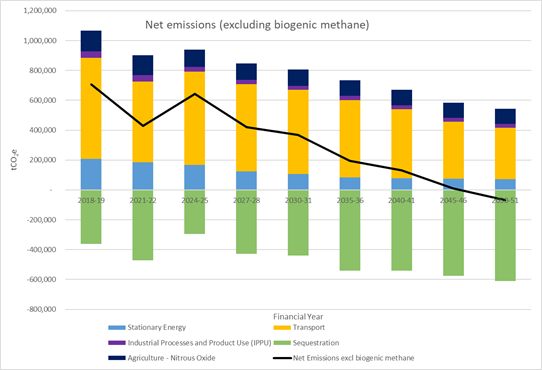
Figure 1 – BAU
Scenario – All other greenhouse gases target
41 The Accelerated
Ambition emissions scenario shows gross emissions reducing 52% by 2050
compared to baseline, with net zero achieved approximately 2044:
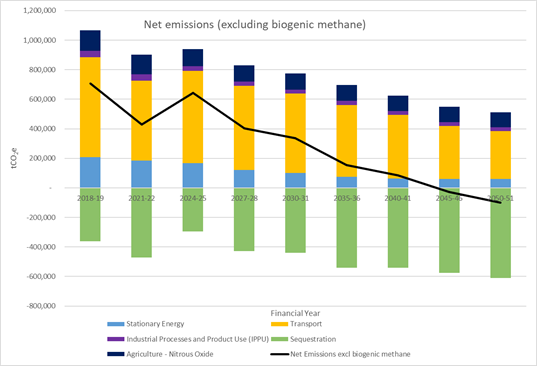
Figure 2 – Accelerated Ambition Scenario: All other greenhouse
gases target
42 The High
Ambition emissions scenario shows gross emissions reducing 53% by 2050
compared to baseline, with net zero achieved approximately 2042:
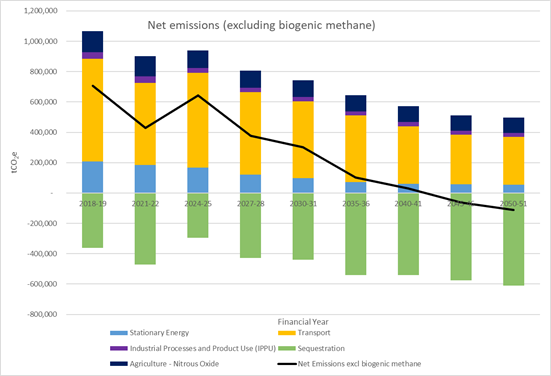
Figure 3 - High Ambition Scenario: All other greenhouse gases target
Biogenic methane reduction modelling
43 Table 4
below shows Dunedin’s modelled biogenic methane emissions through to
2050. The scenarios used in this modelling for waste diversion and agricultural
methane reductions are included in Attachment B. The agricultural methane
emissions reductions are based on the ERP2 agricultural emissions modelling,
considering changes in Dunedin’s agricultural emissions between 2018/19
and 2024/25. This modelling anticipates:
a) 2030/31
biogenic methane emissions being 16% lower than the 2018/19 baseline; and
b) 2050
biogenic methane emissions being 27% lower than the 2018/19 baseline.
Table 4
– Biogenic methane emissions modelling to 2050
|
Emissions Source
|
Actual emissions (tCO2e)
|
Modelled emissions (tCO2e)
|
|
2018/19
|
2024/25
|
2030
|
2035
|
2040
|
2045
|
2050
|
|
Waste and wastewater
|
92,000
|
50,000
|
45,000
|
45,000
|
45,000
|
45,000
|
45,000
|
|
Agriculture
|
461,000
|
429,000
|
421,000
|
390,000
|
374,000
|
364,000
|
358,000
|
|
Total methane emissions
|
553,000
|
479,000
|
466,000
|
435,000
|
419,000
|
409,000
|
403,000
|
Climate
Change Commission Recommendations
44 Staff have
not modelled alternative biogenic methane emissions reduction pathways for
Dunedin. However, the Climate Change Commission’s 2024 review of New
Zealand’s 2050 emissions reduction targets recommended that Central
Government adopt the following biogenic methane reduction targets:
a) Retain
the 2030 target to reduce biogenic methane emissions by 10%, compared with a
2017 baseline; and
b) Reduce
biogenic methane emissions 35-47% by 2050, compared with a 2017 baseline
45 The Climate
Change Commission’s recommended target range was based on their analysis
that adoption of existing technologies could achieve the 35% reduction, with
the 47% reduction possible based on the potential of emerging technologies:
For biogenic methane, the
lower end of the recommended target range reflects a pathway that, according to
our analysis, is largely possible with current technologies. The higher end
reflects what is likely to be possible with significant changes in technology,
in particular if methane inhibiting technologies become available in Aotearoa
New Zealand.
46 Central
Government did not proceed with the Climate Change Commission’s
recommendation, instead in 2025 amending the biogenic methane target to be
14-24% below 2017 levels by 2050.
Best Practice
Guidance and Frameworks
47 This
section summarises international guidance and frameworks relevant to setting
city-wide emissions targets, and is similar to the information included in the City-wide
emissions target refresh options report to Council on 22 July 2026 (CNL/2026/131).
Intergovernmental
Panel on Climate Change (IPCC) Sixth Assessment Report (AR6)
48 The
IPCC AR6 synthesis report sets out core principles to define a scientifically
robust target. Key findings include:
a) Every
increment of warming increases risks, and methane is a major driver of
near-term warming.
b) Rapid
methane reductions deliver climate benefits within years, not decades, due to
methane’s short lifespan in the atmosphere compared to other greenhouse
gases.
c) Limiting
warming to 1.5°C or 2°C will require deep cuts in all gases,
particularly methane.
d) Net-zero
carbon dioxide alone is insufficient. Other greenhouse gases must also decline
sharply.
e) 1.5°C
compatible pathways require approximately 34% methane reductions by 2030 (from
2019 levels).
49 For
setting a Dunedin emissions target, IPCC’s AR6 synthesis report
confirms:
a) Methane
reductions matter immediately at the city-scale, and as such there should be a
focus on short-term actions such as maximising landfill gas capture, wastewater
methane management, and reducing landfilling of materials with high organic
content (such as food, garden, and timber waste).
b) Net-zero
all other gases does not remove the need for significant reductions in biogenic
methane. AR6 is explicit that climate stabilisation requires:
i) Deep
and sustained reductions in carbon dioxide reaching net-zero
ii) Significant
reductions in methane and other non-carbon dioxide gases
Science-Based
Targets for Cities (Guide)
50 The
Science-Based Targets Network is a science-led initiative founded by a group of
global Non-governmental Organisations (NGOs) to define what is necessary for
cities to do to stay within planetary limits. The Science-Based Targets Network
(SBTN) have issued guidance on how cities can set science-based targets.
51 The key
implications for Dunedin emissions targets are that under the SBTN guide, the
2030 short term target should reflect Dunedin’s fair share of halving
global emissions by 2030. The recommended level of reduction would be a 70-75%
reduction in emissions compared with 2015.
52 A 70-75%
reduction in emissions by 2030 far exceeds what is considered plausible in any
of the emissions modelling scenarios included in this report. If Council seek
to adopt a target as close as possible to the level needed to support limiting
warming to 1.5°C above pre-industrial levels, then the most ambitious
emissions reduction and net zero target options presented in this report should
be adopted.
Global
Covenant of Mayors for Climate and Energy
53 Dunedin has
been a signatory to the Global Covenant of Mayors for Climate and Energy (GCoM)
since 2015. Cities in GCoM pledge to set “targets at least as ambitious
as their country’s Nationally Determined Contributions under the United
Nations Framework Convention on Climate Change (UNFCCC).”
54 This does
not provide specific guidance on the level of ambition needed in a city target.
Rather it affirms that for Dunedin to remain a signatory to GCoM, a city level
target of some form is required, with a level of ambition at least equivalent
to that set nationally.
Local
Government Funding Agency – Local Government Sector Climate Scenarios
55 In
September 2025, the Local Government Funding Agency (LGFA) released their Local
Government Sector Climate Scenarios
(LGFA Climate Scenarios). The LGFA Climate Scenarios illustrate how
climate change could impact the local government sector under different
plausible climate futures. While these scenarios do not provide guidance on how
to set a district level target, they do provide guidance on the likely impacts
to local government and the communities local government support.
56 There are
three scenarios included in the LGFA Climate Scenarios report:
a) Scenario
1: Acting now for our mokopuna – based on coordinated global climate
action from the late 2020s, driving a transition to a low-carbon, climate
resilient economy, and limiting global warming to 1.7°C above
pre-industrial levels by 2100.
b) Scenario
2: Leaving it to the next generation – Global climate action is
delayed until the mid-2030s, with a rapid disorderly transition to a low-carbon
economy. This leads to high economic and social costs for Aotearoa New Zealand.
Global warming of 2.7°C above pre-industrial levels by 2100.
c) Scenario
3: Inheriting a broken world – Global climate action falters due to
geopolitical tensions. Global warming of 3.9°C above pre-industrial levels
by 2100.
57 Each of the
scenarios leads to differences in the timing and severity of transition risks
and physical hazards. As stated on page 7 of the LGFA Climate Scenarios report
“[r]educing emissions or building resilience creates transition risk,
whilst higher temperatures cause physical risk. Acting early leads to higher
short-term transition risk, but reduces longer-term exposure to physical
impacts. Conversely, not reducing emissions leads to physical risks rising
exponentially to 2100 and beyond.”
58 This is
illustrated below, in terms of the extent of the transition risks and physical
risks under each scenario, as well as the impacts of each scenario over time:
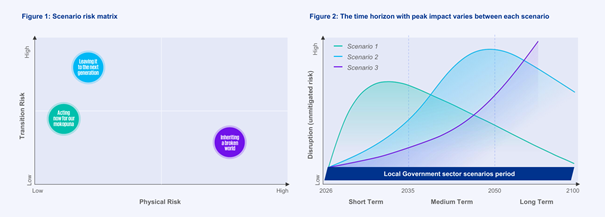
59 The key
implications of the LGFA Climate Scenarios for Dunedin emissions targets are
that action to reduce emissions and adapt to climate change in the short term
will lead to transition risks in a New Zealand local government context,
however decisive action in the late 2020s/2030s is expected to lead to the
lowest transition risks and physical hazards overall.
Peer Cities
60 A
comparison of the Hamilton, Palmerston North and Christchurch district level
targets is shown below in Table 5. While there are some similarities between
Dunedin and these cities, for all three agriculture makes up a smaller share of
their city emissions compared with Dunedin (agriculture made up 39% of
Dunedin’s emissions in 2024/25). Similarly, because of Dunedin’s
large territorial boundaries, there are higher rates of forestry sequestration
in Dunedin than places like Hamilton which are largely urban. This can help
explain why Hamilton have set ambitious gross emissions reduction targets for
2050, without setting an overall net zero emissions target for Hamilton city.
Table 5 – Comparative
New Zealand District Level Targets
|
NZ Peer District
|
Target Statement
|
District Target Years (Gross or Net)
|
Biogenic Methane Treatment
|
|
Palmerston North City Council
|
A central part of our goal to be an eco-city is
achieving a 30% reduction in Palmy’s greenhouse gas emissions by 2031.
This target is our part of a national effort to make the whole of New Zealand
carbon neutral by 2050.
|
Gross target for 2031.
Reference to 2050 national net-zero target.
|
Included in 2031 target.
(Agriculture was 17% of Palmerston North city gross emissions in 2021)
|
|
Christchurch City Council
|
Our targets for Christchurch are to halve emissions
by 2030, compared with 2016-2017 levels, and to achieve net zero greenhouse
gas emissions by 2045, with at least a 50% reduction in methane emissions by
2045.
|
Gross target for 2030.
Net Zero 2045
|
Separate target – 50% reduction in biogenic
methane by 2045
(Agriculture was 16% of Christchurch city gross emissions in 2023)
|
|
Hamilton City Council
|
By 2030 our city's emissions are reduced by at least
30%. By 2050 our city's emissions are reduced by at least 82%.
|
Gross target for 2030 and 2050.
No net zero community target.
|
Included in overall targets.
(Agriculture was 1% of Hamilton city gross emissions in 2022)
|
New Zealand Targets Context
61 Central
Government have set the following emissions reductions targets for New Zealand
to meet, under the Climate Change Response Act:
a) Net
zero emissions of all greenhouse gas emissions other than biogenic methane by
2050.
b) 14% to 24%
reduction below 2017 biogenic methane emissions by 2050, including 10%
reduction below 2017 biogenic methane emissions by 2030.
62 The 2050
biogenic methane emissions target was amended in December 2025, having
previously been a target of a 24% to 47% reduction below 2017 biogenic methane
emissions by 2050.
63 The New
Zealand targets exclude international shipping and aviation emissions, which
are included within Dunedin’s emissions inventory and targets.
64 Central
Government have also set the first and second Nationally Determined
Contributions (NDCs) under the Paris Agreement covering 2021-2030 (NDC1) and
2031-2035 (NDC2). The NDC1 target is to reduce net greenhouse gas emissions to
50% below 2005 levels by 2030. This target can be met by domestic emissions
reductions (reductions within New Zealand) and also by emissions reductions
occurring offshore but paid for by New Zealand.
Key Considerations
Fit with strategic framework
65 The
relevant strategies and plans this decision relates to include the Zero Carbon
Plan, DCC Emissions Management and Reduction Plan 2025-2030, and the Zero
Carbon Policy. As noted within the report, the key shifts identified in the
Zero Carbon Plan for Dunedin to become a low/zero net emissions city, and the
action areas for DCC to support that transition, remain unchanged.
Māori Impact Statement
66 A Treaty of
Waitangi analysis was prepared previously as part of the Zero Carbon work
programme. This indicated that, in general, taking action to reduce emissions
is aligned with Treaty of Waitangi obligations because a wide range of taonga
are at risk from climate change. However, individual projects will need to
consider Te Taki Haruru and incorporate mana whenua and mātāwaka
inputs when delivered.
Legislative Reforms
67 ‘Climate
Action’ is one of the United Nation’s Sustainable Development
Goals, reflecting the centrality of action on climate change to the achievement
of sustainable development. Without significant cuts to emissions, climate
change impacts will further accelerate, with commensurate negative impacts on
the social, environmental, cultural and economic wellbeing of New Zealand
communities. As such, efforts to reduce emissions support sustainable economic
growth and development over the medium to long term, as part of global efforts
to minimise the negative impacts of climate change, and forms part of meeting
the current and future needs of communities.
Sustainability, Climate Mitigation (Zero Carbon),
Adaptation and Resilience
68 As this
report is about setting the level of ambition for city-wide reduction targets,
there are significant implications for Dunedin’s emissions trajectory to
2050 depending on the options chosen.
69 Adaptation alone
cannot address all climate risks. Reducing greenhouse gas emissions is
essential to limit the scale of future climate change and keep adaptation
achievable and affordable. A low emissions Ōtepoti Dunedin can also
deliver local benefits through more efficient infrastructure and systems,
greater energy independence, healthier environments and improved public health,
while contributing to global climate goals. As such, Council’s decisions
and support for emissions reduction within Dunedin can also support efforts to
adapt to the effects of climate change, and increase local resilience.
OPTIONS
70 This report
includes options for three different components of Dunedin city-wide targets:
a) For
all greenhouse gases excluding biogenic methane:
i) A
near term gross emissions reduction target; and
ii) A
long-term net zero emissions target
b) Separate
gross emissions reduction targets for biogenic methane
Near-term
gross emissions reduction target options
71 For the
near-term gross emissions reduction target (all gases excluding biogenic
methane), this report presents two options for Council to consider:
a) A 30%
reduction in gross emissions by 2030/31, compared with a 2018/19 baseline
· This
is based on the High Ambition Scenario outlined under paragraph 36 of
this report, and covered in Attachment B.
b) A 25%
reduction in gross emissions by 2030/31, compared with a 2018/19 baseline
· This
is based on the BAU Scenario outlined under paragraph 36 of this report,
and covered in Attachment B.
Long-term
net zero emissions target options
72 For the
long-term net zero emissions target, this report presents three options for
Council to consider, based on the extent of emissions reduction considered
plausible under three different modelling scenarios:
a) Net
zero emissions (excluding biogenic methane) by 2040
· This
is broadly based on the High Ambition Scenario outlined in paragraph
37-42 of this report, with the changes needed to achieve this covered in detail
in Attachment B. Emissions modelling anticipates net emissions of 30,000tCO2e
in 2040 under this scenario. As such, achieving net zero by 2040 would require
either finding further emissions reductions by 2040, or increasing forestry
sequestration to bridge this gap.
b) Net zero
emissions (excluding biogenic methane) by 2045
· This
is based on the Accelerated Ambition Scenario outlined in paragraph
37-42 of this report, with the changes needed to achieve this covered in detail
in Attachment B.
c) Net
zero emissions (excluding biogenic methane) by 2050
· This
is based on the BAU Scenario outlined in paragraph 37-42 of this report,
with the changes needed to achieve this covered in detail in Attachment B.
Biogenic
methane emissions reduction options
73 For
biogenic methane, staff recommend retaining the existing target to reduce gross
biogenic methane emissions 10% by 2030.
74 This report
includes three options for a 2050 biogenic methane emissions reduction target:
a) Retain
the target of a 24-47% reduction in biogenic methane emissions by 2050,
compared with 2017 levels (set in 2019, in line with Government direction at
that time)
b) Adopt the
Climate Change Commission’s 2024 recommendation to reduce biogenic
methane emissions 35-47% by 2050, compared with 2017 levels
c) Adopt
the current New Zealand government target to reduce biogenic methane 14-24% by
2050, compared with 2017 levels
Assumptions
75 Assumptions
used in each of the emissions modelling scenarios is covered in detail under
Attachment B.
Financial Comparison
76 Throughout
the 2027-2037 10 Year Plan deliberations, Council will make decisions which
have implications for achieving both city-wide and DCC emissions reduction
targets. The emissions implications of these decisions will be outlined in
relevant options reports for Council’s consideration. As such, Council
will consider funding of projects that support city-wide emissions reduction
across the various options reports being presented through 2026.
Short Term Gross Reduction Target: Option One – 30%
Reduction by 2030/31
77 This
short-term target option is for a 30% reduction in gross emissions (excluding
biogenic methane) by 2030/31, compared with a 2018/19 baseline.
78 This is
based on the High Ambition Scenario outlined under paragraph 36 of this report,
and covered in Attachment B.
Option
Assessment
Advantages
· More
closely aligns with best practice guidance on science-aligned city emissions
reduction targets than option two
· Supports
Dunedin residents enjoying the co-benefits of transitioning to a lower carbon
city sooner than option two (such as more efficient infrastructure and systems,
greater energy independence, healthier environments and improved public health)
Disadvantages
· Achievement
requires more significant investment and change across Dunedin through to
2030/31 than option two, which could lead to higher transition risks in the
short term.
Short Term Gross Reduction Target: Option Two – 25%
Reduction by 2030/31
79 This
short-term target option is for a 25% reduction in gross emissions (excluding
biogenic methane) by 2030/31, compared with a 2018/19 baseline.
80 This is
based on the BAU Scenario outlined under paragraph 36 of this report, and
covered in Attachment B.
Option
Assessment
Advantages
· Requires
a slower pace of change in the short term, which could mitigate transition
risks for Dunedin residents over the short term
Disadvantages
· Achievement
of this target would lead to reduced co-benefits associated with transitioning
to a lower carbon city compared with option one, including higher dependence on
fossil fuels for energy
· Less
aligned with best practice guidance on city emissions reduction targets than
option one
Long Term Net Zero Emissions Target – Option One
– Net Zero 2040
81 This target
option is for Dunedin to achieve net zero emissions (excluding biogenic
methane) by 2040.
82 This is
broadly based on the High Ambition Scenario outlined in paragraph 37-42 of this
report, with the changes needed to achieve this covered in detail in Attachment
B.
83 Emissions
modelling anticipates net emissions of 30,000tCO2e in 2040 under this scenario.
As such, achieving net zero by 2040 would require either finding further
emissions reductions by 2040, or increasing forestry sequestration to bridge
this gap.
Option
Assessment
Advantages
· Strongest
alignment with best practice guidance on science-based city emissions reduction
targets than other long term target options
· Supports
Dunedin residents enjoying the co-benefits of transitioning to a lower carbon
city sooner than options two and three (such as more efficient infrastructure
and systems, greater energy independence, healthier environments and improved
public health)
Disadvantages
· Requires
Dunedin to transition to a low emissions city at a significantly faster pace
than is anticipated in the Second National Emissions Reduction Plan for
2026-2030, which could lead to higher levels of local investment and lower
levels of support from Central Government than aligning more closely with the
New Zealand emissions targets.
Risks
· Achievement
of net zero relies on significant increases to forestry sequestration compared
with 2024/25 levels. Natural hazards such as landslides or wildfires of
forested areas could reduce the amount of carbon sequestration possible within
Dunedin’s territorial boundaries.
Opportunities
· Becoming
net zero by 2040, and net negative from 2041 onwards, would support achievement
of New Zealand’s overall 2050 net zero targets, and enable districts with
less capacity for forestry sequestration than Dunedin to have residual hard to
abate emissions remaining by 2050.
· Given
the number of investment and political cycles between 2026 and 2040, along with
potential technological advancements over the same period, there may be
additional opportunities to reduce Dunedin’s emissions over the next 15
years which further support achievement of net zero by 2040
Long Term Net Zero Emissions Target – Option Two
– Net Zero 2045
84 This target
option is for Dunedin to achieve net zero emissions (excluding biogenic
methane) by 2045.
85 This is
broadly based on the Accelerated Ambition Scenario outlined in paragraph 37-42
of this report, with the changes needed to achieve this covered in detail in
Attachment B.
Option
Assessment
Advantages
· Supports
Dunedin residents enjoying the co-benefits of transitioning to a lower carbon
city sooner than option three (such as more efficient infrastructure and
systems, greater energy independence, healthier environments and improved
public health)
· Requires
a slower pace of change than option one.
Disadvantages
· Requires
Dunedin to transition to a low emissions city at a faster pace than is
anticipated in the Second National Emissions Reduction Plan for 2026-2030,
which could lead to higher levels of local investment and lower levels of
support from Central Government than aligning more closely with the New Zealand
emissions targets.
· More
poorly aligned with best practice guidance on science-based city emissions
reduction targets than option one
Risks
· Achievement
of net zero relies on significant increases to forestry sequestration compared
with 2024/25 levels. Natural hazards such as landslides or wildfires of
forested areas could reduce the amount of carbon sequestration possible within
Dunedin’s territorial boundaries.
Opportunities
· Becoming
net zero by 2045, and net negative from 2046 onwards, would support achievement
of New Zealand’s overall 2050 net zero targets, and enable districts with
less capacity for forestry sequestration than Dunedin to have residual hard to
abate emissions remaining by 2050.
· Given
the number of investment and political cycles between 2026 and 2045, along with
potential technological advancements over the same period, there may be
additional opportunities to reduce Dunedin’s emissions over the next 20
years which further support achievement of net zero by 2045
Long Term Net Zero Emissions Target – Option Three
– Net Zero 2050
86 This target
option is for Dunedin to achieve net zero emissions (excluding biogenic
methane) by 2050.
87 This is
broadly based on the BAU Scenario outlined in paragraph 37-42 of this report,
with the changes needed to achieve this covered in detail in Attachment B. The
BAU Scenario anticipates Dunedin becoming a net zero city by 2047.
Option
Assessment
Advantages
· Requires
a slower pace of change, which could mitigate transition risks for Dunedin
residents over the short term
· Aligns
with New Zealand government targets, which may mean there are greater
incentives and policies available from Central Government to encourage
achievement of a 2050 aligned target
Disadvantages
· Achievement
of this target would lead to reduced co-benefits associated with transitioning
to a lower carbon city compared with options one and two, including higher
dependence on fossil fuels for energy between 2026 and 2050
· Poorest
alignment with best practice guidance on science-based city emissions reduction
targets of all long term net zero options
Risks
· Achievement
of net zero relies on significant increases to forestry sequestration compared
with 2024/25 levels. Natural hazards such as landslides or wildfires of
forested areas could reduce the amount of carbon sequestration possible within
Dunedin’s territorial boundaries.
Opportunities
· Given
the number of investment and political cycles between 2026 and 2050, along with
potential technological advancements over the same period, there may be
additional opportunities to reduce Dunedin’s emissions over the next 25
years which further support achievement of net zero by 2050
Biogenic Methane Reduction Target: Option One – 24-47%
Reduction by 2050
88 This option
for biogenic methane emissions reduction involves a short term and long term
target:
a) Retain
the existing target of a 10% reduction in biogenic methane emissions by 2030,
compared with 2017 levels; and
b) Retain the
target of a 24-47% reduction in biogenic methane emissions by 2050, compared
with 2017 levels (set in 2019, in line with Government direction at that time)
89 This target
is within the range of the biogenic methane emissions modelling presented in
paragraph 43 of this report, being a 27% reduction by 2050.
Option
Assessment
Advantages
· Aligns
well with the biogenic methane emissions modelling estimate of a 27% reduction
by 2050
· Is
more closely aligned with best practice guidance that deep reductions in
biogenic methane are required than option 3 (adopt current Central Government
targets)
Disadvantages
· This
option no longer aligns with Central Government policy, nor does it align with
the Climate Change Commission’s recommendation to Central Government in
2024
Risks
· Achievement
of the upper end of this range is significantly more ambitious than the current
New Zealand government target of a 14-24% reduction by 2050, which may make
achievement of a reduction close to 47% by 2050 significantly more challenging,
due to a lack of associated national policy settings and incentives
Opportunities
· Given
the number of investment and political cycles between 2026 and 2050, along with
potential technological advancements over the same period, there may be
additional opportunities to reduce Dunedin’s biogenic emissions over the
next 25 years which make it easier to achieve biogenic methane reductions
closer to 47% by 2050
Biogenic Methane Reduction Target: Option Two –
35-47% Reduction by 2050
90 This option
for biogenic methane emissions reduction involves a short term and long term
target:
a) Retain
the existing target of a 10% reduction in biogenic methane emissions by 2030,
compared with 2017 levels; and
b) Adopt the
Climate Change Commission’s 2024 recommendation to reduce biogenic
methane emissions 35-47% by 2050, compared with 2017 levels
91 The Climate
Change Commission’s recommendation is covered in paragraphs 44-45 of this
report.
92 This target
exceeds the level of biogenic emissions reduction modelled to 2050, presented
in paragraph 43 of this report.
Option
Assessment
Advantages
· Most
closely aligned of all options with best practice guidance that deep reductions
in biogenic methane are required to limit the impacts of climate change
Disadvantages
· This
option does not align with Central Government policy
Risks
· This
target is significantly more ambitious than the current New Zealand government
target of a 14-24% reduction by 2050, which may make achievement of a reduction
close to 35-47% by 2050 significantly more challenging, due to a lack of
associated national policy settings and incentives
· This
target is also moderately more ambitious than what the emissions modelling in
this report anticipates (a 27% reduction by 2050)
Opportunities
· Given
the number of investment and political cycles between 2026 and 2050, along with
potential technological advancements over the same period, there may be
additional opportunities to reduce Dunedin’s biogenic emissions over the
next 25 years which make it easier to achieve biogenic methane reductions
closer to 35-47% by 2050
Biogenic Methane Reduction Target: Option Three –
14-24% Reduction by 2050
93 This option
for biogenic methane emissions reduction involves a short term and long term
target:
a) Retain
the existing target of a 10% reduction in biogenic methane emissions by 2030,
compared with 2017 levels; and
b) Adopt the
current New Zealand government target to reduce biogenic methane 14-24% by
2050, compared with 2017 levels
Option
Assessment
Advantages
· Aligns
with Central Government policy
· Emissions
modelling to 2050 predicts the upper end of this target (24% reduction) could
be exceeded
Disadvantages
· Poorest
alignment with best practice guidance, in particular IPCC analysis that deep
reductions in biogenic methane are required to limit the impacts of climate
change
· The
lower end of this target band was almost achieved in 2024/25, meaning adopting
this target range represents relatively low ambition given Dunedin’s
context
Risks
· This
target is not aligned with either Climate Change Commission advice, or
international best practice guidance, which could create credibility risks
Opportunities
· Given
the number of investment and political cycles between 2026 and 2050, along with
potential technological advancements over the same period, there may be
additional opportunities to reduce Dunedin’s biogenic emissions over the
next 25 years which make it easier to reduce biogenic methane emissions in
excess of a 14-24% reduction by 2050
NEXT STEPS
94 Following
Council’s decision on new city emissions reduction targets, staff will
incorporate the new Dunedin emissions targets into the Long Term Plan
2027-2037. Staff will also undertake a light refresh of the Zero Carbon Plan to
incorporate the new targets.
Signatories
|
Author:
|
Rory McLean - Senior Policy Analyst - Zero Carbon
|
|
Authoriser:
|
Scott MacLean - General Manager, City Services
|
Attachments
|
|
Title
|
Page
|
|
⇩a
|
Global Warming
Potentials Summary
|
88
|
|
⇩b
|
Summary of Emissions
Modelling Scenarios
|
90
|
|
Other CONSIDERATIONS
|
|
Fit with purpose of Local Government
Implementation of the Zero Carbon Policy,
Zero Carbon Plan and DCC’s Emissions Management and Reduction Plan
promotes the economic, social and environmental wellbeing of communities in
the present and for the future, by facilitating the transition to a low
carbon economy.
|
|
LTP / Financial Strategy /Infrastructure Strategy/ Water
Services Strategy
References to the 2030 Zero Carbon targets are embedded
throughout the 9 Year Plan 2025-2034. Following Council decisions on new
Dunedin emissions reduction targets, reference to these new targets will be
incorporated into the Long Term Plan 2027-2037.
|
|
Financial considerations
There are no direct financial implications of this
decision. Council decisions on actions to support reducing Dunedin emissions
will be considered as part of Long Term Plan processes.
|
|
Significance
This decision is considered low significance as the
proposed changes seek to give effect to existing resolutions of Council, and
as noted in the report staff have assessed that should Council decide on
adopting refreshed targets, this does not fundamentally change the priority
action areas for DCC as outlined in the Zero Carbon Plan. Any changes to the
emissions targets Council set for Dunedin will be incorporated into
consultation on the Long Term Plan 2027-2037 for community engagement and
feedback.
|
|
Engagement – external
There was significant external engagement during 2023 in
the development of the Zero Carbon Plan. There has been limited external
engagement in relation to options to refresh Dunedin’s emissions
targets, given adopting refreshed targets does not fundamentally change the
key shifts needed for Dunedin to reduce its emissions, and the priority
action areas for DCC to support emissions reduction at the city
level.
DCC’s Zero Carbon team have engaged with Zero Carbon
Alliance partners on target refresh options, given the Memorandum of
Understanding for the Zero Carbon Alliance includes direct reference to the previous
2030 city emissions targets.
Adopting new city targets is not anticipated to change the
overall purpose of the Zero Carbon Alliance, or the level of urgency required
for both organisational and city-wide emissions reduction efforts across the
6 partners.
|
|
Engagement - internal
A range of teams have been informed that Council will be
considering refreshed Dunedin emissions targets, with specific engagement as
necessary to update emissions modelling scenarios assumptions (for instance,
engagement with Transport).
|
|
Risks: Legal / Health and Safety etc.
There are a range of risks associated with the different
emissions target options, particularly regarding achievability (for higher
ambition options) to credibility (for lower ambition target options). These
have been addressed under each of the options.
|
|
Conflict of Interest
No conflict of interest has been identified.
|
|
Community Boards
There are no direct implications identified for Community
Boards relating to this decision.
|
|

|
Council
2 September 2026
|
Carbon Removals Partnership Pilot
Department: Zero Carbon
EXECUTIVE SUMMARY
1 This
report recommends proceeding with a pilot of native revegetation on Dunedin
City Council (DCC) managed land, funded by partners from the Zero Carbon
Alliance.
2 DCC
manages land with intentions to restore with indigenous vegetation (such as
native trees), however has constraints on the ability to directly fund planting
and restoration projects at scale.
3 Partner
organisations such as the University of Otago Ōtākou
Whakaihu Waka have committed funding for high-quality local carbon removals,
however often face constraints in securing land for projects.
4 Staff
propose a pilot to allow partner organisations to fund and undertake
restoration work on DCC land in line with reserve management plans where
applicable, and share the associated carbon credits generated with DCC.
5 The
proposed pilot involves restoration projects of approximately 10 hectares at
each of Hikaroroa/Mt Watkin Reserve and Hereweka-Harbour Cone, to proceed by
the winter of 2027. Following detailed planning, should either of these sites
be unsuitable other sites will be selected.
6 If
Council approve this proposed pilot, results of the pilot will inform options
for future restoration of DCC land to support carbon removals, biodiversity,
erosion control, recreation, and amenity values.
RECOMMENDATIONS
That the Council:
a) Approves the
establishment of a native revegetation partnership pilot on DCC-managed land
and authorises staff to negotiate and enter into agreements with participating
Zero Carbon Alliance partners.
b) Notes that staff will
provide an update to Council following the establishment phase of the pilot.
BACKGROUND
7 In
September 2023, Council adopted the Zero Carbon Plan, which established a
pathway for achieving the city’s emissions targets, building on existing
trends.
8 The
Zero Carbon Plan includes an action area for the DCC to “support growth
of sequestration that aligns with mana whenua and community values”. This
action is assessed as likely to have a high emissions reduction potential.
9 In
June 2025, staff provided Council with a sequestration update, and advised
staff would continue to explore or progress the following work:
a) Planning
and providing information
b) Insetting
on DCC land (planting/restoring habitat on DCC land rather than paying for
carbon removals elsewhere)
c) Supporting
development of a Dunedin carbon removals platform (exploration underway as part
of the Zero Carbon Alliance work programme).
d) Advancing
opportunities through DCHL (exploration underway under the DCHL Carbon
Roadmap).
10 Council
noted the sequestration update, including information on work to date, key
considerations for Council, potential roles for the DCC, and next steps. The
following resolution was passed by Council at its meeting held on 24 June 2025:
Moved (Mayor
Jules Radich/Cr Kevin Gilbert):
That the
Council:
a) Notes the Carbon Removals (Sequestration) update, including
information about:
i) work to date
ii) key considerations for Council with
respect to carbon removals
iii) potential roles for the DCC to support
growth in Dunedin’s carbon removals
iv) next steps.
Division
The
Council voted by division
For:
Crs Bill Acklin, Sophie
Barker, David Benson-Pope, Christine Garey, Kevin Gilbert, Carmen Houlahan,
Marie Laufiso, Mandy Mayhem, Steve Walker, Brent Weatherall and Mayor Jules
Radich (11).
Against:
Crs Cherry Lucas, Lee Vandervis and Andrew Whiley (3).
Abstained:
Nil
The
division was declared CARRIED by 11 votes to 3
Motion carried (CNL/2025/001)
11 The pilot
proposed in this report helps progress insetting on DCC land, and the results
of the pilot can inform the development of a Dunedin carbon removals platform.
12 The
DCC’s Emissions Management and Reduction Plan 2025/26-2029/30 includes
the following targets for DCC’s organisational emissions:
a) a
short-term target of 46.2% reduction from a 2018/19 baseline by 2029/30; and
b) a
commitment to achieving net zero DCC organisational emissions as quickly as
practicable within agreed annual budgets, but no later than 2050.
13 DCC’s
Emissions Management and Reduction Plan 2025/26-2029/30 was noted by Council in
September 2025. The following resolution was passed by Council at its
meeting held on 23 September 2025:
Moved (Mayor
Jules Radich/Cr Cherry Lucas):
That the
Council:
a) Notes the Zero Carbon implementation plan 2025/26
b) Notes the DCC’s Emissions Management and
Reduction Plan 2025/26 – 2029/30
Motion carried (CNL/2025/002) with
Cr Lee Vandervis recording his vote against
DISCUSSION
14 DCC has
committed to reducing its organisational greenhouse gas footprint to net zero
no later than 2050. Under best practice guidance for emissions management,
reducing gross emissions should be prioritised, however there is likely to
remain a portion of emissions which require offsetting as they are impossible
or impractical to avoid. This paper proposes options for a long-term supply of
carbon offsets from nature-based solutions in Ōtepoti Dunedin.
15 The Zero
Carbon Policy directs staff to reduce greenhouse gas emissions both at a
city-wide scale and for the organisation, with a priority for city-wide
reduction wherever a conflict exists. For a reforestation project to deliver
emissions removals at both of these scales: it needs to be the responsibility
of Council (for the organisation to claim as a carbon credit); and must occur
within the city boundaries of Dunedin (to fall within the city’s
emissions footprint).
16 To offset
DCC organisational emissions, DCC requires a supply of robust carbon credits
with a verified origin. These could be purchased on the international voluntary
carbon market, however there are reputational and financial risks associated
with purchasing offsets. Also, the co-benefits of carbon removal projects
outside of Dunedin (such as enhanced recreation values) are unlikely to be felt
by local Dunedin communities.
17 Market
research has indicated there is limited supply of suitable carbon credits from
New Zealand-based projects, especially from native forests that would meet
community and mana whenua aspirations and align with Council’s strategic
framework.
18 Communities
have expressed support for strengthening and expanding native habitat corridors
in Ōtepoti Dunedin. While DCC owns land intended for native forest and
ecosystem protection and restoration, funding constraints limit the implementation
of these initiatives.
19 This report
proposes to form an agreement with willing Zero Carbon Alliance partners to
revegetate DCC land, maintain the project area, and share carbon credits
generated with DCC by the project. A similar agreement exists between
Wellington City Council and Victoria University of Wellington for restoration
in the Wellington Outer Green Belt.
20 Taking a
stake in the production of carbon credits for use in offsetting enables greater
certainty for DCC and partner developers over long-term availability and cost
of carbon credits required to meet emissions targets.
21 Carbon
offsetting has a higher quality standard for the units surrendered than
compliance-based schemes. Guidance from the Ministry for the Environment,
Science Based Targets initiative, Greenhouse Gas Protocol for Cities, and
Integrity Council for the Voluntary Carbon Market have been applied to the
proposed pilot to ensure genuine carbon removals are occurring. Maintaining
these standards is important to avoid the perception of greenwashing and ensure
any future claims made by DCC about its net-zero organisation status are
robust.
22 Transparency
over progress toward emissions targets is a requirement of the Office of the
Auditor General to ensure Councils are accurately presenting their position. As
DCC continues to make progress toward its targets through gross emissions
reduction, some offsetting will be required to balance the
‘hard-to-abate’ emissions from DCC activities.
23 The pilot
projects will inform future projects that may support DCC and Zero Carbon
Alliance partner organisations to source more high-quality, locally sourced
carbon credits, supporting local employment and investment in the environment
of Ōtepoti Dunedin.
24 Lessons
from the pilot will inform approaches to further revegetation on DCC land.
Opportunities for further revegetation funded by DCC or through partnership may
be considered as an additional option for land management within the DCC land
portfolio.
25 Should the
recommended option be approved, Council will authorise staff to negotiate
partnership agreements, allow restoration and planting works consistent with
management plans for the pilot areas to commence, and report back on findings
from the pilot.
26 DCC owned
land has been assessed for suitability for restoration to native forest, as
well as community and mana whenua interest in native revegetation. Based on
this assessment, two sites are proposed for this pilot. Priority sites are
within Hikaroroa/Mt Watkin Reserve and Hereweka-Harbour Cone. If these sites
are unsuitable for the pilot following detailed site planning, alternative
sites will be chosen.
Proposed Pilot Sites
27 The
proposed pilot sites at Hikaroroa/Mt Watkin Reserve and Hereweka-Harbour Cone are
approximately 10 hectares each. The final project area will be determined by
the detailed restoration plan in consultation with mana whenua, local
conservation groups and funding partners. Precise boundaries may be dictated by
logical geographic features, existing and potential fence lines, and budget
availability.
28 The Hereweka-Harbour
Cone site is proposed to follow a standard planting revegetation process to
support erosion control and expand the existing volunteer-planted areas.
29 The Hikaroroa/Mt
Watkin Reserve site is proposed to use Assisted Natural Revegetation to enhance
an area of existing revegetation through pest control, fencing, and planting
larger species among gorse and kānuka where appropriate.
30 The
proposed project and potential involvement of the University of Otago as a
partner could support research such as how carbon removal is best accounted for
in diverse regenerating native forests. A backstop accounting method is to use
the default values of the Emissions Trading Scheme, should a superior
accounting method not be available when carbon credits are ready to be claimed
from the project.
Engagement with mana whenua
31 Staff have
met separately with the Ōtākou External Issues Komiti and
representatives from Kāti Huirapa Komiti Kaupapa Taiao in April 2026. As
the proposal has developed further both groups have been kept updated. Both
groups have been supportive in principle of environmental restoration and
carbon removals to support reaching net-zero locally.
32 Both
proposed pilot sites are significant to mana whenua and are acknowledged as
Wāhi Tūpuna sites in the DCC Second Generation District Plan.
33 If Council
approve the pilot, further engagement together with Zero Carbon Alliance
partner/s will enable mana whenua representatives to contribute to a more
complete proposal and plan with the resourcing of DCC and partners to proceed.
Engagement with Hereweka Harbour Cone Trust and
Hikaroroa/Mt Watkin Conservation Group
34 Staff met
with representatives of Hereweka Harbour Cone Trust and visited Hikaroroa/Mt
Watkin Reserve with representatives of the conservation group in July 2026.
Both groups were supportive of initiatives to increase the resources for
environmental restoration and may be able to offer contracted services to
support the project if approved.
Key Considerations
Fit with strategic framework
35 The
recommended option contributes to Council’s strategic objectives, in
particular the Environment strategy, Parks and Recreation, Economic
Development, and upholding the pillars of sustainability and Treaty of
Waitangi. The proposed pilot contributes to ecological restoration
objectives within the Management Plans of Hereweka-Harbour Cone and Hikaroroa/Mt
Watkin Reserve.
Māori Impact Statement
36 Mana whenua
have been briefed on the proposal and staff will continue to work
constructively to support mana whenua aspirations for environmental
restoration.
Legislative reforms
37 The
recommended option supports Council to deliver on the purposes of Local
Government currently and under proposed changes, through promoting the social,
environmental, and cultural well-being of communities. The pilot and any
further sites provide local employment and nature-based solutions to protect
communities from natural hazards such as landslides in addition to the primary
objective of climate change mitigation.
38 The
recommended option provides additional community and recreation facilities in
the form of restored forest on public land without additional funding
requirements.
Sustainability, climate mitigation (Zero Carbon),
adaptation and resilience
39 The
proposal contributes to the long-term community aims for environmental
restoration of sites for recreation and biodiversity. It also supports local
businesses to supply the labour and plants required.
40 The
proposal reduces both city-wide and DCC emissions in a small, but sustained way
at the proposed pilot scale. If the pilot is successful and the approach used
more broadly, there is potential for a significant impact on DCC and city-wide
emissions.
41 The
proposal contributes to greater resilience to existing and climate exacerbated
natural hazards and environmental pressures. Restored forest landscapes will be
more resilient to landslips and prevent sediment erosion in catchments.
Increasing forest cover and habitat connectivity will protect native flora and
fauna from loss.
OPTIONS
42 This report
includes three options for Council to consider:
a) Option
One - Recommended option - Partnership pilot: progress with two pilot sites
to allow partners to fund and undertake planting and restoration work on DCC
managed land for a future shared carbon credit return. Proposed pilot sites Hikaroroa/Mt
Watkin Reserve and Hereweka-Harbour Cone.
b) Option
Two – DCC pilot: Progress with two pilot sites, but DCC fully fund
the project.
c) Option
Three – Status Quo – do not proceed with either option one or
two.
Assumptions
43 The pilot
is being proposed on the assumption that revegetation and replanted species
will successfully grow and be eligible for carbon credits through the New
Zealand Emissions Trading Scheme or an alternative scheme by agreement of both
parties.
Financial Comparison
44 The
recommended option can be delivered within the existing operational budget for
the Zero Carbon team for FY 26/27. The Capex and majority of Opex required
would be provided by the delivery partners for the duration of the project.
Specific cost contributions and allocation of carbon credits will be negotiated
as part of the detailed planning process.
45 The
Alternative option two would require an indicative capex of approximately
$300,000 per site and opex up to $12,000 per year in addition to budgeted
staffing levels. There is potential to scale the area restored if more or less
budget were allocated.
46 If option
two is preferred, budgets will be prepared as part of detailed site planning,
and presented back to Council for endorsement.
Other Decision Criteria
In addition to financial considerations above, the table
below compares options against additional decision criteria:
|
|
Long-term value for money
|
Service Level Impact
|
Statutory / Compliance Drivers
|
Capacity and readiness
|
Timebound? (e.g. by reform)
Y/N
|
|
Option
One - Partnership
|

|

|
|

|
Y
|
|
Option
Two – DCC funded
|

|

|
|

|
Y
|
|
Option
Three – Status Quo
|

|

|

|

|

|
Key
|

|
Favourable
|

|
Neutral / mixed
|

|
Unfavourable
|

|
Not applicable
|
Option One – Recommended Option – Partnership
Revegetation Pilot
47 This option
is to progress with two pilot sites to allow partners to fund and undertake
planting and restoration work on DCC managed land for a future shared carbon
credit return.
Option
Assessment
48 At present
DCC has not secured a supply of carbon credits for use in meeting long-term
organisational net zero emissions targets. This option trials an opportunity to
allow third party investment in revegetation on council land for both parties
to receive a share of the carbon credits generated.
49 Zero Carbon
Alliance partners, such as the University of Otago are seeking opportunities to
fund revegetation locally. By working in partnership, local resources can be
directed to high quality carbon removals which support Dunedin’s
environment, employment in Dunedin, and wellbeing of residents and tourists who
enjoy Dunedin’s natural environment.
Advantages
· More
progress occurs with revegetation on Council land to support mana whenua and
community aims without increasing the need for DCC resources.
· Delivers
real carbon removal benefits while trialling an option for broader use in
achieving Council’s goals.
· Taking
a stake in the production of carbon credits for use in offsetting enables
greater certainty for DCC and partner developers over long-term availability
and cost of carbon credits.
· Takes
an opportunity for further collaboration with the University of Otago.
Disadvantages
· DCC
shares the carbon credits generated from the project
Risks
· Any
revegetation project involves risks including but not limited to those
associated with natural hazards, such as landslides, or pest flora and fauna
damaging planted species. Such risks will be mitigated as much as practicable
through appropriate project planning, and ongoing maintenance. The pilots seek
to reduce risks associated with erosion and landslides at the proposed sites,
and reduce existing predator issues over the pilot area at Hikaroroa/Mt Watkin
Reserve.
Opportunities
· Supports
major Dunedin organisations to meet their emissions targets in line with the
purpose of the Zero Carbon Alliance.
· Trials
a novel approach to partnership for native forest restoration and carbon
removals for further use in supporting Ōtepoti Dunedin’s carbon
reduction goals and national emissions targets.
· Pilot
sites seek to help mitigate existing risks such as erosion at Hikaroroa/Mt
Watkin Reserve and Hereweka-Harbour Cone.
Option Two – Alternative Option - Council Only
Revegetation Pilot
50 Council
allocates capital and operational resources to revegetate the pilot sites and
claim carbon credits from these sites when appropriate.
Option
Assessment
51 Council
gains a supply of carbon credits and trials delivering an in-house revegetation
programme, but the mutual support providing land and funding is not delivered
and all costs of the pilot are borne by council.
Advantages
· Environmental
restoration still occurs, delivering on community and mana whenua aspirations
Disadvantages
· Does
not support collaboration between Zero Carbon Alliance Members.
· Requires
direct ratepayer funding
Risks
· Potentially
lower overall environmental restoration due to constrained budgets.
· Any
revegetation project involves risks including but not limited to those
associated with natural hazards, such as landslides, or pest flora and fauna
damaging planted species. Such risks will be mitigated as much as practicable
through appropriate project planning, and ongoing maintenance. The pilots seek
to reduce risks associated with erosion and landslides at the proposed sites.
Opportunities
· Pilot
sites seek to help mitigate existing risks such as erosion at Hikaroroa/Mt
Watkin Reserve and Hereweka-Harbour Cone, and support aspirations of mana
whenua to restore these important maunga.
Option Three – Status Quo
52 Staff
continue to investigate options for Council to meet its organisational and
city-wide emissions reduction and offsetting requirements, without committing
to action on the pilot sites.
Option
Assessment
Advantages
· None
identified
Disadvantages
· Misses
an opportunity to restore areas of native forest.
· Does
not support collaboration between Zero Carbon Alliance Members
Risks
· Does
not make progress toward solutions for ‘hard-to-abate’ emissions in
DCC’s organisational emissions footprint.
Opportunities
· None
identified
NEXT STEPS
53 If Council
approve the recommended option in this report, staff will develop a planting
plan in partnership with Zero Carbon Alliance partner/s, mana whenua, and relevant
interested parties at each of the proposed sites (primarily the Hikaroroa/Mt
Watkin Conservation Group, and the Hereweka Harbour Cone Trust), with the
intention to proceed with the pilot by the winter of 2027.
54 Implementation
of the project is subject to Zero Carbon Alliance partner/s securing internal
approvals to fund restoration of the pilot sites.
55 Staff will
then provide an update to Council following the establishment phase of the
pilot (i.e., once predator control such as fencing, and native planting has
been completed).
Signatories
|
Author:
|
Rory McLean - Senior Policy Analyst - Zero Carbon
|
|
Authoriser:
|
Scott MacLean - General Manager, City Services
|
Attachments
There are no attachments for
this report.
|
Other CONSIDERATIONS
|
|
Fit with purpose of Local Government
This decision promotes the social
well-being of communities in the present and for the future.
This decision promotes the environmental
well-being of communities in the present and for the future.
This
decision promotes the cultural well-being of communities in the present and
for the future.
|
|
LTP / Financial Strategy /Infrastructure Strategy/ Water
Services Strategy
The recommended option improves the levels of service
related to the proposed sites. Proceeding with the recommended option to use
investment from partner organisations also means the work can proceed within
existing Zero Carbon operational budgets.
|
|
Financial considerations
The recommended option can be
delivered within current budget, providing operational oversight to
partner-delivered works.
The alternative option
requires currently unbudgeted capex and opex.
Both options reduce future
liability for emissions costs by generating carbon credits.
The status quo maintains current exposure to volatile
emissions pricing.
|
|
Significance
The decision is considered as low in terms of the
Council’s Significance and Engagement Policy. The proposed pilot areas
influence management of a small area of public land, however the outcomes
sought are consistent with those in the management plans for both areas.
Relevant stakeholder engagement will continue to ensure the project delivers
on its purpose of delivering mana whenua and community aspirations.
|
|
Engagement – external
External engagement has been undertaken with:
· Mana whenua from
kā rūnaka: Ōtākou and Puketeraki
· Zero Carbon
Alliance Partners
· Conservation
groups: Hereweka Harbour Cone Trust, Hikaroroa Mt Watkin Conservation
Group
· Te Uru
Rākau- NZ Forest Service, Ministry of Primary Industries
|
|
Engagement - internal
Zero Carbon staff have engaged with Parks and Recreation
Services, Property, 3 Waters, and Advisory Services.
|
|
Risks: Legal / Health and Safety etc.
The proposal primarily mitigates risks of erosion, and
reduces council’s exposure to reputational risk by providing an option
to meet emissions targets.
|
|
Conflict of Interest
None identified.
|
|
Community Boards
The pilot is proposed to take place within the community
board areas of the Otago Peninsula and the Waikouaiti Coast. Should there be
interest, results will be shared with the Community Boards. If the pilots are
successful, community boards and other stakeholders may present further land
parcels in their areas for revegetation through the programme.
|
|

|
Council
2 September 2026
|
Review of Alcohol (Control of Alcohol in
Public Places) Bylaw
Department: Civic
EXECUTIVE SUMMARY
1 In
March 2026, the Council resolved to review the Alcohol (Control of Alcohol in
Public Places) Bylaw 2004 (the Bylaw). The review must be carried out under
requirements of the Local Government Act 2002 (the Act). The Bylaw prohibits
people from bringing alcohol into, possessing alcohol in, or consuming alcohol
in a specified place within Dunedin’s central city area (with some
exemptions). The Bylaw also provides the Council with the power to make
temporary restrictions, for example a planned public event. The Bylaw is
enforced by the Police.
2 The
Bylaw has a different scope to the Dunedin Local Alcohol Policy which is
limited to alcohol licensing matters.
3 Before
making or continuing an alcohol bylaw, the Council must be satisfied that a
bylaw meets requirements of the Act, for example, that a high level of crime or
disorder is likely to arise in the area to which the bylaw is intended to apply
if the bylaw is not made.
4 This
report presents results of initial engagement on the Bylaw review. This
engagement has informed a draft revised Bylaw.
5 The
report seeks approval of a draft proposed Bylaw and draft Statement of Proposal
for formal consultation using the special consultative procedure. It asks the
Council to make determinations required by the Act. The Chair of the Hearings
Committee, Councillor Lucas, will appoint members of a Hearings Committee to
hear and consider submissions on this review.
6 Following
initial engagement, it is proposed to retain the central city alcohol ban and
to introduce a permanent alcohol ban in the Logan Park sports hub area. Other
minor changes are proposed to make the Bylaw easier to understand.
RECOMMENDATIONS
That the Council:
a) Notes the results of
early engagement.
b) Approves the draft
proposed Alcohol Control Bylaw (Attachment A), for consultation purposes,
subject to any amendment.
c) Adopts the Statement
of Proposal (Attachment B), for consultation purposes, subject to any
amendment.
d) Resolves that the
Council is satisfied that the proposed draft Alcohol Control Bylaw meets requirements
of sections 147A and 147B of the Local Government Act 2002 in that:
i) In the current central city alcohol ban area, a high
level of alcohol-related crime or disorder is likely to return if the bylaw
does not continue.
ii) In the current central city alcohol ban area, the
proposed Bylaw is appropriate and proportionate in the light of the
alcohol-related crime and disorder.
iii) In the Logan Park sports hub area, a high level of
alcohol-related crime or disorder is likely to arise if the bylaw is not made.
iv) In the Logan Park sports hub area, the proposed
Bylaw is appropriate and proportionate in the light of the alcohol-related
crime and disorder.
v) The proposed Bylaw can be justified as a reasonable
limitation on people’s rights and freedoms.
e) Determines that the proposed draft
Alcohol Control Bylaw meets requirements of section 155 of the Local Government
Act 2002 in that:
i) The proposed Bylaw is the most appropriate form of bylaw.
ii) The proposed Bylaw does not give rise to implications under
the New Zealand Bill of Rights Act 1990.
f) Notes that Councillor
Lucas will appoint members of a Hearings Committee to hear submitters, consider
submissions and make recommendations to the Council.
BACKGROUND
Local Government Act 2002
7 The
Local Government Act (the Act) provides the power for councils to make bylaws
for specific alcohol control purposes (section 147). A bylaw may prohibit
people from bringing alcohol into, possessing alcohol in, or consuming alcohol
in a specified place for a specified period. A bylaw may also prohibit or
control the presence or consumption of alcohol in vehicles in public places.
8 Exemptions
to any prohibition are set out in the Act and include, for example,
transporting unopened alcohol through a prohibited area from a licensed
premises, and delivering unopened alcohol to a licensed premises.
9 The
Act also provides the power to make bylaws for the following general purposes
(section 145):
· protecting
the public from nuisance
· protecting,
promoting and maintaining public health and safety, and
· minimising
the potential for offensive behaviour in public places.
10 Before
continuing an alcohol control bylaw, the relevant council must be satisfied
that:
· a
bylaw is the most appropriate way to address the perceived problem
· a
high level of crime or disorder (being crime or disorder caused or made worse
by alcohol consumption in the area concerned) is likely to return to an area if
the bylaw does not continue, and/or is likely to arise in an area to which the
bylaw is intended to apply if the bylaw is not made
· the
bylaw is appropriate and proportionate in the light of that likely crime or
disorder
· the
bylaw can be justified as a reasonable limitation on people’s rights and
freedoms.
11 The Act
requires bylaws to be reviewed within five years of being made, and thereafter
within ten years of the previous review.
Dunedin’s Bylaw
12 Dunedin’s
Bylaw was made in 2004 after the Act took effect and following a request from
the Police. At that time the Bylaw prohibited people from bringing alcohol
into, possessing alcohol in, or consuming alcohol in an area of the central
city at any time, along with exemptions as set out in the Act. The Bylaw also
allowed the Council to make temporary restrictions such as for planned events.
13 In 2008,
the community was consulted on a proposal to extend the restriction area into
North Dunedin permanently. The extension was not adopted at that time because
there were other initiatives, such as campus patrols, being undertaken to
address the alcohol matters in the area. The Bylaw was still found to be
appropriate for the control of alcohol related issues in the central city.
14 In 2016,
the Bylaw was reviewed in response to a request from the Police. At that time,
it was amended to include the main carparks and streets immediately adjacent to
the controlled area. The Police provided evidence of reported incidents in
these areas. See Attachment C for the current Alcohol (Control of Alcohol in
Public Places) Bylaw.
Other councils
15 Most other
larger New Zealand cities have alcohol control bylaws that prohibit the
possession or consumption of alcohol in specified public places to reduce
alcohol related harm.
March 2026 Council resolution
16 At its
meeting on 25 March 2026, the Council resolved the following:
Moved (Mayor
Sophie Barker/Cr Christine Garey):
That the
Council:
a)
Approves commencement of the Alcohol (Control of
Alcohol in Public Places) Bylaw 2004 review
b)
Determines that a bylaw is the most appropriate way
to address some alcohol related issues in Dunedin.
Motion
carried (CNL/2026/084) with Crs Benedict Ong
and Brent Weatherall voting against.
DISCUSSION
Engagement with the Police
17 In order to
retain or introduce an alcohol ban, the Council must be satisfied that there is
evidence that a high level of alcohol-related crime or disorder is likely to
return to an area if the bylaw does not continue, or is likely to arise in an
area if the bylaw is not made. Staff have engaged with Dunedin Police
throughout this review.
18 Dunedin
Police have provided evidence of alcohol-related harm for the central city ban
area, as well as the proposed Logan Park sports hub area – see Attachment
D. They have also provided a statement for both areas to the effect that a high
level of crime or disorder is likely to return to or arise in these areas if a
bylaw is not made – see Attachment E.
Community engagement
19 The DCC ran
an online survey ran from 22 June until 10 July 2026 to identify issues and
options for this review. The survey was promoted through the ODT Noticeboard,
DCC social media channels and was also emailed directly to key stakeholders.
Results of engagement
20 There were
60 responses to the web survey, with seven of these from organisations. The
organisations that responded were Dunedin Venues Management Ltd, National
Public Health Service, Safe and Well Ōtepoti, Dunedin Police, Southern
Football, Alcohol Healthwatch and Grant Braes Amateur Football Club. Feedback
on the level of alcohol-related crime and disorder was also received from
Dunedin’s Chief Licensing Inspector – see Attachment F.
Current central city alcohol ban
21 The survey
asked:
Generally, do you think the
current alcohol prohibition in the central city works well to help minimise
alcohol-related harm in the current bylaw area?
|
Answer
|
Number
|
%
|
|
Yes
|
33
|
55%
|
|
No
|
19
|
32%
|
|
Unsure
|
6
|
10%
|
|
Did not answer
|
2
|
3%
|
|
TOTAL
|
60
|
100%
|
The majority of respondents (55%) agree that the current alcohol
prohibition in the central city works well to help minimise alcohol-related
harm in the current bylaw area. 32% do not agree, 10% were unsure and 3% did
not answer. Dunedin Police and the Chief Licensing Inspector support
continuation of this ban.
Please explain why or why
not:
38 respondents commented with
some commenting on more than one topic.
|
Topic
|
Number
|
|
Public safety - ban helps reduce disorder, violence
and unsafe behaviour
|
23
|
|
Police enforcement – provides proactive tool
for de-escalation
|
8
|
|
Does not change drinking behaviour
|
8
|
|
Encourages drinking in supervised environments
|
5
|
|
Poor enforcement/insufficient monitoring
|
5
|
|
Restricts responsible drinkers/events
|
5
|
|
Reduces litter, glass and damage
|
4
|
|
Penalties and fairness concerns
|
3
|
The majority of comments were that the current ban helps to reduce disorder,
violence and unsafe behaviour, that it provides a proactive tool for
de-escalation, and encourages drinking in supervised environments. Some
commented that it does not change drinking behaviour and that there is poor
enforcement and monitoring of the ban.
Logan Park/Forsyth Barr
Stadium area
22 The survey
provided a map of the area around Logan Park and the Forsyth Barr Stadium which
is regularly covered by temporary bans. It asked:
Do you think this area should
have a permanent alcohol ban in place (the same as in the central city)?
|
Answer
|
Number
|
%
|
|
No
|
34
|
57%
|
|
Yes
|
20
|
33%
|
|
Unsure
|
4
|
7%
|
|
Did not answer
|
2
|
3%
|
|
TOTAL
|
60
|
100%
|
The majority of respondents (57%) did not think this area should have a
permanent alcohol ban in place while 33% did think a permanent ban was
warranted. Dunedin Police and the Chief Licensing Inspector support a permanent
ban in this area.
Please explain why or why
not:
42 respondents commented with
some commenting on more than one topic.
|
Topic
|
Number of comments
|
|
Permanent ban restrictive and excessive/restrict
responsible consumption
|
18
|
|
Ban would improve public safety and reduce harm
|
18
|
|
Temporary bans are sufficient
|
9
|
|
Protection of children and schools
|
6
|
|
Family friendly and alcohol-free
|
5
|
|
Impact on events – restrictions could reduce
attendance
|
5
|
|
Retain responsible drinking
|
5
|
|
Enforcement clarity and effectiveness
|
3
|
Responses were mixed with some saying a permanent alcohol ban is not justified
outside major events and the current temporary bans being sufficient. Others
commented that a permanent ban would improve public safety and reduce
alcohol-related harm.
Other areas
23 The survey
asked:
Are there any other areas in
Dunedin where you think there should be alcohol bans in place because there are
high levels of alcohol-related crime and disorder?
|
Answer
|
Number
|
%
|
|
No
|
27
|
45%
|
|
Yes
|
25
|
42%
|
|
Unsure
|
4
|
7%
|
|
Did not answer
|
4
|
7%
|
|
TOTAL
|
60
|
100%
|
If yes, please specify the
area and explain the issue:
25 respondents said there are
other areas in Dunedin where there should be alcohol bans in place because of
high levels of alcohol-related crime and disorder.
|
Location
|
Number
|
|
North Dunedin, student area - rubbish/disorder
|
9
|
|
South Dunedin shopping area – rubbish/disorder
|
4
|
|
All sportsgrounds – verbal abuse
|
4
|
|
Beaches
|
2
|
|
Oval – safety, children
|
2
|
|
Other – St Pauls Cathedral grounds; Brackens View;
Botanic Gardens; all public areas; bus hub; schools, rest homes &
hospitals; St Clair; cemeteries (1 each)
|
7
|
Several respondents suggested areas of North Dunedin should have an alcohol
ban, and some suggested the shopping area of South Dunedin. Four suggested
sportsgrounds and other areas suggested were beaches, and the Oval.
24 The survey
asked:
Do you have any other
comments about alcohol bylaw restrictions in Dunedin?
|
Topic
|
Number of comments
|
|
Support for alcohol bans/stronger restrictions
|
8
|
|
Opposition to further bans
|
7
|
|
Concern for impact of bans on hospitality businesses
|
6
|
|
Need stronger enforcement
|
5
|
|
Current bylaw is adequate
|
3
|
|
Alternative approaches e.g. education, responsible
drinking, off licence sales, drinking age, exemptions.
|
14
|
30 respondents made other
comments, some on more than one topic. Comments were mixed with some supportive
of alcohol bans and restrictions, some neutral, and some opposed to additional
restrictions. Some commented on enforcement and other issues.
Organisation comments
25 Most
organisations support retaining the central city alcohol ban as well as
introducing an alcohol ban to the Logan Park/Forsyth Barr Stadium area. Some
organisations also supported alcohol bans for other areas such as all
sportsgrounds, South Dunedin and North Dunedin areas.
Social media comments
26 The online
survey for the Bylaw review was promoted through two posts on the DCC’s
Facebook page. Comments showed a mix of views and topics relating to alcohol in
Dunedin, including enforcement, off-licence issues, rules being hard for
on-licence businesses, glass bottles, responsible drinking, and unrelated
matters.
Proposal
Central city
27 Following
initial community engagement, it is proposed to retain the central city alcohol
ban. This is in response to requests from the Police, evidence provided by the
Police on the high level of crime and disorder in this area, and community
feedback. The majority of respondents to the survey support retaining the
alcohol ban in this area with many commenting that the ban helps reduce
violence, disorder and unsafe behaviour.
Logan Park sports hub
28 It is also
proposed to introduce a permanent alcohol ban in the Logan Park sports hub
area. This area regularly has temporary alcohol bans in place for planned
events. The proposal to introduce a permanent ban is in response to requests
from the Police, and evidence provided by the Police about the level of crime
and disorder in these areas.
29 While the
majority of survey respondents do not support a permanent ban in this area, the
Police, Chief Licensing Inspector, Dunedin Venues Management Limited and
organisations such as Health NZ/Te Whatu Ora and Safe and Well Ōtepoti did
support it.
Other changes
30 No other
alcohol ban areas are proposed. Although some survey respondents suggested bans
in areas such as North Dunedin, South Dunedin and sportsgrounds, there is
insufficient evidence of high levels of crime and disorder in these areas.
31 Other
wording amendments throughout the Bylaw are proposed to clarify and simplify
the information, and to better reflect requirements of the Act. These include
adding a purpose statement, providing explanatory notes, rewording information,
and removing a section on Warning by the Police.
32 Proposed
changes are set out in Table 1.
Table 1: Proposed changes to the Bylaw
|
Section
|
Proposed change
|
Reason
|
|
Title
|
Amend to Alcohol Control Bylaw
|
To be clearer and simpler.
|
|
Purpose
|
Add a Purpose
|
To be clear about the purpose of the Bylaw.
|
|
Explanatory notes
|
Add explanatory notes e.g.
· about the Regulatory Standards Act 2025 requirements
· about special licences, Council resolutions,
temporary alcohol bans, powers of the Police, and offences.
|
· Required by section 14 of the Regulatory Standards
Act 2025.
· For extra clarification
|
|
Public notice of resolution
|
Amend that Council must notify any resolution for a
temporary alcohol ban by signage where it is practicable and reasonable to
do so.
|
To better reflect requirements of the Act.
|
|
Powers of the Police
|
Remove some detail that duplicates the Act whilst
referring to it, and providing an explanatory note.
|
To simplify this section.
|
|
Warning by the Police
|
Remove this section that duplicates the Act and
provide an explanatory note.
|
To simplify this information.
|
|
Offences
|
Add more detail about infringement offences
including an explanatory note.
|
To provide more information and explanation, and to
better reflect the Act.
|
|
Schedule B – Specified Restricted Places
|
Add Logan Park sports hub area to Schedule B.
|
To reduce alcohol related harm in this area.
In response to requests from the Police and
community feedback.
|
|
Throughout bylaw
|
Wording amendments
|
To modernise, clarify and simplify the language.
|
New Zealand Bill of Rights Act 1990 (NZBoRA) implications
33 Before
making the Bylaw, the Council must be satisfied that the proposed amended bylaw
can be justified as a reasonable limitation on people’s rights and
freedoms.
34 The intent
of the Bylaw is to regulate the consumption of alcohol in public places, the
bringing of alcohol into public places, and the possession of alcohol in public
places to protect public health and safety and protect the public from
nuisance. In this sense, limiting the right of people to consume, bring, and
possess alcohol in certain areas are proportionate responses and are considered
justifiable limitations to protect public health and safety.
Regulatory Standards Act 2025
35 To meet new
requirements under the Regulatory Standards Act 2025 (RSA 2025), secondary
legislation (such as bylaws) that is adopted by the Dunedin City Council after
1 July 2026 must be assessed against principles of responsible regulation set
out in the RSA 2025. An explanatory note has also been added to the draft
bylaw, as required by the RSA 2025.
OPTIONS
36 Given the
statutory requirement for this review, the two options are to approve the draft
Bylaw and Statement of Proposal for consultation, either with or without any
amendments.
37 While it is
also an option not to consult on the Bylaw review, and let the current Bylaw
lapse, this is not considered to be appropriate in light of the purposes the
proposed Bylaw seeks to address; namely the protection of the public from
nuisance, and promoting and maintaining public health and safety.
Option One – Approve the draft Bylaw and Statement of
Proposal for consultation (Recommended)
38 This
recommended option is to approve the draft Bylaw and Statement of Proposal, as
is, for consultation.
Advantages
· The
proposed Bylaw, Statement of Proposal and review process comply with the
Act’s statutory requirements, including use of the special consultative
procedure.
· Feedback
will inform Dunedin’s alcohol control matters and decision-making.
Disadvantages
· There
are no known disadvantages.
Option Two – Approve the draft Bylaw and Statement of
Proposal for consultation, with amendments.
39 Option Two
is the same as Option One but with any amendments specifically recorded in the
Council’s resolutions.
NEXT STEPS
40 When the
Council approves the draft Bylaw and Statement of Proposal for consultation,
next steps are to consult on the draft Bylaw, using the special consultative
procedure, as required by the Act. A Hearings Committee will then consider
submissions before making recommendations to the Council on any proposed
changes.
41 Here is an
indicative timeframe:
|
What
|
Indicative timeframe
|
|
Consultation on proposed changes
|
October 2026
|
|
Hearings
|
November 2026
|
|
Hearings Committee recommendation report to the
Council
|
Early 2027
|
|
Council adopts revised Bylaw
|
Early 2027
|
Signatories
|
Author:
|
Kevin Mechen - Alcohol, Psychoactive Substances and
Gambling Advisor
|
|
Authoriser:
|
Bonnie Wright - Manager Compliance Solutions
Paul Henderson - General Manager Corporate and Regulatory
Services
|
Attachments
|
|
Title
|
Page
|
|
⇩a
|
Draft Proposed Alcohol
Control Bylaw
|
122
|
|
⇩b
|
Draft Statement of
Proposal for Alcohol Control Bylaw consultation
|
129
|
|
⇩c
|
Current Alcohol
(Control of Alcohol in Public Places) Bylaw 2016
|
136
|
|
⇩d
|
Dunedin Police evidence
of alcohol-related harm
|
141
|
|
⇩e
|
Police statement on
alcohol-related harm
|
170
|
|
⇩f
|
Chief Licensing
Inspector statement on alcohol-related harm
|
177
|
|
SUMMARY OF CONSIDERATIONS
|
|
Fit with purpose of Local Government
This decision enables democratic local
decision making and action by, and on behalf of communities.
This decision promotes the social and
economic well-being of communities in the present and for the future.
|
|
Fit with strategic framework
|
|
Contributes
|
Detracts
|
Not applicable
|
|
Social Wellbeing Strategy
|
✔
|
☐
|
☐
|
|
Economic Development Strategy
|
✔
|
☐
|
☐
|
|
Environment Strategy
|
☐
|
☐
|
✔
|
|
Arts and Culture Strategy
|
☐
|
☐
|
✔
|
|
3 Waters Strategy
|
☐
|
☐
|
✔
|
|
Future Development Strategy
|
☐
|
☐
|
✔
|
|
Integrated Transport Strategy
|
☐
|
☐
|
✔
|
|
Parks and Recreation Strategy
|
☐
|
☐
|
✔
|
|
Other strategic projects/policies/plans
|
☐
|
☐
|
✔
|
This review contributes to the safe and healthy people
priority of the Social Wellbeing Strategy, and the compelling destination
theme of the Economic Development Strategy.
|
|
Māori Impact Statement
No specific impacts for mana whenua have been identified.
However, in recognition of the Autūroa and Autakata pou in Te Taki
Haruru, our mana whenua partners have been advised of the review and invited
to provide feedback. They will be invited to comment again during the formal
consultation. This Bylaw is in line with the cultural key direction of
Autikaka in Te Taki Haruru.
|
|
Sustainability
There are no implications for sustainability.
|
|
LTP/Annual Plan / Financial Strategy /Infrastructure
Strategy
There are no implications for these documents.
|
|
Financial considerations
There are no financial considerations. The review is being
carried out within existing budgets.
|
|
Significance
This decision is considered low in terms of the
Council’s Significance and Engagement Policy.
|
|
Engagement – external
The NZ Police have been advised of the review and asked to
provide information that is required by the Act for this review. There has
been initial community engagement with our partners and stakeholders to
inform draft document. Partners and stakeholders include mana whenua, the NZ
Police, Ministry of Health, Health NZ/Te Whatu Ora, tertiary organisations,
community groups, and the public. The Act requires use of the special
consultative procedure and there will be thorough engagement with interested
and affected parties during the review.
|
|
Engagement - internal
There has been internal engagement with In-House Legal
Counsel, Parks and Recreation Services, Mana Ruruku, Governance and Council
Communications and Marketing.
|
|
Risks: Legal / Health and Safety etc.
There are no identified risks. The draft revised Bylaw has
been reviewed by external legal counsel.
|
|
Conflict of Interest
There are no identified conflicts of interest.
|
|
Community Boards
There are no specific implications for Community Boards.
|
|

|
Council
2 September 2026
|
Submission - Residential Tenancies
(Registration of Boarding House Landlords) Amendment Bill
Department: Corporate Policy
EXECUTIVE SUMMARY
1 The
purpose of this report is to seek Council’s retrospective approval of the
draft Dunedin City Council (DCC) submission to the Social Services and
Community Committee (the Committee) on the Residential Tenancies (Registration
of Boarding House Landlords) Bill (the Bill).
2 The Bill proposes to remedy the lack of
oversight of boarding houses in Aotearoa New Zealand by amending the
Residential Tenancies Act to require the responsible government agency (the
Ministry of Housing and Urban Development) to create and maintain a register of
boarding houses and boarding house landlords.
3 Submissions
on the Bill closed on 11 June 2026. The DCC did not make a submission at this
stage.
4 On
11 August 2026 the Committee subsequently invited the DCC to provide both a
written submission and an oral presentation, as it saw a knowledge gap in the
submissions received through the original consultation, particularly in
relation to the experience and perspective of councils.
5 The
DCC provided a written submission signed by the CEO to the Committee on 16
August 2026 (Attachment A) with Councillor Treadwell speaking to this
submission at oral hearings on 19 August 2026.
RECOMMENDATIONS
That the Council:
a)
Receives the submission to the Residential Tenancies (Registration of Boarding
House Landlords) Bill.
b)
Notes that
the submission was lodged by the CEO due to consultation timeframes.
c)
Retrospectively approves the submission to the
Residential Tenancies (Registration of Boarding House Landlords) Bill.
BACKGROUND
7 The
Bill was introduced to Parliament on July 16, 2025. It seeks to
amend the Residential Tenancies Act 1986 by establishing a boarding house register that will:
· contain basic information in the
register about a boarding house, such as the name of the landlord, their
contact details, their address for service, and the address and description of
all boarding houses that they have currently granted a boarding house tenancy
for (this information will be publicly available)
· require boarding house landlords to
renew their registration each year
· establish criteria by which a boarding
house landlord may be disqualified from operating a boarding house with
reference to, amongst other things, their age, criminal history, and previous
compliance with the boarding house registration process
· require boarding house landlords to
maintain records detailing the nature of the premises on which they are
operating their boarding house, such as a description of the facilities in the
boarding house
· require boarding house landlords to maintain
information about any boarding house tenancy agreements they are party to,
including the names and contact details of tenants occupying the boarding
houses and the rent for any such agreements (this information will not be
publicly available).
DISCUSSION
The DCC Submission
8 In
its regulatory and compliance role as a territorial local authority, the DCC
seeks assurance that amendments in the Bill will:
· clearly
define the role and expectations of territorial authorities and/or MBIE
· ensure
that any additional responsibilities placed on territorial authorities and/or
MBIE are accompanied by appropriate statutory powers and resourcing
· provide
effective mechanisms for inter-agency information sharing
· provide
adequate oversight, vulnerable individuals may continue to be housed in
accommodation that is unsafe, unhealthy, or otherwise unsuitable
· establish
a clear response pathway where enforcement action may displace vulnerable
residents
· ensure that
information about boarding house properties is clear and useful without
creating an incorrect assumption that registration constitutes certification of
compliance by the relevant territorial authority.
9 The
DCC supports the implementation of a register which assists targeted
enforcement by enabling councils and/or MBIE to focus resources on unregistered
or non-compliant properties.
10 The
DCC supports the provision of information that assists relevant agencies to
understand whether a property is subject to Building Warrant Of Fitness
requirements or other relevant statutory requirements which could support more
effective coordination across agencies.
11 The
DCC notes that boarding houses provide an important source of accommodation for
people who may have limited housing choices.
12 The
DCC supports improved standards and accountability but recommends that, as part
of the implementation of any amendments, provisions should be in place to
monitor any unintended impacts on the supply of lower-cost accommodation, and
that appropriate support and transitions arrangements are in place where
necessary for vulnerable residents.
OPTIONS
13. No options
are presented in this report, as the submission has already been lodged under
delegated authority. The purpose of this report is to seek retrospective
Council approval of the submission.
NEXT STEPS
14 There are
no further actions as the submission has been lodged.
Signatories
|
Author:
|
Paul Cottam - Senior Policy Analyst
|
|
Authoriser:
|
Paul Henderson - General Manager Corporate and Regulatory
Services
Nicola Morand - Manahautū (General Manager Community
and Strategy)
|
Attachments
|
|
Title
|
Page
|
|
⇩a
|
Dunedin City Council
Submission on the Residential Tenancies Amendment Bill
|
186
|
|
SUMMARY OF CONSIDERATIONS
|
|
Fit with purpose of Local Government
This decision promotes the social
well-being of communities in the present and for the future.
|
|
Fit with strategic framework
|
|
Contributes
|
Detracts
|
Not applicable
|
|
Social Wellbeing Strategy
|
✔
|
☐
|
☐
|
|
Economic Development Strategy
|
☐
|
☐
|
✔
|
|
Environment Strategy
|
☐
|
☐
|
✔
|
|
Arts and Culture Strategy
|
☐
|
☐
|
✔
|
|
3 Waters Strategy
|
☐
|
☐
|
✔
|
|
Future Development Strategy
|
☐
|
☐
|
✔
|
|
Integrated Transport Strategy
|
☐
|
☐
|
✔
|
|
Parks and Recreation Strategy
|
☐
|
☐
|
✔
|
|
Other strategic projects/policies/plans
|
✔
|
☐
|
☐
|
The submission relates directly to the DCC’s Housing
Plan 2022.
|
|
Māori Impact Statement
Like other boarding house residents, Māori boarding
house residents should benefit from the passage of the Bill given its intent,
in so doing helping to meet the social equity
aspect of Te Taki Haruru.
|
|
Sustainability
There are no implications for sustainability.
|
|
LTP/Annual Plan / Financial Strategy /Infrastructure
Strategy
There are no implications.
|
|
Financial considerations
There are no financial implications.
|
|
Significance
This decision is considered low in terms of the
Council’s Significance and Engagement Policy.
|
|
Engagement – external
There has been no external engagement.
|
|
Engagement - internal
This submission has been prepared by the DCC’s
Corporate Policy team, with input from Compliance and Regulatory Services.
|
|
Risks: Legal / Health and Safety etc.
There are no identified risks.
|
|
Conflict of Interest
There is no conflict of interest.
|
|
Community Boards
There are potential implications for Community Boards if
boarding houses covered by the amendments in the Bill are located in
Community Board areas.
|
|

|
Council
2 September 2026
|
Notice of Intent - Draft Hereweka Harbour Cone
Management Plan
Department: Parks and Recreation
EXECUTIVE SUMMARY
1 The
Hereweka / Harbour Cone Management Plan 2012 (the 2012 Plan) is now 14 years
old. This report seeks Council approval to publicly consult on the Draft
Hereweka Harbour Cone Management Plan 2026 (the Draft Plan) using a process
modelled on section 41(6) of the Reserves Act 1977 (the Act), and to approve
the accompanying Statement of Proposal and public submission form (Attachment
B).
2 The
Draft Plan (Attachment A) sets out aims, objectives and policies for the proper
management of the 328-hectare property.
3 This
is the first comprehensive review of the 2012 Plan since it was adopted. One
hundred and thirty (130) submissions were received during the initial
consultation period and have informed development of the Draft Plan.
4 Following
consultation, submissions will be heard by the Hearings Committee, which will
make recommendations to Council prior to adoption of a final management plan.
RECOMMENDATIONS
That the Council:
a) Approves the Statement
of Proposal, Draft Hereweka Harbour Cone Management Plan 2026 and Public
Submission Form for the purposes of public consultation.
b) Authorises public
consultation on the Draft Hereweka Harbour Cone Management Plan 2026, using a
process modelled on section 41(6) of the Reserves Act 1977.
c) Notes that the
Hearings Committee will consider submissions on the Draft Plan and then make a
recommendation to the Council under a covering report from staff.
BACKGROUND
5 In
January 2008, the Dunedin City Council approved purchase of the 328-hectare
property on the Otago Peninsula that has become known as Hereweka, or Harbour
Cone.
6 The
Council purchased the land to protect its significant landscape, ecological,
heritage and cultural values and in recognition of its potential recreational
and tourist values.
7 The
Hereweka/Harbour Cone Management Plan 2012 (Attachment D) was adopted by
Council in 2012 to provide a policy framework to integrate the multiple
objectives that the Dunedin community had for this property, while ensuring
that management and enhancements were based on sound principles and in
alignment with the values of the property.
8 Management
plans are prepared to ensure activities within public land provide for the use,
enjoyment, maintenance, protection, development and preservation of the land,
as the case may require.
9 After
the Plan was adopted, Council determined that the best vehicle to manage the
land in accordance with the Plan would be an independent charitable trust.
10 In
July 2015, a Memorandum of Understanding (MOU) (Attachment C) was entered into
between the Dunedin City Council and Hereweka/Harbour Cone Management Trust
Board Incorporated (the Trust).
11 The
MOU describes the roles and obligations of Council and the Trust, including
with regard to administration and review of the Management Plan.
12 The
MOU states that the Trust will jointly lead review of the Plan, with Council.
Council retains responsibility for considering submissions and adopting the
final Management Plan.
13 Most of the
property covered by the Management Plan is not currently held or classified as
reserve and is therefore not directly subject to the reserve
management-planning requirements of the Reserves Act 1977.
14 Council has
nevertheless chosen to follow a consultation process modelled on section 41 of
the Act to maintain consistency with its reserve management-planning practices
and provide a robust public consultation process.
15 The Act
requires that a reserve management plan:
a) Ensures
that the principles that apply to a reserve of the relevant classification in
the Reserves Act are complied with;
b) Provides
for the use, enjoyment, maintenance, protection and preservation of the reserve
as the case may require;
c) Provides
for development of the reserve (as appropriate for the purpose for which the
reserve is classified).
16 A review of
the 2012 Plan commenced on 21 July 2025.
17 Public
consultation for making and reviewing reserve management plans is carried out
by Council in two stages. The first stage was completed following public
notice in July 2025.
18 This report
relates to the second stage of consultation described in Section 41(6) of the
Act.
DISCUSSION
19 One hundred
and thirty submissions were received during Stage 1 consultation undertaken
between July and October 2025. Key themes identified through the first
stage included:
a) Strong
support for continued public ownership - Submitters emphasised that the
land should remain in public ownership and not be sold, subdivided, or
privatised.
b) Protection
of the rural landscape character - Submitters valued the pastoral landscape
and working farm character and generally supported retaining an open rural
landscape rather than full reforestation.
c) Support
for indigenous restoration and biodiversity - There was widespread support
for native planting, ecological restoration, and pest plant and predator
control, particularly in gullies and riparian areas.
d) Mixed
views on the extent of “rewilding” - Some submitters supported
large-scale native forest restoration, while others preferred a balanced
approach that retains open pasture and landscape views.
e) Recreation
access and track development - Submitters supported maintaining and
improving walking and mountain biking tracks, although some cautioned against
overdevelopment or impacts on sensitive areas.
f) Visitor
infrastructure improvements - Common suggestions included improved signage,
wayfinding, parking areas, and possibly toilets at key access points.
g) Traffic
and access concerns - Some submitters raised concerns about vehicle access
and road suitability, particularly around Camp Road and other entry points.
h) Recognition
of cultural and mana whenua values - Submissions highlighted the importance
of incorporating stronger mana whenua narratives and engagement in the
management of the property.
i) Environmental
management and pest control - Several submissions called for stronger
management of pest plants and weeds (e.g. banana passionfruit, Darwin’s
barberry, sycamore) and continued ecological restoration.
j) Catchment health and slope stability
– Several submissions highlighted the importance of managing the property
in a way that supports slope stability and catchment function, particularly
given the steep terrain and erosion-prone gullies. Submitters supported
approaches such as maintaining appropriate vegetation cover, riparian
restoration, and land management practices that protect water quality and
reduce erosion risk within the Smiths Creek and Stewarts Creek catchments.
k) Support
for volunteer and community involvement - Submitters recognised the
role of volunteers and community groups in track building, planting, and
restoration work.
l) Governance
and transparency - A small number of submissions raised questions about
governance arrangements, including the role and transparency of the Trust.
m) Heritage and
interpretation opportunities - Some submitters suggested better
interpretation of the site’s cultural, natural, and historic values
through signage or other educational initiatives.
20 The Draft
Plan was prepared with full consideration of the feedback received during the initial
submission period.
21 The Draft
Plan retains the general intent of the 2012 Plan’s objectives, while
updating and strengthening the policy framework to reflect current statutory,
governance, ecological, cultural, heritage and visitor-management
considerations.
22 Key changes
within the Draft Plan include:
a) Long-term
legal protection – the Draft Plan provides for Council to initiate a
process to consider whether all or part of the property should be gazetted as
reserve, and, if so, which classification or combination of classifications
would be appropriate. No decision on gazettal or classification is being sought
through the current consultation.
b) Stronger
mana whenua partnership framework – expanded recognition of mana
whenua values, narratives, and involvement, including greater emphasis on
partnership.
c) Alignment
with current planning frameworks – the Draft Plan now references and
aligns with updated statutory and policy documents that did not exist or were
less developed in 2012.
d) Ecological
restoration and biodiversity outcomes – the Draft Plan shifts toward
a more catchment-based ecological restoration framework, with greater emphasis
on protecting indigenous remnants, restoring indigenous vegetation, riparian
planting, pest control, habitat resilience, and improving ecological connectivity
within the property and across adjoining Peninsula landscapes.
e) Greater
recognition of catchment health, hydrology and slope stability – the
Draft Plan gives stronger attention to erosion risk, land instability,
headwater protection, wetland and drainage systems, water quality, and the role
of vegetation restoration in improving catchment function, particularly in
steep and landslide-prone areas.
f) Recognition
of dark sky and nocturnal landscape values – the Draft Plan
introduces recognition of the property’s natural darkness and night-time
landscape character, including protection from unnecessary artificial lighting
and the potential for low-impact activities such as stargazing.
g) Values-based
recreation management – the Draft Plan provides clearer direction for
track development, access, user safety and wayfinding, while ensuring
recreation activities, including walking, biking and horse riding, are managed
in a way that protects ecological, heritage, farming, landscape and cultural
values.
h) Improved
visitor infrastructure direction – the Draft Plan provides clearer
guidance on the location, scale and design of visitor infrastructure, including
entrances, gateway points, signage, interpretation, car parking and wayfinding,
so that access and visitor safety are improved while protecting the
property’s rural, open and highly visible landscape character.
i) Stronger
landscape, cultural and heritage protection – the Draft Plan more
clearly aligns management with current planning overlays and heritage
frameworks, including Outstanding Natural Landscape and Outstanding Natural
Feature values, Wāhi Tūpuna, Areas of Significant Biodiversity Value,
archaeological sites, historic farm structures, shelter plantings and the wider
relict rural landscape.
j) Expanded
community and volunteer role – clearer acknowledgement of volunteer
groups, community restoration initiatives, and partnerships in land management.
k) Future-focused
management tools – the Draft Plan provides greater flexibility for
evolving initiatives, including staged restoration programmes, ecological
trials, catchment-scale planting, carbon accounting or sequestration tools,
research partnerships, improved monitoring, adaptive visitor management, and
future recreation links where consistent with property values and long-term
protection.
23 Under the
Act, the reserve management plan must be prepared by the administering body in
draft form and give public notice stating that the Draft Plan is available for
inspection at a place and at times specified in the notice.
24 The notice
calls on persons and organisations interested to lodge with the administering
body written objections to or suggestions on the draft Plan before a specified
date, being not less than two (2) months after the date of publication of the
notice.
25 The Act
specifies that the notice must be published in a local newspaper and in such
other newspapers, (if any) as the council decides.
26 As well as
the public notice in a local newspaper, there will be a media release for wider
media outlets. The project will be listed as a consultation project on
the DCC website.
27 The
Statement of Proposal will include a copy of the Draft Plan, the 2012 Plan and
the public submission form as attachments.
28 The
submission period will start on 10 September 2026 and
will remain open until 10 November 2026.
29 Every
person or organisation who submits on the Draft Plan who asks to be heard will
have the opportunity to appear before Council’s Hearings Committee.
30 The
Hearings Committee will hear and consider submissions and then make a
recommendation back to Council.
OPTIONS
Option One – Recommended Option
31 Council
approves the Statement of Proposal, Draft Plan and Public Submission Form for
the purposes of a public consultation process, using a process modelled on
section 41(6) of the Reserves Act 1977.
Advantages
· Staff
can begin the public consultation process, as described in section 41(6) of the
Reserves Act 1977, allowing the public to provide submissions on the Draft
Plan.
Disadvantages
There are minor costs associated
with undertaking the public consultation process required by section 41(6) of
the Reserves Act 1977, including staff time, public notification,
communications, consultation materials, and administrative support for hearings.
These costs can be met from existing operating budgets.
Option Two – Status Quo
32 Council does
not approve the Statement of Proposal, the Draft Plan and Public Submission
Form and does not initiate a public consultation process.
Advantages
· Associated
costs for Council involved in the public consultation process are not required.
Disadvantages
33 The
Hereweka Harbour Cone property would continue to be managed by the 2012 Plan
until a revised Statement of Proposal, Draft Hereweka Harbour Cone Management
Plan and Public Submission Form are approved for public consultation.
NEXT STEPS
34 If
approved, staff will follow the public consultation process described in
section 41(6) of the Reserves Act 1977.
Signatories
|
Author:
|
Stephen Hogg - Parks and Recreation Planner
|
|
Authoriser:
|
John Brenkley - Planning and Partnerships Manager
Heath Ellis - Group Manager Parks and Recreation
|
Attachments
|
|
Title
|
Page
|
|
⇨a
|
Draft Hereweka Harbour
Cone Management Plan 2026 (Under Separate Cover 1)
|
|
|
⇨b
|
Hereweka Harbour Cone
Statement of Proposal and Submission Form (Under Separate Cover 1)
|
|
|
⇨c
|
Memorandum of
Understanding - Hereweka Harbour Cone Management Trust Board - 28 July 2015
(Under Separate Cover 1)
|
|
|
⇨d
|
Hereweka / Harbour Cone
Management Plan 2012 (Under Separate Cover 1)
|
|
|
SUMMARY OF CONSIDERATIONS
|
|
Fit with purpose of Local Government
This decision enables democratic local
decision making and action by, and on behalf of communities.
This decision promotes the social
well-being of communities in the present and for the future.
This decision promotes the environmental
well-being of communities in the present and for the future.
This decision promotes the cultural
well-being of communities in the present and for the future.
|
|
Fit with strategic framework
|
|
Contributes
|
Detracts
|
Not applicable
|
|
Social Wellbeing Strategy
|
✔
|
☐
|
☐
|
|
Economic Development Strategy
|
☐
|
☐
|
☐
|
|
Environment Strategy
|
✔
|
☐
|
☐
|
|
Arts and Culture Strategy
|
☐
|
☐
|
☐
|
|
3 Waters Strategy
|
☐
|
☐
|
☐
|
|
Future Development Strategy
|
☐
|
☐
|
☐
|
|
Integrated Transport Strategy
|
☐
|
☐
|
☐
|
|
Parks and Recreation Strategy
|
✔
|
☐
|
☐
|
|
Other strategic projects/policies/plans
|
☐
|
☐
|
☐
|
The Draft Hereweka/Harbour Cone Management Plan
contributes to the Parks and Recreation Strategy by providing a framework for
recreation, public access and stewardship of a significant Council-owned
property. It contributes to the Environment Strategy through biodiversity
protection, ecological restoration, catchment management and landscape
protection. The Draft Plan also contributes to social and cultural wellbeing
through recognition of cultural values, heritage protection, volunteer
participation and community engagement opportunities.
|
|
Māori Impact Statement
Policies within the Draft Plan have implications for
Māori in the administration and development of Hereweka Harbour Cone.
Mana whenua, through Aukaha have provided advice on the Draft Plan. DCC’s
Māori Partnerships team have provided guidance in aligning the Draft
Plan with Te Taki Haruru, DCC’s Māori Strategic Framework.
|
|
Sustainability
Sustainability and the Council’s Zero Carbon Policy
has been considered through the process of developing the Draft Plan.
|
|
LTP/Annual Plan / Financial Strategy /Infrastructure
Strategy
There are no identified implications on the plans and
strategies for preparing and engaging on reserve management plans.
|
|
Financial considerations
Community engagement on the draft and any revisions or
amendments to it prior to it being adopted can be resourced from within the
existing Parks and Recreation Services operating budget for the 2026/27 year.
|
|
Significance
This decision is considered low in terms of the
Council’s Significance and Engagement Policy.
|
|
Engagement – external
Staff will follow the reserve management plan review
process set out in the Reserves Act 1977, including the Act’s
requirements for public consultation.
|
|
Engagement - internal
The DCC Legal team has provided guidance on the Draft Plan
and the review process within the Reserves Act 1977. Internal engagement has
been undertaken with various departments as part of Stage 1 engagement.
|
|
Risks: Legal / Health and Safety etc.
Risks associated with this decision are considered low.
There is a potential risk of public concern regarding proposed management
approaches, governance arrangements, ecological restoration activities,
public access and recreation management. These risks are mitigated through
the public consultation process, the opportunity for submitters to be heard
by the Hearings Committee, and Council retaining responsibility for adopting
the final Management Plan.
|
|
Conflict of Interest
There are no known conflicts of interest.
|
|
Community Boards
Community Boards were invited to make submissions during
Stage 1 of engagement.
|
|

|
Council
2 September 2026
|
Notice of Intent - Consultation on Proposed
Speed Limit Changes
Department: Transport
EXECUTIVE SUMMARY
1 This
report informs the Council about upcoming public consultation on proposed speed
limit changes for John Wilson Ocean Drive, Kettle Park Road, Dalziel Road,
McMaster Road and Three Mile Hill Road in accordance with the Land Transport
Rule - Setting of Speed Limits 2024 (the Rule).
2 The
proposed changes are intended to better align posted speed limits with the
function and characteristics of the roads, current operating speeds, and changes
to the surrounding environment.
3 The
proposed speed limit changes are:
a) John
Wilson Ocean Drive and Kettle Park Road, from 50 km/h to 30 km/h.
b) Dalziel
Road (between Brinsdon Road and Three Mile Hill Road), from 70 km/h to 60 km/h
or 50 km/h.
c) McMaster
Road, from a default rural speed limit of 100 km/h to 60 km/h.
d) A tortuous part of Three Mile Hill Road, from 80 km/h to 60 km/h.
4 The
proposed speed limit changes seek to improve safety outcomes for all road users
while reflecting the surrounding road environments and functions. For John
Wilson Ocean Drive, Kettle Park Road and Dalziel Road, this includes
recreational, beach access and developing residential environments. For
McMaster Road, the proposal responds to community concerns regarding increasing
traffic volumes, dust generation and road safety. For Three Mile Hill Road, the
proposed speed reduction reflects the road's mountainous terrain and tortuous
alignment, which present increased safety risks for road users.
5 Public
consultation on the proposed speed limit changes will be undertaken in late
2026, in accordance with the Rule.
RECOMMENDATIONS
That the Council:
a) Notes the Consultation
on Proposed Speed Limit Changes Report.
b) Notes that the
Hearings Committee will consider submissions on the proposed speed limit
changes and make recommendations to the Council under a covering report from
staff.
BACKGROUND
6 The
Rule establishes the process that Road Controlling Authorities (RCAs) must
follow when setting speed limits.
7 Under
the previous Setting of Speed Limits Rule 2022, Road Controlling Authorities
(RCAs) were required to draft and consult on Speed Management Plans (SMPs). In
2023, the Dunedin City Council (DCC) consulted on a draft SMP which proposed
lower speed limits on rural roads, in rural settlements and some areas within
the city. The draft SMP included proposals to reduce speed limits on:
· John Wilson Ocean
Drive and Kettle Park Road, from 50 km/h to 30 km/h.
· Dalziel Road, from
70 km/h to 60 km/h.
· McMaster Road,
from a default rural speed limit of 100 km/h to 60 km/h.
· Three Mile Hill
Road, from 80 km/h to 60 km/h.
8 During
public consultation on the draft SMP, one submission suggested that a 70 km/h
speed limit would be more appropriate than the proposed 60 km/h speed limit on
McMaster Road, and two submissions advocated for retaining the existing 80 km/h
speed limit on Three Mile Hill Road. No other submissions were received in
relation to the speed limit changes that are the subject of this report.
9 Following
the change in Government in November 2023, the speed setting framework was
revised. When the Rule came into force in October 2024, the draft SMP consulted
on in 2023 under the previous Rule could no longer be progressed.
10 Staff have
reviewed the speed limit proposals previously identified through the draft SMP
process, together with additional concerns raised by the community and the Council
regarding McMaster Road. Staff consider that speed limit reductions on John
Wilson Ocean Drive, Kettle Park Road, Dalziel Road, McMaster Road and Three
Mile Hill Road have the strongest justification for progression under the
current Rule.
11 These roads
align with the classifications in Schedule 3 of the Rule that permit speed
limit reductions and have characteristics that support further consideration of
lower speed limits. These include recreational and beach access destinations,
developing residential areas, community concerns regarding changing traffic
patterns and tortuous alignment.
12 Staff
intend to undertake public consultation on proposed speed limit reductions for
John Wilson Ocean Drive, Kettle Park Road, Dalziel Road, McMaster Road and
Three Mile Hill Road in accordance with the Rule. This will provide affected
communities, road users, and stakeholders with an opportunity to provide
feedback before any decisions are made.
DISCUSSION
John Wilson Ocean Drive and Kettle Park Road
13 Staff
intend to consult on reducing the speed limit on John Wilson Ocean Drive and
Kettle Park Road, from the Victoria Road roundabout to the John Wilson Ocean
Drive bollards, from 50 km/h to 30 km/h (see Map 1). The current speed limit
beyond the bollards towards Lawyers Head is already 30 km/h.
14 John Wilson
Ocean Drive and Kettle Park Road provide access to Marlow Park Destination
Playground, sporting facilities, recreational areas, beach access points and
the John Wilson Ocean Drive promenade. The area experiences high levels of
pedestrian activity associated with organised sport, recreation and beach use,
and this is expected to increase following the redevelopment of Marlow Park.
15 The
function and characteristics of these roads align most closely with the
"unconventional roads" classification in Schedule 3 of the Rule. This
classification applies to roads within environments such as parking areas,
beach access points, riverbeds and cultural or recreational reserves. Roads
within this category may have speed limits set between 10 km/h and 30 km/h,
reflecting their unique operating environments and high levels of pedestrian
activity.
16 The
proposed speed limit reduction is being considered for the following reasons:
· The roads
primarily provide access to recreational and community destinations, including Marlow
Park, sports clubs and grounds, beach access points, and the John Wilson Ocean
Drive promenade. They do not serve a through-traffic function, and pedestrians
and cyclists travelling between these destinations must use the roadway due to
the absence of a dedicated footpath or shared path.
· The area is
heavily used by pedestrians and cyclists, including families with young
children, older people, dog walkers and people with disabilities.
· Existing operating
speeds are already low, with average recorded speeds ranging from approximately
16 km/h to 32 km/h. The proposed speed limit would better align the posted
speed limit with the road environment and observed operating speeds.
· John Wilson Ocean
Drive connects the cycle skills area and pump track at Marlow Park to the shared
path on Victoria Road.
· John Wilson Ocean
Drive is a wide roadway with angled parking and constrained sight lines.
· Seven non-injury
or minor crashes have been recorded in the area over the past five years.
·  Council has received reports of unsafe driving behaviour and
antisocial vehicle activity in the area.
Council has received reports of unsafe driving behaviour and
antisocial vehicle activity in the area.

17 The
proposed speed reduction is expected to:
· Improve safety for
pedestrians, cyclists and other vulnerable road users.
· Better support the
recreational function of the area by creating a more welcoming and people-focused
environment.
· Better align the
posted speed limit with observed operating speeds.
· Reduce the
likelihood and severity of crashes should they occur.
Dalziel Road
18 Staff
intend to undertake public consultation on two potential speed limit reductions
on Dalziel Road, between Brinsdon Road and Three Mile Hill Road. The options
are a reduction from 70 km/h to 60 km/h, or a reduction from 70 km/h to 50
km/h (see Map 2).
19 This
section of Dalziel Road forms part of the connection between Brockville and the
wider transport network and is located on the urban fringe, where the
surrounding environment transitions from urban residential development to more
open and rural land uses.
20 Based on
its function and characteristics, Dalziel Road aligns most closely with the
"urban connector" classification in Schedule 3 of the Rule. This
classification applies to roads that provide for the movement of people and
goods between different parts of an urban area, generally with lower levels of
interaction between adjacent land uses and the road corridor. Speed limits
within this category may be set between 50 km/h and 80 km/h.
21 The
proposed speed limit reduction is being considered for the following reasons:
· The surrounding area is experiencing residential development,
increasing vehicle movements and traffic volumes on Dalziel Road.
This section of road currently carries approximately 1,367
vehicle movements per day.
· The number of conflict points on the corridor has
increased. Reports have been received of near misses involving vehicles turning
into or out of the new subdivision at Macleod Avenue.
· A condition of the Macleod Avenue subdivision resource consent
required a second vehicle access to be provided via Taieri Road. The connection
was intended to act as the primary access to the subdivision, limiting the
increase in vehicle movements that would otherwise have occurred on Dalziel
Road as the area developed.
· The Taieri Road connection has not yet been completed. As a result,
residents currently rely on Dalziel Road to access Taieri Road, nearby bus
stops and other local destinations. This has increased pedestrian and cyclist
activity along a section of road that has no footpath and limited shoulder
width. The issue is compounded by pedestrian access to Frasers Gully walking
track, which is accessed directly from Dalziel Road.
· The current average operating speed is approximately 62 km/h,
which is already below the existing posted speed limit of 70 km/h.
· A reduced speed limit would better reflect the undulating nature of
Dalziel Road, where changes in vertical alignment can restrict visibility and
increase the safety risks associated with higher vehicle speeds and increasing
pedestrian activity.
· Two temporary speed humps have recently been installed by the
developer on either side of the Macleod Avenue intersection due to delays in
completing the Taieri Road connection. These have recommended crossing speeds
of 25 km/h. In addition, the nearby curve has an advisory speed of 45 km/h,
indicating that lower vehicle speeds are already considered appropriate for
sections of the road.
22 The
proposed speed reduction is expected to:
· Improve consistency between the road environment and the posted
speed limit, aligning this section of Dalziel Road with the 50 km/h speed
limit that applies within Brockville and along Dalziel Road between
Brockville and Brinsdon Road, and the 50 km/h speed limit on Dalziel
Road as it approaches Taieri Road.
· Better align the speed limit with the increasingly residential
nature and function of the surrounding area.
· Reduce
the likelihood and severity of crashes.
· Improve safety conditions for vulnerable road
users such as pedestrians, cyclists and others using active
modes of transport along Dalziel Road.
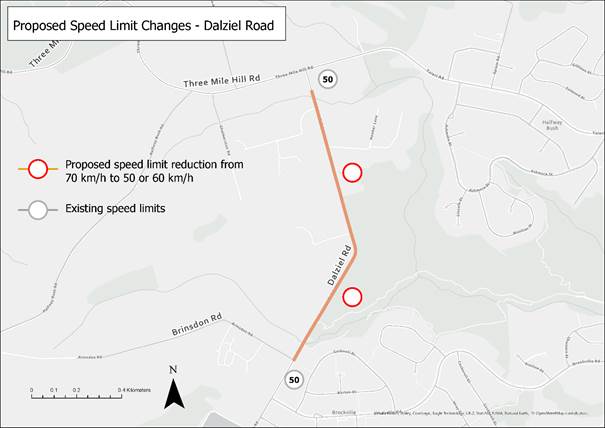
Figure 2 - Map 2
McMaster Road
23 Staff
intend to undertake public consultation on a proposal to reduce the speed limit
on McMaster Road from the default rural speed limit of 100 km/h to 60 km/h (see
Map 3).
24 Community
members have raised concerns about the increasing use of McMaster Road as a
through route between Brighton/Waldronville and Mosgiel. Concerns relate to
traffic growth, road safety, dust generation from the unsealed road surface and
the suitability of the road for increased levels of through traffic.
25 On 27 May
2026, the Council resolved to investigate a speed limit reduction on McMaster
Road, including a full assessment and public consultation in accordance with
the Rule, and report back to a Hearings Committee in 2027.
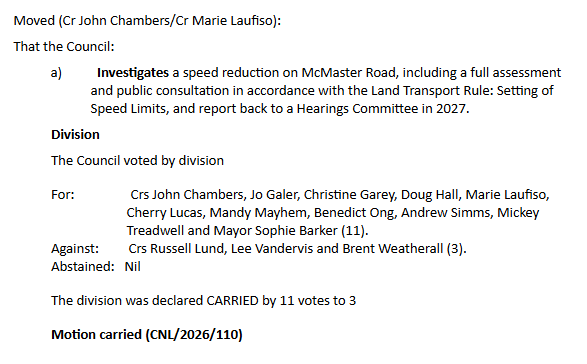
26 McMaster
Road is currently subject to the default rural speed limit of 100 km/h. Based
on its characteristics as an unsealed road in a rural environment with a low
level of roadside development, McMaster Road aligns most closely with the
“unpaved rural road” classification under Schedule 3 of the Rule.
The Rule specifies a speed limit range of 60 km/h to 80 km/h for roads within
this category.
27 Traffic volumes on McMaster Road are low. Traffic monitoring
conducted by Transport staff from February 2026 found 748 vehicle movements
over 4 days, an average of 187 vehicle movements per day. This aligns with the
Annual Average Daily Traffic (AADT) of 125 vehicles per day, as estimated by MegaMaps, the New Zealand Transport
Agency’s (NZTA) online geospatial tool for traffic data sets.
28 The recorded average operating speed is 47 km/h, significantly below
the current 100 km/h speed limit.
29 Crash history on the road is limited, with one non-injury crash
recorded between 2020 and 2025.
30 While the
available data indicates that operating speeds are already well below the
current speed limit, consultation will provide an opportunity for the community
and road users to express their views on whether a lower posted speed limit
would better reflect the function of the road and address concerns regarding
increasing traffic volumes, dust generation and associated safety risks.
31 The
proposed speed reduction is expected to:
· Improve consistency between the road environment and the posted
speed limit.
· Align the speed limit more closely with the speed limit range
specified for unpaved rural roads under Schedule 3 of the Rule.
· Respond to community concerns regarding the increasing use of
McMaster Road as a through route between Brighton/Waldronville and Mosgiel.
· Support a reduction in dust generation and improve the amenity of
the surrounding area.
· Better reflect the speed at which vehicles currently travel on the
road.
Three Mile Hill Road
32 Three Mile
Hill Road is currently subject to an 80 km/h speed limit and provides an
important connection between Dunedin and Mosgiel. Traffic volumes on the route
have increased significantly over time, with AADT increasing from approximately
3,700 vehicles per day in 2011 to more than 5,600 vehicles per day in 2026.
33 Three Mile
Hill Road traverses steep, mountainous terrain and contains numerous curves and
changes in alignment. Staff assessment has identified a section of the road
meets the Rule's definition of tortuous alignment. Under Schedule 3 of the
Rule, roads with a tortuous alignment may have speed limits set within a range
of 60 km/h to 80 km/h.
34 Three Mile
Hill Road has a significant crash history, with 72 crashes recorded between
2020 and 2025. Of these, 52 occurred on the section identified by staff as
having a tortuous alignment.
35 NZTA's road
safety risk mapping identifies Three Mile Hill Road as one of the highest-risk
local road corridors in Dunedin and rates it as High Risk for both collective
and personal risk. Collective risk estimates the expected number of deaths and
serious injuries on a road by considering both the safety performance of the
road and the volume of traffic using it, while personal risk reflects the likelihood
of an individual road user being killed or seriously injured.
36 This
section of Three Mile Hill Road serves a range of recreational and industrial
land uses. Vehicles frequently slow and turn to access the lookout, South Road
car park and other parking areas used by mountain bikers and pedestrians, while
nearby sawmill and forestry operations generate regular heavy vehicle
movements. These activities contribute to a more complex road environment and
increase interactions between different road users.
37 Public
consultation will be undertaken on a proposal to reduce the speed limit on the
section of Three Mile Hill Road that meets the Rule's definition of a tortuous
road from 80 km/h to 60 km/h (see Map 4).
38 Consultation
will provide an opportunity for road users, residents, freight operators, and
the wider community to provide feedback on the proposed speed limit reduction
and whether it appropriately reflects the road's function, alignment, traffic
volumes, and safety risk.
39 The
proposed speed reduction is expected to:
· Improve consistency between the road environment and the posted
speed limit on a section of Three Mile Hill Road, ensuring the speed limit
better reflects the mountainous terrain, tortuous alignment and operating
characteristics of the road.
· Reduce the likelihood and severity of crashes on a section of road
with a significant crash history and elevated safety risk.
· Improve safety outcomes for all road users, including motorists,
motorcyclists, cyclists and other vulnerable road users.
· Better reflect the high-risk classification of Three Mile Hill Road
and the increasing traffic volumes using the route.
· Support a safer and more forgiving road environment by encouraging
speeds that are better matched to the road's geometry and function.
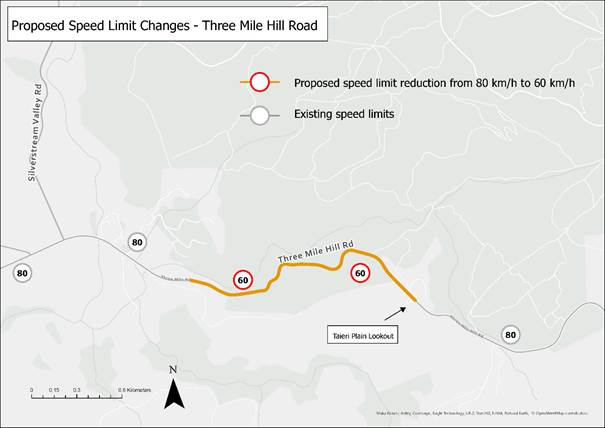
Figure 4 - Map 4
Consultation
40 While
consultation on the draft 2023 SMP included some of the proposed speed limit
changes and received relevant submissions, the Rule now requires a formal
public consultation period of at least six weeks for proposed speed limit
changes. The draft SMP consultation period was only three weeks.
41 In addition
to requiring a minimum six week consultation period, the Rule requires a Cost
Benefit Disclosure Statement (CBDS) to be published alongside the consultation
material. A CBDS typically includes information such as traffic volumes, operating
speeds, crash history over the previous five years, estimated travel time
impacts and estimated safety impacts.
42 NZTA
provides an optional Cost Impact Analysis Tool to assist RCAs in preparing a
CBDS. The tool is publicly available on NZTA's website under the Guidance for
RCAs resources. Supporting data used to develop a CBDS is typically sourced
from NZTA systems, including MegaMaps
and the Crash
Analysis System (CAS).
43 Consultation
on the proposed speed limit changes for John Wilson Ocean Drive, Kettle Park
Road, Dalziel Road, McMaster Road and Three Mile Hill Road is expected to
commence in late 2026, with a Hearings Committee recommendation and Council
decision anticipated in early 2027.
44 Although
consultation will be undertaken concurrently for all proposed speed limit
changes, each proposal will be assessed independently. Any decision on a
proposed speed limit change will be based on the characteristics of the
individual road, relevant technical information and consultation feedback
specific to that proposal.
OPTIONS
45 There are
no options presented in this report.
NEXT
STEPS
46 Staff will
prepare consultation materials for the proposed speed limit changes in
accordance with the Rule.
47 Consultation
materials will include information on the role, function and use of the roads,
the reasons for the proposed speed limit changes, and the associated CBDS.
48 Public
consultation will be undertaken for a minimum period of six weeks.
49 Following
consultation, staff will prepare a summary of submissions and recommendations
for consideration by a Hearings Committee and Council.
50 Subject to
Council approval, the final proposal will be submitted to the Director of Land
Transport for consideration in accordance with the Rule.
Signatories
|
Author:
|
Janet Young - Transport Analyst
|
|
Authoriser:
|
Simon Smith - Asset and Funding Manager
Scott MacLean - General Manager, City Services
|
Attachments
There are no attachments for
this report.
|
SUMMARY OF CONSIDERATIONS
|
|
Fit with purpose of Local Government
This decision enables democratic local
decision making and action by, and on behalf of communities.
This decision
promotes the social, economic, environmental, and cultural well-being of
communities in the present and for the future.
|
|
Fit with strategic framework
|
|
Contributes
|
Detracts
|
Not applicable
|
|
Social Wellbeing Strategy
|
✔
|
☐
|
☐
|
|
Economic Development Strategy
|
☐
|
☐
|
✔
|
|
Environment Strategy
|
✔
|
☐
|
☐
|
|
Arts and Culture Strategy
|
☐
|
☐
|
✔
|
|
3 Waters Strategy
|
☐
|
☐
|
✔
|
|
Future Development Strategy
|
✔
|
☐
|
☐
|
|
Integrated Transport Strategy
|
✔
|
☐
|
☐
|
|
Parks and Recreation Strategy
|
✔
|
☐
|
☐
|
|
Zero Carbon Plan
|
✔
|
☐
|
☐
|
The proposed speed limit changes support the
Council’s strategic framework by improving safety outcomes, maintaining
efficient transport connections, and protecting the natural environment.
|
|
Māori Impact Statement
During the consultation process, staff will engage with
Mana Whenua regarding the proposed speed limit changes to ensure there is an
opportunity for feedback, and that consultation follows the guidelines set
out in the Rule.
|
|
Sustainability
A reduction in mean operating speeds
could result in a reduction of vehicle carbon emissions.
|
|
LTP/Annual Plan / Financial Strategy /Infrastructure
Strategy
There are no known implications.
|
|
Financial considerations
Implementation costs associated with the
proposed speed limit changes are expected to be low and can be met from
existing Transport budgets.
|
|
Significance
The decision is of low significance, as it relates to
localised speed limit changes with minimal financial impact and is subject to
public consultation in accordance with the Rule.
|
|
Engagement – external
External engagement will be undertaken through a six week
public consultation process, supported by targeted stakeholder engagement
including iwi, emergency services, and other key road users.
|
|
Engagement - internal
Internal engagement will include communication through the
Council intranet, inviting staff who are not directly involved in the project
to provide feedback.
|
|
Risks: Legal / Health and Safety etc.
There are no significant legal, financial or operational
risks associated with this report. Public consultation on the proposed speed
limit changes will be undertaken in accordance with the Rule to mitigate any
procedural risk. Any changes resulting from the consultation process will be
reported back to Council for consideration.
|
|
Conflict of Interest
There are no known conflicts of interest.
|
|
Community Boards
Staff will communicate with the Saddle Hill Community
Board regarding McMaster Road and with the Mosgiel Taieri Community Board
regarding Three Mile Hill Road.
|
|

|
Council
2 September 2026
|
Ōtepoti Pathways - DRAFT Dunedin’s
Walking, Wheeling and Cycling Strategy 2026 - 2057 - Upcoming Public
Consultation
Department: Transport
EXECUTIVE SUMMARY
1 This
report presents the draft Ōtepoti Pathways Strategy and seeks Council
approval to release it for public consultation from 14 September to 16 October
2026.
2 The
Ōtepoti Pathways Strategy sets out Dunedin’s 30-year vision for
walking, cycling and wheeling. It identifies strategic goals, investment
priorities, and future connections within the city and to regional tracks and
trails. Council adoption of the strategy is required to support future funding
applications and co-funding opportunities.
3 The
Ōtepoti Pathways Strategy has been in development for the past four
years and Councillors have been engaged through Council workshops and papers.
4 Funding
for Ōtepoti Pathways projects is currently allocated in the 9 year plan
and will be further considered as part of the upcoming Long Term Plan
process.
5 Following
public consultation, the strategy will be finalised and presented to Council
for adoption.
RECOMMENDATIONS
That the Council:
a) Notes the draft
Ōtepoti Pathways Strategy (Attachment 1)
b) Approves the draft Ōtepoti Pathways Strategy to be released for public
consultation.
BACKGROUND
6 The
Ōtepoti Pathways
Strategy has been developed over the past four years. Initially, an NZ
Transport Agency Waka Kotahi (NZTA) Programme Business Case was drafted to
attract NZTA co-funding. After the change in Government in 2023, NZTA no longer
requires Programme Business Cases. It now requires councils to have an endorsed
strategic direction, which is why this draft strategy was developed.
7 Council
workshops were held in August 2023 and May 2026 to report on progress and provide
feedback into the development of this work. A report was presented to
Council on 30 July 2025 and Council resolved the following:
Moved (Cr
Jim O'Malley/Cr Mandy Mayhem):
That the
Council:
a) Approves the draft vision and goals of Ōtepoti
Dunedin Pathways: A walking and cycling plan set out in Attachment
A.
b) Approves the draft strategic walking and cycling
networks, and priority areas shown in Attachment B.
c) Notes that staff were currently developing an
engagement document and would come back to Council in early 2026 to seek
approval for public engagement.
d) Notes that funding for planning and delivery of
projects identified in Ōtepoti Dunedin Pathways was included in the 9
year-plan from 2027/28.
e) Notes that New Zealand Transport Agency co-
funding for prioritised projects included in Ōtepoti Dunedin Pathways will
be sought through the 2027-31 Regional Land Transport Plan and National Land
Transport programme.
Division
The Council
voted by division
For:
Crs Sophie Barker, David Benson-Pope, Christine Garey, Kevin Gilbert, Carmen
Houlahan, Marie Laufiso, Mandy Mayhem, Jim O'Malley and Andrew Whiley (9).
Against:
Crs Cherry Lucas, Lee Vandervis,
Brent Weatherall and Mayor Jules Radich (4).
Abstained:
Nil
The division
was declared CARRIED by 9 votes to 4
Motion
carried (CNL/2025/216)
DISCUSSION
About the Strategy
8 Ōtepoti Pathways
is a 30-year strategy for walking, cycling and
wheeling in Dunedin. It sets out a long-term approach to make it
safer and easier for people to move around the city, while improving community
outcomes and helping Dunedin to grow and be
resilient. This strategy supports improving transport options in Dunedin
while acknowledging that many people will want or need to drive.
9 Council
adoption of the strategy will provide direction for investment in
walking, cycling and wheeling across Dunedin that endures across short term funding cycles. It
will support funding decisions and improve
coordination across Council teams and with partners, including
developers and community trusts.
10 A
Council-adopted walking, cycling and wheeling strategy, together with committed
local funding, is required to be considered for NZTA co-funding. Where
appropriate, projects will be put forward through the Otago-Southland Regional
Land Transport Plan to seek NZTA co-funding under the 2027-2030 National Land
Transport Programme (NLTP).
11 The
strategy does not allocate funding for specific projects. Funding decisions
will be made through the Dunedin City Council Long Term Plan process. An Ōtepoti Pathways
Implementation Plan will then be developed based on allocated funding.
12 The
strategy applies to Dunedin as a whole, with the Dunedin City Council (DCC)
being just one of several stakeholders working towards improved outcomes for
walking, cycling and wheeling. As a result, projects may be delivered by a
range of organisations, including NZTA, developers, the University and
community groups such as the Dunedin Tracks and Trails Trust. These
organisations operate under different decision-making processes and funding
arrangements.
13 An adopted
strategy means that Council would be well positioned for responding to external
funding opportunities.
14 The Council
can contribute to improving walking, cycling and wheeling in Dunedin by
implementing infrastructure improvements, regulatory changes and
promotional/educational activities. Examples could include better crossing
points, shared streets, shared paths, cycle lanes, safe and appropriate speed
limits, cycle skills training or wayfinding.
15 Where
supported by Council, changes can be trialled before committing to permanent
infrastructure, and lower-cost materials or temporary solutions can be used
where appropriate. DCC staff will engage with the public and key
stakeholders on specific projects and proposed changes once
funding is confirmed.
16 The
strategy has been developed and informed by community
feedback gathered through Council Long Term Plan consultations, project
engagements, and targeted stakeholder discussions, Councillor feedback through
workshops and collaboration with Enterprise Dunedin. Its development has also
been guided by a range of national and local strategies and plans, including
Arataki (NZTA’s 30 Year Plan), the Future Development Strategy,
the South Dunedin Future programme, the Zero Carbon Plan, Dunedin Integrated
Transport Strategy, and Te Taki Haruru. In addition, the strategy supports the
objectives of the Dunedin Tracks and Trails Strategic Plan and the Dunedin
Parks and Recreation Strategy.
17 A monitoring
framework will be developed to track progress towards the strategy’s
vision and goals. The strategy and implementation plan will be reviewed every
three years to align with the Long Term Plan and Regional Land Transport Plan
review cycles.
Strategy summary
18 The 30-year
vision is ‘In Ōtepoti Dunedin, it is safe and easy for people of all
ages and abilities to walk, cycle or wheel for everyday travel’.
19 The goals
of the strategy are:
· Safety
and accessibility
All people in Dunedin can travel safely and
independently to where they need to go in their everyday life.
· Choice and
wellbeing
Our active transport system is safe,
well-connected and attractive, giving people a genuine choice to travel in ways
that support their wellbeing and the environment.
· Economic prosperity
and tourism
Our city has strong active transport
connections to tracks, trails and key destinations, which will
strengthen tourism and support local businesses and our economy.
· Traffic
reliability and resilience
Our transport system continues to support
reliable traffic flow while our city grows and is resilient to local and global
disruptions.
20 This strategy
identifies five priority areas for investment:
· The Central City
· The Hill Suburbs (Kaikorai,
Māori Hill, Roslyn, Helensburgh, Wakari, Halfway Bush, Brockville)
· South Dunedin and
Caversham
· Mosgiel
· Andersons Bay and
Musselburgh
21 These areas
have been prioritised because of their high numbers of homes, schools and
workplaces. Focusing investment in these locations is expected to deliver the
greatest return on investment with maximum benefits for our communities, and
the greatest chance to attract co-funding from NZTA through the NLTP.
Improvements can still be delivered outside of priority areas.
22 Future
connections across the Dunedin region and city are shown on maps. These
connections link key locations that could be improved for walking, cycling and
wheeling over the next 30 years. More detail is provided on the maps for the
five priority areas. These will be updated regularly to include current
existing and feasible walking and cycling routes.
23 The
strategy includes a proposed Investment Hierarchy to help guide and prioritise
Council investment. This hierarchy was developed based on Councillor feedback
at the May 2026 Council workshop. Priority should be given to projects that:
i) Close
gaps and connect existing routes within identified priority areas.
ii) Align
with other investment and development opportunities.
iii) Connect
schools and education facilities.
iv) Support
improvements in other areas.
Public consultation
24 Public
consultation on the draft strategy is planned for 14 September to 16 October
2026.
25 The purpose
of consultation is to seek feedback from the community and stakeholders on the
draft strategy before it is presented to Council for final adoption. The
consultation process will help staff to understand:
· Whether the draft
strategy reflects community aspirations for walking, wheeling and cycling.
· Whether important
opportunities, barriers or perspectives have been overlooked.
· Whether the
proposed future network and strategic direction are appropriate.
· What changes, if
any, should be made before final adoption.
26 Consultation
will include the following activities:
· An information
pack distributed by email to partners and internal and external stakeholders.
· A project webpage
with a summary of the strategy, the draft strategy document and link to the
consultation survey.
· Signs along
walking and cycling paths and at playgrounds in the five priority areas.
· Copies of the
strategy summary and survey forms available at Council Customer Services and
all Dunedin libraries.
· A Library book
display at all Dunedin Libraries.
· Public advertising
through the Otago Daily Times, The Star and the DCC Facebook account.
· A Media release.
· An article in FYI,
the Dunedin City Council’s printed community newsletter.
· ODT Noticeboards.
· Community
newsletters (depending on deadlines).
· Stakeholder
meetings before and during consultation.
· A cycling group
hui that encourages collaboration across different cycling infrastructure and
service providers.
27 Following
consultation, the strategy will be updated where appropriate to reflect
community and stakeholder feedback. The final strategy will be presented to
Council for adoption later this year.
OPTIONS
Option One – approves consultation on the draft
Ōtepoti Pathways Strategy (Recommended)
28 This option
is to approve public consultation on the draft Ōtepoti Pathways Strategy
as proposed.
Advantages
· Enables
the public to provide feedback on the draft strategy and help shape the final
document.
· Is
a required next step towards a Council adopted walking, cycling and wheeling
strategy for Dunedin. A Council adopted strategy will support applications for
NZTA co-funding, help guide investment decisions for projects, improve
coordination with our partners and achieving value for money outcomes for
Dunedin.
· Will
inform long term and annual planning processes.
Disadvantages
· Staff
time will be required to manage the submission process
Option Two – does not approve consultation on the
draft Ōtepoti Pathways Strategy
29 This option
is to not approve public consultation on the draft Ōtepoti Pathways
Strategy at this time.
Advantages
· No
staff time will be required to manage the submission process.
Disadvantages
· The
public would not have an opportunity to provide feedback on the draft strategy.
· Progress
towards a Council adopted walking, cycling and wheeling strategy for Dunedin
would be delayed. This would remove opportunities to attract NZTA co-funding
for projects included in the Long Term Plan. There would be less strategic
guidance for investment decision making and less coordination with partners.
· Long
term or annual planning investment decisions will not be informed by an
overarching strategy.
NEXT STEPS
30 Public
consultation on the draft Ōtepoti Pathways Strategy will take place from
14 September to 16 October 2026.
31 Following
consultation, the draft strategy will be updated where appropriate to reflect
feedback received. The final strategy will be presented to Council for adoption
late 2026.
32 Staff will
submit walking and cycling projects identified in the Council 9 year plan for
inclusion in the Otago Southland Regional Land Transport Plan. This is the
mechanism for seeking NZTA co-funding through the NLTP 2027-2030.
33 Decisions
on funding for walking, cycling and wheeling projects will be made by Council
through the Long Term Plan process. These funding decisions are separate from
the adoption of the strategy.
Signatories
|
Author:
|
Simone Handwerk - Transport Planning Team Leader
|
|
Authoriser:
|
Simon Smith - Asset and Funding Manager
Scott MacLean - General Manager, City Services
|
Attachments
|
|
Title
|
Page
|
|
⇩a
|
Draft Ōtepoti
Pathways Strategy
|
220
|
|
SUMMARY OF CONSIDERATIONS
|
|
Fit with purpose of Local Government
This decision enables democratic local
decision making and action by, and on behalf of communities and promotes the
social, economic, environmental, and cultural well-being of communities in
the present and for the future.
|
|
Fit with strategic framework
|
|
Contributes
|
Detracts
|
Not applicable
|
|
Social Wellbeing Strategy
|
✔
|
☐
|
☐
|
|
Economic Development Strategy
|
✔
|
☐
|
☐
|
|
Environment Strategy
|
✔
|
☐
|
☐
|
|
Arts and Culture Strategy
|
☐
|
☐
|
✔
|
|
3 Waters Strategy
|
☐
|
☐
|
✔
|
|
Future Development Strategy
|
✔
|
☐
|
☐
|
|
Integrated Transport Strategy
|
✔
|
☐
|
☐
|
|
Parks and Recreation Strategy
|
✔
|
☐
|
☐
|
|
Other strategic projects/policies/plans
|
✔
|
☐
|
☐
|
This strategy aligns with and supports other DCC
strategies and plans, including the Future Development Strategy, South
Dunedin Future programme, Zero Carbon Plan, Dunedin Integrated Transport
Strategy, and Te Taki Haruru. It also supports the Dunedin Tracks and Trails
Strategic Plan and the Dunedin Parks and Recreation Strategy.
|
|
Māori Impact Statement
Te Taki Haruru is Dunedin City Council's
Māori Strategic Framework. It guides the relationship between Council,
mana whenua, the wider Māori community, and sets aspirations for the
future of Dunedin.
Ōtepoti Pathways supports these
aspirations by helping people move safely and independently around the city,
connect with places and communities, and experience the natural and cultural
landscapes of Ōtepoti. The strategy also recognises the importance of
working in partnership with mana whenua as future walking, wheeling and
cycling connections are planned and delivered.
The relationship between Ōtepoti
Pathways and Te Taki Haruru can be seen across the four pou (pillars) of the
framework.
|
|
Sustainability
The strategy is expected to have positive long-term
sustainability outcomes as more people walking and cycling contributes to
economic, social and environmental well-being.
|
|
LTP/Annual Plan / Financial Strategy /Infrastructure
Strategy
There are no LTP budget implications as a result of the
strategy. Budgets for projects need to be set through the upcoming Long Term
Plan but this is a separate process.
There are no implications for current levels of service
and performance measures as a result of the strategy.
|
|
Financial considerations
There are no financial considerations. Budgets for
projects need to be set through the upcoming Long Term Plan but this is a
separate process.
|
|
Significance
The significance of the Ōtepoti Pathways Strategy to
Dunedin is considered to be medium. This is based on the importance to
Dunedin; community interest; consistency with existing policy and strategy;
and impact on Council’s finances, capacity and capability (using
section 2.2 of the Council’s Significance and Engagement Policy).
|
|
Engagement – external
External engagement on the draft strategy has been
undertaken with the following stakeholders:
- Otago
Regional Council
- NZTA
- University
of Otago
- Otago
University Student Association
- Otago
Polytechnic
- Otago
Polytechnic Student Association
- Public
Health South
- Southern
District Health Board
- Spokes
- Hospital
Bike User Group
- CCS
disability action (national disability advocacy and support organisation)
- Disabled
Person Assembly
- Age
Concern Otago
- Living
Well
- Otago
Automobile Association (AA Otago)
- Grey
Power Otago
- Bus
Go Dunedin
- Dunedin
Tracks and Trails Trust
- Pedals
Couriers
- Urban
Nerds
|
|
Engagement - internal
Internal engagement has been undertaken with the following
departments:
- Mana
Ruruku
- Parks
& Recreation
- Climate
Adaptation & Resilience
- City
Growth and Advisory Services
- City
Development
- Zero
Carbon
|
|
Risks: Legal / Health and Safety etc.
There are no identified risks.
|
|
Conflict of Interest
There are no conflicts of interest
|
|
Community Boards
There are implications for all community boards as the
Ōtepoti Pathways strategy outlines priority areas for infrastructure
investment including future connections between suburbs and feasible routes
for Mosgiel. Community boards are included on the stakeholder list and will
receive an information pack at the start of the consultation period.
|
|

|
Council
2 September 2026
|
New Road Names Assigned from Road Name
Register
Department: Transport
EXECUTIVE SUMMARY
1 This
report updates the Council on the selection of seven new road names from the
Dunedin City Council Road Name Register for two new subdivisions.
2 The
names for the new roads at 121-125 Stevenson Road (Concord) for subdivision 2019-165
C/D are:
· Wineberry Drive
(new public road) (see Attachment A)
· Knight Lane (new
private way)
3 The
names for the new roads at 80 & 94 Panmure Avenue (Calton Hill) for
subdivision 2025-100 are:
· Rachel Reynolds
Place (see Lot 100 in Attachment B)
· Lusk Lane (Lot
103)
· Fache Lane (Right
of Way C)
· Hinds Place (Right
of Way M)
· Soper Close (Right
of Way L)
4 As
these names were selected from the Dunedin City Council Road Name Register,
Council staff have granted approval to the applicants and will update the Road
Name Register accordingly.
RECOMMENDATIONS
That the Council:
a) Notes that the names Wineberry, Knight, Rachel Reynolds, Lusk, Fache,
Hinds, and Soper have been assigned to new roads or private ways from the Road
Name Register and will be listed as no longer available in the register.
BACKGROUND
5 The
Dunedin
City Council Road Naming Policy provides the framework for timely and
consistent naming of legal roads and private ways that reflect the identity of
the local community, meet requirements set by the Council, and comply with Land
Information New Zealand addressing guidelines. A ‘legal road’ is
any road legally established as a public road under section 315 of the Local
Government Act 1974 (the Act). As defined by the Act, a ‘private
way’ is a road on private land with restricted access (e.g. rights of
way).
6 The
Council has a selection of available road names pre-approved by the
Infrastructure Services Committee published in the Dunedin
City Council Road Name Register. In their meeting
of 27 November 2025, the Council adopted an amendment to the Council Road
Naming Policy so that if a road name applicant selects a name from the Road
Name Register, they can receive immediate approval once Council staff have
assessed their application (Minutes
of Council - Thursday, 27 November 2025), rather than require a second approval
from Council. The new process has reduced the amount of time staff spend on
road naming applications and appears to be incentivising more use of the Road
Name Register.
7 The
process that applicants must follow when applying for a new road name is set
out in the diagram below, with two different approaches depending on whether
the Road Name Register is used or not.
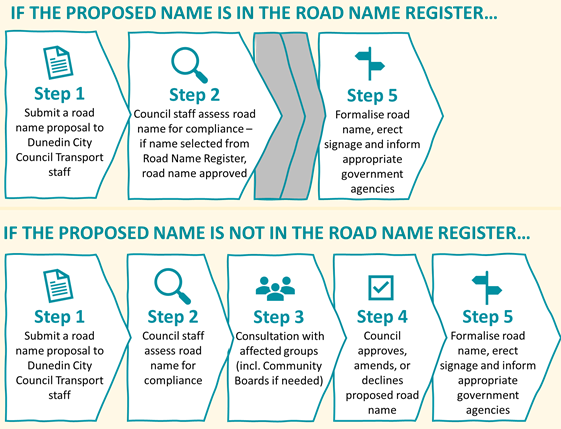
DISCUSSION
Road names assigned for 121-125 Stevenson Road
(Concord) (SUB 2019-165 C/D)
|
TABLE A
SUB 2019-165 C/D | 121-125
Stevenson Road, Concord
|
|
Location of
road
|
Proposed road name
|
Recommended road name
|
|
New public road to be
vested, off Stevenson Road
|
Wineberry Drive
|
‘Wineberry
Drive’ as selected from the
Road Name Register
|
|
New private way off
the proposed Wineberry Drive
|
Knight Lane
|
‘Knight
Lane’ as selected from the
Road Name Register
|
8 Table
A presented below provides the preferred road names proposed for this
subdivision. A map of the roads is provided in Attachment A. Staff consider the
proposed road names to be appropriate for this development.
9 The
names selected from the register have the following references:
· Wineberry
Drive – is in reference to the wineberry tree or makomako
(Aristotelia serrata), a small deciduous tree native to New Zealand that bears
large clusters of pink flowers followed by dark red berries. The wineberry tree
is fast-growing and resilient in cold climates, and can be found in the Dunedin
Botanic Gardens among other areas.
· Knight
Lane – is in reference to Hardwicke Knight (1911-2008), a photographer,
historian and collector. Born in London, Hardwicke moved to Dunedin in
1957 as director of the Medical Photographic Unit of the Otago Medical School.
In addition to his own photography, Knight published extensively on the history
of New Zealand photography and photographers and on the history of Otago.
He was awarded a Queen’s Service Order in 1991.
10 The
developers selected Wineberry to reflect local flora in Dunedin.
11 The
developers selected Knight due to a keen interest in photography and
art, which aligns with what Hardwicke Knight championed during his life.
12 A site map
is included as Attachment A.
Road names assigned for 80 & 94 Panmure Road
13 Table
B presented provides the preferred road names proposed for this subdivision.
A map of the roads is provided in Attachment B. Staff consider the proposed
road names to be appropriate for this development.
|
TABLE B
SUB 2025-100| 80
& 94 Panmure Road
|
|
Location
of road
|
Proposed road name
|
Recommended road name
|
|
New private way off
94 Panmure Avenue
|
Rachel Reynolds Place
|
‘Rachel
Reynolds Place’ as selected
from the Road Name Register
|
|
New private way off
Panmure Avenue near Mariner Street intersection
|
Lusk Lane
|
‘Lusk
Lane’ as selected from the
Road Name Register
|
|
New private way off
Rachel Reynolds Place
|
Fache Lane
|
‘Fache Lane’ as selected from the Road Name Register
|
|
New private way off
Lusk Lane
|
Hinds Place
|
‘Hinds
Place’ as selected from the
Road Name Register
|
|
New private way off
Lusk Lane
|
Soper Close
|
‘Soper
Close’ as selected from the
Road Name Register
|
14 The names
selected from the register have the following references:
· Rachel
Reynolds Place – is in reference to Rachel Selina Reynolds
(1838-1928), a social worker and community leader involved in a wide range of
social justice causes including women’s access to education, provision of
welfare services to people living in poverty, and the women’s suffrage
movement in the 1880s-1890s. Reynolds’ involvement in campaigns for the
establishment of a girls’ secondary school and for the admission of women
to the University of Otago both culminated in success in 1871, when Otago Girls’
High School first opened and the University of Otago began admitting women.
· Lusk
Lane – is in reference to Doris Lusk (1916-1990), an artist, art
teacher, potter and university lecturer born in Dunedin. Lusk was one of New
Zealand’s pioneer potters and taught at the University of Canterbury
School of Fine Arts from 1966-1981. She was posthumously awarded the Governor
General Art Award in 1990 to recognise her career and contributions to art.
· Fache
Lane – is in reference to Ada Fache (1918-1994), the City Librarian
of Dunedin from 1960-1968 who was the second woman in New Zealand to be
appointed the head of a major metropolitan library. At Fache’s bequest,
the Ada Fache Fund continues her legacy by providing professional development
grants for library workers.
· Hinds
Place – is in reference to Elizabeth Hinds (1940-1998), the director
of the Toitū Otago Early Settlers Museum from 1983-1996. Hinds worked as
an archaeologist in the Pacific Islands and served as the acting director of
the Fiji Museum in the 1960s. Her work in Dunedin revitalised the Otago Early
Settler’s Association, and with it the museum.
· Soper
Close – is in reference to Eileen Louise Soper (1900-1989), an author
and journalist who was first an editor of the Otago Daily Times in the 1920s
and later became an associate editor for the Otago Witness until 1932. Soper
published five books beginning with The Otago of Our Mothers in 1948,
and later published her memoirs in three volumes from 1969-1973.
15 The
developers of this subdivision selected these names to pay homage to
influential Dunedin women, with all of the names proposed connected by this
theme.
16 A site map
is included as Attachment B.
OPTIONS
17 Not
applicable.
NEXT STEPS
18 Staff will
advise Land Information New Zealand of the new road names.
19 Staff will
update the Road Name Register to note that the selected road names are no
longer available.
20 Staff will
liaise with the developers on the installation of appropriate signage for the
new roads (once ready).
Signatories
|
Author:
|
Rose Wunrow - Policy Analyst Transport Regulation
|
|
Authoriser:
|
Simon Smith - Asset and Funding Manager
Scott MacLean - General Manager, City Services
|
Attachments
|
|
Title
|
Page
|
|
⇩a
|
Attachment A - New Road
Names Assigned 121-125 Stevenson Road
|
263
|
|
⇩b
|
Attachment B - New Road
Names Assigned 80 & 94 Panmure Avenue
|
264
|
|
SUMMARY OF CONSIDERATIONS
|
|
Fit with purpose of Local Government
This decision enables democratic local
decision making and action by, and on behalf of communities.
This
decision promotes the social, economic, environmental and cultural well-being
of communities in the present and for the future.
|
|
Fit with strategic framework
|
|
Contributes
|
Detracts
|
Not applicable
|
|
Social Wellbeing Strategy
|
☐
|
☐
|
✔
|
|
Economic Development Strategy
|
☐
|
☐
|
✔
|
|
Environment Strategy
|
☐
|
☐
|
✔
|
|
Arts and Culture Strategy
|
☐
|
☐
|
✔
|
|
3 Waters Strategy
|
☐
|
☐
|
✔
|
|
Future Development Strategy
|
✔
|
☐
|
☐
|
|
Integrated Transport Strategy
|
✔
|
☐
|
☐
|
|
Parks and Recreation Strategy
|
☐
|
☐
|
✔
|
|
Other strategic projects/policies/plans
|
✔
|
☐
|
☐
|
This is an administrative function.
|
|
Māori Impact Statement
There are no known impacts for Māori.
|
|
Sustainability
There are no implications for sustainability.
|
|
LTP/Annual Plan / Financial Strategy /Infrastructure
Strategy
There are no implications.
|
|
Financial considerations
There are no financial implications.
|
|
Significance
The significance of this decision is considered low in
terms of the Council’s Significance and Engagement Policy.
|
|
Engagement – external
There has been engagement with the developers.
|
|
Engagement - internal
There has been engagement within the Transport Group and Business
Information Services.
|
|
Risks: Legal / Health and Safety etc.
There are no known risks.
|
|
Conflict of Interest
There are no known conflicts of interest.
|
|
Community Boards
There are no implications for Community Boards as none of
the selected names are within Community Board areas.
|
|
|
Council
2 September 2026
|
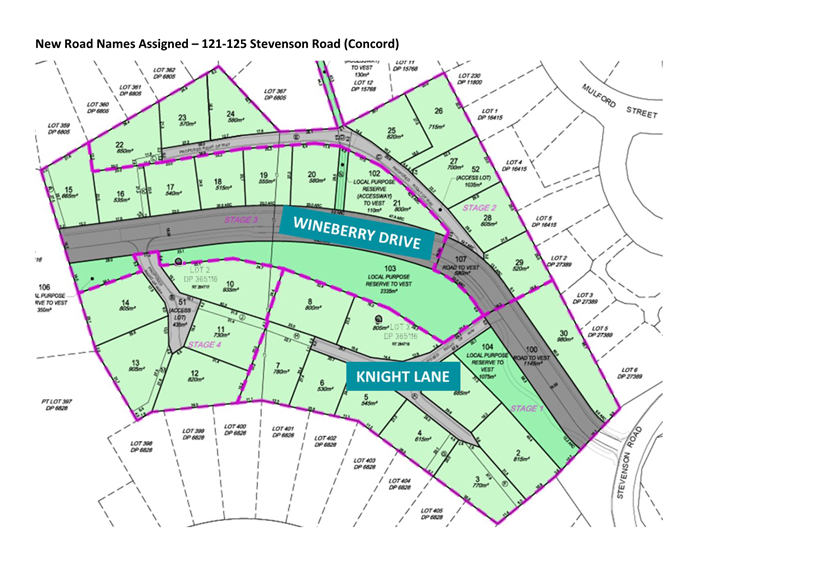
|

|
Council
2 September 2026
|
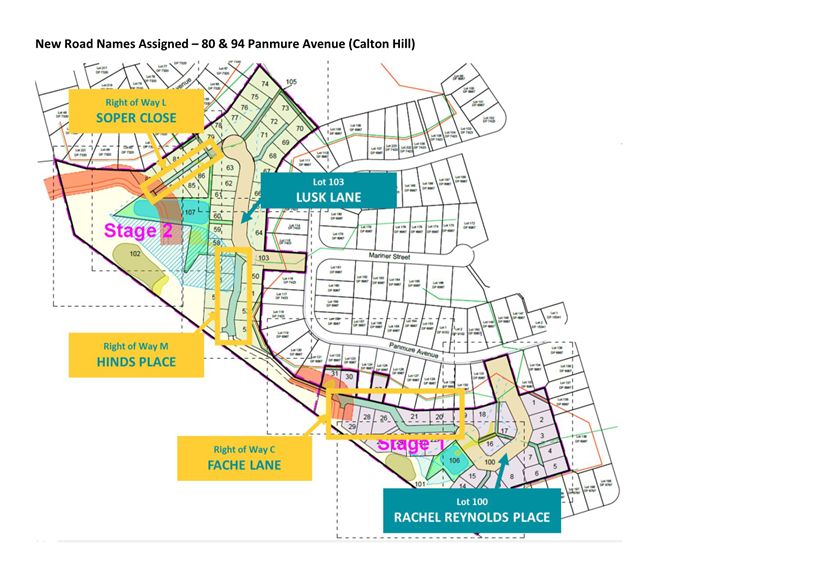
|

|
Council
2 September 2026
|
Proposed Event Road Closures
Department: Transport
EXECUTIVE SUMMARY
1 The
DCC has received temporary road closure applications relating to the following
events:
i) John
McGlashan School Fete
ii) Youth Rock Event
2 This
report recommends that Council approves the temporary closure of the affected
roads.
RECOMMENDATIONS
That the Council:
a) Resolves to close the
roads detailed below (pursuant to Section 319, Section 342, and Schedule 10
clause 11(e) of the Local Government Act 1974 (LGA 1974)):
i) John McGlashan School Fete
|
Saturday, 12 September
2026
|
8.30am
to 2.30pm
|
· Pilkington Street, between Balmacewen Road and
Passmore Crescent
|
ii) Youth Rock Event
|
Saturday, 3 October
2026
|
9.00am to 1.00am on Sunday, 4 October 2026
|
· Devon Street, between Jutland Street and Sturdee
Street
|
BACKGROUND
3 Council’s
Dunedin Festival and Events Plan supports the goal of a successful city with a
diverse, innovative, and productive economy and a hub for skill and
talent.
4 The
areas proposed to be used for these events are legal roads and can therefore be
temporarily closed to normal traffic if statutory temporary road closure
procedures are followed. The procedures are set out in Section 319 of the LGA
1974 and give Council the power to stop or close any road (or part of a road)
within the parameters of Section 342 and Schedule 10 of the LGA 1974 (Schedule
10 is included as Attachment A).
5 These
procedures include:
· Consultation
with the New Zealand Transport Authority Waka Kotahi and the Police.
· Public
notice being given of the proposal to close any road (or part of a road), and public
notice of a decision to close the road.
· Council
being satisfied that traffic is not likely to be unreasonably impeded.
6 A
resolution of Council is required where a proposal to temporarily close a road
relates to public functions.
7 Council
is required to give public notice of its decision. This notice will be
published after this meeting and prior to the event, if approved.
DISCUSSION
Consultation and
Notification
8 The
Police and the New Zealand Transport Authority Waka Kotahi have no objections
to the proposed road closures.
9 On
Saturday, 1 August 2026 the proposed temporary road closures were advertised in
the Otago Daily Times (Attachments B) with a deadline for feedback.
10 Schedule
10 clause 11(e) states a road cannot be closed more than 31 days in the
aggregate in any one year. This limit will not be exceeded by the
approval of the proposed temporary road closures.
Traffic Impacts
11 The event
locations of these events have had identical road closures for the same, or
similar event(s) in prior years without causing unreasonable delays to the
travelling public.
12 Emergency
services and public transport services will be managed through the temporary
traffic management process.
13 The
Temporary Traffic Management Plan process ensures that other issues such as
temporary relocation of certain parking (e.g. taxi, mobility and Authorised
Vehicles Only) are managed.
OPTIONS
14 Note any
amendment to this report’s recommendations cannot be implemented without
further consultation with the affected parties, New Zealand Transport Agency Waka
Kotahi, the Police, and verifying that traffic impacts are acceptable.
Option One – Recommended Option
15 That the Council
closes the sections of road as recommended in this report.
Advantages
· Roads
can be closed, and the event will be able to proceed.
· The
closures will assist in realising the economic, social, and cultural benefits
associated with the events.
Disadvantages
· There
will be temporary loss of vehicular access through the closed areas. However,
there are detours available, and safety can be assured using temporary traffic
management.
Option Two – Status Quo
16 That the
Council decides not to close the roads in question.
Advantages
· There
would be no detour required for the travelling public, and the roads would be
able to be used as normal.
Disadvantages
· The
events would not be able to go ahead, and the benefits of the events would be
lost.
NEXT STEPS
17 Should the
resolution be made to temporarily close the roads, Council staff will accept
the temporary traffic management plans that have been received for the events
and notify the public of the closures.
Signatories
|
Authoriser:
|
Simon Smith - Asset and Funding Manager
Scott MacLean - General Manager, City Services
|
Attachments
|
|
Title
|
Page
|
|
⇩a
|
Local Government Act
1974, Schedule 10
|
269
|
|
⇩b
|
ODT Advert - 1 August
2026
|
270
|
|
SUMMARY
OF CONSIDERATIONS
|
|
Fit with purpose of Local
Government
This decision
promotes the social well-being of communities in the present and for the
future.
|
|
Fit with strategic
framework
|
|
Contributes
|
Detracts
|
Not applicable
|
|
Social Wellbeing Strategy
|
✔
|
☐
|
☐
|
|
Economic Development
Strategy
|
✔
|
☐
|
☐
|
|
Environment Strategy
|
☐
|
☐
|
✔
|
|
Arts and Culture Strategy
|
✔
|
☐
|
☐
|
|
3 Waters Strategy
|
☐
|
☐
|
✔
|
|
Future Development
Strategy
|
☐
|
☐
|
✔
|
|
Integrated Transport
Strategy
|
☐
|
☐
|
✔
|
|
Parks and Recreation
Strategy
|
☐
|
☐
|
✔
|
|
Other strategic
projects/policies/plans
|
✔
|
☐
|
☐
|
Events contribute to the
Strategic Framework. Events contribute to the Economic Development Strategy,
the Social Wellbeing Strategy. There is a Festival and Events Plan 2018-2023.
|
|
Māori Impact
Statement
Mana whenua have not been
directly engaged with in relation to these road closures.
|
|
Sustainability
There are no implications
for sustainability.
|
|
LTP/Annual Plan /
Financial Strategy /Infrastructure Strategy
There are no implications,
as the decision is a regulatory one and there are no direct costs to Council.
|
|
Financial considerations
There are no financial
implications. The cost of the proposed road closure is not a cost to
Council.
|
|
Significance
This decision is considered
low in terms of the Council’s Significance and Engagement Policy.
|
|
Engagement –
external
There has been external
engagement (as required by the LGA 1974), with the Police and New Zealand
Transport Agency Waka Kotahi. Affected parties were notified and provided a
time period for feedback.
|
|
Engagement - internal
There has been engagement
with DCC Events and Transport. There is support for the events to
proceed.
|
|
Risks: Legal / Health and
Safety etc.
There are no identified
risks should the recommended resolution be made.
|
|
Conflict of Interest
There are no known
conflicts of interest.
|
|
Community Boards
There are no implications
for Community Boards.
|
|

|
Council
2 September 2026
|
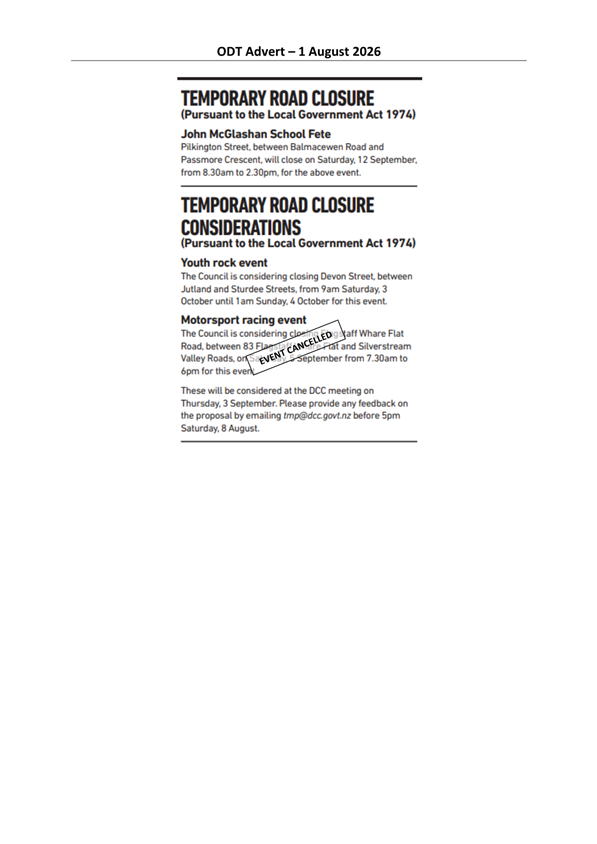
|
|
Council
2 September 2026
|
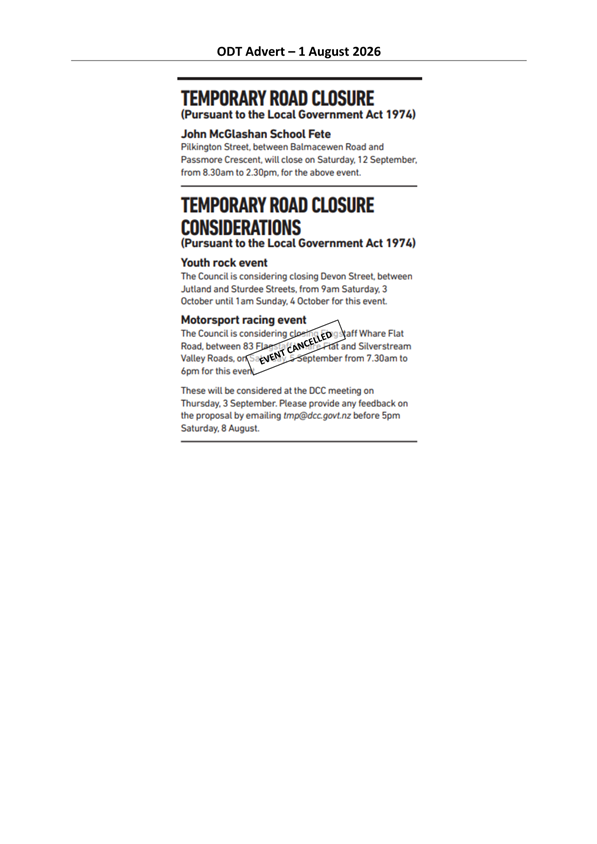
|

|
Council
2 September 2026
|
Notice
of Motion
Notice
of Motion - Exploring a Strategic Partnership with an Indian city.
EXECUTIVE SUMMARY
1 In
accordance with Standing Order 26.1, the following Notice of Motion has been
received from Cr Benedict Ong for inclusion on the
agenda for the meeting being held on Wednesday, 2 September 2026:
RECOMMENDATIONS
That the Council:
a) Receives the Notice of
Motion.
b) Notes the
opportunities arising from the New Zealand–India Free Trade Agreement and
the strengthening strategic relationship between New Zealand and India.
c) Directs the Chief
Executive (or delegate) to work with the University of Otago to investigate
opportunities to establish a Sister City, Friendship City, or Memorandum of
Understanding (MoU) with a suitable Indian city to support both the
city’s and university’s plans in the region.
d) Notes that the costs
of any additional sister city relationship are currently unbudgeted and would
need to be considered before a sister city, friendship city or similar
agreement is signed by the Dunedin City Council.
Attachments
|
|
Title
|
Page
|
|
⇩a
|
Cr Ong Notice of Motion
Sister City India
|
272
|
|
|
Council
2 September 2026
|
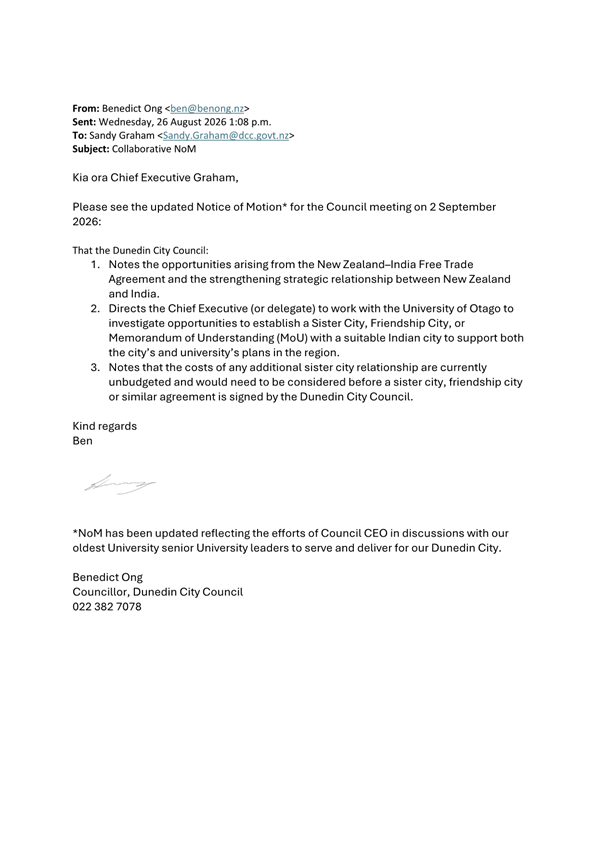
|

|
Council
2 September 2026
|
Notice of Motion - Social Housing
EXECUTIVE SUMMARY
1 In
accordance with Standing Order 26.1, the following Notice of Motion has been
received from Cr Marie Laufiso for inclusion on the
agenda for the meeting being held on Wednesday, 2 September 2026:
RECOMMENDATIONS
That the Council:
a) Receives the Notice of
Motion.
b) Notes that Council
provides 940 community housing units primarily for older people in urgent need
of housing.
c) Notes that Council's
Community Housing Policy is focused on the operation of Council's existing
housing portfolio and does not provide a broader policy framework for Council's
role in enabling social housing across the city.
d) Recognises the need
for Council to consider its broader role as an enabler of social housing in
Ōtepoti Dunedin, in response to housing need, financial pressures and a
changing housing environment.
e) Requests staff to
develop a Draft Social Housing Policy to enable Council to consider its role
and objectives for social housing, including the future role of its Community
Housing portfolio and opportunities for partnerships and other delivery models.
f) Requests that a Draft
Social Housing Policy be reported to Council to inform implementation of the
Housing Action Plan and development of the 207-2037 Long Term Plan.
Attachments
|
|
Title
|
Page
|
|
⇩a
|
Cr Laufiso Notice of
Motion Social Housing
|
274
|
|
|
Council
2 September 2026
|
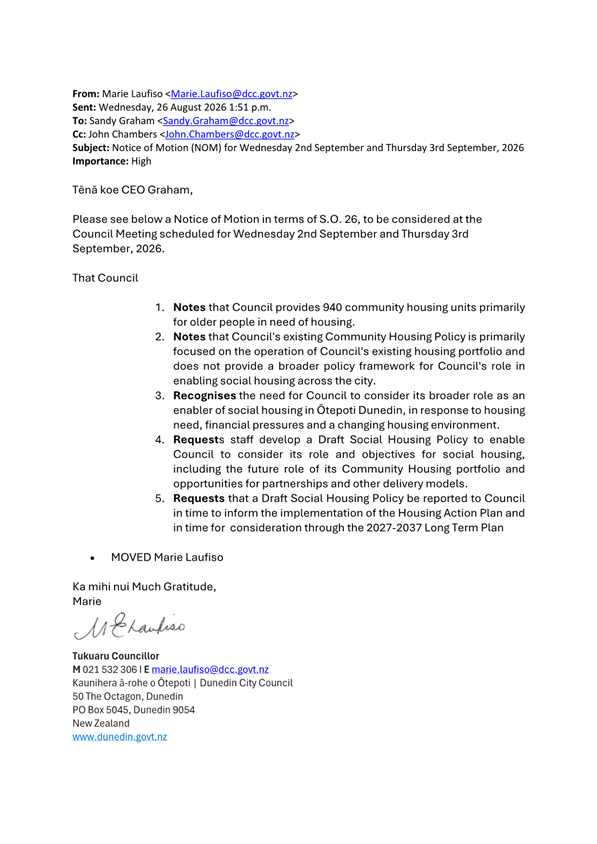
|

|
Council
2 September 2026
|
Resolution to Exclude the
Public
That the Council excludes
the public from the following part of the proceedings of this meeting (pursuant
to the provisions of the Local Government Official Information and Meetings Act
1987) namely:
|
General subject of the matter to be considered
|
Reasons
for passing this resolution in relation to each matter
|
Ground(s) under
section 48(1) for the passing of this resolution
|
Reason for
Confidentiality
|
|
C1
Confirmation of the Confidential Minutes of Ordinary Council meeting -
22 July 2026 - Public Excluded
|
S7(2)(h)
The
withholding of the information is necessary to enable the local authority to
carry out, without prejudice or disadvantage, commercial activities.
S7(2)(i)
The
withholding of the information is necessary to enable the local authority to
carry on, without prejudice or disadvantage, negotiations (including
commercial and industrial negotiations).
|
.
|
|
|
C2
Confirmation of the Confidential Minutes of Ordinary Council meeting -
3 August 2026 - Public Excluded
|
S7(2)(g)
The
withholding of the information is necessary to maintain legal professional
privilege.
|
.
|
|
|
C3
Confirmation of the Confidential Minutes of Ordinary Council meeting -
13 August 2026 - Public Excluded
|
S7(2)(b)(ii)
The
withholding of the information is necessary to protect information where the
making available of the information would be likely unreasonably to prejudice
the commercial position of the person who supplied or who is the subject of
the information.
S7(2)(g)
The
withholding of the information is necessary to maintain legal professional
privilege.
S7(2)(h)
The
withholding of the information is necessary to enable the local authority to
carry out, without prejudice or disadvantage, commercial activities.
S7(2)(i)
The
withholding of the information is necessary to enable the local authority to
carry on, without prejudice or disadvantage, negotiations (including
commercial and industrial negotiations).
S7(2)(a)
The
withholding of the information is necessary to protect the privacy of natural
persons, including that of a deceased person.
|
.
|
|
|
C4
Property Matter - Public Works Act
|
S7(2)(g)
The
withholding of the information is necessary to maintain legal professional
privilege.
S7(2)(h)
The
withholding of the information is necessary to enable the local authority to
carry out, without prejudice or disadvantage, commercial activities.
S7(2)(i)
The
withholding of the information is necessary to enable the local authority to
carry on, without prejudice or disadvantage, negotiations (including
commercial and industrial negotiations).
|
S48(1)(a)
The public conduct of
the part of the meeting would be likely to result in the disclosure of
information for which good reason for withholding exists under section 7.
|
|
|
C5
Agreement to Grant Telecommunications Licence - Chorus New Zealand Limited -
Swampy Summit
|
S7(2)(h)
The
withholding of the information is necessary to enable the local authority to
carry out, without prejudice or disadvantage, commercial activities.
S7(2)(i)
The
withholding of the information is necessary to enable the local authority to
carry on, without prejudice or disadvantage, negotiations (including
commercial and industrial negotiations).
|
S48(1)(a)
The public conduct of
the part of the meeting would be likely to result in the disclosure of
information for which good reason for withholding exists under section 7.
|
|
|
C6
Unsolicited Offer for Potential Property Purchase
|
S7(2)(i)
The
withholding of the information is necessary to enable the local authority to
carry on, without prejudice or disadvantage, negotiations (including
commercial and industrial negotiations).
|
S48(1)(a)
The public conduct of
the part of the meeting would be likely to result in the disclosure of
information for which good reason for withholding exists under section 7.
|
|
|
C7
231 Stuart Street – RFP Outcomes
|
S7(2)(b)(ii)
The
withholding of the information is necessary to protect information where the
making available of the information would be likely unreasonably to prejudice
the commercial position of the person who supplied or who is the subject of
the information.
S7(2)(h)
The
withholding of the information is necessary to enable the local authority to
carry out, without prejudice or disadvantage, commercial activities.
S7(2)(i)
The
withholding of the information is necessary to enable the local authority to
carry on, without prejudice or disadvantage, negotiations (including
commercial and industrial negotiations).
|
S48(1)(a)
The public conduct of
the part of the meeting would be likely to result in the disclosure of
information for which good reason for withholding exists under section 7.
|
|
This resolution is made in
reliance on Section 48(1)(a) of the Local Government Official Information and
Meetings Act 1987, and the particular interest or interests protected by
Section 6 or Section 7 of that Act, or Section 6 or Section 7 or Section 9 of
the Official Information Act 1982, as the case may require, which would be
prejudiced by the holding of the whole or the relevant part of the proceedings
of the meeting in public are as shown above after each item.