Notice of Meeting:
I hereby give notice that an ordinary meeting of the Dunedin
City Council will be held on:
Date: Wednesday
22 February 2023
Time: 10.00
am
Venue: Council
Chamber, Dunedin Public Art Gallery, The Octagon, Dunedin
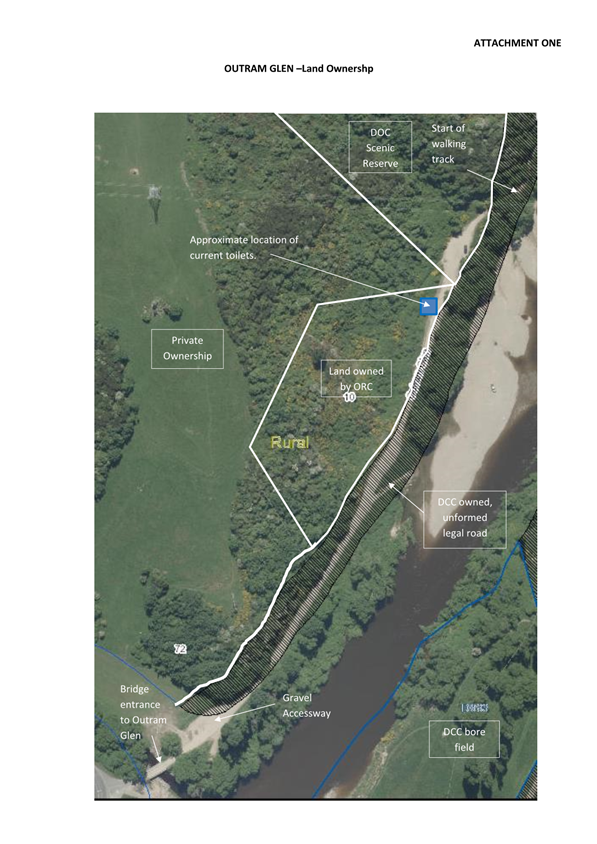
Sandy Graham
Council
PUBLIC AGENDA
|
Mayor
|
Mayor Jules Radich
|
|
|
Deputy Mayor
|
Cr Sophie Barker
|
|
|
Members
|
Cr Bill Acklin
|
Cr David Benson-Pope
|
|
|
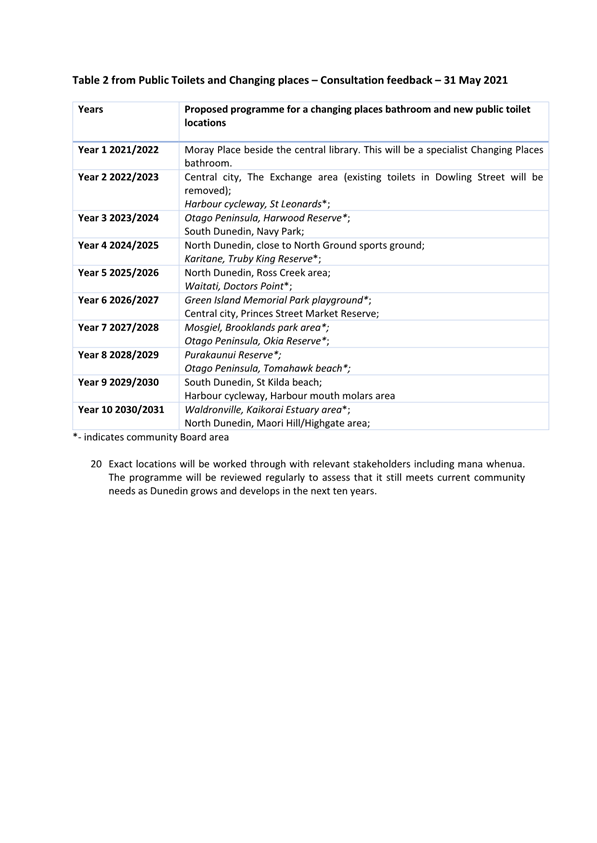
Cr Christine Garey
|
Cr Kevin Gilbert
|
|
|
Cr Carmen Houlahan
|
Cr Marie Laufiso
|
|
|
Cr Cherry Lucas
|
Cr Mandy Mayhem
|
|
|
Cr Jim O'Malley
|
Cr Lee Vandervis
|
|
|
Cr Steve Walker
|
Cr Brent Weatherall
|
|
|
Cr Andrew Whiley
|
|
Senior Officer Sandy
Graham, Chief Executive Officer
Governance Support Officer Lynne
Adamson
Lynne Adamson
Governance Support Officer
Telephone: 03 477 4000
Lynne.Adamson@dcc.govt.nz
www.dunedin.govt.nz
Note: Reports
and recommendations contained in this agenda are not to be considered as
Council policy until adopted.
|

|
Council
22 February 2023
|
ITEM TABLE OF CONTENTS PAGE
1 Public
Forum 5
2 Apologies 5
3 Declaration
of Interest 6
Reports
4 CEO
Overview Report - Annual Plan 2023/24
Report to follow.
5 Annual
Plan Budget Update - Property Services
Report to follow.
6 Outram
Glen - Facilities Upgrade 17
7 Annual
Plan Budget Update - Reserves and Recreational Facilities
Report to follow.
8 Destination
Playspaces - Stage 1 Consultation Feedback 28
9 Aquatic
Facilities Network Review 47
10 Sports
Facilities Review 60
11 Annual
Plan Budget Update - Roading and Footpaths
Report to follow.
12 Unsealed
Road Maintenance - Dust Suppression 70
13 Annual
Plan Budget Update - Governance and Support Services
Report to follow.
14 Annual
Plan Budget Update - Regulatory Services
Report to follow.
15 Annual
Plan Budget Update - 3 Waters
Report to follow.
16 Annual
Plan Budget Update - Galleries, Libraries and Museums
Report to follow.
17 Annual
Plan Budget Update - Community and Planning
Report to follow.
18 Annual
Plan Budget Update - Economic Development
Report to follow.
19 Annual
Plan Budget Update - Waste Management
Report to follow.
20 2023-24
Rating Method
Report to follow.
21 Revenue
Policy Compliance
Report to follow.
22 Engagement
on the 2023/24 Annual Plan
Report to follow.
|

|
Council
22 February 2023
|
1 Public
Forum
There will be no public forum for
the Council meeting commencing on Wednesday 22 February 2023 as this meeting
will concentrate on Annual Plan items. A public forum will be held prior
to the meeting on Tuesday 28 February 2023.
.
2 Apologies
At the close of the agenda no
apologies had been received.
|

|
Council
22 February 2023
|
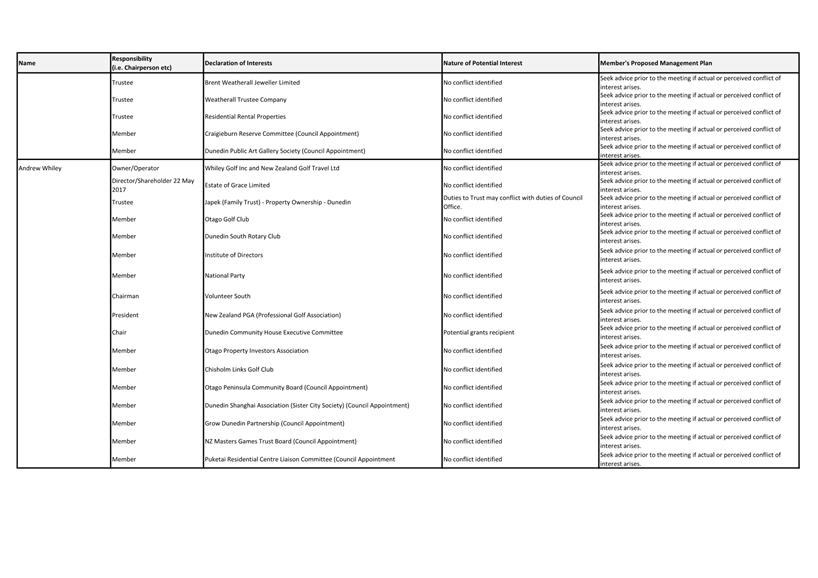
Declaration of Interest
EXECUTIVE SUMMARY
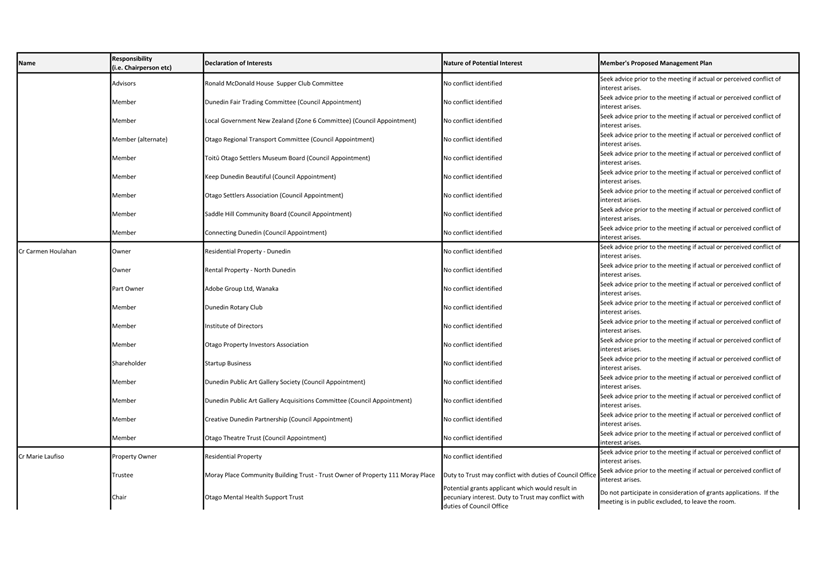
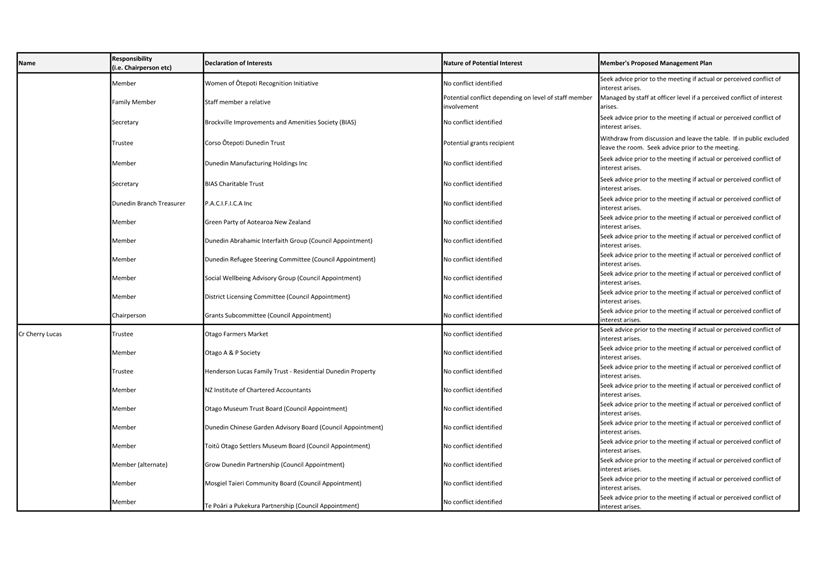
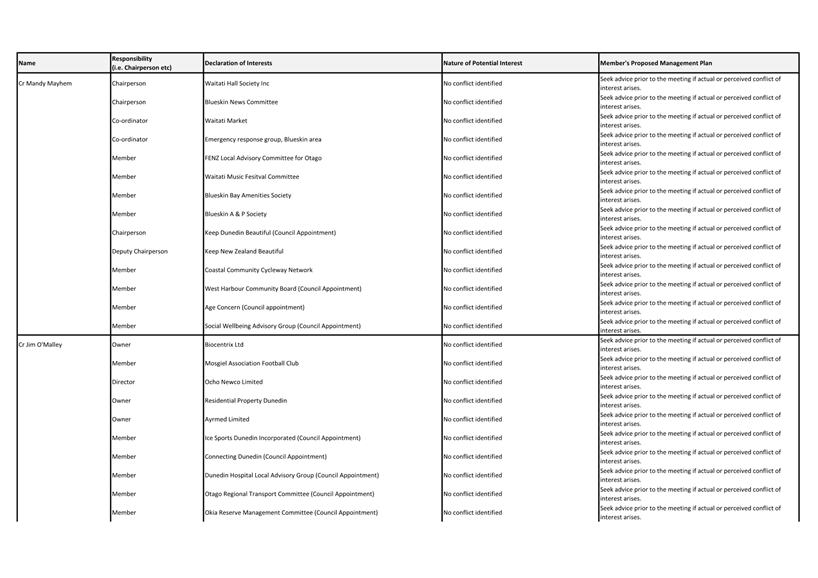
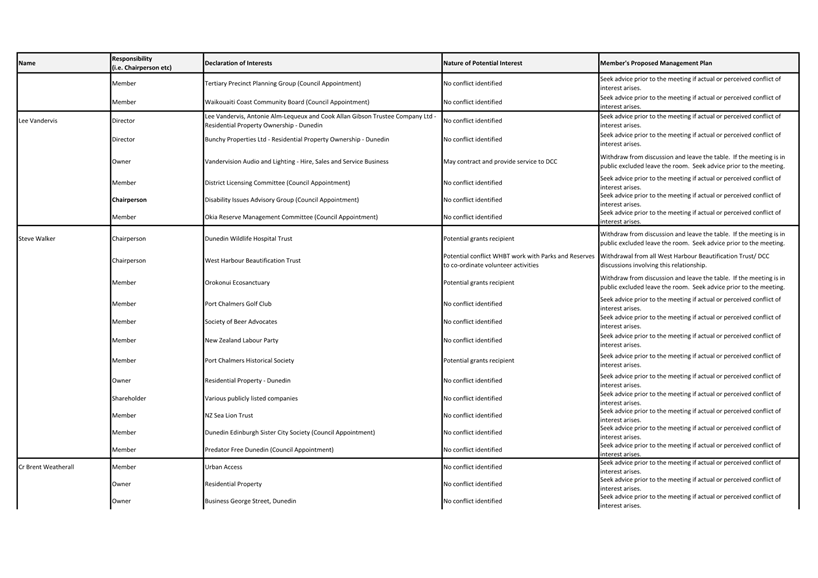
1. Members
are reminded of the need to stand aside from decision-making when a conflict
arises between their role as an elected representative and any private or other
external interest they might have.
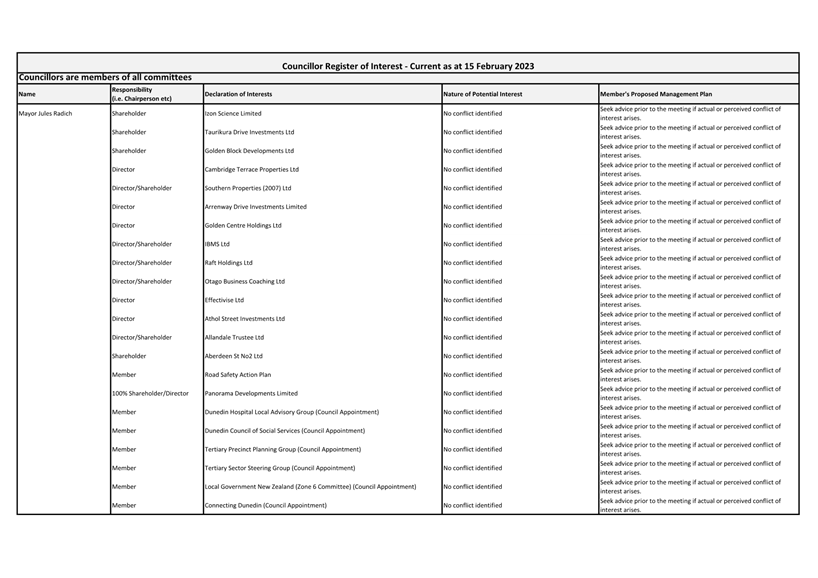
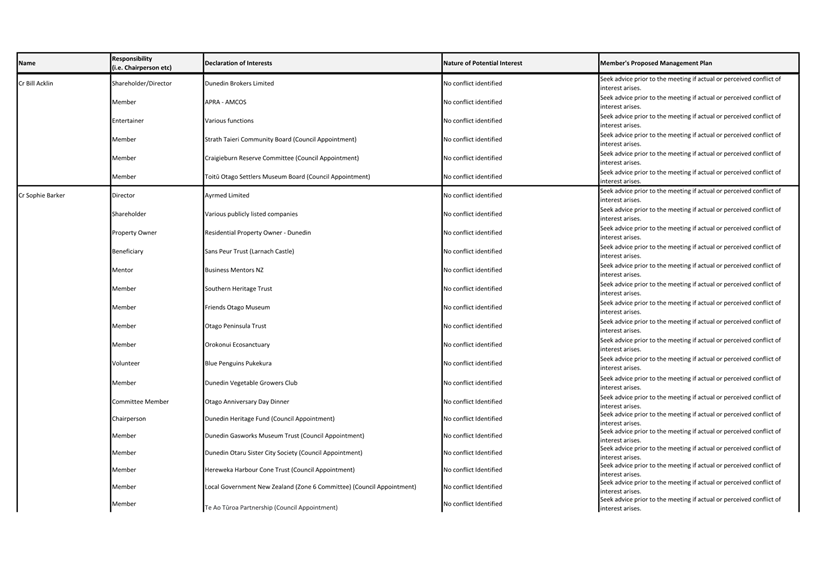
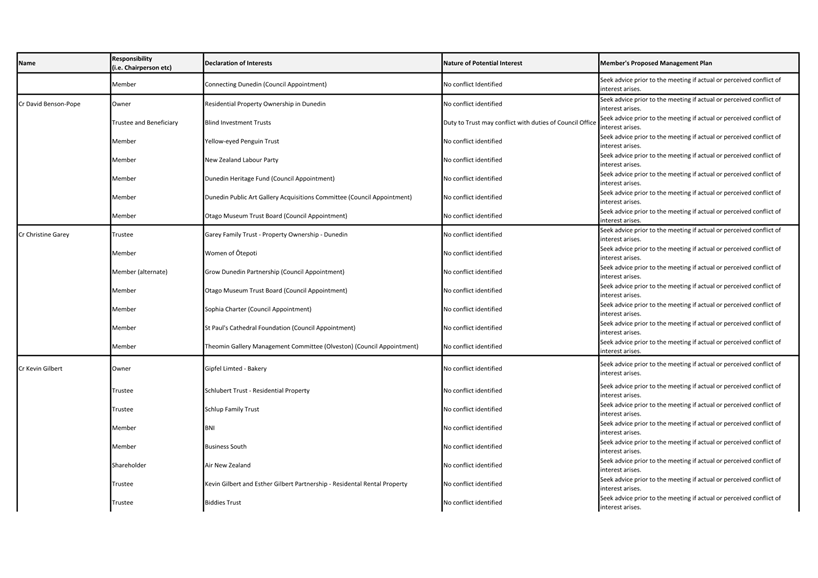
2. Elected
members are reminded to update their register of interests as
soon as practicable, including amending the register at this meeting if
necessary.
3. Staff members are
reminded to update their register of interests as soon as possible.
|
RECOMMENDATIONS
That the Council:
a) Notes/Amends if necessary the Elected Members'
Interest Register attached as Attachment A; and
b) Confirms/Amends the proposed management plan for
Elected Members' Interests.
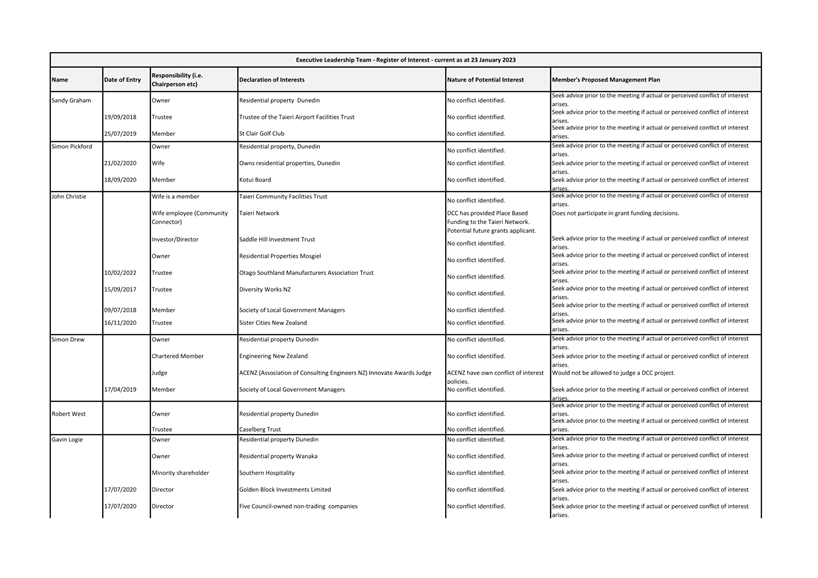
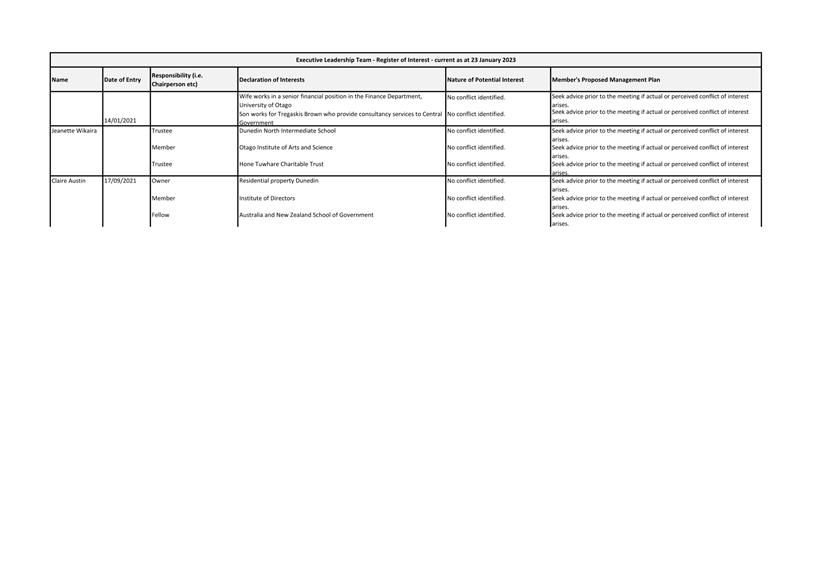
c) Notes the Executive Leadership Teams’ Interest
Register.
|
Attachments
|
|
Title
|
Page
|
|
⇩a
|
Elected Members
Interest Register
|
7
|
|
⇩b
|
Executive Leadership
Team Interest Register
|
15
|
|

|
Council
22 February 2023
|
Reports
Outram Glen - Facilities Upgrade
Department: Property
EXECUTIVE SUMMARY
1 This
report responds to a Council resolution from Annual Plan 22/23 deliberations on
23 May 2022 requesting a report for the Annual Plan 2023/24 on the cost to upgrade
the facilities at Outram Glen including the provision of a new toilet and road
sealing options.
2 The
resolution was in response to a submission from the Mosgiel Taieri Community
Board to the 2022/23 draft Annual Plan requesting that Council upgrade
facilities at Outram Glen (submission 865958).
3 Staff
(Property, Parks and recreation, Transport) have prepared options and costings
for a new toilet and road sealing options. Staff have also given options for
other facility upgrades Council may wish to consider.
|
RECOMMENDATIONS
That the Council:
a) Considers options to upgrade the facilities at
Outram Glen.
|
BACKGROUND
4 The
development of Outram Glen is listed as Priority 1 within the Mosgiel-Taieri
Community Board Community Plan, and the view of the Community Board is that
Outram Glen requires improved facilities to accommodate the needs of the many
people that visit the site.
5 The
Council resolution from 23 May 2022 was:
Moved (Cr. Carmen Houlahan/Cr. Jules Radich):
“That the Council:
Requests
a report for the Annual Plan 2023/24 on the cost to upgrade the facilities
at Outram Glen including the provision of a new toilet
and road sealing options.”
Motion
carried (CAPCC/2022/033)
6 Outram
Glen is located between Mosgiel and Outram, approximately one kilometre
north-east of Outram and is situated on the edge of the Taieri River. It
is a popular area over the summer for picnicking and freshwater swimming.
Other activities in the area include fishing, jet boating, rafting and horse
riding.
7 The
Outram Glen to Lee Stream Walk starts from the area and is a popular walk
throughout the year. We do not have a counter of people using the Glen,
however, anecdotally the Glen is always busy. Department of Conservation
(DoC) estimate that from November to April the Department of Conservation (DOC)
has recorded an average use of 31 people per day.
8 The
Outram Glen area is largely undeveloped. There is unformed legal road,
informal turning circle, informal parking either side of the gravel accessway
and four-wheel drive access to the riverbed. A concrete block, public
toilet facility with two single units is provided.
DISCUSSION
9 Land
ownership at Outram Glen is split between four parties - Department of
Conservation (DoC), Otago Regional Council (ORC), Dunedin City Council (DCC),
and private ownership. Attachment A shows an aerial view of the site and
identifies land ownership and location of the toilet.
10 Outram
Glen has historically been used by the public for recreation, and there has
never been any formal agreements between the four landowners regarding access
or the siting of facilities e.g., the toilets are located on ORC land, and the
gravel accessway goes across DCC, ORC, DoC and private land.
11 Staff
have had informal conversations with landowners over a period of time.
Dependant on the decision of Council, staff will work with landowners to
formalise agreements on land usage and the siting of facilities where required.
Department of Conservation (DOC)
land
12 DoC
owns 69 hectares of Local Purpose (Scenic) Reserve land (Reserves Act 1977)
that extends from Outram Glen primarily adjoining the Taieri River and Lee
Stream.
Otago Regional Council land
13 ORC
owns the land adjacent to the accessway. This land was formerly a quarry
and is largely overgrown and steep.
14 The
current public toilets are located on ORC land and there is no formal agreement
between the DCC and the ORC for the occupation of this land.
Dunedin City Council land
15 DCC
owns the area of unformed legal road which covers part, but not all, of the
gravel accessway into the area.
Private Ownership land
16 A
small section of privately owned farmland forms part of the gravel accessway.
This is used informally by the public for access.
Current
Facilities
Toilets
17 There
are two unisex dry vault (long drop) toilets in a small concrete block
building. The toilets are old and in poor condition. The toilets
are not accessible for people with disabilities.
18 For
the past two summers the DCC has provided portaloos at Outram Glen to assist in
meeting demand during peak use of the site. The portaloos require weekly
servicing and a high volume of effluent suggests that most visitors prefer to
use the portaloos rather than the permanent toilets.
19 The
toilets, portaloos and surrounding area are subject to significant vandalism on
a regular basis.
Road access and car parking
20 There
is an unformed legal road that covers most of the gravel accessway into the
Glen. Maintenance of the gravel accessway has historically been managed by the
Parks and Recreation department and is graded as required.
21 Car
parking is informal with vehicles arriving and parking where spaces are
available. An informal turning circle has evolved over time at the end of
the drive. This is narrow and requires some manoeuvring for turning.
Facilities
Upgrade Options
22 In
response to the Council resolution staff (Parks, Property, and Transport) have
considered and provided high level cost estimates for installing new toilets
and road sealing.
23 As
per the resolution staff have also considered other opportunities to upgrade
the facilities at Outram Glen. These include improving car parking,
creating a formal turning circle for vehicles, introducing traffic control
measures to improve safety and vehicle flow, and a BBQ.
24 There
are potentially other options for upgrading the facilities that Council may
wish staff to consider.
New toilets
25 There
are no water, sewerage, or electrical services available on the site, and so
the best option is a wet vaulted toilet (flushing) it does not require
utilities.
Surface treatments
26 The
accessway, turning circle and car parking could be improved by using either tar
seal, Otta seal or by re-grading the gravel.
27 All
surface treatment upgrade options would require re-contouring of the accessway
and ongoing maintenance.
28 Council
has an extensive network of unsealed roads and decided several years ago not to
extend the tar sealed network.
Turning Circle
29 The
vehicle turning space at the end of the accessway is narrow and adds to
congestion issues during peak times.
30 The
creation of a larger formal turning circle would require additional earthworks,
drainage and retaining wall as well as associated design fees.
31 Alternatively,
the current informal turning circle could be improved by cutting back the
surrounding vegetation.
Cost Estimates
32 The
high-level cost estimates for upgrade work are as follows;
|
Facility
|
Cost
Estimate
|
|
New
Toilets
|
$255k
|
|
Accessway
upgrade – Gravel
|
$30.5k
|
|
Accessway
upgrade – Otta seal
|
$40k
|
|
Accessway
upgrade - Tar seal
|
$360k
|
|
Barbeque
(BBQ)
|
$30k
|
|
Creating
Turning Circle
|
$537k
|
33 There
is $2.05m in the current ten-year plan for new public toilets. The proposed
locations, which were presented to Council in 2021, are shown in Attachment B.
Plans are currently underway for the Changing Places, Central City (Exchange
area), and St Leonards.
34 Staff
advised Council in 2021 that the programme will be reviewed regularly to assess
that it still meets current community needs as Dunedin grows and develops in
the next ten years.
35 The
demand at Outram Glen suggests it would be appropriate to reprioritise a new
toilet at Outram Glen into the existing 10 Year Plan budget for new public
toilets.
36 The
creation of a turning circle including earthworks and retaining wall would be
subject to agreement with landowners as it would sit outside of DCC land.
37 Parks
and Recreation will also consider the feasibility of installing a BBQ into the
existing 10 Year Plan budget.
OPTIONS
38 Based
on staff considerations and costings, two options are presented to Council for
consideration.
39 A
“do nothing” option is possible but has not been included as
improvements are required and Option One can be delivered within existing
budgets.
40 A
tar sealed accessway is possible for either of the options presented but has
not been included because of the Councils position to not increase the sealed
network.
41 Both
options would require discussions and the agreement with the landowners.
Option
One – Install new toilets and BBQ, and re-grade and re surface the
accessway with either a gravel or Otta seal.
42 This
option proposes building a new toilet at Outram Glen at cost of $255k, and
installation of a BBQ at a cost of $30k
43 This
option creates an improved surface for the road accessway at a cost of $30.5k
for gravel or $40k for Otta seal.
44 The
programme and budget for new public toilets will be reprioritised to include
new toilets at Outram Glen.
45 The
cost of the BBQ, re-grading and the surface treatment of the accessway can be
funded from existing budgets.
Advantages
· Responds
to the Community Board’s request and Community Board Plan.
· Does
not add any cost to existing Council budgets.
· Delivers
public toilets to a standard that meets community expectations.
· Addresses
accessibility issues of the current toilets.
· Is
consistent with existing Council policy position on not extending the tar seal
network.
Disadvantages
· No formal
turning circle, which does not address some of the congestion issues.
· Outram
Glen is subject to regular and significant vandalism which may result in regular
repairs for toilets and BBQ.
Zero Carbon Considerations
46 This
option has been assessed as having the strongest alignment with the Zero Carbon
Policy.
City-wide
47 The
proposal to redevelop the Outram Glen area has been assessed as not having a significant
impact on city emissions as it is unlikely to result in a significant change in
the number of trips to the destination.
DCC
48 This
option eliminates the need for ongoing provision of portaloos (and associated
transport).
Carbon Management
49 Capital/embodied
emissions associated with physical works will be subject to standard DCC Zero
Carbon procurement considerations.
Option
Two – Install new toilets and BBQ, re-grade and re surface the accessway
with either a gravel or Otta seal, and create a formal turning circle.
50 This
option proposes the creation of a formal turning circle at an estimated cost of
$537k, which would require additional funding to be agreed by Council.
51 This
option proposes building a new toilet at Outram Glen at cost of $255k, and
installation of a BBQ at a cost of $30k.
52 This
option creates an improved surface for the road accessway at a cost of $30.5k
for gravel or $40k for Otta seal.
53 The
programme and budget for new public toilets will be reprioritised to include
new toilets at Outram Glen.
54 The
cost of the BBQ, re-grading and the surface treatment of the accessway can be
funded from existing budgets.
Advantages
· Addresses
some of the congestion issues by inclusion of a turning circle.
· Responds
to the Community Boards request and Community Board Plan.
· Delivers
public toilets to a standard that meets community expectations.
· Addresses
some accessibility issues of the current toilets.
· Is
consistent with existing Council policy position on not extending the tar seal
network.
Disadvantages
· Requires
additional funding within the draft Annual Plan 2023-24 budget.
· Outram
Glen is subject to regular and significant vandalism which may result in
regular repairs for toilets and BBQ.
Zero Carbon Considerations
City Wide
55 The
proposal to redevelop the Outram Glen area has been assessed as not having a
significant impact on city emissions as it is unlikely to result in a
significant change in the number of trips to the destination
DCC
56 As
with Option 1, this option eliminates the need for ongoing provision of
portaloos (and associated transport). However, this option is likely to result
in slightly higher capital/embodied emissions than Options 1 due to the
creation of the turning circle.
Carbon management
57 Capital/embodied
emissions associated with physical works will be subject to standard DCC Zero
Carbon procurement considerations.
NEXT STEPS
58 Staff
will develop a plan for the upgrade of the facilities dependant on the
resolution of Council.
59 Staff
will engage stakeholders in discussion and formalise land use agreements as
required.
Signatories
|
Author:
|
Anna Nilsen - Group Manager, Property Services
|
|
Authoriser:
|
Robert West - General Manager Corporate and Quality
|
Attachments
|
|
Title
|
Page
|
|
⇩a
|
Outram Glen land
ownership
|
26
|
|
⇩b
|
10 Year plan 2021 2031
New Public toilet locations
|
27
|
|
SUMMARY OF CONSIDERATIONS
|
|
Fit with purpose
of Local Government
This decision enables democratic
|
|
Fit with strategic
framework
|
|
Contributes
|
Detracts
|
Not applicable
|
|
Social Wellbeing Strategy
|
☒
|
☐
|
☐
|
|
Economic Development Strategy
|
☐
|
☐
|
☒
|
|
Environment Strategy
|
☐
|
☐
|
☒
|
|
Arts and Culture Strategy
|
☐
|
☐
|
☒
|
|
3 Waters Strategy
|
☐
|
☐
|
☒
|
|
Spatial Plan
|
☐
|
☐
|
☒
|
|
Integrated Transport Strategy
|
☐
|
☐
|
☒
|
|
Parks and Recreation Strategy
|
☒
|
☐
|
☐
|
|
Other strategic projects/policies/plans
|
☒
|
☐
|
☐
|
This report contributes to the Parks and Recreation
Strategy, the Social Well Being Strategy.
|
|
Māori Impact
Statement
The upgrade of Outram Glen has been discussed over several
years and there have been conversations with mana whenua early on.
There have been no recent discussions with mana whenua.
|
|
Sustainability
There are no known implications
that are not covered in the report
|
|
LTP/Annual Plan /
Financial Strategy /Infrastructure Strategy
Implications for the Annual Plan budget are discussed in
the body of the report
|
|
Financial
considerations
The financial considerations are discussed in the body of
the report
|
|
Significance
This is matter considered to be low in terms of
Councils significance and engagement policy.
|
|
Engagement –
external
Staff have engaged with Department of Conservation and had
informal discussions with Otago Regional Council staff.
|
|
Engagement -
internal
Property Services, Transport and Parks & Recreation
staff have worked together to consider options and costs.
|
|
Risks: Legal /
Health and Safety etc.
These are covered in the body of the report
|
|
Conflict of
Interest
There are no known conflicts of interest.
|
|
Community Boards
The options in this report support the Mosgiel Taieri
Community Board submission to Annual plan 2022-2023 and supports the
Community Board Plan.
|
|

|
Council
22 February 2023
|
|
|
Council
22 February 2023
|
|
|
Council
22 February 2023
|
Destination Playspaces - Stage 1 Consultation
Feedback
Department: Parks and Recreation
EXECUTIVE SUMMARY
1 This
report summarises submissions received from stage one of the destination
playspaces engagement process. Engagement with the community occurred
between 10 October and 31 October 2022.
2 The
community was asked about the level of investment they would like to see at
Dunedin’s three large playgrounds (Marlow Park, Memorial Gardens
playground and Woodhaugh Gardens playground). The comm unity was also whether
the Council should build a new, modern destination playspace elsewhere in city.
3 Of
the three playgrounds, Marlow Park and Woodhaugh Gardens were the preferred
playgrounds to be fully redeveloped into a modern destination
playgrounds. The community preference was that Mosgiel Memorial Gardens
Playground should receive regular investment i.e., the replacement of
equipment, with modern equipment as required.
4 Over
half of submitters responded that they wanted a new, modern destination
playground.
|
RECOMMENDATIONS
That the Council:
a) Considers the feedback from Stage 1 of community
consultation on destination playspaces.
b) Decides the preferred investment option for each
of the existing three destination playspaces (Marlow Park, Woodhaugh Gardens
and Mosgiel Memorial Park).
c) Decides whether to
progress site investigations for the establishment of a new destination
playspace on Council owned land.
|
BACKGROUND
5 The
Play Spaces Plan was adopted by Community and
Culture Committee on 3 August 2021, replacing the 2006 Play Spaces Strategy.
6 Feedback
received during the Play Spaces Plan 2021 and the 2021-31 10-Year Plan
consultation indicated that some people do not consider Dunedin to have a
destination playspace and asked for Council to invest in a “Margaret
Mahy” style playspace, as developed in Christchurch.
7 A
“destination playspace” means different things to different
people. In the recreational industry, destination playspaces are broadly
accepted as having supporting infrastructure, features, and amenities such as
(but not limited to) large gathering spaces, picnic and BBQ facilities, toilets
(with baby change facilities), built and natural shade areas, drinking
fountains and a variety of park furniture. They typically include at
least one large multi-play centrepiece feature.
8 Dunedin
has three playspaces with a mix of these features: Marlow Park, Woodhaugh
Gardens and Mosgiel Memorial Gardens and all three are managed as destination
playspaces.
9 Council,
at its meeting of 31 May 2021, resolved that:
|
|
Moved (Mayor Aaron Hawkins/Cr David Benson-Pope):
That the Council:
a) Supports,
in principle, the development of a new destination playground; and
b) Requests
an options report in time for consideration as part of the Draft Annual Plan
2022-2023.
Motion
carried (CNL/2021/130) with Cr Andrew Whiley recording his vote
against
|
10 During
debate at the Council meeting of 31 January 2022, it was discussed that there
had been no specific engagement with the community on destination
playgrounds. Following that debate, Council resolved that the Council:
|
|
Moved (Mayor Aaron Hawkins/Cr David Benson-Pope):
That the Council:
Requests a
report in time for Annual Plan 2022/23 deliberations, looking at resourcing
options for the development of concept and community engagement plans for
destination playspaces, including:
a) a
single site development on council owned land; and
b) a
distributed network of investment across three sites.
Division
The Council voted by division:
For: Crs
David Benson-Pope, Sophie Barker, Rachel Elder, Christine Garey, Doug Hall,
Carmen Houlahan, Marie Laufiso, Mike Lord, Jim O'Malley, Chris Staynes, Steve
Walker and Mayor Aaron Hawkins (12).
Against: Crs
Jules Radich, Lee Vandervis and Andrew Whiley (3).
Abstained: Nil
The division was declared CARRIED by 12 votes to 3
Motion carried (CAPCC/2022/005)
|
11 Council,
at its meeting of 23 May 2022, considered a staff report on the resourcing
options for the development of concept and community engagement plans for
destination playspaces. That report recommended a staged approach to community
engagement regarding investment into destination playspaces.
12 Council,
at its meeting of 23 May 2022 resolved:
|
|
Moved (Cr Lee Vandervis/Mayor Aaron Hawkins):
That the Council:
Agrees
the staged community engagement approach for destination playspaces,
across a range of investment and site options.
Motion carried
(CAPCC/2022/035)
|
13 The
three existing large playspaces have a variety of settings, play elements,
facilities, and amenities:
Marlow
Park (Dinosaur Park)
14 Marlow
Park is in a coastal setting. It has a total play area of approximately
9,200 m2:
· 3,500 m2
primary existing play space area.
· 700 m2
basketball court area.
· 950 m2
hard court associated with skate elements.
· 1,050 m2
with flexible grassed open space between courts, primary play equipment and
social seating area.
· 3,000 m2 learn to ride facility.
15 In
addition, there is a grassed open space transition to southern embankment set
aside for potential dune restoration.
16 The
park has the following play elements:
· An
extensive learn to ride facility (a small-scale road environment complete with
signalled intersections) is located in the western section of the park.
· The
central area of the park provides a significant, flat all-weather surface that
accommodates skate elements and a full-sized basketball court alongside a
flexible grassed open space.
· Primary
equipment areas in the eastern and southern extent of the park accommodate a
range of proprietary and unique play elements - swings, slides see saw and
modules with platforms, tunnels, and agility/climbing elements.
17 Facilities
and amenities:
· Marlow
Park has a basic range and standard of facilities including public toilets,
flexible grassed open space, seating areas and associated shade structures.
· On-street
car parking is available along John Wilson Ocean Drive with good visibility and
access to the park.
· There
are complementary activities nearby such as mini golf, the railway and model
engineering society, scout group, surf club and access to the beach.
These offer synergies with the park as destinations in their own right.
· Mobile
coffee vans and food trucks provide further reasons for people to visit and
enjoy this playground.
Woodhaugh
Gardens Playground
18 Woodhaugh
Gardens is set in a woodland/natural environment. It has a total play
area of approximately 4,300 m2 and includes the following:
· 3,500 m2
existing northern area associated with BBQ and play equipment.
· 550 m2
water/paddling pool and an early childhood equipment area.
· 250 m2
threshold transition from toilet and BBQ facilities to grassed open space
associated with paddling pool area.
19 The
park has the following play elements:
· The
area to north has a flying fox, swing bank (with belt and toddler provision and
slide structure).
· The
area to the west has a flying fox (for the 5 – 9 plus age
range), swings and slide for older children.
· The
paddling pool area has a spinner and small slide (primarily aimed at
0 – 4 age range).
20 Facilities
and amenities:
· Woodhaugh
has a basic range and standard of facilities including public toilets, BBQ
facilities, flexible grassed open space and seating, and a paddling pool area.
· On-street
car parking is available along Duke Street, and limited parking on Queen and
Inverleith Streets.
Mosgiel Memorial Gardens Playground
21 Mosgiel
Memorial Park is set in an urban environment. It has a play area of
approximately 5,500 m2:
· 2,500 m2
play area with tower module (including slides).
· 600 m2
skate area.
· 950 m2
recently refurbished central net structure area.
· 850 m2
early childhood area.
· 600 m2
grassed open space area adjacent to the library car park.
22 The
park has the following play elements:
· A
fenced early childhood (0 – 4 age range) play area with
proprietary play modules, swing, spinner, and rockers/springers.
· Equipment
for 5 – 9 plus age range with select elements for older groups
including a skate facility and associated features.
· A
central open space area that has group/social swing, large space net, see saws,
rockers, spinners, accessible carousel.
· The
area to the north has rockers and a large proprietary play module with slides.
23 Facilities
and amenities:
· The
Mosgiel Memorial Park has good supporting amenities including public toilets,
BBQ facilities, the adjacent library, supermarket, commercial activities, and
car parking.
Engagement
24 Stage
1 of community engagement focussed on asking how the community wanted to invest
in the three existing destination playgrounds and if the community wanted
Council to invest in a new destination playground:
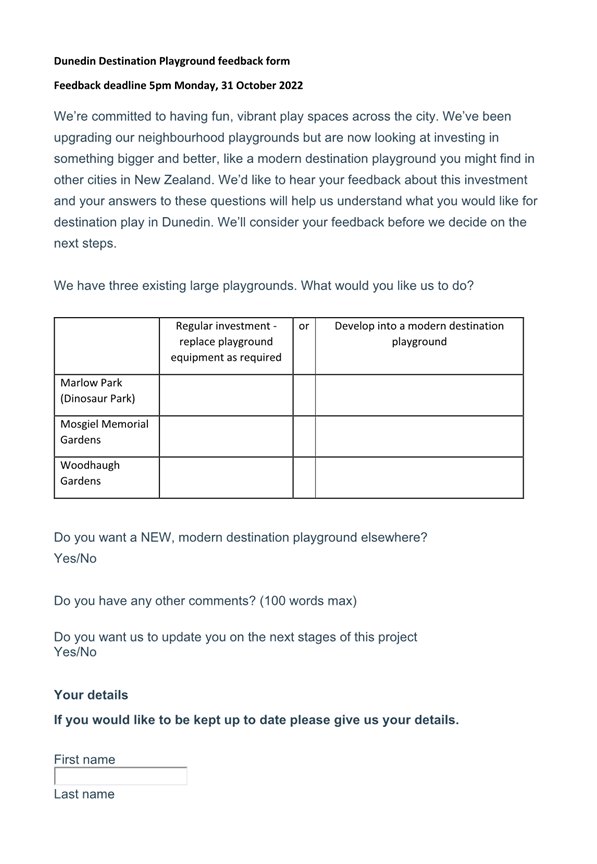
25 Specific
questions were asked (Attachment A), including:
a) At
each of the three existing large playgrounds (Marlow Park, Woodhaugh Gardens
and Mosgiel Memorial Gardens), would you like:
· Regular
investment (replacement of equipment as required); or,
· Develop
into a modern destination playground.
· Do
you want a NEW modern destination playground elsewhere? (YES / NO)
26 The
first stage of engagement with the community was via the following methods:
· A
page on the DCC website.
· Feedback
form.
· Proactive
use of social media.
· Media
releases included two articles in the Otago Daily Times.
· Informing
Community Boards and Groups to share via their social media channels.
· Physical
advertising in DCC facilities by way of posters with QR codes to access webpage
and feedback form.
· Signage
with QR codes located within the city’s three destination playgrounds
Stage 1 of engagement occurred between 10 October and 31 October 2022.
DISCUSSION
27 The
total number of submissions received was 1,639.
28 The
results of the first question about the level of investment DCC should make at
the three existing large playgrounds are shown in Figure 1
(“invest” being replacement of equipment as required and
“redevelop” being full redevelopment into a modern destination
playground).
29 Respondents
could choose one or more options.
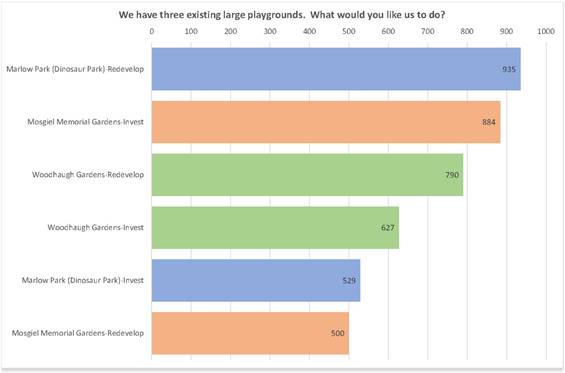
Figure 1: Community
feedback on whether Dunedin’s three large playgrounds should receive
regular investment (“Invest”) or be developed
(“Redevelop”) into modern destination playgrounds.
30 Redeveloping
Marlow Park into a modern, destination playground was the most popular response
with 935 respondents supporting this option.
31 The
second most popular response (884 responses) was that Mosgiel Memorial Gardens
Playground should receive regular investment, being replacement of equipment,
with modern equipment as required.
32 Seven
hundred and ninety (790) respondents wanted Woodhaugh Gardens to be fully
redeveloped into a modern destination playground.
33 In
response to the question “Do you want a new, modern destination
playground elsewhere?” 60% of submitters responded yes – see Figure
2.
|
Do you want a new,
modern destination playground elsewhere?
|
|
Answer
|
Count
|
Percentage
|
|
Yes
|
977
|
60%
|
|
No
|
662
|
40%
|
|
Total
|
1,639
|
100%
|
Figure 2: Table
showing the results to the question “Do you want a new, modern
destination playground elsewhere?”
34 Submitters
were offered the opportunity to comment on destination playgrounds generally.
35 Submitters
provided a range of ideas regarding the location of a new destination
playground, what type of play should be allowed for and the features that
should be included at destination playgrounds generally.
36 The
preferred locations for a new destination playground were Port Chalmers and
central city locations including the waterfront, Kensington Oval, Market
Reserve, the Town Belt, and the Botanic Gardens.
37 The
most requested play type received (90 submitters) was for water play through
provision of paddling pools, fountains, and splash pads.
38 Submitters
also identified they would like to see destination playgrounds include play
choices for all ages from toddlers through to teens and adults.
39 Supporting
infrastructure requested for destination playgrounds generally included
fencing, shading, weather shelters, barbeques, toilets, seating, and tables.
Assessment
of Existing Destination Play Spaces
40 Bespoke
Landscape Architects (Bespoke) carried out an assessment of Dunedin’s
three destination playspaces, to identify how well the current facilities
provide for current play trends such as inclusive play, adventure and natural
play, age–appropriate play, self–directed/challenging play, and
accessibility.
Marlow Park
41 Marlow
Park play equipment is scattered and the use of space inefficient. The
assessment identified that the existing equipment provides a baseline level of
play experience for those aged 0 – 14 years, but that significant
improvement could be made to improve multiple use, connected and
self–directed play and provide play opportunities for children/youth
aged 10 – 14 plus years.
42 The
assessment also considered that the equipment to be old and outdated compared
to modern standards. Bespoke recommends retaining many of the existing
iconic play elements and improving the flow through the space to elevate play
values and improve social areas. Much of the revitalisation can be
achieved through surface upgrades and the inclusion of new play
structures. An improved landscape setting would also improve amenity
value and aid in improving spaces for social interaction for older age groups.
43 A
consistent theme from the submissions regarding Marlow Park was that the
playground can be cold due to the coastal wind and rain that funnels through
the site at times. Supporting infrastructure such as wind and rain shelters
would improve the experience of visiting the playground.
Woodhaugh Gardens
44 Woodhaugh
Gardens provides a basic level of play experience but requires investment to
provide a meaningful destination level provision across all age ranges and play
value attributes. Equipment is scattered in three general locations and
requires consolidation to minimise duplication of elements.
45 The
assessment also identified that the playground lacks inclusive play elements
that encourage social interaction and has limited accessibility due to the lack
of all–weather surfaces.
46 Bespoke
recommends redeveloping the playground by removing the existing scattered
equipment and creating a new playground in one area with a new range of play
equipment to improve the experience required of a destination play space.
An improved landscape setting building on existing natural values would also
improve amenity values.
Mosgiel Memorial Gardens
47 Mosgiel
Memorial Gardens has a good range of play equipment and play experience.
However, the equipment is scattered resulting in poor use of the available
space, limiting the playground’s maximum potential. The scattered
layout makes the supervision of several children challenging for
caregivers.
48 The
playground does not require redevelopment in its entirety, it is recommended
that investment should focus on consolidation/reconfiguration of existing
elements in an improved arrangement, and supplementing these with new elements
that improve play value.
49 An
improved landscape setting would also improve amenity value and improve spaces
for social interaction for older age groups.
Catchment
and Distribution
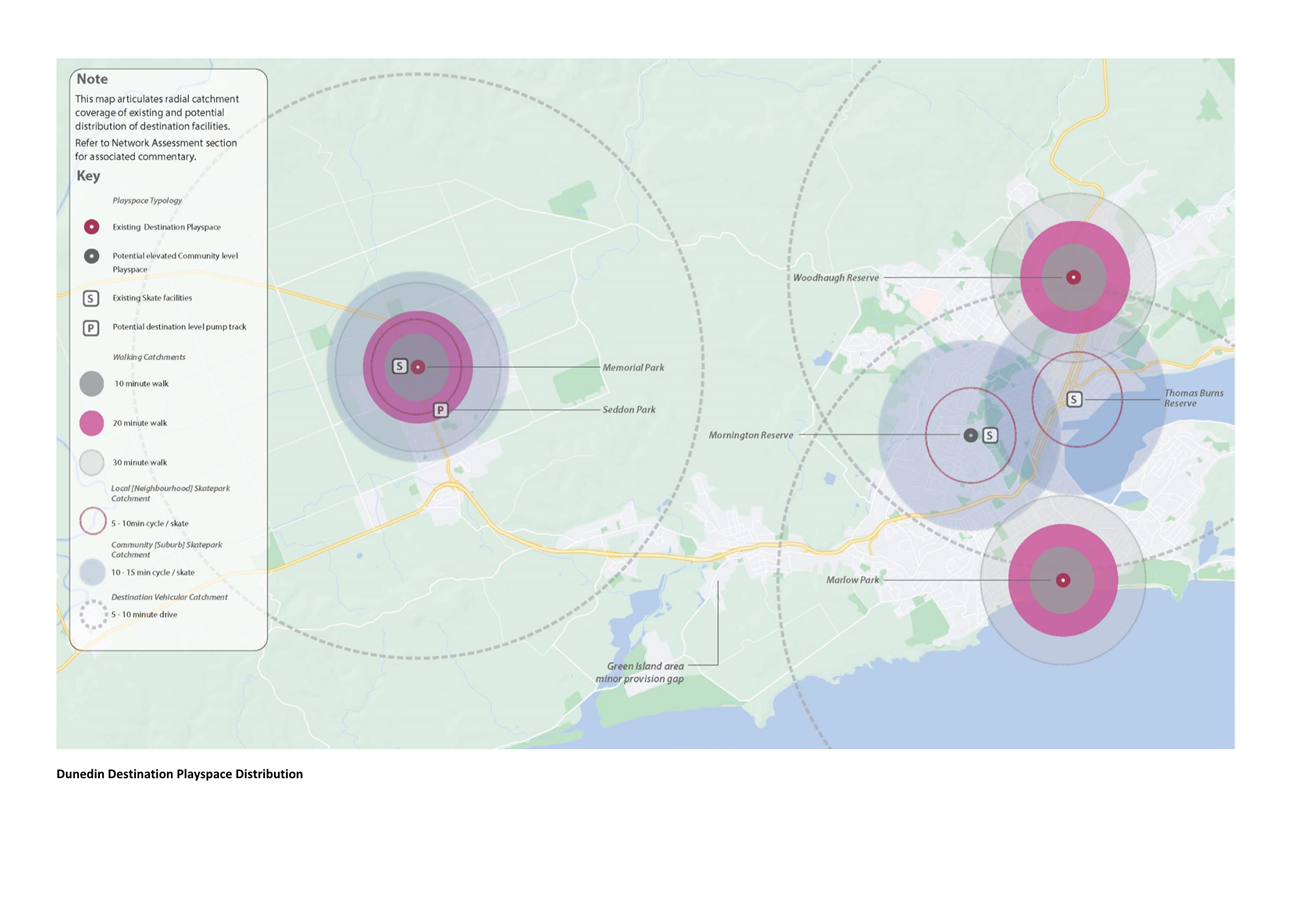
50 Collectively
the three existing destination play spaces provide good catchment coverage for
the Mosgiel – Fairfield and Northern – Southern urban areas.
All facilities are within an approximate 10 – 20 minute drive of each
other (Attachment B).
51 Woodhaugh
and Marlow facilities have significant catchment overlap in the central Dunedin
area. There is however opportunity to create significantly
different/complementary experiences due to location and context, and this would
provide diversity and choice for the community.
Stage
2 Consultation
52 If
Council decides to redevelop any of the existing three destination playgrounds,
concept plans will be prepared using feedback on the play types and values
gained through Stage 1 of consultation.
53 Concept
plans are high–level schematics that provide a visual summary of the play
types and play values that the community said are important to them. They
are not a final design and do not determine the specific pieces of play
equipment to be included (that comes later through the development of detailed
design plans).
54 The
concept plans will form the basis of the second round of community engagement
to visually represent the play values and to gather feedback on the
concepts. The engagement will take a fun, accessible, highly graphical
approach to ensure wide community appeal.
55 Concept
plans will be the basis for detailed designs and incorporated through a design
and build process.
56 If
Council decides to progress site investigations for the establishment of a new
destination playground on Council owned land, staff will work to identify a
suitable site for a new destination playground and report back to Council with
a preferred site.
Budget
57 For
the remainder of the 2021-31 10-Year Plan (years 2023/24 through 2030/31),
there is a total of $9,500,000 of new and renewals capital for playground
upgrades (subject to annual budget approval).
58 The
priorities identified during the development of the Play Space Plan 2021 was to
invest in local and neighbourhood playgrounds for the first three years of
implementation. No specific budget has been provided for redeveloping any
of the existing playgrounds into modern destination playgrounds. However
individual pieces of equipment could still be replaced as required from within
existing budgets.
OPTIONS
59 There
are two decisions required of Council. The first relates to the level of
investment Council at Dunedin’s three large playgrounds (Marlow Park,
Memorial Gardens playground and Woodhaugh Gardens playground). The second
decision relates to whether to progress site investigation into a new, modern
destination playground elsewhere in city.
60 The
overall network of destination playgrounds is important from a Zero Carbon
perspective. The locations of the existing three destination playgrounds
are well placed to serve different communities. The location of any new
destination playground in relation to the existing network will be a key Zero
Carbon consideration.
Decision
One
Option
One – Decides to develop concept plans for one or more of the existing
three destination playspaces (Marlow Park, Woodhaugh Gardens and Mosgiel
Memorial Park) as modern destination playgrounds.
Advantages
· Addresses
community feedback requesting the development of modern destination
playgrounds.
· Investment
in existing assets is more cost effective than establishing a new destination
playspace as generally the supporting infrastructure is already in place
(paths, plumbing, BBQ’s, etc).
· Investment
in the existing three playgrounds would better meet the service needs of the
community as they are well distributed.
· Investment
of the three existing playgrounds was the recommendation from Bespoke’s
Destination Playspaces Provision Assessment Report.
Disadvantages
· The
costs associated with redeveloping the existing destination playspaces into
modern destination playspaces is not currently budgeted for.
Zero Carbon Considerations
· Prior
to the design process it is difficult to determine the level of emissions that
would be generated from any upgrades to the playgrounds.
· Continuing
to invest in the existing playgrounds may support reduced city transport
emissions. The existing three large playgrounds are well distributed to
service a significant number of the city’s residents enabling a large
proportion to access the playground via active or public transport modes.
· The
existing playgrounds have well–established supporting infrastructure, so
capital/embodied emissions from refurbishment are likely to be lower than
constructing a new playground.
Option
Two – Decides to not to develop concept plans for any of the existing
three destination playspaces (Marlow Park, Woodhaugh Gardens and Mosgiel
Memorial Park) as modern destination playgrounds.
Advantages
· No
cost or expenditure required beyond the standard cost to maintain and manage
the playgrounds.
Disadvantages
· Does
not address community feedback requesting the development of a modern
destination playground.
· Does
not maximise the opportunity from existing assets.
· Does
not ensure that most residents will have a modern destination playground that
is easily accessible.
Zero Carbon Considerations
· No
upgrades will result in no capital or embodied emissions generated through the
manufacture, transport, construction, and installation of play elements.
Decision
Two
Option
One – Decides to progress site investigations for the establishment of a
new destination playspace on Council owned land
Advantages
· Addresses
community feedback requesting the development of a new, modern destination
playground.
· If
the investigation leads to the establishment of a new playground, having a
blank canvas allows a playground to be designed to consider best practice in
terms of location and orientation without having to consider existing elements
and infrastructure.
Disadvantages
· The
costs associated with developing a new destination playspace is not currently
budgeted for.
· The
potential construction costs of a new modern destination playground on a
greenfield site is likely to be higher than investing in existing destination
playspaces due to higher site establishment costs and construction of
supporting infrastructure.
· The
potential loss of amenity open space reserve or sports ground.
Zero Carbon Considerations
· It
is difficult at this stage to quantify the potential impact of any new modern
destination playground without a location and spatial design.
· It
is likely that constructing a new modern destination playground will generate
additional carbon emissions:
§ Transport
emissions from residents using motor vehicles to travel to the playground,
however this could be mitigated through location selection that considers the
overall network of playgrounds and availability of transport modes.
§ Capital
and embodied emissions from the construction and installation of new supporting
infrastructure and play equipment.
Option
Two – Do not progress site investigations for the establishment of a new
destination playspace on Council owned land
Advantages
· No
cost or expenditure required.
· No
loss of amenity open space or sportsground due to it being repurposed for a
playground.
Disadvantages
· Does
not address community feedback requesting the development of a modern
destination playground.
· The
loss of an opportunity to develop a purpose–built destination playground.
Zero Carbon Considerations
· It
is expected that this option will not have any impact on emissions.
NEXT STEPS
61 If
Council decides to redevelop any of the existing three destination playgrounds,
concept plans will be prepared and consulted on as part of Stage 2 of community
engagement, during the 2023/24 year.
62 If
Council decides to progress site investigations for a new destination
playground, staff will commence site investigations and due diligence and
provide a report on options in time for the January 2024-2034 10 Year Plan
meeting.
Signatories
|
Author:
|
Elizabeth Schonwald - Parks and Recreation Planner
Scott MacLean - Group Manager Parks and Recreation
|
|
Authoriser:
|
Simon Pickford - General Manager Community Services
|
Attachments
|
|
Title
|
Page
|
|
⇩a
|
Feedback Form
Destination Playground
|
42
|
|
⇩b
|
Destination Playspace
Distribution Map
|
44
|
|
SUMMARY OF CONSIDERATIONS
|
|
Fit with purpose
of Local Government
This decision enables democratic local
decision making and action by, and on behalf of communities.
This decision promotes the social
well-being of communities in the present and for the future.
|
|
Fit with strategic
framework
|
|
Contributes
|
Detracts
|
Not applicable
|
|
Social Wellbeing Strategy
|
☒
|
☐
|
☐
|
|
Economic Development Strategy
|
☐
|
☐
|
☒
|
|
Environment Strategy
|
☐
|
☐
|
☒
|
|
Arts and Culture Strategy
|
☒
|
☐
|
☐
|
|
3 Waters Strategy
|
☐
|
☐
|
☒
|
|
Spatial Plan
|
☒
|
☐
|
☐
|
|
Integrated Transport Strategy
|
☒
|
☐
|
☐
|
|
Parks and Recreation Strategy
|
☒
|
☐
|
☐
|
|
Other strategic projects/policies/plans
|
☒
|
☐
|
☐
|
Playspaces contribute to the wellbeing of the
community. The development of playspaces provides opportunities for art
and culture to be included within the design. The Integrated Transport
Strategy and Spatial Plan are relevant when considering locations of future
playspaces and in particular destination playspaces. Playspaces are a
key component of the Parks and Recreation Strategy.
|
|
Māori Impact
Statement
There will be continued engagement with mana whenua
throughout both the design and development of our destination playspaces.
|
|
Sustainability
Sustainability will be considered all stages of the
project from planning to construction.
|
|
LTP/Annual Plan /
Financial Strategy /Infrastructure Strategy
Currently there is no budget allocated within the LTP or
the Annual Plan for developing destination playspaces, although there is
funding in the LTP for the upgrading of our existing destination playspaces
as a result of the Play Spaces Plan.
|
|
Financial
considerations
Stage 2 consultation will be undertaken in the 2022/23
financial year and can be resourced from within the existing PARS draft
operating budgets for the 2023/24 financial year.
|
|
Significance
The decision is considered low in terms of the
Council’s Significance and Engagement Policy.
|
|
Engagement –
external
Development of playspaces requires external engagement
across all age demographics. Development of destination playspaces is
likely to attract wide community interest.
|
|
Engagement -
internal
Parks and Recreation Services staff will work closely with
our colleagues in other departments with the development of destination
playspaces.
|
|
Risks: Legal /
Health and Safety etc.
There are no identified risks.
|
|
Conflict of
Interest
There are no known conflicts of interest.
|
|
Community Boards
Community Boards will be interested in this topic as there
are many DCC playgrounds within Community Boards areas.
|
|

|
Council
22 February 2023
|
|
|
Council
22 February 2023
|
Aquatic Facilities Network Review
Department: Parks and Recreation
EXECUTIVE SUMMARY
1 This
report presents a review of Dunedin’s aquatic facilities network.
The purpose of the review was to determine the extent of the network, the role
each facility plays in the community and to explore opportunities for
collaboration, to optimise the provision of aquatic services in Dunedin.
2 The
city’s aquatic network is comprised of DCC pools, school pools and
community pools.
3 To
understand the challenges and opportunities in the aquatic network, discussions
were held with pool operators, swim schools, user groups, stakeholders, mana
whenua and the Ministry of Education.
4 The city’s ratio of population per square metre of pool space
meets the national provision guidelines. However, there are fewer
municipal pools for the size of the population in Dunedin than in other areas
of the country. This means there is a greater reliance on school and
community pools, for the provision of aquatic services, particularly for
children’s water skills and learn-to-swim services.
5 Based
on future demand projections, there would be a longer-term benefit of locating
increased junior-based, learn to swim activity within the school pools to free
up pool space at the Council facilities, which are the only pools currently
suitable for older adult use.
6 The
report considers options that Council could pursue to meet future aquatic
demand across the city.
|
RECOMMENDATIONS
That the Council:
a) Notes the Aquatic Facilities Review.
b) Request staff investigate potential
co-investment options with the Ministry of Education and other partners and
report back in time for the January 2024-2034 10‑Year Plan meeting.
c) Notes staff will continue to work with the Otago
Therapeutic Pool Trust.
|
BACKGROUND
7 The
review of Dunedin’s aquatic facilities began during the building of the
new pool at Mosgiel. The purpose of the review was to determine the extent of
the network, the role each facility plays in the community and to explore
opportunities for collaboration, to optimise the provision of aquatic services
in Dunedin.
8 The
city’s aquatic network is comprised DCC pools, school pools and community
pools.
9 In
addition, the Council at its meeting of 23 May 2022 resolved:
|
|
“That the Council:
Ask staff to
include discussions with the Therapeutic Pool Trust as part of the Aquatics
Network Review.
Motion carried (CAPCC/2022/034)”
|
10 Discussions
were held with all school and community pool operators (whether DCC funded or
not), formalised user groups of Moana Pool, Sport Otago, commercial swim
schools, Swimming New Zealand, Water Safety New Zealand, the Otago Therapeutic
Pool Trust, the DCC Disability Issues Advisory Group, mana whenua and the
Ministry of Education. User groups of all school and community pools were
also interviewed as part of the Review.
Current
State
11 DCC
plays a role in the direct supply of aquatic facilities and contributes to the
indirect supply of aquatic access through support of community and school
pools. The six markets the aquatic facilities cater for are:
· lap
swimming
· swim
coaching/squads
· aquatic
education (learn to swim and water safety lessons)
· recreational
aquatic play
· aquatic
fitness programs
· therapeutic
and rehabilitation programmes, and
· aquatic
based sports (water polo, underwater hockey, diving etc)
DCC
Facilities
12 Once
Mosgiel Pool, Te Punu o Whakaehu, becomes operational in mid-2023, the DCC will
operate two all-year round pools (Moana and Te Punu o Whakaehu) and two
seasonal pools (St Clair and Port Chalmers).
13 Moana
Pool is Dunedin’s major aquatic facility. It is categorised as a
regional facility in terms of its size, features, and the level of competition
swimming for which it caters.
14 Moana
Pool has a 50-metre, eight-lane competition pool, 25 metre multi-use/dive pool,
learners, and leisure pools, hydroslides and spa pool. It includes gym
and group fitness facilities. Moana caters for a range of aquatic swim
programmes, clubs, and swim squads.
15 There
are limitations to hosting some competition events at Moana. The shallow
end of Moana Pool is 0.91 metres. The minimum depth required for
Swimming New Zealand 50 metre “long-course” events is
1.4 metres. The International Swimming Federation
(Fédération Internationale de Natation (FINA)) requires a minimum
depth of 1.0 metre for non-dive starts and 1.35 metres for dive
starts (off starting blocks).
16 Moana
Pool is being refurbished to improve accessibility, the carbon footprint and general
functionality and usability of the facility.
17 Te
Punu o Whakaehu, once operational, will include a 25 metre, eight-lane
main pool, a learn to swim pool, leisure and toddlers pool, hydrotherapy pool
and a spa pool. It will cater for aquatic fitness programmes, leisure
swimming, learn-to-swim and swim skills programmes, squad and swim clubs and
therapy/rehabilitation swimming.
18 DCC
operates seasonal facilities at Port Chalmers and St Clair.
19 Port
Chalmers is a 30.5 metre, six-lane pool. It caters for lane
swimming, leisure swimming, swim lessons and squad club swimming.
20 St
Clair is a heated, outdoor saltwater pool. It is a 25 metre,
six-lane pool and caters for leisure swimming and lane swimming.
Community
Pools
21 There
are three community-run pools in the city. Moana Gow, located at
Hawksbury, Mosgiel West pool in Mosgiel and the Dunedin Physio Pool in the
centre city (currently closed due to lack of funding for required maintenance).
22 Moana
Gow Pool is located in Hawksbury Village. It is 20 metres long and
four-lanes wide. It is open year-round and is accessible by purchasing a
key from the trust for an annual subscription.
23 Mosgiel
West Pool has remained open during the construction of the new pool at Mosgiel
but will close once the new facility is up and running so has not been included
in the review.
School
Pools
24 Dunedin
has 16 operational school pools of varying age and condition spread across the
city. DCC contributes funding towards eight of these to offset their
operating costs.
25 The
“newest” school pool is over 47 years old and the oldest around 100
years old.
26 School
pools contribute to the delivery of water safety skills and learn to swim
programmes, predominantly for children.
27 Thirteen
of the school pools are of a depth (less than 1.2 metres deep) suitable
for younger children only (up to Year 4). Three schools offer deeper
water up to 1.8 metres deep.
28 School
principals interviewed reported ongoing challenges with the funding and
maintenance of their school pools. Most indicated that formalising
agreements with DCC for the provision of technical advice and assistance with
the bulk procurement of aquatic chemical would be beneficial.
29 Some
school principals reported that formalising training programmes with DCC
aquatic staff in general pool operations, such as water quality management and
lifeguard training, would also be beneficial in keeping their pools operational
and compliant.
30 The
school principals spoken to that operate pools see swimming as a priority part
of the curriculum and all are keen to retain their pools.
31 Schools
without pools were also interviewed. Of the 53 schools asked about their
use of aquatic facilities, about half provided a response. Those
responses indicate that 56% use Moana Pool for their swimming lessons and 44%
use a school or community pool.
Network
Support
32 The
DCC currently supports two community pools (Moana Gow at Hawksbury and Mosgiel
West) and 16 school pools. Support can include financial grants,
assistance with bulk chemical purchasing and provision of technical advice upon
request. DCC also stores bulk chemical at Moana Pool, for some schools
that don’t have compliant facilities for bulk chemical storage.
33 In
addition to the funding grants for pools, DCC currently provides two grants for
swim programme support. These are:
· Dunedin
Swim Coaching Board (to support the development of swim coaching capability and
capacity in Dunedin for all levels), $45,000 per annum.
· Sport
Otago – ‘Skills to Swim’ (to support schools with the costs
of pool access and swim programmes), $30,000 per annum.
34 Benchmarking was carried out against the National Facilities Strategy for Aquatic Sports
2013 and the Sport New Zealand Insights Tool (developed using data from
the Active NZ annual surveys) was used to determine the swimming participation
trends for the Dunedin area. Data from each of these informed the Review.
35 Attachment
A shows a map of the network. A summary of the network’s facilities
is shown below.
|
Facility
|
Seasonal/ All-year round (All)
|
Shallow/ Deep 1
|
Grant
|
Technical support
|
Accessibility
|
|
DCC
Facilities
|
|
|
|
|
|
|
Moana Pool
|
All
|
Deep
|
|
|
Hoist
|
|
Te Punu o
Whakaehu (when opened)
|
All
|
Deep
|
|
|
Ramps / Hoist
|
|
Port
Chalmers Pool
|
Seasonal
|
Deep
|
|
|
|
|
St Clair Hot
Saltwater Pool
|
Seasonal
|
Deep
|
|
|
Hoist
|
|
Community
pools
|
|
|
|
|
|
|
Moana
Gow Pool
|
All
|
Deep
|
$70,000
|
Site visits, advice
|
Ramp
|
|
Dunedin Physio Pool
(currently closed)
|
All
|
Deep
|
|
Site visits, advice
|
Hoist
|
|
Schools
2
|
|
|
|
|
|
|
Abbotsford
School
|
Seasonal
|
Shallow
|
|
Site Visit/ Chlorine
|
|
|
Andersons
Bay School
|
Seasonal
|
Shallow
|
$10,000
|
Site visit
|
Hoist
|
|
Big
Rock Primary School
|
Seasonal
|
Shallow
|
$5,000
|
|
|
|
Carisbrook
School
|
Seasonal
|
Shallow
|
$10,000
|
Site Visit/ Chlorine
|
Hoist
|
|
Dunedin
North Intermediate
|
All
|
Shallow
|
$12,000
|
Chlorine
|
|
|
Fairfield
School (Dunedin)
|
Seasonal
|
Shallow
|
|
Site visit
|
|
|
Macandrew
Bay School
|
Seasonal
|
Shallow
|
|
Chlorine
|
Hoist
|
|
Mornington
School
|
Seasonal
|
Shallow
|
$13,000
|
Site Visit
|
|
|
Otago
Boys' High School
|
Seasonal
|
Deep
|
|
|
|
|
Outram
School
|
Seasonal
|
Shallow
|
|
Chlorine
|
|
|
Portobello
School
|
Seasonal
|
Shallow
|
$5,000
|
Site visit
|
|
|
Ravensbourne
School
|
Seasonal
|
Shallow
|
|
Site visit/ Chlorine
|
|
|
Strath
Taieri School
|
Seasonal
|
Deep
|
$10,000
|
Pool covers (from old Mosgiel pool)
/Advice
|
|
|
Taieri
College
|
Seasonal
|
Deep
|
|
Site visits
|
Hoist
|
|
Wakari
School
|
Seasonal
|
Shallow
|
$11,000
|
Site visits/Chlorine
|
Hoist
|
|
Warrington
School
|
Seasonal
|
Shallow
|
|
|
|
|
1 Shallow
is a maximum depth of 1.2 metres and Deep is greater than
1.2 metres.
|
|
2 Lee
Stream School Pool is closed and the Mosgiel West (Elmgrove School) community
pool is closing when Te Punu o Whakaehu opens.
|
DISCUSSION
Consultation – Issues and Opportunities for the
Network
36 Parties
were consulted about what they considered to be issues and opportunities for
the aquatic network. The most common themes identified during the
consultation were:
· Physical
infrastructure – the building and plant specifications and characteristics,
including accessibility.
· Financial
– the ability to secure the funds to enable access, the swim instruction
resources and cost, and (for schools) travel costs. Schools and/or the
community must fundraise for the operational costs of the pools. All pool
operators said that funding was an ongoing concern.
· Operations
– the logistics and factors associated with ongoing operation of the
facilities, including access to technical expertise.
37 The
current club and community group users of the DCC facilities were surveyed for
their views on the aquatic facilities network and services. Fifteen were
invited to contribute and responses were received from eight of these.
38 For
swimming clubs, the challenges identified were the lack of lane space, time
slot constraints and having to have lanes available for public. Also
mentioned was the cost of pool space and having limited access to Moana Pool.
39 For
aquatic sports clubs (canoe and kayak clubs, artistic swimming, underwater
hockey), the challenges identified were time constraints in the pool schedule,
availability for more practice time, availability due to events, and the pool
closing time. Also mentioned were coaches' availability, lack of pool
depth and equipment available at the pool (kayak paddles).
40 The
two community pool groups were also interviewed. Moana Gow pool
identified opportunities for DCC to help with procurement, safety guidance and
lifeguard training. For the Dunedin Physiotherapy pool, the challenges
identified related to the age of the plant, security of tenure, staffing and
access issues.
41 Dunedin
has four commercial, learn-to-swim schools. The community pools both have
local providers delivering programmes to the schools and some learn-to-swim
instruction. None have their own facility, relying on the network on DCC,
school and community pools.
42 Mana
whenua acknowledged the importance of water safety and learning to swim.
Many Māori whānau are involved in mahika kai activities such as,
fishing, collecting tuaki, diving and birding (travel requiring boats to the
Manu Tītī Islands), and water activities such as waka ama and
spending time on rivers.
43 Mana
whenua thought it would be beneficial to incorporate Kaupapa Māori
elements into swimming facilities, which would support the use of waterways and
bodies of water. This could include activities based on mahika kai, being
in boats and navigational stories.
44 The
Disability Issues Advisory Group (DIAG) was engaged with to understand the
perspectives of the representative organisations and their members. The
issues raised related to Dunedin Physio Pool being temporarily being closed and
facilities at Moana.
Pool Capacity
45 By
mid-2023 there will be 21 operational pools within Dunedin (16 school pools,
four DCC pools and one community pool).
46 The
National Facilities Strategy for Aquatic Sports 2013 (National Strategy)
outlines that in urban areas, there should be a ratio of one square metre of
pool space per 60 head of population. Municipal pools, school pools and
community pools are all considered in the capacity calculations.
47 Once
Te Punu o Whakaehu is operational in 2023, the provision of publicly useable
indoor pool space will be 3,576 square metres for Dunedin, giving a ratio of
approximately 37.5 people per square metre of pool.
48 While
the Dunedin ratio of 37.5 people per square metre of pool space sits
comfortably within the national provision guidelines, the National Strategy
identifies there are fewer municipal pools for the size of the population in
Dunedin, than in other areas of the country. This means there is a
greater reliance on school and community pools, for the provision of aquatic
services, such as water skills and learn-to-swim services, particularly for
children.
49 The
capacity calculation does not consider the available time pools can be
accessed, or the specific features the pools may have. For example, the
Review found that most Dunedin primary school pools were shallow, small, and
had relatively limited availability outside of school use. In addition, due to
the Dunedin climate, the period of availability of the school pools for
swimming was relatively short (on average 14 weeks during term time per
year).
50 This
means that in their current condition (all being seasonal) school pools in
Dunedin contribute much less to the available pool space for the community than
has been assumed in the National Strategy.
Population Growth
51 The
population for Dunedin is projected to grow to 142,671 by 2043. To estimate
demand for swimming facilities and services the Dunedin population, data and
projections used for the 2021 Long Term Plan Significant Forecasting
Assumptions and the projected growth has been used as a basis.
|
Dunedin
residents
|
2018
|
2022
|
2043
|
Change between 2018 and 2043
|
|
0-14
|
20,501
|
20,775
|
19,817
|
-684
|
|
15-24
|
28,558
|
27,926
|
27,774
|
-784
|
|
25-64
|
60,368
|
61,521
|
60,442
|
75
|
|
65+
|
21,093
|
23,962
|
34,637
|
13,545
|
|
Total
|
130,520
|
134,184
|
142,671
|
12,151
|
52 While
the total population will increase by 12,151, the number of people under 24
will decrease, those 25-64 will have a minor increase, and the number of people
aged over 65 years will account for much of the population growth.
53 This
data suggests the demand for children’s activities such as learn to swim
lessons and play and young adult activities such as lap swimming will decrease
slightly.
54 Demand
for older adult activities will increase, which will generally require indoor
water space.
55 New
population projections were released by Statistics New Zealand in December
2022. These suggest that Dunedin’s growth will be slower than
previously expected, however they retain the projected trends of a decrease in
residents aged under 25 and a significant increase in residents aged 65+.
56 Using
these population projections, demand estimates for the network have been
calculated and are shown in the table below:
|
2018
|
2023
|
2028
|
2033
|
2038
|
2043
|
|
Estimated
swims per year from population trends
|
1,050,616
|
1,065,083
|
1,096,813
|
1,088,100
|
1,089,331
|
1,084,771
|
|
Actual
and forecast DCC pool visits
|
768,315
|
798,443
|
819,565
|
835,776
|
841,103
|
843,186
|
|
Estimated
school swims per year
|
195,599
|
195,087
|
197,962
|
192,051
|
188,203
|
185,871
|
|
Estimated
community pool swims per year
|
58,500
|
58,500
|
58,500
|
58,500
|
58,500
|
58,500
|
|
Total
estimated supply from the facility user information
|
1,022,414
|
1,052,030
|
1,076,027
|
1,086,327
|
1,087,806
|
1,087,557
|
|
Residual
demand
|
(28,202)
|
(13,053)
|
(20,786)
|
(1,773)
|
(1,525)
|
2,786
|
Strategic Investment in School Pools
57 The
Review has shown that Dunedin has sufficient pool space for its
population. However, there is a lack of usable deep water for all
requested activities at peak times.
58 School
pools will not be able to meet the needs of the increasing number of older
adults. This strengthens the longer-term benefit of locating increased
junior-based, learn to swim activity within the school pools to free up pool
space at the Council facilities, which are the only pools currently suitable
for older adult use.
59 There
are 16 school pools within the network. These pools serve the school where they
are located, and some provide service to neighbouring schools. The
condition of the pools is generally good and there is a commitment to maintain
the pools. However, many have poor quality changing facilities and the
enclosing roof structures are in varying conditions. None have adequate
heating and insulation throughout with only one operating as an all-year-round
facility. Two have adequate end to end disability improvements.
Otago
Therapeutic Pool (Physio Pool)
60 The
Physio Pool provided a therapeutic and rehabilitation
facility for the Otago region. In May 2021, the pool closed due to mechanical plant issues.
61 Prior
to its closure, the pool was operated by the Otago Therapeutic Pool Trust (OTPT), which was established in 1983 to maintain the use of the pool for
therapeutic purposes by patients from hospitals in Otago and for use by the
public. In the year prior to closure OTPT estimate there were 35,000
visitors.
62 OTPT
has commissioned a consultant to develop a feasibility study looking at future
options for the pool and the viability of it reopening. DCC staff have
been in communication with OTPT and their consultants and will continue to
engage and provide advice for the feasibility study as required. OTPT were
consulted as part of this Review.
OPTIONS
Option
One – Investigate Potential Co-investment Options
63 To
make the most of the school pools within the network, DCC in partnership with
Ministry of Education, School Boards, and private investment could enhance
strategically selected primary school pools to provide access for other local
schools that do not have their own pools. These Hub Pools (or
‘Aquatic Learning Centres’) could provide all-year-round facilities
for greater access and targeted users appropriate for the pools. This
would also create a more sustainable market to support the year-round provision
of private learn to swim while easing the demand on facilities such as Moana
pool.
Advantages
· Taking
a strategic investment approach rather than ad-hoc support.
· School
pools would ease demand on Moana Pool.
· School
pools would provide all-year-round facilities for greater access for other
local schools that do not have their own pools.
· School
pools would create a more sustainable market to support the year-round
provision of private learn to swim.
Disadvantages
· While
the costs to investigate the feasibility of School Pools can be met withing
existing budgets, the cost of upgrading the pools is not currently budgeted.
Zero Carbon Considerations
· This
option has the potential to align with the Zero Carbon Policy, as providing
greater access to pools across the network may reduce transport requirements.
· Investigation
work will include Zero Carbon considerations of the pool network, including
energy demands and transport implications.
Option
Two – Status Quo
64 DCC
would continue to support community and school pools on an ad-hoc basis.
Support would include financial grants, assistance with bulk chemical
purchasing/storage and provision of technical advice.
Advantages
· Funding
already included in 10-Year Plan budget.
Disadvantages
· School
pools likely to deteriorate increasing the likelihood of increased funding
requests and/or requests for a new Council-run aquatic facility.
· Does
not address growth in older demographic which generally
requires warmer indoor water space.
Zero Carbon Considerations
· This
option aligns less well with the Zero Carbon Policy, as it does not minimise
emissions or contribute to achieving the city-wide or DCC emissions reduction
targets.
NEXT STEPS
65 If
Council endorse the resolution, staff will further investigate the options with
MoE and other potential partners and report back in time for the January
2024-2034 10-Year Plan meeting.
66 Staff
will continue to engage with the Otago Therapeutic Pool Trust and
provide advice for its feasibility study as required.
67 Staff
will meet with swim school providers to discuss opportunities to incorporate
Māori customs and values into aquatic programmes.
Signatories
|
Author:
|
Heath Ellis - Aquatics Manager
Scott MacLean - Group Manager Parks and Recreation
|
|
Authoriser:
|
Simon Pickford - General Manager Community Services
|
Attachments
|
|
Title
|
Page
|
|
⇩a
|
Map of Pools Network
|
59
|
|
SUMMARY OF CONSIDERATIONS
|
|
Fit with purpose
of Local Government
This decision promotes the social
well-being of communities in the present and for the future.
|
|
Fit with strategic
framework
|
|
Contributes
|
Detracts
|
Not applicable
|
|
Social Wellbeing Strategy
|
☒
|
☐
|
☐
|
|
Economic Development Strategy
|
☒
|
☐
|
☐
|
|
Environment Strategy
|
☐
|
☐
|
☒
|
|
Arts and Culture Strategy
|
☐
|
☐
|
☒
|
|
3 Waters Strategy
|
☐
|
☐
|
☒
|
|
Spatial Plan
|
☐
|
☐
|
☒
|
|
Integrated Transport Strategy
|
☐
|
☐
|
☒
|
|
Parks and Recreation Strategy
|
☒
|
☐
|
☐
|
|
Other strategic projects/policies/plans
|
☐
|
☐
|
☒
|
The Parks and Recreation Strategy provides guidance for
the planning development and management of Dunedin’s recreational facilities
parks and open spaces. The core of this strategy is to encourage
Dunedin’s communities to be more active.
Aquatic facilities contribute to the economy of the city
through providing recreational facilities and attracting competitive aquatic
events.
|
|
Māori Impact
Statement
Mana whenua were consulted as part of this review.
There is an opportunity to improve the outcomes for Māori by
incorporation of mana whenua values into aquatic facilities and programmes.
|
|
Sustainability
Dunedin has sufficient pool space for its
population. However, there is lack of usable deep water for all
requested activities at peak times. School pools will not be able to meet the
needs of the increasing number of older adults. The report presents options
for future sustainability.
|
|
LTP/Annual Plan /
Financial Strategy /Infrastructure Strategy
There are no implications.
|
|
Financial
considerations
There are no implications.
|
|
Significance
This decision is considered low in terms of the
Council’s Significance and Engagement Policy.
|
|
Engagement –
external
There has been external engagement with mana whenua,
schools, Moana Gow and Otago Therapeutic Pool Trust, clubs and community user
groups, swim schools and aquatic stakeholder groups.
|
|
Engagement –
internal
There was internal
engagement with various Council departments including Transport and City
Development.
|
|
Risks: Legal /
Health and Safety etc.
There are no known risks.
|
|
Conflict of
Interest
There are no known conflicts of interest.
|
|
Community Boards
Community Boards will be interested in this topic as there
are several DCC and community-run pools in Community Boards areas.
|
|

|
Council
22 February 2023
|
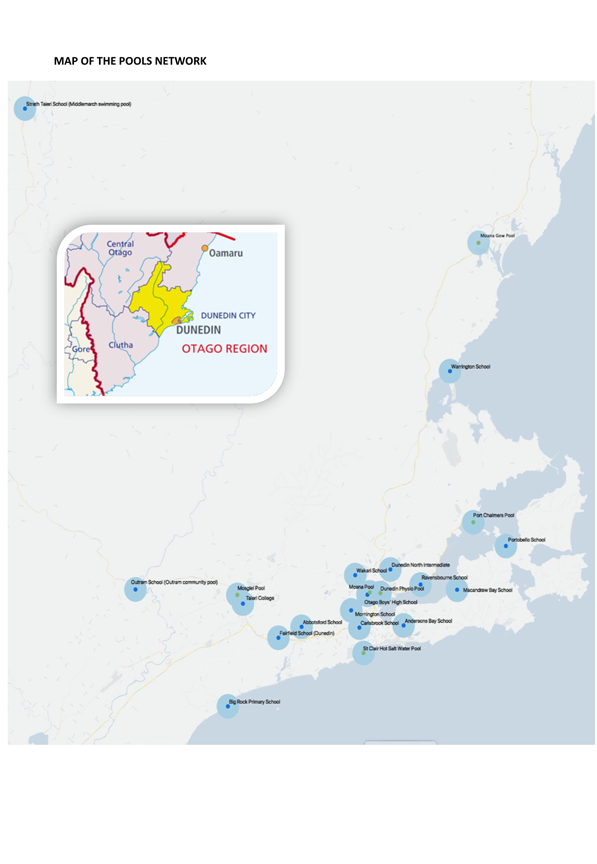
|

|
Council
22 February 2023
|
Sports Facilities Review
Department: Parks and Recreation
EXECUTIVE SUMMARY
1 Parks
and Recreation Services (PARS) has completed a review (The Review) of Dunedin
City Council’s (DCC) indoor and outdoor sports facilities (excluding
aquatic facilities) to understanding the current state and level of provision
of DCC’s indoor and outdoor sport and recreation facilities.
2 The
Review included engagement with mana whenua, sports organisations, sports
clubs, sport and recreation stakeholders and the wider Dunedin community.
3 The
Review identified that DCC currently provides sufficient outdoor sports
facilities per population in comparison to similar metro councils, when
benchmarked using the “Yardstick” tool, a universally accepted
ratio for provision.
4 The
constraining factors identified for the use of these outdoor facilities were
drainage and lighting for evening training in winter months. These
constraints will be addressed as part of the PARS annual greenspace capital
renewals programme.
5 The
Review identified that DCC’s provision of indoor sports facilities meets
the benchmark with the current population. Access to court space at peak
demand times is reported by some stakeholders as a constraining factor in the
growth of their sports. Netball, basketball, and futsal report that it
can be difficult securing sufficient court space during peak hours.
6 The
age and condition of both the Edgar Centre and the Dunedin Ice Stadium were
also noted as constraints for the growth of sports using these facilities.
7 Feedback
received from stakeholders was that while the playing surfaces of indoor
facilities was often adequate, other aspects like climate control could be
improved.
8 Sport
Otago, on behalf of Sport New Zealand, is developing an Otago
Regional Spaces and Places Plan which will identify levels of provision of
facilities across Otago, identify regionally important facilities, identify
gaps in provision and inform sub-regional plans.
9 The
Sports Facilities Review will be used by PARS as it works with Sport Otago in
the development of an Otago Regional Spaces and Places Plan and sub-regional
plan for Dunedin.
|
RECOMMENDATIONS
That the Council:
a) Notes the Sports Facility
Review 2022.
b) Notes that the Sports Facilities Review will be used by PARS as it works with Sport Otago in the
development of an Otago Regional Spaces and Places Plan and subsequent
sub-regional plan for Dunedin.
|
BACKGROUND
10 DCC
manages a range of indoor and outdoor sporting facilities that cater for a wide
range of formal and informal sports and recreational activities.
11 The
DCC also owns two indoor facilities that are leased out and managed by Trusts:
the Edgar Centre and the Dunedin Ice Stadium.
12 Approaches
to the DCC from sports clubs and stakeholders over time seeking support for new
or improved facilities prompted PARS to review indoor and outdoor sports
facilities.
13 The
purpose of the review was to work with stakeholders to understand current state
and future needs. This information will inform the development of a
sub-regional Sports Facilities Plan for Dunedin, that will guide future
investment.
14 The
Dunedin Gymnastics Academy submitted to the 2021-31 10-Year Plan requesting
Council builds a “fit-for-purpose and permanent gymnastic
facility/facilities for Dunedin”.
15 That
request was not supported by Council, instead, at its meeting of 31 May 2022,
Council resolved that:
|
|
Moved (Cr Carmen Houlahan/Cr Rachel Elder):
That the Council:
Requests staff
work with Sport Otago and Dunedin Gymnastics Academy and gym clubs to
investigate options to find suitable facilities for their activities in the
Sports Facilities Review Report.
Motion
carried (CNL/2021/120)
|
16 Engagement
with mana whenua and stakeholders including Sport Otago, Parafed, Special
Olympics, The Youth Council, the Access-for-All forum, various sports clubs and
codes, Dunedin Gymnastics Academy, and the wider community formed part of the
Review
17 A
total of 44 interviews were held with sports and recreation codes.
18 A
community survey was undertaken which received 525 responses.
19 Engagement
topics included current levels of provision and condition of facilities,
issues, and opportunities.
20 Ministry
of Education and Tertiary Education facilities were not included in the Review
as they will be covered in the Otago Regional Places and Spaces Plan being
developed by Sport Otago.
DISCUSSION
21 Dunedin
is part of one of the most active regions in New Zealand with many sports in
the city tracking above national trends. For the wider Otago region,
adult participation in weekly sport sits at 73%, slightly higher than the
average national weekly participation of 72%.
22 Participation
rates are across all sports, both indoor and outdoor.
23 To
measure levels of provision for outdoor sports and recreation areas, the New
Zealand Recreation Association uses the national benchmarking tool,
Yardstick.
24 The
Yardstick tool collects and compares management and user information and
produces an annual report on a range of categories.
25 Yardstick
does not provide a universally accepted ratio for provision. However,
councils can compare their provision against the peer group median and
historical trends. The peer group for Dunedin includes metro councils
such as Wellington City as well as smaller district councils like Waitomo and
Gore District.
Outdoor
Facilities
26 Sports
parks are defined as land that caters for publicly available organised sports
activities (that is, sports fields with associated amenities). The area
includes the surrounds to the actual sport playing area so may include
additional grass areas, carparks, access roads and garden areas.
27 Dunedin
has 53 open spaces categorised as sports parks, totalling approximately 400
hectares.
28 These
areas are adaptable and can be configured into 345 different field
configurations catering to a variety of sports. These areas include two
artificial turfs, 42 natural turfs, seven sand carpet fields and one specialist
fine turf.
29 Approximately
250 weekly games are played during the winter and summer sports seasons.
30 Dunedin
currently provides 2.6 hectares of sports parks per 1,000 residents. This
is higher than the Yardstick median in this category for both Dunedin’s
peer group (1.8 hectares) and New Zealand across all Territorial Authorities
(1.6 hectares).
31 Regarding the actual playing surfaces for
publicly available organised sports and recreation activities, Dunedin has 1.17 hectares of playing surface
per 1,000 residents. The Yardstick median in this category for both
Dunedin’s peer group and New Zealand across all Territorial Authorities
is 0.89 hectares per 1,000 residents.
32 Dunedin’s
outdoor sports facilities are well distributed across the city, with parks such
as Logan Park and the Kensington Oval providing for a larger volume of
participants and multiple codes to be played at the same time.
33 These
indicators show that there is capacity to create more playing surfaces for
publicly available organised sports and recreation activities in Dunedin if
required as there is 1.43 hectares of sports parks per 1,000 residents with
potential for development.
34 Stakeholders
and sports park users interviewed and surveyed during the engagement phase
reported that drainage and provision of lighting during winter for evening
trainings were constraining factors in the growth of their sports.
35 PARS
engaged the New Zealand Sports Turf Institute to undertake condition audits of
Dunedin’s sports fields.
36 A
programme of upgrades and improvements to the playing surfaces, based on
recommendations from the condition audits is being delivered as part of the
PARS annual greenspace capital renewals programme.
37 Capital
provision has been made in the PARS draft 2023/24 budget (subject to approval)
of $536,000 to improve outdoor sports facilities. This will include
drainage and irrigation upgrades, playing surface improvements, field lighting
and sports equipment (goals, posts, etc).
38 Upgrades
for the 2023/24 year are proposed at Seddon Park, North Ground, Bishopcourt
(fields 4 and 5) and Ocean Grove.
Indoor
Sports Venues
39 DCC
owns, or has an active involvement in, several indoor sports venues. The
largest are the Edgar Centre and the Dunedin Ice Stadium, which are owned by
DCC, with their management leased out to Trusts. DCC also owns the
Caledonian Memorial Gymnasium and the Mosgiel Memorial Park Gymnasium.
40 The
Edgar Centre is a single-level building which has approximately 16,800 m2
of floor space across two indoor areas. The facility provides for several
sports including tennis, netball, basketball, futsal, roller derby and
handball. The Edgar Centre is the only indoor sports facility that has
multiple courts available for public use. Demand is greatest during
weekdays during the hours of 4.00 pm though to 9.30 pm, with minimal demand
during the hours of 8.00 am to 4.00 pm. This is primarily due to sports
participants working or studying during the day.
41 The
Caledonian Gymnasium is a multi-purpose recreational facility with a floor area
of approximately 806 m2. The ground floor is mainly
occupied by a large entrance foyer with toilet and changing room facilities to
either side. The first floor contains one full-sized basketball court,
office space, self-catering kitchen facilities and medical treatment
facilities, along with tiered seating for approximately 320 spectators.
Court markings provide for both basketball and netball on a sprung wooden
floor.
42 The
Mosgiel Memorial Gymnasium is a multi-purpose recreational facility located in
Mosgiel Memorial Park. The building has a floor area of 957 m2
with space for one basketball court and three badminton courts on a sprung
wooden floor. The building has a kitchen, meeting room, storage, and a
toilet upstairs, and at the end of the basketball court. Tiered seating
for over 100 spectators, changing rooms, including for referees, and
toilets and showers are also available in the building.
43 The
Dunedin Ice Stadium houses both an ice hockey rink and a curling rink.
The stadium has seating for up to 1,850 people. The facility is used for
ice hockey, curling, figure skating and public ice skating, and is the home
venue of the Dunedin Thunder ice hockey team.
44 The
age and condition of both the Edgar Centre and the Dunedin Ice Stadium were
noted as constraints for the growth of sports using these facilities.
45 A
common theme identified in stakeholder engagement was that while the courts or
playing surfaces of the indoor facilities was often seen as adequate.
Inadequate heating and condensation in the facilities was an issue for both
athletes and spectators.
46 Issues
with the changing rooms were also identified as an area where improvements and
upgrades were required.
47 Another
issue affecting both the Edgar Centre and the Ice Stadium is the potential
impacts sea level rise and associated natural hazards may have on the medium to
long term viability (30-50 years and beyond) of these facilities.
48 Metrics
for indoor sports facility provision are provided by Sport New Zealand.
49 Sport
New Zealand’s indoor sports facility (court) benchmark is 1 court per
9,000 people in metropolitan areas. Dunedin has 15 indoor courts in total
(excluding school courts), so currently meets this benchmark.
50 While
Dunedin has sufficient court capacity for the population, access to court space
at peak times is reported by stakeholders as a constraining factor in the
growth of their sports. Netball, basketball, and futsal all report that
it can be difficult securing sufficient court space during peak hours.
51 PARS
will continue to work closely with the Edgar Centre management to identify
opportunities to optimise court space during off-peak times. This could
include investigation into more efficient use of the facility such as
increasing the number of sprung wooden floors from the current seven to
accommodate increasing demand, however this comes at the cost of reducing the
number of other playing surfaces at the facility.
52 Upgrading
outdoor facilities to provide alternate all-weather options, such as covering
some tennis courts at Logan Park could be investigated which would allow
reallocation of space at the Edgar Centre.
53 Similarly,
sports or team training could be moved to new outdoor covered artificial
surface training facilities. Increasing floor space at existing
facilities by revisiting earlier redevelopment proposals could also be
considered.
54 These
type of investigations into efficiency of usage will be part of the development
of a Sports Facilities sub-regional plan.
Growth and Demand
55 The
population for Dunedin is projected to grow to 142,671 by 2043. To estimate
demand for sport and recreation facilities for the Dunedin population, data and
projections used for the 2021 Long Term Plan Significant Forecasting
Assumptions and the projected growth has been used as a basis.
|
Dunedin
residents
|
2018
|
2022
|
2043
|
Change between 2018 and 2043
|
|
0-14
|
20,501
|
20,775
|
19,817
|
-684
|
|
15-24
|
28,558
|
27,926
|
27,774
|
-784
|
|
25-64
|
60,368
|
61,521
|
60,442
|
75
|
|
65 plus
|
21,093
|
23,962
|
34,637
|
13,545
|
|
Total
|
130,520
|
134,184
|
142,671
|
12,151
|
56 While
the total population will increase by 12,151, the number of people under 24 is
projected to decrease, those 25-64 will have a minor increase, and the number
of people aged over 65 years will account for much of the population
growth.
57 New
population projections were released by Statistics New Zealand in December
2022. These suggest that Dunedin’s growth will be slower than
previously expected, however they retain the projected trends of a decrease in
residents aged under 25 and a significant increase in residents aged 65 plus.
58 Population
changes need to be considered alongside participation trends. Dunedin is
part of one of the most active regions in New Zealand, with some sports
(futsal, basketball, netball, volleyball for younger people and cycling/biking,
tennis, badminton, and bowls, for older people) in the city tracking above
national trends. For the wider Otago region, adults spend about 5.9 hours
per week participating in sport and active recreation which is significantly
higher than the national average of 5.2 hours.
59 Young
people spend about 12.6 hours which is also above the national average of 11
hours. Adult participation in weekly sport sits at 73%, slightly higher than
the average national weekly participation of 72%. Young people have 99% weekly
participation which is significantly higher than the national average of 94%.
60 Female
participation is increasing in many sports. Additional changing room facilities
must provide space for both men’s teams and women’s teams to participate.
61 Despite
Dunedin being part of one of the most active regions in New Zealand, research
shows that almost all sports reported a drop in participation between
2011-2019, with only football/ soccer having an increase in participation (1%).
62 Reasons
for the decline in participation include the trend away from organised sport,
with an increase in gym/fitness centre memberships and a move to casual games.
Many respondents said they want more opportunities for casual sports where they
can turn up and play without the need to book in advance.
63 School
data shows the 10 sports with the highest participation are:
|
Basketball
|
17.3%
|
|
Rugby
|
15.6%
|
|
Volleyball
|
13.5%
|
|
Netball
(outdoor)
|
11.8%
|
|
Football
(outdoor)
|
11.1%
|
|
Futsal
|
10.5%
|
|
Touch Rugby
|
9.6%
|
|
Hockey
(outdoor)
|
8%
|
|
Athletics
(track and field)
|
7.5%
|
|
Cricket
(outdoor)
|
6.7%
|
64 This
corresponds with life stages data from Sport New Zealand which states the main
sports associated with younger age groups were Basketball, Gymnastics, Netball
(outdoor), Volleyball and Football (outdoor).
65 The
top three popular sports for school age females were netball (outdoor),
volleyball and basketball. For school aged males, the top three were
rugby, basketball, and football (outdoor).
66 Futsal,
basketball, netball, and volleyball have been reporting growth, or report that
growth would be achievable if other factors were addressed. This includes
making improvements to the condition of facilities and providing more court
space.
67 While
the number of people under 24 will decrease slightly, the increase in numbers
participating in basketball, volleyball, gymnastics, and futsal is likely to
offset the population changes.
68 For
the older age groups the highest participation sports are cycling/biking,
tennis, badminton, and Bowls (Outdoor and Lawn). There may be a need for
future provision of indoor space for badminton and possibly covered tennis
courts. However, many older people have the advantage of being able to
access the indoor spaces at off peak times of the day which will result in
better utilisation of existing indoor facilities.
Otago
Regional Spaces and Places Plan
69 Sport
Otago, on behalf of Sport New Zealand, is developing an Otago Regional Spaces
and Places Plan which will identify levels of provision of facilities across
Otago, identify regionally important facilities, identify gaps in provision and
inform sub-regional plans.
70 In
parallel, Sport New Zealand is updating its facilities investment tool, which
will help local authorities with their sport and recreational facilities
investment decisions.
71 ‘Hub
and Spoke’ model will be considered through the work with Sport
Otago. The Edgar Centre at the centre would act as the ‘Hub’
and other new or improved facilities acting as ‘Spokes’ supporting
the Hub. These spokes help to spread out sport participation across
Dunedin instead of putting traffic and court space pressure on one
centre. The sub-regional plan and indoor court strategy will consider the
accessibility of facilities with a Zero Carbon perspective.
Dunedin
Gymnastics Academy
72 Gymnastics
in Dunedin is a sport which is reporting strong growth. The Dunedin
Gymnastics Academy (DGA) is the largest gym club (by membership) in Dunedin.
73 DGA
currently occupies two commercial lease facilities. DGA report that the
facilities are no longer suitable for a range of reasons.
74 PARS
has no facilities available of the size required by DGA, without displacing
other user groups. One option being explored is for DCC to provide a
suitable “green-fields” site and DGA to build a facility (subject
to DGA securing funding). Discussions around that option are progressing
favourably and if both party’s due diligence is positive, a report will
be provided to Council at a later stage for a decision.
75 PARS
staff continue to work closely with the Dunedin Gymnastics Academy on suitable
options.
OPTIONS
76 There
are no options as this is a noting report.
NEXT STEPS
77 Staff
will continue to work with Sport Otago on the development of an Otago Regional
Places and Spaces Plan.
78 Following
the development of the Otago Regional Spaces and Places plan, PARS will
commence drafting a comparable sub regional plan for Dunedin, incorporating Zero
Carbon considerations. The sub-regional plan for Dunedin will guide
future sports facility investment decisions.
79 Staff
will continue to work with the Dunedin Gymnastics academy in identifying a
suitable option for a gymnastics facility and if required, bring a report back
to Council for a decision.
Signatories
|
Author:
|
Scott MacLean - Group Manager Parks and Recreation
John Brenkley - Planning and Partnerships Manager
|
|
Authoriser:
|
Simon Pickford - General Manager Community Services
|
Attachments
There are no attachments
for this report.
|
SUMMARY OF CONSIDERATIONS
|
|
Fit with purpose
of Local Government
Sports facilities promote and encourage
the social well-being of communities in the present and for the future.
|
|
Fit with strategic
framework
|
|
Contributes
|
Detracts
|
Not applicable
|
|
Social Wellbeing Strategy
|
☒
|
☐
|
☐
|
|
Economic Development Strategy
|
☒
|
☐
|
☐
|
|
Environment Strategy
|
☒
|
☐
|
☐
|
|
Arts and Culture Strategy
|
☐
|
☐
|
☒
|
|
3 Waters Strategy
|
☐
|
☐
|
☒
|
|
Spatial Plan
|
☒
|
☐
|
☐
|
|
Integrated Transport Strategy
|
☐
|
☐
|
☒
|
|
Parks and Recreation Strategy
|
☒
|
☐
|
☐
|
|
Other strategic projects/policies/plans
|
☐
|
☐
|
☒
|
Provision and development of sports and active recreation
facilities contribute to a number of strategies. Sport and active recreation
is acknowledged to contribute to wellbeing, the economy and getting people
active.
|
|
Māori Impact
Statement
Mana whenua were engaged in the development of the Sport
Facilities Review 2022.
|
|
Sustainability
There are opportunities to improve, over time, the
environmental impact of existing and new sports and active recreation
facilities. Development of existing and new facilities that recognises sport
and active recreation trends in sports participation provides an opportunity
to contribute positive social outcomes through increased participation.
|
|
LTP/Annual
Plan/Financial Strategy/Infrastructure Strategy
There are no implications.
|
|
Financial
considerations
This is a noting report only. There are no financial
considerations. Improvements being made to sports and recreation
facilities are from within existing budgets.
|
|
Significance
This decision is considered low in terms of
Council’s Significance and Engagement Policy.
|
|
Engagement –
external
External engagement was held with Aukaha, Sport Otago,
Sports facility providers (The Edgar Centre, Ice Stadium), High Performance
Sport NZ, Dunedin Venues Limited, various sport and active recreation
national governing bodies, Halberg Disability Sport Foundation, Parafed
Otago, Blind Sport, Special Olympics, Dunedin Gymnastics Academy, University
of Otago sport and recreation academics, Unipol, Otago University Students
Association, Otago Regional Council, Ministry of Education, Dunedin Amenities
Society and members of the Public.
|
|
Engagement -
internal
Internal engagement was held with Communications and
Marketing, Events and the Youth Council.
|
|
Risks:
Legal/Health and Safety etc.
There are no risks identified with the recommended option.
|
|
Conflict of Interest
There are no known conflicts of interest.
|
|
Community Boards
There are indoor and outdoor sports facilities in every
Community Board area. This report will be of interest to all Boards.
|
|
|
Council
22 February 2023
|
Unsealed Road Maintenance - Dust Suppression
Department: Transport
EXECUTIVE SUMMARY
1 This
report describes how DCC currently manages and funds dust suppression on
unsealed roads and presents to Council different funding options to continue
the delivery of dust suppression.
|
RECOMMENDATIONS
That the Council:
a) Notes that Dunedin City Council will replace the current bio-oil
dust suppression with Otta sealing.
b) Considers how to fund dust suppression activities
on unsealed roads.
|
BACKGROUND
2 Airborne
dust from unsealed roads can cause negative issues for residences. Dust may
settle on roofs and enter rainwater collection systems, be blown in open
windows and doors, and/or soil washing on clothes lines.
3 Dust
can be harmful to human health by causing skin irritation, eye irritation and
have adverse effects on the respiratory system.
4 Recycled
motor oil is an effective dust suppressant for unsealed roads. The gravel absorbs the oil, preventing the dust from
becoming airborne. Supply of this product is plentiful and inexpensive.
5 Recycled
motor oil was used by the Dunedin City Council (DCC) as a dust suppressant up
to and including the 2019/2020 financial year. The cost of the recycled oil and
its application was approximately $110,000/year.
6 Updates
to the Otago Regional Council Regional Plan: Waste for Otago (the Waste Plan)
were made in 2022, which changed using recycled motor oil for dust suppression
from a permitted (but discouraged) activity, to a prohibited activity.
7 DCC
stopped using recycled motor oil in 2020 before the adoption of the Waste Plan
changes.
8 Dust
suppression is not subsidised by Waka Kotahi and is currently funded through
Transport operational budgets. The yearly budget for dust suppression is
$110,000 (2022/23 and 2023/24).
9 Staff
maintain a Dust Suppression Register, which lists the locations where dust
suppression is applied. The DCC website outlines the process for residents to
apply for dust suppression outside their property (refer Attachment A). The requests must be made before 30 September each
year. Treatment is generally applied once a year at the beginning of
summer (before the driest weather of the year).
10 There
are 159 locations currently registered. 145 locations serve a single
adjacent residence. 13 locations serve multiple adjacent residences (121
residences in total across the 13 locations). The remaining location is a
DCC-owned urban access track at Tahuna Park, which is next to the Dunedin
Holiday Park.
11 The
current register includes 22.75km of road length or 94,440m² of dust
suppression.
DISCUSSION
12 There
are several non-petroleum products for dust suppression in the New Zealand
market. The products are proprietary and can include
resins, tall oil emulsions, molasses, hygroscopic chemicals, animal fats, and
vegetable oils. The industry refers to these as
‘bio-oil’.
13 Staff
have conducted two years of bio-oils trials. The trials have been used to
assess the ongoing cost to deliver dust suppression services. No
bio-oil has been proven to be as effective in suppressing dust as recycled
motor oil. Recycled motor oil last longer and is better at binding dust into
the pavement.
14 The
cost of undertaking bio-oil dust suppression was $386,890 in the 2020/21
financial year, and $388,821 in 2021/22 against a yearly budget of $110,000.
The overspend for these years was managed by underspends in other transport
maintenance activities.
15 The
2022/23 forecast cost is $540,000, due to increased costs for procuring bio-oil
products.
16 Due
to increasing costs to deliver dust suppression activities, staff have
considered alternative options as Transport operational budgets are no longer
able to absorb the increased costs to deliver this service.
17 An
alternative method for dust control on unsealed roads is ‘Otta
Sealing’. This option can provide asset and amenity level-of-service
improvement. Otta sealing involves the application of sprayed bitumen-emulsion
and spread crushed aggregate.
18 The
approximate financial costs of the different dust suppression activities are:
a) Bio-Oil $4-5/m2
b) Otta
Seal $15-20/m2
c) Recycled
Oil (no longer used) $1.15/m2
19 The
cost of Otta sealing is approximately four times that of applying bio-oil dust
suppressant, however Otta seal lasts longer (approximately five years and often
more). Otta sealing typically has a lower overall lifecycle cost than applying
bio-oil dust suppressant each summer.
20 An
Otta seal provides year-round benefit as a dust suppressant, whereas the
effectiveness of bio-oil decreases after 3 months from application.
21 Staff
were interested to progress with this option and consulted with neighbouring
Councils to see how dust suppression was managed in their area. A summary
is as follows:
|
Council
|
Product
|
Funding
|
|
Waitaki District Council
|
Otta sealing on request
|
100% funded by resident
|
|
Clutha District Council
|
Otta sealing on request
|
50% funded by resident
|
|
Central Otago District Council
|
Bio-oil and Otta sealing
|
100% funded by ratepayers
|
|
Southland District Council
|
Otta sealing on request
|
50% by resident + $65
application fee
|
22 Other
neighbouring Councils have, or are in the process of, moving away from bio-oil
application to Otta sealing due to the lower lifecycle cost.
23 The
Councils consulted also indicated a reduction in the amount of dust suppression
activities when cost-sharing arrangements are implemented. Many residents elect
not to meet the funding requirements to continue their dust suppression.
24 Staff
plan to transition from bio-oil application on unsealed roads to Otta sealing
because it provides year-round dust suppression at a lower overall lifecycle
cost.
25 To
spread the higher upfront cost of applying an Otta seal (approximately four
times greater than bio-oil), staff will transition to Otta seals over a four to
five year period (based on the recommended option). This would mean some
residents who receive dust suppression will receive bio-oil for up to five
years.
26 The
savings from transitioning to Otta sealing will start to be realised
approximately four years into the transition when all of the dust suppression
sites had been Otta sealed. Savings are estimated to be $80,000 per annum
at current demand for dust suppression. This does not account for any
drop (or increase) in demand.
Community Board Consultation
27 The
majority of unsealed road dust suppression is covered by Community Board areas
(refer Appendix D for further detail). Community Boards were asked for
feedback on funding options in late 2022. Their feedback is summarised as
follows:
|
Community Board
|
Support for Cost
Sharing Options
|
|
50% funded by
applicant
|
0% funded by
applicant
|
100% funded by the
applicant
|
|
Mosgiel-Taieri
|
|
ü
|
|
|
Otago Peninsula
|
|
ü
|
|
|
Saddle Hill
|
ü
|
|
|
|
Strath Taieri
|
|
ü
|
|
|
Waikouaiti Coast
|
|
ü
|
|
|
West Harbour
|
ü
|
|
|
OPTIONS
28 Four
options are presented to Council to consider to maintain the delivery of
unsealed road dust suppression.
Option
One (Recommended) – Applicants fund 50% of the $540,000 cost of dust
suppression
29 This
option is to implement a 50/50 cost share of bio-oil and/or Otta sealing dust
suppression between an applicant and the DCC, sharing equally $270,000 of the
yearly cost.
30 The
applicant and DCC will assess and agree the area of suppression, after which
staff will quote the cost to the applicant (50% of the total cost).
Typical costs to an applicant for a 100m long application would be
approximately $750-$1,500 per year. The applicant can accept (or reject)
the quote before DCC contractors apply the dust suppressant.
Advantages
· DCC
operational budgets for dust suppression will be shared amongst a greater
number of applicants compared to Option 2.
· Residents
receive 50% subsidised dust suppression outside their dwelling.
· Those
directly benefitting from dust suppression will be contributing to the
cost.
Disadvantages
· Approximately
260 households will incur half the cost for dust suppression (if they opt in).
· Dust
suppression activities could be difficult to administer on roads with multiple
dwellings. 100m long sections of application will ‘overlap’.
Disagreements could arise between neighbouring properties and these may need to
be mediated by Staff.
· Dust
nuisance issues will occur for those residents who chose not to fund dust
suppression activities.
· Staff
time to administer the Dust Suppression Register and coordinate the works with
residents will increase
· Increased
budget of $160,000 will be required to fund dust suppression activities.
Option
Two – Status Quo – DCC Fund 100% of dust suppression activities
within the existing budget of $110,000.
Advantages
· Residents
receive fully subsidised dust suppression outside their dwelling.
· There
is no increase to Transport operational budgets.
Disadvantages
· There
would be a reduction in the amount of dust suppression undertaken.
· Funding
for bio-oil and Otta sealing dust suppression is subsidised by all rate payers,
of whom the majority will not receive benefits from it.
· Dust
suppression activities will be difficult to administer. Staff will be
required to administer which residents do and do not receive dust suppression.
Disagreements are likely and these will need to be mediated by Staff.
· Staff
time to administer the Dust Suppression Register will increase.
Option
Three – DCC Fund 100% of existing dust suppression activities at a cost
of $540,000.
31 This
option will require Transport operational budgets to be increased by $430,000,
which would be needed to continue the existing dust suppression
activities.
Advantages
· Residents
receive fully subsidised dust suppression outside their dwelling.
· Staff
time to administer the Dust Suppression Register will remain neutral.
Disadvantages
· Funding
for bio-oil and Otta sealing dust suppression is subsidised by all rate payers,
of whom the majority will not receive benefits from it.
· An
increased budget of $430,000 would be required to fund existing dust
suppression activities.
Option
Four – Applicants fund 100% of dust suppression activities
32 This
option would require applicants to fund 100% of bio-oil and/or Otta sealing
dust suppression.
33 The
applicant and DCC will assess and agree the area of suppression, after which
staff will quote the cost to the applicant (100% of the total cost).
Typical costs to an applicant for a 100m long application would be
approximately $1500-$2,500 per year. The applicant can accept (or reject)
the quote before DCC contractors apply the dust suppressant.
Advantages
· DCC
funding for dust suppression would cease, which would provide a $110,000 per
annum Transport operational budget saving.
· The
cost of dust suppression is paid for by those who directly benefit from it.
Disadvantages
· Approximately
260 households will incur the full cost for dust suppression (if they opt in).
· Dust
suppression activities could be difficult to administer on roads with multiple
dwellings. 100m long sections of application will ‘overlap’.
Disagreements could arise between neighbouring properties that may need to be
mediated by Staff.
· Staff
time to administer the Dust Suppression Register and coordinate the works with
residents will increase
· Dust
nuisance issues will occur for those residents who chose not to fund dust
suppression activities
NEXT STEPS
34 Staff
will transition dust suppression activities from bio-oil to Otta
sealing. The transition period will vary depending on the decision
of Council.
35 The
draft Transport budget will be updated to reflect the decision of Council
36 Staff
will develop clear guidelines for dust suppression implementation to
communicate to applicants how the dust suppression process is managed.
Signatories
|
Author:
|
Ben Hogan - Transport Delivery Manager
|
|
Authoriser:
|
Simon Drew - General Manager Infrastructure and
Development
|
Attachments
|
|
Title
|
Page
|
|
⇩a
|
DCC Website Snip
|
78
|
|
⇩b
|
Clutha District Council
Website
|
79
|
|
⇩c
|
Central Otago Council
Website
|
80
|
|
⇩d
|
Area of Dust
Suppression Activity by Community Board area
|
81
|
|
SUMMARY OF CONSIDERATIONS
|
|
Fit with purpose
of Local Government
This decision enables democratic local
decision making and action by, and on behalf of communities.
|
|
Fit with strategic
framework
|
|
Contributes
|
Detracts
|
Not applicable
|
|
Social Wellbeing Strategy
|
☐
|
☐
|
☒
|
|
Economic Development Strategy
|
☐
|
☐
|
☒
|
|
Environment Strategy
|
☐
|
☐
|
☒
|
|
Arts and Culture Strategy
|
☐
|
☐
|
☒
|
|
3 Waters Strategy
|
☐
|
☐
|
☒
|
|
Spatial Plan
|
☐
|
☐
|
☒
|
|
Integrated Transport Strategy
|
☒
|
☐
|
☐
|
|
Parks and Recreation Strategy
|
☐
|
☐
|
☒
|
|
Other strategic projects/policies/plans
|
☐
|
☐
|
☒
|
The Integrated Transport Strategy prescribes Dunedin as
having an integrated, affordable, responsive, effective, and safe transport
network for all modes. This report presents options for funding dust
suppression activities.
|
|
Māori Impact
Statement
Mana whenua have not been
consulted with in the preparation of this report.
|
|
Sustainability
Waste oil use has already ceased, which has eliminated an
environmental concern with dust suppression activities.
If dust suppression activity is reduced, there will be
increased airborne dust on unsealed roads adjacent to properties that once
received dust suppression.
|
|
LTP/Annual Plan /
Financial Strategy /Infrastructure Strategy
The financial implications for this Annual Plan decision
are set out in the report. The impact on rates will depend on the option
adopted.
|
|
Financial
considerations
The financial implications of this decision are set out in
the report.
|
|
Significance
This decision is considered low in terms of the Council's
Significance and Engagement Policy.
|
|
Engagement –
external
Other neighbouring Councils were consulted in the
preparation of this report.
|
|
Engagement -
internal
Parks and Recreation, and the Transport Department were
engaged in the development of this report.
|
|
Risks: Legal /
Health and Safety etc.
There are health risks associated with breathing airborne
dust. However, the DCC are not proposing to stop dust suppression, but
consider the way in which the service is maintained.
|
|
Conflict of
Interest
There is no known conflict of interest.
|
|
Community Boards
Community Boards were consulted in the preparation of this
report.
|
|
|
Council
22 February 2023
|

|
|
Council
22 February 2023
|
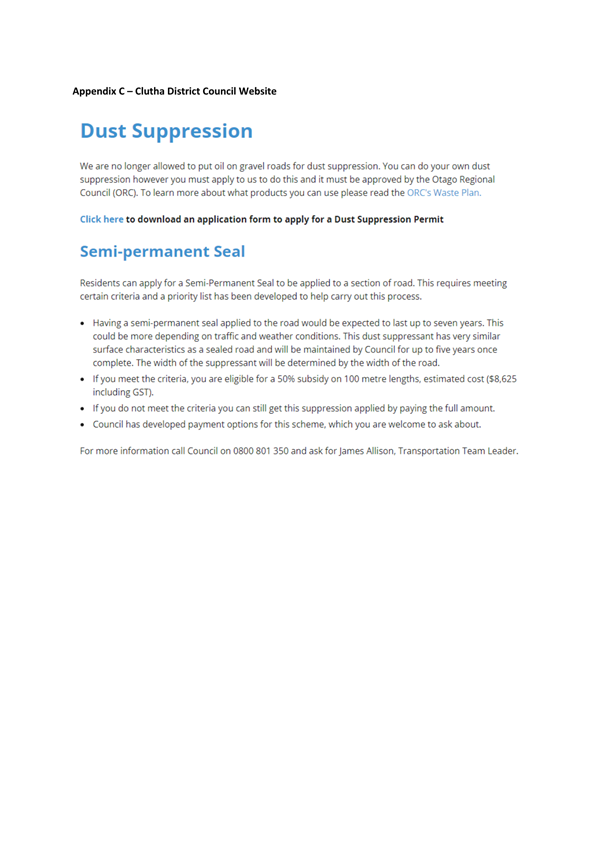
|
|
Council
22 February 2023
|
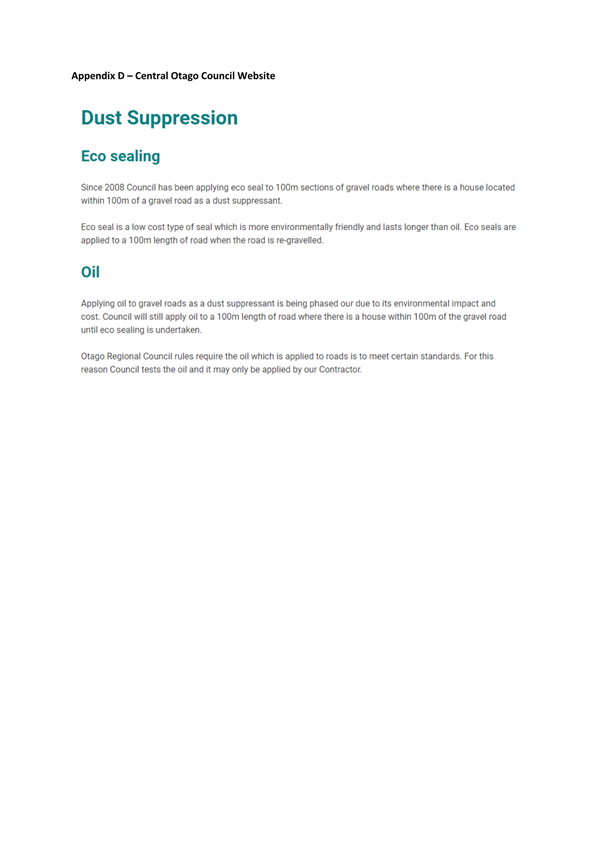
|
|
Council
22 February 2023
|