Notice of Meeting:
I hereby give notice that an ordinary meeting of the Dunedin
City Council will be held on:
Date: Tuesday
28 February 2023
Time: 10.00
am
Venue: Council
Chamber, Dunedin Public Art Gallery, The Octagon, Dunedin
Sandy Graham
Council
PUBLIC AGENDA
|
Mayor
|
Mayor Jules Radich
|
|
|
Deputy Mayor
|
Cr Sophie Barker
|
|
|
Members
|
Cr Bill Acklin
|
Cr David Benson-Pope
|
|
|
Cr Christine Garey
|
Cr Kevin Gilbert
|
|
|
Cr Carmen Houlahan
|
Cr Marie Laufiso
|
|
|
Cr Cherry Lucas
|
Cr Mandy Mayhem
|
|
|
Cr Jim O'Malley
|
Cr Lee Vandervis
|
|
|
Cr Steve Walker
|
Cr Brent Weatherall
|
|
|
Cr Andrew Whiley
|
|
Senior Officer Sandy
Graham, Chief Executive Officer
Governance Support Officer Lynne
Adamson
Lynne Adamson
Governance Support Officer
Telephone: 03 477 4000
Lynne.Adamson@dcc.govt.nz
www.dunedin.govt.nz
The meeting
will be live streamed on the Council’s YouTube page: dunedin
city council - YouTube
Note: Reports
and recommendations contained in this agenda are not to be considered as
Council policy until adopted.
|

|
Council
28 February 2023
|
ITEM TABLE OF CONTENTS PAGE
1 Opening 4
2 Public
Forum 4
3 Apologies 4
4 Declaration
of Interest 5
5 Confirmation
of Minutes 16
5.1 Ordinary Council
meeting - 31 January 2023 16
Reports
6 Actions
From Resolutions of Council Meetings 29
7 Forward
Work Programme for Council - February 2023 33
8 Water
Services Legislation Bill and Water Services Economic Efficiency and Consumer
Protection Bill - Submission 41
9 Future
for Local Government Review - Submission 100
10 Future
Development Strategy - Governance Arrangements 119
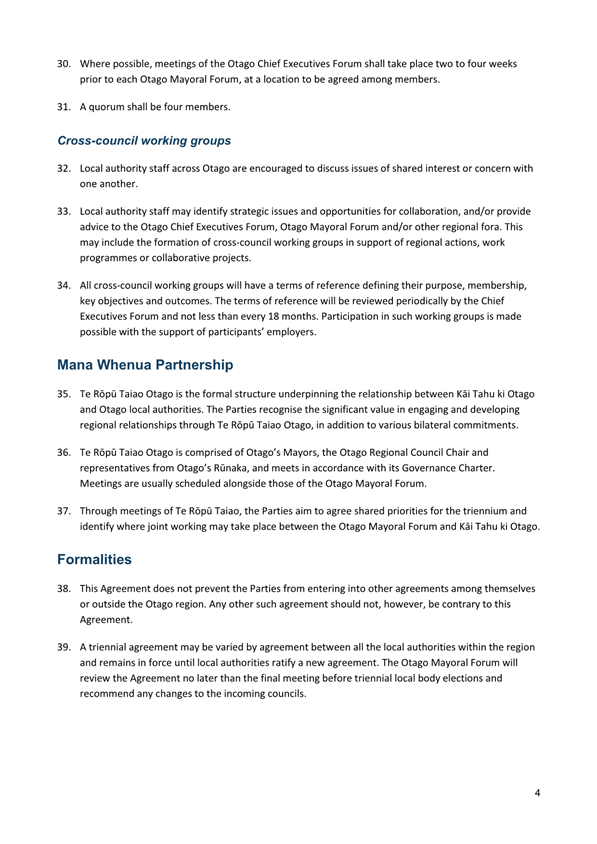
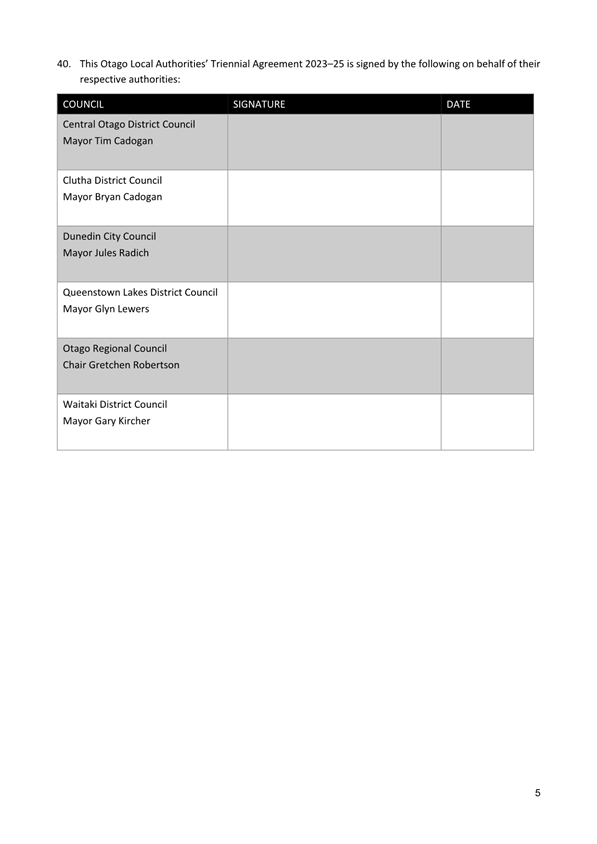
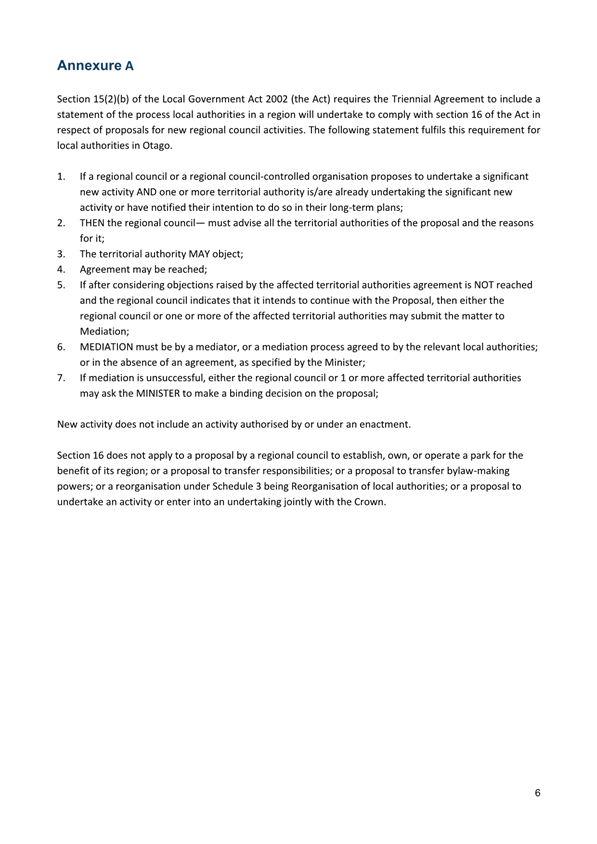
11 Triennial
Agreement 2023-2025 126
12 Appointment
of Hearing Panel for Interim Speed Management Plan 135
13 Councillor
appointments to external organisations 137
14 Proposed
Event Road Closures for March - April 2023 139
Resolution to Exclude the Public 152
|
|
Council
28 February 2023
|
1 Opening
Rev Canon Michael Wallace
(All Saints Church) will open the meeting with a prayer.
2 Public
Forum
At the close of the
agenda public forum registrations were still being taken. The speakers
will be confirmed following closure of registrations 24 hours before the
meeting starts.
3 APOLOGIES
An apology has been received from
Cr Andrew Whiley.
That the Council:
Accepts the apology from Cr
Andrew Whiley.
|

|
Council
28 February 2023
|
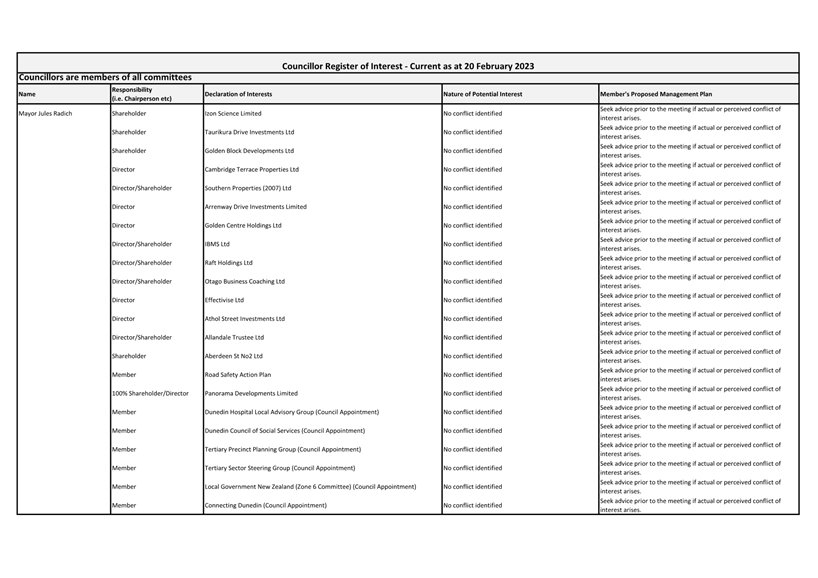
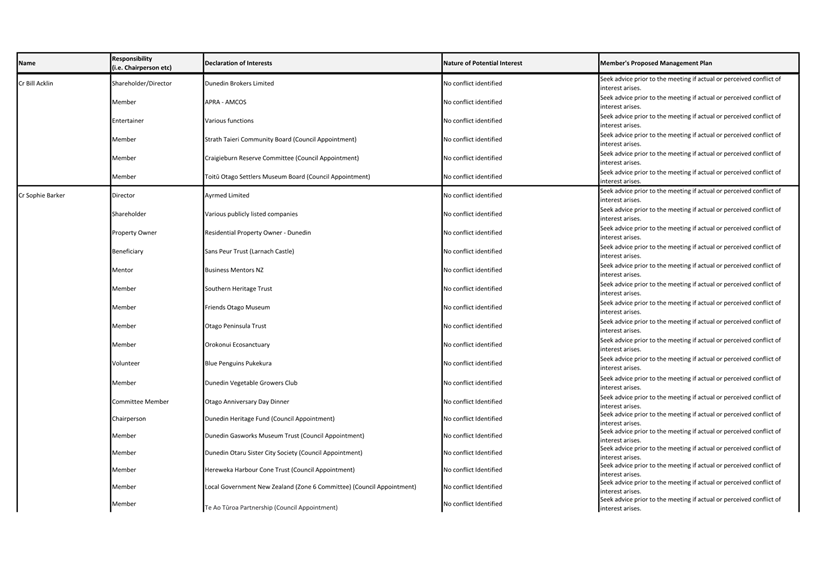
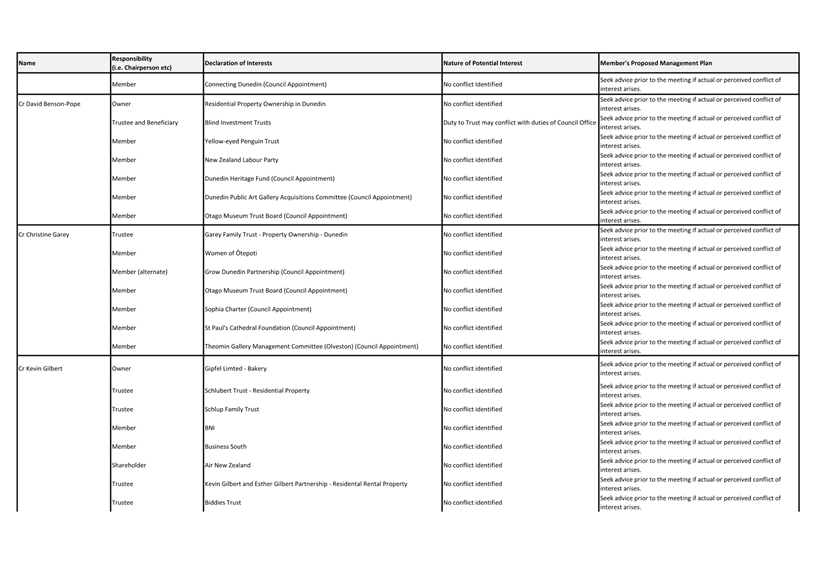
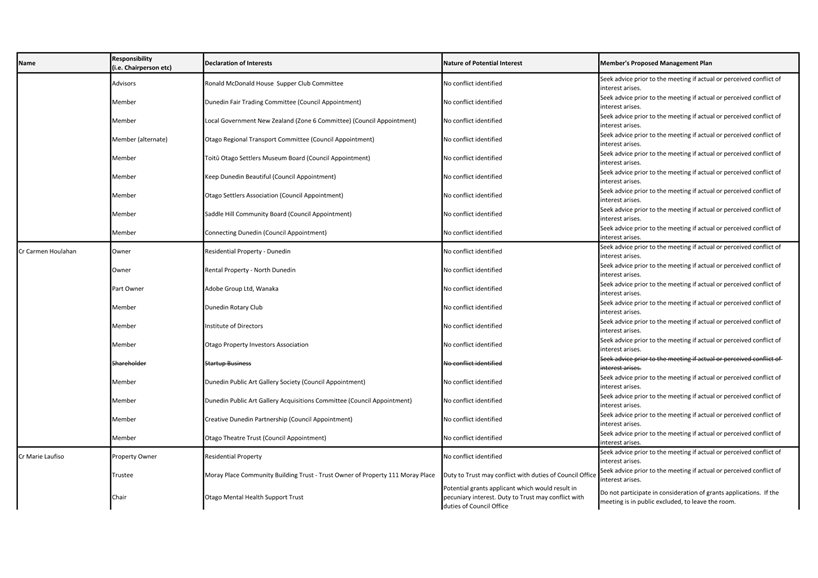
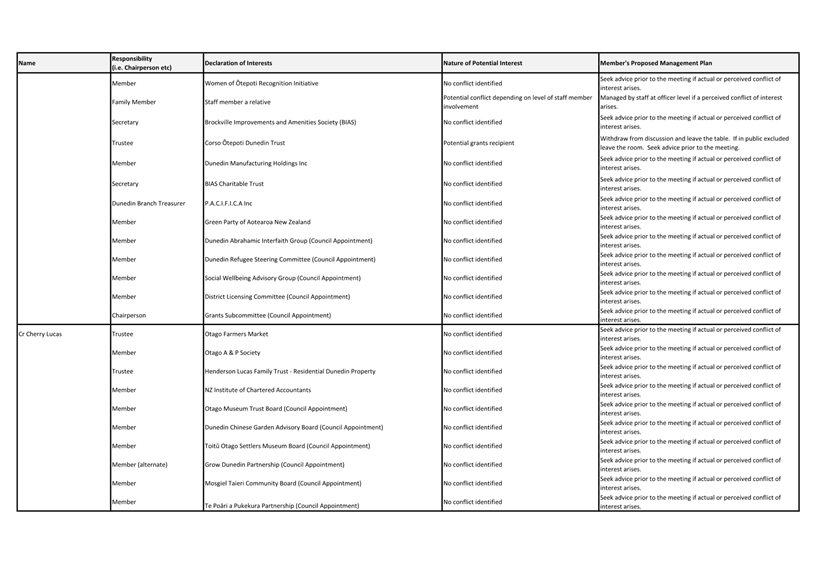
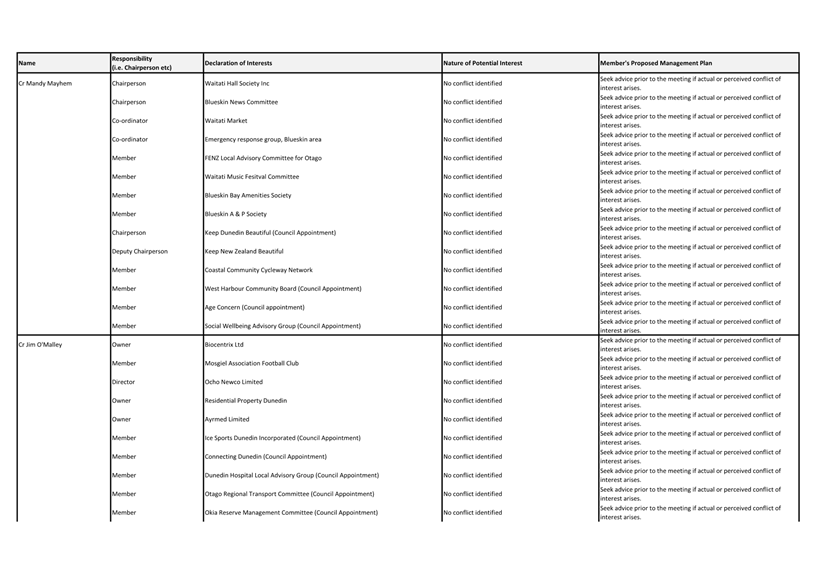
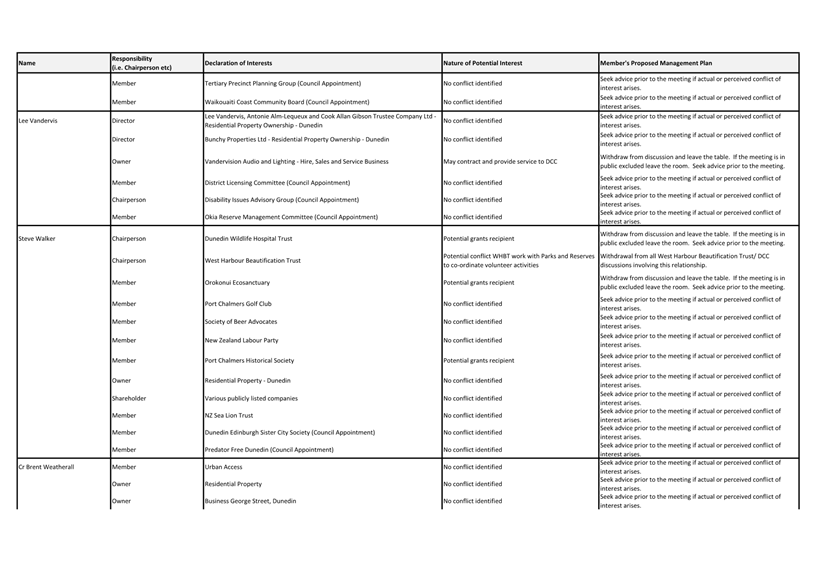
Declaration of Interest
EXECUTIVE SUMMARY
1. Members
are reminded of the need to stand aside from decision-making when a conflict
arises between their role as an elected representative and any private or other
external interest they might have.
2. Elected
members are reminded to update their register of interests as
soon as practicable, including amending the register at this meeting if
necessary.
3. Staff members are
reminded to update their register of interests as soon as possible.
|
RECOMMENDATIONS
That the Council:
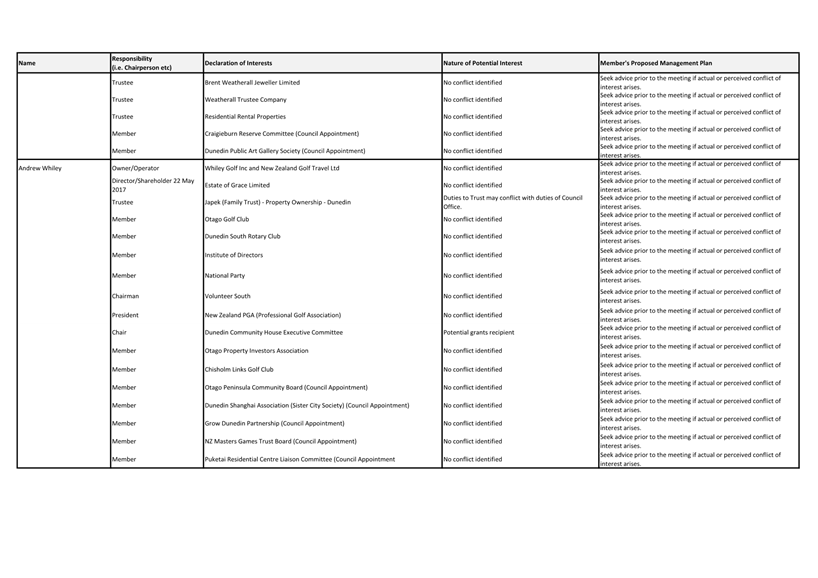
a) Notes/Amends if necessary the Elected Members'
Interest Register attached as Attachment A; and
b) Confirms/Amends the proposed management plan for
Elected Members' Interests.
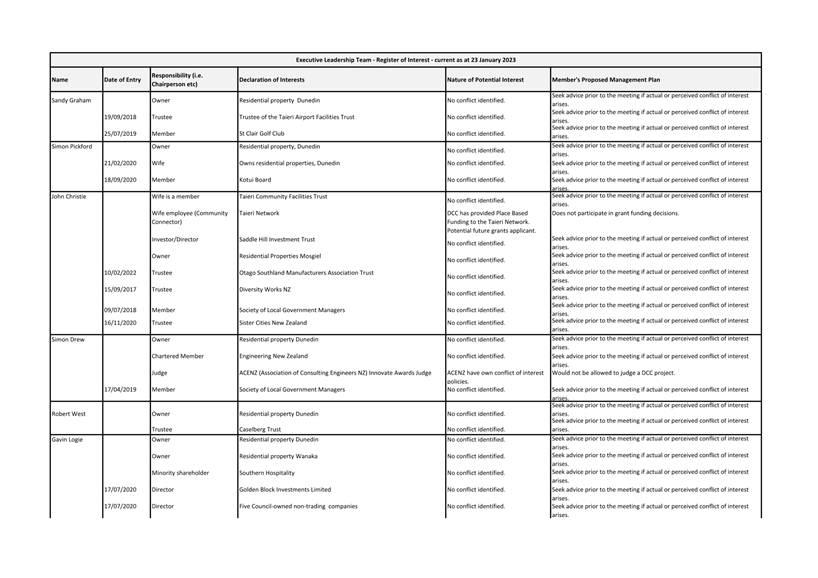
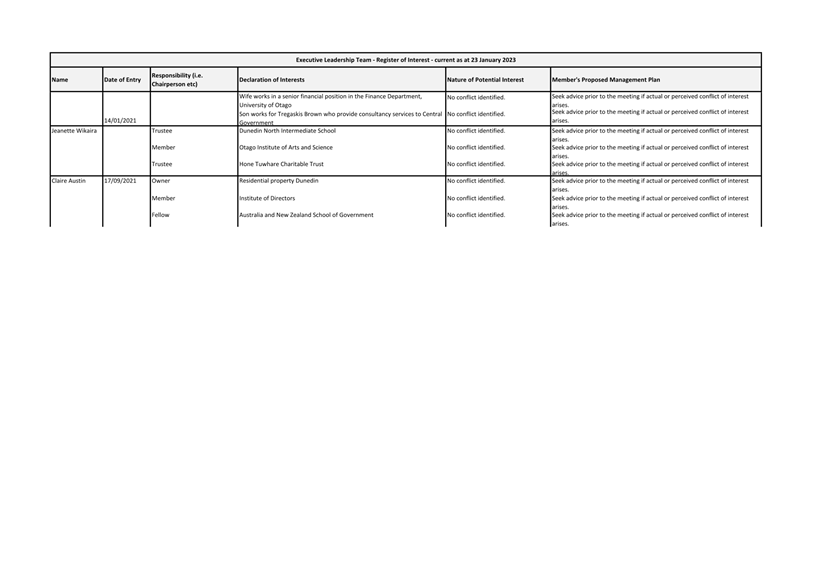
c) Notes the Executive Leadership Team Members’ Interest
Register.
|
Attachments
|
|
Title
|
Page
|
|
⇩a
|
Councillor Register of
Interest
|
6
|
|
⇩b
|
ELT Register of
Interest
|
14
|
|
|
Council
28 February 2023
|
Confirmation
of Minutes
Ordinary Council meeting - 31 January 2023
|
RECOMMENDATIONS
That the Council:
a) Confirms the public part of the minutes of the
Ordinary Council meeting held on 31 January 2023 as a correct record.
|
Attachments
|
|
Title
|
Page
|
|
A⇩
|
Minutes of Ordinary
Council meeting held on 31 January 2023
|
17
|
|
|
Council
28 February 2023
|

Council
MINUTES
Minutes of an ordinary
meeting of the Dunedin City Council held in the Council Chamber, Dunedin Public
Art Gallery, The Octagon, Dunedin on Tuesday 31 January 2023, commencing at
10.00 am
PRESENT
|
Mayor
|
Mayor Jules Radich
|
|
|
Deputy Mayor
|
Cr Sophie Barker
|
|
|
Members
|
Cr Bill Acklin
|
Cr David Benson-Pope
|
|
|
Cr Christine Garey
|
Cr Kevin Gilbert
|
|
|
Cr Carmen Houlahan
|
Cr Marie Laufiso
|
|
|
Cr Cherry Lucas
|
Cr Mandy Mayhem
|
|
|
Cr Jim O'Malley
|
Cr Lee Vandervis
|
|
|
Cr Steve Walker
|
Cr Brent Weatherall
|
|
|
Cr Andrew Whiley
|
|
|
IN ATTENDANCE
|
Sandy Graham (Chief Executive
Officer), Simon Pickford (General Manager Community Services), John Christie
(Manager Enterprise Dunedin), Simon Drew (General Manager Infrastructure and
Development), Jeanette Wikaira (Manahautū (General Manager Māori,
Partnerships and Policy)), Gavin Logie (Chief Financial Officer), Claire
Austin (General Manager Customer and Regulatory), Leanne Mash (Communications
and City Marketing Manager), Jinty MacTavish (Principal Policy Advisor), Rick
Zwaan (Senior Policy Analyst, Zero Carbon) and Clare Sullivan (Deputy
Electoral Officer), Paul Freeland (Principal Policy Advisor) and Kevin Mechen
(Alcohol Drug Gambling Advisor and Secretary, District Licensing Committee)
|
Governance Support Officer Lynne
Adamson
1 Opening
Geoff Mitchell (The Church of Jesus Christ of Latter-day
Saints) opened the meeting with a prayer.
TRIBUTE
The Mayor acknowledged the recent passing of former
Councillor and Community Board member, Maurice Prendergast.
2 Public
Forum
1.1 Public
Forum – Rachel Elder
Ms Elder tabled information on cycleways and ideas for a
Taieri Gorge Cycle Trail to connect Dunedin with Middlemarch.
Ms Elder responded to questions.
1.2 Public
Forum – Paulina Barry
Ms Barry spoke on street lighting in Port Chalmers and responded
to questions.
1.3 Public
Forum – Jo Millar
On behalf of Grey Power Otago
Inc, Ms Millar spoke about Aurora Energy.
Ms Millar responded to questions.
|
3 Apologies
|
|
There
were no apologies.
|
4 Declarations
of interest
Members were reminded
of the need to stand aside from decision-making when a conflict arose between
their role as an elected representative and any private or other external
interest they might have.
|
|
Moved (Mayor Jules Radich/Cr Steve
Walker):
That the
Council:
a) Notes the Elected Members'
Interest Register; and
b) Confirms the proposed management plan
for Elected Members' Interests.
c) Notes the Executive Leadership
Teams’ Interest Register.
Motion
carried (CNL/2023/001)
|
5 Confirmation
of Minutes
|
5.1 Ordinary
Council meeting - 13 December 2022
|
|
|
Moved (Mayor Jules Radich/Cr Kevin Gilbert):
That the Council:
Confirms the public part of the minutes of the
Ordinary Council meeting held on 13 December 2022 as a correct record with a
correction to Item 6 noting that the first resolutions was lost.
Motion
carried (CNL/2023/002)
|
RepoRts
|
6 Actions
From Resolutions of Council Meetings
|
|
|
A report from Civic provided an update on the
implementation of resolutions made at Council meetings.
|
|
|
Moved (Mayor Jules Radich/Cr Andrew Whiley):
That the Council:
Notes the Open and Completed Actions from resolutions of Council
meetings.
Motion
carried (CNL/2023/003)
|
|
7 Forward
Work Programme for Council - January 2023
|
|
|
A report from Civic provided an update on the forward work
programme.
|
|
|
Moved (Mayor Jules Radich/Cr Sophie Barker):
That the Council:
Notes the
updated Council forward work programme.
Motion
carried (CNL/2023/004)
|
Cr Carmen Houlahan left the meeting at 10.38 am.
|
8 Zero Carbon Work Programme and Dunedin Community Carbon
Footprint Update
|
|
|
A report from the
Sustainability Group provided an update on the Zero Carbon work programme.
|
|
|
The Manahautū (General Manager Māori
Partnerships and Policy), Principal Policy Advisor Sustainability (Jinty
MacTavish) and Senior Policy Analyst, Zero Carbon (Rick Zwaan) spoke to the
report and responded to questions.
|
|
Cr Carmen Houlahan returned to the meeting at 10.41 am.
Cr Carmen Houlahan left the meeting at 11.02 am and
returned at 11.05 am.
Cr Christine Garey left the meeting at 10.23 am and
returned at 11.25 am.
Cr Carmen Houlahan left the meeting at 11.39 am and
returned at 11.42 am.
|
|
|
Moved (Cr Steve Walker/Cr Christine Garey):
That the Council:
Notes
the Zero Carbon work
programme update, including updates to the Dunedin Community Carbon
Footprint.
Division
The Council voted by division
For: Crs
Bill Acklin, Sophie Barker, David Benson-Pope, Christine Garey, Kevin
Gilbert, Carmen Houlahan, Marie Laufiso, Cherry Lucas, Mandy Mayhem, Jim
O'Malley, Steve Walker, Brent Weatherall, Andrew Whiley and Mayor Jules
Radich (14).
Against: Cr
Lee Vandervis (1).
Abstained: Nil
The division
was declared CARRIED by 14 votes to 1
Motion
carried (CNL/2023/005)
|
Moved: (Mayor Jules Radich/Cr Carmen Houlahan):
That the Council:
Adjourns
the meeting.
Motion
carried
The meeting adjourned at 11.59 am and reconvened at 12.34
pm.
|
14 Financial
Result - Period Ended 30 November 2022
|
|
|
A report
from Finance provided the financial results for the period ended 30 November
2022 and the financial position as at that date.
|
|
|
The Chief Financial Officer (Gavin Logie) spoke to the
report and responded to questions.
|
|
|
Moved (Cr Lee Vandervis/Cr Cherry Lucas):
That the Council:
Notes
the Financial
Performance for the period ended 30 November 2022 and the Financial Position
as at that date.
Motion
carried (CNL/2023/006)
|
|
9 Letter
of Expectations for Dunedin City Holdings Limited and Group
|
|
|
A report from Civic provided
a draft Letter of Expectations for the Dunedin City Holdings Limited Board
for consideration.
|
|
|
The Chief Executive Officer (Sandy Graham) spoke to the
report and explained an omission of one line in the letter. She then responded
to questions.
|
|
Cr Mandy Mayhem left the meeting at 12.44 pm
|
|
|
Moved (Cr Sophie Barker/Cr Lee Vandervis):
That the Council:
a) Approves the draft Letter of Expectations to the
Board of Dunedin City Holdings Limited on behalf of the Council as
Shareholder with the addition of a statement of compliance with DCC policies.
b) Authorises the CEO to make any changes to the
Letter of Expectations following Council’s feedback.
c) Authorises the Mayor to sign the Letter of Expectations
on behalf of the Council as Shareholder.
Motion
carried (CNL/2023/007)
|
|
10 Local
Elections - Submission to 2022 local elections inquiry
|
|
|
A report from Civic and
Corporate Policy sought consideration and approval of a draft submission to
the Justice Committee’s Inquiry into the 2022 Local Elections.
|
|
|
The Manahautū (General Manager Māori
Partnerships and Policy) Jeanette Wikaira and Deputy Electoral Officer (Clare
Sullivan) spoke to the report and responded to questions.
|
|
Cr Mandy Mayhem returned to the meeting at 12.49 pm.
It was moved (Mayor Jules Radich/Cr Sophie Barker):
That the Council:
Adjourns
the meeting.
Motion
carried
The meeting adjourned at 12.54 pm and reconvened at
12.58 pm.
The Mayor advised an additional public forum presentation
would be held following this item.
|
|
|
Moved (Cr Sophie Barker/Cr Jim O'Malley):
That the Council:
a) Approves the draft Dunedin City Council
Submission to the Inquiry into the 2022 Local Elections
b) Authorises the Mayor or his delegate to speak to
the submission at Select Committee hearings
c) Authorises the Chief Executive to make any minor
editorial amendments to the submission
Division
The Council
voted by division
For: Crs
Bill Acklin, Sophie Barker, David Benson-Pope, Christine Garey, Kevin
Gilbert, Carmen Houlahan, Marie Laufiso, Cherry Lucas, Mandy Mayhem, Jim
O'Malley, Steve Walker, Brent Weatherall, Andrew Whiley and Mayor Jules
Radich (14).
Against: Cr
Lee Vandervis (1).
Abstained: Nil
The division
was declared CARRIED by 14 votes to 1
Motion
carried (CNL/2023/008)
|
PUBLIC FORUM
1.4 Public Forum
– Diane Yeldon
Ms
Yeldon acknowledged the recent passing of former Councillor and Community Board
member,
Maurice Prendergast and welcomed the Mayor and Councillors to the new
triennium.
Ms
Yeldon then spoke on the Dunedin City Council Hospital Campaign and responded
to questions.
|
11 Gambling
Act 2003 - Submission on Performance-based Class 4 Licensing
|
|
|
A report from Civic and
Corporate Policy sought approval of a draft Dunedin City Council submission
to the Department of Internal Affairs.
|
|
|
The Manahautū (General Manager Māori
Partnerships and Policy) Jeanette Wikaira and Gambling Advisor (Kevin Mechen)
spoke to the report and responded to questions on the submission.
|
|
Cr Carmen Houlahan left the meeting at 1.28 pm and
returned at 1.31 pm.
|
|
|
Moved (Cr Christine Garey/Cr Steve Walker):
That the Council:
a) Approves the DCC submission on
“Performance-Based Class 4 Licensing”.
b) Authorises the Chief Executive to make any minor
editorial amendments to the submission.
Division
The Council
voted by division
For:
Crs
Sophie Barker, David Benson-Pope, Christine Garey, Kevin Gilbert, Carmen
Houlahan, Marie Laufiso, Cherry Lucas, Mandy Mayhem, Jim O'Malley, Lee
Vandervis, Steve Walker, Brent Weatherall, Andrew Whiley and Mayor Jules Radich
(14).
Against:
Cr Bill Acklin (1).
Abstained:
Nil
The division
was declared CARRIED by 14 votes to 1
Motion
carried (CNL/2023/009)
|
|
12 Sale
and Supply of Alcohol (Community Participation) - Submission on the Amendment
Bill
|
|
|
A report from Civic and
Corporate Policy sought approval of a draft Dunedin City Council submission
to the Government’s Justice Committee on the Sale and Supply of Alcohol
(Community Participation) Amendment Bill.
|
|
|
The Manahautū (General Manager Māori Partnerships
and Policy), Jeanette Wikaira; Corporate and Secretary, District Licensing
Committee (Kevin Mechen) spoke to the report and responded to questions on
the submission.
|
|
|
Moved (Cr David Benson-Pope/Cr Jim O'Malley):
That the Council:
a) Approves the DCC submission, on the “Sale
and Supply of Alcohol (Community Participation) Amendment Bill with the
amendment that the DCC wishes to speak to the submission.
b) Authorises the Mayor or his delegate to speak to
the submission at hearings.
c) Authorises the Chief Executive to make any minor
editorial amendments to the submission.
Motion
carried (CNL/2023/010)
|
Cr Christine Garey left the meeting at 2.06 pm.
|
13 Local
Government Official Information and Meetings Bill - Submission on the
Amendment Bill
|
|
|
A report from City
Development sought consideration and approval of a draft submission to the
Governance and Administration Committee on the Local Government Official
Information and Meetings Amendment Bill.
|
|
|
The General Manager Infrastructure and Development (Simon
Drew) and Principal Policy Advisor (Paul Freeland) spoke to the report and
responded to questions on the submission.
|
|
|
Moved (Cr Bill Acklin/Cr Lee Vandervis):
That the Council:
a) Approves the draft Dunedin City Council
submission, with any amendments, on the Local Government Official Information
and Meetings Amendment Bill.
b) Authorises the Chief Executive to make any minor
editorial amendments to the submission
Motion
carried (CNL/2023/011)
|
|
15 Committee
Structure and Delegations Manual 2023
|
|
|
A report from Civic presented
the Committee Structure and Delegations Manual for formal adoption by
Council.
|
|
Cr Christine Garey returned to the meeting at 2.10 pm.
|
|
|
The Chief Executive Officer (Sandy Graham) spoke to the
report and responded to questions.
|
|
|
Moved (Cr Bill Acklin/Cr Jim O'Malley):
That the Council:
Adopts the
Committee Structure and Delegations Manual 2023 with an amendment to add the
word “sustainable” into Clause 4 of the Finance and Council
Controlled Organisations Committee delegations.
Motion
carried (CNL/2023/012)
|
Moved (Mayor Jules Radich/Cr Steve Walker):
That the Council:
Adjourns
the meeting.
Motion
carried
The meeting adjourned at 2.13 pm and reconvened at 2.23 pm.
|
16 Notice
of Motion - Dunedin Hospital
|
|
|
In
accordance with Standing Order 26.1 a Notice of Motion was received from Cr David
Benson-Pope.
|
|
|
Cr David Benson-Pope spoke to his Notice of Motion which
was then considered by Council.
|
|
|
Moved (Cr David Benson-Pope/Mayor Jules Radich):
That the Council:
a) Supports the New Dunedin Hospital being built to
the specifications in the Final Detailed Business Case approved by Cabinet,
and that the Dunedin City Council will not accept changes that reduce the
long-term capacity of the New Dunedin Hospital, or that compromise in any way
the clinical services available to residents of the city and the wider
region.
b) Seeks the commitment of all parliamentary parties to
adequately fund that work.
c) Engages with stakeholders to support this
advocacy position.
d) Commits to fund a public campaign in support of
1 – 3 above, up to $130,400 and seek support funding from other
sources.
Division
The Council voted by division
For: Crs
Bill Acklin, Sophie Barker, David Benson-Pope, Christine Garey, Kevin
Gilbert, Carmen Houlahan, Marie Laufiso, Cherry Lucas, Mandy Mayhem, Jim
O'Malley, Lee Vandervis, Steve Walker, Brent Weatherall, Andrew Whiley and
Mayor Jules Radich (15).
Against: Nil
Abstained: Nil
The division
was declared CARRIED by 15 votes to 0
Motion
carried (CNL/2023/013)
|
|
Resolution
to exclude the public
|
|
Moved (Mayor Jules Radich/Cr Steve Walker):
That the Council:
Pursuant
to the provisions of the Local Government Official Information and Meetings
Act 1987, exclude the public from the following part of the proceedings of
this meeting namely:
|
General
subject of the matter to be considered
|
Reasons
for passing this resolution in relation to each matter
|
Ground(s) under
section 48(1) for the passing of this resolution
|
Reason for
Confidentiality
|
|
C1
Ordinary Council meeting - 13 December 2022 - Public Excluded
|
S7(2)(g)
The
withholding of the information is necessary to maintain legal professional privilege.
S7(2)(h)
The
withholding of the information is necessary to enable the local authority
to carry out, without prejudice or disadvantage, commercial activities.
S7(2)(i)
The
withholding of the information is necessary to enable the local authority
to carry on, without prejudice or disadvantage, negotiations (including
commercial and industrial negotiations).
S7(2)(a)
The
withholding of the information is necessary to protect the privacy of
natural persons, including that of a deceased person.
|
.
|
|
|
C2
Confidential Council Actions from Resolutions at Council Meetings
|
S7(2)(a)
The
withholding of the information is necessary to protect the privacy of
natural persons, including that of a deceased person.
S7(2)(g)
The
withholding of the information is necessary to maintain legal professional
privilege.
S7(2)(h)
The
withholding of the information is necessary to enable the local authority
to carry out, without prejudice or disadvantage, commercial activities.
S7(2)(i)
The
withholding of the information is necessary to enable the local authority
to carry on, without prejudice or disadvantage, negotiations (including
commercial and industrial negotiations).
|
S48(1)(a)
The public conduct of
the part of the meeting would be likely to result in the disclosure of
information for which good reason for withholding exists under section 7.
|
|
|
C3
Confidential Council Forward Work Programme - January 2023
|
S7(2)(h)
The
withholding of the information is necessary to enable the local authority
to carry out, without prejudice or disadvantage, commercial activities.
|
S48(1)(a)
The public conduct of
the part of the meeting would be likely to result in the disclosure of
information for which good reason for withholding exists under section 7.
|
|
|
20
Appointment of Deputy Chair to Dunedin City Holdings Limited
|
S7(2)(a)
The
withholding of the information is necessary to protect the privacy of
natural persons, including that of a deceased person.
|
S48(1)(a)
The public conduct of
the part of the meeting would be likely to result in the disclosure of
information for which good reason for withholding exists under section 7.
|
|
|
C4
Appointment of Deputy Chair to Dunedin City Holdings Limited
|
S7(2)(a)
The
withholding of the information is necessary to protect the privacy of
natural persons, including that of a deceased person.
|
S48(1)(a)
The public conduct of
the part of the meeting would be likely to result in the disclosure of
information for which good reason for withholding exists under section 7.
|
|
|
C5
Dunedin Railway - Future Options
|
S7(2)(i)
The
withholding of the information is necessary to enable the local authority
to carry on, without prejudice or disadvantage, negotiations (including
commercial and industrial negotiations).
|
S48(1)(a)
The public conduct of
the part of the meeting would be likely to result in the disclosure of
information for which good reason for withholding exists under section 7.
|
|
This resolution is made in
reliance on Section 48(1)(a) of the Local Government Official Information and
Meetings Act 1987, and the particular interest or interests protected by
Section 6 or Section 7 of that Act, or Section 6 or Section 7 or Section 9 of
the Official Information Act 1982, as the case may require, which would be
prejudiced by the holding of the whole or the relevant part of the
proceedings of the meeting in public are as shown above after each item.
Motion
carried (CNL/2023/014)
|
The meeting moved into confidential at 3.12 pm and concluded
at 4.56 pm.
..............................................
MAYOR
|
|
Council
28 February 2023
|
Reports
Actions From Resolutions of Council Meetings
Department: Civic
EXECUTIVE SUMMARY
1 The
purpose of this report is to show progress on implementing resolutions made at
Council meetings.
2 As
this report is an administrative report only, there are no options or Summary
of Considerations.
|
RECOMMENDATIONS
That the Council:
Notes the Open and Completed Actions from resolutions of Council
meetings as attached.
|
discussion
3 This
report also provides an update on resolutions that have been actioned and
completed since the last Council meeting. Note that items on the Forward
Work Programme are not included in the attached schedules.
NEXT STEPS
4 Updates
will be provided at future Council meetings.
Signatories
|
Author:
|
Lynne Adamson - Governance Support Officer
|
|
Authoriser:
|
Sharon Bodeker - Manager Governance
|
Attachments
|
|
Title
|
Page
|
|
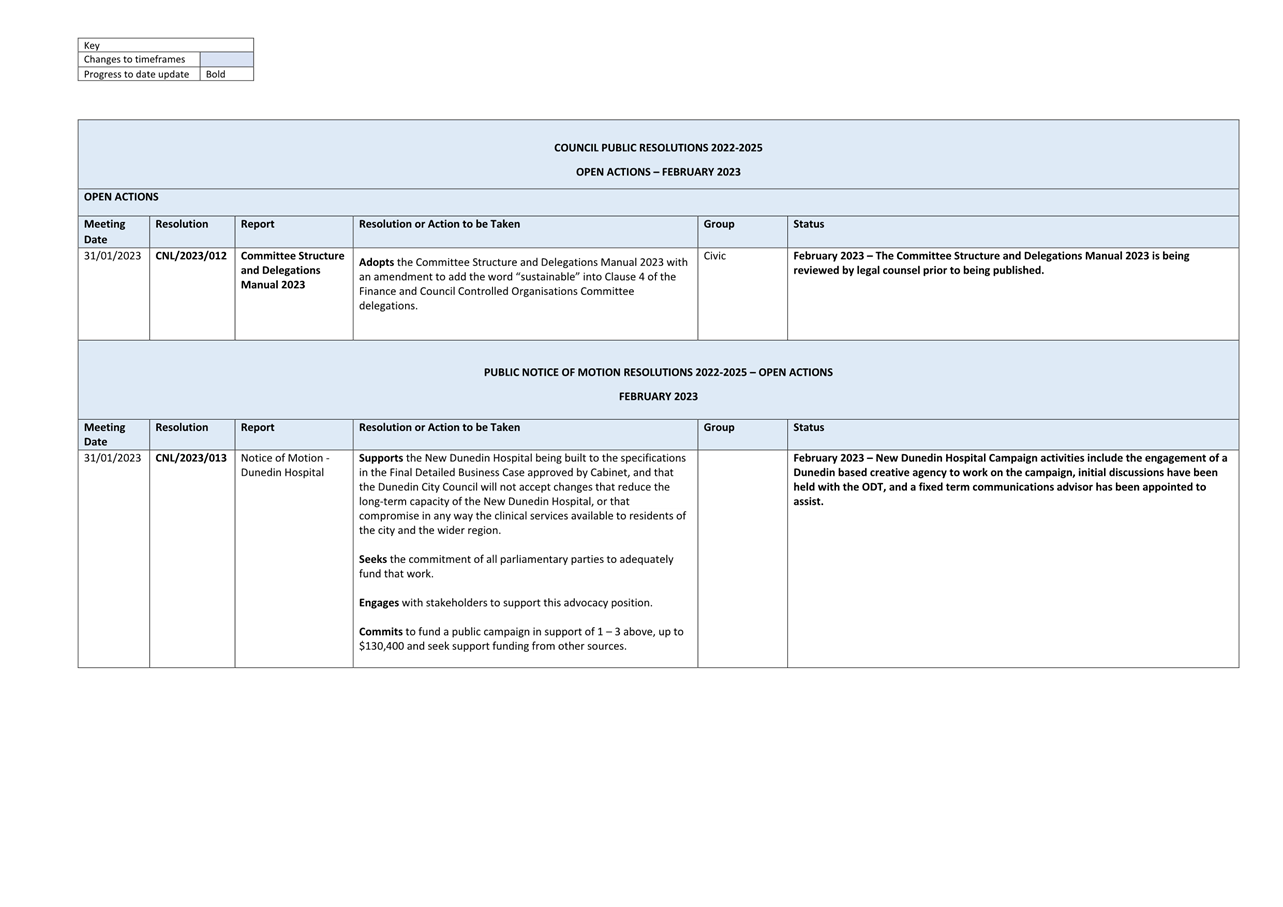
⇩a
|
Open actions update -
February 2023
|
31
|
|
|
Council
28 February 2023
|
|
|
Council
28 February 2023
|
Forward Work Programme for Council - February
2023
Department: Civic
EXECUTIVE SUMMARY
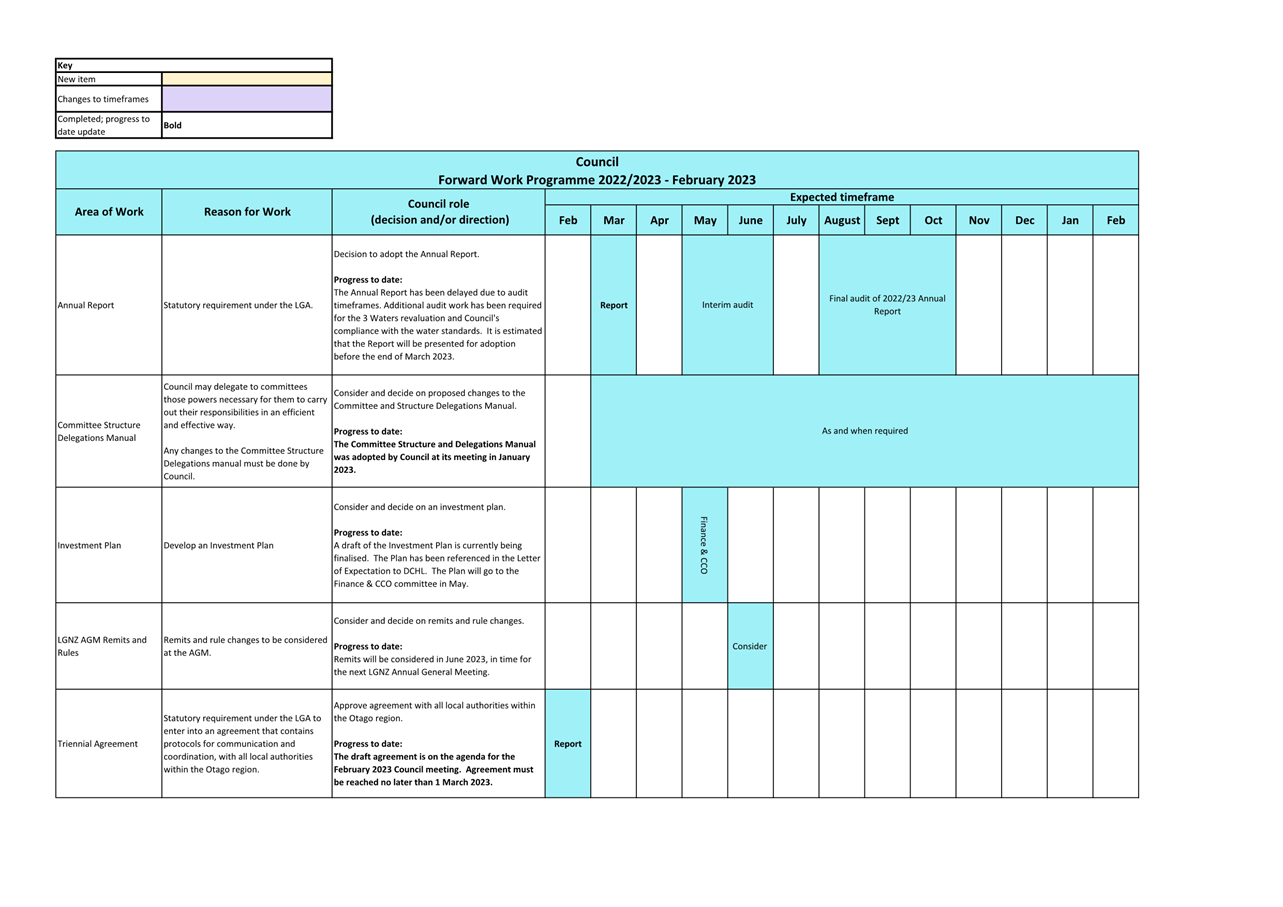
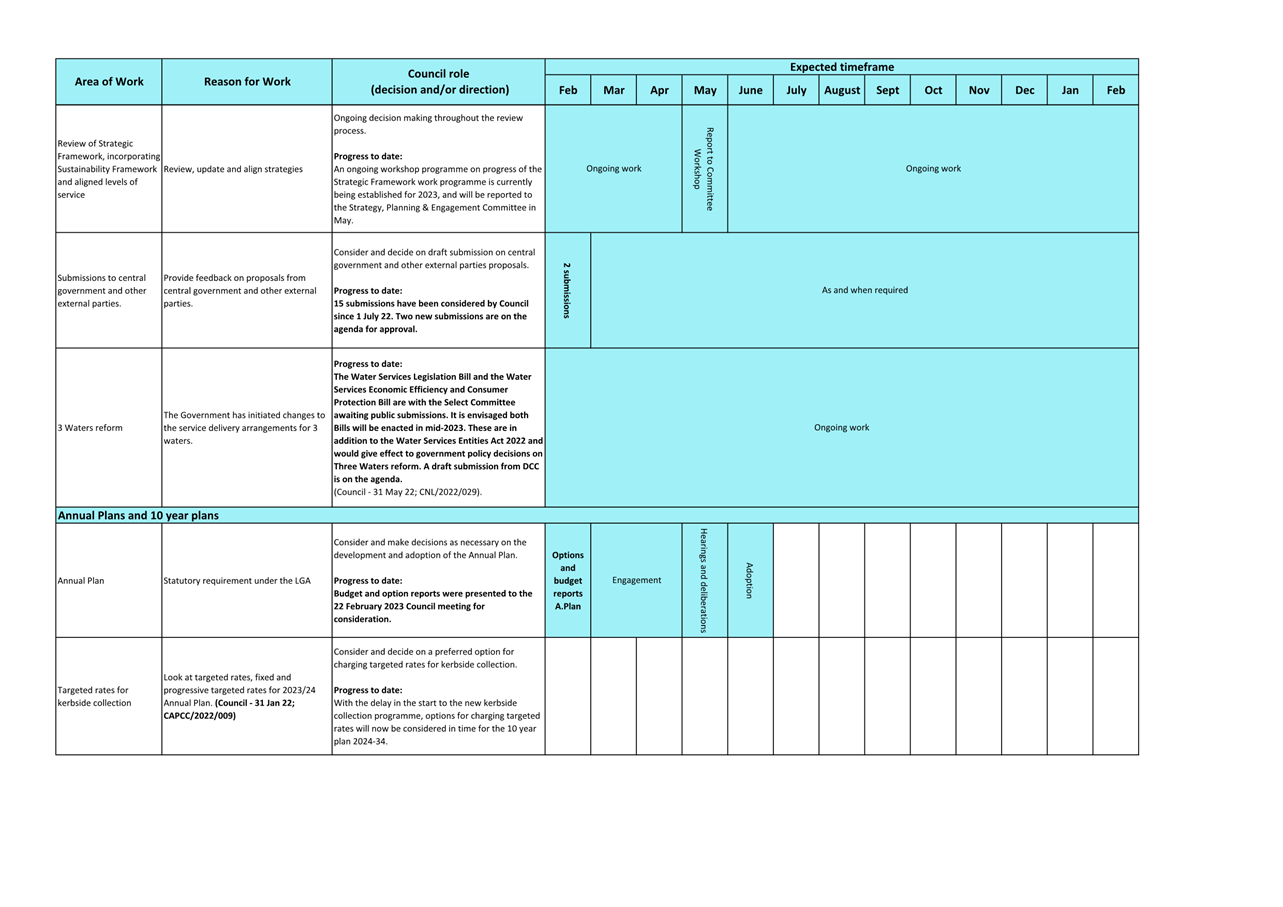
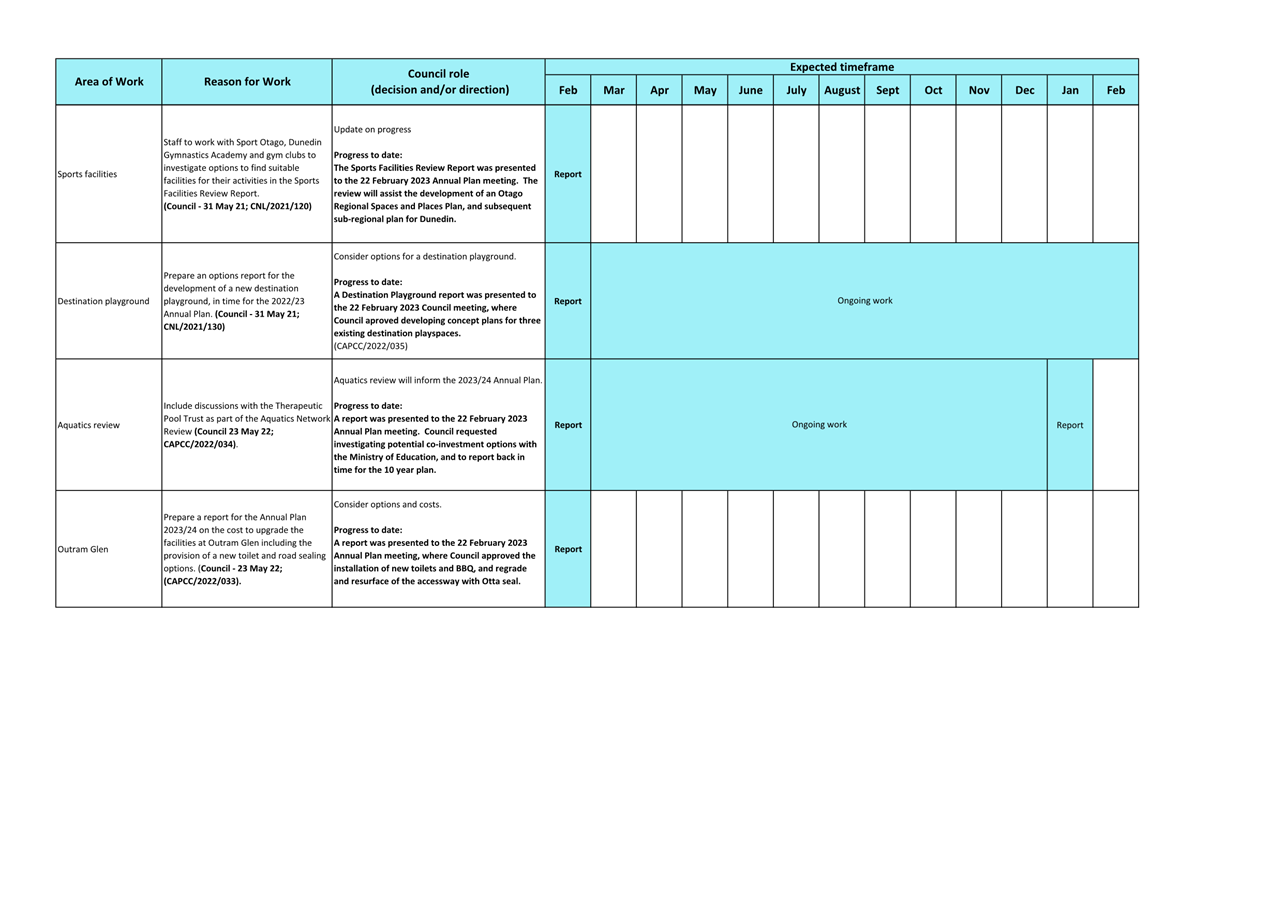
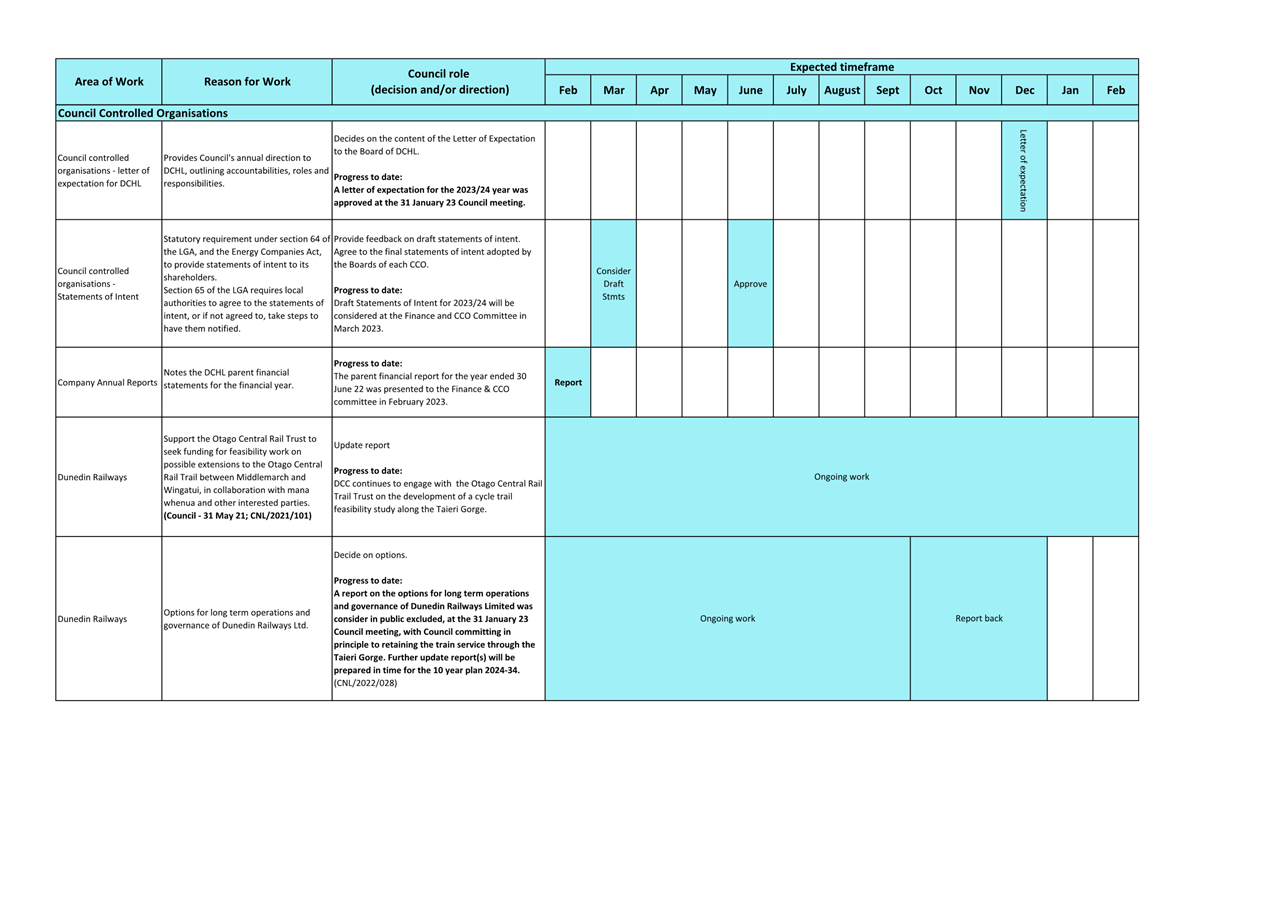
1 The
purpose of this report is to provide the updated forward work programme for the
2022-2023 year (Attachment A).
2 As
this is an administrative report only, there are no options or Summary of
Considerations.
|
RECOMMENDATIONS
That the Council:
a) Notes the updated Council forward work programme as shown
in Attachment A.
|
DISCUSSION
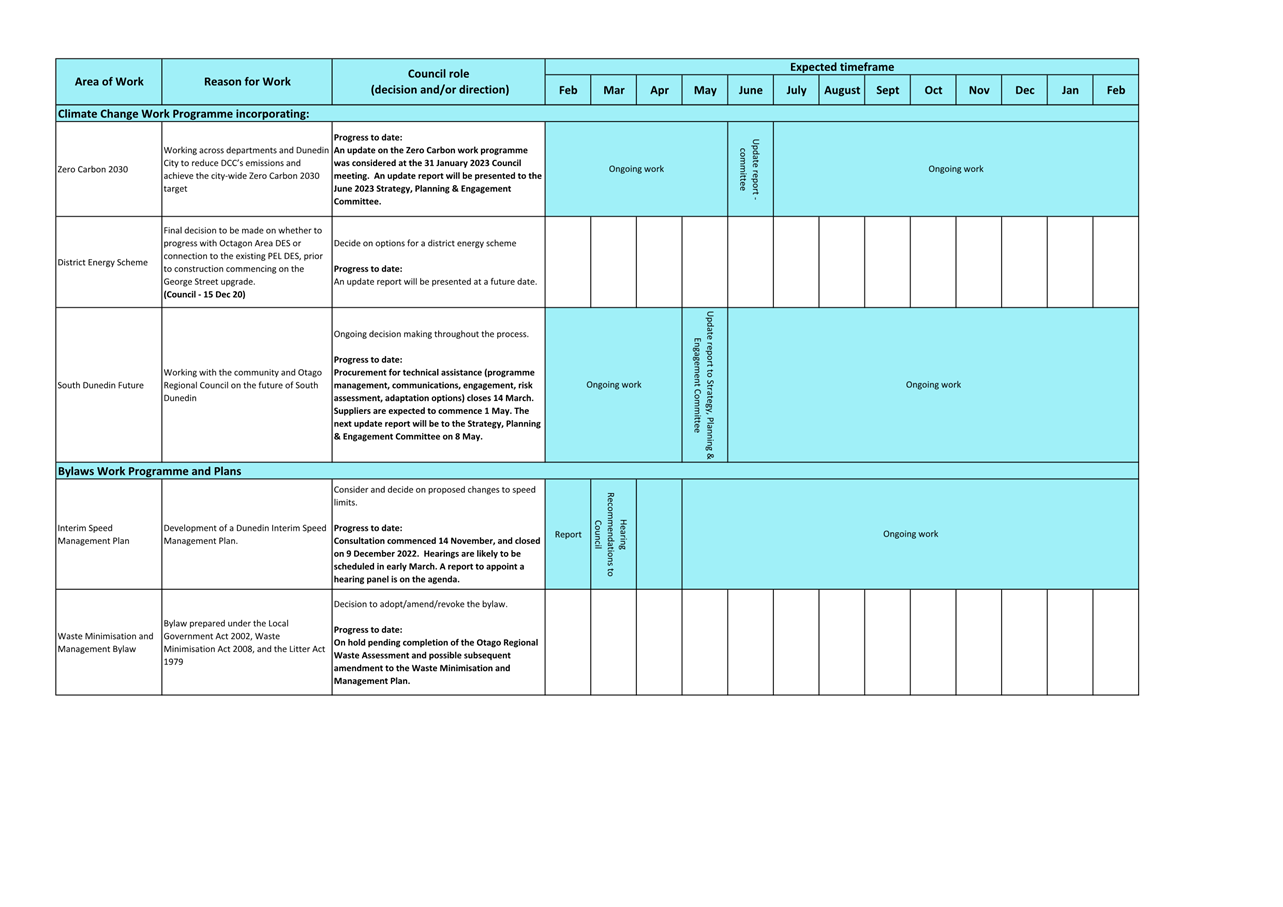
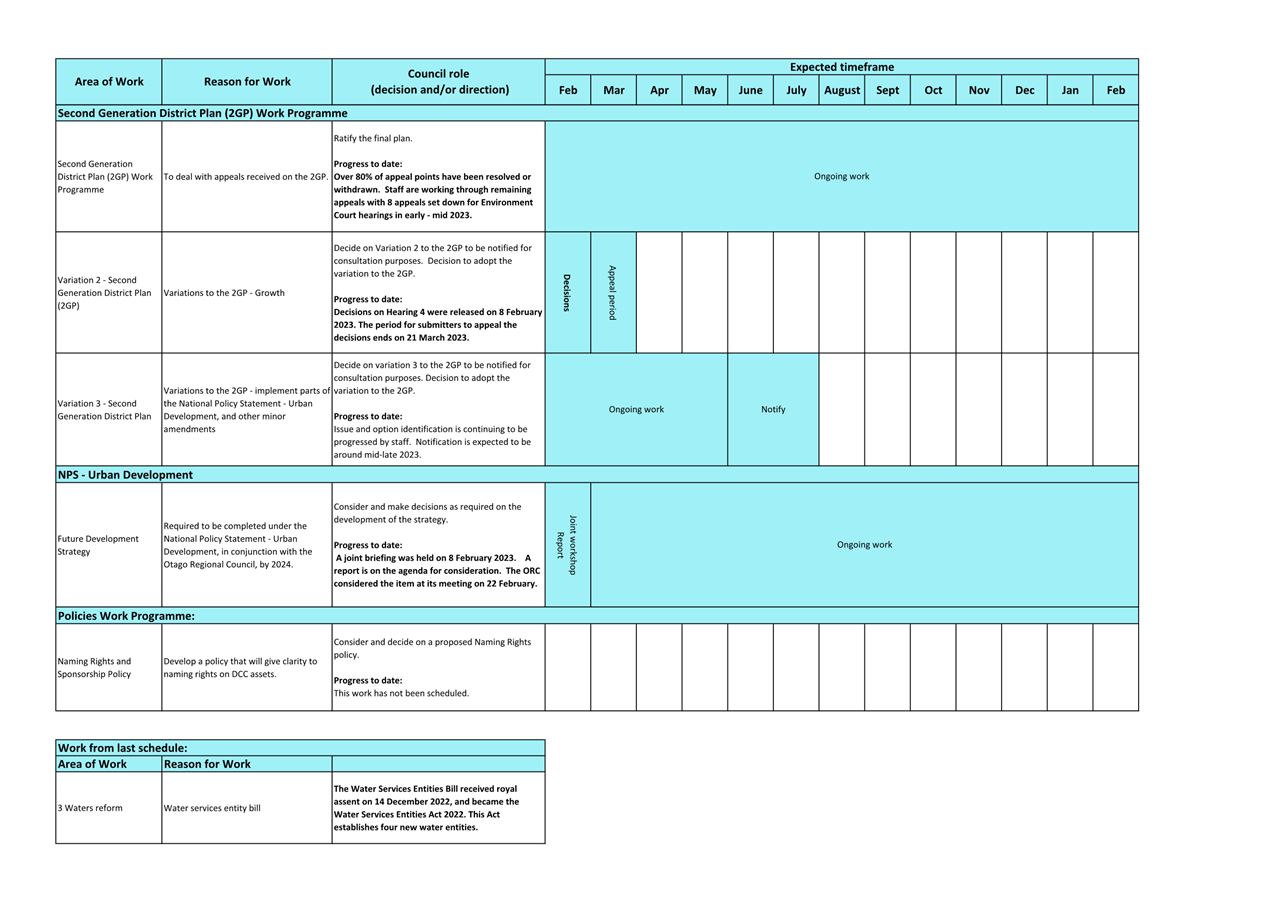
3 The
forward work programme is a regular agenda item which shows areas of activity,
progress and expected timeframes for Council decision making across a range of
areas of work.
4 As
an update report, the purple highlight shows changes to timeframes. New
items added to the schedule are highlighted in yellow. Items that have been
completed or updated are shown as bold.
5 The
attached report covers all items previously presented to Council in late
2022. With the establishment of the new committee structure, some items
have been transferred to their relevant committees.
NEXT STEPS
6 An
updated report will be presented to the March 2023 Council meeting.
Signatories
|
Author:
|
Sharon Bodeker - Manager Governance
|
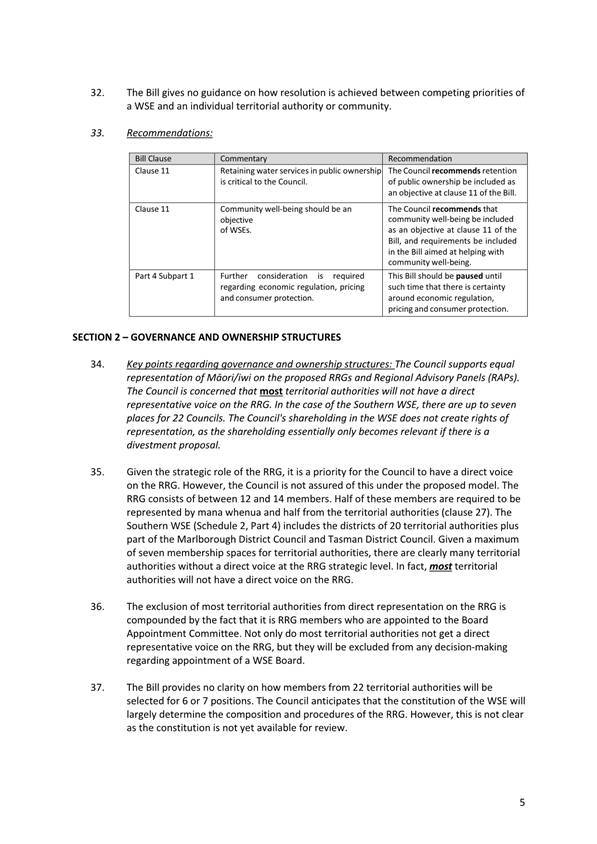
|
Authoriser:
|
Sandy Graham - Chief Executive Officer
|
Attachments
|
|
Title
|
Page
|
|
⇩a
|
Council Forward Work
Programme - February 2023
|
35
|
|
|
Council
28 February 2023
|
Water Services Legislation Bill and Water
Services Economic Efficiency and Consumer Protection Bill - Submission
Department: Executive Leadership Team and Legal
EXECUTIVE SUMMARY
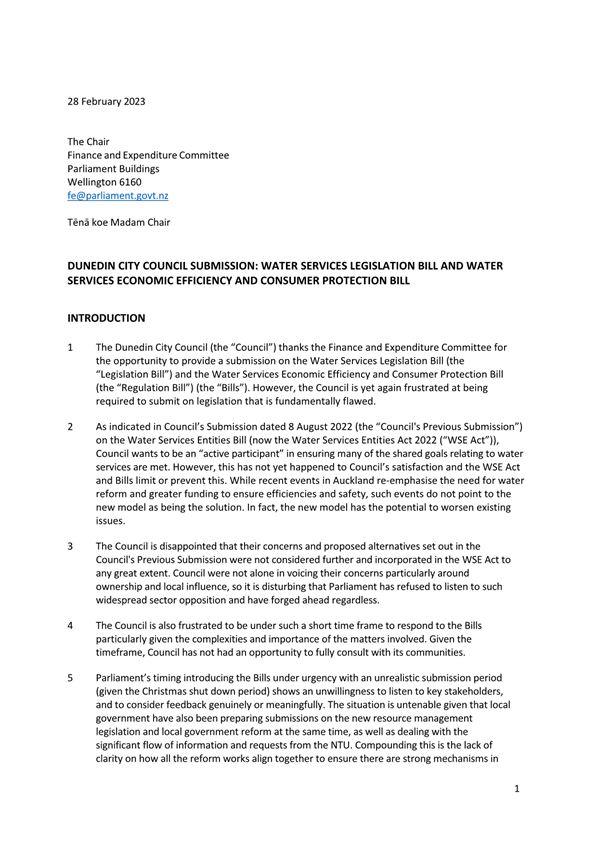
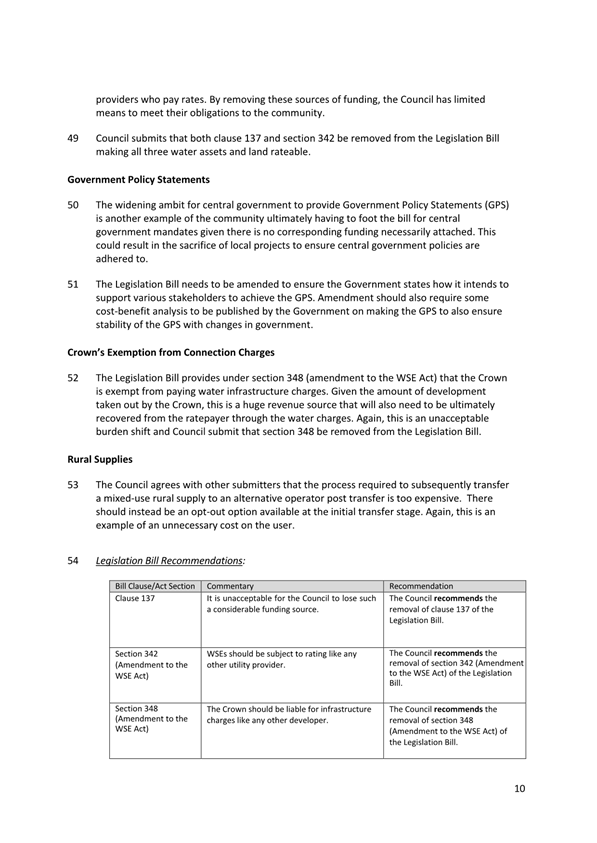
1 This
report seeks the Council’s approval of a draft Dunedin City Council (DCC)
submission (Attachment A) to Parliament’s Finance and Expenditure Select
Committee on two bills - the Water Services Legislation Bill (Legislation Bill)
and the Water Services Economic Efficiency and Consumer Protection Bill
(Regulation Bill) (the Bills).
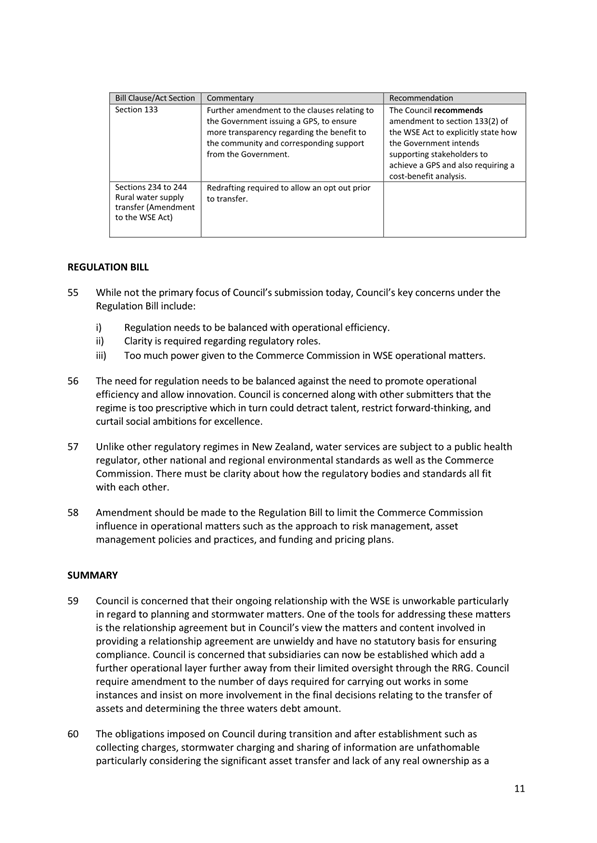
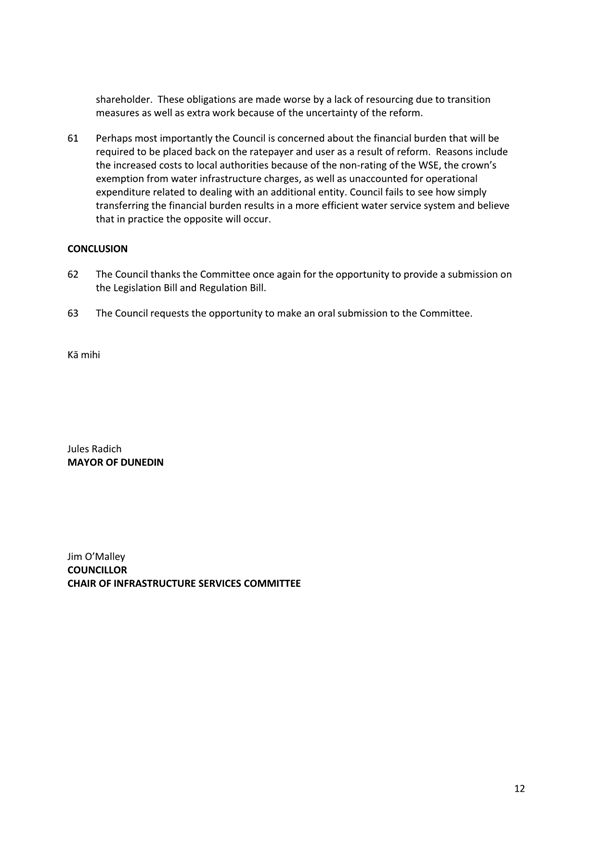
2 Key
points from the draft submission include:
a) The
reform is unworkable. The legislation in its entirety needs to be rethought and
to be slowed down to ensure the principal goals of water reform are met long
term.
b) There
is a very real risk that ratepayers/consumers are going to end up paying
significantly more in combined rates and water charges than they are currently
paying. This would be particularly the case if Water Service Entities (WSEs)
are exempt from having to pay local body rates. Council seriously question why
they should transfer such significant community assets if the model itself
cannot achieve the efficiencies that have been assured throughout the water reform
process. To simply transfer the financial burden to the ratepayer is
unacceptable.
c) Councils'
city planning processes will be hamstrung with the WSE exerting investment
power over Council’s ability to plan for future land use. There is the
potential for WSEs to concentrate their funding in some regions and not others.
The neglected regions will have little recourse as the model substantially
removes local voices.
d) The
complexities of a mixed ownership stormwater model will result in gross
inefficiencies both operationally and make handling emergency events difficult.
e) Council
will still be viewed by the public as providing water services if they are left
to collect water charges yet will have no control of the assets nor real
influence operationally.
f) The
Legislation Bill will repeal existing protections against privatisation (e.g.
section 130 of the Local Government Act 2002 is being repealed by the
Legislation Bill), and replacement protections are not as strong.
g) Decision
making power in relation to the reform work now sits with the Department of
Internal Affairs which has no community consultation requirement, yet Council
is accountable to its ratepayers.
3 Recent
events in Auckland and the wider North Island re-emphasise the need for water
reform and greater funding to ensure efficiencies and safety. However, such
events do not point to the new model as being the only solution. In fact, the
new model has the potential to worsen existing infrastructure issues and make
managing civil defence emergencies more difficult.
|
RECOMMENDATIONS
That the Council:
a) Approves the draft DCC submission to the Finance
and Expenditure Committee on the Legislation Bill and the Regulation Bill
(Attachment A).
b) Authorises the Mayor and/or his delegate to speak
to the submission.
c) Authorises the Chief Executive to make any minor editorial
changes if needed.
|
BACKGROUND
Three Waters Reform Programme
4 In
July 2020, the Government launched the Three Waters Reform Programme to reform
local government three waters service delivery arrangements throughout New
Zealand. The DCC has participated in the reform programme by responding to
requests for information, providing feedback on policy proposals, and making
written and oral submissions in relation to proposed legislative changes.
5 In
the latter half of 2021, the Minister of Local Government asked for feedback
from local authorities on the Government’s Three Waters Reform Programme.
6 The
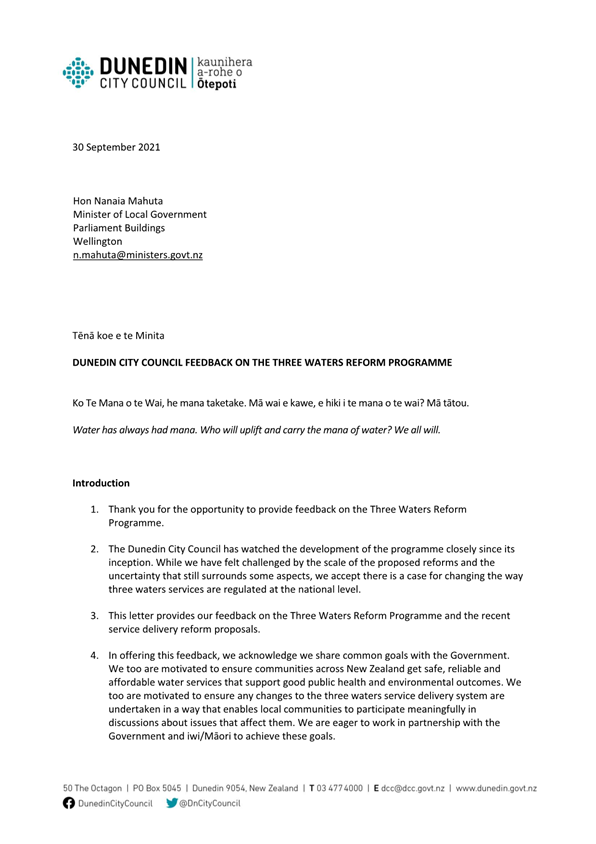
DCC provided feedback to the Minister (Attachment B) and the primary message
was that the DCC wanted the Three Waters Reform Programme to be reset with a
full exploration of options for future three waters service delivery
arrangements. Council also asked for further work to be completed to reassess
and clearly define the relationship between the Three Waters Reform Programme
and other major Government reform initiatives. Other feedback items included:
a) Allow
time for meaningful engagement with communities.
b) Council’s
support for Ngāi Tahu participation in water services decision making.
c) Mechanisms
to enable local influence in a new three waters service delivery model were
needed.
d) Refinement
of assumptions and analysis of financial impacts on projected household costs.
e) Support for
existing three waters workforce and their development.
f) Ensure
local decision making was maintained for urban growth planning and city
development.
7 In
October 2021, the Government announced that local government participation in
the Three Waters Reform Programme would be mandatory. Soon after, the
Government released an exposure draft of a Bill that would establish the
proposed four new WSEs: the Water Services Entities Bill.
Water Services Entities Act
2022
8 In
2022, the Government introduced the Water Services Entities Bill. The Bill was
to establish four new water services entities, and included provisions related
to:
a) entity
ownership and protections against privatisation
b) entity
governance, accountability and consumer engagement
c) transitional
arrangements.
9 In
August 2022, the DCC submitted to the Finance and Expenditure Committee on the Water
Services Entities Bill (Attachment C). On 29 August 2022, the then Mayor made
an oral submission to the Committee. The key concerns of the DCC submission
related to:
a) whether
the Bill would achieve its objectives;
b) the
proposed governance and ownership structure of the WSEs;
c) the
protections against privatisation, joint arrangements and the amalgamation of a
WSE; and
d) the
transitional provisions.
10 The
Finance and Expenditure Committee considered all submissions and released its
report on 11 November 2022. Following further Parliamentary process steps, the
Bill received royal assent on 14 December 2022 and became the Water Services
Entities Act 2022 (the Act).
11 The
Act is part of a suite of legislative changes required to give effect to Government
policy decision on three waters service delivery reform. The Act establishes
four publicly owned WSEs to deliver three waters services across New Zealand in
place of local authorities. The entities are due to become fully operational by
the establishment date of 1 July 2024.
Water Services Legislation
Bill
12 The
Legislation Bill is the second bill in the suite of legislation to reform three
waters service delivery in New Zealand. It is an amendment Bill that would make
changes and additions to the Water Services Entities Act 2022 and other
legislation to give effect to the Government’s policy decisions on three
waters service delivery reform. The Legislation Bill is the subject of the
draft submission in Attachment A.
13 The
main purpose of the Legislation Bill is to establish and empower WSEs by
setting out their functions, powers, obligations and oversight arrangements,
including:
a) Services
delivery functions and powers, to enable WSEs to deliver water services in place
of local authorities;
b) Regulatory
functions and powers, to enable water services entities to make rules, plans,
and other instruments relating to water services, and engage in compliance and
enforcement activities; and
c) Pricing
and charging arrangements for water services.
14 The
Legislation Bill also features further provisions to facilitate the transition
from the existing service delivery model to the four new entities, including:
a) Provisions
relating to the transfer of assets, liabilities, and other matters from local
authorities to the WSEs;
b) Changes
to Treaty settlement legislation that are required to ensure that settlement
obligations are carried forward from local authorities to the new WSEs; and
c) Detailed
changes to local government legislation, the Resource Management Act 1991, the
Water Services Act 2021, and other legislation relating to regulation and
service delivery of water services.
15 The
Legislation Bill was introduced to Parliament and had its first reading on 13
December 2022. Parliament subsequently referred the Legislation Bill to the
Finance and Expenditure Committee and a call for submissions by February 2023
was issued.
Water Services Economic
Efficiency and Consumer Protection Bill
16 A
third bill was also introduced to Parliament at the same time in December 2022
– the Regulation Bill. The Regulation Bill is also the subject of the
draft submission in Attachment A.
17 The
Regulation Bill would establish an economic regulation and consumer protection
framework for the reformed water services delivery system. The Government
considers that specific economic regulation and consumer protection regimes are
necessary to ensure against problems that can arise when an organisation has a
lot of market power.
18 Under
the Regulation Bill, the Commerce Commission will be the regulator for the
three waters sector. A new role of Water Services Commissioner will be
established to ensure transparency of WSEs’ operations.
19 Key
features of the Regulation Bill are the requirements for information
disclosure, and price-quality regulation, which is envisaged to be implemented
in phases over a period of time.
20 Like
the Legislation Bill, the Regulation Bill was introduced to Parliament and had
its first reading on 13 December 2022. Parliament subsequently referred the
Regulation Bill to the Finance and Expenditure Committee and a call for
submissions by February 2023 was issued.
Next Steps: Legislative
Process
21 The
Finance and Expenditure Committee has a deadline of 25 May 2023 to consider
submissions and release its report on the Bills. The Government timeline
intends for the Bills to be passed by mid-2023. Both Bills in their entirety
can be read on the New Zealand Legislation website: https://legislation.govt.nz/.
DISCUSSION
Draft DCC submission: feedback on the
Water Services Legislation Bill
22 Both
Bills, and particularly the Legislation Bill, would have significant impacts on
Council and the community. The Bills currently open for feedback do not address
concerns previously raised by the Council in its feedback on the proposed
reforms.
23 The
draft DCC submission states that the DCC is frustrated at being required to
submit again on legislation that is fundamentally flawed and within the short
time frame provided for submissions.
24 Further,
the draft submission states that DCC is disappointed that the concerns and
proposed alternatives concerning ownership and local influence raised in its
previous submission were not considered and incorporated in the new
legislation.
25 A
key message in the draft submission is that all water reform legislation
– the Water Services Entities Act 2022, the Legislation Bill and the
Regulation Bill, are not workable in their current forms. The draft submission
states the legislation in its entirety needs to be rethought and slowed down to
ensure Government’s stated goals are met long-term.
26 Further
feedback on the Legislation Bill is provided in the draft submission under
three headings:
a) Unworkable
relationship between Territorial Authorities and the WSEs
b) Imposed
obligations on Councils
c) Unfair
burden on the ratepayer.
27 The
key issues under those themes are set out below.
Unworkable relationship between
Territorial Authorities and the WSEs
28 The
draft DCC submission states:
a) The
DCC has no assurance that local decision making will be maintained in planning
decisions nor how investment in Dunedin will be assured. Councils as
organisations close to the community, remain best placed to balance the wide
variety of considerations informing land use decisions of which three waters is
but one part.
b) The
proposed mixed ownership model for stormwater between the WSE, local
authorities and private operators/owners
is complex, impractical and dangerous; and the stormwater provisions of the
Legislation Bill need to be comprehensively rethought.
c) Relationship
agreements are a proposed tool under the Legislation Bill that may combat some
of the issues outlined above, however the scope of these agreements is unwieldy
and needs thorough review.
d) The
proposed asset and debt transfer provisions in the Legislation Bill give the
Minister broad asset transfer amendment powers without any local authority
input. No unilateral discretion should be given to the Minister.
Imposed obligations on councils
29 The
draft DCC submission:
a) Objects
to provisions that could require councils to collect charges for services that
are already transferred to the WSE, for example for stormwater charges, and
insists that provision in the Legislation Bill relating to “pass-through
billing” be removed.
a) Recommends
councils should be compensated for providing rating information to the WSEs and
for maintaining and keeping it.
b) States
the reform programme is placing resourcing pressures on councils.
Unfair burden on the ratepayer
30 The
draft DCC submission states:
a) Exempting
WSEs from paying rates would have a major impact on both the financial
situation of Council and consequently on ratepayers.
b) The
WSEs should not be treated any differently to other network infrastructure
providers who pay rates, and both clauses regarding this should be removed from
the Legislation Bill.
c) The
Crown’s exemption from paying water infrastructure charges is an
unacceptable burden shift on to the ratepayer and the relevant section
regarding this should be removed from the Legislation Bill.
The Water Services Economic Efficiency and Consumer
Protection Bill
31 The
Regulation Bill is not the main focus of the DCC’s submission. However,
the draft submission states the DCC’s key concerns regarding this Bill
are:
a) Regulation
needs to be balanced with operational efficiency
b) Clarity
is required regarding regulatory roles
c) Too
much power is given to the Commerce Commission in WSE operational matters.
OPTIONS
Option
One – submit on the Water Services Legislation Bill and the Water
Services Economic Efficiency and Consumer Protection Bill (Recommended Option)
32 Approve,
with any suggested amendments, the draft submission to the Finance and
Expenditure Select Committee on the Legislation Bill and the Regulation Bill
(Attachment A).
Advantages
a) Opportunity
to provide further feedback on three waters service delivery reform.
b) Opportunity
to recommend changes to the Finance and Expenditure Select Committee on
particular provisions of both Bills.
Disadvantages
b) There
are no identified disadvantages for this option.
Option
Two – do not submit on the Water Services Legislation Bill or the Water
Services Economic Efficiency and Consumer Protection Bill
33 Do
not approve the draft submission (Attachment A).
Advantages
a) There
are no identified advantages for this option.
Disadvantages
a) Missed
opportunity to provide further feedback on three water service deliver reform.
b) Missed
opportunity to recommend changes to the Finance and Expenditure Select
Committee regarding the provisions of both Bills.
NEXT STEPS
34 The
deadline for submissions from local government was 17 February 2023. On 21
December 2022, the Mayor lodged a short placeholder submission on behalf of the
Council, stating that the DCC would like to make an oral submission on both
Bills. If the Council approves the draft DCC submission at the 28 February 2023
Council meeting, the submission (which covers both Bills) will be considered by
the Finance and Expenditure Select Committee alongside the placeholder and oral
submission.
Signatories
|
Author:
|
Simon Drew - General Manager Infrastructure and
Development
Karilyn Canton - Chief In-House Legal Counsel
Nadia McKenzie - In-House Legal Counsel
|
|
Authoriser:
|
Sandy Graham - Chief Executive Officer
|
Attachments
|
|
Title
|
Page
|
|
⇩a
|
Attachment A: DCC Submission
Water Services Legislation Bill and Water Services Economic Efficiency and
Consumer Protection Bill
|
50
|
|
⇩b
|
Attachment B: Feedback
to Minister of Local Government 30 September 2021
|
62
|
|
⇩c
|
Attachment C: Water
Services Entities Bill Submission 8 August 2022
|
71
|
|
SUMMARY OF CONSIDERATIONS
|
|
Fit with purpose
of Local Government
This decision enables democratic local
decision making and action by, and on behalf of communities and promotes the
social, economic, environmental and cultural well-being of communities in the
present and for the future.
|
|
Fit with strategic
framework
|
|
Contributes
|
Detracts
|
Not applicable
|
|
Social Wellbeing Strategy
|
☐
|
☐
|
☒
|
|
Economic Development Strategy
|
☒
|
☐
|
☐
|
|
Environment Strategy
|
☒
|
☐
|
☐
|
|
Arts and Culture Strategy
|
☐
|
☐
|
☒
|
|
3 Waters Strategy
|
☒
|
☐
|
☐
|
|
Spatial Plan
|
☒
|
☐
|
☐
|
|
Integrated Transport Strategy
|
☐
|
☐
|
☒
|
|
Parks and Recreation Strategy
|
☐
|
☐
|
☒
|
|
Other strategic projects/policies/plans
|
☒
|
☐
|
☐
|
This report has been prepared with reference to the
Dunedin strategic framework.
|
|
Māori Impact
Statement
The Government has undertaken extensive high-level engagement
with iwi/Maori in relation to the three waters reforms, including with Te Rūnanga
o Ngāi Tahu. Central Government officials have worked closely with Ngāi
Tahu to develop the boundary for the South Island water services entity.
|
|
Sustainability
Any changes to New Zealand’s Three Water service
delivery model may change the economic and environmental sustainability of
three waters infrastructure and services across New Zealand.
|
|
LTP/Annual Plan /
Financial Strategy /Infrastructure Strategy
This report and the decision to approve the submission to
the Finance and Expenditure Select Committee has no direct implications for
these plans and strategies. However, should the Bills go ahead in their
current form, there will be serious implications for the next LTP and annual
plan.
|
|
Financial
considerations
There are no financial implications directly associated
with this report and the decision to approve the draft submission to the
Finance and Expenditure Select Committee.
|
|
Significance
The decision to approve the draft DCC submission is
considered low in terms of the Council’s significance and engagement
policy.
|
|
Engagement –
external
There has been engagement with other Otago and Southland
councils and with mana whenua in relation to the Bills and the development of
the draft DCC submission.
|
|
Engagement -
internal
Staff from the 3 Waters Group, Executive Leadership Team
and the Legal Team have contributed to the development of the draft DCC
submission.
|
|
Risks: Legal /
Health and Safety etc.
There are no identified risks directly related to a DCC
submission on the Water Services Legislation Bill or the Water Services
Economic Efficiency and Consumer Protection Bill. There are however
significant issues if the Bills proceed as drafted.
|
|
Conflict of
Interest
There are no known conflicts of interest.
|
|
Community Boards
Community Boards are likely to be interested in the three
waters reform updates and staff will consider how to update the Community
Boards.
|
|
|
Council
28 February 2023
|
Future for Local Government Review -
Submission
Department: Corporate Policy
EXECUTIVE SUMMARY
1 This
report seeks approval of a draft Dunedin City Council (DCC) submission
(Attachment A) on the Review into the Future for Local Government (the Review).
2 Lead
by the Department of Internal Affairs (DIA), the Review is intended to be an
opportunity to create a new system of local governance and democracy that will
effectively respond to a changing New Zealand and create conditions for
communities to thrive.
3 The
Review’s draft report, He mata whāriki, he matawhānui,
(the Report) was released in late October 2022. It outlines the need for a
local governance system in Aotearoa New Zealand that is community-focussed and
citizen-centred, based on strong relationships and partnerships. The
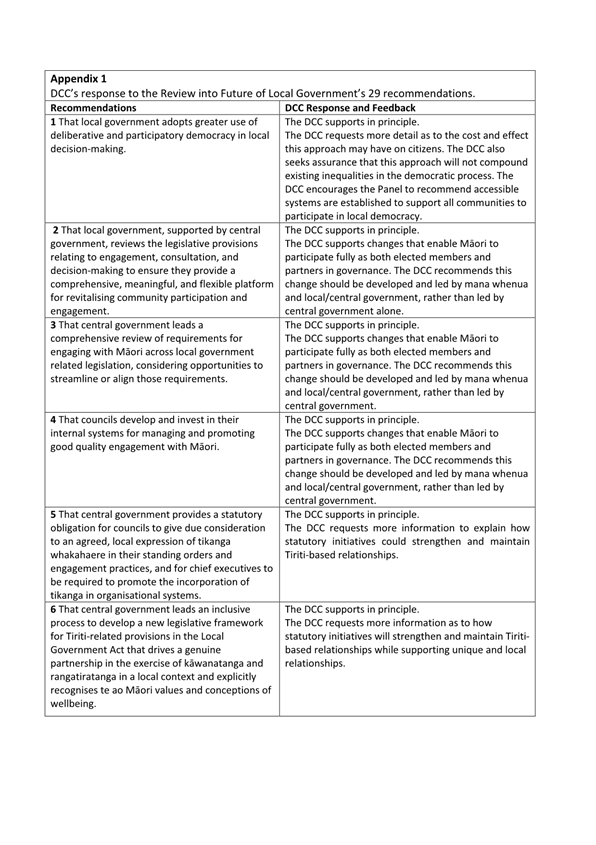
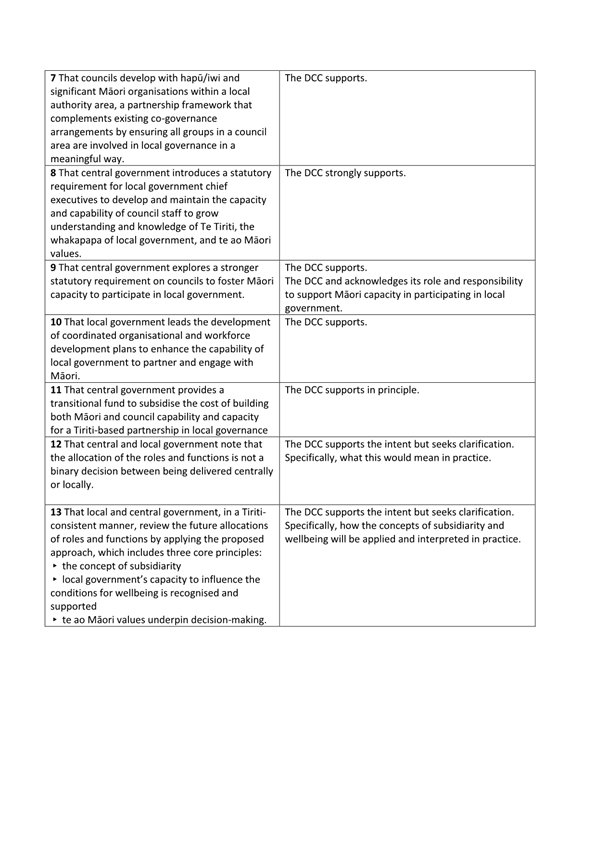
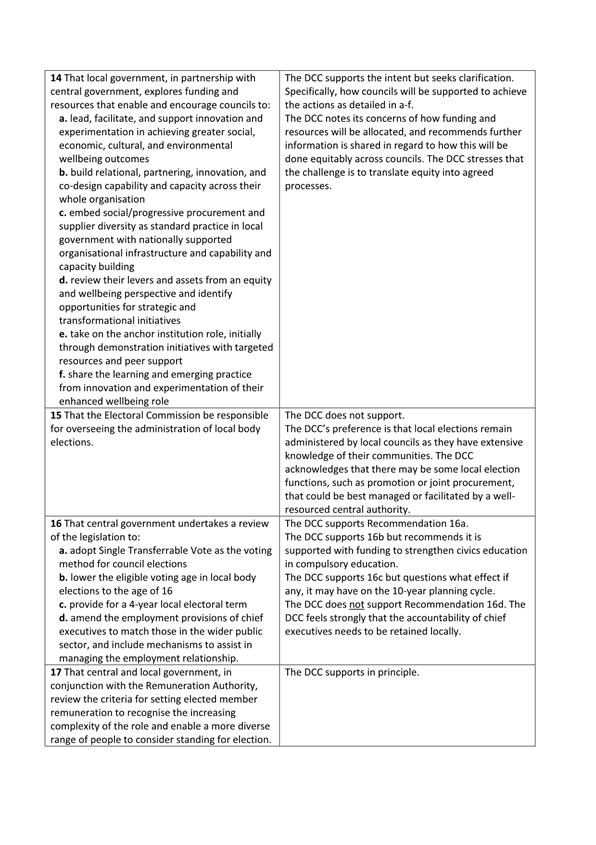
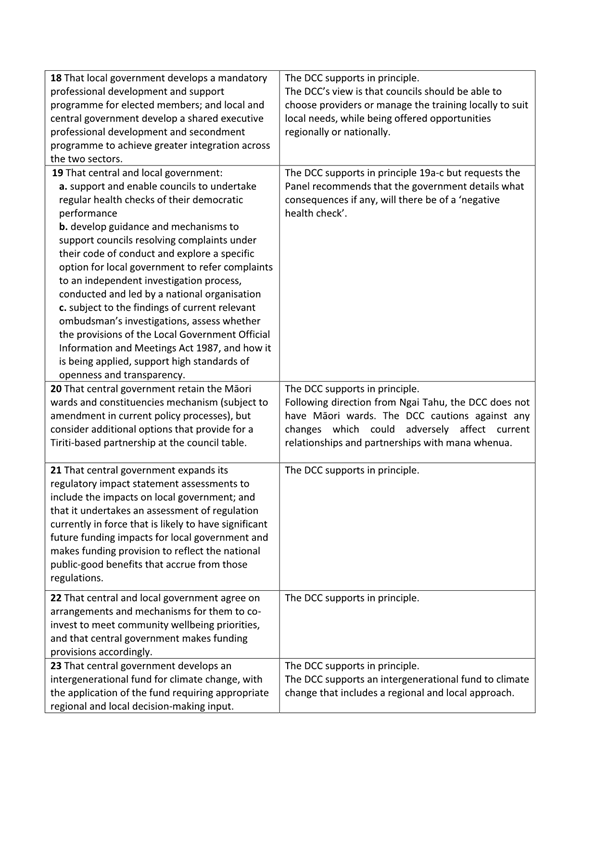
DCC’s submission speaks to the Report and to its 29 recommendations in
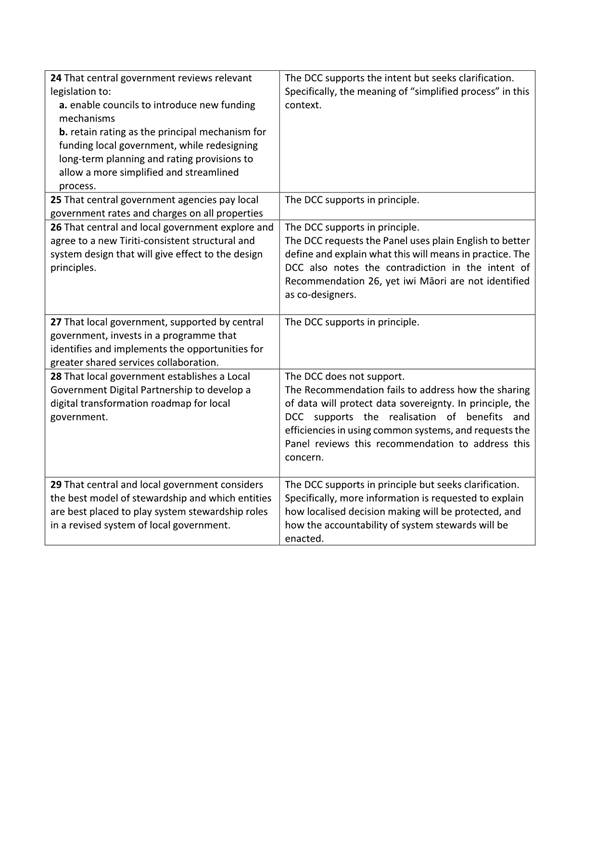
Attachment B, titled Appendix A for the purpose of the submission.
4 Submissions
on the draft report close on 28 February 2023; the DCC has an extension until 3
March 2023.
5 The
final Report is scheduled for release in June 2023.
6 DCC
staff have been involved in webinars and workshops on this topic from Local
Government New Zealand and Taituarā (the organisation of local government
organisations), which has also helped
to inform the DCC’s submission.
|
RECOMMENDATIONS
That the Council:
a) Approves the DCC submission, with any amendments,
on “the Future for Local Government Review”.
b) Authorises the Chief Executive to make any minor
editorial amendments to the submission.
|
BACKGROUND
The Context and Scope of the
Review
7 Current
local governance structures and systems are now facing considerable pressure
due to:
· Increased
responsibilities and demands arising from the reform of New Zealand local
government reform in 1989 (850 local bodies amalgamated into 86 local
authorities), and the Local Government Act 2002 (the LGA). The LGA introduced
the Long Term Plan (LTP) and the associated Special Consultative Procedure
(SCP), and Community Outcomes with progress indicators and measures).
·
· Complex issues
with local impacts (e.g. climate change, poverty and inequity, housing) as well
as national reforms such as the Resource Management Act (RMA), Three Waters,
and local government’s commitment to the principles of the Treaty of
Waitangi.
The Review is seen as an opportunity to address these
issues and ensure that the system of local governance is fit for the future, in
order to maximise wellbeing and prosperity for all communities.
8 The
scope of the Review includes:
· Functions, roles,
and structures of local government
· Relationships with
central government, iwi, Māori, businesses, communities, and other organisations
that contribute to local wellbeing
· Treaty partnership
· Funding
9 The reform of
the RMA and Three Waters are outside of the scope of the Review; however
consideration will be given to the implications of these and other central
government policy decisions for the local government sector.
Discussion
Summary of the draft report,
He mata whāriki, he matawhanui
10 The
Report identifies five key shifts in the way that local government operates:
1.
Strengthened local democracy. From low public trust and participation in local
governance, to citizens participating in local decision-making; councils being
trusted and reflecting community diversity.
2.
Authentic relationship with hapū/iwi and Māori. From variable
relationships between councils and hapū/iwi/Māori, to strong,
authentic relationships between councils and hapū/iwi/Māori that
enable self-determination and shared authority.
3.
Stronger focus on wellbeing. From councils often narrowly focused on
delivering services and infrastructure, to councils focusing on holistic
strategies to improve the wellbeing of their communities.
4.
Genuine partnership between local and central government. From low trust
between local and central government, to genuine partnership to co-invest in
and deliver wellbeing outcomes for communities
5. More equitable funding. From
an over-burdened and constrained funding system, to an equitably funded system
that enables communities to thrive.
11 The
DCC’s submission is structured to address each of these five key shifts.
12 The
Report notes that many of its suggestions can be activated to some degree,
without needing a mandate or legislative reform, but that significant
coordinated changes will also be needed across the system of local and central
government, to different extents and across a range of timeframes.
13 This
will require a “joined-up approach”, with commitment across the
system and sufficient resourcing and capacity made available, and recognising
systemic and structural changes will be required including:
· updating some of
the underlying legislation and frameworks that define local government
· embedding
Te Tiriti more explicitly within local government systems
· considering
changes to the roles and functions carried out by local councils
· the form of the
local government system itself.
DCC submission
14 The draft DCC
submission broadly supports the objectives of the Review’s
recommendations and highlights a number of positive changes, outlines areas of
concern and makes a number of suggestions. DCC’s comments in relation to
the 29 recommendations are included in Appendix 1, in Attachment A.
15 The
key comments are:
· The DCC notes a high level of uncertainty associated with
the recommendations and how they will impact on the diverse and interconnected
workstreams that local government currently carries out.
· The DCC encourages the Panel to give clear guidance to government
on adequate and appropriate transition periods, so that local communities are
actively supported during any proposed system changes.
· The Panel was clear that the scope of the Review did not
include other reforms such as the Three Waters Bill, the Natural and Built
Environment Bill and the Spatial Planning Bill. The DCC’s view is that
the Panel has missed a critical opportunity to engage with local government on
the implications of these reforms, which could have informed the proposed system
designs.
· The Panel’s proposed system designs of local
government lacks alignment with other reforms and in places, specific
recommendations contradict requirements that are detailed in the reforms.
· The DCC acknowledges there is a strong feeling of
uncertainty among the local community. The DCC encourages the Panel to
recommend to government that alignment is needed across the reforms, including
the review into local government, so the system is cohesive, coherent and
consistent.
· The DCC is
particularly concerned about the lack of detail in the proposed system designs.
This concern is in relation to the key operational roles that councils
currently have, besides the political, policy and democratic roles.
· The DCC agrees
with the Panel’s view that proposed system designs need to balance
realising efficiencies across population groups with meeting local community
needs based on an equitable funding model. However, the Report’s system
designs appear naïve as they do not identify how the proposed system
designs will improve services across different and dispersed geographical
communities or increase savings and efficiencies.
OPTIONS
Option
One – Recommended Option - Approve the DCC submission, with any
amendments, on the Future for Local Government Review
16 Approve
the DCC submission, with any amendments, on the Review into the Future for
Local Government.
Advantages
· Opportunity
to feedback on the proposed changes and specific recommendations in the draft
Report on the “Review into the Future for Local Government”
· Opportunity
to provide feedback on topics relevant to the DCC’s strategic and
operational work,
· Opportunity
to provide feedback and request clarification around some areas of the draft
Report that may impact on Ōtepoti Dunedin when recommendations are
implemented.
Disadvantages
· There
are no identified disadvantages for this option.
Option
Two – Do not approve the DCC submission on the Future for Local
Government Review
17 Do
not approve the DCC
submission on the Review into the Future for Local Government.
Advantages
· There
are no identified advantages to this option.
Disadvantages
· Missed
opportunity to provide feedback on topics relevant to the DCC’s strategic
and operational work.
· Missed
opportunity to request clarification around some areas of the draft report that
may impact on Ōtepoti Dunedin when recommendations are implemented.
NEXT STEPS
18 If
the Council approves the draft submission, it will be sent to the Review into
the Future for Local Government for its consideration.
Signatories
|
Author:
|
Gina Huakau - Corporate Policy Manager
|
|
Authoriser:
|
Jeanette Wikaira - Manahautū (General Manager
Māori Partnerships and Policy
|
Attachments
|
|
Title
|
Page
|
|
⇩a
|
Review into the Future
for Local Government - DCC Submission on: HE MATA WHĀRIKI, HE
MATAWHĀNUI - THE REVIEW INTO THE FUTURE FOR LOCAL GOVERNMENT
|
107
|
|
SUMMARY OF CONSIDERATIONS
|
|
Fit with purpose
of Local Government
This decision enables democratic local
decision making and action by, and on behalf of communities.
This decision promotes the social
well-being of communities in the present and for the future.
This decision promotes the economic
well-being of communities in the present and for the future.
This decision promotes the environmental
well-being of communities in the present and for the future.
This decision promotes the cultural
well-being of communities in the present and for the future.
|
|
Fit with strategic
framework
|
|
Contributes
|
Detracts
|
Not applicable
|
|
Social Wellbeing Strategy
|
☒
|
☐
|
☐
|
|
Economic Development Strategy
|
☒
|
☐
|
☐
|
|
Environment Strategy
|
☒
|
☐
|
☐
|
|
Arts and Culture Strategy
|
☒
|
☐
|
☐
|
|
3 Waters Strategy
|
☐
|
☐
|
☒
|
|
Spatial Plan
|
☐
|
☐
|
☒
|
|
Integrated Transport Strategy
|
☒
|
☐
|
☐
|
|
Parks and Recreation Strategy
|
☒
|
☐
|
☐
|
|
Other strategic projects/policies/plans
|
☐
|
☐
|
☒
|
This submission aligns with most DCC strategies as it
enables democratic local decision making and action by and on behalf of all Dunedin residents. In particular, the DCC’s
Social Wellbeing Strategy seeks to ensure that all Dunedin residents are
valued citizens with a role to play in the city. The 3 Waters Strategy
and Spatial Plan have not been included here as they are deemed “out of
scope in the terms of the Review.
|
|
Māori Impact
Statement
The DCC supports
recommendations in the draft Report that promote models for democracy that
build capability and understanding of Te Tiriti o Waitangi and te ao
Māori. Te Pae
Māori was established as a new mana to mana forum to advance the
strategic relationship between the Rūnaka and the DCC. To have these
unique relationships supported through statutory initiatives, as recommended
in the draft Report, provides an additional level of strengthening and
maintenance of Tiriti-based relationships. The DCC strongly supports
recommendation 8 in the draft Report, which seeks to strengthen Te Tiriti
capability and capacity at local governance levels through statutory means.
|
|
Sustainability
The Report notes the importance of effective service
design, support and stewardship in achieving sustainability. The DCC supports
this in its submission.
|
|
LTP/Annual Plan /
Financial Strategy /Infrastructure Strategy
There are no implications for current levels of service
and/or performance measures.
|
|
Financial
considerations
There are no financial implications.
|
|
Significance
This decision is considered low in terms of the
Council’s Significance and Engagement Policy.
|
|
Engagement –
external
Due to time constraints in preparing the submission, there
has been no external engagement.
|
|
Engagement -
internal
There has been internal engagement across General Managers
and teams.
|
|
Risks: Legal /
Health and Safety etc.
There are no identified risks.
|
|
Conflict of
Interest
There is no conflict of interest.
|
|
Community Boards
The DCC submission is likely to be of interest to all
Dunedin communities including those served by Community Boards.
|
|
|
Council
28 February 2023
|
Future Development Strategy - Governance
Arrangements
Department: City Development
EXECUTIVE SUMMARY
1 The
National Policy Statement on Urban Development (NPS-UD) requires the Dunedin
City Council (DCC) and Otago Regional Council (ORC) to jointly prepare a Future
Development Strategy (FDS) for Dunedin by mid-2024. The FDS is being prepared
by DCC and ORC in partnership with mana whenua.
2 The
purpose of this report is to note the governance arrangements for stage one of
the FDS, preparing and approving the draft strategy for consultation. This
report also notes the proposed approach to engaging the community during the
preparation of the FDS.
3 A
similar report on the governance arrangements and community engagement approach
was considered by the Otago Regional Council at their meeting on 22 February
2023. The ORC resolved their preferred governance arrangement was to
utilise its standing committee, the Regional Leadership Committee, and provide
delegation to that Committee to enable the Committee to consider and make
decisions concerning the FDS work with the DCC.
|
RECOMMENDATIONS
That the Council:
a) Notes that Dunedin City Council governance and decision
making on the FDS will be exercised by the Strategy, Planning and Engagement
Committee, as per the current Committee Structure and Delegations Manual.
b) Notes the proposed approach to community engagement during
the preparation of the FDS.
|
BACKGROUND
4 The
NPS-UD requires the DCC and ORC to jointly prepare the FDS. The Dunedin
FDS is also being prepared in partnership with mana whenua.
5 There
are three key stages in the FDS process:
· Stage
one - preparation and approval of the draft FDS for public notification
· Stage
two - making decisions on public submissions and adoption of a final FDS
· Stage
three - development of an implementation plan
6 The
purpose of an FDS is to ensure there is enough housing and business land
capacity available; infrastructure necessary to support growth is planned,
funded and integrated with growth; and that growth delivers a
‘well-functioning urban environment’. Future changes to the
district plan (changes to zoning and planning rules) and infrastructure funding
decisions must have regard to the FDS.
7 The
NPS requires an FDS to describe and spatially show the following:
· Hapū
and iwi values and aspirations for urban development
· the
existing and future areas that will provide for Dunedin’s growth needs
· strategic
infrastructure required to support and service that growth, and
· development
constraints.
8 Alongside
the FDS, the FDS partnership must also prepare an implementation plan and update
this annually.
9 The
FDS must be prepared using the Special Consultative Procedure (SCP), under the
Local Government Act 2002. A draft FDS will be published in mid 2023 for public
submission and submissions will be considered in a public hearing prior to
adopting the strategy.
10 Authorities
are also required to engage with the following stakeholders during the
preparation of the draft FDS prior to the publication of the draft for public
submissions:
· other
authorities with whom there are significant connections relating to
infrastructure or community
· relevant
central government agencies
· relevant
hapū and iwi
· providers
of infrastructure
· relevant
providers of nationally significant infrastructure, and
· the
development sector.
11 In
a report to Planning and Environment Committee on 6 July 2022, the Committee
noted the DCC, ORC and mana whenua partnership approach to the preparation of
the FDS, and the interim governance arrangements for the last triennium. Under
the interim arrangements, DCC’s Planning and Environment Committee and
ORC’s Strategy and Planning Committee were responsible for providing
strategic direction on the FDS. Both committees had mana whenua
representatives, enabling the draft FDS to be prepared in partnership with mana
whenua.
12 Joint
workshops provided a forum for discussion of strategic issues and strategic
intent and matters of significance were confirmed by reports to the respective
committees or Councils.
13 A
joint workshop was held on strategic directions in October 2022 and on scope
and focus areas in November 2022. The November 2022 workshop was followed
by a report to ORC Council on 8 December 2022 and DCC Council on 13 December.
14 The
next joint governors’ workshop is planned for April 2023 on strategic
directions and development constraints.
DISCUSSION
Governance arrangements for
preparing an FDS
15 The
purpose of an FDS is to promote long-term strategic planning. The FDS has an
important role in establishing a framework for future district plan decisions
and in setting direction for decisions on funding in the respective
Councils’ 10 year plans, and Infrastructure Strategies. There is a
need for strong integration between decision-making on the FDS and
decision-making on respective Councils’ 10 year plans and Infrastructure
Strategies throughout the preparation of these documents to ensure they align.
16 At
its meeting on 22 February 2023, the ORC resolved that decision making on stage
one (preparation of the FDS and decision to notify the draft FDS for
consultation) would be delegated to its Regional Leadership Committee. This
is a committee of the whole with one mana whenua representative.
17 This
resolution aligns with the DCC’s approach, where decision making has been
delegated to Council’s Strategy, Planning and Engagement Committee.
This is also a committee of the whole with two mana whenua representatives.
18 Joint
ORC, DCC and mana whenua workshops will continue ahead of committee reports,
which are an opportunity to seek informal feedback.
19 Decision
making by the respective Council committees will help ensure integration of the
FDS and the respective Councils 10 year plans and Infrastructure
Strategies. It also aligns with the partnership between mana whenua and
the two Councils.
20 While
there is a small risk that DCC or ORC may make different decisions at their
respective committee meetings, to date this has been mitigated by holding joint
workshops ahead of key decisions.
Approach to engaging with the
community and key stakeholders
21 The
National Policy Statement on Urban Development requires that the FDS be
prepared using a Special Consultative Procedure under the Local Government Act,
in early 2024. There will be opportunities for engagement in the strategy
during its development through workshops and targeted stakeholder engagement
and formal submissions on the draft strategy.
22 Engagement
on the FDS is already underway, including engagement with key central
government agencies such as Waka Kotahi and Kāinga Ora.
23 Non-DCC/ORC
infrastructure providers such as telecommunication and power companies will be
engaged through a planning and infrastructure evaluation process. Developers
will have the opportunity to input.
24 Targeted
stakeholder engagement based on the key focus areas is planned, such as,
engagement with:
· community and
social housing providers
· environmental and
biodiversity specialists and recreation groups
· business
land-owners and large businesses
· other local
authorities with significant infrastructure or community connections.
25 Broader
community engagement is planned in the second quarter of 2023, through a series
of place-based workshops. The workshops will seek feedback from local residents
and businesses on:
a) areas
identified for new housing and business land
b) any
additional options to consider as part of progressing the strategic objectives
and areas of focus
c) infrastructure
improvements needed to service growth.
26 Workshops
are proposed for the following locations:
· Mosgiel
· Outram/Allanton/Waihola
· Green
Island/Brighton
· Waitati/Blueskin
Bay
· Waikouaiti
· West
Harbour/Port Chalmers
· Portobello
· Central
City (day-time and evening workshop)
· Corstorphine/Caversham
· Brockville/Wakari
· Middlemarch
(possibly linked to community board meeting).
OPTIONS
27 There
are no options.
NEXT STEPS
28 A
joint Councillor workshop will be held in April 2023 on strategic directions
and development constraints. Community engagement workshops on the FDS
will be held in quarter two of this year.
29 A
report will be presented to the respective Councils later in the year on
decision making on stage two (making decisions on submissions on the draft
FDS).
Signatories
|
Author:
|
Anna Johnson - City Development Manager
|
|
Authoriser:
|
Simon Drew - General Manager Infrastructure and
Development
|
Attachments
There are no attachments for
this report.
|
SUMMARY OF CONSIDERATIONS
|
|
Fit with purpose
of Local Government
This decision enables democratic local decision making and
action by, and on behalf of communities.
This decision promotes the social, economic, cultural and
environmental wellbeing of communities in the present and for the future.
|
|
Fit with strategic
framework
|
|
Contributes
|
Detracts
|
Not applicable
|
|
Social Wellbeing Strategy
|
☒
|
☐
|
☐
|
|
Economic Development Strategy
|
☒
|
☐
|
☐
|
|
Environment Strategy
|
☒
|
☐
|
☐
|
|
Arts and Culture Strategy
|
☒
|
☐
|
☐
|
|
3 Waters Strategy
|
☒
|
☐
|
☐
|
|
Spatial Plan
|
☒
|
☐
|
☐
|
|
Integrated Transport Strategy
|
☒
|
☐
|
☐
|
|
Parks and Recreation Strategy
|
☒
|
☐
|
☐
|
|
Other strategic projects/policies/plans
|
☒
|
☐
|
☐
|
|
|
Māori Impact
Statement
The NPS-UD emphasises the existing requirements in the
Resource Management Act 1991 (RMA) to take into account the principles of the
Treaty of Waitangi in planning decisions relating to urban development and
decisions on further development strategies and ensure iwi/Māori are
engaged in processes to prepare plans and strategies that shape urban
environments. These requirements recognise the strong traditional, and
continuing, associations iwi/Māori have with urban environments
throughout Aotearoa. In the Dunedin context, strategic priorities in the FDS
are identified through a range of means including aspirations and expertise
of Kai Tahu mana whenua. The FDS is being prepared in partnership with Kā
Rūnaka through Aukaha Ltd and will include a clear statement of
hapū and iwi values and aspirations for urban development.
|
|
Sustainability
The FDS is required to address several aspects of
improving sustainability including examining sustainable modes of transport,
reducing greenhouse gas emissions and resilience to the effects of
climate change.
|
|
LTP/Annual Plan /
Financial Strategy /Infrastructure Strategy
The FDS will inform the 10 year plan 2024-34 and
Infrastructure Strategy.
|
|
Financial
considerations
The DCC costs to prepare and consult on the Future
Development Strategy are being managed through City Development operational
budgets.
|
|
Significance
The decisions of this report are considered low in terms
of Council’s Significance and Engagement Policy.
|
|
Engagement –
external
The FDS is required under the NPS-UD and it must be
prepared under the Special Consultative Procedure of the Local Government
Act. External engagement to date has included engagement with the ORC, mana
whenua, Waka Kotahi and Kāinga Ora.
|
|
Engagement -
internal
There is engagement across Parks & Reserves,
Transport, 3 Waters, City Development, South Dunedin Futures, Legal, Carbon
Zero, Communications and Marketing and Waste & Environmental Solutions in
the development of the FDS.
|
|
Risks: Legal /
Health and Safety etc.
There are no identified risks.
|
|
Conflict of
Interest
There are no known conflicts of interest.
|
|
Community Boards
Community Boards will be engaged in the preparation of the
Draft FDS through the outlying settlements focus area. Workshops are
planned in all board areas.
|
|
|
Council
28 February 2023
|
Triennial Agreement 2023-2025
Department: Civic
EXECUTIVE SUMMARY
1 Under
Section 15 of the Local Government Act 2002, the six local authorities within
the Otago region must enter into an agreement containing protocols for
communication and coordination. Triennial Agreements enable local
authorities to give better effect to their core purposes under the Local
Government Act by adopting a regional approach where appropriate to deliver
seamless local government service.
2 The
new Triennial Agreement for the period 2023-2025 is required to be approved by
each local authority within Otago, in identical format no later than 1 March
2023. The Otago Local Authorities’ Triennial Agreement 2023-25 (the
Triennial Agreement) is being presented to all the other local authorities in
the region for their consideration and approval. At the time of writing
this report, Otago Regional Council, Queenstown Lakes District Council and
Central Otago District Council have approved the Triennial Agreement.
3 This
report presents the Triennial Agreement, at Attachment A, for approval by
Council.
|
RECOMMENDATIONS
That the Council:
a) Approves the Otago Local Authorities’
Triennial Agreement 2023-25.
b) Authorises the Mayor to sign the Otago Local
Authorities’ Triennial Agreement 2023-25 on behalf of the Dunedin City
Council.
|
BACKGROUND
4 Section
15 of the Local Government Act 2002 (the Act) requires all local authorities
within a region to enter into a triennial agreement not later than 1 March
after each triennial election.
5 Triennial
agreements must include:
· protocols
for communication and co-ordination between councils,
· the
process by which councils will comply with section 16 of the Act, which applies
to significant new activities proposed by regional councils, and
· processes
and protocols through which all councils can participate in identifying,
delivering, and funding facilities and services of significance to more than
one district.
6 Triennial
agreements may also include commitments to establish joint governance
arrangements to give better effect to the matters set out in paragraph 5 above.
7 A
triennial agreement may be varied by agreement between all the local
authorities within a region and remains in force until local authorities ratify
a new agreement.
DISCUSSION
8 The
Otago Mayoral Forum agreed on 9 December 2022 to refer the Triennial Agreement
at Attachment A to Councils for agreement.
9 The
Otago Mayoral Forum is the primary mechanism to implement the Triennial
Agreement.
10 The Triennial Agreement positions the
Otago Chief Executives Forum as a key complement and advisor to the Otago
Mayoral Forum. The Chief Executives Forum is responsible for identifying
strategic issues and opportunities, and for delivering on regional actions, and work programmes
and projects.
11 This work is often developed and supported
by cross-council staff working groups. The Triennial Agreement has
expectations, including that each group will have a terms of reference defining their purpose,
membership, key objectives and outcomes.
12 The
Triennial Agreement includes commitment to a formal relationship between the
Papatipu Rūnaka and the local authorities of Otago through Te
Rōpū Taiao Otago. This arrangement operates under a separate
Governance Charter.
OPTIONS
13 As
this report is for administrative purposes, no options are presented.
NEXT STEPS
14 The
Triennial Agreement for the local authorities of the Otago region is signed by
the Mayor on behalf of Council.
Signatories
|
Author:
|
Sharon Bodeker - Acting Manager Governance
|
|
Authoriser:
|
Sandy Graham - Chief Executive Officer
|
Attachments
|
|
Title
|
Page
|
|
⇩a
|
Otago Local
Authorities' Triennial Agreement 2023-25
|
129
|
|
SUMMARY OF CONSIDERATIONS
|
|
Fit with purpose
of Local Government
This decision enables democratic local
decision making and action by, and on behalf of communities.
|
|
Fit with strategic
framework
|
|
Contributes
|
Detracts
|
Not applicable
|
|
Social Wellbeing Strategy
|
☐
|
☐
|
☒
|
|
Economic Development Strategy
|
☐
|
☐
|
☒
|
|
Environment Strategy
|
☐
|
☐
|
☒
|
|
Arts and Culture Strategy
|
☐
|
☐
|
☒
|
|
3 Waters Strategy
|
☐
|
☐
|
☒
|
|
Spatial Plan
|
☐
|
☐
|
☒
|
|
Integrated Transport Strategy
|
☐
|
☐
|
☒
|
|
Parks and Recreation Strategy
|
☐
|
☐
|
☒
|
|
Other strategic projects/policies/plans
|
☐
|
☐
|
☒
|
|
|
Māori Impact Statement
There are no known impacts for Māori.
|
|
Sustainability
There are no known implications for sustainability.
|
|
LTP/Annual Plan /
Financial Strategy /Infrastructure Strategy
There are no implications identified.
|
|
Financial
considerations
There are no known financial implications.
|
|
Significance
This matter is considered of low significance in terms of
the Council’s Significance and Engagement Policy.
|
|
Engagement –
external
The Triennial Agreement has been discussed by the
Mayors/Chair and Chief Executives of the Otago region.
|
|
Engagement -
internal
There has been no internal engagement.
|
|
Risks: Legal /
Health and Safety etc.
There are no identified risks.
|
|
Conflict of
Interest
There are no known conflicts of interest.
|
|
Community Boards
There are no implications for Community Boards.
|
|
|
Council
28 February 2023
|
Appointment of Hearing Panel for Interim Speed
Management Plan
Department: Civic
EXECUTIVE SUMMARY
1 A
Draft Dunedin Interim Speed Management Plan (the Plan), primarily focusing on
reducing speed limits around schools, was open for public consultation from 14
November to 9 December 2022, in accordance with section 82 of the Local
Government Act 2002 and section 12.17 of the new Land Transport Rule: Setting
of Speed Limits 2022 (the Rule).
2 Council
received 187 submissions on the Plan, and of those, 13 submitters wish to be
heard.
3 The
purpose of this report is to establish a hearing panel to consider all
submissions received, hear from those submitters wishing to present, and make
recommendations on the Plan to the Infrastructure Services Committee.
4 As
this is an administrative report, there are no options or Summary of
Considerations.
|
RECOMMENDATIONS
That the Council:
a) Appoints Cr O’Malley (Chair), Cr Lucas, Cr
Whiley, and Cr Mayhem as a substitute if needed, to the hearing panel for the Draft Dunedin
Interim Speed Management Plan.
|
DISCUSSION
5 The
Committee Structure and Delegations Manual (the Manual) provides that Cr
O’Malley, as the Chair of the Hearings Committee, has the delegation to
appoint hearing panels.
6 For
this matter however, Cr O’Malley has decided to refer the matter to
Council for decision using the following section in the Manual, that
“…. members are to be approved on a case by
case basis by the Chair of the Hearings Committee or Council in consultation
with the Chair”.
7 Cr
O’Malley recommends that he chairs the hearings panel with Crs Lucas and
Whiley as members, and that Cr Mayhem be appointed as a substitute panel
member, should one be needed.
8 A
hearing for the Plan will be scheduled for early March 2023.
NEXT STEPS
9 A
date will be scheduled for hearing submitters on the Plan.
Signatories
|
Author:
|
Sharon Bodeker - Manager Governance
|
|
Authoriser:
|
Sandy Graham - Chief Executive Officer
|
Attachments
There are no attachments for
this report.
|
|
Council
28 February 2023
|
Councillor appointments to external
organisations
Department: Civic
EXECUTIVE SUMMARY
1 There
are a number of organisations throughout the city which the Council is required
or able to appoint representatives to under the terms of those
organisations’ constitutions.
2 A
vacancy exists on the Hereweka Harbour Cone Trust (the Trust), following the
retirement of the Council appointee, Neville Peat from the Trust.
3 The
purpose of this report is to recommend an appointment for the Trust, and a swap
of Councillor representative appointments made on two external
organisations.
4 As
this is an administrative report, there are no options or summary of
considerations.
|
RECOMMENDATIONS
That the Council:
a) Records its thanks to Mr Neville Peat for his
service on the Hereweka Harbour Cone Trust since 2014.
b) Appoints Cr Andrew Whiley to the Hereweka Harbour
Cone Trust.
c) Appoints Cr Lee Vandervis as the Councillor
representative for Age Concern and Cr Mandy Mayhem as the Councillor
representative on the Disability Issues Advisory Group.
|
DISCUSSION
5 A
vacancy has arisen on the Hereweka Harbour Cone Trust Board following the
retirement of Mr Neville Peat from the Board. Mr Peat has been a trustee
on the Board since its inception in 2014. It is recommended that Cr
Andrew Whiley be appointed to the Trust, to replace Mr Peat.
6 A
swap of Councillor representative is also proposed for Age Concern and the
Disability Issues Advisory Group.
NEXT STEPS
7 The
organisations will be advised of the decisions made.
Signatories
|
Author:
|
Sharon Bodeker - Manager Governance
|
|
Authoriser:
|
Sandy Graham - Chief Executive Officer
|
Attachments
There are no attachments for
this report.
|
|
Council
28 February 2023
|
Proposed Event Road Closures for March - April
2023
Department: Transport
EXECUTIVE SUMMARY
1 The
DCC has received temporary road closure applications relating to the following
events:
a) 2023
Rally Otago
b) Community
Regatta Day Event – Macandrew Road Careys Bay
c) Anzac
Day Service and Parades – Mosgiel and Outram
2 This
report recommends that Council approves the temporary closure of the affected
roads.
|
RECOMMENDATIONS
That the Council:
a) Resolves to close the roads detailed below
(pursuant to Section 319, Section 342, and Schedule 10 clause 11(e) of the
Local Government Act 1974):
i) 2023
Rally Otago
1
Date: Friday, 31 March 2023:
2
Roads and times:
3
Ceremonial Rally Start (Progressive Road closure between 12.00
noon and 8.00pm).
12:00 noon to
8:00pm.
· Octagon
Central Carriageway, between George Street and Princes Street.
4:00pm to
8:00pm.
· The
Lower Octagon, from George Street to Princes Street.
· Lower
Stuart Street, from the Octagon to Lower Moray Place.
Note: Egress from Bath Street into Stuart Street will
be maintained.
Date: Saturday, 1 April 2023:
Roads and times:
9:00am to 9:00pm.
· Sturdee
Street, from Wickliffe Street to Halsey Street.
· Halsey
Street, from Sturdee Street to Ward Street.
· Ward
Street, from Halsey Street to Wickliffe Street.
· Wickliffe
Street, from Ward Street to Jutland Street.
· Jutland
Street, from Wickliffe Street to Akaroa Street.
· Ward
Street overbridge, from Anzac Avenue to Ward Street.
2.00pm to
7.00pm.
· Jutland
Street, from Akaroa Street to Devon Street.
Date:
Sunday, 2 April 2023:
Roads
and times:
6:30am
to 11:30am.
· Waipori Falls Road, from DCC/CDC
Boundary to Koefords Road.
9:30am
to 2:30pm.
· Flagstaff - Whare Flat Road, from Longridge
Road (forestry) to Silverstream Valley Road.
· Silverstream Valley Road, from Flagstaff - Whare Flat Road to the
start of sealed part of the road.
1:00
pm to 6:00pm.
· Otokia - Kuri Bush Road East, from Brighton - Taieri Mouth Road to Big
Stone Road.
· Big Stone Road, from Otokia -
Kuri Bush Road East to Rapid 141 Big Stone Road.
1:00pm
to 6:00pm (Rally finish).
· Brighton Domain.
ii) Community
Regatta Day Event
Date: Sunday, 16 April 2023:
Roads and Times:
9:00am to 4:00pm.
· Macandrew Road Careys Bay, between Slant Street and Harbour Terrace.
iii) Anzac
Day Service and Parades – Mosgiel and Outram
Date: Tuesday, 25 April 2023:
Roads and Times:
9.30am to 10.05am.
· Church Street, between Factory Road and Cargill Street.
· 10.55am to 11.15am - Hoylake Street, from Skerries Street to the end of
the cul-de-sac.
|
|
|
BACKGROUND
3 Events
support Council’s 10 Year Plan goal of a successful city with a diverse,
innovative, and productive economy and a hub for skill and talent. They
also contribute to the Festival and Events Plan 2018-2023.
4 The
areas proposed to be used for these events are legal roads and can therefore be
temporarily closed to normal traffic if statutory temporary road closure
procedures are followed. The procedures are set out in Section 319 of the
LGA 1974 and give Council the power to stop or close any road (or part of a
road) within the parameters of Section 342 and Schedule 10 of the LGA 1974
(Schedule 10 is included as Attachment A).
5 These
procedures include:
· Consultation
with Waka Kotahi (New Zealand Transport Agency) and the Police.
· Public
notice being given of the proposal to close any road (or part of a road), and
public notice of a decision to close the road.
· Council
being satisfied that traffic is not likely to be unreasonably impeded.
6 A
resolution of Council is required where a proposal to temporarily close a road
relates to public functions.
7 Council
is required to give public notice of its decision. This notice will be
published after this meeting and prior to the event, if approved.
DISCUSSION
Consultation and Notification
8 The
Police and Waka Kotahi have no objections to the proposed road closures.
9 On
Saturday 21 January 2023 and Saturday 4 February 2023, the proposed temporary
road closures were advertised in the Otago Daily Times (Attachments B and C)
with a deadline for feedback.
10 The
event organisers contacted those considered affected prior to submitting their
application, and no objections were received.
11 Schedule
10 section 11(e) states a road cannot be closed more than 31 days in the
aggregate in any one year. This limit will not be exceeded by the
approval of the proposed temporary road closures.
Traffic Impacts
12 Most
of these events have been held in prior years without causing unreasonable
delays to the travelling public.
13 Emergency
Services and Public transport services will be managed through the temporary
traffic management process.
14 The
temporary traffic management plan process ensures that other issues such as
temporary relocation of certain parking (e.g. taxi, mobility and AVO) are
managed.
OPTIONS
15 Any
amendment to this report’s recommendations cannot be implemented without
further consultation with the affected parties, Waka Kotahi, the Police, and
verifying that traffic impacts are acceptable.
Option
One – Recommended Option
16 That
the Council closes the sections of roads as recommended in this report.
Advantages
· The
roads will be able to be closed and the events will be able to proceed.
· The
closure will assist in realising the economic, social, and cultural benefits
associated with the events.
Disadvantages
· There
will be temporary loss of vehicular access through the closed areas.
However, there are detours available, and safety can be assured using temporary
traffic management.
Option
Two – Status Quo
17 That
the Council decides not to close the roads in question.
Advantages
· There
would be no detour required for travelling public, and the road would be able
to be used as normal.
Disadvantages
· The
events would not be able to go ahead, and the benefits of the events would be
lost.
NEXT STEPS
18 Should
the resolution be made to temporarily close the roads, Council staff will
accept the temporary traffic management plan and notify the public of the
closures.
Signatories
|
Author:
|
Michael Tannock - Transport Network Team Leader
|
|
Authoriser:
|
Jeanine Benson - Group Manager Transport
Simon Drew - General Manager Infrastructure and
Development
|
Attachments
|
|
Title
|
Page
|
|
⇩a
|
Local Government Act
1974, Schedule 10
|
145
|
|
⇩b
|
DCC Notice Board - ODT
21 January 2023
|
150
|
|
⇩c
|
DCC Notice Board - ODT
4 February 2023
|
151
|
|
SUMMARY OF CONSIDERATIONS
|
|
Fit with purpose of Local Government
This decision
promotes the social and economic well-being of communities in the present and
for the future.
|
|
Fit with strategic framework
|
|
Contributes
|
Detracts
|
Not applicable
|
|
Social Wellbeing Strategy
|
☒
|
☐
|
☐
|
|
Economic Development
Strategy
|
☒
|
☐
|
☐
|
|
Environment Strategy
|
☐
|
☐
|
☒
|
|
Arts and Culture Strategy
|
☒
|
☐
|
☐
|
|
3 Waters Strategy
|
☐
|
☐
|
☒
|
|
Spatial Plan
|
☐
|
☐
|
☒
|
|
Integrated Transport
Strategy
|
☐
|
☐
|
☒
|
|
Parks and Recreation
Strategy
|
☐
|
☐
|
☒
|
|
Other strategic
projects/policies/plans
|
☒
|
☐
|
☐
|
Events contribute to the
Strategic Framework. Events contribute to the Economic Development Strategy,
the Social Wellbeing Strategy. There is a Festival and Events Plan 2018-2023.
|
|
Māori Impact Statement
Mana whenua have not been
directly engaged with in relation to these road closures.
|
|
Sustainability
There are no implications
for sustainability.
|
|
LTP/Annual Plan / Financial Strategy /Infrastructure
Strategy
There are no implications,
the decision is a regulatory one and there are no direct costs to Council.
|
|
Financial considerations
There are no financial
implications. The cost of the proposed road closures is not a cost to
Council.
|
|
Significance
This decision is considered
low in terms of the Council’s Significance and Engagement Policy.
|
|
Engagement – external
There has been external
engagement as required by the LGA 1974, with the Police and Waka Kotahi.
Affected parties were notified and provided a time period for feedback.
|
|
Engagement - internal
There has been engagement
with DCC Events, In-House Legal, and Transport. There is support for
the events to proceed.
|
|
Risks: Legal / Health and Safety etc.
There are no identified
risks should the recommended resolution be made.
|
|
Conflict of Interest
There are no known
conflicts of interest.
|
|
Community Boards
Whilst the Motorsport Event
is within a Community Board area, the event has been held successfully in
previous years contributing positively to the local community.
|
|
|
Council
28 February 2023
|
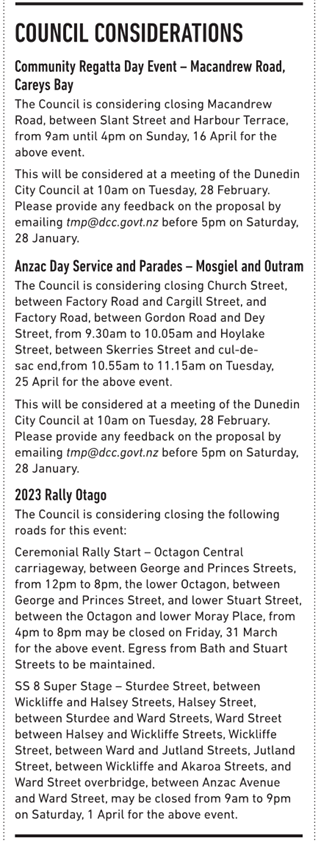
|
|
Council
28 February 2023
|
|

|
Council
28 February 2023
|
Resolution to Exclude the
Public
That the Council excludes
the public from the following part of the proceedings of this meeting (pursuant
to the provisions of the Local Government Official Information and Meetings Act
1987) namely:
|
General subject of the matter to be considered
|
Reasons
for passing this resolution in relation to each matter
|
Ground(s) under
section 48(1) for the passing of this resolution
|
Reason for
Confidentiality
|
|
C1
Confidential Public Forum
|
S7(2)(b)(ii)
The
withholding of the information is necessary to protect information where the
making available of the information would be likely unreasonably to prejudice
the commercial position of the person who supplied or who is the subject of
the information.
|
S48(1)(a)
The public conduct of
the part of the meeting would be likely to result in the disclosure of
information for which good reason for withholding exists under section 7.
|
|
|
C2
Confirmation of the Confidential Minutes of Ordinary Council meeting -
31 January 2023 - Public Excluded
|
S7(2)(a)
The
withholding of the information is necessary to protect the privacy of natural
persons, including that of a deceased person.
S7(2)(g)
The
withholding of the information is necessary to maintain legal professional
privilege.
S7(2)(h)
The
withholding of the information is necessary to enable the local authority to
carry out, without prejudice or disadvantage, commercial activities.
S7(2)(i)
The
withholding of the information is necessary to enable the local authority to
carry on, without prejudice or disadvantage, negotiations (including
commercial and industrial negotiations).
|
.
|
|
|
C3
Confidential Council Actions from Resolutions at Council Meetings
|
S7(2)(a)
The
withholding of the information is necessary to protect the privacy of natural
persons, including that of a deceased person.
S7(2)(g)
The
withholding of the information is necessary to maintain legal professional
privilege.
S7(2)(h)
The
withholding of the information is necessary to enable the local authority to
carry out, without prejudice or disadvantage, commercial activities.
S7(2)(i)
The
withholding of the information is necessary to enable the local authority to
carry on, without prejudice or disadvantage, negotiations (including
commercial and industrial negotiations).
|
S48(1)(a)
The public conduct of
the part of the meeting would be likely to result in the disclosure of
information for which good reason for withholding exists under section 7.
|
|
|
C4
Confidential Council Forward Work Programme - February 2023
|
S7(2)(h)
The
withholding of the information is necessary to enable the local authority to
carry out, without prejudice or disadvantage, commercial activities.
|
S48(1)(a)
The public conduct of
the part of the meeting would be likely to result in the disclosure of
information for which good reason for withholding exists under section 7.
|
|
|
C5
Social Housing - Inner City Site
|
S7(2)(a)
The
withholding of the information is necessary to protect the privacy of natural
persons, including that of a deceased person.
S7(2)(h)
The
withholding of the information is necessary to enable the local authority to
carry out, without prejudice or disadvantage, commercial activities.
S7(2)(i)
The
withholding of the information is necessary to enable the local authority to
carry on, without prejudice or disadvantage, negotiations (including
commercial and industrial negotiations).
|
S48(1)(a)
The public conduct of
the part of the meeting would be likely to result in the disclosure of
information for which good reason for withholding exists under section 7.
|
The content of this
report is subject to commercial sensitivity..
|
|
C6
Revocation of resolution
|
S7(2)(h)
The
withholding of the information is necessary to enable the local authority to
carry out, without prejudice or disadvantage, commercial activities.
|
S48(1)(a)
The public conduct of
the part of the meeting would be likely to result in the disclosure of
information for which good reason for withholding exists under section 7.
|
|
This
resolution is made in reliance on Section 48(1)(a) of the Local
Government Official Information and Meetings Act 1987, and the particular
interest or interests protected by Section 6 or Section 7 of that Act, or
Section 6 or Section 7 or Section 9 of the Official Information Act 1982, as
the case may require, which would be prejudiced by the holding of the whole or
the relevant part of the proceedings of the meeting in public are as shown
above after each item.
That Russell Lund (Developer) and
David McEwen and Fiona Arnold (Salvation Army) be permitted to remain at the
meeting after the public has been excluded to speak to Item C1. Their knowledge
for this item may be of assistance in matters to be discussed.