Notice of Meeting:
I hereby give notice that an ordinary meeting of the Dunedin
City Council will be held on:
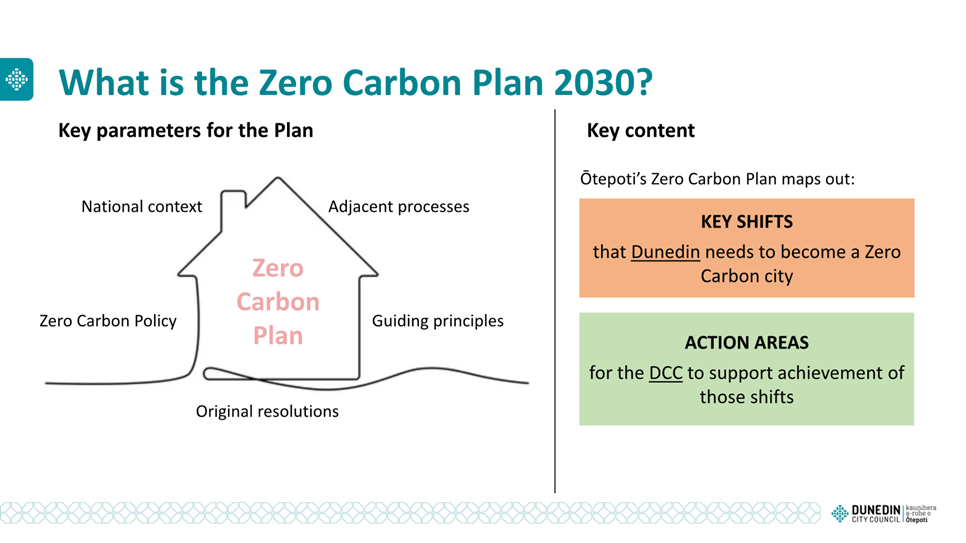
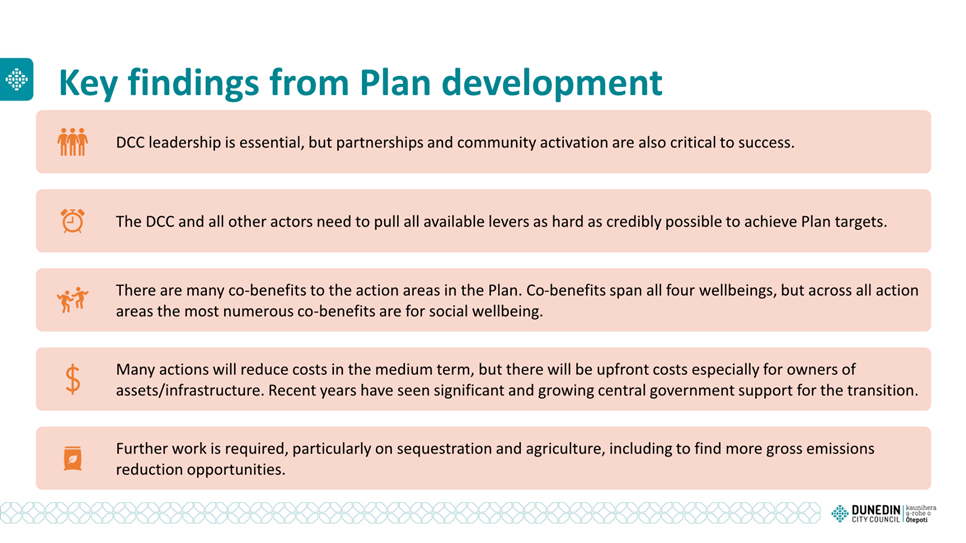
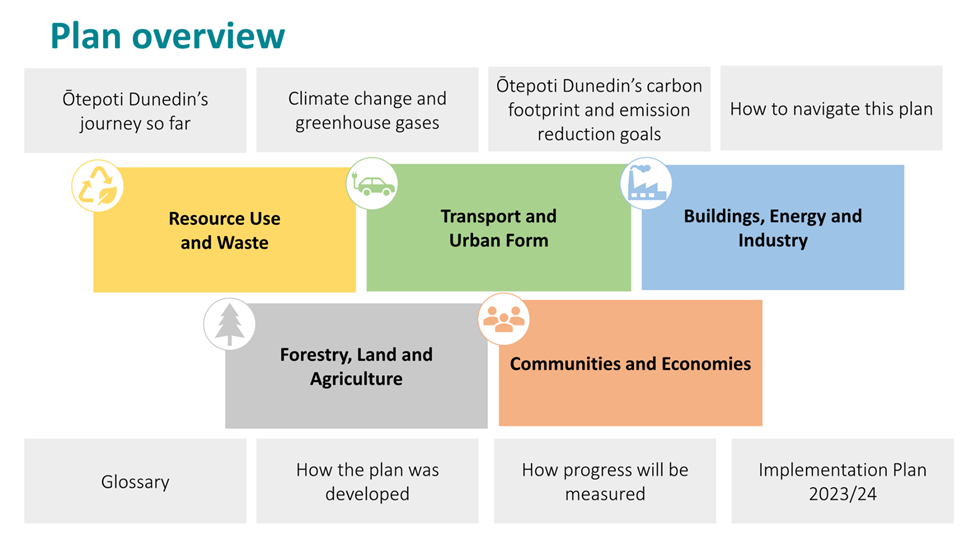
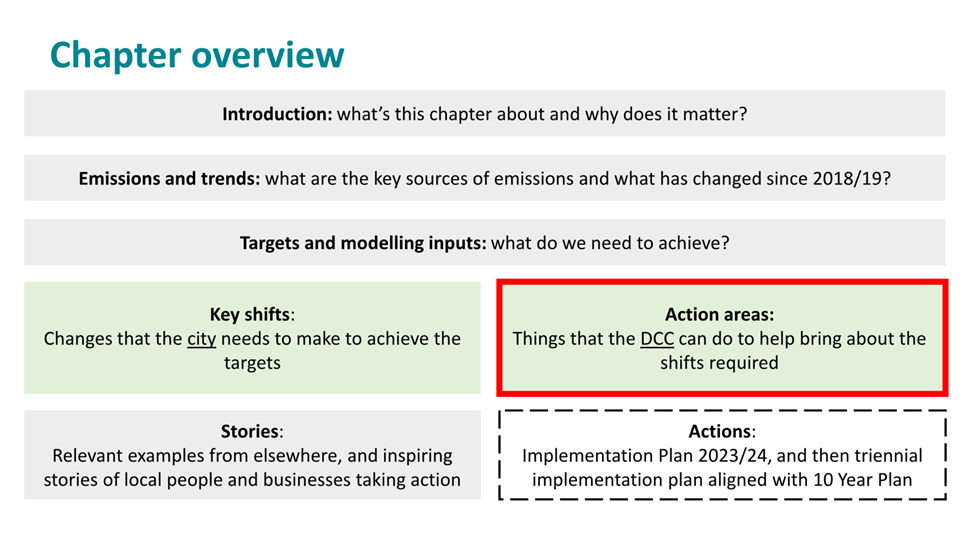
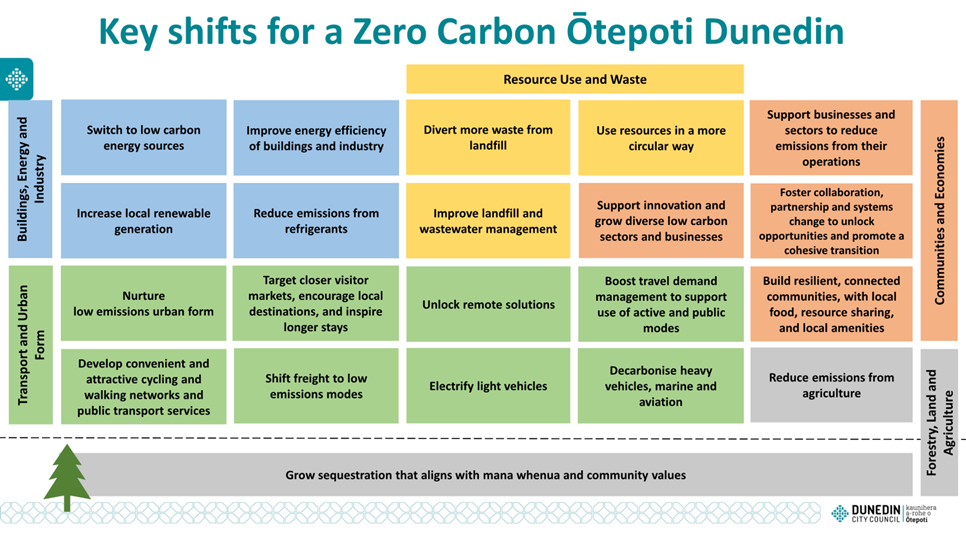
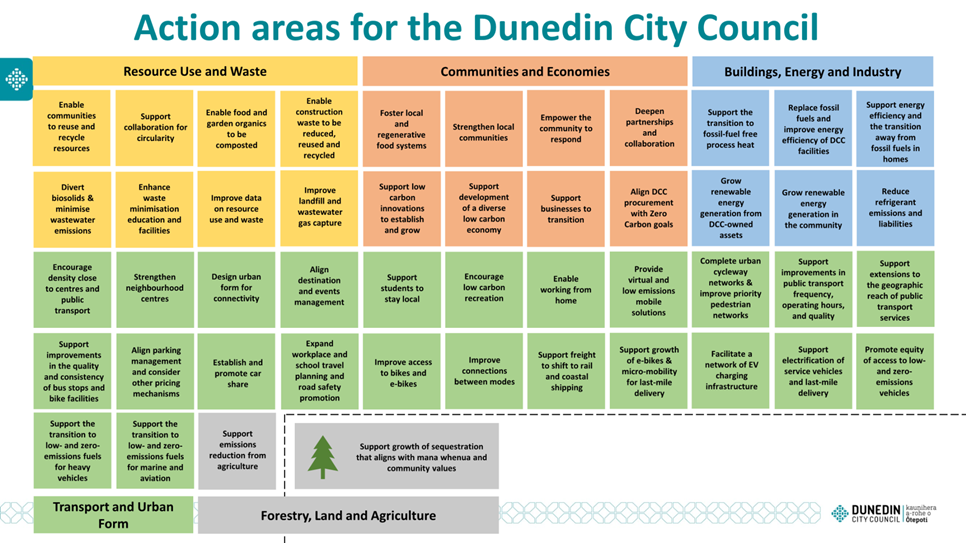
Date: Monday
25 September 2023
Time: 10.00
am
Venue: Council
Chamber, Dunedin Public Art Gallery, The Octagon, Dunedin
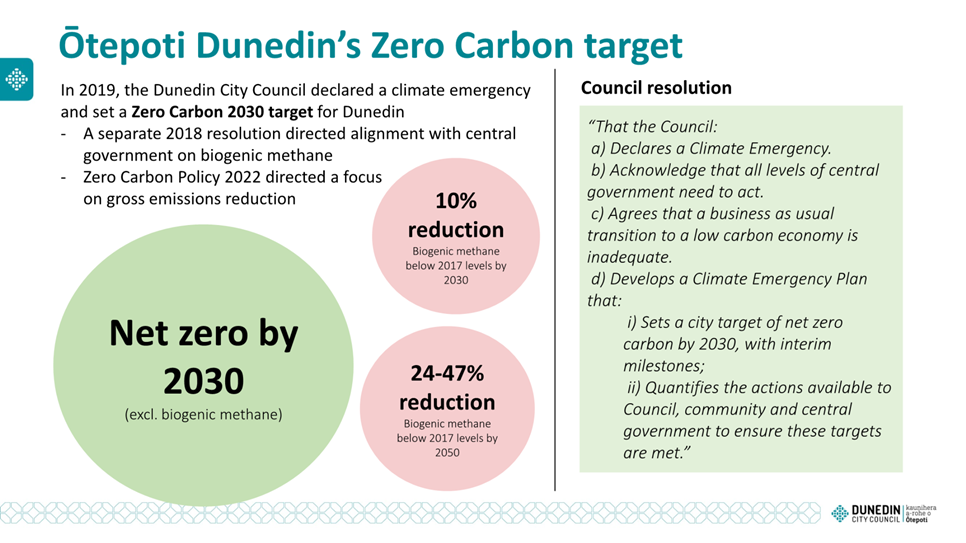
Sandy Graham
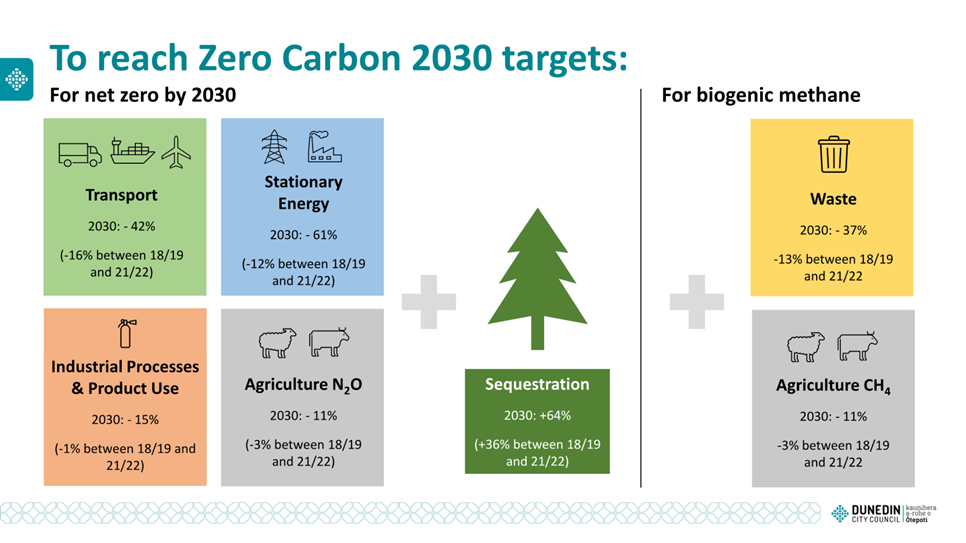
Council
PUBLIC AGENDA
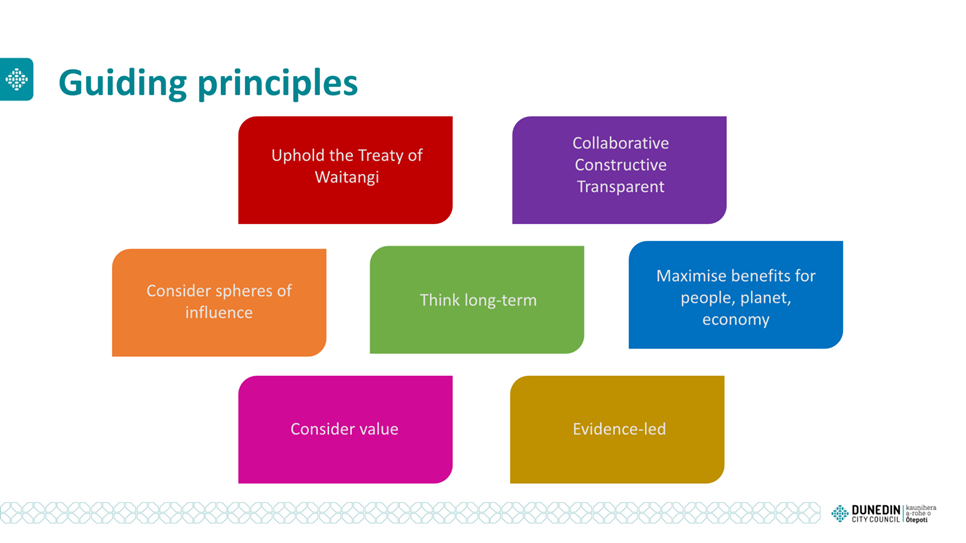
|
Mayor
|
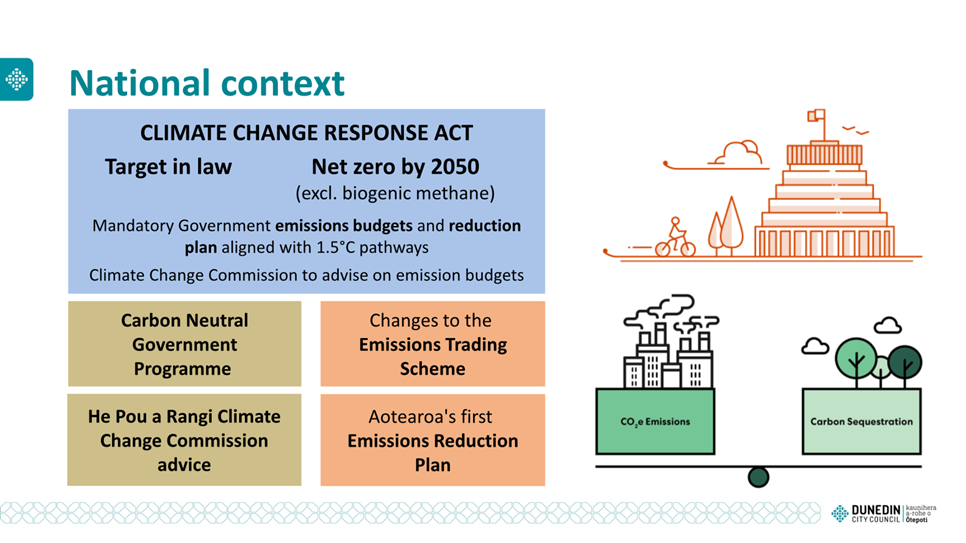
Mayor Jules Radich
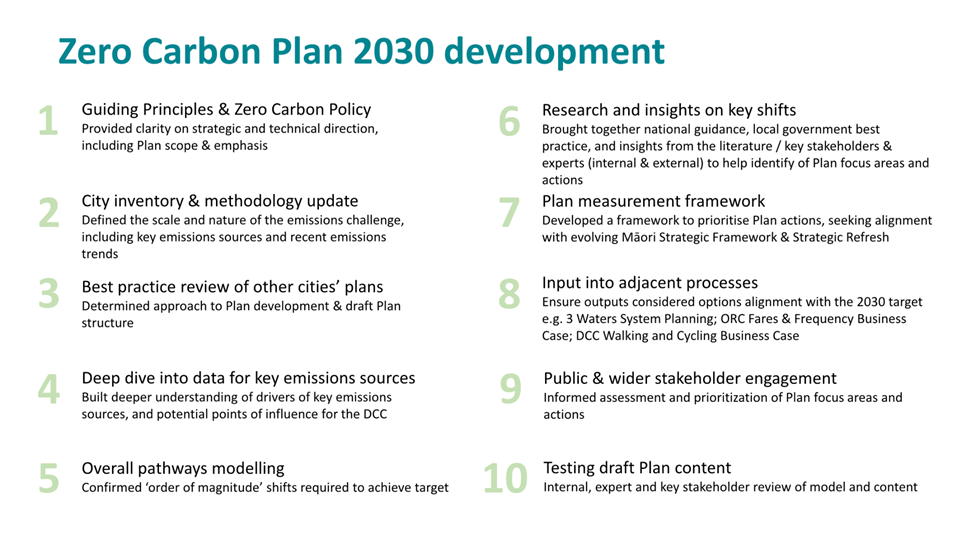
|
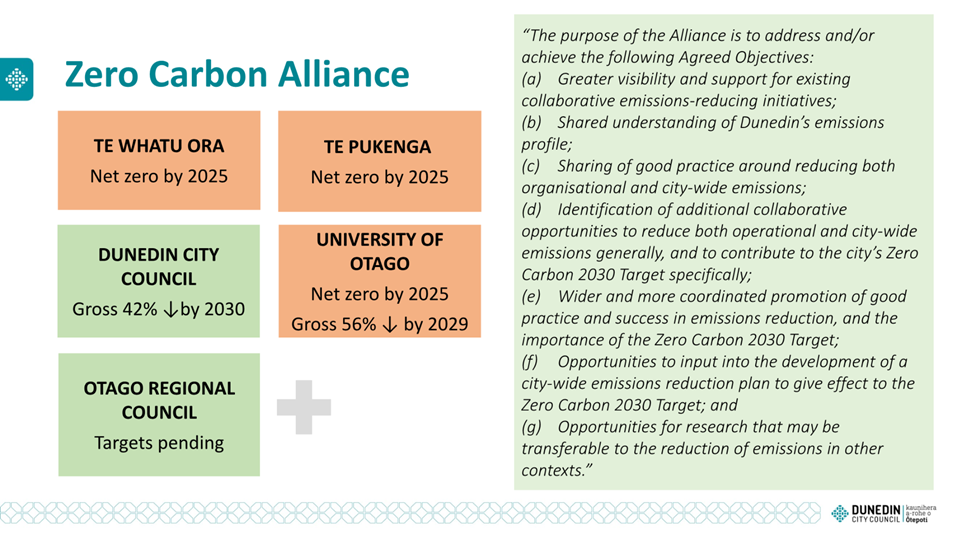
|
|
Deputy Mayor
|
Cr Cherry Lucas
|
|
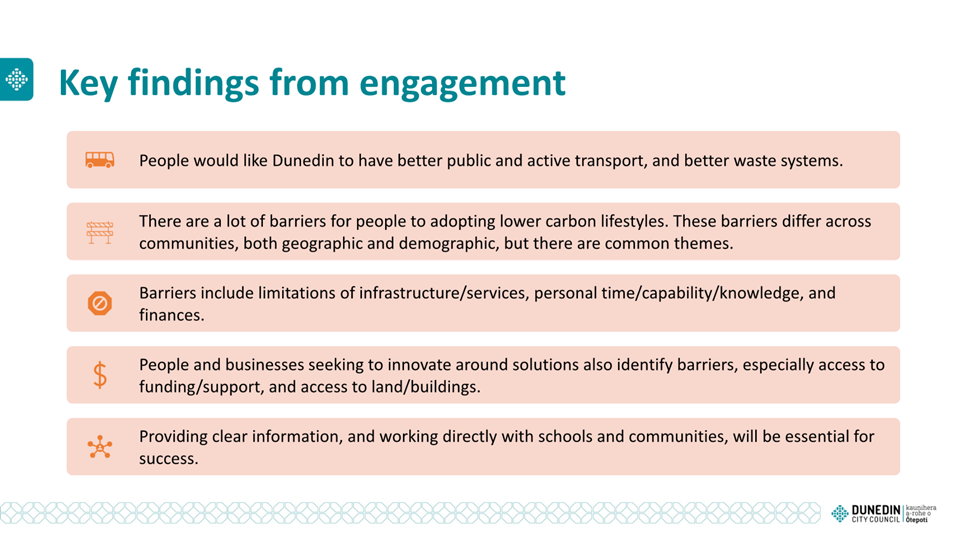
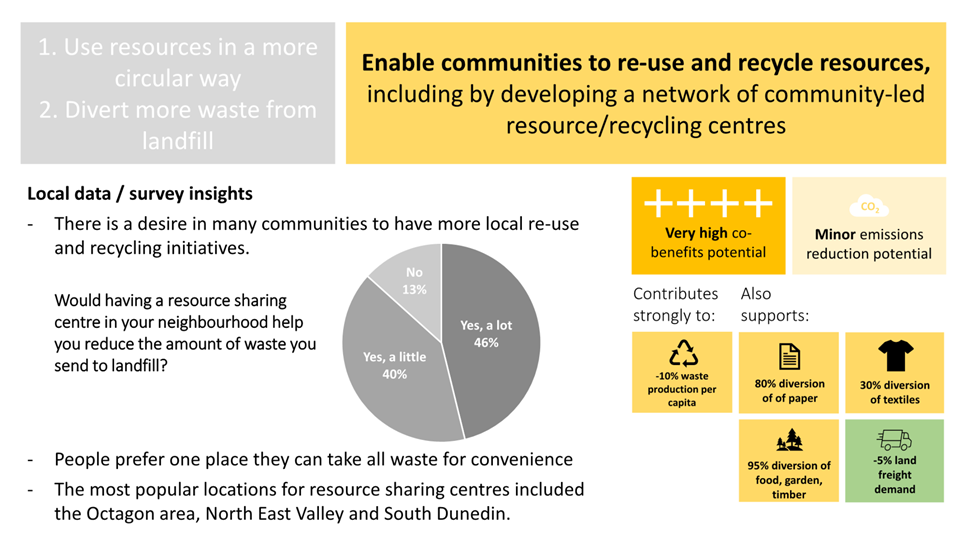
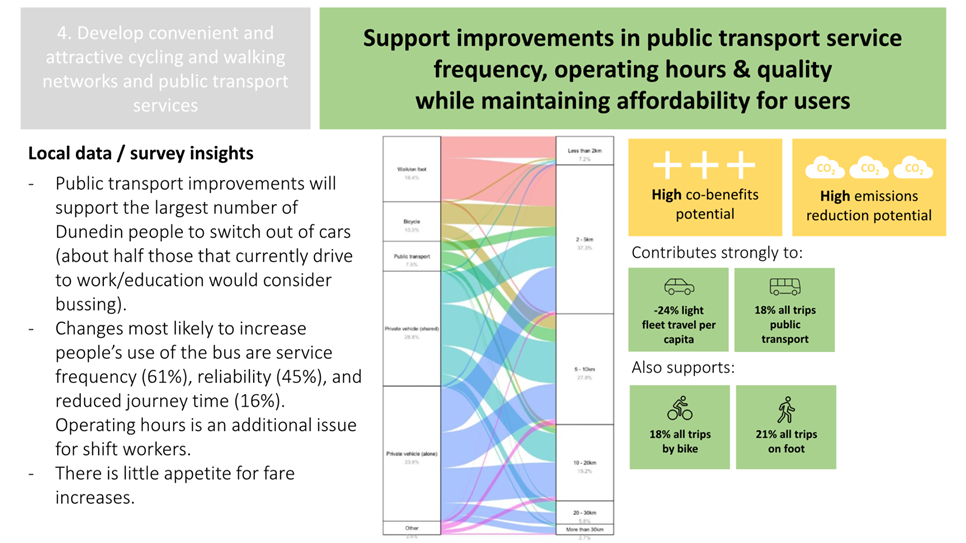
|
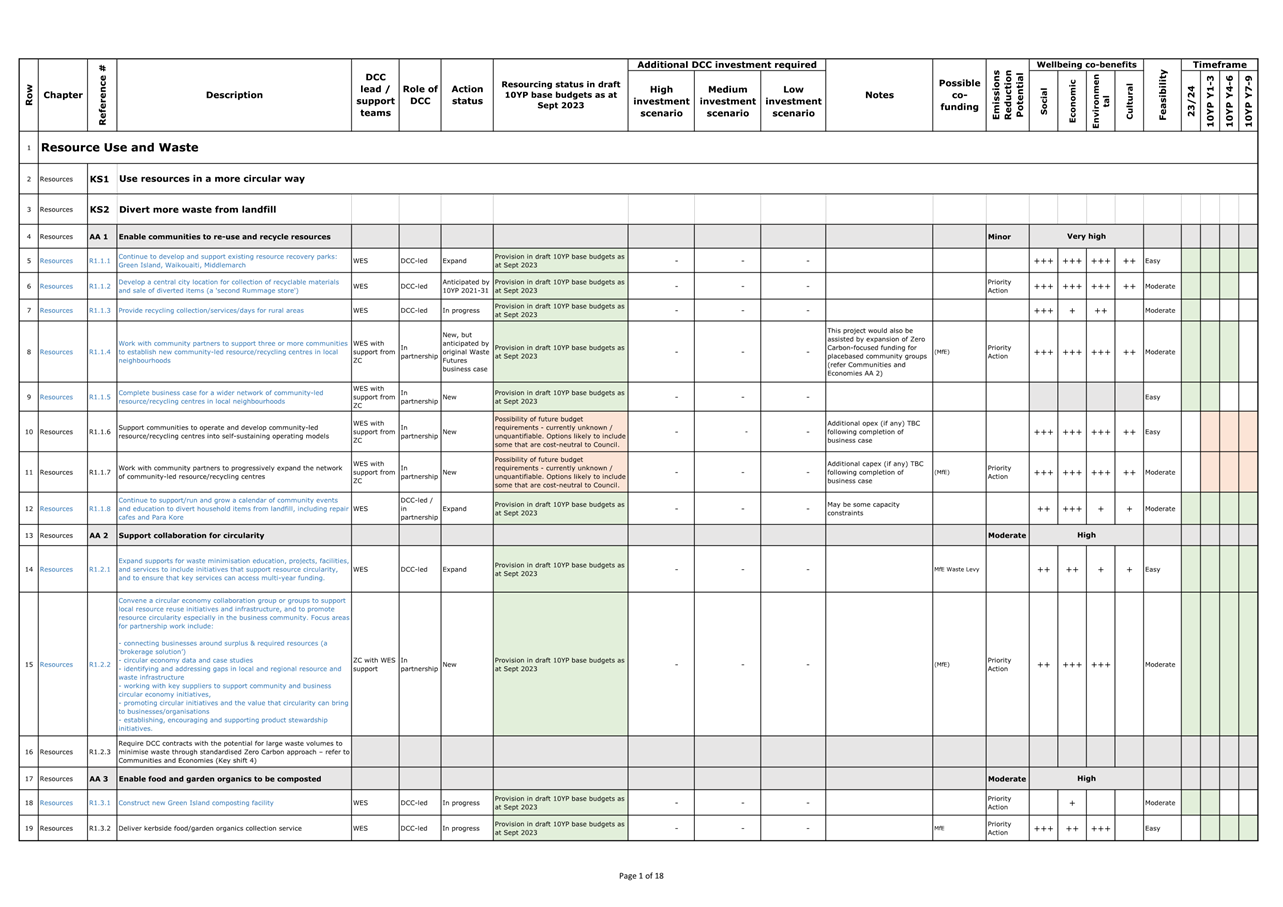
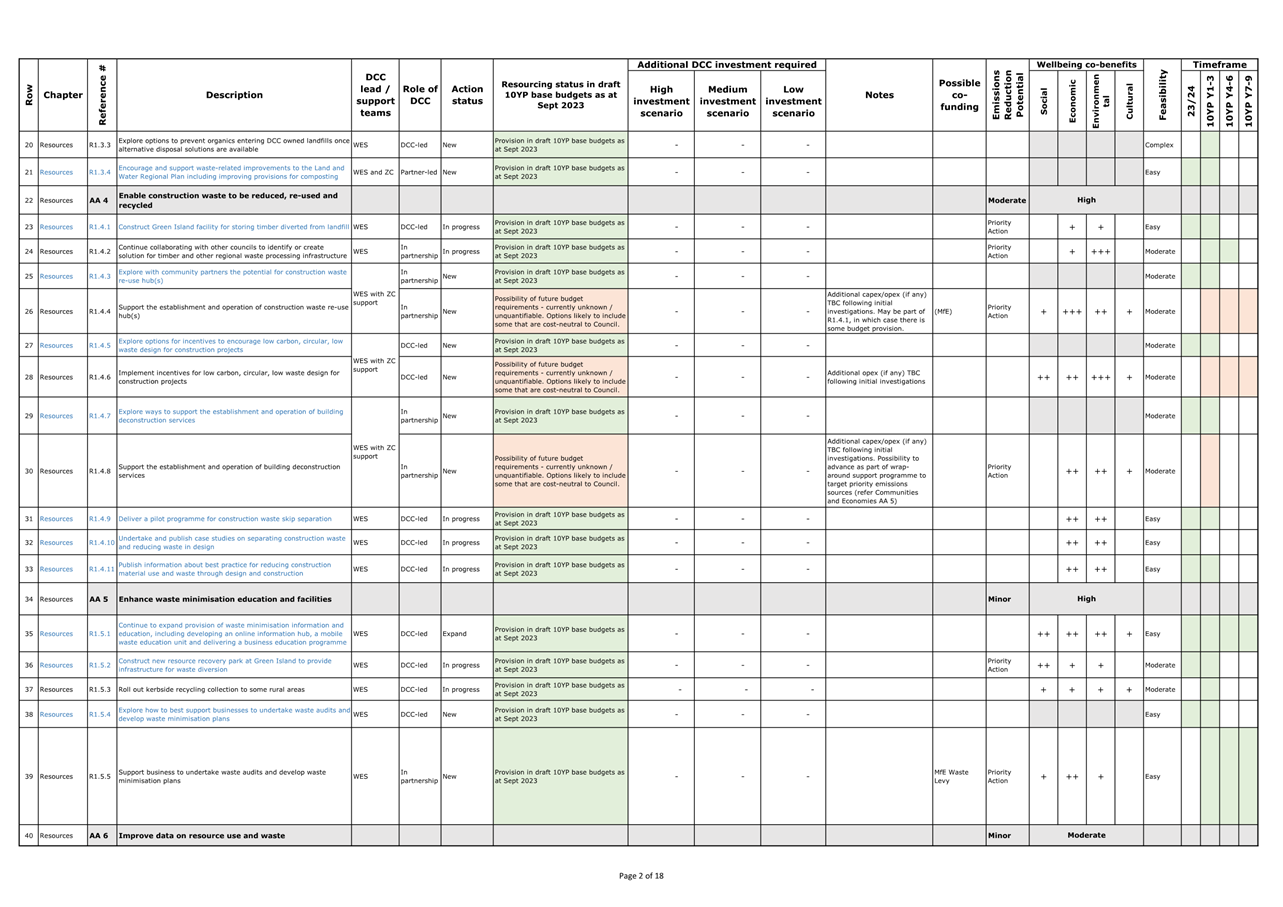
Members
|
Cr Bill Acklin
|
Cr Sophie Barker
|
|
|
Cr David Benson-Pope
|
Cr Christine Garey
|
|
|
Cr Kevin Gilbert
|
Cr Carmen Houlahan
|
|
|
Cr Marie Laufiso
|
Cr Mandy Mayhem
|
|
|
Cr Jim O'Malley
|
Cr Lee Vandervis
|
|
|
Cr Steve Walker
|
Cr Brent Weatherall
|
|
|
Cr Andrew Whiley
|
|
Senior Officer Sandy
Graham, Chief Executive Officer
Governance Support Officer Lynne
Adamson
Lynne Adamson
Governance Support Officer
Telephone: 03 477 4000
governance.support@dcc.govt.nz
www.dunedin.govt.nz
Note: Reports
and recommendations contained in this agenda are not to be considered as
Council policy until adopted.
|

|
Council
25 September 2023
|
ITEM TABLE OF CONTENTS PAGE
1 Opening 4
2 Public
Forum 4
3 Apologies 4
4 Confirmation
of Agenda 4
5 Declaration
of Interest 5
6 Confirmation
of Minutes 17
6.1 Ordinary Council
meeting - 29 August 2023 17
Reports
7 Actions
From Resolutions of Council Meetings 28
8 Forward
Work Programme for Council - September 2023 31
9 Draft
Zero Carbon Plan 2030 43
10 Residents'
Opinion Survey Results 2022/2023 187
11 Update
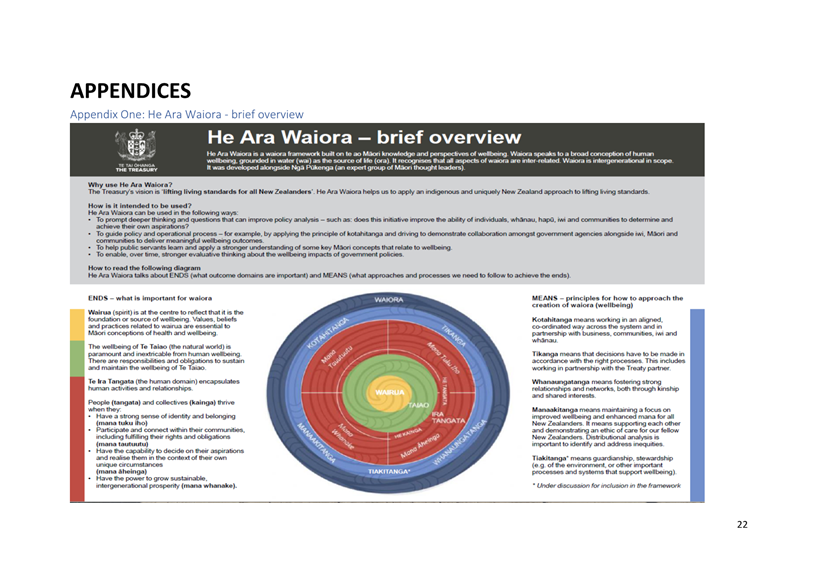
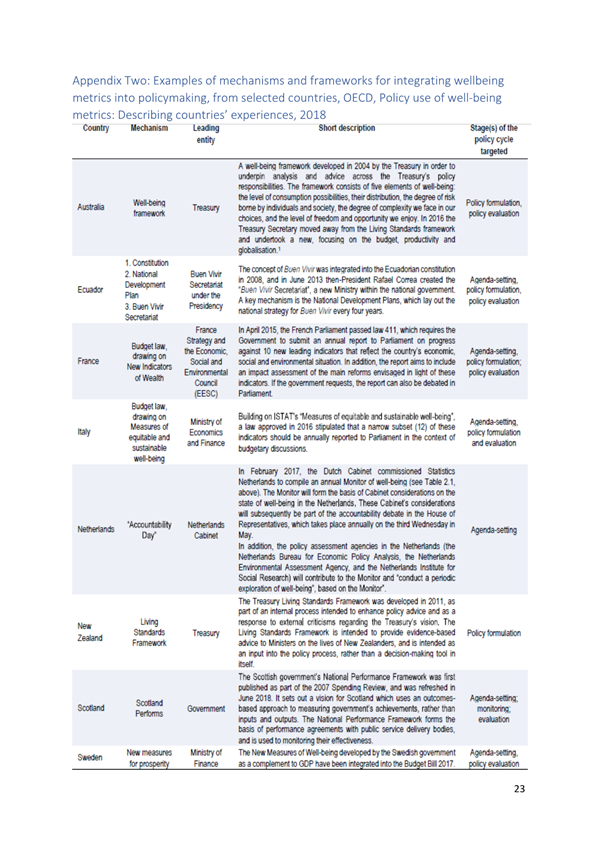
on Refreshing the DCC's Wellbeing Strategies 277
12 Approval
to Grant Electricity Easement to Aurora Energy Limited - Part Rotary Park 349
13 Appointment
of Deputy Mayor and Other Appointments 358
14 Elected
Member Remuneration 2023/24 360
15 Proposed
Event Road Closures - October to December 2023 363
16 Te
Taki Haruru - Māori Strategic Framework 374
17 Sustainability
Framework Update - City Portrait and United Nations Sustainability Development
Goals 403
18 10
year plan 2024-34 Update 455
19 Groups
of Activities - 10 Year Plan 2024-34 461
20 Growth
and Economic Significant Forecasting Assumptions - 10 year plan 2024-34 468
21 Climate
change significant forecasting assumptions - 10 year plan 2024-34 479
22 City
Profile Snapshot - 10 year plan 2024-34 496
23 DCC
Grants - 10 year plan 2024-2034 Supporting Information 514
Resolution to Exclude the Public 528
|
|
Council
25 September 2023
|
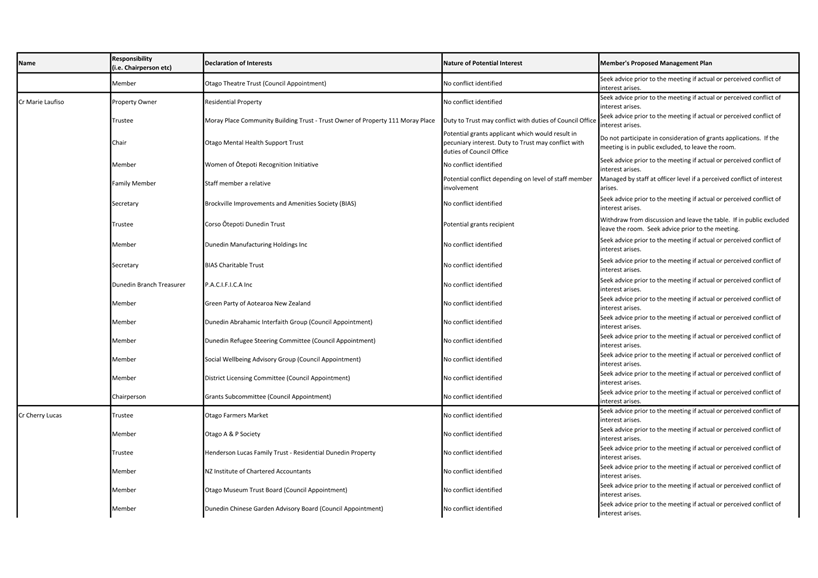
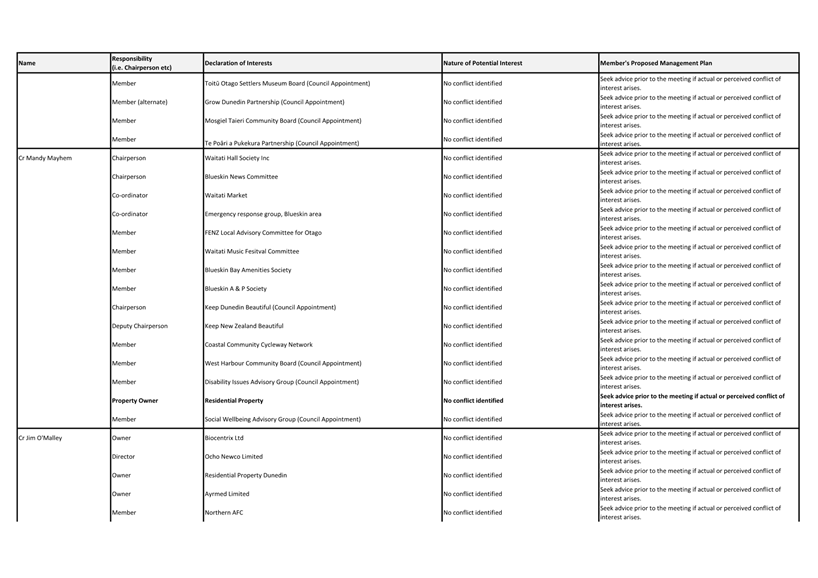
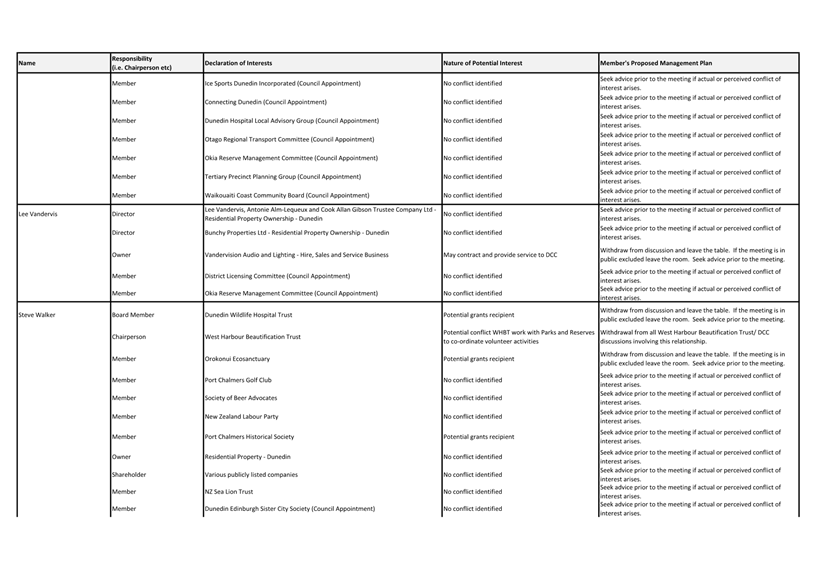
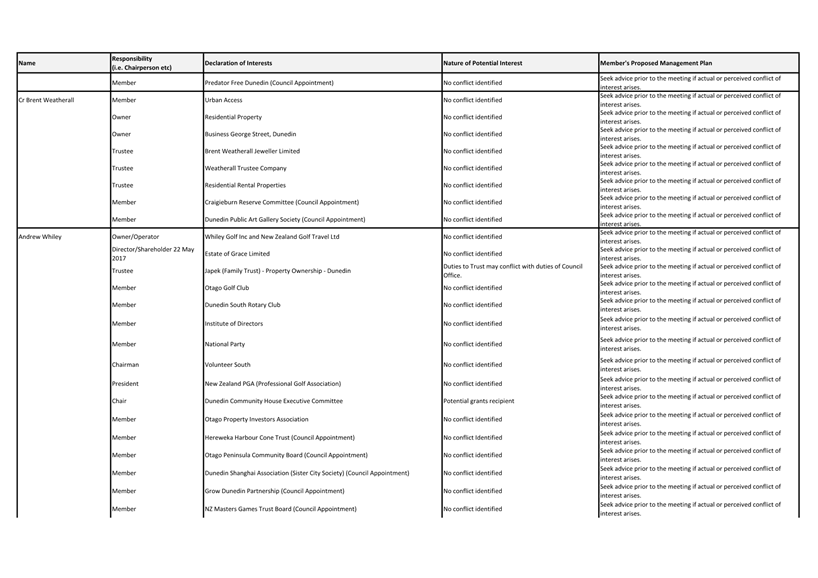
Declaration of Interest
EXECUTIVE SUMMARY
1. Members
are reminded of the need to stand aside from decision-making when a conflict
arises between their role as an elected representative and any private or other
external interest they might have.
2. Elected
members are reminded to update their register of interests as
soon as practicable, including amending the register at this meeting if
necessary.
3. Staff members are
reminded to update their register of interests as soon as practicable.
|
RECOMMENDATIONS
That the Council:
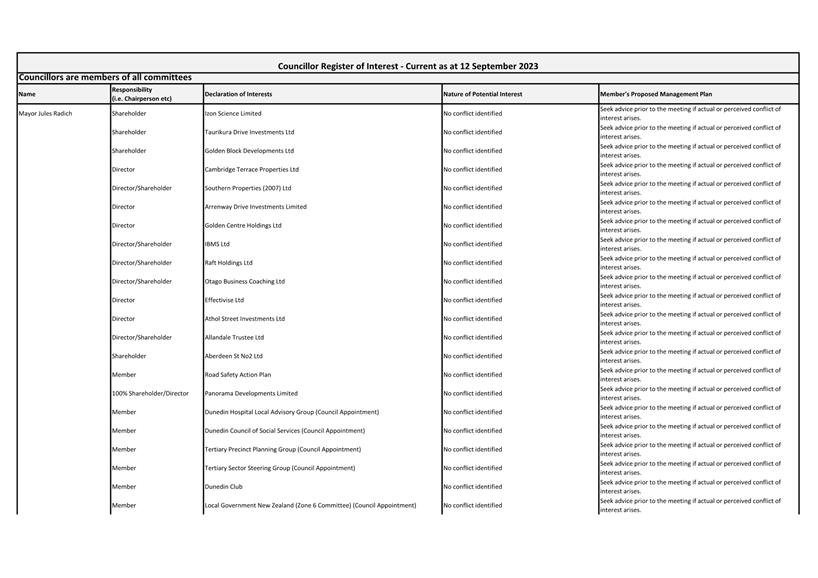
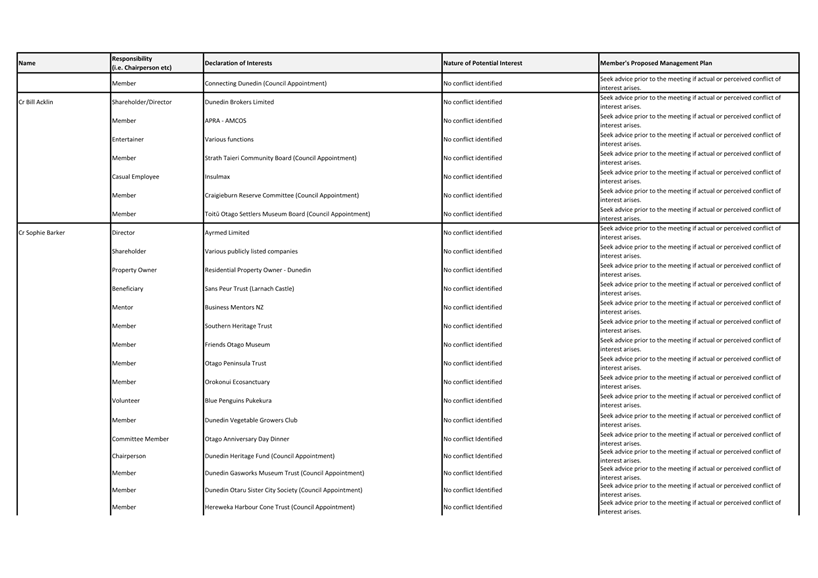
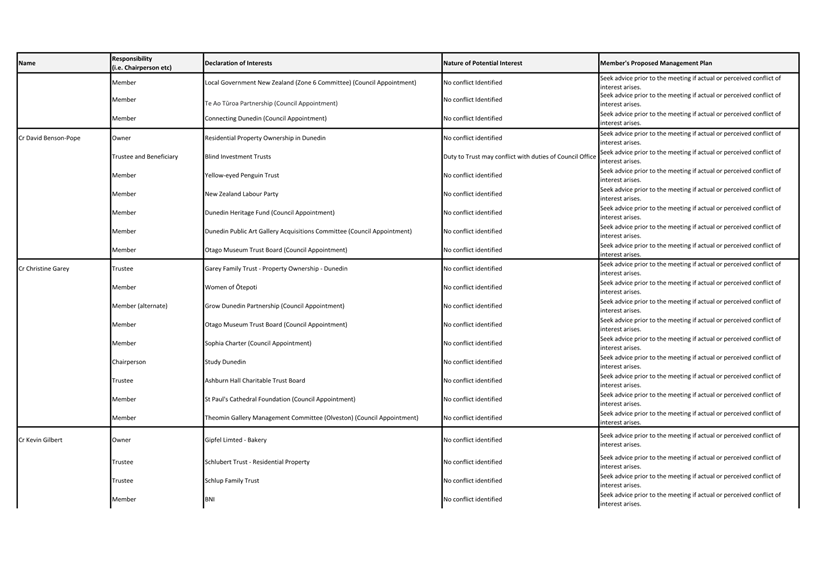
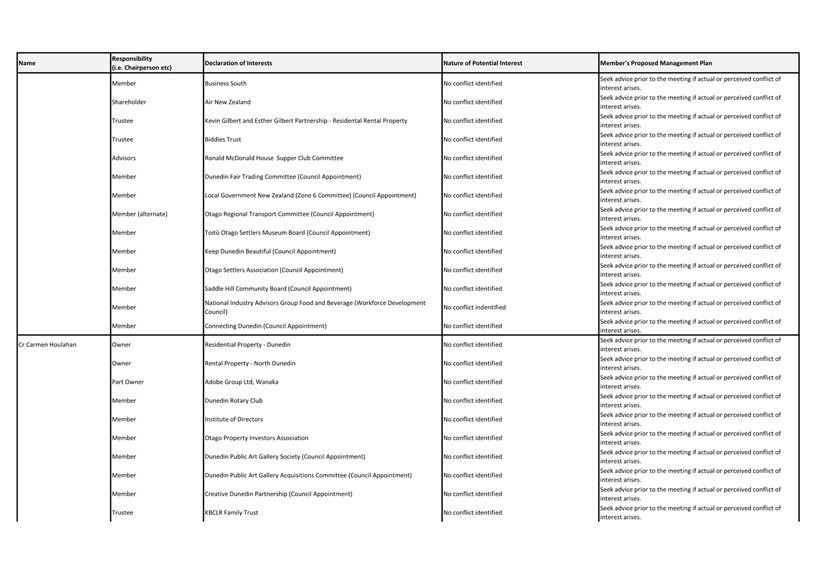
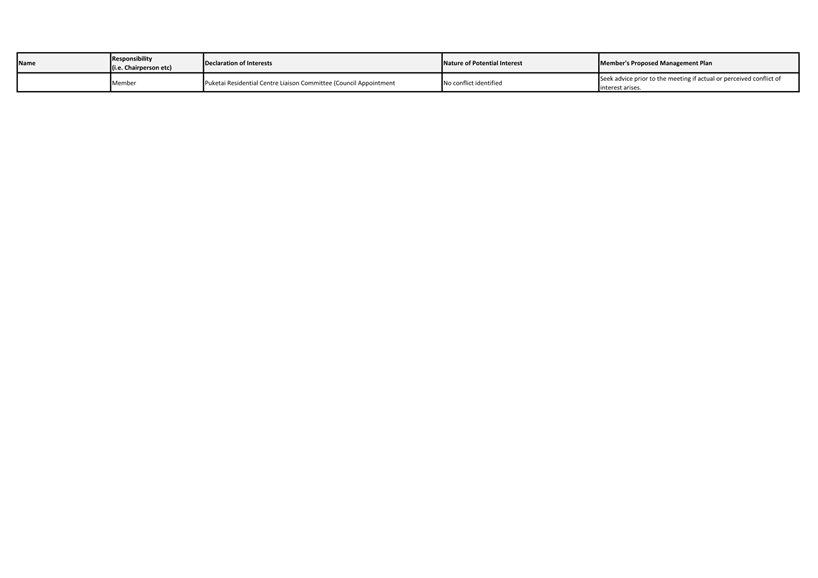
a) Notes/Amends if necessary the Elected Members'
Interest Register attached as Attachment A; and
b) Confirms/Amends the proposed management plan for
Elected Members' Interests.
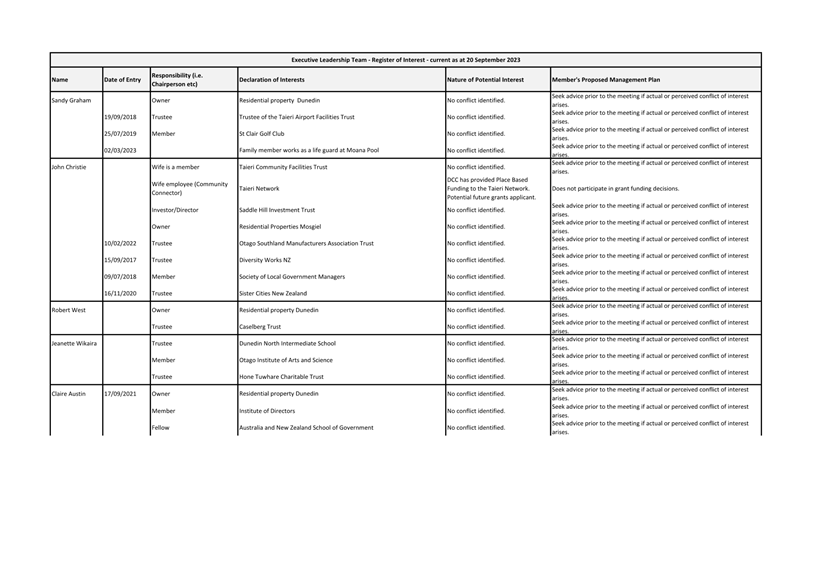
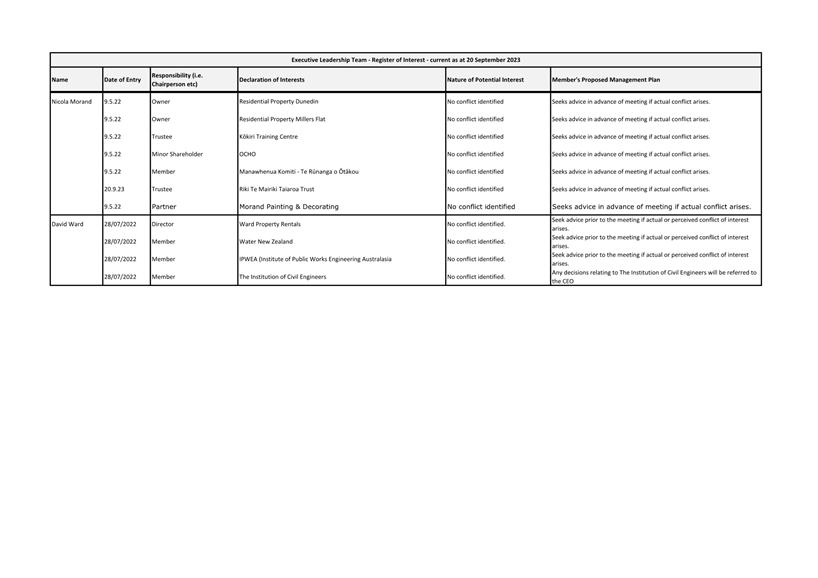
c) Notes the proposed management plan for the Executive Leadership
Team.
|
Attachments
|
|
Title
|
Page
|
|
⇩a
|
Councillor Register of
Interest
|
6
|
|
⇩b
|
Executive Leadership
Team Register of Interest
|
15
|
|
|
Council
25 September 2023
|
|
|
Council
25 September 2023
|
|
|
Council
25 September 2023
|
Confirmation
of Minutes
Ordinary Council meeting - 29 August 2023
|
RECOMMENDATIONS
That the Council:
a) Confirms the public part of the minutes of the
Ordinary Council meeting held on 29 August 2023 as a correct record.
|
Attachments
|
|
Title
|
Page
|
|
A⇩
|
Minutes of Ordinary
Council meeting held on 29 August 2023
|
18
|
|
|
Council
25 September 2023
|
Council
MINUTES
Minutes of an ordinary
meeting of the Dunedin City Council held in the Council Chamber, Dunedin Public
Art Gallery, The Octagon, Dunedin on Tuesday 29 August 2023, commencing at
10.00 am
PRESENT
|
Mayor
|
Mayor Jules Radich
|
|
|
Deputy Mayor
|
Cr Sophie Barker
|
|
|
Members
|
Cr David Benson-Pope
|
Cr Christine Garey
|
|
|
Cr Kevin Gilbert
|
Cr Carmen Houlahan
|
|
|
Cr Marie Laufiso
|
Cr Cherry Lucas
|
|
|
Cr Mandy Mayhem
|
Cr Jim O'Malley
|
|
|
Cr Lee Vandervis
|
Cr Steve Walker
|
|
|
Cr Brent Weatherall
|
Cr Andrew Whiley
|
|
IN ATTENDANCE
|
Sandy Graham (Chief Executive
Officer), Gavin Logie (Chief Financial Officer), Robert West (General Manager
Corporate and Quality), Jeanette Wikaira (Acting General Manager Community
Services), Claire Austin (General Manager Customer and Regulatory), Simon
Drew (General Manager Infrastructure and Development), John Christie (Manager
Enterprise Dunedin) and Clare Sullivan (Principal Committee Advisor).
|
Governance Support Officer Lynne
Adamson
1 Opening
The Mayor opened the meeting with a Karakia – The City Of
Light
Diane Bellamy , member of the Dunedin
Interfaith Council and the Anglican Church opened the meeting
with a prayer.
2 Public
Forum
2.1 Doctors
Point Beach and Doctors Point Road, Waitati
Diana Struthers spoke on issues
relating to Doctors Point Beach and Doctors Point Road, Waitati which included
the increase in traffic, careless driving, visitors, overnight campers, damage
caused to the beach and danger to pedestrians. She commented she would like
DCC to review the signage on Doctors Point Road and enforce the Reserves and
Beaches bylaw at Doctors Point Beach.
Cr Christine
Garey entered the meeting at 10.05 am.
Ms
Struthers responded to questions.
2.2 DCC
Compensation and relief for shops affected by the roadworks on George Street.
Mr Ashkon Ashraf advised he had
opened a shop on George Street four months ago and spoke of the disruption to
his business caused by the roadworks. He requested help either
by compensation or a marketing campaign to help the business stay afloat.
Mr
Ashraf responded to questions.
|
3 APOLOGIES
|
|
Moved (Mayor
Jules Radich/Cr Steve Walker):
That
the Council:
Accepts the apologies
from Crs Bill Acklin, Carmen Houlahan and Marie Laufiso for absence and from
Cr Christine Garey for lateness.
Motion
carried (CNL/2023/185)
|
|
4 CONFIRMATION
OF AGENDA
|
|
|
Moved (Mayor Jules Radich/Cr Andrew Whiley):
That the Council:
Confirms
the agenda with the deletion of Item 9 – Draft Zero Carbon Plan 2030,
noting that this report would be presented to the 25 September 2023 Council
meeting.
Motion carried (CNL/2023/186)
|
5 Declarations
of interest
Members were
reminded of the need to stand aside from decision-making when a conflict arose
between their role as an elected representative and any private or other
external interest they might have.
|
|
Moved (Mayor Jules Radich/Cr Steve Walker):
That the Council:
a) Notes the Elected Members' Interest Register; and
b) Confirms the proposed management plan for
Elected Members' Interests.
c) Notes the proposed management plan for the Executive
Leadership Teams’ interests.
Motion
carried (CNL/2023/187)
|
6 Confirmation
of Minutes
|
6.1 Ordinary
Council meeting - 25 July 2023
|
|
|
Moved (Mayor Jules Radich/Cr Cherry Lucas):
That the Council:
a) Confirms the public part of the minutes of the
Ordinary Council meeting held on 25 July 2023 as a correct record.
Motion
carried (CNL/2023/188)
|
Reports
|
7 Actions
From Resolutions of Council Meetings
|
|
|
A report
from Civic provided an update on the implementation of resolutions made at
Council meetings.
|
|
|
The Chief Executive Officer (Sandy Graham) spoke to the
report and responded to questions.
|
|
|
Moved (Mayor Jules Radich/Cr Mandy Mayhem):
That the Council:
a) Notes
the Open and Completed Actions from resolutions of Council meetings.
Motion carried
(CNL/2023/189)
|
|
8 Forward
Work Programme for Council - August 2023
|
|
|
A report from Civic provided
the updated forward work programme for the 2023-2024 year.
|
|
|
The Chief Executive Officer (Sandy Graham) spoke to the
report and responded to questions.
|
|
|
Moved (Mayor Jules Radich/Cr Mandy Mayhem):
That the Council:
a) Notes the updated Council forward work programme.
Motion
carried (CNL/2023/190)
|
|
9 Draft
Zero Carbon Plan 2030
|
|
|
This item was moved to a
later Council meeting.
|
|
10 Draft
Speed Management Plan 2024-2027 - Consultation
|
|
|
A
report from Transport presented the draft Speed Management Plan (SMP) for
public consultation.
The report noted that the SMP
proposed speed limit changes to rural roads, rural settlements and selected
urban areas within Dunedin City had been developed in accordance with the
guidance and recommendations set out in the Waka Kotahi NZ Transport
Agency’s Speed Management Guide Road to Zero edition.
|
|
|
The General Manager Infrastructure and Development (Simon
Drew) and Group Manager Transport (Jeanine Benson) spoke to the report and
responded to questions.
|
|
|
Moved (Cr Jim O'Malley/Cr Mandy Mayhem):
That the Council:
a) Notes the draft Speed Management Plan for consultation from
1 - 21 September 2023.
b) Authorises the Chief Executive to make any minor
editorial changes to the draft Speed Management Plan if required.
Division
The Council voted by division
For: Crs
Sophie Barker, David Benson-Pope, Christine Garey, Kevin Gilbert, Cherry
Lucas, Mandy Mayhem, Jim O'Malley, Steve Walker, Brent Weatherall, Andrew
Whiley and Mayor Jules Radich (11).
Against: Cr
Lee Vandervis (1).
Abstained: Nil
The division was declared CARRIED by 11
votes to 1
Motion
carried (CNL/2023/191)
|
|
11 Governance
options for stage two of the Future Development Strategy; Submissions and
Hearing Process
|
|
|
A report from City
Development noted that the National Policy Statement on Urban Development
required the Dunedin City Council (DCC) and Otago Regional Council (ORC) to
jointly prepare and approve a Future Development Strategy (FDS) for Dunedin
by mid-2024.
The report noted that the ORC
had considered a similar report at its Council meeting on 23 August 2023 and
resolved that decisions on submissions and the approval of the final Future
Development Strategy was delegated to a Joint Hearings Panel. The ORC
also resolved that the Joint Hearing Panel comprised of an independent Chair,
two elected members from each of ORC and DCC, and up to two mana whenua
recommended appointment/s.
|
|
|
The General Manager Infrastructure and Development (Simon
Drew) and City Development Manager (Dr Anna Johnson) spoke to the report and
responded to questions.
|
|
Cr Christine Garey left the meeting at 11.19 am and
returned at 11.22 am.
|
|
|
Moved (Cr Sophie Barker/Mayor
Jules Radich):
That the Council:
a) Approves decisions on submissions and the
approval of the final Future Development Strategy was delegated to a Joint
Hearings Panel.
b) Agrees proportionate membership of a Joint Hearing Panel,
made up of an independent Chair with planning expertise, two elected members
from each of ORC and DCC and up to two mana whenua recommended appointment/s.
c) Notes the timeframe for formal consultation on the draft
FDS in early 2024.
Division
The Council
voted by division
For: Crs
Sophie Barker, David Benson-Pope, Christine Garey, Kevin Gilbert, Cherry
Lucas, Mandy Mayhem, Jim O'Malley, Steve Walker, Brent Weatherall, Andrew
Whiley and Mayor Jules Radich (11).
Against: Cr
Lee Vandervis (1).
Abstained: Nil
The division
was declared CARRIED by 11 votes to 1
Motion
carried (CNL/2023/192)
|
|
12 Revocation
of Food Grading Bylaw
|
|
|
A report from Customer and
Regulatory advised that the implementation of the Food Act 2014 had
removed the need for both the Food Grading Bylaw 2016 and the Food Grading
Policy.
|
|
|
The General Manager Customer and Regulatory (Claire
Austin) and Manager Compliance Solutions (Ros MacGill) spoke to the report
and responded to questions.
|
|
|
Moved (Cr Lee Vandervis/Cr Cherry Lucas):
That the Council:
a) Determines that the
Food Grading Bylaw was no longer the most appropriate way to address any
issues of food safety in Dunedin food premises.
b) Determines that the revocation would not have a
significant impact on the public.
c) Revokes the Food Grading Bylaw 2016 from 1
January 2024.
d) Notes that the Food Grading Policy would also become revoked
from 1 January 2024.
Motion
carried (CNL/2023/193)
|
|
13 Proposed
Event Road Closures - September 2023
|
|
|
A report from Transport
sought approval for temporary road closures for the John McGlashan School
Fete to be held on Saturday 9 September 2023.
|
|
|
Moved (Cr Lee Vandervis/Cr David Benson-Pope):
That the Council:
a) Resolves to close the roads detailed below
(pursuant to Section 319, Section 342, and Schedule 10 clause 11(e) of the Local Government Act 1974):
i) John
McGlashan School Fete
Dates and Times:
Saturday 9 September 2023, from 7.30am to 3.30pm
Roads:
· Pilkington
Street from Balmacewen Road to Passmore Crescent
Motion
carried (CNL/2023/194)
|
|
14 New
Zealand Masters Games CCO Exemption
|
|
|
A report from Events and Community
Development advised that the Dunedin (New Zealand) Masters Games Trust sought
a continuation of exemption status from being a Council Controlled
Organisation in accordance with s7(3) Local Government Act 2002.
|
|
|
The General Manager Community Services (Acting) (Jeanette
Wikaira) and Masters Games Manager (Vicki Kestila) spoke to the report and
responded to questions.
|
|
|
Moved (Cr Andrew Whiley/Cr Lee
Vandervis):
That the Council:
a) Approves the exemption of the Dunedin (New
Zealand) Masters Games Trust from the requirements of being a Council
Controlled Organisation in accordance with s7(3) Local Government Act 2002.
Motion
carried (CNL/2023/195)
|
|
Resolution to
exclude the public
|
|
Moved (Mayor Jules
Radich/Cr Jim O'Malley):
That
the Council:
Pursuant to the provisions of the Local Government
Official Information and Meetings Act 1987, exclude the public from the
following part of the proceedings of this meeting namely:
|
General
subject of the matter to be considered
|
Reasons
for passing this resolution in relation to each matter
|
Ground(s) under
section 48(1) for the passing of this resolution
|
Reason for
Confidentiality
|
|
C1
Ordinary Council meeting - 25 July 2023 - Public Excluded
|
S7(2)(a)
The
withholding of the information is necessary to protect the privacy of
natural persons, including that of a deceased person.
S7(2)(g)
The
withholding of the information is necessary to maintain legal professional
privilege.
S7(2)(h)
The
withholding of the information is necessary to enable the local authority
to carry out, without prejudice or disadvantage, commercial activities.
S7(2)(i)
The
withholding of the information is necessary to enable the local authority
to carry on, without prejudice or disadvantage, negotiations (including
commercial and industrial negotiations).
|
.
|
|
|
C2
Confidential Council Actions from Resolutions at Council Meetings
|
S7(2)(a)
The
withholding of the information is necessary to protect the privacy of
natural persons, including that of a deceased person.
S7(2)(g)
The
withholding of the information is necessary to maintain legal professional
privilege.
S7(2)(h)
The
withholding of the information is necessary to enable the local authority
to carry out, without prejudice or disadvantage, commercial activities.
S7(2)(i)
The
withholding of the information is necessary to enable the local authority
to carry on, without prejudice or disadvantage, negotiations (including
commercial and industrial negotiations).
|
S48(1)(a)
The public conduct of
the part of the meeting would be likely to result in the disclosure of information
for which good reason for withholding exists under section 7.
|
|
|
C3
Confidential Council Forward Work Programme - August 2023
|
S7(2)(h)
The
withholding of the information is necessary to enable the local authority
to carry out, without prejudice or disadvantage, commercial activities.
|
S48(1)(a)
The public conduct of
the part of the meeting would be likely to result in the disclosure of
information for which good reason for withholding exists under section 7.
|
|
|
C4
Strath Taieri Matter
|
S7(2)(a)
The
withholding of the information is necessary to protect the privacy of
natural persons, including that of a deceased person.
S7(2)(c)(i)
The
withholding of the information is necessary to protect information which is
subject to an obligation of confidence or which any person has been or
could be compelled to provide under the authority of any enactment, where
the making available of the information would be likely to prejudice the
supply of similar information or information from the same source and it is
in the public interest that such information should continue to be
supplied.
|
S48(1)(a)
The public conduct of
the part of the meeting would be likely to result in the disclosure of
information for which good reason for withholding exists under section 7.
|
|
|
C5
Potential Property Purchase
|
S7(2)(g)
The
withholding of the information is necessary to maintain legal professional
privilege.
S7(2)(h)
The
withholding of the information is necessary to enable the local authority
to carry out, without prejudice or disadvantage, commercial activities.
S7(2)(i)
The
withholding of the information is necessary to enable the local authority
to carry on, without prejudice or disadvantage, negotiations (including
commercial and industrial negotiations).
|
S48(1)(a)
The public conduct of
the part of the meeting would be likely to result in the disclosure of
information for which good reason for withholding exists under section 7.
|
|
|
C6
Director Remuneration - Dunedin City Holdings Limited
|
S7(2)(a)
The
withholding of the information is necessary to protect the privacy of
natural persons, including that of a deceased person.
S7(2)(b)(i)
The
withholding of the information is necessary to protect information where
the making available of the information would disclose a trade secret.
|
S48(1)(a)
The public conduct of
the part of the meeting would be likely to result in the disclosure of
information for which good reason for withholding exists under section 7.
|
This report is
confidential because the information contained in this report remains
confidential until Council has determined the level of fees and advised
Dunedin City Holdings Limited of the outcome at which point the information
can be made public..
|
This
resolution is made in reliance on Section 48(1)(a) of the Local Government
Official Information and Meetings Act 1987, and the particular interest or
interests protected by Section 6 or Section 7 of that Act, or Section 6 or
Section 7 or Section 9 of the Official Information Act 1982, as the case may
require, which would be prejudiced by the holding of the whole or the
relevant part of the proceedings of the meeting in public are as shown above
after each item.
Motion carried (CNL/2023/196)
|
The meeting moved into confidential at 11.52 am and
concluded at 2.24 pm.
..............................................
MAYOR
|
|
Council
25 September 2023
|
Reports
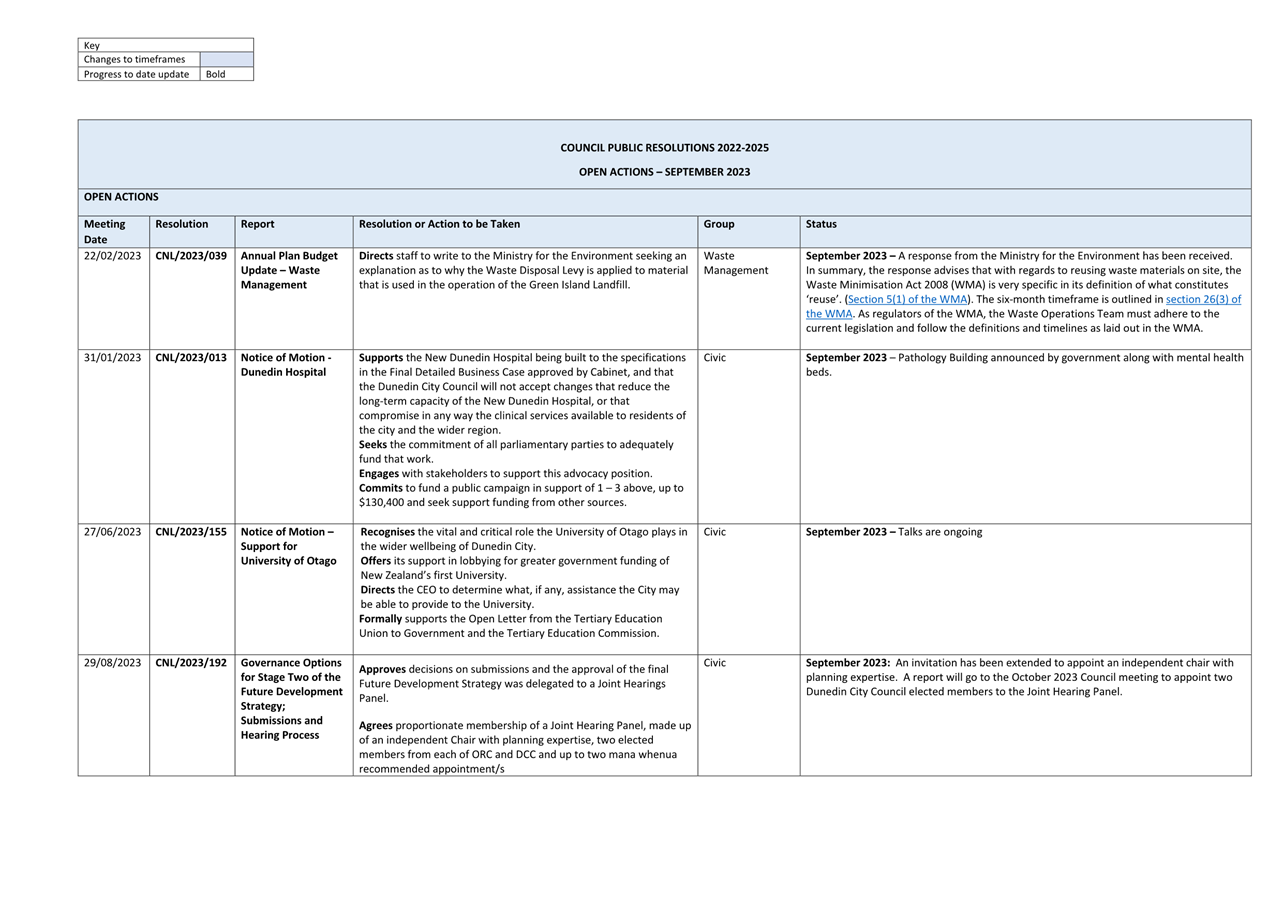
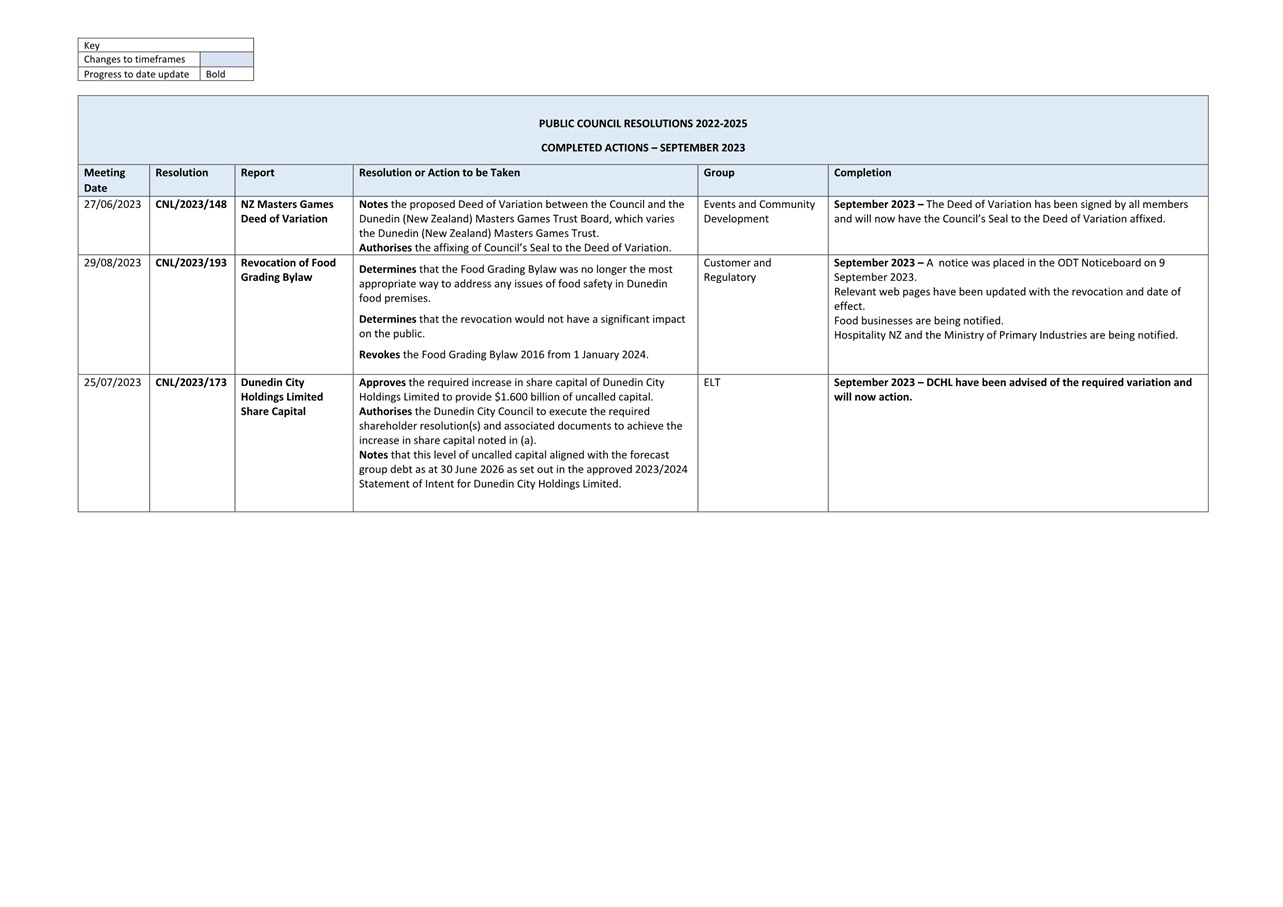
Actions From Resolutions of Council Meetings
Department: Civic
EXECUTIVE SUMMARY
1 The
purpose of this report is to show progress on implementing resolutions made at
Council meetings.
2 As
this report is an administrative report only, there are no options or Summary
of Considerations.
|
RECOMMENDATIONS
That the Council:
a) Notes
the Open and Completed Actions from resolutions of Council meetings as
attached.
|
discussion
3 This
report also provides an update on resolutions that have been actioned and
completed since the last Council meeting. Note that items on the Forward
Work Programme are not included in the attached schedules.
NEXT STEPS
4 Updates
will be provided at future Council meetings.
Signatories
|
Author:
|
Lynne Adamson - Governance Support Officer
|
|
Authoriser:
|
Sharon Bodeker - Manager Governance
|
Attachments
|
|
Title
|
Page
|
|
⇩a
|
Council Public Open
Actions
|
29
|
|
⇩b
|
Council Public Closed
Actions
|
30
|
|
|
Council
25 September 2023
|
|
|
Council
25 September 2023
|
|
|
Council
25 September 2023
|
Forward Work Programme for Council - September
2023
Department: Civic
EXECUTIVE SUMMARY
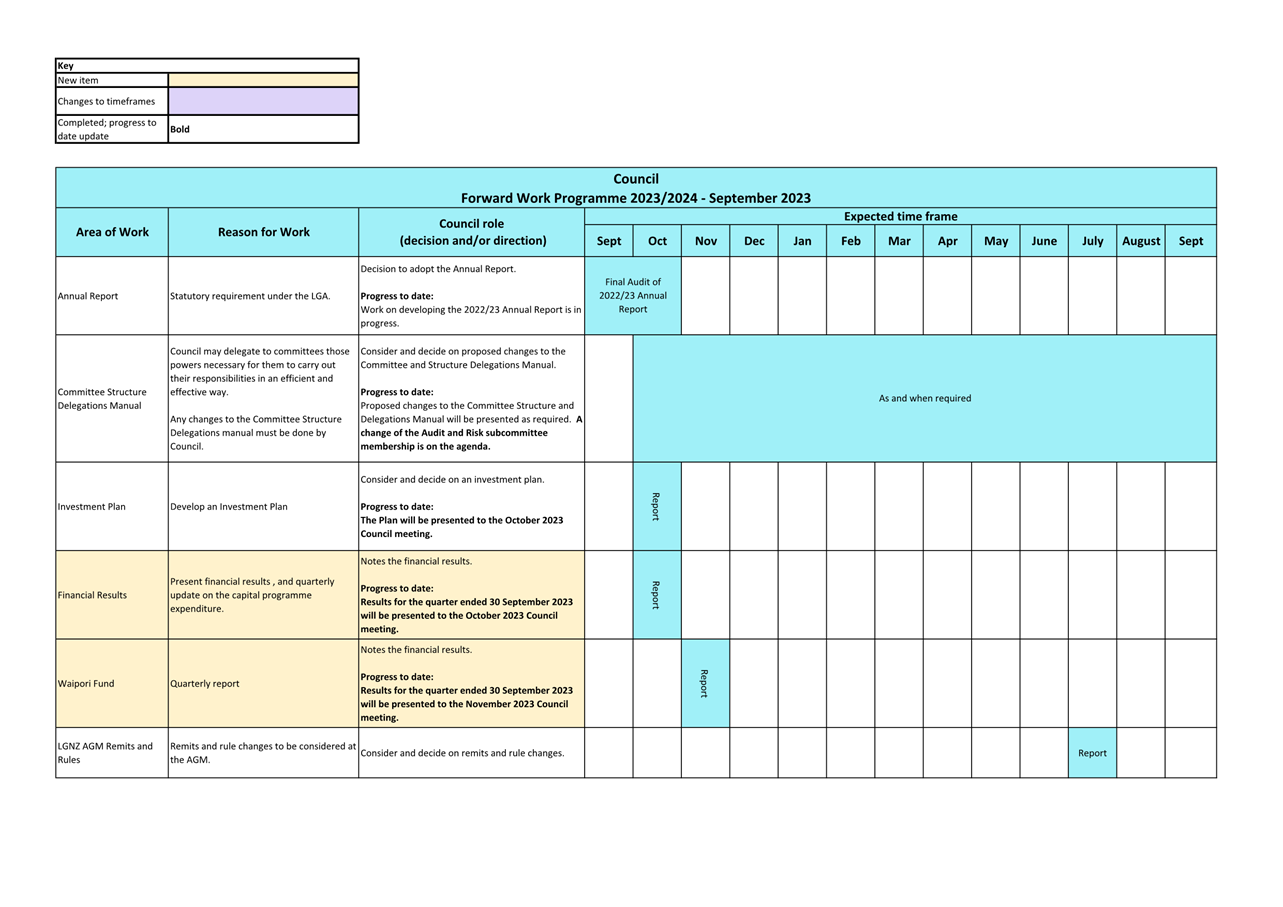
1 The
purpose of this report is to provide the updated forward work programme for the
2023-2024 year (Attachment A).
2 As
this is an administrative report only, there are no options or Summary of
Considerations.
|
RECOMMENDATIONS
That the Council:
a) Notes the updated Council forward work programme as shown
in Attachment A.
|
DISCUSSION
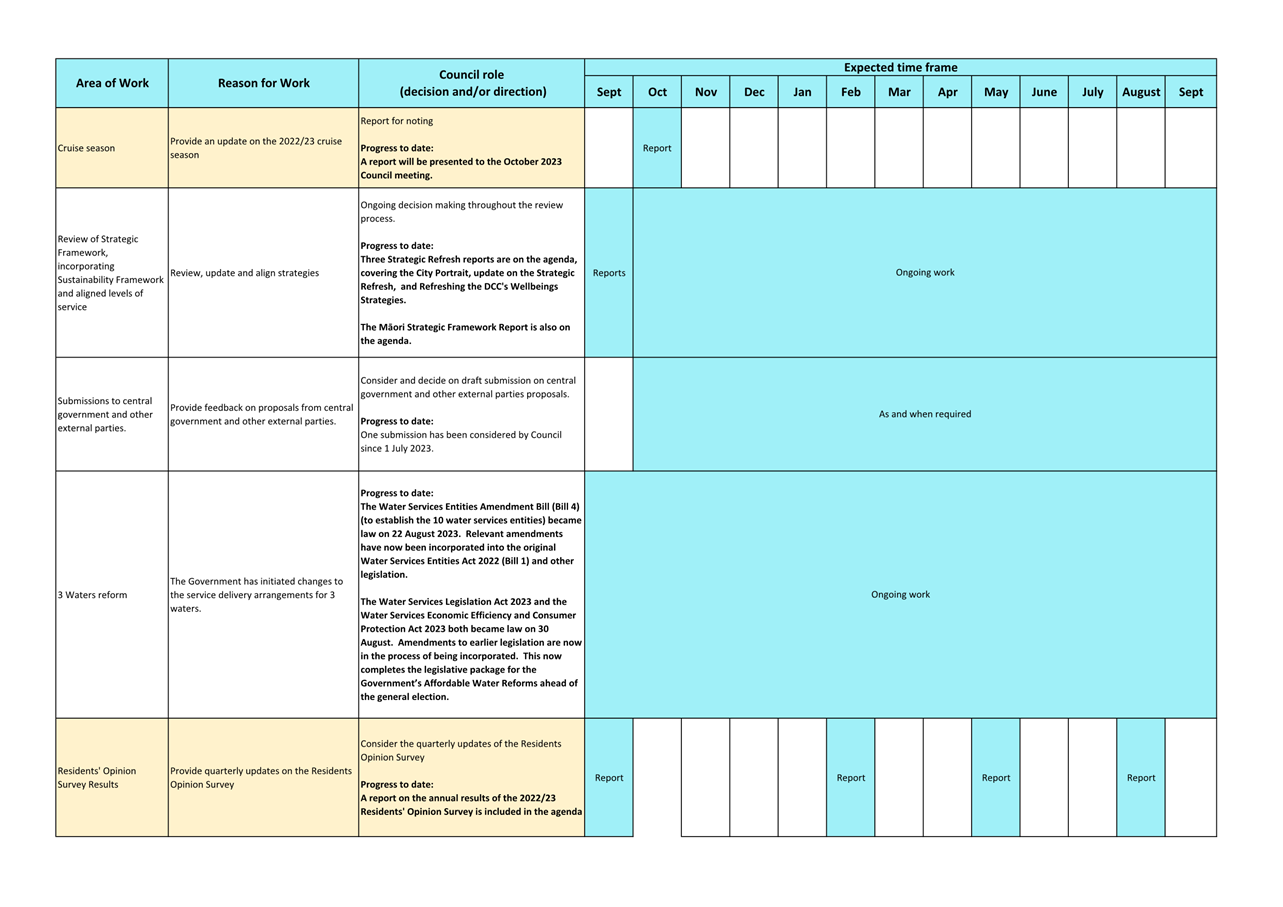
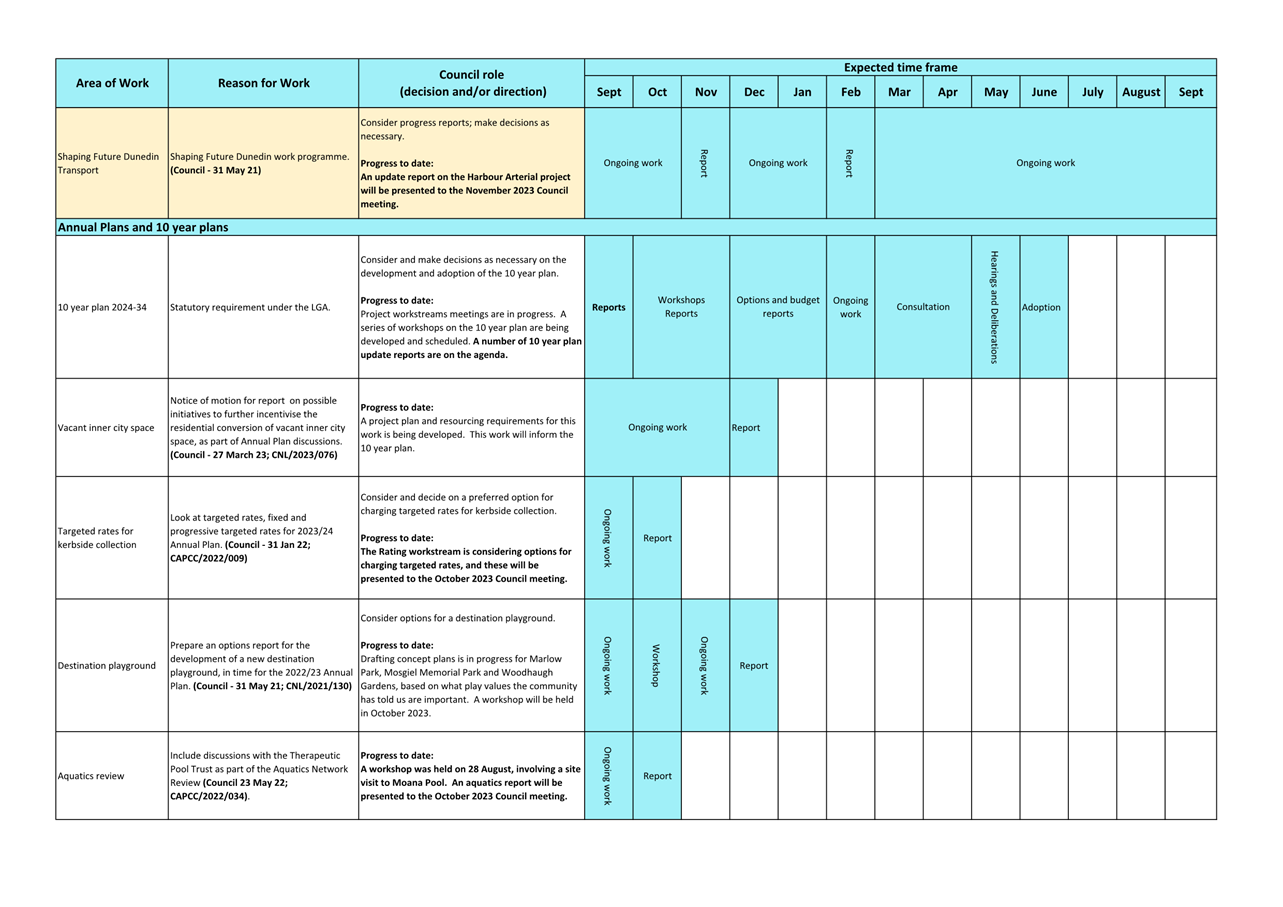
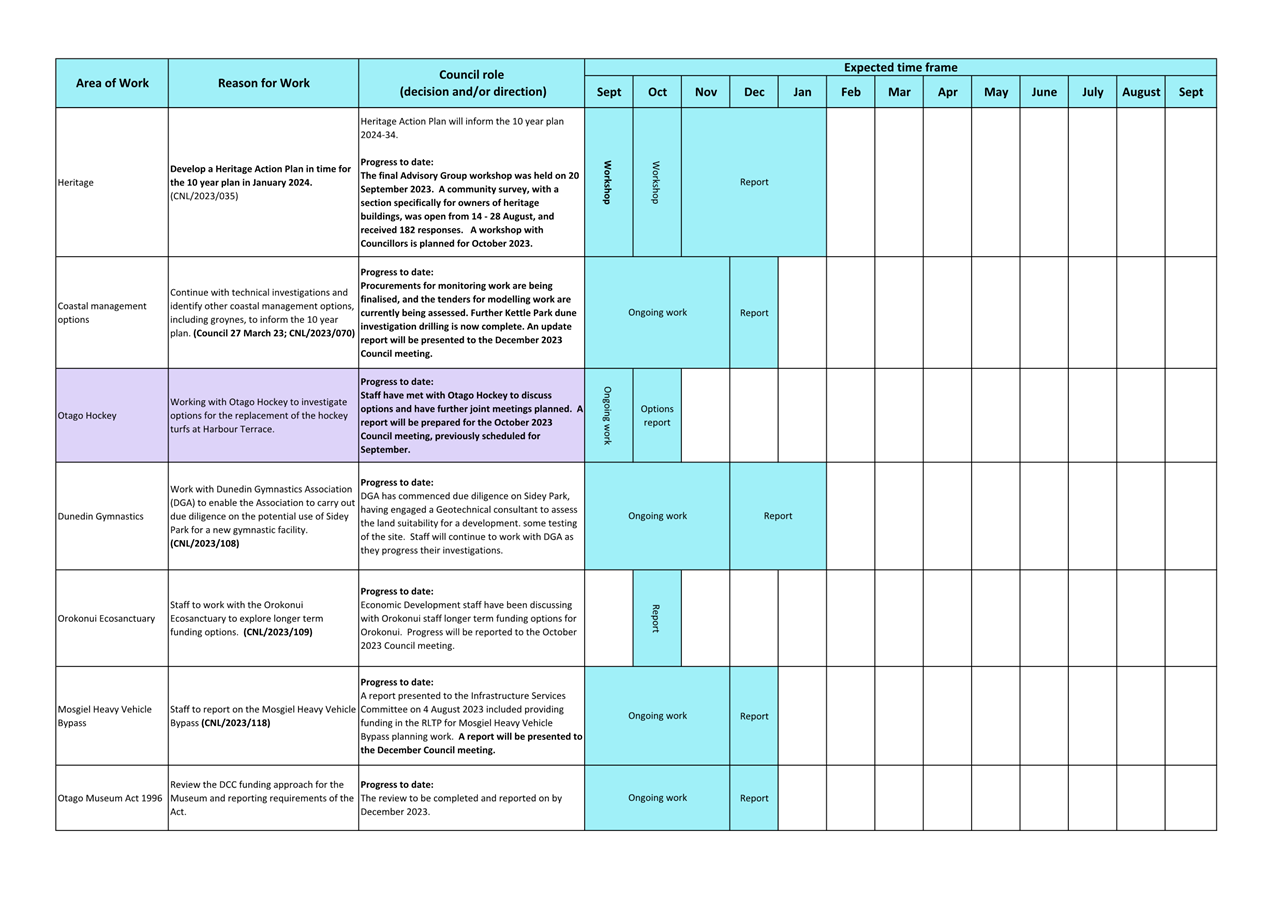
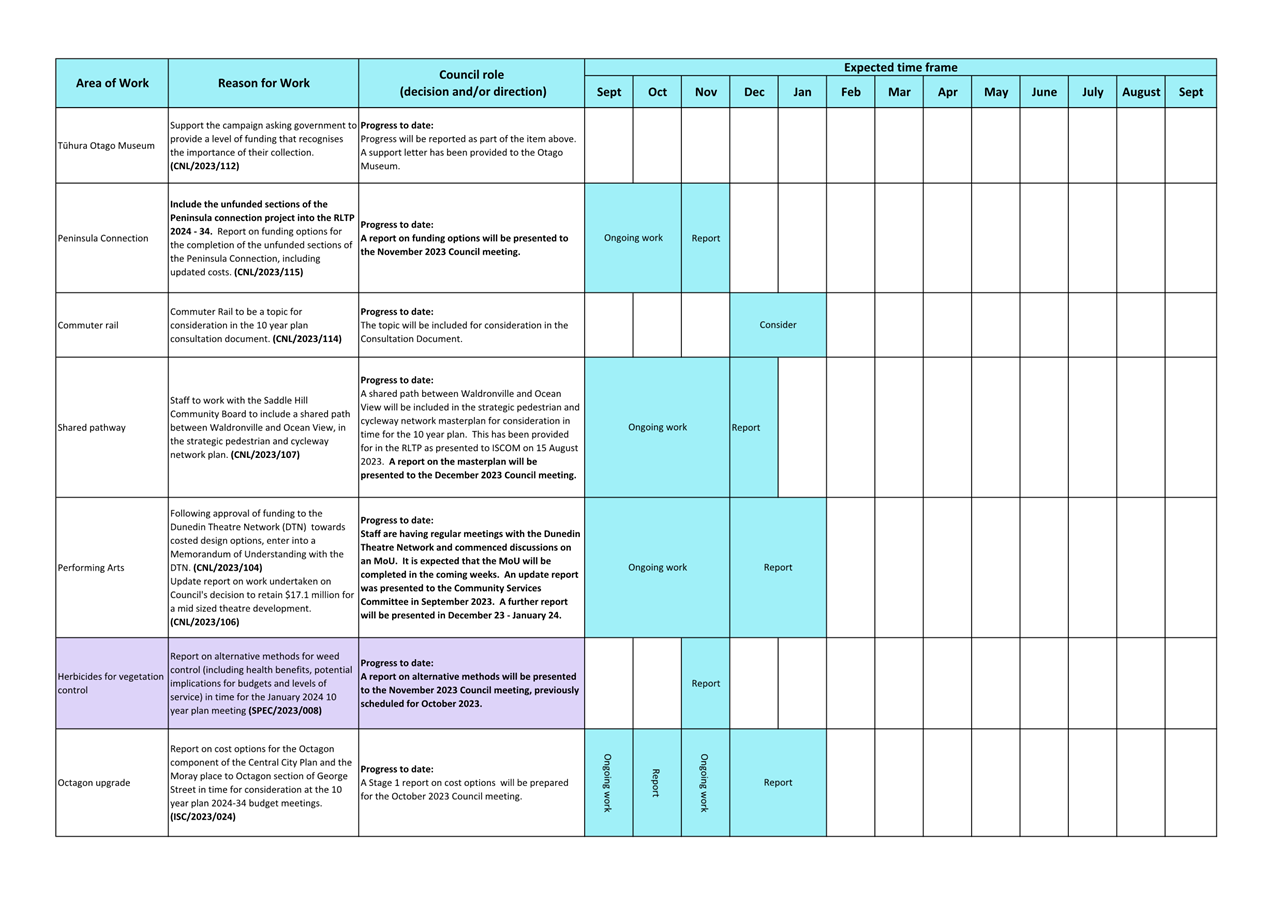
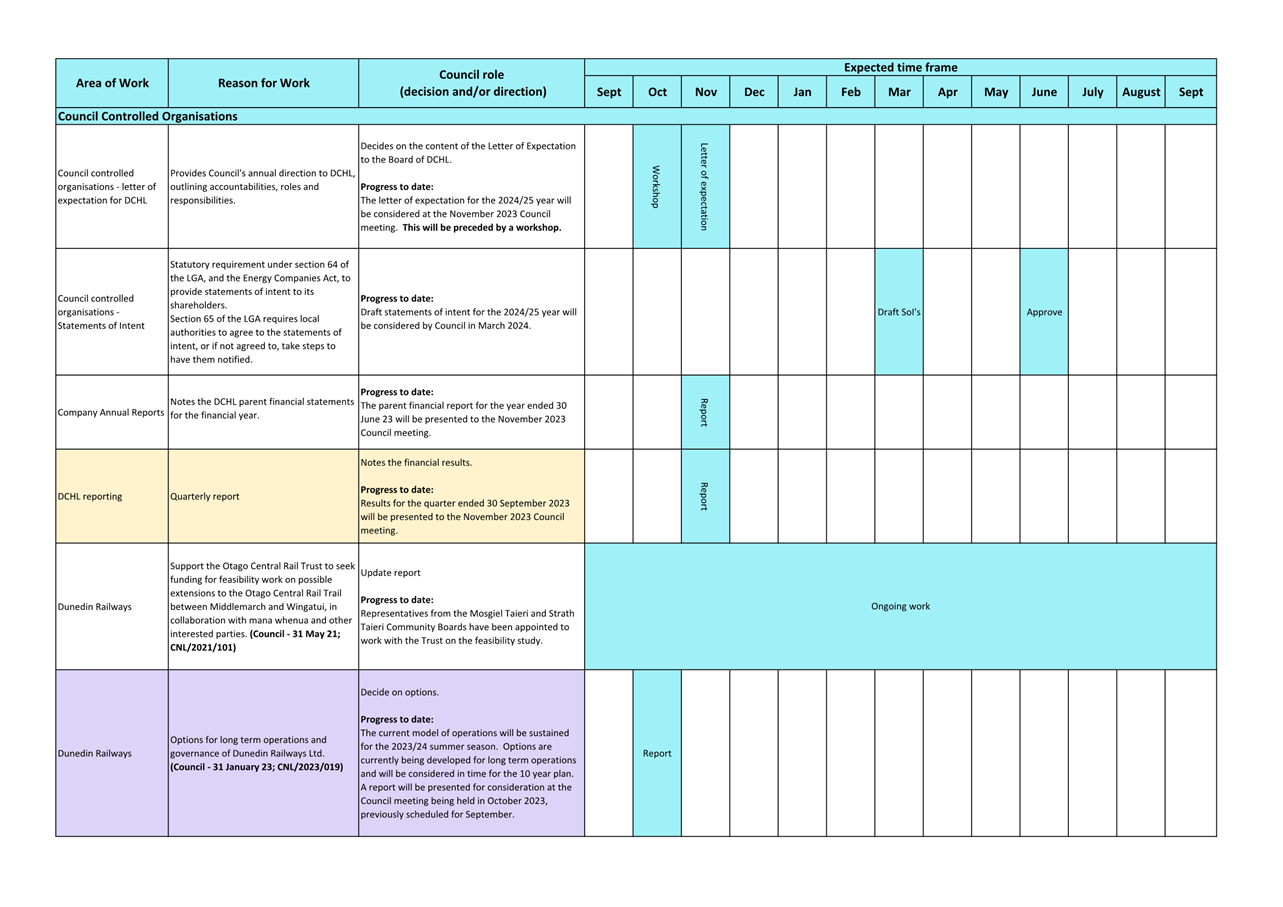
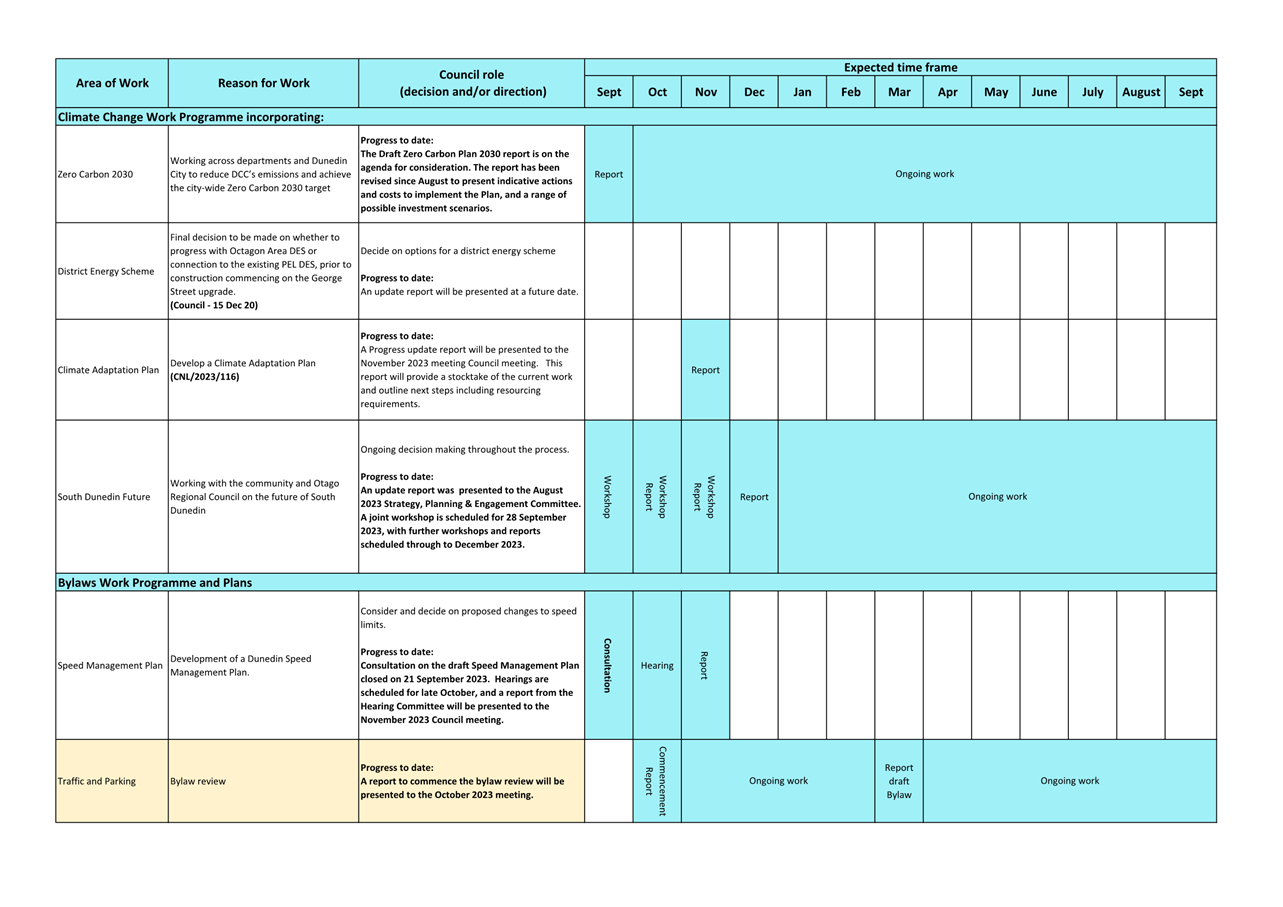
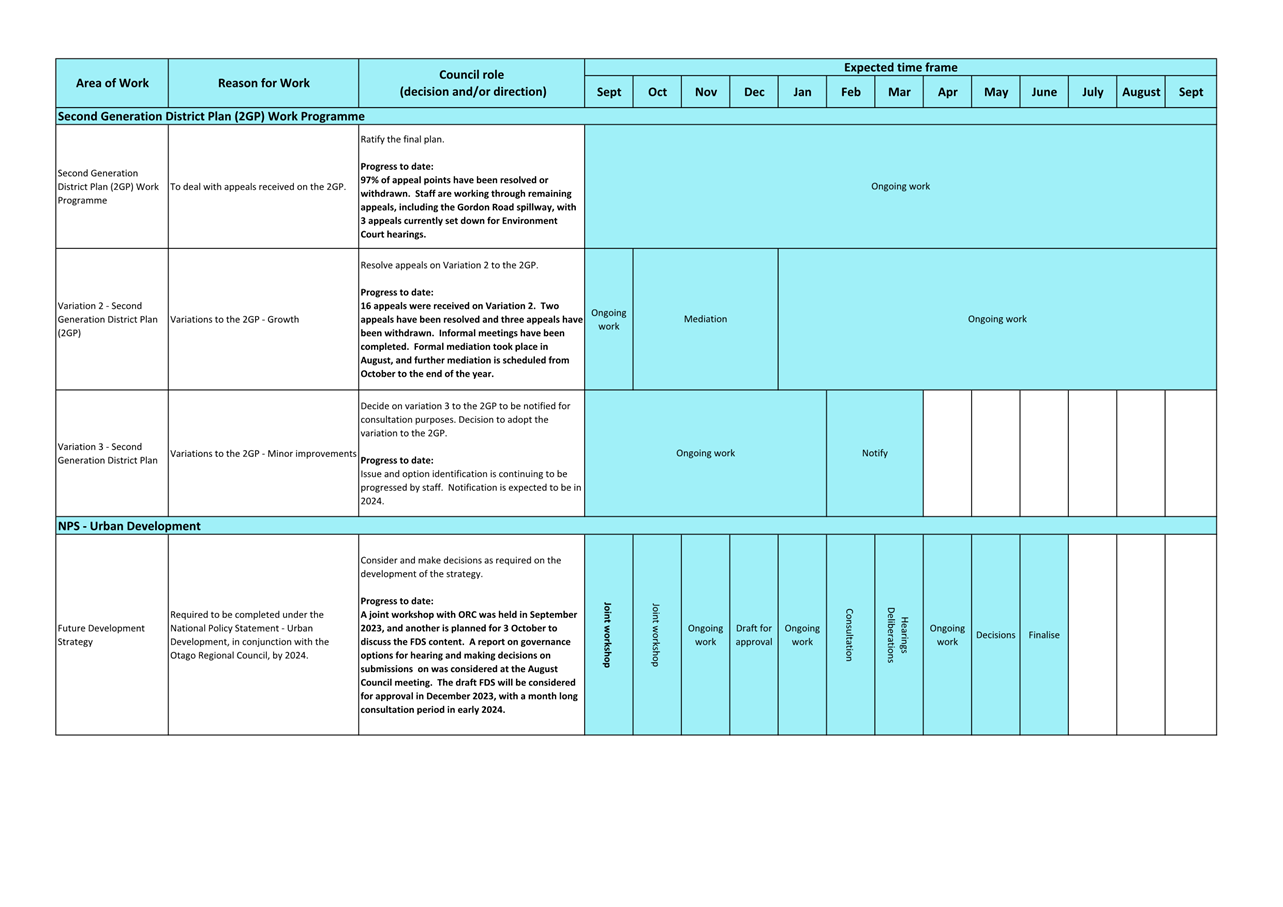
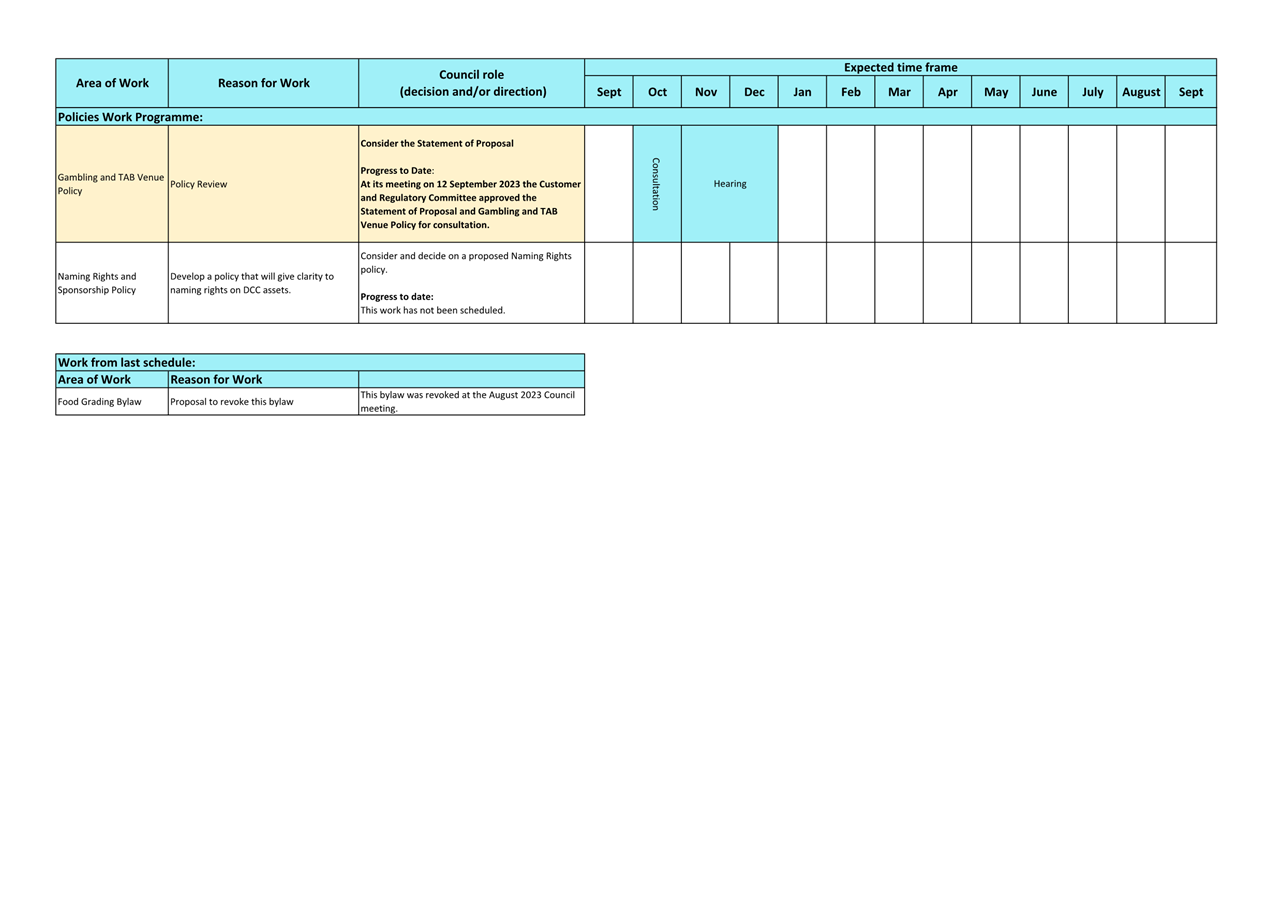
3 The
forward work programme is a regular agenda item which shows areas of activity,
progress and expected timeframes for Council decision making across a range of
areas of work.
4 As
an update report, the purple highlight shows changes to timeframes. New
items added to the schedule are highlighted in yellow. Items that have been
completed or updated are shown as bold.
NEXT STEPS
5 An
updated report will be presented to future Council meetings.
Signatories
|
Author:
|
Sharon Bodeker - Manager Governance
|
|
Authoriser:
|
Sandy Graham - Chief Executive Officer
|
Attachments
|
|
Title
|
Page
|
|
⇩a
|
Council Forward Work
Programme - September 2023
|
33
|
|
|
Council
25 September 2023
|
|
|
Council
25 September 2023
|
Draft Zero Carbon Plan 2030
Department: Sustainability Group and Corporate Policy
EXECUTIVE SUMMARY
1 The
purpose of this report is to present for Council consideration the draft Zero
Carbon Plan 2030 (Attachment A), along with the implementation plan for the
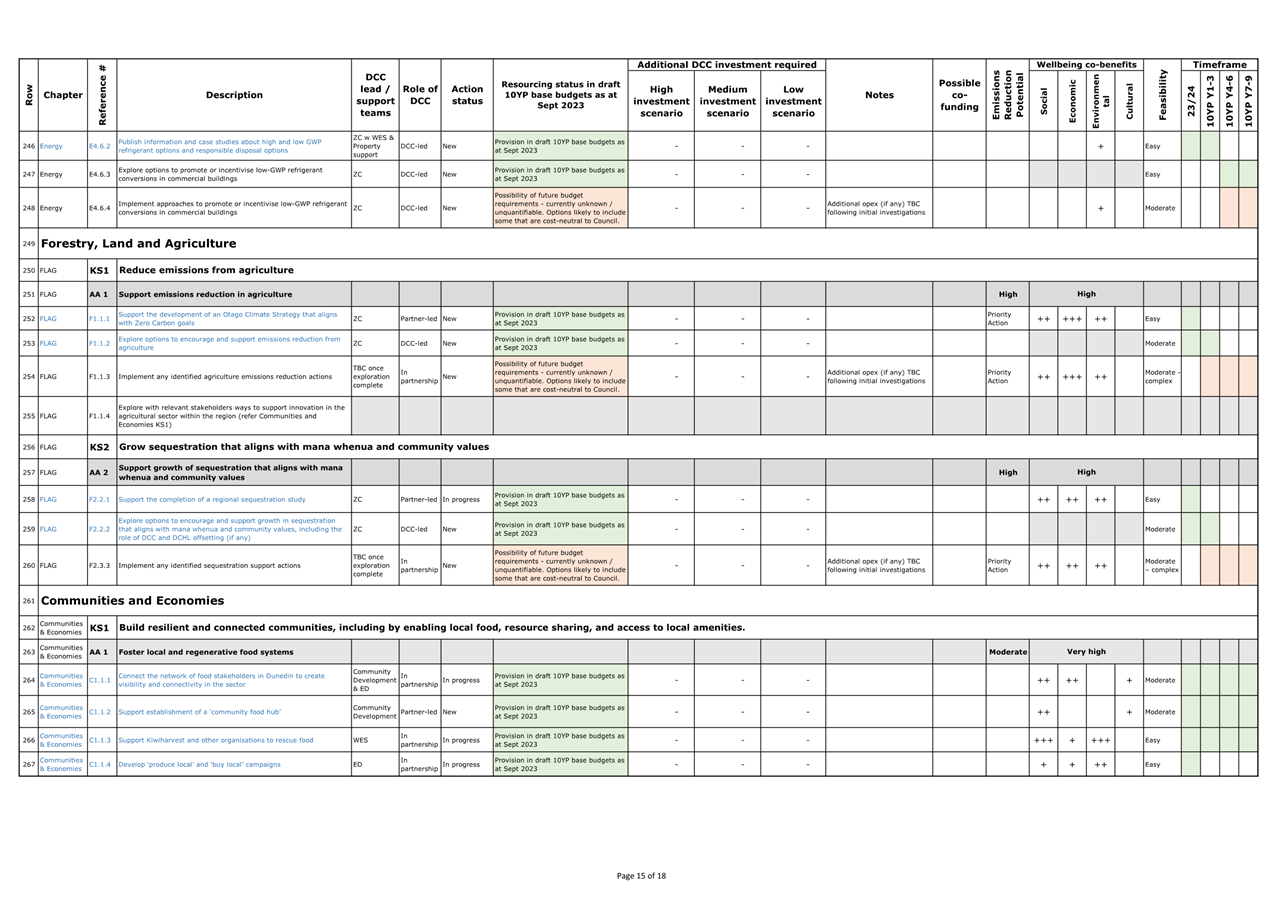
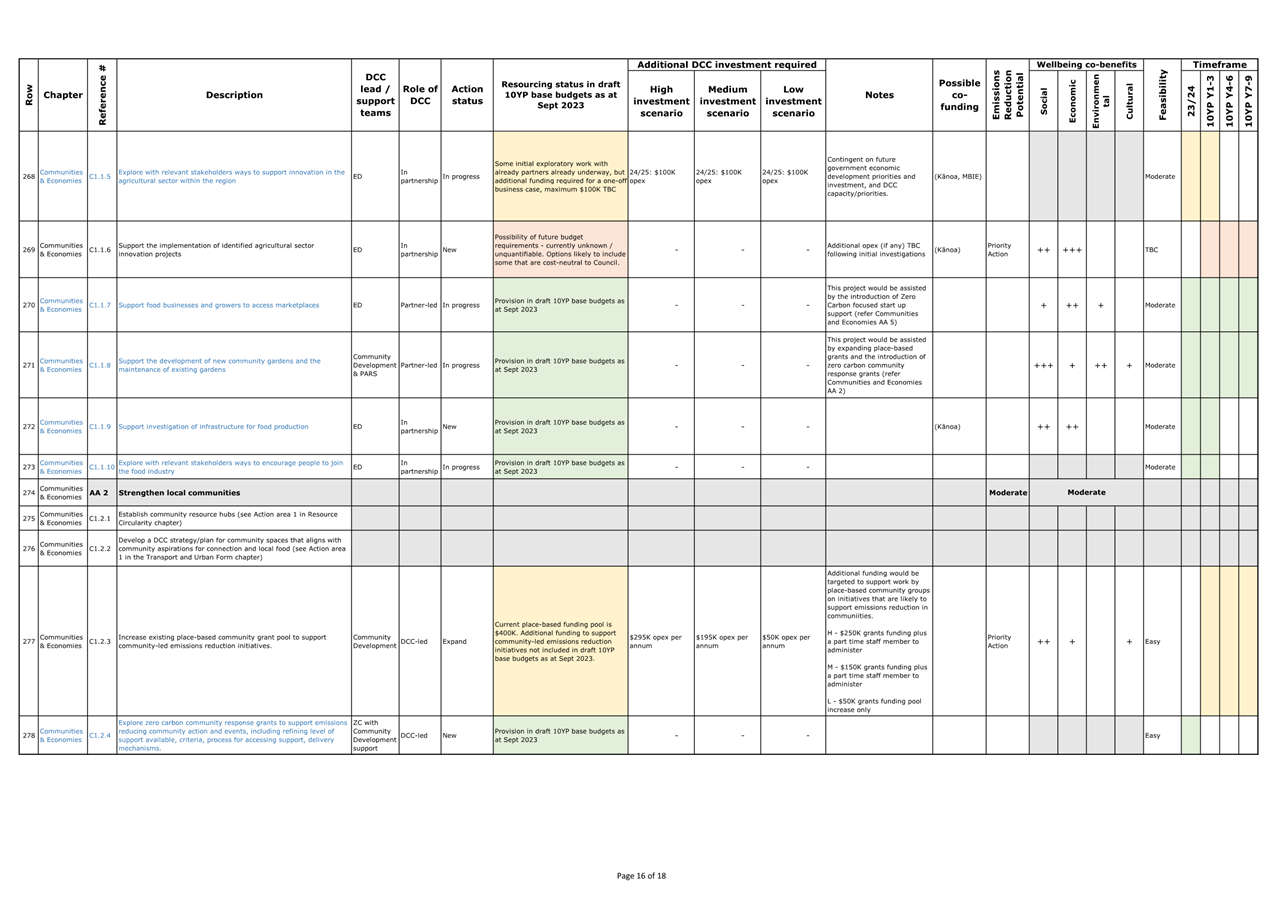
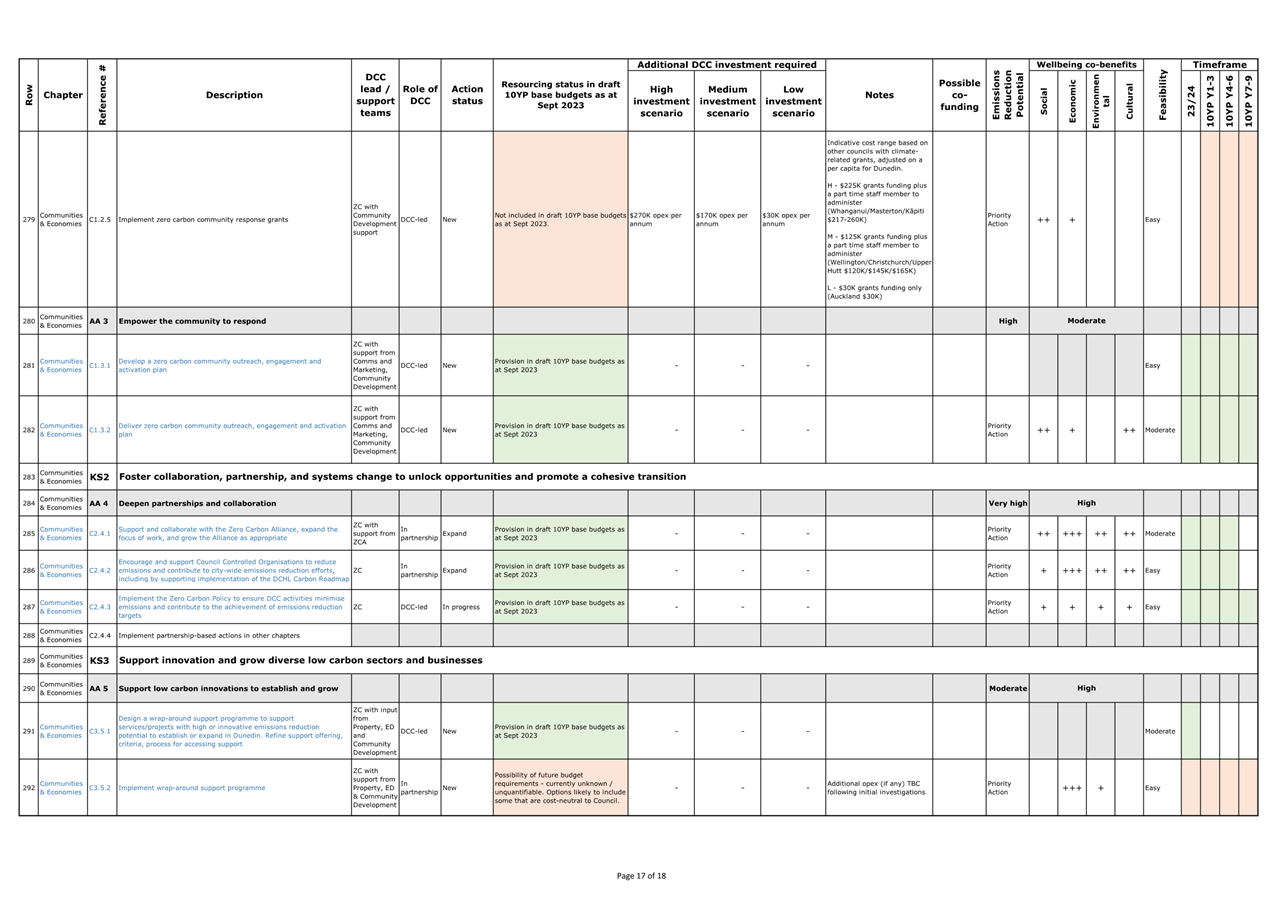
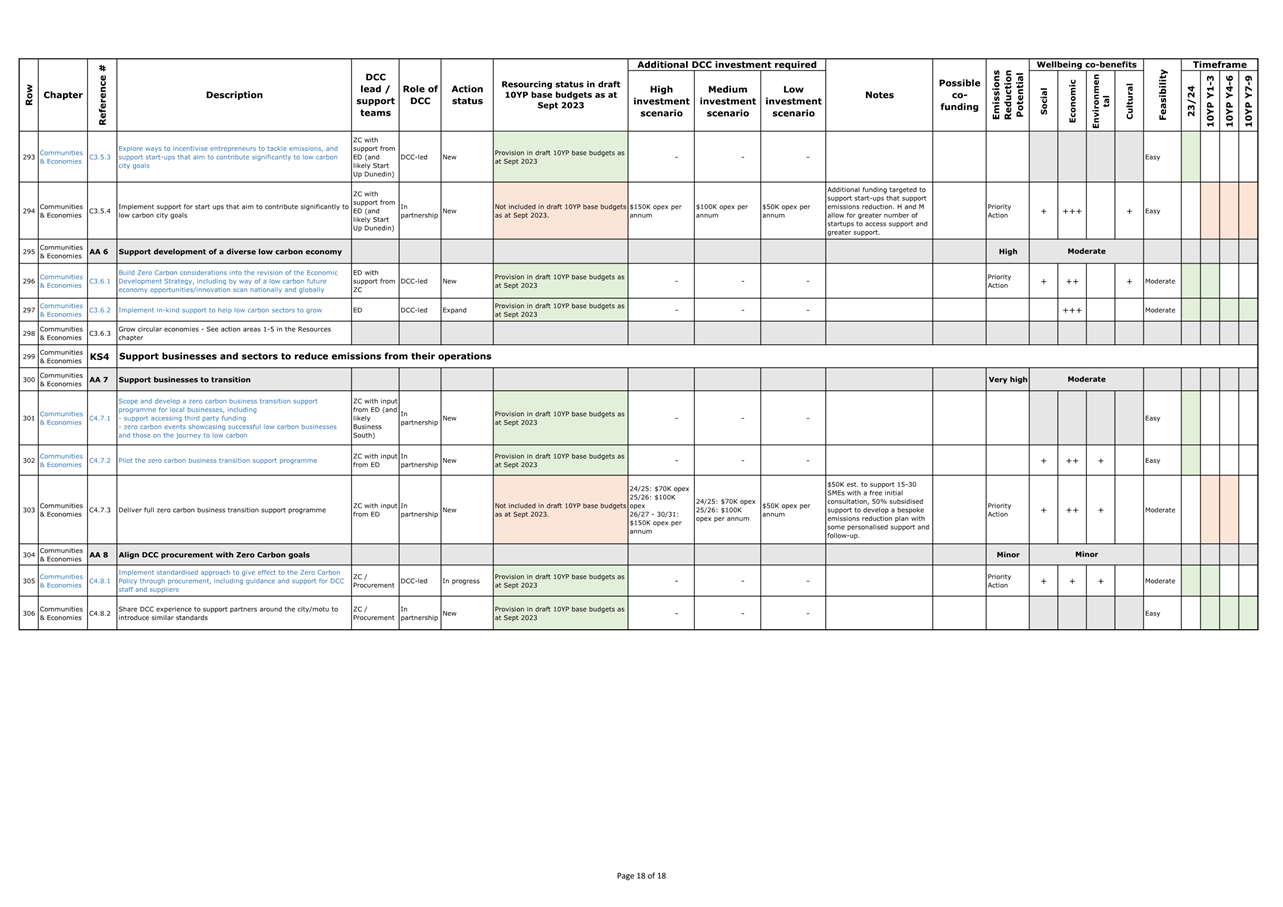
current financial year and indicative actions/cost estimates for the 2024-34 10
year plan period (Attachment B). Three possible investment scenarios have also
been developed to assist Council’s decision-making.
2 Council
resolutions over several years have led to the development of a draft Zero
Carbon Plan 2030 (the Plan).
3 The
Plan sets out the overall shifts Dunedin as a city will need to make to become
a Zero Carbon city, and action areas for the Dunedin City Council (DCC).
Achieving the city’s targets will involve a wide range of government,
community and business stakeholders: DCC leadership is essential, but
partnerships and community activation are also critical to success.
4 The
modelling underpinning the Plan takes into account actions and targets already
committed to by third parties (including central government and industry
bodies). In recent years there has been significant and growing central
government support for the transition. The DCC and all other actors need to
pull all available levers as hard as credibly possible to achieve Plan targets.
5 There are many co-benefits to the action areas in the Plan.
Co-benefits span all four wellbeings.
6 Many
actions will reduce costs in the medium term, but there will be upfront costs
especially for owners of assets/infrastructure. Provisional cost estimates and
indicative investment scenarios have been provided to support early stage
decision-making.
7 Delivery
of the Plan, if adopted by Council, will have implications for work programmes
across the organisation. The report considers next steps.
RECOMMENDATIONS
That the Council:
a) Adopts the Zero Carbon Plan 2030
b) Delegates authority to the Chief Executive Officer
to incorporate minor editorial amendments to the Plan
c) Notes the Zero Carbon implementation plan for the current financial
year
d) Considers which, if any, investment scenario it
wishes staff to carry out further work on noting this will be used to develop
actions for consideration as part of 10 year plan 2024-34 development
BACKGROUND
8 Several
resolutions of Council initiated development of the Plan and informed its
direction.
Zero Carbon 2030 targets and Plan
9 In
June 2019, Council declared a climate emergency and moved to bring forward the
existing emissions target for the city, as follows:
Moved Cr Hawkins / Cr Laufiso
That the Council:
a) Declares
a Climate Emergency.
b) Acknowledge
that all levels of central government need to act.
c) Agrees
that a business-as-usual transition to a low carbon economy is inadequate.
d) Develops
a Climate Emergency Plan that:
i) Sets
a city target of net zero carbon by 2030, with interim milestones;
ii) Quantifies
the actions available to Council, community and central government to ensure
these targets are met.”
Division
The Council voted by division:
For: Crs
David Benson-Pope, Rachel Elder, Christine Garey, Aaron Hawkins, Marie Laufiso,
Damian Newell, Jim O'Malley, Kate Wilson and Mayor Dave Cull (9).
Against: Crs Doug
Hall, Mike Lord, Conrad Stedman, Lee Vandervis and Andrew Whiley (5).
Abstained: Nil
The division was declared CARRIED by 9 votes to 5
Motion carried (CNL/2019/154)
10 Dunedin’s
emission reduction targets (‘Zero Carbon targets’), as amended by
the June 2019 resolution, are as follows:
· net
zero emissions of all greenhouse gases other than biogenic methane by 2030
· 24%
to 47% reduction below 2017 biogenic methane emissions by 2050, including a 10%
reduction below 2017 biogenic methane emissions by 2030.
Interim Guiding Principles for the
Zero Carbon work programme
11 In
February 2022, Council adopted working principles to guide Plan development and
other aspects of the work programme.
Moved (Cr Steve Walker/Cr Chris Staynes):
That the Council:
a) Approve the
proposed interim working principles for the Zero Carbon work programme.
b) Note the
proposed approach to creating the emissions reduction plan for Dunedin city.
Motion carried (CNL/2022/004) with
Cr Lee Vandervis recording his vote against
12 The
guiding principles are as follows:
a) Uphold
the Treaty of Waitangi
We acknowledge our Treaty of Waitangi responsibilities and are committed to
working in partnership to provide opportunities for Mana Whenua and Mataawaka
to contribute to decision making processes and to have an active role in the
city’s climate mitigation.
b) Collaborative,
constructive, and transparent
We work in an open and transparent way alongside the local community,
business, and organisations.
c) Consider
different spheres of influence
We take action on what we can control directly, and work to influence areas
outside of our control (for example, through advocacy to central government).
d) Thinking
long-term
We take a long-term view to 2030 and beyond, considering the interests of
future as well as current communities. Dunedin will need to adopt actions that
not only set it on a path to meet emissions reduction targets, but which
sustain achievement of those targets beyond 2030. Meeting these goals requires
a long-term view of investments and infrastructure developments. We also
acknowledge the uncertainty of the future and work in a flexible, adaptable
manner.
e) Maximise
co-benefits for people, planet, and economy
We consider the impact of different approaches on equity and wellbeing, the
environment, and the economy. We seek opportunities for co-benefits and
consider how any negative impacts could be mitigated.
f) Considering
value
We prioritise actions with higher value, accounting where possible for the
costs and consequences of both action and inaction.
g) Evidence-led
We utilise data and evidence, and strive to follow international best
practice. We acknowledge the urgency of climate change mitigation and are
committed to contributing to global efforts to limit warming to 1.5°C.
Adoption of a Zero Carbon
Policy for DCC
13 In
June 2022, Council adopted a Zero Carbon Policy for the DCC:
Moved (Cr Steve Walker/Cr Christine Garey):
That the Council:
a) Adopts the
Zero Carbon Policy.
b) Notes that
this replaces the Carbon Management Policy 2017.
Division
The Council
voted by division.
For: Crs
Sophie Barker, David Benson-Pope, Rachel Elder, Christine Garey, Carmen
Houlahan, Marie Laufiso, Jim O'Malley, Chris Staynes, Steve Walker and Mayor
Aaron Hawkins (10).
Against: Crs
Mike Lord, Jules Radich, Lee Vandervis and Andrew Whiley (4).
Abstained:
Nil
The division
was declared CARRIED by 10 votes to 4
Motion
carried (CNL/2022/049)
14 The Zero Carbon Policy informed Plan
development, with key provisions including:
a) “The DCC seeks to reduce emissions in a manner that is
consistent with limiting global warming to no more than 1.5°C above
pre-industrial levels, including by achieving or exceeding adopted city-wide
emissions reduction targets and the DCC organisational targets.”
b) “In pursuit of targets, the DCC will prioritise gross emissions
reduction.”
c) “The DCC will prefer options that contribute most to city-wide
emissions reduction targets.”
National context
15 In
addition to responding to Council direction, Plan development considered
national direction for emissions reduction, including priorities in specific
sectors (such as waste and transport). The relevant national direction is
outlined briefly in each chapter of the Plan. Modelling incorporated actions
and targets that central government and other relevant industry bodies have
committed to.
Plan development process
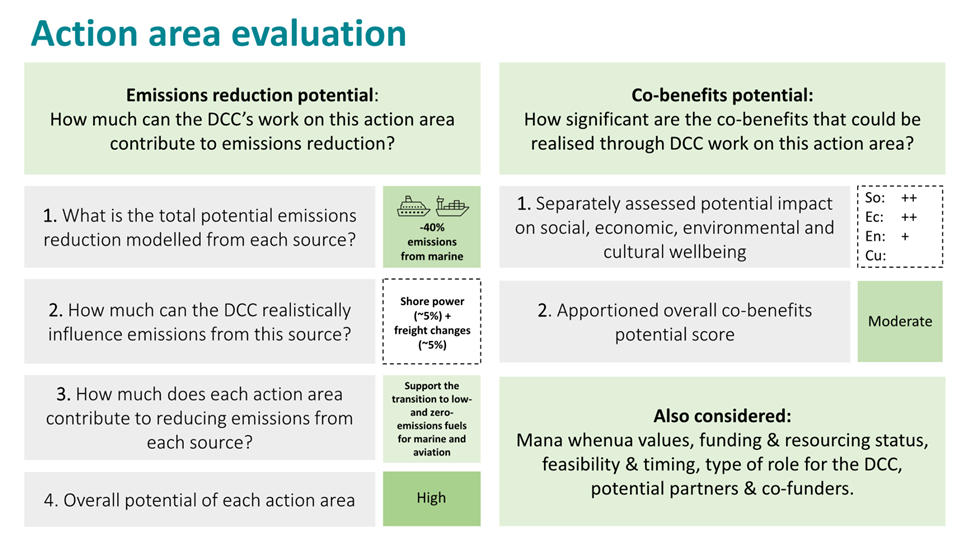
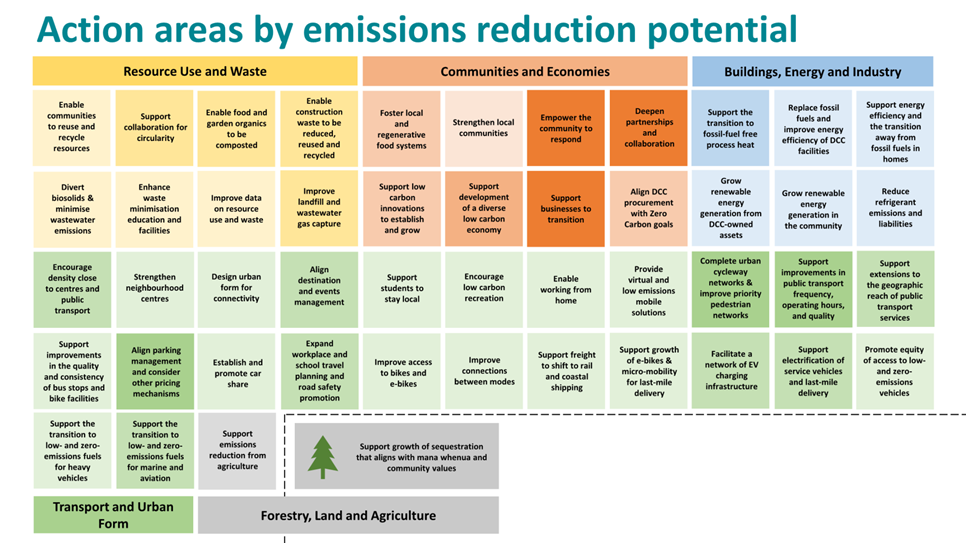
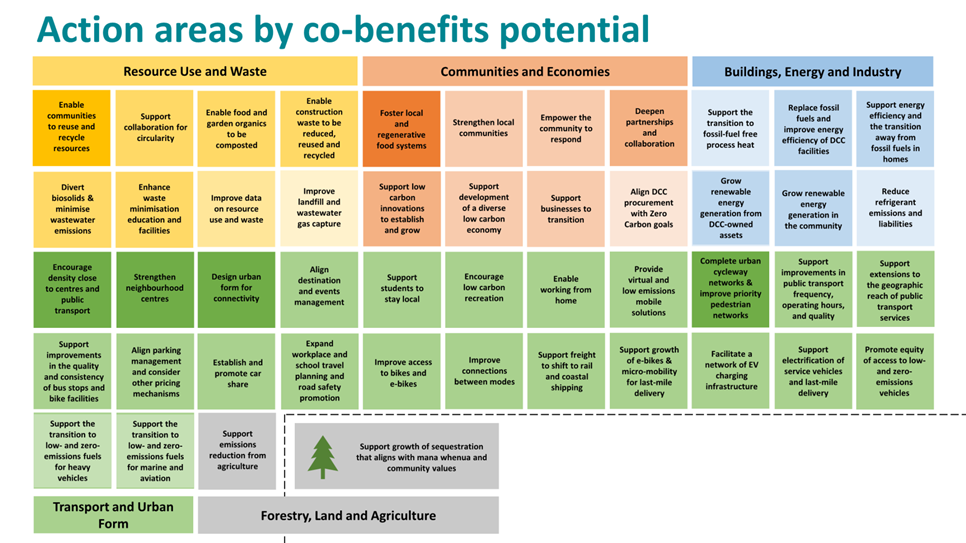
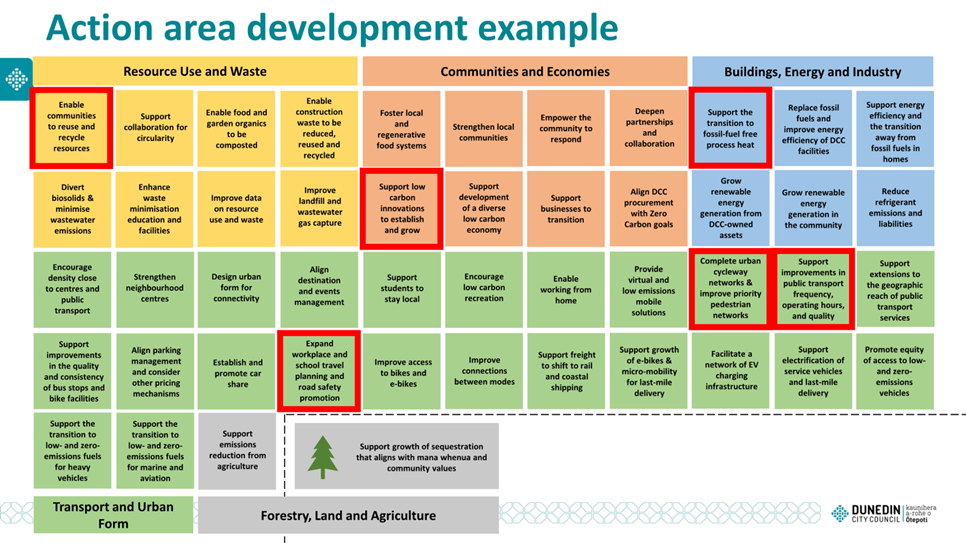
16 The
Plan development process is summarised below. The briefing slides included as
Attachment C provide a visual guide to key inputs and steps in this process,
and some examples of action areas to illustrate how they have been built out.
17 The
Plan development process included key elements as follows:
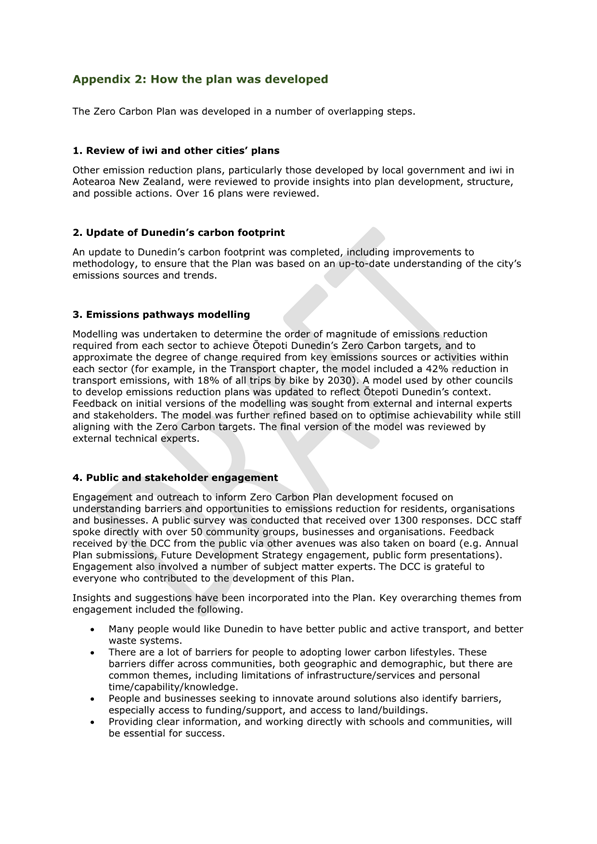
a) Best
practice review of other cities’ and iwi plans
Over 16 plans were reviewed to provide insights into plan development.
b) Emissions
pathways modelling
A model used by a number of other territorial authorities was employed to
determine the order of magnitude of emissions reduction required in each sector
to achieve Zero Carbon targets. The populated model has been reviewed by
external technical experts. Key findings of the model are discussed in
paragraph 19-23 below.
c) Public,
expert and stakeholder engagement
Engagement to inform Plan development focused on understanding barriers and
opportunities to emissions reduction for residents, organisations and
businesses. Staff conducted a public survey that received over 1300 responses
and spoke directly with over 50 community groups, businesses and organisations.
Feedback received by the DCC from the public via other avenues was also taken
on board (e.g. Annual Plan submissions, Future Development Strategy engagement,
public form presentations). Engagement also involved a range of subject matter
experts. Insights and suggestions have been incorporated into the Plan. Key
findings from engagement are discussed in more detail in paragraph 24.
d) Working
with teams across the DCC, and key stakeholders
In preparing the Plan, the Zero Carbon team have worked closely with teams
across the organisation and other key stakeholders e.g. Zero Carbon Alliance
partners. Collaborative work included considering the emissions reduction
potential of existing plans and actions, as well as plans and actions that are
currently in development. It also involved identifying additional actions that
might be required to support achievement of targets, and subsequent review of
Plan content.
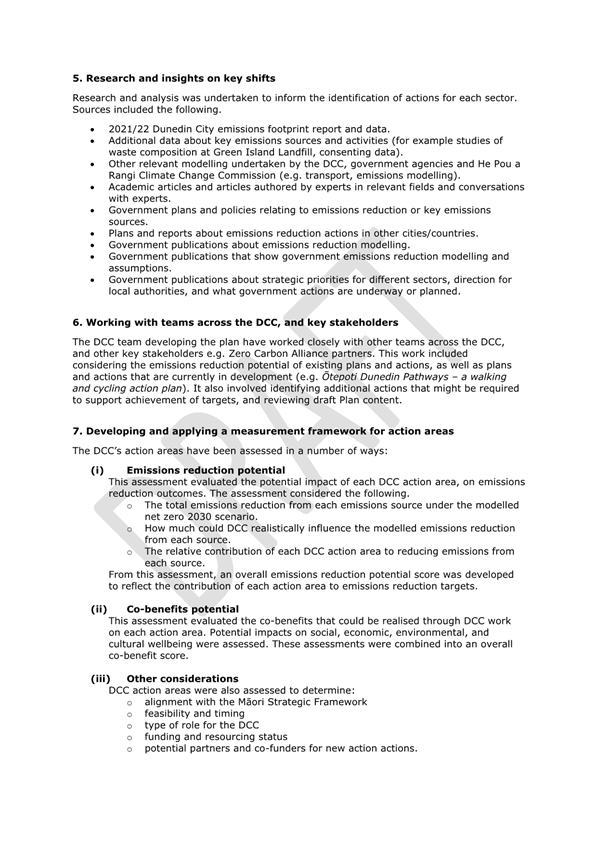
e) Research
and insights on key shifts
Research and analysis was undertaken to inform the identification of key
shifts required in each of the city’s sectors. Sources included academic
articles and articles by experts in relevant fields, researching interventions
in other cities/countries, and understanding current actions or strategic
priorities at a national/regional level.
f) Developing
and applying a measurement framework for action areas
Identified action areas for the DCC have been assessed to determine current
action/resourcing status, emissions reduction potential, co-benefits potential,
feasibility, and ability to be delivered in a way that aligns with mana whenua
values. Potential partners and co-funders have been considered where
applicable.
g) Testing
Plan content
The Plan content has been reviewed by internal and external experts and key
stakeholders. The Plan modelling has also been externally reviewed.
h) Final
updates
Following requests from councillors for further information about future
investment required to deliver the Plan, some minor updates to Plan content
were made to ensure the Plan accurately reflects the nature of indicative
actions for the 2024-34 10 year plan period onwards. Some typos have also been
amended.
DISCUSSION
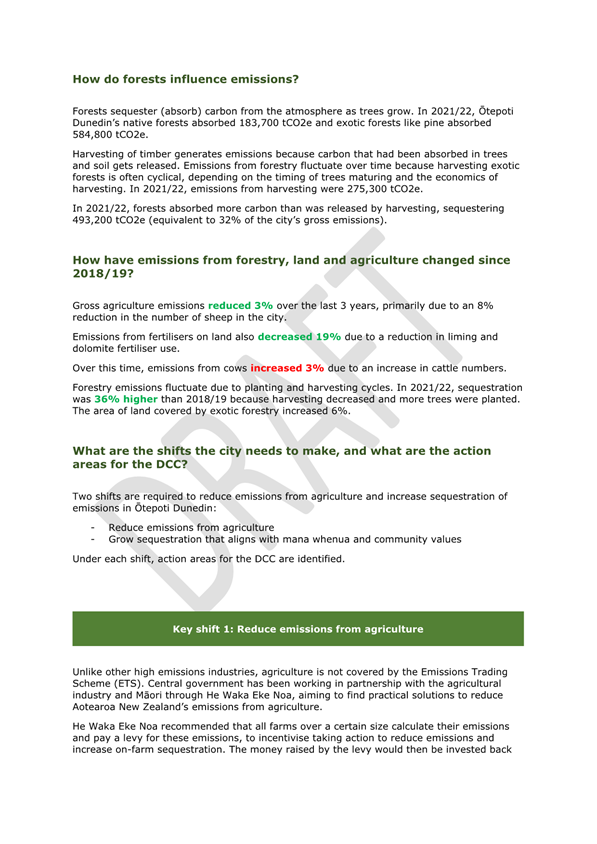
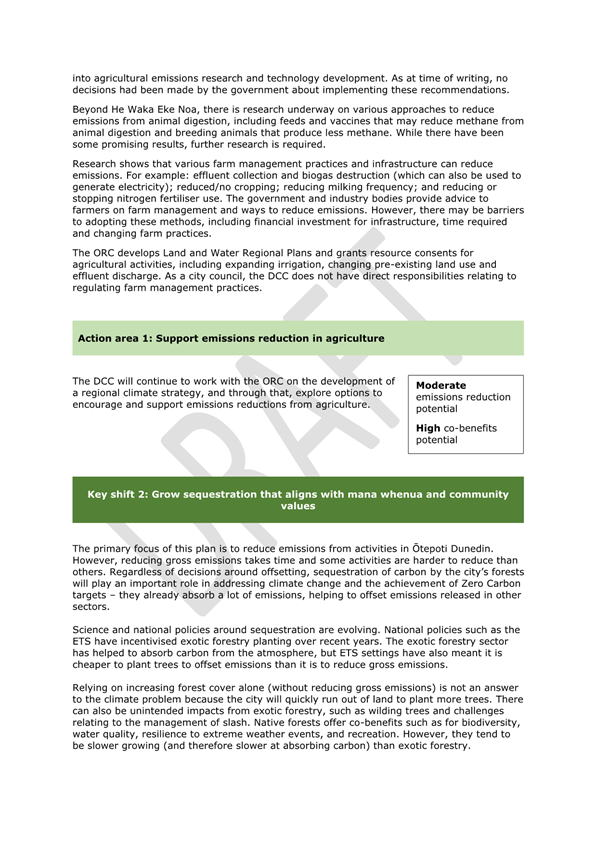
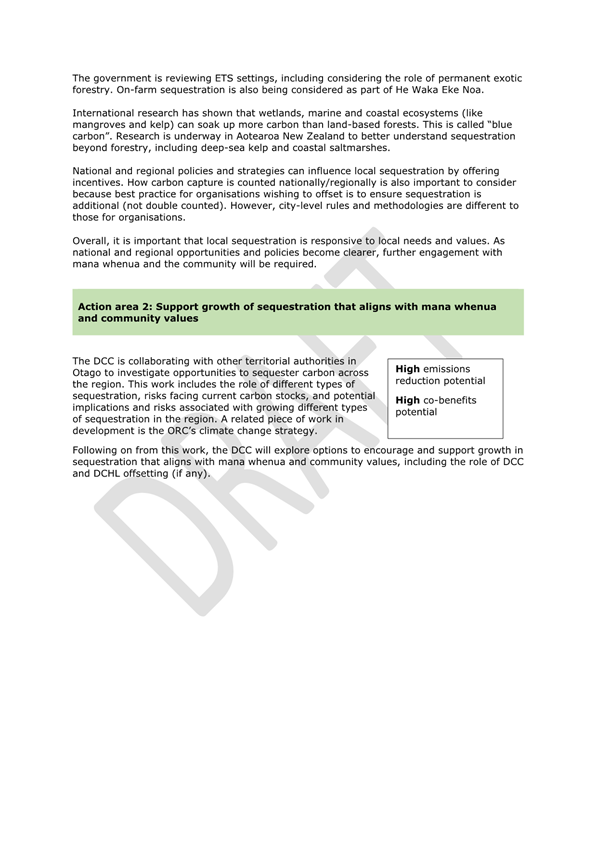
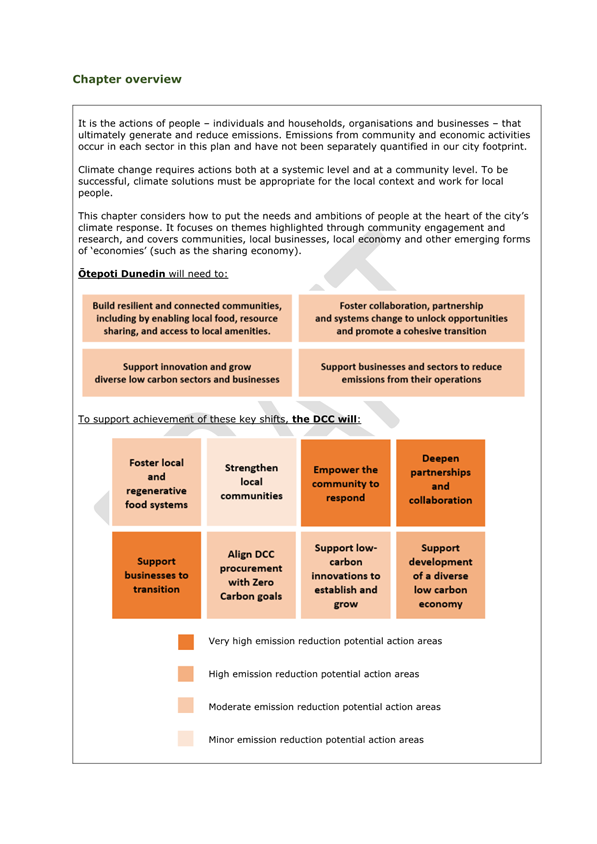
The Plan identifies both key shifts
for the whole city, and action areas for the DCC
18 While
DCC leadership is essential, achieving the city’s targets will involve a
wide range of stakeholders – all actors need to pull all available levers
as hard as credibly possible. The Plan seeks to reflect this by considering two
scales: the changes needed at the ‘whole of city’ level, and the
actions the DCC can take to support these changes.
a) ‘Whole
of city’ level: The Plan explains key shifts required within the city to
achieve Zero Carbon targets. Achieving these shifts will require input from
many actors (including central government, industries, business, households,
individuals, and the DCC).
b) Actions
the DCC can take: The Plan also identifies specific action areas for the DCC to
help achieve these shifts. Action areas include a range of roles for the DCC,
including as an asset owner or service provider, as a regulator, in partnership
and support as a funder or collaborator, and less direct roles through
advocacy.
Key findings from emissions pathway
modelling
19 The
DCC’s modelling shows that achieving Dunedin’s Zero Carbon targets
will involve significant changes across all sectors.
a) Net
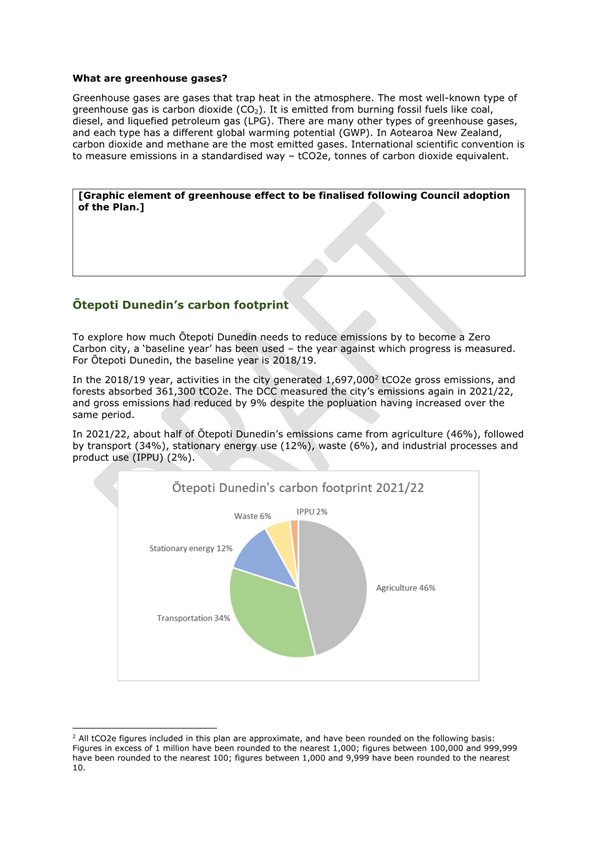
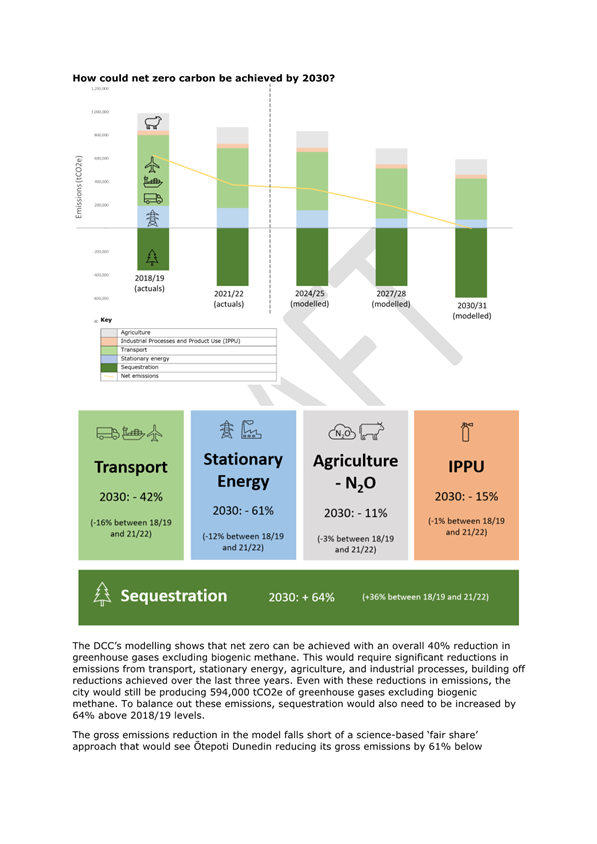
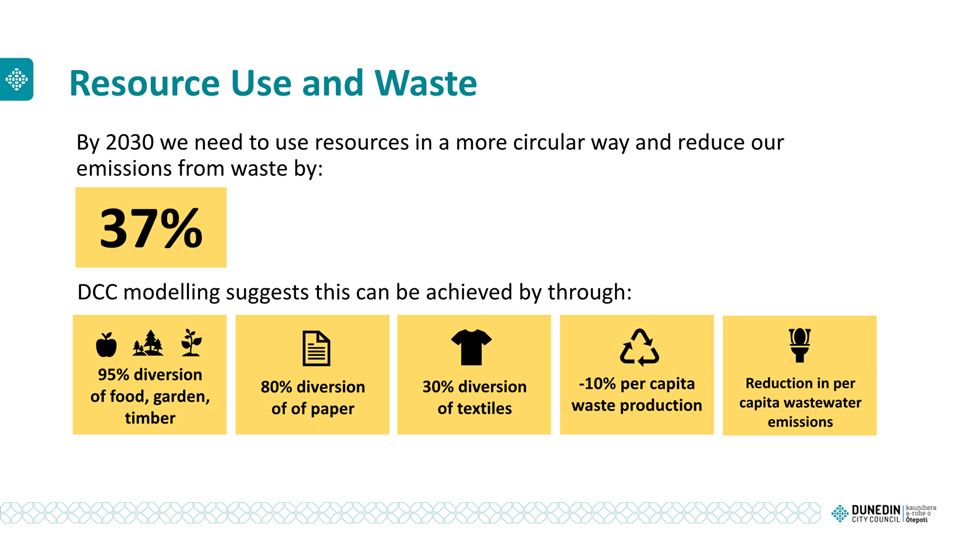
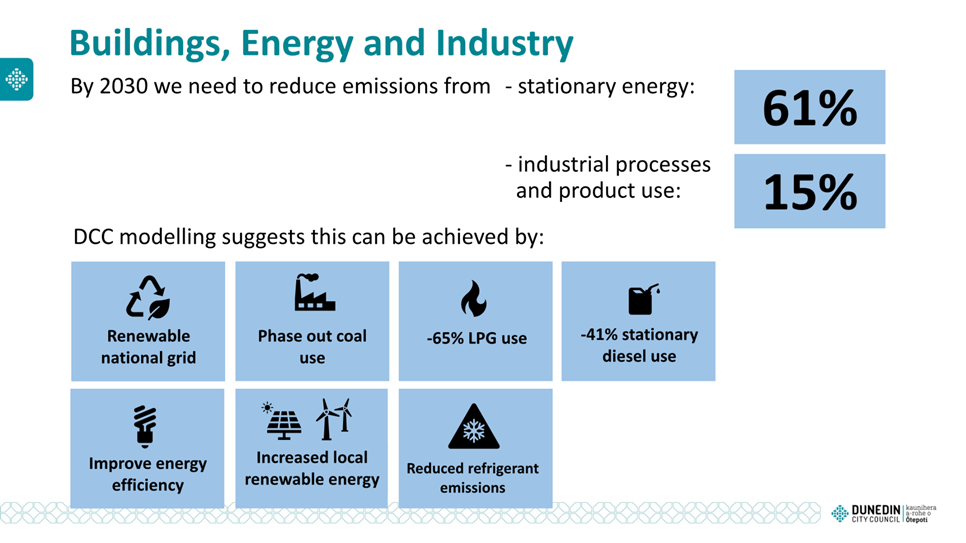
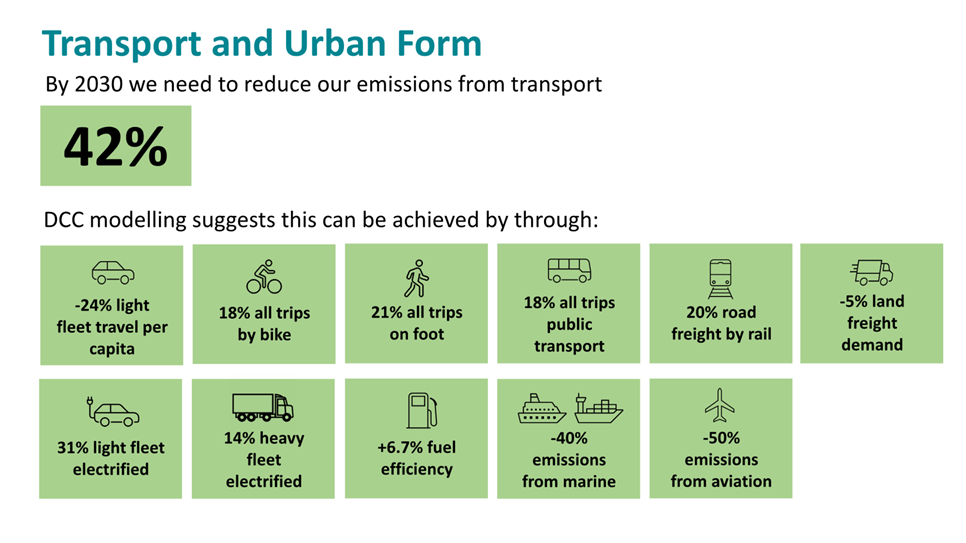
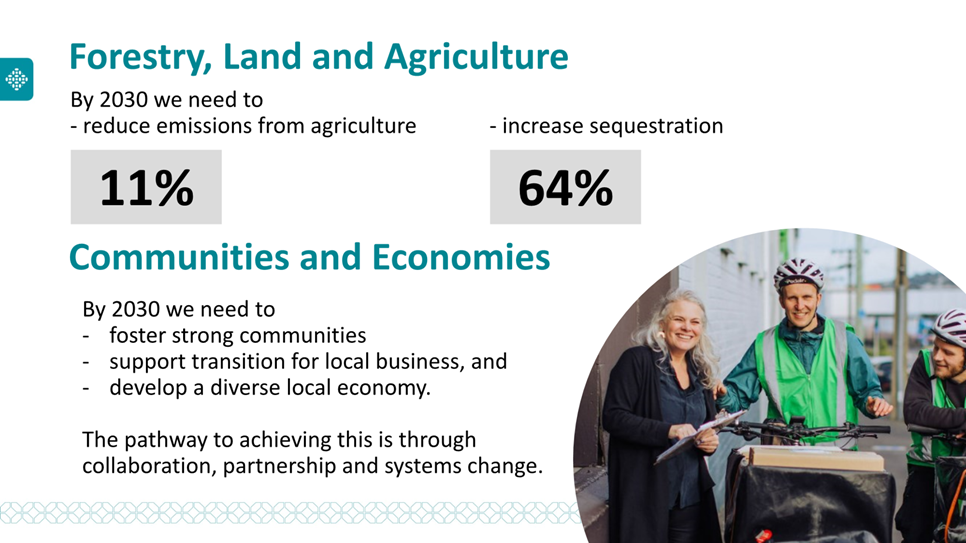
zero emissions excluding biogenic methane can be achieved with an overall 40%
reduction in all other greenhouse gases, and a 64% increase in sequestration
(compared with 18/19 levels).
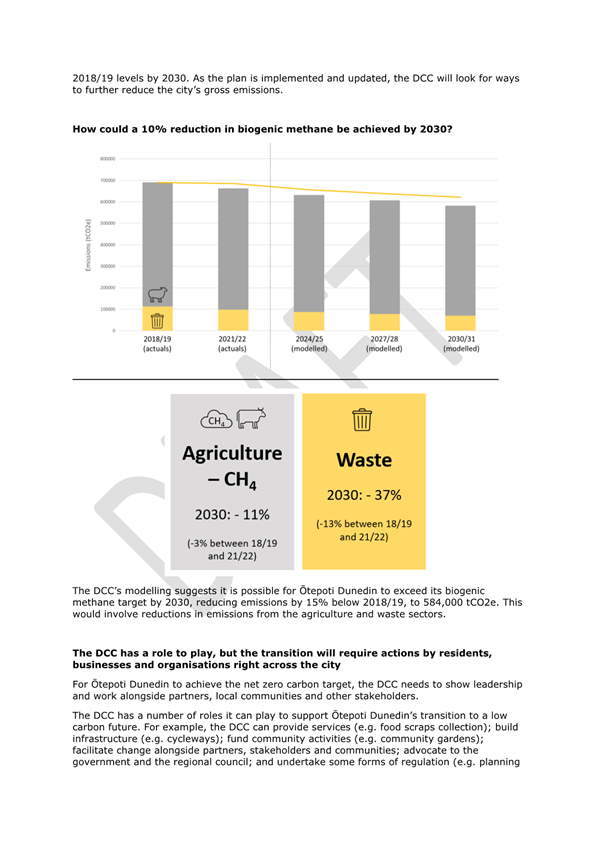
b) Ōtepoti Dunedin can exceed its biogenic methane target,
reducing emissions 15% (compared with 18/19 levels).
20 The
gross emissions reduction achieved in Plan modelling falls short of a
science-based ‘fair share’ approach that would see Ōtepoti Dunedin reducing its emissions 61% below 2018/19 levels
by 2030. Achieving this would require further work to
find more gross emissions reduction opportunities.
21 The
increase in the level of sequestration modelled in the Plan is broadly aligned
with the level of sequestration that He Pou a Rangi Climate Change Commission
has modelled as being necessary to achieve national targets over the same
period.
22 The gross emissions reduction achieved in Plan modelling sits in the
middle of the range of targets adopted by many other New Zealand cities:
|
Council
|
Base year
|
2030 gross reduction target
|
|
Wellington
City Council
|
2020
|
57% reduction*
|
|
Auckland
Council
|
2016
|
50% reduction*
|
|
Christchurch
City Council
|
2016/17
|
50% reduction
|
|
Hutt
City Council
|
2016/17
|
50% reduction*
|
|
Queenstown
Lakes District Council
|
2019
|
44%
reduction*
|
|
Draft
Zero Carbon Plan (Dunedin City Council)
|
2018/19
|
40% reduction*
|
|
Hamilton
City Council
|
2018/19
|
30% reduction*
|
|
Palmerston
North City Council
|
2016/17
|
30%
reduction
|
* biogenic methane
reductions aligned with central government targets, or are a minor part of
footprint (most territorial authorities do not have significant agricultural
emissions).
23 Making
direct comparisons between the degree of reduction included in each city plan
is difficult because of the varied approaches to plan development. Some plans
do not explicitly reference sector modelling; others have different base years,
used different models to inform plan development, or are seeking to address
different emissions sources.
Key findings from public
engagement
24 Public
engagement included a public survey that received over 1300 responses and
conversations with over 50 community groups. Key findings from public and
stakeholder engagement include:
a) People
would like Dunedin to have better public and active transport, and better waste
systems.
b) There are a lot of barriers for people to adopting lower carbon
lifestyles. These barriers differ across communities, both geographic and
demographic, but there are common themes.
c) Barriers include limitations of infrastructure and services, and
also personal time, capability, knowledge and/or finances.
d) People
and businesses seeking to innovate around solutions also identify barriers,
especially access to funding/support, and access to land/buildings.
e) Providing clear information, and working directly with schools and
communities, will be essential for success.
f) DCC
leadership is essential, but partnerships and community activation are also
critical to the achievement of targets.
Implementing the Plan
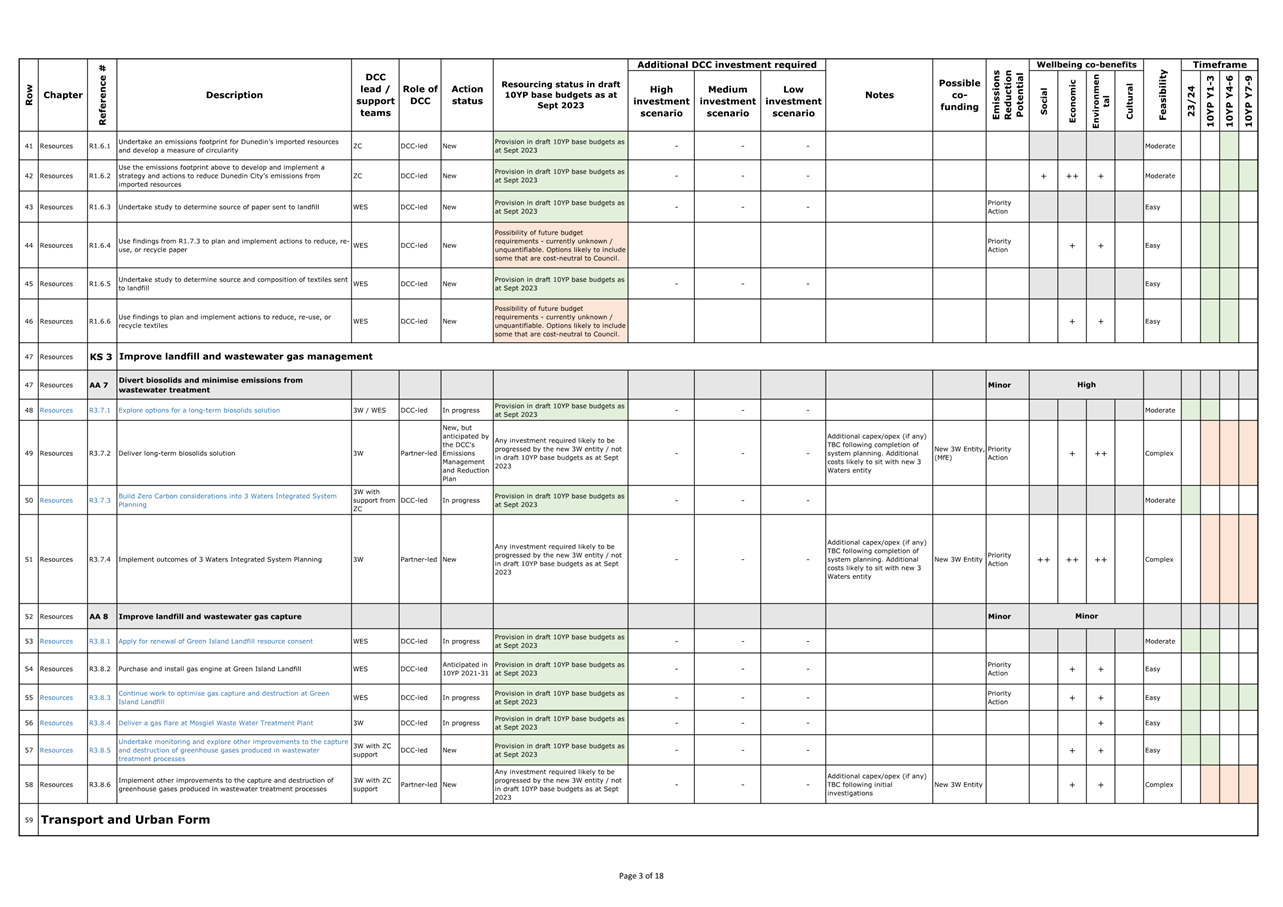
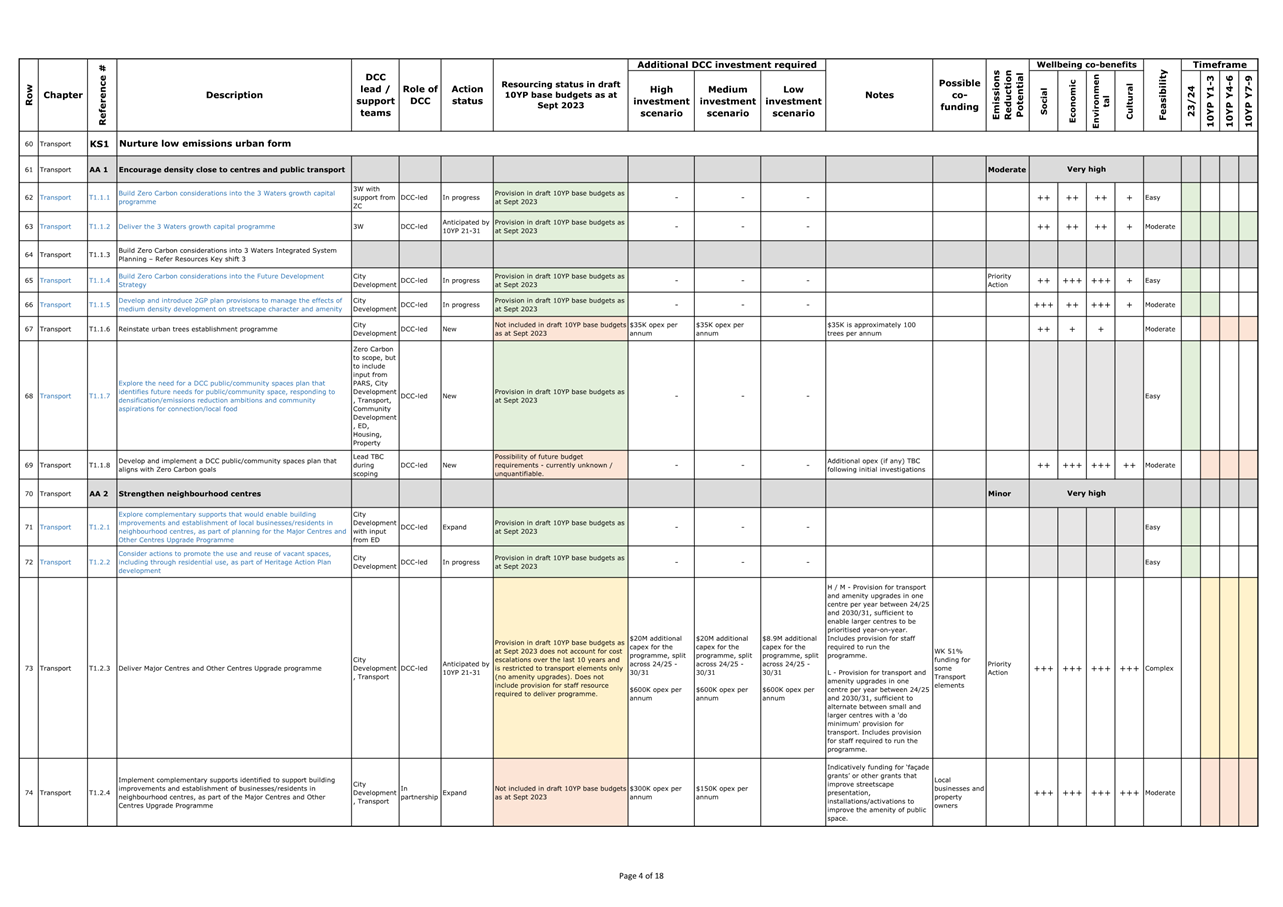
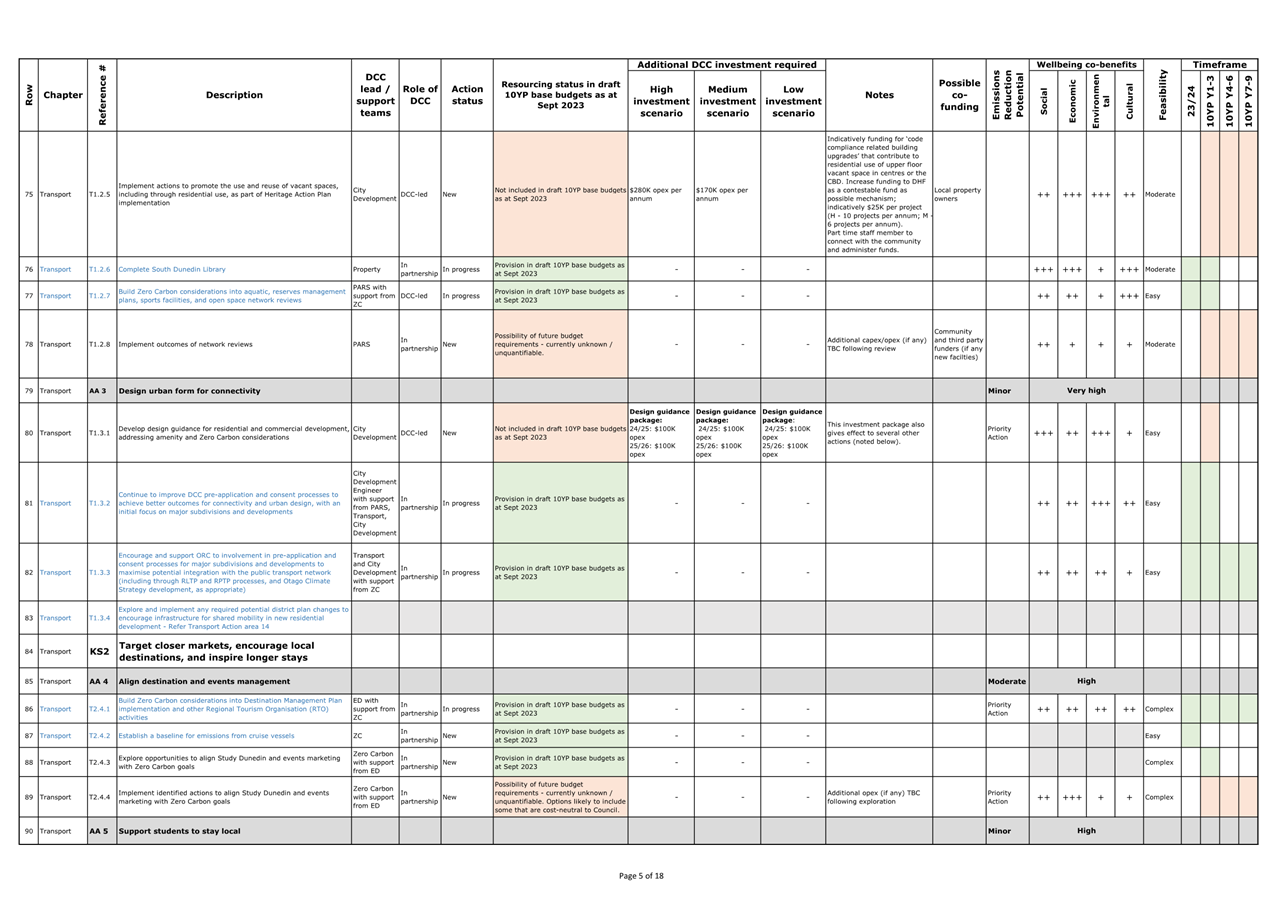
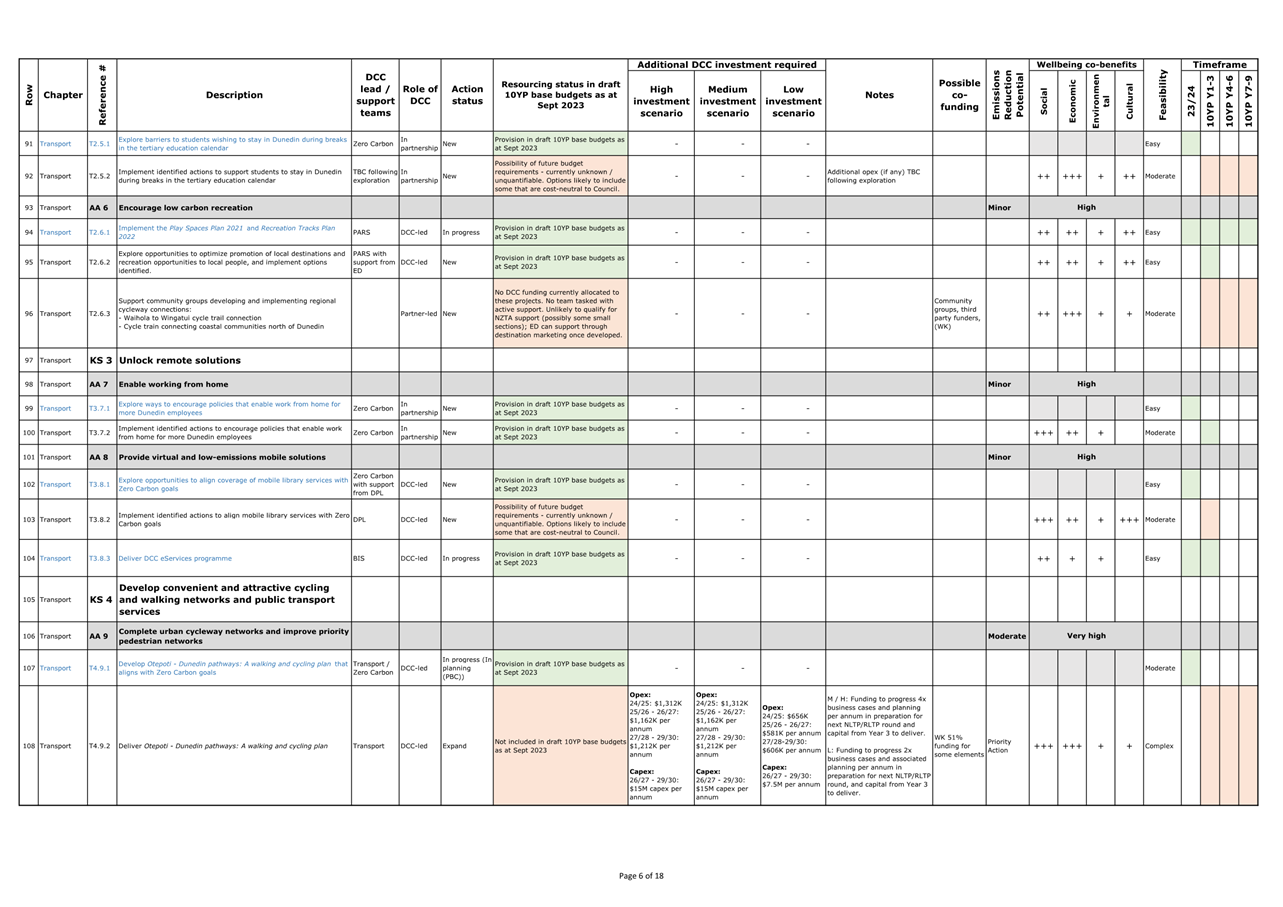
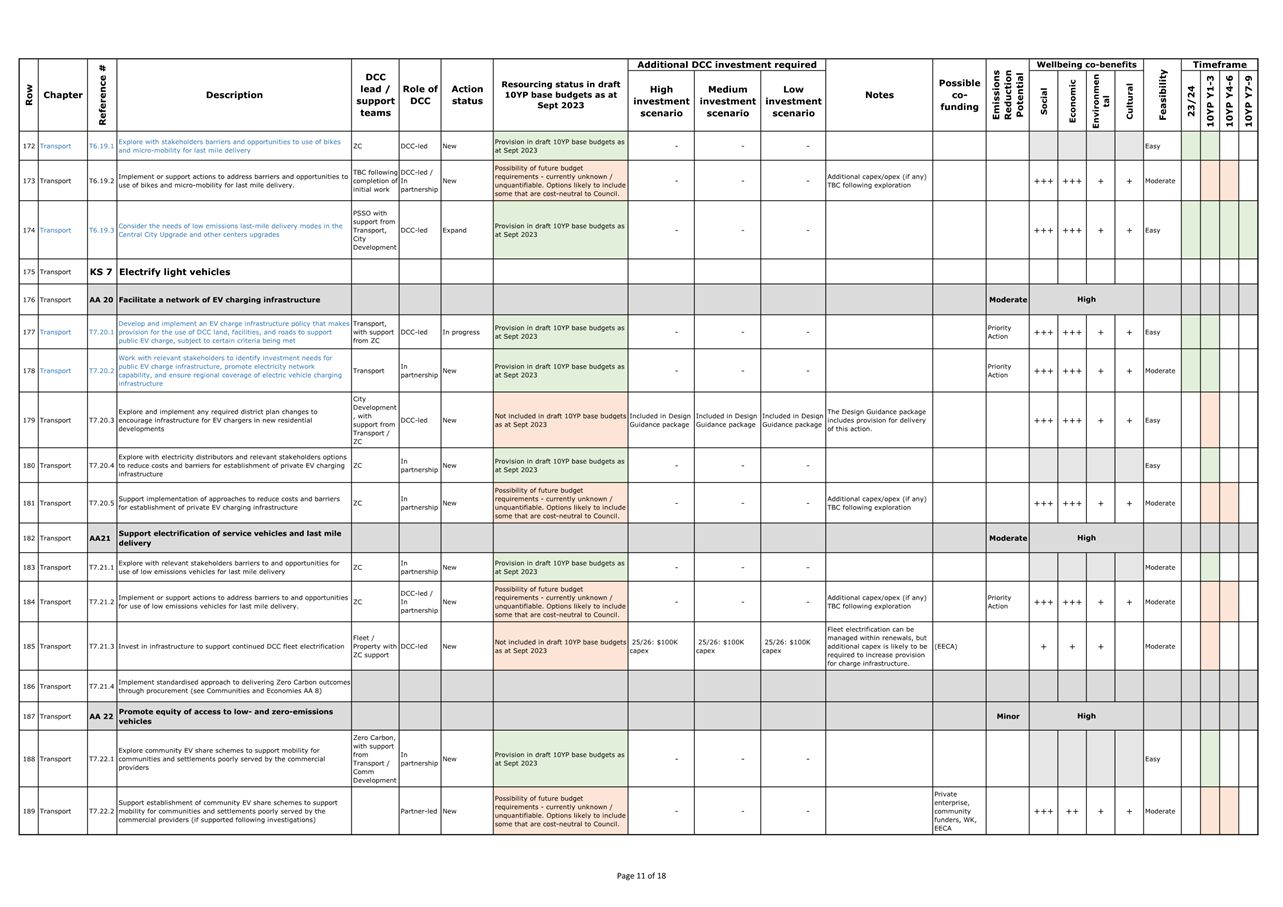
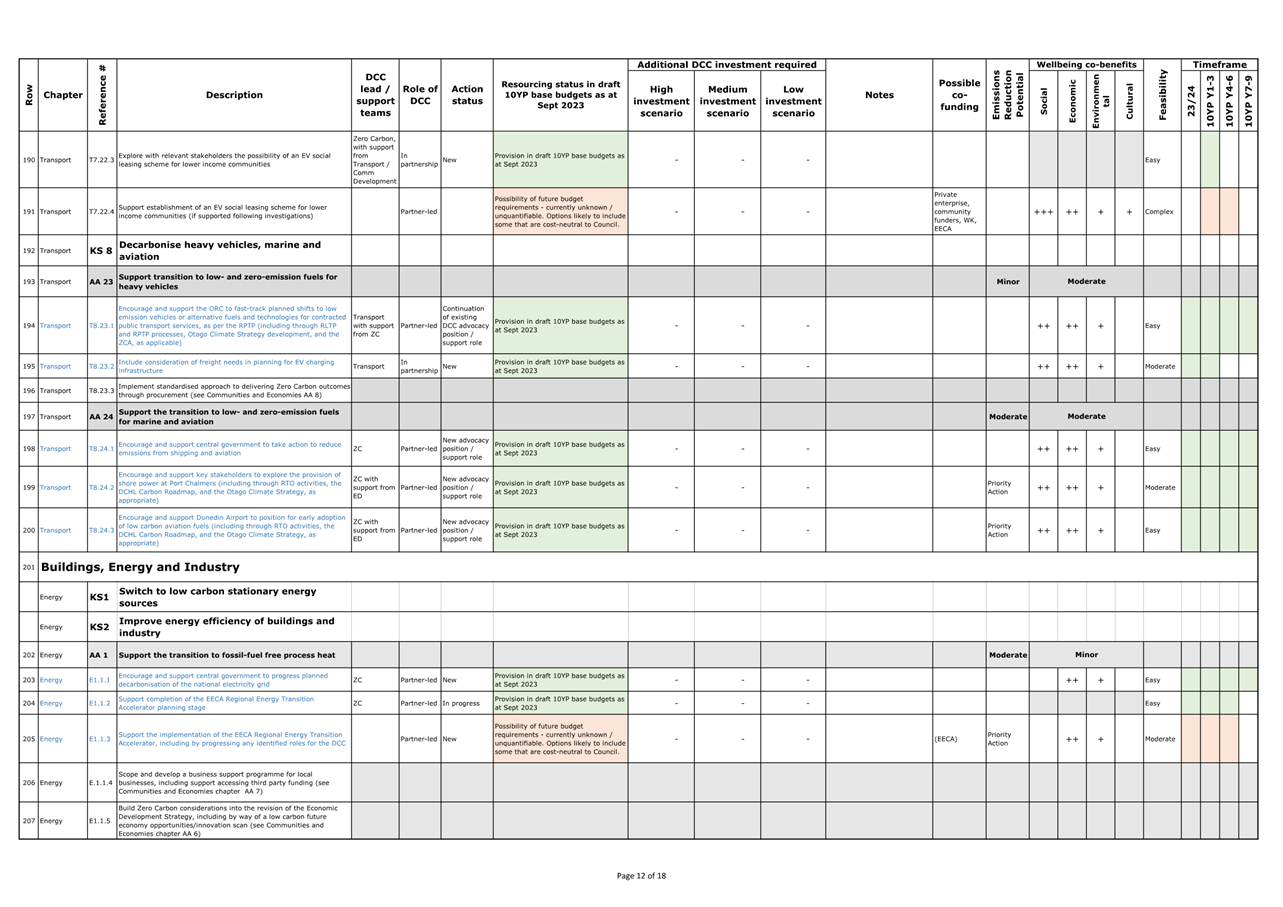
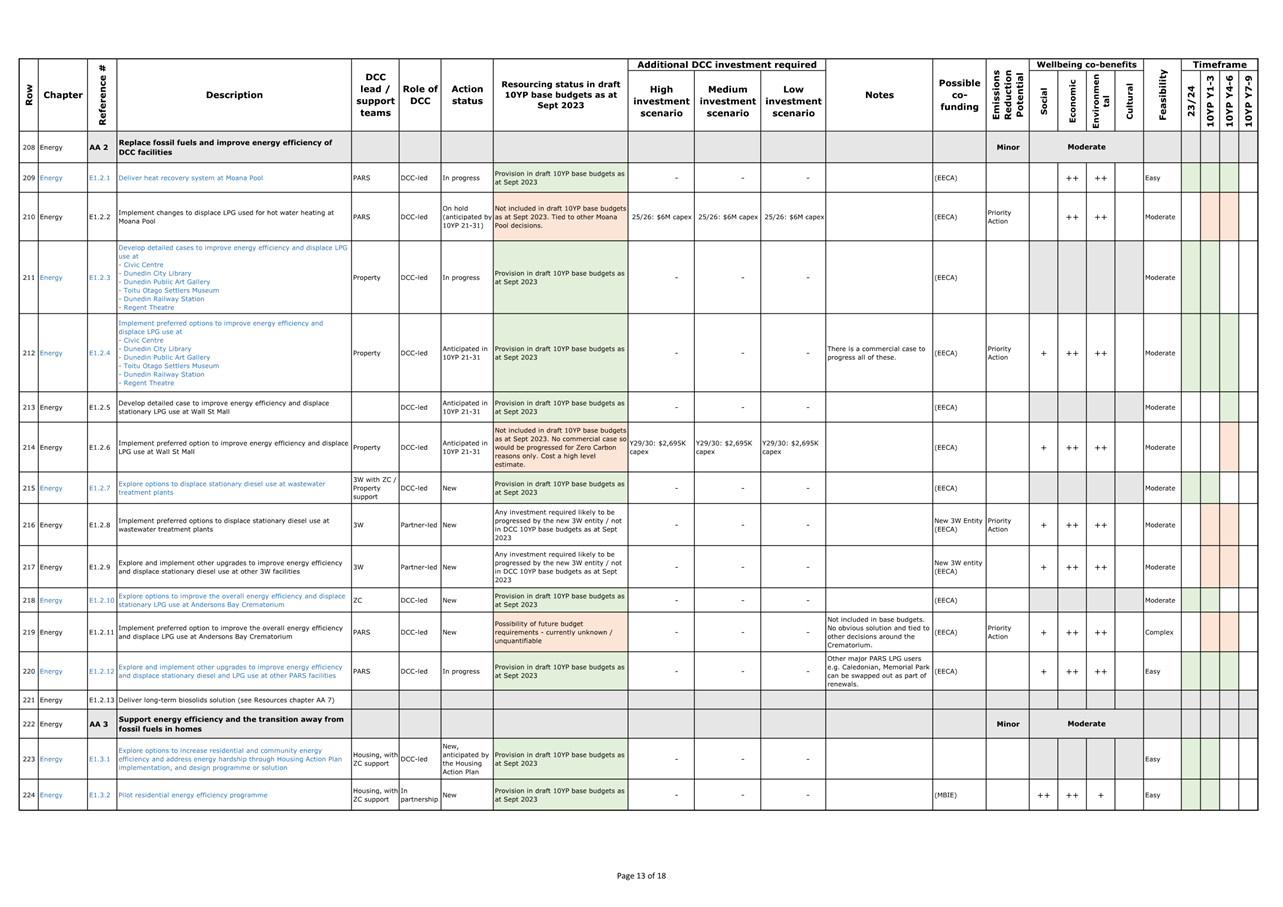
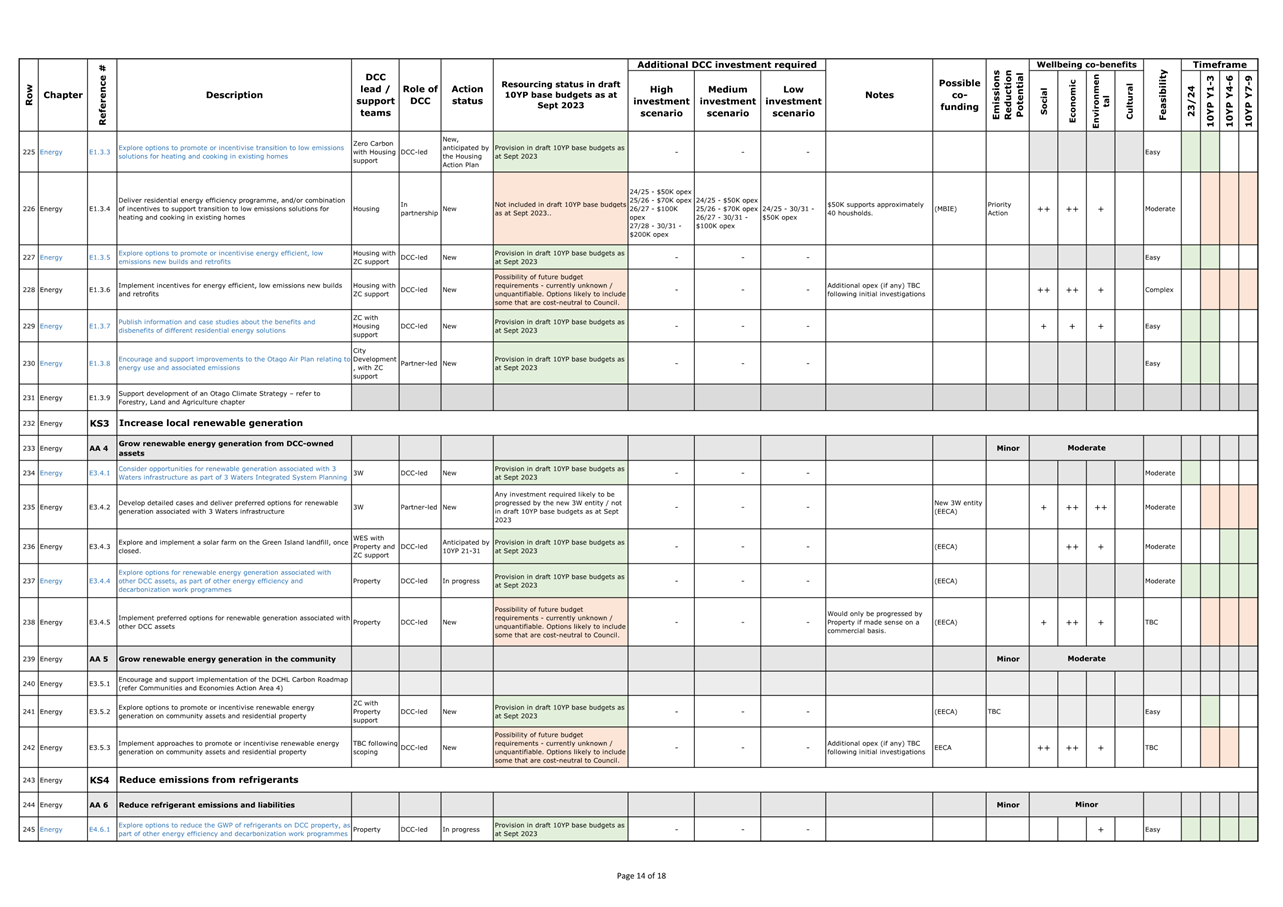
25 A
Zero Carbon implementation plan for the current financial year has been
developed, comprising actions that can be progressed within existing budgets.
Indicative actions for 2024-34 have also been identified, following requests
from councillors for additional information about future investment required to
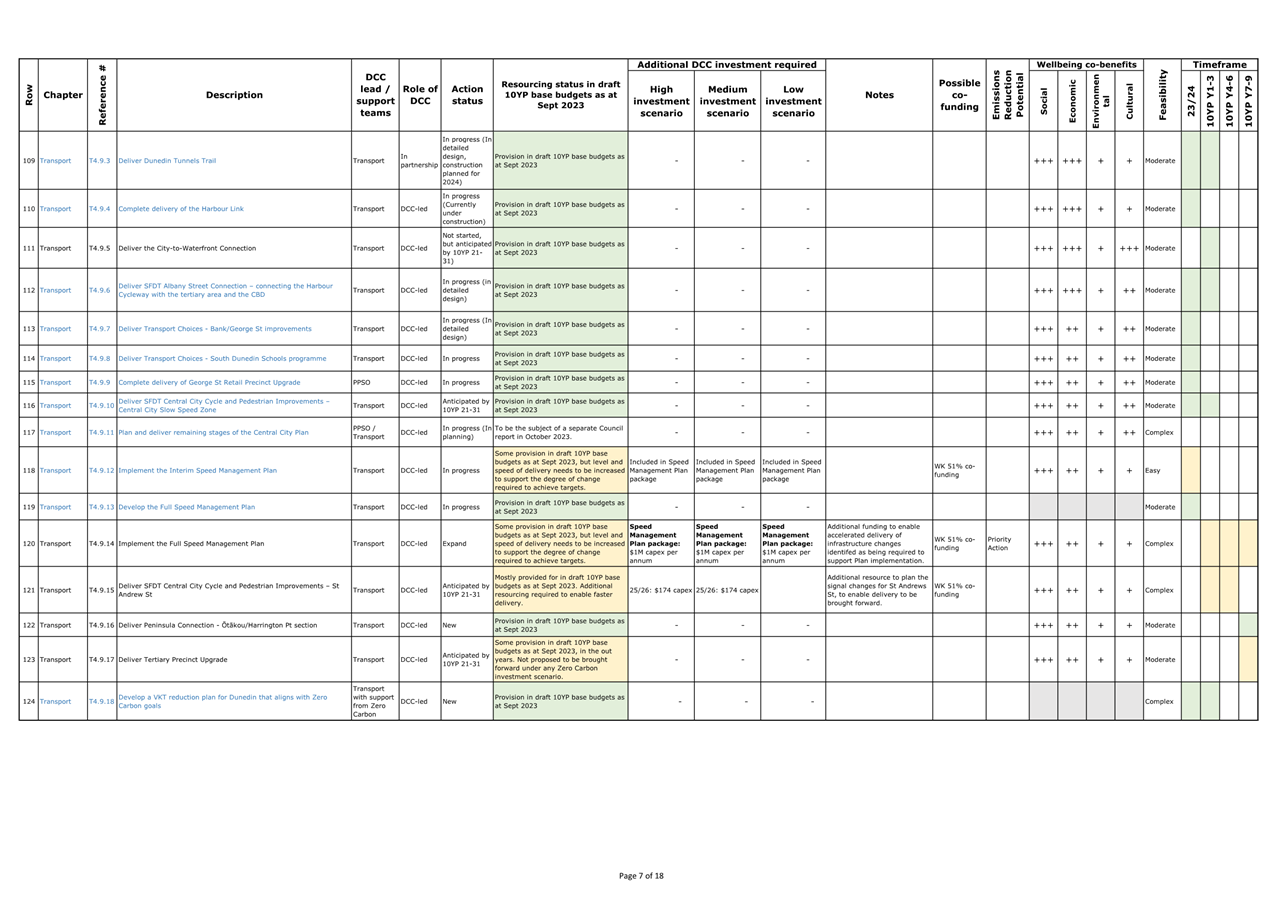
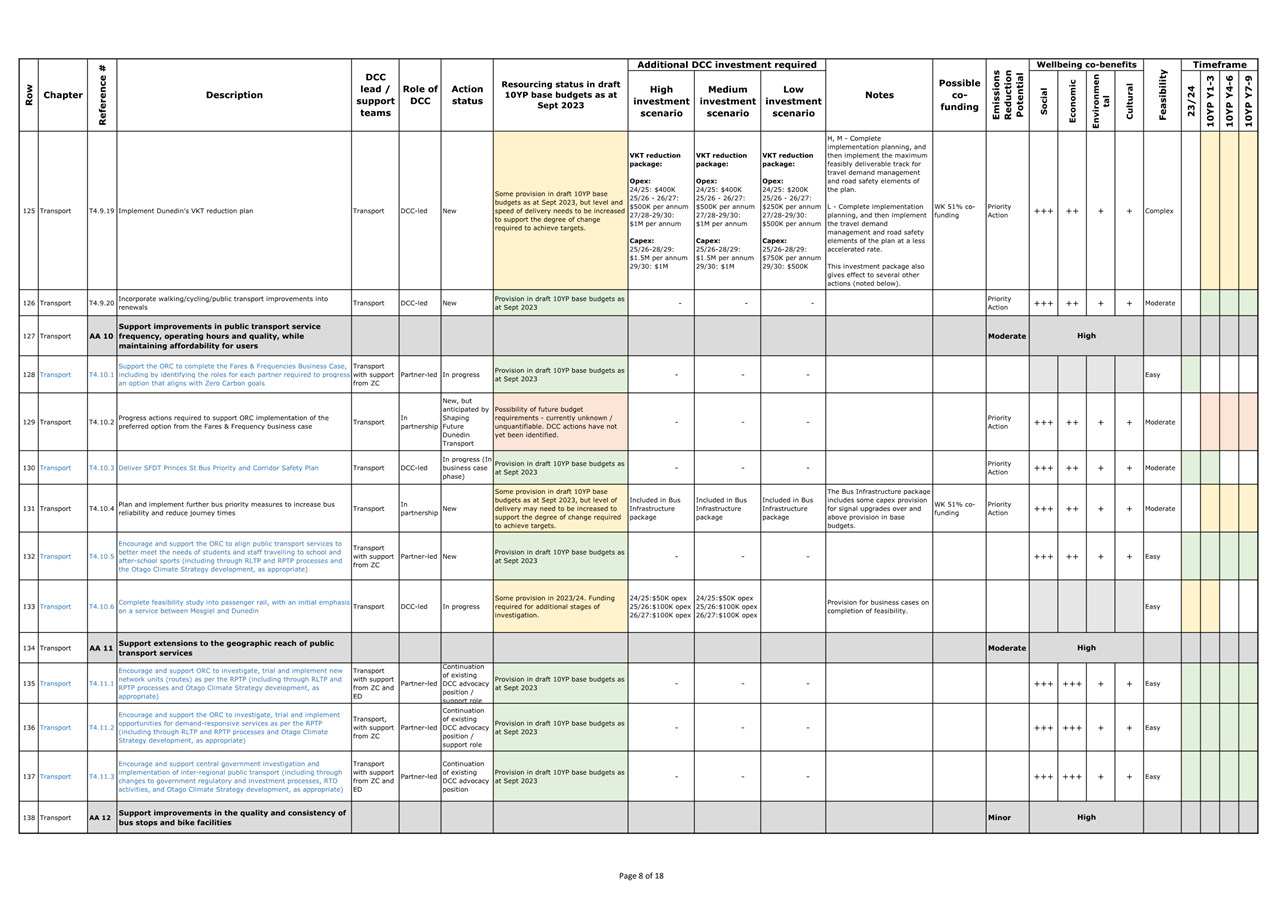
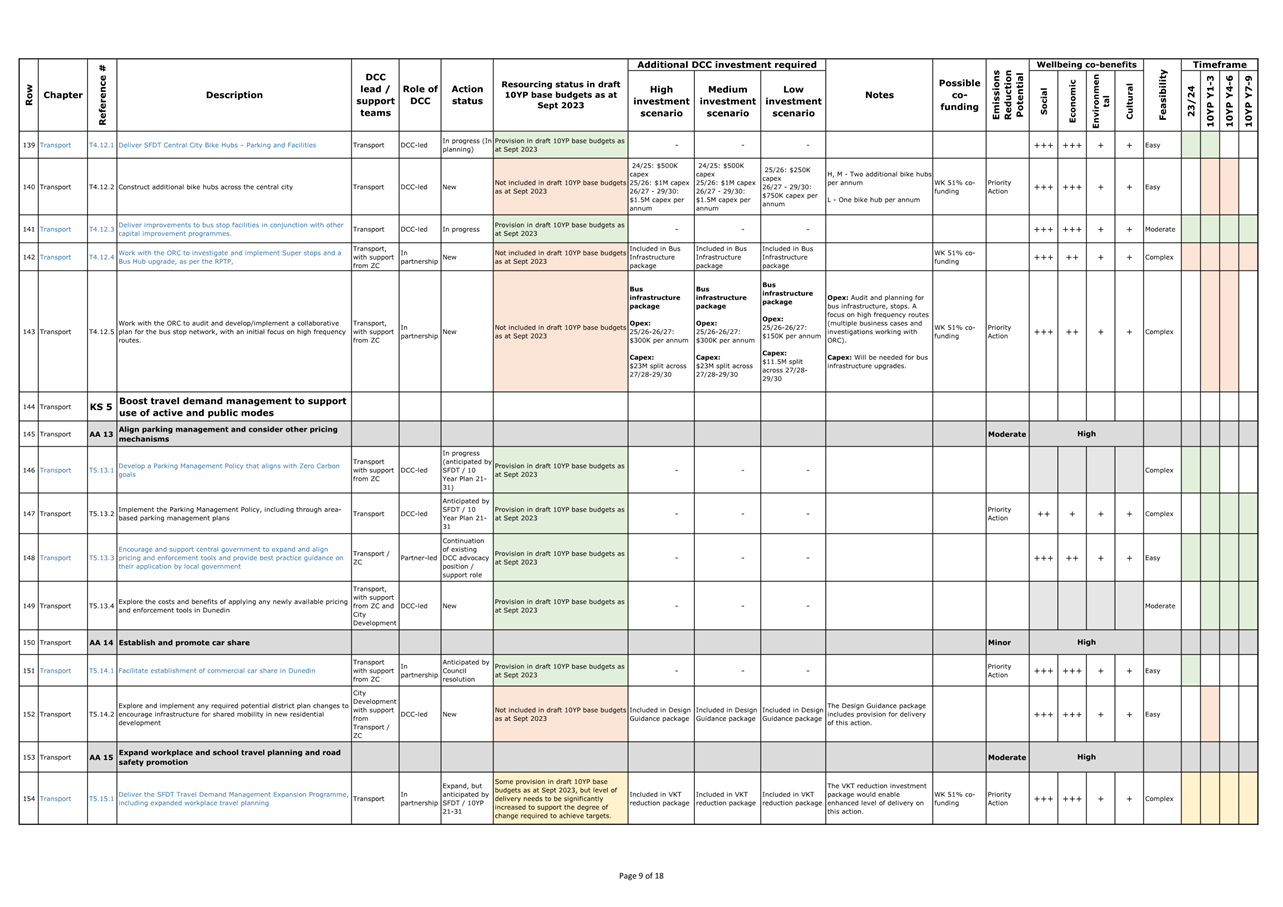
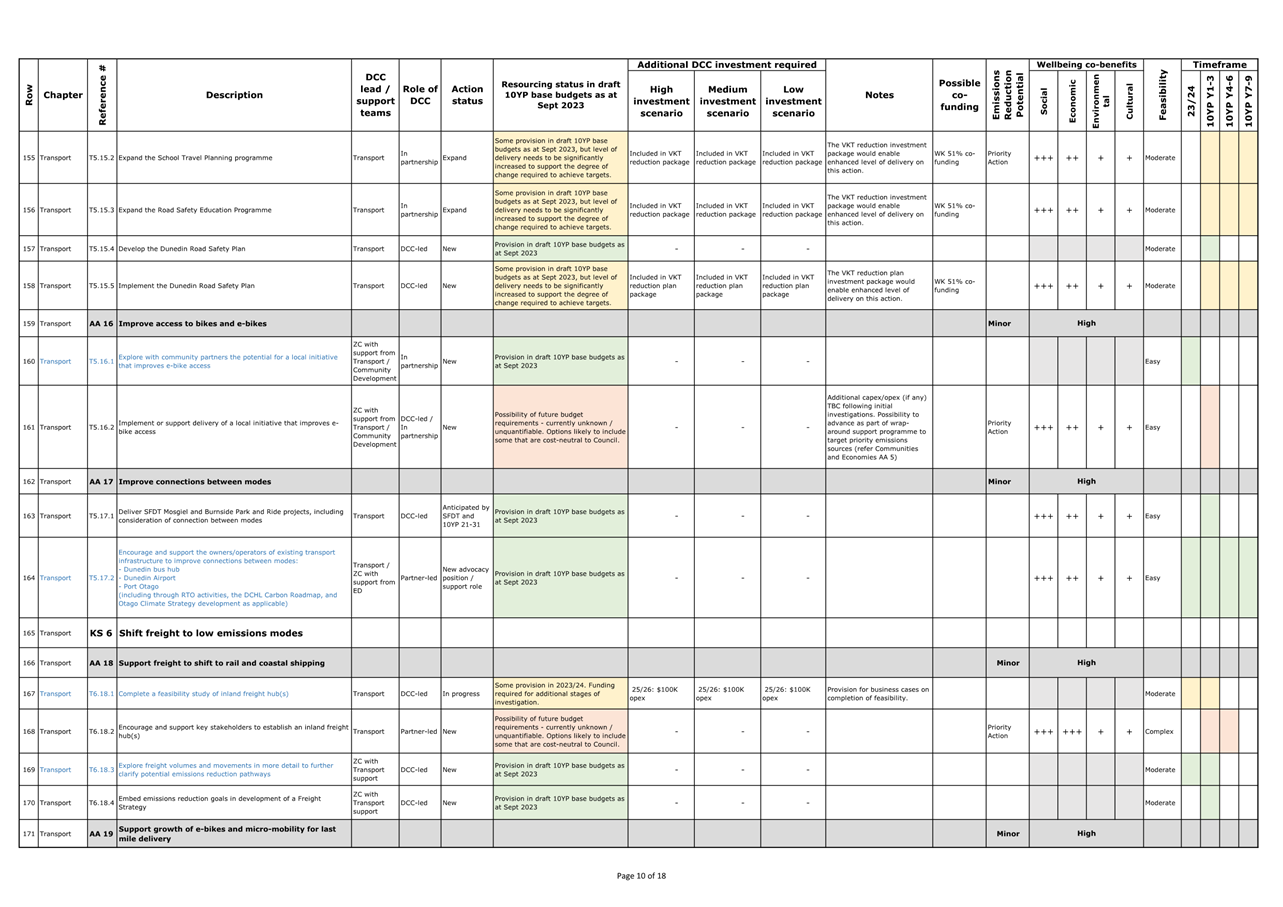
deliver the Plan. Attachment B sets out both the implementation plan for the
current year (blue text), and the indicative actions for 2024-34 (black text).
26 Actions
and their timing for 2024-34 are indicative only and are based on best
currently available information. Actions later in the out-years of the 10 year
plan will be highly dependent on further investigations and exploration, and on
the actions progressed in the early years. Should Council adopt the Plan, the
indicative actions for 2024-34 will need to be further refined into a Zero
Carbon implementation plan for the 10 year plan period, to be considered as
part of 10 year plan development.
Costs and benefits of implementing the Plan
27 Many
actions will reduce DCC operational and household costs in the medium term, but
there will be upfront costs especially for the DCC and other owners of
assets/infrastructure. Indicative costs and investment scenarios are explored
in paragraphs 29-45.
28 Longer-term
costs of inaction on climate change have not been quantified. Neither have
co-benefits been quantified in financial terms. However, co-benefits of DCC
actions have been considered as part of Plan development. Implementing DCC
actions will have many co-benefits, spanning all four wellbeings. For example,
reducing fossil fuels burnt can have positive impacts on air quality, with
subsequent benefits for social (public health) and environmental wellbeing.
Similarly, enabling active transport can have positive impacts on public health
and reduce transport costs for households. Across all action areas in the Plan,
the most numerous co-benefits are for social wellbeing. There are also many
positive co-benefits for economic and environmental wellbeing, and fewer for
cultural wellbeing.
Provisional cost estimates
29 Many
indicative actions for 2024-34 have been assessed as being ‘Provided for
in draft 10YP base budgets as at Sept 2023’, meaning that in the event
that budgets be adopted by Council as currently drafted, all these actions
could be progressed.
30 Current
base budgets are an early draft, and are subject to change following
consideration by ELT and Council. As such, the cost estimates associated with
Plan implementation will need to be further refined as decisions on the 10 year
plan are made. The cost estimates and investment
scenarios included in this report must be considered indicative and
provisional, and are provided to support early stage decision-making only.
Possible investment scenarios
31 While
any level of investment in the Zero Carbon Plan will help reduce the
city’s emissions, three indicative options for DCC investment over the
period 2024/25-2029/30 have been developed to give councillors a sense of a
range of possible scenarios.
32 No
attempt has been made to cost an investment scenario for the period
2030/31-2034/35. As discussed above, additional actions are likely to emerge
for the out-years of the Plan as early investigative actions are progressed,
and given that the Zero Carbon Plan primarily focuses on the period to 2030, it
is not possible to provide cost estimates for the period beyond 2030 at this
time.
33 Investment
scenarios include:
· additional
funding that has been identified as necessary (due to scope change or cost escalation)
to deliver projects included in the Zero Carbon Plan that have been already
agreed to by Council and/or included 10 year plan 2021-31 (e.g. Moana Pool/Wall
St Mall decarbonisation, Major Centres Upgrade)
· potential
new projects that have not been endorsed by way of Council resolution and/or
were not included in the 10 year plan 2021-31
· an
assumption of 51% Waka Kotahi co-funding applied to total project costs for
transport projects that would qualify under current Government policy settings.
34 Investment
scenarios exclude:
· costs
associated with delivering actions where these have been identified as being
able to be progressed within DCC departments’ business-as-usual work
· costs
already included current draft 10 year plan 2024-34 base budgets as at
September 2023, including the Central City Plan, which will be subject to a
separate Council paper as part of 10 year plan development
· capital
and operating expenditure that cannot be estimated at this time, being subject
to investigations and exploration in the first instance. In many cases, it is
anticipated there will be at least one option emerging from investigative work
that would be cost neutral to the DCC.
· potential
co-funding from entities other than Waka Kotahi. While potential sources have
been identified (e.g. EECA co-funding for DCC energy decarbonisation projects),
these will need to be explored further as feasibility cases and business cases
progress and re-evaluated over time, as central government priorities and
policy direction evolve.
35 Under
each investment scenario, staff have sought to prioritise investment in areas
in which DCC investment is likely to deliver higher emissions reductions.
Because reducing emissions from the transport sector is a high priority to support
achievement of targets, and the DCC has key roles in addressing emissions from
this sector, the number of transport actions and associated investment required
is significant. However, under current Government policy settings most
transport-related actions are likely to be eligible for Waka Kotahi co-funding.
36 The
high investment scenario includes undertaking all DCC actions at the
highest level deemed feasible and deliverable over the period 2024/25-2029/30.
37 The
medium investment scenario retains a high level of investment in
decarbonisation of DCC-owned infrastructure and transport-related actions, but
most other actions are progressed to a lesser degree than under the high
investment scenario.
38 The
low investment scenario retains a high level of investment in
decarbonisation of DCC owned infrastructure, but the level of investment in
transport-related actions is reduced. Most other actions are retained at the
minimum level that staff consider would have any degree of efficacy. Some
actions that are considered to represent longer-term investments in emissions
reduction (e.g. amenity aspects of urban form actions) are not progressed.
39 Because
of the magnitude of investment on transport-related initiatives relative to
other types of initiatives under each scenario, these two categories are
separately presented.
40 Provisional
estimates of investment required for transport actions under each scenario are
as set out in Table 1.
Table 1: Investment
scenarios for all transport actions
|
Total Expenditure $'000
|
Potential Total Co-Funding $'000
|
|
|
Expenditure Type
|
Years
1 - 3
|
Years
4 - 6
|
Total Expenditure
|
Years 1 - 3 Co-Funding
|
Years 4 - 6 Co-Funding
|
Total Co-Funding
|
|
High
|
Capital
|
31,174
|
90,400
|
121,574
|
14,624
|
44,574
|
59,198
|
|
|
Operating
|
7,789
|
8,439
|
16,228
|
3,565
|
4,074
|
7,639
|
|
High Total
|
|
38,963
|
98,839
|
137,802
|
18,189
|
94,474
|
66,837
|
|
Medium
|
Capital
|
31,174
|
90,400
|
121,574
|
14,624
|
44,574
|
59,198
|
|
|
Operating
|
7,539
|
8,439
|
15,978
|
3,565
|
4,074
|
7,639
|
|
Medium Total
|
|
38,713
|
98,839
|
137,552
|
18,189
|
48,648
|
66,837
|
|
Low
|
Capital
|
20,750
|
55,950
|
76,700
|
9,308
|
27,005
|
36,313
|
|
|
Operating
|
4,721
|
6,621
|
11,342
|
2,127
|
3,147
|
5,274
|
|
Low Total
|
|
25,471
|
62,571
|
88,042
|
11,435
|
30,152
|
41,587
|
41 Provisional
estimates of investment required for all other DCC actions under each scenario
are as set out in Table 2.
Table 2: Investment
scenarios for all other DCC actions
|
Total Expenditure $'000
|
|
|
Expenditure Type
|
Years 1 - 3
|
Years 4 - 6
|
Total Expenditure
|
|
High
|
Capital
|
6,100
|
2,695
|
8,795
|
|
|
Operating
|
4,830
|
5,040
|
9,870
|
|
High Total
|
|
10,930
|
7,735
|
18,665
|
|
Medium
|
Capital
|
6,100
|
2,695
|
8,795
|
|
|
Operating
|
3,250
|
3,060
|
6,310
|
|
Medium Total
|
|
9,350
|
5,755
|
15,105
|
|
Low
|
Capital
|
6,100
|
2,695
|
8,795
|
|
|
Operating
|
990
|
690
|
1,680
|
|
Low Total
|
|
7,090
|
3,385
|
10,475
|
42 For
operating expenditure, a guideline for the potential rates impact of the
packages is, $2m additional expenditure results in a 1% increase in rates.
43 For
capital expenditure, for $10m of debt, the interest cost would be $485k which
is 0.24% of an increase in rates. Note this is based on an assumed interest
rate of 4.85% from the 2023/24 annual plan. Interest rate assumptions are yet
to be determined for the 2024-34 10 year plan.
44 Subject
to Council approving the Plan, Council could choose to indicate a preference
for an investment scenario for further development and refinement into a Zero Carbon
Implementation Plan to be considered as part of 10 year plan development.
Communicating the Plan
45 Subject
to Council adoption of the Plan, staff will also produce a shorter,
public-facing version of the Plan, and accessible web-based communications
associated with the Plan. This public-facing version of the Plan will include:
a) narrative
components
b) graphic
elements, including to illustrate what a typical Dunedin resident might
experience over the term of the Plan
c) accessible
explanations of some concepts in the Plan, and
d) additional
emphasis on community stories and profiles.
46 In
broader terms, the Zero Carbon implementation plan for the current financial
year includes developing and implementing a Zero Carbon community outreach,
engagement and activation plan, building on the engagement and partnerships the
DCC has started building through the Plan development phase.
OPTIONS
47 Two
options have been identified.
Option
One – Adopt the Zero Carbon Plan (Recommended Option)
48 Under
this option, Council would adopt the Plan.
49 Following
Council adoption of the Plan, next steps would include:
a) production
of a public-facing version of the Plan
b) giving
effect to the Zero Carbon implementation plan for the current financial year
c) further
work on Council’s preferred investment scenario (if any) to be considered
by Council as part of 10 year plan 2024-34 development, to form a Zero Carbon
implementation plan for the 10 year plan period.
Advantages
· Enables
coordinated action to be taken to reduce Dunedin’s emissions in line with
previous Council resolutions.
· Enables
DCC to meet global Covenant of Mayors commitments.
· Helps
to deliver on stakeholder and public expectations of DCC action and leadership
to reduce city emissions.
Disadvantages
· As
set out in the report, giving effect to DCC action areas included in the Plan
will have implications for the DCC’s 10 year plan 2024-34. Resourcing
implications will need to be further considered through 10 year plan development.
Option
Two – Do not adopt the Zero Carbon Plan 2030 (Status Quo)
50 Under
this option, Council would not adopt the Plan.
Advantages
· If
the Plan is not adopted, there would be no need for Council to consider
associated resourcing requirements through 10 year plan 2024-34 development.
Disadvantages
· It
is highly likely that Dunedin’s Zero Carbon targets will not be achieved.
· The
city will not fulfil its commitments under the Global Covenant of Mayors.
· Stakeholder
and public expectations of DCC action and leadership to reduce city emissions
are unlikely to be fulfilled.
NEXT STEPS
51 Subject
to Council adoption of the Plan, next steps include:
a) production of a public-facing version of
the Plan
b) giving effect to the Zero Carbon
Implementation Plan for the current financial year
c) further work on Council’s preferred
investment scenario (if any) to be considered by Council as part of 10 year
plan 2024-34 development, to form a Zero Carbon implementation plan for the 10
year plan period.
Signatories
|
Author:
|
Rory McLean - Senior Policy Analyst
Florence Reynolds - Senior Policy Analyst, Zero Carbon
Jinty MacTavish - Principal Policy Advisor Sustainability
|
|
Authoriser:
|
Robert West - General Manager Corporate and Quality
Sandy Graham - Chief Executive Officer
|
Attachments
|
|
Title
|
Page
|
|
⇩a
|
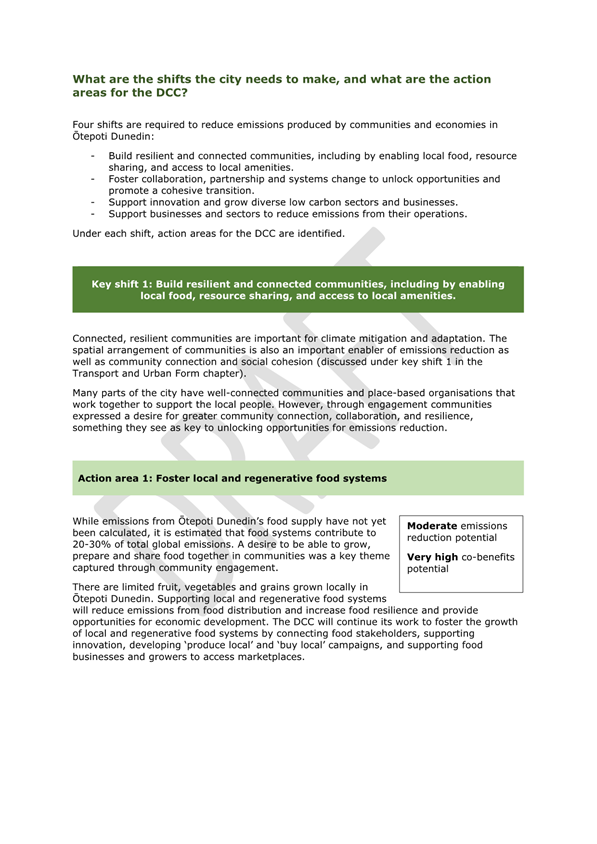
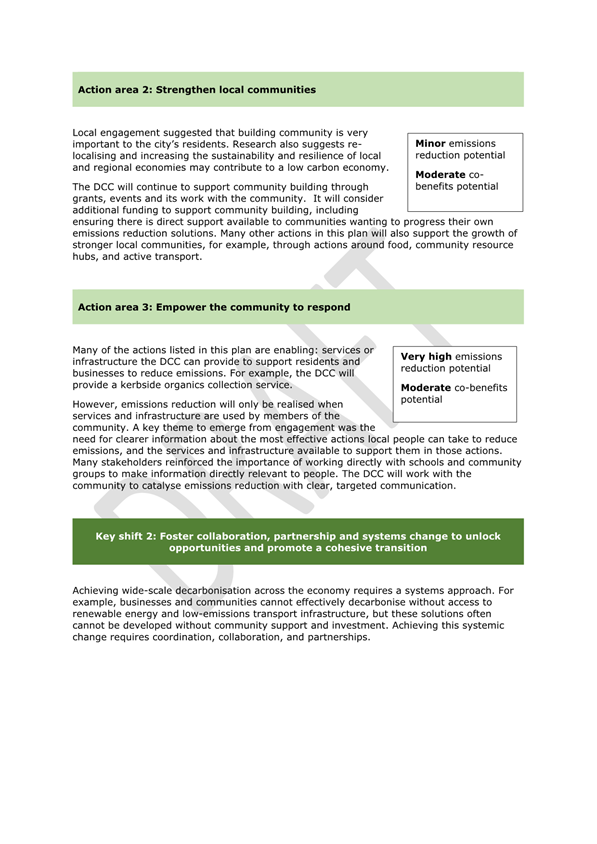
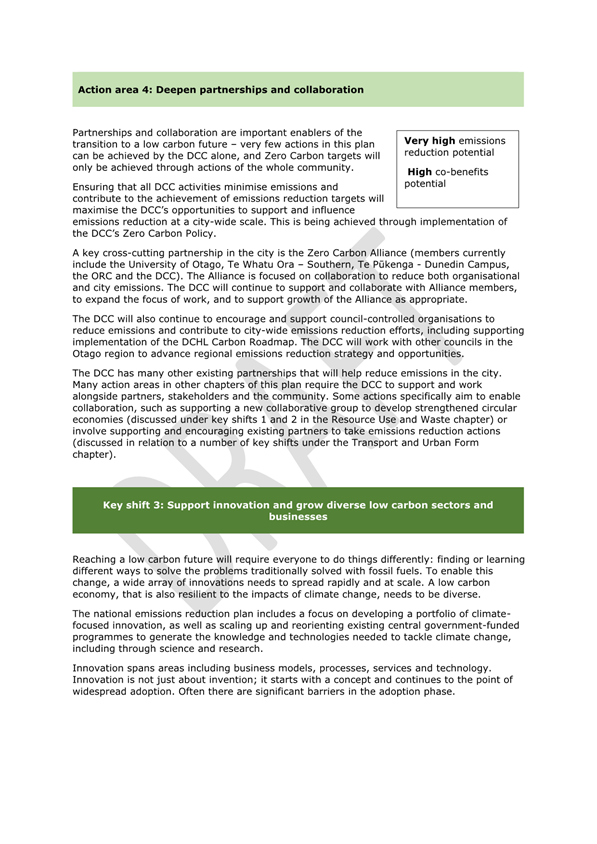
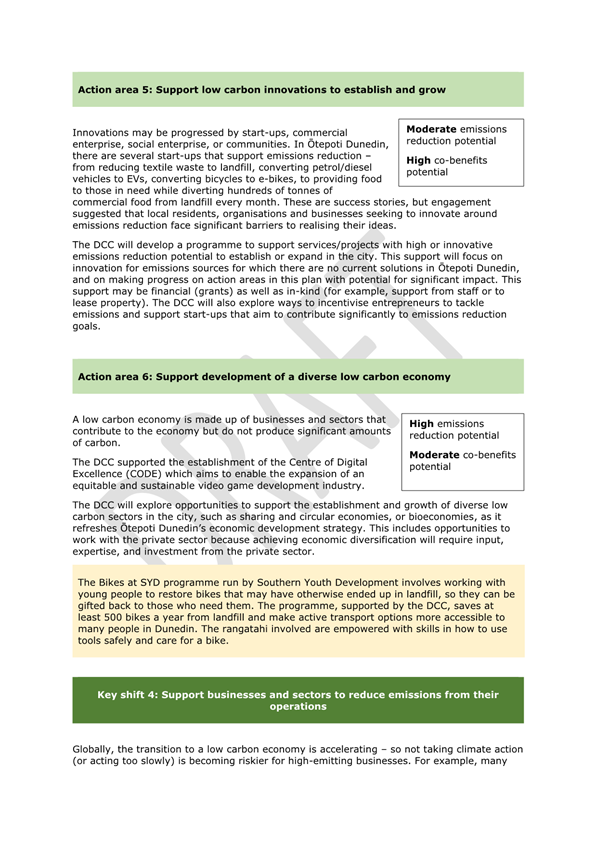
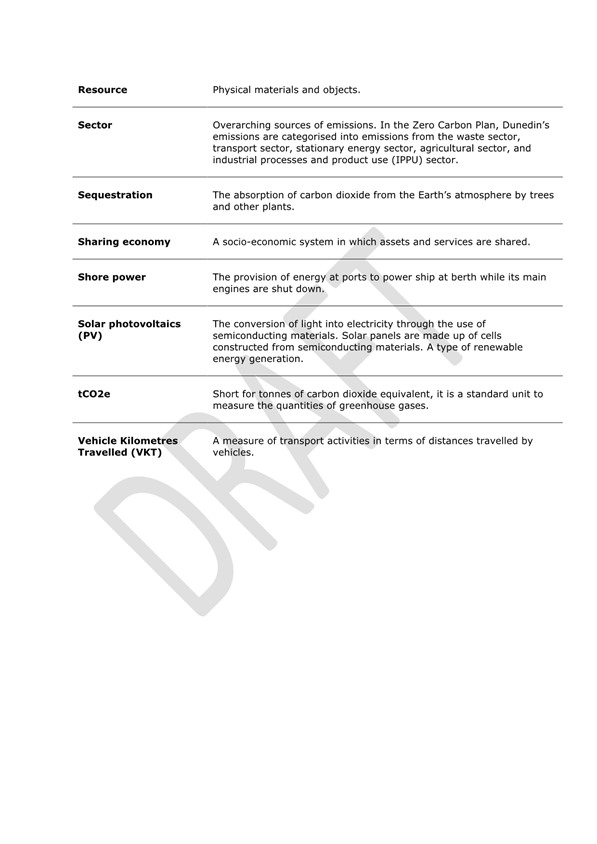
Draft Zero Carbon Plan
2030
|
58
|
|
⇩b
|
Zero Carbon
implementation plan 2023-24 and indicative actions for the 10 year plan
period
|
131
|
|
⇩c
|
Zero Carbon Plan
briefing slides
|
151
|
|
SUMMARY OF CONSIDERATIONS
|
|
Fit with purpose
of Local Government
The Zero Carbon Plan is anticipated to
promote the social, economic and environmental wellbeing of communities in
the present and for the future, by facilitating the transition to a low
carbon economy.
|
|
Fit with strategic
framework
|
|
Contributes
|
Detracts
|
Not applicable
|
|
Social Wellbeing Strategy
|
☒
|
☐
|
☐
|
|
Economic Development Strategy
|
☒
|
☐
|
☐
|
|
Environment Strategy
|
☒
|
☐
|
☐
|
|
Arts and Culture Strategy
|
☒
|
☐
|
☐
|
|
3 Waters Strategy
|
☒
|
☐
|
☐
|
|
Spatial Plan
|
☒
|
☐
|
☐
|
|
Integrated Transport Strategy
|
☒
|
☐
|
☐
|
|
Parks and Recreation Strategy
|
☒
|
☐
|
☐
|
|
Other strategic projects/policies/plans
|
☒
|
☐
|
☐
|
Elements of the Plan have been assessed as directly
contributing to the goals of all strategies and the DCC’s Emissions Management
and Reduction Plan.
|
|
Māori Impact
Statement
A critical Treaty of Waitangi analysis was prepared
previously as part of the Zero Carbon work programme. This indicated that, in
general, taking action on climate change is aligned with Treaty of Waitangi
obligations because a wide range of taonga are at risk from climate change.
The wellbeing assessments for each action area have included aspects such as
equity and cultural wellbeing. Individual projects will need to consider the
Māori Strategic Framework and incorporate mana whenua and mātāwaka inputs when delivered.
|
|
Sustainability
This Plan contributes
to the DCC’s work to strengthen the commitment to sustainability
through the Strategic Refresh. The development of the Plan aligns with
develop of the City Portrait; analysis undertaken for the City Portrait shows
that focussing on reducing emissions from agriculture, transport and waste
will also have a positive impact on other areas of planetary health more
broadly.
Climate change mitigation/emissions reduction efforts are
considered key to sustainability. ‘Climate Action’ is one of the
United Nation’s Sustainable Development Goals, reflecting the
centrality of action on climate change to the achievement of sustainable
development. Without significant cuts to emissions, climate change impacts
will further accelerate, with commensurate negative impacts on the social,
environmental, cultural and economic wellbeing of New Zealand communities.
Conversely, actions to reduce emissions generally have significant
co-benefits in terms of community wellbeing.
|
|
LTP/Annual Plan /
Financial Strategy /Infrastructure Strategy
All actions included in the Zero Carbon Implementation
Plan for the current financial year are provided for in the 10 year plan /
Annual Plan / Financial Strategy / Infrastructure Strategy. Indicative Zero
Carbon Plan investment scenarios are presented alongside this report and,
subject to Zero Carbon Plan adoption, a Zero Carbon implementation plan for
the 10 year plan will be considered and consulted on through the 10 year plan
process.
|
|
Financial considerations
Progressing the DCC action areas in the Plan will require
additional resourcing, over and above what is currently provided for in the
10 Year Plan 2021-31. Indicative Zero Carbon Plan investment scenarios are
presented alongside this report and, subject to Zero Carbon Plan adoption, a
Zero Carbon implementation plan for the 10 year plan will be considered and
consulted on through the 10 year plan process.
|
|
Significance
This decision is considered low significance as the
proposed changes seek to give effect to existing resolutions of Council, and
the Zero Carbon Implementation Plan for the current financial year can be
managed within existing budgets. Indicative Zero Carbon Plan investment
scenarios are presented alongside this report and, subject to Zero Carbon
Plan adoption, a Zero Carbon implementation plan for the 10 year plan period
will be considered and consulted on through the 10 year plan process.
|
|
Engagement –
external
There has been substantial external engagement in the
development of the Plan. The Zero Carbon team conducted a public survey that
received over 1300 responses. The team has spoken directly with over 50
community groups and organisations, and a range of subject matter experts.
|
|
Engagement -
internal
There has been substantial internal engagement in the
development of the Plan. Key teams have been integrally involved in Plan
development (Transport, Waste and Environmental Solutions), with a large number
of others consulted on content related to their activity areas and/or areas
of expertise. These teams include Economic Development, Community Development
and Events, Parks and Recreation Services, Property, Housing, Māori
Partnerships, Corporate Policy, Procurement, 3 Waters, Dunedin Public
Library, Communications and Marketing, BIS, City Development, PPSO.
|
|
Risks: Legal /
Health and Safety etc.
There may be reputational risks for the DCC associated
with non-delivery on emissions reduction ambitions, given the target adopted
by Council in 2019.
|
|
Conflict of
Interest
No conflict of interest has been identified.
|
|
Community Boards
A workshop involving members of all community boards was
held to inform Plan development.
|
|
|
Council
25 September 2023
|








|
|
Council
25 September 2023
|
|
|
Council
25 September 2023
|
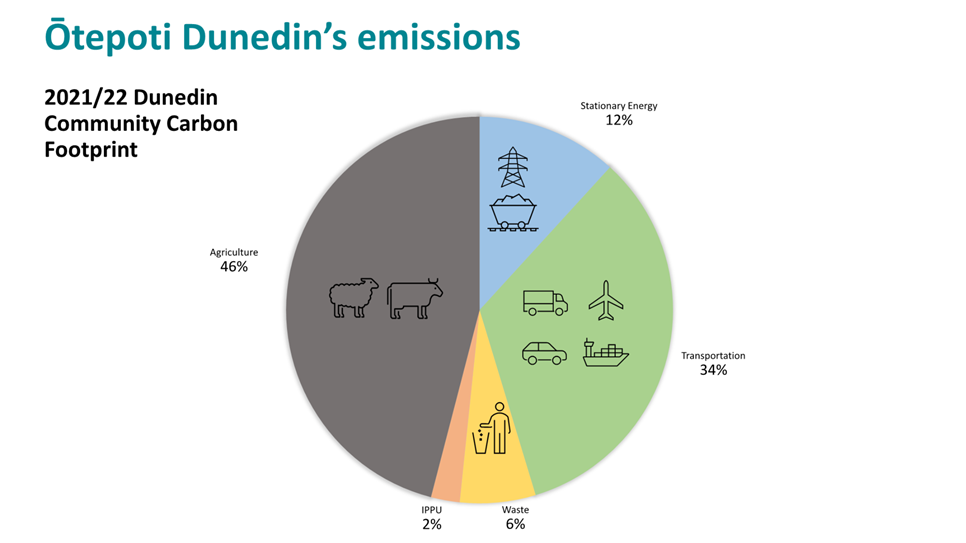

|
|
Council
25 September 2023
|
Residents' Opinion Survey Results 2022/2023
Department: Corporate Policy
EXECUTIVE SUMMARY
1 This
report provides a summary of the annual results of the 2022/23 Residents’
Opinion Survey (ROS) (Attachment A). The 2022/23 survey was conducted over the
12 months from 1 July 2022 to 30 June 2023 by an independent research company,
called GravitasOPG.
2 The
Dunedin City Council (DCC) has commissioned a ROS every year in varying forms
since 1994 to gauge residents’ satisfaction and engagement with a wide
range of DCC services and facilities. The 2022/23 survey received a total of
1,402 responses out of 4,800 survey invitations, based on a random sample of
residents aged 18 years and over from the electoral roll. Participation is
voluntary.
3 ‘Overall
satisfaction with the DCC’ significantly increased to 50% (from 43% in
2021/22) so did those with ‘Performance of the Mayor and
Councillors’ (34%, up from 26%), ‘Value for money of DCC services
and activities’ (39%, up from 32%), and ‘Facilities, infrastructure
and services delivery’ (60%, up from 53%).
4 Similarly,
overall satisfaction significantly increased with ‘Public
facilities’ (84%, up from 79%), ‘Water-related
infrastructure’ (63%, up from 54%), ‘Regulatory services’
(59%, up from 53%), and ‘Planning and Urban Design’ (58%, up from
53%). On the other hand, overall satisfaction with ‘Roading-related infrastructure’
remained unchanged and low at 26%.
5 Positive
ratings significantly increased for respondents’ perceptions on
‘Dunedin recognises and supports cultural diversity’ (65%, up from
60%). In contrast, a significant decline was found for respondents’
perceptions on ‘Dunedin is a safe city’ (62%, down from 67%) - the
lowest in six years.
6 The
top two priorities for the DCC featured in the responses include
‘Infrastructure/Maintain infrastructure’ (22%) (e.g., fix the roads
and footpaths) and ‘Being more environmentally friendly (e.g., climate
change, beach erosion, recycling) (17%). The latter became more prominent than
‘More parking’ and ‘Better traffic flow’, compared to
the previous year.
|
RECOMMENDATIONS
That the Council:
a) Notes the annual results of the 2022/23 Residents’
Opinion Survey.
|
BACKGROUND
The purpose and use of a
Residents’ Opinion Survey at the DCC
7 The
ROS is a monitoring tool utilised by the DCC to gauge residents’
satisfaction and engagement with a wide range of DCC services and facilities.
It has been commissioned by the DCC every year since 1994 in varying forms and
provides an annual snapshot of residents’ satisfaction. Residents’
opinion surveys are a common tool utilised by other Councils across the country
to monitor residents’ satisfaction.
8 All
ROS reports from 2006 onwards are available publicly on the DCC website. The
ROS results are released every year, and most recently since 2020, reported
directly to the Council via a report.
9 Since
2016, the ROS has been conducted on a monthly, rather than annual basis, to
provide for analysis of seasonal trends throughout the year. Gravitas Research
& Strategy Limited was selected in 2019 to conduct the ROS following a
public procurement process. They have since rebranded to GravitasOPG after
being acquired by Big Picture Marketing Strategy & Research Ltd, a New
Zealand owned and operated marketing insights and research company. The 2022/23
survey was year three of a four-year contract with GravitasOPG.
10 The
current five-year contract with GravitasOPG expires in August 2024 with the
delivery of a 2023/24 survey (ending 30 June 2024).
11 The
aim of the ROS is to provide statistically representative results on
residents’ satisfaction with DCC services and facilities and perceptions
of Council performance.
12 The
objectives of the ROS are to:
· gauge
the extent to which Council is meeting its 10 Year Plan (10YP) and Annual Plan
objectives
· measure
resident’s satisfaction with the services, facilities and infrastructure
Council provides to the community
· identify
areas for improvement that would be valued by residents.
ROS and Levels of Service
13 The
results of the ROS are currently used to inform 42 Levels of Service (LoS)
performance measures that are set out in the 10YP 2021-2031. The 10YP sets out
the activities undertaken by the DCC. Each activity has LoS that describe what
the DCC will provide to the community, along with measures and targets used to
assess the level of achievement in delivering those activities. These
statements, measures and targets are Council’s performance framework. The
DCC reports on how it is achieving its LoS through its Annual Report and
quarterly activity reporting.
14 A
review of the LoS statements and measures is underway as part of the 10YP
preparations. The focus of the LoS review is to evaluate the effectiveness of
DCC’s existing performance framework and existing suite of survey tools
used to measure performance and monitor wellbeing, including the ROS and Quality
of Life Survey. ROS will continue to be a key element in a range of measures
designed to gauge the performance of Council.
15 Quarterly
ROS update reports will continue to be presented to Council via the Strategy,
Planning and Engagement Committee.
DISCUSSION
ROS
methodology
16 The
ROS is based on a sample of randomly selected residents aged 18 years and over
from the electoral roll, with a target sample size of 1,200 residents each
year. Participation is voluntary. Some groups of residents are more likely to respond
to the ROS than others, and it is recognised that younger people (18-29 years)
have been noticeably underrepresented in the ROS. However, due to the limited
access to the electoral roll for the purpose of the ROS, the DCC cannot target
particular groups in sampling efforts.
17 The
results are weighted to known population distributions based on the 2018 Census
data for age, gender, ethnicity and location to reduce sample bias due to the
aforementioned differential response rate.
18 The
2022/23 survey was conducted over 12 months from 1 July 2022 to 30 June 2023. A
total of 4,800 survey invitations were sent over the survey period, and 1,402
responses (1,313 in 2021/22) were received. A response rate of 31% was
achieved, compared with 32% in 2021/22. The survey results have a margin of
error of +/-2.6%.
Summary
of findings
19 The
Residents’ Opinion Survey 2023 (ROS 2022/23) (Attachment A) has been
prepared by GravitasOPG with support from Corporate Policy.
20 The
ROS 2022/23 uses black arrows to indicate statistically significant differences
in results compared to the previous year’s results, or between users and
non-users of facilities. In this report, the word ‘significant’
specifically refers to statistical significance and does not mean
‘large’.
21 Summaries
for each of the activities represented in the survey are provided below in the
order as presented in Attachment A.
Facilities
Parks,
Reserves and Open Spaces
22 Satisfaction
ratings for most parks, reserves and open spaces facilities remained stable
over the last 12 months. A significant increase in satisfaction was found for
‘DCC playgrounds’ (65%, up from 56%), returning to the level of
satisfaction in 2020/21. In contrast, satisfaction with ‘Public
toilets’ remained low at 45%.
23 There
was not much change in the level of visitation of parks, reserves, and open
spaces, with ‘DCC reserves (scenic, bush and coastal)’ receiving
the highest percentage of visitation at 83%, followed by ‘Public
toilets’ at 82%.
Sports
and Recreation Facilities
24 There
was an indication of increase in user satisfaction with ‘Community
swimming pools’ (76%, up from 68%) although the change was not
statistically significant. Users’ satisfaction was stable for all other
facilities, including Forsyth Barr Stadium (90%), Moana Pool (80%), Edgar
Sports Centre (78%), and Dunedin Ice Stadium (76%).
Other
Public Facilities
25 Three
public facilities received high user satisfaction ratings of above 90%,
including Toitū Otago Settlers Museum (93%), Otago Museum (92%), and
Olveston Historic Home (90%) although the rating was lower than the previous
year for Olveston Historic Home, which saw a decrease of 4%.
26 The
most notable significant increase in user satisfaction was seen for the Dunedin
i-Site Visitor Centre (80%, up from 61%), returning to the level of
satisfaction recorded in 2020/21. A similar pattern was observed for users of
Lan Yuan Dunedin Chinese Gardens although the change was not statistically
significant (89%, up from 82%).
Infrastructure
Water
related Infrastructure
27 The
percentage of respondents satisfied with ‘Water-related
infrastructure’ significantly increased in all aspects of the services,
back to similar levels in 2019/2020: ‘Overall’ (63%, up from 54%),
‘Water pressure and quality’ (72%, up from 65%), ‘Sewerage
system’ (68%, up from 62%), and ‘Stormwater system’ (57%, up
from 47%).
Roading,
footpaths, lighting and parking
28 Overall
satisfaction with ‘Roading-related infrastructure’ remained
unchanged and low at 26%. Highest satisfaction ratings were recorded for
‘Street lighting throughout the city’ (61%), followed by
‘Flow of traffic at off-peak hours’ (58%).
29 While
satisfaction ratings were lower than all other aspects, there was significant
increases in satisfaction with ‘Availability of on-street metered parking
in the central city’ (22%, up from 18%) and ‘Availability of
parking in the central city’ (21%, up from 15%). In contrast, there was a
significant decline in satisfaction with ‘Flow of traffic at peak
hours’, after a significant increase between 2020/21 and 2021/22.
Satisfaction with ‘Ease of pedestrian movement’ also declined
significantly to 56% from 62% - the lowest rating since 2015/2016.
Services
Waste
Management
30 Satisfaction
with ‘Waste management services’ increased by various degrees in
all aspects of the services. There was a significant increase in satisfaction
with ‘Kerbside recycling’ (78%, up from 71%), returning to the
satisfaction level in 2019/20. Overall, over half of respondents (58%) were
satisfied with waste management services, with the highest rating being for
‘Kerbside recycling’ (78%) and the lowest being for
‘Cleanliness of the streets in general’ (53%) and ‘Public
recycling bins’ (53%).
Regulatory
Services
31 Satisfaction
with ‘Regulatory services’ continued to show upwards trend in all
aspects of the services, with the highest being for ‘Control of roaming
dogs’ (66%) and the lowest being for ‘Parking enforcement’
(51%). There were statistically significant increases, in satisfaction with
‘Overall regulatory services’ (59%, up from 53%) and ‘Parking
enforcement (51%, up from 46%).
Planning
and Urban Design
32 Overall
satisfaction with ‘Planning and Urban Design’ increased
significantly to 58% from 53% last year. Satisfaction with other individual
aspects of ‘Planning and Urban Design’ remained stable over the
last 12 months. Satisfaction was highest for ‘Overall look and feel of
your suburb or township’ (66%) and lowest for ‘Overall look and feel
of the central city retail area’ (51%).
Communications, Contact and Information
33 Overall
satisfaction with ‘How well the DCC keeps residents informed’ had a
slight increase from 53% to 56%. There was a similar pattern with a slight
increase in satisfaction with ‘FYI newsletter’ (54%, up from 50%)
and ‘DCC social media’ (48%, up from 42%). Satisfaction with
‘DCC website’ remained highest and unchanged at 57%. None of these
changes was statistically significant.
34 The
percentage of respondents who contacted DCC staff in the last three months
remained unchanged at 29%, after a significant decline in 2021/22 from 36%. 53%
of these interactions were done by telephone, compared to 59% in 2021/22. The
share of visiting in person remined lower at 23%, while the share of contacting
staff using methods that are neither phone nor in person showed a gentle
increasing trend. While not specifically asked in the survey,
‘Other’ contact methods would likely include contact via email and
letter.
35 Overall,
around three quarters of respondents who have had contacted the DCC in the last
three months were satisfied with ‘How DCC staff handled the enquiry
overall’, with the highest rating being for ‘How well staff
communicated with enquires’ (77%). A significant increase was seen in
satisfaction with ‘The outcome of the matter’ (71%, up from 63%) -
the highest rating since 2018/19. Satisfaction with ‘How long it took
staff to deal with the matter’ slightly decreased to 72% from 74%.
Leadership
and Overall Satisfaction
36 Four
of five aspects of ‘Dunedin City Council leadership’ received
significantly higher satisfaction ratings compared to the last year. They are:
‘Support for the city’s festival and events’ (61%, up from
55%), ‘Supporting Dunedin’s economic development’ (41%, up
from 35%), ’The amount of public consultation taken’ (37%, up from
31%) and ‘Performance of Mayor and Councillors’ (34%, up from 26%).
Satisfaction with ‘Performance of Community Board members’ showed a
slight increase, though not statistically significant (37%, up from 33%).
37 Similar
to the leadership ratings, overall satisfaction with the DCC significantly
increased in all three aspects covered in the survey. The highest rating was
for ‘Overall satisfaction with facilities, infrastructure and
services’ at 60% (up, from 53%). ‘Overall satisfaction with the
Dunedin City Council’ increased to 50% from 43% in the previous year,
after a significant decline to 40% between 2019/20 and 2020/21.
Perceptions
of Dunedin
38 Positive
ratings significantly increased for respondents’ perceptions on
‘Dunedin recognises and supports cultural diversity’ (65%, up from
60%), after a significant decline between 2020/21 and 2021/22.
39 A
significant decline was found for respondents’ perceptions on
‘Dunedin is a safe city’, which fell to 62% from 67% in the
previous year. This is the lowest rating in six years and is back to a similar
level to that of 2015/16.
40 Of
the nine aspects of ‘Perceptions of Dunedin’ considered, the
highest positive rating was found for ‘Dunedin maintains and preserves
its architectural heritage’ (74%). In contrast, ratings were the lowest
for the ‘DCC being a leader in encouraging the development of a
sustainable city’ (33%).
Top
two priorities for the DCC
41 Of
the 1,402 survey respondents, 1071 (76%) provided their top two priorities for
the DCC to address this year (Note: the survey period 1 July 2022 to 30 June
2023). The top two priorities featured in the responses include
‘Infrastructure/Maintain infrastructure’ (22%) (e.g., fix the roads
and footpaths) and ‘Being more environmentally friendly (e.g., climate
change, beach erosion, recycling) (17%). Other priorities include ‘Better
traffic flow (e.g., less roadworks, heavy traffic diversions) (15%) and
‘Finishing projects that have been started/faster to finish
projects’ (15%).
42 The
top priorities provided in the response slightly changed from the previous
year. While the top priority remained the same, ‘Being more
environmentally friendly’ became more prominent
than ‘More parking’ and ‘Better traffic flow’ in this
survey. The fourth ranked ‘Finishing projects that have been
started/faster to finish projects’ was not identified as a priority in
the last survey. A summary of the comments is provided below and on page 70 of
Attachment A.
Correlation
analysis
43 A
performance versus importance correlation analysis was undertaken by
GravitasOPG, since the 2019/20 year (see pages 72-75 of Attachment A). This
analysis considers the relative importance of each aspect measured in the
survey to the overall satisfaction rating. This analysis considers the relative
importance of each measure in the survey to the overall satisfaction rating.
44 Five
areas were identified as areas that are of high importance but need to be
improved to maximise the overall satisfaction with the DCC. They are:
‘Performance of Mayor and Councillors’, ‘Performance of
Community Board members’, ‘Roading-related infrastructure,
‘Planning and Urban Design’, and ‘Communication
Channels’. Improvement in these areas will strongly influence the overall
satisfaction with the DCC.
OPTIONS
45 There
are no options as this is a report for noting.
NEXT STEPS
46 The
2022/23 ROS results report (Attachment A) will be uploaded onto the DCC
website. GravitasOPG will continue to deliver the ROS monthly for the 2023/24
survey, ending 30 June 2024.
47 The
rationale or need for the ROS will be further informed and contextualised as
the LoS review progresses as part of the next 10YP.
48 Staff
will continue to work with GravitasOPG to provide Council with ROS quarterly
results.
Signatories
|
Author:
|
Gina Huakau - Corporate Policy Manager
|
|
Authoriser:
|
Sandy Graham - Chief Executive Officer
|
Attachments
|
|
Title
|
Page
|
|
⇩a
|
2022-23 Residents'
Opinion Survey
|
196
|
|
SUMMARY OF CONSIDERATIONS
|
|
Fit with purpose
of Local Government
The ROS enables democratic local decision
making and action by, and on behalf of communities
|
|
Fit with strategic
framework
|
|
Contributes
|
Detracts
|
Not applicable
|
|
Social Wellbeing Strategy
|
☒
|
☐
|
☐
|
|
Economic Development Strategy
|
☒
|
☐
|
☐
|
|
Environment Strategy
|
☒
|
☐
|
☐
|
|
Arts and Culture Strategy
|
☒
|
☐
|
☐
|
|
3 Waters Strategy
|
☒
|
☐
|
☐
|
|
Spatial Plan
|
☒
|
☐
|
☐
|
|
Integrated Transport Strategy
|
☒
|
☐
|
☐
|
|
Parks and Recreation Strategy
|
☒
|
☐
|
☐
|
|
Other strategic projects/policies/plans
|
☒
|
☐
|
☐
|
The ROS contributes to all
aspects of the strategic framework as it gauges resident’s opinions on
DCC services and performance.
|
|
Māori Impact
Statement
The current ROS does not qualify to receive Māori descent
electoral roll data under section 112 of the Electoral Act 1993. This data
would enable more accurate representation of Māori in the ROS through
targeted sampling.
Where response rates are not
proportional to the Ōtepoti population for Māori the results are weighted to known population
distributions based on the 2018 Census data to reduce sample bias.
|
|
Sustainability
The ROS asks about
residents’ perception of Dunedin as a sustainable city, and whether the
DCC is a leader in encouraging the development of a sustainable city.
|
|
LTP/Annual Plan /
Financial Strategy /Infrastructure Strategy
The ROS asks about
resident’s satisfaction with the ‘value for money’ of the
services provided by the DCC.
|
|
Financial
considerations
There are no direct financial considerations.
|
|
Significance
The significance of this report
is low, in terms of Council’s Significance and Engagement policy, as it
is for noting only.
|
|
Engagement –
external
The ROS is a form of external
engagement.
|
|
Engagement -
internal
Reporting of ROS results will be considered as part of
future work on non-financial reporting, levels of service and strategic
framework refresh.
|
|
Risks: Legal /
Health and Safety etc.
There are no known risks.
|
|
Conflict of
Interest
There are no known conflicts of interest.
|
|
Community Boards
ROS result breakdowns are available at a community level,
which includes Community Board areas.
|
|
|
Council
25 September 2023
|
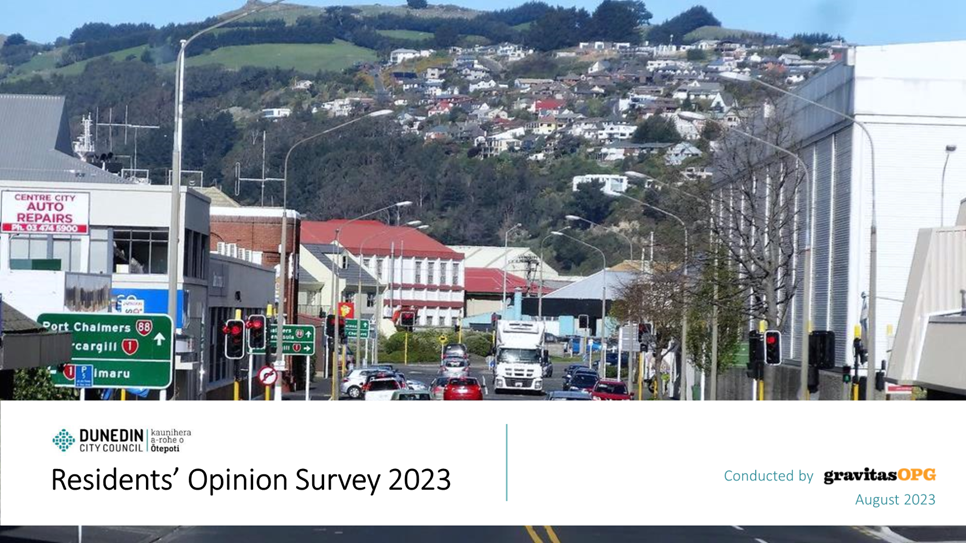
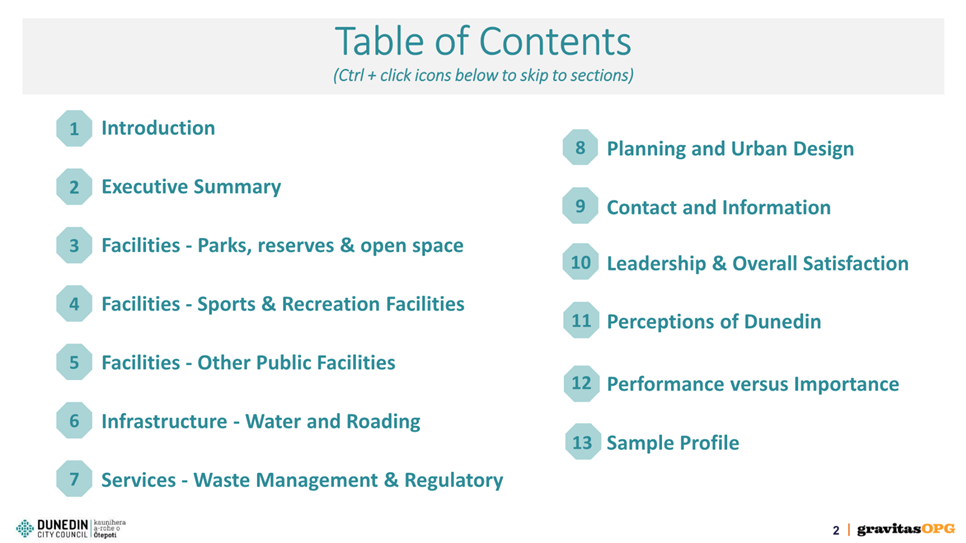
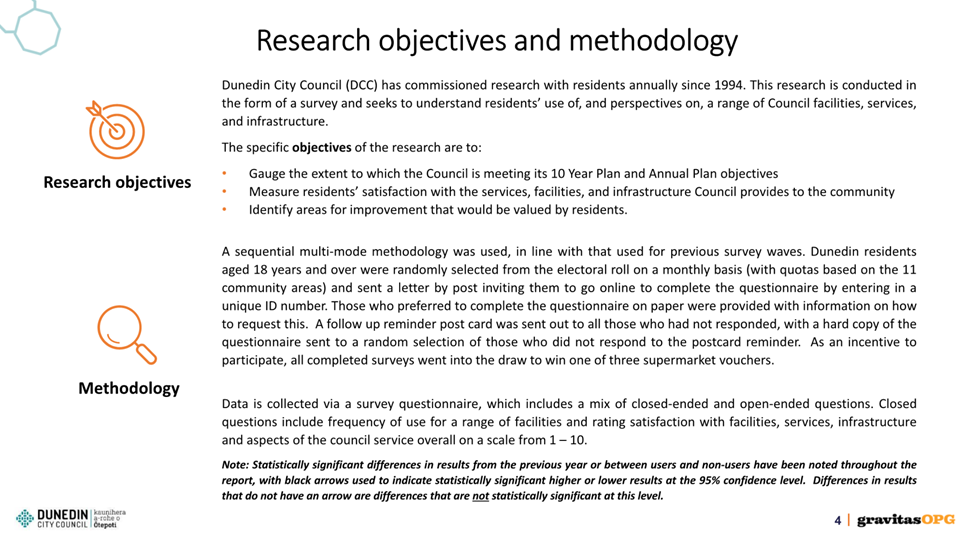
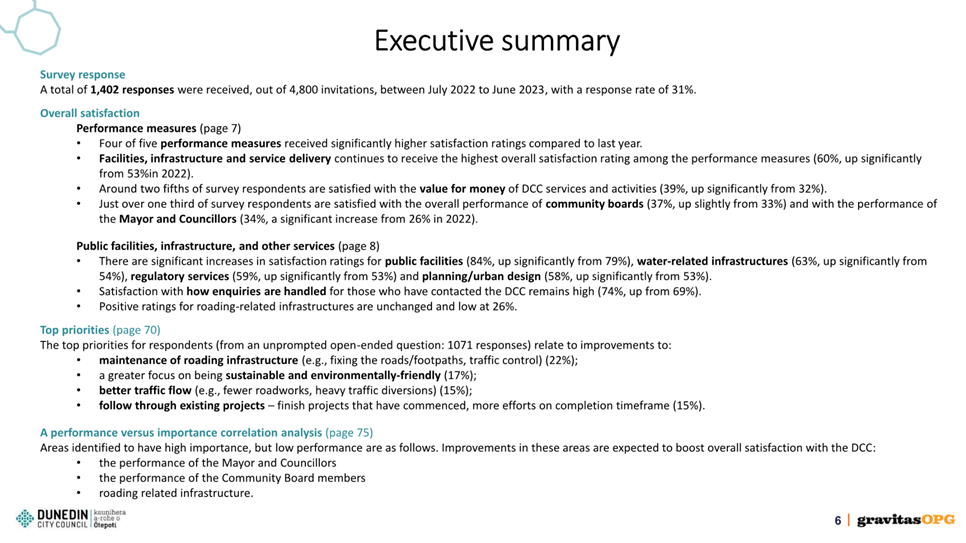
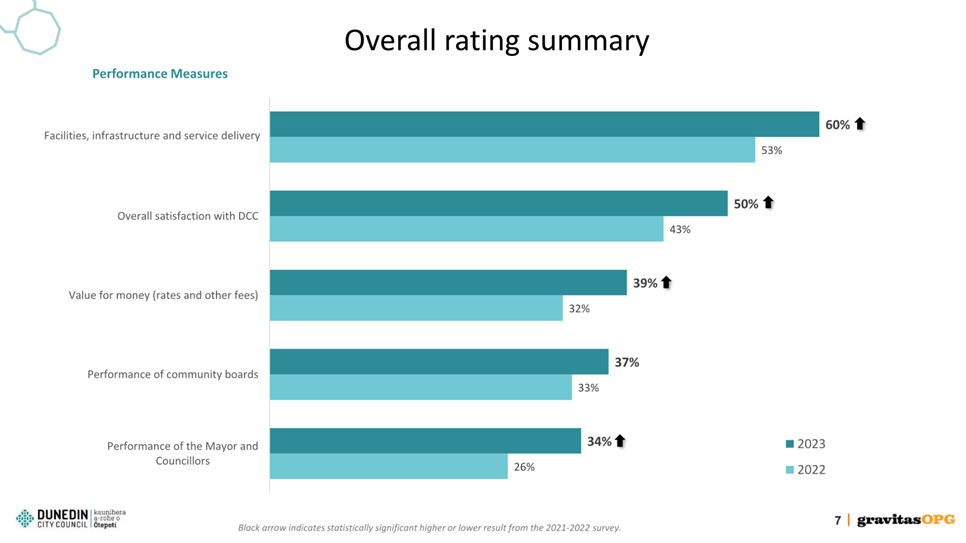
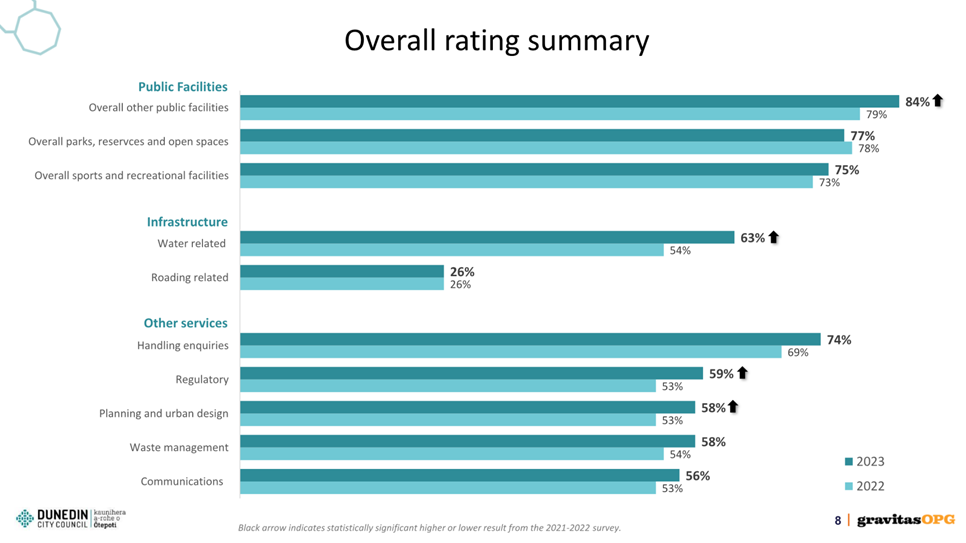
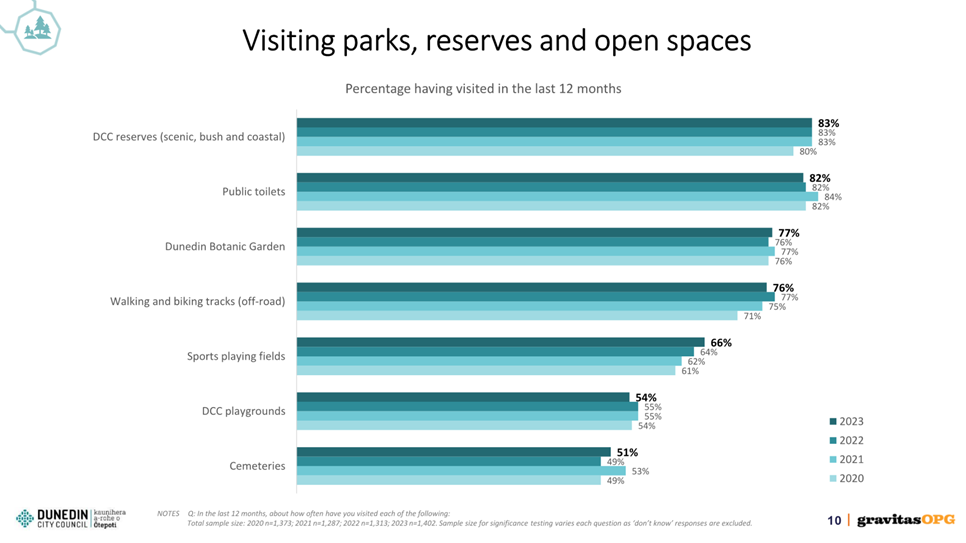
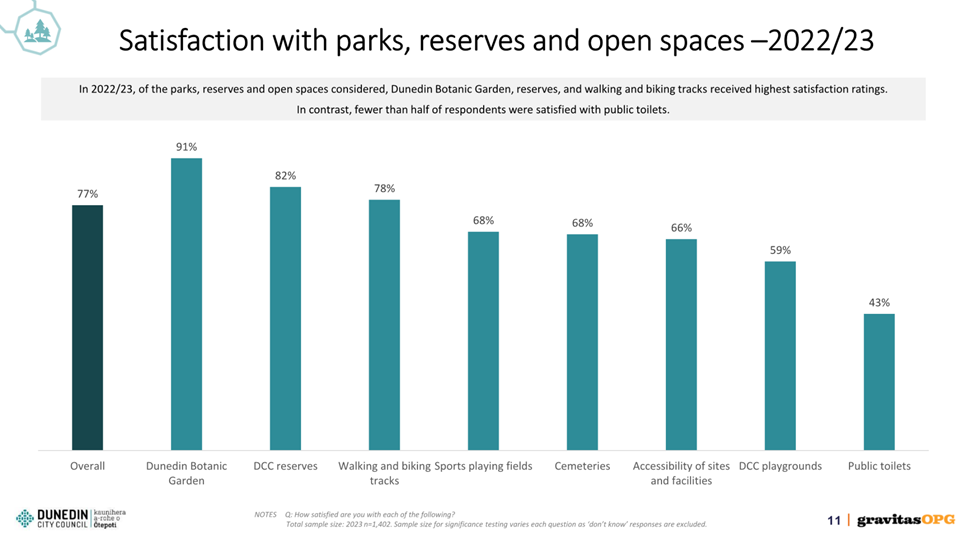
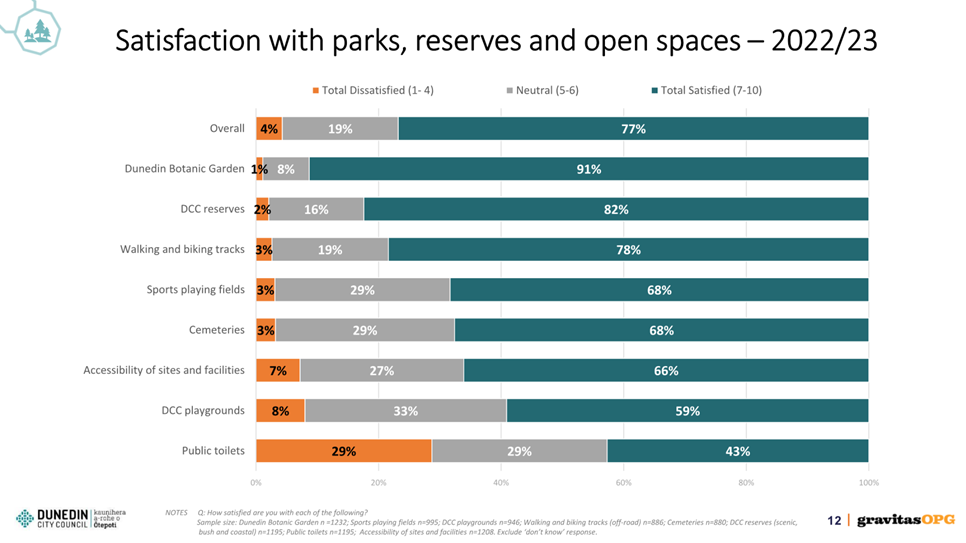
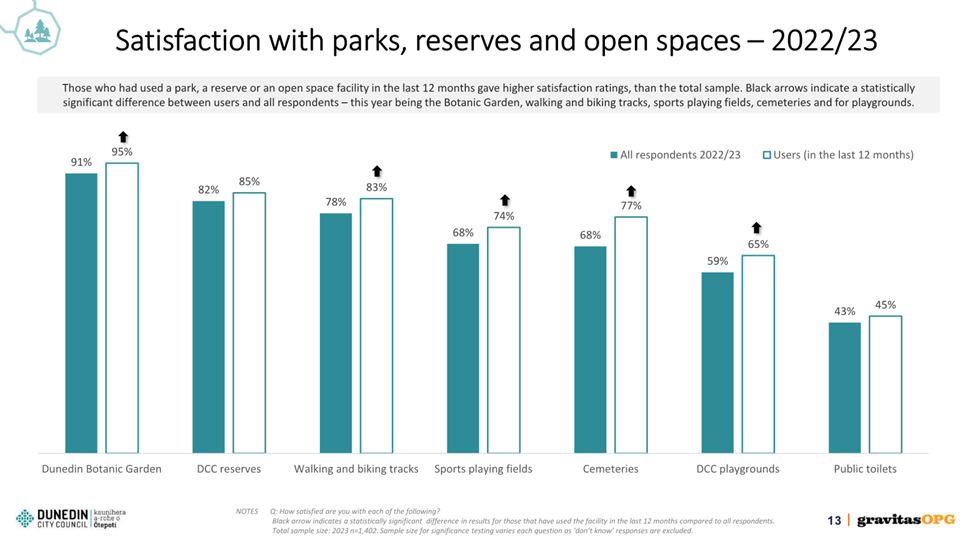
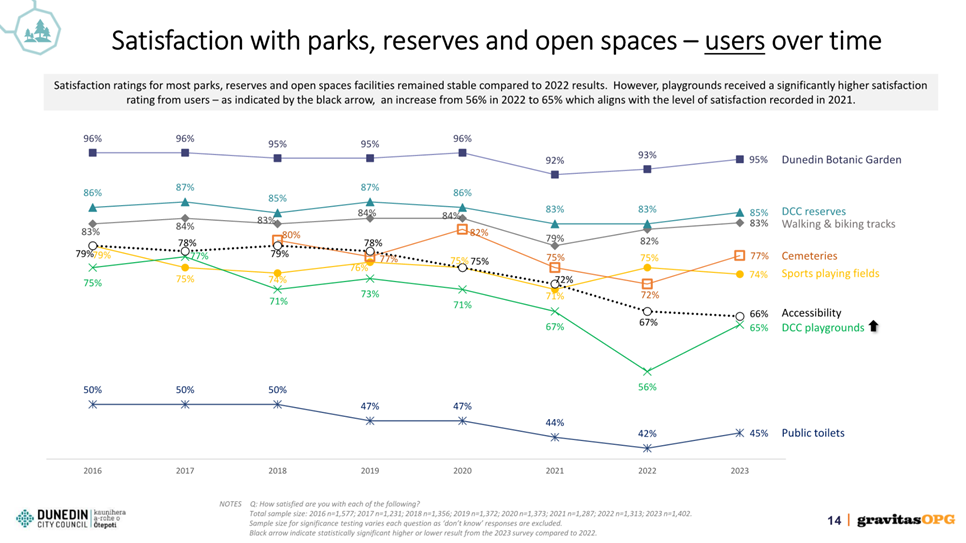
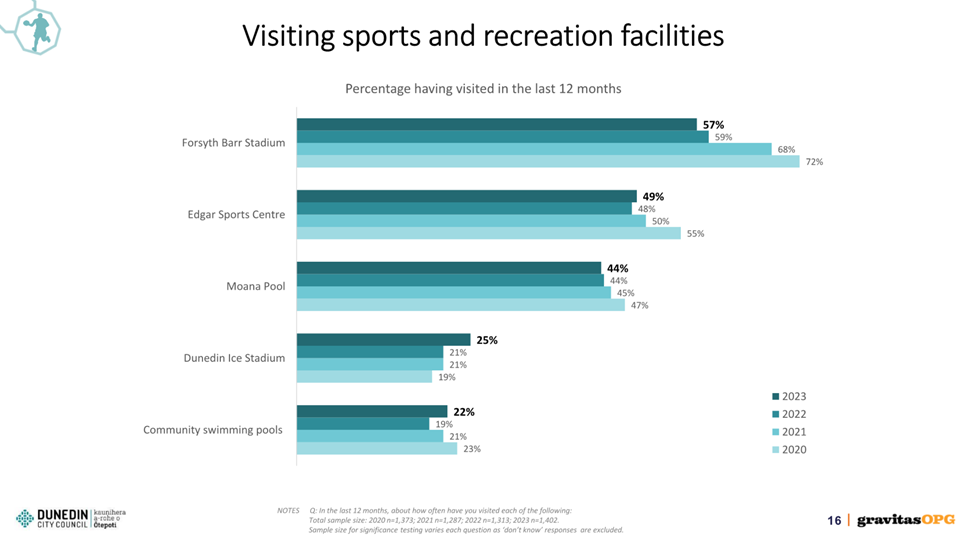
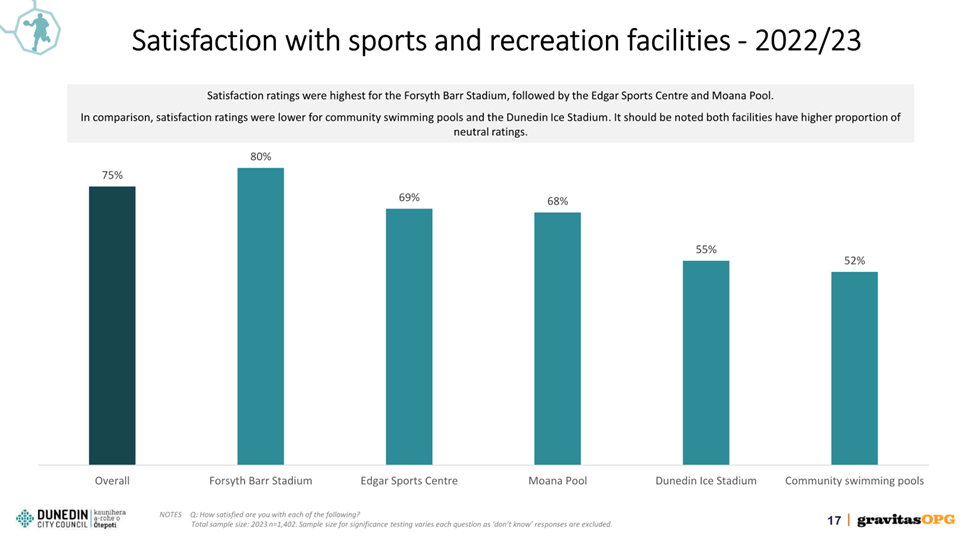
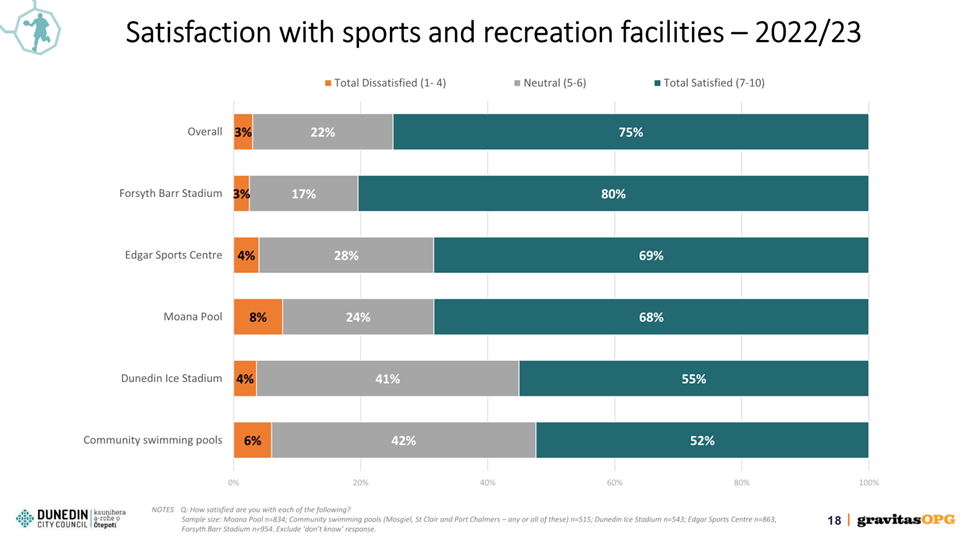
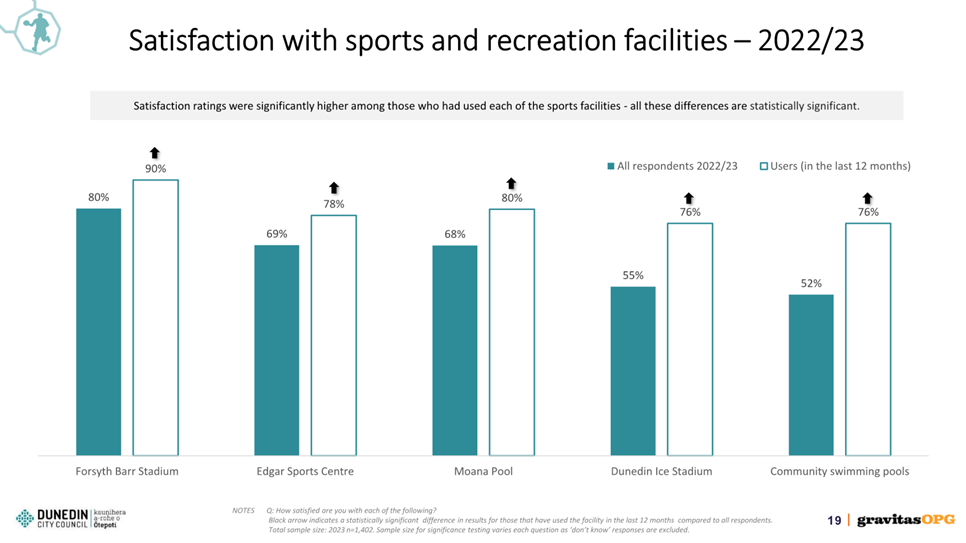
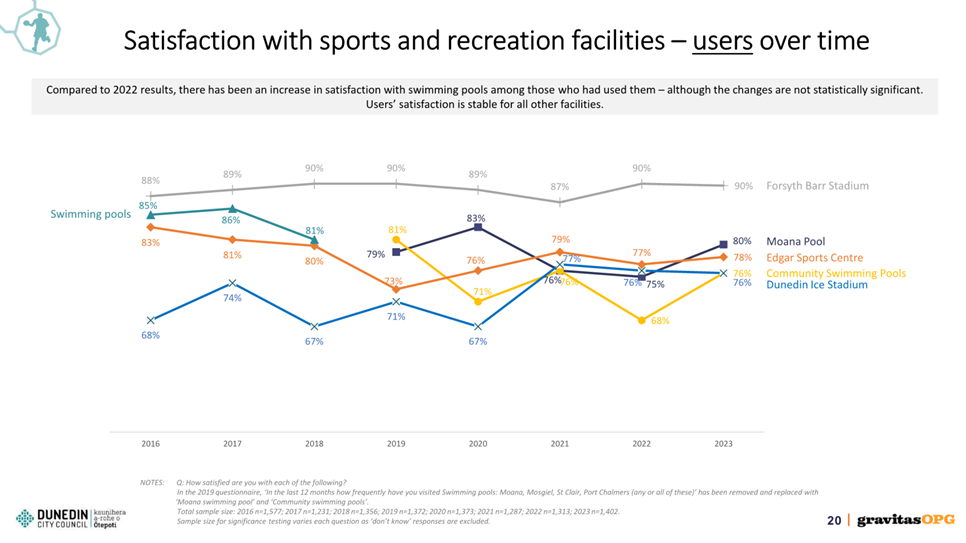
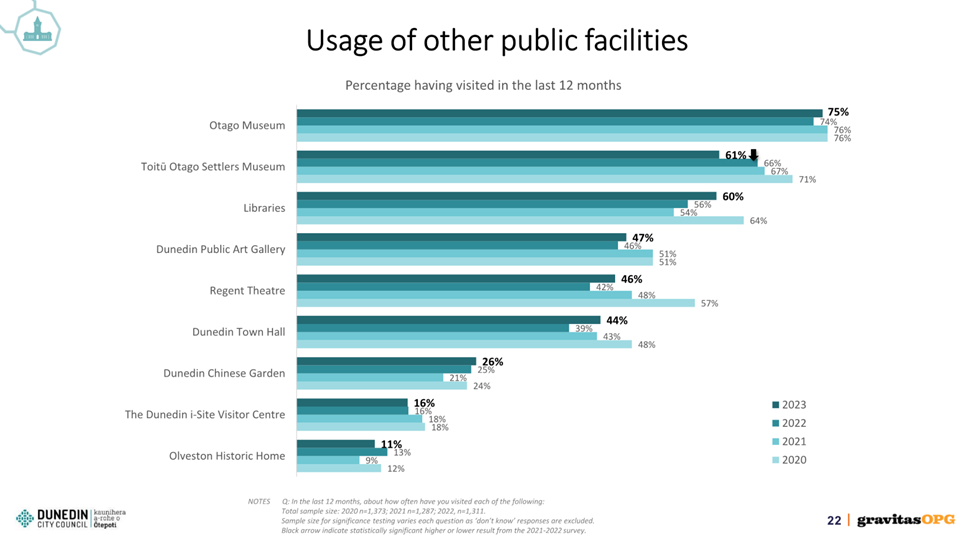
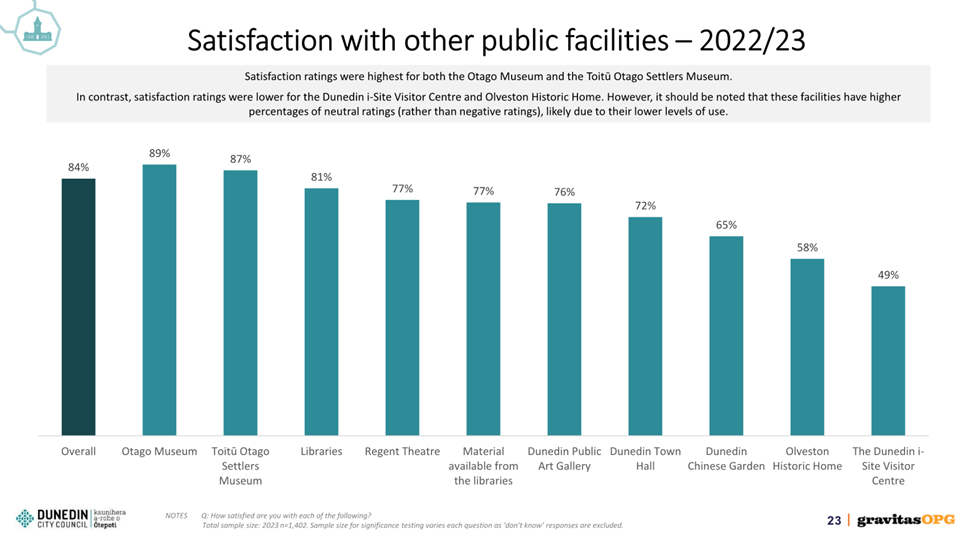
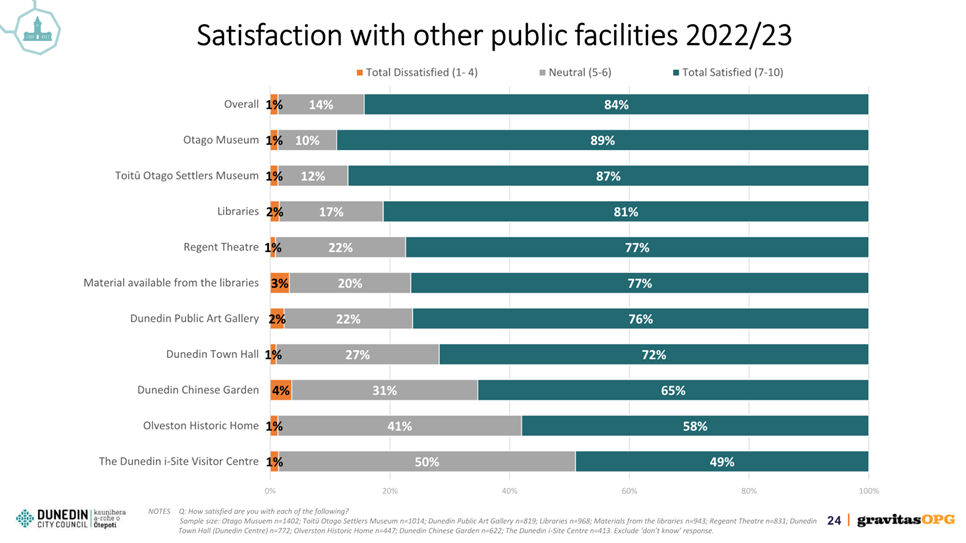
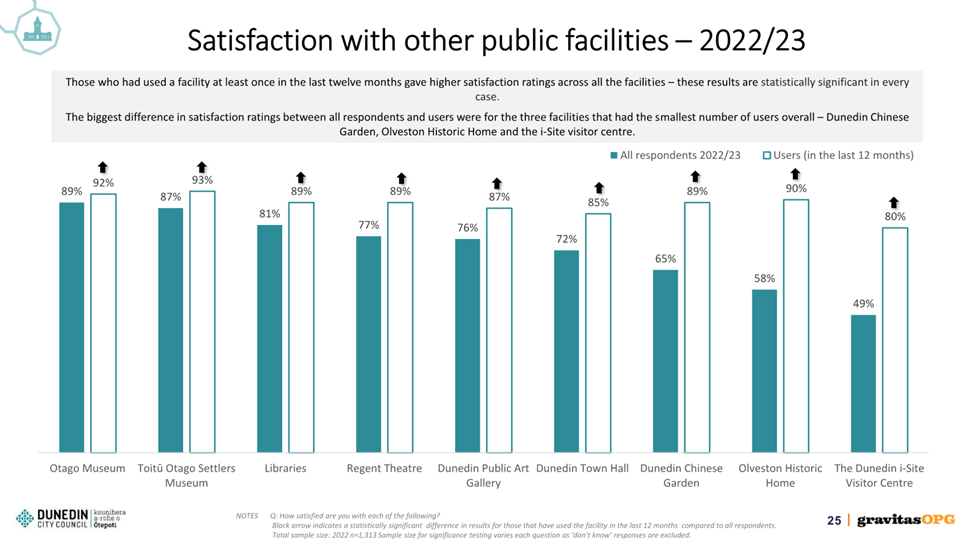
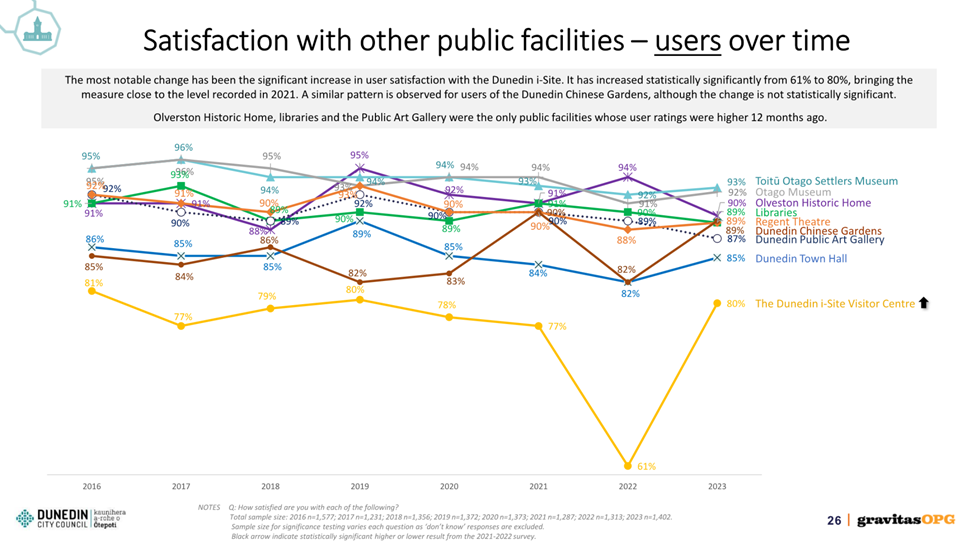
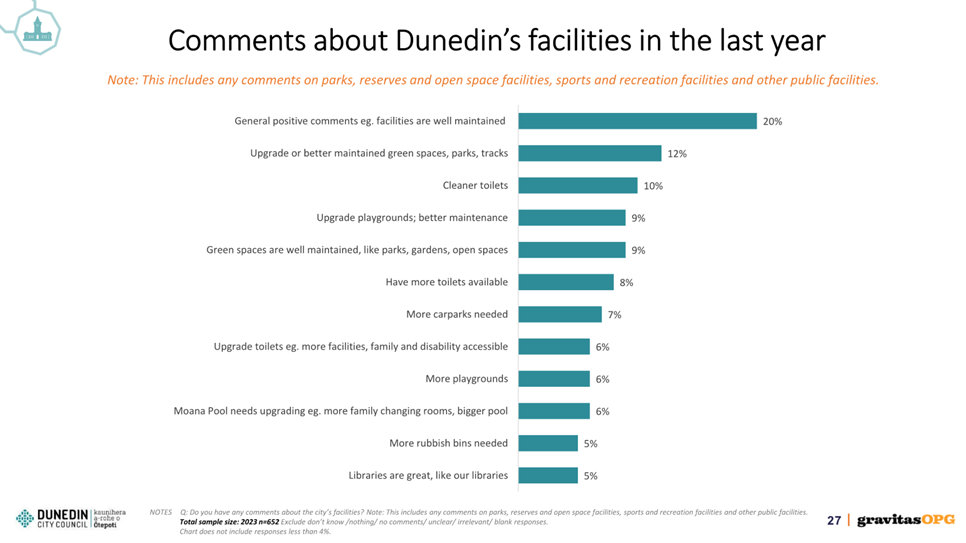
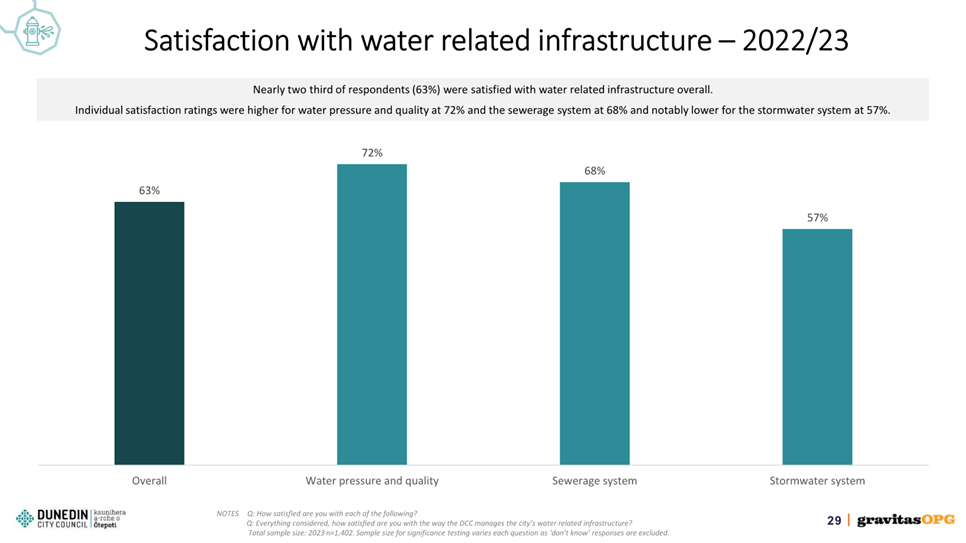
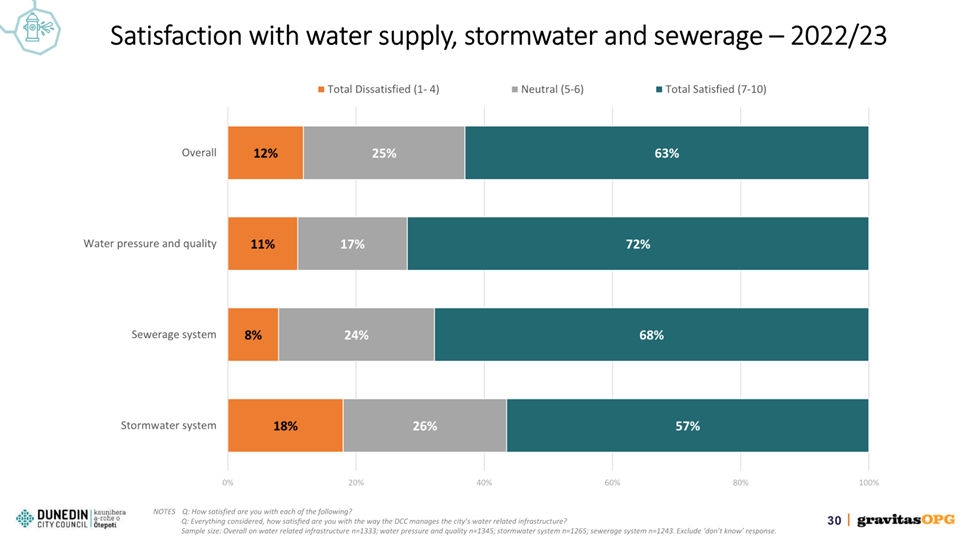
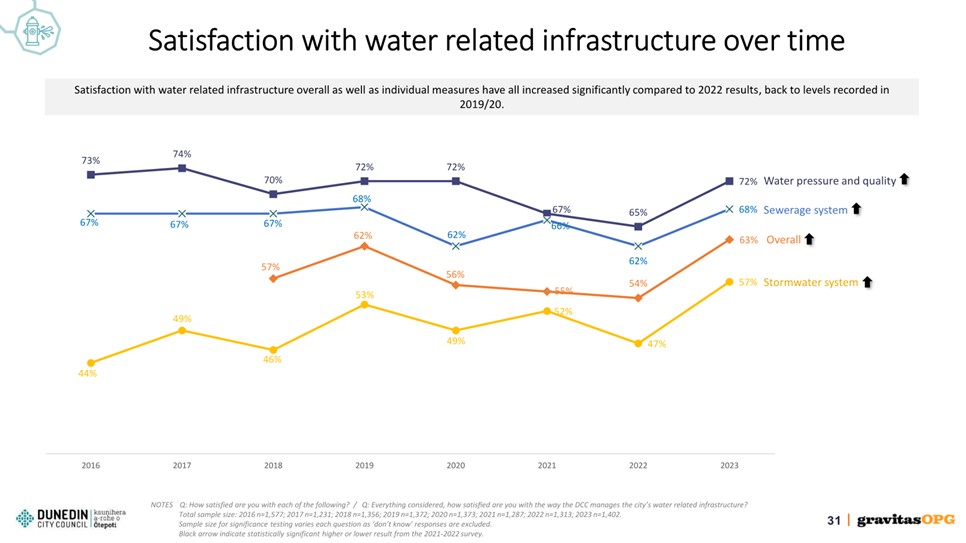
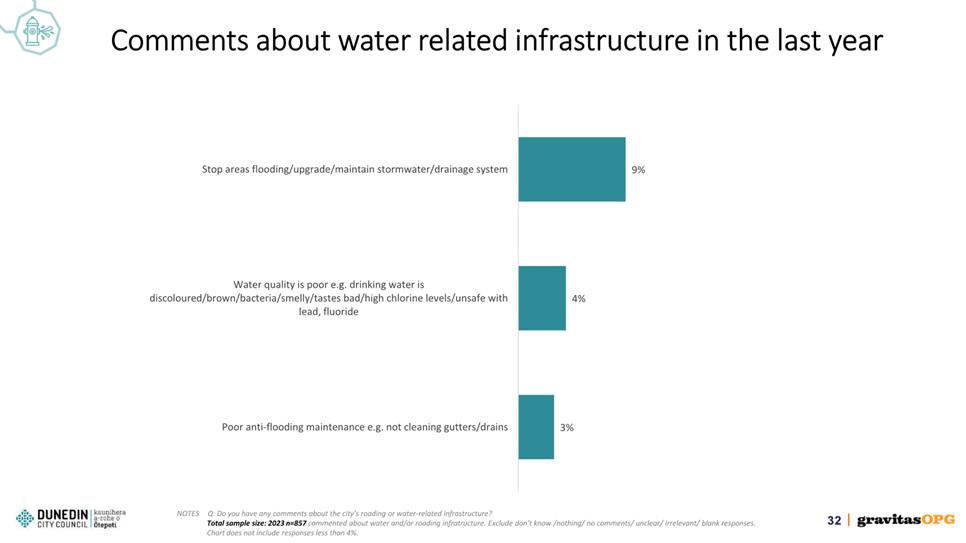
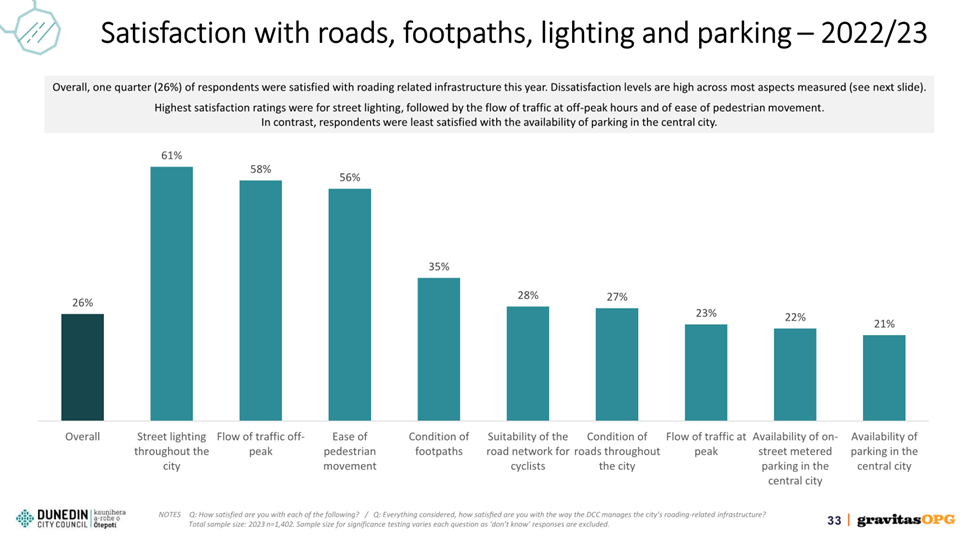
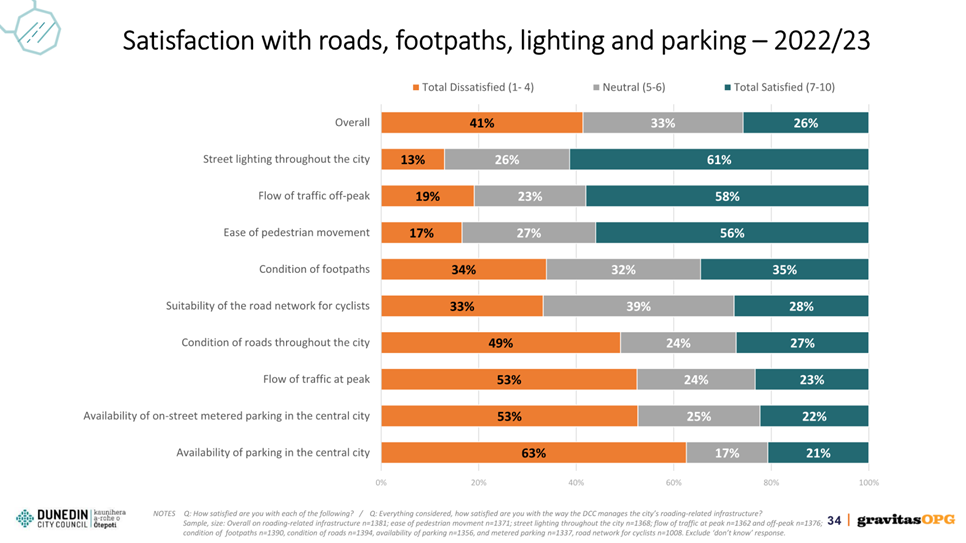
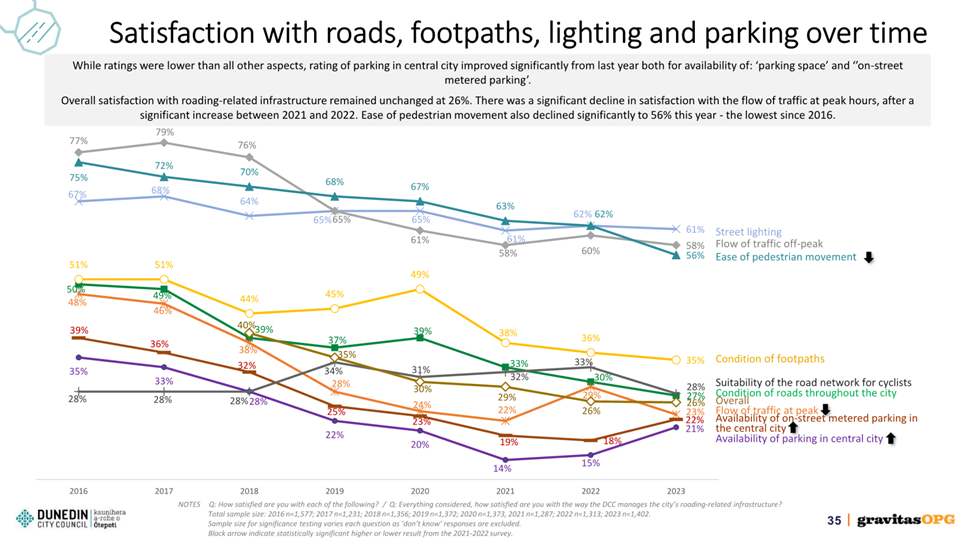
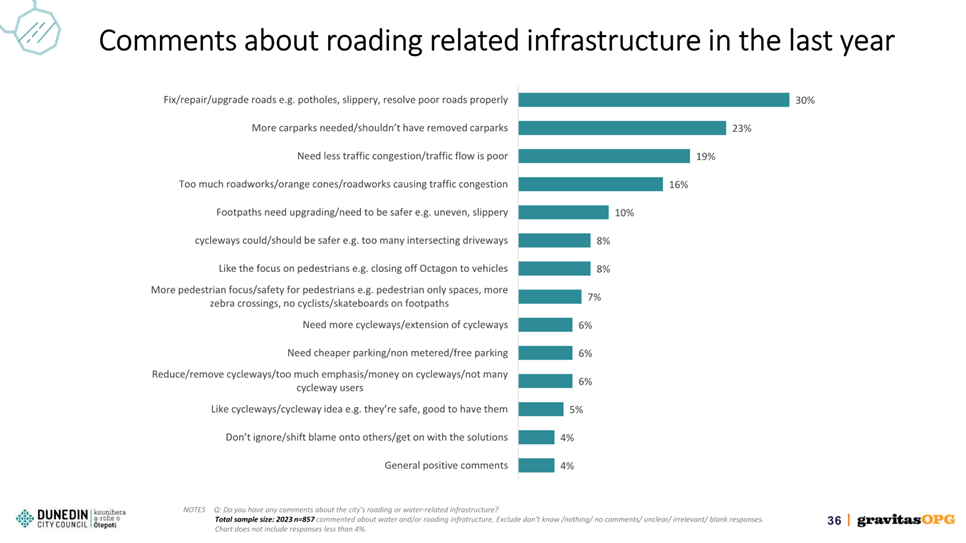
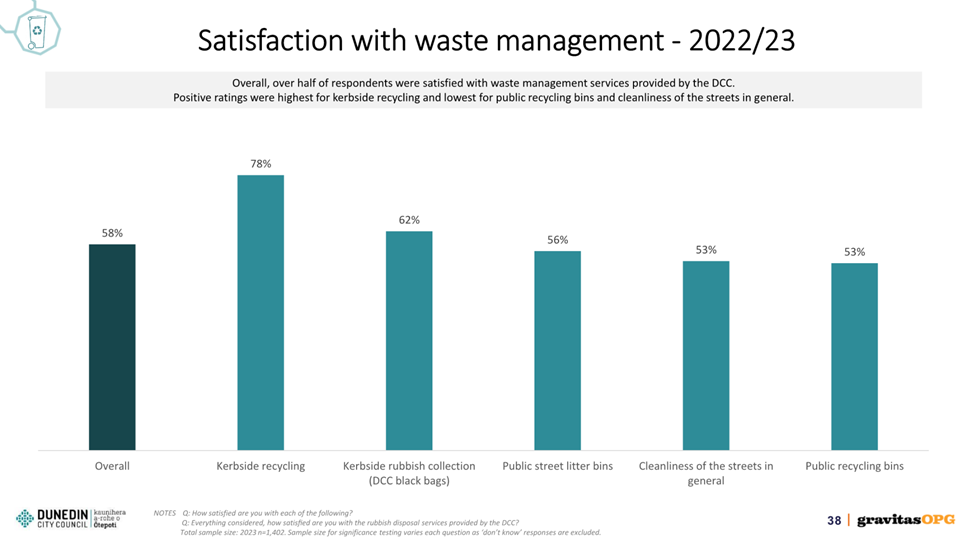
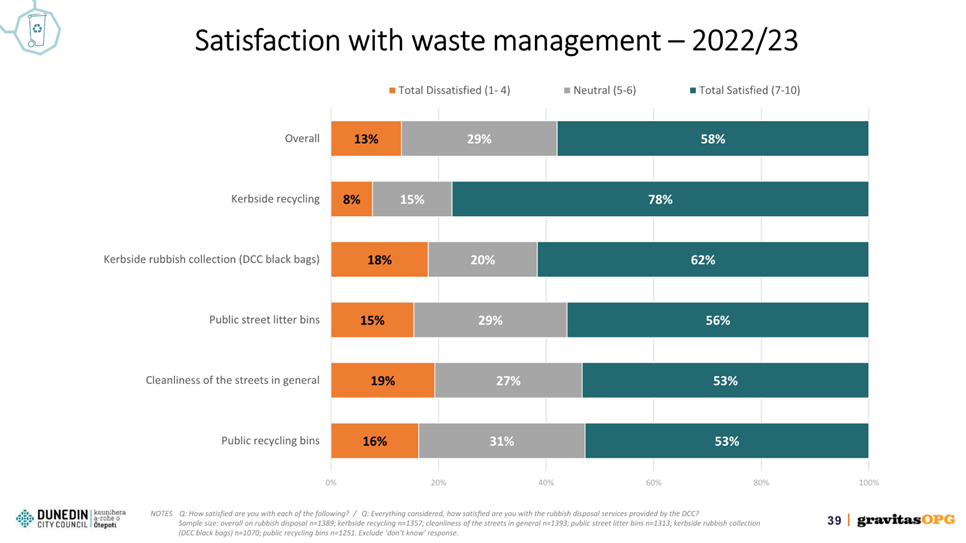
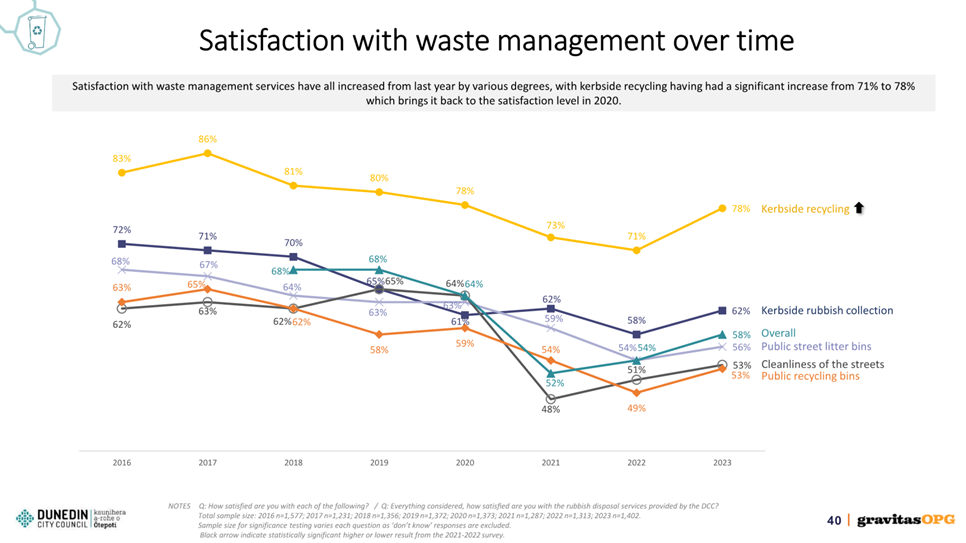
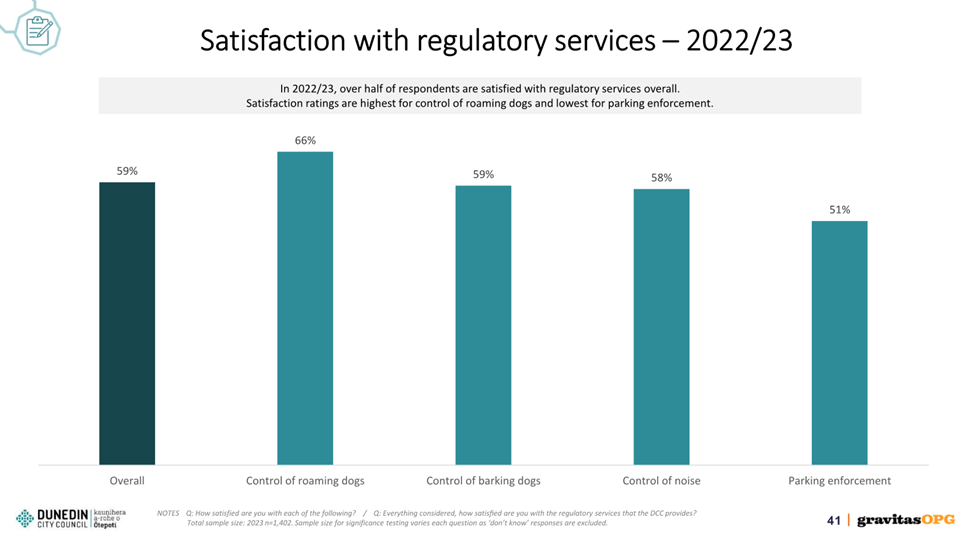
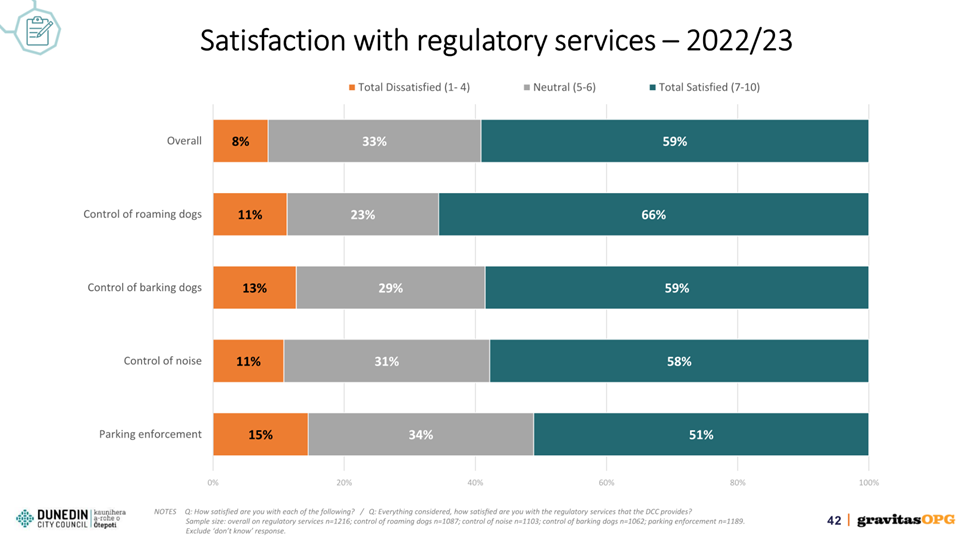
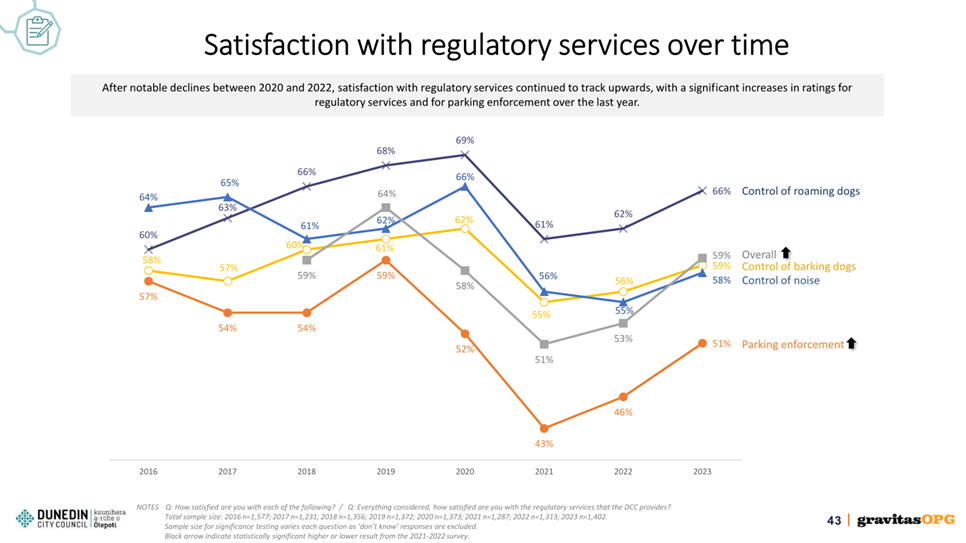
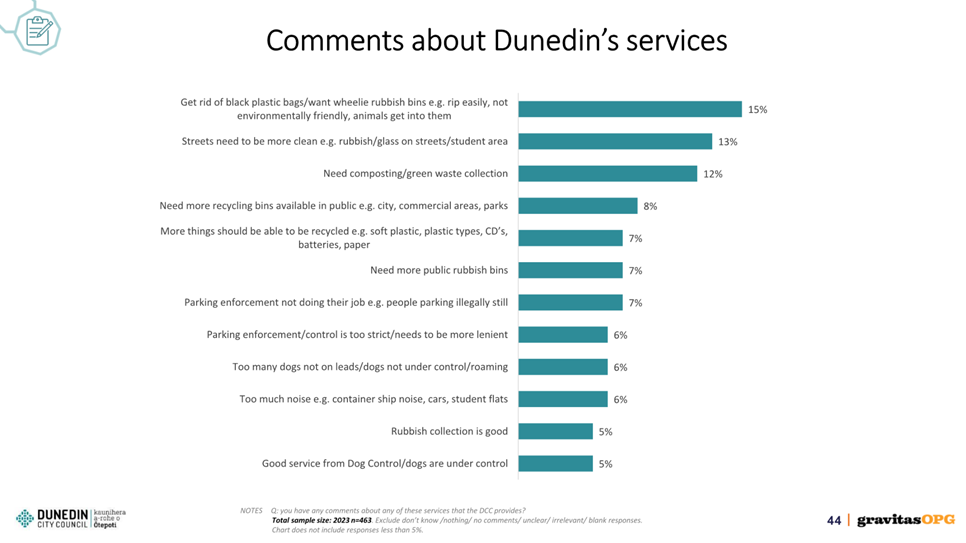
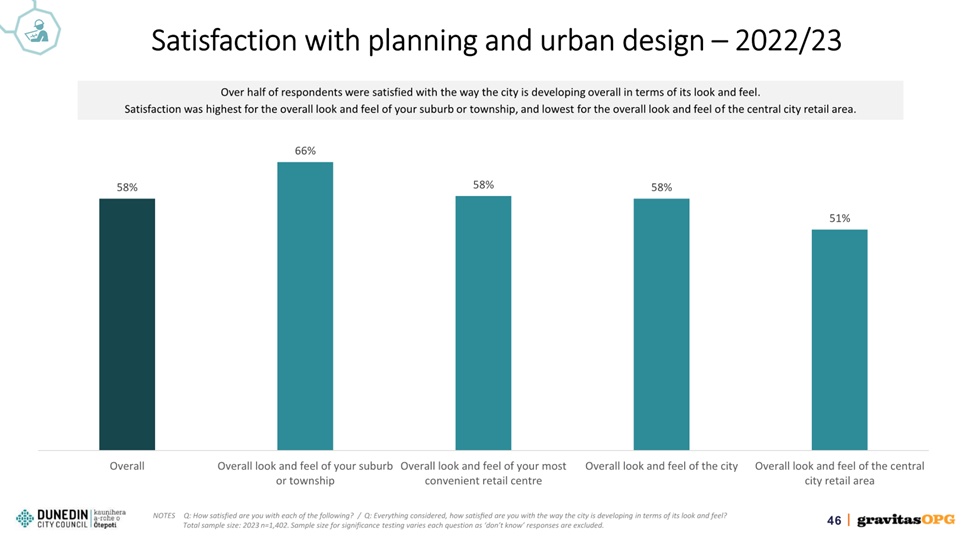
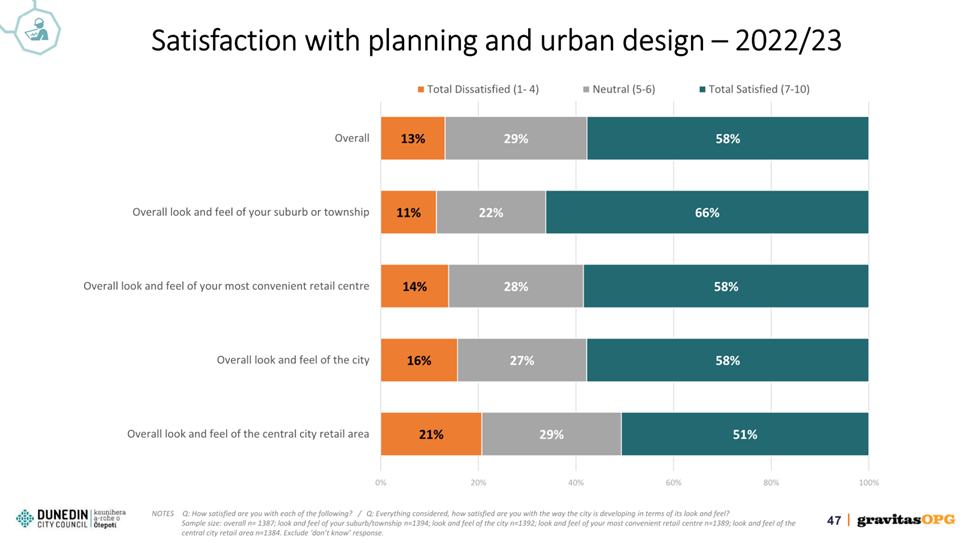
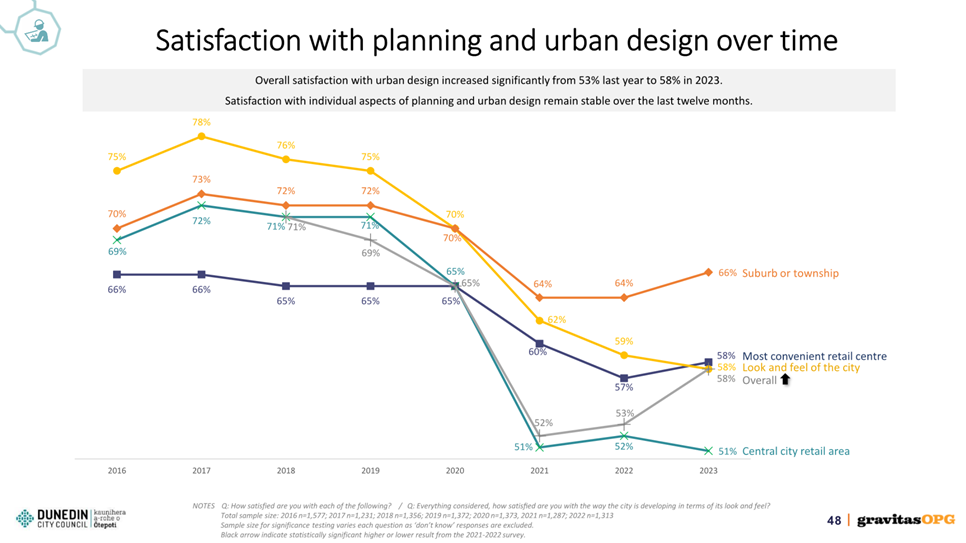
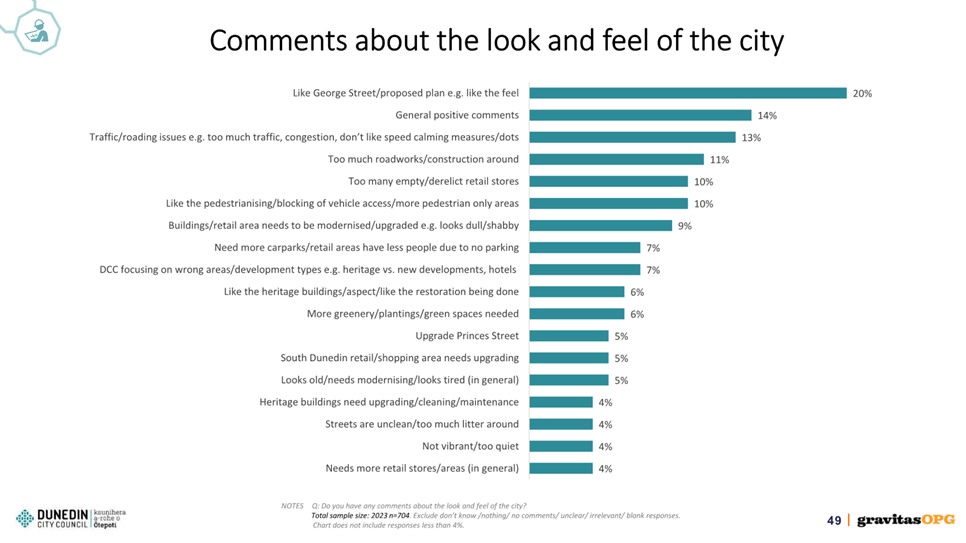
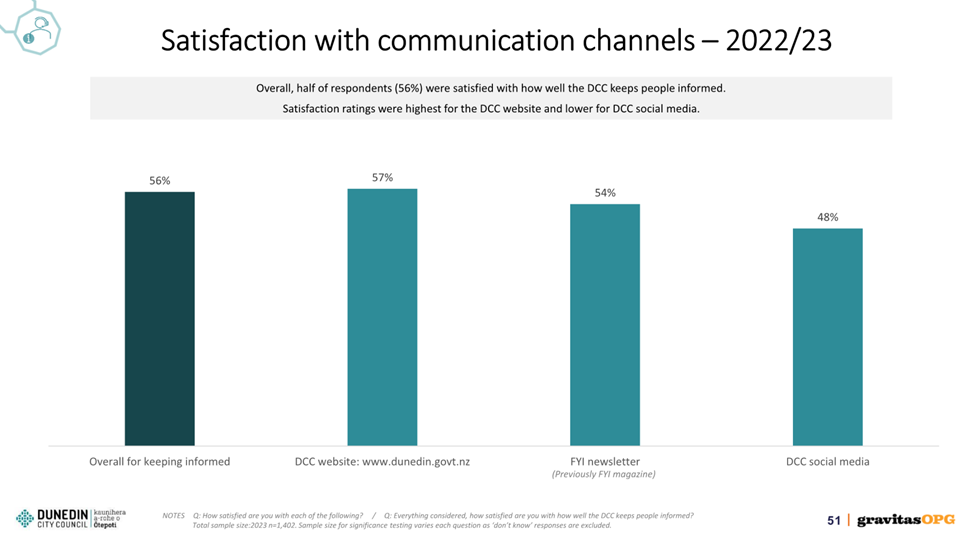
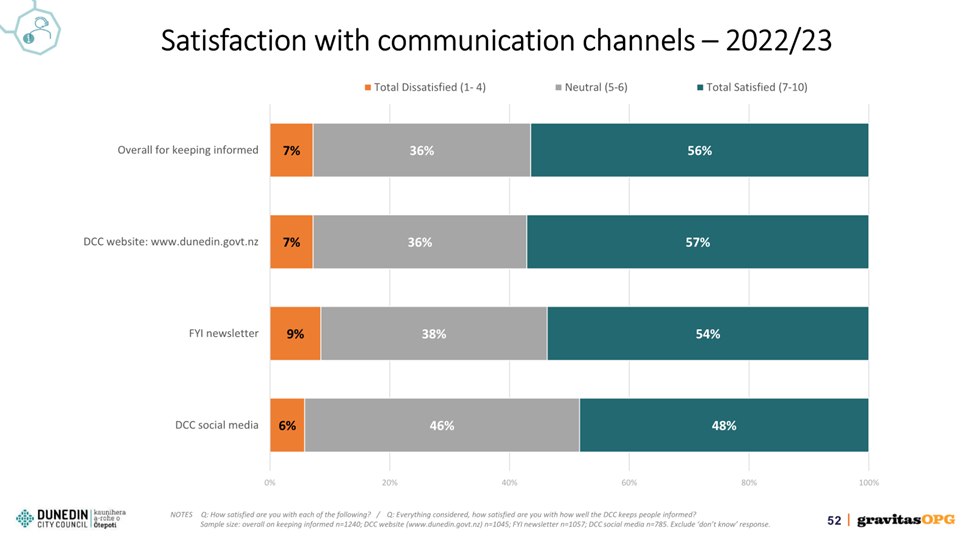
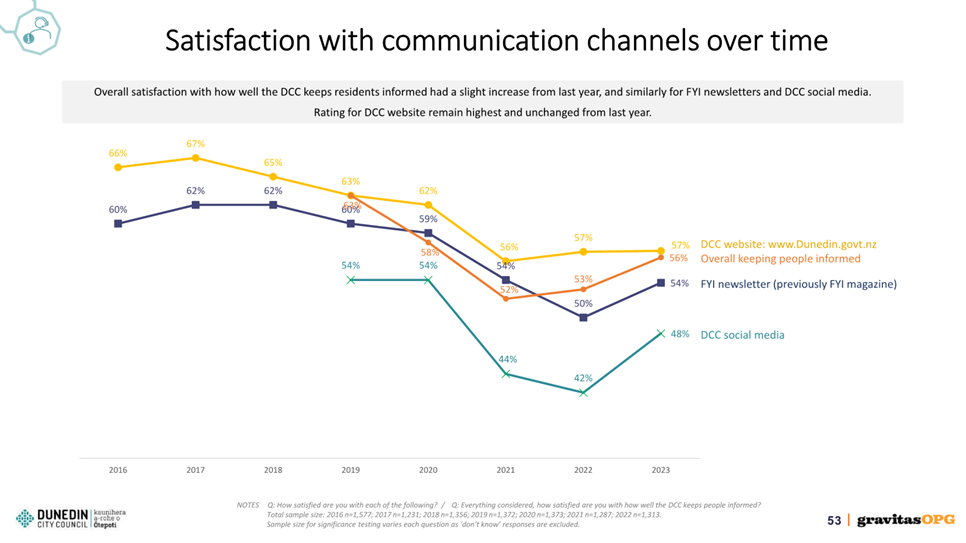
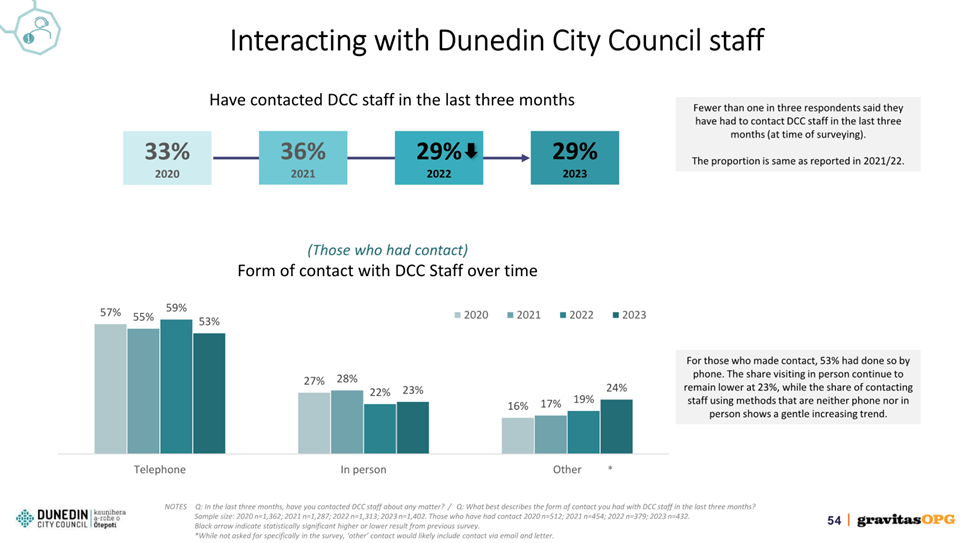
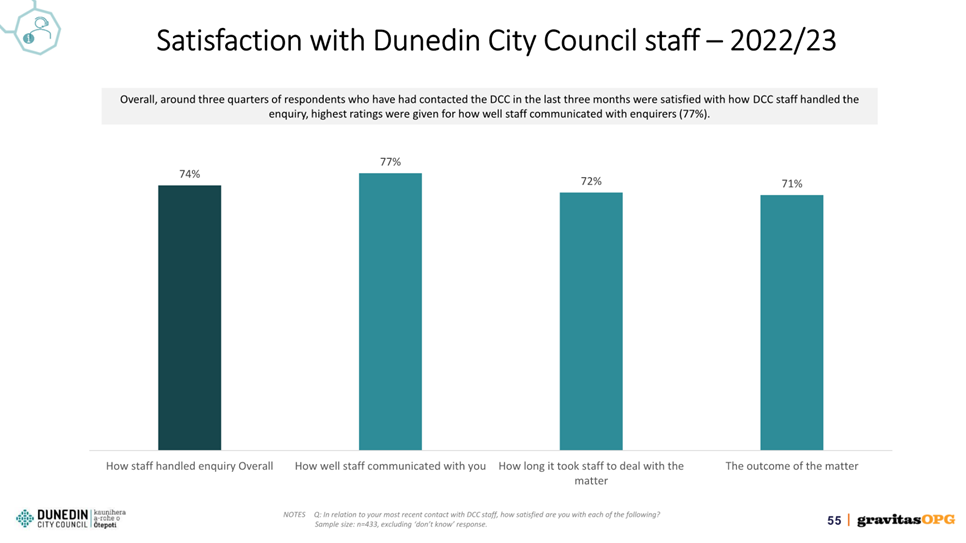
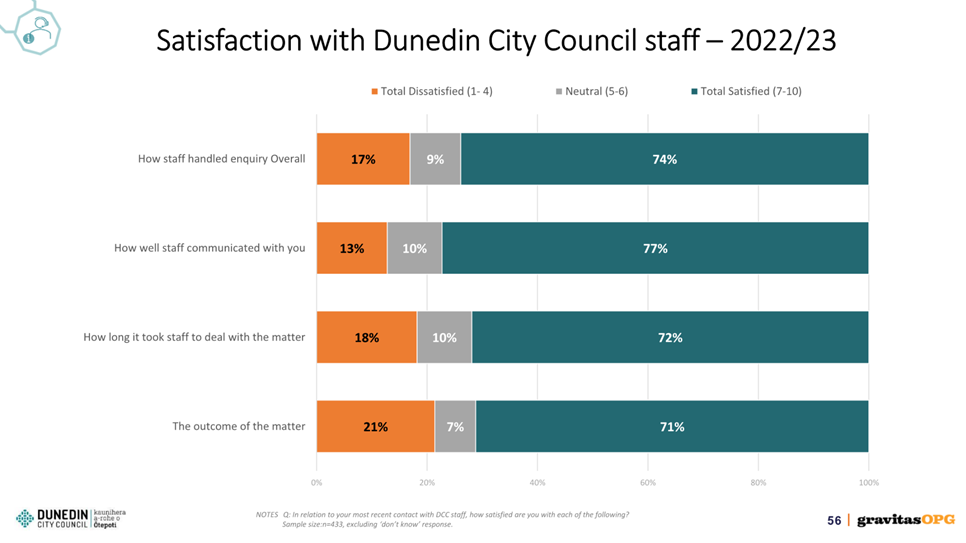
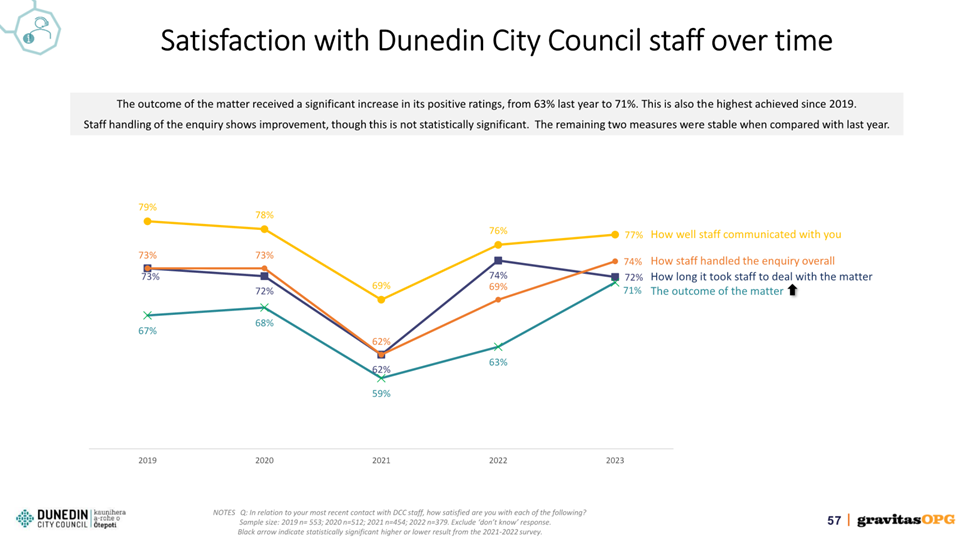
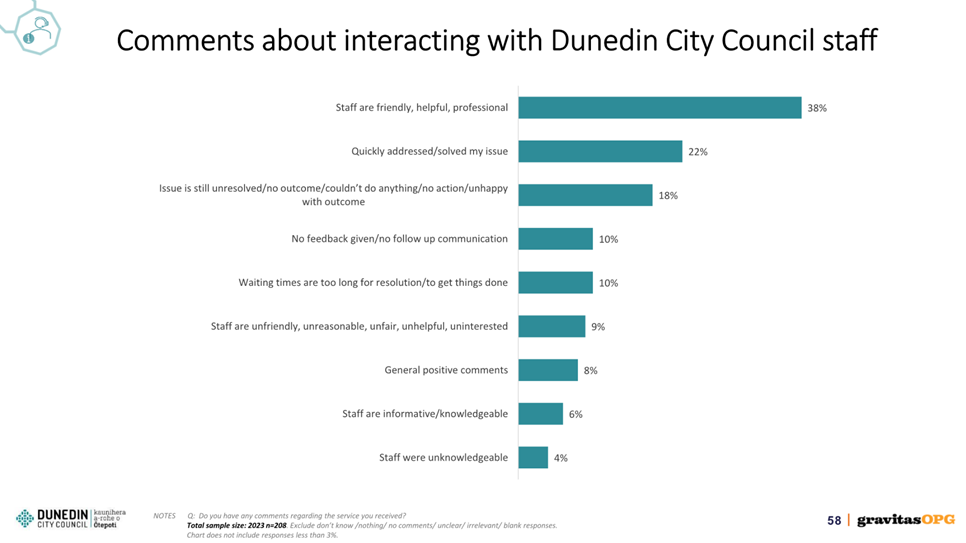
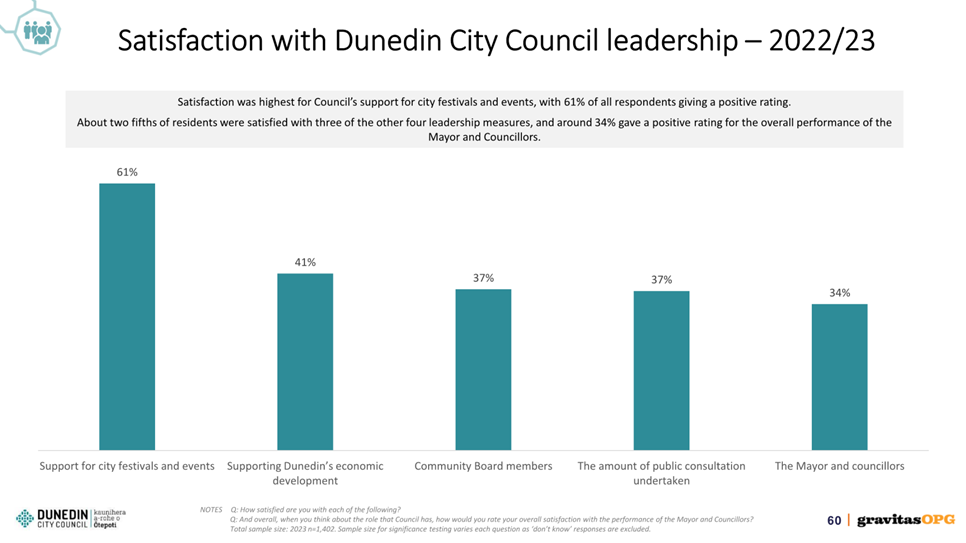
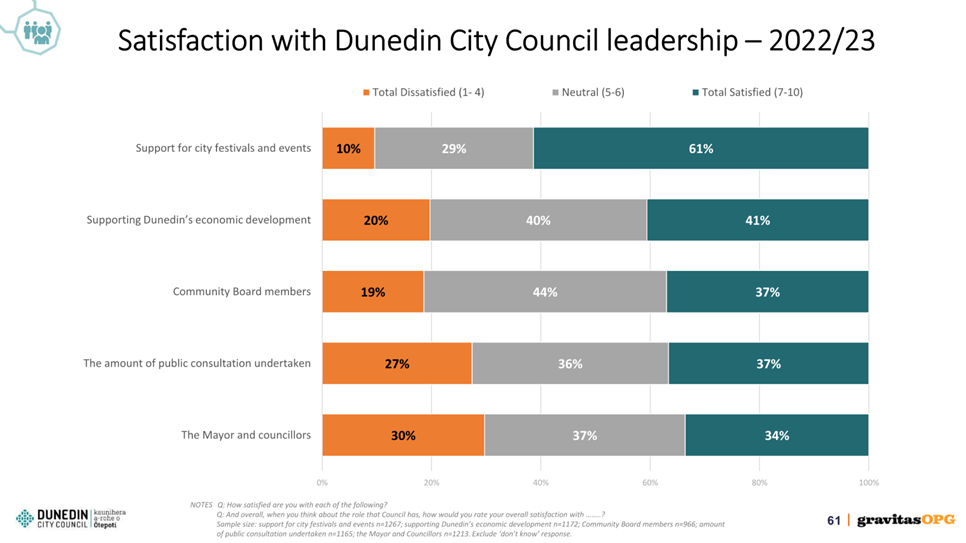
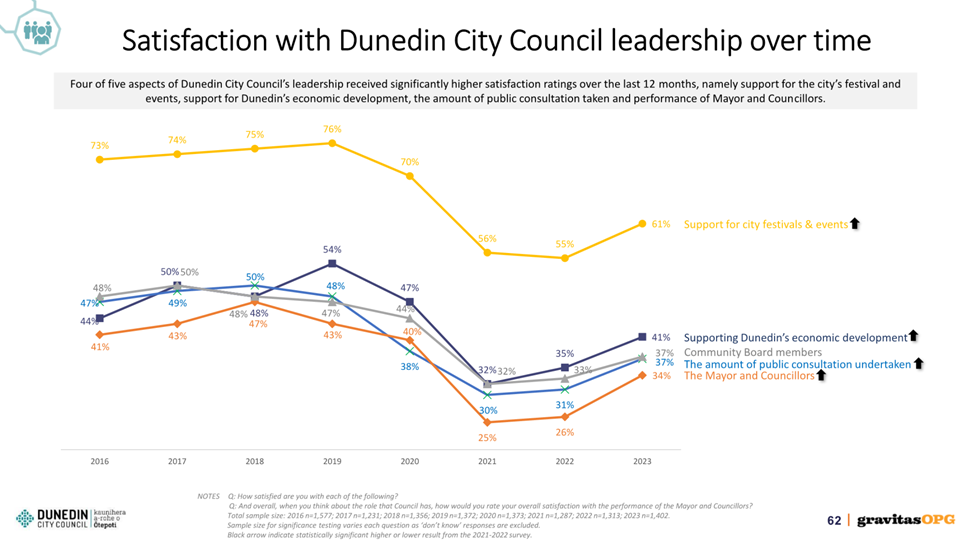
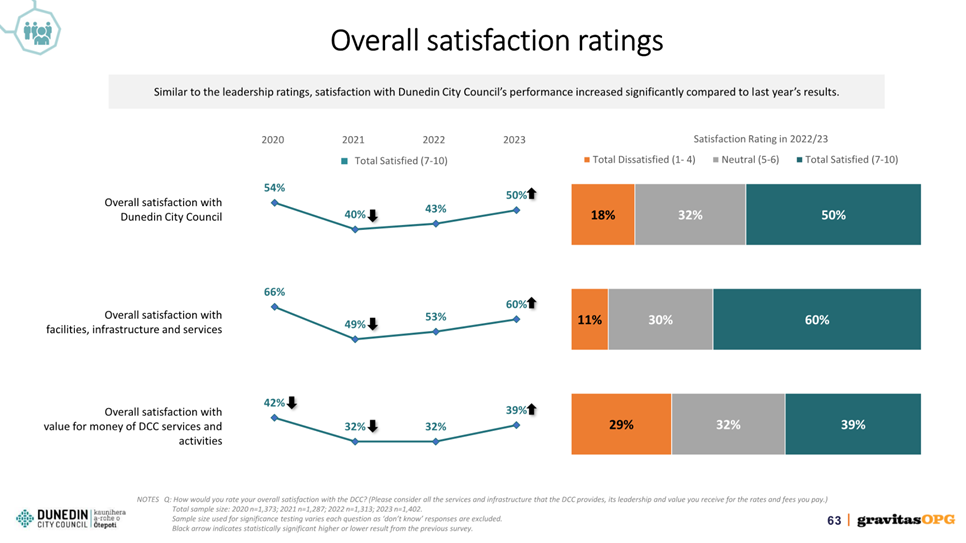
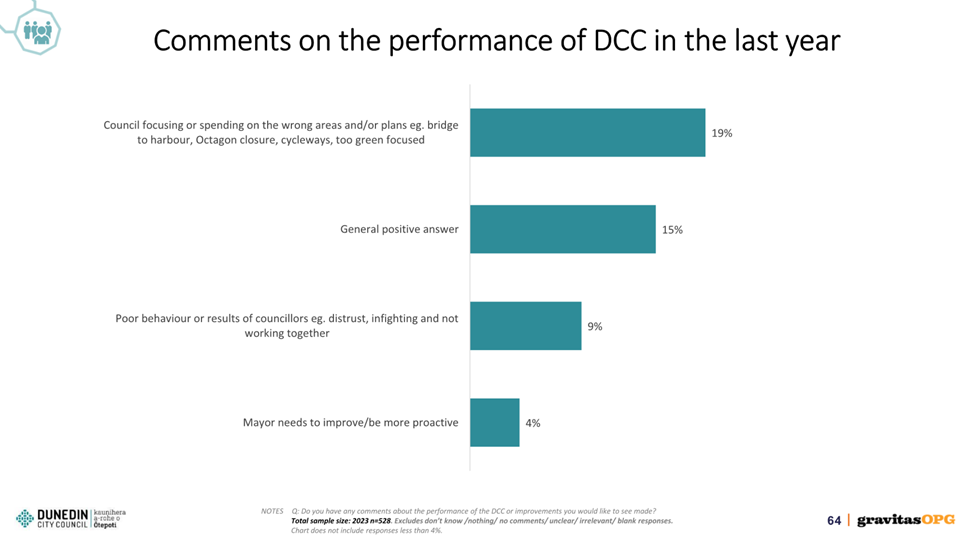
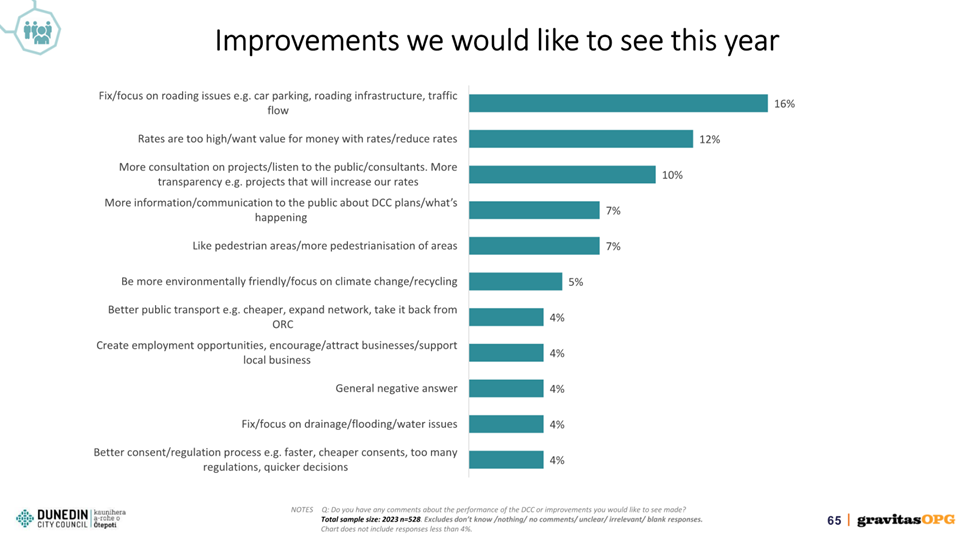
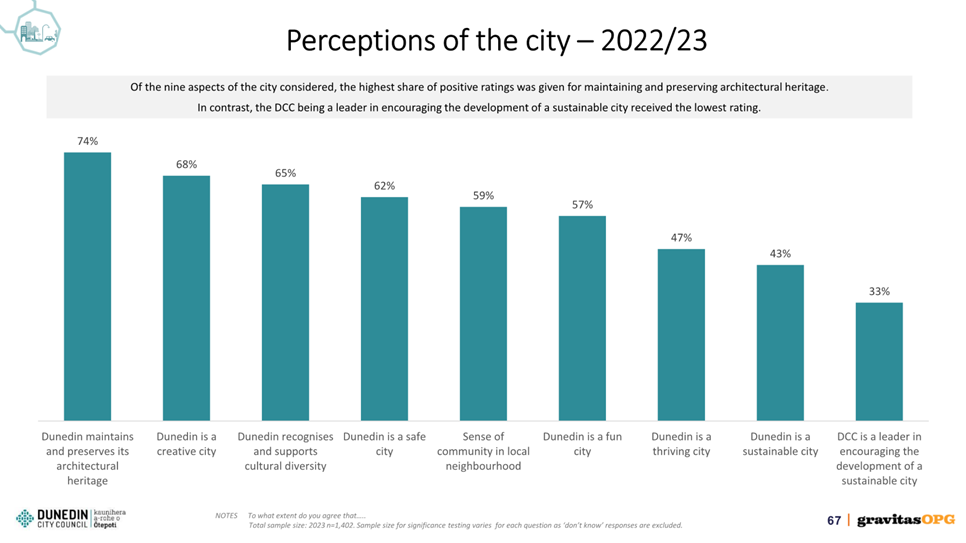
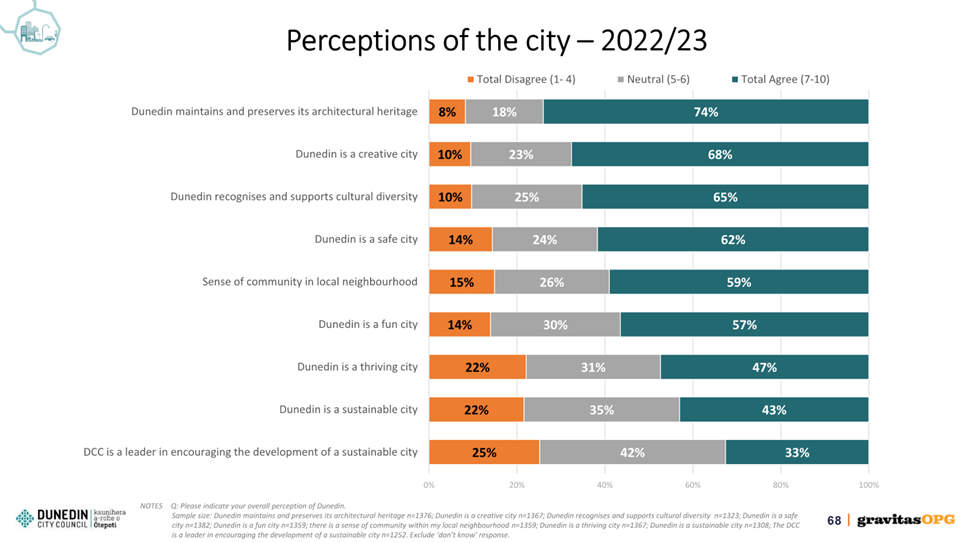
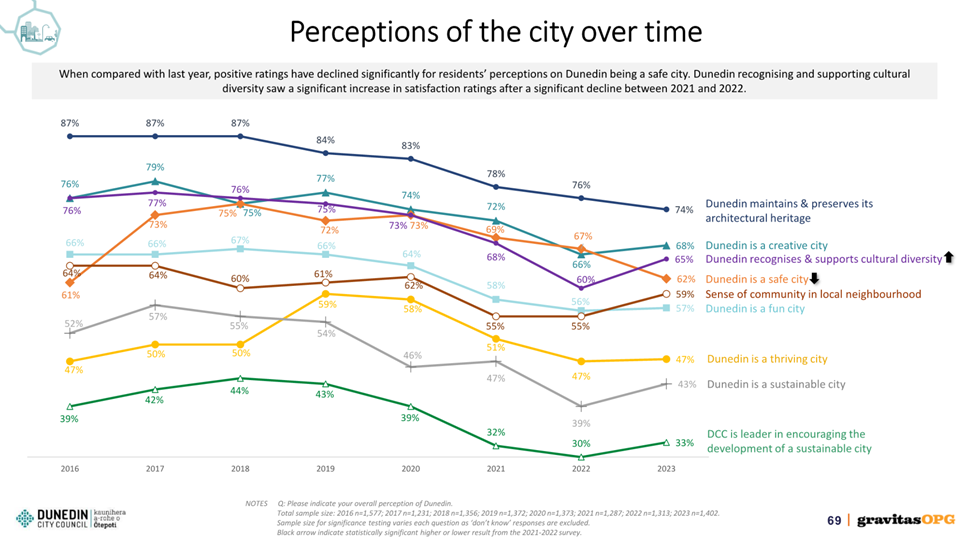
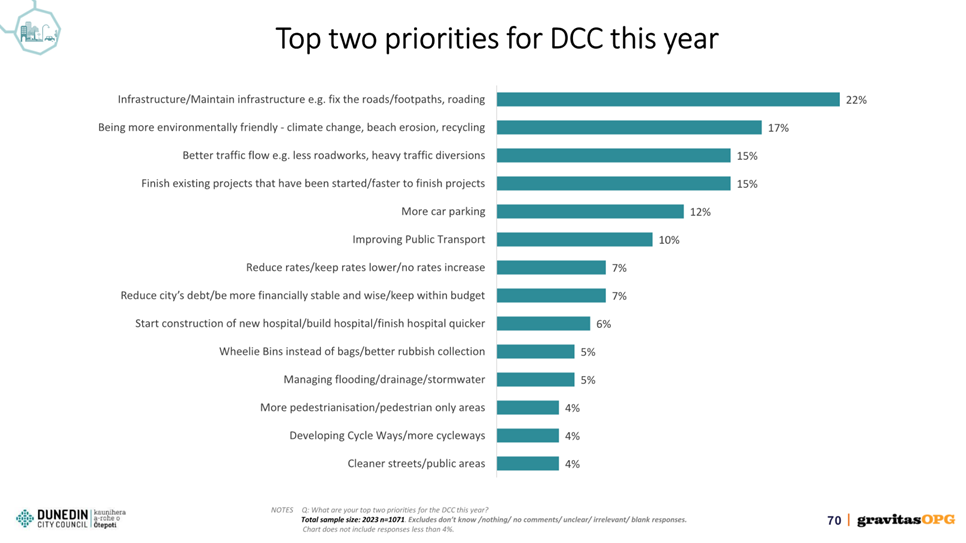
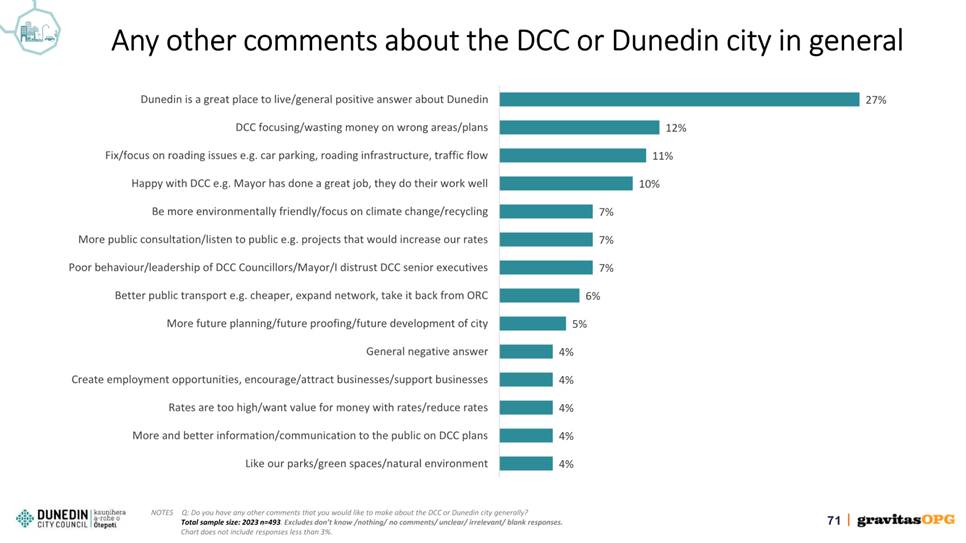
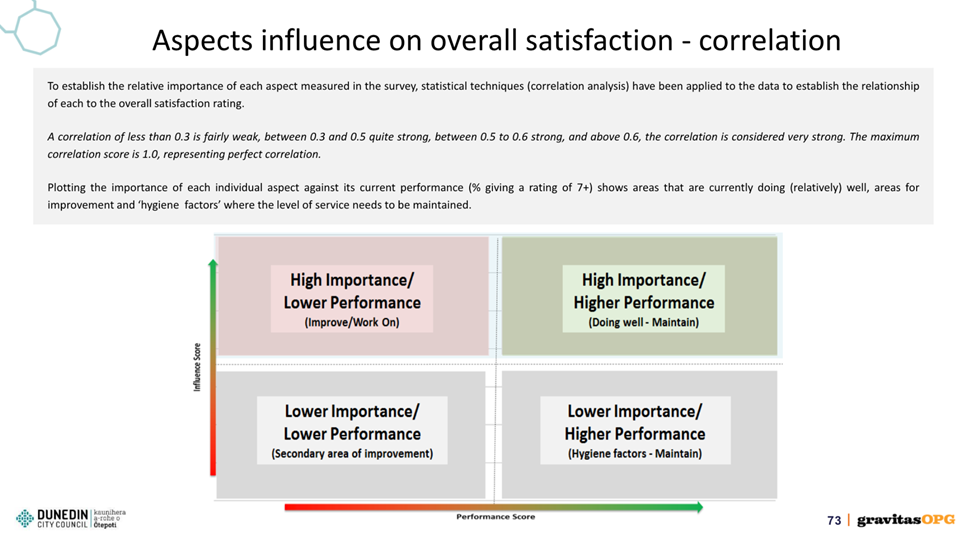
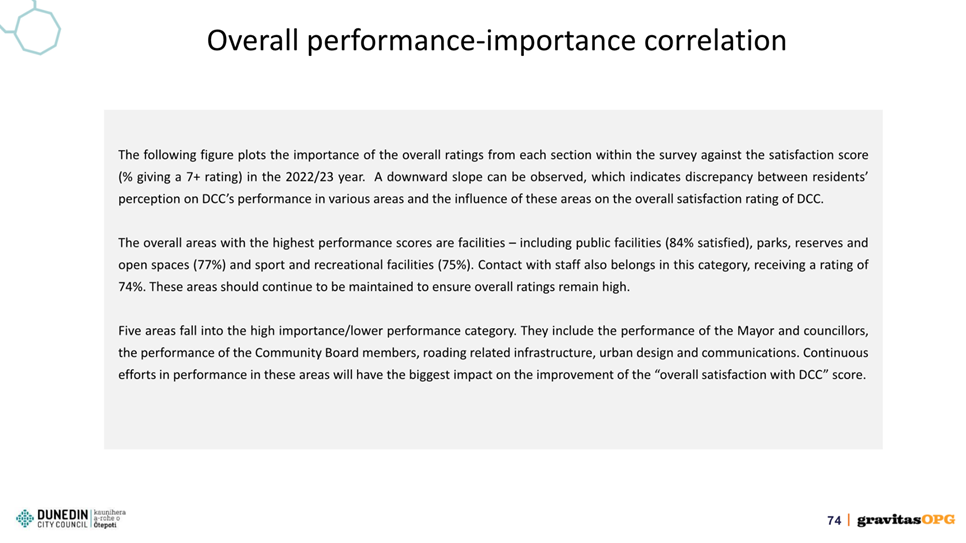
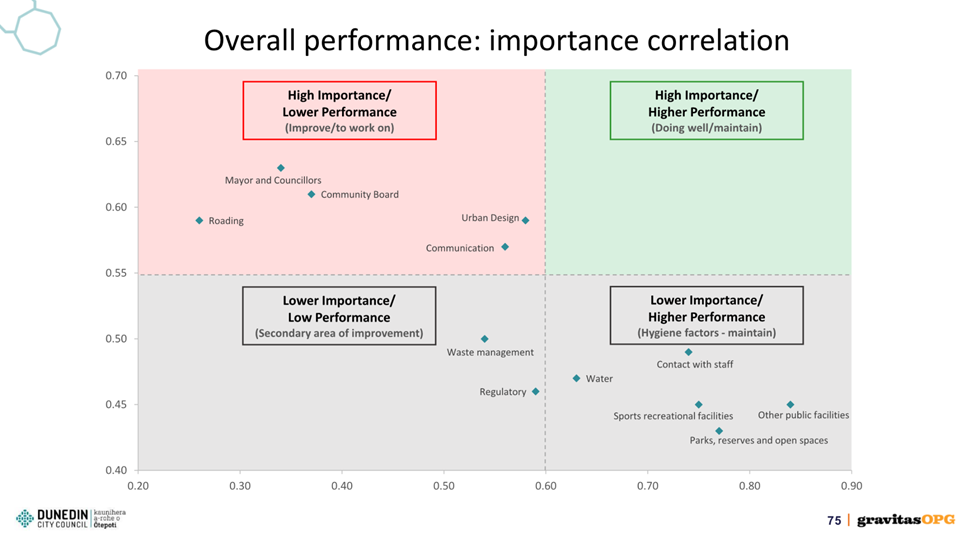
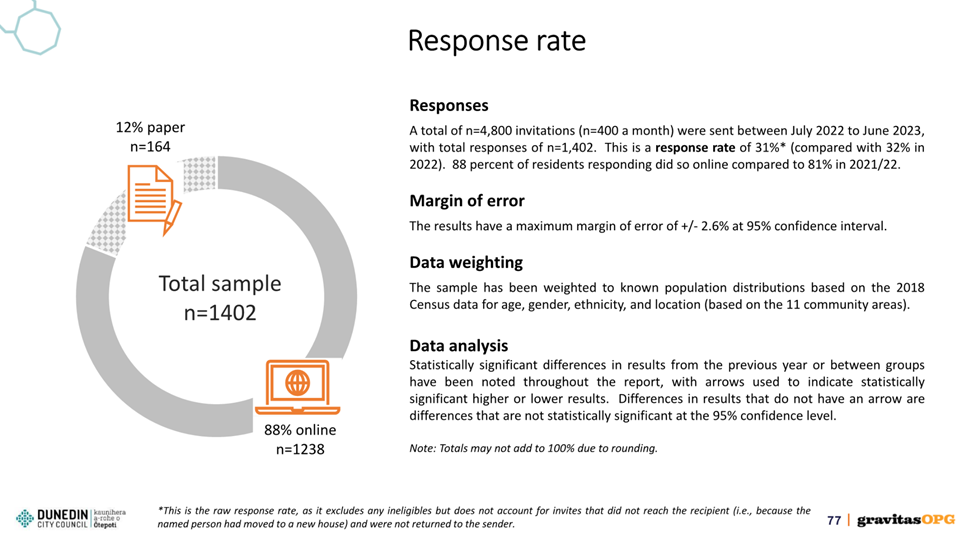
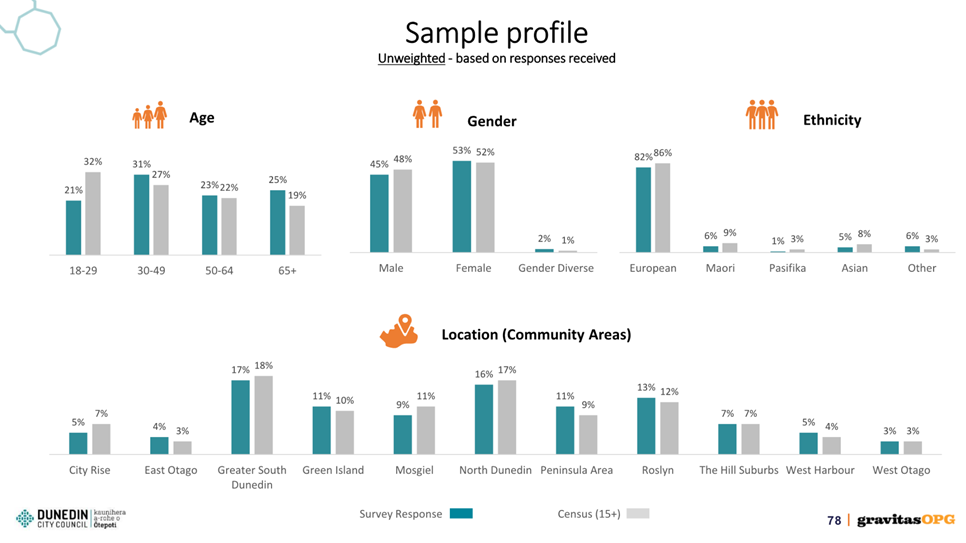
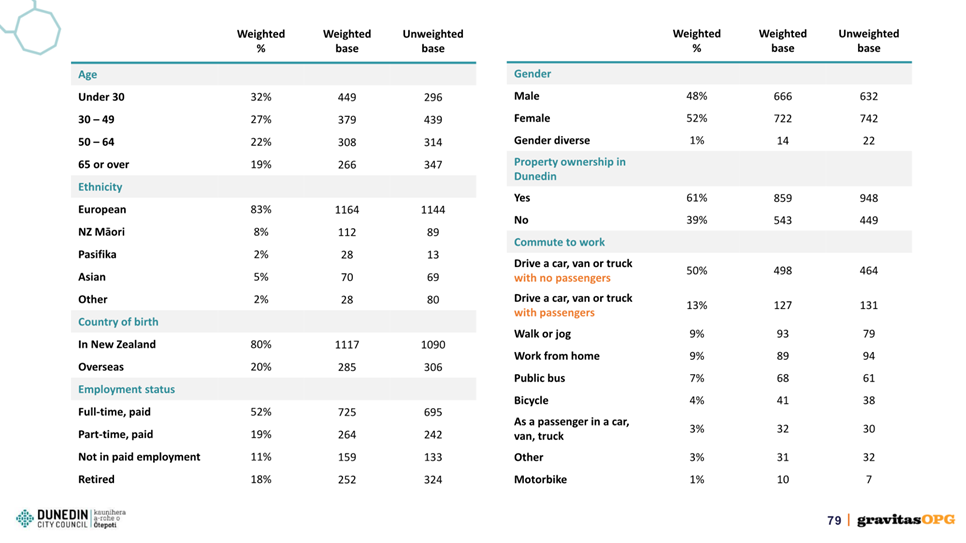
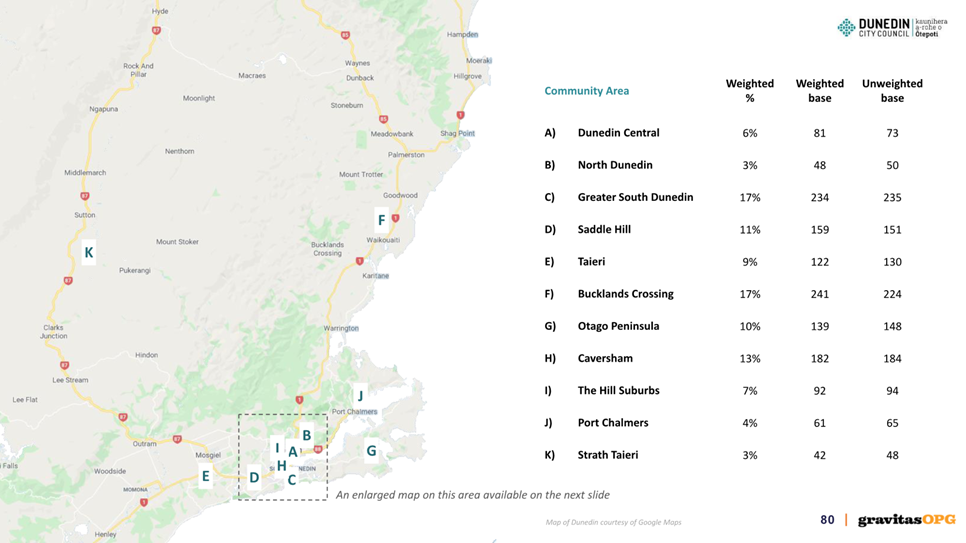
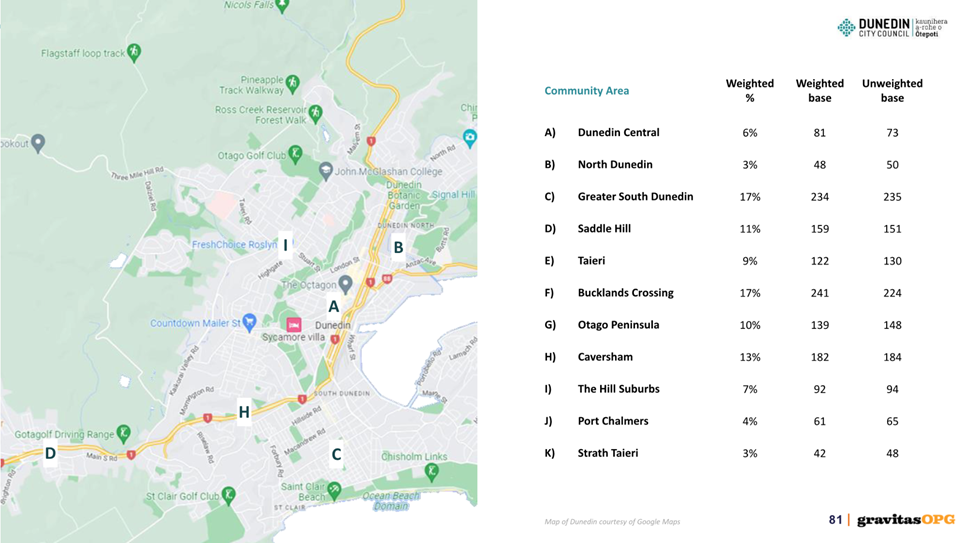
|
|
Council
25 September 2023
|
Update on Refreshing the
DCC's Wellbeing Strategies
Department: Corporate Policy
EXECUTIVE SUMMARY
1 The
purpose of this report is to update the Council on the progress in refreshing
the Dunedin City Council’s (DCC) wellbeing strategies (Ara Toi, Economic
Development Strategy, Social Wellbeing Strategy and Te Ao Tūroa).
2 The
report provides for noting and consideration by Council, draft wellbeing
concepts and outcomes related to the refresh of the wellbeing strategies.
3 The
Dunedin City Council’s (DCC) wellbeing strategies have been reviewed. The
review has found that the strategies could be strengthened by clarification of
wellbeing, aligned reporting functions and consistent governance oversight.
4 To
clarify wellbeing for the benefit of the community, it must be understood
locally. Developing local wellbeing explanations provides an opportunity for the
community to voice their priorities while understanding Council’s
responsibility, role, and ability to deliver on services and activities.
5 Draft
wellbeing concepts and outcomes are provided to strengthen the wellbeing
strategies. The refreshed wellbeing concepts and outcomes also provide an
opportunity to align the wellbeing strategies with the next 10 year plan
2024-2034 (10YP).
RECOMMENDATIONS
That the Council:
a) Notes the update of the refresh of the wellbeing strategies report.
b) Notes the draft wellbeing concepts and outcomes related to the
refresh of the Wellbeing Strategies, as detailed in Attachment H.
c) Notes the next steps in refreshing the wellbeing strategies to
align with the 10YP, (subject to approval of the draft wellbeing concepts and
outcomes).
BACKGROUND
6 The
previous strategic refresh update report was presented to the Council on 8 May
2023 which included an update on refreshing the DCC’s wellbeing
strategies (Ara Toi, Economic Development Strategy, Social Wellbeing Strategy and
Te Ao Tūroa).
7 In
refreshing its strategies and in developing approaches that embed
Council’s commitment to the Treaty of Waitangi and sustainability, it is
proposed that the Council will be better positioned to strategically lead the
DCC in realising community outcomes that consider future challenges while
meeting its legislative responsibilities going forward.
DISCUSSION
8 Following from the previous Council report
(8 May 2023), work completed on the wellbeing strategies has delivered on five
areas as outlined in Table 1 below.
Table 1: Deliverables and Outputs of wellbeings work
|
Deliverables
|
Outputs
|
Attachments
|
|
1. A review of
DCC’s current wellbeing strategies
|
Summary table of a review of the DCC’s current
Wellbeing Strategies
|
Attachment A
|
|
SWOT analysis of the DCC’s current Wellbeing
Strategies
|
Attachment B
|
|
2. Understanding wellbeing
and what it means for Dunedin communities
|
Wellbeing Summary Report
|
Attachment C
|
1.
Review of (draft) Wellbeing Outcomes
with United Nations Sustainable Development Goals |
Attachment D
|
|
3. Understanding wellbeing
in regard to the DCC’s responsibilities
|
Adaptation of Wellington City Council’s image
to the DCC, showing Council’s roles
|
Figure 2 in this report
|
|
4. Draft wellbeing
concepts and outcomes and how they relate to the DCC’s 10YP
|
Information related to each wellbeing strategy
|
Attachment E
|
|
Examples of measures related to the draft wellbeing
outcomes
|
Attachment F
|
|
10YP test – comparison of draft wellbeing
concepts with the current 10YP community outcomes
|
Attachment G
|
|
Draft wellbeing concepts and outcomes
|
Attachment H
(and in Table 2 in this report)
|
|
5. Draft Strategy Template
|
Draft Strategy Template to ensure the refreshed
wellbeing strategies are aligned
|
Attachment I
|
A review of Council’s current wellbeing strategies
9 A
review was undertaken on each of the DCC’s current wellbeing strategies
(Ara Toi, Economic Development Strategy, Social Wellbeing Strategy and Te Ao
Tūroa). Key findings from the review are summarised in Attachment A, which
identified key projects and, where possible, related measures.
10 A
SWOT (strengths, weaknesses, opportunities, and threats) analysis was also
carried out and summarised in Attachment B. The SWOT showed that the current
strategies embedded strong wellbeing intent, but could be strengthened by
developing wellbeing explanations, stronger reporting functions and consistent
governance oversight.
Understanding wellbeing and what it means for Dunedin
communities
11 To understand what wellbeing could mean
for Ōtepoti Dunedin residents, a Wellbeing Summary Report was developed
which reviewed international and national understandings of wellbeing,
critiqued wellbeing frameworks and measures, and proposed the development of local
wellbeing concepts (Attachment C). Although the Local Government Act 2002
(LGA) does not define wellbeing, it requires Councils to address
residents’ environmental, cultural, social and economic wellbeing through
reporting on its activities and services and describing how these relate to
community outcomes.
12 The Wellbeing Summary Report identified key points to be
considered when refreshing the DCC’s current wellbeing strategies and in
preparation for the next 10YP. These also helped inform the development
of the draft wellbeing concepts and outcomes to strengthen the DCC’s
current wellbeing strategies. The report showed that although wellbeing is a multifaceted concept, developing local wellbeing
explanations and outcomes can be used to help identify priorities for the
community, while considering Council’s context.
13 An important aspect in refreshing the DCC’s wellbeing
strategies was how they could help articulate and embed Council’s
commitment, in a consistent way in relation to the Treaty of Waitangi and
sustainability, as recommended by consultants Harrison Grierson (2020). In
2020, the Council also considered three sustainability frameworks and approved
staff to develop the City Portrait. The City Portrait uses the United
Nations Sustainability Development Goals (SDGs) to describe the ‘Social
Foundation’ of a community and applies science-based measures to describe
a community’s environmental impact. Simply, the City Portrait is a tool
to show at a local level, how a community takes care of its people and the
planet.
14 The advantage in using the City Portrait, is that there is
also flexibility to develop a local social foundation which enables
communities to embed the intent of the SDGs, while developing a social foundation
that is meaningful and useful at a local level.
15 In refreshing the DCC’s wellbeing strategies, staff
noted the strong synergies with the SDGs and the draft wellbeing strategies and
outcomes (Attachment C). Staff proposed by using the wellbeing strategies that
this approach would help the DCC retain a global connection to the SDGs, while
identifying local wellbeing outcomes and measures specific to Dunedin. Applying
the wellbeing strategies as Dunedin’s social foundation also enabled the
DCC to adopt a pragmatic and cost-effective way to develop the City Portrait.
Staff were also aware that the development of the Te Taki Haruru - Māori
Strategic Framework also embeds wellbeing concepts and found it important to
retain strong alignment.
16 In looking forward, the option to refining the SDGs in
addition to refreshing the DCC’s wellbeing strategies is still
available to explore. As the DCC is required legislatively to report on
community outcomes related to wellbeing, the role and function of the wellbeing
strategies are well embedded in the DCC’s planning functions and
reporting abilities. Recent results from a survey by Waimakariri District
Council (May 2023), showed that there are many Councils interested in applying
the SDGs in their planning processes, but only two Councils have progressed
beyond a high-level commitment, to including them in their annual and long-term
planning (Waimakariri District Council and Hauraki District Council). This does
mean however, there is an opportunity to work across Councils to help develop
this area of work in the future if Council wishes to.
Understanding wellbeing in regard to the
DCC’s roles and responsibilities
17 In addition to research about wellbeing,
Figure 1 was utilised to better understand the DCC’s purpose, and its
areas of concern, influence and control related to wellbeing. The illustration
also helped show that although Council is concerned about residents’
wellbeing, its ability to influence or control positive change related to
wellbeing outcomes, can be limited by its remit and resourcing
capability.
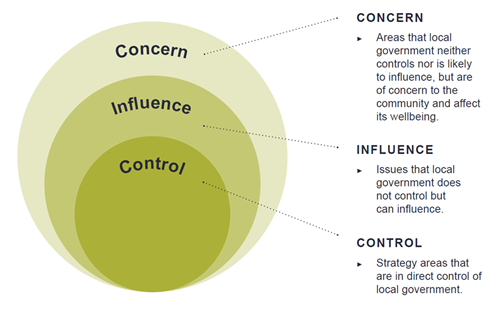
Figure 1. NSW Department of Planning, Industry and
Environment, 2020. A how to Guide. P13
18 The rationale for refreshing and
strengthening the DCC’s current wellbeing strategies, therefore, stems
from Council’s commitment to improve on the delivery of services and
activities related to wellbeing, but does not assume that Council is solely
responsible for effecting residents’ wellbeing. In this aspect, there is
recognition by the Council that with partners, stakeholders and community, the
ability to effect and grow positive wellbeing requires a combined effort and
shared responsibilities in service delivery and resourcing.
19 Staff propose there is an opportunity to
address each of the three areas in the refresh of the DCC’s wellbeing
strategies by:
· Concern – developing local wellbeing concepts that communicate
to residents what Council means in a clear and understandable way. In our
current wellbeing strategies, there are no explanations of wellbeing.
· Influence – identifying the DCC’s relationships and partnerships
that help address and support wellbeing across the city. In the current
wellbeing strategies, partners and stakeholders are identified but their role
in supporting or delivering on wellbeing outcomes is not well defined. There is
also an opportunity to develop long-term wellbeing measures.
· Control – defining the DCC’s ability to support or
deliver on activities and services that relate to wellbeing can be identified
in its refreshed strategies and through the 10YP process. The 10YP process will
also help identify how much resource Council can allocate within its remit, and
how fast it wants to deliver on actions and services. Figure 2, which was
developed by the Wellington City Council and then adapted to the DCC, shows the
different roles that Council has in its ‘Control’.
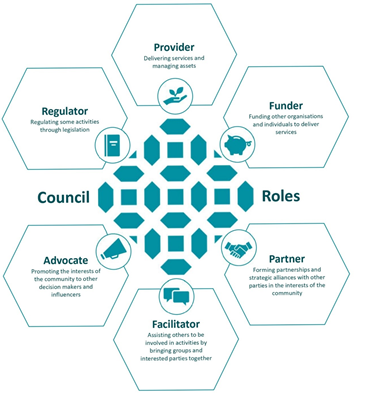
Figure 2. Council’s roles adapted to the
DCC’s context. Original image sourced from Wellington City Council, Aho
Tini 2030 – Arts, Culture and Creativity Strategy (August 2021). Page 14
Draft wellbeing concepts and outcomes and how they relate to
the DCC’s 10 year plan
20 Information related to each wellbeing
strategy was then developed to identify the next steps in refreshing the
strategies. This can be viewed in Attachment E.
21 A key deliverable was the development of
draft wellbeing concepts and outcomes to strengthen the current wellbeing
strategies. These can be viewed in Attachment H and are listed in Table 2 below.
The drafting of local wellbeing concepts and outcomes was informed by wellbeing
research and from input from Councillors and staff. Community feedback on
wellbeing concepts and outcomes could be explored during the engagement and
consultation periods in the 10YP or as an aligned engagement process.
22 It is proposed that ‘wellbeing
concepts’ are a way for Council to clearly explain what wellbeing means
to the local community, whereas wellbeing outcomes identify what changes
Council expects to see, if Ōtepoti Dunedin residents and communities were experiencing positive
wellbeing.
23 Table 2: Draft
wellbeing concepts and outcomes
|
Wellbeing
|
Wellbeing is when
Ōtepoti Dunedin residents have what they need to survive and thrive, now
and into the future
|
|
Environmental Wellbeing
|
Cultural Wellbeing
|
Social Wellbeing
|
Economic Wellbeing
|
|
Wellbeing concepts:
|
is when people live in harmony with a healthy,
natural environment that we look after, respect and enjoy.
|
is when people’s sense of belonging is
nourished through experiencing and participating in arts, culture and
creativity.
|
is when people are safe, healthy, connected and
valued, and can access resources and systems that support their sense of wellbeing.
|
is when people can access resources and
opportunities to be secure, resilient, and prosperous, now and into the
future.
|
|
Wellbeing Outcomes:
|
1. People have a healthy environment
2. People enjoy, connect to and celebrate the
natural world
3. Our city is resilient and carbon zero and
plays our part in global efforts to address climate change
4. People appreciate and understand the value
of the natural world by actively giving back to the natural world
|
1. People’s indigenous value and
cultural potential are supported equitably, celebrated, and nourished
2. Dunedin has inclusive and connected
communities that actively engage people in cultural activities and
experiences
3. People thrive through vibrant spaces and
open places that support cultural wellbeing
4. Dunedin has a thriving Creative Economy
that creates opportunities that empower people
|
1. People are connected
2. People experience vibrant and
cohesive communities
3. People and healthy, well and safe
4. People experience a reasonable
standard of living and quality of life
5. People live in affordable and healthy
homes
6. People participate in local city-wide
affairs
7. Dunedin is prepared for an adverse
event or emergency
|
1. Local businesses are thriving,
resilient and contribute to peoples’ wellbeing
2. People can meet their daily needs and
are free from economic deprivation
3. People have an income to live a
dignified life
4. People are skilled and educated to
have economic choice
5. People have access to infrastructure
that meet their needs
|
24 It is proposed to work with the Council to
consider wellbeing concepts and outcomes and refresh the current strategies by
identifying measurements related to each of the wellbeing outcomes. This also
includes drafting other parts of the strategies such as identifying and/or
developing key themes, other related measures and indicators, rationale and
identifying regular reporting cycles on wellbeing outcomes.
25 As a general update, wellbeing measures
have also been reviewed from other Councils as well as exploring what data
options are currently available and accessible. Draft examples of measures
related to the draft wellbeing outcomes are summarised in Attachment F. In the
next steps it is noted that more work is needed to identify specific measures
and reporting, with input from the Council to ensure that reporting is useful
and supports decision making. There may also be an opportunity to include
wellbeing targets and/or baselines to indicate when Council decisions or
actions may be needed to support community wellbeing in some areas.
26 Staff also reviewed if the draft wellbeing
outcomes support the current community outcomes as outlined in the DCC’s
current 10YP (2021-2031). This was to test the reliability of the draft
wellbeing outcomes being used to measure the current community outcomes in the
scenario that they were retained. Attachment G shows that the draft wellbeing
outcomes do align with the DCC’s existing community outcomes. Staff
propose that if the community outcomes were to change with the new 10YP
(2024-2034), then analysis of the wellbeing outcomes could be updated.
27 To support this work area, staff have
developed a draft template to support the refresh of the strategies to align
the strategies in terms of structure, reporting, language, and governance
oversight (Attachment I). The template also includes Council’s
commitments to the Treaty of Waitangi and sustainability in a consistent way,
as recommended by Harrison Grierson in 2020.
28 The draft strategy template shows key
elements that will be in each of the wellbeing strategies, while allowing
options to include specific narrative, stories, or case studies relevant to
each wellbeing area. Identification of specific action plans will also be
unique to each wellbeing strategy.
29 Community
engagement related to wellbeing in general has also been included in the 10YP
early engagement activities, and staff will include this data going forward.
OPTIONS
30 As
this is a report for noting, there are no options.
NEXT STEPS
31 The next steps will be undertaken in
refreshing the wellbeing strategies as summarised below:
a) Deliver
workshops for Councillors to consider wellbeing concepts and outcomes as
outlined in this report.
b) Engage
with the community on the draft
wellbeing concepts and outcomes to strengthen the current wellbeing strategies.
Explore the opportunity to develop an engagement process that aligns with the
engagement and consultation periods in the 10YP.
c) Continue
developing draft measures and targets to support the monitoring of wellbeing
outcomes related to each wellbeing strategy. This is underway, but more work is
needed along with Council input, to define relevant and accessible measures and
consistent reporting. See Attachment G for updated details.
d) Confirm
a governance structure for each wellbeing strategy. Staff understand that this
work area will be led by the Council. This will need to be completed by
November 2023 so any changes can be included in the draft wellbeing strategies.
e) Analyse
feedback from the 10YP community engagement and formal consultation periods,
will help to inform the remaining aspects of the wellbeing strategies and
related outcomes. This will also help align the wellbeing strategies with the
10YP process.
f) Develop
draft wellbeing strategies with Council direction, for Council approval, so
that they align with Council’s adoption of the 10YP in 2024.
g) Develop
draft wellbeing strategies with Council direction, for Council approval, so
that they align with Council’s adoption of the 10YP in 2024.
h) Provide
an update report to Council in November 2023.
Signatories
|
Author:
|
Junichi Sugishita - Senior Policy Analyst
Gina Huakau - Corporate Policy Manager
|
|
Authoriser:
|
Jeanette Wikaira - General Manager Community Services
(Acting)
Sandy Graham - Chief Executive Officer
|
Attachments
|
|
Title
|
Page
|
|
⇩a
|
Attachment A. Summary
table of a review of current wellbeing strategies
|
287
|
|
⇩b
|
Attachment B. SWOT
Analysis for current Wellbeing Strategies
|
291
|
|
⇩c
|
Attachment C.
Wellbeings summary report
|
292
|
|
⇩d
|
Attachment D. Review of
(draft) wellbeing outcomes with United Nations Sustainable Development Goals
|
315
|
|
⇩e
|
Attachment E.
Information related to each wellbeing strategy
|
316
|
|
⇩f
|
Attachment F. Draft
examples of measures related to the draft wellbeing outcomes
|
341
|
|
⇩g
|
Attachment G. 10YP test
- Wellbeings outcomes and current community outcomes
|
346
|
|
⇩h
|
Attachment H. For
Council Approval. Wellbeing concepts & outcomes
|
347
|
|
⇩i
|
Attachment I. Draft
Strategy Template
|
348
|
|
SUMMARY OF CONSIDERATIONS
|
|
Fit with purpose
of Local Government
The Strategic Refresh enables democratic
local decision making and action by, and on behalf of communities. It also
promotes the social, economic, environmental and cultural well-beings of
communities in the present and for the future.
|
|
Fit with strategic
framework
|
|
Contributes
|
Detracts
|
Not applicable
|
|
Social Wellbeing Strategy
|
☒
|
☐
|
☐
|
|
Economic Development Strategy
|
☒
|
☐
|
☐
|
|
Environment Strategy
|
☒
|
☐
|
☐
|
|
Arts and Culture Strategy
|
☒
|
☐
|
☐
|
|
3 Waters Strategy
|
☒
|
☐
|
☐
|
|
Spatial Plan
|
☒
|
☐
|
☐
|
|
Integrated Transport Strategy
|
☒
|
☐
|
☐
|
|
Parks and Recreation Strategy
|
☒
|
☐
|
☐
|
|
Other strategic projects/policies/plans
|
☒
|
☐
|
☐
|
The Refresh encapsulates all of the above strategies.
|
|
Māori Impact
Statement
Mana whenua and mātāwaka are partners in the
development of the Te Taki Haruru – Māori Strategic Framework and
in the Strategic Refresh work programme. The project will ensure the DCC is a
good Treaty partner and contributes to positive outcomes for Māori and
will seek further Māori input via community engagement
|
|
Sustainability
The development and adoption of a sustainability framework
will promote social, economic, environmental and cultural well-being of
communities in the present and for the future. It will do this by clarifying
the interpretation and measures of sustainability, and promoting consistent
application of a sustainable development approach.
|
|
LTP/Annual Plan /
Financial Strategy /Infrastructure Strategy
The Refresh is expected to bring greater visibility and
clarity as to how current and future corporate planning functions
(encompassing long term plans and associated statutory strategies, levels of
service and performance measures) support the DCC’s strategic goals and
meet statutory requirements. The Strategic Refresh will directly impact on
the next 10 Year Plan.
|
|
Financial
considerations
There are no financial considerations.
|
|
Significance
This report is considered to be of low significance in
terms of the Significance and Engagement Policy as it provides an update of
the Strategic Refresh. The Strategic Refresh itself is of high importance and
so community engagement is planned and has been detailed in the report.
|
|
Engagement –
external
Staff have presented to the Grow Dunedin Partnership and
Creative Dunedin Partnership groups
|
|
Engagement -
internal
There has been extensive internal engagement as a part of
the strategic refresh project.
|
|
Risks: Legal /
Health and Safety etc.
There are no identified risks.
|
|
Conflict of
Interest
There are no known conflicts of interest.
|
|
Community Boards
All areas of the city will be interested in the Strategic
Refresh and Community Boards will have an opportunity to participate as part
of the engagement process.
|
|
|
Council
25 September 2023
|
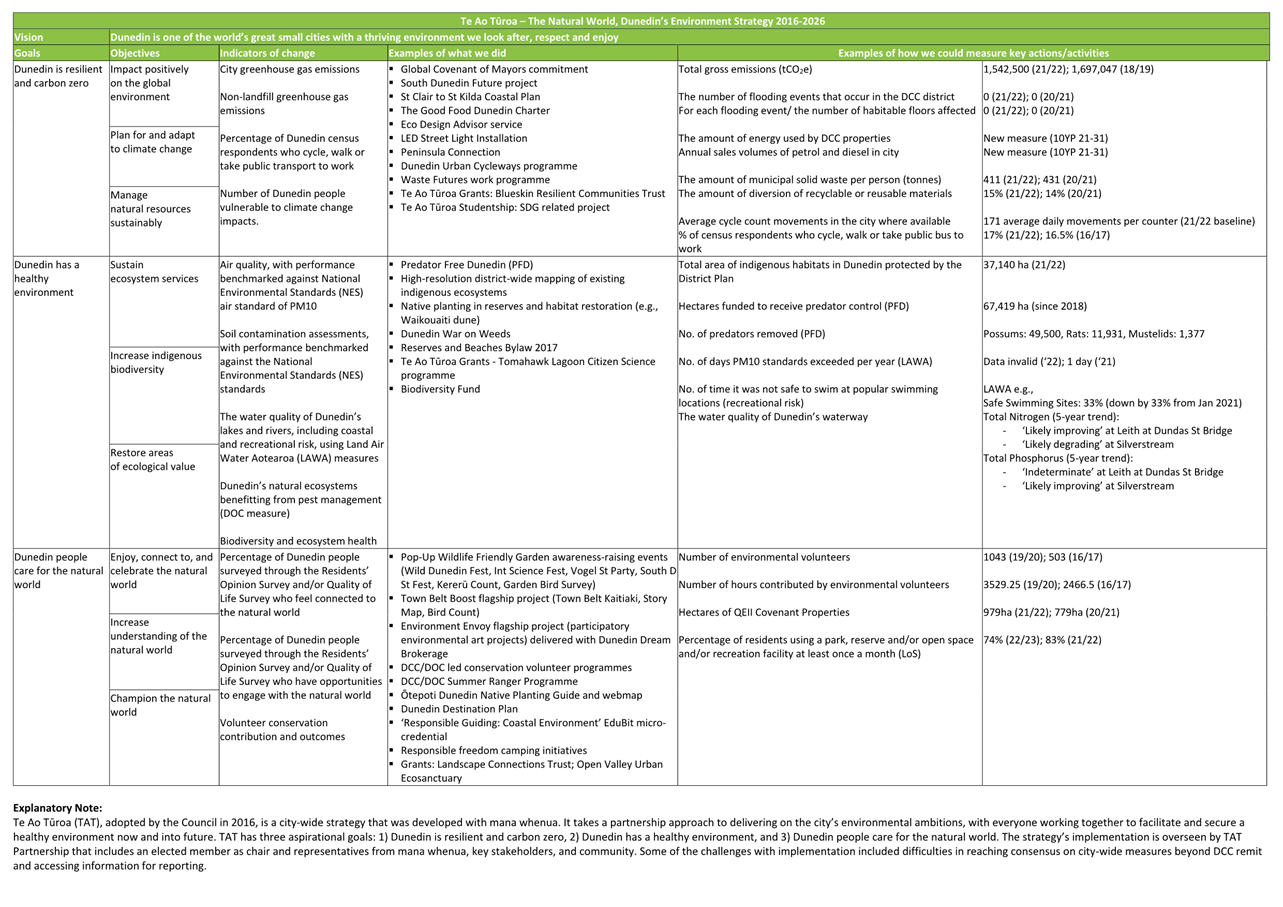
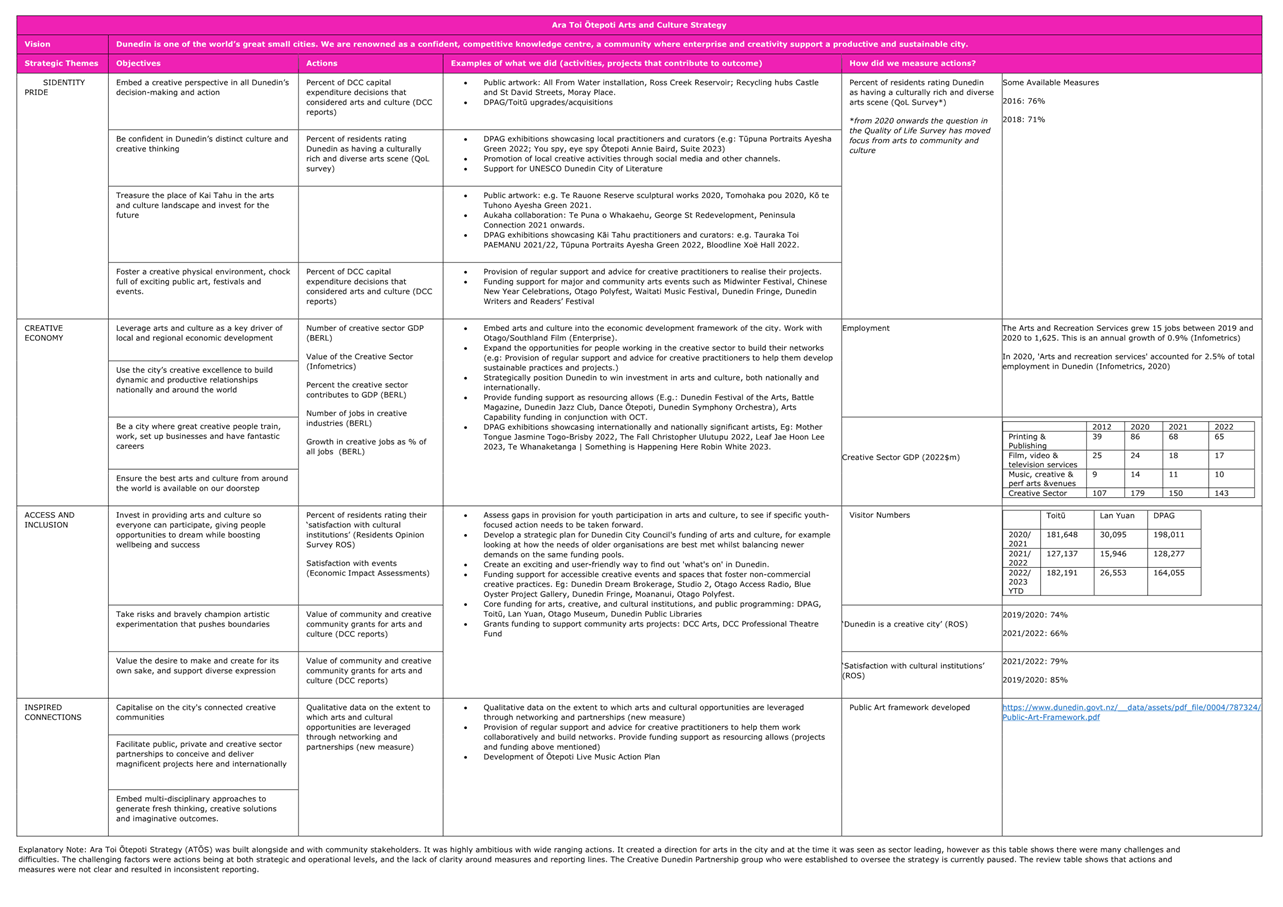
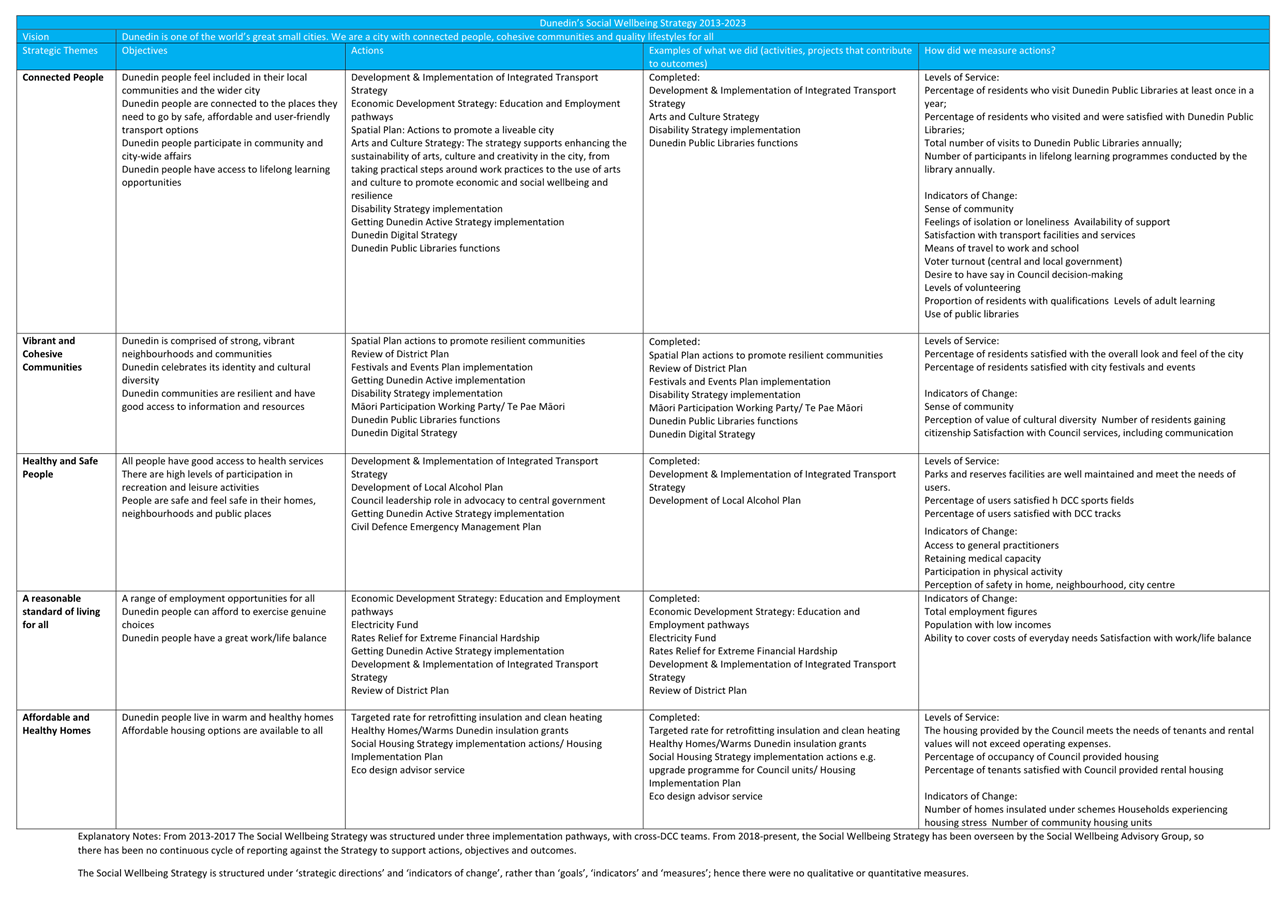
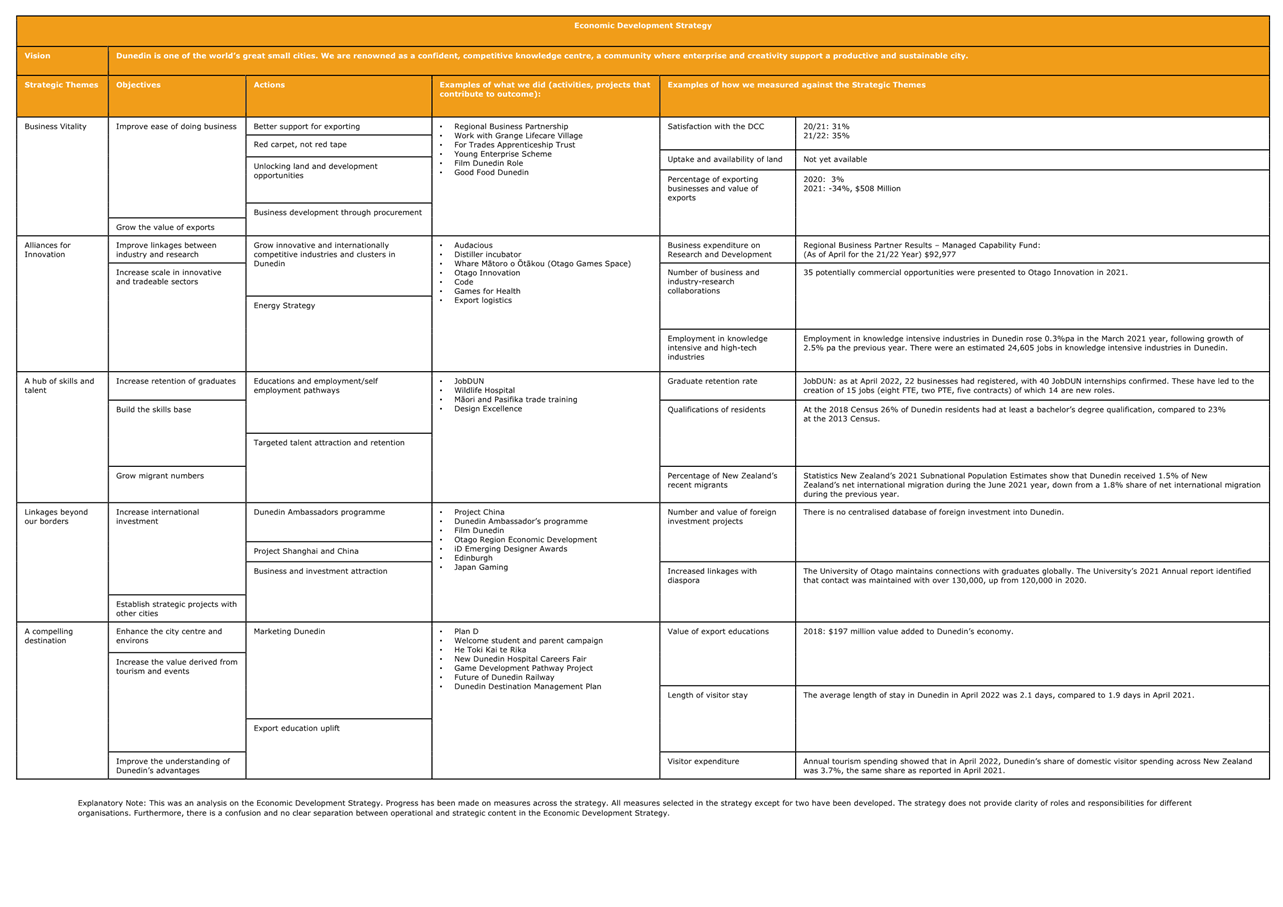
|
|
Council
25 September 2023
|
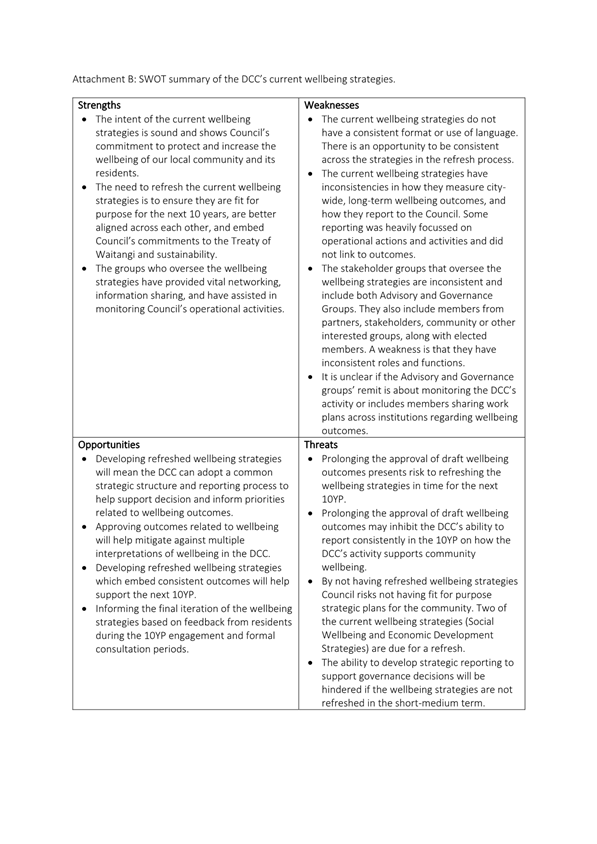
|
|
Council
25 September 2023
|
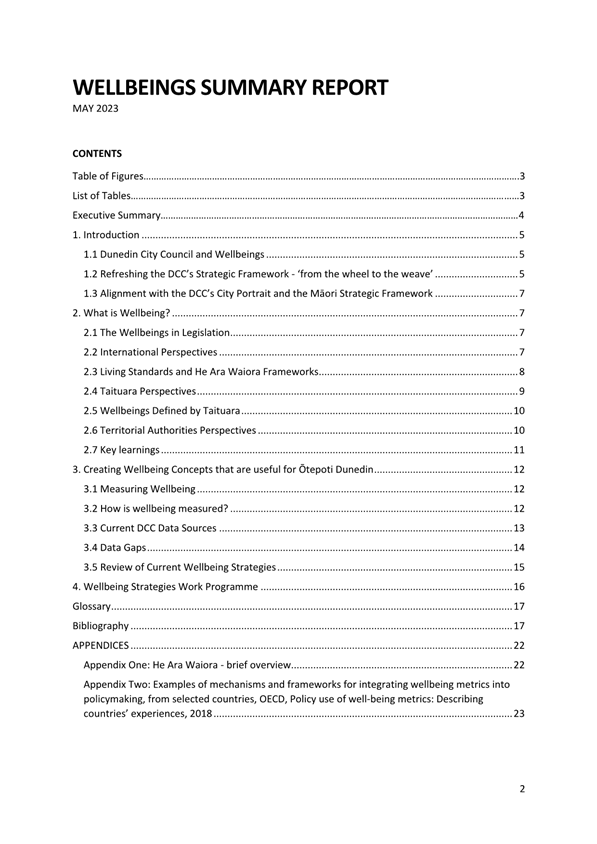
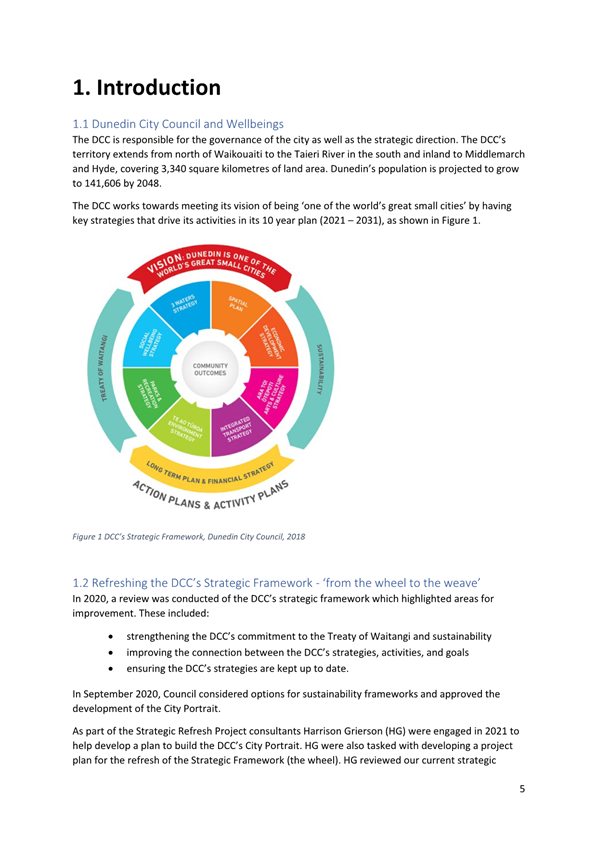
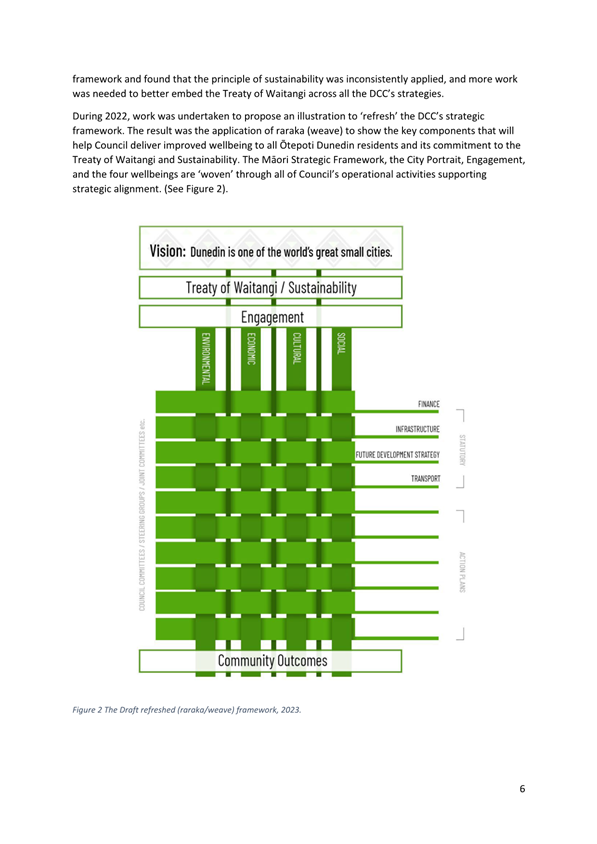
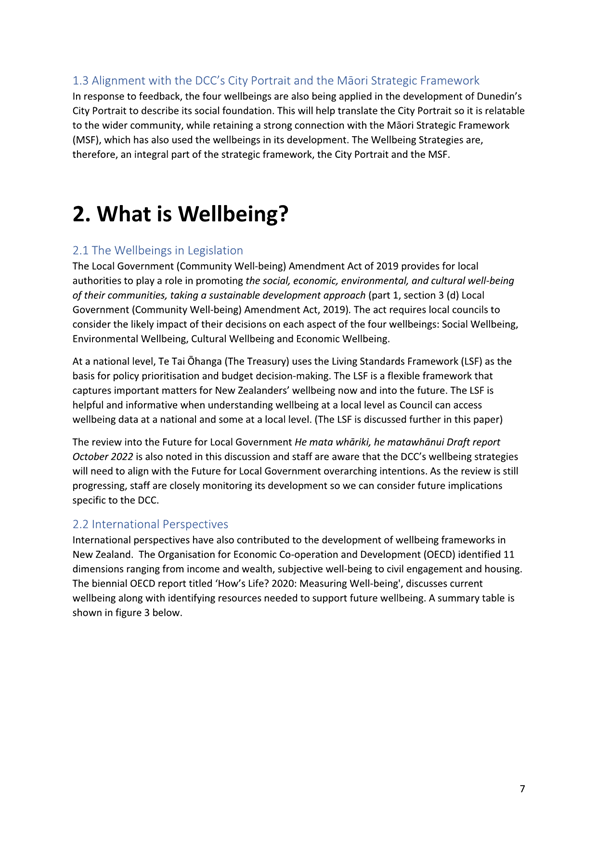
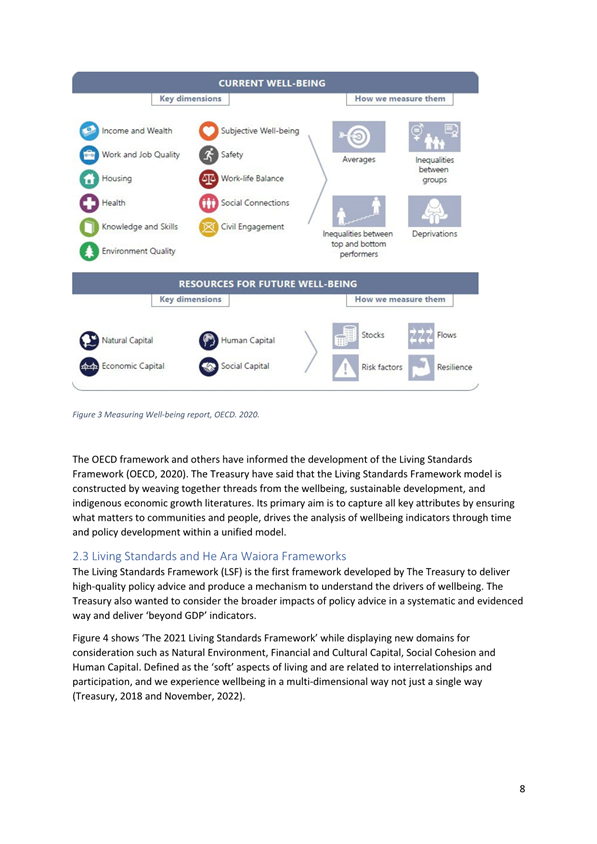
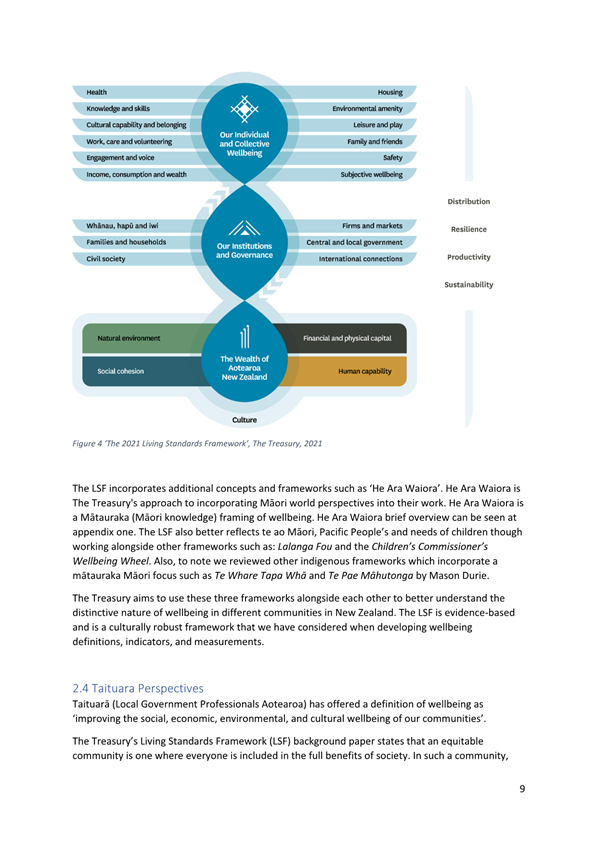
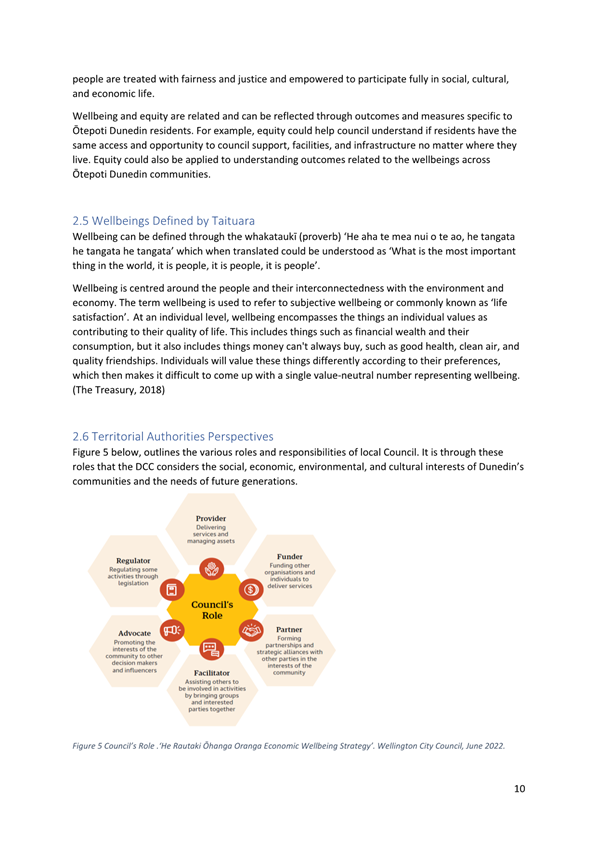
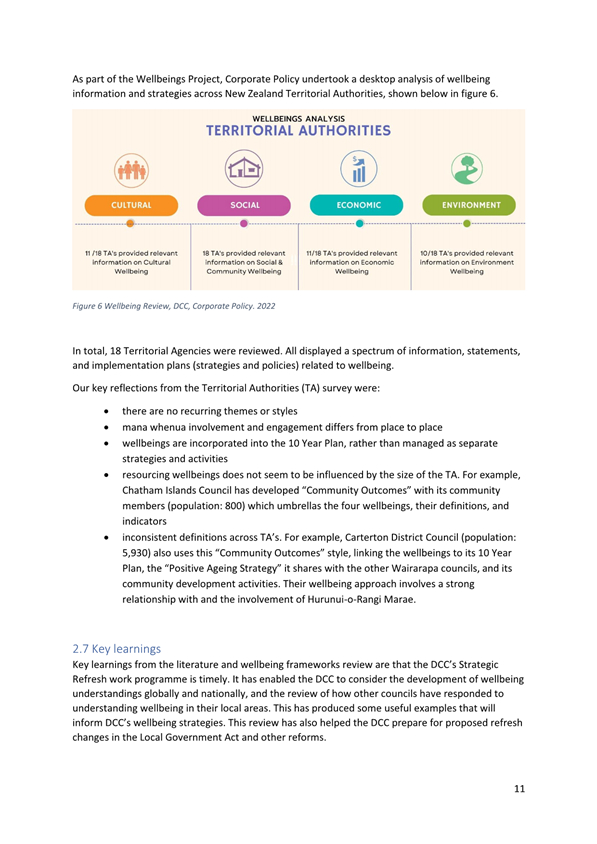
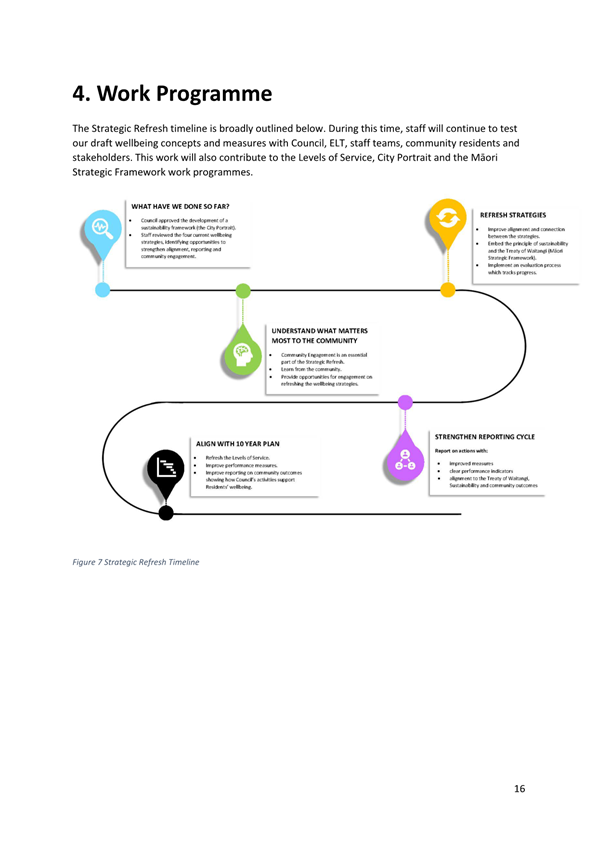
|
|
Council
25 September 2023
|
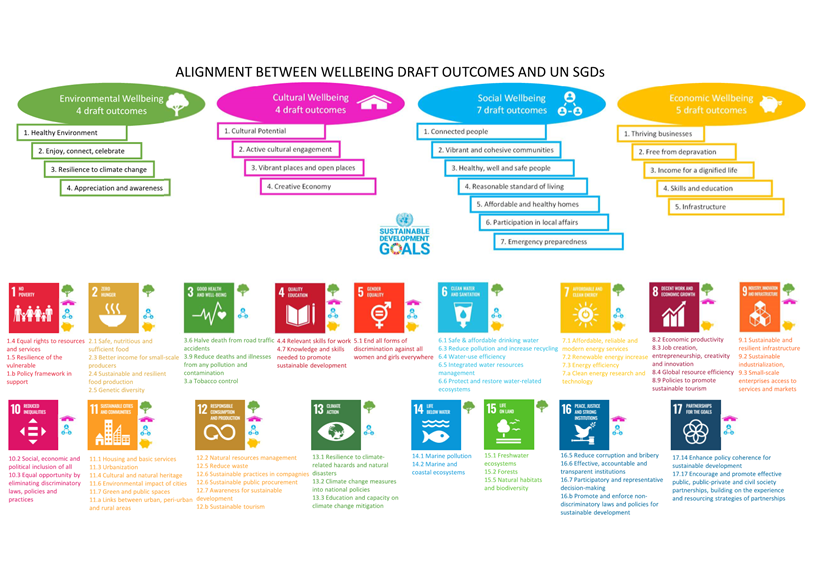
|
|
Council
25 September 2023
|
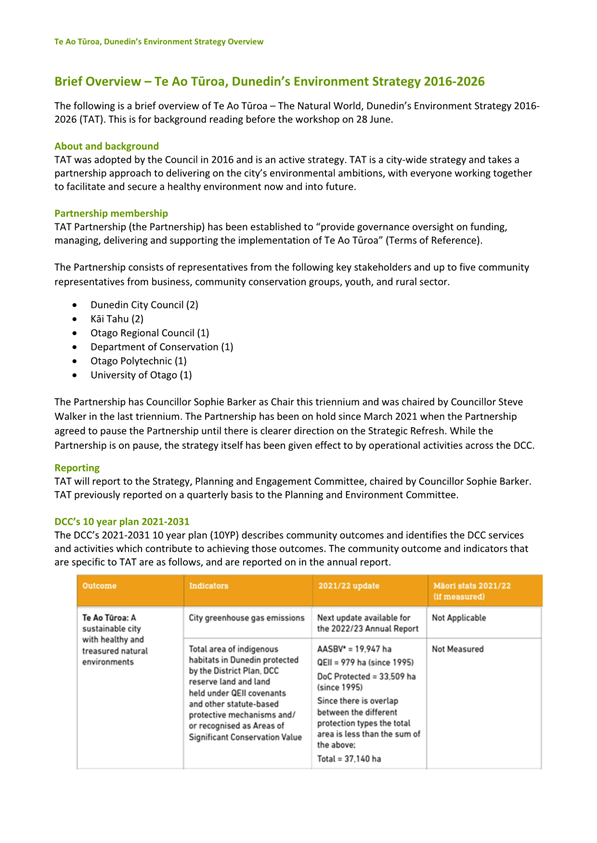
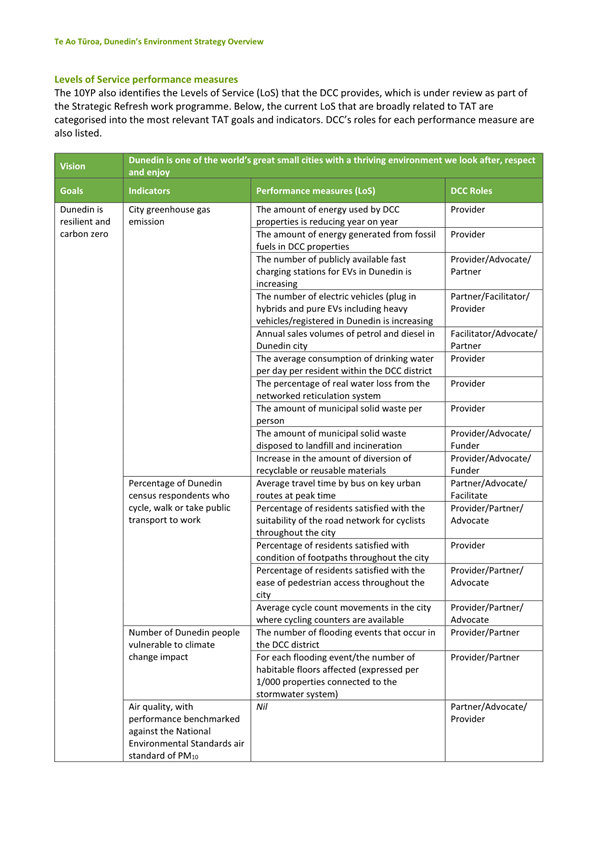
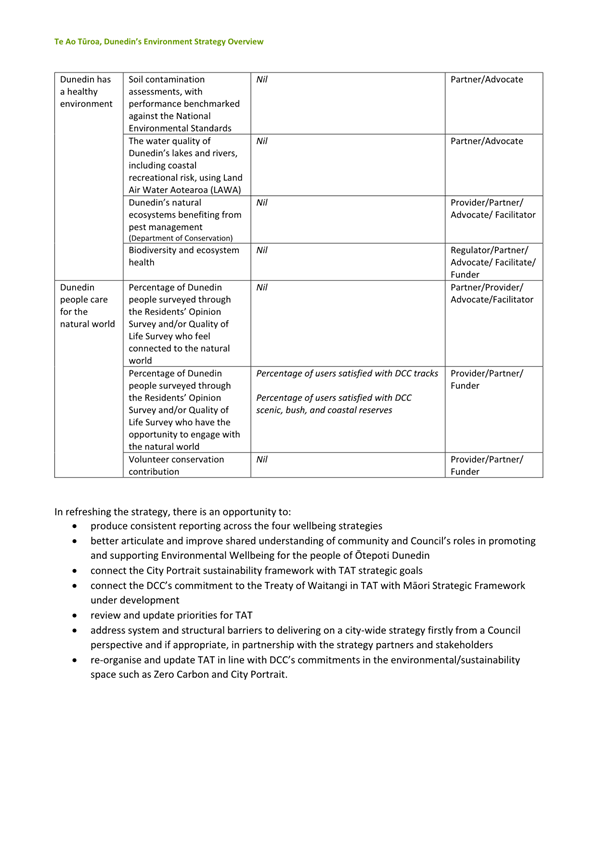
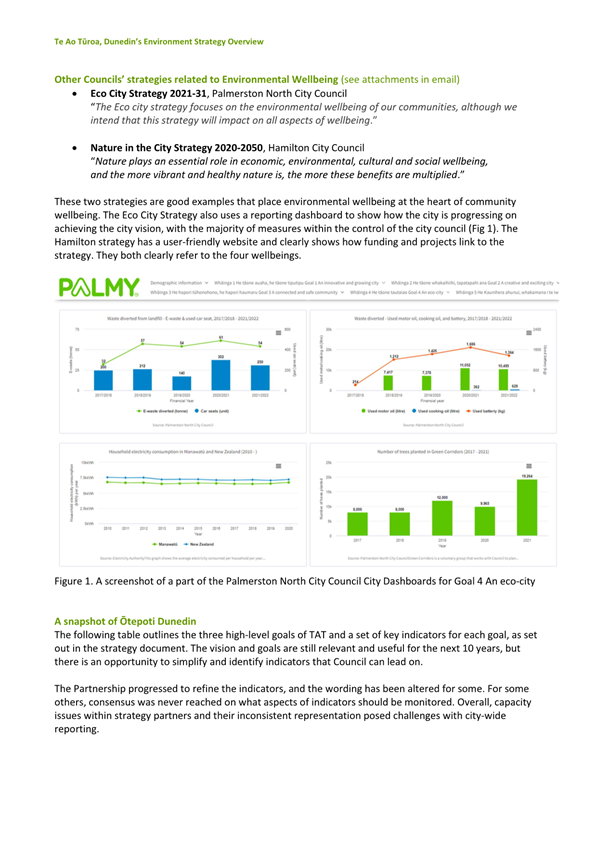
|
|
Council
25 September 2023
|
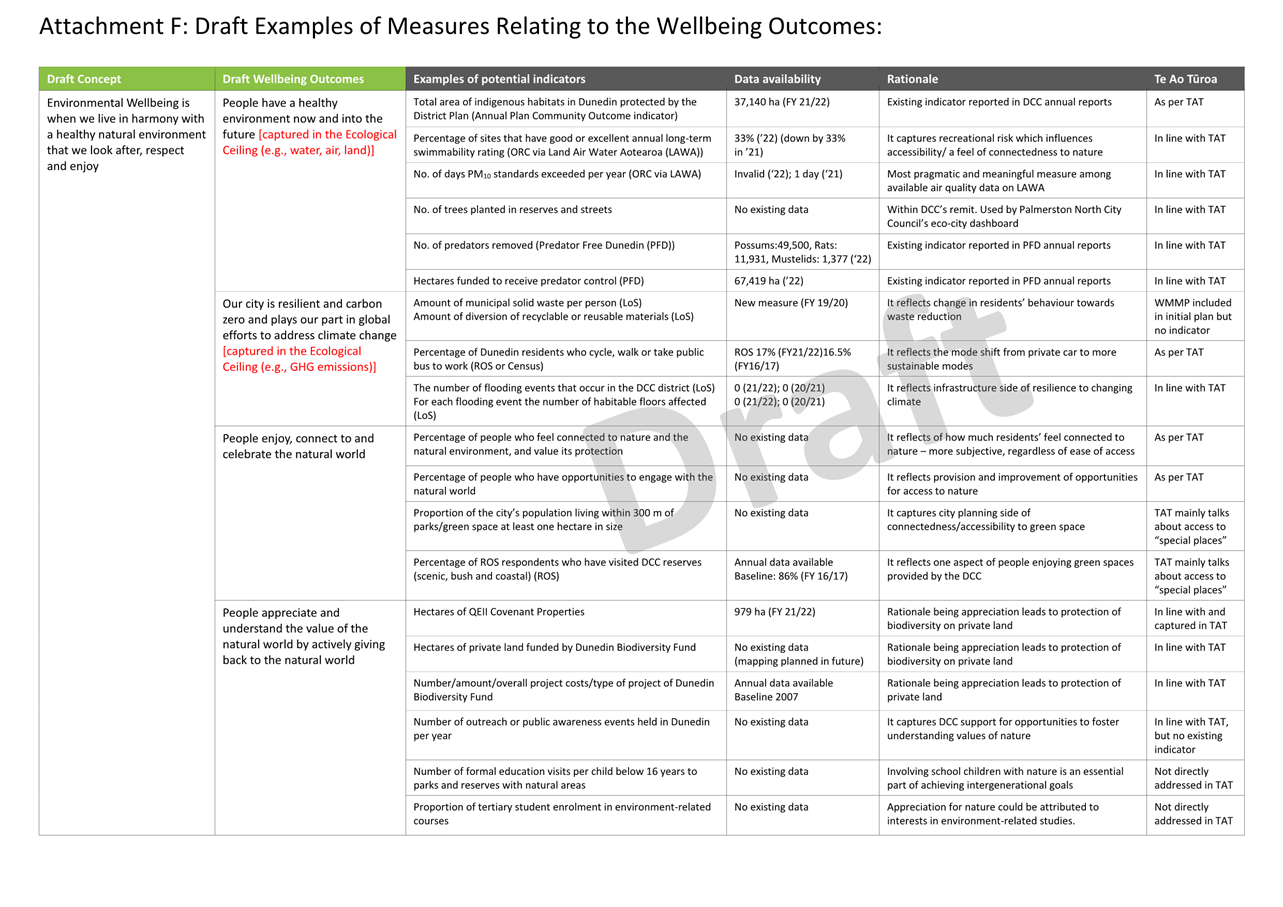
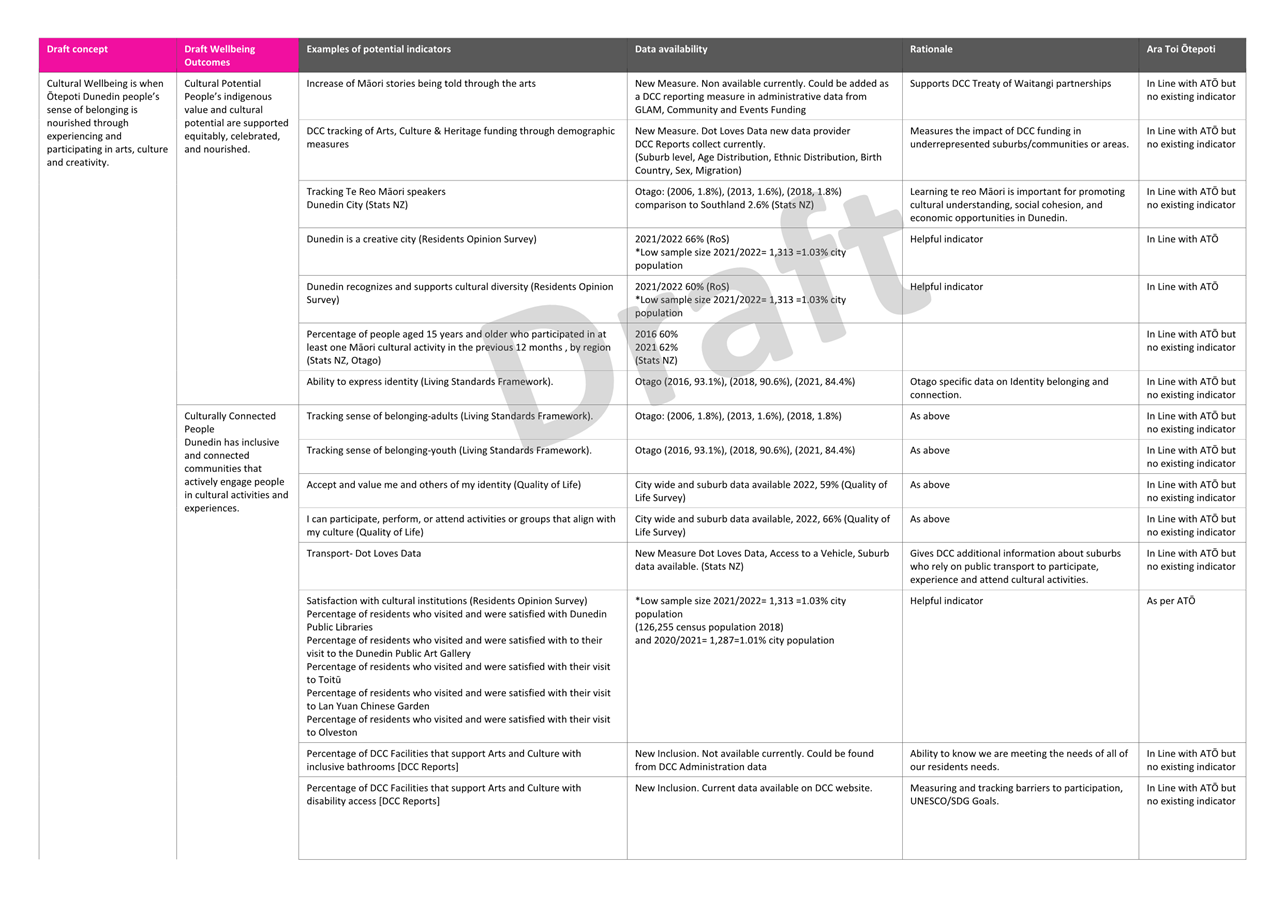
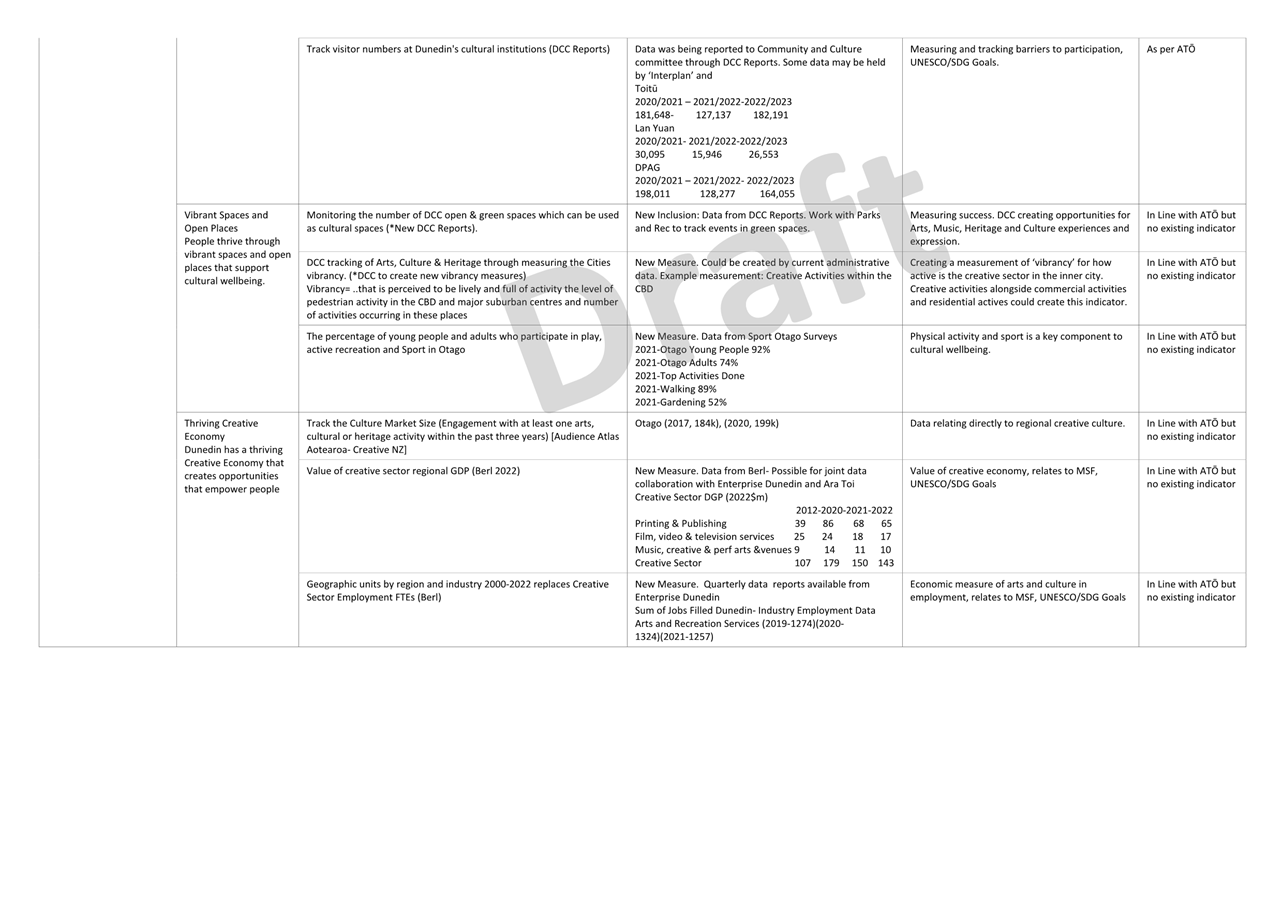
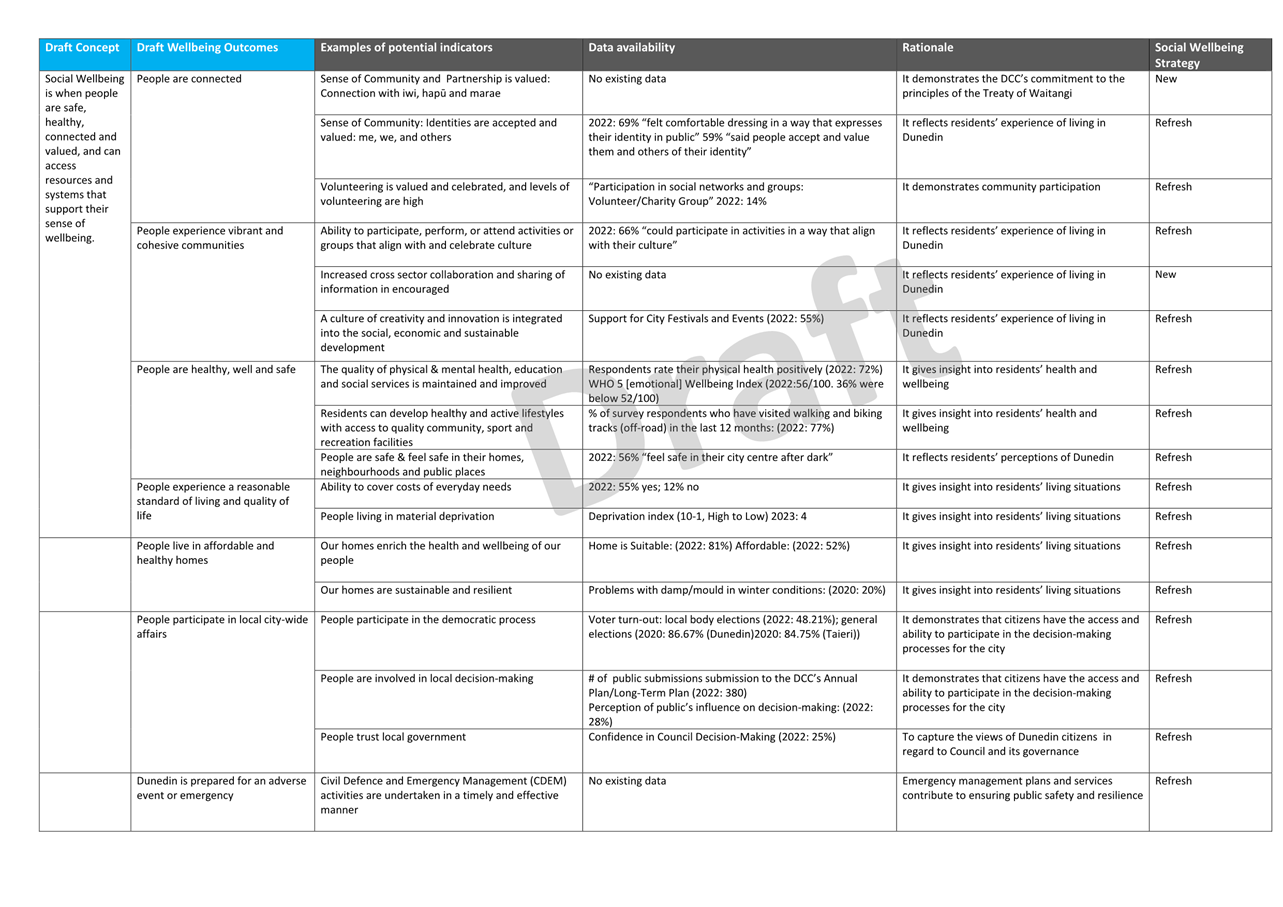
|
|
Council
25 September 2023
|
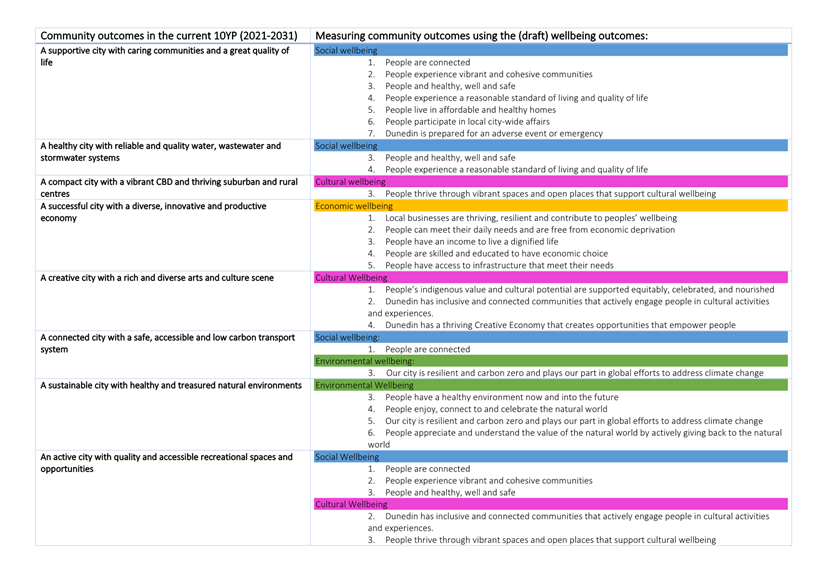
|
|
Council
25 September 2023
|
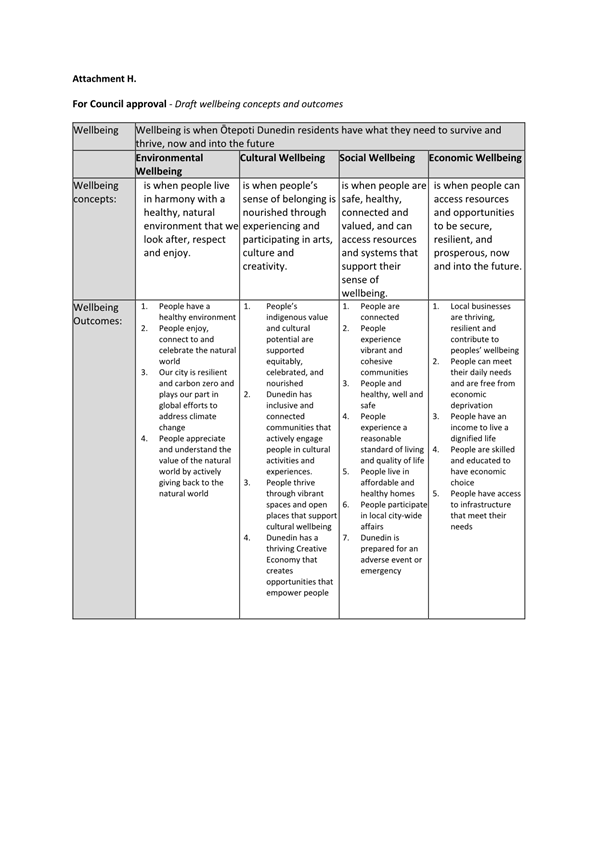
|
|
Council
25 September 2023
|
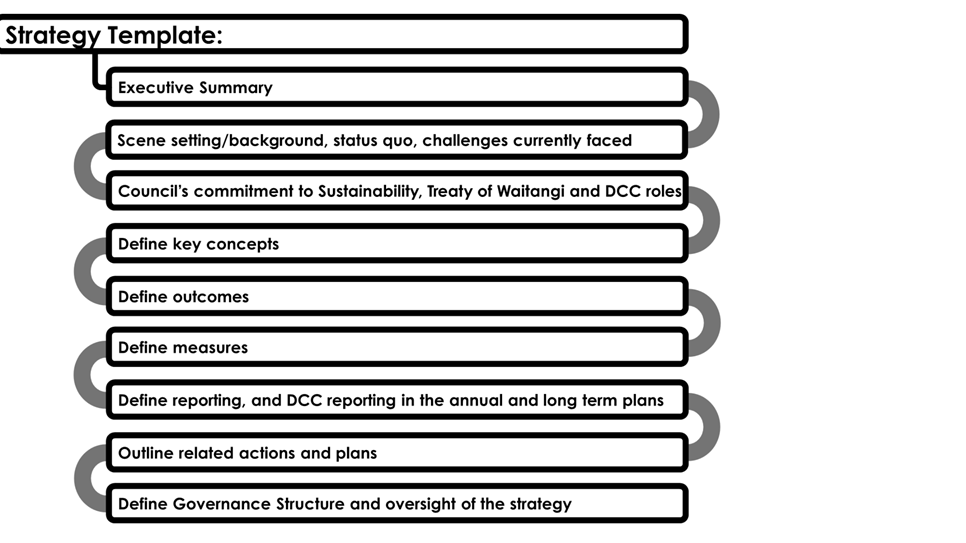
|
|
Council
25 September 2023
|
Approval to Grant Electricity Easement to
Aurora Energy Limited - Part Rotary Park
Department: Parks and Recreation
EXECUTIVE SUMMARY
1 This
report discusses an application by Aurora Energy Limited for the grant of an
electricity easement over part of Rotary Park held as recreation reserve.
2 The
easement is to allow the installation of a new electricity transformer and
associated cabling at 23 Harbour Heights, Dunedin which is part of Rotary Park.
The electricity transformer will service the local community needs.
3 This
report asks Council to make two decisions:
a) Firstly,
a decision as the administering body of Rotary Park to grant an easement; and
b) Secondly,
a decision to exercise the delegation given by the Minister of Conservation to
Council.
RECOMMENDATIONS
That the Council:
a) Grants, as administering body of Rotary Park, pursuant to Section
48 of the Reserves Act 1977, an easement in gross to Aurora Energy Limited for
the installation of a new electricity transformer and associated cabling over
part of the Rotary Park (Record of Title OT14A/258).
b) Decides the criteria for exemption from public notification has been
met.
c) Acting
under its delegation from the Minister of Conservation dated 12 June 2013 and
pursuant to Section 48 of the Reserves Act 1977, approves an easement in gross
to Aurora Energy Limited for the installation of a new electricity transformer
and associated cabling over part of Rotary Park (Record of Title OT14A/258).
BACKGROUND
4 Aurora
has advised that the electricity transformer, located on private property at 15
Harbour Heights, and serves the neighbourhood at Harbour Heights is in need of
upgrading however the existing site on private land is not capable of taking
the new replacement transformer. Subject to this decision, Aurora hopes to
commence work for the new transformer in October 2023.
5 Given
the very limited space within the road reserve and footpath at Harbour Heights,
Aurora has advised that its preferred location would be one of two options
located on a corner of what is part of Rotary Park. The two options are shown
as a red box and a blue box on Attachment A. This location affords an
opportunity to re-locate the transformer further away from private residences.
6 Council
staff have inspected and considered the two possible locations for the
transformer on the reserve, noting the size of the transformer and area
required around it will be approx. 4m x 5m. The location approx. shown with a
red box on Attachment A is considered the most suitable and practical location,
and is not expected to affect reserve maintenance contractors.
7 Aurora
advises that in its discussions with potentially affected Harbour Heights
residents, there is agreement for use of this location. The transformer in this
location also will not adversely affect public use and enjoyment of the main
part of Rotary Park.
8 An
aerial photo showing the location of the proposed electricity easement is
attached as Attachment A and a photo and diagram of the proposed transformer
unit is at Attachment B.
DISCUSSION
Land
Status
9 Rotary
Park is owned by Dunedin City Council. The land affected by this proposal is
described as Lot 20 Deposited Plan 22191 contained in Record of Title
OT14A/258. It is held for and appropriately managed as a recreation reserve
subject to the Reserves Act 1977.
Council
as the owner and as the administering body
10 The
Council, in its capacity as administering body of Rotary Park, has the
responsibility for ensuring compliance in terms of the Reserves Act 1977 and
for considering the merits of the proposal to grant easements.
11 Section
48 of the Reserves Act 1977 ("Section 48") is the statutory authority
for the grant of easements over reserves. Section 48(1) specifically allows for
electricity easements on reserves.
The
Reserves Act 1977
12 Section
48 of the Reserves Act 1977 empowers the reserve's administering body (the
Council), to grant easements over reserve lands subject to the Resource
Management Act and the consent of the Minister of Conservation. The
Minister of Conservation has delegated powers of consent to the Council,
without limitation under instrument of delegation dated 12 June 2013. If
resource consent is required, then Aurora will be responsible for meeting this
requirement and this will be addressed in the Easement Agreement.
13 Section
48(2) requires public notification of the intention to grant an easement unless
it can be demonstrated that:
(a) Rotary
Park is owned by the Council and is not likely to be materially altered or
permanently damaged; and
(b) The
rights of the public in respect of Rotary Park are not likely to be permanently
affected by the establishment and lawful exercise of the easement.
14 Given
that the transformer will be installed at a location that will not impede
public access to or enjoyment of the main part of Rotary Park, the easement is
not likely to materially alter or permanently damage Rotary Park and the rights
of the public are not likely to be permanently affected by the establishment
and lawful exercise of the easement.
Reserves
Management Plan
15 The
Reserves Management Plan – General Policies document ("General
Policies") covers all basic issues of the day-to-day administration of
reserves in Dunedin.
16 Although
the General Policies specify that easements should be for a limited term, in
this instance Council Officers recommend that the easement be granted in
perpetuity as its primary purpose is public benefit. The policies also require
the applicant to meet all costs associated with legalising and maintaining the
easement.
Merits
of the proposed easement
17 Aurora
advises that the upgraded transformer will provide greater energy supply
capacity for this neighbourhood. There will be required a short section of
cabling from the footpath to the transformer itself (shown as a yellow line on
Attachment A). The minor inconvenience during installation is outweighed by
upgrading supply for the benefit of the community.
Standard
Easement terms and conditions
18 The
proposed key elements of this easement include:
Statute Section
48 of the Reserves Act 1977
Grantee Aurora
Energy Limited
Reserve Rotary
Park (recreation reserve)
Purpose The
right to install a new electricity transformer and associated cabling
Term In
perpetuity
Rental Nil
19 The
terms and conditions of the easement are to be finalised by the Council's
solicitors. As a first step, an Agreement to Grant an Easement will be prepared
by Council's solicitors which will include the following conditions:
a) Aurora
will meet all costs associated with installation of the transformer and
associated cabling, as well as reserve remediation, all survey, legal, LINZ and
related costs to register the new easement;
b) All
physical works must be carried out in consultation with Council's Parks and
Recreation staff; and
c) Aurora
will be responsible for obtaining all necessary consents, including any
resource consent.
20 An
easement will be registered against Council's title once the transformer has
been installed and location surveyed.
Council
as the Minister of Conservation's delegate
21 The
Council, in its capacity as the Minister of Conservation's delegate, has the
supervisory role in ensuring that the decision on whether or not to grant the
easement over part of Rotary Park has been arrived at in compliance with the
requirements of the Reserves Act 1977.
22 In
particular, the Council as the Minister's delegate, needs to be satisfied that:
· the
status of the land has been correctly identified;
· there
is statutory power to grant the easement;
· the
necessary statutory processes have been followed;
· the
easement has been appropriately considered; and
· the
decision is a reasonable one.
23 This
part of Rotary Park is owned by Council in fee simple and is held and managed
as a recreation reserve subject to the Reserves Act 1977. This is
recorded on Record of Title OT14A/258. Section 48 of the Reserves Act
1977 provides the statutory authority to grant an easement over this
reserve. The statutory processes have been followed with full
consideration given to whether public notification is required.
24 The
functions and purposes of Rotary Park as recreation reserve and adjacent public
land will not be unduly impacted by legalising the proposed electricity
easement. The decision is a reasonable one considering the facts outlined
in this report.
OPTIONS
Option
One – Recommended Option
25 That
the Council:
a) Grants,
as administering body of Rotary Park, pursuant to Section 48 of the Reserves
Act 1977, an easement in gross to Aurora Energy Limited for the installation of
a new electricity transformer and associated cabling over part of Rotary Park
(Record of Title OT14A/258).
b) Decides
the criteria for exemption from public notification has been met.
c) Acting
under its delegation from the Minister of Conservation dated 12 June 2013 and
pursuant to Section 48 of the Reserves Act 1977, approves an easement in gross
to Aurora Energy Limited for the installation of a new electricity transformer
and associated cabling over part of Rotary Park (Record of Title OT14A/258).
Advantages
· The
upgraded electricity transformer and associated cabling is essential to provide
greater energy supply capacity for this neighbourhood, for the benefit of the
community.
· The
existing transformer site on private property at 15 Harbour Heights will be
retained for other supply equipment.
· The
extent of work within the reserve is minimal and unlikely to affect park users.
· Confirms
that the Council has fully considered the merits of the proposed easements and
has complied with the requirements of the Reserves Act 1977.
Disadvantages
· The
installation of a new electricity transformer and associated cabling over a
small section of Rotary Park may cause some short duration disturbance to users
however, access to and use of the main area of Rotary Park will not be
restricted.
Option
Two – Status Quo
26 Do
not consent to the grant of an electricity easement over part of the Rotary
Park in favour of Aurora Energy Limited.
Advantages
· No
advantages have been identified.
Disadvantages
· Prevents the new
electricity transformer and associated cabling being installed and may impact
energy supply capacity for this neighbourhood in future.
NEXT STEPS
27 If
the Council consents to the grant of an electricity easement and is satisfied
the legislative requirements are met, an Agreement to Grant Electricity
Easement can be prepared for execution and physical work can proceed after
that.
Signatories
|
Author:
|
Owen Graham - Senior Leasing and Land Advisor
|
|
Authoriser:
|
Scott MacLean - Group Manager Parks and Recreation
Jeanette Wikaira - General Manager Community Services
(Acting)
|
Attachments
|
|
Title
|
Page
|
|
⇩a
|
Aerial photos showing
Rotary Park and existing and proposed transformer locations.
|
356
|
|
⇩b
|
Diagrams of Aurora
transformer easement area dimensions - 23 Harbour Heights, Dn
|
357
|
|
SUMMARY OF CONSIDERATIONS
|
|
Fit with purpose
of Local Government
This decision relates to providing local
infrastructure to ensure continuity of power supply for the Harbour Heights
neighbourhood and is considered an essential network utility work.
This decision supports the economic and
social well-being of communities in the present and for the future.
|
|
Fit with strategic
framework
|
|
Contributes
|
Detracts
|
Not applicable
|
|
Social Wellbeing Strategy
|
☒
|
☐
|
☐
|
|
Economic Development Strategy
|
☒
|
☐
|
☐
|
|
Environment Strategy
|
☐
|
☐
|
☒
|
|
Arts and Culture Strategy
|
☐
|
☐
|
☒
|
|
3 Waters Strategy
|
☐
|
☐
|
☒
|
|
Spatial Plan
|
☐
|
☐
|
☒
|
|
Integrated Transport Strategy
|
☐
|
☐
|
☒
|
|
Parks and Recreation Strategy
|
☒
|
☐
|
☐
|
|
Other strategic projects/policies/plans
|
☐
|
☐
|
☒
|
|
|
Māori Impact
Statement
Māori have not been directly engaged with in
relatiuon to this matter.
|
|
Sustainability
The upgraded electricity transformer and associated
cabling is to provide greater energy supply capacity for the benefit of the
community. This contributes to the economic sustainability and social and
physical well-being.
|
|
LTP/Annual Plan /
Financial Strategy /Infrastructure Strategy
There are no known implications from this proposal for the
LTP or the Annual Plan.
|
|
Financial
considerations
Aurora Energy will meet all costs of survey and preparing
and execution of the easement documentation. On-going maintenance/repair
responsibility rests with Aurora.
|
|
Significance
The decision has been assessed as being of low
significance under Council’s Significance and Engagement Policy.
|
|
Engagement –
external
Aurora Energy Limited. Aurora advise they have consulted
with potentially affected residents near to the location without any concerns
being expressed.
|
|
Engagement -
internal
Parks and Recreation Operations and Parks Contract Team
Leader. The Council’s Chief In-House Legal Counsel has provided advice
in relation to the Reserves Act requirements.
|
|
Risks: Legal /
Health and Safety etc.
There are no material risks associated with the decisions.
|
|
Conflict of
Interest
There are no known conflicts of interest.
|
|
Community Boards
The easement area on part of Rotary Park is not located
within a Community Board area.
|
|
|
Council
25 September 2023
|
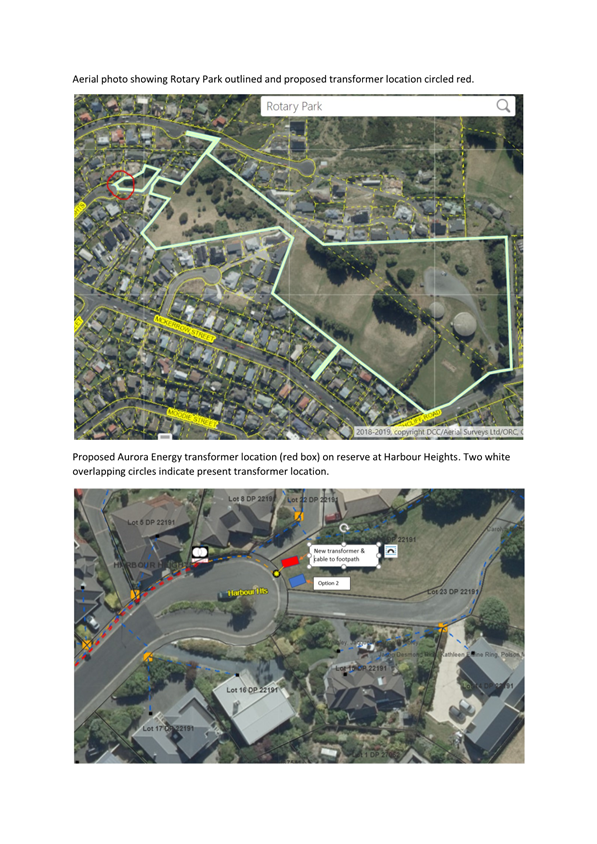
|
|
Council
25 September 2023
|
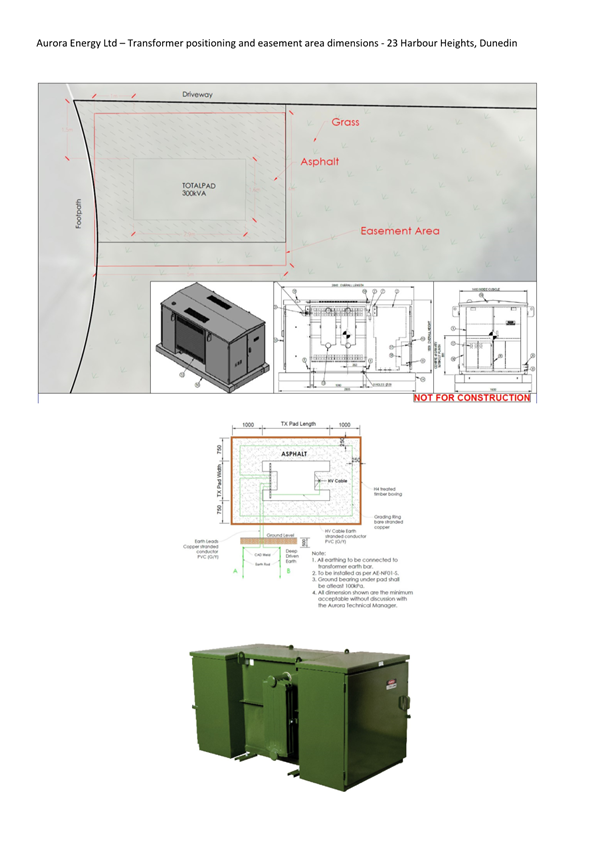
|
|
Council
25 September 2023
|
Appointment of Deputy Mayor and Other
Appointments
Department: Civic
EXECUTIVE SUMMARY
1 Following
the resignation of Cr Sophie Barker as Deputy Mayor, this report provides
Councillors with my choice for a new Deputy Mayor. It notes an update to
the membership of the Audit and Risk Subcommittee and also a change in Councillor
appointment on the Local Government NZ Zone 6 Committee.
2 As
this is an administration report, there are no options or summary of
considerations.
RECOMMENDATIONS
That the Council:
a) Notes the appointment of Cr Cherry Lucas as Deputy Mayor.
b) Amends the membership of the Audit and Risk Subcommittee to remove
Cr Sophie Barker.
c) Approves the appointment of Cr Cherry Lucas as a
Councillor representative on the Local Government NZ Zone 6 Committee.
DISCUSSION
Deputy Mayor
3 Section
41A of the Local Government Act 2002 (the Act) provides the Mayor with the
powers to:
· Appoint
the Deputy Mayor
· Establish
Council Committees and
· Appoint
Chairs and Deputy Chairs to those Council Committees.
4 I
am exercising the powers provided by the Act, and I appoint Cr Cherry Lucas as
Deputy Mayor.
Audit and Risk Subcommittee
5 The
Committee Structure and Delegations Manual provides that the membership of the
Audit and Risk Subcommittee is made up of:
· Chair of Finance
and Council Controlled Organisations Committee
· Deputy Chair of
Finance and Council Controlled Organisations Committee
· The Mayor (ex
officio)
· The Deputy Mayor
· Warren Allen and
Janet Copeland (Independent Members)
· Cr
Christine Garey
6 The
Audit and Risk Subcommittee has an extra Councillor member (Cr Garey) for
continuity, as she was the only existing councillor who had previously been a
member.
7 I
note that Cr Lucas now holds both the Deputy Mayor and Deputy Chair of Finance
and Council Controlled Organisations Committee positions on this
Subcommittee. I propose that Cr Barker is not replaced as a member
on the Audit and Risk Subcommittee.
Other Appointments
8 At
its meeting on 8 November 2022, Council approved the following appointments to
Local Government NZ Zone 6 :
· Mayor
Radich
· Cr
Barker
· Cr
Gilbert
9 Cr
Barker was appointed because she was the Deputy Mayor. I recommended that
Cr Lucas, as the new Deputy Mayor, replace Cr Barker as a representative on
Local Government NZ Zone 6.
Signatories
|
Authoriser:
|
Jules Radich - Mayor
|
Attachments
There are no attachments for
this report.
|
|
Council
25 September 2023
|
Elected Member Remuneration 2023/24
Department: Civic
EXECUTIVE SUMMARY
1 The
Local Government Act 2002 (the Act) gives the Remuneration Authority (the
Authority) the responsibility for setting remuneration for local government
elected members.
2 The
Authority allocates a governance pool (the pool) to each council. The
pool provides the total amount that can be paid in remuneration to councillors,
excluding the Mayor, whose remuneration has been determined directly by the
Authority.
3 A
remuneration proposal for the 2022 – 2025 triennium was approved by the
Authority in February 2023. With the resignation of Cr Barker as Deputy
Mayor on 11 September 2023 and the appointment of Cr Lucas as the new Deputy
Mayor on 12 September 2023, a new remuneration proposal is now needed for the
period from 25 September 2023 (being the date of a Council resolution) to 30
June 2024.
4 This
paper presents a revised remuneration pool allocation for approval.
RECOMMENDATIONS
That the Council:
a) Approves remuneration of $106,241 for the Deputy
Mayor from 25 September 2023 to 30 June 2024.
b) Approves remuneration of $90,144 for Chairs of
Standing Committees from 25
September 2023 to 30 June 2024.
c) Approves remuneration of $77,266 for Deputy Chairs from 25 September 2023 to 30 June 2024.
d) Approves remuneration of $72,759 for Councillors
with not additional responsibilities from 25 September 2023 to 30 June 2024.
BACKGROUND
5 The
Authority has allocated a remuneration pool that is made up of a base pay for
each councillor, and a pool for remunerating additional responsibilities.
6 The
pool for the DCC councillors, excluding the Mayor is $1,191,826.00.
7 At
is meeting on 13 December 2022, Council approved a proposed allocation of the
remuneration pool, and this was approved by the Authority, gazetted and a determination
made in February 2023.
8 On
11 September 2023, Cr Barker resigned as Deputy Mayor, and on 12 September, the
Mayor appointed Cr Lucas to the Deputy Mayor position.
DISCUSSION
9 The
change in Deputy Mayor has meant that Cr Barker is moving from the Deputy Mayor
position to a Chair position, and Cr Lucas moves to the Deputy Mayor position,
while retaining her Deputy Chair role.
10 These
changes result in the need to reallocate the remuneration pool. If a
revision is not made and Councillors continue to get paid at the current
allocation rates, the remuneration paid to 30 June 2024 would exceed the pool
of $1,191,826.00, and this is not permitted under the Act.
11 A
revised calculation, along with the current allocation is shown in the table
below.
|
Position
|
Number
|
Current Allocation
|
Proposed Numbers
|
Proposed Revised
Allocation
|
Difference Inc
(Dec)
|
|
Deputy Mayor
|
1
|
$110,475
|
1
|
$106,241
|
($4,234)
|
|
Chairs
|
6
|
$90,979
|
7
|
$90,144
|
($835)
|
|
Deputy Chairs
|
5
|
$77,982
|
4
|
$77,266
|
($716)
|
|
Councillor
|
2
|
$72,783
|
2
|
$72,759
|
($24)
|
12 The
proposed reduction in the Deputy Mayor’s remuneration reflects the fact
that the new Deputy Mayor holds a Deputy Chair position, while the former
Deputy Mayor held a Chair’s position.
13 If
Council approves the revised calculation, staff will forward it, along with the
resolution passed to the Authority for approval. If approved, it will go
forward for determination to be made in mid-October.
14 Once
a determination is made, amendments will be made to Councillor’s pays,
backdated to 25 September 2023.
OPTIONS
15 The
Council cannot exceed the remuneration pool of $1,191,826, and therefore has no
option but to revise the current allocation. Council is free to consider
alternative options for allocating the pool, but any alternative must ensure
that the pool is fully allocated, and not exceeded.
16 The
minimum that can be paid to members is approximately $72,750 as per previous
advice from the Remuneration Authority. This limits options.
NEXT STEPS
17 The
approved remuneration will be forwarded to the Authority for approval, and for
a new determination to be made.
Signatories
|
Author:
|
Sharon Bodeker - Manager Governance
|
|
Authoriser:
|
Sandy Graham - Chief Executive Officer
|
Attachments
There are no attachments for
this report.
|
|
Council
25 September 2023
|
Proposed Event Road Closures - October to
December 2023
Department: Transport
EXECUTIVE SUMMARY
1 The
DCC has received temporary road closure applications relating to the following
events:
a) Rainbow
Run
b) 2023
Dunedin Primary and Intermediate Schools Triathlon
c) 2023
Green Island Market Day
2 This
report recommends that Council approves the temporary closure of the affected
roads.
RECOMMENDATIONS
That the Council:
a) Resolves to close the roads detailed below (pursuant to Section
319, Section 342, and Schedule
10 clause 11(e) of the Local Government Act 1974):
i) Rainbow
Run
Dates and Times:
Sunday 15
October 2023, from 11.00am to 12.30pm
Roads:
· Logan
Park Drive from Union Street East to Butts Road
ii) 2023
Dunedin Primary and Intermediate Schools Triathlon
Dates and Times:
Wednesday 1
November 2023, from 8.00am to 2.00pm, with contingency date being 3 November
2023
Roads:
· Albertson
Avenue, full length
· Wickliffe
Terrace, from Mary Street to Laing Street
· Victory
Place, full length
· Peninsula
Beach Road, full length
iii) 2023
Green Island Market Day
Date and Times:
Saturday 2
December 2023, from 7.00am to 3.00pm
Roads:
· Main
South Road Green Island, from Howden Street to Church Street
· Jenkins
Street, from Main South Road to Shand Street
BACKGROUND
3 Events
support Council’s 10 Year Plan goal of a successful city with a diverse,
innovative, and productive economy and a hub for skill and talent. They
also contribute to the Festival and Events Plan 2018-2023.
4 The
area proposed to be used for these events is legal road and can therefore be
temporarily closed to normal traffic if statutory temporary road closure
procedures are followed. The procedures are set out in Section 319 of the LGA
1974 and give Council the power to stop or close any road (or part of a road)
within the parameters of Section 342 and Schedule 10 of the LGA 1974 (Schedule
10 is included as Attachment A).
5 These
procedures include:
· Consultation
with Waka Kotahi (New Zealand Transport Agency) and the Police.
· Public
notice being given of the proposal to close any road (or part of a road), and
public notice of a decision to close the road.
· Council
being satisfied that traffic is not likely to be unreasonably impeded.
6 A
resolution of Council is required where a proposal to temporarily close a road
relates to public functions.
7 Council
is required to give public notice of its decision. This notice will be
published after this meeting and prior to the event, if approved.
DISCUSSION
Consultation and Notification
8 The
Police and Waka Kotahi have no objections to the proposed road closure.
9 On
Saturday 19 August 2023, the proposed temporary road closure was advertised in
the Otago Daily Times (Attachment B) with a deadline for feedback.
10 The
event organisers contacted those considered affected prior to submitting their
application, and no objections were received.
11 Schedule
10 section 11(e) states a road cannot be closed more than 31 days in the
aggregate in any one year. This limit will not be exceeded by the
approval of the proposed temporary road closures.
Traffic Impacts
12 The
location of these events has have had identical road closures for the same, or
similar event (s) in prior years without causing unreasonable delays to the
travelling public.
13 Emergency
Services and Public transport services will be managed through the temporary
traffic management process.
14 The
temporary traffic management plan process ensures that other issues such as
temporary relocation of certain parking (e.g. taxi, mobility and Authorised
Vehicles only) are managed.
OPTIONS
15 Any
amendment to this report’s recommendations cannot be implemented without
further consultation with the affected parties, Waka Kotahi, the Police, and
verifying that traffic impacts are acceptable.
Option
One – Recommended Option
16 That
the Council closes the sections of road as recommended in this report.
Advantages
· The
roads will be able to be closed and the event will be able to proceed.
· The
closure will assist in realising the economic, social, and cultural benefits
associated with the event.
Disadvantages
· There
will be temporary loss of vehicular access through the closed areas.
However, there are detours available, and safety can be assured using temporary
traffic management.
Option
Two – Status Quo
17 That
the Council decides not to close the roads in question.
Advantages
· There
would be no detour required for travelling public, and the roads would be able
to be used as normal.
Disadvantages
· The
events would not be able to go ahead, and the benefits of the events would be
lost.
NEXT STEPS
18 Should
the resolution be made to temporarily close the roads, Council staff will
accept the temporary traffic management plans for the events and notify the
public of the closures.
Signatories
|
Author:
|
Leesa Seatter - Personal Assistant/Administration Team
Leader - Transport
Vanessa Dalton - Network Assets Team Leader
|
|
Authoriser:
|
Jeanine Benson - Group Manager Transport
David Ward - Acting General Manager Infrastructure and
Development
|
Attachments
|
|
Title
|
Page
|
|
⇩a
|
Local Government Act
1974, Schedule 10
|
368
|
|
⇩b
|
ODT Advert - 19 August
2023
|
373
|
|
SUMMARY OF CONSIDERATIONS
|
|
Fit with purpose
of Local Government
This decision promotes the social and
economic well-being of communities in the present and for the future.
|
|
Fit with strategic
framework
|
|
Contributes
|
Detracts
|
Not applicable
|
|
Social Wellbeing Strategy
|
☒
|
☐
|
☐
|
|
Economic Development Strategy
|
☒
|
☐
|
☐
|
|
Environment Strategy
|
☐
|
☐
|
☒
|
|
Arts and Culture Strategy
|
☒
|
☐
|
☐
|
|
3 Waters Strategy
|
☐
|
☐
|
☒
|
|
Spatial Plan
|
☐
|
☐
|
☒
|
|
Integrated Transport Strategy
|
☐
|
☐
|
☒
|
|
Parks and Recreation Strategy
|
☐
|
☐
|
☒
|
|
Other strategic projects/policies/plans
|
☒
|
☐
|
☐
|
Events contribute to the Strategic Framework. Events
contribute to the Economic Development Strategy, the Social Wellbeing Strategy.
There is a Festival and Events Plan 2018-2023.
|
|
Māori Impact
Statement
Mana whenua have not been directly engaged with in
relation to these road closures.
|
|
Sustainability
There are no implications for sustainability.
|
|
LTP/Annual Plan / Financial
Strategy /Infrastructure Strategy
There are no implications, the decision is a regulatory
one and there are no direct costs to Council.
|
|
Financial
considerations
There are no financial implications. The cost of the
proposed road closure is not a cost to Council.
|
|
Significance
This decision is considered low in terms of the
Council’s Significance and Engagement Policy.
|
|
Engagement –
external
There has been external engagement as required by the LGA
1974, with the Police and Waka Kotahi. Affected parties were notified and
provided a time period for feedback.
|
|
Engagement -
internal
There has been engagement with DCC Events, In-House Legal,
and Transport. There is support for the event to proceed.
|
|
Risks: Legal /
Health and Safety etc.
There are no identified risks should the recommended
resolution be made.
|
|
Conflict of
Interest
There are no known conflicts of interest.
|
|
Community Boards
There are no implications for Community Boards.
|
|
|
Council
25 September 2023
|
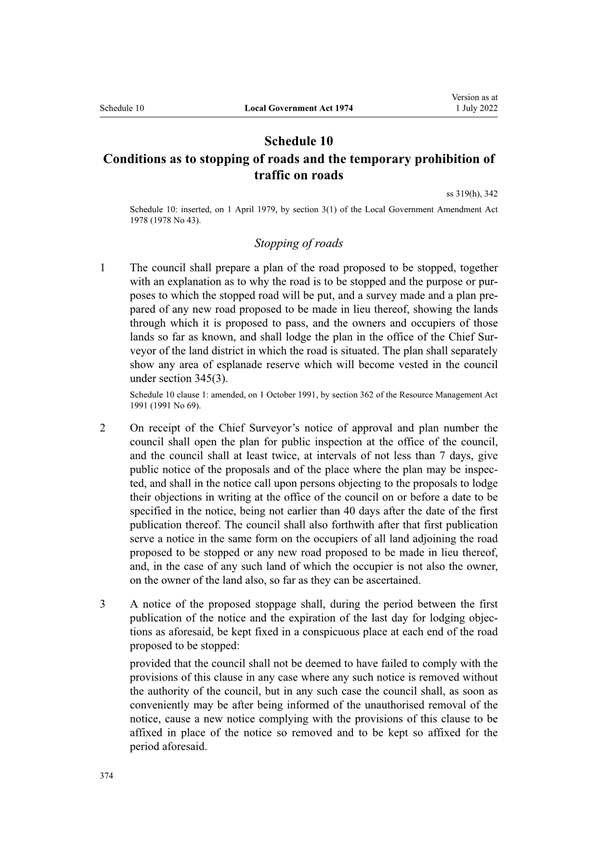
|
|
Council
25 September 2023
|
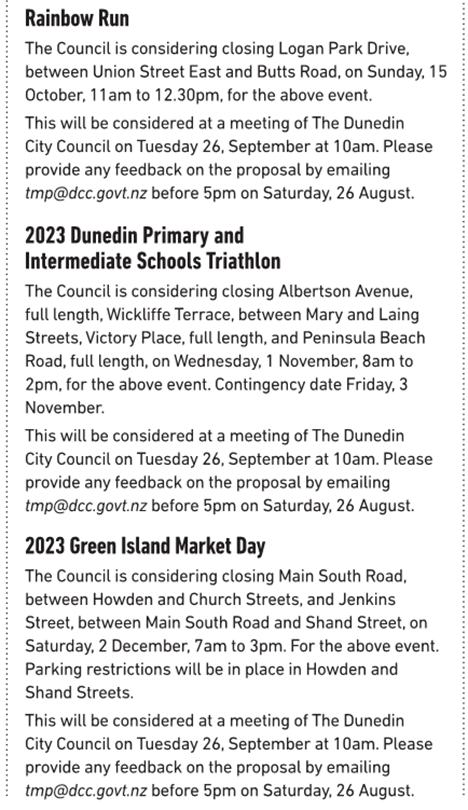
|
|
Council
25 September 2023
|
Te Taki Haruru - Māori Strategic
Framework
Department: Corporate Policy
EXECUTIVE SUMMARY
1 This
report seeks the adoption of the draft Te Taki Haruru - Māori Strategic
Framework.
2 The
key purpose of the Te Taki Haruru is to provide a framework to operationalise
the Treaty of Waitangi partnership between mana whenua and Council. It
establishes te ao Māori (Māori world view) aspirations that will
guide the Dunedin City Council’s (DCC) contribution to Māori
wellbeing across Ōtepoti Dunedin.
3 The
development of Te Taki Haruru is an important strategic step in strengthening
Council’s Treaty of Waitangi partnership with mana whenua.
RECOMMENDATIONS
That the Council:
a) Adopts Te Taki Haruru- Māori Strategic Framework 2023.
b) Delegates authority to the Chief Executive Officer
to incorporate minor editorial amendments.
c) Notes that the next steps include:
i. finalising the design and production of a
public facing version of Te Taki Haruru- Māori Strategic Framework
ii. finalising the implementation plan to that
will sit alongside Te Taki Haruru
BACKGROUND
5 The
Local Government Act (LGA) 2002 recognises and respects the Crown’s
obligations under the Treaty of Waitangi by placing some specific obligations
on local authorities. These obligations are intended to facilitate
participation by Māori in local authorities’ decision-making
processes. The LGA (2002) charges local authorities with a clear responsibility
to take an informed approach to how decision-making can benefit the social,
cultural, economic and environmental well-being of the Māori community.
6 For
many years the DCC and mana whenua have been on long journey towards more
meaningful partnership. Over the years, the DCC’s partnership has been
expressed in a number of ways across a number of platforms. Some of these have
included a 2003 relationship protocol agreed between Kai Tahu ki Otago and DCC;
a 2006 Memorandum of Understanding agreed between Kā Rūnaka and DCC;
the 2006 establishment of the Māori Participation Working Party and the
2019 operational agreement between Aukaha Ltd and the DCC.
7 In
2020 as part of the early stages of developing the strategic refresh work
programme, the DCC commissioned consultants Harrison Grierson to provide an
evaluation of the existing strategic framework. The primary aim of the
evaluation was to undertake a high level stocktake of the current strategic
framework. A key objective was to improve alignment between core strategies and
enable DCC to give greater effect to the principles of the Treaty of Waitangi
and sustainability.
8 The
evaluation included analysis of the framework itself, DCC staff and Councillor
feedback, a survey of existing governance groups and mana whenua feedback.
9 Feedback from key mana whenua representatives on the existing DCC
strategic framework included potential improvements to Treaty of Waitangi
commitments; considerations for governance arrangements; embedding
Māori-focused outcomes in future strategies and other opportunities around
capturing and using Māori related data to inform decision making.
10 The
Harrison Grierson report (2020) provided an analysis of the DCC’s
existing strategic framework with a focus on DCC’s commitments to the
Treaty of Waitangi across all strategies. The analysis found that:
· there
was no overarching Treaty of Waitangi approach applied equally to all strategies
· there
was a lack of clarity on how existing strategic commitments to the Treaty of
Waitangi were intended to be delivered and how successful delivery and outcomes
were intended to be measured
· there
was a lack of clarity for a formal structure for the partnership between DCC
and mana whenua to develop
· there
was no overarching strategic direction from a mana whenua perspective
· there
was no overarching alignment between strategies, particularly around common
language, clear priorities and directions, and clear recording and measurement
11 The
Harrison Grierson report (2020) together with mana whenua feedback provided a
clear pathway to progress work on delivering clarity and direction for
Council’s commitment to the Treaty of Waitangi. The work has focused
on developing three key areas, Māori Partnerships, Māori Strategy and
Māori Success.
12 Significant developments have occurred in recent years, these
include:
· 2021:
the establishment of Kā Rūnaka representative positions on two
Council committees
· 2022: the signing of the Manatu Whakaaetaka Relationship
Agreement, a refreshed Memorandum of Understanding between the DCC and mana
whenua. The intended outcome of this Agreement
is to facilitate a relationship of mutual benefit between Kā Rūnaka
and the DCC, in order to produce meaningful outcomes for current and future
generations of mana whenua, mātāwaka and all citizens of Dunedin
· 2022:
the establishment of Te Pae Māori, a mana to mana forum. The intended
outcome of Te Pae Māori is to bring all of Council, mana whenua and
mātāwaka together to advance shared aspirations and respect, to
acknowledge one another’s roles and responsibilities and uphold each
other’s obligations under the Treaty of Waitangi
13 Te
Taki Haruru is the next important strategic step in strengthening
Council’s Treaty of Waitangi partnership with mana whenua and Māori.
DISCUSSION
Development of Te Taki Haruru
Three phases of work guided the approach
to developing Te Taki Haruru:
14 Phase
one. Information Gathering and Research: Over 2021 a series of online hui
were held with Māori colleagues from other Councils to discuss the
development of Māori strategic frameworks within a local government
context. Research was undertaken on Māori strategic frameworks; Māori
wellbeing models and implementation plans, and Māori wellbeing research
was conducted to understand the broader Māori wellbeing context and how
this can be applied to Ōtepoti Dunedin.
15 Phase
two. Engagement with mana whenua and Māori: Over 2022 a series of
co-design hui were held with mana whenua and representatives from the wider
Māori community in Ōtepoti Dunedin. The
co-design hui were based in a Kaupapa Māori methodology, a methodology
that is founded in matauraka Māori (Māori knowledge) and reflects a
te ao Māori (Māori world) view. These initial discussions focussed on
what a te ao Māori vision could look like to enable thriving Māori
communities. This engagement was an important starting point to explore
Māori concepts of wellbeing across a values inspired framework
16 Phase
three. Develop Māori Strategic Framework: Over 2022 and 2023
the framework was developed. Staff sought further feedback, guidance and
contributions internally, engaging again with mana whenua and Māori. In
recent months staff have presented high level presentations of the draft
Māori Strategic Framework to each marae community, Ōtākou, Kāti
Huirapa ki Puketeraki and Araiteuru, Te Pae Māori, Mayor and Councillors,
the DCC Executive Leadership team and the Wider Leadership Team.
17 The
result of these three phases of work is that mana whenua, Māori and
Council have collectively developed a strategic framework that envisions a
thriving future for mana whenua and Māori in Ōtepoti Dunedin that is
founded in Māori knowledge and Treaty of Waitangi partnership.
Structure of Te Taki Haruru
18 Te
Taki Haruru is the name gifted to the DCC’s Māori Strategic
Framework by mana whenua. Taki Haruru is the original name for Pilots Beach, a
historical site where the Treaty of Waitangi was signed on June 13 1840 by
chiefs Korako and Karetai.
19 In
Māori, taki translates as ‘to cry’ and haruru
‘to roar’. Takiharuru (Pilots Beach) is named because of the
roar of the ocean. In the context of the strategic framework, the name Te Taki
Haruru is a metaphor that connects Ōtepoti Dunedin residents to the past,
to the place where the Treaty was signed and like the constant roar of the
ocean, is a constant reminder of our Treaty of Waitangi relationship.
20 Te
Taki Haruru imagery depicts Ōtepoti Dunedin, from the mountains to the
harbour with prominent landmarks visible. The image views the city from the
ocean looking into the Ōtākou Harbour. Takiharuru (Pilots Beach) sits
at the front of this image at the Harbour entrance. (See Figure 1.)

Figure 1. Te Taki Haruru image design
depicting Ōtepoti Dunedin.
21 
Te Taki Haruru design represents Important cultural landmarks found in Ōtepoti
Dunedin and provides the inspiration for the overarching principles and values.
Each quadrant of the design represents a principle and the value connected with
it. (See Figure 2.)
Figure 2. Te Taki Haruru
design representing important cultural landmarks, principles and values.
22 Vision:
Kaika Ōtepoti, Kaika Oraka - a thriving home, a thriving
village, sits at the heart of Te Taki Haruru and reimagines a Māori
wellbeing vision for Ōtepoti Dunedin. Aligning with the DCC vision that Dunedin
is one of the world’s great small cities – the Te Taki Haruru
vision acknowledges one of the beauties of Ōtepoti Dunedin - that it is
small enough to still operate like a village.
23 Principles
and Values: The four key principles and key values of Taki Haruru are
outlined here:
· Autūroa,
refers to the concept and practice of mana and the longivity of
ongoing influence and leadership in the community
· Auora,
refers to the concept and practice of mauri and the health and wellbeing
of people, land and waterways
· Autaketake refers to the concepts of tapu and noa and the
protection of resources, people and particular areas that enable us to live
sustainable lives
· Autakata refers to concept and practice of whakapapa and the connection of people and place through genealogies,
relationships, reciprocity and respect
24 
Te Taki Haruru is structured around a series of interconnecting principles,
values, key intents, key directions and four well beings. This values based wellbeing
framework is depicted below in Figure 3.
Figure 3. Te Taki Haruru – a values based wellbeing
framework.
Implications of Te Taki Haruru
25 Te
Taki Haruru is a values-based wellbeing framework that embodies a Treaty of
Waitangi partnership that is based on a long standing and ongoing relationship
between mana whenua, Māori and Council. It establishes a vision and
foundational principles and values by which the DCC can give effect to its
commitment to the Treaty of Waitangi across DCC work.
26 Te
Taki Haruru has a matauraka Māori (Māori knowledge) foundation and
reflects a te ao Māori (Māori world) view of wellbeing.
27 Te
Taki Haruru establishes new ways of working together, strengthening our
relationships, and supporting whānau to thrive. Whānau wellbeing is
central to the framework, and it focusses on establishing the conditions for
whānau to thrive.
28 Te
Taki Haruru reflects and is consistent with the recent commitments that Council
has with mana whenua - the Manatu Whakaaetaka Relationship Agreement - a
refreshed Memorandum of Understanding between the DCC and mana whenua signed in
2022 and the establishment of Te Pae Maori, a mana to mana forum for all Councillors,
mana whenua and Māori.
29 Te
Taki Haruru sets the platform for DCC’s action on Māori wellbeing
and provides a framework for Council, mana whenua and Māori to achieve the
aspirations outlined in this strategic framework.
30 Te
Taki Haruru is a focused strategy that intentionally supports the enabling
conditions for Māori intergenerational cultural,
social, economic and environmental wellbeing.
31 An implementation plan is being developed that will sit
alongside this strategic framework and outline the range of activities and
initiatives across Council business units that will deliver on Te Taki
Haruru’s vision. The implementation plan will also detail how the actions
will be measured, evaluated and monitored to deliver on Te Taki Haruru outcomes.
32 A Te Taki Haruru implementation plan will be presented to
Council.
33 The
financial investment in the delivery of actions and initiatives to achieve
outcomes of Te Taki Haruru will be met within the existing Annual Plan/
Long-term Plan budgets.
OPTIONS
OPTION One: REcommended option - Adopt TE TAKI
HARURU- Māori Strategic Framework
Advantages
· Opportunity
to give effect to the DCC’s ongoing commitment to the Treaty of Waitangi
· Opportunity
to progress meaningful partnership with mana whenua and mātāwaka
· Opportunity
to create a foundational strategic platform that intentionally supports the enabling
conditions for Māori intergenerational cultural, social, economic and
environmental wellbeing.
· Opportunity
to celebrate the unique history of Ōtepoti Dunedin
Disadvantages
· There
are no identified disadvantages for this option.
OPTION
TWO: DO NOT ADOPT TE TAKI HARURU- MĀORI STRATEGIC FRAMEWORK
Advantages
· There
are no identified advantages for this option.
Disadvantages
· Missed
opportunity to give effect to the DCC’s ongoing commitment to the Treaty
of Waitangi.
· Missed
opportunity to consolidate and strengthen relationships built with mana whenua
and mātāwaka, key stakeholders and communities across Dunedin through
the development of Te Taki Haruru
· Missed
opportunity to create a foundational strategic platform that intentionally
supports the enabling conditions for Māori intergenerational cultural,
social, economic and environmental wellbeing.
· Missed
opportunity to celebrate the unique history of Ōtepoti Dunedin
NEXT STEPS
35 If
Council adopts Te Taki Haruru (staff will:
· Finalise
the design and production of a public facing version of Te Taki Haruru-
Māori Strategic Framework. The final document will be published on the DCC
website and distributed to mana whenua, key stakeholders and communities.
· Finalise the implementation plan that will sit alongside Te
Taki Haruru and outline the range of activities and initiatives across Council
business units that will deliver on Te Taki Haruru’s vision. The
implementation plan will also detail how the actions will be measured,
evaluated and monitored to deliver on Te Taki Haruru outcomes.
36 If
Council does not adopt the Te Taki Haruru staff will work with Council to
clarify direction going forward.
Signatories
|
Author:
|
Nicola Morand - Manahautū (General Manager Māori
Partnerships and Policy)(Acting)
|
|
Authoriser:
|
Jeanette Wikaira - General Manager Community Services
(Acting)
Sandy Graham - Chief Executive Officer
|
Attachments
|
|
Title
|
Page
|
|
⇩a
|
Te Taki Haruru - Maori
Strategic Framework Draft
|
384
|
|
SUMMARY OF CONSIDERATIONS
|
|
Fit with purpose
of Local Government
This decision provides opportunities for
Māori to effectively contribute to Council’s decision-making
processes and consider ways in which Council can foster the development of
Māori capacity. This decision enables democratic local decision making
and action by, and on behalf of communities.
This decision promotes the social
well-being, economic well-being, environmental and cultural well-being of
communities in the present and for the future.
|
|
Fit with strategic
framework
|
|
Contributes
|
Detracts
|
Not applicable
|
|
Social Wellbeing Strategy
|
☒
|
☐
|
☐
|
|
Economic Development Strategy
|
☒
|
☐
|
☐
|
|
Environment Strategy
|
☒
|
☐
|
☐
|
|
Arts and Culture Strategy
|
☒
|
☐
|
☐
|
|
3 Waters Strategy
|
☒
|
☐
|
☐
|
|
Spatial Plan
|
☒
|
☐
|
☐
|
|
Integrated Transport Strategy
|
☒
|
☐
|
☐
|
|
Parks and Recreation Strategy
|
☒
|
☐
|
☐
|
|
Other strategic projects/policies/plans
|
☒
|
☐
|
☐
|
This report directly relates to all areas of the
DCC’s Strategic Framework and strategies, as it acknowledges the role
of Māori representation in Council decision-making
processes and the role of the Treaty of Waitangi in developing effective
partnership with Māori.
|
|
Māori Impact
Statement
Mana whenua and mātāwaka
perspectives have directly informed this report. Rūnaka
and Araiteuru Marae representatives have collaborated
in meetings and Discussion that form the content of this report.
|
|
Sustainability
This report is in line with the Sustainability principal
of the strategic framework, as it discusses relation agreements with
Māori regarding leadership, decision-making, participation, and
effective partnership.
|
|
LTP/Annual Plan /
Financial Strategy /Infrastructure Strategy
The development of Te Taki
Haruru is expected to bring greater visibility and clarity as to how
current and future corporate planning functions (encompassing long term plans
and associated statutory strategies, levels of service and performance
measures) are supporting DCC strategic goals, the Treaty of Waitangi as well
as meeting statutory requirements.
|
|
Financial
considerations
The
financial investment in the delivery of actions and initiatives to achieve
the outcomes of Te Taki Haruru will be met within the existing Annual Plan/
Long-term Plan budgets.
|
|
Significance
This report is considered to be of low significance in
terms of the Significance and Engagement Policy
|
|
Engagement –
external
There has been considerable engagement with mana whenua
and mātāwaka in the development of this report.
|
|
Engagement -
internal
Councillors and staff have been engaged in the development
of this report.
|
|
Risks: Legal /
Health and Safety etc.
There are no known legal or Health and Safety risks.
|
|
Conflict of
Interest
There are no known conflicts of interest.
|
|
Community Boards
The development of Te Taki
Haruru is expected to bring greater visibility and clarity as to how
Council upholds their commitment to the Treaty of Waitangi. Te Taki Haruru
may also support Community Boards in their work with their local communities.
|
|
|
Council
25 September 2023
|
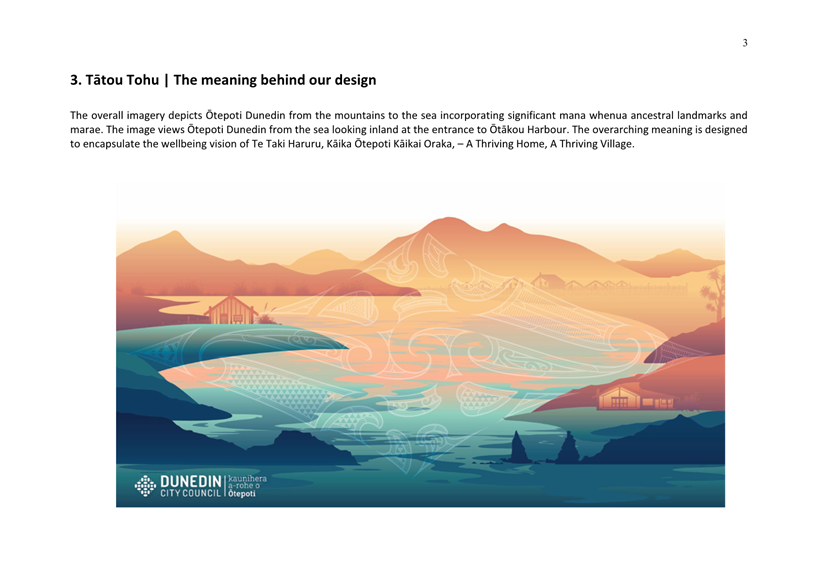
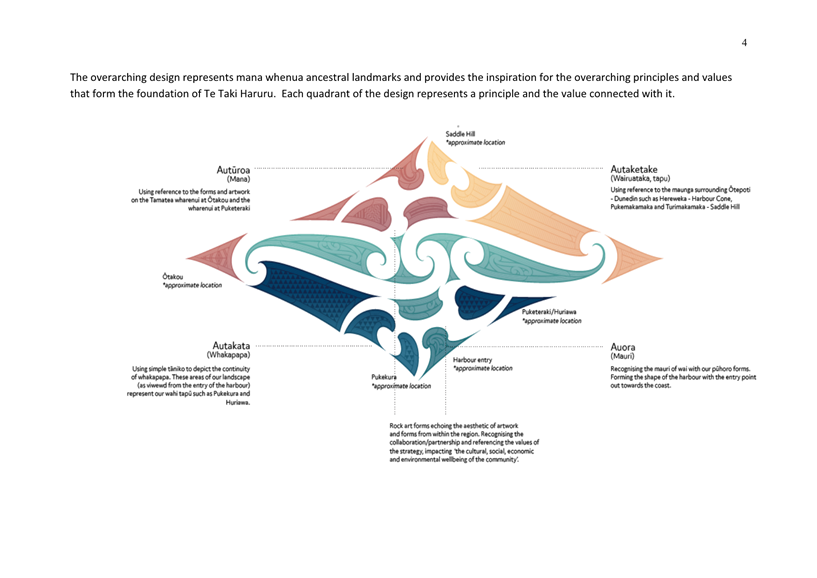
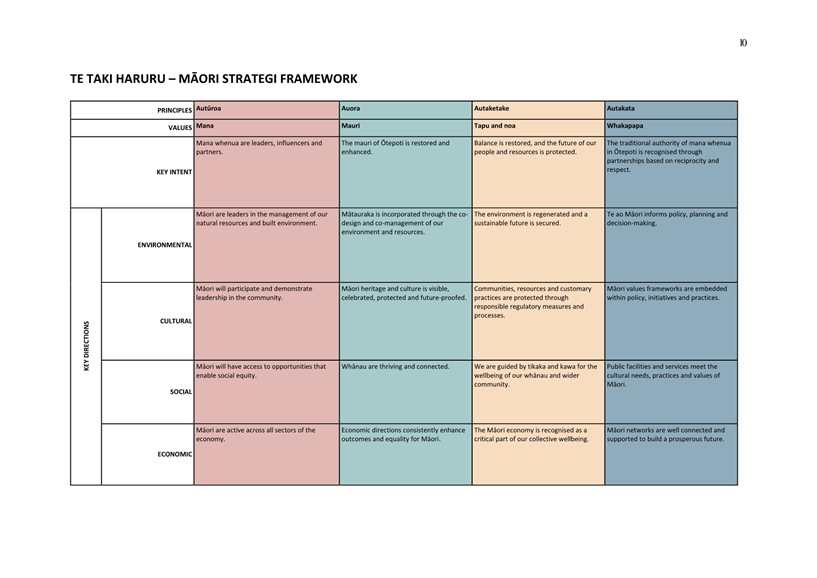
|
|
Council
25 September 2023
|
Sustainability Framework Update - City
Portrait and United Nations Sustainability Development Goals
Department: Corporate Policy
EXECUTIVE SUMMARY
1 The
purpose of this report is to:
a) Provide
an update to Council on the development of the City Portrait for adaptation for
a Dunedin context.
b) Respond
to Council’s request to present information on the United Nations
Sustainable Development Goals (SDGs).
c) Provide
a high level comparative analysis between two sustainability frameworks, the
City Portrait and the SDGs.
2 In
September 2020, Council considered three sustainability frameworks, including
the SDGs, and approved development of the City Portrait for adaptation for a
Dunedin context.
3 Work
on Dunedin’s City Portrait has been undertaken. Staff worked with the
Planetary Accounting Network (PAN) to obtain a current snapshot of the
city’s ecological impacts on the planet in relation to the Ecological
Ceiling component of the City Portrait.
4 A
stocktake informed the development of a draft of Dunedin’s Ecological
Ceiling, which graphically demonstrates Dunedin’s ecological impact. This
marks a first important milestone in the development of the City Portrait,
which is designed to be iterative through working with partners, stakeholders
and communities.
5 Information
related to the SDGs and City Portrait is summarised along with a high-level
analysis of strengths and weaknesses related to each.
6 A
key point is that the SDGs and City Portrait are not entirely distinct. They
each represent different approaches to supporting sustainability at different
geographical scales, with the latter specifically designed for cities.
RECOMMENDATIONS
That the Council:
a) Notes the sustainability framework update report.
BACKGROUND
7 The
Dunedin City Council’s (DCC’s) Strategic Framework is underpinned
by a commitment to the Treaty of Waitangi and sustainability.
8 Originally,
a vision for ‘Sustainable Practice’ at the DCC was adopted in 2009
for use in the 10 year plan (10YP), in response to community feedback. In 2012,
the concept of sustainability became a guiding principle across the DCC’s
Strategic Framework.
9 In
2019, an internal review focussed on understanding sustainability and the
application of sustainable practice across the DCC identified that there was
ambiguity in its interpretation due to the absence of a formal definition or
framing of sustainability.
10 In
2020, the DCC decided to refresh its Strategic Framework. As a first step in
the Strategic Framework Refresh, consultants Harrison Grierson undertook an
initial high-level stocktake of the existing framework. It was considered that
a clearer representation of the sustainability guiding principle (along with
that of the Treaty of Waitangi) would be helpful in the refresh of the
Strategic Framework.
11 On
29 September 2020, Council approved the development of the City Portrait from
three sustainability frameworks presented for Council’s consideration.
The other two options were New Zealand Treasury’s Living Standards
Framework and the SDGs. The Council resolved as follows:
Moved (Cr Steve
Walker/Cr Christine Garey):
That the
Council:
a) Considers the
sustainability frameworks set out in the report, and
b) Approves development of the
City Portrait framework for development and adaptation.
Division
The Council
voted by division:
For: Crs
Sophie Barker, David Benson-Pope, Christine Garey, Doug Hall, Mike Lord, Jim
O'Malley, Chris Staynes, Steve Walker and Mayor Aaron Hawkins (9).
Against: Crs
Rachel Elder, Jules Radich, Lee Vandervis and Andrew Whiley (4).
Abstained:
Nil
The division was declared CARRIED by 9 votes to 4
Motion carried (CNL/2020/072)
12 Key
reasons for supporting the development of the City Portrait over the SDGs and
Living Standards Framework included:
· more
user-friendly and easier for wider community to engage with
· conceptually
stronger
· built
on the SDGs, offering a way to adapt the SDGs to a local context to reflect
local situations
· a
better visualisation tool to graphically show the progress made in taking care
of people and the planet
· better
reflection of the DCC’s responsibilities for the entire city.
13 The
Harrison Grierson report (2020) recommended development of the City Portrait
and a framework with mana whenua to give effect to DCC’s commitments to
the Treaty of Waitangi. The conceptual relationships are visually represented
in Figure 1.
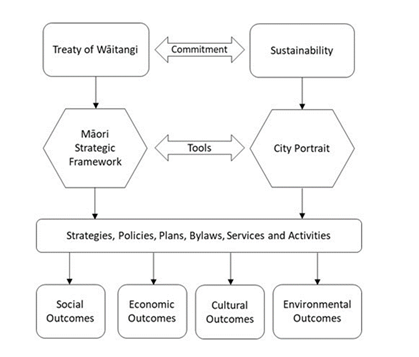
Figure 1. A visual representation of how DCC's commitment
to the Treaty of Waitangi and Sustainability are to be given effect to by
Māori Strategic Framework and the City Portrait.
14 A
strategic approach to delivering on Māori aspirations in relation to the
Treaty of Waitangi is through the development of Te Taki Haruru - Māori
Strategic Framework. It is envisaged that this will positively contribute to
DCC’s strategies, policies, plans, and culture in a way that is
meaningful and affirming of the Treaty of Waitangi, while also benefiting all
residents in Ōtepoti Dunedin.
15 Progress
to date on the development of the City Portrait is provided below, including
the development of a draft of the Ecological Ceiling component of the City
Portrait. Although not yet complete, the work represents Council’s journey
in understanding Dunedin’s ecological state and its ecological
performance relative to global limits.
CITY PORTRAIT PROGRESS
UPDATE
What is the City Portrait?
16 The
City Portrait measures a city’s social and ecological state relative to
global limits. One important fact to note is that the social part of the City
Portrait is represented by minimum standards of living for humanity, and these
are drawn from the SDGs.
17 A
draft City Portrait has been developed with assistance from The Planetary
Accounting Network (PAN) (for more information, view PAN's website), which helped
apply the City Portrait to a Dunedin context. This produced a draft doughnut of
Dunedin's Ecological ‘picture’ (Figure 4). Staff also proposed to
apply the DCC’s wellbeing strategies to describe Dunedin’s social
foundation, as they have strong synergies with the SDGs and existing reporting and governance functions. This is fully
discussed in a separate report on ‘Strategic Refresh Update and Wellbeing
Strategies.
The City Portrait and Doughnut Economics
Figure 2. The classic image of the Doughnut Economics
model of Social Foundation and Ecological Ceiling (Source: Doughnut Economics
Action Lab)
18 The
City Portrait uses the theory of Doughnut Economics which was developed by
economist Dr Kate Raworth. It centres on defining a ‘safe and just space
for humanity to thrive’ (Figure 2). This comprises two domains: a
‘Social Foundation’ and an ‘Ecological Ceiling’
(illustrated by the dark green rings below). The Social Foundation represents
minimum standards of living for humanity, and indicators that comprise it are
drawn from the SDGs. The Ecological Ceiling comprises nine Planetary Boundaries
defined through the collaboration of earth systems scientists.
19 Applying
the theory of Doughnut Economics to a city level is challenging. In order to
achieve this, the City Portrait methodology was created by the Thriving Cities
Initiative and has been trialled by around 40 local or regional governments
internationally (for more information, view Doughnut Economics Action Lab
website). Dunedin was also listed as one of the cities currently trialling
the City Portrait in a presentation by Dr Kate Raworth in February 2021 for the
Department of International Development at the London School of Economics and
Political Science.
20 The
City Portrait sets out how to downscale Doughnut Economics to a city level,
utilising the two domains (ecological and social), but applying baselines and
measurements at a city level rather than a global level. The methodology
produces a doughnut image, but it is specific to a city or community such as
Dunedin.
21 The
City Portrait methodology aims to combine local aspirations with global
responsibility and helps people to consider their interconnections with the
world. To do this, four lenses are considered, combining the two domains and
two scales (local and global), as shown in Figure 3 below.
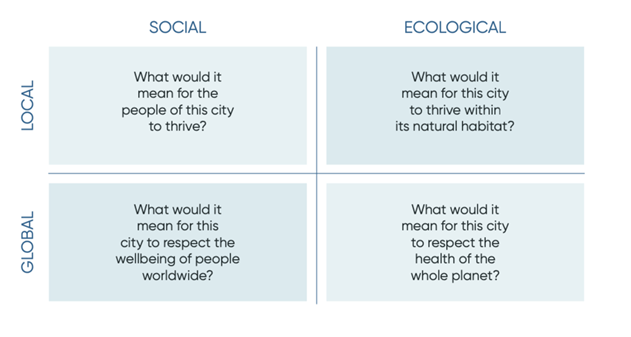
Figure 3. The Four Lenses of the City Portrait
22 These
four lenses create a framework to consider what it would mean for the city to
achieve local aspirations, whilst respecting the planet, and the rights and
aspirations of others.
Developing the City Portrait – Ecological Ceiling
23 Staff
worked with PAN to obtain a current snapshot of the city’s ecological
impacts on the planet in relation to the Ecological Ceiling component of the
City Portrait. PAN is an independent, not-for-profit research centre that
specialises in Planetary Accounting, a framework that translates global
environmental challenges into actionable targets at any scale.
24 PAN
conducted a stocktake of the DCC’s eight existing strategies, as well as
the Waste Minimisation Management Plan and Zero Carbon Policy to assess the
availability and relevance of existing data and to identify data gaps. PAN also
had a series of sessions with relevant DCC teams to help improve the
understanding of how their work contribute to the Ecological Ceiling and
discuss opportunities to collect more applicable data.
25 The
results of the stocktake show that the DCC is already measuring, to some
degree, seven of the ten components of the Ecological Ceiling (Figure 4). PAN
tracked measurements across ten ecological areas which showed what the DCC is
measuring in terms of three domains of the Ecological Ceiling: Air, Water and
Land. It also identified several focus areas where more coordinated actions
across different teams could be explored to add or enhance measures. The final
report can be read in Attachment A.
Figure 4. PAN’s Recommendations Heatmap shows
the relevance of each of the Ecological Ceiling focus areas, and the current
measurement status across the existing eight strategies, as well as the Waste
Minimisation Management Plan and Zero Carbon Policy
26 
Based on the stocktake, PAN then produced a draft of Dunedin’s first
doughnut, focussing on Dunedin’s environmental footprint (Figure 5).
Although it is still in draft, it shows strong alignment with the Zero Carbon
Policy and Zero Carbon (draft) plan. It should be noted that this was produced
with currently available data, and there are areas of insufficient or limited
data as detailed in PAN’s report. Attachment B outlines how to read the
Dunedin Doughnut.
Figure 5. Draft Dunedin’s Ecological Ceiling
with ten environmental footprints and the four wellbeings as the Social
Foundation as a concept
27 Creating
a City Portrait is designed to be a highly iterative process and is intended to
be improved as more data becomes available and to be informed by ongoing engagement
with stakeholders and the wider community, as outlined by the Harrison Grierson
2020 report. If the Council wishes to continue the development of the City
Portrait, further improvements can be made to this draft Dunedin’s
Ecological Ceiling (Figure 5) through working with stakeholders and
communities.
28 To
make the City Portrait Framework user friendly, staff proposed that the four
wellbeing strategies are applied to Dunedin’s Social Foundation, as shown
in the centre of Figure 4. Use of the four wellbeings will ensure the City
Portrait is relevant to the people of Ōtepoti Dunedin, while retaining a
strong connection with the Te Taki Haruru - Māori Strategic Framework,
which has also used the four wellbeings in its development. It also ties the
City Portrait with Council’s statutory purposes under the Local
Government Act 2002 (LGA).
29 Similar
to the Ecological Ceiling, measures and baselines will need to be developed to
measure the Social Foundation. Staff are considering possible measures and
targets, but propose these can be developed with the Council, as part of the
refresh of the Wellbeing Strategies. This is discussed in a separate report in
this agenda.
30 Developing
the City Portrait could be explored through the 10YP process and take into
consideration public feedback.
31 Staff
are aware that the DCC’s contribution to Dunedin’s ecological and
social context is only part of Dunedin’s ‘City Portrait’.
This is because the data used relates to the whole city. In addition, some
elements of the Ecological Ceiling are outside of the DCC’s remit, such
as monitoring air quality. If the Council wishes to develop the City Portrait
further, clarifying the DCC’s roles and responsibilities across some of
these areas and building partnerships to foster city wide ownership of
Dunedin’s portrait would be critical.
32 A
draft illustration has been developed to explain to residents, partners and
stakeholders what Doughnut Economics is, how a City Portrait is made and how it
can be applied (Attachment C).
Applying the City Portrait as Dunedin’s sustainability
framework
33 In
considering how the City Portrait could be applied as a sustainability
framework, staff investigated examples and applications from other cities and
other Councils who take a stewardship role in monitoring city-wide measures.
34
One example, from Cornwall Council, shows how the Doughnut image is used to
support decision making and to indicate the possible impact of projects and
decisions. In Figure 6 below, the Doughnut image was part of a Council paper
that was discussing social housing.
Figure 6. Cornwall’s Development and Decision
Wheel (taken from Report to Cabinet, 8 Feb 2023 HRA Business Plan Medium Term
Budget Rent Setting for 2023-24 and Changes to CHL Commissioning - .pdf
(cornwall.gov.uk)
35 This
type of application of Dunedin's City Portrait may be helpful to inform
decision making through offering a consistent perspective on sustainability.
For the DCC, the City Portrait could also be included in the sustainability
section of the ‘Summary of Considerations’ in reports to the
Council and Executive Leadership Team for specific projects.
36 The
City Portrait could also be used as a monitoring tool to report on and
visualise Dunedin’s progress. The City Portrait would continually evolve
as data is updated, or more relevant data made available.
37 
The Devon Doughnut Collective, a group of individuals, community
representatives and NGOS, has created ‘Devon Doughnut’ that shows
measures for both the citizens and policy maker levels (Figure 7). This is an
interactive model, which encourages action by various parties and shows
connections. Please note, this has not been formally adopted. By providing
multiple levels at which to measure, the role of citizens is clearer which
could increase buy-in from residents. This example, however, does suggest that
by providing multiple levels at which to measure a city’s social and
ecological footprint, the role of citizens and Council is supported through
offering measures and suggested actions, which could increase buy-in from
residents and communities.

Figure 7. ‘Devon Doughnut’ created by the
Devon Doughnut Collective
UNITED NATIONS SUSTAINABLE
DEVELOPMENT GOALS
What are the United Nations
Sustainable Development Goals (SDGs)?
38 In
2015, the United Nations member states including New Zealand adopted the SDGs.
The SDGs are 17 goals comprised of 169 targets and guiding global action on
sustainable development. The SDGs interconnect environmental, social and
economic aspects of sustainable development. The call to action is to have a
global, collective plan that results in positive improvements for all
communities and in all areas in relation to planetary health. A summary of the
SDGs is set out below in Figure 8.
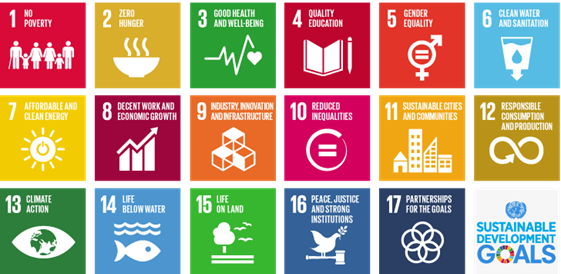
Figure 8. The United
Nation’s 17 Sustainable Development Goals (Source - United Nations)
39 Different
organisations implement the SDGs in their organisation and strategic framework
differently. For example, the Waikato Wellbeing Project includes all 17 SDGs.
Alternatively, other local governments have adopted some but not all of the
SDGs, such as Central Otago District Council’s Sustainability Strategy
2019-2024, which aligns with ten of the SDGs.
40 Recent
results from a survey by Waimakariri District Council (May 2023) showed two
Councils have progressed beyond a high-level commitment to include the SDGs in
their annual and long-term plans (Waimakariri District Council and Hauraki
District Council).
DISCUSSION and COMPARATIVE ANALYSIS
41 By
reviewing the SDGs and City Portrait, this offers a useful comparison to
revisit strengths and limitations related to each sustainability framework.
United Nations Sustainable
Development Goals (SDGs)
Strengths
42 The
SDGs are a well-known brand and have a strong global profile. The SDGs promote
17 global goals, 169 targets and 231 unique indicators to guide countries in
their strategic intent and actions.
43 The
SDGs provide holistic themes that cover all commonly recognised sustainability
issues (socially and environmentally). New Zealand has adopted the SDG goals as
an international commitment, and the themes are reasonably clear and easy to
communicate with a wider community.
44 Although
the SDGs are designed for reporting at the national level, recently there has
been emerging practices in translating the SDGs to the sub-national level and
for cities, which includes the City Portrait methodology.
45 United
Nations-affiliated programmes have a strong connection to the SDGs. Locally,
this includes the UNESCO City of Literature initiative, and Whaiao Regional
Centre of Expertise Otago, led by the Otago Polytechnic (now Te Pūkenga).
Limitations
46 Wiedmann
and Allen’s (2021) review of over two thousand published articles related
to SDGs’ monitoring and assessment (link to publication here) noted that the SDGs were limited in their
practical consideration of local indicators, targets and implementation as the
SDGs are global in nature.
47 Similarly,
a noted limitation of the SDGs is the large number of indicators and policy
that does not translate easily to a city level. This is due to a lack of common
methodology in measuring environmental impact, in comparison to using planetary
boundaries.
48 The
SDGs do not consider a cultural component in the framework, missing an
important link to one of the Council’s statutory purposes under the Local
Government Act 2002 (LGA). Consideration as to how the SDGs would complement
the Te Taki Haruru – Māori Strategic Framework would need to be
explored.
49 Some
of the SDG targets are specifically aimed at developing countries and may not
be easily applicable to a Dunedin context.
50 There
are no open-resource guides and resources available for adapting SDGs to a city
level, unlike the City Portrait.
City
Portrait
Strengths
51 The
City Portrait incorporates the SDGs to describe the Social Foundation and uses
science to measure ecological impacts at a city level. These measurements are
then used to show how Dunedin is meeting its global responsibility in regard to
the planet (i.e., Ecological Ceiling), and socially in regard to taking care of
its people locally as well as globally (i.e., the SDGs).
52 It
provides a good visualisation tool to graphically show the progress made in
taking care of people and the planet, making communication about sustainability
with the public easier.
53 It
offers flexibility in developing appropriate targets and indicators at a city
level that are science-informed and considers rationale that supports fair and
just actions at a local policy and planning level.
54 There
is the opportunity to connect, collaborate with, and support other cities and
regions around the world that are also developing their City Portrait. Doughnut
Economics Action Lab provides a platform and a range of open-source guides and
resources.
Limitations
55 There
is no cultural component in the original Doughnut’s Social Foundation.
However, in understanding Dunedin’s social foundation, it is proposed
that the DCC uses its existing wellbeing strategies as a local expression of
the SDGs as there is strong alignment between them. Moreover, it ties the City
Portrait with Council’s statutory purposes under the LGA. This is
discussed in a separate report in this agenda.
56 It
requires expert technical support to scale to different stakeholder
applications (e.g., communities, citizens, local businesses, DCC employees
etc). One example of this is the DCC’s engagement with the PAN for
development of a draft of Dunedin’s Ecological Ceiling.
57 The
City Portrait produces an image which is a snapshot in time. Its purpose is to
produce data to support decisions about the future, but the model itself does
not provide guidance on the practical actions needed to achieve that vision.
58 Due
to its holistic nature, some elements are outside the DCC’s remit,
creating a need to clarify the DCC’s roles and responsibilities in
monitoring city-wide measures.
59 There
are communication challenges associated with the City Portrait, as it includes
the Doughnut Economics theory. Its brand and profile may not be as strong as
the SDGs (e.g., no icons, labels or badges). It is common for people to see a
City Portrait as another theory of sustainability, rather than a methodology
which applies Doughnut Economics in practice.
Similarities
and distinctions
60 The
SDGs and City Portrait share a common intent – to promote global
sustainability, socially and environmentally. They both adopt the use of global
measures to assess sustainability.
61 Rather
than understanding the SDGs and City Portrait as distinct therefore, it is
helpful to understand that they are complimentary and work along a continuum
towards sustainable practices. As explained by Wiedmann and Allen (2021),
“There is a substantial overlap between PBs
(planetary boundaries) and environmental SDGs. Defining what is environmentally
safe and socially just, helps to operationalise the SDGs based on quantifiable
benchmarks. Currently, no country in the world operates fully within this safe
and just operating space (SJS).”
62 The
key similarity between the SDGs and City Portrait is that they are both new and
emerging practices, and they are both committed to making systemic change for a
more sustainable planet while caring for all people.
63 They
are distinct from each other in their approach in monitoring activity and
actions related to sustainability. The SDGs are focussed on 17 global and
national measures, whereas the City Portrait uses the Ecological Ceiling as
well as the SDGs and then translates these to a local level to understand a
city’s global impact.
64 A
common weakness in both the SDGs and City Portrait is that they do not include
culture in their framing of sustainability, which is an important value for New
Zealand. For local councils, culture is also integral to its purpose though the
LGA, related to the Treaty of Waitangi and in supporting residents’
cultural wellbeing.
Dunedin City Council’s commitment to
a sustainability framework
65 The
role of cities is widely recognised as drivers of sustainable behaviour as they
support communities to develop sustainable practices over time. Be it through
supporting sustainable land development, offering transport options, providing
essential services that embrace sustainable methods or responding to climate
change in an equitable way. Cities are playing a large role in designing
sustainable cities and lifestyles for the future, while supporting local
communities as they transition to sustainable ways of living.
66 The
intention of a sustainability framework is to enable the DCC to understand and
give effect to sustainability in a way that is meaningful for the city of
Dunedin. Adopting an appropriate sustainability framework to serve Ōtepoti Dunedin communities now and into the
future is worthy of consideration.
67 The
discussion above shows that the SDGs and City Portrait are not entirely distinct
as both promote aligned approaches to sustainability - but they do represent
different approaches at different scales.
68 Which
approach is most useful will depend on Council’s priorities and which
framework will best meet the needs of residents and our environment now and in
the future.
OPTIONS
69 As
this is a report for noting, there are no options.
NEXT STEPS
70 The
following are steps to be undertaken in the City Portrait workstream of the
Strategic Refresh work programme:
a) continue
developing local measures to strengthen the draft of Dunedin’s Ecological
Ceiling.
b) develop
indicators and targets for the Social Foundation component of the City Portrait
based on the four wellbeing (subject to Council adoption of the wellbeing
concepts and outcomes, presented in a separate report in this agenda.
c) plan
for engagement with the public - this is a critical factor in producing a
meaningful City Portrait for Dunedin, as noted by consultants Harrison Grierson
in 2020.
d) clarify
the DCC’s roles and responsibilities in the City Portrait in relation to
DCC’s remit.
e) build
partnerships to foster city-wide ownership of Dunedin’s City Portrait.
Signatories
|
Author:
|
Gina Huakau - Corporate Policy Manager
|
|
Authoriser:
|
Jeanette Wikaira - General Manager Community Services
(Acting)
Sandy Graham - Chief Executive Officer
|
Attachments
|
|
Title
|
Page
|
|
⇩a
|
Attachment A Final PAN
2023 Extended Stocktake Summary and Recommendations
|
419
|
|
⇩b
|
Attachment B How to
Read the Dunedin Doughnut_Extract pp17-20
|
449
|
|
⇩c
|
Attachment C How To
Make a Doughnut Illustration
|
453
|
|
SUMMARY OF CONSIDERATIONS
|
|
Fit with purpose
of Local Government
This decision enables democratic local
decision making and action by, and on behalf of communities.
This decision promotes the social,
economic, environmental, and cultural well-being of communities in the
present and for the future.
|
|
Fit with strategic
framework
|
|
Contributes
|
Detracts
|
Not applicable
|
|
Social Wellbeing Strategy
|
☒
|
☐
|
☐
|
|
Economic Development Strategy
|
☒
|
☐
|
☐
|
|
Environment Strategy
|
☒
|
☐
|
☐
|
|
Arts and Culture Strategy
|
☒
|
☐
|
☐
|
|
3 Waters Strategy
|
☒
|
☐
|
☐
|
|
Spatial Plan
|
☒
|
☐
|
☐
|
|
Integrated Transport Strategy
|
☒
|
☐
|
☐
|
|
Parks and Recreation Strategy
|
☒
|
☐
|
☐
|
|
Other strategic projects/policies/plans
|
☒
|
☐
|
☐
|
The existing DCC’s Strategic Framework is
underpinned by a commitment to the Treaty of Waitangi and sustainability. The
decision on a clear representation of sustainability concerns all of the
DCC’s strategies.
|
|
Māori Impact
Statement
Mana whenua and mātāwaka are partners in the
development of Te Taki Haruru - Māori Strategic Framework and in the
Strategic Refresh work programme, of which the development of a
sustainability framework is part. To date, use of the four wellbeings has
ensured the City Portrait is relevant to the people of Dunedin, while
retaining a strong connection with the Māori Strategic Framework, which
has also used the four wellbeings in its development.
|
|
Sustainability
The development and adoption of a sustainability framework
for the city will promote the social, economic, environmental and cultural
wellbeing of communities in the present and for the future. It will do this
by clarifying the interpretation and measures of sustainability and promoting
consistent application of this development approach.
|
|
LTP/Annual Plan /
Financial Strategy /Infrastructure Strategy
The Strategic Refresh, which will be informed by
development of a sustainability framework, will directly impact on the next
10 year plan.
|
|
Financial considerations
There are no financial considerations.
|
|
Significance
This report is considered low significance in terms of the
Significance and Engagement Policy as it provides an update of the Strategic
Refresh. The Strategic Refresh itself is of high importance.
|
|
Engagement –
external
There has been no external engagement.
|
|
Engagement -
internal
There has been no internal engagement.
|
|
Risks: Legal /
Health and Safety etc.
There are no identified risks.
|
|
Conflict of
Interest
No conflicts of interest have been identified.
|
|
Community Boards
No implications for Community Boards have been identified.
|
|
|
Council
25 September 2023
|
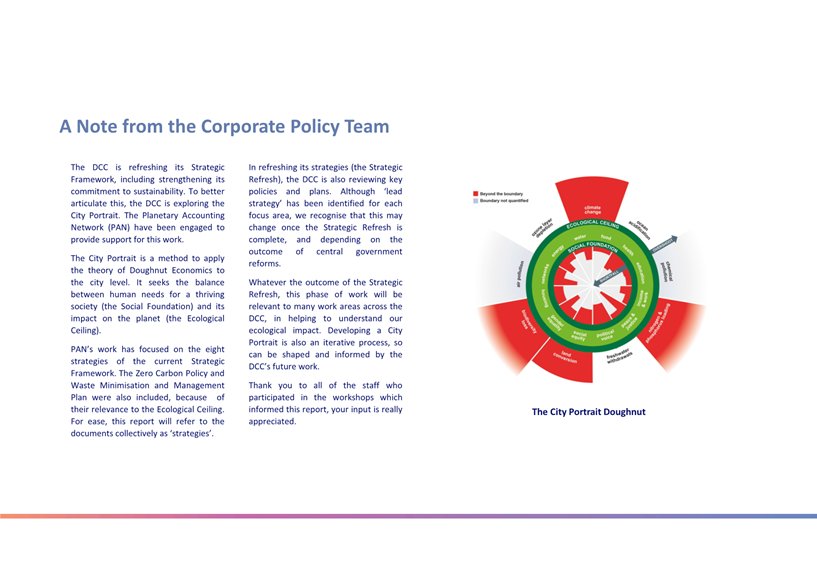
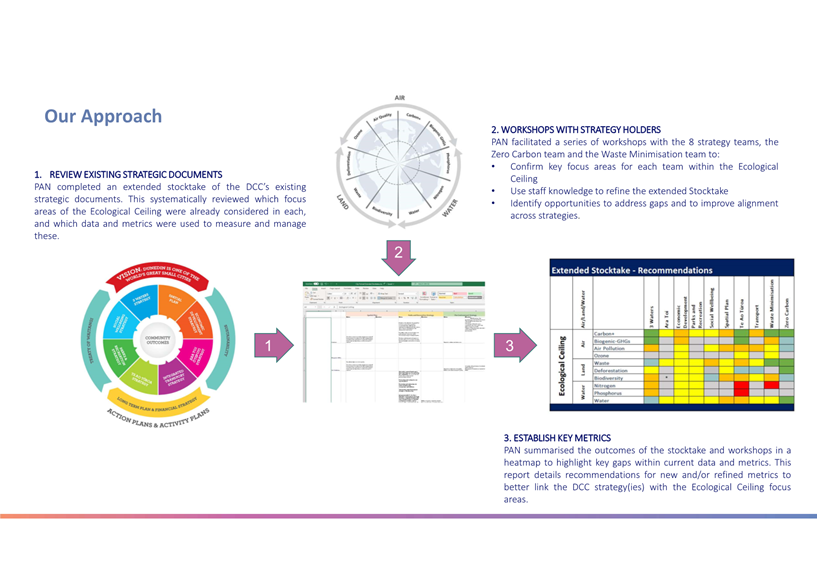
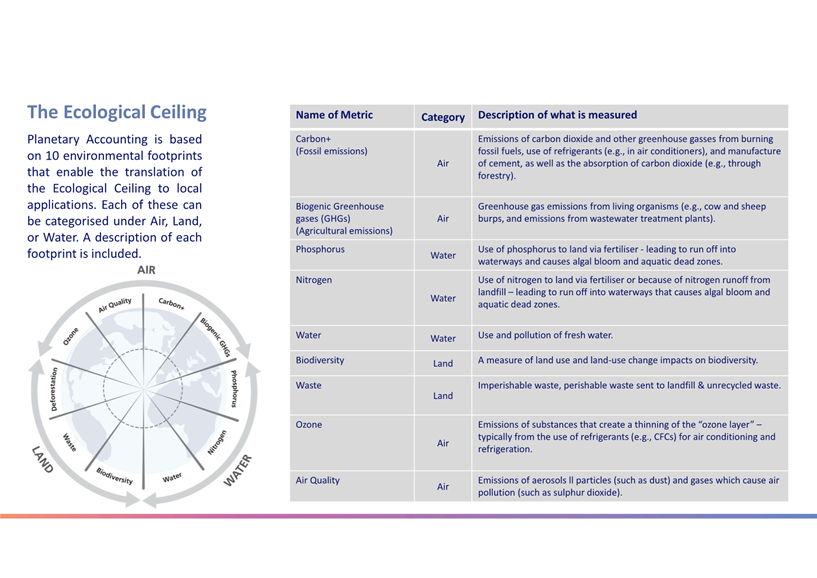
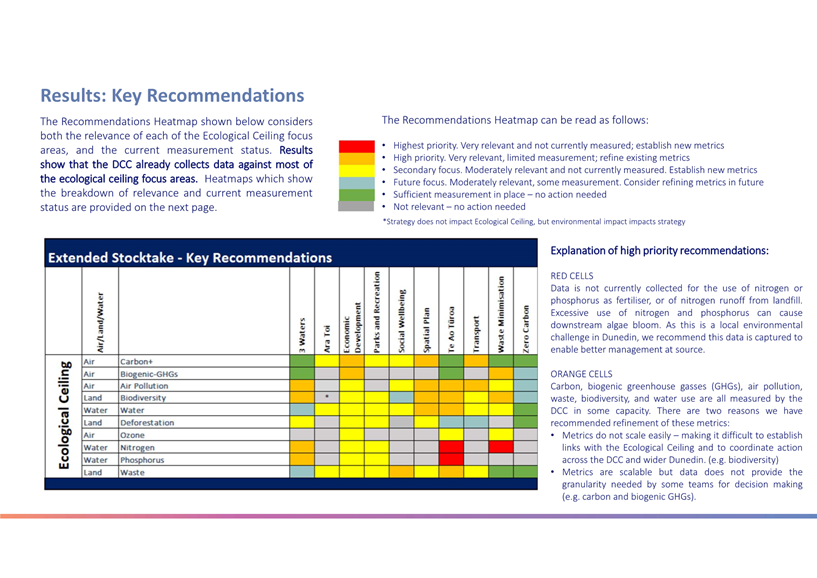
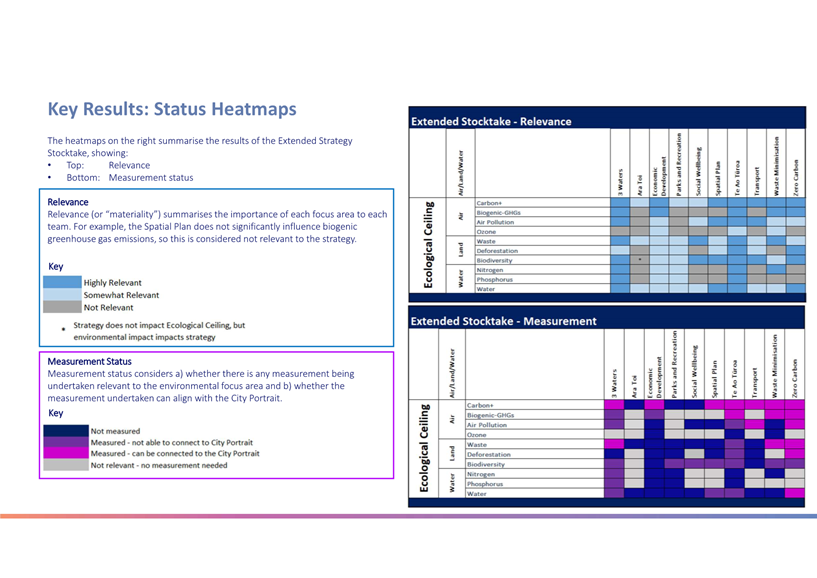
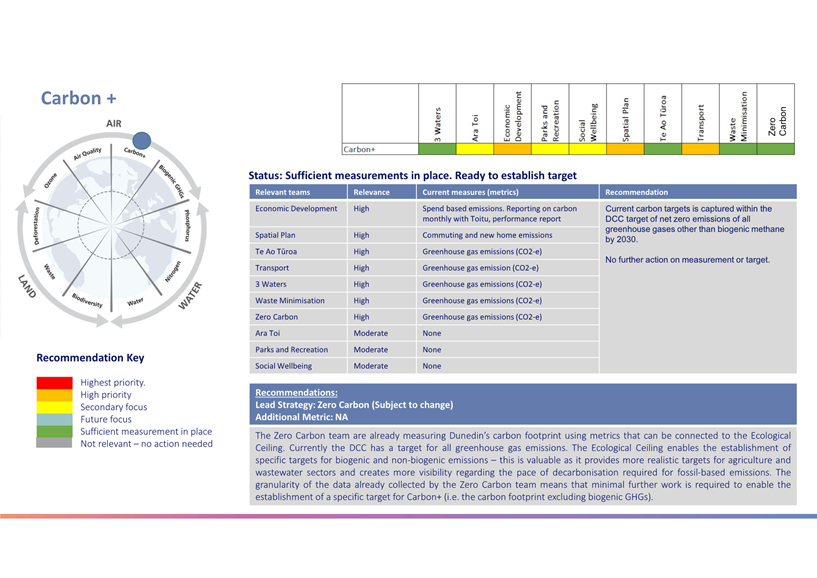
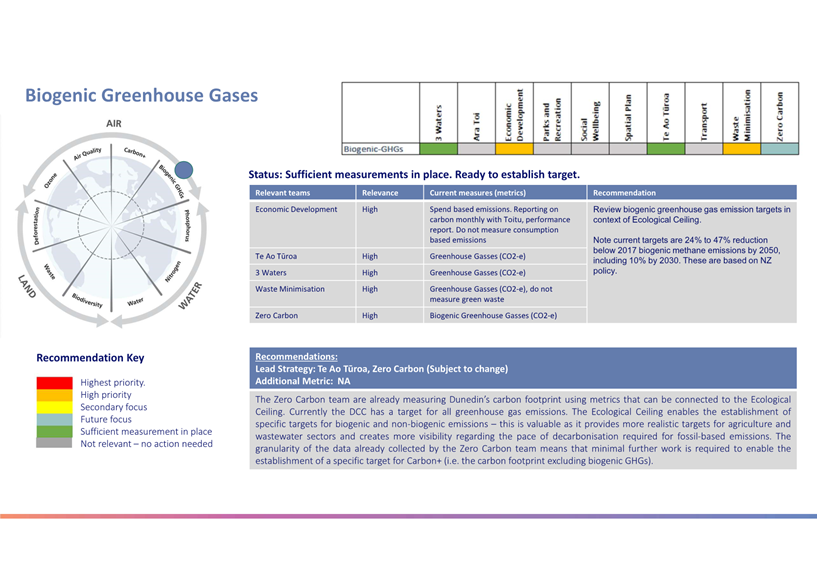
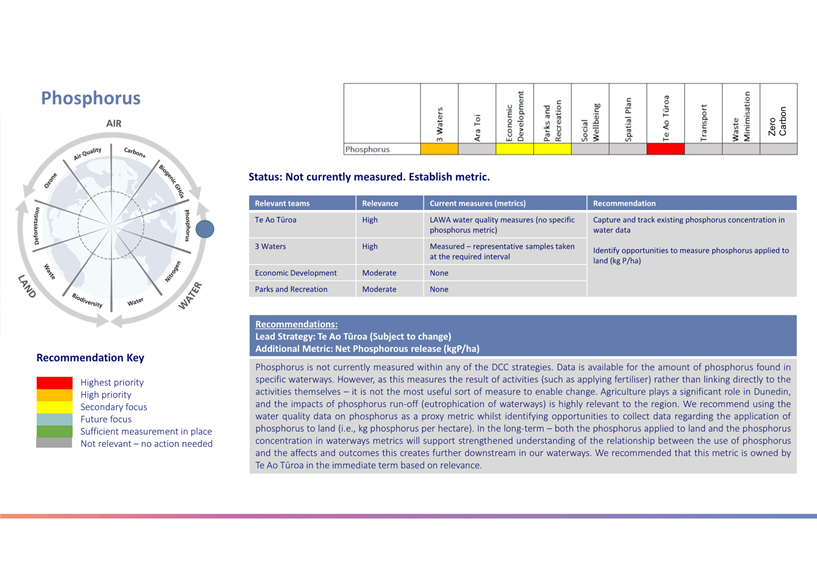
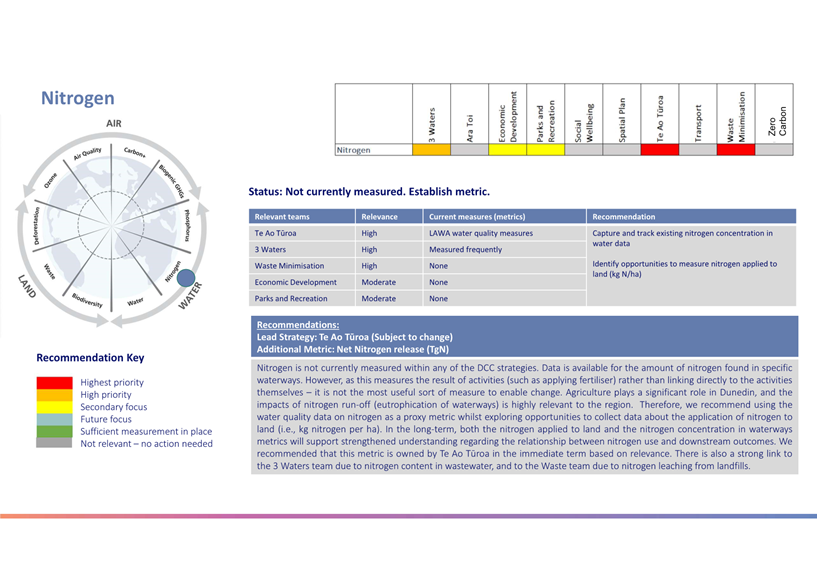
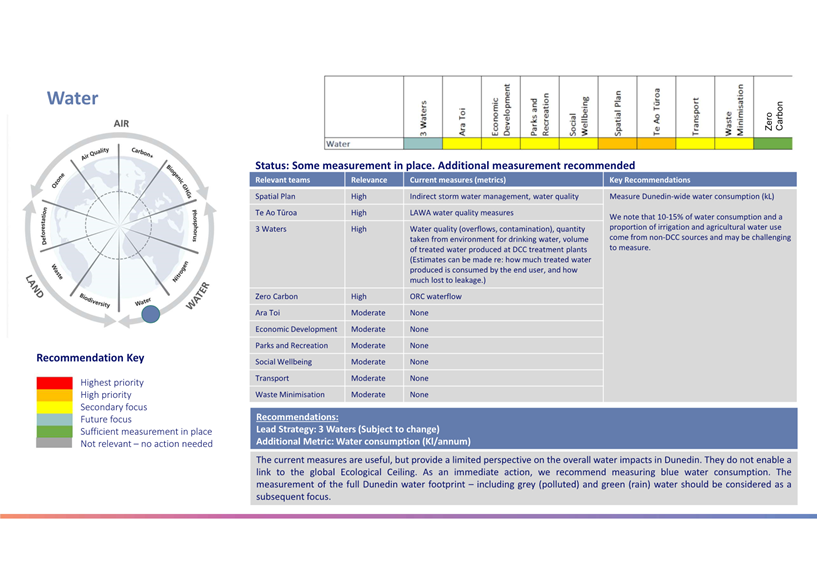
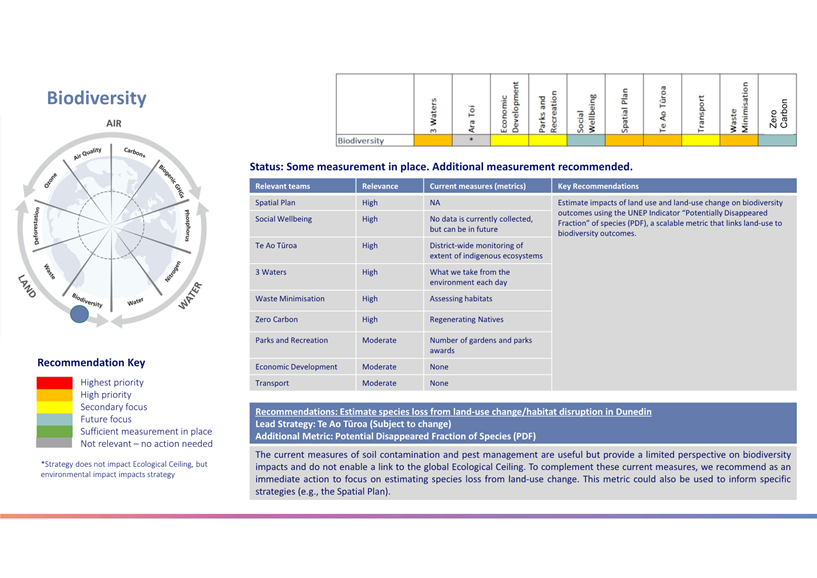
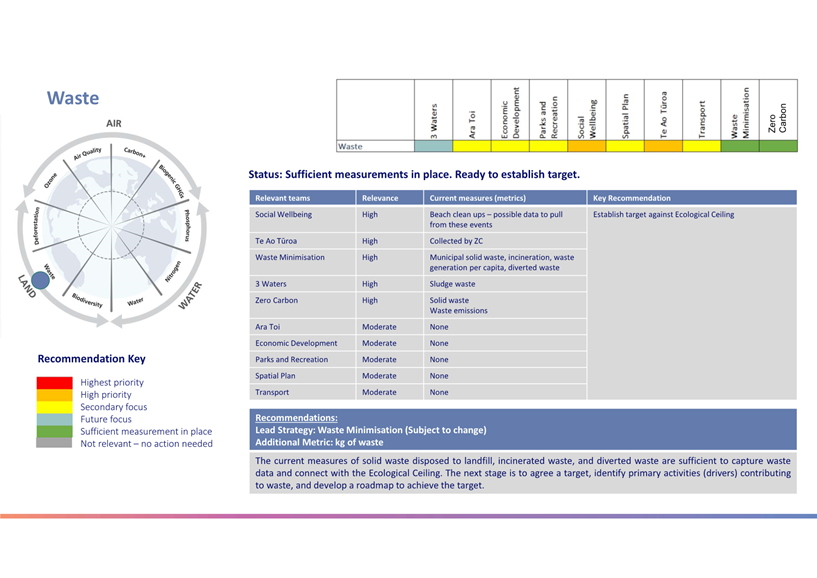
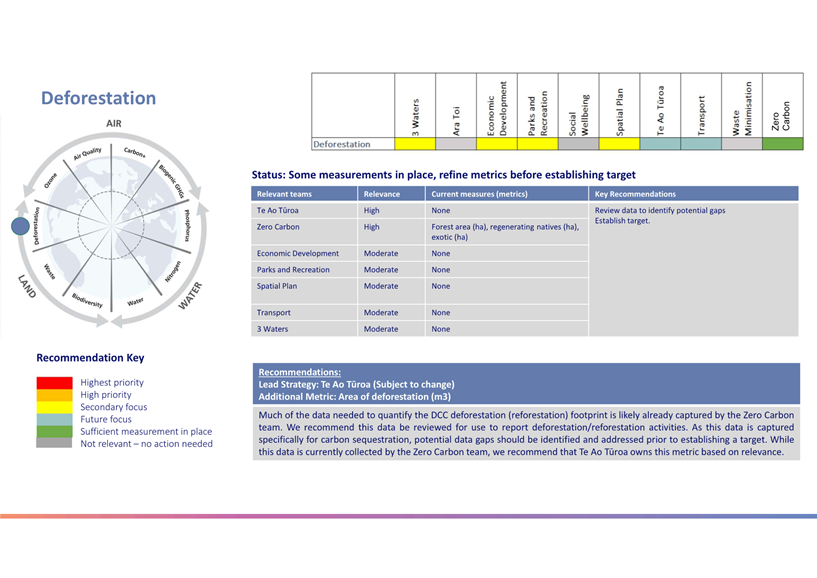
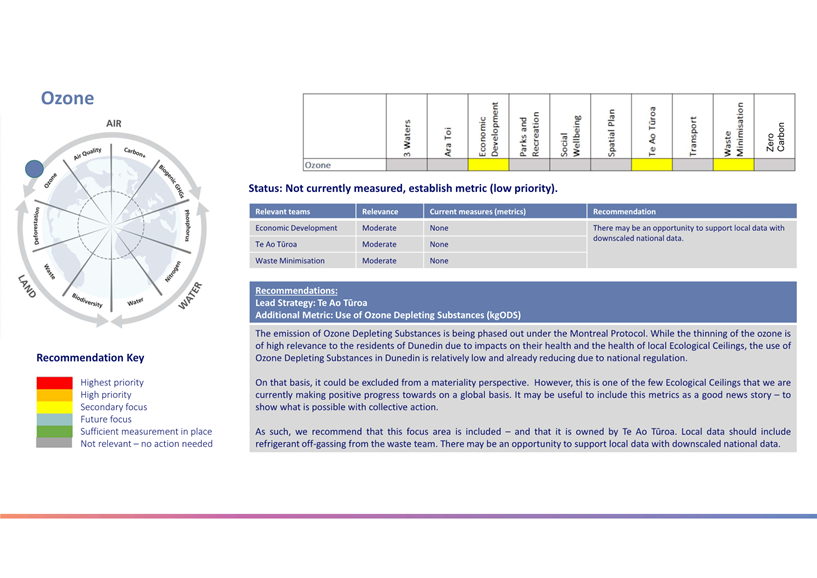
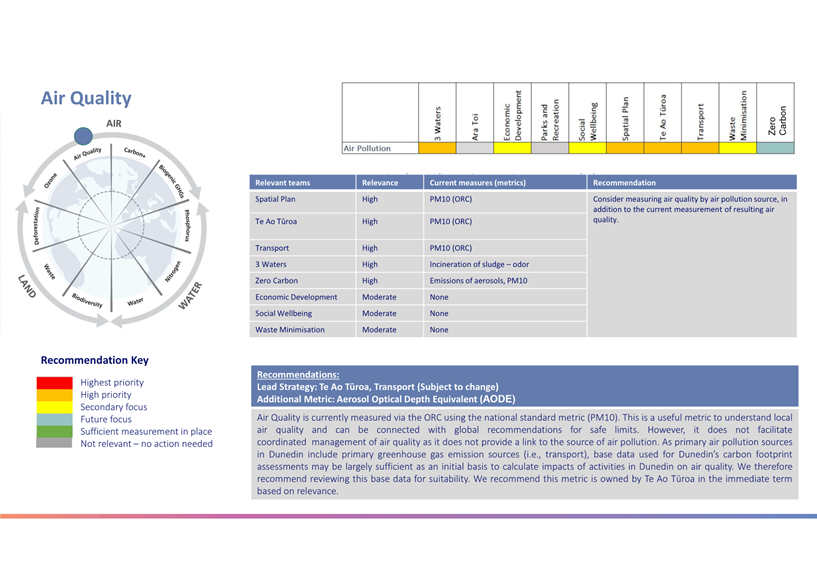
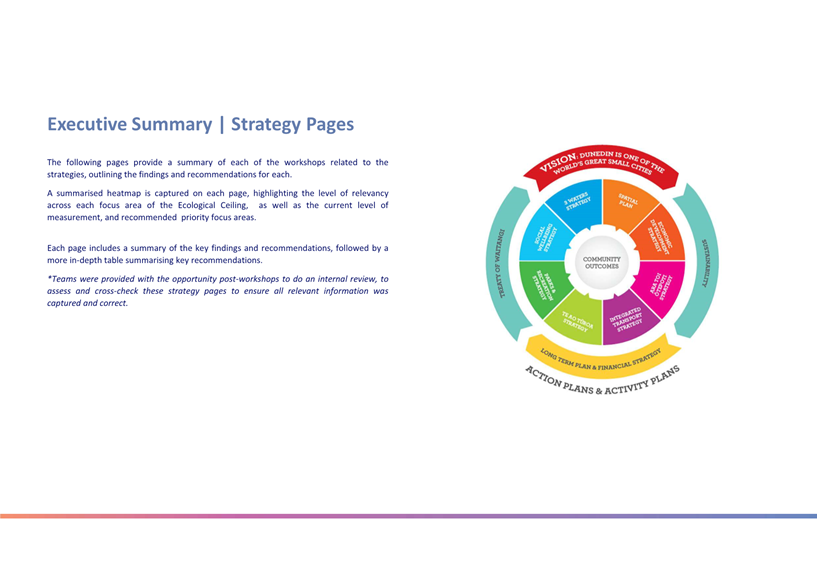
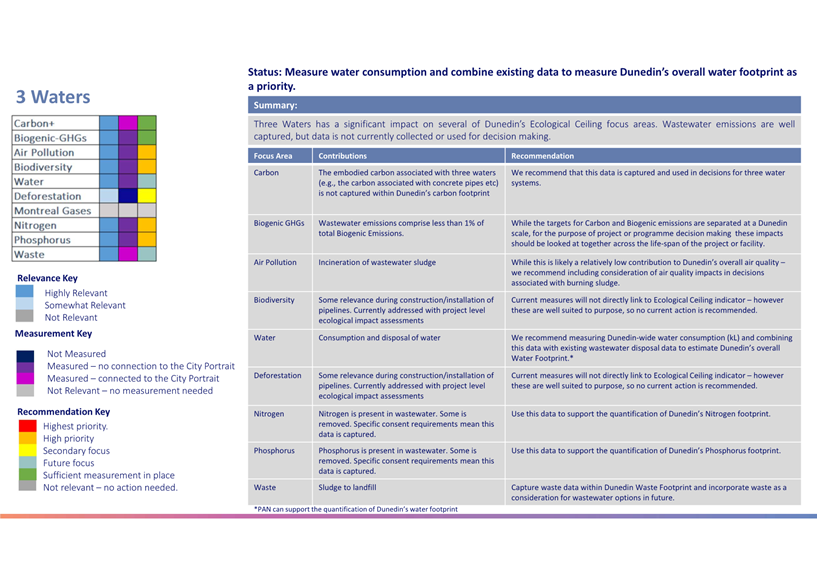
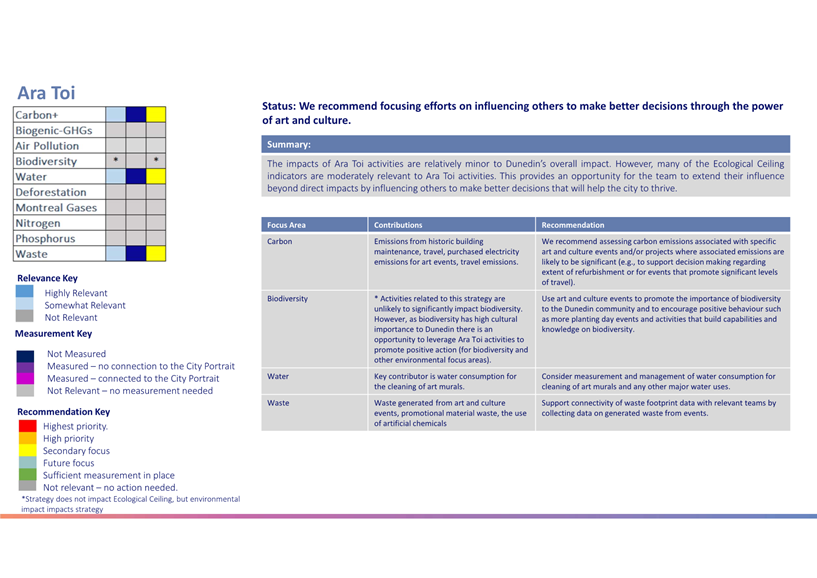
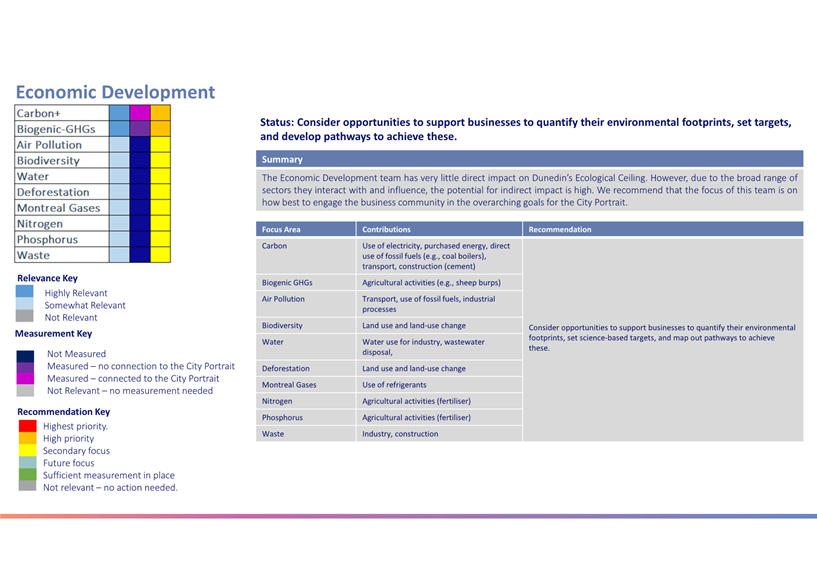
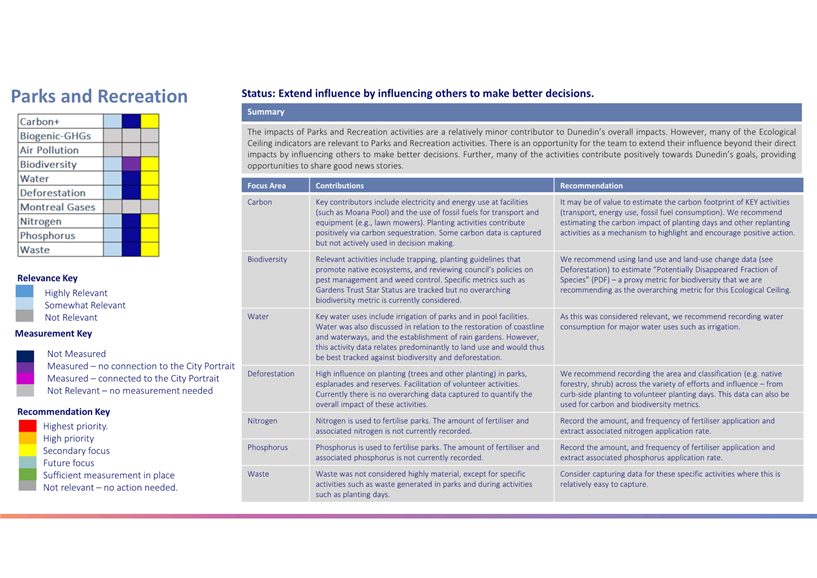
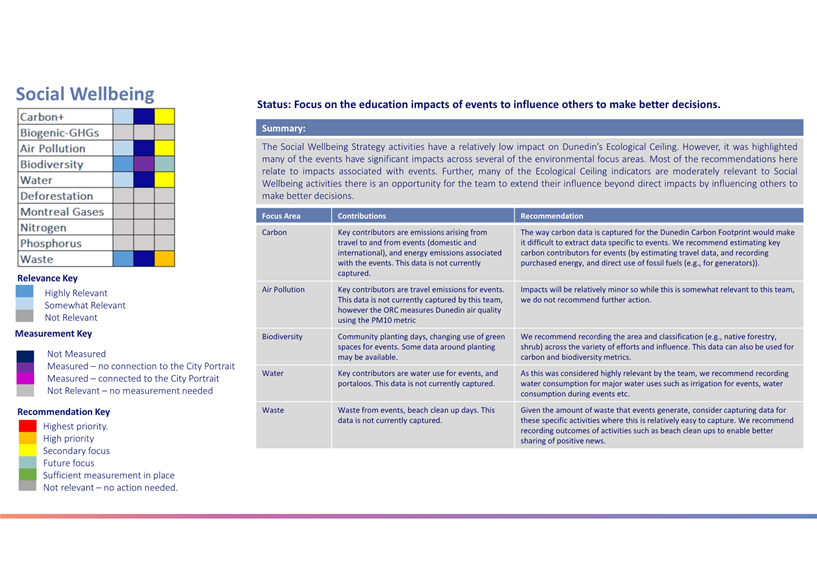
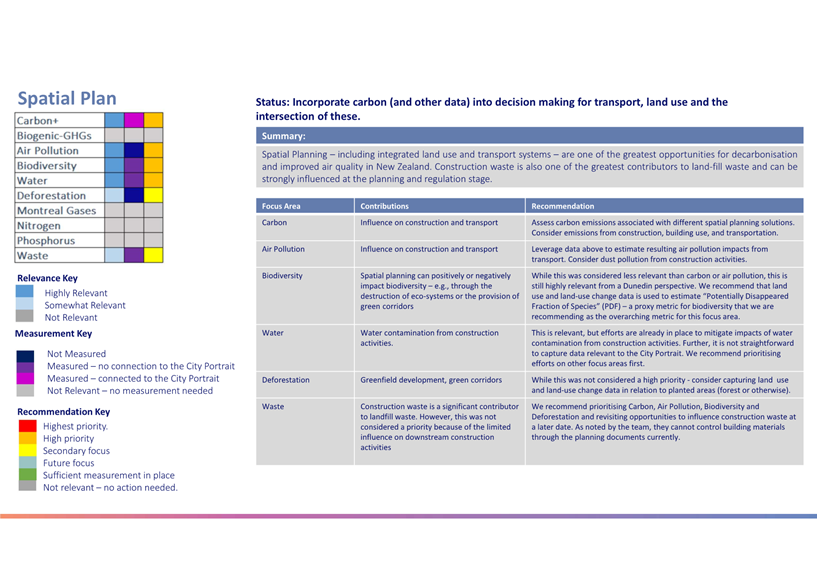
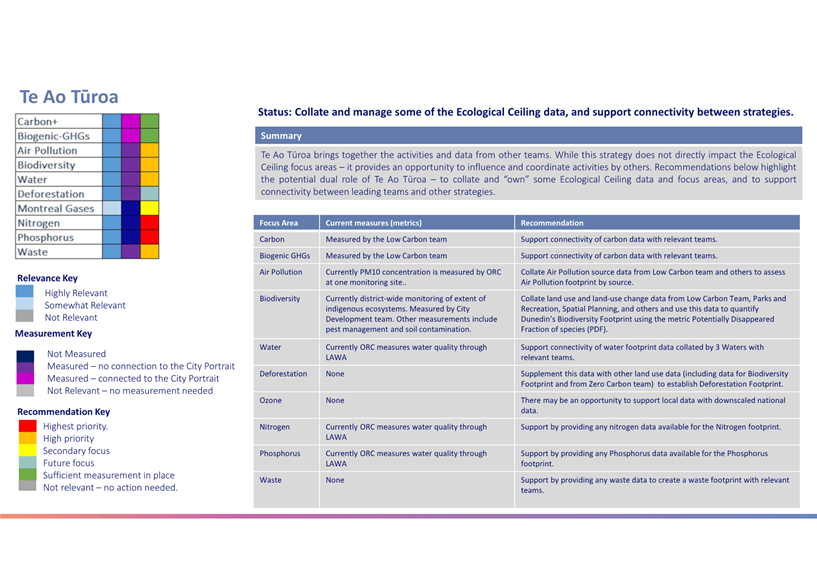
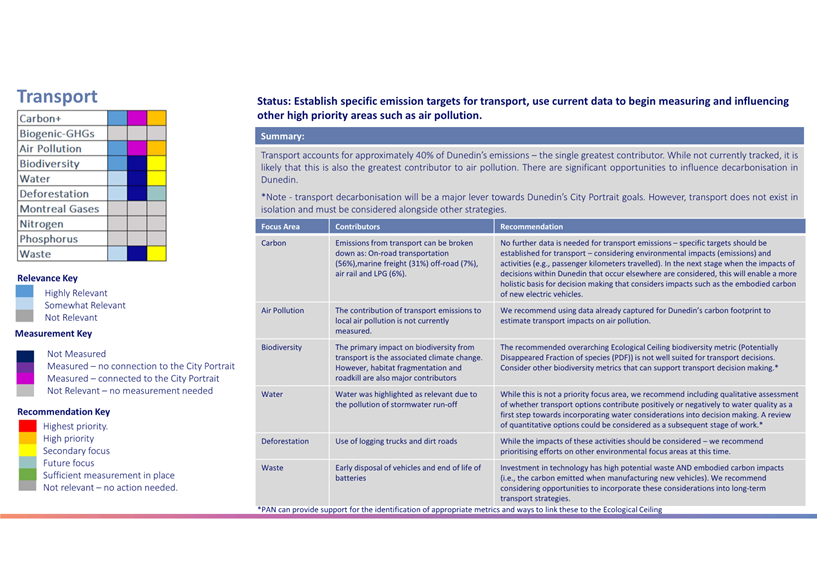
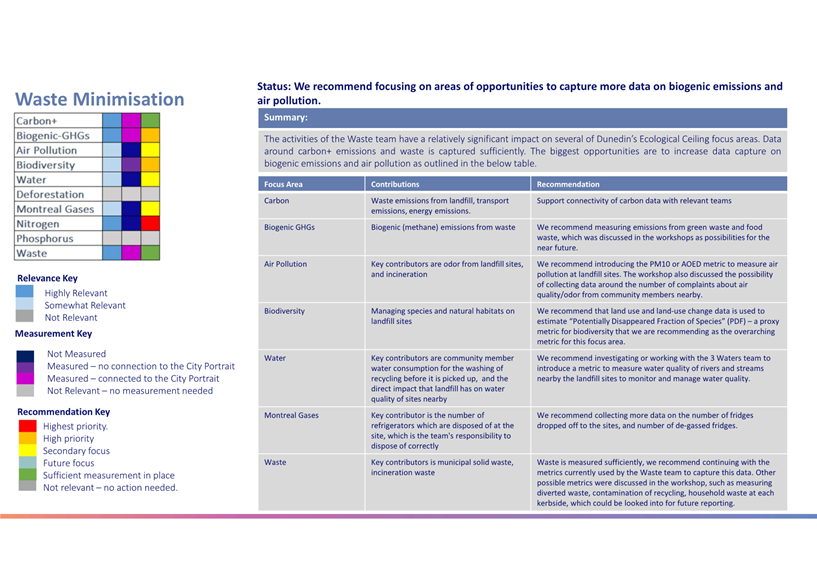
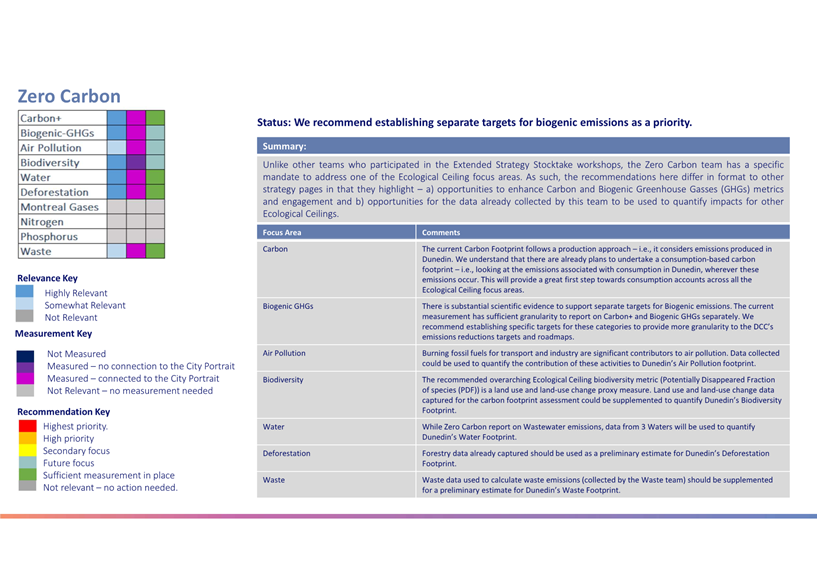

|
|
Council
25 September 2023
|
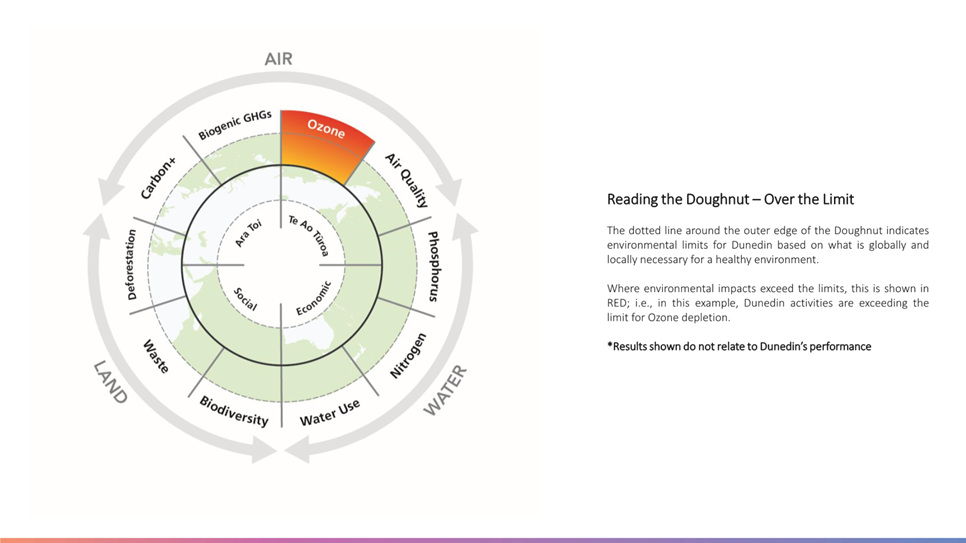
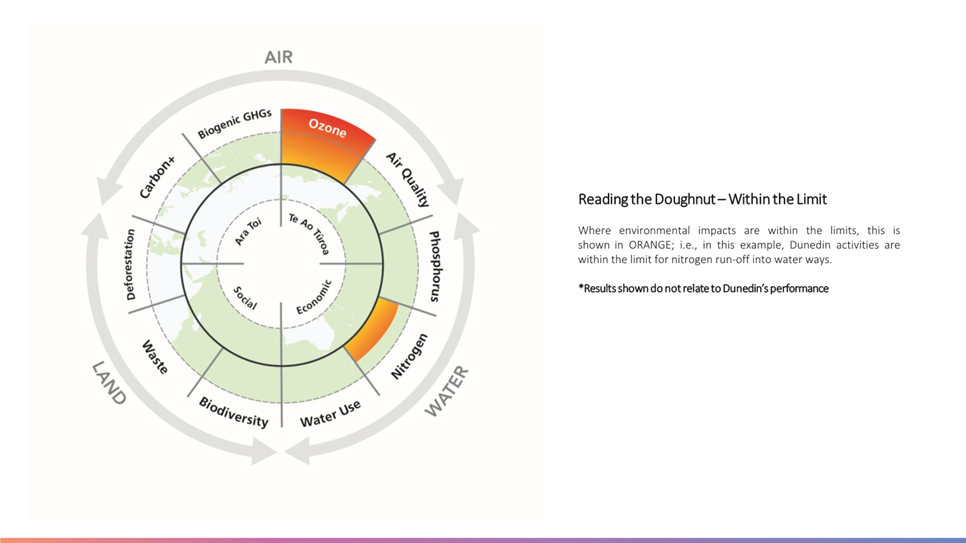
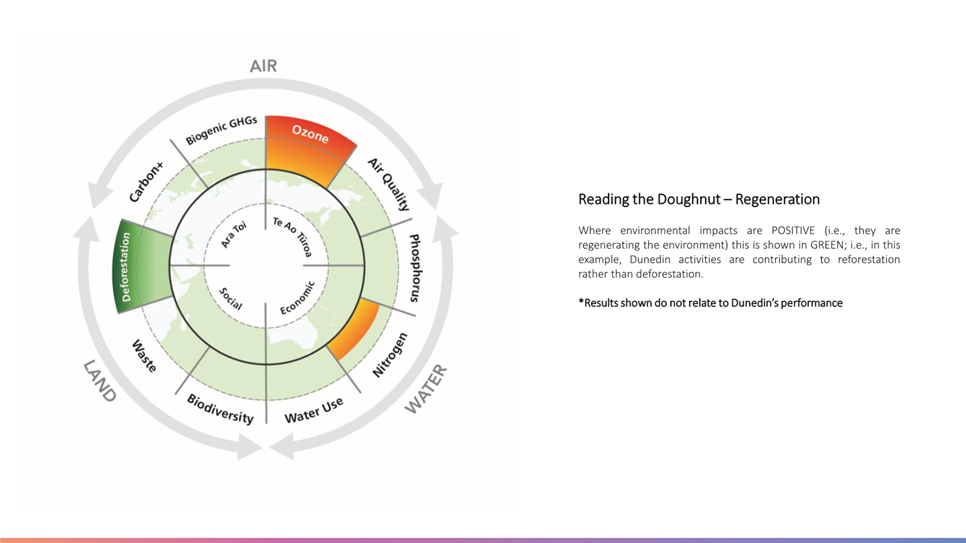
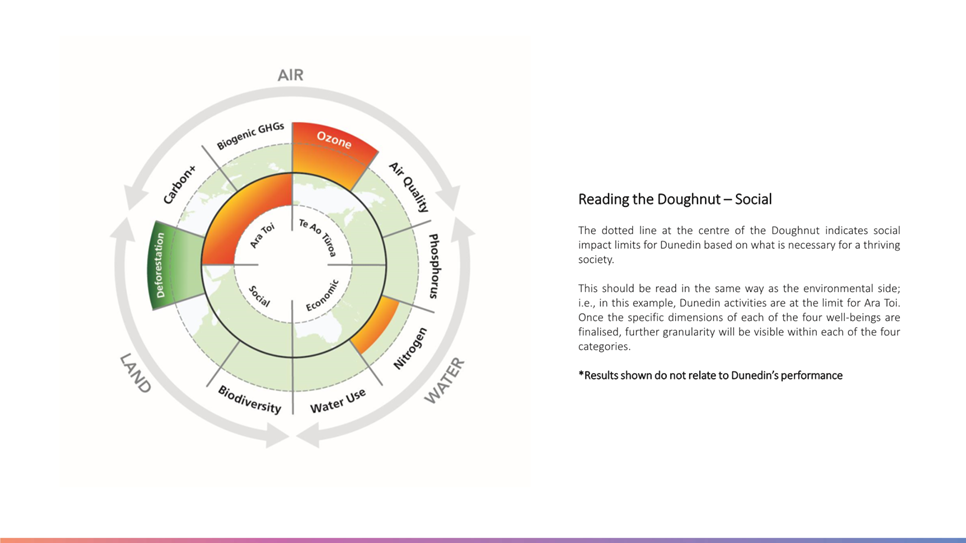
|
|
Council
25 September 2023
|
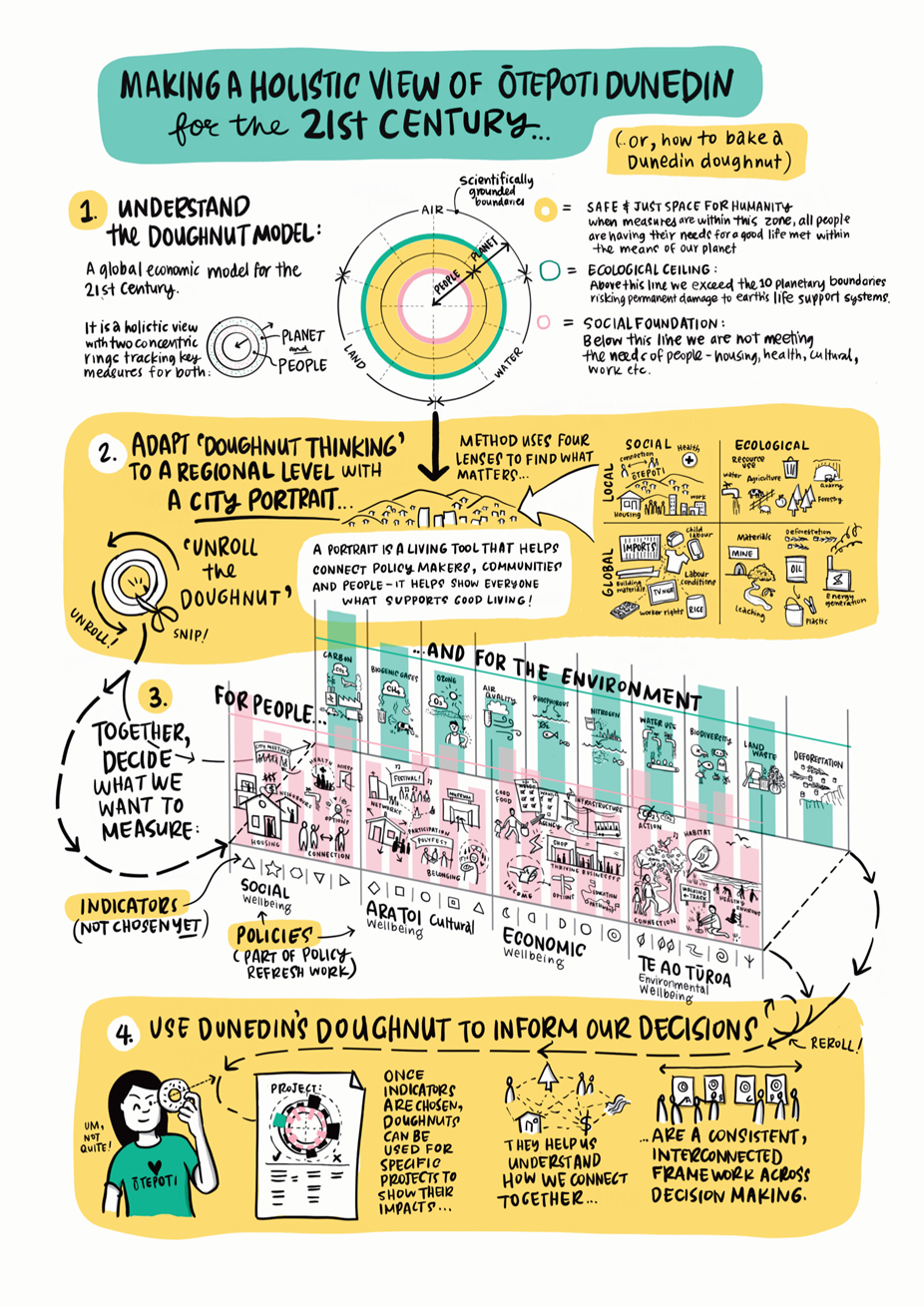
|
|
Council
25 September 2023
|
10 year plan 2024-34 Update
Department: Corporate Policy
EXECUTIVE SUMMARY
1 The
purpose of this report is to provide Council with an update on the development
of the 10 year plan 2024-34 (the plan). Five further 10 year plan reports
follow this update:
- Significant
Forecasting Assumptions
- Climate
Change significant forecasting assumptions
- Groups
of Activities
- Draft
City Profile Snapshot
- DCC
Grants
|
RECOMMENDATIONS
That the Council:
a) Notes the 10 year plan 2024-34 update report.
|
BACKGROUND
2 The
Local Government Act 2002 (LGA) requires all local authorities to develop a 10
year plan. Section 93(6) of the LGA provides that the purpose of the Plan
is to:
a) describe the Council’s activities;
b) describe the community outcomes for Dunedin;
c) provide integrated decision-making and co-ordination of
resources;
d) provide a long-term focus for the decisions and
activities of the Council; and
e) provide a basis for accountability of the local
authority to the community.
3 Schedule
10 of the LGA specifies the minimum information and content that must be
included in the Plan as follows:
· Community
outcomes;
· Groups
of activities (including capital expenditure, levels of service and funding
impact statements);
· Statement
on any variations between proposals outlined in the Plan and our assessment of
water and sanitary services, and waste management and minimisation plans;
· Council
controlled organisations (including activities provided and key performance
targets);
· Statement
on the development of Māori capacity to contribute to decision making
processes;
· Financial
Strategy;
· Infrastructure
Strategy;
· Revenue
and Financing Policy;
· Significance
and Engagement Policy;
· Forecast
financial statements (including balancing of budget, rating information and
reserve funds); and
· Significant
forecasting assumptions.
4 Council
is also required under section 93(B) of the LGA to develop a Consultation
Document, to provide an effective base for public participation in the
Council’s decision making processes relating to the content of the
Plan.
5 The
final Plan and Consultation Document must contain a report from the Auditor
General.
DISCUSSION
Workstream progress
6 At
the 19 June 2023 Strategy, Planning and Engagement Committee, the Committee
noted a report providing an overview of the 10 year plan. The
report outlined the project structure, objectives, deliverables, roles and
responsibilities and included a high-level timeline for delivery through 10
workstreams.
7 All
10 workstreams are meeting regularly and progressing to deliver to their
assigned responsibilities. Reports related to the 10 year plan are being
brought to Council for decision-making in order for development of the plan to
proceed.
Reform update
8 The key legislation reforming the resource management system is now
in place. The Natural and Built Environment Act and the Spatial Planning Act
were passed into law on 23 August 2023. The new legislation creates
a resource management (RM) system that aims to deliver better outcomes for the
environment, people and the economy.
9 The Spatial Planning Act and the Natural and Built Environment Act
are being phased in over the next ten years. A small number of operational
changes are in force, but larger structural changes are being rolled out region
by region. It is not clear when the larger structural changes with implications
for DCC will be rolled out in Otago. However, the move will be gradual with
forewarning.
10 The transition to the new resource planning system will occur in
Otago once a regional planning committee is established and the regional
spatial strategy and the natural and built environment plan are developed. This
work will occur regionally while a National Planning Framework is being developed
by Government. This will all occur over the next 10 years, unless the Acts are
amended or repealed.
11 Legislation related to the reform of three waters was passed into
law in August. Provision of DCC’s 3 waters services will transfer to the
new water entity by 1 July 2026 (current indicative date is 1 October 2025).
12 As a result, council is only required to include budgets to deliver
3 Waters services for the first two years of the 10 year plan. The
legislation also removes the requirement to include three waters in
Council’s infrastructure strategy.
13 A separate report to Council is planned, which will provide more
detail on the legislation and impacts for Council and for the 10 Year Plan
process.
OPTIONS
14 As
this is a report for noting, options are not applicable.
NEXT STEPS
15 The
first round of 10 Year Plan supporting information is being presented for
approval at the Council meeting on 25-26 September. If approved, the supporting
documentation will be included in, and used to support the development of the
draft 10 year plan.
16 Development
of the draft 10 year plan 2024-34 is expected to progress to the following
timeframes:
|
10 Year Plan processes:
|
Date
|
|
Early engagement with the community
|
October 2023
|
|
Interim audit
|
November – December 2023
|
|
Audit of consultation document and supporting info
|
January – February 2024
|
|
Formal consultation period
|
March – April 2024
|
|
Hearings and deliberations
|
May 2024
|
|
Final audit of 10 year plan document and supporting
information
|
June 2024
|
|
Council adoption of 10 Year Plan 2024-2034
|
Prior to 30 June 2024
|
17
Signatories
|
Author:
|
Jasmin Lamorie - Senior Corporate Planner
|
|
Authoriser:
|
Jeanette Wikaira - General Manager Community Services
(Acting)
Sandy Graham - Chief Executive Officer
|
Attachments
There are no attachments
for this report.
|
SUMMARY OF CONSIDERATIONS
|
|
Fit with purpose
of Local Government
This decision enables democratic local
decision making and action by, and on behalf of communities, and promotes the
social, economic, environmental and cultural wellbeing of the Dunedin
communities, taking a sustainable development approach.
|
|
Fit with strategic
framework
|
|
Contributes
|
Detracts
|
Not applicable
|
|
Social Wellbeing Strategy
|
☒
|
☐
|
☐
|
|
Economic Development Strategy
|
☒
|
☐
|
☐
|
|
Environment Strategy
|
☒
|
☐
|
☐
|
|
Arts and Culture Strategy
|
☒
|
☐
|
☐
|
|
3 Waters Strategy
|
☒
|
☐
|
☐
|
|
Spatial Plan
|
☒
|
☐
|
☐
|
|
Integrated Transport Strategy
|
☒
|
☐
|
☐
|
|
Parks and Recreation Strategy
|
☒
|
☐
|
☐
|
|
Other strategic projects/policies/plans
|
☒
|
☐
|
☐
|
The 10 year plan contributes to all of the objectives and
priorities of the strategic framework as it describes the Council’s
activities, the community outcomes, and provides a long term focus for
decision making and coordination of the Council’s resources, as well as
a basis for community accountability.
|
|
Māori Impact
Statement
The adoption of the Māori Strategic Framework signals
Council’s commitment to mana whenua and to its obligations under the
Treaty of Waitangi. Mana whenua and Māori will be involved in
pre-engagement and have an opportunity to engage with the 10 year plan consultation
process through a series of planned hui.
|
|
Sustainability
As part of the 10 year plan, several pieces of work are
underway to give effect to Council’s commitment to sustainability,
including work on the city portrait, Sustainable Development Goals, the Zero
Carbon policy and the adoption of the Māori Strategic Framework.
|
|
LTP/Annual Plan /
Financial Strategy /Infrastructure Strategy
This report provides an update on the development of the
10 year plan. The 10 year plan project includes specific workstreams that
will review Council’s financial and infrastructure strategies to ensure
they are appropriate for the future.
|
|
Financial
considerations
Financial considerations (including financial
sustainability) will be key considerations in the development of the 10 year
plan.
|
|
Significance
The 10 year plan will include community engagement and
public consultation. Pre-engagement initiatives are being planned.
|
|
Engagement –
external
The 10 year plan presents an opportunity for Council to
engage fully with the community across a range of issues.
|
|
Engagement -
internal
Staff from across council are involved in the development
of the 10 year plan.
|
|
Risks: Legal /
Health and Safety etc.
There are legal, reputational, financial and strategic
risks if the 10 year plan is not well executed, or the public do not trust
that the Council is showing good governance, prudent strategic and
operational leadership.
|
|
Conflict of
Interest
There are no known conflicts of interest.
|
|
Community Boards
Community Boards will be engaged and consulted with as
part of the 10 year plan.
|
|
|
Council
25 September 2023
|
Groups of Activities - 10 Year Plan 2024-34
Department: Corporate Policy and Executive Leadership Team
EXECUTIVE SUMMARY
1 This
report seeks Council approval for revised groups of activities structure for
inclusion in the 10 year plan 2024-34.
2 The
revised groups of activities have been developed by the Levels of Service (LOS)
workstream and is informed by LOS reporting guidance from the Office of the
Auditor General and Taituarā.
3 The
revised groups of activities provide the foundations for revised LOS
reporting. If approved by Council, the groups of activities will be
aligned with community outcomes, budgets (capital and operational), and levels
of service and performance measure components, which will also come to Council
for approval for inclusion in the 10 year plan.
RECOMMENDATIONS
That the Council:
a) Approves, for the purposes of developing the 10 year
plan 2024-2034, the groups of activity structure, grouping rationale and
activities (Attachment A).
BACKGROUND
4 The
Local Government Act 2002 (LGA) requires all local authorities to develop a 10
year plan. Schedule 10 of the LGA specifies the minimum information
and content that must be in the 10 year plan. Local Authorities are required to
have specified groups of activities. Capital expenditure, levels of
service, and funding impact statements are required for each group of
activities.
5 At
the 19 June 2023 Strategy Planning and Engagement Committee, the Committee
noted a report providing an overview of the development of the
draft plan. This outlined the project structure, objectives, deliverables,
roles and responsibilities and a high-level view of timeframes delivered
through 10 workstreams.
6 The LOS Workstream has been tasked to review groups of activities
and LOS for the draft plan. Their work is informed by guidance from the
Office of the Auditor General and Taituarā to align with best
practice and to ensure that they are more community focussed.
DISCUSSION
7 The
LOS Workstream have developed the groups of activities based on the following
guiding principles (which align with advice from the Officer of the Auditor
General):
· Groupings
need a clear rationale
· Groupings
should provide clarity for community and enable them to easily find what they
are looking for
· The
10 year plan LOS reporting should be written in plain language
· The
LOS should relate to community well-beings, outcomes, and purpose
8 The
rationale for proposed group of activities (Attachment A) is to make them more
customer centric and enable clearer alignment between Council’s
objectives and service delivery.
OPTIONS
Option
One – The revised group of activities is approved. Recommended
Option
9 Council
approves the revised groups of activities (Attachment A) for development of,
and inclusion in, the 10 year plan 2024-34.
Advantages
· Provides
improved clarity for the community.
· Aligns
with guidance from the Office of the Auditor General.
Disadvantages
· There
are no identified disadvantages.
Option
Two – The revised group of activities is not approved.
10 Council
does not approve the revised groups of activities and further work will be
undertaken.
Advantages
· There
are no identified advantages.
Disadvantages
· Further
work would be required to amend the group of activity structure, resulting in
compressed timeframes for the development of the 10 year plan 2024-34.
NEXT STEPS
11 If
approved by Council, the groups of activities will be used by the LOS
workstream to provide DCC Managers with guidance to review current LOS
statements and performance measures. As a result of this review it is likely
that some current LOS statements and performance measures will be retired and
new ones identified that have not been reported on previously.
12 Draft
LOS statements and proposed performance measures and targets will then be
consolidated and presented to Council for approval at the Council meeting of 31
October 2023.
Signatories
|
Author:
|
Jasmin Lamorie - Senior Corporate Planner
Claire Austin - General Manager Customer and Regulatory
|
|
Authoriser:
|
Robert West - General Manager Corporate and Quality
|
Attachments
|
|
Title
|
Page
|
|
⇩a
|
Groups of activities
|
466
|
|
SUMMARY OF CONSIDERATIONS
|
|
Fit with purpose
of Local Government
This decision enables democratic local
decision making and action by, and on behalf of communities, and promotes the
social, economic, environmental and cultural wellbeing of the Dunedin
communities, taking a sustainable development approach.
|
|
Fit with strategic
framework
|
|
Contributes
|
Detracts
|
Not applicable
|
|
Social Wellbeing Strategy
|
☒
|
☐
|
☐
|
|
Economic Development Strategy
|
☒
|
☐
|
☐
|
|
Environment Strategy
|
☒
|
☐
|
☐
|
|
Arts and Culture Strategy
|
☒
|
☐
|
☐
|
|
3 Waters Strategy
|
☒
|
☐
|
☐
|
|
Spatial Plan
|
☒
|
☐
|
☐
|
|
Integrated Transport Strategy
|
☒
|
☐
|
☐
|
|
Parks and Recreation Strategy
|
☒
|
☐
|
☐
|
|
Other strategic projects/policies/plans
|
☒
|
☐
|
☐
|
The 10 year plan contributes to all of the objectives and
priorities of the strategic framework as it describes the Council’s
activities, the community outcomes, and provides a long term focus for
decision making and coordination of the Council’s resources, as well as
a basis for community accountability.
|
|
Māori Impact
Statement
The adoption of the Māori Strategic Framework signals
Council’s commitment to mana whenua and to its obligations under the
Treaty of Waitangi. Mana whenua and Māori will be involved in
pre-engagement and have an opportunity to engage with the 10 year plan consultation
process through a series of hui.
|
|
Sustainability
As part of the 10 year plan, several pieces of work are
underway to give effect to Council’s commitment to sustainability,
including work on the city portrait, Sustainable Development Goals, the Zero
Carbon policy and the adoption of the Māori Strategic Framework.
|
|
LTP/Annual Plan /
Financial Strategy /Infrastructure Strategy
This report provides an update on the development of the
10 year plan. The 10 year plan project includes specific workstreams that
will review Council’s financial and infrastructure strategies to ensure
they are appropriate for the future.
|
|
Financial
considerations
Financial considerations (including financial
sustainability) will be key considerations in the development of the 10 year
plan.
|
|
Significance
The 10 year plan will include community engagement and
public consultation. Pre-engagement initiatives are being planned.
|
|
Engagement –
external
The 10 year plan will include community engagement and
public consultation. Pre-engagement initiatives are being planned.
|
|
Engagement -
internal
Staff from across council are involved in the development
of the 10 year plan.
|
|
Risks: Legal /
Health and Safety etc.
There are legal, reputational, financial and strategic
risk if the 10 year plan is not well executed, or the public do not trust
that the Council is showing good governance, prudent strategic and
operational leadership.
|
|
Conflict of
Interest
There are no known conflicts of interest.
|
|
Community Boards
Community Boards will be engaged and consulted with as
part of the 10 year plan.
|
|
|
Council
25 September 2023
|
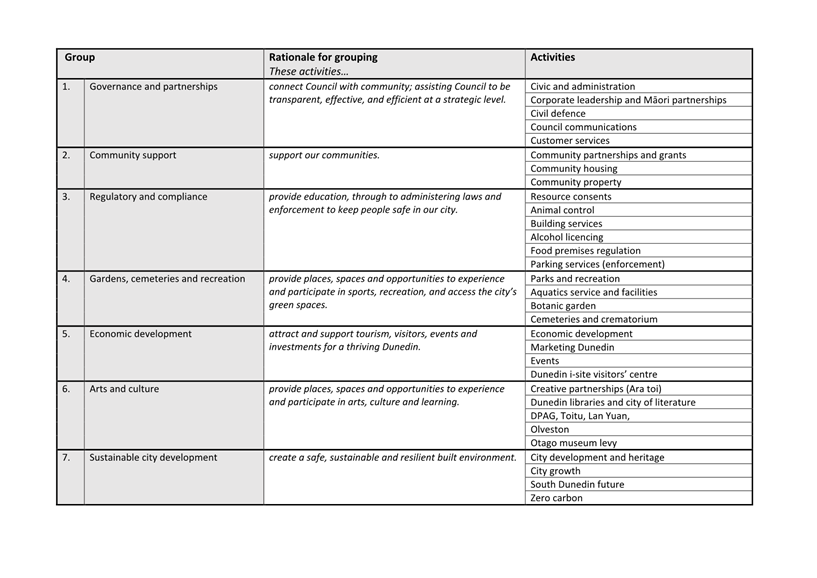
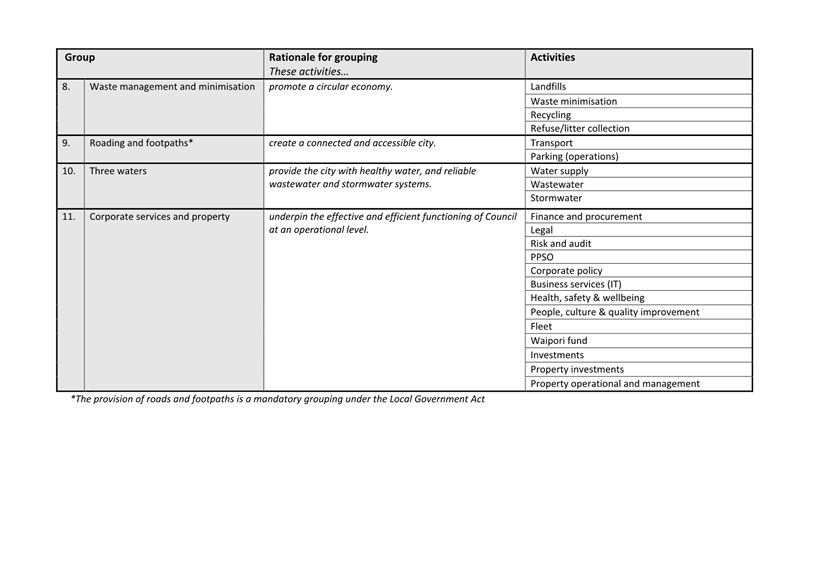
|
|
Council
25 September 2023
|
Growth and Economic Significant Forecasting
Assumptions - 10 year plan 2024-34
Department: City Development and Enterprise Dunedin
EXECUTIVE SUMMARY
1 The
purpose of this report is to seek Council approval of the significant
forecasting assumptions (SFAs) supporting information that has been developed
for the 10 year plan 2024-2034 (the Plan).
2 The
draft SFA’s has been developed by the Strategy workstream.
|
RECOMMENDATIONS
That the Council:
a) Approves, for the purposes of developing the 10
year plan 2024-34, and consulting with the community the significant
forecasting assumptions at Attachment A.
|
BACKGROUND
3 The
Local Government Act 2002 (LGA) requires all local authorities to develop a 10
year plan. Schedule 10 of the LGA specifies the minimum information and
content in the Plan; this includes significant forecasting assumption.
DISCUSSION
Growth Projections
4 The
DCC growth projections are used for a range of forward planning activities
including infrastructure planning, spatial planning, the Development
Contributions Policy and the City Profile.
5 Projected
population growth and demographic changes are based on projections released by
Statistics New Zealand in December 2022. Since the Statistics New Zealand
projections were released, New Zealand has had much higher migration rates than
expected. To reflect this, and the risks of underestimating growth, a composite
high-medium growth scenario has been developed and used. This presumes that
Dunedin’s growth rate follows the high growth scenario over the next ten
years (2024-34) and the growth rates from the medium growth scenario over the
following twenty years (2034-54).
6 The
risks of overestimating growth include inefficient use of funds and an
under-recovery of costs. Growth costs are generally divided by the expected
number of new homes to calculate development contribution fees. Other costs are
distributed by the expected number of rating units to determine rating fees.
This means an over-estimate of growth will result in actual revenue received
being less than projected revenue.
7 The
risks of underestimating growth include inadequate provision of Council services
and a potential follow-on impact on the attractiveness of Dunedin to new
residents and visitors.
Economic Projections
8 Economic
projections have been informed by Infometrics and recently released datasets.
While the Dunedin economy has continued to show resilience in the Post COVID
19, wider inflationary and interest rate pressure exist in the national
economy.
9 These
are expected to continue to influence the local Dunedin economy. There is a
risk that the lower economic growth and sustained inflation and interest rates
will impact on household consumption, investment and spend.
10 Infometrics
project domestic and international visitors are expected to recovery steadily,
with forecast annual visitors reaching 1.878m by June 2024 and 2.539m by 2034.
Financial projections
11 Operational SFAs, including financial assumptions such as inflation
will be presented to Council for approval later this year.
Legislative and reform
assumptions
12 A report on assumptions relating to legislation and reform will be
presented to Council later this year.
Climate-related
projections
13 SFA’s related to climate will be presented to Council for
approval in a separate report.
OPTIONS
Option
One – Supporting documentation is approved. Recommended Option
14 Council
approves the supporting documentation for development of, and inclusion in, the
10 year plan.
Advantages
· The
documentation will be used to further inform the development of the 10 year
plan.
Disadvantages
· There
are no identified disadvantages.
Option
Two – Supporting documentation is not approved.
15 Council
does not approve the supporting documentation and requires further work be
undertaken to amend as necessary.
Advantages
· There
are no identified advantages.
Disadvantages
· Further
work would be required to amend the supporting documentation, which would put
additional pressure on meeting timeframes for development of the 10 year plan.
NEXT STEPS
16 If
approved, the supporting documentation will be included in, and used to support
the development of the 10 year plan.
Signatories
|
Author:
|
Nathan Stocker - Team Leader Research and Monitoring
Fraser Liggett - Economic Development Programme Manager
|
|
Authoriser:
|
Jeanette Wikaira - General Manager Community Services
(Acting)
Sandy Graham - Chief Executive Officer
|
Attachments
|
|
Title
|
Page
|
|
⇩a
|
Growth and Economic
Significant Forecasting Assumptions
|
473
|
|
SUMMARY OF CONSIDERATIONS
|
|
Fit with purpose
of Local Government
This decision enables democratic local
decision making and action by, and on behalf of communities, and promotes the
social, economic, environmental and cultural wellbeing of the Dunedin
communities, taking a sustainable development approach.
|
|
Fit with strategic
framework
|
|
Contributes
|
Detracts
|
Not applicable
|
|
Social Wellbeing Strategy
|
☒
|
☐
|
☐
|
|
Economic Development Strategy
|
☒
|
☐
|
☐
|
|
Environment Strategy
|
☒
|
☐
|
☐
|
|
Arts and Culture Strategy
|
☒
|
☐
|
☐
|
|
3 Waters Strategy
|
☒
|
☐
|
☐
|
|
Spatial Plan
|
☒
|
☐
|
☐
|
|
Integrated Transport Strategy
|
☒
|
☐
|
☐
|
|
Parks and Recreation Strategy
|
☒
|
☐
|
☐
|
|
Other strategic projects/policies/plans
|
☒
|
☐
|
☐
|
The 10 year plan contributes to all of the objectives and
priorities of the strategic framework as it describes the Council’s
activities, the community outcomes, and provides a long term focus for
decision making and coordination of the Council’s resources, as well as
a basis for community accountability.
|
|
Māori Impact
Statement
The adoption of the Māori Strategic Framework signals
Council’s commitment to mana whenua and to its obligations under the
Treaty of Waitangi. Mana whenua and Māori will be involved in
pre-engagement and have an opportunity to engage with the 10 year plan consultation
process through a series of planned hui.
|
|
Sustainability
As part of the 10 year plan, several pieces of work are
underway to give effect to Council’s commitment to sustainability,
including work on the city portrait, Sustainable Development Goals, the Zero
Carbon policy and the adoption of the Māori Strategic Framework.
|
|
LTP/Annual Plan /
Financial Strategy /Infrastructure Strategy
This report provides an update on the development of the
10 year plan. The 10 year plan project includes specific workstreams that
will review Council’s financial and infrastructure strategies to ensure
they are appropriate for the future.
|
|
Financial
considerations
Financial considerations (including financial
sustainability) will be key considerations in the development of the 10 year
plan.
|
|
Significance
The 10 year plan will include community engagement and
public consultation. Pre-engagement initiatives are being planned.
|
|
Engagement –
external
The 10 year plan presents an opportunity for Council to
engage fully with the community across a range of issues.
|
|
Engagement -
internal
Staff from across council are involved in the development
of the 10 year plan.
|
|
Risks: Legal /
Health and Safety etc.
There are legal, reputational, financial and strategic
risk if the 10 year plan is not well executed, or the public do not trust
that the Council is showing good governance, prudent strategic and
operational leadership.
|
|
Conflict of
Interest
There are no known conflicts of interest.
|
|
Community Boards
Community Boards will be engaged and consulted with as
part of the 10 year plan.
|
|
|
Council
25 September 2023
|
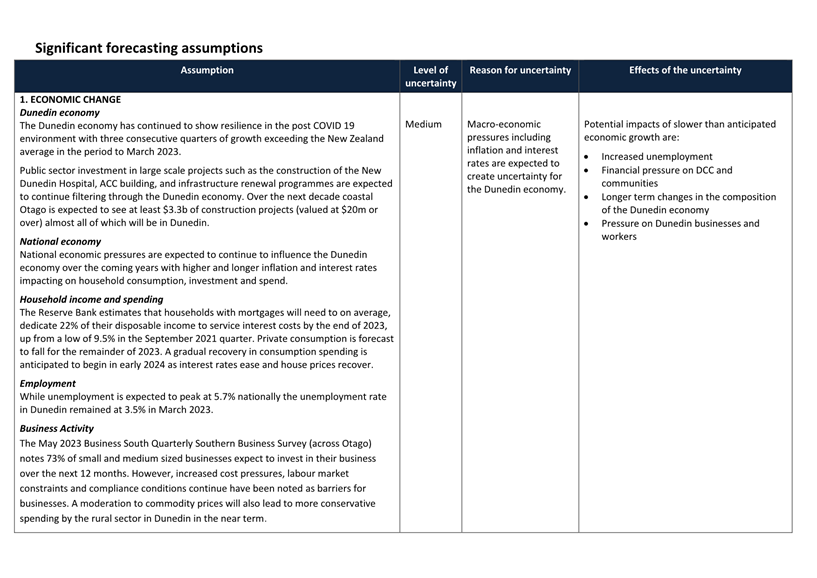
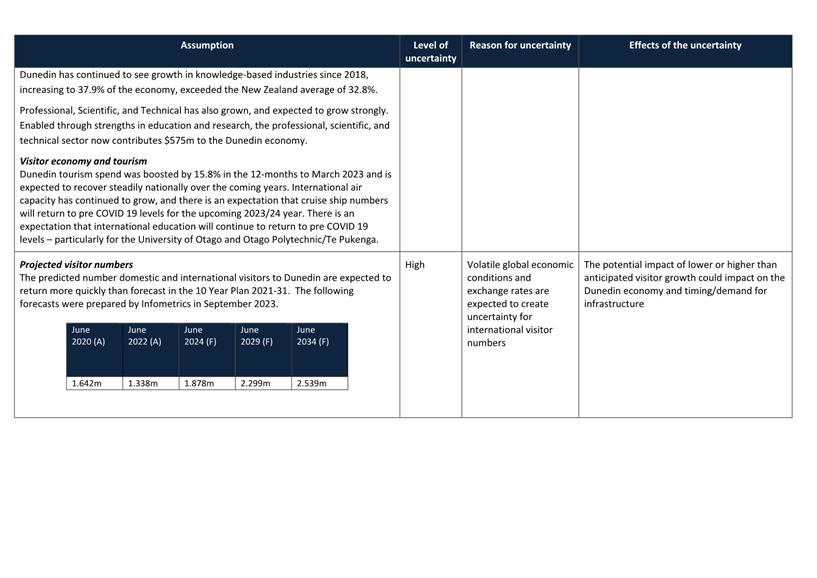
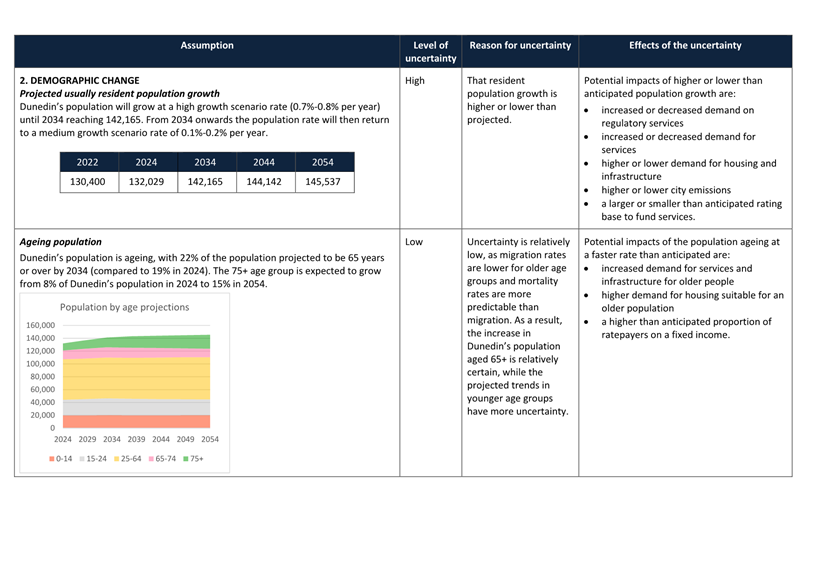
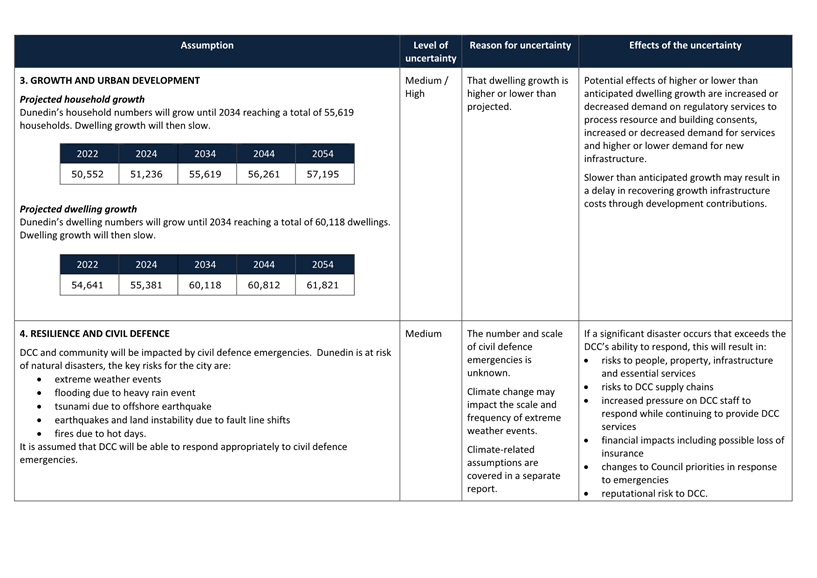
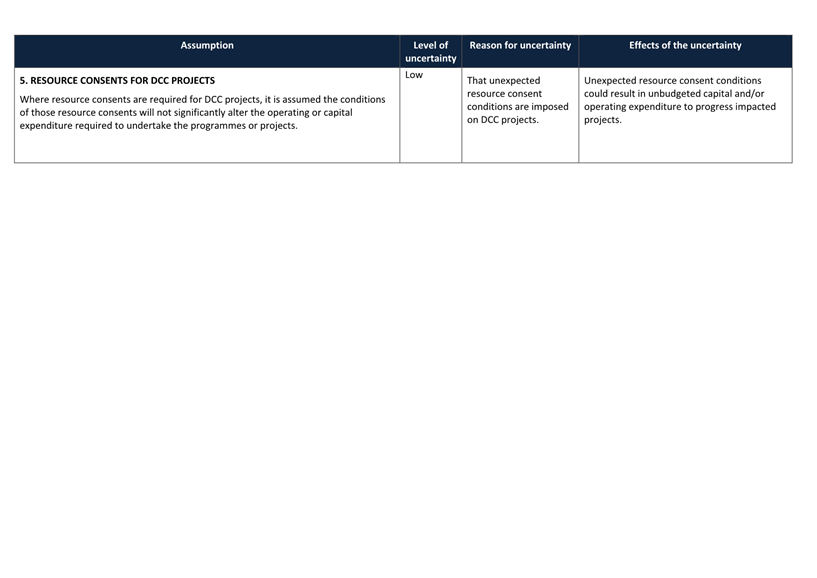
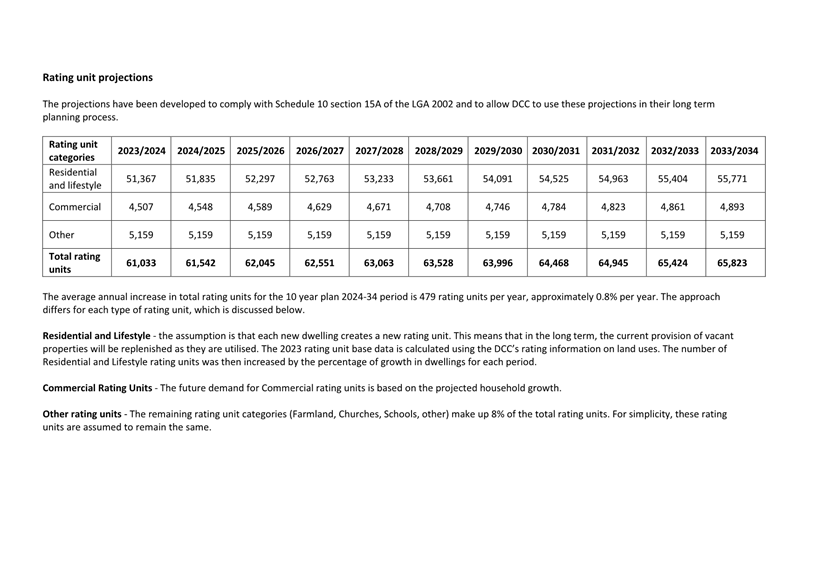
|
|
Council
25 September 2023
|
Climate change significant forecasting
assumptions - 10 year plan 2024-34
Department: Sustainability Group and Maori, Partnerships &
Policy
EXECUTIVE SUMMARY
1 The
purpose of this report is to set out the intended approach to integrating
climate change considerations into the 10 year plan 2024-34, and to seek
Council approval of the climate change aspects of the significant forecasting
assumptions.
2 This
report also provides information about the growing expectations of regulatory
bodies for councils to consider and address climate change, as well as an
overview of national and local emissions context and commitments, and climate
projections.
|
RECOMMENDATIONS
That the Council:
a) Notes the intended approach to integrating climate change
considerations into the 10 year plan
b) Approves, for the purposes of developing the 10
year plan 2024-34, and consulting with the community, the climate-related
significant forecasting assumptions at Attachment A
c) Delegates authority to the CEO to make any minor
amendments to the climate-related significant forecasting assumptions
required to reflect Council decisions on the draft Zero Carbon Plan 2030
(under separate cover) and any updates to DCC emissions reduction targets.
|
BACKGROUND
Climate
change and 10 year plans
3 The
Local Government Act 2002 (LGA) requires that all local authorities develop a
10 year plan (10YP). Schedule 10 of the LGA specifies the minimum
information and content; this includes significant forecasting assumptions
(SFAs), which comprise of growth and economic assumptions along with climate
change projections.
4 Climate-related
considerations are a growing focus area for auditors assessing local government
10YPs. In recent years, the Office of the Auditor-General (OAG) has stressed
the need for councils to address climate change risk, noting that councils have
an important role in understanding, planning for, and responding to the effects
of climate change given their roles in environmental planning and regulation,
transport planning, and responding to natural hazards and extreme weather
events.
5 A key purpose of local government under the LGA is to promote
the social, economic, environmental, and cultural well-being of communities in
the present and for the future. Climate change mitigation (reducing emissions)
and adaptation (preparing for the impacts of climate change) reduces long term
risks and costs for council and the community, promotes future wellbeing, and
responds to community expectations of climate action. A report by Deloitte
estimates that inadequate climate action could cost the New Zealand economy
$4.4 billion by 2050, with losses becoming exponentially worse after that. On
the other hand, decisive climate action could deliver $64 billion to New
Zealand’s economy by 2050.
6 For
the DCC, building emissions reduction and climate adaptation considerations
into decision-making also responds to Council’s strategic direction and
the Zero Carbon Policy 2022.
Best
practice guidance relating to climate change issued ahead of 2021-31 10YPs
7 Having
found most councils’ 2018-28 10YPs inadequately addressed climate change,
the OAG and local government membership bodies published extensive advice on
their evolving expectations in the lead up to 2021-31 10YPs. Climate change
assumptions and disclosures were a focus for OAG auditors when auditing the
2021-31 10YPs, as was assessing the steps that councils are taking to reduce
emissions and whether they are prioritising climate action.
8 The
OAG recommended that councils should actively seek to understand the potential
effects of climate change on its assets and activities, and that assumptions
about climate change and its effects should be key building blocks for 10YPs.
All assumptions underpinning the 10YP should use the best available information,
and climate change and related matters should be woven through the content of
the 10YP and the processes that support the 10YP. Climate change assumptions
should cover:
· the
expected effects of climate change for the city
· the
effects on council activities from the expected effects of climate change
· the
effects on different communities across the city
· the
effects of climate change on levels of service, council finances, and capital
and operational work programmes over the period of the 10YP.
9 The
OAG articulated an expectation that councils that have declared climate
emergencies should be demonstrating a tangible response of accelerating climate
mitigation/adaptation activity, in the form of governance, management, and
prioritisation of council activity and investment.
OAG
findings relating to climate change in 2021-31 10YPs
10 In
matters arising from our audits of the 2021-31 long-term plans, the OAG noted a
marked improvement in consideration of climate change in 2021-31 10YPs.
11 They
singled out two shifts as being particularly positive:
· the increasing number of councils with
dedicated climate action plans and resources, or that are working on them, and
· councils beginning to put climate-related
performance targets and measures in their plans, and in some cases aligning
reporting against these with recently developed national reporting standards.
12 They
generally observed that the 17 councils that had declared climate emergencies
(including the DCC), had included tangible actions or programmes relating to
mitigating or adaptation to the effects of climate change, and that these were
priority areas of council activity.
13 Specific
references to the DCC’s 2021-31 10YP included:
· highlighting
the DCC as an example of councils considering the equity or social justice
aspects of climate change (in relation to building resilience and planning for
long-term adaptation in South Dunedin) and
· the
DCC’s 2030 emissions reduction target for Dunedin.
OAG
direction relating to the 10YP 2024-34, and signalled areas of focus
14 The
OAG has not taken the step of issuing a comprehensive update to its direction
on climate change in 10YPs. However, in matters arising from our audits of the
2021-31 long-term plans, the OAG noted that as councils develop their next
10YP, they could consider the opportunity to take a strong leadership role in
climate action in their district or region.
15 The
OAG has signalled that with climate-related reporting requirements increasing
in importance, they are considering their role in providing assurance over
climate-related reporting, decision making and planning processes through their
annual audits of public organisations. In local government, the OAG will be
measuring how councils are progressing with climate actions over time and
tracking any increasing urgency and activity.
16 The
OAG have also signalled that in 2023/24, they will be looking at how strongly
New Zealand’s climate change commitments are reflected in infrastructure
planning.
Emissions
reduction targets and emissions profiles
17 This
section sets out national, local and organisational emissions reduction targets
relevant to 10YP decision making, as well as the most recent information
available on city and organisational emissions sources.
National emissions
reduction targets
18 As
a signatory of the Paris Agreement, New Zealand has committed to taking actions
that limit global warming to 1.5°C and to meeting a ‘net zero’
emissions by 2050 target. Domestic emissions reduction targets are embedded in
the Climate Change Response Act 2002:
a) Net
zero emissions of all greenhouse gas (GHG) emissions other than biogenic
methane by 2050.
b) 24%
to 47% reduction below 2017 biogenic methane emissions by 2050, including 10%
reduction below 2017 biogenic methane emissions by 2030.
Dunedin emissions
reduction targets and 2021/22 emissions
19 In 2019, the DCC declared a climate
emergency and adopted a ‘Zero Carbon 2030’ emissions reduction
target for Dunedin. As with national commitments, the target is in two parts:
a) Net
zero emissions of all GHG emissions other than biogenic methane by 2030.
b) 24%
to 47% reduction below 2017 biogenic methane emissions by 2050, including 10%
reduction below 2017 biogenic methane emissions by 2030.
20 Dunedin’s
gross emissions in 2021/22 totalled 1.542 million tCO2-e. The main
contributing sectors were Agriculture and Transport, followed by Stationary
Energy, Waste and Industrial Processes and Product Use (IPPU) (Figure 1). This
was offset by the city’s forests absorbing 0.493 million t CO2-e,
reducing net emissions to 1.049 million tCO2-e.
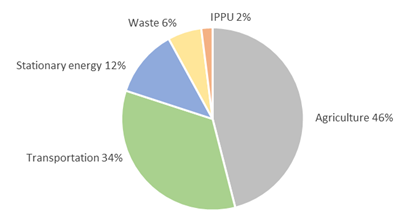
Figure 1: Dunedin City emissions
2021/22
21 Trends
in emissions are set out in further detail in the draft City Snapshot, under
separate cover.
DCC’s emissions reduction
targets and 2021/22 emissions
22 At
an organisational level, the DCC’s most recently adopted target is for a
42% reduction in core emissions by 2030 based on the 2018/19 baseline. Since
this target was adopted, a range of additional emissions sources have been
added to the organisation’s emissions footprint in response to updates to
the global reporting standard used by the DCC. An appropriate target for the
extended scope of the organisation’s emissions footprint is currently
under development.
23 The
DCC’s gross emissions for the 2021/22 period totalled 70,212 tCO2-e.
Major emissions sources (Figure 2) were waste to Green Island Landfill (60%),
closed landfill (13%), and wastewater treatment (12%). Relatively fewer
emissions originated from electricity use (5%) LPG use (3%) and chemical use
(3%). Other minor emissions sources made up the final 4% of the footprint.
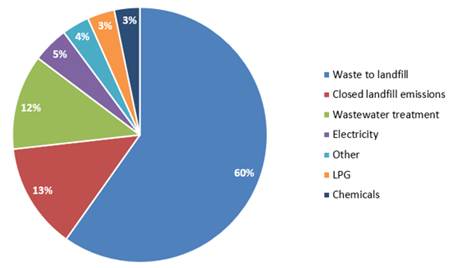
Figure 2: DCC emissions 2021/22
Risk
and adaptation frameworks, and projected climate change impacts
24 This
section describes the national frameworks established to assess risk and adapt
to climate change and sets out current understanding of projected national and
local climate change impacts.
National climate change
risk and adaptation frameworks
25 In
August 2020, the Ministry of the Environment (MfE) published the first National
Climate Change Risk Assessment (NCCRA), which acknowledged that the climate
is changing and that further changes will result from increasing amounts of
greenhouse gases in the atmosphere.
26 The
NCCRA noted that in New Zealand, the effects of this change are already being
experienced. Over the past century, temperatures have increased, glaciers have
melted and sea levels have risen. Such changes will continue, and their impacts
increase. These future changes will have far-reaching consequences for people
and the environment – in cities, towns and communities, across all levels
of government, and from the coastline to lakes, rivers and forests.
27 New
Zealand’s 10 most significant climate change risks (across five domains)
include:
· Natural
environment: Risk to coastal ecosystems due to ongoing sea-level rise and
extreme weather events; risk to indigenous ecosystems and species from enhanced
spread, survival and establishment of invasive species.
· Human:
Risks to social cohesion and community wellbeing from displacement of
individuals families and communities; risk of exacerbating existing
inequalities and creating new ones.
· Economy:
Risk of lost productivity, disaster relief expenditure and unfunded contingent
liabilities; risks to financial system from instability due to extreme weather
events and ongoing gradual changes.
· Built
environment: Risk to potable water supplies (availability and quality) and
buildings due to changes in rainfall, temperature, drought, wildfire, extreme
weather events and ongoing sea-level rise.
· Governance:
Risk of maladaptation due to decisions that do not account for uncertainty and
change over long timeframes; risk that climate change impacts are exacerbated
because current institutional arrangements are not fit for adaptation.
28 In
August 2022, and in response to the NCCRA, MfE published the first National
Adaptation Plan (NAP) 2022-28, which outlined a national structure and set
of processes for adapting to the impacts of a changing climate in Aotearoa New
Zealand.
29 The
NAP noted that adaptation is a continuous process of assessing and managing
risk, evaluating the effectiveness of actions taken and adjusting those actions
as needed. By adapting to the unavoidable effects of climate change, we become
more resilient to those risks. Climate change is exacerbating the risks of
existing natural hazards – including flooding and drought – and
creating new risks such as sea-level rise. We can build on our past experience
with natural hazards to prepare for increased risk in the future.
30 The
four key focus areas of the NAP 2022-28 include:
· Better
risk-informed decisions
· Climate-resilient
development in the right location
· Adaptation
options including managed retreat
· Embed
climate resilience across Government
Projected climate change
impacts
31 The
following projections for climate change impacts are derived from the NCCRA,
NAP, research
undertaken by NIWA on climate change projections for the Otago Region
(commissioned by the Otago Regional Council in 2019), and the Aotearoa
New Zealand climate change projections guidance: Interpreting the latest IPCC
WG1 report findings (commissioned by MfE in 2022, updated in 2023).
· In
the last 100 years, our climate has warmed by 1.1°C. Depending on global
emissions, temperatures will likely increase by a further 1-1.3°C by
mid-century and 1.6-3.1°C by end of century, with the greatest warming
likely to be in the northeast of New Zealand.
· In
the last 60 years, sea levels have risen by 0.15 m (or around 2.44 mm per
year). If global emissions remain high, sea levels will likely increase by a
further 0.21 m by 2040 and 0.67 m by 2090.
· Extreme
weather events such as storms, heatwaves and heavy rainfall are likely to be
more frequent and intense. Large increases in extreme rainfall are expected
everywhere in the country. Annual rainfall in Otago is expected to increase
slightly by mid-century (0-10%), while the increase spans 10-20% at the end of
the century.
· The
number of frost and snow days are projected to decrease.
· Drought
is predicted to increase in frequency and severity, particularly along the
eastern side of the Southern Alps. Wildfire risk is predicted to increase.
Guidance on planning for,
and adapting to, the impacts of climate change
32 Further
to requirements of the LGA in regard to 10YP processes, and directions issued
by the OAG in relation to climate change, both noted above, in July 2022 MfE
issued updated
guidance relating to coastal hazards and climate change (which builds on
previous guidance from 2017).
33 When
exercising their functions under the Resource Management Act 1991 (RMA) and
giving effect to the provisions of the New Zealand Coastal Policy Statement
(NZCPS), councils should use a framework of five “medium
confidence” climate change scenarios.
34 These
five scenarios use shared socio-economic pathways (SSPs) introduced by the IPCC
(Intergovernmental Panel on Climate Change) Sixth Assessment Report (AR6)
published in 2021-23. These span a wide range of plausible societal and
climatic futures and replace the previous representative concentration pathways
(RCPs) used in the 2017 guidance. The scenarios include:
· SSP1-2.6
Median (Sustainability) - Aspirational pathway with extremely low emissions
· SSP2-4.5
Median (Middle of the road) - Most likely scenario, with emissions reductions
consistent with historic social, economic and technological trends.
· SSP3-7.0
Median (Regional rivalry) - Resurgent nationalism over regional and global
issues
· SSP5-8.5
Median (Fossil fuel intensive development) - Ongoing emissions-intensive
development
· SSP5-8.5
H+ (Upper likely range) - Worst case scenario.
35 MfE’s
advice recommends using the five updated “medium confidence”
scenarios out to 2150 to undertake risk and vulnerability assessments and
stress-test proposals, strategies, project designs, policies, rules, statutory
coastal hazard overlays, and emerging spatial plans.
36 It
is also recommended to include vertical land movement (VLM) rates to calculate
relative sea-level rise (RSLR) locally, or if rates are low, average them
regionally. Where local VLM rates are specifically monitored and more granular,
these should be used instead.
37 To
further stress test risk-sensitive or long-lived projects such as new
subdivisions, long-lived infrastructure, or vulnerable cultural sites,
“low confidence” SSP scenarios could be used (which extend beyond
2150 and model some more uncertain contributors to sea-level rise, such as
instabilities of polar ice shelves).
DISCUSSION
Approach
to integrating climate change considerations in the 10 year
plan
38 The
following steps are being taken to integrate climate change considerations in
the 10YP.
|
10 year plan element
|
Proposed approach
|
|
City snapshot
|
Draft Dunedin emissions and climate change sections
included in City Snapshot for Council consideration under separate cover.
|
|
Forecasting assumptions
|
Draft climate-related significant forecasting assumptions
set out for Council consideration in this report. The draft may need to be
further updated following Council decisions on the draft Zero Carbon Plan
2030, under separate cover.
|
|
Financial and
infrastructure strategies
|
Climate change and Zero Carbon sections of the financial
and infrastructure strategies will be updated to reflect South Dunedin Future
and Zero Carbon work programme progress and relevant Council decisions made
since adoption of the 2021-31 10 Year Plan, including:
- adoption
of the South Dunedin Future work programme
- adoption
of the Zero Carbon Policy 2022
- progress
against the DCC’s Emissions Management and Reduction Plan
- progress
against key projects that were identified in the 2021-31 10YP as being
important contributors to climate change response.
Council’s decisions on the draft Zero Carbon Plan
2030, under separate cover, will also inform this work.
|
|
Service and activity
information
|
In line with the Zero Carbon Policy 2022:
- all
proposed capital expenditure and all new proposed operating expenditure is
being assessed for potential emissions impact, and
- consideration
will be given to how climate-related goals and targets can be reflected in
levels of service and associated performance measures.
Council’s decisions on the draft Zero Carbon Plan
2030, under separate cover, will also inform this work.
|
|
Consultation document
|
Consideration will be given to how climate-related issues
can be reflected in consultation documents, following relevant decisions of
Council.
|
|
Policy reviews
|
The Zero Carbon team will be involved in reviewing
relevant policies for the 10YP, including the revenue and financing policy
and the significance and engagement policy.
|
Climate-related
Significant Forecasting Assumptions
This section sets out the
proposed approach to the climate-related SFAs for the 10YP 2024-34.
Significant Forecasting
Assumptions
40 Schedule
10 (17) of the LGA provides the following:
A long-term plan must
clearly identify—
(a) all
the significant forecasting assumptions and risks underlying the financial
estimates:
(b) without
limiting the generality of paragraph (a), the following assumptions on which
the financial estimates are based:
(i) the
assumptions of the local authority concerning the life cycle of significant
assets; and
(ii) the
assumptions of the local authority concerning sources of funds for the future
replacement of significant assets:
(c) in
any case where significant forecasting assumptions involve a high level of
uncertainty,
(i) the
fact of that uncertainty; and
(ii) an
estimate of the potential effects of that uncertainty on the financial
estimates provided.
41 The strategic significant forecasting assumptions (SFA’s)
traditionally include the key assumptions around growth, climate change and
economic projections.
Best practice guidance for climate-related SFAs
42 Best
practice guidance directs that climate change assumptions must be realistic,
evidence based, internally consistent with other assumptions and applied
consistently across the organisation.
43 Climate
change assumptions are likely to include the expected direct impact of climate
change in the local area (e.g. sea-level rise, rainfall levels) and the impacts
on communities from the expected effects of climate change (including broader
impacts on the social, environmental, economic and cultural wellbeing of the
local community), and how these might flow through to the local authority.
Draft SFAs for the 10YP 2024-34
44 Draft
significant forecasting assumptions related to emissions reduction targets and
climate change projections are at Attachment A, for Council approval.
Growth assumptions and economic projections are presented in reports under
separate cover.
45 The climate-related SFAs have been updated since the previous 10YP
to reflect updated understanding and changes in our context:
· The City and DCC emissions reduction targets SFA has been
updated since the last 10YP to reflect work programme progress and additional
DCC decisions relating to emissions reduction. In particular, since the last
10YP, Council has adopted the Zero Carbon Policy (2022).
· The Climate Change Projections SFA is based on updated
national guidance from the Ministry for the Environment (MfE), supporting
research from the National Institute for Water and Atmospheric Research (NIWA),
and information derived from Victoria University of Wellington’s NZ
SeaRISE Programme. In the interests of simplicity, only two of the five
scenarios are proposed to be included in the 10YP, SSP2-4.5 (Middle of the
Road) and SSP5-8.5 (Fossil fuel intensive development).
OPTIONS
Option
One – The draft climate-related SFAs are approved. Recommended Option.
46 Council
approves the draft climate-related SFAs for development of, and inclusion in,
the draft 10YP 2034-34 (with or without amendment).
Advantages
· The
draft climate-related SFAs will be used to further inform the development of
the 10 year plan.
· Meets
OAG guidelines for progressing climate actions as part of 10 year plan.
Disadvantages
· There
are no identified disadvantages.
Option
Two – Supporting documentation is not approved.
47 Council
does not approve the draft climate-related SFAs and requires further work be
undertaken to amend as necessary.
Advantages
· There
are no identified advantages.
Disadvantages
· Further
work would be required to amend the climate-related SFAs, which would put
further pressure on meeting time frames for the development of the 10YP
2024-34.
NEXT STEPS
48 If
approved, the draft climate-related SFAs will be included in, and used to
support the development of the draft 10YP 2024-34.
Signatories
|
Author:
|
Jinty MacTavish - Principal Policy Advisor Sustainability
Jonathan Rowe - Programme Manager, South Dunedin Future
|
|
Authoriser:
|
Jeanette Wikaira - General Manager Community Services
(Acting)
Sandy Graham - Chief Executive Officer
|
Attachments
|
|
Title
|
Page
|
|
⇩a
|
Appendix A:
Climate-related SFAs for the 10 year plan 2024-34
|
491
|
|
SUMMARY OF CONSIDERATIONS
|
|
Fit with purpose
of Local Government
This decision enables democratic local
decision making and action by, and on behalf of communities, and promotes the
social, economic, environmental and cultural wellbeing of the Dunedin
communities, taking a sustainable development approach.
|
|
Fit with strategic
framework
|
|
Contributes
|
Detracts
|
Not applicable
|
|
Social Wellbeing Strategy
|
☒
|
☐
|
☐
|
|
Economic Development Strategy
|
☒
|
☐
|
☐
|
|
Environment Strategy
|
☒
|
☐
|
☐
|
|
Arts and Culture Strategy
|
☒
|
☐
|
☐
|
|
3 Waters Strategy
|
☒
|
☐
|
☐
|
|
Spatial Plan
|
☒
|
☐
|
☐
|
|
Integrated Transport Strategy
|
☒
|
☐
|
☐
|
|
Parks and Recreation Strategy
|
☒
|
☐
|
☐
|
|
Other strategic projects/policies/plans
|
☒
|
☐
|
☐
|
The 10 year plan contributes to all of the objectives and
priorities of the strategic framework as it describes the Council’s
activities, the community outcomes, and provides a long term focus for
decision making and coordination of the Council’s resources, as well as
a basis for community accountability.
|
|
Māori Impact
Statement
The adoption of the Māori Strategic Framework signals
Council’s commitment to mana whenua and to its obligations under the
Treaty of Waitangi. Mana whenua and Māori will be involved in
pre-engagement and have an opportunity to engage with the 10 year plan
consultation process through a series of planned hui.
|
|
Sustainability
As part of the 10 year plan, several pieces of work are
underway to give effect to Council’s commitment to sustainability,
including work on the city portrait, Sustainable Development Goals, the Zero
Carbon policy and the adoption of the Māori Strategic Framework.
|
|
LTP/Annual Plan /
Financial Strategy /Infrastructure Strategy
This report provides an update on the development of the
10 year plan. The 10 year plan project includes specific workstreams that
will review Council’s financial and infrastructure strategies to ensure
they are appropriate for the future.
|
|
Financial
considerations
Financial considerations (including financial
sustainability) will be key considerations in the development of the 10 year
plan.
|
|
Significance
The 10 year plan will include community engagement and
public consultation. Pre-engagement initiatives are being planned.
|
|
Engagement –
external
The 10 year plan presents an opportunity for Council to
engage fully with the community across a range of issues.
|
|
Engagement -
internal
Staff from across council are involved in the development
of the 10 year plan.
|
|
Risks: Legal /
Health and Safety etc.
There are legal, reputational, financial and strategic
risk if the 10 year plan is not well executed, or the public do not trust
that the Council is showing good governance, prudent strategic and
operational leadership.
|
|
Conflict of
Interest
There are no known conflicts of interest.
|
|
Community Boards
Community Boards will be engaged and consulted with as
part of the 10 year plan.
|
|
|
Council
25 September 2023
|
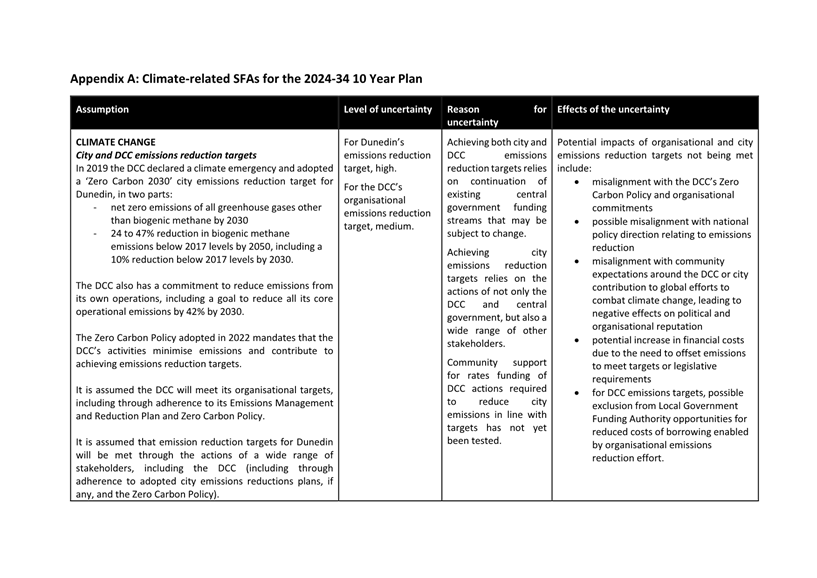
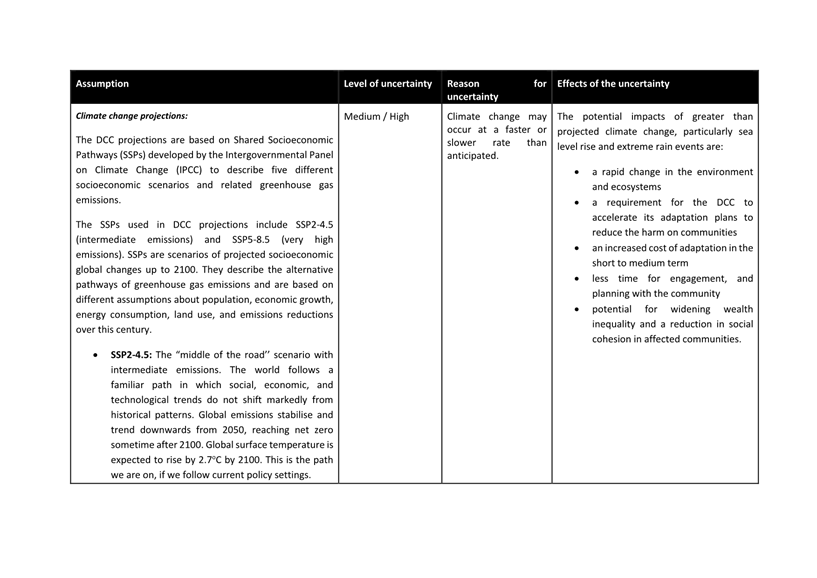
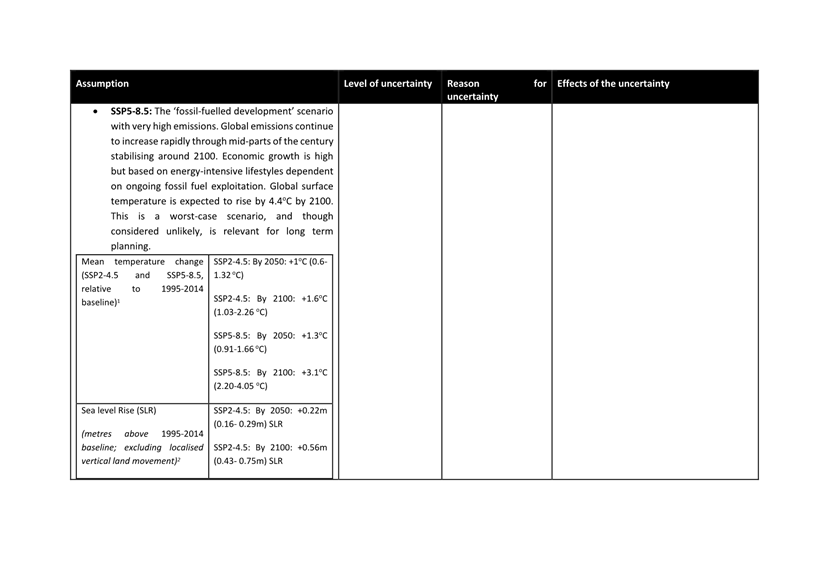
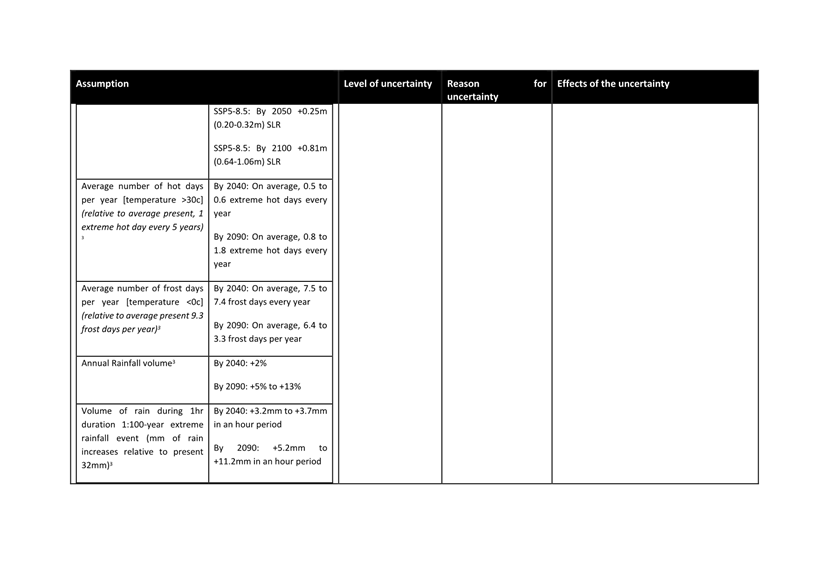
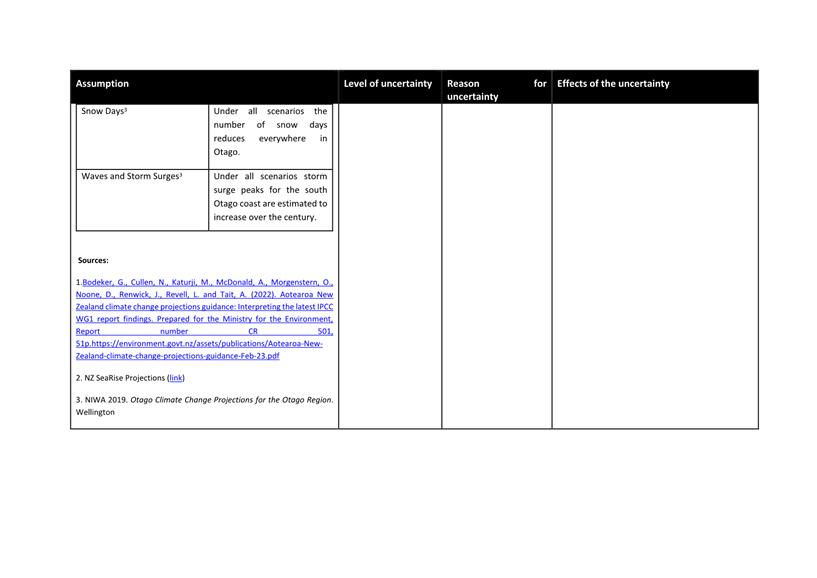
|
|
Council
25 September 2023
|
City Profile Snapshot - 10 year plan 2024-34
Department: City Development and Enterprise Dunedin
EXECUTIVE SUMMARY
1 The
purpose of this report is to seek Council approval of the city profile snapshot
supporting information that has been developed for the 10 year plan 2024-2034
(the Plan).
2 The
draft city profile snapshot has been developed by the Strategy workstream.
|
RECOMMENDATIONS
That the Council:
a) Approves, for the purposes of developing the 10
year plan 2024-34, and consulting with the community the draft city profile
at Attachment A.
|
BACKGROUND
3 The
Local Government Act 2002 (LGA) requires all local authorities to develop a 10
year plan.
4 Schedule
10 of the LGA specifies the minimum information and content in the Plan; this
includes significant forecasting assumptions.
DISCUSSION
City Profile
5 The
Dunedin 2023 city profile (Attachment A) provides a snapshot of the social,
cultural, economic and environmental demographics of the city. The
profile outlines the makeup and trends of the population and provides
projections for what Dunedin could look like over the next 30 years. The
profile also provides information such as residents’ perception on
various topics, Dunedin’s major religions, unemployment rate, and climate
change emissions and impacts. The snapshot also includes macro-economic
information such as inflation, growth and interest rates track, contained in
the recently released Pre-election Economic Fiscal Update (PREFU).
6 The
purpose of the city profile is to provide a picture of Dunedin’s current
state, trends and future projections. This information is intended to help
inform planning and decisions relating to the Plan. The attached city profile
provides draft content for approval. The draft content will be formatted
appropriately as consistent with other 10YP publications.
OPTIONS
Option
One – Supporting documentation is approved. Recommended Option
7 Council
approves the supporting documentation for development of, and inclusion in, the
draft 10 year plan.
Advantages
· The
documentation will be used to further inform the development of the 10 year
plan.
Disadvantages
· There
are no identified disadvantages.
Option
Two – Supporting documentation is not approved.
8 Council
does not approve the supporting documentation and requires further work be
undertaken to amend as necessary.
Advantages
· There
are no identified advantages.
Disadvantages
· Further
work would be required to amend the supporting documentation, which would put
further pressure on meeting time frames for the development of the 10 year
plan.
NEXT STEPS
9 If
approved, the supporting documentation will be included in, and used to support
the development of the draft 10 year plan.
Signatories
|
Author:
|
Nathan Stocker - Team Leader Research and Monitoring
Fraser Liggett - Economic Development Programme Manager
|
|
Authoriser:
|
Jeanette Wikaira - General Manager Community Services
(Acting)
|
Attachments
|
|
Title
|
Page
|
|
⇩a
|
Draft City Snapshot
|
500
|
|
SUMMARY OF CONSIDERATIONS
|
|
Fit with purpose
of Local Government
This decision enables democratic local
decision making and action by, and on behalf of communities, and promotes the
social, economic, environmental and cultural wellbeing of the Dunedin
communities, taking a sustainable development approach.
|
|
Fit with strategic
framework
|
|
Contributes
|
Detracts
|
Not applicable
|
|
Social Wellbeing Strategy
|
☒
|
☐
|
☐
|
|
Economic Development Strategy
|
☒
|
☐
|
☐
|
|
Environment Strategy
|
☒
|
☐
|
☐
|
|
Arts and Culture Strategy
|
☒
|
☐
|
☐
|
|
3 Waters Strategy
|
☒
|
☐
|
☐
|
|
Spatial Plan
|
☒
|
☐
|
☐
|
|
Integrated Transport Strategy
|
☒
|
☐
|
☐
|
|
Parks and Recreation Strategy
|
☒
|
☐
|
☐
|
|
Other strategic projects/policies/plans
|
☒
|
☐
|
☐
|
The 10 year plan contributes to all of the objectives and
priorities of the strategic framework as it describes the Council’s
activities, the community outcomes, and provides a long term focus for
decision making and coordination of the Council’s resources, as well as
a basis for community accountability.
|
|
Māori Impact
Statement
The adoption of the Māori Strategic Framework signals
Council’s commitment to mana whenua and to its obligations under the
Treaty of Waitangi. Mana whenua and Māori will be involved in
pre-engagement and have an opportunity to engage with the 10 year plan
consultation process through a series of planned hui.
|
|
Sustainability
As part of the 10 year plan, several pieces of work are
underway to give effect to Council’s commitment to sustainability,
including work on the city portrait, Sustainable Development Goals, the Zero
Carbon policy and the adoption of the Māori Strategic Framework.
|
|
LTP/Annual Plan /
Financial Strategy /Infrastructure Strategy
This report provides an update on the development of the
10 year plan. The 10 year plan project includes specific workstreams that
will review Council’s financial and infrastructure strategies to ensure
they are appropriate for the future.
|
|
Financial
considerations
Financial considerations (including financial
sustainability) will be key considerations in the development of the 10 year
plan.
|
|
Significance
The 10 year plan will include community engagement and
public consultation. Pre-engagement initiatives are being planned.
|
|
Engagement –
external
The 10 year plan presents an opportunity for Council to
engage fully with the community across a range of issues.
|
|
Engagement -
internal
Staff from across council are involved in the development
of the 10 year plan.
|
|
Risks: Legal /
Health and Safety etc.
There are legal, reputational, financial and strategic
risk if the 10 year plan is not well executed, or the public do not trust
that the Council is showing good governance, prudent strategic and
operational leadership.
|
|
Conflict of
Interest
There are no known conflicts of interest.
|
|
Community Boards
Community Boards will be engaged and consulted with as
part of the 10 year plan.
|
|
|
Council
25 September 2023
|

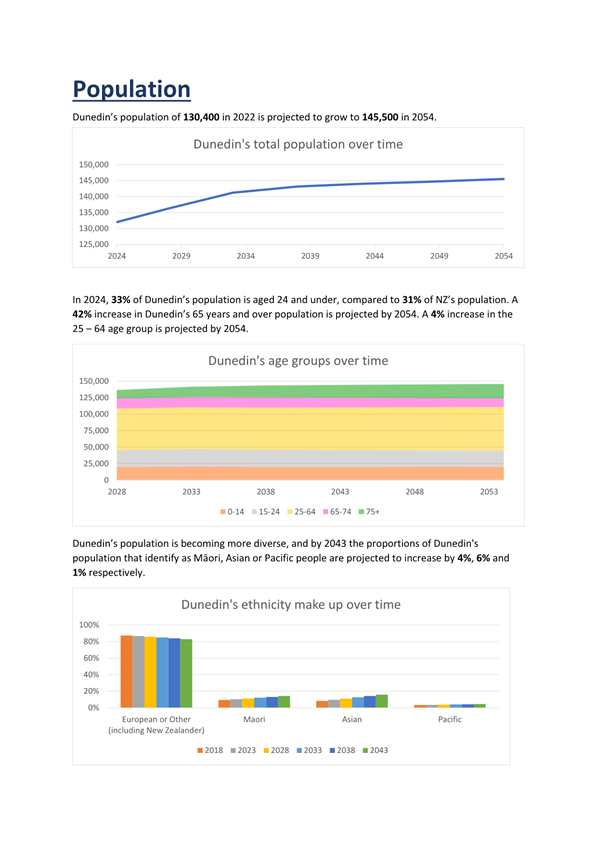
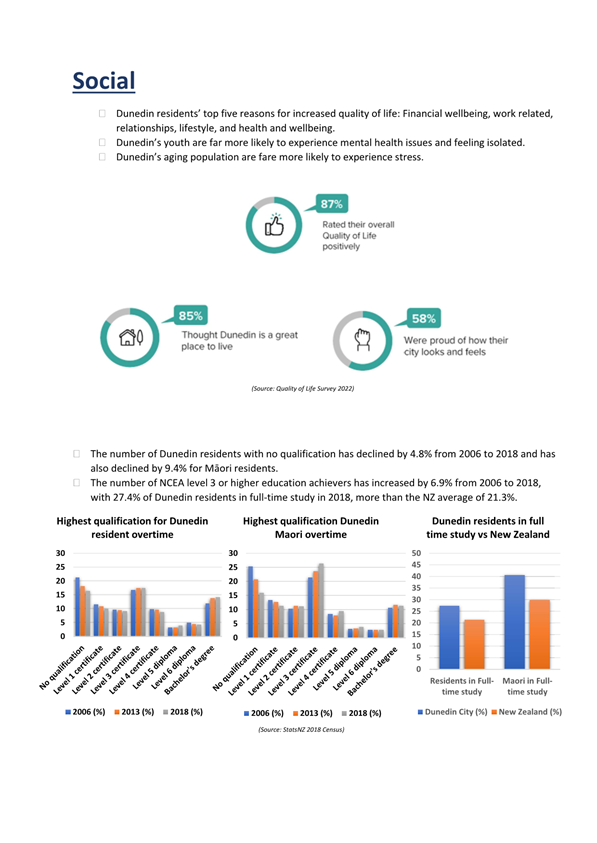
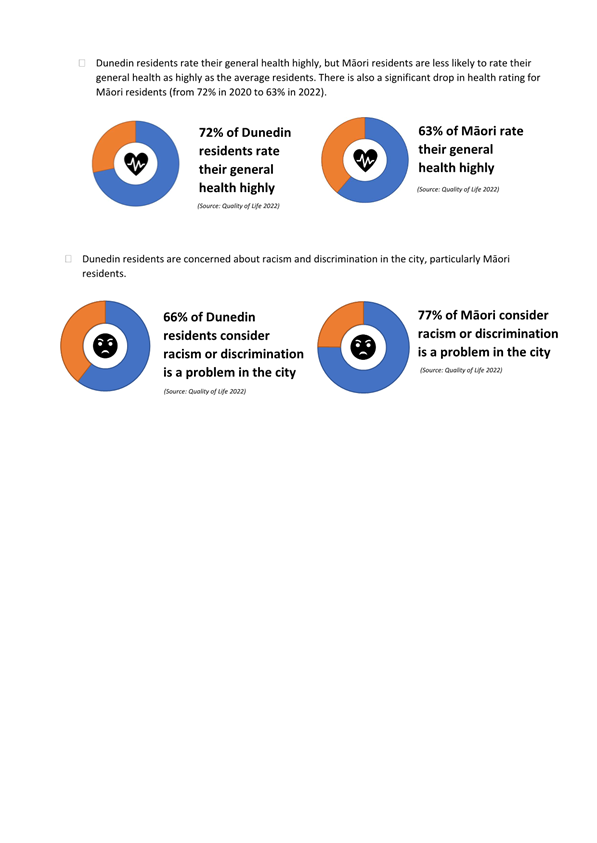
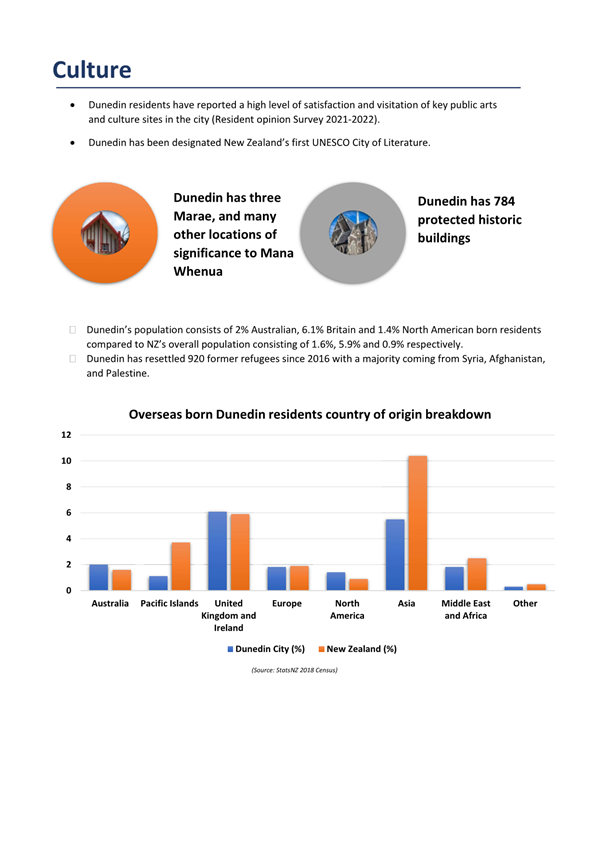
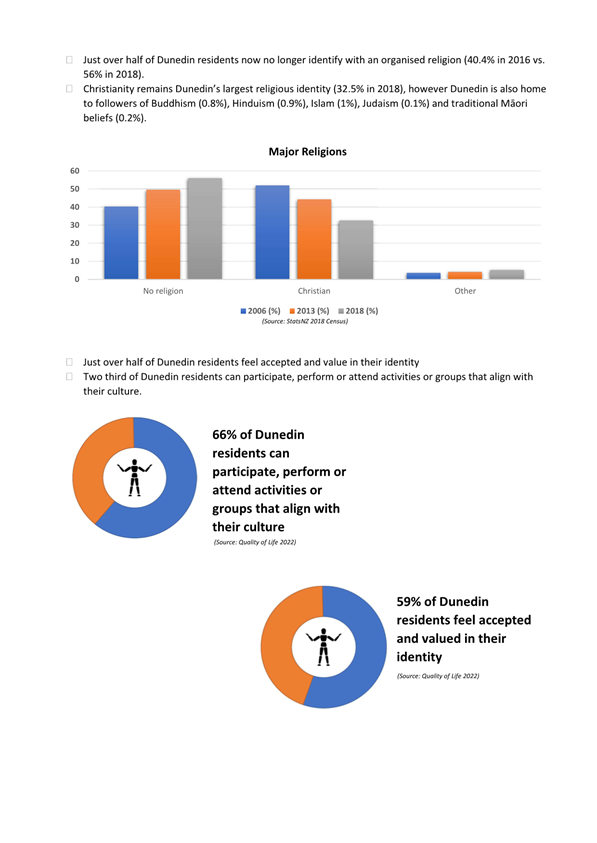
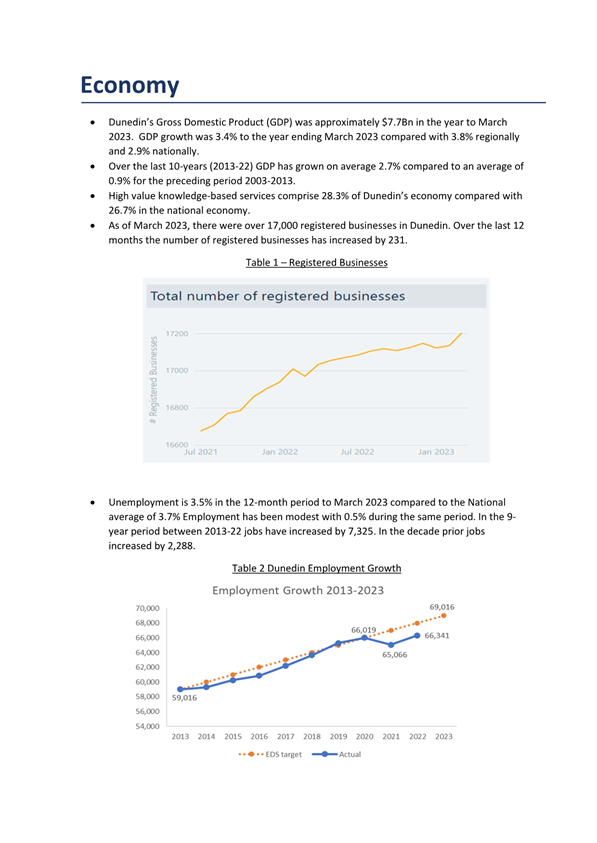
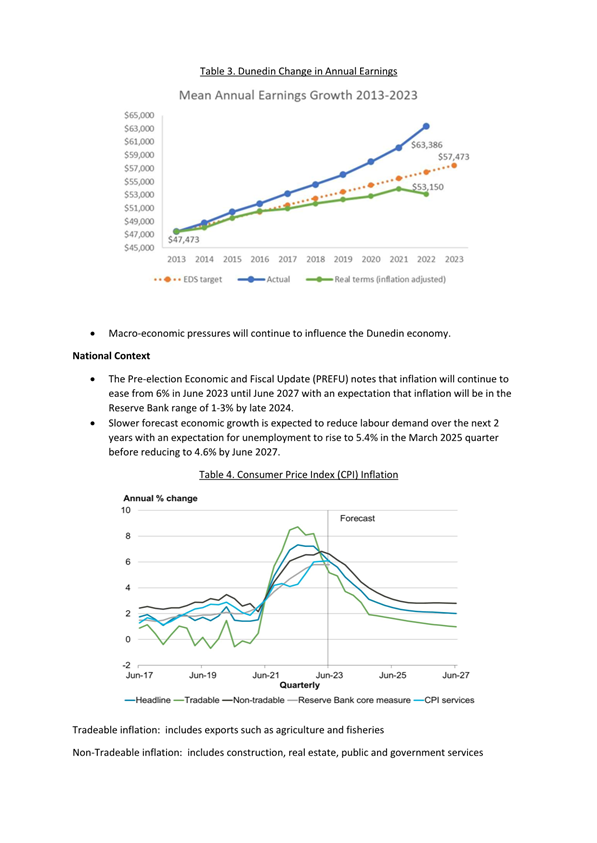
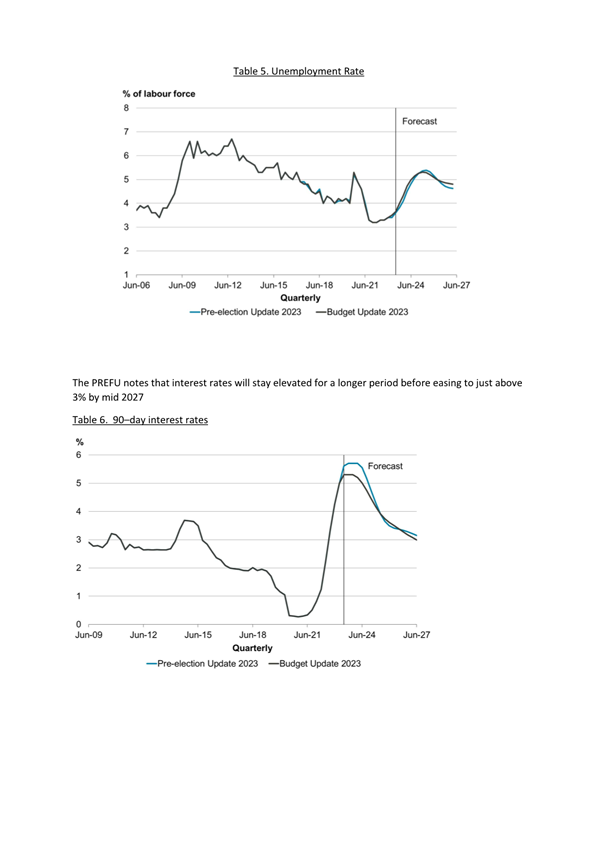
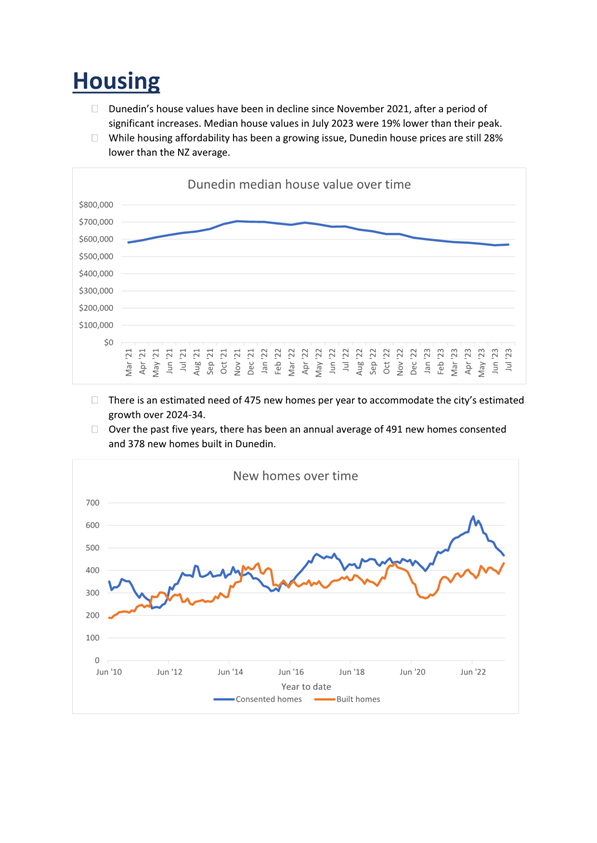
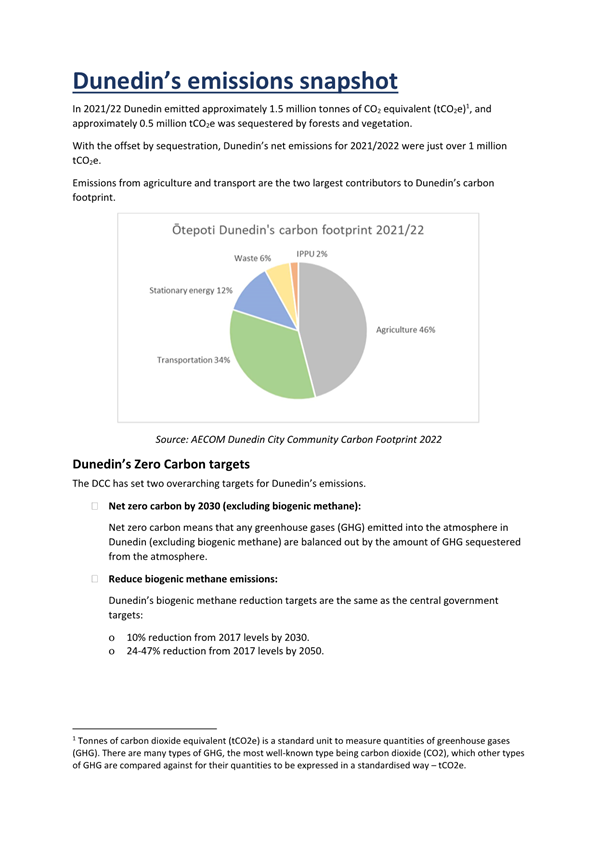
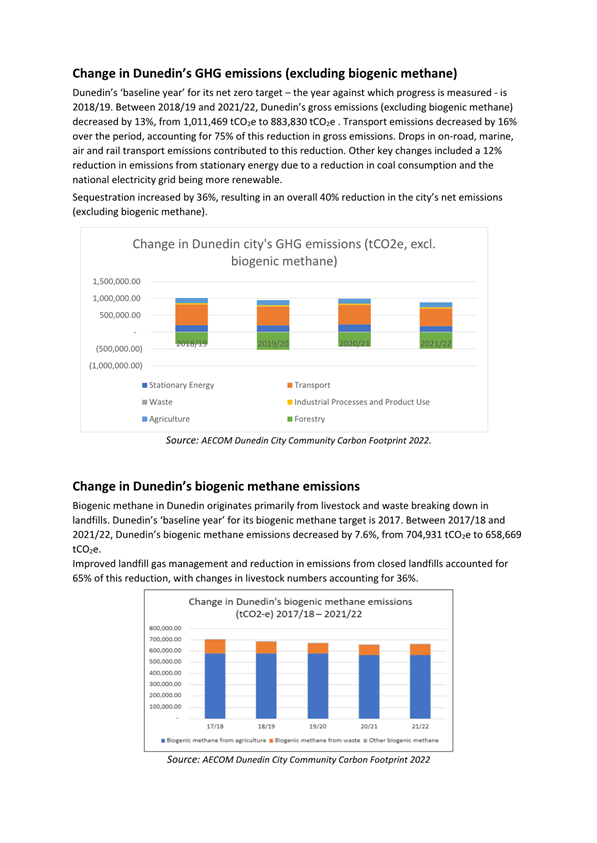
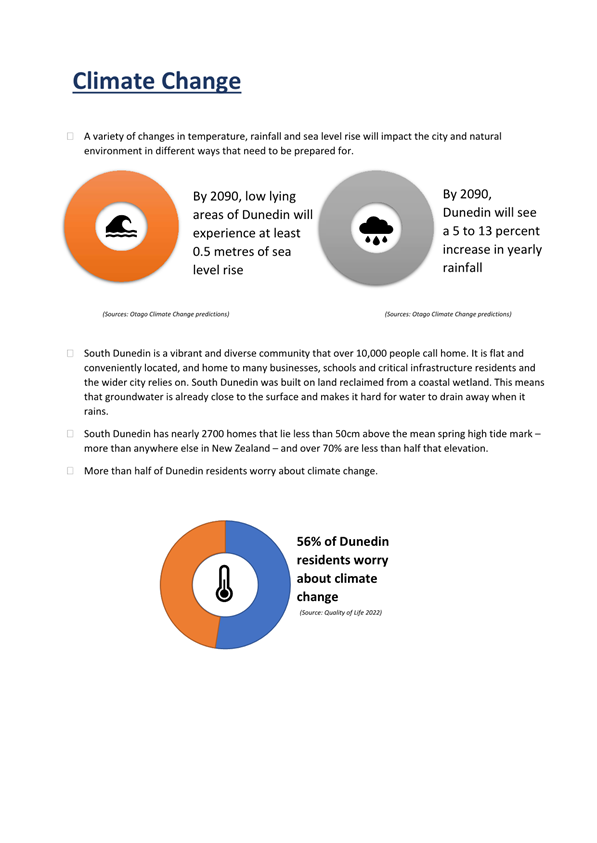
|
|
Council
25 September 2023
|
DCC Grants - 10 year plan 2024-2034 Supporting
Information
Department: Corporate Policy, Office of the Chief Executive
and Finance
EXECUTIVE SUMMARY
1 This
report follows a request by Council to review grants. Its purpose is to support
the DCC’s preparation of the upcoming 10 year plan 2024-2034 (10YP).
2 Three
areas of granting were identified as; Grants, Other Support and Subsidies. This
report focusses on ‘Grants’ and has produced a;
a) stocktake
of the types of grants, and
b) identified
the grants budget and amounts spent in the last financial year 2022-2023
(FY22-23) – Attachment A.
3 10
broad categories were identified across grants which suggest that the DCC is
responding to a variety of groups such as communities, businesses, and event
organisers through administering diverse grant-types. The stocktake of
recipients also suggests that the DCC administers to a variety of recipients
across Ōtepoti Dunedin (Attachment A), although
more analysis is needed to better understand potential trends across time.
4 The
total amount granted by the DCC to other organisations and entities in the
FY22-23 was just over $13.8 million. This includes $971k of Central Government
funding which the DCC administered. Detailed information related to DCC grants
is provided in Attachment A.
5 Information
related to subsidies is still being collated, however a stocktake of groups who
received rates relief in FY22-23 was completed. This showed that just over
$665k was awarded as detailed in Attachment B.
6 The
report does not include information about ‘Other Support’ made by
the DCC to groups and organisations.
RECOMMENDATIONS
That the Council:
a) Notes the contents of this report
BACKGROUND
7 The
DCC makes a significant contribution to the social, economic, environmental and
cultural wellbeing of Dunedin’s communities and its natural and built
environment through administering grants.
8 This
report follows a request by Council to review grants. Its purpose is to support
the DCC’s preparation of the upcoming 10 year plan 2024-2034 (10YP).
9 This
report summarises the work completed to date.
DISCUSSION
What is a Grant? An overview
of the work plan.
10 In
its simplest form a grant is “a sum of money given by a government or
other organisation for a particular purpose”.
11 In
regard to the DCC, three broad categories were identified:
· Grants
· Other
support
· Subsidies
12 Grants
are defined as where the DCC provides funding to another organisation or entity
and the DCC has a current policy and/or process that oversees this. This report
summarises information related to the existing Grants and has identified ten
funding categories and associated amounts using financial data from the 22-23
financial year. Longitudinal data was not available in time for this report.
13 Other
support is defined as where the DCC provides in-kind support to groups and
organisations. This may include providing equipment, or fees waived on DCC
owned facilities for a community event. Work in this area has not yet started
but will focus on identifying categories of support, and the rationale
associated with each.
14 Subsidies
are defined as where the DCC subsidises a group or entity. Examples may
include subsiding rent on DCC owned facilities that a group uses or subsidising
other fees or costs. Work in this area has started but only regarding
rates relief which has been summarised in Attachment B. The remaining work on
identifying other types of subsidies, and the rationale associated with each,
has not yet begun.
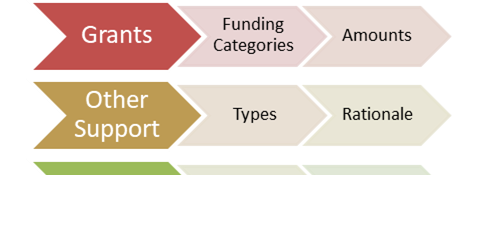
Figure 1: Grants, Other Support and
Subsidies – key work areas
Grant Totals and Categories
in 2022-2023 FY
15 In
the previous financial year (2022-2023), the DCC granted $13,830,389 across ten
different categories. The first three grant categories are administered under
the DCC’s Grant Management Policy 2019 and are fully contestable, while
the remaining grant categories are legislatively or contractually managed.
16 The
ten Grant categories are:
1) 
 Contestable
Grants
Contestable
Grants
2) Discretionary
Funding
3) Community
Service Agreements
4)  Service
Level Agreements
Service
Level Agreements
5) Property
Arrangements
6) Grants that are
funded by Central Government Agencies
7) DCC
Grants that are administered by other agencies
8) Legislatively-required
Grants
9) Grants
to DCC owned companies and trusts
10) Partnership
Agreements
17 Explanations
for each Grant category are as follow:
1) Contestable
Grants provide funding to support the delivery of a clearly defined
activity, project or initiative. These funds are awarded through a publicly
contestable process. Contestable Grants recipients are required to supply the
DCC with a standardised Grants Report Back form on the completion of their
project. The report back must be supported by financial statements for the 12
months in which they received and used the DCC Grant. Some contestable grants
directly support DCC strategies such as Ara Toi and Social Wellbeing. This type
of grant is covered in the DCC’s Grants Management Policy and is overseen
by the Council’s Grants subcommittee which include Councillors and
representatives from the community. The one exception is the Heritage Fund
which is overseen by its own committee but is chaired by a DCC Councillor.
2) Discretionary
Funding can be allocated outside DCC grants round schedules and/or outside
allocated grants budget. This type of grant is covered in the DCC’s
Grants Management Policy and is overseen by the Council’s Grants
subcommittee which includes Councillors and representatives from the community.
The one exception is the Mayor’s Discretionary Fund administered by the
Mayor’s office. This is a small discretionary fund used to support
projects such as the TUIA programme. Discretionary Funding is used in instances
where:
· the organisation
has a compelling reason for funding allocation but falls outside of regular
funding round schedules
· funding would
significantly contribute to one or more of the Council’s strategic goals
· non-supply of
funding would significantly impact upon one or more of the Council’s
strategic goals.
3) Community
Service Agreements are one-off or time-bound (typically one to three year)
agreements between the DCC and an external entity to supply a community service
or activity or manage a community facility on behalf of the DCC. These are also
referred to within the DCC as Service Level Payments and Service Level
Agreements. This type of grant is covered in the DCC’s Grants Management
Policy and is overseen by the Council’s Grants subcommittee which
includes Councillors and representatives from the community.
4) Service Level
Agreements are managed according to the nature of the services and
activities being delivered, and whether there is a long-term ongoing
relationship between the funded organisation and the DCC. For example, the
contract structure for SLAs managed by Parks and Recreation has a standard head
of agreement, and services schedules. These agreements are for a three-year
term and are generally not contestable. They are for indirect support or direct
delivery of Parks and Recreation Strategy and its objectives and have a
pre-allocated budget.
5) Property
Arrangements are grants to groups who currently occupy DCC venues as their primary
premises, such as the Regent Theatre Trust of Otago. This category also
includes DCC community premises (e.g. community halls) that are managed by
community groups on behalf of the DCC.
6) Grants that are
funded by Central Government Agencies. The DCC manages and
distributes funding on behalf of central government when it is more appropriate
for the granting process to be undertaken at a local level. For example, the
Creative Communities Scheme, on behalf of Creative New Zealand, and Waste
Minimisation grants which are funded by the Ministry for the Environment.
7) DCC Grants that
are administered by other agencies. At times it is deemed more appropriate
for funding to be administered by other groups in the community as they have
relationships that help strengthen the granting process. Examples include Arts
Capability Funding which is administered by the Otago Community Trust and the
Electricity Fund, which is administered by Dunedin Budget Advisory Services.
8) Legislatively
Required Grant. The DCC is required to administer a grant to the Otago
Museum under the Otago Museum Trust Board Act 1996.
9) Grants
to DCC owned companies and trusts. The DCC provides funding to its
companies and trusts. One example is an annual grant provided to Dunedin Venues
Management Limited which is contested by community groups to access their
venues at a discounted rate.
10) Partnership Agreements are
grants administered to our partners. Examples include grants to local marae
which aligns with the DCC’s commitment to the Treaty of Waitangi, and to
Film Otago Southland as our regional partner.
18 The
total amount of grants by category for the 22-23 Financial Year is shown in
Figure 2.
19 The
total amount of grants, broken down into percentage by category, for the
2022-23 Financial Year is:
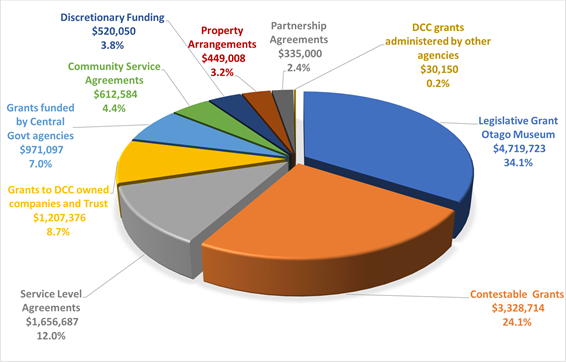
Figure 2 Percentage of grants in FY22-23
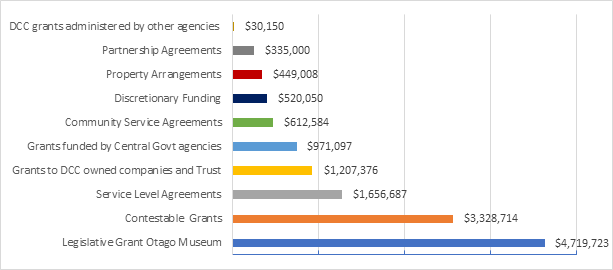
Figure 3 Amounts granted across 10
granting categories in FY22-23
20 Details
related to each funding category and the groups associated with each granting
category for the 22-23 FY are detailed in Attachment A.
Subsidy update – Rates
Relief to groups in 2022-2023 FY
21 As
explained in paragraph 5, work in the area of ‘Subsidies’ has begun
by identifying which groups received rates relief in 22-23 FY.
22 The
DCC provides rates relief to groups according to the nature of the services and
activities being delivered, and whether there is a long-term ongoing
relationship between the funded organisation and the DCC.
23 The
total amount of rates relief administered to groups in 22-23 FY was $666,480.
24 Details
related to groups who received rates relief for the 22-23 FY are detailed in
Attachment B.
How Grants are Administered
The DCC’s Grants
Management Policy
25 The
DCC has a Grants Management Policy (the Policy) which covers the process
related to three granting categories:
1) Contestable
Grants
2) Discretionary
Funding
3) Community
Service Agreements
26 The
policy is overseen by the Council’s Grants subcommittee which includes
Councillors and representatives from the community. The exceptions are the
Heritage Fund which is administered by its own group and chaired by a
councillor, and the Mayor’s Discretionary Fund.
27 The
Policy’s core principles are to:
· Encourage the
development and delivery of social, economic, environmental and cultural
opportunities for all residents and visitors, and support the local natural and
built environment
· Encourage
partnerships and pathways that support community wellbeing and resilience
· Support community
aspirations by establishing effective public engagement and participation
forums that are accessible and appropriate
· Acknowledge and
celebrate the social, cultural and ethnic values of our communities
28 The
Policy includes management responsibilities to ensure that assessment and
decision-making processes regarding funding covered in the Policy are
appropriate, inclusive, and transparent.
29 A
scheduled review of the Policy commenced in 2022. This has been paused while
grants are reviewed as part of the DCC’s 10YP preparations.
Processes that Oversee other Types of
Granting
30 The
DCC has various processes and guides which covers the administration of the
remaining granting categories:
4) Service
Level Agreements
5) Property
Arrangements
6) Grants
that are funded by Central Government Agencies
7) DCC
Grants that are administered by other agencies
8) Legislatively-required
Grants
9) Grants
to DCC owned companies and trusts
10) Partnership
Agreements
31 Grants
that are Service Level Agreements or Property Arrangements are long term
contracts that acknowledge the work that community groups do in their community
or in looking after a DCC facility. These are documented and reviewed
regularly.
32 Grants
that the DCC administers on behalf of central government or ones the DCC
allocates to groups to administer on the DCC’s behalf, are covered in
contracts which are renewed regularly, and the legislative grant outlines the
DCC’s obligations to Otago Museum.
33 Grants
to DCC owned companies and trusts identified in the financial ledger and are
historical. Partnership agreements acknowledge a long-term arrangement to
further mutual benefits and are overseen by the DCC.
OPTIONS
34 There
are no options as this is a report for noting.
NEXT STEPS
35 This
initial stocktake has identified other areas of work including (but not limited
to);
a) Producing
longitudinal data on grant categories and amounts to investigate what trends
emerge in line with past budgets
b) Producing
a stocktake of ‘Other Support’ including in-kind support to understand
the DCC’s contributions to the community
c) Producing
a review of DCC subsidies and rationale to understand the DCC’s
contributions to the community
d) Producing
recommendations where appropriate for improvements going forward. These
recommendations may also contribute to the review of the Grants Management
Policy such as investigating if there should be one over-arching policy across
all grants, with flexibility to include different processes or not.
36 DCC
staff will provide a further update on Grants to Council in December 2023, as
part of the 10YP process.
Signatories
|
Author:
|
Gina Huakau - Corporate Policy Manager
Kim Barnes - Chief of Staff
Wai Piggott - Financial Analyst
|
|
Authoriser:
|
Jeanette Wikaira - General Manager Community Services (Acting)
Sandy Graham - Chief Executive Officer
|
Attachments
|
|
Title
|
Page
|
|
|
⇩a
|
Details of Grant
funding FY22/23
|
523
|
|
|
⇩b
|
Rates relief FY22-23
|
525
|
|
|
SUMMARY OF CONSIDERATIONS
|
|
Fit with purpose
of Local Government
This decision enables democratic local
decision making and action by, and on behalf of communities, and promotes the
social, economic, environmental and cultural wellbeing of the Dunedin
communities, taking a sustainable development approach.
|
|
Fit with strategic
framework
|
|
Contributes
|
Detracts
|
Not applicable
|
|
Social Wellbeing Strategy
|
☒
|
☐
|
☐
|
|
Economic Development Strategy
|
☒
|
☐
|
☐
|
|
Environment Strategy
|
☒
|
☐
|
☐
|
|
Arts and Culture Strategy
|
☒
|
☐
|
☐
|
|
3 Waters Strategy
|
☐
|
☐
|
☐
|
|
Spatial Plan
|
☐
|
☐
|
☐
|
|
Integrated Transport Strategy
|
☐
|
☐
|
☐
|
|
Parks and Recreation Strategy
|
☒
|
☐
|
☐
|
|
Other strategic projects/policies/plans
|
☒
|
☐
|
☐
|
The 10 year plan contributes to all of the objectives and
priorities of the strategic framework as it describes the Council’s
activities, the community outcomes, and provides a long term focus for
decision making and coordination of the Council’s resources, as well as
a basis for community accountability.
|
|
Māori Impact
Statement
The adoption of the Māori Strategic Framework signals
Council’s commitment to mana whenua and to its obligations under the
Treaty of Waitangi. Mana whenua and Māori will be involved in
pre-engagement and have an opportunity to engage with the 10 year plan consultation
process through a series of planned hui.
|
|
Sustainability
As part of the 10 year plan, several pieces of work are
underway to give effect to Council’s commitment to sustainability,
including work on the city portrait, Sustainable Development Goals, the Zero
Carbon policy and the adoption of the Māori Strategic Framework.
|
|
LTP/Annual Plan /
Financial Strategy /Infrastructure Strategy
This report provides an update on the development of the
10 year plan. The 10 year plan project includes specific workstreams that
will review Council’s financial and infrastructure strategies to ensure
they are appropriate for the future.
|
|
Financial
considerations
Financial considerations (including financial
sustainability) will be key considerations in the development of the 10 year
plan.
|
|
Significance
The 10 year plan will include community engagement and
public consultation. Pre-engagement initiatives are being planned.
|
|
Engagement –
external
The 10 year plan presents an opportunity for Council to
engage fully with the community across a range of issues.
|
|
Engagement -
internal
Staff from across council are involved in the development
of the 10 year plan.
|
|
Risks: Legal /
Health and Safety etc.
There are legal, reputational, financial and strategic
risk if the 10 year plan is not well executed, or the public do not trust
that the Council is showing good governance, prudent strategic and
operational leadership.
|
|
Conflict of
Interest
There are no known conflicts of interest.
|
|
Community Boards
Community Boards will be engaged and consulted with as
part of the 10 year plan.
|
|
|
Council
25 September 2023
|
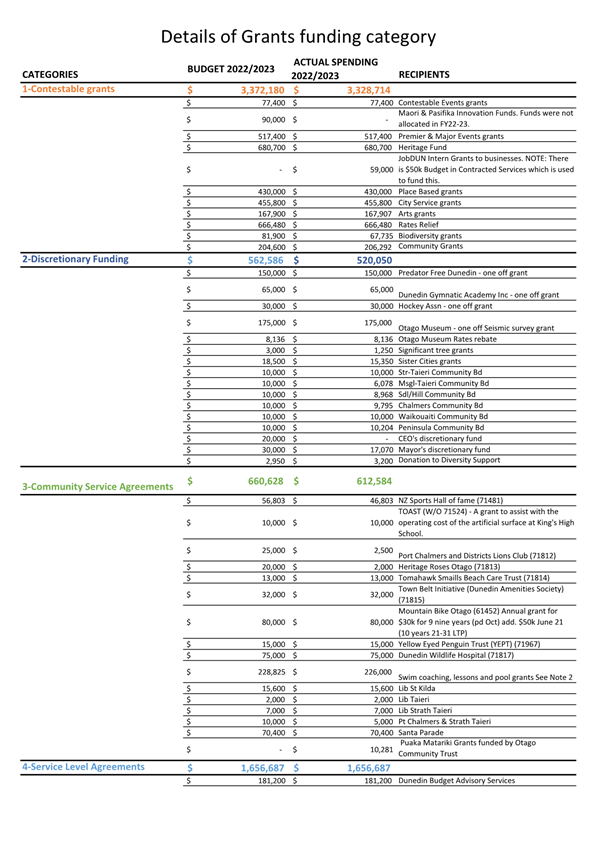
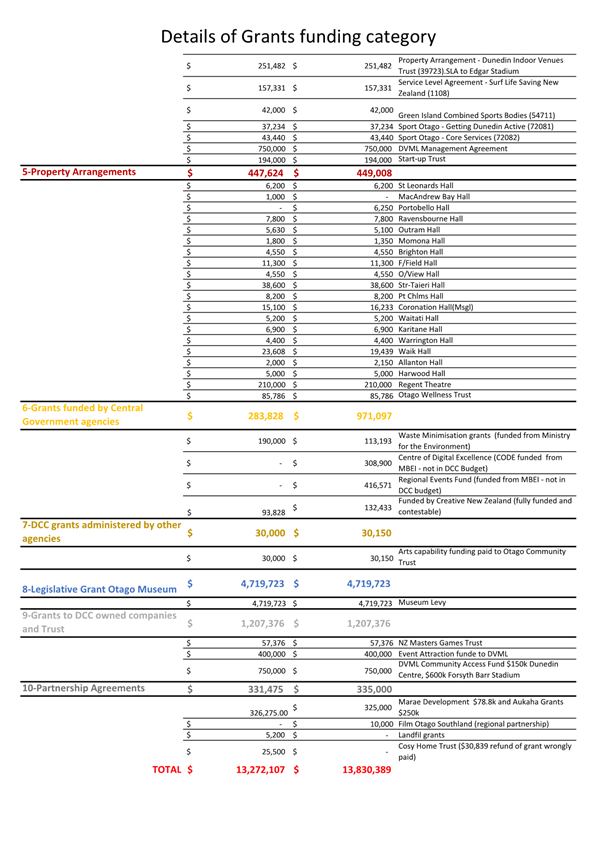
|
|
Council
25 September 2023
|
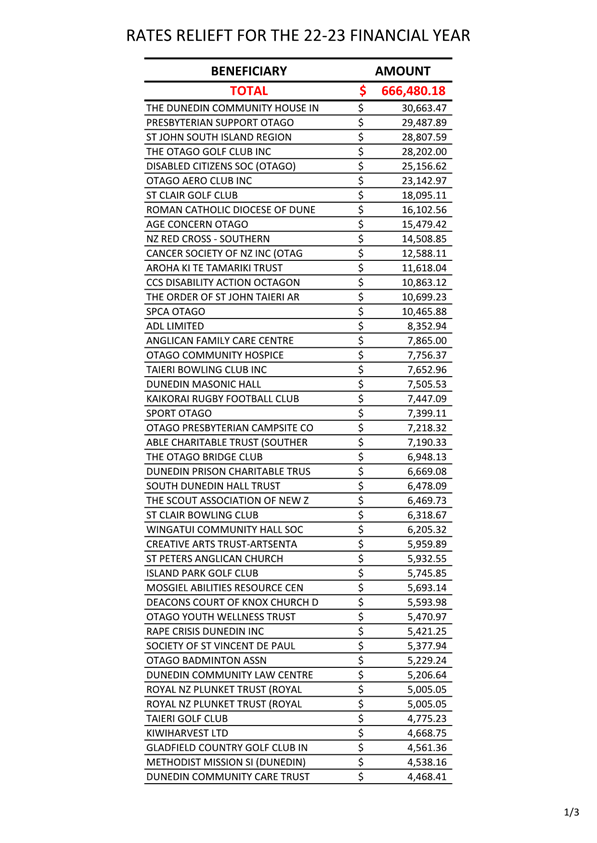
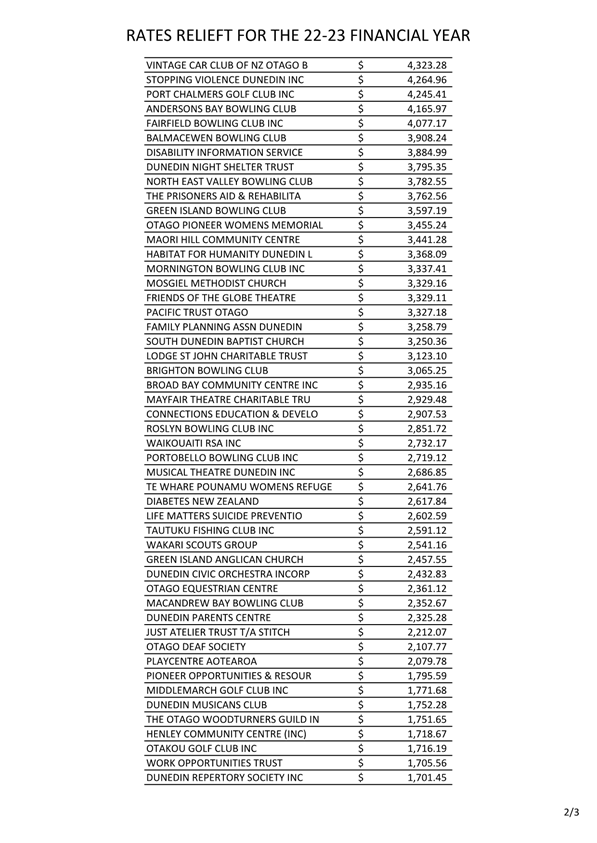
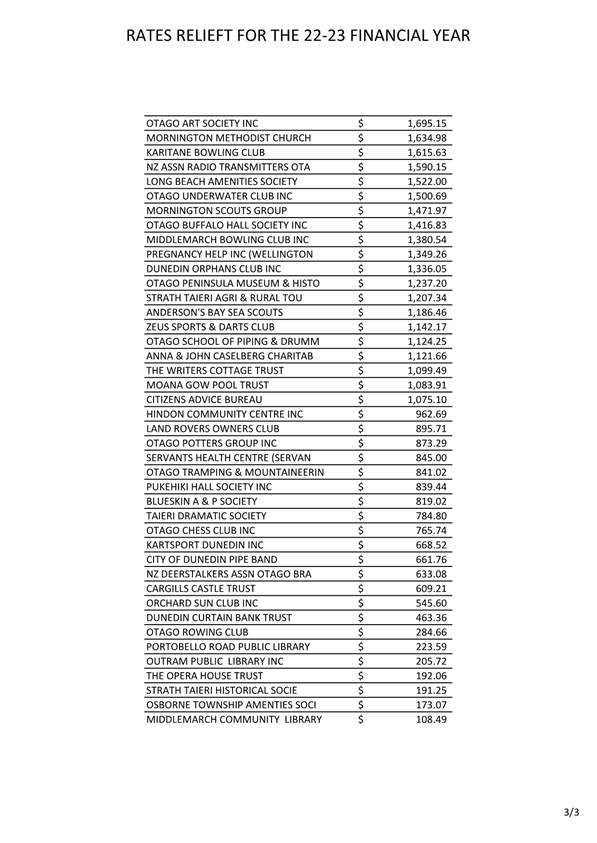
|

|
Council
25 September 2023
|
Resolution to Exclude the
Public
That the Council excludes
the public from the following part of the proceedings of this meeting (pursuant
to the provisions of the Local Government Official Information and Meetings Act
1987) namely:
|
General subject of the matter to be considered
|
Reasons
for passing this resolution in relation to each matter
|
Ground(s) under
section 48(1) for the passing of this resolution
|
Reason for
Confidentiality
|
|
C1
Confirmation of the Confidential Minutes of Ordinary Council meeting -
29 August 2023 - Public Excluded
|
S7(2)(a)
The
withholding of the information is necessary to protect the privacy of natural
persons, including that of a deceased person.
S7(2)(g)
The
withholding of the information is necessary to maintain legal professional
privilege.
S7(2)(h)
The
withholding of the information is necessary to enable the local authority to
carry out, without prejudice or disadvantage, commercial activities.
S7(2)(i)
The
withholding of the information is necessary to enable the local authority to
carry on, without prejudice or disadvantage, negotiations (including
commercial and industrial negotiations).
S7(2)(c)(i)
The
withholding of the information is necessary to protect information which is
subject to an obligation of confidence or which any person has been or could
be compelled to provide under the authority of any enactment, where the
making available of the information would be likely to prejudice the supply
of similar information or information from the same source and it is in the
public interest that such information should continue to be supplied.
S7(2)(b)(i)
The
withholding of the information is necessary to protect information where the
making available of the information would disclose a trade secret.
|
.
|
|
|
C2
Confidential Council Actions from Resolutions at Council Meetings
|
S7(2)(a)
The
withholding of the information is necessary to protect the privacy of natural
persons, including that of a deceased person.
S7(2)(g)
The
withholding of the information is necessary to maintain legal professional
privilege.
S7(2)(h)
The
withholding of the information is necessary to enable the local authority to
carry out, without prejudice or disadvantage, commercial activities.
S7(2)(i)
The
withholding of the information is necessary to enable the local authority to
carry on, without prejudice or disadvantage, negotiations (including
commercial and industrial negotiations).
|
S48(1)(a)
The public conduct of
the part of the meeting would be likely to result in the disclosure of
information for which good reason for withholding exists under section 7.
|
|
|
C3
Confidential Council Forward Work Programme - September 2023
|
S7(2)(h)
The
withholding of the information is necessary to enable the local authority to
carry out, without prejudice or disadvantage, commercial activities.
|
S48(1)(a)
The public conduct of
the part of the meeting would be likely to result in the disclosure of
information for which good reason for withholding exists under section 7.
|
|
|
C4
New Zealand Masters Games Appointment of Trustee
|
S7(2)(a)
The
withholding of the information is necessary to protect the privacy of natural
persons, including that of a deceased person.
|
S48(1)(a)
The public conduct of the
part of the meeting would be likely to result in the disclosure of
information for which good reason for withholding exists under section 7.
|
|
|
C5
Procurement Matter
|
S7(2)(g)
The
withholding of the information is necessary to maintain legal professional
privilege.
S7(2)(h)
The
withholding of the information is necessary to enable the local authority to
carry out, without prejudice or disadvantage, commercial activities.
S7(2)(i)
The
withholding of the information is necessary to enable the local authority to
carry on, without prejudice or disadvantage, negotiations (including
commercial and industrial negotiations).
|
S48(1)(a)
The public conduct of
the part of the meeting would be likely to result in the disclosure of
information for which good reason for withholding exists under section 7.
|
|
|
C6
Report from the Chief Executive Appraisal Committee
|
S7(2)(a)
The
withholding of the information is necessary to protect the privacy of natural
persons, including that of a deceased person.
|
S48(1)(a)
The public conduct of
the part of the meeting would be likely to result in the disclosure of
information for which good reason for withholding exists under section 7.
|
|
This resolution is made in
reliance on Section 48(1)(a) of the Local Government Official Information and
Meetings Act 1987, and the particular interest or interests protected by
Section 6 or Section 7 of that Act, or Section 6 or Section 7 or Section 9 of
the Official Information Act 1982, as the case may require, which would be
prejudiced by the holding of the whole or the relevant part of the proceedings
of the meeting in public are as shown above after each item.