
Notice of Meeting:
I hereby give notice that an ordinary meeting of the
Infrastructure Services Committee will be held on:
Date: Monday
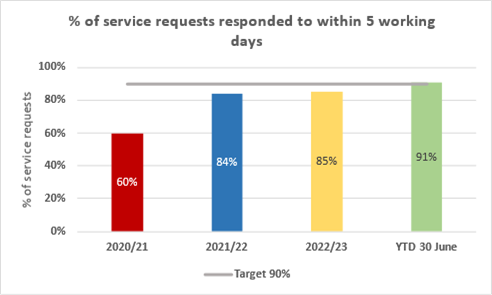
19 August 2024
Time: 10.00
am
Venue: Council
Chamber, Dunedin Public Art Gallery, The Octagon
Sandy Graham
Infrastructure Services Committee
PUBLIC AGENDA
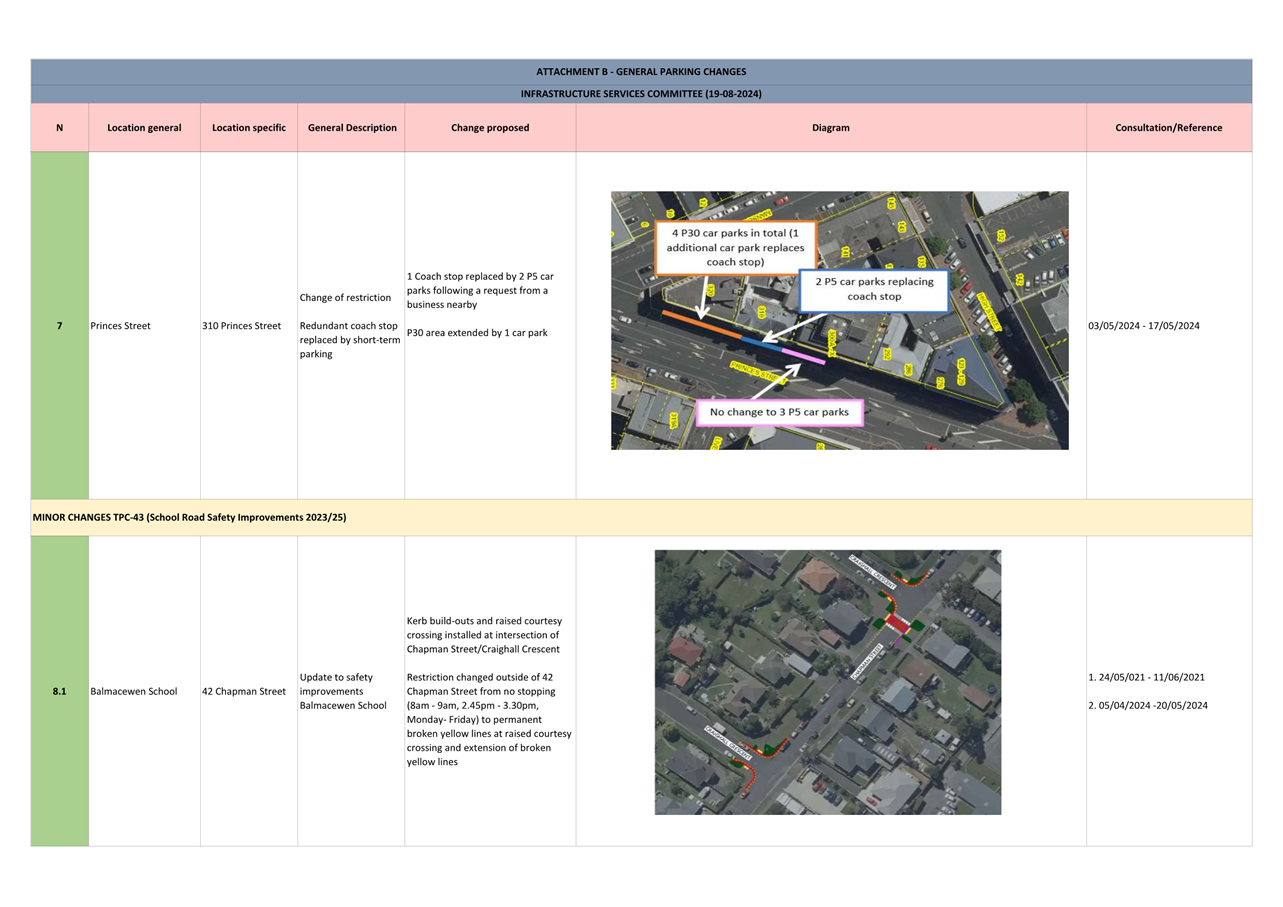
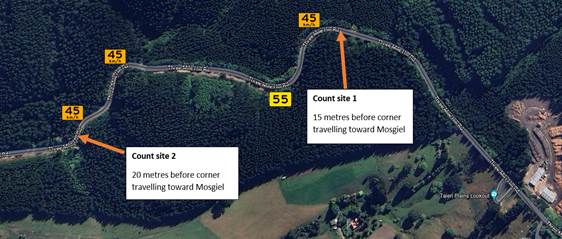
|
Chairperson
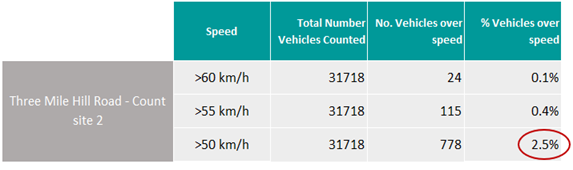
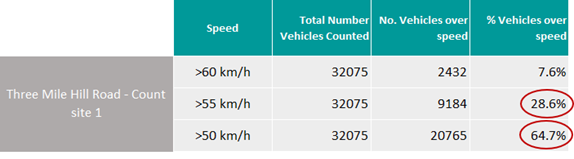
|
Cr Jim O'Malley
|
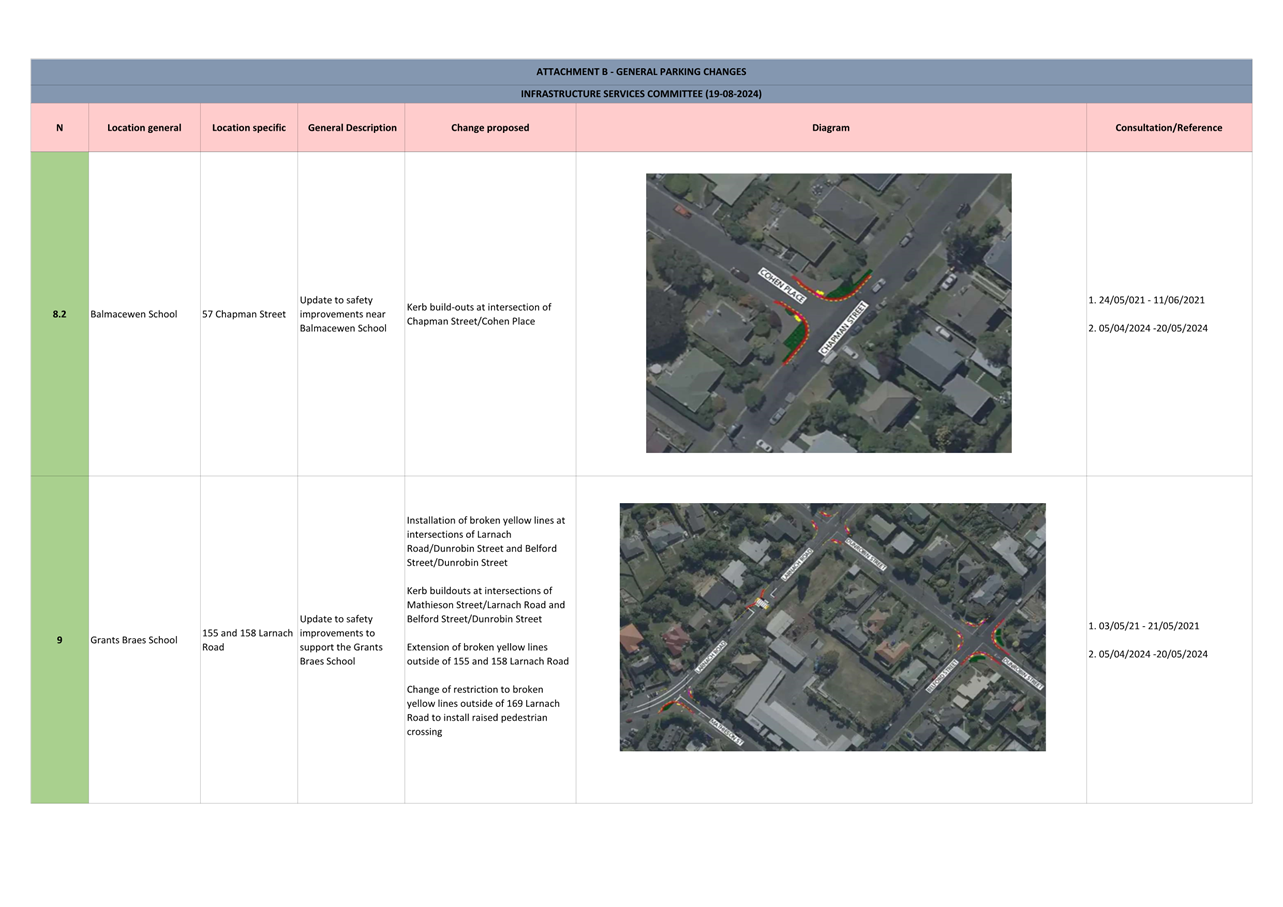
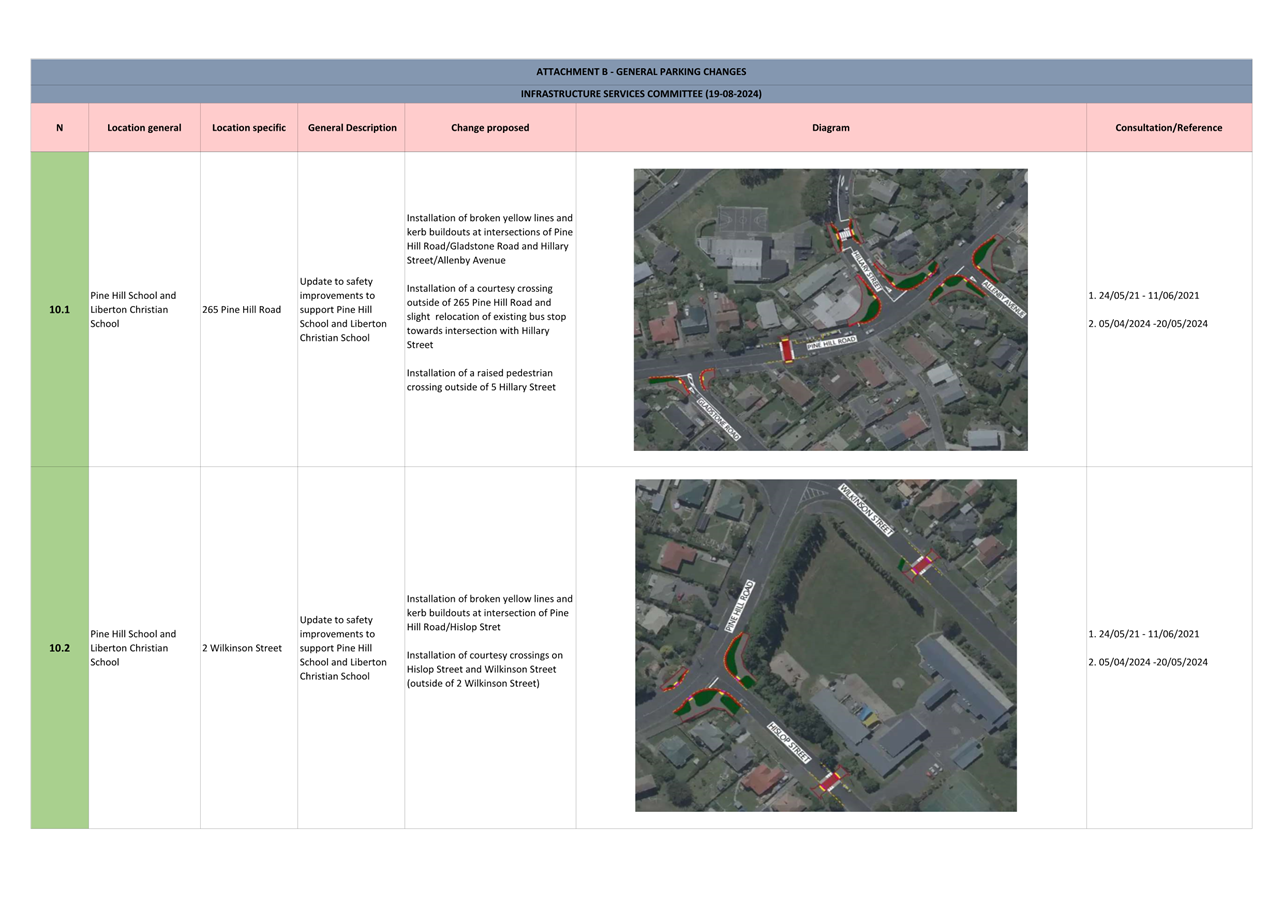
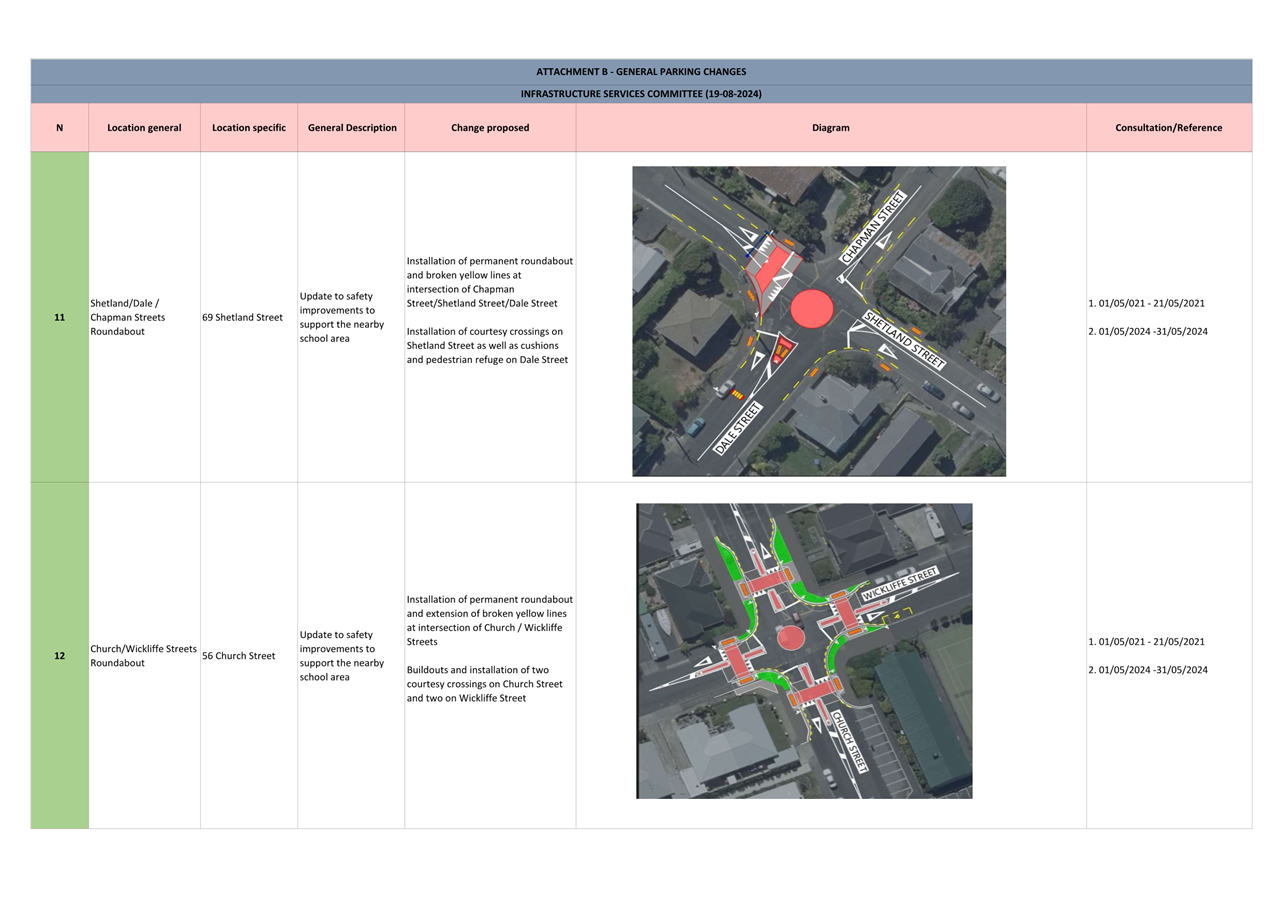
|
|
Deputy Chairperson
|
Cr Brent Weatherall
|
|
|
Members
|
Cr Bill Acklin
|
Cr Sophie Barker
|
|
|
Cr David Benson-Pope
|
Cr Christine Garey
|
|
|
Cr Kevin Gilbert
|
Cr Carmen Houlahan
|
|
|
Cr Marie Laufiso
|
Cr Cherry Lucas
|
|
|
Ms Donna
Matahaere-Atariki
|
Cr Mandy Mayhem
|
|
|
Ms Marlene McDonald
|
Mayor Jules Radich
|
|
|
Cr Lee Vandervis
|
Cr Steve Walker
|
|
|
Cr Andrew Whiley
|
|
Senior Officer Scott
MacLean, General Manager Climate and City Growth
Governance Support Officer Rebecca
Murray
Rebecca Murray
Governance Support Officer
Telephone: 03 477 4000
governance.support@dcc.govt.nz
www.dunedin.govt.nz
Note: Reports
and recommendations contained in this agenda are not to be considered as
Council policy until adopted.
|

|
Infrastructure Services
Committee
19 August 2024
|
ITEM TABLE OF CONTENTS PAGE
1 Karakia
Timatanga 4
2 Public
Forum 4
2.1 Speed Limits of
Motorised Vehicles in the City 4
2.2 Petition - SH1
Waitati Speed Reduction 4
3 Apologies 4
4 Confirmation
of Agenda 4
5 Declaration
of Interest 5
6 Confirmation
of Minutes 15
6.1 Infrastructure
Services Committee meeting - 18 June 2024 17
Part
A Reports (Committee has power to decide these matters)
7 Actions
from Resolutions of Infrastructure Services Committee Meetings 24
8 Infrastructure
Services Committee Forward Work Programme 29
9 3
Waters - Integrated System Planning 37
10 Proposed
Parking Changes - Hearings Committee July 2024 Recommendations 47
11 Transport
Activity Report for the Period Ending 30 June 2024 73
12 Waste
and Environmental Solutions Activity Report for the period ending 30 June 2024 78
13 Items
for Consideration by the Chair 89
14 Karakia
Whakamutunga
The meeting will close with a
Karakia Whakamutunga.
|

|
Infrastructure Services
Committee
19 August 2024
|
1 karakia
timatanga
The meeting will open
the meeting with a Karakia Timatanga.
2 Public
Forum
2.1 Speed
Limits of Motorised Vehicles in the City
Jakub Závacký wishes to
address the meeting regarding speed limits of motorised vehicles in the city.
2.2 Petition
- SH1 Waitati Speed Reduction
Amee Parker wishes to
present an online petition on SH 1 Watati Speed Reduction. As at 13
August has 876 online signatures. The wording of the petition is as
follows:
“The Blueskin
General Store, the Waitati turnoff, a bus stop, and a parking lot are located
on SH1 Waitati where the speed limit is 100 km/h. Crossing this road on foot is
perilous, as visibility is poor in both directions. Cars coming from the south
are almost invisible until they're dangerously close, and seeing cars from the
north is difficult, especially with a truck parked nearby. This is particularly
alarming for those with prams or mobility challenges. Pulling into or out of
the parking lot is also daunting. Moreover, southbound drivers often cross
double yellow lines and exceed safe speeds when turning into Waitati. Given the
frequent accidents (including the recent one) between Waitati and Waikouaiti,
we urge NZTA to reduce the speed limit on this section of SH1 to 70 km/h and
install new signs to enhance safety and reduce fear for all road users.”
This is the link to
the online petition: https://www.change.org/p/sh1-waitati-speed-reduction
3 Apologies
An apology has been received from
Cr Steve Walker.
That the Committee:
Accepts the apology from Cr
Steve Walker.
4 Confirmation
of agenda
Note:
Any additions must be approved by resolution with an explanation as to why they
cannot be delayed until a future meeting.
|
|
Infrastructure Services Committee
19 August 2024
|
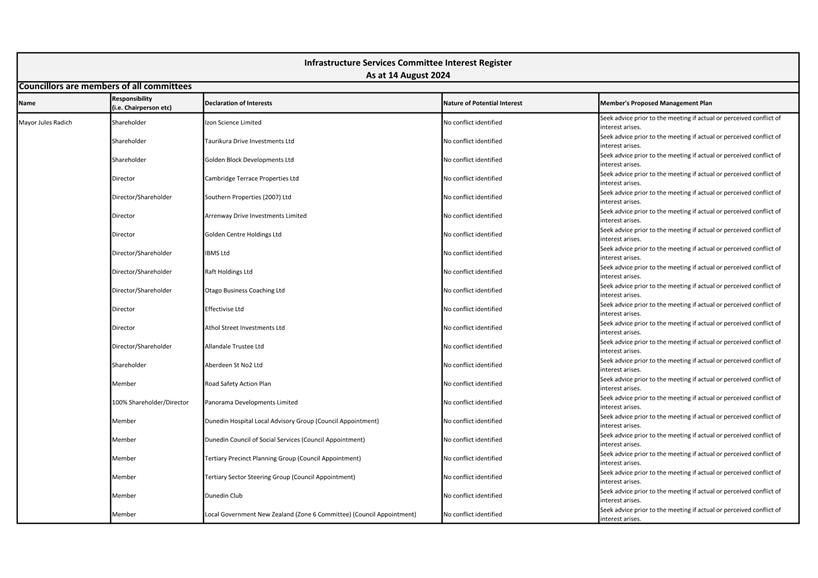
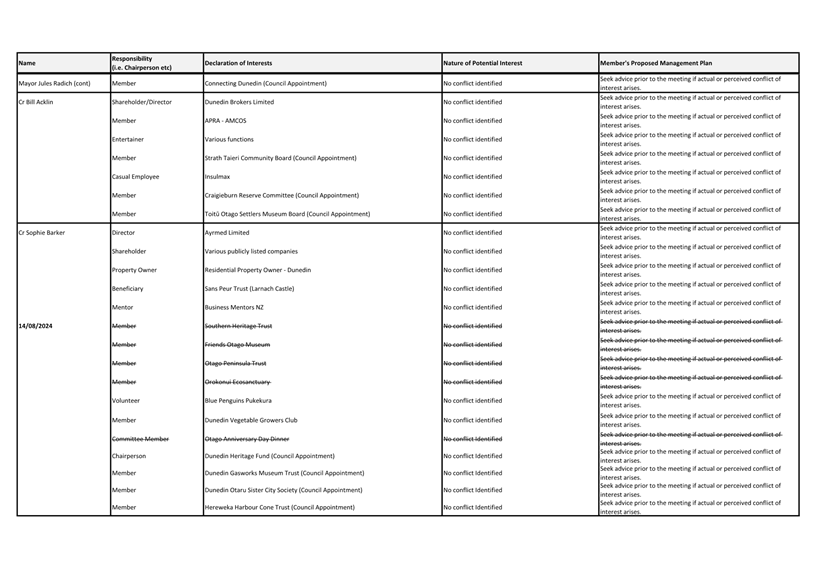
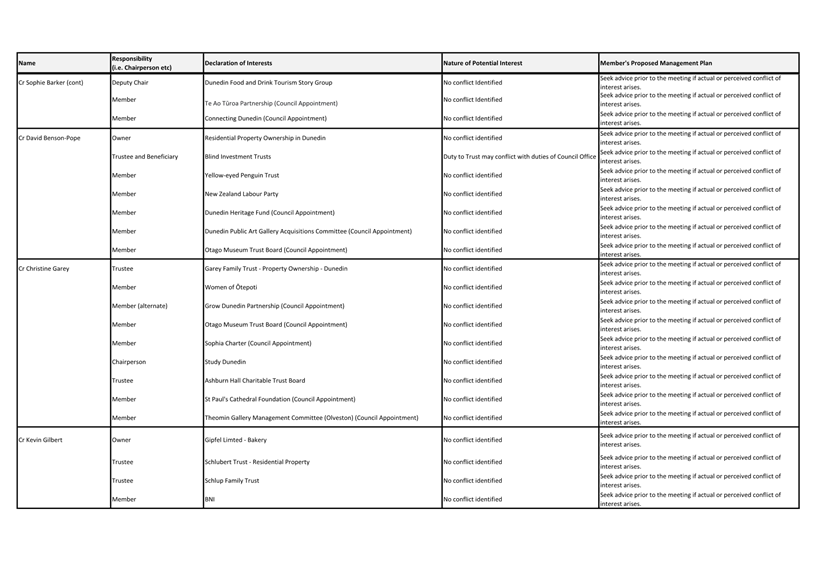
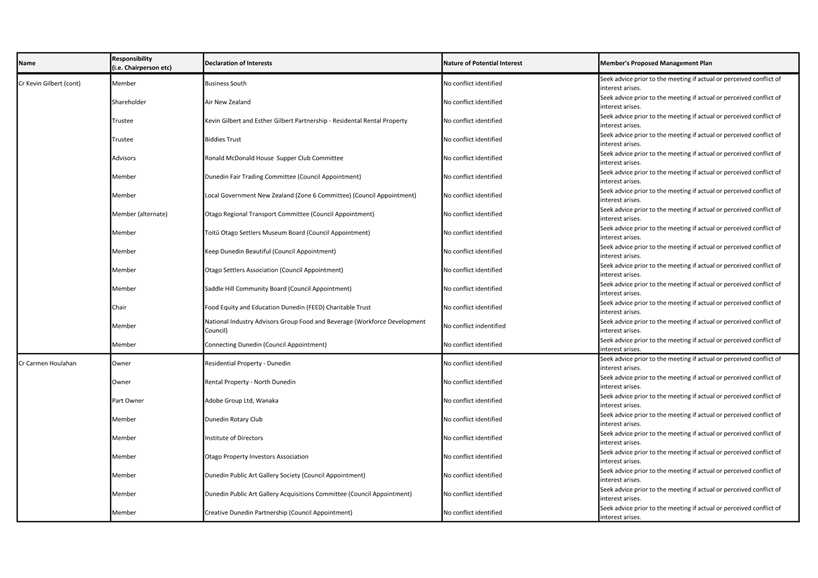
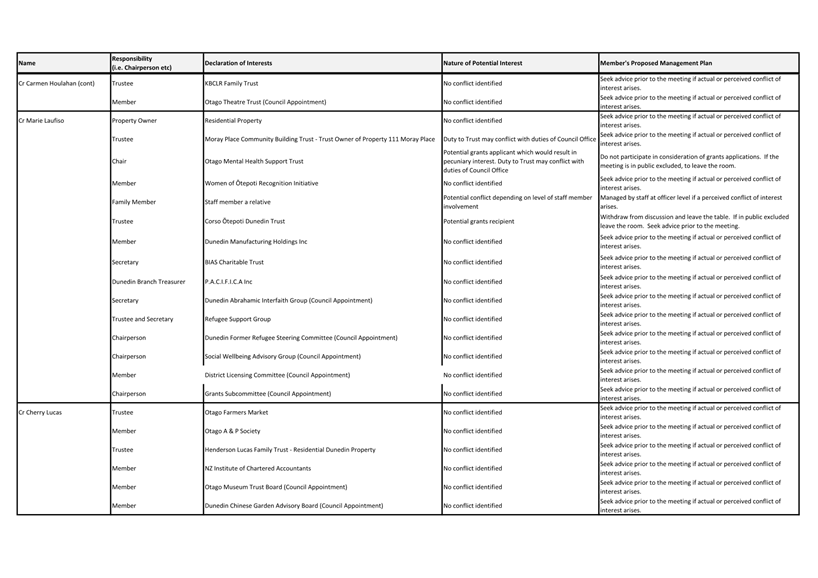
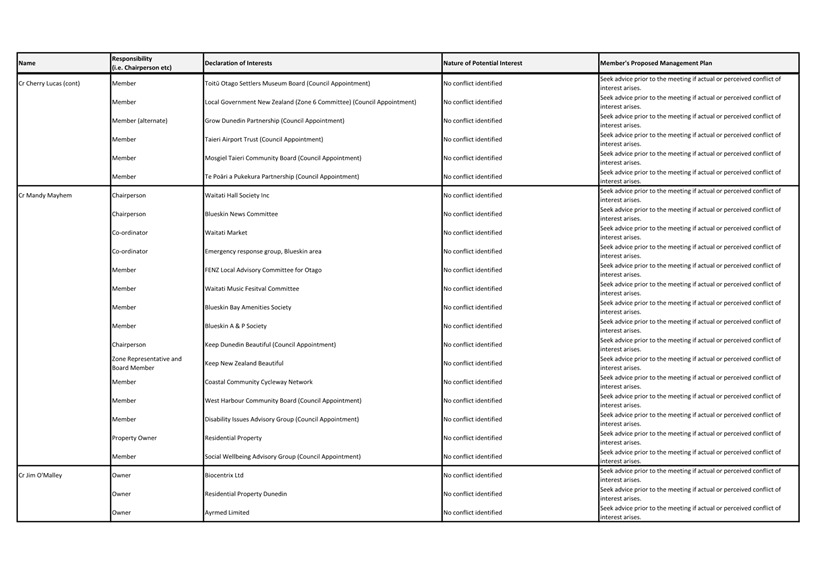
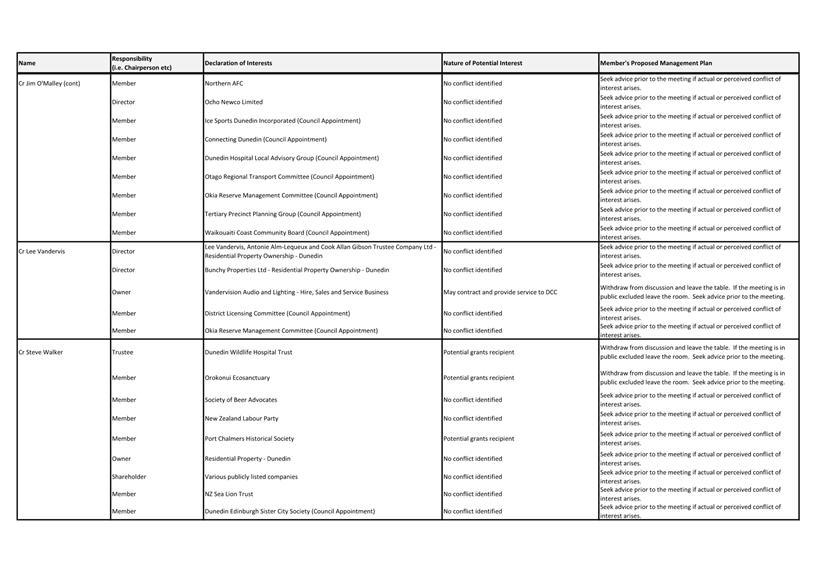
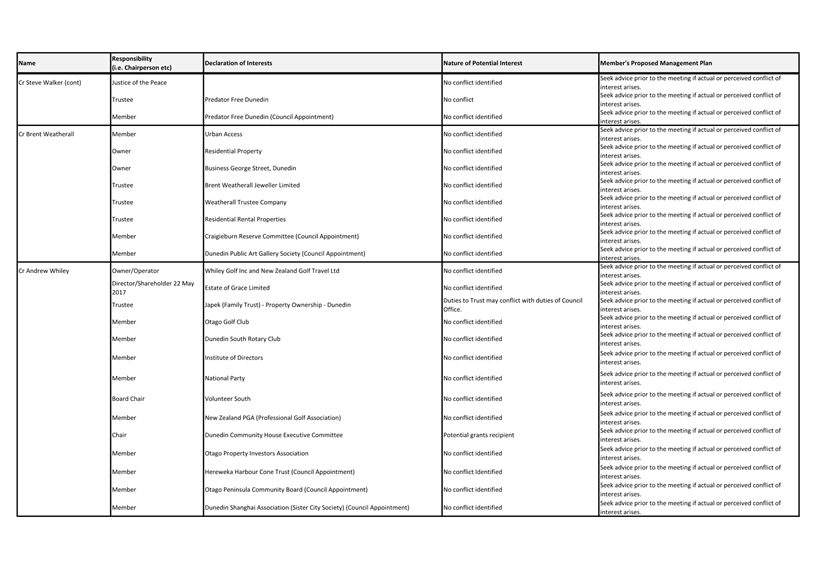
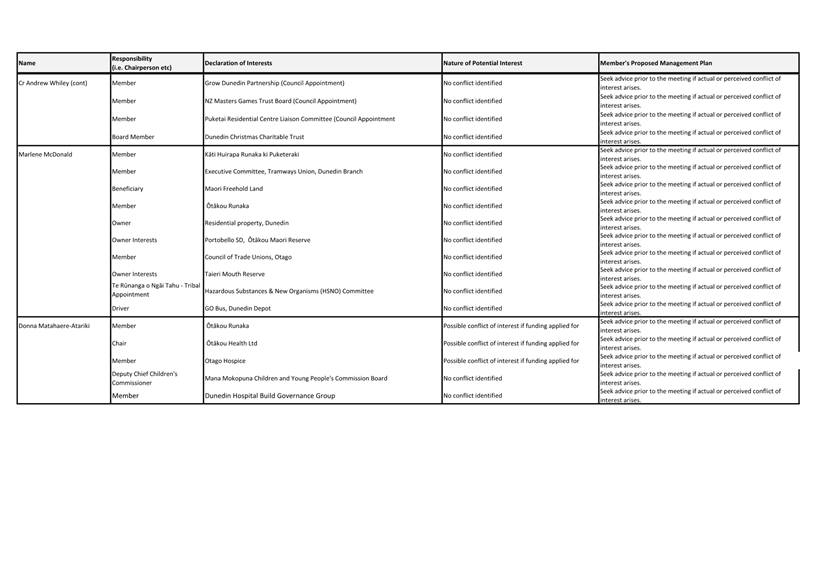
Declaration of Interest
EXECUTIVE SUMMARY
1. Members
are reminded of the need to stand aside from decision-making when a conflict
arises between their role as an elected or independent representative and any
private or other external interest they might have.
2. Elected or
independent members are reminded to update their register of
interests as soon as practicable, including amending the register at this
meeting if necessary.
RECOMMENDATIONS
That the Committee:
a) Notes/Amends if
necessary the Elected or Independent Members' Interest Register attached as
Attachment A; and
b) Confirms/Amends the
proposed management plan for Elected or Independent Members' Interests.
Attachments
|
|
Title
|
Page
|
|
⇩a
|
Infrastructure Services
Committee Register of Interest
|
6
|
|
|
Infrastructure Services Committee
19 August 2024
|
|
|
Infrastructure Services Committee
19 August 2024
|
Confirmation
of Minutes
Infrastructure
Services Committee meeting - 18 June 2024
RECOMMENDATIONS
That the Committee:
a) Confirms the Infrastructure
Services Committee meeting held on 18 June 2024 as a correct record.
Attachments
|
|
Title
|
Page
|
|
A⇩
|
Minutes of
Infrastructure Services Committee meeting held on 18 June 2024
|
16
|
|
|
Infrastructure
Services Committee
19 August 2024
|
Infrastructure Services Committee
MINUTES
Minutes of an ordinary
meeting of the Infrastructure Services Committee held in the Council Chamber,
Dunedin Public Art Gallery, The Octagon on Tuesday 18 June 2024, commencing at
10.40 am
PRESENT
|
Chairperson
|
Cr Jim O'Malley
|
|
|
Deputy Chairperson
|
Cr Brent Weatherall
|
|
|
Members
|
Cr Sophie Barker
|
Cr David Benson-Pope
|
|
|
Cr Christine Garey
|
Cr Kevin Gilbert
|
|
|
Cr Carmen Houlahan
|
Cr Cherry Lucas
|
|
|
Ms Donna
Matahaere-Atariki
|
Cr Mandy Mayhem
|
|
|
Ms Marlene McDonald
|
Cr Lee Vandervis
|
|
|
Cr Steve Walker
|
Cr Andrew Whiley via
Zoom audio visual link
|
|
IN ATTENDANCE
|
Scott MacLean
(General Manager Climate and City Growth), David Ward (General Manager 3
Waters and Transition, Claire Austin (General Manager Customer and
Regulatory), Leanne Mash (General Manager Business and Community Engagement),
Nadia McKenzie (In-House Legal Counsel), John McAndrew (Acting Group Manager
3 Waters), Anna Nilsen (Group Manager Property), Simon Smith (Manager
Transport Asset and Funding), Mark Mawdsley (Team Leader Advisory Services)
and Clare Sullivan (Manager Governance)
|
Governance Support Officer Rebecca
Murray
1 karakia
timatanga
Marlene McDonald opened the meeting with a Karakia
Timatanga.
2 Public
Forum
There was no Public Forum.
|
3 Apologies
|
|
|
Apologies were received from Mayor Jules Radich, Cr Bill
Acklin and Cr Marie Laufiso.
|
|
|
|
|
|
Moved (Cr Jim O'Malley/Cr Mandy Mayhem):
That the Committee:
Accepts the apologies
from Mayor Jules Radich, Cr Bill Acklin and Cr Marie Laufiso.
Motion
carried (ISC/2024/021)
|
|
4 Confirmation
of agenda
|
|
|
Moved (Cr Jim O'Malley/Cr Kevin Gilbert):
That the Committee:
Confirms the agenda
without addition or alteration.
Motion
carried (ISC/2024/022)
|
5 Declarations
of interest
Members were
reminded of the need to stand aside from decision-making when a conflict arose
between their role as an elected representative and any private or other
external interest they might have.
Donna Matahaere-Atariki updated
her register of interest with changing Chair to Member for Ōtākou
Runaka.
|
|
Moved (Cr Jim O'Malley/Cr Mandy Mayhem):
That the Committee:
a) Amends the Elected or Independent Members' Interest
Register; and
b) Confirms the proposed management plan for
Elected or Independent Members' Interests.
Motion
carried (ISC/2024/023)
|
6 Confirmation
of Minutes
|
6.1 Infrastructure
Services Committee meeting - 23 April 2024
|
|
|
Moved (Cr Jim O'Malley/Cr Brent Weatherall):
That the Committee:
Confirms
the minutes of the
Infrastructure Services Committee meeting held on 23 April 2024 as a correct
record.
Motion
carried (ISC/2024/024)
|
Part
A Reports
|
7 Actions
from Resolutions of Infrastructure Services Committee Meetings
|
|
|
A report from Civic provided an update on
the implementation of resolutions made at Infrastructure Services Committee
meetings.
General Manager Climate and City Growth
(Scott MacLean) responded to questions.
|
|
|
Moved (Cr Jim O'Malley/Cr Kevin Gilbert):
That the Committee:
Notes
the Open and Completed
Actions from resolutions of Infrastructure Services Committee meetings.
Motion
carried (ISC/2024/025)
|
|
8 Infrastructure
Services Committee Forward Work Programme
|
|
|
A report from Civic provided an update on
the Infrastructure Services Committee forward work programme.
General
Manager Climate and City Growth (Scott MacLean) and Group Manager Property Services
(Anna Nilsen) responded to questions.
|
|
|
Moved (Cr Jim O'Malley/Cr Kevin Gilbert):
That the Committee:
Notes
the Infrastructure
Services Committee forward work programme.
Motion
carried (ISC/2024/026)
|
|
9 3
Waters Activity Report for the Period Ending 31 May 2024
|
|
|
A report provided an update
on 3 Waters activities for the period ending 31 May 2024.
General
Manager 3 Waters and Transition (David Ward) and Acting Group Manager (John
McAndrew) responded to questions.
|
|
|
Moved (Cr Jim O'Malley/Cr Brent
Weatherall):
That the Committee:
Notes the
3 Waters Activity Report for the Period Ending 31 May 2024.
Motion
carried (ISC/2024/027)
|
|
12 Transport
Activity Report for the Period Ending 31 March 2024
|
|
|
A report provided an update
on Transport activities for the period ending 31 March 2024.
General
Manager Climate and City Growth (Scott MacLean) and Manager Transport Asset
and Funding (Simon Smith) responded to questions.
Cr
Christine Garey left the room at 12.18 pm and returned to the meeting at
12.21 pm.
Cr
Andrew Whiley left the meeting at 12.30 pm.
|
|
|
Moved (Cr Jim O'Malley/Cr Brent
Weatherall):
That the Committee:
Notes the
Transport activity report for the period ending 31 March 2024.
Motion
carried (ISC/2024/030)
|
|
|
|
|
|
Moved (Cr Jim O'Malley/Cr Brent Weatherall):
That the Committee:
Adjourns the meeting
until 1.00 pm.
Motion carried
|
|
|
|
|
|
Donna Matahaere-Atariki, Cr Lee Vandervis and Cr David
Benson-Pope left the meeting at 12.34 pm.
|
|
|
|
|
|
The meeting adjourned at 12.34 pm and reconvened at 1.10
pm.
|
|
13 Road
Naming of Three Private Ways
|
|
|
A report sought the approval of road
names for three private ways in the Mosgiel-Taieri area.
The General Manager Climate and City
Growth (Scott MacLean) provided an update from the developer that advised the
preferred name for their private way was now Stables Lane instead of Cottage
Drive and responded to questions.
|
|
|
Moved (Cr Jim O'Malley/Cr Cherry
Lucas):
That the Committee:
a) Approves the naming of the new private way off School
Road South, Taieri as ‘Wilden Lane’.
b) Approves the naming of the new private way off Gladstone
Road North, as ‘Stables Lane’.
c) Approves the naming of the new private way off Lorne
Street, as ‘Mako Lane’.
Motion
carried (ISC/2024/031)
|
|
15 Submission
on the Rules Setting Local Government Performance Measures (Safety of
Drinking Water)
|
|
|
A report sought retrospective
approval of a Dunedin City Council (DCC) submission to the Department of
Internal Affairs (DIA).
General
Manager 3 Waters and Transition (David Ward) and Team Leader Regulation and
Policy (Scott Campbell) spoke to the report and responded to questions.
Cr Andrew Whiley returned to the meeting at 1.38 pm.
|
|
|
Moved (Cr Jim O'Malley/Cr Brent
Weatherall):
That the Committee:
Approves, retrospectively, the DCC submission to
the Department of Internal Affairs on proposed amendments to the local
government mandatory non-financial performance measure for safety of drinking
water.
Motion
carried (ISC/2024/033)
|
|
16 Submission
on the Local Government (Water Services Preliminary Arrangements) Bill
|
|
|
A report sought approval of a
draft Dunedin City Council (DCC) submission to Parliament’s Finance and
Expenditure Select Committee on the Local Government (Water Services Preliminary
Arrangements) Bill (the Bill).
Cr
Kevin Gilbert left the room at 1.42 pm and returned to the meeting at 1.44
pm.
General
Manager 3 Waters and Transition (David Ward), In-House Legal Counsel (Nadia
McKenzie) and Team Leader Regulation and Policy (Scott Campbell) provided an
overview of an update to the recommendations in the submission and responded
to questions.
|
|
|
Moved (Cr Jim O'Malley/Cr Brent
Weatherall):
That the Committee:
a) Approves the draft DCC submission to the Finance
and Expenditure Select Committee on the Bill and Amendment.
b) Authorises the Mayor and/or his delegate to speak
to the submission.
c) Authorises the Chief Executive to make any minor
editorial changes if needed.
Motion
carried (ISC/2024/034)
|
|
17 Remit
Support LGNZ
|
|
|
Council received a request
for support for a remit from Gisborne District Council prior to it being
submitted to LGNZ for consideration. The report sought support for the
remit regarding the proactive lever to mitigate the deterioration of unoccupied
buildings.
General Manager Customer and Regulatory (Claire Austin)
and Team Leader Advisory Services (Mark Mawdsley) spoke to the report and
responded to questions.
|
|
|
Moved (Cr Jim O'Malley/Cr Sophie
Barker):
That the Committee:
Decides to support the remit proposed by
Gisborne District Council seeking
proactive legislative levers to mitigate the deterioration of unoccupied
buildings and incentivise repurposing vacant buildings.
Motion
carried (ISC/2024/035)
|
|
18 Items
for Consideration by the Chair
|
|
|
Items for consideration by the Chair:
Cr Jim O’Malley provided the following:
Better off Funding – request that staff advise the
Chair where the Better off Funding analysis will be presented to.
Cr Vandervis earlier asked for volumes of materials going
to landfills inside the municipal area, to be broken down into municipal
waste and clean fill and whether or not council had the ability to obtain
from private providers the volume of those materials and what materials are
in it.
Some activities that are civil construction and capital
construction work activities under other delegations and captured under other
Committee’s Forward Work Programmes and an ability to capture these
activities that are across more than one Committee.
Cr Sophie Barker provided the following:
Annual report on the waste minimisation grants to include
additional commentary on what the funding was used for and how the funded
activity contributes to the waste minimisation objectives.
Strategic walking and cycling plan doesn’t appear in
its own column in the Forward Work Programme.
Feedback on activity reports that some have links to the
levels of service and the targets being consistent within them.
|
|
19 Karakia
Whakamutunga
|
|
|
Marlene McDonald closed the
meeting with a Karakia Whakamutunga.
|
The meeting concluded at 2.10 pm.
..............................................
CHAIRPERSON
|
|
Infrastructure Services Committee
19 August 2024
|
Part
A Reports
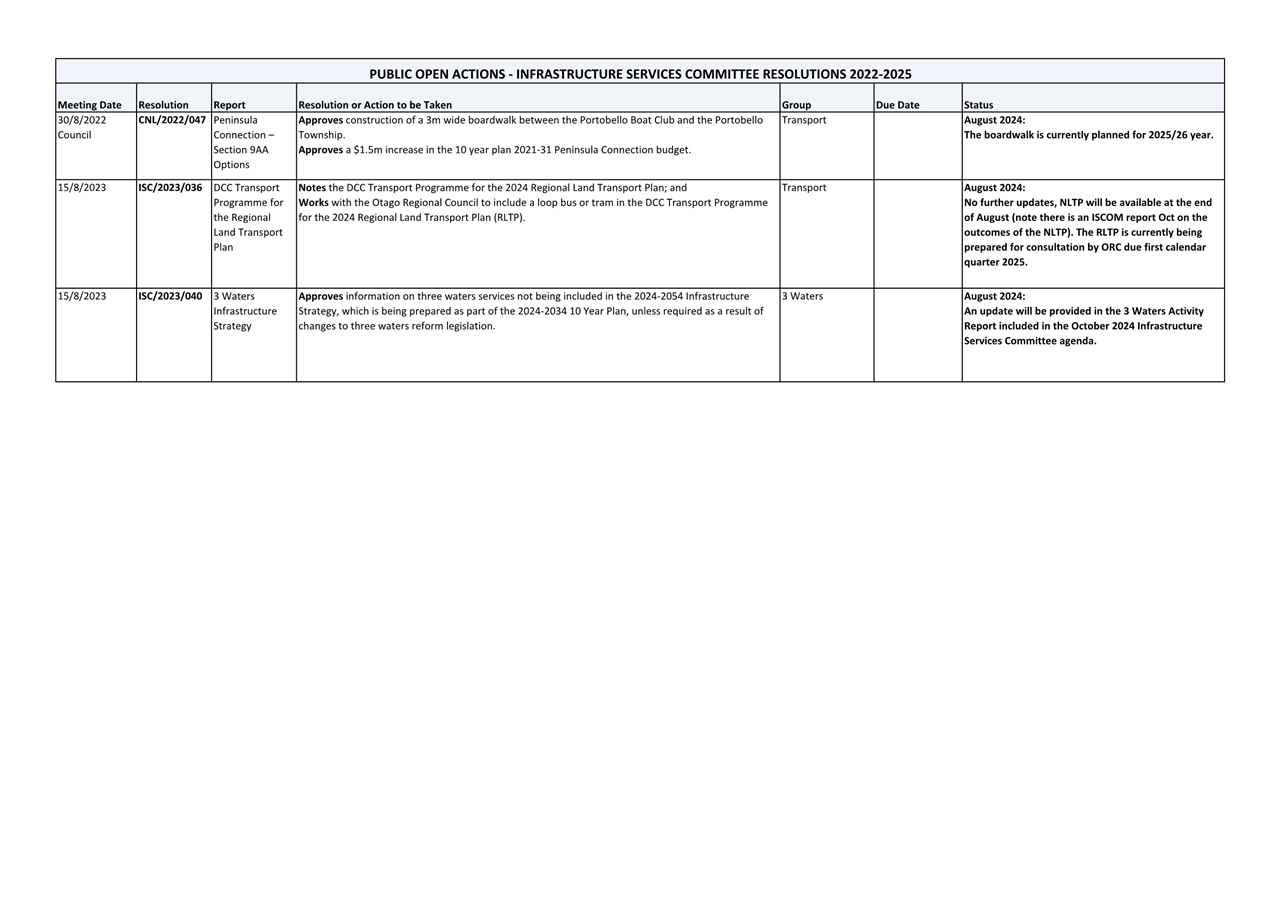
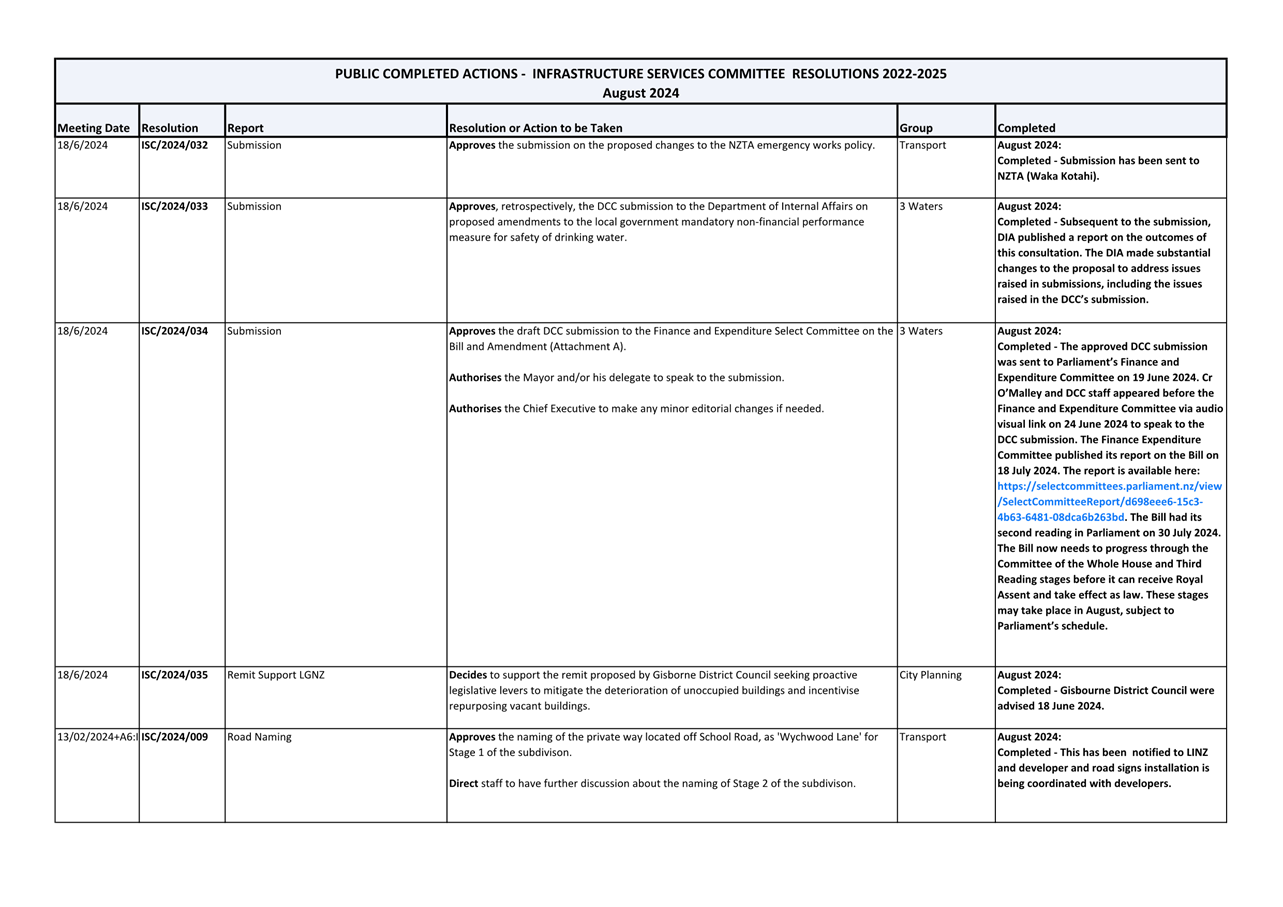
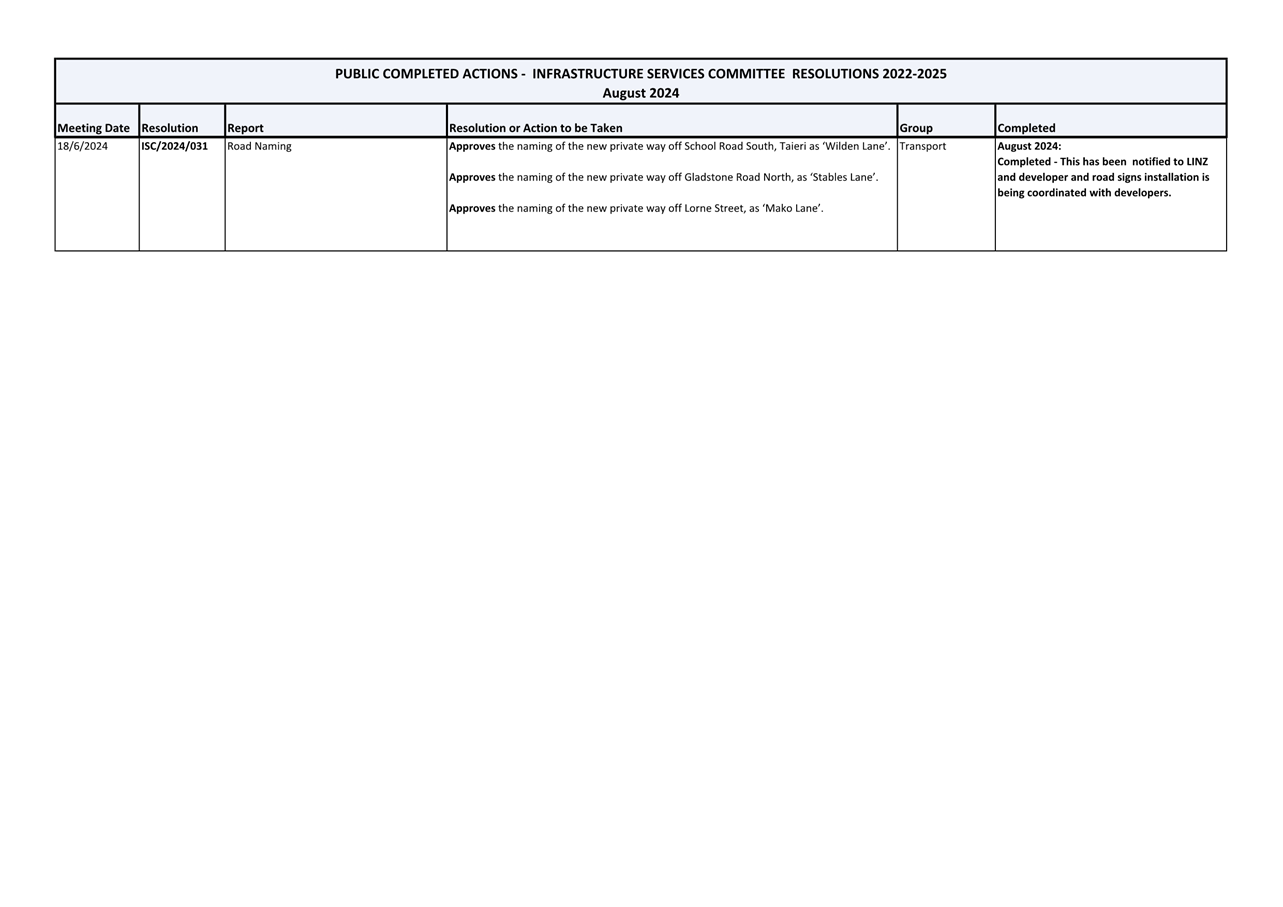
Actions from Resolutions of Infrastructure Services
Committee Meetings
Department: Civic
EXECUTIVE SUMMARY
1 The
purpose of this report is to detail the open and completed actions from
resolutions of Infrastructure Services Committee meetings from the start of the
triennium in October 2022 (Attachments A and B).
2 As
this is an administrative report only, there are no options or Summary of
Considerations.
RECOMMENDATIONS
That the Committee:
a) Notes the Open and
Completed Actions from resolutions of Infrastructure Services Committee
meetings shown in Attachments A and B.
DISCUSSION
3 This
report provides an update on resolutions that are being actioned since the last
Infrastructure Services Committee meeting.
Signatories
|
Author:
|
Rebecca Murray - Governance Support Officer
|
|
Authoriser:
|
Scott MacLean - General Manager, Climate and City Growth
|
Attachments
|
|
Title
|
Page
|
|
⇩a
|
Infrastructure Services
Committee Public Open Action List
|
25
|
|
⇩b
|
Infrastructure Services
Committee Public Completed Action List
|
26
|
|
|
Infrastructure Services Committee
19 August 2024
|
|
|
Infrastructure Services Committee
19 August 2024
|
|
|
Infrastructure Services Committee
19 August 2024
|
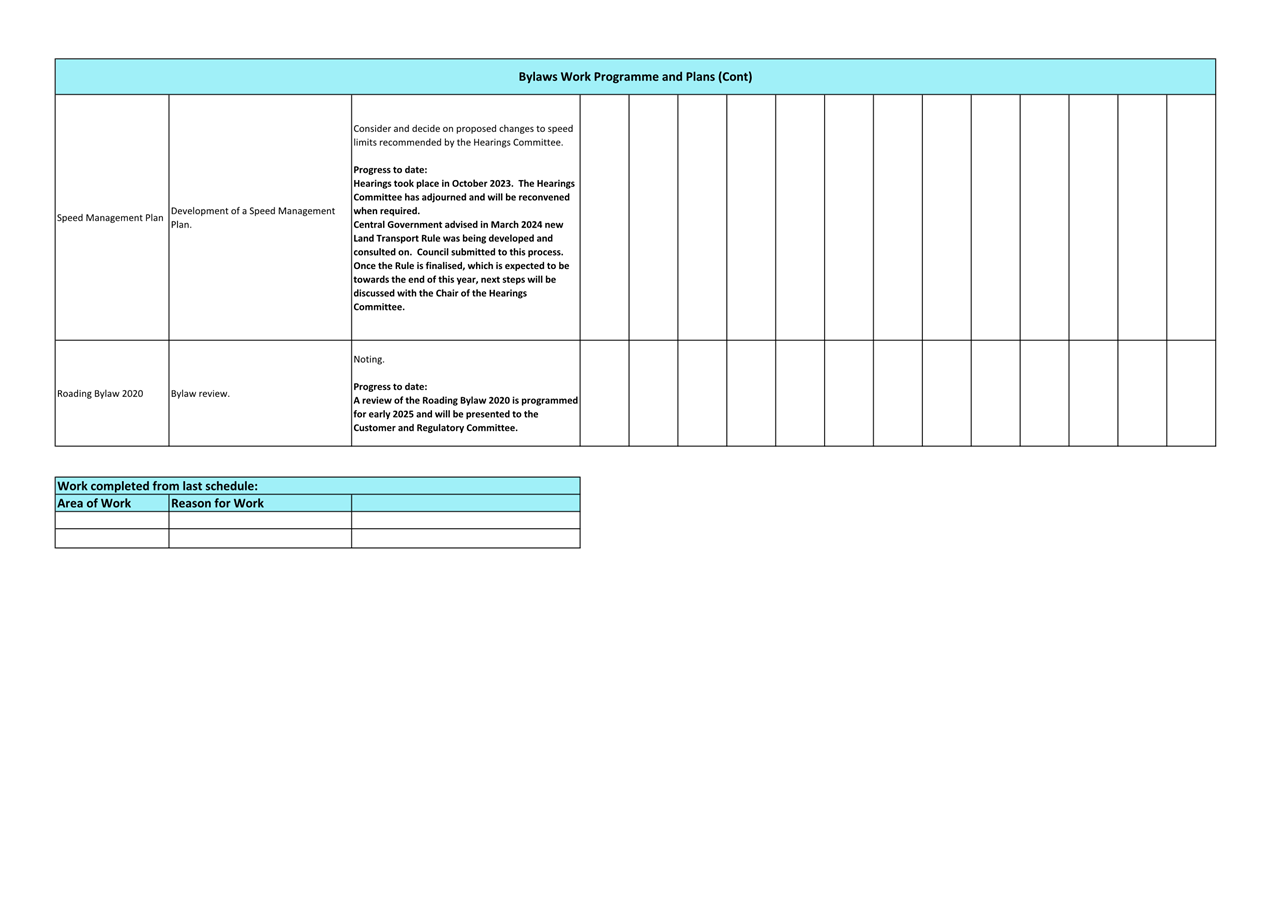
Infrastructure Services Committee Forward Work Programme
Department: Civic
EXECUTIVE SUMMARY
1 The
purpose of this report is to provide a regular update of the Infrastructure
Services Committee forward work programme to show areas of activity, progress
and expected timeframes for decision making across a range of areas of work
(Attachment A).
2 As
this is an administrative report only, there are no options or Summary of
Considerations.
RECOMMENDATIONS
That the Committee:
a) Notes the Infrastructure
Services Committee forward work programme as shown in Attachment A.
DISCUSSION
3 The
forward work programme will be a regular agenda item which shows areas of
activity, progress and expected timeframes for decision making across a range
of areas of work.
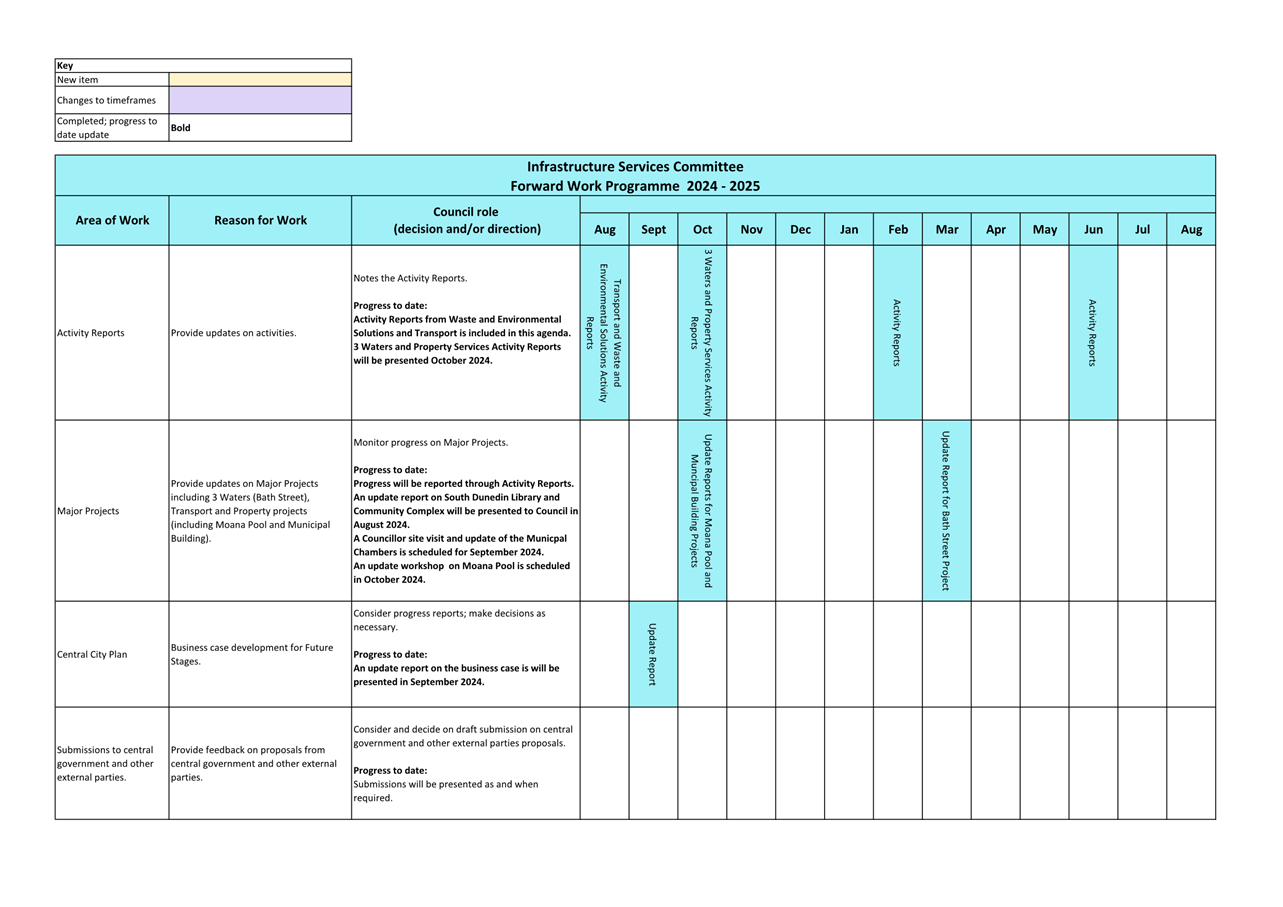
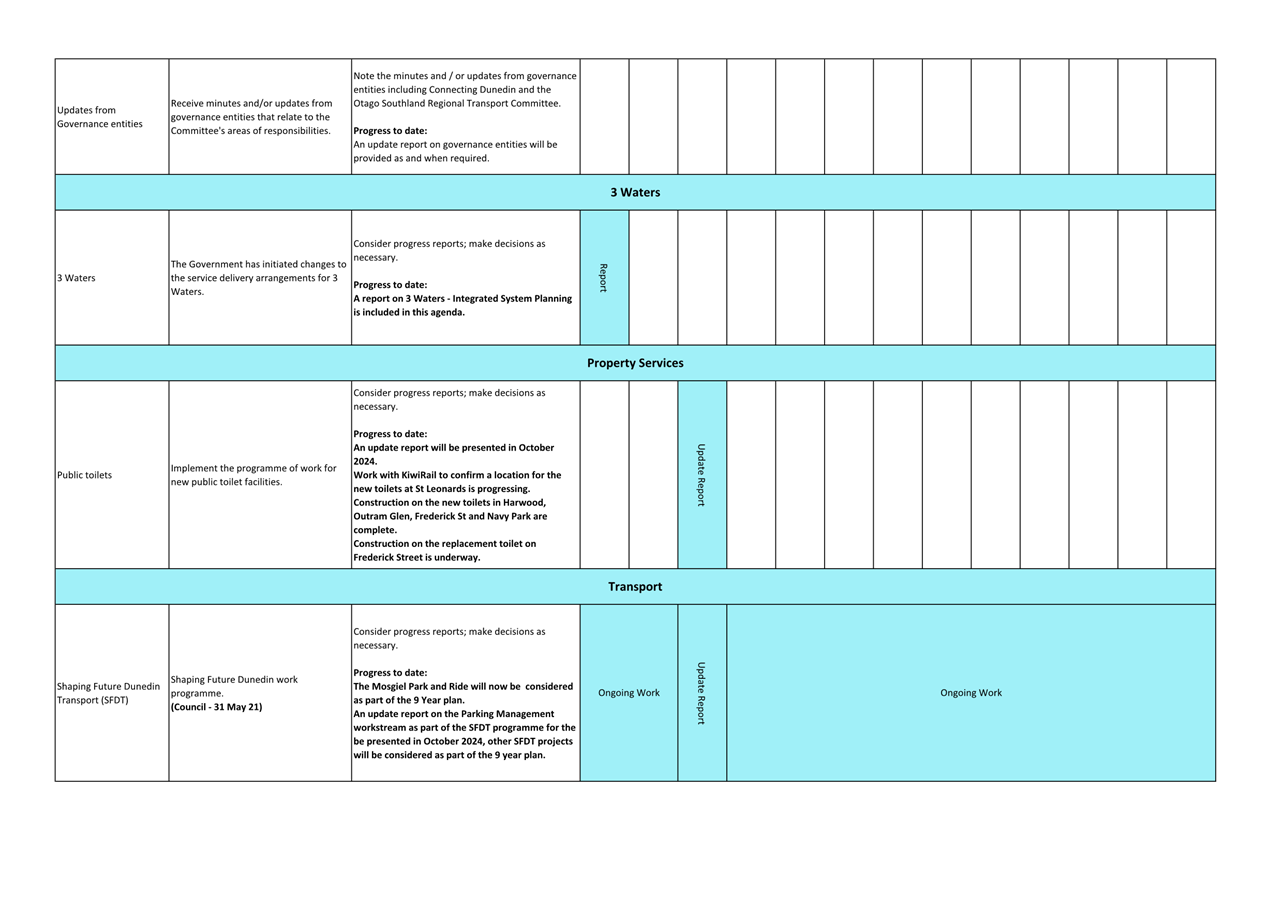
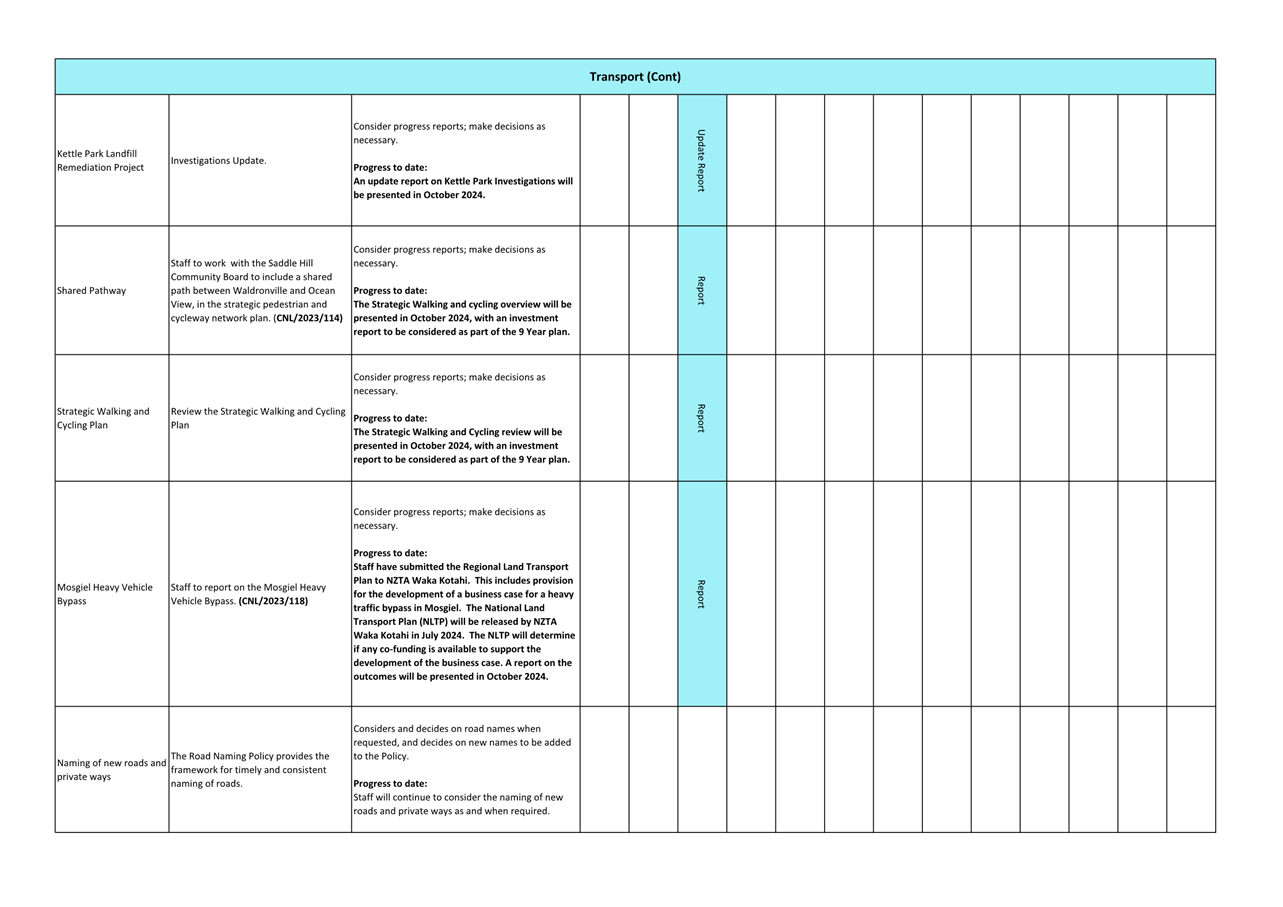
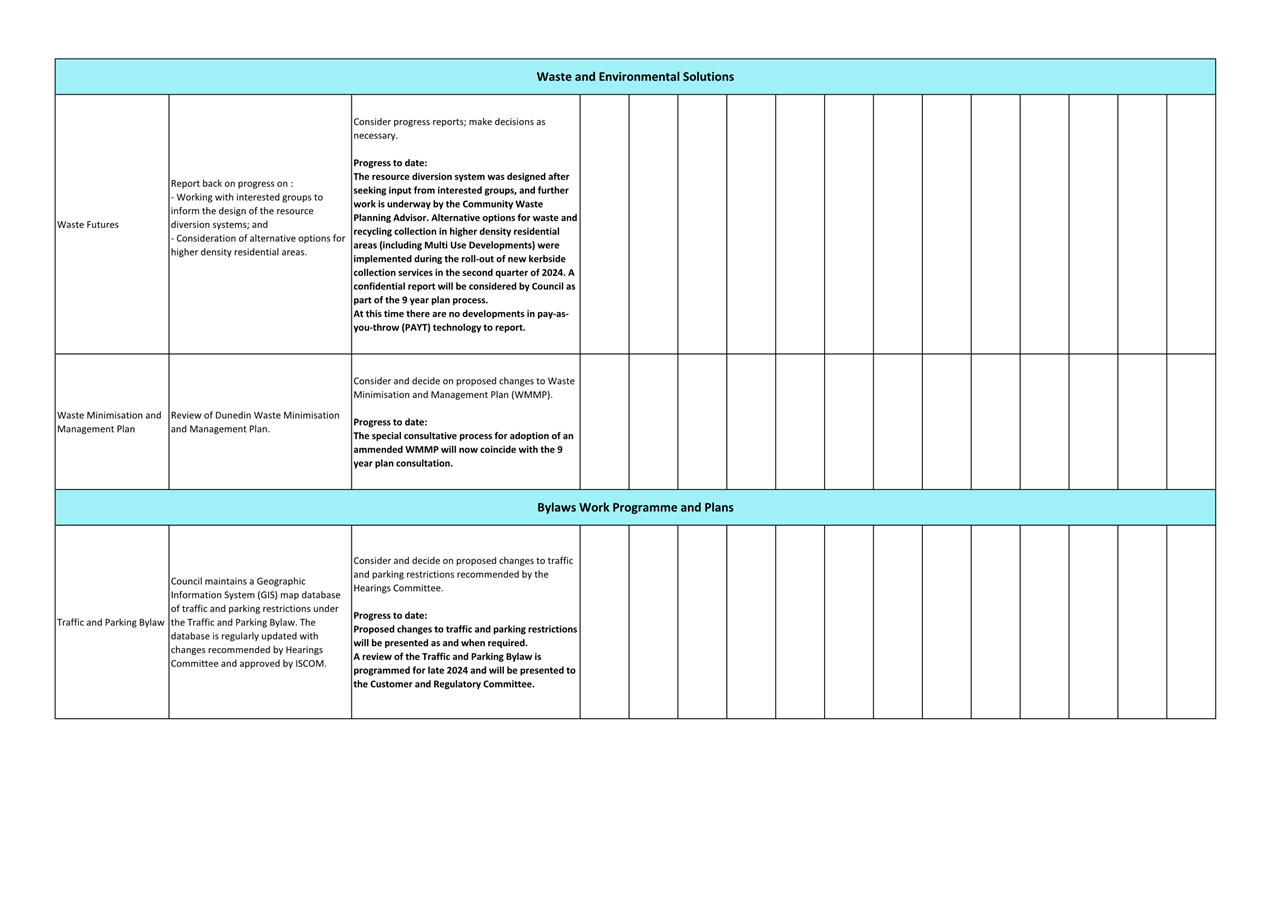
4 As
an update report, purple highlights show changes to timeframes. New items
added to the schedule will be highlighted in yellow. Items that have been
completed or updated are shown as bold.
Signatories
|
Author:
|
Rebecca Murray - Governance Support Officer
|
|
Authoriser:
|
Scott MacLean - General Manager, Climate and City Growth
|
Attachments
|
|
Title
|
Page
|
|
⇩a
|
Infrastructure Services
Committee Forward Work Programme
|
31
|
|
|
Infrastructure Services Committee
19 August 2024
|
|
|
Infrastructure Services Committee
19 August 2024
|
3 Waters - Integrated System Planning
Department: 3 Waters
EXECUTIVE SUMMARY
1 The
purpose of this report is to inform the Infrastructure Services Committee of
the strategic planning work that 3 Waters has been undertaking through the
Integrated System Planning (ISP) programme.
2 The
Integrated System Planning (ISP) programme is a strategic planning programme
with a 50-year planning horizon to identify the future investment required to
ensure that 3 Waters services meet current and adapt to future standards and
levels of service for 3 Waters and to achieve affordability obligations to
customers.
3 Dunedin’s
3 Waters services have a number of risks, issues and constraints including
aging infrastructure, vulnerable water supplies, wastewater and stormwater
contamination of fresh and coastal waters, climate change impacts, growth,
community expectations, regulatory requirements, increasing costs and reform of
service delivery. There are opportunities for carbon reductions and
beneficial reuse.
4 ISP
has assessed current system performance and expected future performance
requirements. “Responses” that could move 3 Waters services
from current performance to the required future state were identified and
evaluated. Preferred responses were selected to form a “core
pathway” of future investments.
5 Key
responses in the core pathway include:
· improving
the efficiency of water use while diversifying water sources and adding storage.
· reducing
wet weather overflows in our wastewater networks, biosolids reuse and upgrades
to wastewater treatment plants as part of obtaining new consents.
· improving
the management of stormwater quantity and quality in key catchments through the
implementation of green infrastructure, targeted treatment devices in high
traffic areas and reducing the risk of flooding in private property.
6 The
capital works required to deliver the core pathway will be included in the 3
Waters 9 year plan, the associated Infrastructure Strategy and Local Water Done
Well Water Service Delivery Plan. A further report to ISCOM will be made on
completion of the final and summary reports for ISP.
RECOMMENDATIONS
That the Committee:
a) Notes the 3 Waters
– Integrated System Planning report.
BACKGROUND
7 3
Waters services are faced with a number of challenges, including:
· aging
infrastructure
· environmental
impacts with increasing risk of drought, floods and damage to infrastructure
due to climate change impacts
· growth
in parts of Dunedin being constrained by infrastructure capacity
· regulatory
requirements and community expectations of improved performance in terms of
resource efficiency
· the
need to reduce the carbon footprint of 3 Waters activities
· increasing
costs that challenge the affordability of services.
8 Given
the number of and complexity of these challenges, the 3 Waters Department has
undertaken the Integrated System Planning (ISP) programme of work. The ISP
programme is a strategic planning programme with a 50-year horizon. The
purpose of ISP is to identify the future investment required to ensure that 3
Waters services meet current and adapt to future standards and levels of service
for 3 Waters and to achieve affordability obligations to customers.
9 Given
future uncertainties a Dynamic Adaptive Planning Pathways (DAPP) approach has
been applied. DAPP is a method of strategic planning in the face of
future uncertainties, identifying multiple future options and the signals and
triggers which might indicate a need to move to a different option.
Originally developed for climate adaptation, this approach is increasingly
being used for infrastructure planning overseas. Dunedin City Council (DCC) is
recognised as one of New Zealand’s early adopters of this methodology for
3 Waters infrastructure planning.
10 ISP will
deliver a “core pathway” of future strategic investments required
over a 50-year timeframe for water supply, wastewater and stormwater services.
The work is due to be completed by the end of 2024 but is sufficiently complete
to inform budgets for the 9-Year Plan and Water Service Delivery Plans.
11 The ISP
methodology consists of four stages:
1. Baselining
Performance – assessing the current performance of the infrastructure.
2. Objective
Setting – determining the performance standards and
levels of service expected to be achieved in the future. These are
summarized in a set of “Guiding Principles”.
3. Strategic
Responses – after considering the gap between current performance and
expected future performance requirements, developing “responses”
that would enable 3 Waters services to reach the required future state.
4. Strategy
Selection / Adaptive Planning – evaluating responses and selecting
preferred responses to form a “core pathway” of future investments
required to reach the future state. The core pathway includes alternatives,
should future uncertainties develop differently to expectations.
12 Targeted
engagement with our Te Tiriti partner and key stakeholders was included as a
feature of ISP and proved to be vital in understanding, first hand, historic
and likely future positions.
13 Mana whenua
are a part of the Programme Board for the ISP programme, providing governance
as well as cultural and technical input via Aukaha but involving members of Te
Rūnanga o Ōtākou and Kati Huirapa Runaka ki Puketeraki when they
felt the need to input directly.
14 Key
stakeholders included:
· Otago
Regional Council – a key regulator of our activities (e.g., water takes,
wastewater and stormwater discharges)
· Taumata
Arowai – the regulator for our water supply activities and potential
future regulator for wastewater and stormwater activities.
· DCC
stakeholders outside of the 3 Waters:
i) City
Development – providing growth projections and expectations.
ii) Zero
Carbon – inputting on how 3 Waters reaches Carbon Zero targets.
iii) South
Dunedin Futures – to ensure alignment of programmes.
DISCUSSION
15 The
Baselining Performance stages of ISP confirmed known or identified new risks,
issues, constraints and opportunities. These include:
· Water
Supply
i) Dunedin’s
water supply is vulnerable – almost 80% of Dunedin’s water comes
from the Deep Creek and Deep Stream supplies. These supplies are vulnerable to
catchment fire and several critical pipelines are vulnerable to asset failure,
which also have regulatory and health and safety risks.
ii) Most
of Dunedin’s water supply is taken from surface water sources, many of
which are over allocated. All of Dunedin’s existing water sources
will need new consents in the early 2040s and it is unlikely that we will be
able to take as much water from existing sources as we currently do. More
water will need to be left in streams and rivers for the health of the
environment and water taken must be used more efficiently.
iii) The need
to maintain river flows under new consent condition in the early 2040s means
it’s expected that during peak demand periods in summer no water will be
able to be taken from surface water sources for several weeks. Dunedin
does not currently have sufficient raw water storage available to meet expected
demand during these future “no surface water take” periods.
· Wastewater
i) While
our wastewater networks perform adequately in dry weather, in wet weather,
overflows of wastewater to streams and watercourses is degrading water
quality. Freshwater is relatively clean in the headwaters of waterbodies
such as the Leith, Lindsay, Kaikorai and Silverstream but deteriorates as it
flows through urban areas. The most common contaminants are E.coli and
nitrates.
ii) The
poor wet weather performance of the wastewater networks is due to aging pipes,
that let in groundwater and surface water during rain, and likely also
cross-connections of stormwater pipes into wastewater pipes although this
requires further investigation.
iii) The wet
weather performance and capacity of the wastewater network is constraining
Dunedin’s growth in a number of areas, including Kaikorai Valley, North
East Valley, parts of the CBD and Mosgiel.
iv) The Main
Interceptor Sewer is a critical asset and is at the end of its theoretical
useful life. Condition assessment of this asset is ongoing and, when
completed, will confirm remaining life and help plan for its replacement.
v) The
Musselburgh Wastewater Pump Station and pipelines from there to Tahuna
Wastewater Treatment Plant (WWTP) carry 64% of Dunedin’s
wastewater. Both are highly vulnerable to failure and in need of upgrade
or replacement.
vi) One of the
biggest contributors to the 3 Waters carbon footprint is disposal of wastewater
sludges. These contribute approximately 25% of 3 Waters and almost 6% of
DCC’s operational carbon emissions. Currently wastewater sludges are
landfilled or incinerated; both of these pathways are vulnerable to asset
failure which results in sludges needing to be disposed of outside of Dunedin,
at high cost.
vii) All wastewater
consents expire within the next eight years with Tahuna and Green Island WWTP
consents expiring in 2032. It is expected that higher standards of treatment
will need to be met.
· Stormwater
i) Stormwater
also contributes to the poor health of our streams and watercourses in urban
areas. In addition to E.coli and nitrates, zinc is another common
contaminant. During wet weather turbidity increases and lead and copper
also exceed guideline values at times. Run-off from roads is likely to be
a contaminant contributor.
ii) Stormwater
also impacts water quality in coastal areas with elevated levels of zinc,
copper, faecal coliforms and hydrocarbons being present in coastal waters.
iii) Stormwater
infrastructure in South Dunedin is the most critical in the city although there
are also areas of high risk in Mosgiel, Kaikorai Valley, North East Valley,
Sawyers Bay and Abbotsford.
iv) Watercourses
provide a significant portion of Dunedin’s stormwater drainage but over
70% of these are privately owned and not always well maintained. The proper
functioning of watercourses is highly critical to ensuring flood protection in
urban areas and vulnerable infrastructure such as roads, railways, schools and
hospitals.
v) Climate
change is expected to reduce the level of service of stormwater infrastructure
due to increasing frequencies of intense rainfall and sea level rise reducing
capacity available in low lying areas.
16 Through
engaging with our Te Tiriti partner and key stakeholders during the Objective
Setting stage of ISP, performance standards and levels of
service expected to be achieved in the future were considered. A set of “Guiding
Principles” were developed focussing on three key areas:
· Regeneration
i) Giving
effect to Te Mana o te Wai - protecting the health of water protects the health
and well-being of the wider environment and our communities.
ii) Alignment
with Tikaka and Kawa - acknowledging and upholding the rakatirataka
(self-determination, right to exercise authority) of mana whenua and
incorporating traditional knowledge, beliefs, values, practice and protocols.
iii) Minimizing
emissions and contributing to carbon reductions targets.
iv) Protecting and
enhancing the natural environment – including compliance with national
and regional requirements.
v) Improving
the health and wellbeing of communities.
· Resilience
i) Adapting
to climate change
ii) Robust,
recoverable and flexible to respond to incidents and natural disasters.
· Efficiency
i) Minimising
wastage – using natural resources such as water as well as energy and
chemicals more efficiently and realising opportunities for rehabilitation and
reuse.
ii) Supporting
a vibrant city by providing services in the right place at the right time
– to enable Dunedin’s continued growth.
iii) Minimising
cost impacts to customers – so that performance improves while
remaining affordable.
17 Updating of
the 3 Waters Strategy was outside of the scope of ISP however the ISP Guiding
Principles are aligned with and will significantly influence the next update to
the 3 Waters Strategy.
18 The third
stage of ISP, Strategic Responses developed responses that could bridge the gap
between current performance and expected future state, addressing risks, issues
and constraints while meeting the Guiding Principles. These were then
evaluated, and in the fourth stage of ISP a preferred set of
“responses” has been determined and formed into the core pathway of
investments required to reach the required future state. Key responses on the
core pathway include:
· Water
Supply
i) Using
water more efficiently, by reducing losses and leakage and demand management.
This is expected to result in operational savings.
ii) Investigating,
consenting and implementing alternative water sources, which are likely to
include groundwater, prior to the expiry of existing surface water take
consents in the early 2040s.
iii) Increasing
raw water storage potentially up to 30 days storage, with the scale of storage
required being dependent on the investigations into alternative water sources.
· Wastewater
i) Continuing
to focus on reducing wet weather overflows by reducing inflow and infiltration
into the wastewater network, through a combination of rehabilitation or renewal
of aging infrastructure, removal of cross-connections, pipe capacity increases
and constructing network storage. This is expected to result in operational
savings. A new global wastewater networks discharge consent will be required.
ii) Development
of a biosolids reuse facility, to convert wastewater sludges into beneficial products
and significantly reduce the carbon impact of 3 Waters operations.
iii) A
significant programme of upgrades to wastewater treatment plants over the next
eight years as part of reconsenting. This will require improvements to
treatment plant performance, cost efficiency and a reduction in the carbon
footprint of activities.
· Stormwater
i) Prioritising
improvements in the Lindsay, Leith, South Dunedin and Mosgiel stormwater
catchments and stormwater discharges to Otago Harbour.
ii) Implementing
green infrastructure, where practicable, to resolve quantity and quality
issues. This could include raingardens, swales, floodable parks, wetlands and
detention ponds.
iii) Targeting
high traffic areas of the road network with proprietary stormwater treatment devices,
to improve stormwater quality.
iv) Clearly
delineating certain roads as overland flowpaths, to reduce the risk of flooding
in private property.
19 Key risks
that may impact the implementation of the core pathway are:
· Funding
– this will be considered as part of the 9-Year Plan. Consideration
will be given to which responses in the core pathway should be prioritised if
available funding does not meet the expected costs of full core pathway
implementation.
· Local
Water Done Well (LWDW) – the body of work that ISP consists of provides
Dunedin with a robust and evidence-based plan that defines our infrastructure
needs and the best ways to meet expected performance requirements. It is
believed that this puts Dunedin in a strong position to secure the investment
required regardless of the nature of any service delivery model.
20 The outputs
from the ISP programme are aligned with the following related DCC programmes of
work:
· Servicing
Assessment – as described in the 3 waters Activity report for the Period
Ending 31 May 2024, presented to ISCOM on 18 June 2024, 3 Waters, has commenced
work on a Servicing Assessment in accordance with sections 125-128 of the Local
Government Act 2002 (LGA). The ISP programme considered what 3 Waters
services are expected to be required for outlying communities that currently
only have some or no 3 Waters services. Cost estimates were produced and will
support the Servicing Assessment project, which will be reporting to ISCOM
later in 2024.
· Future
Development Strategy – in addition to producing cost estimates for
servicing some currently partially / unserviced areas of Dunedin, the ISP
programme incorporates growth projections from City Development. Where
possible, core pathway responses implementation will focus on current and
future growth areas of Dunedin as a priority.
· South
Dunedin Futures (SDF) – the ISP programme has produced updated and
recalibrated stormwater and wastewater hydraulic models for the South Dunedin
area. These will be used to assess various adaptation options developed
in the SDF programme in more detail. The ISP core pathway for stormwater, with
its prioritisation of green infrastructure is expected to align with the
direction of the SDF programme.
· Carbon
Zero – in addition to key carbon reduction responses, such as
establishing a biosolids reuse facility, infrastructure responses in the core
pathway will incorporate carbon reduction through planning, design,
construction and operation.
OPTIONS
21 This report
is for information only. No options are presented.
NEXT STEPS
22 The ISP
programme is in the process of being finalised. A detailed final report
and high-level summary report, suitable for public engagement, will be produced
by the end of 2024.
23 The
investment required to deliver the core pathway will be included in the 3
Waters 9-Year Plan and LWDW Water Service Delivery Plan. Council and the
public will have the opportunity to provide feedback through the engagement
processes of these two plans.
24 An ISP
Implementation Plan is being prepared. This will detail the next steps
required to begin to deliver the core pathway and the monitoring required to
track progress and any changes required to the core pathway, as the future
unfolds.
25 A further
report to ISCOM will be made on completion of the final and summary reports for
ISP. 3 Waters will prepare separate ISCOM papers on the Servicing Assessment
project and watercourse ownership.
Signatories
|
Author:
|
Jared Oliver - Planning Manager
|
|
Authoriser:
|
David Ward - General Manager, 3 Waters and Transition
|
Attachments
There are no attachments for
this report.
|
SUMMARY OF CONSIDERATIONS
|
|
Fit with purpose of Local Government
This report decision promotes the social,
economic, environmental and cultural well-being of communities in the present
and for the future.
|
|
Fit with strategic framework
|
|
Contributes
|
Detracts
|
Not applicable
|
|
Social Wellbeing Strategy
|
✔
|
☐
|
☐
|
|
Economic Development Strategy
|
☐
|
☐
|
✔
|
|
Environment Strategy
|
✔
|
☐
|
☐
|
|
Arts and Culture Strategy
|
☐
|
☐
|
✔
|
|
3 Waters Strategy
|
✔
|
☐
|
☐
|
|
Future Development Strategy
|
✔
|
☐
|
☐
|
|
Integrated Transport Strategy
|
☐
|
☐
|
✔
|
|
Parks and Recreation Strategy
|
☐
|
☐
|
✔
|
|
Other strategic projects/policies/plans
|
✔
|
☐
|
☐
|
In addition to contributing to the Social Wellbeing,
Environment, 3 Waters and Future Development Strategies the ISP Programme
also contributes to:
· DCC’s Zero
Carbon Policy and Plan – By planning to minimize emissions and
contributing to carbon reductions targets.
· DCC’s
Māori Strategic Framework – by acknowledging and upholding the
rakatirataka (self-determination, right to exercise authority) of mana whenua
and incorporating traditional knowledge, beliefs, values, practice and
protocols.
|
|
Māori Impact Statement
Mana whenua are a part of the Programme Board for the ISP programme,
providing governance as well as cultural and technical input via Aukaha but
involving members of Te Rūnanga o Ōtākou and Kati Huirapa
Runaka ki Puketeraki when they felt the need to input directly.
Two of the ten Guiding Principles developed in the
programme are particularly relevant to mana whenua:
· Giving effect to
Te Mana o te Wai - protecting the health of water protects the health and
well-being of the wider environment and our communities.
· Alignment with
Tikaka and Kawa - acknowledging and upholding the rakatirataka
(self-determination, right to exercise authority) of mana whenua and
incorporating traditional knowledge, beliefs, values, practice and protocols.
|
|
Sustainability
The ISP programme contributes positively to the interests
of the community by identifying the future investment required to ensure that
3 Waters services meet current and adapt to future standards and levels of
service for 3 Waters while achieving affordability obligations to customers.
|
|
LTP/Annual Plan / Financial Strategy /Infrastructure
Strategy
Investment requirements identified in the ISP programme
will be included for consideration in the 9-Year Plan, Infrastructure
Strategy and Local Water Done Well Water Service Delivery Plan.
|
|
Financial considerations
The report does not seek any change to capital or
operating budgets and provides updates only. Changes
to capital or operating budgets resulting from the ISP core pathway will be
considered in the 9-Year Plan, Infrastructure Strategy and Local Water
Done Well Water Service Delivery Plan.
|
|
Significance
This noting report is considered of low significance under
the Significance and Engagement Policy as no decisions are required to be
made.
|
|
Engagement – external
External engagement has taken place with the following
organisations:
· Otago Regional
Council – a key regulator of our activities (e.g., water takes,
wastewater and stormwater discharges)
· Taumata Arowai
– the regulator for our water supply activities and potential future
regulator for wastewater and stormwater activities.
The views of these stakeholders were used to inform the
core pathway of investments required to reach the required future state.
Neither of these stakeholders had views contrary to the core pathway.
|
|
Engagement - internal
Internal engagement has taken place with the following
Council departments outside of 3 Waters:
· City Development
– providing growth projections and expectations.
· Carbon Zero
– inputting on how 3 Waters reaches Carbon Zero targets.
· South Dunedin
Futures – to ensure alignment of programmes.
Engagement has occurred throughout the project from Stage
2 - Objective setting, to the final stage, Stage 4 – Strategy Selection
/ Adaptive Planning. None of these internal stakeholders have views contrary
to the core pathway.
|
|
Risks: Legal / Health and Safety etc.
There are no identified risks.
|
|
Conflict of Interest
There is no conflict of interest.
|
|
Community Boards
There are no implications for Community Boards because
this report is a noting report only.
|
|

|
Infrastructure Services Committee
19 August 2024
|
Proposed Parking Changes - Hearings Committee July 2024
Recommendations
Department: Transport
EXECUTIVE SUMMARY
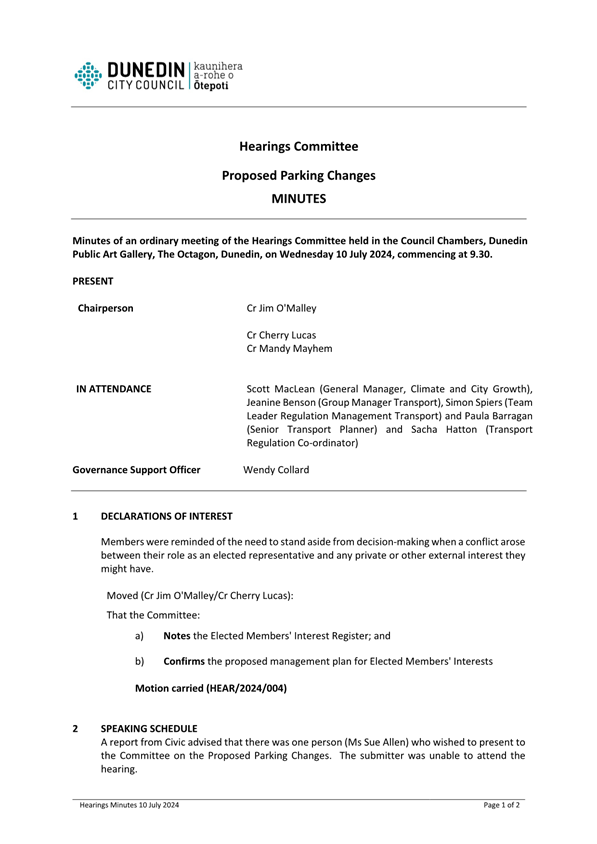
1 This
report presents recommendations of the Hearings Committee meeting (Attachment A - Minutes of Hearings Committee meeting),
held on 10 July 2024 on proposed changes and corrections to parking
restrictions.
2 The
Hearings Committee (the Committee) recommends that all proposed changes and
corrections to parking restrictions to the GIS database as presented in July
2024 be approved.
3 If
approved by the Infrastructure Services Committee, the changes recommended by
the Hearings Committee, will be included into the GIS database and become part
of the Dunedin City Traffic and Parking Bylaw 2010.
4 The
proposed changes in parking and traffic restrictions are presented in two
sections:
a) general
minor parking changes which include requests from residents, changes made to enhance
safety or amenity, and suggestions from officers. These changes include:
i. parking
time restriction changes to support local businesses in Hillside Road
ii. parking
restrictions on Silverton Street to increase visibility for drivers at the
nearby intersection with Cranston Street
iii. parking
restrictions relating to Balmacewen School, Grants Braes School, Pine Hill
School, and Liberton Christian School as part of the School Road Safety
Improvements 2023/25 project.
b) corrections
to the bylaw database to ensure it matches existing markings and signage.
5 Consultation
has been undertaken separately for all the proposed changes discussed in this
report.
RECOMMENDATIONS
6 That
the Committee:
a) Adopts the proposed
changes to parking and traffic restrictions shown in the July 2024 update of
the Dunedin City Council's traffic and parking restrictions database Webmap - General Parking
Changes - July 2024
b) Notes that Committee has considered feedback from consultation on the
proposed changes to parking restrictions.
c) Notes that all parking
restrictions previously approved by Council remain unchanged.
BACKGROUND
1
Traffic and parking controls
7 Traffic
and parking controls contribute to the objectives of the Dunedin Integrated
Transport Strategy 2013, by helping to achieve a safe, efficient, and
accessible transport network.
8 Council
maintains a Geographic Information System (GIS) map database of traffic and
parking restrictions (the database) that reflects all on-street parking
restrictions that are implemented with markings and/or signs.
9 Parking
controls are made under the Traffic and Parking Bylaw 2010. The Hearings
Committee has the delegation to consider changes to parking controls and to
make recommendations to Council that can approve traffic restrictions and
parking controls.
2
Context for proposed
changes
10 Council
often receives requests from individuals and businesses to change parking
restrictions. When considering these requests, officers assess a range of
factors including safety concerns, commuters’ needs, commercial
users’ needs, road width and topography, traffic flow, neighbouring
on-street parking spaces, visibility concerns and crash statistics. If a
proposed change is supported by officers, consultation is undertaken with
affected residents, businesses, and property owners to demonstrate support for
the requested change.
11 The
proposed changes in parking and traffic restrictions are presented in two sections:
a) general
changes – this section includes parking changes that arise from requests
from the public and businesses to change parking restrictions, other general
changes and safety and infrastructure changes.
b) corrections
to parking restrictions.
DISCUSSION
3
General changes proposals
12 All
proposed general parking changes are shown in Webmap - General Parking
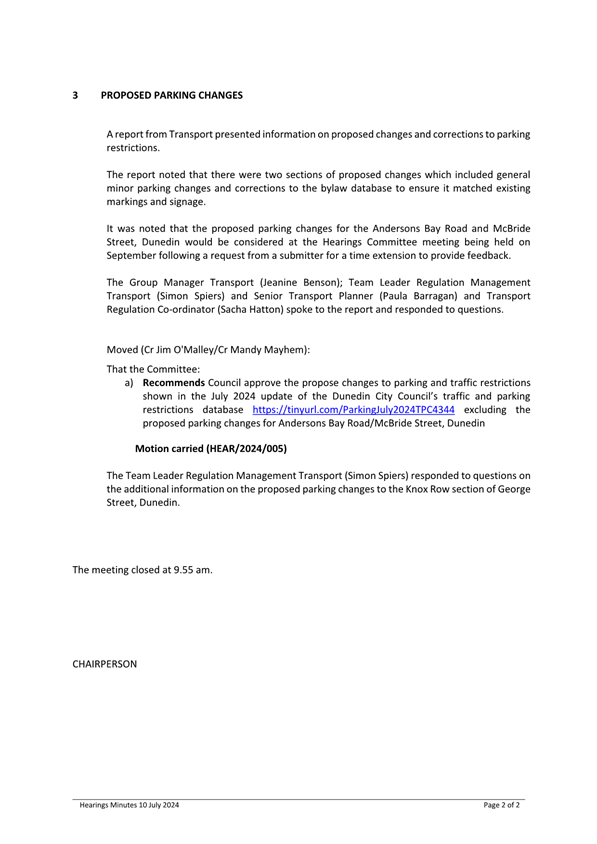
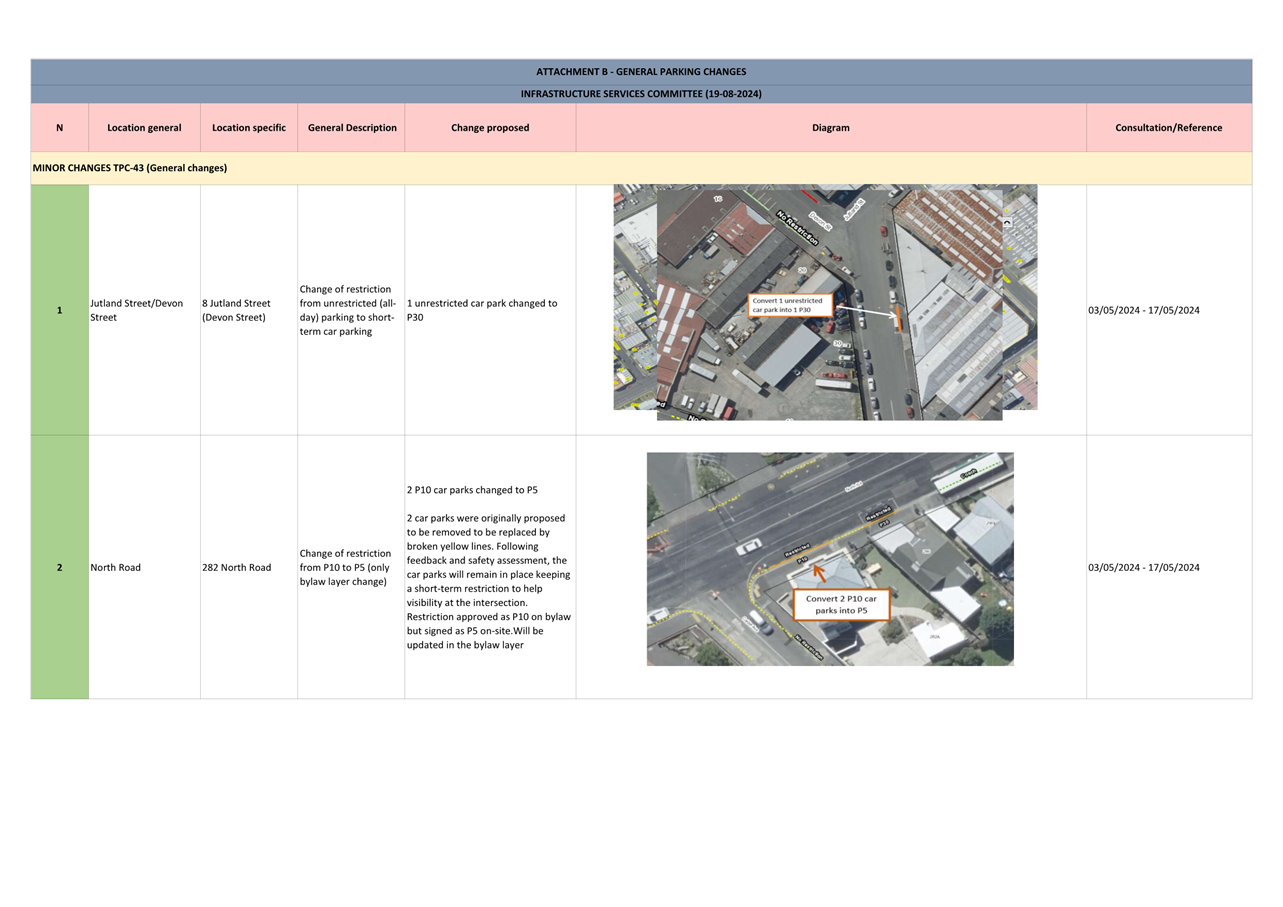
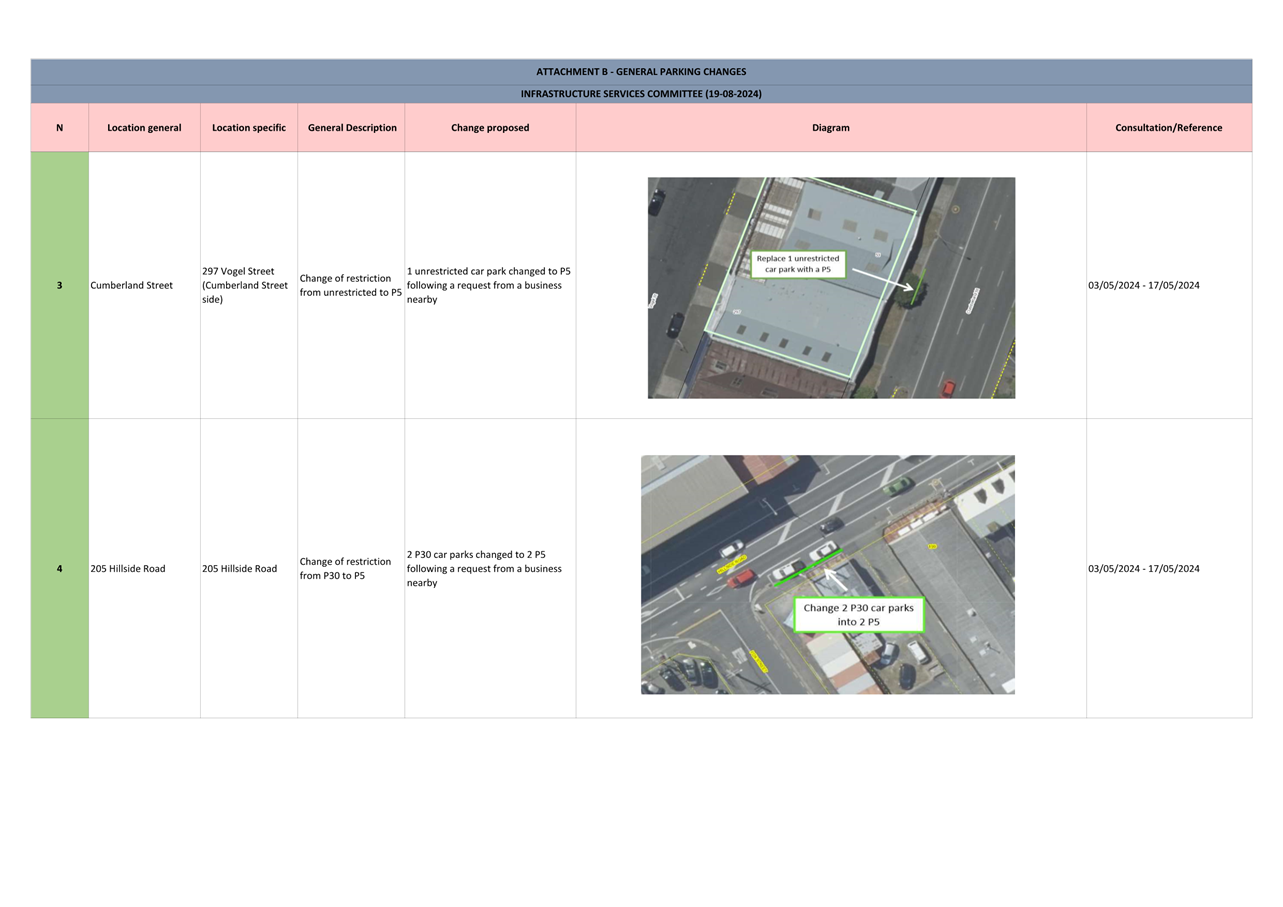
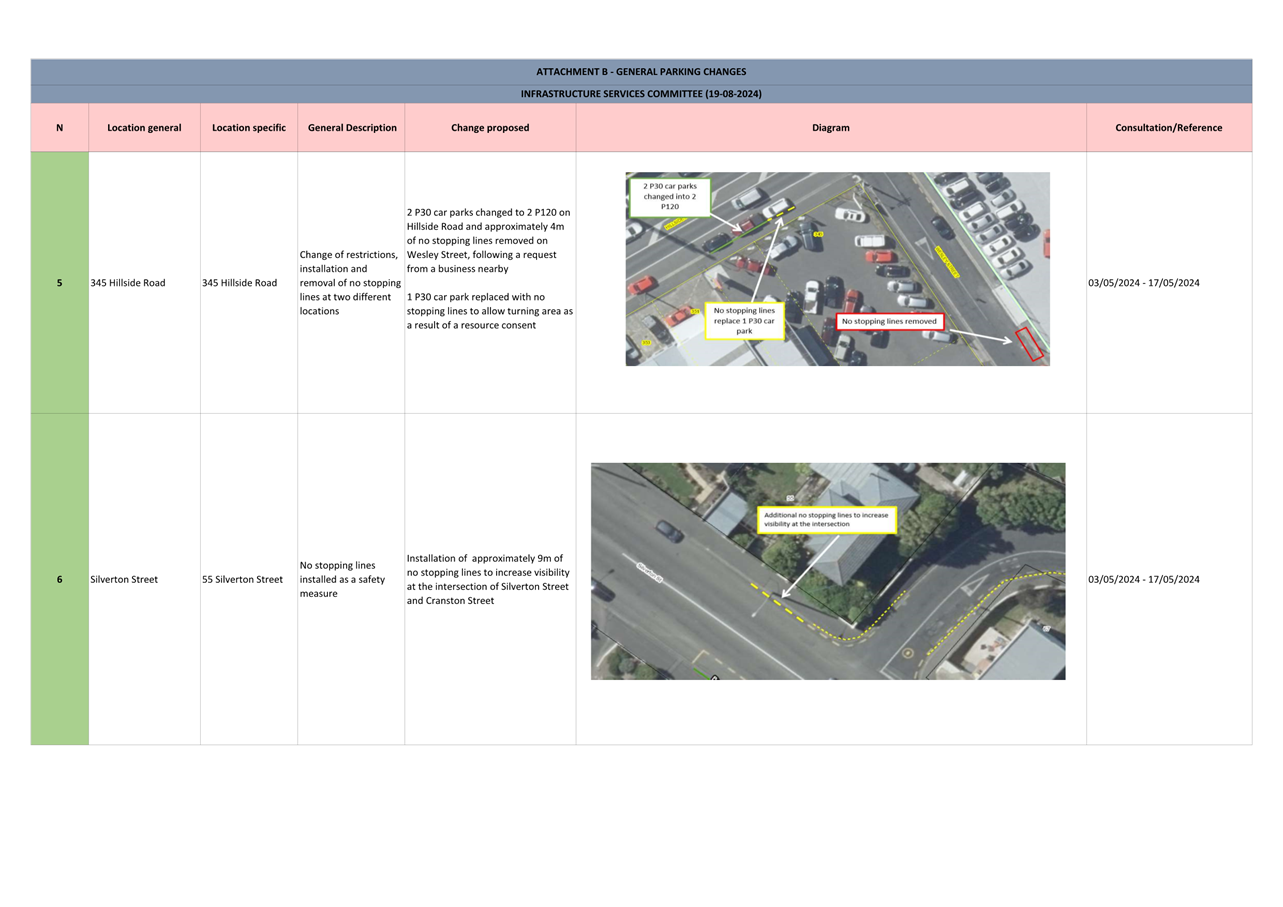
Changes - July 2024 and are detailed in Attachment B - General Parking Changes. The GIS layer
includes a bookmark feature which links the numbered cases presented in the
tables of Attachment B, to their specific location.
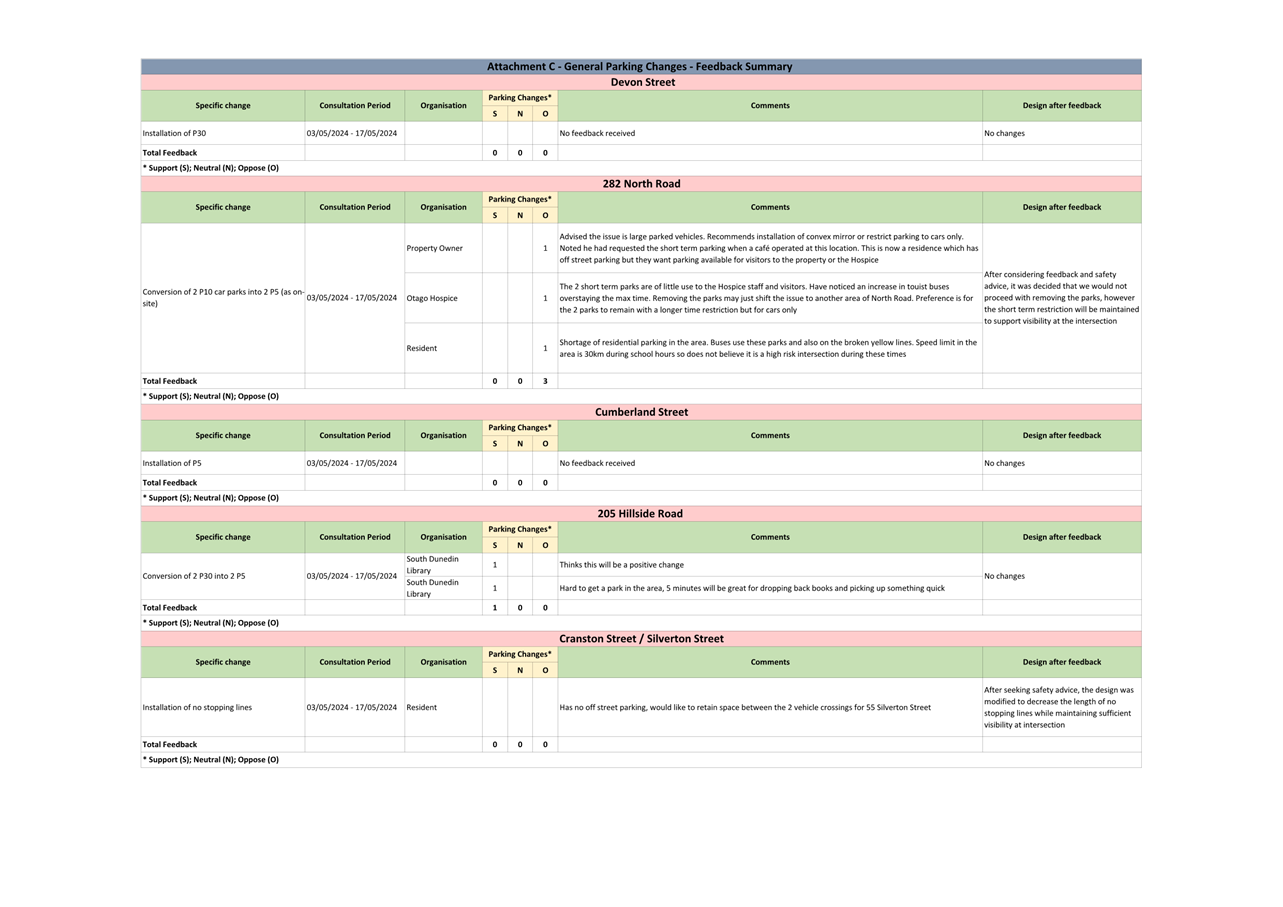
13 Summaries
of consultation undertaken with affected parties, including owners, residents
and businesses are presented in Attachment C - General
Parking Changes - Feedback Summary.
4
Parking changes to support businesses
14 Several
business requests were received for changes on Hillside Road:
a) 205
Hillside Road: It is proposed to change two 30-minute car parks to 5-minute car
parks to increase the parking turnover in this area
b) 345
Hillside Road: It is proposed to extend the parking time restrictions for two
spaces from 30 minutes to 120 minutes, based on requests from local businesses
that find the current 30-minute restriction unsuitable. The proposal also
includes removing no-stopping lines on Wesley Street, which are no longer
needed
c) As
a result of a resource consent for a new business soon to open at 345 Hillside
Road, it is proposed to replace one 30-minute car park with no stopping lines.
This is proposed to provide trucks a safe and sufficient turning area when
leaving the premises.
15 In response
to requests from two businesses for short-term parking in areas frequently
occupied by all-day commuters, the proposal is to change one unrestricted car
park on Devon Street to a 30-minute time restriction, and one unrestricted car
park on Cumberland Street to a 5-minute time restriction. This change aims to
increase parking turnover.
5
Parking restrictions on Silverton Street
16 Approximately
9m of new no stopping lines are proposed to increase the visibility at the
intersection of Silverton Street and Cranston Street after safety concerns were
raised and supported by a transport engineering assessment.
6
School Road Safety Improvements 2023/25
17 This
project focuses on supporting speed reduction around schools and follows the
implementation of the Interim Speed Management Plan. The School Road Safety
Improvements 2023/25 project comprises two separable portions of construction,
with the first part already implemented and regulated in the previous financial
year.
18 The
regulatory changes presented relate to infrastructure changes that will improve
safety around schools. The construction of these projects is underway, and the
purpose of this report is to update the traffic and parking bylaw to make the
new restrictions enforceable.
19 The
improved safety zones relate to the following schools:
a) Balmacewen School
b) Grants
Braes School
c) Pine
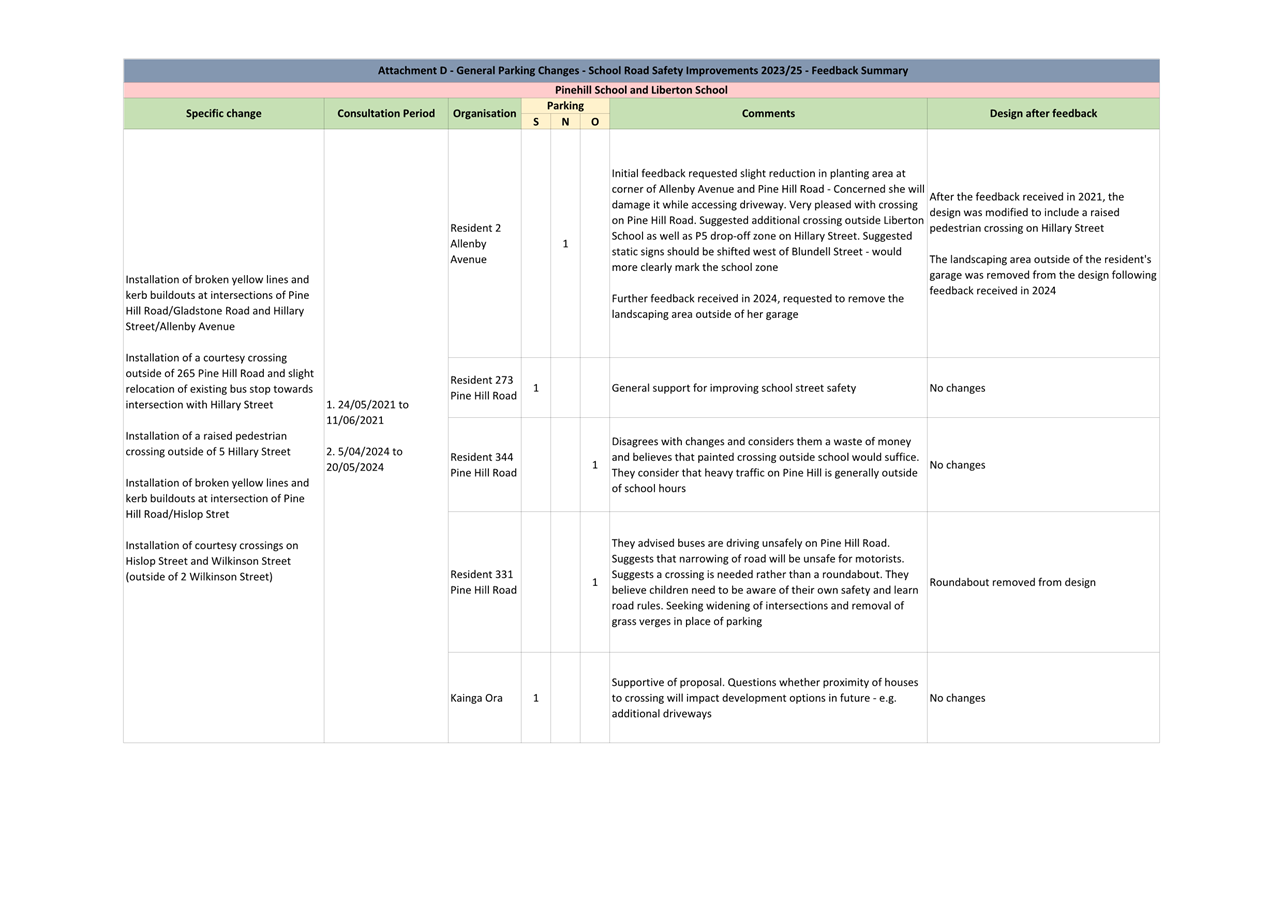
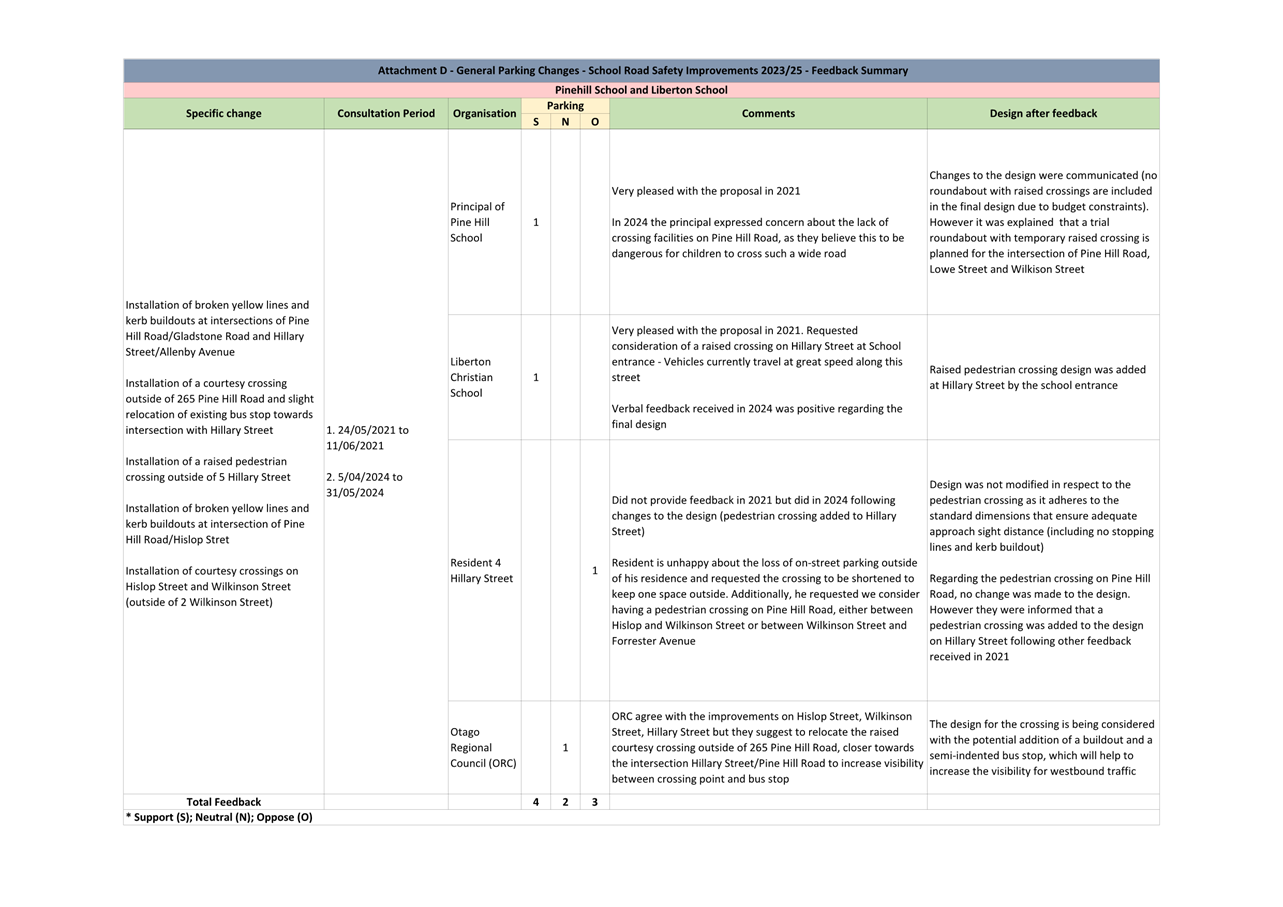
Hill School and Liberton Christian School
d) Shetland,
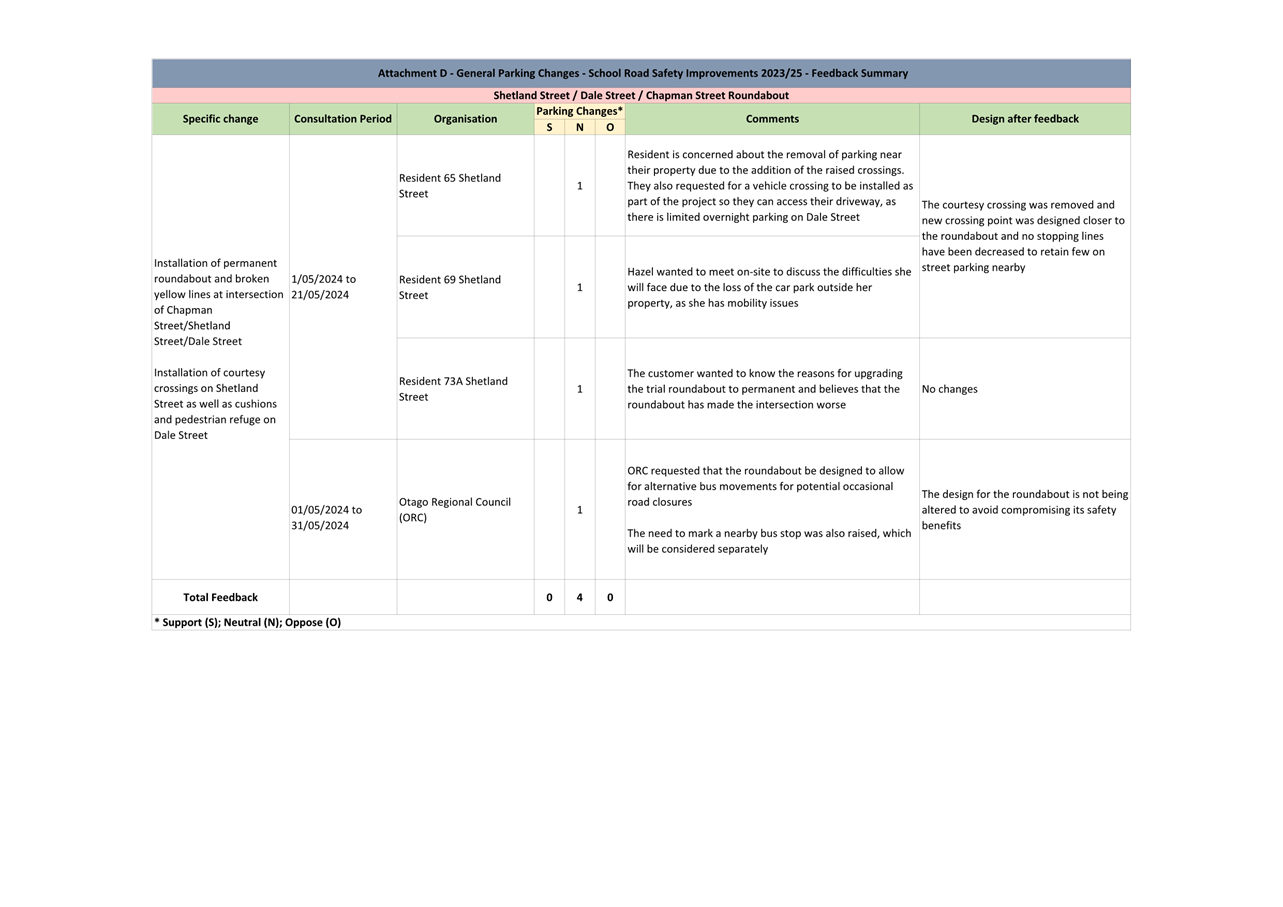
Dale, Chapman Streets intersection roundabout (near Balmacewen School)
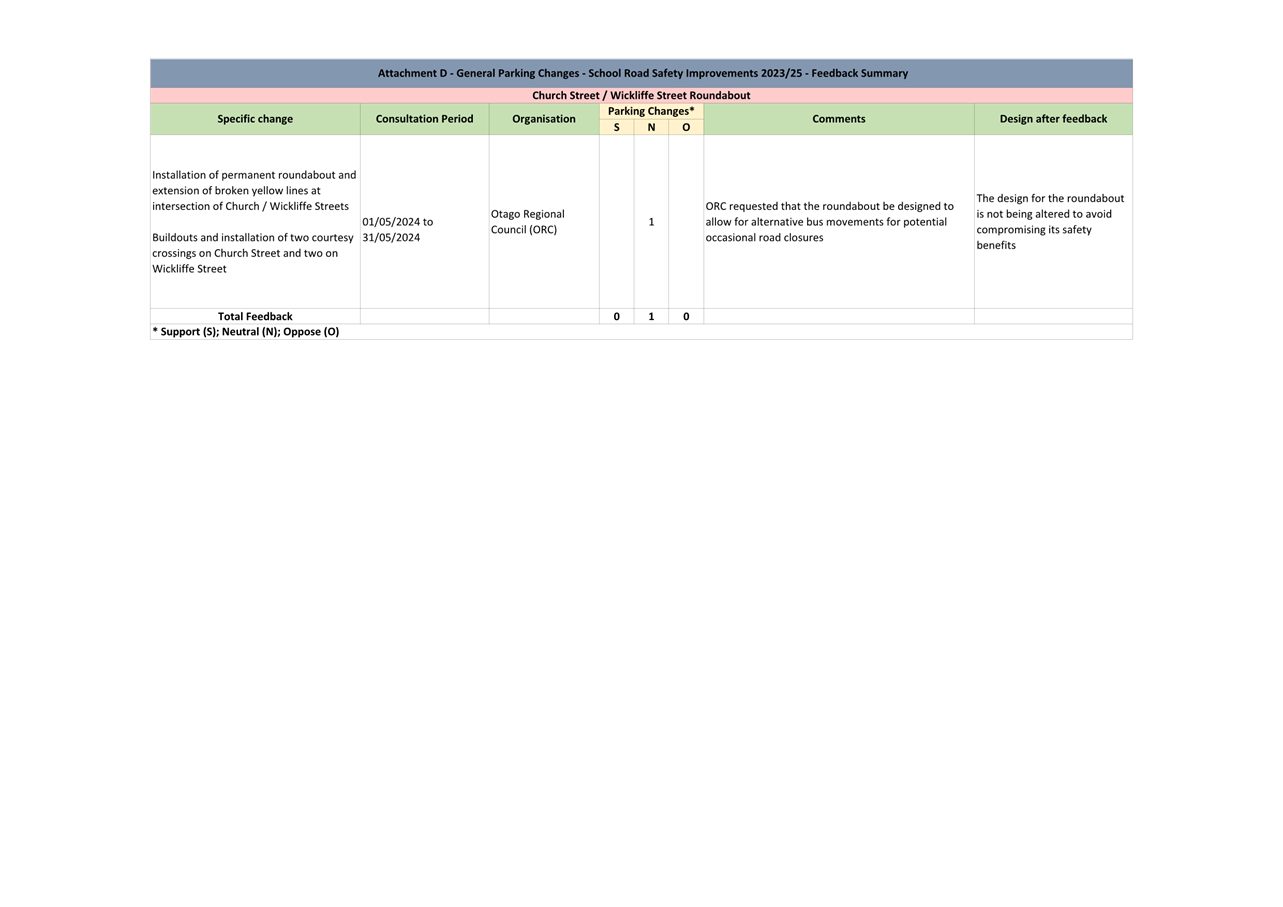
e) Wickcliffe Street and Church Street intersection
roundabout (near Taieri College, Silverstream School and St. Mary’s
School)
20 Detail about
the changes can be found in Attachment B - General Parking Changes and at the
following link:
a)
a) Dunedin
City Council - Safer School Streets
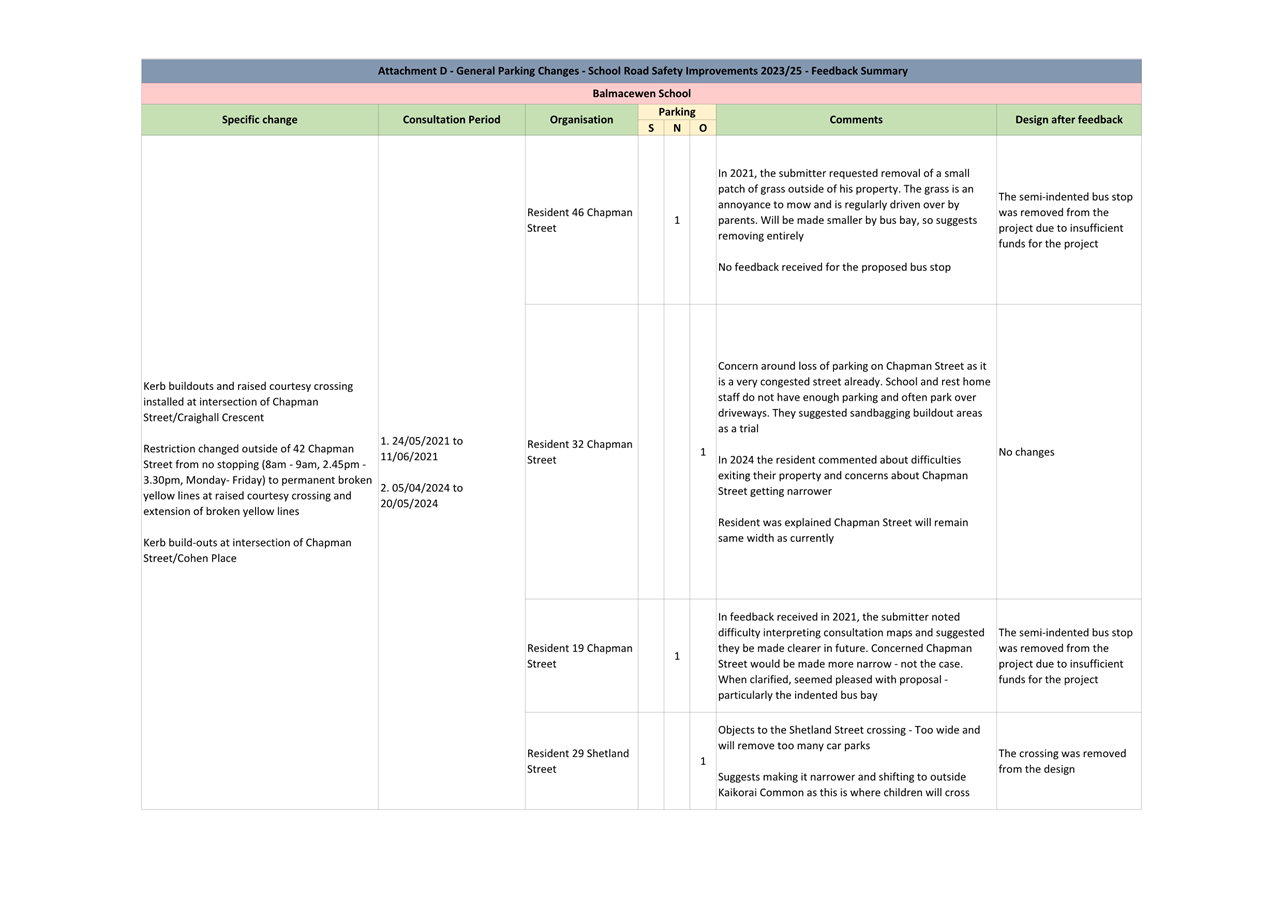
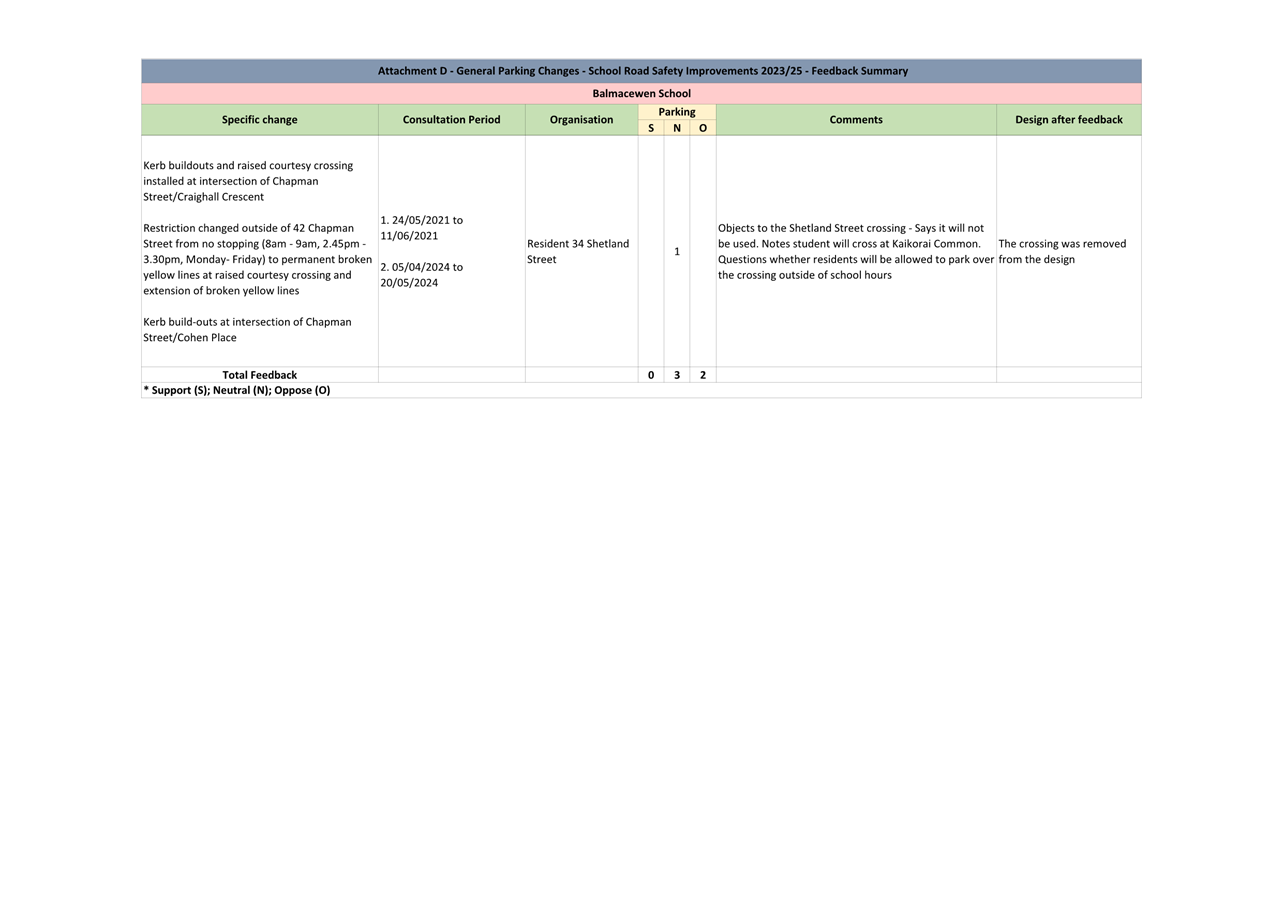
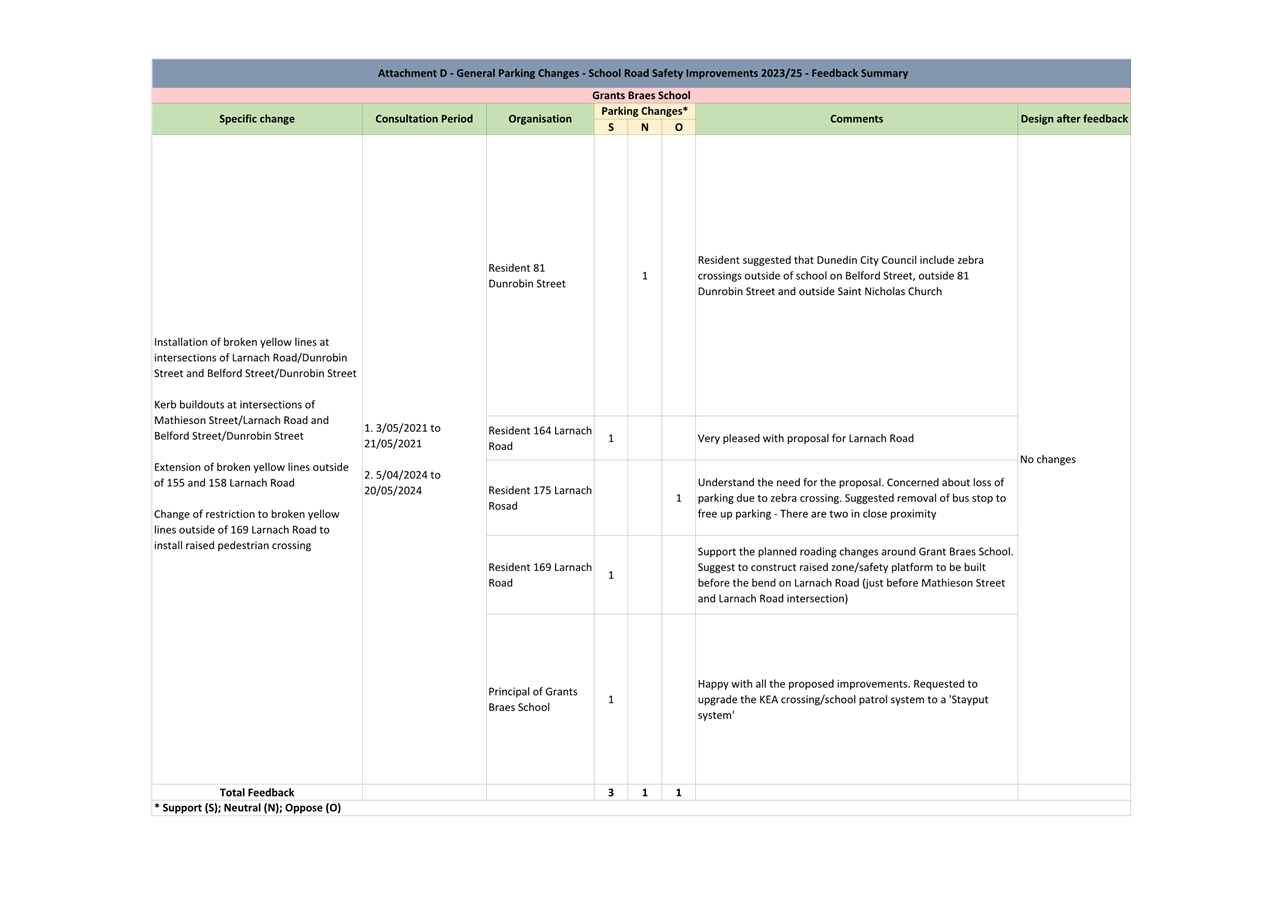
21 The initial
consultation was undertaken in 2021 with the updated designs communicated to
owners, residents, and other stakeholders in 2024. Specific feedback
(additional to that provided in the reports online) is included in Attachment
D.
7
Parking Counts
22 In
total, it is proposed there will be a net loss of 1 restricted and 12 unrestricted
spaces across the city, resulting in a total reduction of 13 car parks. Detail
is provided in Table A – Parking Counts below. Most of the losses relate
to school safety improvements.
23 Changes
to restriction type only (no loss in parking) are also shown in the table
below.
24 Table
A details the parking changes as referenced in the attachments.
8

9
Corrections to the bylaw database
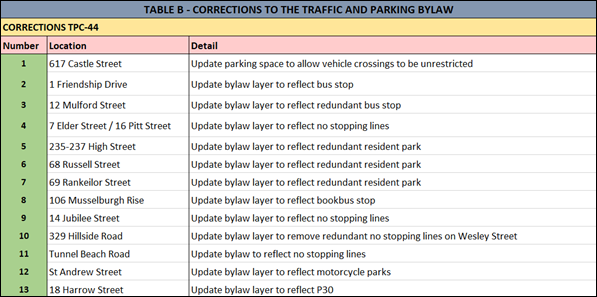
25 Corrections
of parking restrictions are detailed in Table B below. They do not change
current parking restrictions but include corrections to the database that have
been made to accurately reflect the actual parking restrictions.
10
OPTIONS
26 Two
options are proposed. The recommended option (Option One) is to proceed with
some or all of the proposed changes to the GIS database, and Option Two is maintaining
the status quo.
Option One – Recommended Option - Proceed with all of
the proposed changes to the GIS database
27 That
the Committee approves the proposed changes to the traffic and parking controls
database.
Advantages
· Improves safety, efficiency, and access on the transport network by:
a)
- enabling property access by prohibiting obstructive parking, making existing parking
controls clearer, and providing
for access to new driveways
b)
- providing an improved
and enforceable framework
of parking restrictions
c)
- providing appropriate length of parking stay according to the surrounding
land uses
d)
- increasing visibility at intersections.
· Contributes to
achieving an integrated, affordable responsive, effective and safe transport
network.
Disadvantages
· There are no disadvantages.
Option Two – Maintaining the Status Quo
28 Status Quo
– do not change parking restrictions.
Advantages
·
There are no advantages.
Disadvantages
· Does not improve efficiency and access to the transport network.
· Does not improve safety or reduce conflict points.
· Does not contribute to the Integrated Transport Strategy goals.
NEXT STEPS
11
29 If the
Committee adopts the recommended changes to parking restrictions, these will be
implemented through appropriate signs and road markings and restrictions will
be enforced under the Traffic and Parking Bylaw.
Signatories
|
Author:
|
Paula Barragan - Senior Transport Planner
Sacha Hatton - Transport Regulation Co-ordinator
Daniel Fitzpatrick - Graduate Engineer/Planner
|
|
Authoriser:
|
Jeanine Benson - Group Manager Transport
Scott MacLean - General Manager, Climate and City Growth
|
Attachments
|
|
Title
|
Page
|
|
⇩a
|
Attachment A - Minutes
of Hearings Committee Meeting 10 July 2024
|
55
|
|
⇩b
|
Attachment B - General
Parking Changes
|
57
|
|
⇩c
|
Attachment C - General
Parking Changes – Feedback Summary
|
64
|
|
⇩d
|
Attachment D –
General Parking Changes - School Road Safety Improvements 2023-25 Feedback
Summary
|
65
|
|
SUMMARY OF CONSIDERATIONS
|
|
Fit with purpose of Local Government
This decision enables democratic local
decision making and action by, and on behalf of communities.
This decision promotes the social well-being
of communities in the present and for the future.
|
|
Fit with strategic framework
|
|
Contributes
|
Detracts
|
Not applicable
|
|
Social Wellbeing Strategy
|
✔
|
☐
|
☐
|
|
Economic Development Strategy
|
✔
|
☐
|
☐
|
|
Environment Strategy
|
☐
|
☐
|
✔
|
|
Arts and Culture Strategy
|
☐
|
☐
|
✔
|
|
3 Waters Strategy
|
☐
|
☐
|
✔
|
|
Future Development Strategy
|
☐
|
☐
|
✔
|
|
Integrated Transport Strategy
|
✔
|
☐
|
☐
|
|
Parks and Recreation Strategy
|
☐
|
☐
|
✔
|
|
Other strategic projects/policies/plans
|
✔
|
☐
|
☐
|
Improvements to traffic and parking restrictions supports
a safe, efficient, and accessible transport network, and supports the social
and economic wellbeing of Dunedin communities.
|
|
Māori Impact Statement
Mana
whenua have expressed support for a safe and efficient transport network.
|
|
Sustainability
Parking
control changes improve efficiency and access to the transport network, which
contribute to sustainability goals.
|
|
LTP/Annual Plan / Financial Strategy /Infrastructure
Strategy
There
are no implications.
|
|
Financial considerations
Costs
for implementing the proposed changes are covered by existing budgets.
|
|
Significance
The
report is considered of low significance in terms of the Council’s
Significance and Engagement Policy.
|
|
Engagement – external
There has been engagement with
affected parties, including
residents, landowners, and business owners adjacent to changes.
|
|
Engagement - internal
There has been engagement with Transport and
Parks and Recreation
|
|
Risks: Legal / Health and Safety etc.
Many of the proposed changes aim to
improve safety of vulnerable users of the transport network.
|
|
Conflict of Interest
There are no known conflicts of interest.
|
|
Community Boards
There are no implications for Community Boards as part of
this report.
|
|

|
Infrastructure Services Committee
19 August 2024
|
|

|
Infrastructure Services Committee
19 August 2024
|
|

|
Infrastructure Services Committee
19 August 2024
|
|
|
Infrastructure Services Committee
19 August 2024
|
|

|
Infrastructure Services Committee
19 August 2024
|
Transport Activity Report for the Period Ending 30 June
2024
Department: Transport
EXECUTIVE SUMMARY
1 The
purpose of this report is to provide an update on Transport activities for the
period ending 30 June 2024.
RECOMMENDATIONS
That the Committee:
a) Notes the Transport
activity report for the period ending 30 June 2024.
BACKGROUND
2 The
Transport activity report covers planning, construction, maintenance, and
upgrading of Dunedin’s roads and footpaths.
3 The
Transport activity includes:
· Maintenance
of Transport corridors (footpaths, roads, cycleways), streetlights and traffic
signals.
· Renewals
of footpaths, roads, bridges, seawalls and traffic signals.
· Road
safety education.
· Planning
for major capital projects.
· Regulation
(not enforcement) of parking, and speed limits.
· Asset
Management of transport related assets.
· Managing
and obtaining co-funding from Waka Kotahi NZTA.
DISCUSSION
Customer service
4 The
current Level of Service measure for responding to service requests within 5
days is 90%. Response times are currently sitting at 91%. This is an
improvement on last year.
Kettle Park Protection Project
5 Work
continues to protect the dunes of Kettle Park from erosion.
6 Approximately
500 metres of geo-bags are being placed at the foot of the dunes at Kettle Park
to create a protective wall in front of the landfill.
7 Work
commenced on site in April 2024, and is expected to be completed by the end of
August 2024. The structure has been designed to meet the lowest beach levels
surveyed following previous storm events.
8 Cost
savings may be realised in this project due to the prevalence of north-easterly
winds over recent months contributing to a large volume of sand accumulating
along the beach. There has been no need to import sand to fill the geo-bags.
9 Maintenance
of the geo-bags is ongoing as the Coastal Team regularly assess weather
patterns and undertake inspections when required as a result of high-water
levels during periods of elevated wave action and tides.
10 Public
access is maintained during this period of work.
Three Mile
Hill – Speed Counts
11 Speed
count surveys are undertaken at specific locations across the network in
response to concerns about the speeds vehicles are travelling in these areas.
These areas can be characterised by having a high accident rate, where Police
are concerned about driver behaviour, or where obtaining the average speed is
useful data for forward planning.
12 A speed
count was completed at Three Mile Hill this reporting period.
13 The
illustration below indicates where the speed counts were taken on 3 Mile Hill.
14 The tables
below illustrate the results including the speeds for vehicles travelling in
both directions.
15 2.5% of
vehicles were travelling over 50km/h at Count site 2, and 64.7% of vehicles
were travelling over 50km/h at Count site 1.
16 At Count
site 1, 28.6% of vehicles were travelling over 55km/hr within a short distance
entering or exiting a corner with an advisory speed of 45km/hr.
17 Results
from speed surveys can be shared with the Police and are useful in determining
where further advisory signs might be required to bring attention to drivers to
slow down.
Renewals programme
18 250m of
kerb and channel renewals on Wharf High Streets and 8,600m2 of
footpath renewals in Mornington and Green Island were completed this reporting
period.
Shaping
Future Dunedin Transport
19 Work
continued during this period with Waka Kotahi NZTA on refinement of the SH88/St
Andrew Street project which responds to the need to change how SH88/St Andrew
Street functions given the location of the new Dunedin hospital.
Dunedin urban cycleways
20 Planning
has started for the construction of the section of the Tunnels Trail between
Gladstone and Chain Hills Tunnel. Discussions with landowners associated
with the Tunnels Trail are continuing.
OPTIONS
21 As this is
an update report there are no options.
NEXT STEPS
22 Staff are
reviewing the upcoming renewals programmes. Included in this work is the
identification of opportunities to improve network accessibility and safety.
23 Staff will
continue to work with the Trust to deliver part of the Tunnels Trail in
2024/24.
24 Staff will
continue preparing procurement documents as part of the on-road Licence Plate
Recognition and parking wayfinding projects.
25 Staff will
continue to maintain Kettle Park geobags, assessing weather patterns and
undertaking inspections as required.
Signatories
|
Author:
|
Ashleigh Jarvis - Business Performance Co-ordinator
Simon Smith - Asset and Funding Manager
|
|
Authoriser:
|
Jeanine Benson - Group Manager Transport
Scott MacLean - General Manager, Climate and City Growth
|
Attachments
There are no attachments
for this report.
|
SUMMARY OF CONSIDERATIONS
|
|
Fit with purpose of Local Government
This report promotes the social, economic
and environmental wellbeing of communities in the present and for the future.
|
|
Fit with strategic framework
|
|
Contributes
|
Detracts
|
Not applicable
|
|
Social Wellbeing Strategy
|
✔
|
☐
|
☐
|
|
Economic Development Strategy
|
☐
|
☐
|
☐
|
|
Environment Strategy
|
✔
|
☐
|
☐
|
|
Arts and Culture Strategy
|
☐
|
☐
|
☐
|
|
3 Waters Strategy
|
☐
|
☐
|
☐
|
|
Spatial Plan
|
☐
|
☐
|
☐
|
|
Integrated Transport Strategy
|
✔
|
☐
|
☐
|
|
Parks and Recreation Strategy
|
☐
|
☐
|
☐
|
|
Other strategic projects/policies/plans
|
✔
|
☐
|
☐
|
The Transport activity supports the outcomes of a number
of strategies.
|
|
Māori Impact Statement
Mana whenua will continue to be involved in various
Transport projects.
|
|
Sustainability
The Transport activity is included in the 9 Year Plan.
|
|
LTP/Annual Plan / Financial Strategy /Infrastructure
Strategy
This is considered low in terms of the Significance and
Engagement Policy.
|
|
Financial considerations
The updates reported are within existing operating and
capital budgets.
|
|
Significance
The report is considered low in terms of the Significance
and Engagement Policy.
|
|
Engagement – external
As this is an update report no external engagement has
been undertaken.
|
|
Engagement - internal
As this is an update report, no internal engagement has
been undertaken.
|
|
Risks: Legal / Health and Safety etc.
There are no identified risks.
|
|
Conflict of Interest
There are no known conflicts of interest.
|
|
Community Boards
Any specific issues are discussed with the appropriate
Community Board.
|
|
|
Infrastructure Services Committee
19 August 2024
|
Waste and Environmental Solutions Activity Report for the
period ending 30 June 2024
Department: Waste and Environmental Solutions
EXECUTIVE SUMMARY
1 The
purpose of this report is to provide an update on Waste and Environmental
Solutions activities for the period ending 30 June 2024.
RECOMMENDATIONS
That the Committee:
a) Notes the Waste and
Environmental Solutions activity report for the period ending 30 June 2024.
BACKGROUND
2 The
Waste and Environmental Solutions activity provides for effective refuse and
recyclables collection, resource recovery, and refuse disposal in a way that
protects public health and minimises impact on the environment.
3 The
Waste and Environmental Solutions activity includes:
· Planning
and policy functions in line with Part Four of the Waste Minimisation Act 2008:
“Responsibilities of territorial authorities in relation to waste
management and minimisation”
· Administration
of Waste Minimisation Grants: Small Project Grants, Community
Project/Initiative Grant, and Waste Minimisation Innovation and Development
(Commercial) Grant
· Kerbside
collection of waste and recycling for most urban and city residents and small
businesses
· Disposal
Facilities (landfill and transfer station) for waste and a Resource Recovery
Park (recycling and reuse store) are provided at Council’s Green Island
site. The Waikouaiti site has both a transfer station for waste disposal and
recycling facilities. Middlemarch has a transfer station and a community hosted
recycling drop-off centre. Waste collected at the community transfer stations
is then transferred to Green Island Landfill for disposal. Recycling is sent to
the Material Recovery Centre for sorting and transportation to recycling
markets.
· Public
place recycling infrastructure and servicing is provided on the streets in the
CBD and Tertiary Precinct, and several satellite locations in the district.
· Monitoring
the state of the Council’s one proposed, one active, and five closed
landfills in accordance with the conditions of consents.
· Monitoring
the usage, capacity, and condition of public place waste and recycling
infrastructure, CAA cardboard collection services, and kerbside collection
services.
· Education
programmes promoting “rethinking, reducing, reusing, and recycling”
practices.
· Education,
auditing, and enforcement activities aimed at increasing the quality or
quantity of recovered materials.
DISCUSSION
4 Level of
Service – Refuse collection and kerbside recycling meet customer
expectations.
The Residents
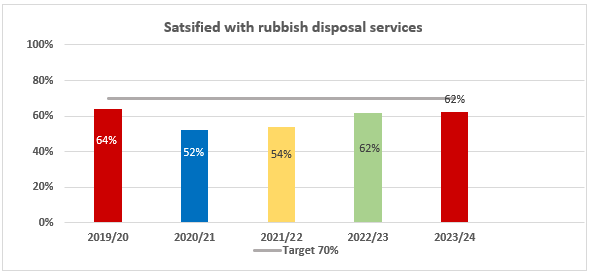
Opinion Survey result for rubbish disposal services in the 2023/24 year was
62.1%, which is similar to the result for 2022/23. Additional kerbside services
for food and garden waste, plus replacement of black plastic rubbish bags with
kerbside bins, were introduced on 1 July 2024. It is expected that once
there has been a settling in period of the new system, resident satisfaction
will improve.
5 Level of
Service – Waste minimisation targets are met.
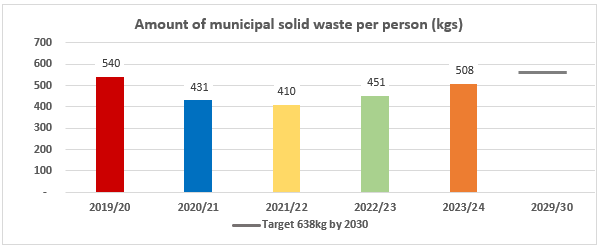
a) The
waste minimisation target for municipal solid waste (being a maximum of 638kg /
per annum by 2030) has been consistently achieved since 2019. The average
for the 23/24 year per person was 508kg.
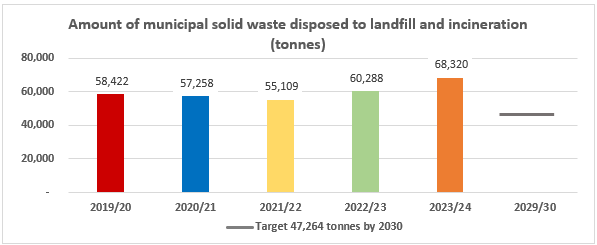
b) The
waste minimisation target for municipal solid waste disposed to landfill and
incineration is not being met. The introduction of new kerbside services for
both food and garden waste on 1 July 2024, plus the future establishment of a
Construction and Demolition sorting facility at the Green Island Resource
Recovery Park, is expected to significantly reduce the solid waste disposed to
landfill.
c) The
waste minimisation target for diversion of recyclable or reusable materials is
not being met. The introduction of new kerbside services for both food and garden
waste, plus the future establishment of a Construction and Demolition sorting
facility at the Green Island Resource Recovery Park, is expected to
significantly increase the diversion of recyclable or reusable materials.
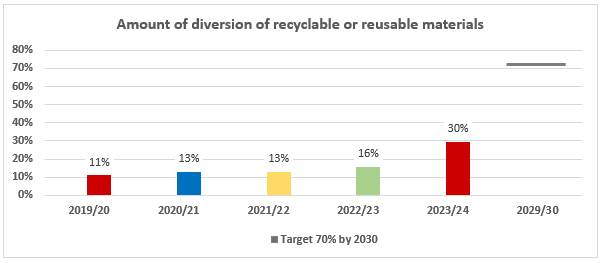
d) The
amount of diverted material has increased from 16% in 2023 to 30% in 2024;
however, this comparison is not reliable as Waste and Environmental Solutions recently
implemented changes to how data is reported to the Ministry for the Environment
under the ‘Waste Minimisation (Information Requirements) Amendment
Regulations 2023’, including changes for volume-to-weight conversion
factors, and the categories for types of waste or diverted materials.
6 Other
areas of work:
a) Review
of Waste Management and Minimisation Plan (WMMP) - The first draft of the
amended WMMP has been completed.
b) A
Councillor workshop was held on the 21st of June 2024 that sought
feedback on the draft Plan. Further workshops are planned which will include
our mana whenua partners.
c) The
draft WMMP 2025 will be consulted on as part of the 9 Year Plan.
d) The
draft Plan is expected to be presented to Council on the 24th of
September to be approved for public consultation. This will be followed by a
Special Consultative Procedure and hearings process, with the final draft being
presented for adoption in mid-2025.
e) Review
of Litter Compliance Policy - The Litter Compliance Policy (2021) has been
reviewed. The new Policy was approved by ISCOM for public notification on 30
July 2024. It will be publicly notified on 10th August 2024, and
presented to Council in September for adoption.
f) Waste
Minimisation Grants - The March 2024 Waste Minimisation Community Grants
closed for applications on 28 March 2024. The grant received seven
applications. The total requested amount was $34,353.38. The outcomes of this
funding round were decided in the May 2024 Grants Sub-Committee Meeting. Five
applicants received a share of $24,164.00. The remaining two applications were
declined (refer to Attachment A).
g) The
Waste Minimisation Small Project Grant applications received one application.
The total requested amount was $315.00. These small grant applications were
approved by the Grants Sub-Committee Chair and noted by the Grants Subcommittee
at the November 2023 meeting (refer Attachment A).
h) Further
to Waste Minimisation contestable grants, the waste levy also annually provides
grants or funds approved under financial delegation to proven programmes for
non-contested Community Service Agreements (at Attachment A).
i) Waste Futures Project – Council resolved to
adopt a new kerbside collection service for inclusion in the 2021-31 10‑Year
Plan on 31 May 2021. Council also allocated funding for the development
of a Resource Recovery Park (RRP) consisting of new waste diversion and
transfer facilities, to be constructed at the Green Island Landfill site.
j) New
kerbside services were introduced on 1 July 2024. This also included a
comprehensive communications campaign and improvements to the customer services
website and smart-phone application. Staff are also working through the
concept design, detailed design, consenting, and procurement required for the
Resource Recovery Park.
k) Construction
of the organic waste receival building began in October 2023 in advance of the
rest of the RRPP and was completed on 17 June 2024. Food and garden waste
collected under the new kerbside collection system, and any green waste dropped
off by the public at Green Island, will be consolidated and shredded within the
enclosed organics building and then loaded onto trucks to be transported for
composting off-site at the Enviro NZ plant in Timaru.
l) A
new composting operation for food and garden waste will be established at Green
Island as part of the wider Resource Recovery Park (RRP) development during
2024/25 – 2025/26. Once the PRP is operational, both organic waste
and mixed recycling collections will be processed at the Green Island
facilities and the transport of material to Timaru will cease.
m) The
consents required for the RRP facilities were notified to affected parties by
the Otago Regional Council on 5 August 2024.
n) During
the first month of the new kerbside collection services over 665 tonnes of food and green waste was collected in
the green-lidded bins. This made up 45% of the total waste collected for the
month of July, with the remaining 55% (822 tonnes) collected in the red-lidded
waste bins. The number of households using the
new food and garden waste collection service every week during the first month
was approximately 50%, and further education campaigns are planned.
Contamination in the green-lidded bins has been very low at <1%.
o) Over the June and July months, the new kerbside collections
smartphone app was downloaded 18,333 times by new users and by those updating
the previous version of the app. The number of active users increased from 4784
in May to 15,439 by the end of July.
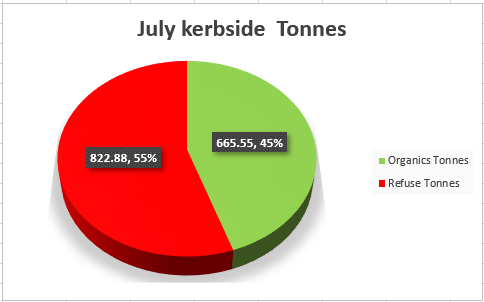
p) Smooth
Hill Landfill - Council consulted on funding for the development of Smooth
Hill as part of the 2021 – 2031 10‑Year Plan. Construction
was initially scheduled to start in the 2024-25 year and be completed in 2027;
however, the conditions of consent for Smooth Hill require at least three years
of baseline environmental monitoring prior to commencement of
construction. Because of this requirement, construction on the new
landfill is expected to start in the 2026-27 year, with projected completion in
2029. The baseline environmental monitoring is currently underway.
q) Green
Island Landfill and Transfer Station Management – The consents for
Green Island Landfill were due to expire in October 2023; however, Smooth Hill
Landfill will not be ready to accept waste until 2029 (contingent on completion
of baseline monitoring, detailed design, management plans, and
construction).
r) Staff
have evaluated several alternative options to ensure the City’s waste
disposal demands can be met. This has led to the selection of an option
which continues the filling of the southwestern area of Green Island landfill
within the existing 38ha footprint and perimeter bund (subject to resource consent). The selected option is expected to extend the
projected life of the landfill to between 2029 – 2031.
OPTIONS
7 As
this is an update report there are no options.
NEXT STEPS
8 Staff
will continue the baseline environmental monitoring as required by the Smooth
Hill resource consents, alongside continued
engagement with the local community via the Smooth Hill Community Liaison Group
and the Independent Peer Review Panel.
9 Staff
will continue the resource consent process for the Green Island landfill and
Resource Recovery Park, alongside the procurement process for development of
the new facilities.
10 Staff will continue developing an amended Waste
Minimisation and Management Plan in preparation for the next Councillor
workshop.
Signatories
|
Author:
|
Chris Henderson - Group Manager Waste and Environmental
Solutions
|
|
Authoriser:
|
Scott MacLean - General Manager, Climate and City Growth
|
Attachments
|
|
Title
|
Page
|
|
⇩a
|
Waste Minimisation
Grants Overview Summary
|
87
|
|
SUMMARY OF CONSIDERATIONS
|
|
Fit with purpose of Local Government
This decision promotes the environmental
well-being of communities in the present and for the future.
|
|
Fit with strategic framework
|
|
Contributes
|
Detracts
|
Not applicable
|
|
Social Wellbeing Strategy
|
✔
|
☐
|
☐
|
|
Economic Development Strategy
|
☐
|
☐
|
✔
|
|
Environment Strategy
|
✔
|
☐
|
☐
|
|
Arts and Culture Strategy
|
☐
|
☐
|
✔
|
|
3 Waters Strategy
|
☐
|
☐
|
✔
|
|
Future Development Strategy
|
☐
|
☐
|
✔
|
|
Integrated Transport Strategy
|
☐
|
☐
|
✔
|
|
Parks and Recreation Strategy
|
☐
|
☐
|
✔
|
|
Other strategic projects/policies/plans
|
✔
|
☐
|
☐
|
The Waste and Environmental Solutions activity supports
the outcomes of a number of strategies.
|
|
Māori Impact Statement
Mana whenua will continue to partner with DCC in key Waste
Futures projects.
|
|
Sustainability
The Waste and Environmental Solutions
activity contributes positively to the environmental interests of the
community through refuse and recycling collection at the kerbside and public
places, educating and promoting environmentally sustainable behaviour and
managing landfill and transfer station facilities.
|
|
LTP/Annual Plan / Financial Strategy /Infrastructure
Strategy
The Waste and Environmental Solutions activity is included
in the Long-Term Plan.
|
|
Financial considerations
The updates reported are within existing operating and capital
budgets.
|
|
Significance
This report is considered low in terms of the Significance
and Engagement Policy.
|
|
Engagement – external
As this is an update report no external engagement has
been undertaken.
|
|
Engagement - internal
As this is an update report no internal engagement has
been undertaken.
|
|
Risks: Legal / Health and Safety etc.
There are no identified risks.
|
|
Conflict of Interest
There are no known conflicts of interest.
|
|
Community Boards
Any specific issues are discussed with the appropriate
Community Board.
|
|
|
Infrastructure Services Committee
19 August 2024
|
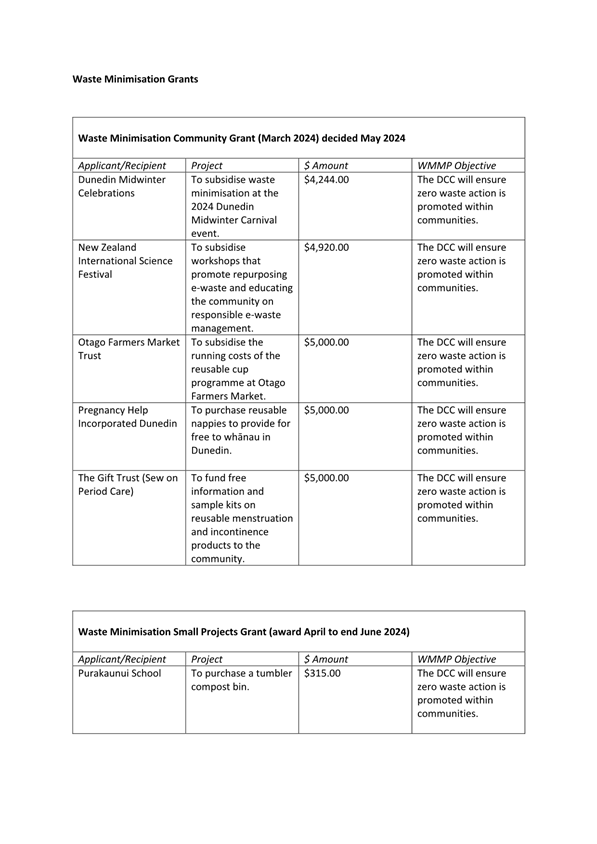
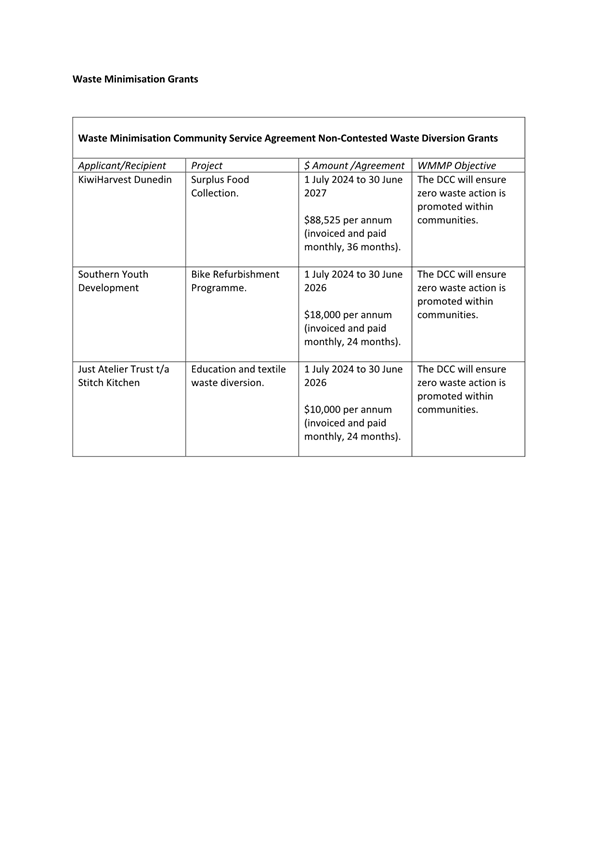
|
|
Infrastructure Services Committee
19 August 2024
|
Items for Consideration by the Chair
Any items for
consideration by the Chair.
Attachments
There are no attachments for this report.