Notice of Meeting:
I hereby give notice that an ordinary meeting of the Audit,
Risk and Assurance Committee will be held on:
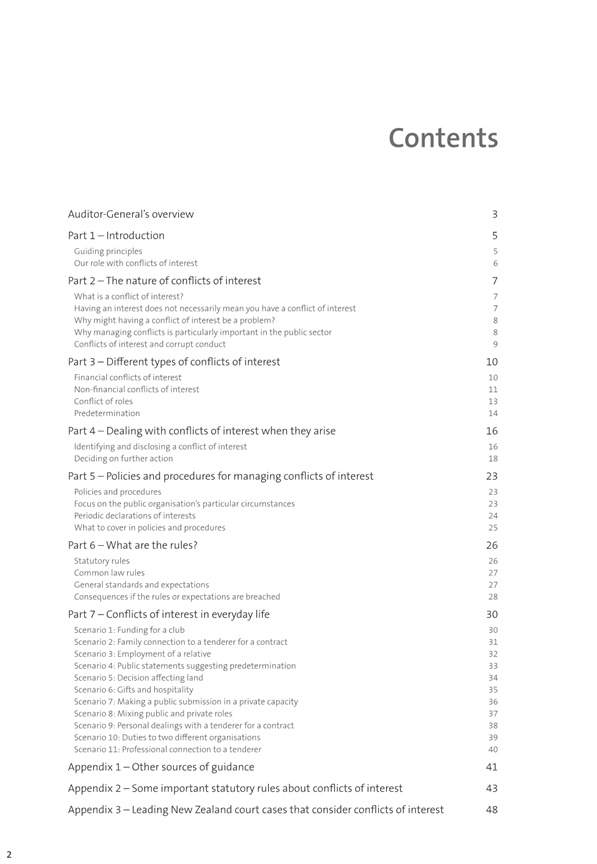
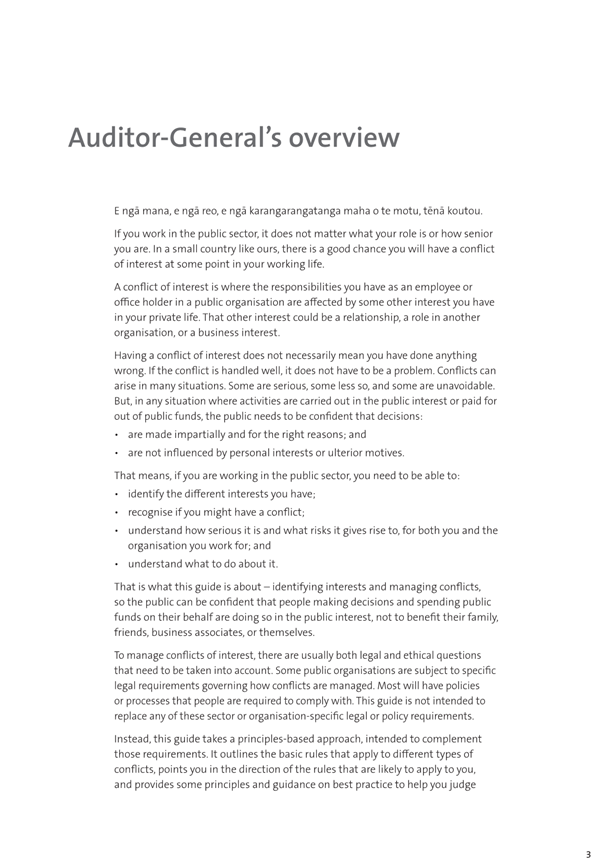
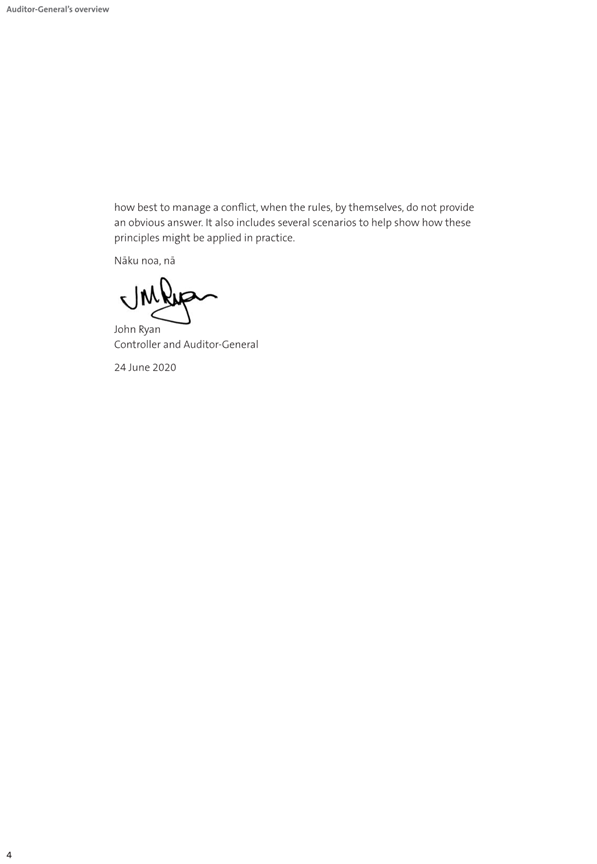
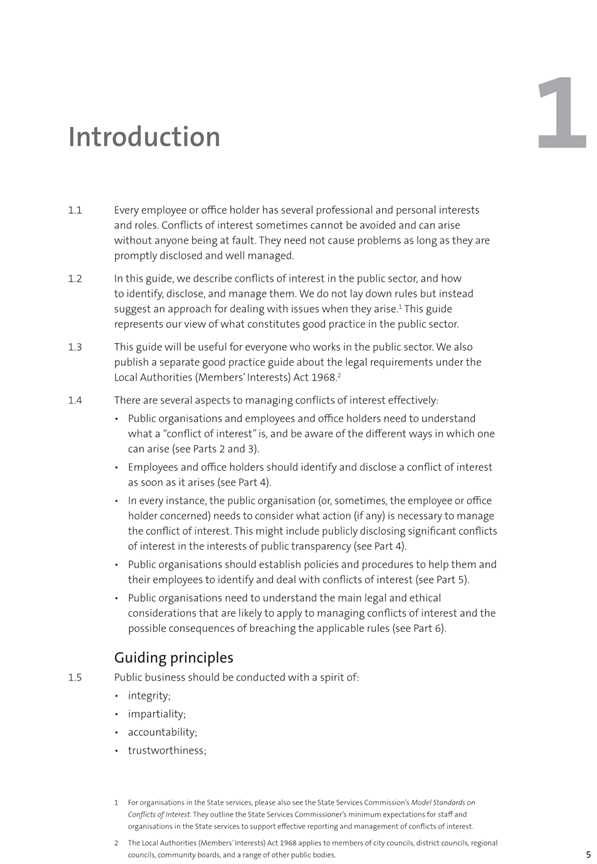
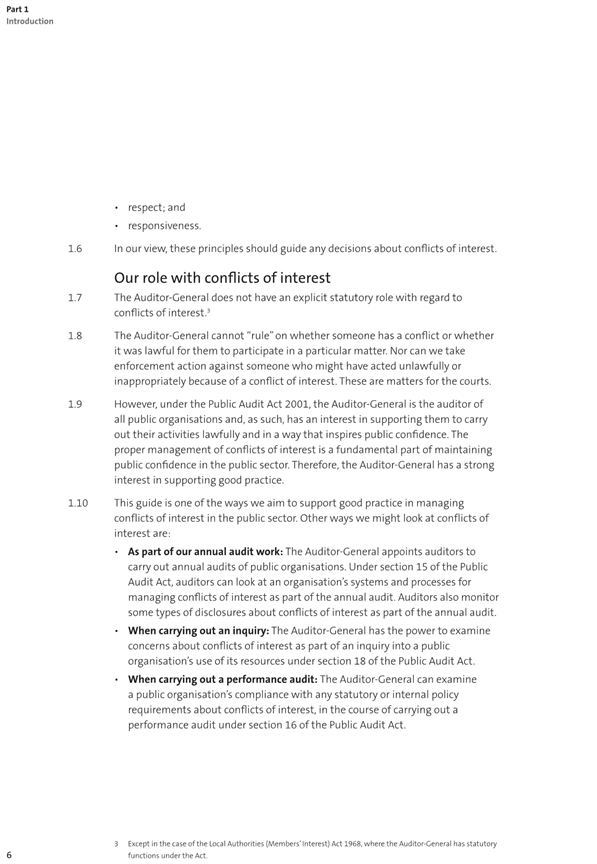
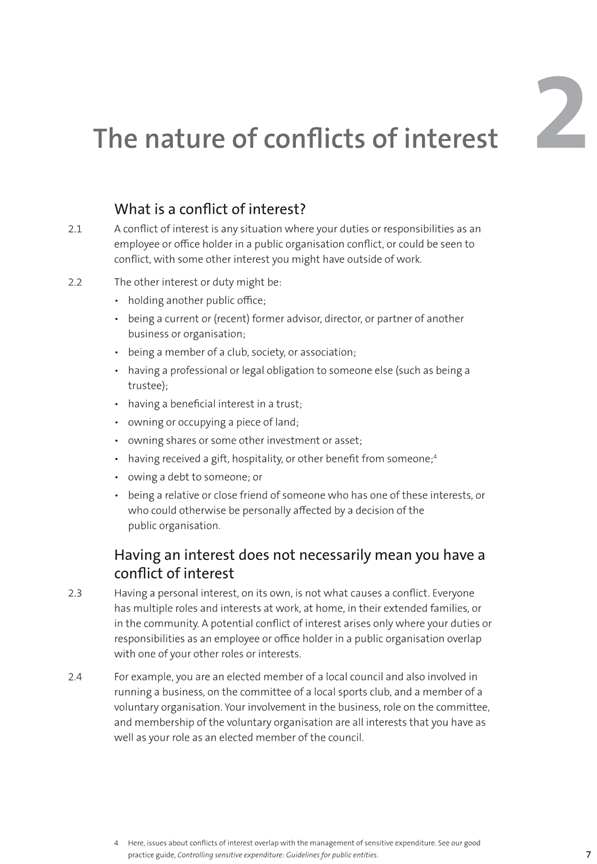
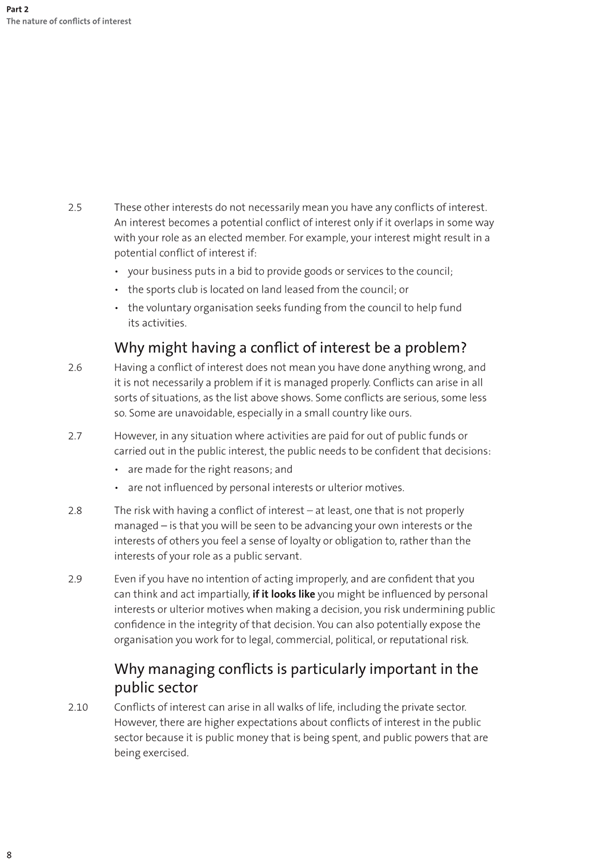
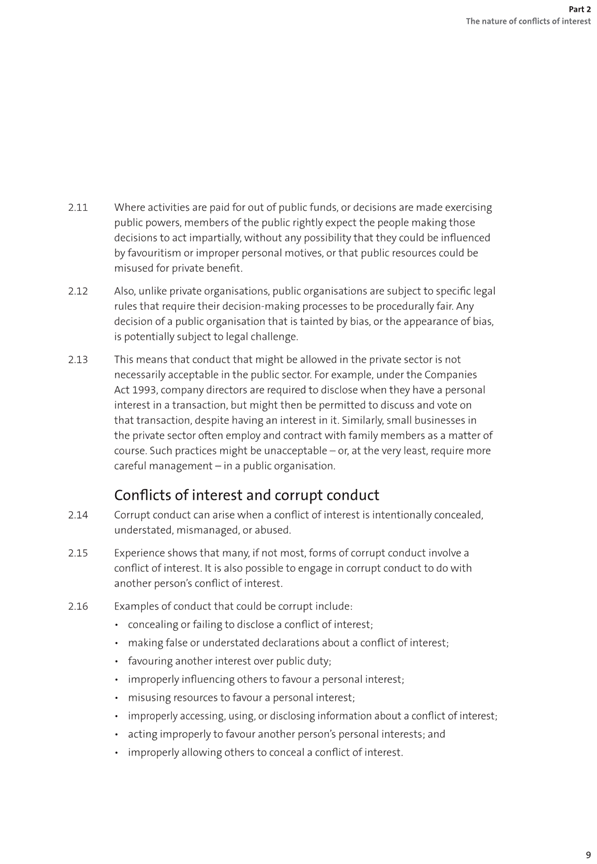
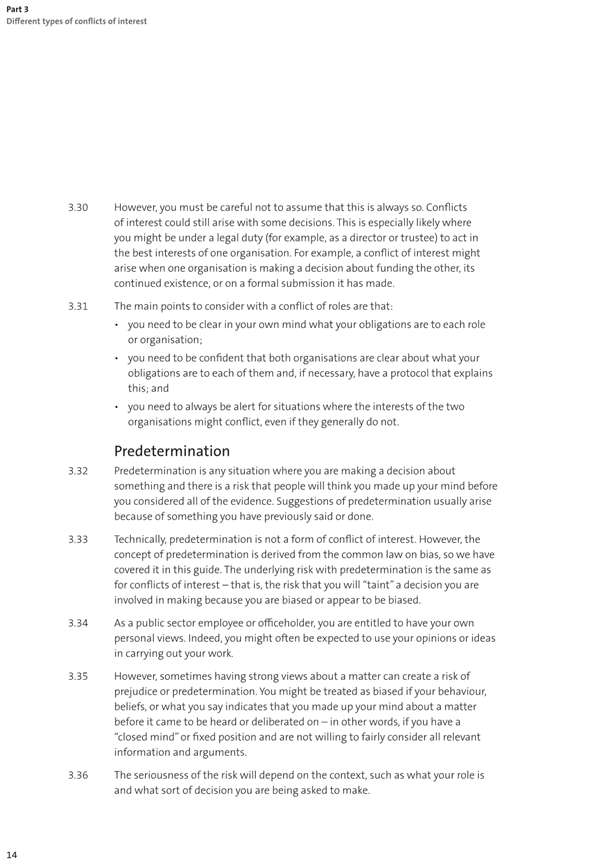
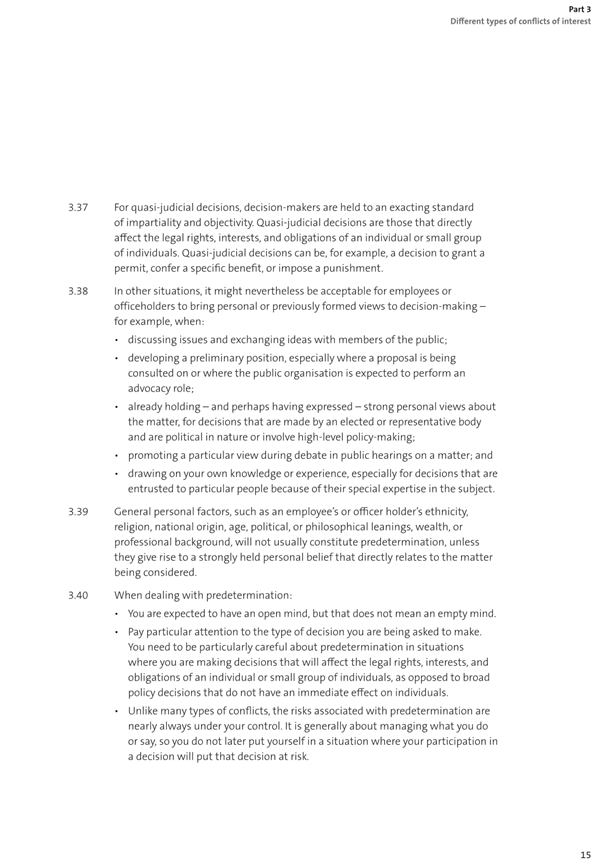
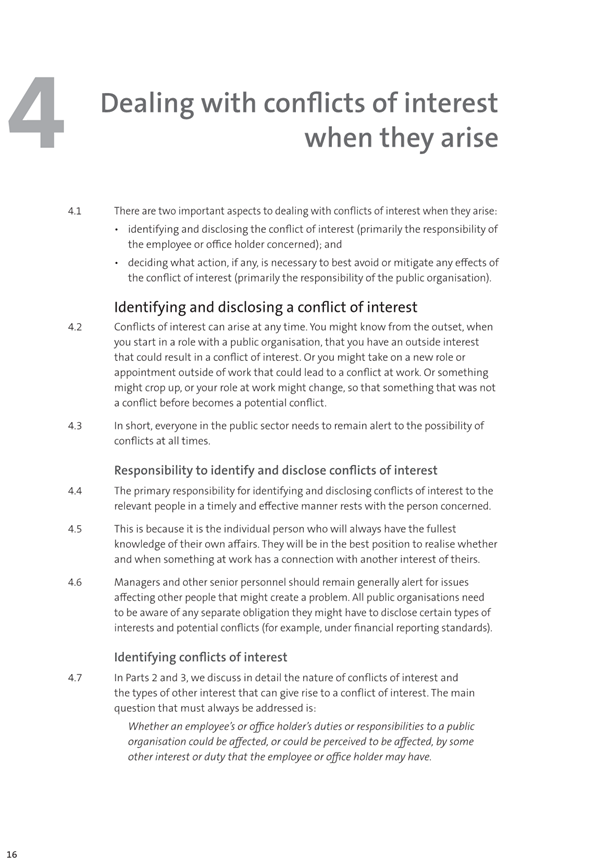
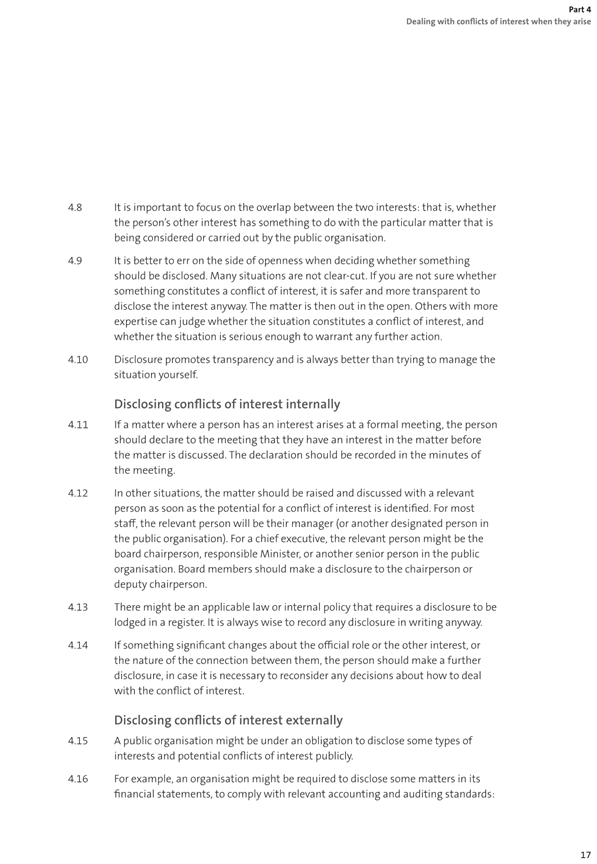
Date: Thursday
4 December 2025
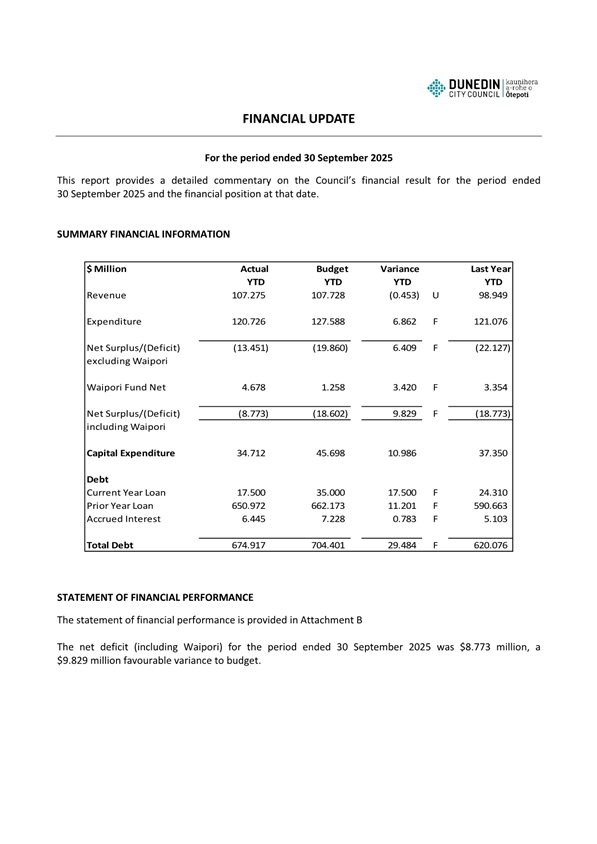
Time: 11.30
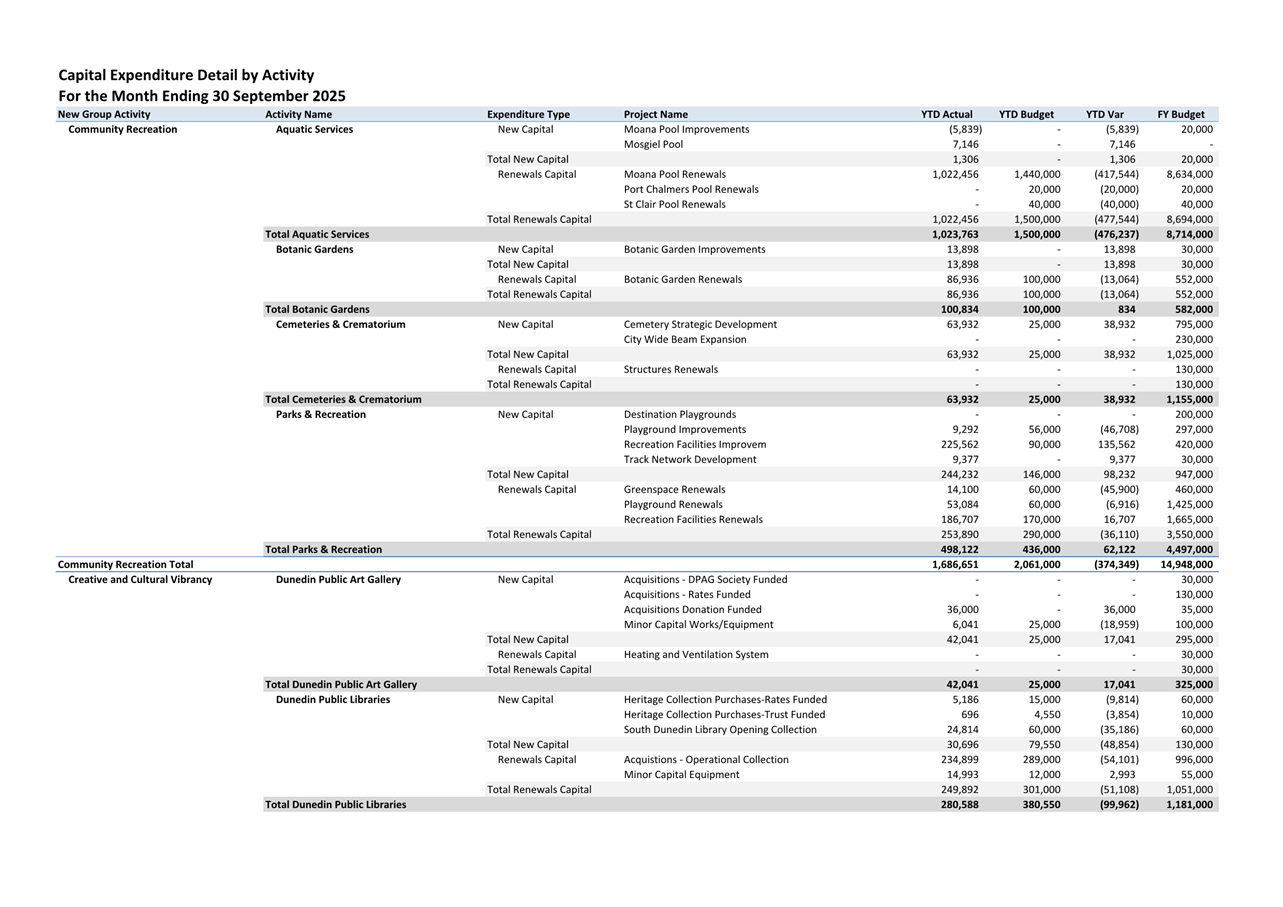
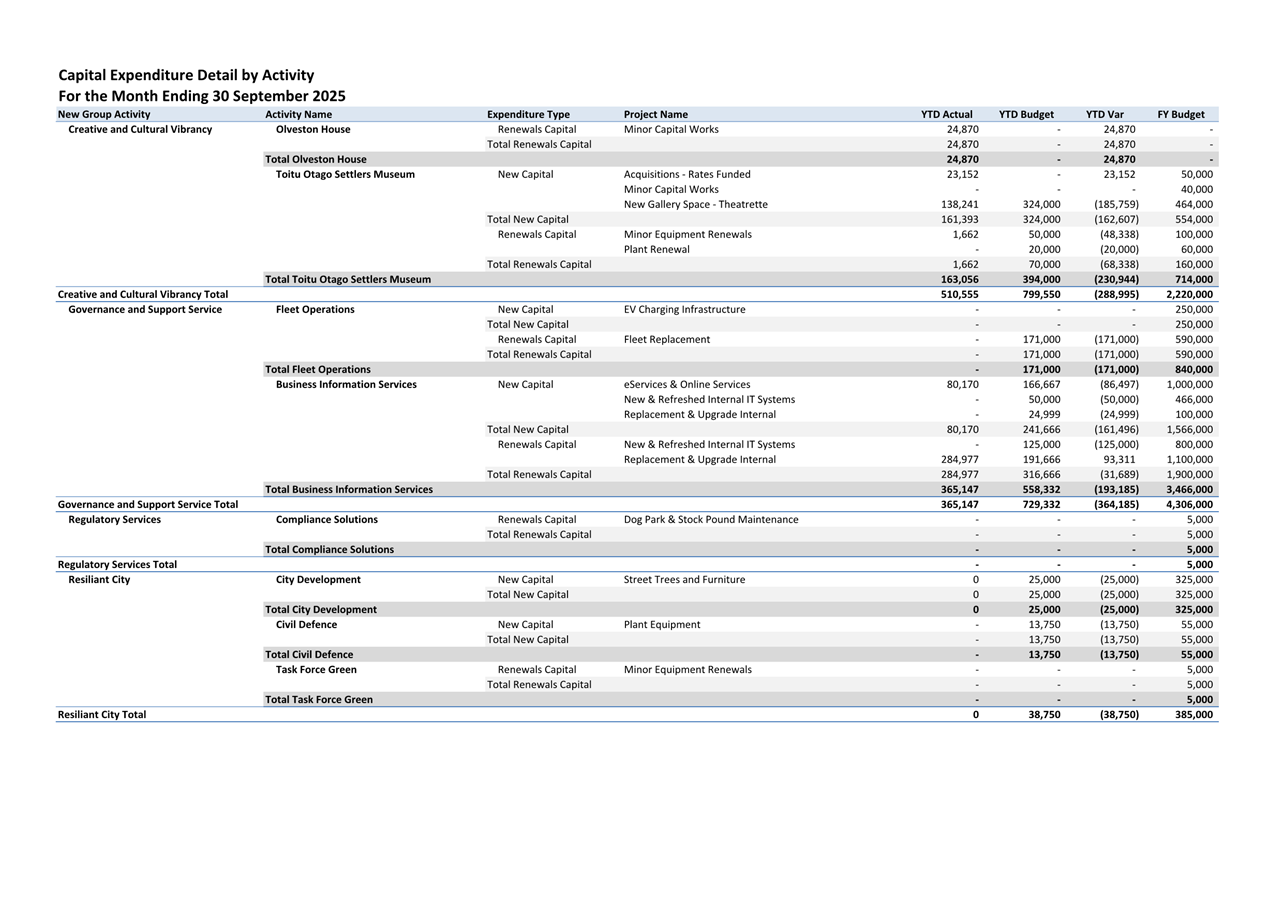
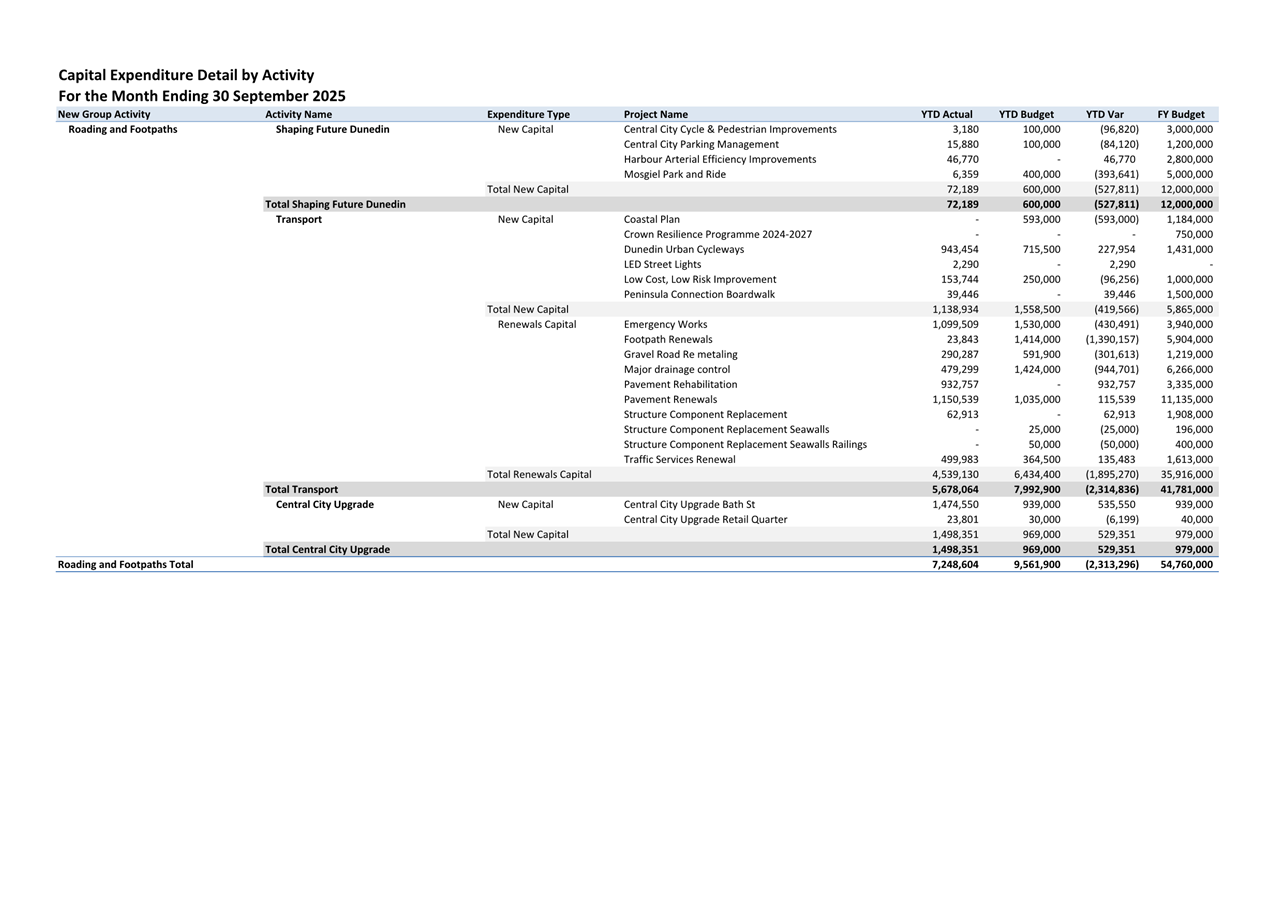
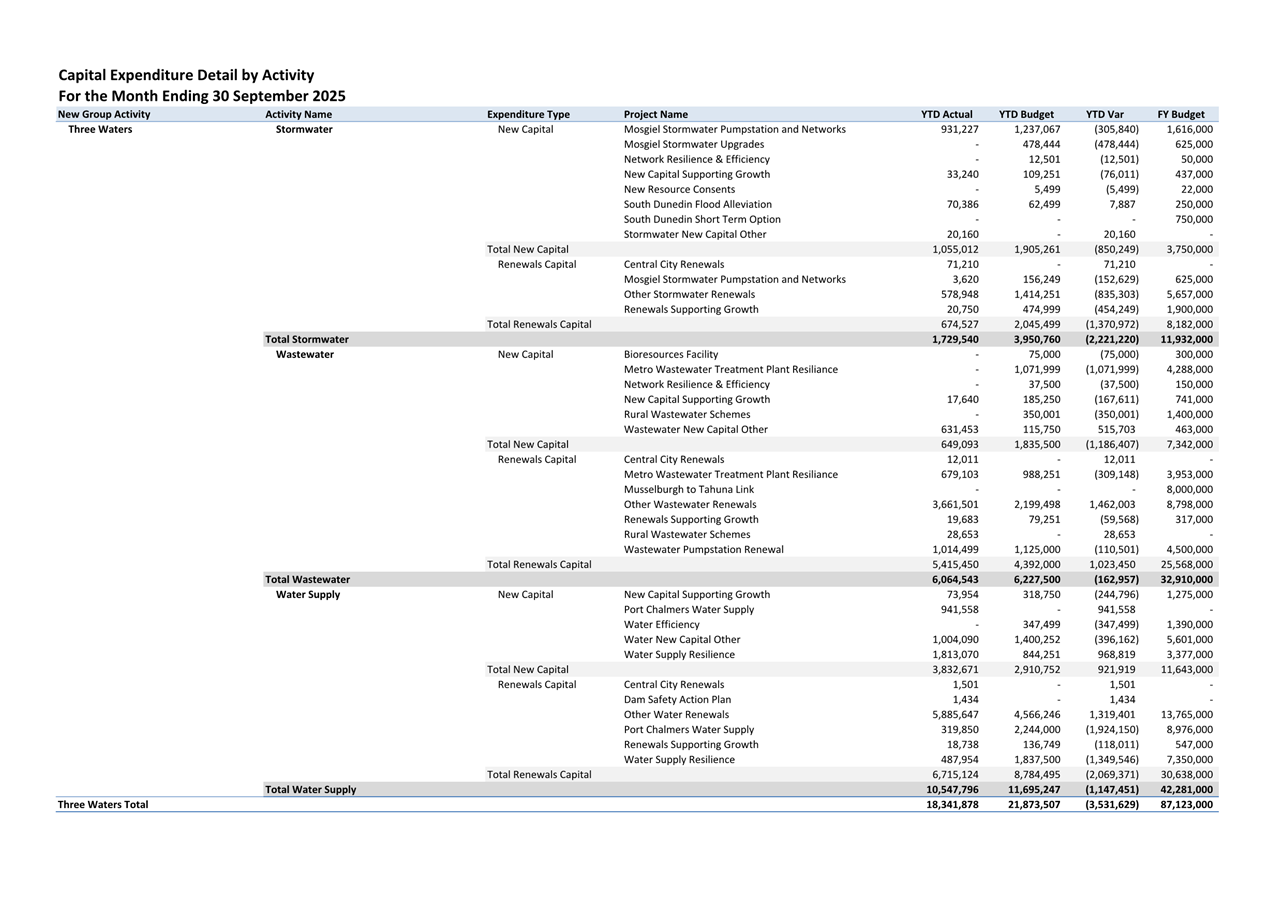
am
Venue: Council
Chamber, Dunedin Public Art Gallery, The Octagon, Dunedin
Sandy Graham
Audit, Risk and Assurance Committee
PUBLIC AGENDA
|
Chairperson
|
Warren Allen
|
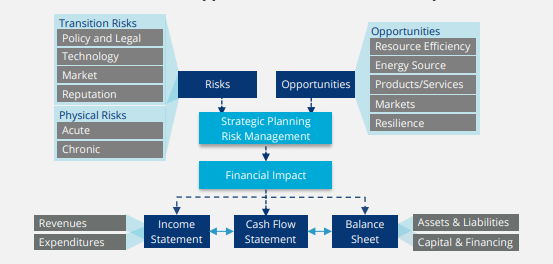
|
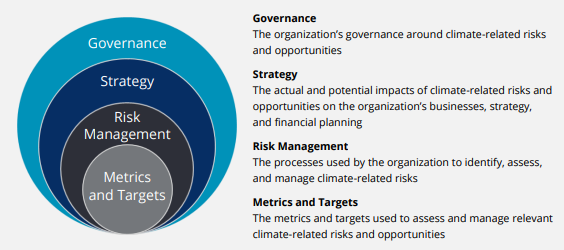
|
Deputy Chairperson
|
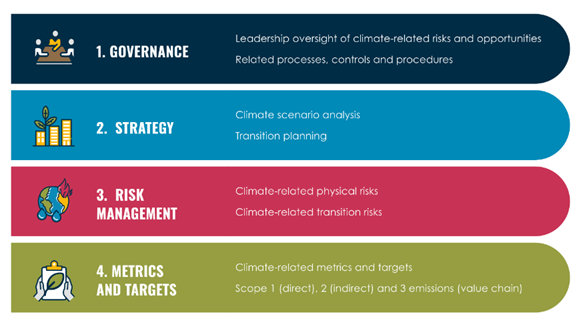
Janet Copeland
|
|
|
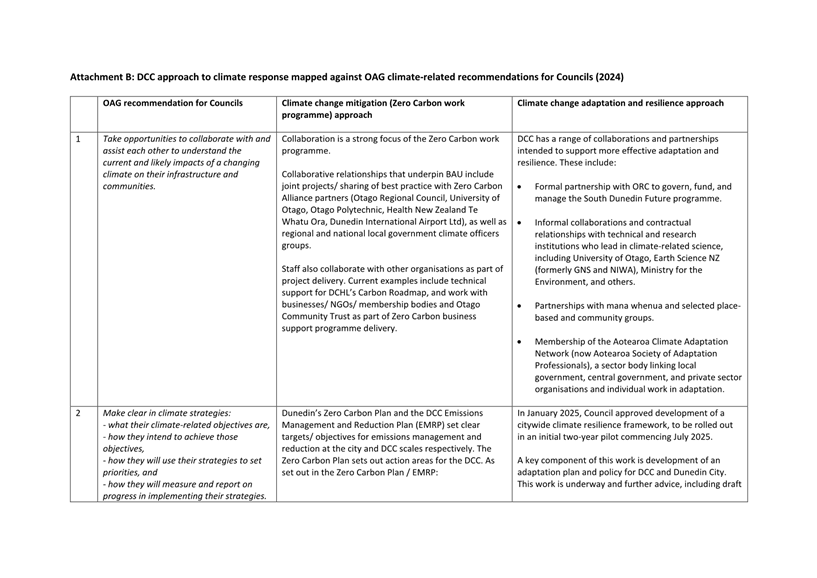
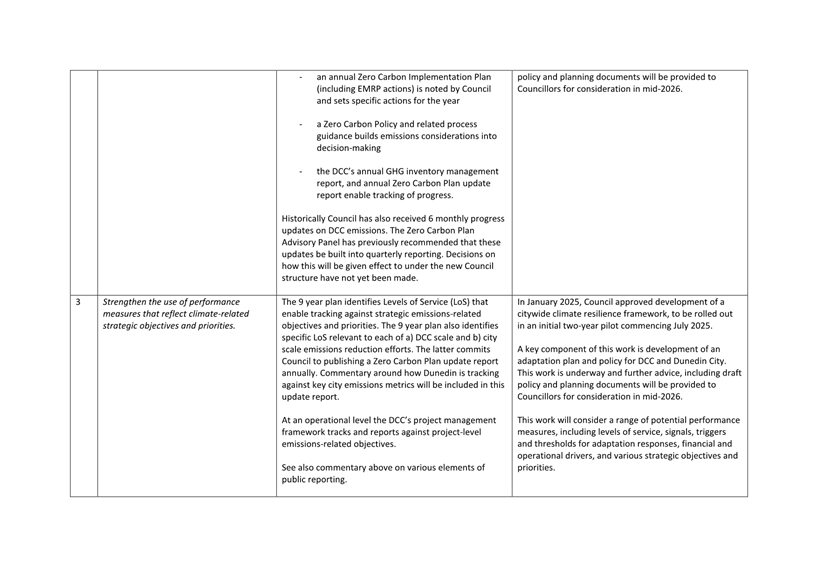
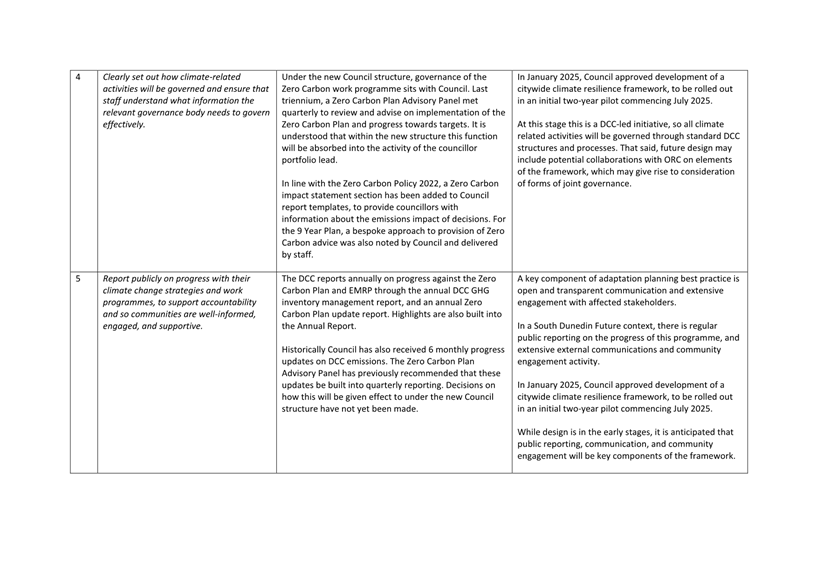
Members
|
Mayor Sophie Barker
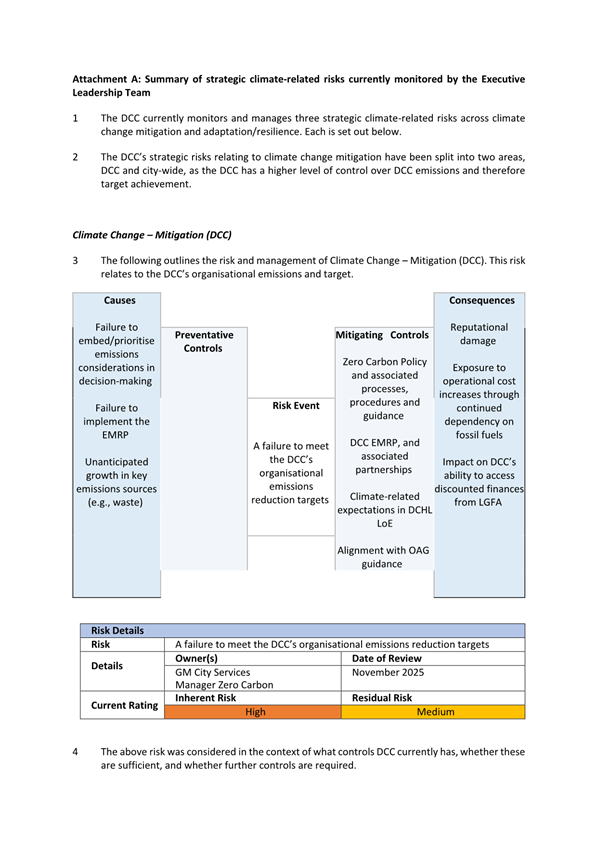
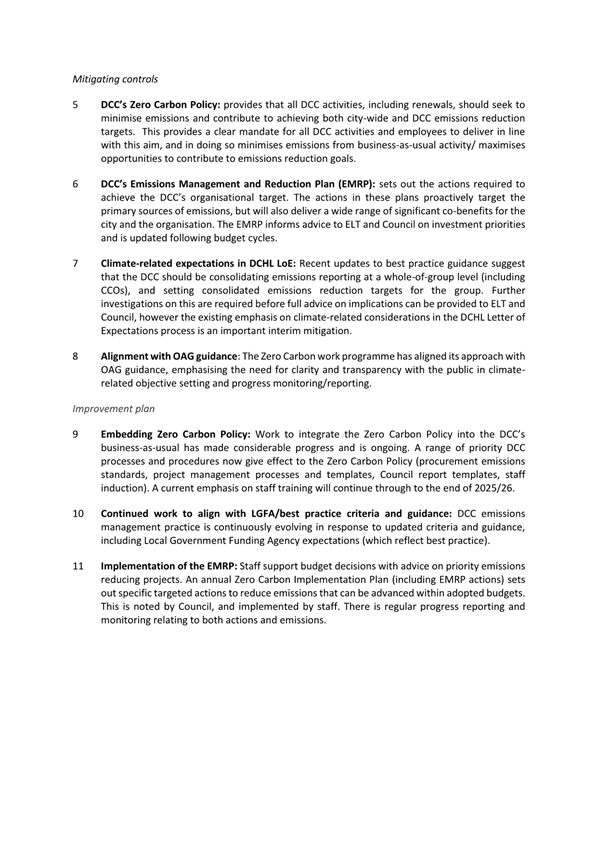
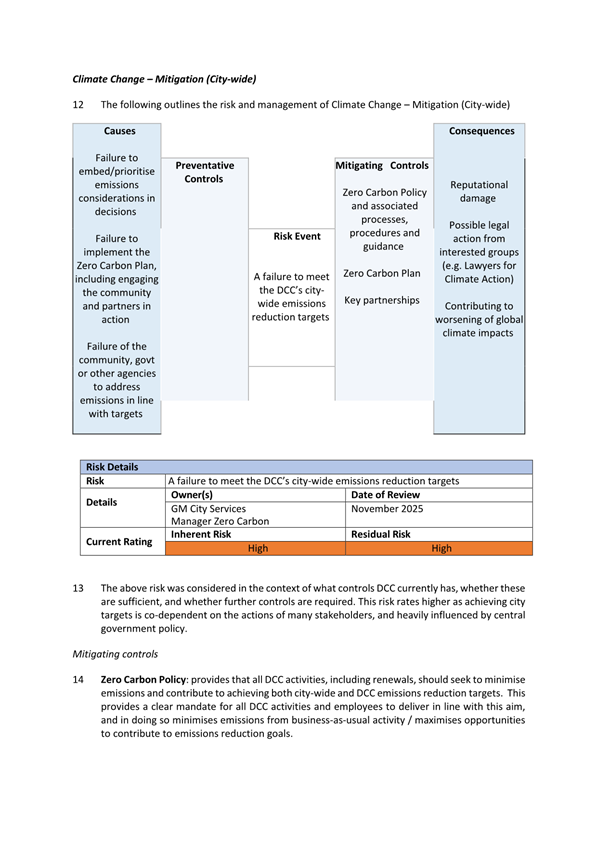
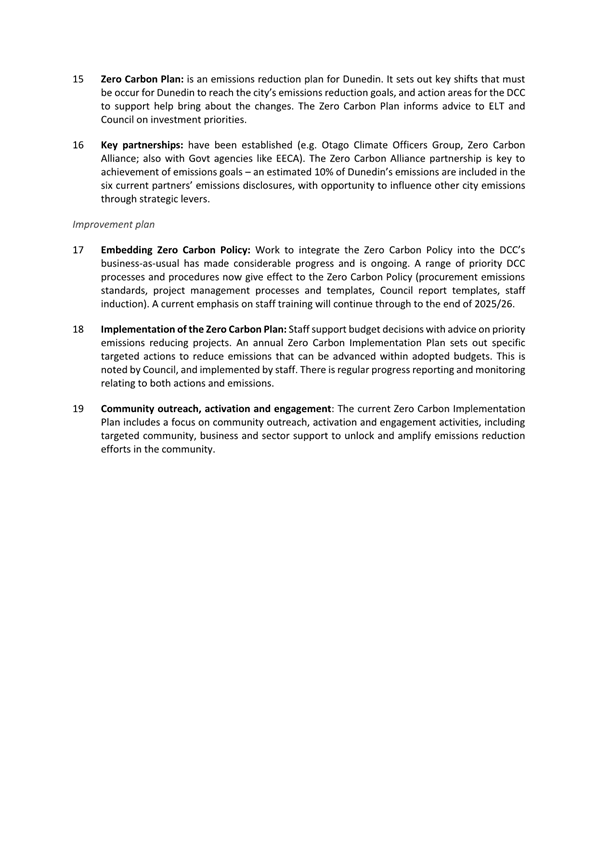
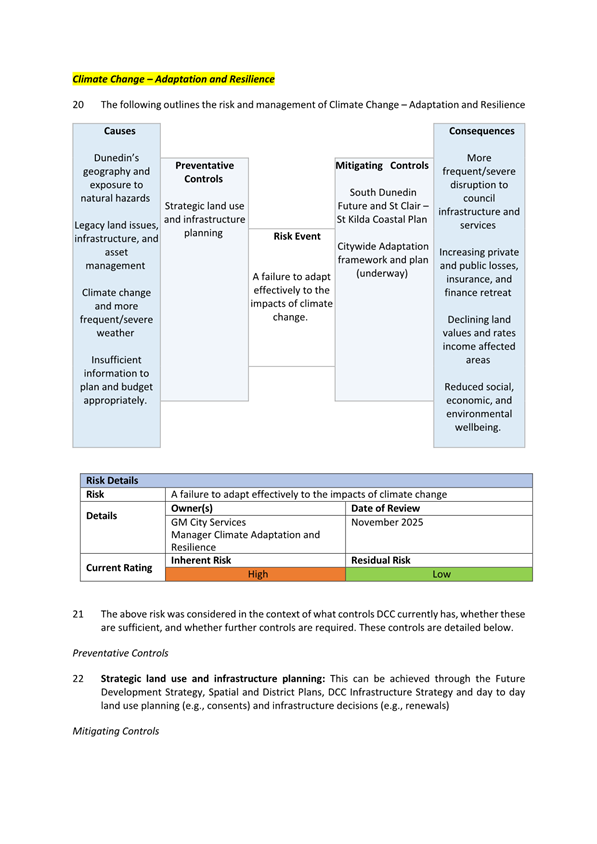
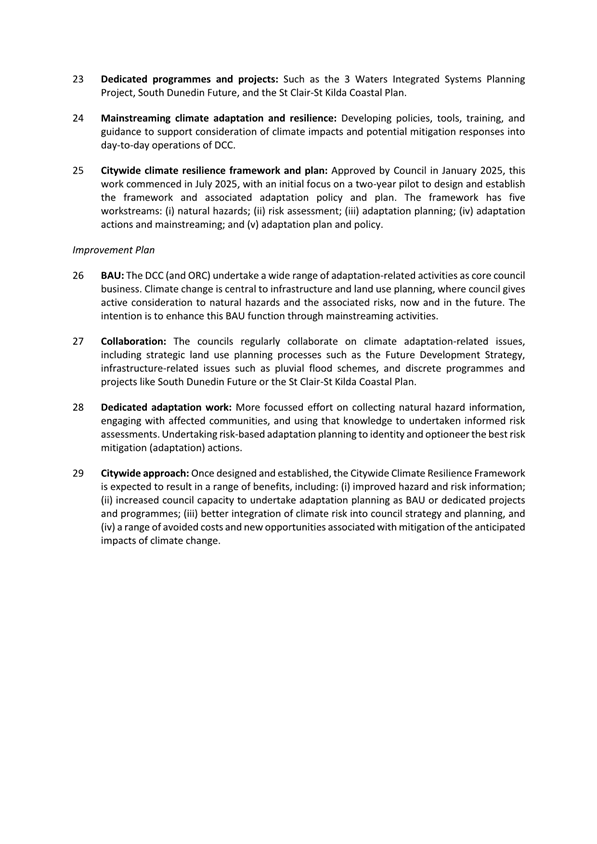
|
Cr John Chambers
|
|
|
Cr Cherry Lucas
|
Cr Andrew Simms
|
|
|
Cr Lee Vandervis
|
|
Senior Officer Carolyn
Allan, Chief Financial Officer
Governance Support Officer Wendy
Collard
Wendy Collard
Governance Support Officer
Telephone: 03 477 4000
Wendy.Collard@dcc.govt.nz
www.dunedin.govt.nz
Note: Reports
and recommendations contained in this agenda are not to be considered as
Council policy until adopted.
|

|
Audit, Risk and Assurance
Committee
4 December 2025
|
ITEM TABLE OF CONTENTS PAGE
1 Apologies 4
2 Confirmation
of Agenda 4
3 Declaration
of Interest 5
Part
A Reports (Committee has power to decide these matters)
4 Delegations
for the Audit, Risk and Assurance Committee 11
5 Audit,
Risk and Assurance Committee Work Plan 2025-26 14
6 Audit,
Risk and Assurance Committee Updates Report - December 2025 17
7 Health,
Safety and Wellbeing Monthly report for September and October 2025 22
8 Waipori
Fund - Quarter ending 30 September 2025 45
9 Climate-related
risk management 50
10 Financial
Report - Period ended 30 September 2025 70
11 Financial
Strategy Compliance - November 2025 95
12 Elected
Member Gifts and Hospitality - Guidance 104
Resolution to Exclude the Public 160
|

|
Audit, Risk and Assurance
Committee
4 December 2025
|
1 Apologies
At the close of the agenda no
apologies had been received.
2 Confirmation
of agenda
Note:
Any additions must be approved by resolution with an explanation as to why they
cannot be delayed until a future meeting.
|

|
Audit, Risk and Assurance Committee
4 December 2025
|
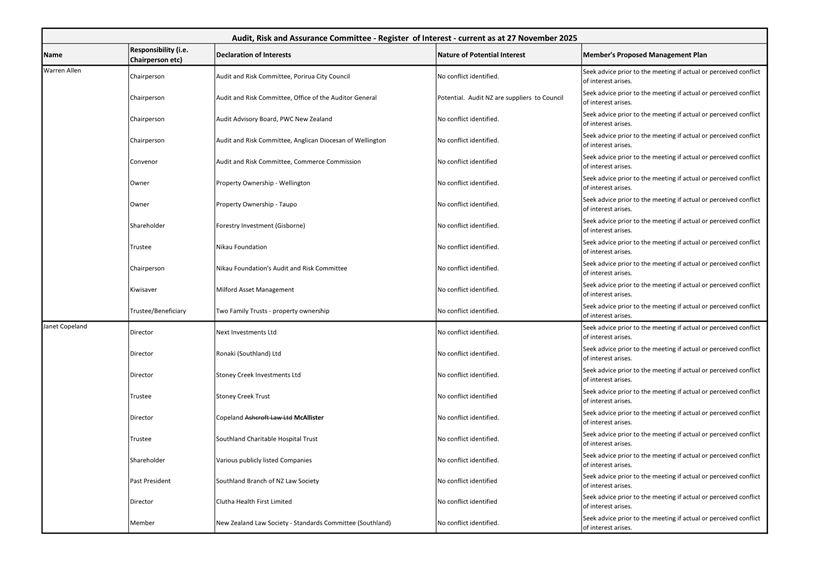
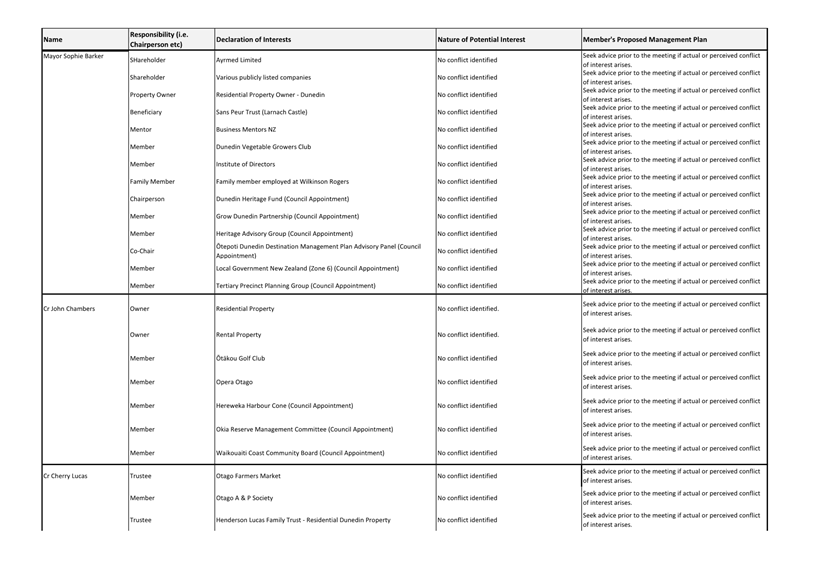
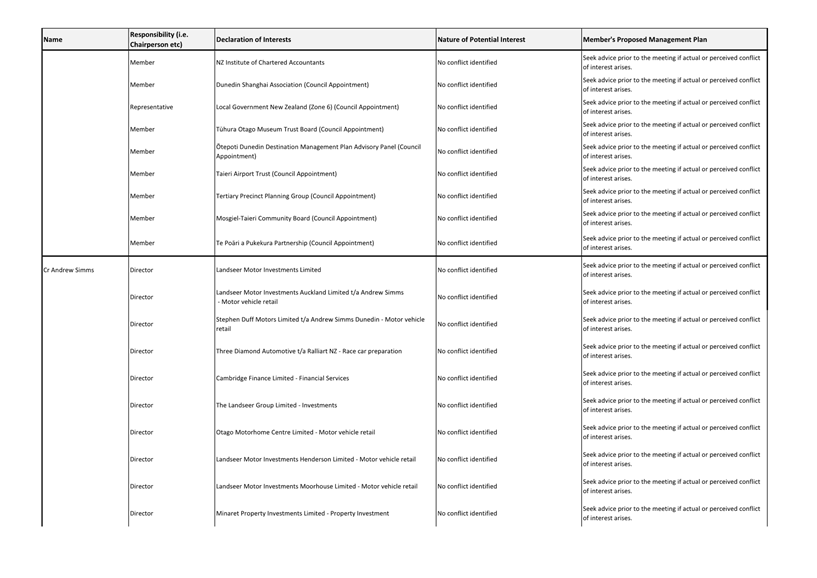
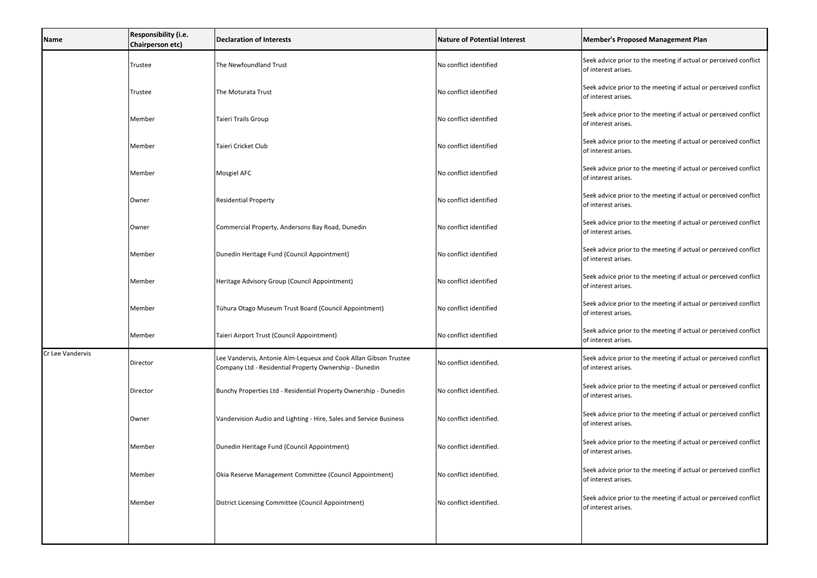
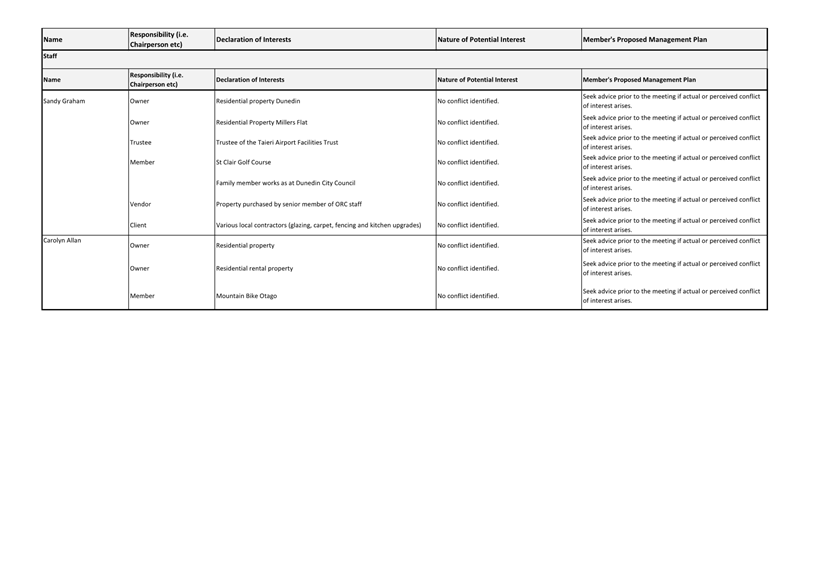
Declaration of Interest
EXECUTIVE SUMMARY
1. Members
are reminded of the need to stand aside from decision-making when a conflict
arises between their role as an independent or elected representative and any
private or other external interest they might have.
2. Elected
and Independent members are reminded to update their register
of interests as soon as practicable, including amending the register at this
meeting if necessary.
RECOMMENDATIONS
That the Committee:
a) Notes/Amends if
necessary the Elected or Independent Members' Interest Register attached as
Attachment A; and
b) Confirms/Amends the
proposed management plan for Elected or Independent Members' Interests.
Attachments
|
|
Title
|
Page
|
|
⇩a
|
Register of Interests
|
6
|
|

|
Audit, Risk and Assurance Committee
4 December 2025
|
|

|
Audit, Risk and Assurance Committee
4 December 2025
|
Part
A Reports
Delegations for the Audit, Risk and Assurance Committee
Department: Civic
EXECUTIVE SUMMARY
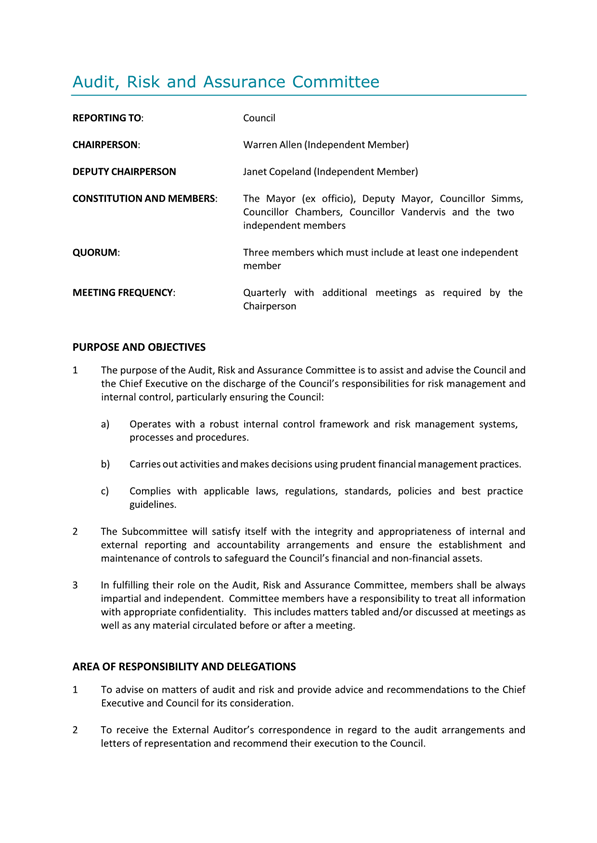
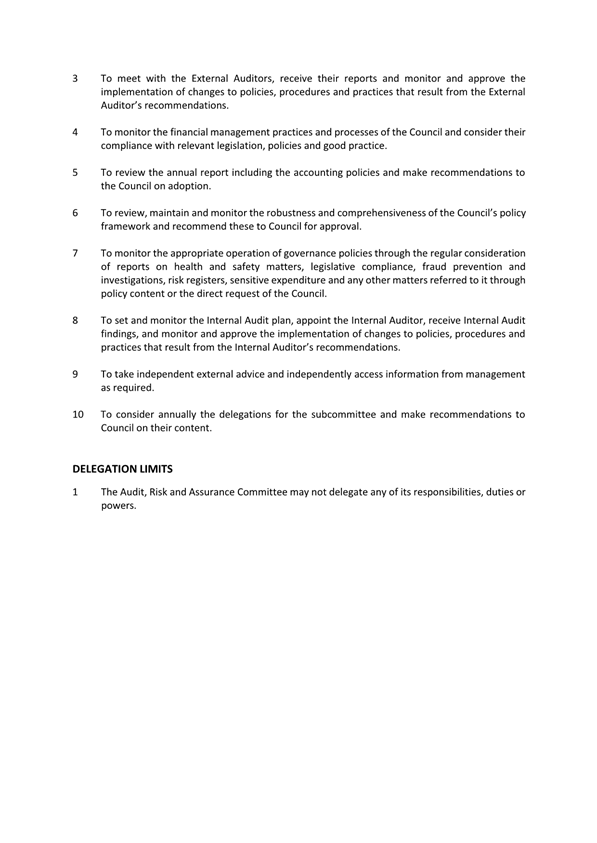
1 This
report provides a copy of the Audit, Risk and Assurance Committee’s
delegations for the Committee’s information (Attachment A)
2 The
Chairperson will also provide an overview of roles and responsibilities of an
Audit, Risk and Assurance Committee.
3 As
this is an administrative report, there is Summary of Considerations.
RECOMMENDATIONS
That the Committee:
a) Notes the delegations
and overview of the Audit, Risk and Assurance Committee.
Signatories
|
Author:
|
Wendy Collard - Governance Support Officer
|
|
Authoriser:
|
Jackie Harrison - Manager Governance
|
Attachments
|
|
Title
|
Page
|
|
⇩a
|
Audit, Risk and
Assurance Committee Delegations
|
12
|
|

|
Audit, Risk and Assurance Committee
4 December 2025
|
|

|
Audit, Risk and Assurance Committee
4 December 2025
|
Audit, Risk and Assurance Committee Work Plan 2025-26
Department: Civic
EXECUTIVE SUMMARY
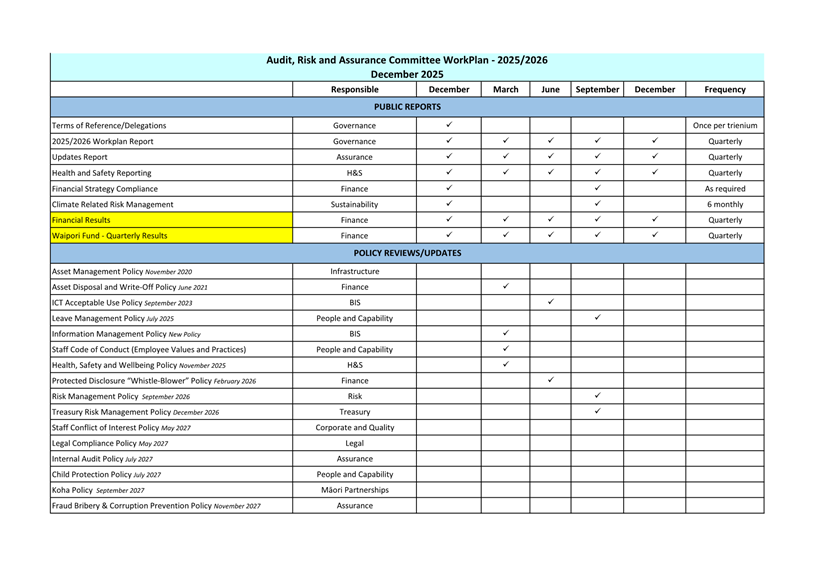
1 This
report provides a copy of the Audit, Risk and Assurance Committee Work Plan
2025-26 which has been aligned to work programme scheduling and decision
making.
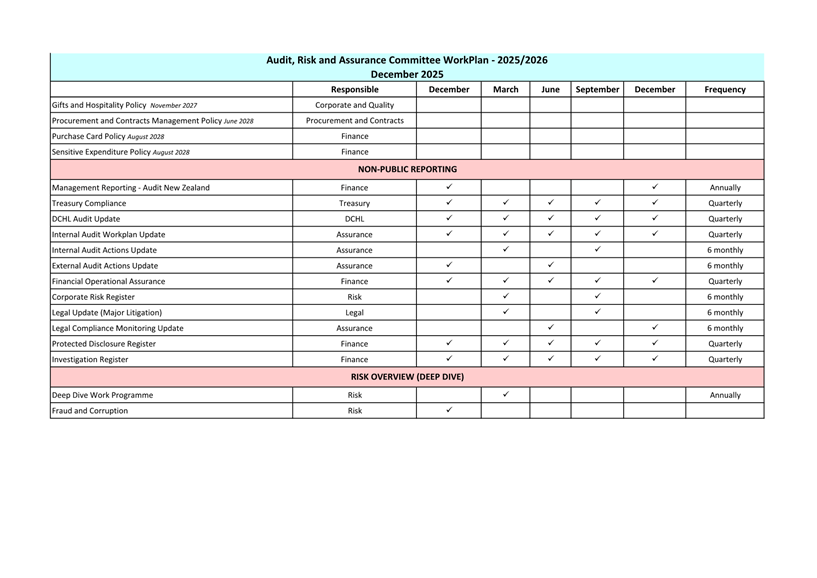
2 Please
note that the items without ticks shown have not been scheduled for action. A
Deep Dive work programme will be developed and presented to the Committee in
2026. Deep dive topics will reflect high or emerging risks.
3 As
this is an administrative report only, the Summary of Consideration is not
required.
RECOMMENDATIONS
That the Committee:
a) Notes the Audit, Risk
and Assurance Committee Work Plan for 2025-26.
Signatories
|
Author:
|
Wendy Collard - Governance Support Officer
|
|
Authoriser:
|
Carolyn Allan - Chief Financial Officer
|
Attachments
|
|
Title
|
Page
|
|
⇩a
|
Audit, Risk and
Assurance Committee WorkPlan
|
15
|
|

|
Audit, Risk and Assurance Committee
4 December 2025
|
|

|
Audit, Risk and Assurance Committee
4 December 2025
|
Audit, Risk and Assurance Committee Updates Report -
December 2025
Department: Finance
EXECUTIVE SUMMARY
1 This
report provides updates on the progress of various sundry matters that have
been noted by the Committee.
RECOMMENDATIONS
That the Committee:
a) Notes the Audit, Risk
and Assurance Committee Updates Report – December 2025
DISCUSSION
Insurance
2 The
liability insurance programme has now been fully renewed with effect from 1
November 2025. The policies include general/public liability, statutory
liability, professional indemnity, and employer’s liability, with the
required capacity secured.
3 Full
cost insurance valuations are being undertaken at the DCC aquatic buildings and
University Oval assets (including plant).
4 Refresher
training is being scheduled with Project and Contract Managers on the contract
works insurance policy including key risks around hot works and hazardous
substance warranties.
2024/25
Annual Report
5 The
final audit fieldwork started in the week of 15 September 2025 and finished on
31 October 2025, resulting in an unqualified audit opinion.
6 Following
the audit process, the 2024/25 Annual Report was adopted by Council at its
inaugural meeting of the new triennium on 31 October 2025.
7 The
2024/25 Annual Report Summary has been prepared by staff and has been audited
by Audit NZ. An audit opinion was received in the week beginning 24 November
2025.
8 Following
this, the 2024/25 Annual Report and its Summary have been published on the DCC
website, within statutory deadlines.
9 Recommended
improvements to the development of future Annual Reports are as follows:
a) 3
Waters valuations are completed as at 31 March. Over the past four years, there
have been recurring issues with valuations, and completing them three months
earlier than usual provides a buffer to address any potential challenges.
b) More
detail is included on the performance of each Council-Controlled Organisation
(CCO). While the primary focus of the Annual Report is the performance of the
DCC, more supporting information on CCOs would provide helpful context to a
reader.
c) The
timeline for the development of the Annual Report is incrementally brought
forward each year, in consultation with Dunedin City Holdings Limited and Audit
NZ. This will ensure that the 2027/28 Annual Report can be adopted ahead of the
next local government elections.
2026/27 Annual Plan
10 Work on the
development of the 2026/27 Annual Plan continues. The development of the Plan
is being used as an opportunity to identify new or improved revenue streams,
and to review expenditure.
11 Budget
update reports for each activity are being prepared and will be considered by
Council in January 2026.
12 The
schedule for development of the 2026/27 Annual Plan includes sufficient time
for an amendment, including audit, should one be required to address a
significant or material change from Year 2 of the 9 Year Plan. Community engagement
is tentatively scheduled for March/April 2026.
13 The Annual
Plan 2026/27 will be adopted by Council by 30 June 2026.
Local Water Done Well
14 All
legislation making up the three stages of “Local Water Done Well”
have now been passed.
15 Council’s
Water Services Delivery Plan (WSDP) was accepted by the Secretary for Local
Government on 10 November 2025 and confirms acceptance of the in-house delivery
model. DIA accepted the plan without any changes being required and recommended
that the delivery of projects required to achieve regulatory compliance is
monitored.
16 Staff
are now in the process of implementing the WSDP. A programme governance
structure has been proposed with ELT representation and a cross departmental
group will be formed to meet regularly and coordinate implementation delivery.
This group will include representation from 3 Waters, finance and legal and
others as required. The DCC Project Management Framework (PMF) has been adopted
to manage this programme of work.
Policy Updates
17 The
following policies are undergoing review:
a) Information
Management Policy
b) Asset
Disposal and Write-Off Policy
c) ICT
Acceptable Use Policy
d) Staff Code
of Conduct
e) Health,
Safety and Wellbeing Policy
18 After
the review process, updated copies of DCC policies will be provided to the
Committee for either feedback or approval.
OPTIONS
19 This is a
noting report so there are no options.
Signatories
|
Author:
|
Hayley Knight - Assurance Manager
|
|
Authoriser:
|
Carolyn Allan - Chief Financial Officer
|
Attachments
There are no attachments for this report.
|
SUMMARY OF CONSIDERATIONS
|
|
Fit with purpose of Local Government
This report provides an update on various
audit, risk and assurance related matters.
|
|
Fit with strategic framework
|
|
Contributes
|
Detracts
|
Not applicable
|
|
Social Wellbeing Strategy
|
✔
|
☐
|
☐
|
|
Economic Development Strategy
|
✔
|
☐
|
☐
|
|
Environment Strategy
|
✔
|
☐
|
☐
|
|
Arts and Culture Strategy
|
✔
|
☐
|
☐
|
|
3 Waters Strategy
|
✔
|
☐
|
☐
|
|
Future Development Strategy
|
✔
|
☐
|
☐
|
|
Integrated Transport Strategy
|
✔
|
☐
|
☐
|
|
Parks and Recreation Strategy
|
✔
|
☐
|
☐
|
|
Other strategic projects/policies/plans
|
☐
|
☐
|
✔
|
This report provides an update on the progress made by
Council to deliver upon the activities identified by the Audit, Risk and
Assurance Committee, which is a regulatory function and considered good
quality and cost effective
|
|
Māori Impact Statement
There are no known impacts for mana whenua
|
|
Sustainability
There are no implications for sustainability
|
|
Zero carbon
There
are no implications for zero carbon
|
|
LTP/Annual Plan / Financial Strategy /Infrastructure
Strategy
There are no implications
|
|
Financial considerations
No financial implications have been identified
|
|
Significance
This report is rated low under the Council’s
Significance and Engagement Policy
|
|
Engagement – external
No external engagement has been undertaken
|
|
Engagement - internal
Activities noted herein include cross Council engagement
and collaboration
|
|
Risks: Legal / Health and Safety etc.
No risks have been identified
|
|
Conflict of Interest
There are no conflict of interest identified
|
|
Community Boards
There have been no implications for Community Boards
identified
|
|

|
Audit, Risk and Assurance Committee
4 December 2025
|
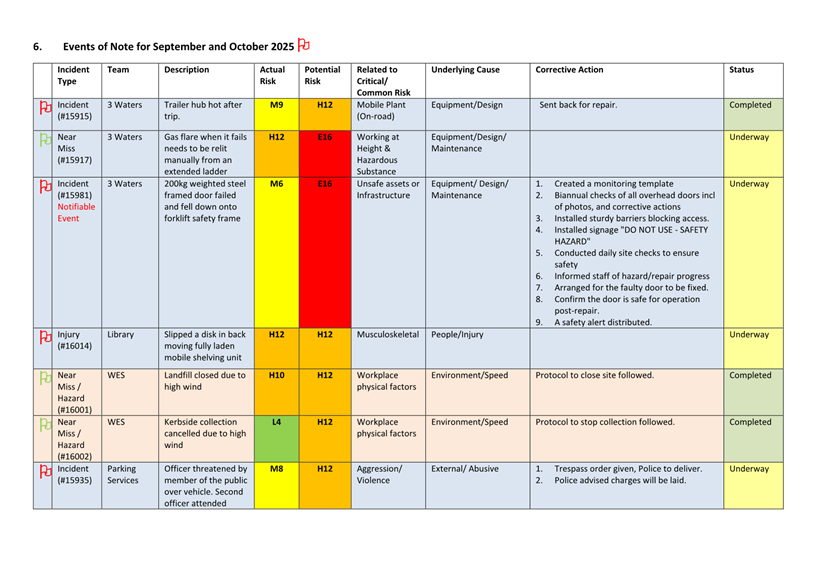
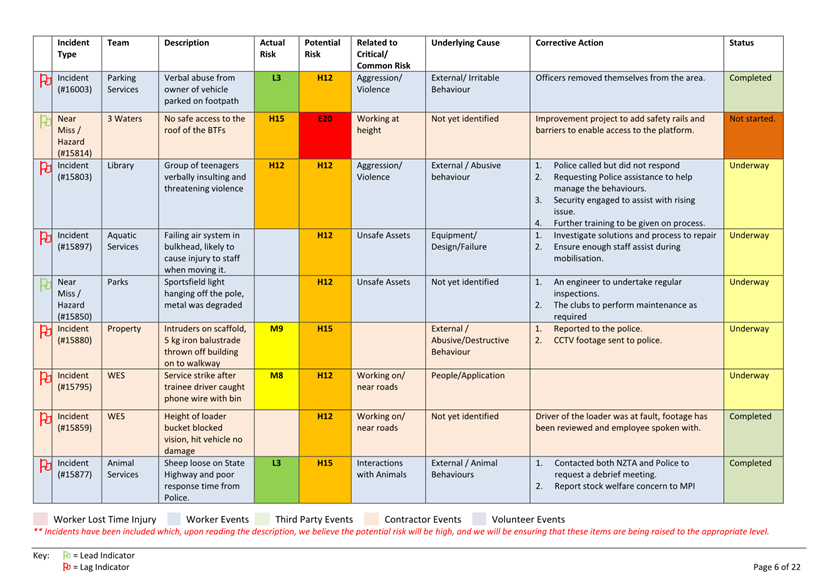
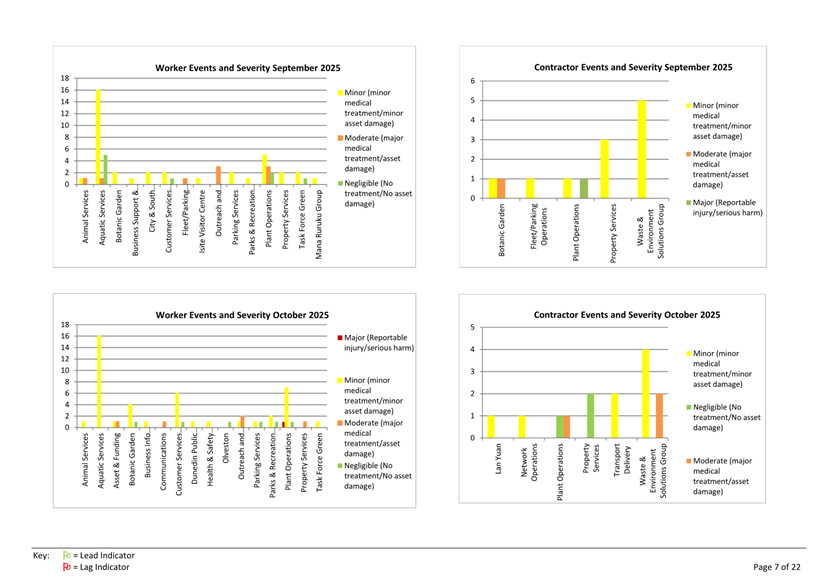
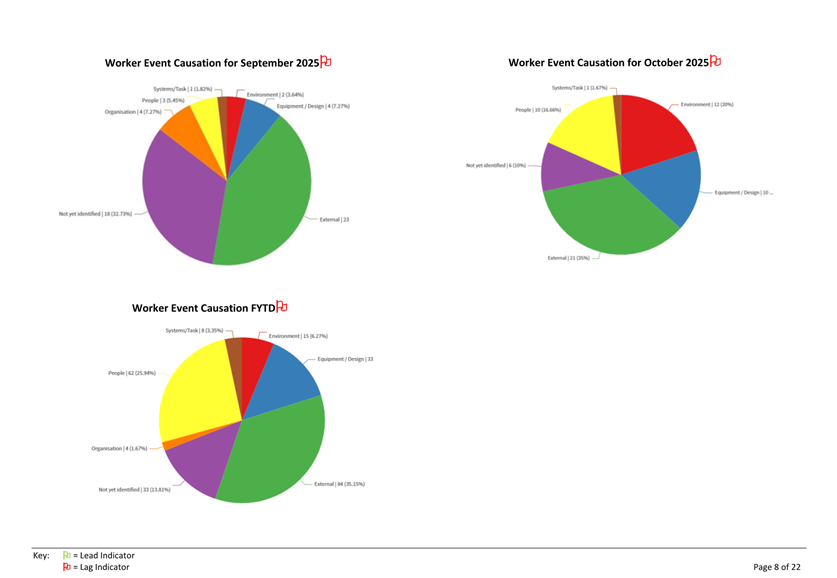
Health, Safety and Wellbeing Monthly report for September
and October 2025
Department: Health and Safety
EXECUTIVE SUMMARY
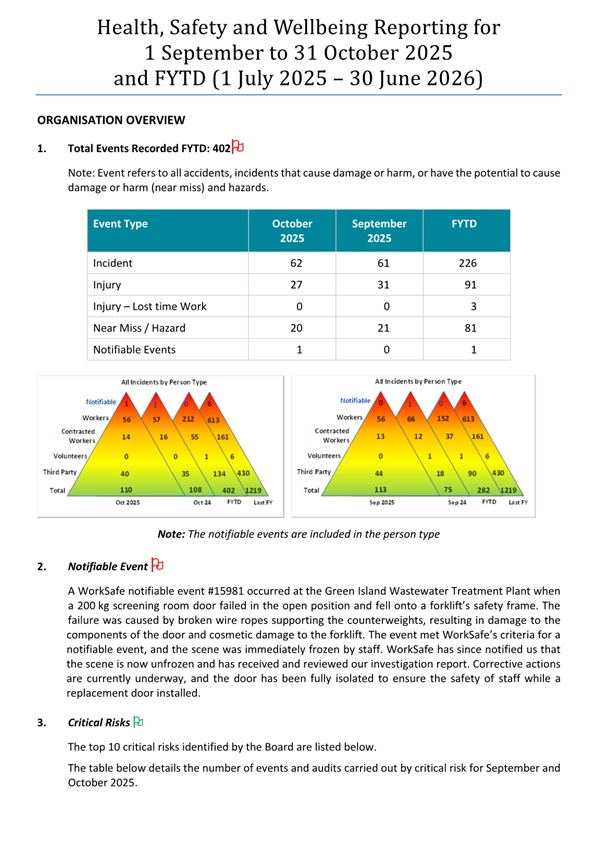
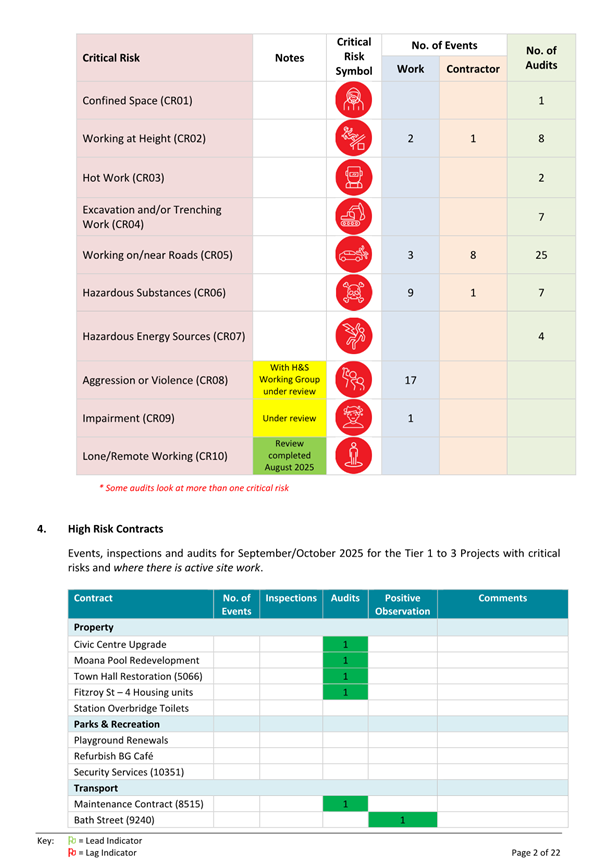
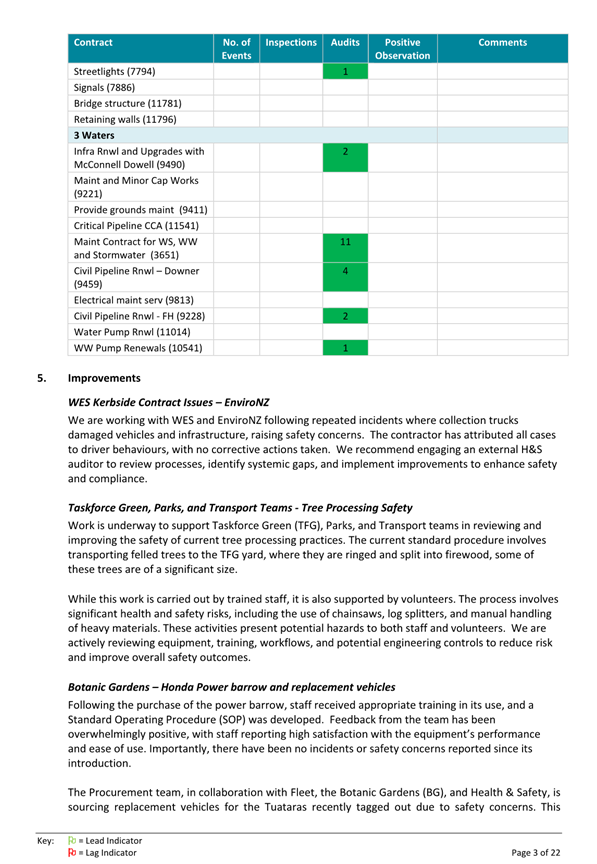
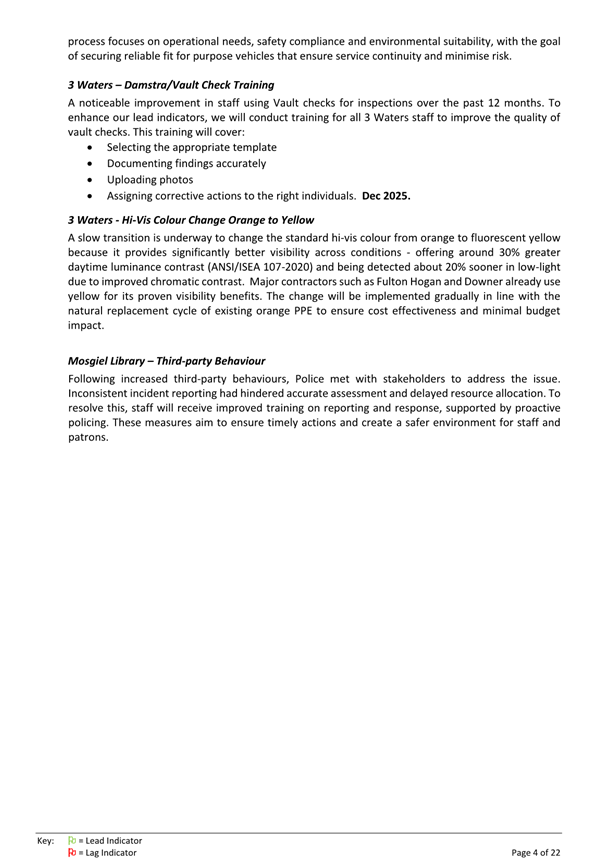
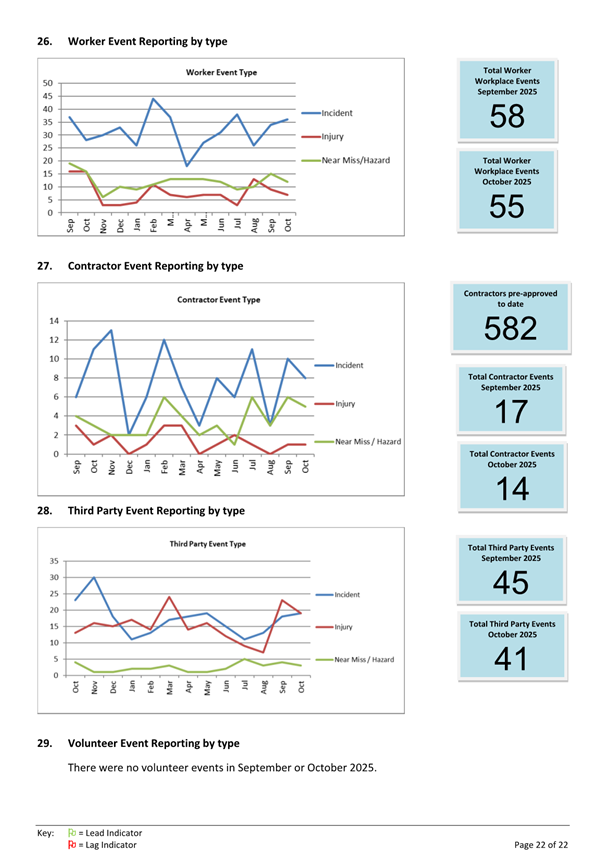
1 The
monthly Health, Safety and Wellbeing report for September and October 2025 is
attached for consideration.
RECOMMENDATIONS
That the Committee:
a) Notes the monthly
Health, Safety and Wellbeing report for September and October 2025.
Signatories
|
Author:
|
Jane Pearce - Health and Safety Manager
|
|
Authoriser:
|
Paul Henderson - General Manager Corporate and Regulatory
Services
|
Attachments
|
|
Title
|
Page
|
|
⇩a
|
Health, Safety and
Wellbeing monthly report for September and October 2025
|
23
|
|

|
Audit, Risk and Assurance Committee
4 December 2025
|
|

|
Audit, Risk and Assurance Committee
4 December 2025
|
Waipori Fund - Quarter ending 30 September 2025
Department: Finance
EXECUTIVE SUMMARY
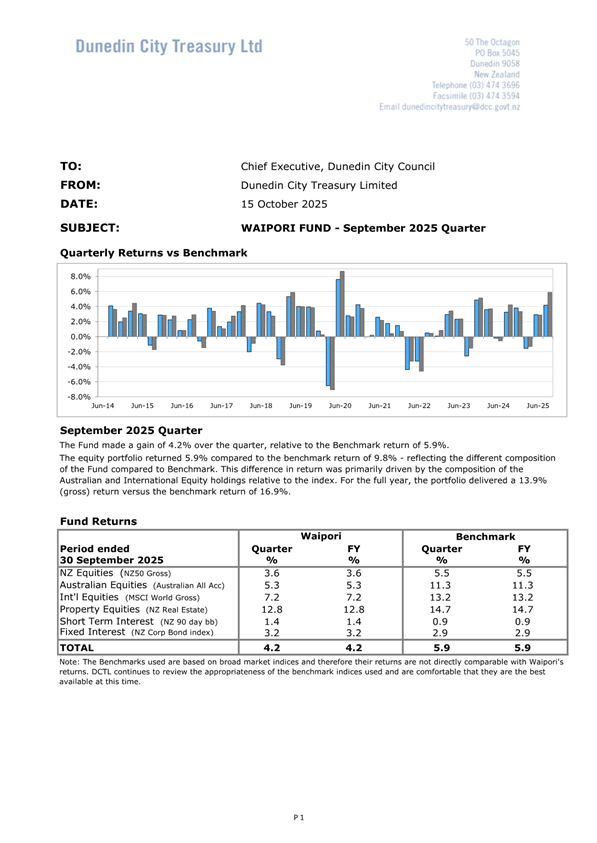
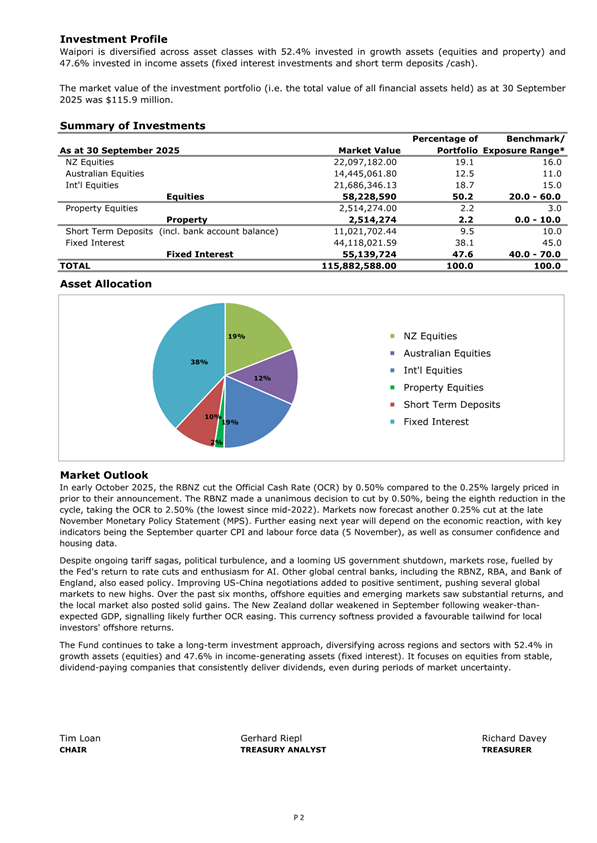
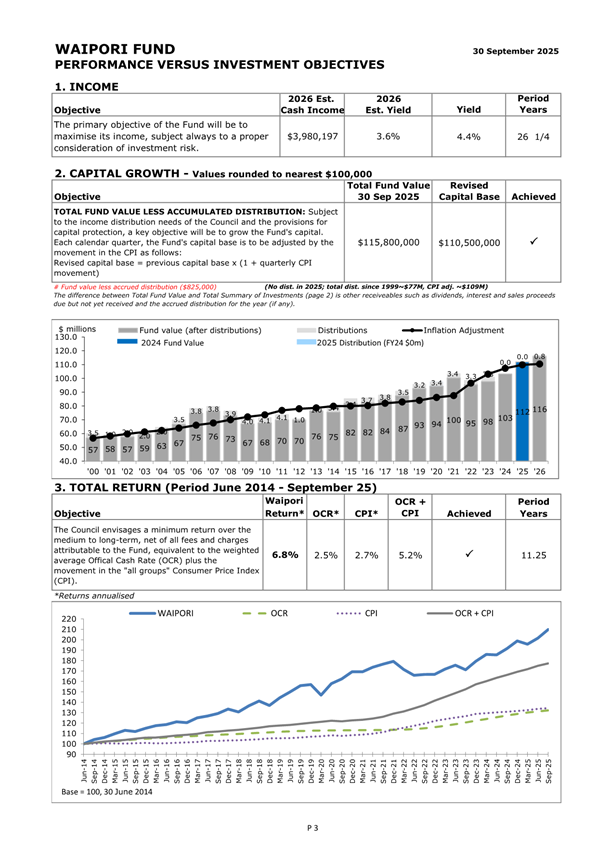
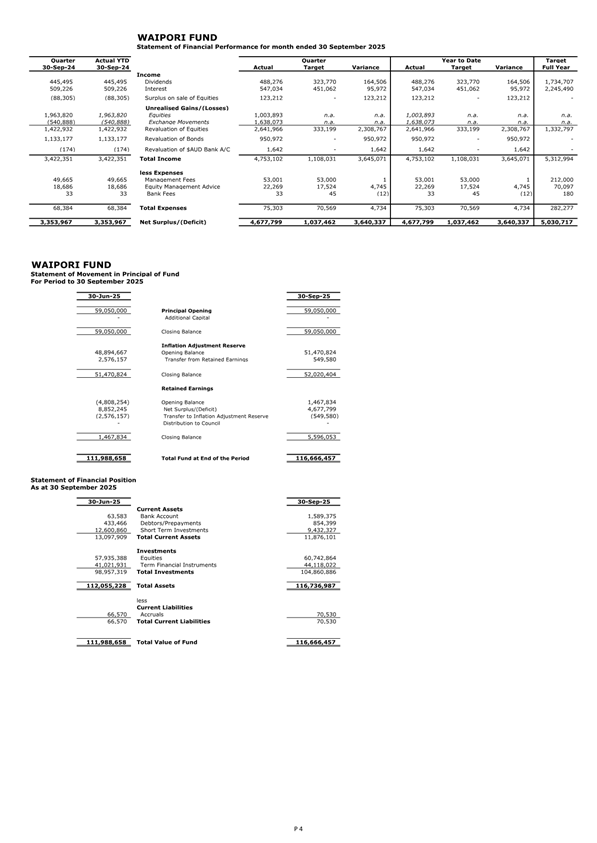
1 The
attached report from Dunedin City Treasury Limited provides information on the
results of the Waipori Fund for the quarter ended 30 September 2025. The report was presented to the Council meeting held on Tuesday, 11
November 2025.
RECOMMENDATIONS
That the Committee:
a) Notes the report from
Dunedin City Treasury Limited on the Waipori Fund for the quarter ended 30
September 2025.
DISCUSSION
2 The
Waipori Fund Statement of Investment Policy and Objectives (SIPO) requires
quarterly reporting on the performance and financial position of the fund.
3 Dunedin
City Treasury Limited has provided the Waipori Fund report for the September
2025 quarter. The report is provided as Attachment A.
OPTIONS
4 As
this is a noting report, no options are provided.
NEXT STEPS
5 Quarterly
reporting on the performance and financial position of the fund will be
provided to future Council meetings.
Signatories
|
Authoriser:
|
Carolyn Allan - Chief Financial Officer
|
Attachments
|
|
Title
|
Page
|
|
⇩a
|
Waipori Fund - Quarter
ending 30 September 2025
|
46
|
|

|
Audit, Risk and Assurance Committee
4 December 2025
|
|

|
Audit, Risk and Assurance Committee
4 December 2025
|
Climate-related risk management
Department: Zero Carbon, Climate and City Growth and Quality
and Improvement
EXECUTIVE SUMMARY
1 This
report provides information on the DCC’s current climate-related risk
management framework, and compares this with evolving best practice. It
discusses potential to strengthen the DCC’s approach.
2 The
DCC’s climate change response comprises mitigation and adaptation work
programmes (Zero Carbon and Climate Adaptation and Resilience). The DCC
currently monitors and manages three strategic climate-related risks.
3 Best
practice suggests that integration of climate change considerations across
governance, strategy, risk management, metrics/targets, and assurance is
required for an organisation to manage climate-related risk and opportunity
coherently and successfully.
4 The
DCC is giving effect to recent sector-specific guidance from the Office of the
Auditor General (OAG) on climate-related risk management and associated
organisational frameworks. However, an approach more closely aligned with the
New Zealand Climate Standards would afford ELT and Council deeper insights on
key areas of risk and opportunity, to support stronger climate-related
decision-making.
5 The
preferred option is for staff to investigate ways the DCC could align more
strongly with the NZ Climate Standards approach to climate-related risk
management. Staff would report their findings back to the Audit, Risk and
Assurance (ARAS) Subcommittee, no later than July 2026.
RECOMMENDATIONS
That the Subcommittee:
a) Notes the
climate-related risk management report
b) Approves staff
investigation of ways the DCC could align more strongly with the NZ Climate
Standards approach to climate-related risk management
BACKGROUND
Responding to climate change has two aspects:
mitigation and adaptation
6 Climate
Change is defined as a change of climate which is attributed directly or
indirectly to human activity that alters the composition of the global
atmosphere, and which is in addition to natural climate variability observed
over comparable time periods.
7 Climate
change mitigation is a human intervention to reduce emissions or enhance
the sinks of greenhouse gases.
8 Climate
change adaptation is the process of adjustment to actual or expected
climate and its effects, in order to moderate harm or exploit beneficial
opportunities.
The terms ‘resilience’ and ‘adaptation’ are often used
interchangeably in climate change discourse. While they are complementary
terms, there are subtle but important differences. Resilience describes the
capacity to anticipate and cope with shocks or adverse events, and to recover
from the associated impacts in a timely and efficient manner. In this sense,
adaptation is part of and contributes to resilience.
9 Most
economic sectors and industries are affected both by climate-related risks and
by the transition to a lower-carbon economy. There are also significant
opportunities for organisations focused on climate change mitigation and
adaptation.
10 While no
equivalent figures are available for Dunedin, a report by Deloitte estimates
that inadequate climate action could cost the New Zealand economy $4.4 billion
by 2050, with losses becoming exponentially worse after that. On the other
hand, decisive climate action could deliver $64 billion to New Zealand’s
economy by 2050.
11 The Office
of the Auditor General has recently updated its advice to councils with respect
to climate change. In doing so, it commented that:
“…in many ways,
councils are at the front line of a wider response to climate change. Councils
are largely responsible for civil defence, regional and district land use,
planning and major community infrastructure. They are also the owners of
significant assets, some of which are at risk because of climate change. They
also have a role in reducing greenhouse gas emissions.
Councils have obligations to
keep their communities and assets safe from the impacts of a changing climate.
They also have a responsibility to consult and keep their communities informed
about the scenarios they are planning for and the steps they are taking to
protect people and property.”
The DCC’s
climate change responses comprises two key work programmes
12 Across both
work programmes, the approach is designed to be practical, focused on outcomes,
and aligned with the city’s broader goals for economic and community
development. A low emissions, climate-resilient Ōtepoti Dunedin ultimately
means better local services and infrastructure, more efficient systems,
improved public health and wellbeing, as well as contributing to global climate
goals.
Climate change mitigation
13 The Zero
Carbon work programme supports emissions reduction at both the organisation
scale (DCC emissions) and the wider city scale (Dunedin emissions). It is led
by the Zero Carbon team but integrates with, and is co-dependent on, the work
of teams across the DCC. There is also an emphasis for the work programme on
collaboration with external partners.
Climate change adaptation
14 A citywide
climate adaptation and resilience framework is in development to guide
Council and communities as they make decisions about how to respond to natural
hazards and the anticipated impacts of climate change. This work commenced only
recently and is led by the newly formed Climate Adaptation and Resilience team.
The team and work programme have evolved out of the South Dunedin Future
programme – a joint initiative between the DCC and the Otago Regional
Council (in close association with other stakeholders) focused on producing a
long-term adaptation plan for the area by the end of 2026.
DISCUSSION
Best practice
climate-related risk management
15 Recent
years have seen rapid evolution of the guidance and tools available to steer
organisations’ climate-related risk management. Related to this, there is
an increasing focus on climate-related reporting and disclosures, and a growing
expectation from central government, private sector, and communities that local
government will align with the spirit and intent of these approaches.
International
guidance - Taskforce on Climate-related Financial Disclosures
16 In 2023,
the Task Force on Climate-related Financial Disclosures (TCFD, initiated by the
G20) set out recommendations for clear, comparable and consistent
climate-related disclosures. The aim was to:
a) promote
routine consideration of climate change in business and investment decisions
b) enable
entities to better demonstrate responsibility and foresight on climate
c) drive
smarter, more efficient allocation of capital, and
d) smooth the
transition to a low-carbon economy.
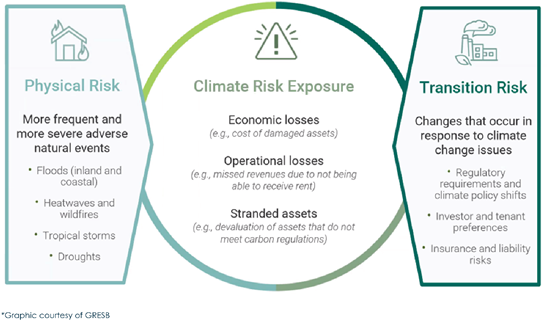
17 The
TCFD identified that an organisation’s climate risk exposure is a
function of both physical risks caused by the impacts of climate change,
and transition risks associated with changes that occur in response to
climate change issues:
18 The are
four core elements of TCFD’s recommended climate-related financial
disclosures, including risk management:
19 The TCFD
recommended greater emphasis on the impact of climate-related risks and
opportunities on an organisation’s future financial position (as
reflected in its income statement, cash flow statement, and balance sheet).
This is summarised by the figure below:
National guidance - Aotearoa New Zealand Climate
Standards
20 The New
Zealand government introduced a mandatory climate-related disclosures regime in
2023, applying to financial institutions, as well as managers of large investment
schemes and licensed/large listed issuers that meet certain thresholds. In
2025, thresholds for mandatory participation were revised upwards.
21 Under the
regime, climate reporting entities must report in line with the Aotearoa New
Zealand Climate Standards (NZ Climate Standards) issued by the External Reporting
Board (XRB). The NZ Climate Standards were developed largely in line with TCFD
recommendations (there are sections on governance, strategy, risk
management, metrics and targets), with an added emphasis on assurance
of emissions disclosed by an organisation under the standard. Key elements of
disclosure can be summarised as follows:
Source:
GRESB
22 The
standards can also be adopted voluntarily by organisations, to improve planning
and resilience. Examples of Dunedin organisations that have voluntarily aligned
with the standards include Silver Fern Farms and the University of Otago.
23 Within the
local government sector, strict adherence to the NZ Climate Standards appears
to be limited to entities that were caught by the 2023 legislation e.g.
Auckland Council (which report at a Group level), and Christchurch City
Holdings Ltd.
24 However,
local government is increasingly looking to TCFD and the NZ Climate Standards
to inform management approaches. This includes in management of council
controlled organisations (e.g. Nelson City Council/Tasman District Council have
set an expectation that their Infrastructure Holdings company provide
climate-related disclosure on an ongoing basis).
Sector-specific guidance - climate-related
OAG recommendations
25 In
late 2024 the Office of the Auditor General (OAG) released a report auditing
the performance of four councils’ climate work. The report included five
recommendations for councils, emphasising the need for clarity and transparency
with the public in climate-related objective setting and progress monitoring/reporting.
The recommendations echo best practice established by the TCFD framework, and
the NZ Climate Standard, by emphasising governance, strategy, metrics
and targets:
a) Take
opportunities to collaborate with and assist each other to understand the current
and likely impacts of a changing climate on their infrastructure and
communities.
b) Make clear
in climate strategies:
i) what
their climate-related objectives are,
ii) how
they intend to achieve those objectives,
iii) how they
will use their strategies to set priorities, and
iv) how they will
measure and report on progress in implementing their strategies.
c) Strengthen
the use of performance measures that reflect climate-related strategic
objectives and priorities.
d) Clearly set
out how climate-related activities will be governed and ensure that staff
understand what information the relevant governance body needs to govern
effectively.
e) Report
publicly on progress with their climate change strategies and work programmes,
to support accountability and so communities are well-informed, engaged, and
supportive.
26 Previous
OAG advice has also emphasised a role of Audit and Risk committees in
climate-related risk management.
The
DCC’s current approach to climate-related risk management and disclosure
27 The
DCC’s approach to climate-related risk management has evolved over time,
as the organisation’s general risk management framework and climate
change work programmes have matured.
28 From a
purely risk management perspective, ELT has included three climate-related
risks in its suite of strategic risks, considered as part of regular
monitoring:
a) Climate
Change (Mitigation – DCC): A failure to meet the DCC’s
organisational emissions reduction targets
b) Climate
Change (Mitigation – City-wide): A failure to meet the DCC’s
city-wide emissions reduction targets.
c) Adaptation
to Climate Change: A failure to respond effectively to the impacts of
climate change
29 The risks,
along with current ratings, mitigating controls and improvement plans are set
out in Attachment A.
30 However,
as discussed above, recent guidance at all scales places climate-related risk
management firmly in the context of wider organisational frameworks. Best
practice suggests that integration of climate change considerations across
governance, strategy, risk management, metrics/targets, and assurance is
required for an organisation to manage climate-related risk and opportunity
coherently and successfully.
31 The
DCC has to date closely followed and sought to align with evolving
climate-related OAG guidance. Council was most recently updated on alignment in
November 2024, when it noted the Zero Carbon work programme approach to align
with the OAG’s most recent recommendations (CNL/2024/221). At that
time, the city-wide climate change adaptation and resilience work programme had
not yet been developed or approved.
32 Attachment
B provides an updated view of how the OAG’s recommendations are being
given effect to. The approach is built out across the Zero Carbon work programme,
which has had a clear mandate to address climate change mitigation at both city
and DCC scales since its genesis in 2020. Work is underway to build a similar
framework for climate change adaptation and resilience at both city and DCC
scales, which is currently in design as part of an initial two-year pilot
through to June 2027. Further advice will be provided to ARAS and Council once
design works have progressed, likely in mid-2026.
33 When
compared with the NZ Climate Standards, the DCC is fully aligned with some
elements of the standards, including emissions-related metrics and annual
assurance of Scope 1, 2 and 3 emissions.
Further evolution of DCC’s climate-related risk
management
34 While the
DCC’s current approach aligns with OAG recommendations, the structured
approach set out in the NZ Climate Standards is a step up from current DCC
climate-related risk management practice. The approach prescribed by the
NZ Climate Standards involves scenario development and analysis,
risk/opportunity identification and impact assessment. It supports
organisations to develop a more granular understanding of both physical and
transition risks and mitigations, as well as climate-related opportunities.
35 Within the
local government sector, Auckland Council is most advanced with respect to
development of a formal NZ Climate Standards-aligned approach. It has developed
its framework at a group level, and currently manages 16 material
climate-related risks. Auckland Council anticipates its climate-related
scenarios will be reviewed on a three-yearly basis, with an annual review of
the group’s climate-related risks and ratings. Work is also underway on a
climate-related risk management framework that can be used by operational
teams.
36 While a
climate-related risk management and disclosures regime fully compliant with the
NZ Climate Standards would be a significant undertaking and beyond the current
capacity of the DCC’s Zero Carbon and Climate Adaptation and Resilience
teams to resource, greater alignment with the standards would afford ELT and
Council deeper insights on key areas of risk and opportunity, to support
stronger climate-related decision-making.
OPTIONS
37 Two options
have been identified.
Option One – Investigate ways to align DCC climate-related
risk management more closely with the NZ Climate Standards (Recommended Option)
38 Under this
option, the Zero Carbon and Climate Adaptation and Resilience teams investigate
ways the DCC could align more strongly with the NZ Climate Standards approach
to climate-related risk management. Staff would report their findings back to
the Audit, Risk and Assurance Subcommittee, no later than July 2026.
Advantages
· If
stronger alignment is ultimately realised, the approach is likely to afford
Council/ELT deeper insights on key areas of climate-related risk and
opportunity, supporting stronger climate-related decision-making.
· If
stronger alignment is ultimately realised, the approach would bring the
DCC’s approach more in line with best practice.
· Stronger
alignment would contribute to a range of direct and indirect benefits for
council and our communities, including in terms of avoided costs that would
otherwise be anticipated the impacts of climate change, and opportunities
associated with a planned and coordinated transition to a low carbon economy.
Disadvantages
· If
strongly alignment is ultimately realised, work associated with implementation
(including initial scenario development and analysis, risk/opportunity
identification and impact assessment) is likely to involve increased draw on
staff capacity. It is unknown at this point whether this could be absorbed
within existing team capacity.
Option Two – Continue with existing approach to
management of climate-related risk (Status Quo)
39 Under this
option, ELT’s current approach to climate-related risk management will
continue (currently monitoring three strategic risks).
40 The Zero
Carbon and Climate Adaptation and Resilience teams will continue to draw on OAG
advice to inform their evolving work programmes, and associated advice to
ELT/Council.
Advantages
· An
extension of business-as-usual that can be managed within existing resourcing.
Disadvantages
· DCC
climate-related risk management and associated decision-making will continue to
be less well aligned with best practice than what might be realised under
Option One.
· There
is a higher chance that climate-related risks and opportunities may remain
unaddressed/unrealised.
· DCC
and Dunedin city are likely to face costs associated with the impacts of
climate change that might otherwise be avoidable and forego opportunities associated
with a planned and coordinated transition to a low carbon economy.
NEXT STEPS
41 Should the
Committee endorse investigation of ways the DCC climate-related risk management
regime more strongly aligned with the NZ Climate Standards, the Zero Carbon and
Climate Adaptation and Resilience teams will work together to progress this,
reporting back to Audit, Risk and Assurance Subcommittee no later than July
2026.
Signatories
|
Author:
|
Jinty MacTavish - Manager - Zero Carbon
Jonathan Rowe - Programme Manager, South Dunedin Future
Tania Cribb - Risk Manager
|
|
Authoriser:
|
Scott MacLean - General Manager, City Services
|
Attachments
|
|
Title
|
Page
|
|
⇩a
|
Summary of strategic
climate-related risks currently monitored by DCC
|
61
|
|
⇩b
|
DCC climate risk
actions mapped against OAG recommendations
|
67
|
|
SUMMARY OF CONSIDERATIONS
|
|
Fit with purpose of Local Government
Strong climate-related risk management
promotes the social, economic and environmental well-being of communities in
the present and for the future.
|
|
Fit with strategic framework
|
|
Contributes
|
Detracts
|
Not applicable
|
|
Social Wellbeing Strategy
|
✔
|
☐
|
☐
|
|
Economic Development Strategy
|
✔
|
☐
|
☐
|
|
Environment Strategy
|
✔
|
☐
|
☐
|
|
Arts and Culture Strategy
|
☐
|
☐
|
✔
|
|
3 Waters Strategy
|
✔
|
☐
|
☐
|
|
Future Development Strategy
|
✔
|
☐
|
☐
|
|
Integrated Transport Strategy
|
✔
|
☐
|
☐
|
|
Parks and Recreation Strategy
|
✔
|
☐
|
☐
|
|
Other strategic projects/policies/plans
|
✔
|
☐
|
☐
|
Strong climate-related risk management supports
achievement of goals across most of the DCC’s strategies, as well as
the Zero Carbon Plan, Emissions Management and Reduction Plan, and Zero
Carbon Policy.
|
|
Māori Impact Statement
A critical
Treaty of Waitangi analysis was prepared previously as part of the Zero
Carbon work programme. This indicated that, in general, taking action to
reduce emissions is aligned with Treaty of Waitangi obligations because a
wide range of taonga are at risk from climate change. However, individual
projects will need to consider Te Taki Haruru and incorporate mana whenua and
mātāwaka inputs when delivered.
|
|
Sustainability
Climate change mitigation and adaptation efforts are
considered key to sustainability. ‘Climate Action’ is one of the
United Nation’s Sustainable Development Goals, reflecting the
centrality of action on climate change to the achievement of sustainable
development. Without significant cuts to emissions, climate change impacts
will further accelerate, with commensurate negative impacts on the social,
environmental, cultural and economic wellbeing of New Zealand communities.
Conversely, adaptation is essential to support community wellbeing to prepare
for impacts of climate change that are already locked in and actions to
reduce emissions generally have significant co-benefits in terms of community
wellbeing.
|
|
Zero carbon
A
strengthened climate-risk management regime is likely to support emissions reduction
at both DCC and city scale, by increasing Council and ELT oversight of
transition risks and opportunities.
|
|
LTP/Annual Plan / Financial Strategy /Infrastructure
Strategy
A strengthened climate-risk management regime would
support LTP / Annual Plan decision making.
|
|
Financial considerations
Staff can progress initial exploration of a strengthened
climate-risk management regime within existing budgets. It is unknown
at this point whether work associated with implementing a strengthened
climate risk management regime could be absorbed within existing team
capacity.
|
|
Significance
This decision is considered low significance in terms of
the Council’s Significance and Engagement Policy.
|
|
Engagement – external
There has been no external engagement.
|
|
Engagement - internal
Assurance Manager
|
|
Risks: Legal / Health and Safety etc.
This report sets out an option to deepen climate-related
risk management. Advantages and disadvantages are set out in the report.
|
|
Conflict of Interest
No conflict of interest has been identified.
|
|
Community Boards
No direct implications for Community Boards have been
identified.
|
|

|
Audit, Risk and Assurance Committee
4 December 2025
|
|

|
Audit, Risk and Assurance Committee
4 December 2025
|
|
|
Audit, Risk and Assurance Committee
4 December 2025
|
Financial Report - Period ended 30 September 2025
Department: Finance
EXECUTIVE SUMMARY
1 This
report provides the financial results for the period ended 30 September 2025
and the financial position as at that date. The report was presented to
the Council meeting held on Tuesday, 11 November 2025.
2
3 As
this is an administrative report only, there are no options or Summary of
Considerations.
RECOMMENDATIONS
That the Committee:
a) Notes the Financial
Performance for the period ended 30 September 2025 and the Financial Position
as at that date.
BACKGROUND
4 This
report attaches a financial update and financial statements for the period
ended 30 September 2025.
DISCUSSION
5 The
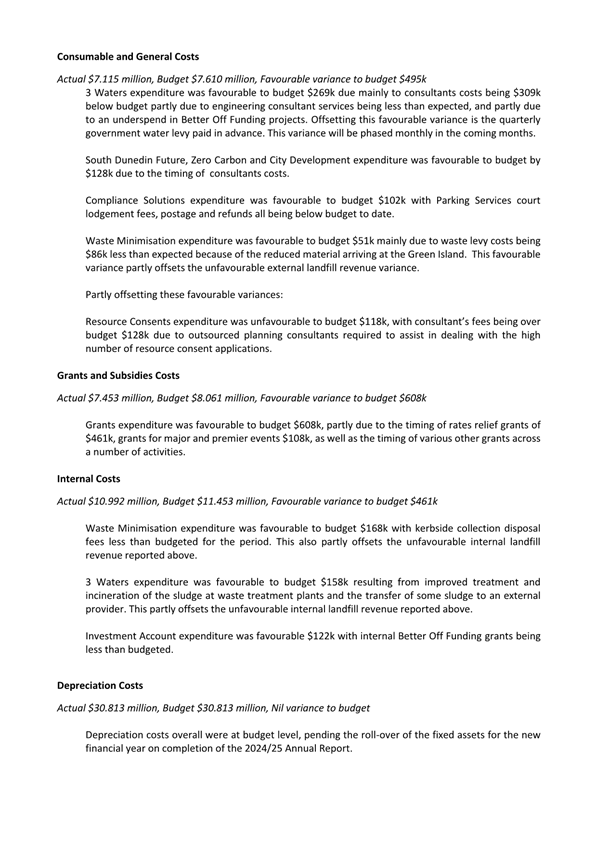
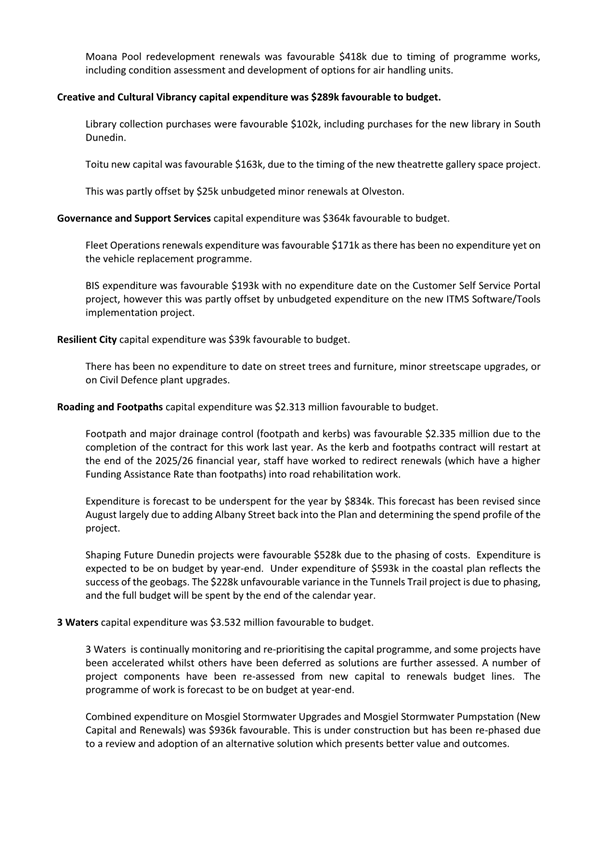
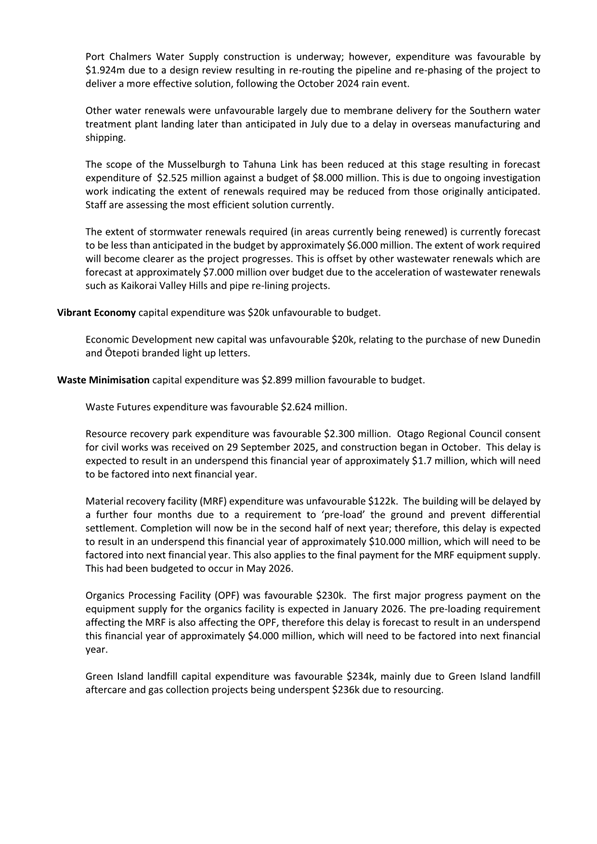
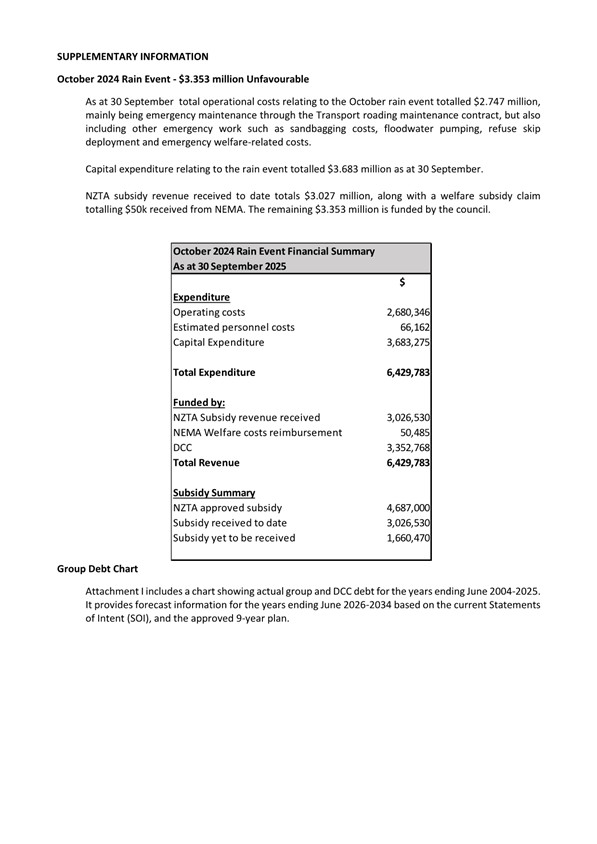
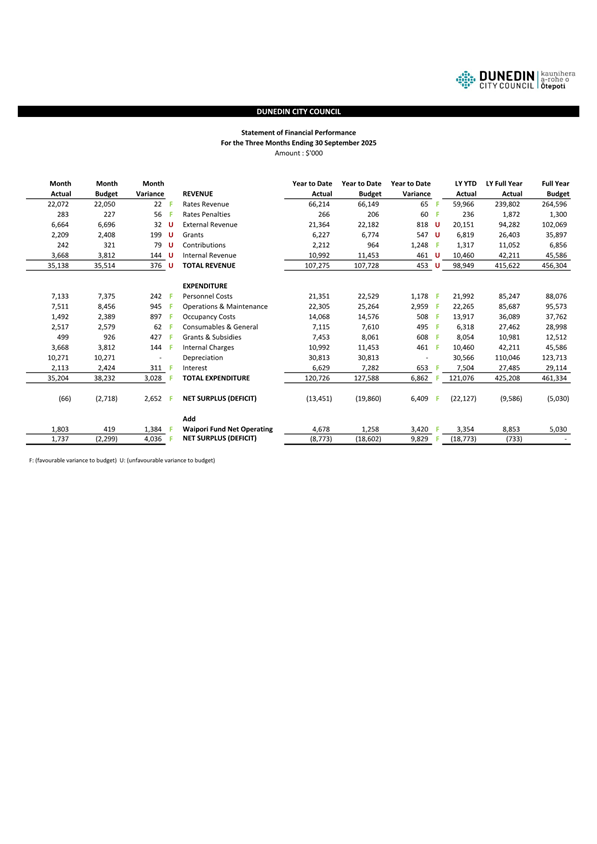
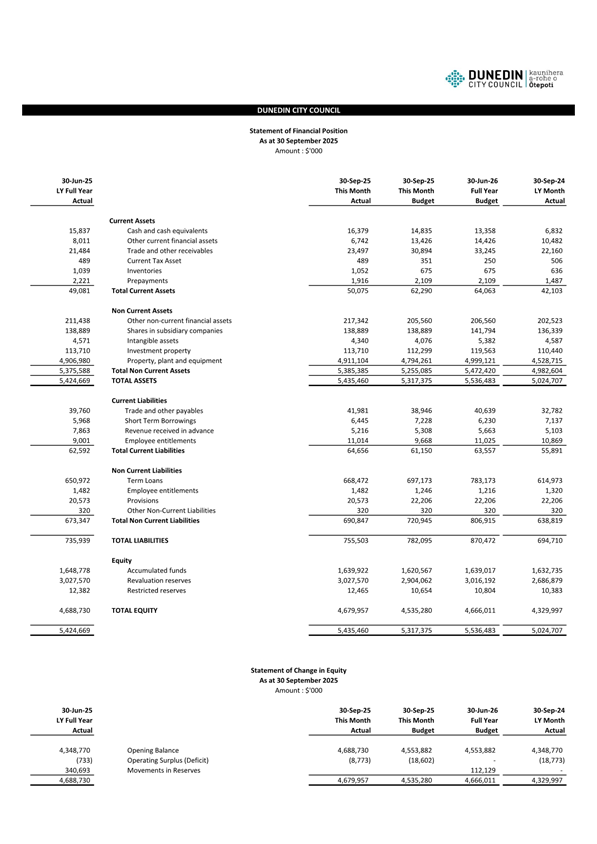
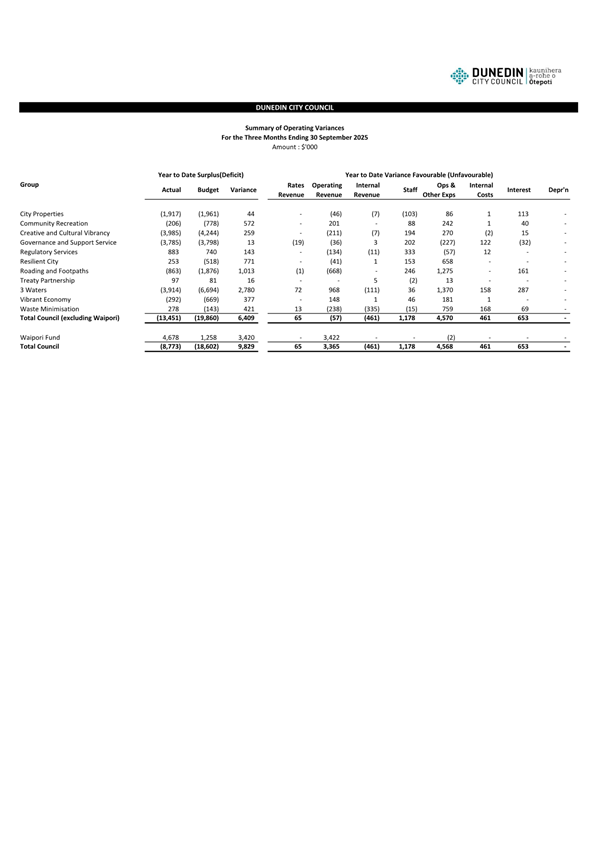
net deficit (including Waipori) for the period ended 30 September 2025 was $8.773
million, a $9.829 million favourable variance to budget. A detailed commentary is provided in Attachment A (Financial Update). In summary, the
following variances were recorded:
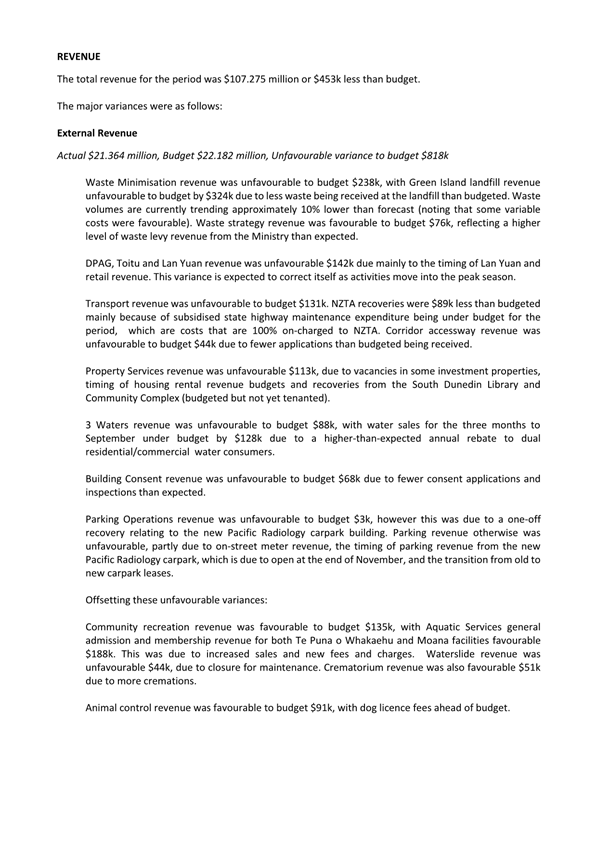
a) Revenue
was $107.275 million for the period or $453k unfavourable to budget.
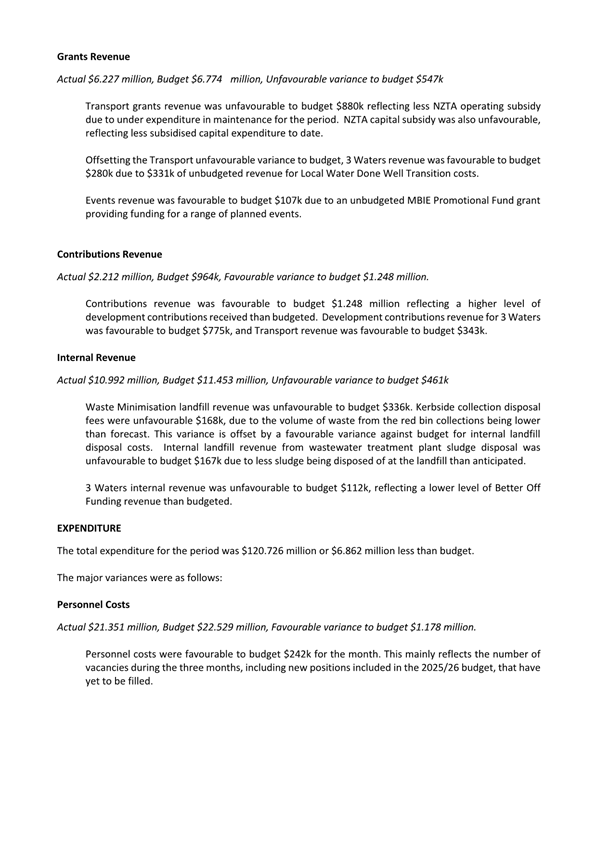
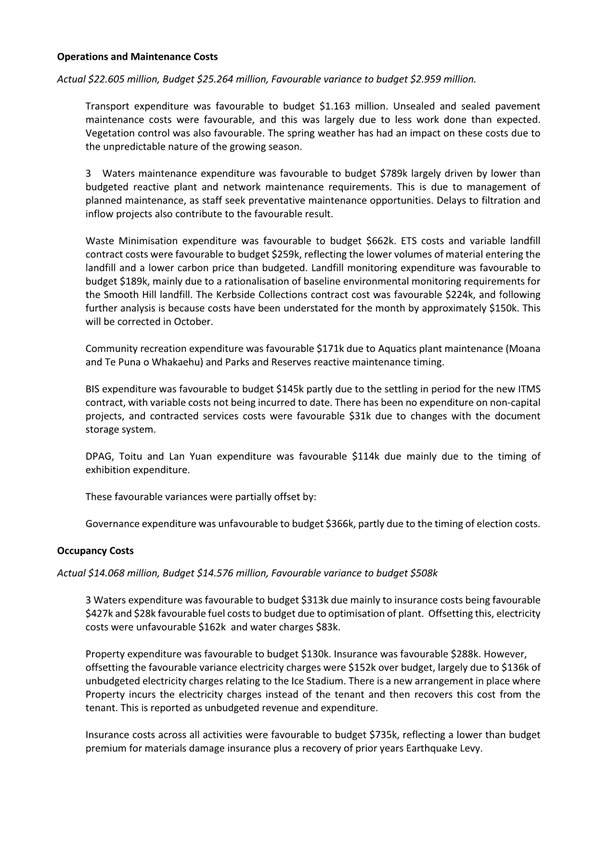
b) Expenditure
was $120.726 million for the period, or $6.862 million favourable to budget.
c) The
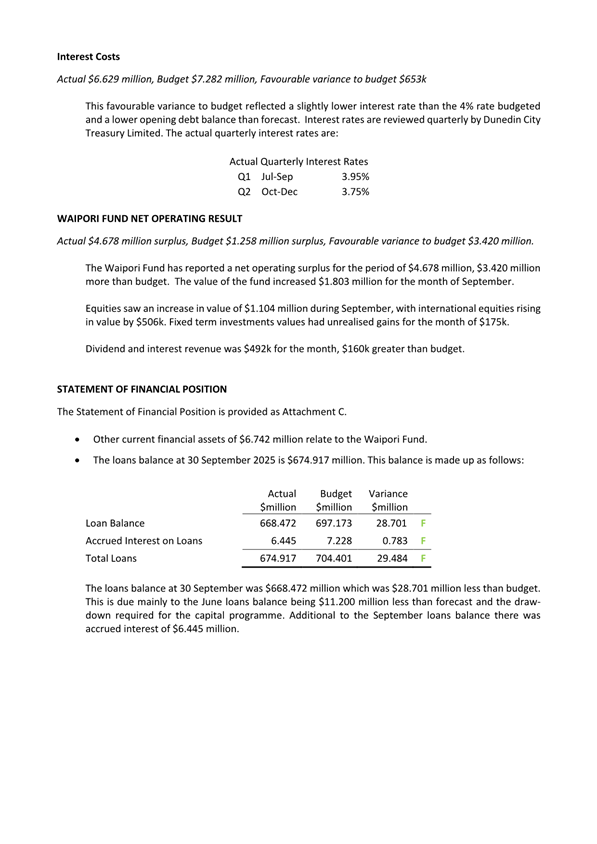
Waipori Fund has reported a net operating surplus for the period of $4.678
million, $3.420 million favourable to budget.
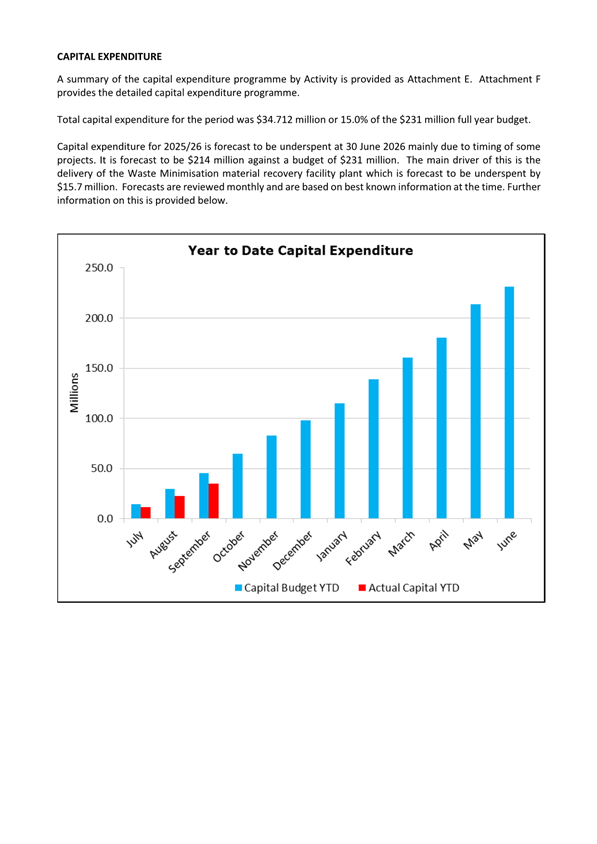
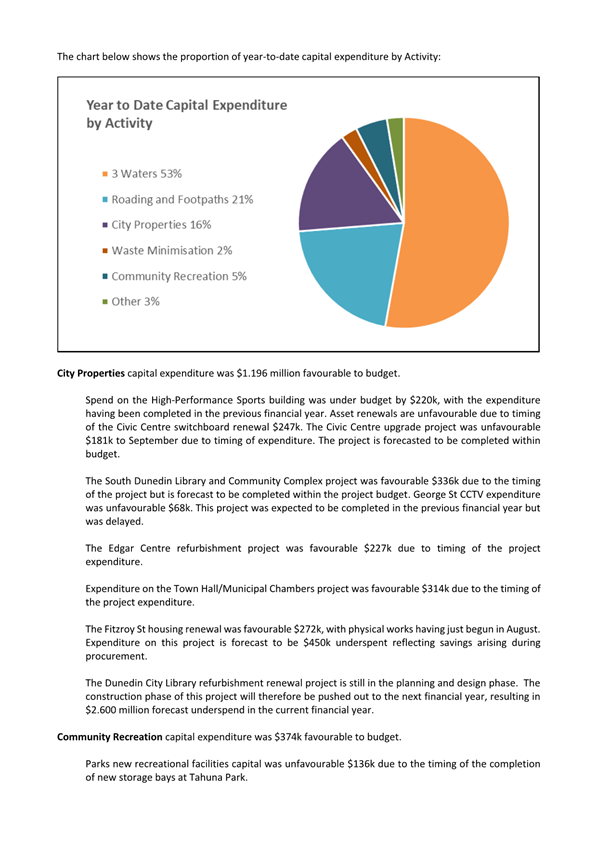
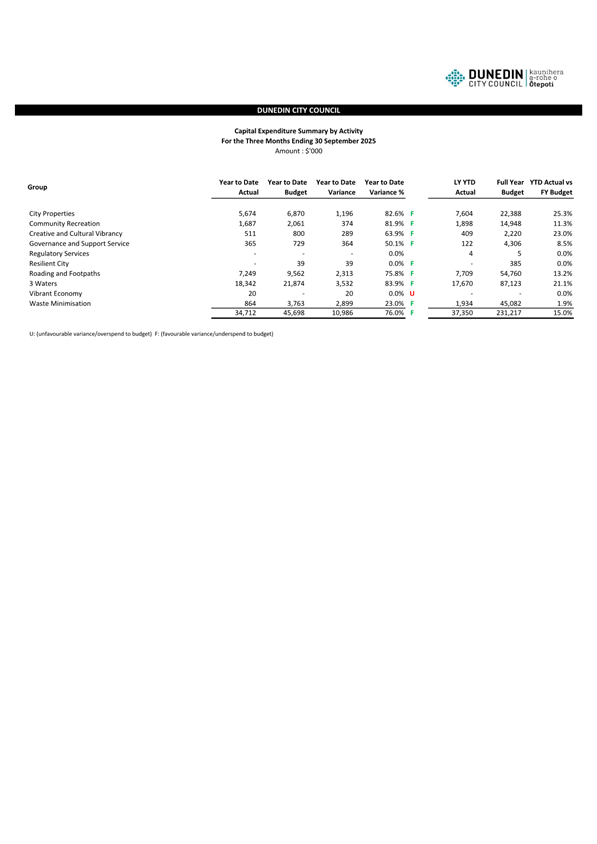
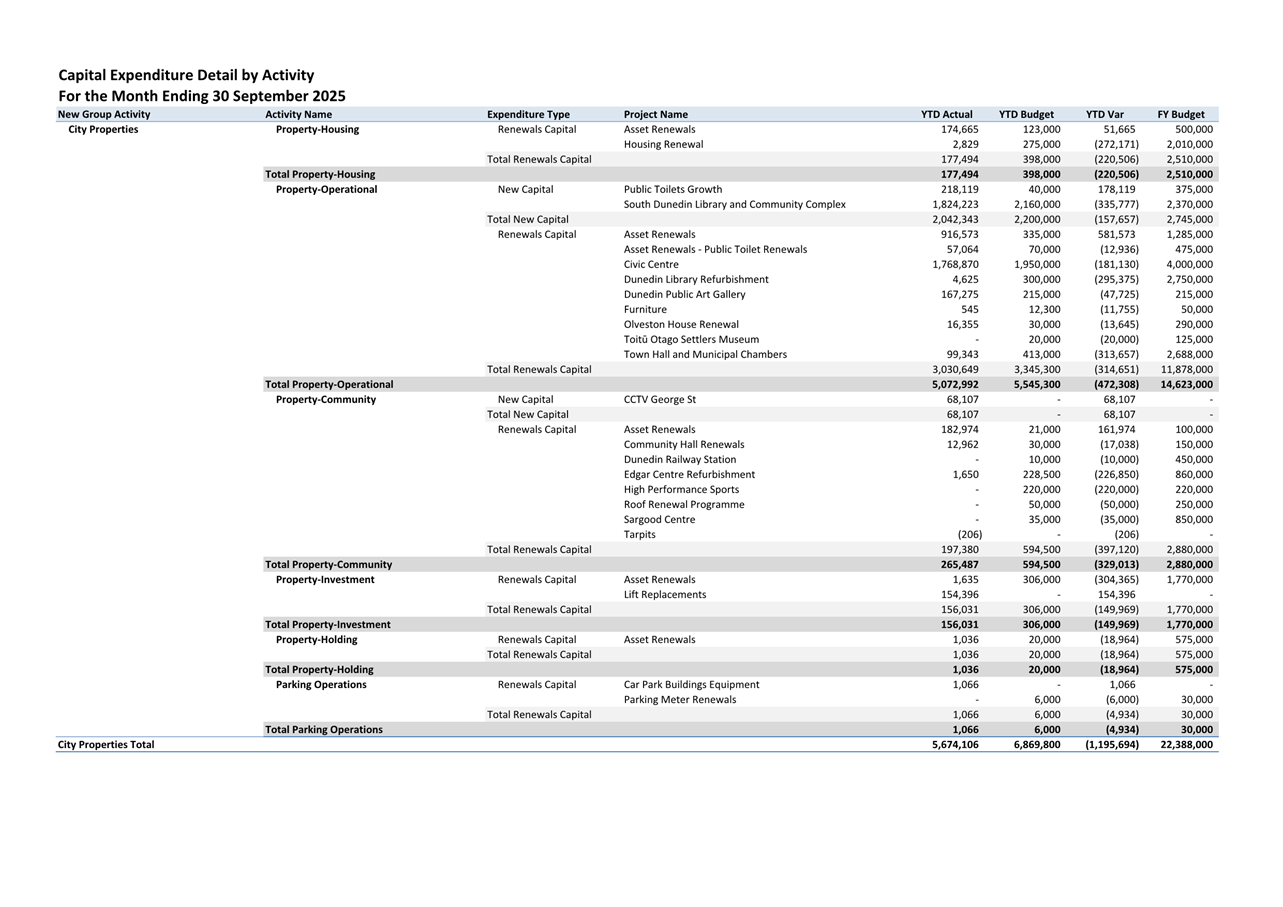
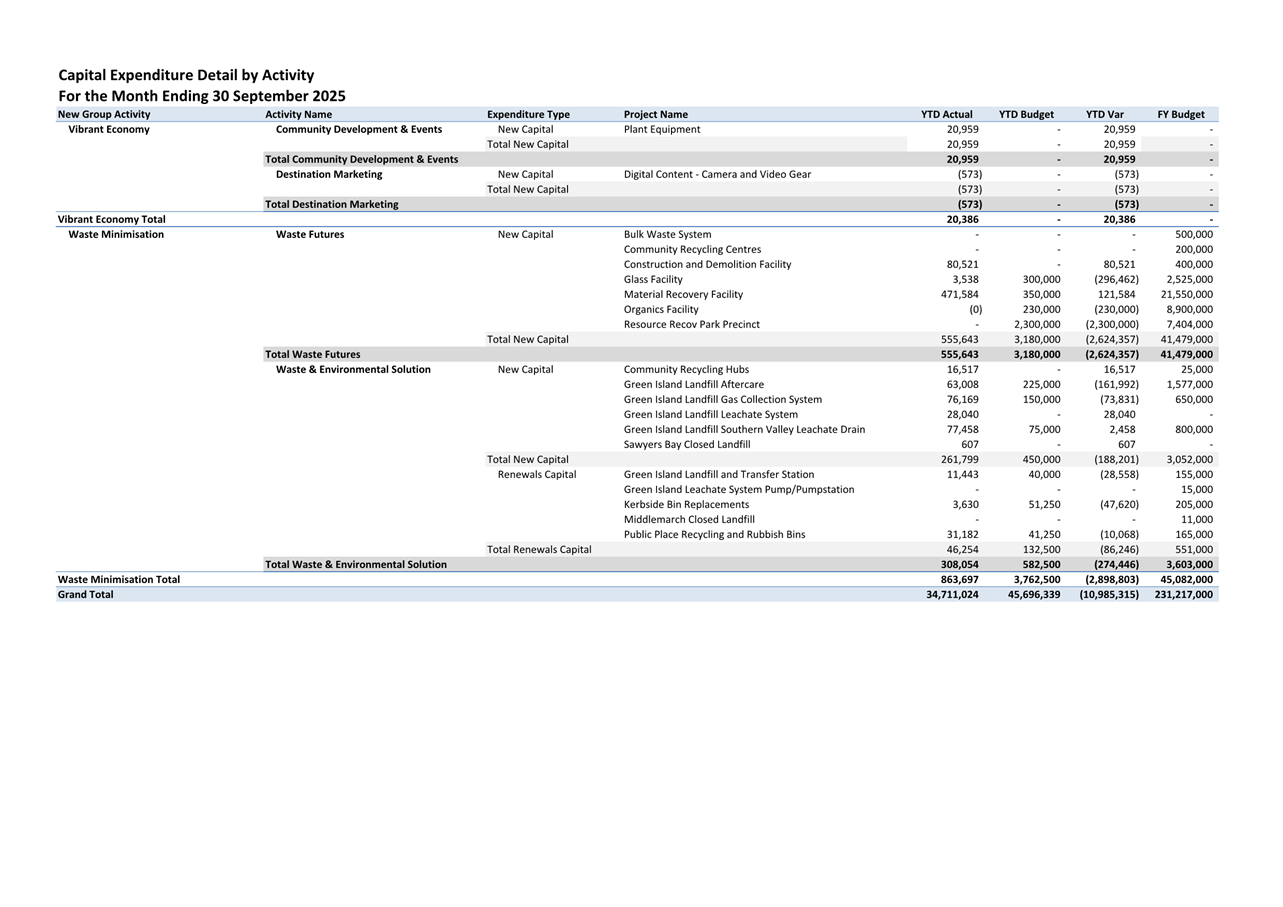
6 Capital
expenditure was $34.712 million for the period ended 30 September 2025 or 76.0%
of the year-to-date budget.
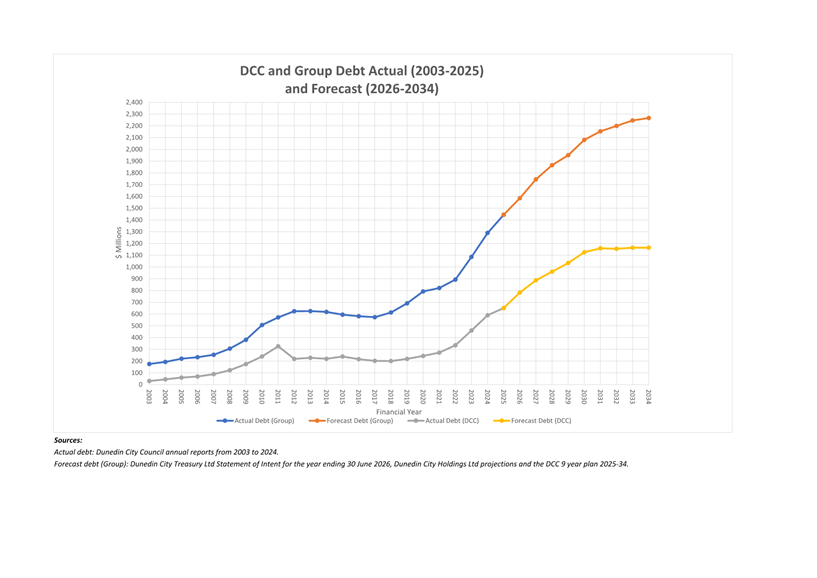
7 The
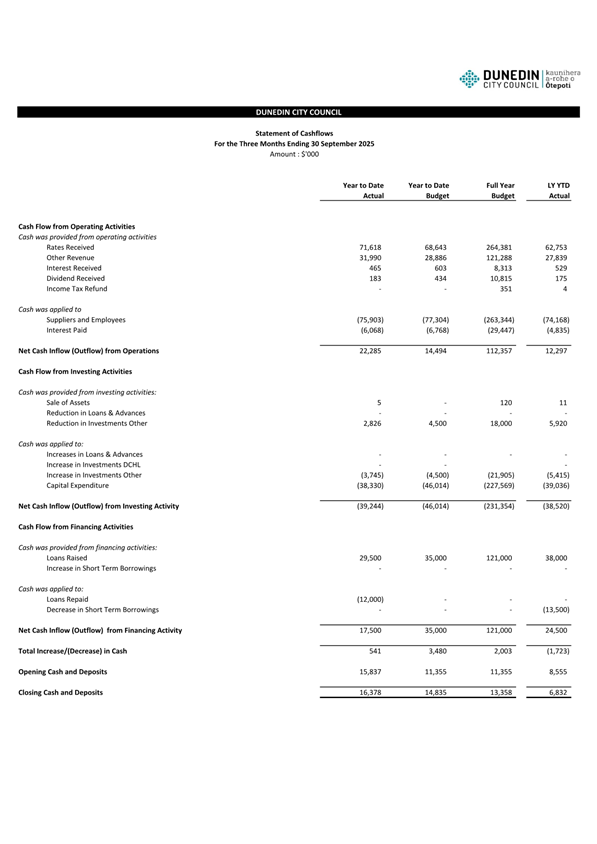
total loan balance at 30 September 2025 was $668.472 million which was $28.701
million less than budget.
OPTIONS
8 As
this is an administrative report only, there are no options provided.
NEXT STEPS
9 Month
end financial reports continue be presented to future Council meetings.
Signatories
|
Author:
|
Lawrie Warwood - Financial Analyst
|
|
Authoriser:
|
Hayden McAuliffe - Financial Services Manager
Carolyn Allan - Chief Financial Officer
|
Attachments
|
|
Title
|
Page
|
|
⇩a
|
Financial Update
|
72
|
|
⇩b
|
Statement of Financial
Performance
|
83
|
|
⇩c
|
Statement of Financial
Position
|
84
|
|
⇩d
|
Statement of Cashflows
|
85
|
|
⇩e
|
Capital Expenditure
Summary
|
86
|
|
⇩f
|
Capital Expenditure
Detailed
|
87
|
|
⇩g
|
Summary of Operating
Variances
|
93
|
|
⇩h
|
Debt Graph
|
94
|
|

|
Audit, Risk and Assurance Committee
4 December 2025
|
|

|
Audit, Risk and Assurance Committee
4 December 2025
|
|

|
Audit, Risk and Assurance Committee
4 December 2025
|
|
|
Audit, Risk and Assurance Committee
4 December 2025
|
|

|
Audit, Risk and Assurance Committee
4 December 2025
|
|

|
Audit, Risk and Assurance Committee
4 December 2025
|
|
|
Audit, Risk and Assurance Committee
4 December 2025
|
|
|
Audit, Risk and Assurance Committee
4 December 2025
|
|

|
Audit, Risk and Assurance Committee
4 December 2025
|
Financial Strategy Compliance - November 2025
Department: Finance
EXECUTIVE SUMMARY
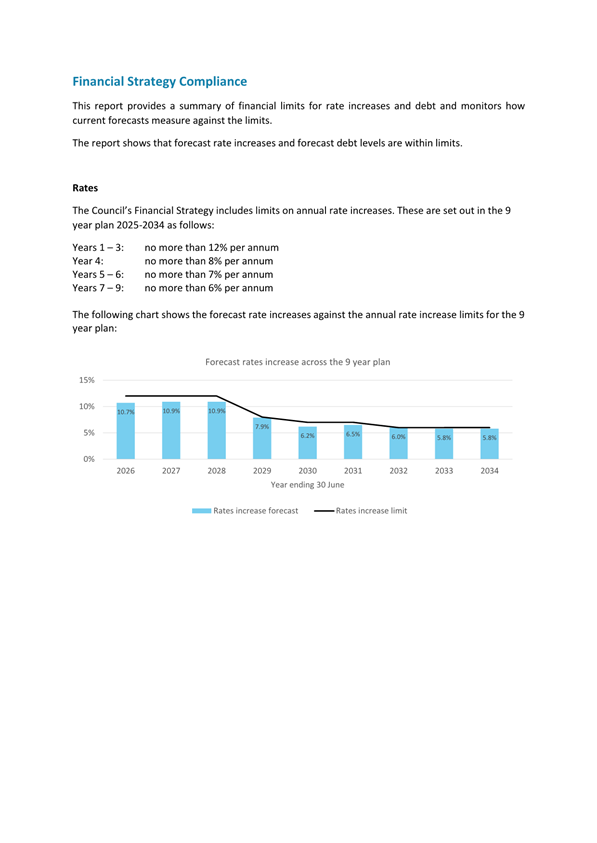
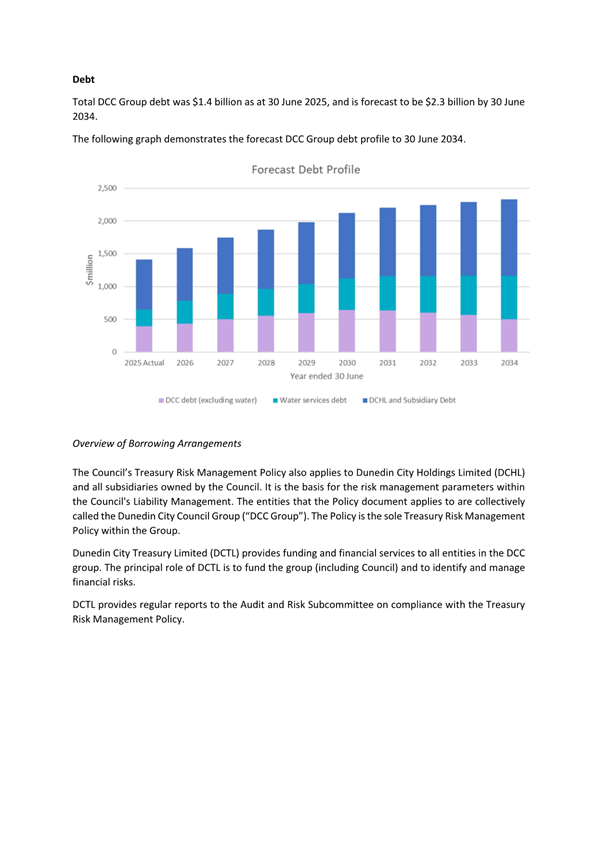
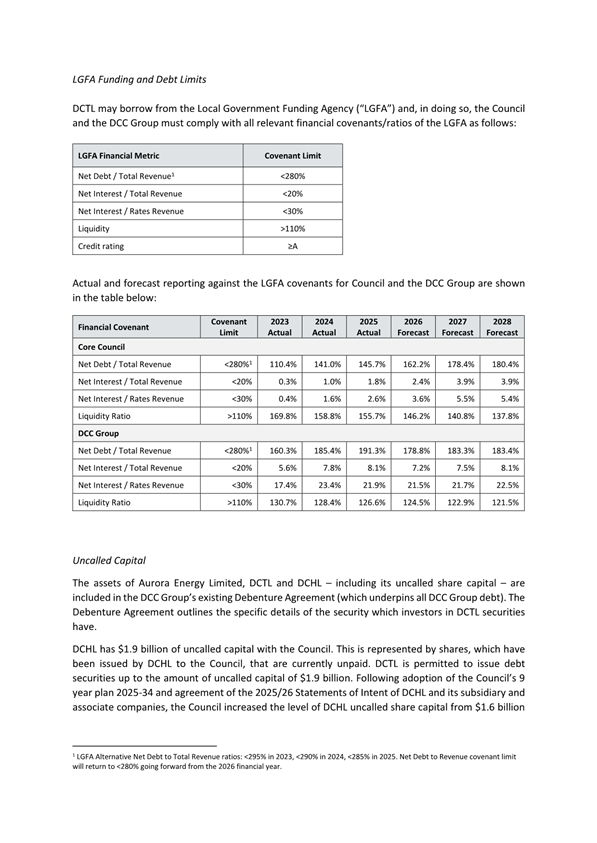
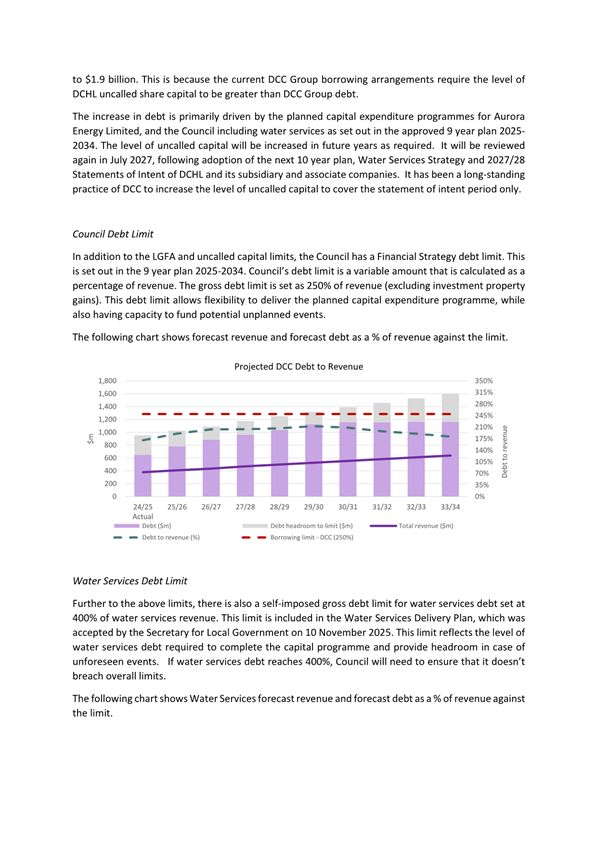
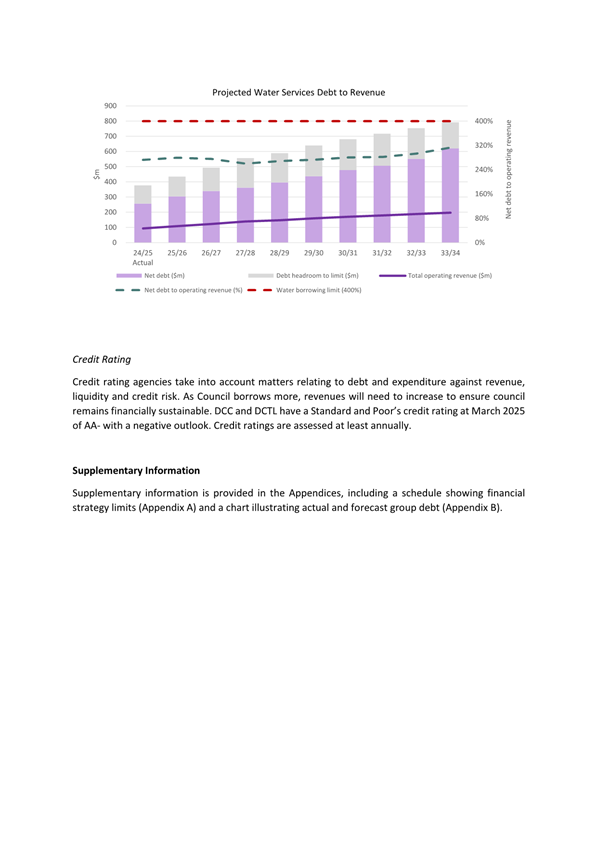
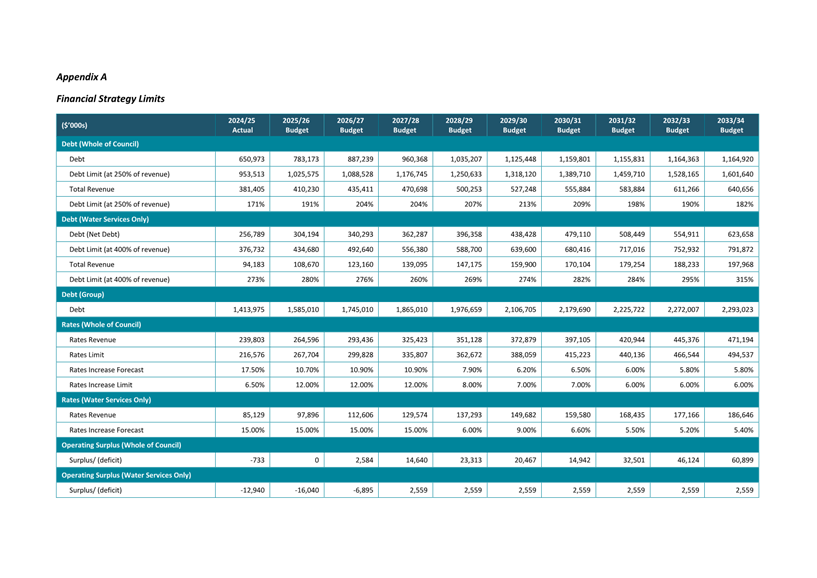
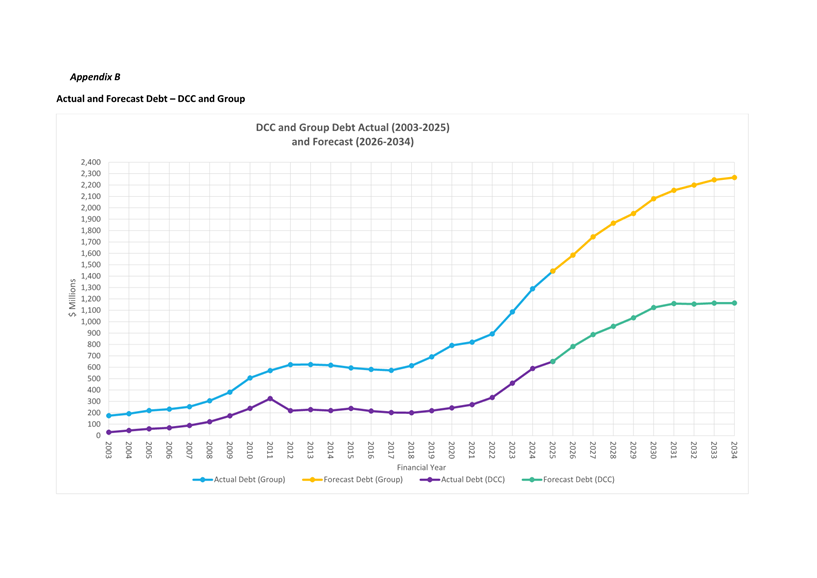
1 The
attached report provides a summary of rate and debt limits, including group
debt limits. The purpose of the report is to monitor compliance against
these limits.
2 As
this is an administrative report only, the Summary of Considerations is not
required.
RECOMMENDATIONS
That the Committee:
a) Notes the Financial
Strategy Compliance – November 2025.
BACKGROUND
3 The
report provided in Attachment A shows compliance with Financial Strategy limits
and group debt limits. It summarises rates and debt limits as well as forecast
rates and debt levels for the period of the 9 year plan. Actual financial
information for the year ended 30 June 2025 is also now provided.
4 The
report uses financial forecasts from the 9 year plan, the Dunedin City Treasury
Limited Statement of Intent for the year ending 30 June 2026 and Dunedin City
Holdings Limited projections as at 30 June 2025.
NEXT STEPS
5 Financial
Strategy Compliance Reports will be provided quarterly to the Audit, Risk and
Assurance Committee.
Signatories
|
Author:
|
Tony Nelmes - Project Accountant
|
|
Authoriser:
|
Carolyn Allan - Chief Financial Officer
|
Attachments
|
|
Title
|
Page
|
|
⇩a
|
Financial Strategy
Compliance
|
96
|
|
|
Audit, Risk and Assurance Committee
4 December 2025
|
|

|
Audit, Risk and Assurance Committee
4 December 2025
|
Elected Member Gifts and Hospitality - Guidance
Department: Finance
EXECUTIVE SUMMARY
1 This
report provides an overview to the Audit, Risk and Assurance Committee (ARAC)
of the management of gifts and hospitality offered to elected members.
RECOMMENDATIONS
That the Committee:
a) Notes the Elected
Member Gifts and Hospitality – Guidance report.
BACKGROUND
2 The
offer of gifts and/or hospitality from third parties can constitute a personal
thank you or be appropriate for relationship management because of the nature
of the elected members role. However, gifts and/or hospitality offered by third
parties can create an actual, potential, or perceived conflict of interest.
3 By
managing conflicts of interest, the DCC ensures that all decision-making
processes and business activities cannot be justifiably challenged based on any
actual, potential, or perceived bias, or conflict of interest. Guidance has
been provided by the Office of the Auditor General on the management of
conflicts of interest and includes a scenario regarding gifts and hospitality
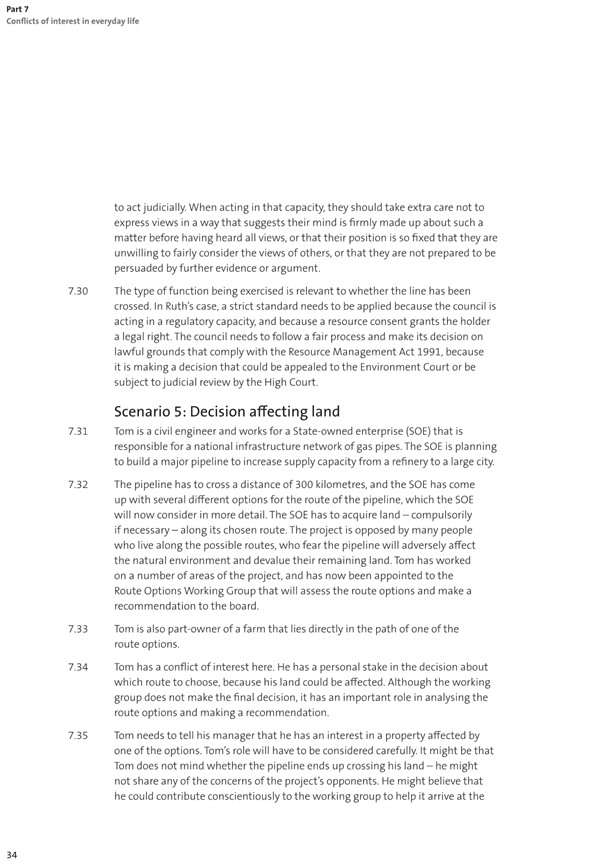
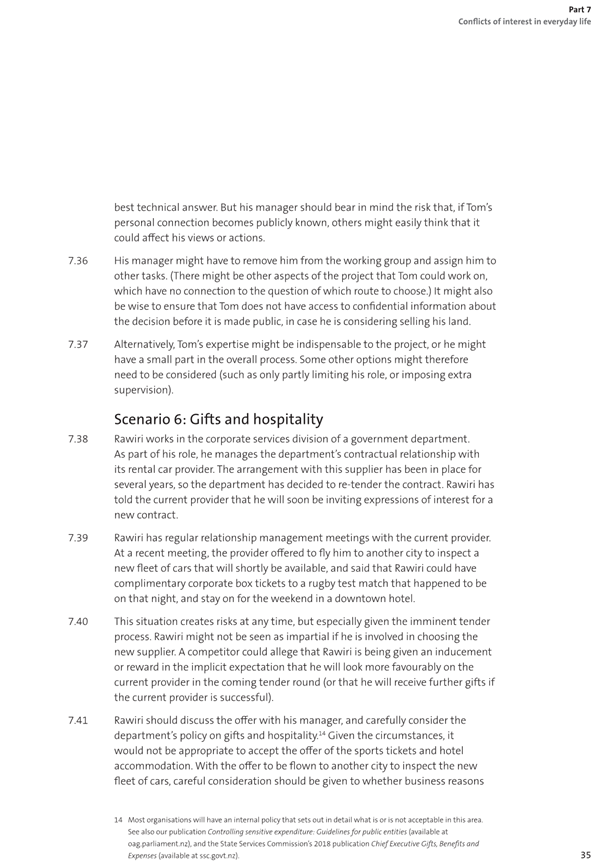
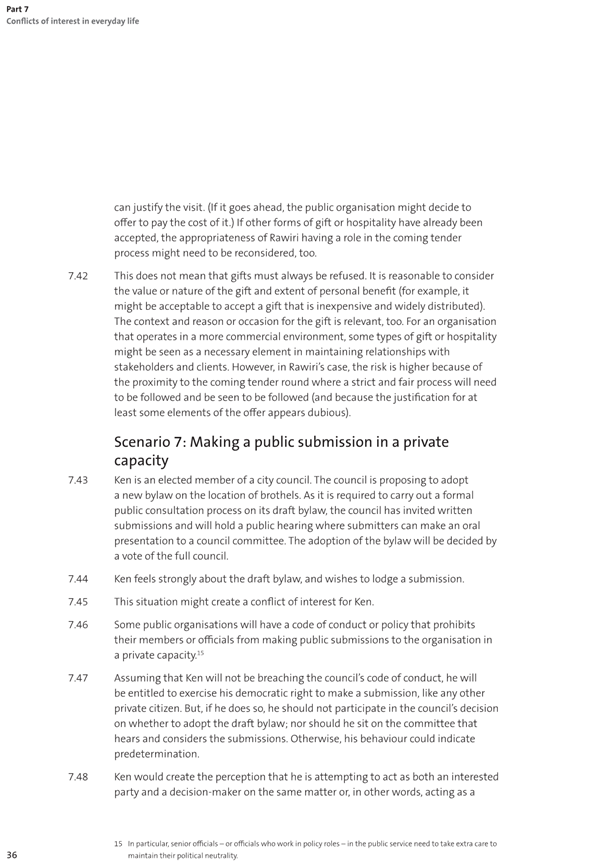
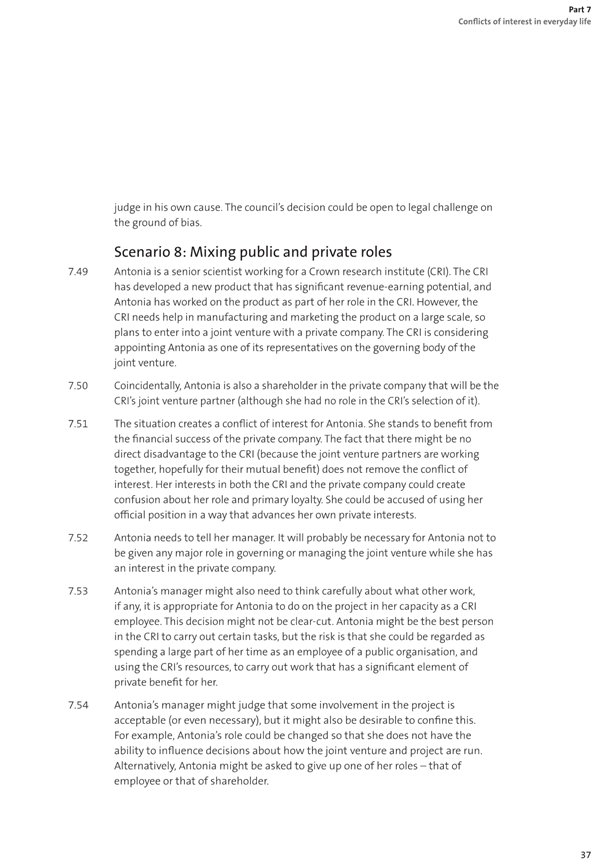
(attachment A).
4 At
a minimum the Local Government (Pecuniary Interests Register) Amendment Act
2022 requires elected members to declare gifts and hospitality valued at or
over $500.
5 The
Dunedin City Council has a limit for elected members of $50 for declaration as
per the code of conduct - https://www.dunedin.govt.nz/resources/documents/council/mayor-and-councillors/mayor/Code-of-Conduct-Oct-2019.pdf
6 The
$50 limit aligns with the DCC staff policy, and the table below captures the
limits for elected members from some of the other local authorities.
|
Local Authority
|
Limit for declaration
|
|
Ashburton District Council
|
$500
|
|
Christchurch City Council
|
$500
|
|
Queenstown Lakes District
Council
|
$500
|
|
Wellington City Council
|
$500
|
|
Hamilton City Council
|
$150
|
|
Auckland City Council
|
$100
|
|
Gisborne District Council
|
$100
|
|
Dunedin City
Council
|
$50
|
|
Hastings District Council
|
$50
|
|
Hutt City Council
|
$50
|
|
Invercargill City Council
|
$50
|
|
Kāpiti
Coast District Council
|
$50
|
|
Manawatū
District Council
|
$50
|
|
Napier City Council
|
$50
|
|
Tauranga City Council
|
$50
|
DISCUSSION
7 At
a recent fraud awareness and prevention training session for elected members,
questions were raised on what is acceptable or not regarding gifts and
hospitality. It was recognised that there needs to be further guidance and a
clear process for elected members on what to do when offered gifts and
hospitality as a part of their role for the DCC. The following sections aim to
provide that clarity.
8 Gifts
and hospitality are defined as follows:
a) Gifts
can be defined as any benefit provided as a good or service an elected members
receives in association with work at the DCC, from a third party. Gifts can
include, but are not limited to:
· Bottles
of wine
· Flowers
· Prizes
won in ‘business card draws’ at DCC-funded conferences
· Tickets
to an event
· Invitations
to attend an event which has a price tag, including corporate boxes or
corporate areas at any function.
b) Hospitality
is defined as a type of gift that involves food, drink, entertainment, or a
meal. It involves being hosted by a person or organisation at an occasion or
function without the freedom to choose when, where and which guests will also
attend. Hospitality includes, but is not limited to:
· Meals
(includes breakfast, lunch, dinner) paid for the third party with business
associates or networks for any purpose.
· Corporate
hospitality surrounding events.
· Corporate
functions that are catered.
9 Any
gifts or hospitality offered at or over the value of $50 needs to be declared,
regardless of if it was accepted or not.
10 An initial
gifts and hospitality register for elected members has been set-up with elected
members required to declare to the Councillor Support email Councillor.Support@dcc.govt.nz
An electronic form is under development.
11 The elected
members gift and hospitality register will be reviewed by ARAC every quarter.
Any identified gifts and hospitality valued at or over $500 will also be
included on the relevant members pecuniary interests register.
12 Like that
of the staff gifts and hospitality register, the elected members register will
capture:
a) Date
the gift/hospitality was offered.
b) Who the
gift/hospitality was offered to.
c) The
name of the third party (company or individual).
d) Description
of gift/hospitality.
e) Estimated
value.
f) Comments
on action (accepted, declined, offered to pay etc.)
g) Any
other relevant background (e.g. known DCC supplier, known grant recipient etc.)
13 If elected
members are unsure on what is appropriate to accept or not, they should seek
guidance from the CEO, or Chair of the Audit, Risk and Assurance Committee.
OPTIONS
14 There are
no options as this is an update report.
NEXT STEPS
15 Continue
development of an electronic form for the elected members gifts and hospitality
register.
16 Circulate
this guidance to elected members.
17 Report to
ARAC the elected members gifts and hospitality register alongside the staff
register.
Signatories
|
Author:
|
Hayley Knight - Assurance Manager
|
|
Authoriser:
|
Carolyn Allan - Chief Financial Officer
|
Attachments
|
|
Title
|
Page
|
|
⇩a
|
OAG Conflicts of
Interest Guidance
|
108
|
|

|
Audit, Risk and Assurance Committee
4 December 2025
|


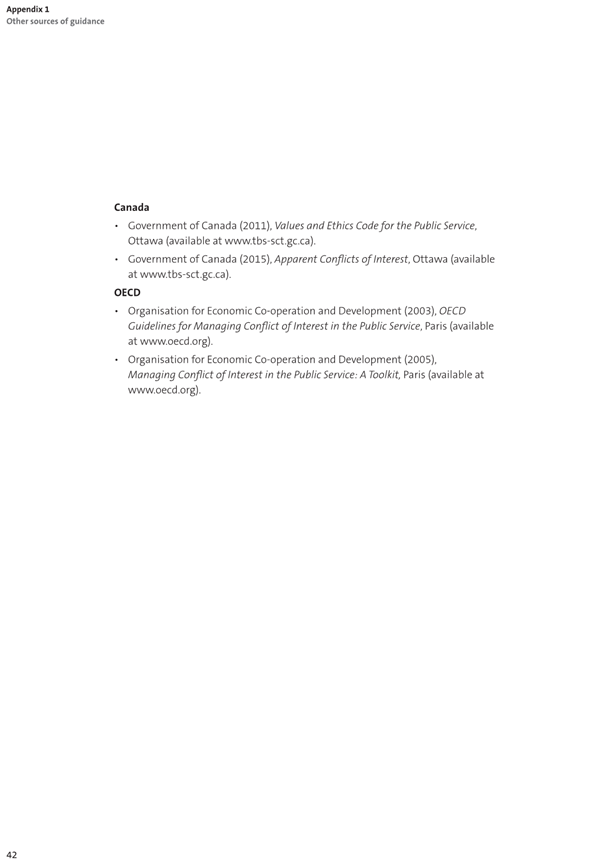
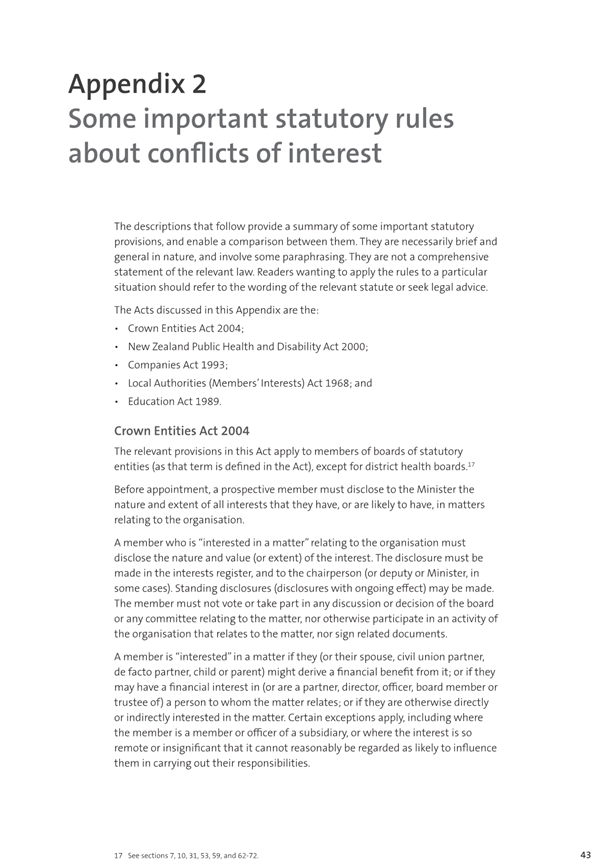
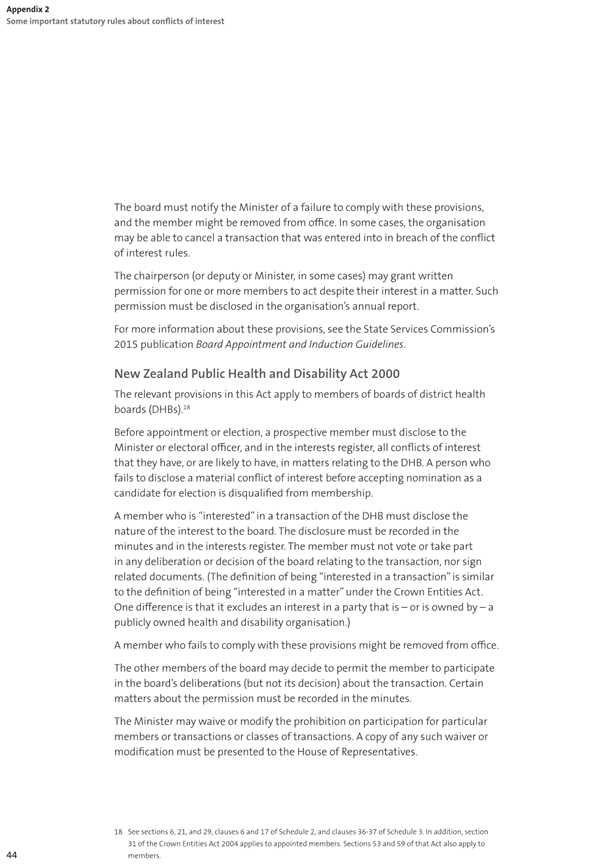
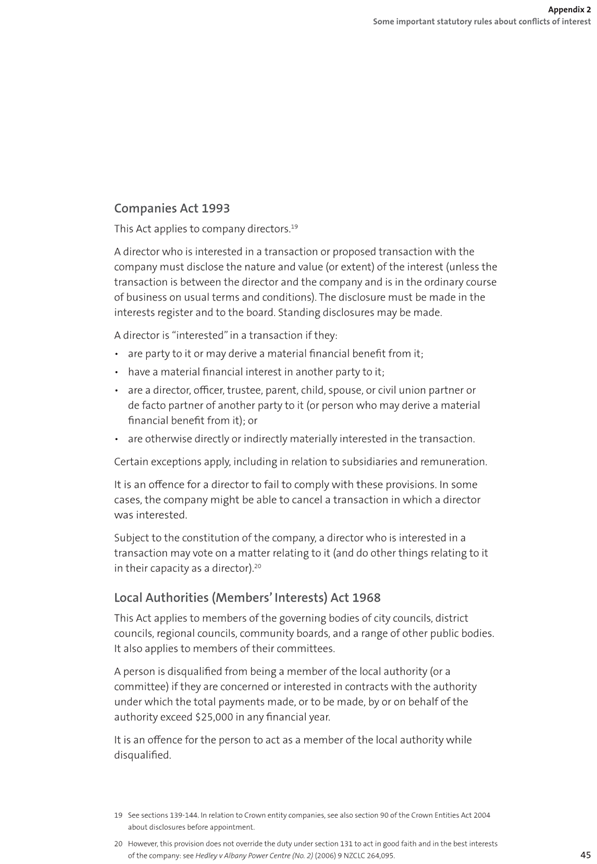
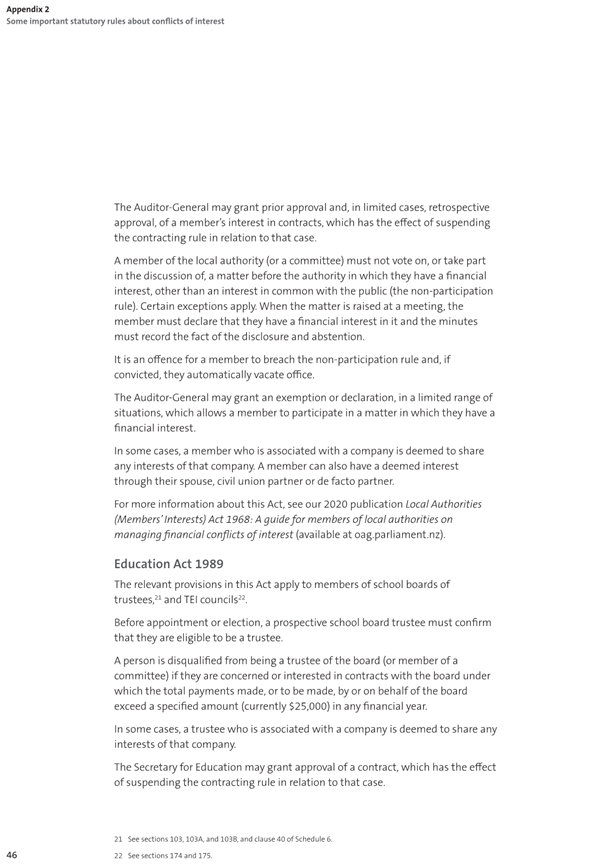
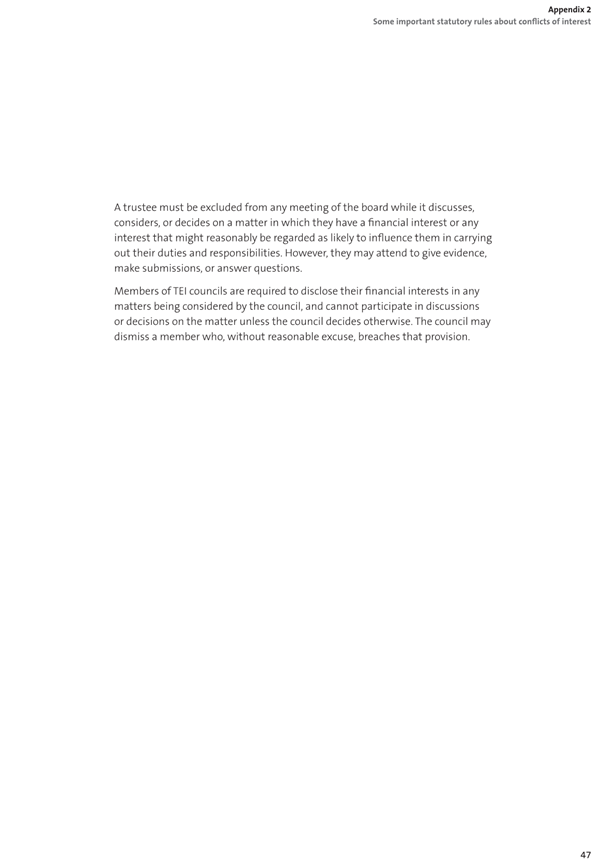
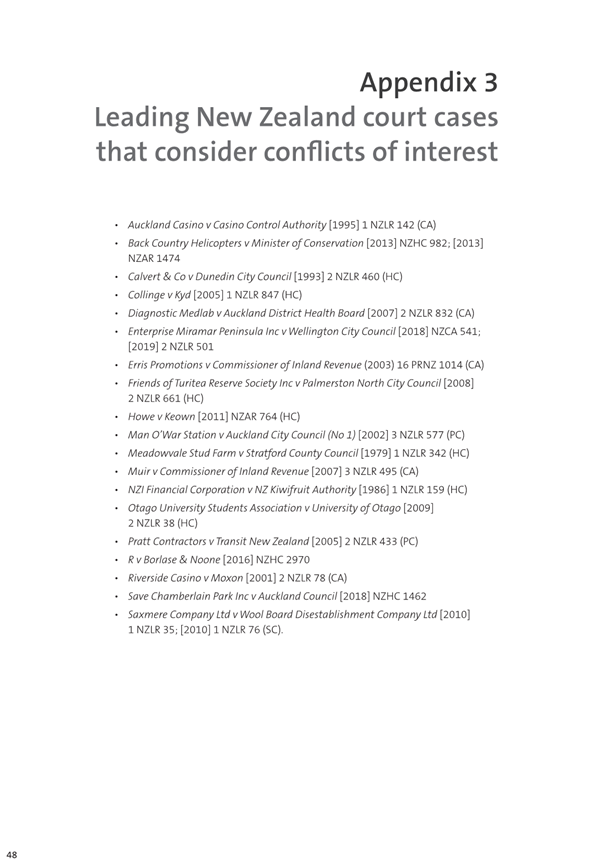

|

|
Audit, Risk and Assurance
Committee
4 December 2025
|
Resolution to Exclude the
Public
That the Audit, Risk and
Assurance Committee:
Pursuant to the provisions of the
Local Government Official Information and Meetings Act 1987, exclude the public
from the following part of the proceedings of this meeting namely:
|
General subject of the matter to be considered
|
Reasons
for passing this resolution in relation to each matter
|
Ground(s) under
section 48(1) for the passing of this resolution
|
Reason for
Confidentiality
|
|
C1
Treasury Risk Management Compliance Report
|
S7(2)(h)
The
withholding of the information is necessary to enable the local authority to
carry out, without prejudice or disadvantage, commercial activities.
|
S48(1)(a)
The public conduct of
the part of the meeting would be likely to result in the disclosure of
information for which good reason for withholding exists under section 7.
|
|
|
C2
Dunedin City Holdings Ltd - Update on Audit and Risk Activity
|
S7(2)(b)(ii)
The
withholding of the information is necessary to protect information where the
making available of the information would be likely unreasonably to prejudice
the commercial position of the person who supplied or who is the subject of
the information.
|
S48(1)(a)
The public conduct of
the part of the meeting would be likely to result in the disclosure of
information for which good reason for withholding exists under section 7.
|
|
|
C3
Report to the Council on the Audit of Dunedin City Council for year end 30
June 2025
|
S7(2)(b)(ii)
The
withholding of the information is necessary to protect information where the
making available of the information would be likely unreasonably to prejudice
the commercial position of the person who supplied or who is the subject of
the information.
|
S48(1)(a)
The public conduct of
the part of the meeting would be likely to result in the disclosure of
information for which good reason for withholding exists under section 7.
|
|
|
C4
Finance Operational Assurance Report
|
S7(2)(h)
The
withholding of the information is necessary to enable the local authority to
carry out, without prejudice or disadvantage, commercial activities.
|
S48(1)(a)
The public conduct of
the part of the meeting would be likely to result in the disclosure of
information for which good reason for withholding exists under section 7.
|
The information in this
report is commercially sensitive.
|
|
C5
Risk Deep Dive: Fraud and Corruption
|
S7(2)(c)(i)
The
withholding of the information is necessary to protect information which is
subject to an obligation of confidence or which any person has been or could
be compelled to provide under the authority of any enactment, where the
making available of the information would be likely to prejudice the supply
of similar information or information from the same source and it is in the
public interest that such information should continue to be supplied.
|
S48(1)(a)
The public conduct of
the part of the meeting would be likely to result in the disclosure of
information for which good reason for withholding exists under section 7.
|
|
|
C6
DCC External Audit Actions Update - November 2025
|
S7(2)(c)(i)
The
withholding of the information is necessary to protect information which is
subject to an obligation of confidence or which any person has been or could
be compelled to provide under the authority of any enactment, where the
making available of the information would be likely to prejudice the supply
of similar information or information from the same source and it is in the
public interest that such information should continue to be supplied.
|
S48(1)(a)
The public conduct of
the part of the meeting would be likely to result in the disclosure of
information for which good reason for withholding exists under section 7.
|
|
|
C7
Internal Audit Workplan Update
|
S7(2)(b)(i)
The
withholding of the information is necessary to protect information where the
making available of the information would disclose a trade secret.
S7(2)(c)(i)
The
withholding of the information is necessary to protect information which is
subject to an obligation of confidence or which any person has been or could
be compelled to provide under the authority of any enactment, where the
making available of the information would be likely to prejudice the supply
of similar information or information from the same source and it is in the
public interest that such information should continue to be supplied.
S7(2)(h)
The
withholding of the information is necessary to enable the local authority to
carry out, without prejudice or disadvantage, commercial activities.
|
S48(1)(a)
The public conduct of
the part of the meeting would be likely to result in the disclosure of
information for which good reason for withholding exists under section 7.
|
|
|
C8
Improvement Opportunities - Actions Update
|
S7(2)(c)(i)
The
withholding of the information is necessary to protect information which is
subject to an obligation of confidence or which any person has been or could
be compelled to provide under the authority of any enactment, where the
making available of the information would be likely to prejudice the supply
of similar information or information from the same source and it is in the
public interest that such information should continue to be supplied.
|
S48(1)(a)
The public conduct of
the part of the meeting would be likely to result in the disclosure of
information for which good reason for withholding exists under section 7.
|
|
|
C9
Protected Disclosure Register - November 2025
|
S7(2)(a)
The
withholding of the information is necessary to protect the privacy of natural
persons, including that of a deceased person.
S7(2)(c)(i)
The
withholding of the information is necessary to protect information which is
subject to an obligation of confidence or which any person has been or could
be compelled to provide under the authority of any enactment, where the
making available of the information would be likely to prejudice the supply
of similar information or information from the same source and it is in the
public interest that such information should continue to be supplied.
|
S48(1)(a)
The public conduct of
the part of the meeting would be likely to result in the disclosure of
information for which good reason for withholding exists under section 7.
|
|
|
C10
Investigation Register - November 2025
|
S7(2)(a)
The
withholding of the information is necessary to protect the privacy of natural
persons, including that of a deceased person.
S7(2)(c)(i)
The
withholding of the information is necessary to protect information which is
subject to an obligation of confidence or which any person has been or could
be compelled to provide under the authority of any enactment, where the
making available of the information would be likely to prejudice the supply
of similar information or information from the same source and it is in the
public interest that such information should continue to be supplied.
|
S48(1)(a)
The public conduct of
the part of the meeting would be likely to result in the disclosure of
information for which good reason for withholding exists under section 7.
|
|
This resolution is made in
reliance on Section 48(1)(a) of the Local Government Official Information and
Meetings Act 1987, and the particular interest or interests protected by
Section 6 or Section 7 of that Act, or Section 6 or Section 7 or Section 9 of
the Official Information Act 1982, as the case may require, which would be
prejudiced by the holding of the whole or the relevant part of the proceedings
of the meeting in public are as shown above after each item.