|

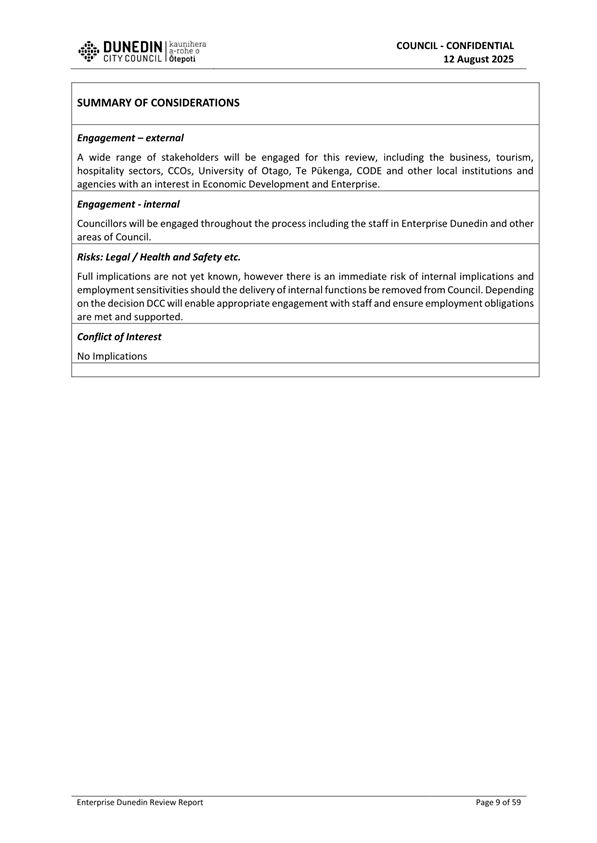
|
Council
29 January 2026
|
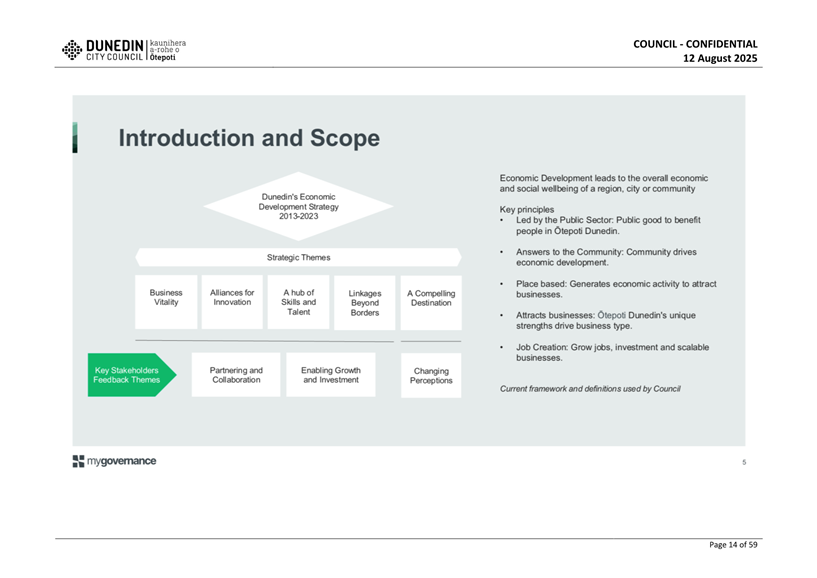
Reports
Enterprise Dunedin Review
Department: Executive Leadership Team
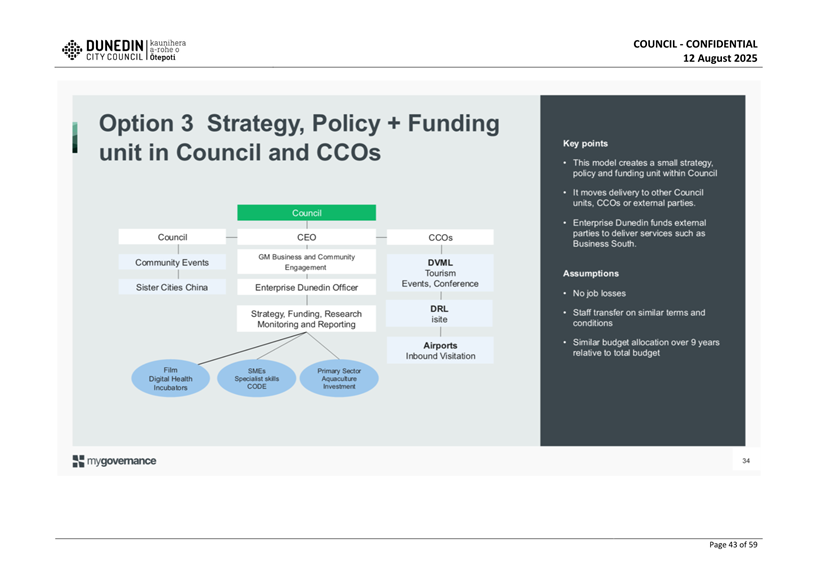
EXECUTIVE SUMMARY
1 The
report’s purpose is to inform Council deliberations on Enterprise Dunedin’s
future governance. It draws on operational data, portfolio-specific impact
assessments, benchmarking of other New Zealand economic development agencies,
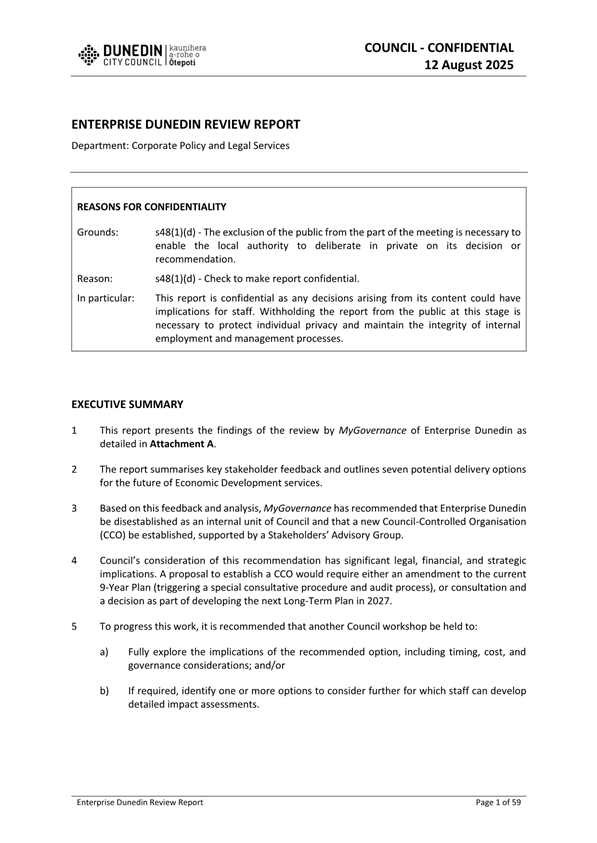
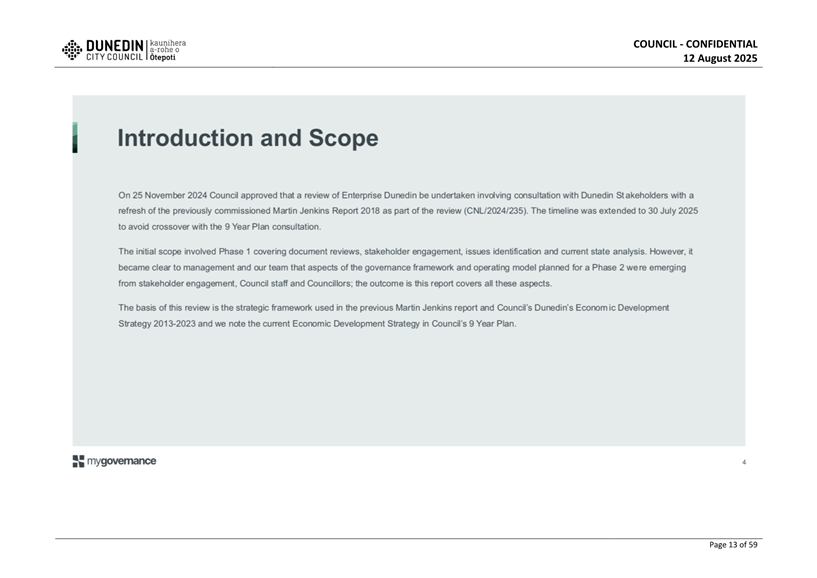
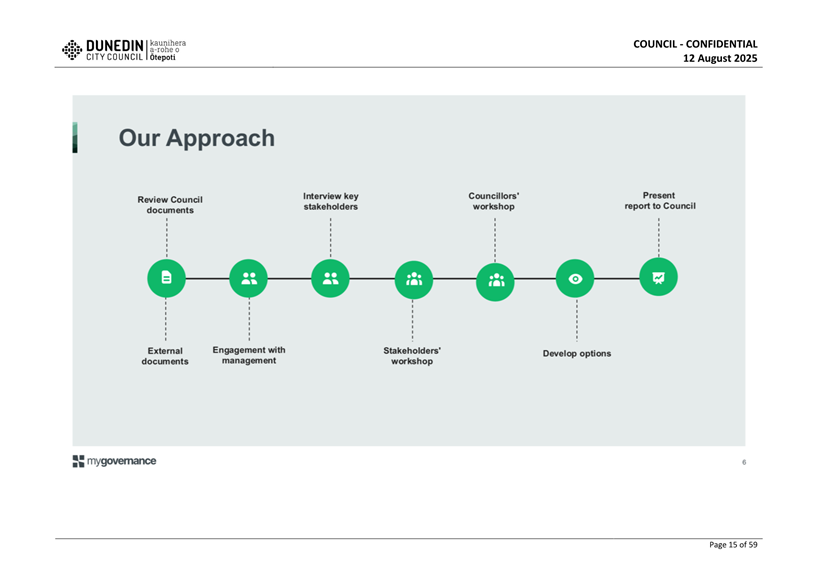
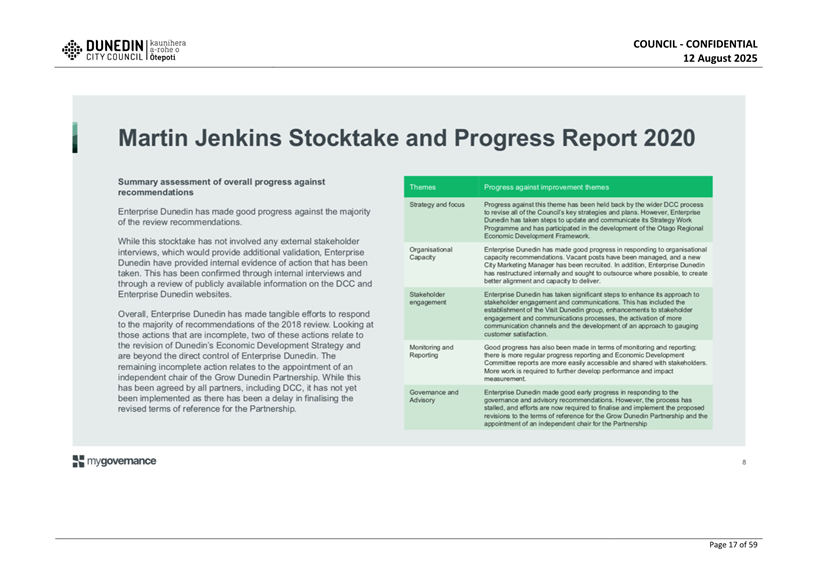
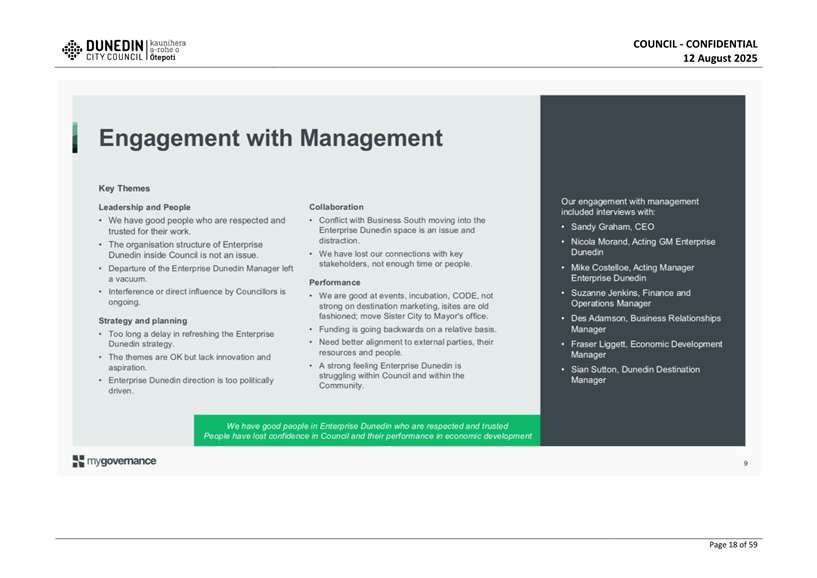
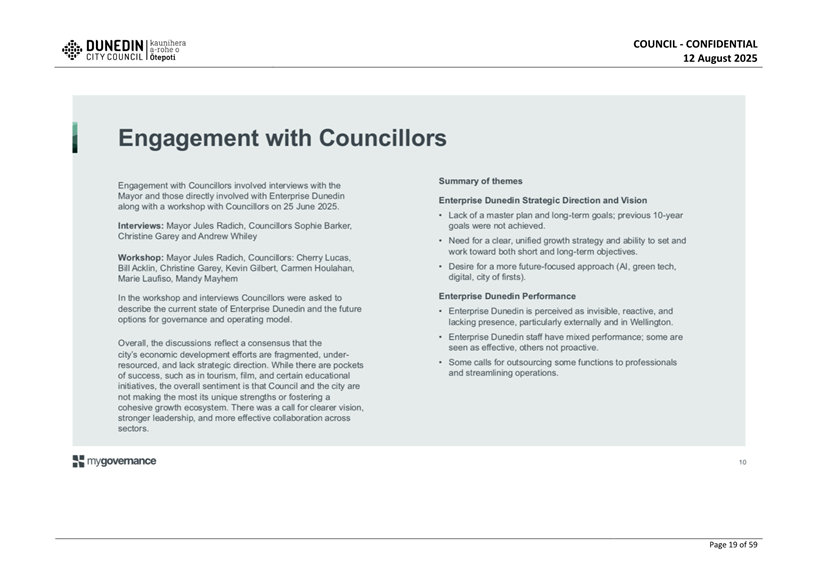
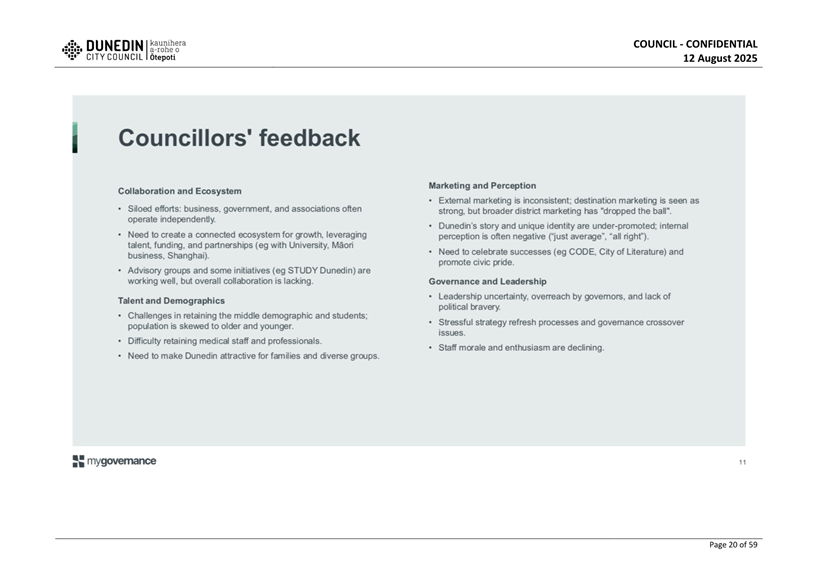
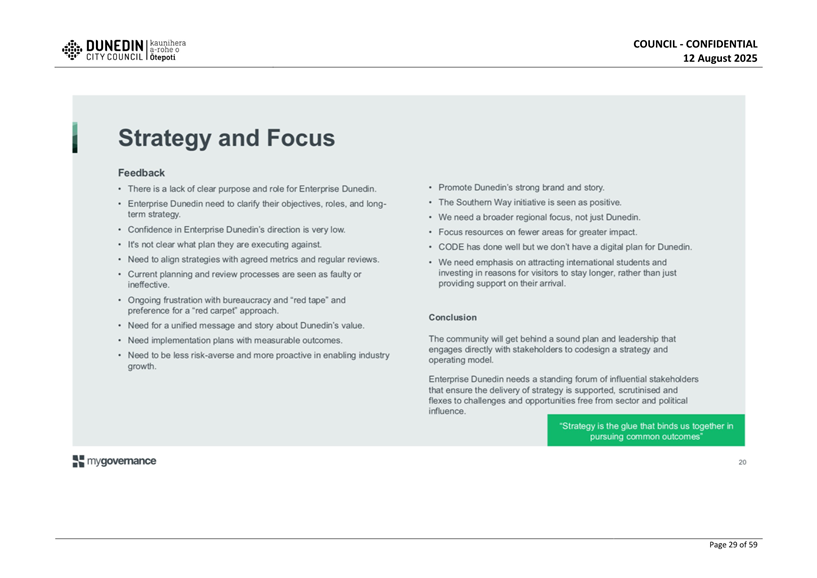
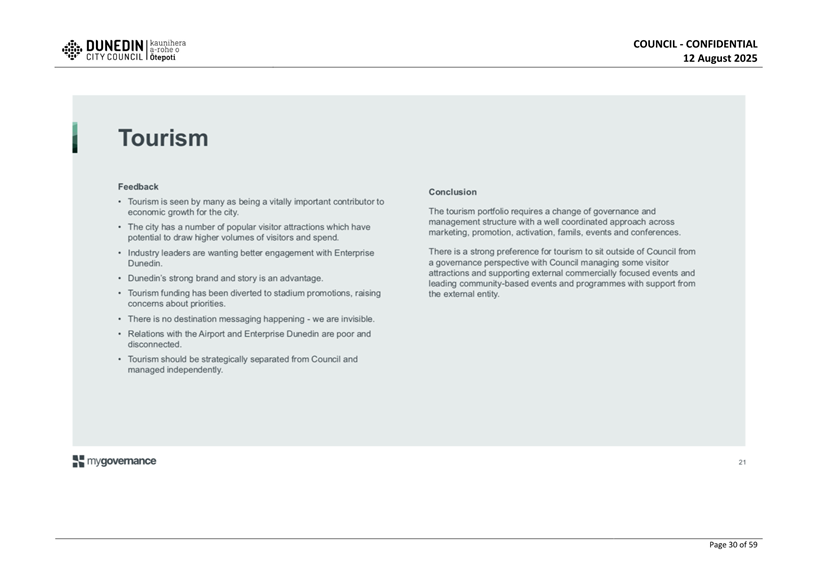
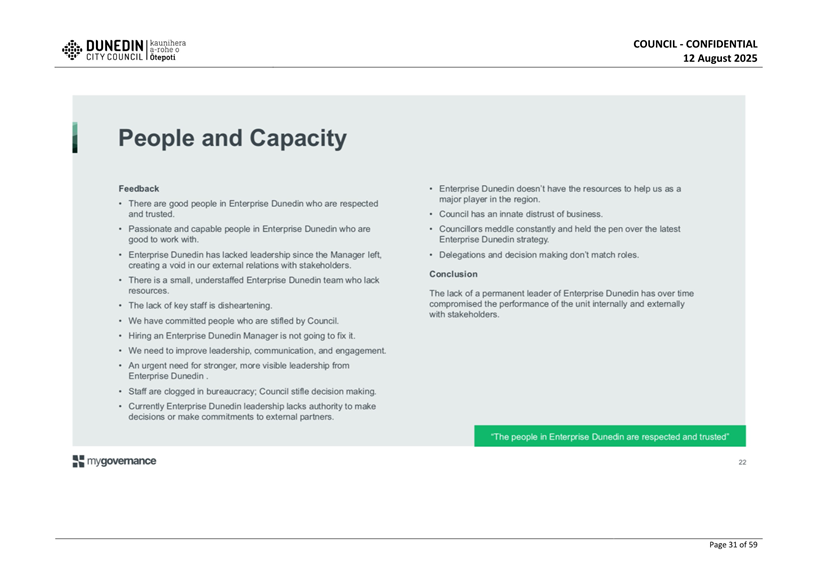
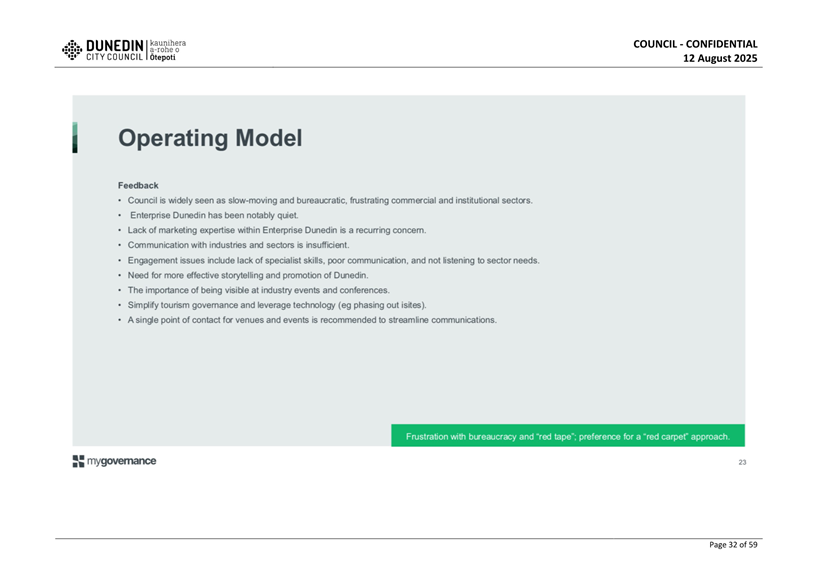
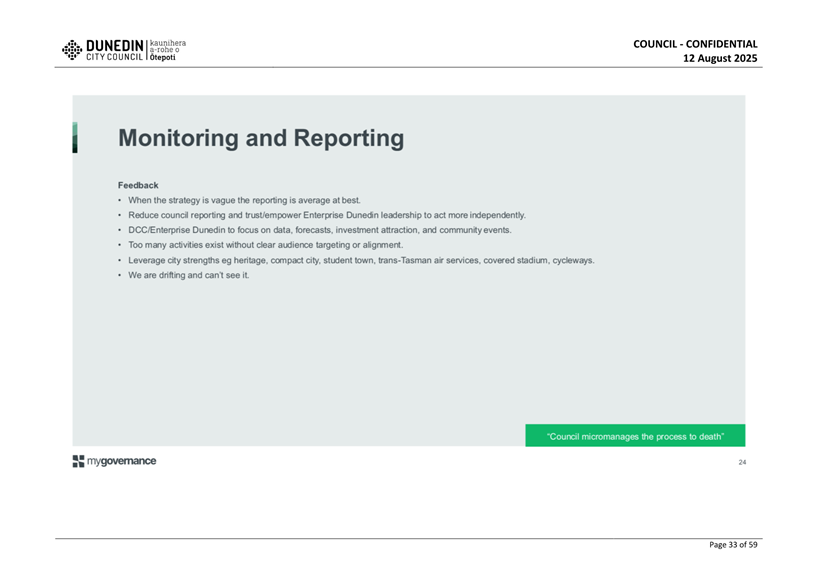
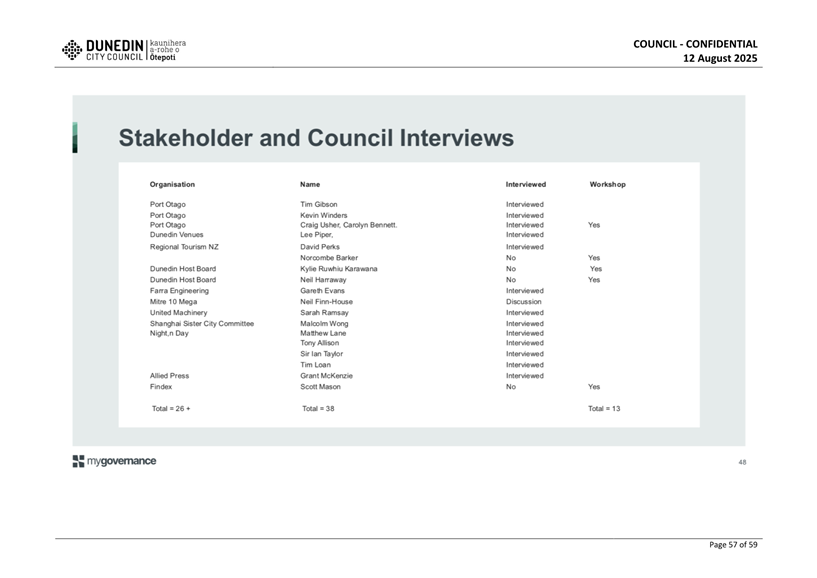
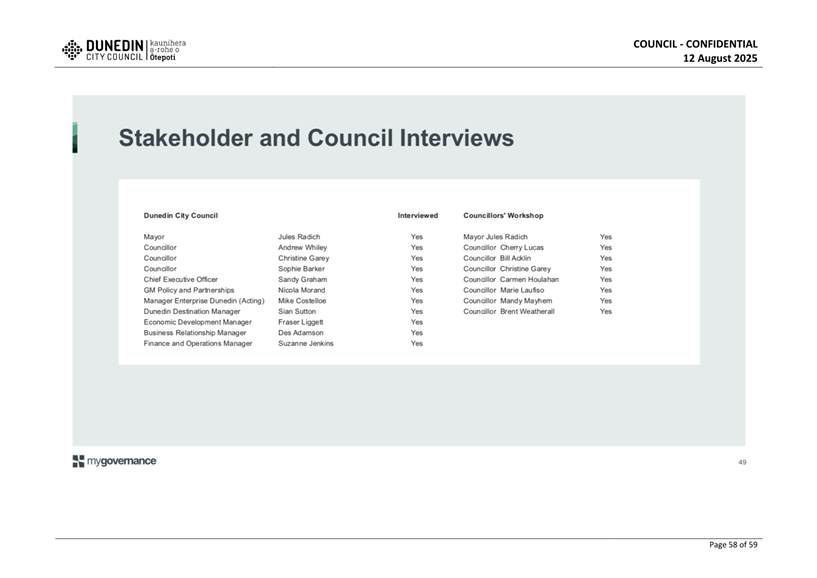
and lessons learned from similar governance changes in Auckland, Wellington,
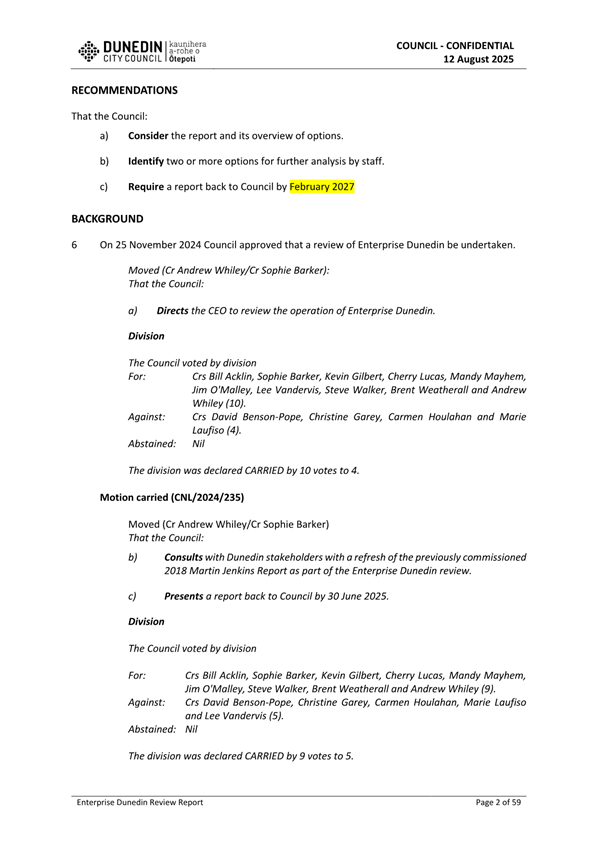
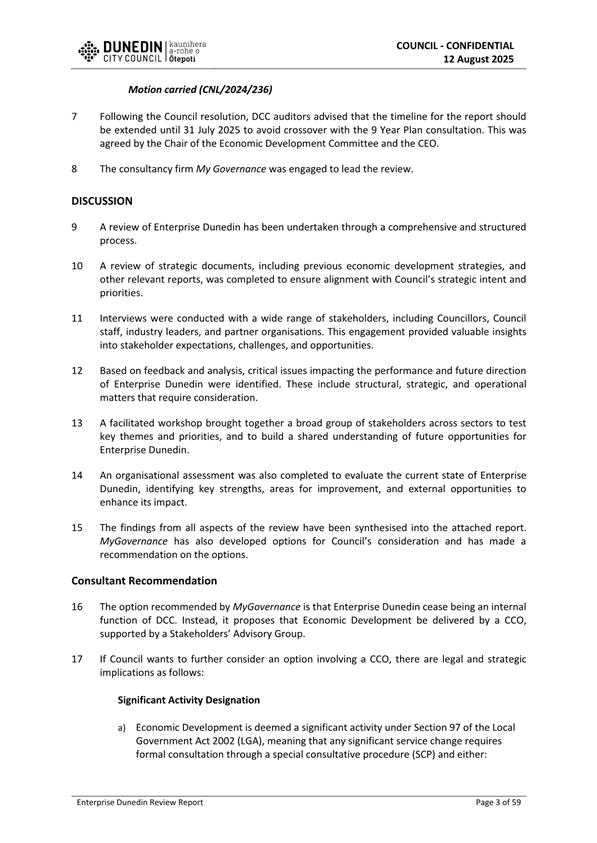
Christchurch, and other regions.
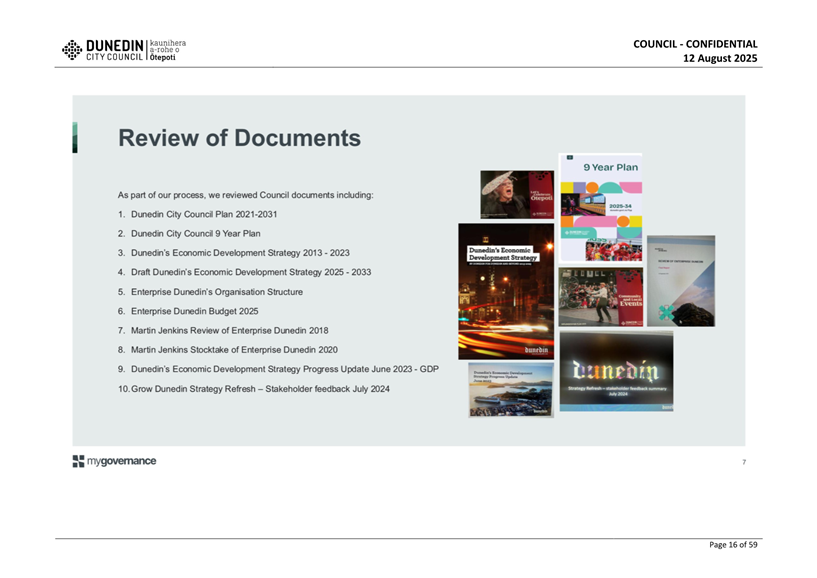
2 This
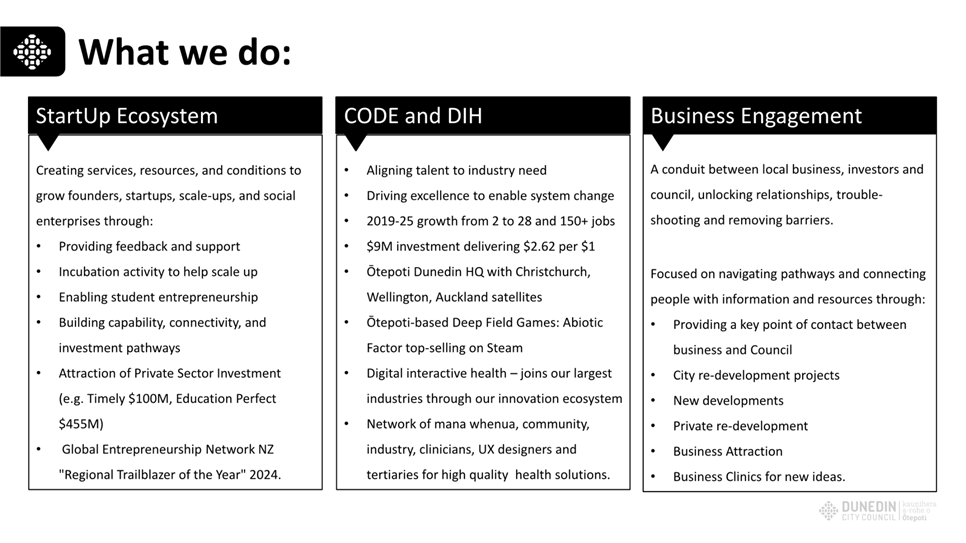
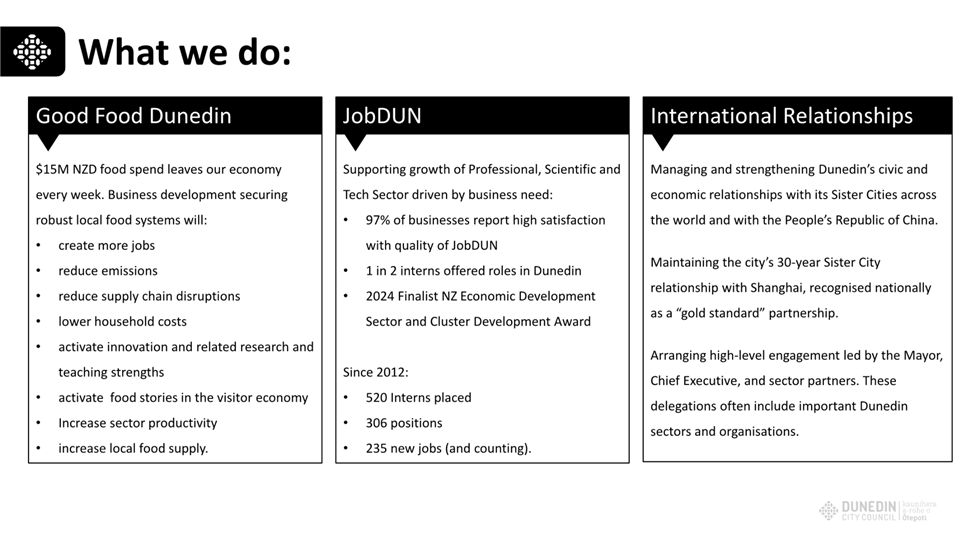
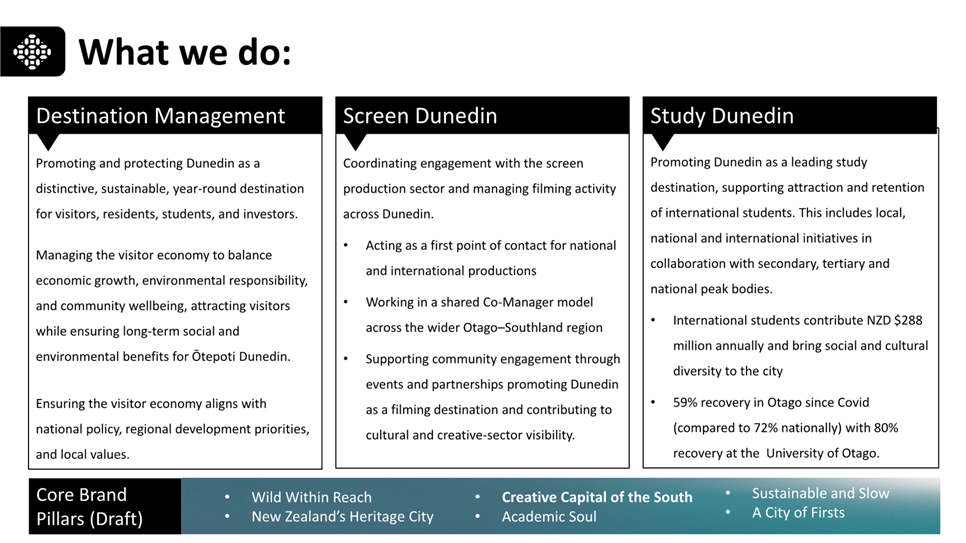
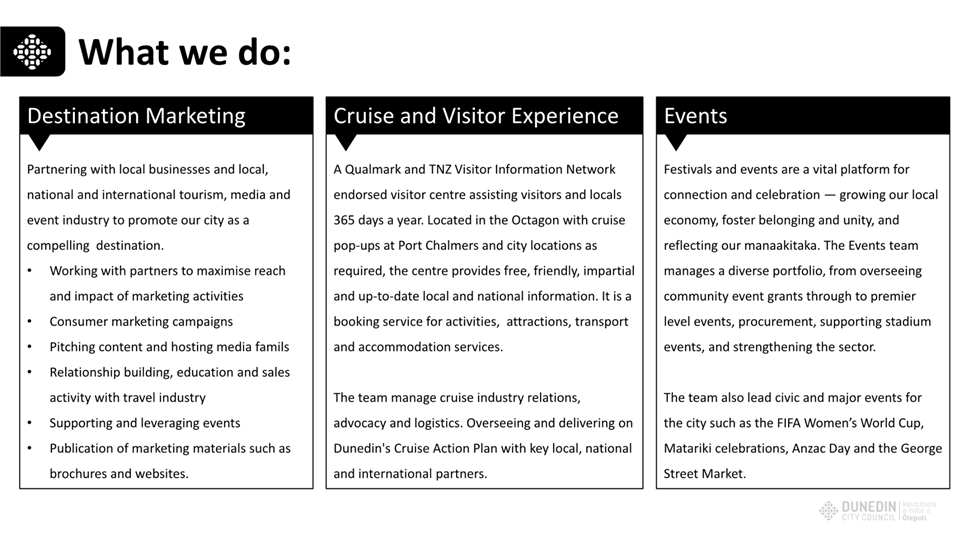
report evaluates two governance options for Enterprise Dunedin – the
Council’s economic development agency – as directed by council
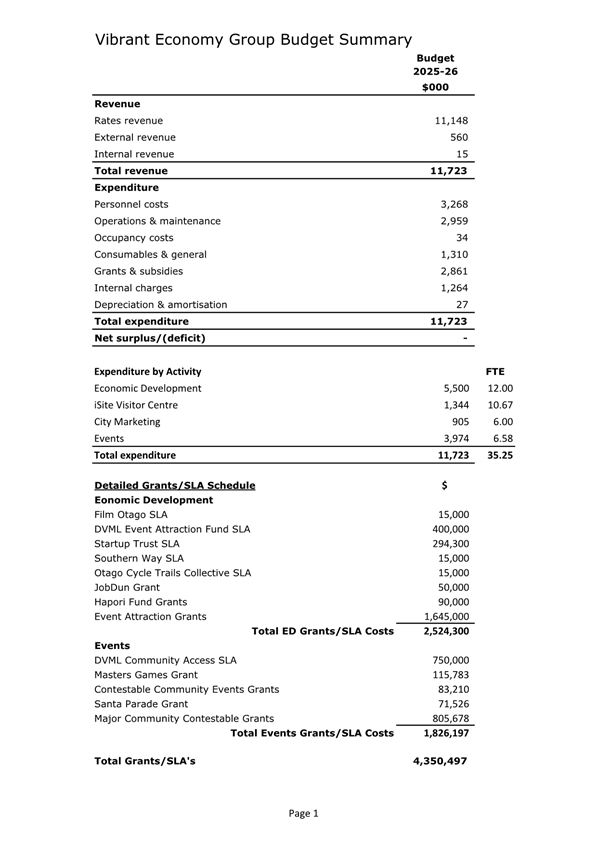
resolution on 12 August 2025. The options compared are:
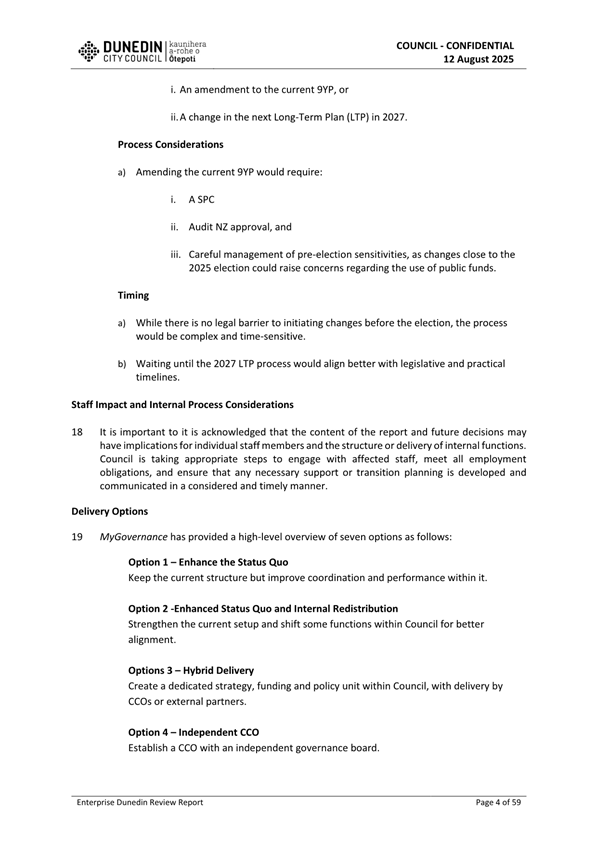
a) Council-Controlled
Organisation (CCO): Create an arm’s-length entity owned by Council,
governed by an independent board and advised by a stakeholder group.
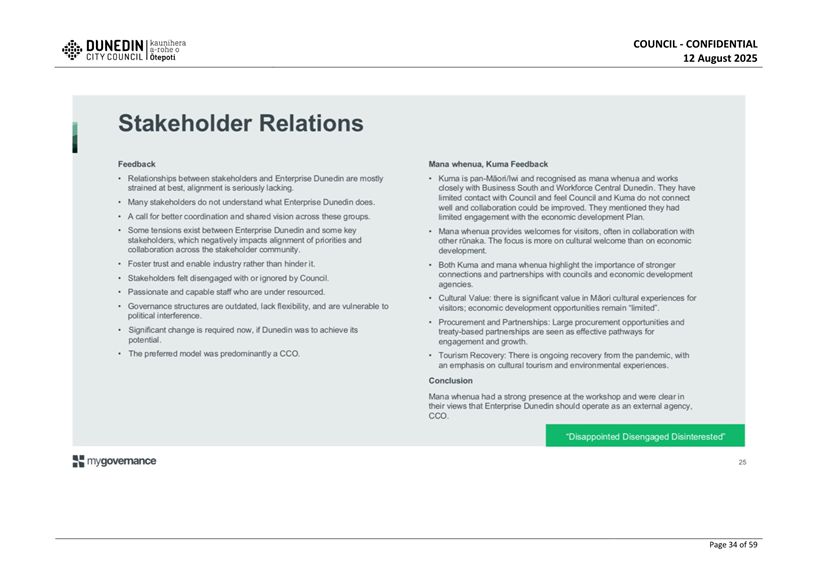
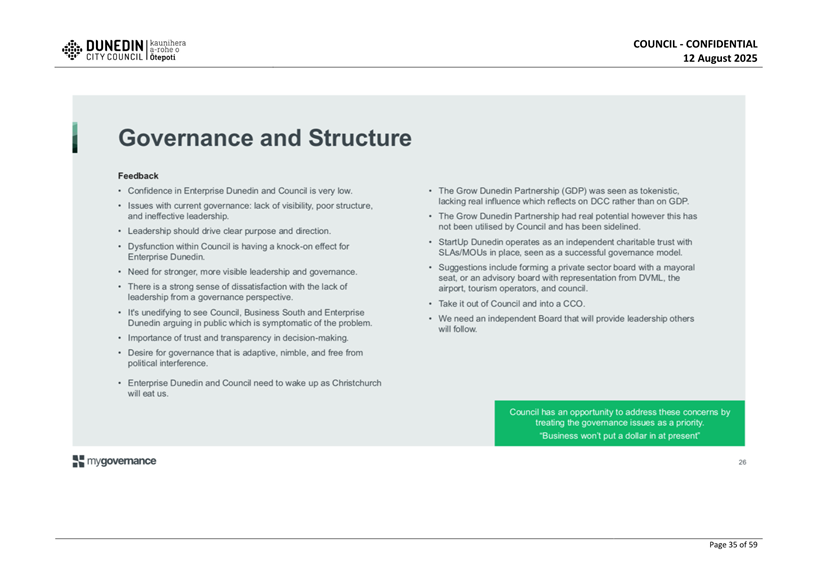
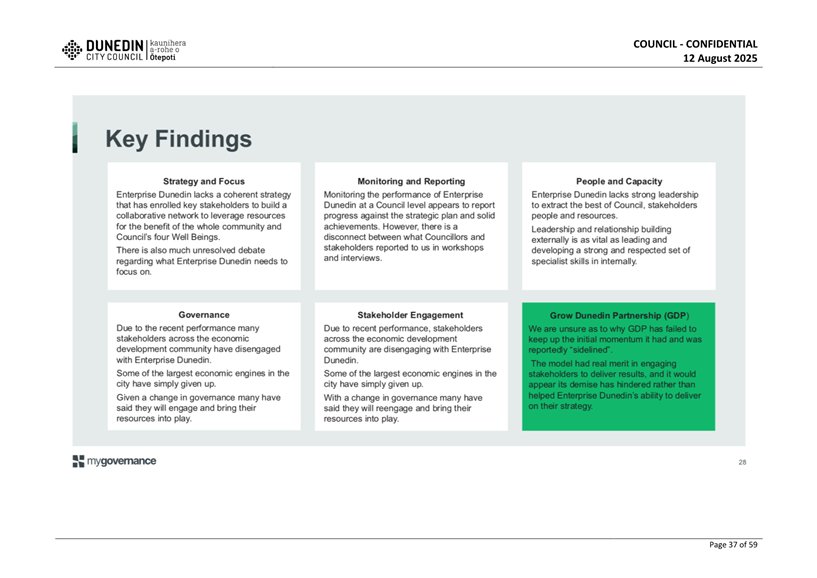
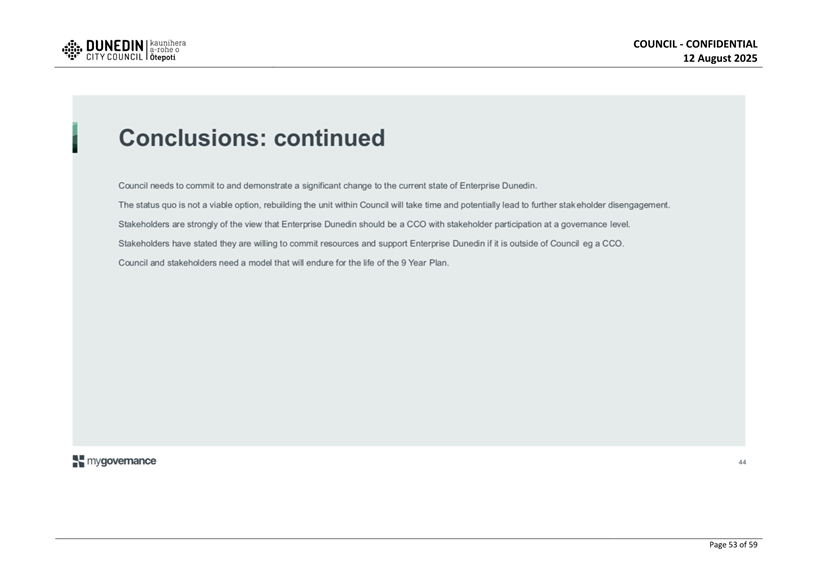
b) Enhanced
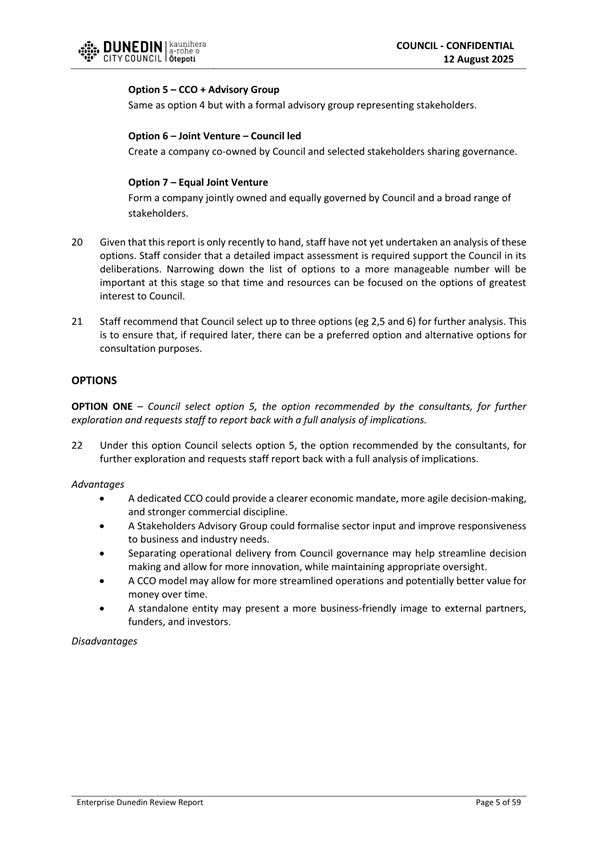
In-House Model: Retain Enterprise Dunedin as an internal unit of the
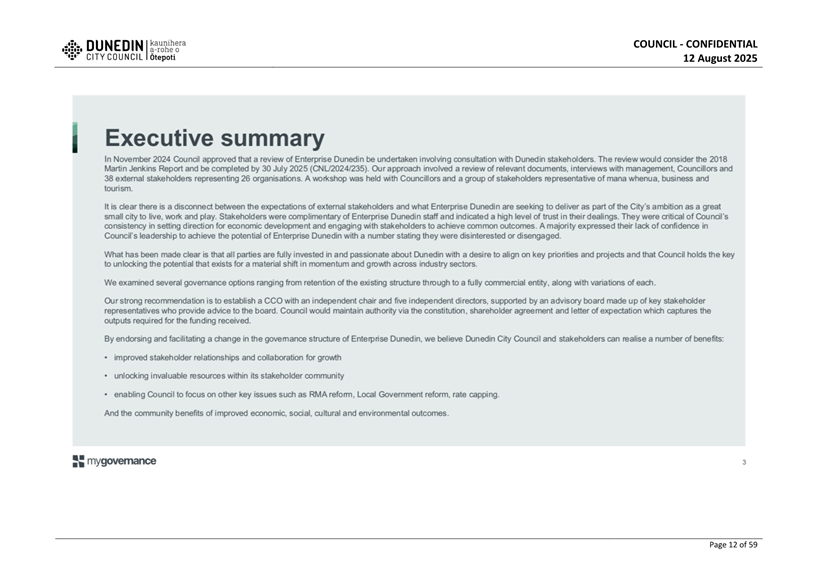
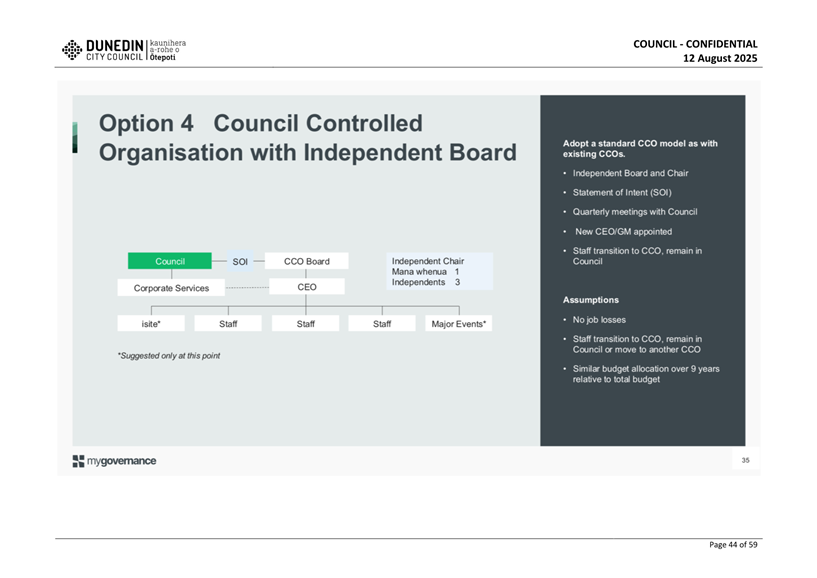
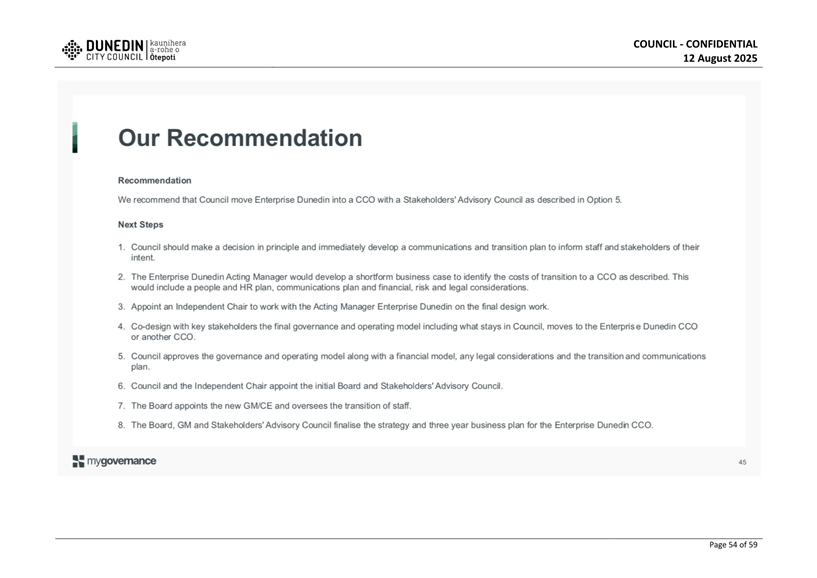
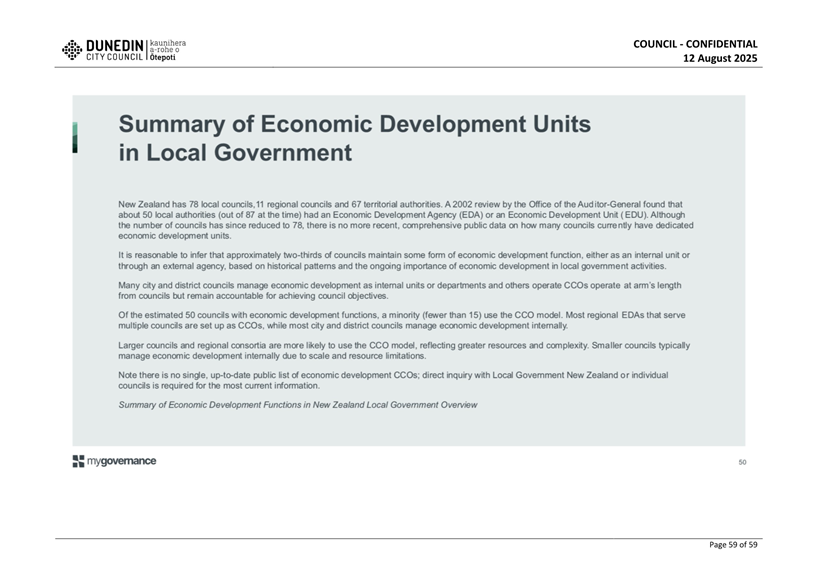
Council, with some functions refined or redistributed within Council.
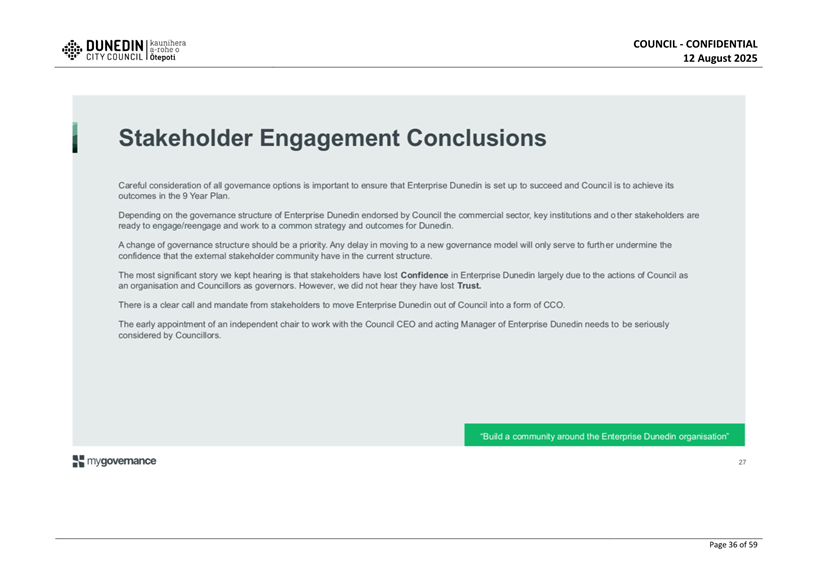
3 Each
model offers distinct advantages and drawbacks which are outlined in the report
under the five headings listed below:
· Governance
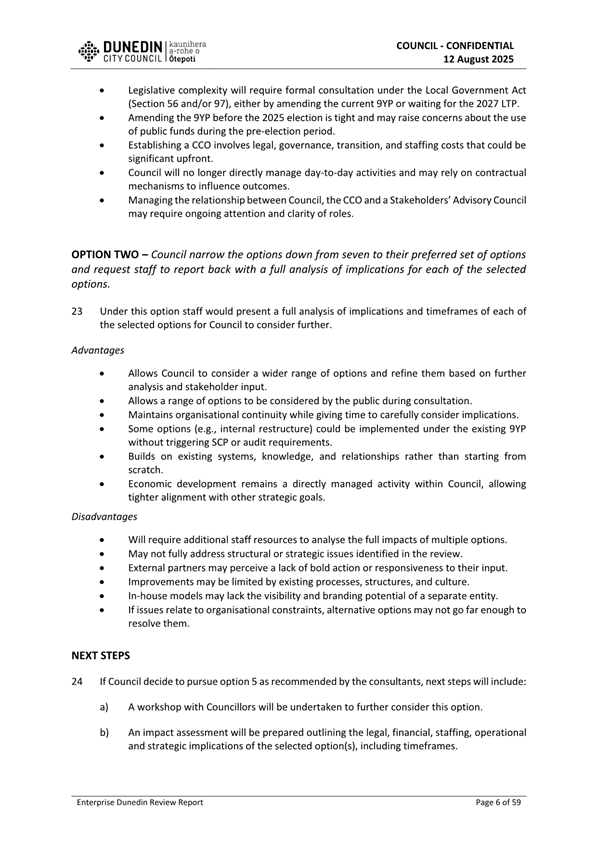
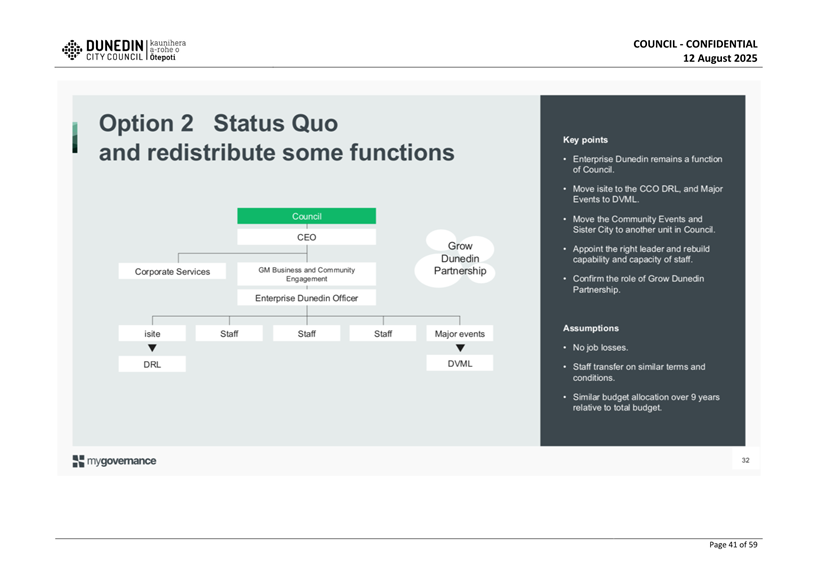
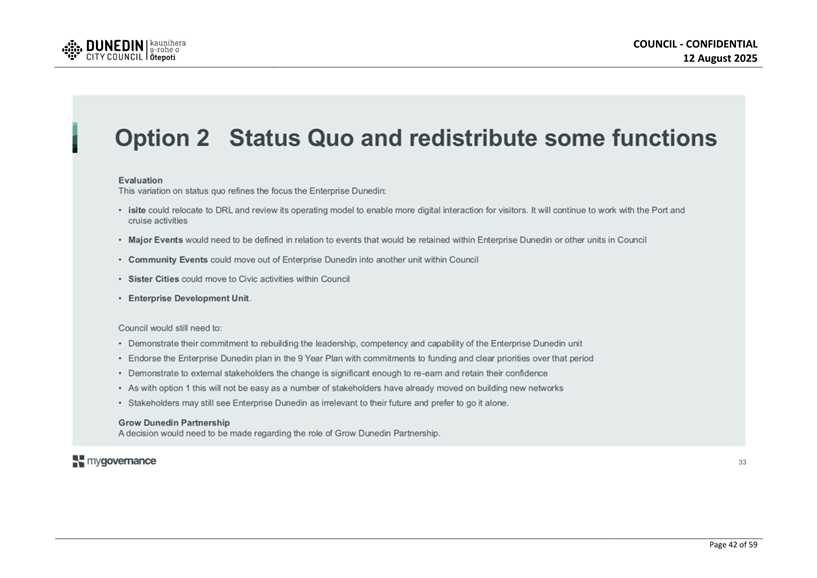
and Accountability
· Strategic
Alignment
· Operational
Flexibility
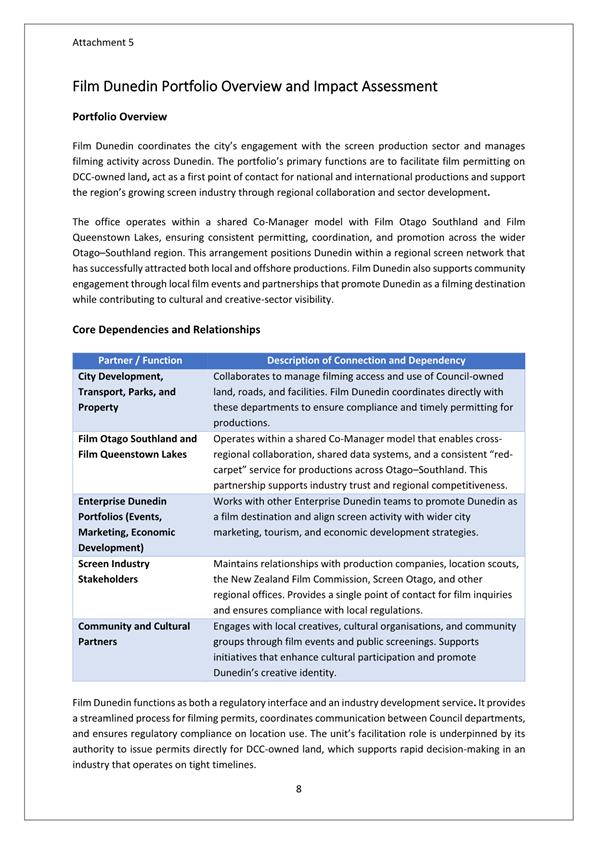
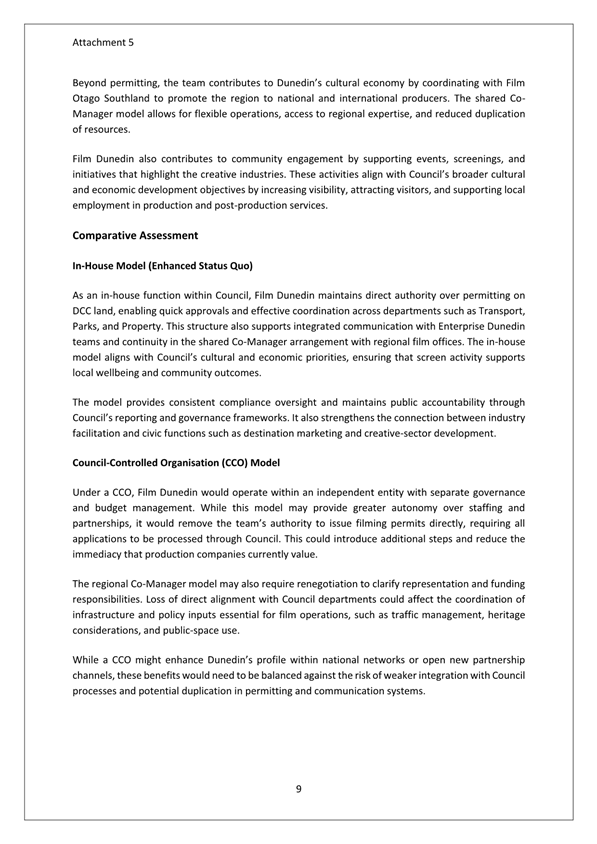
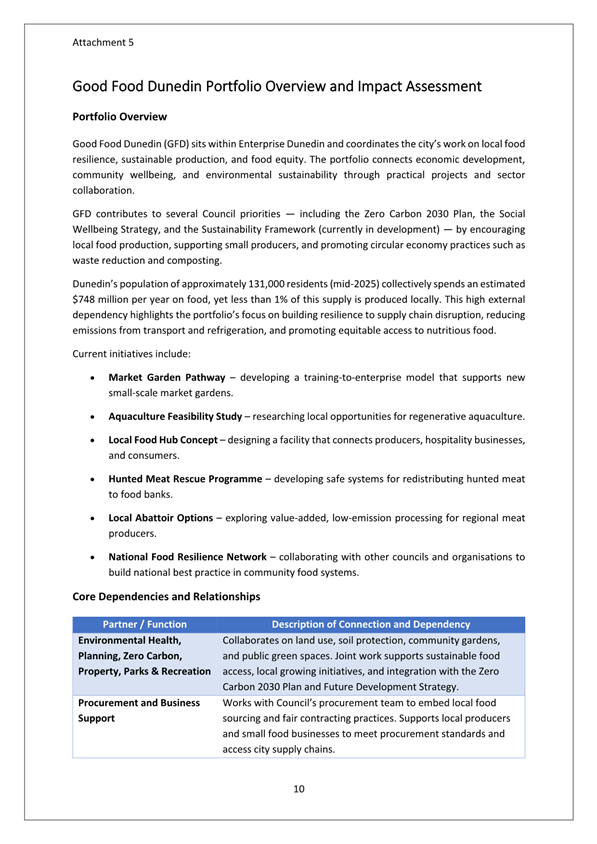
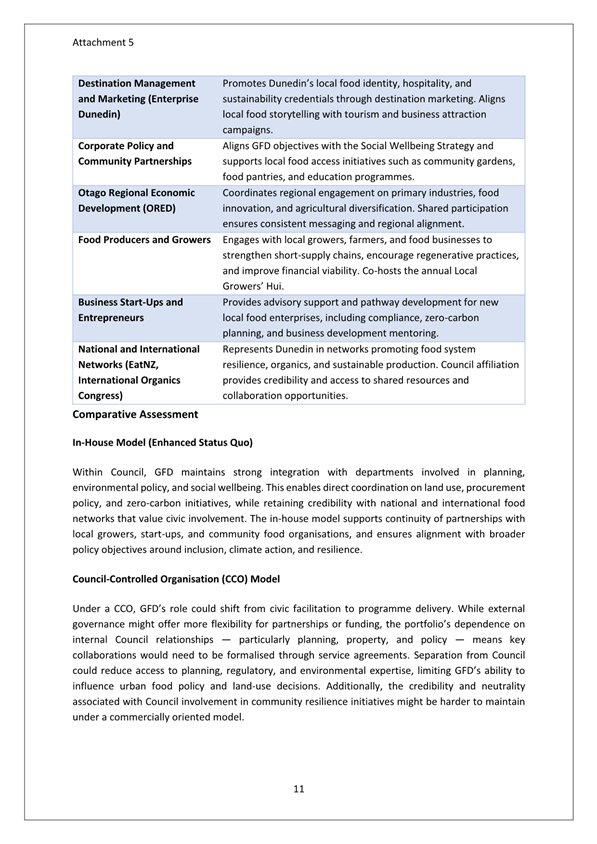
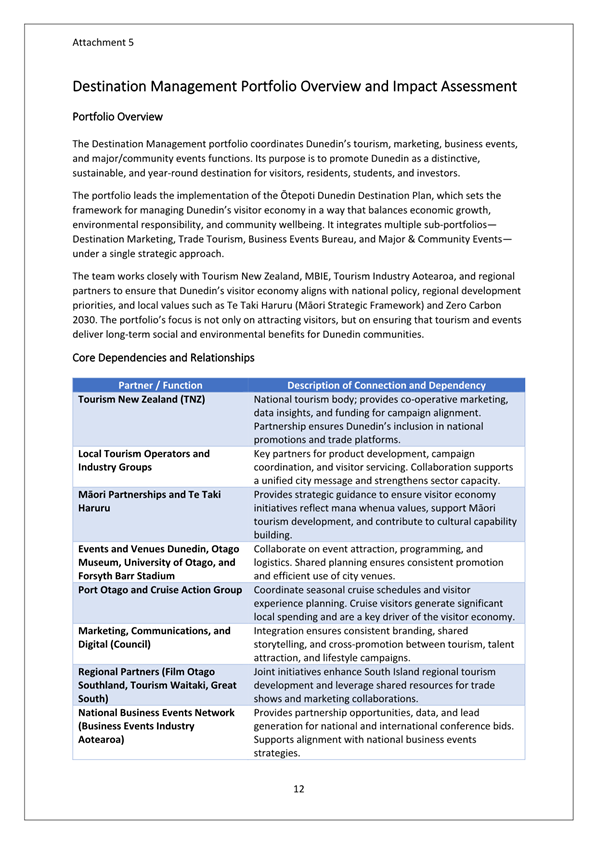
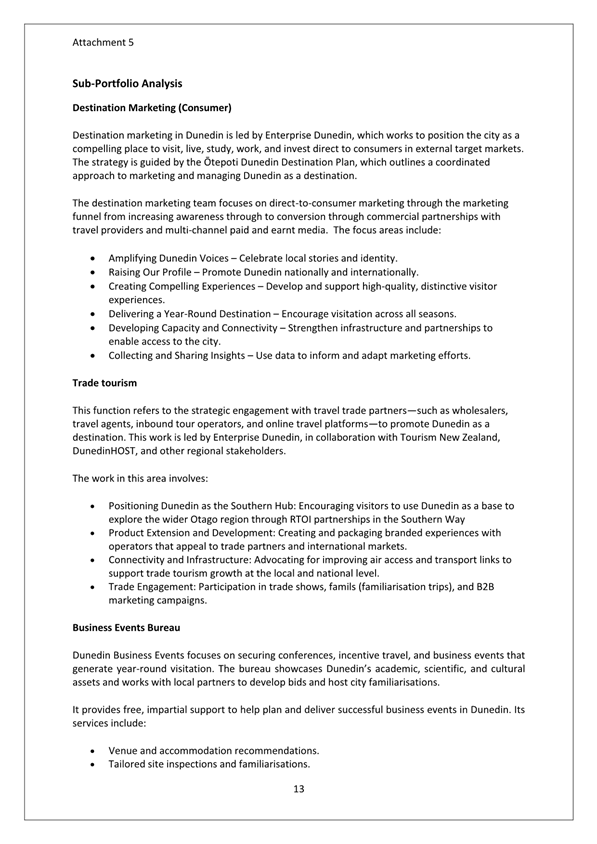
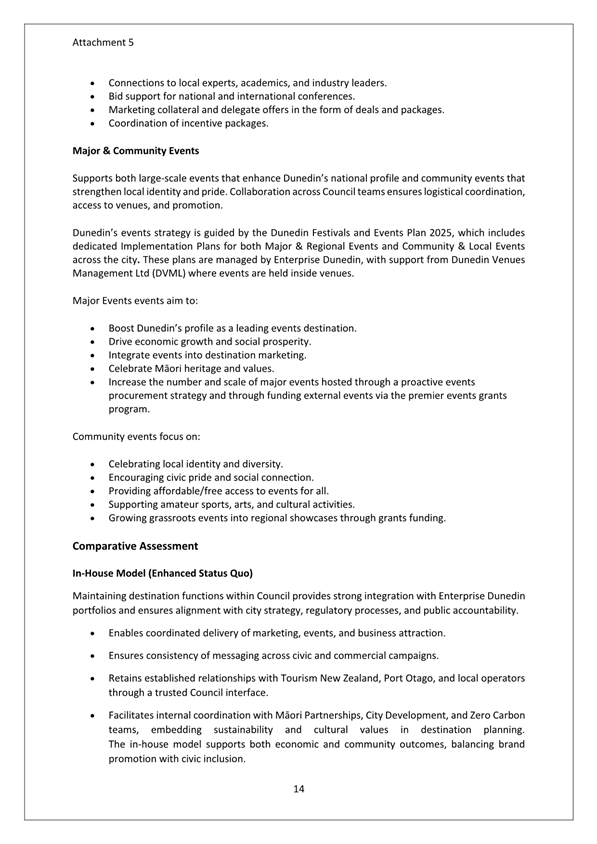
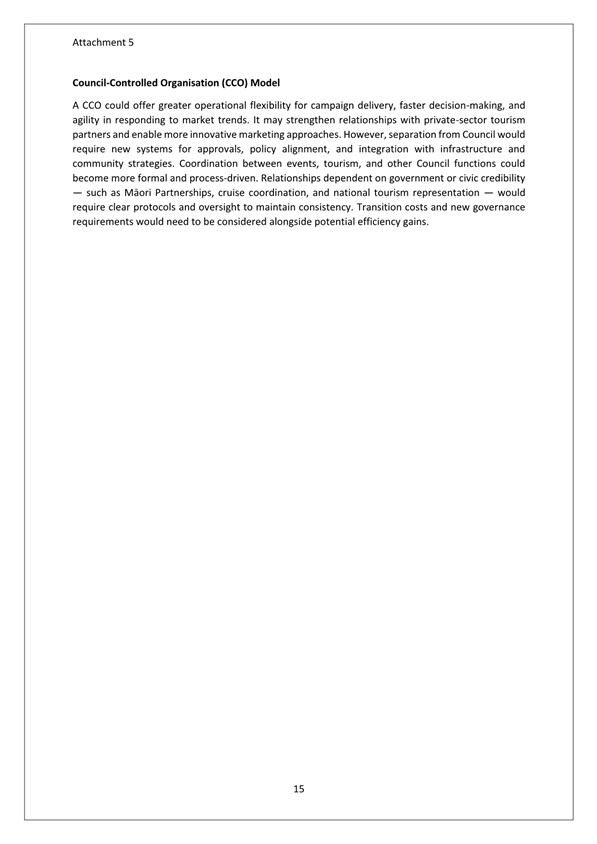
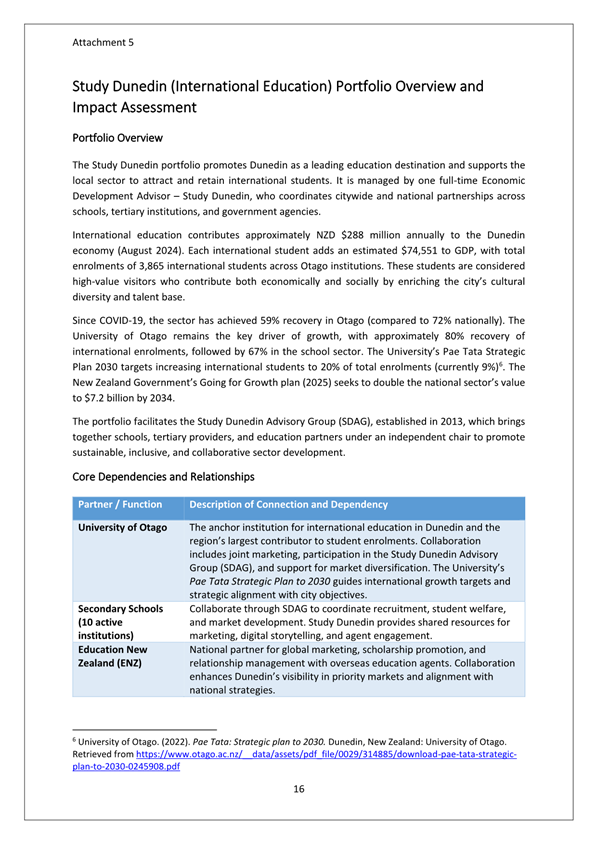
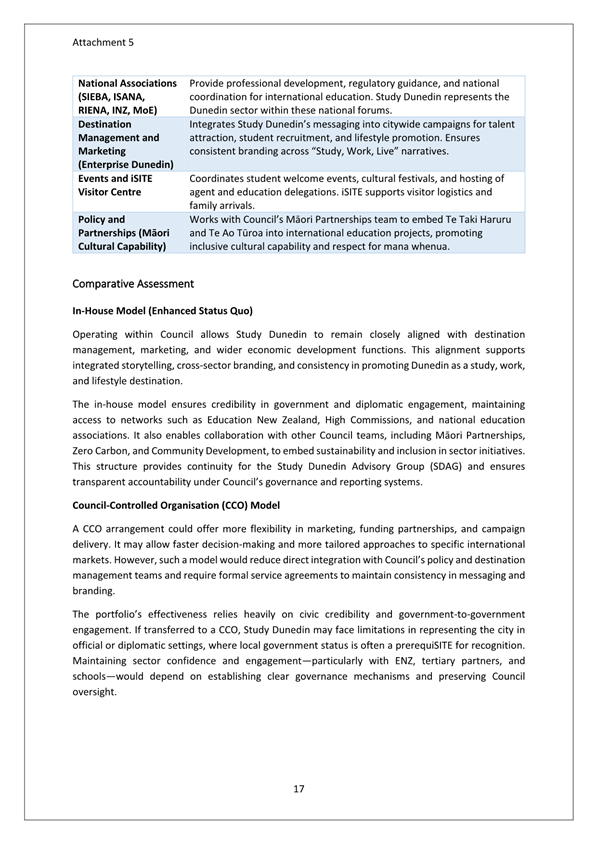
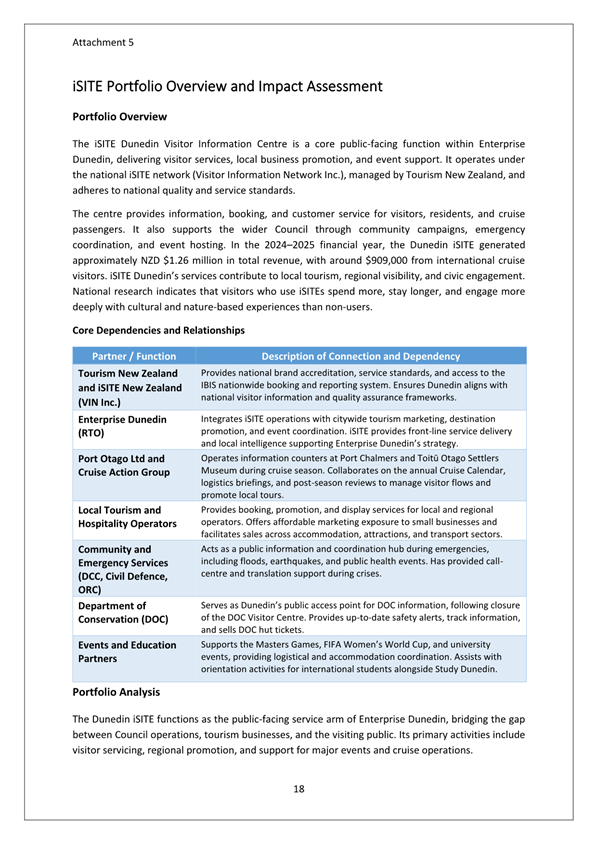
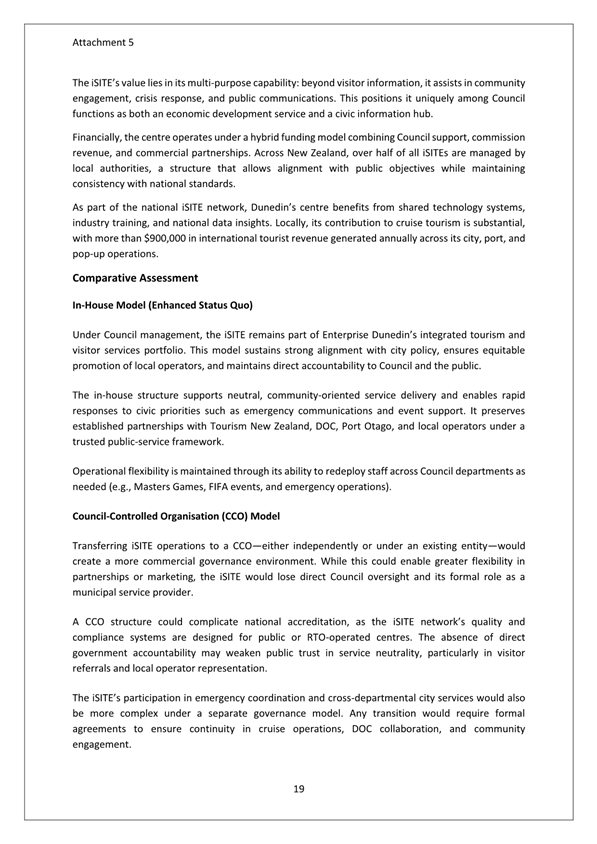
· Financial
Consideration
· Risk
and Transition
4 Local
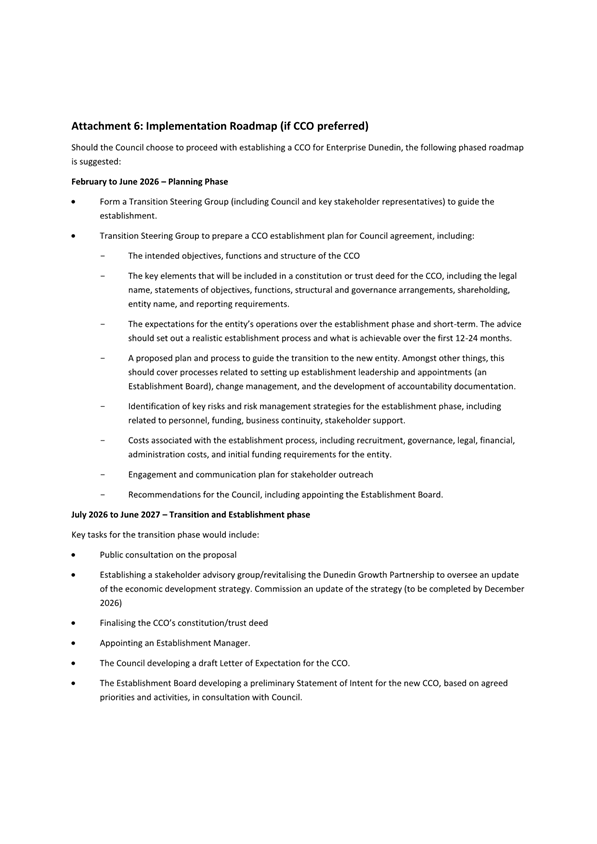
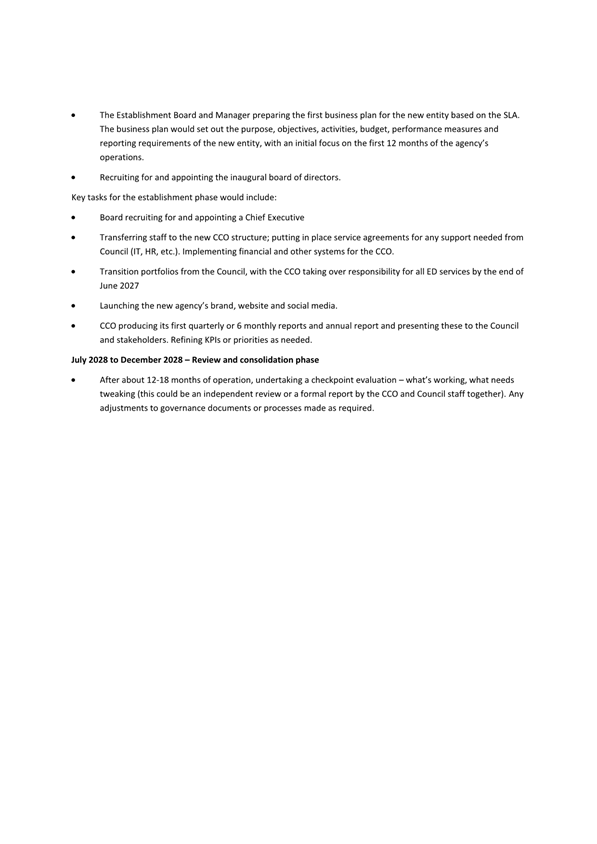
government in New Zealand is entering a period of significant structural and
financial change. Central government has signalled reforms intended to improve
council financial sustainability, constrain rates growth, and strengthen
value-for-money expectations. Measures under discussion include potential rates
capping, increased scrutiny of council-controlled activities, and stronger
incentives for shared services or regional-scale delivery. At the same time,
councils face rising costs, constrained revenue growth, and increasing expectations
to clearly demonstrate outcomes and prioritisation.
5 This
reform environment coincides with several strategic realities for Dunedin. The
city does not currently have an agreed, contemporary city-wide vision that
clearly articulates long-term priorities for growth, investment, and
place-making. In addition, Dunedin’s Economic Development Strategy
(2013–2023) has reached the end of its intended timeframe and has not yet
been replaced. As a result, economic development and destination management
activities are being delivered without a refreshed, consolidated strategic
framework that reflects current economic conditions, fiscal constraints, or
community priorities.
6 The
potential introduction of a rates capping regime further reinforces the importance
of clarity about priorities. Under more constrained funding settings, Council
will need to make explicit choices about where investment will deliver the
greatest public value. This creates an opportunity to engage the community,
mana whenua, and stakeholders in a broader conversation about Dunedin’s
future direction and the role economic development and destination management
should play in achieving it.
7 Within
this context, Council is considering the future governance of Enterprise
Dunedin, which delivers the Council’s economic development and
destination management functions. These functions play a critical role in
supporting business growth, investment attraction, destination marketing,
events, international education, and sector development. There is clear
stakeholder interest in ensuring these activities are delivered in a way that
is agile, effective, and well connected to external partners.
8 In
addition to these two options and noting the evolving local government reform
and funding context, a further potential approach has emerged during the course
of this work. This approach would involve leveraging the existing
Council-Controlled Organisation, Dunedin Venues Management Limited (DVML), to
support selected functions with strong alignment to destination management and
visitor attraction, particularly major events and aspects of destination
management delivery. Consideration would also be required as to whether some
economic development functions could be appropriately integrated within such a
model with the appropriate amendment of this entity and its overall purpose.
9 This
potential approach is not a formal option assessed or recommended in this
report. It has emerged in response to the current strategic and fiscal
environment, particularly the prospect of a rates capping regime and increased
scrutiny on the costs associated with establishing and operating new entities.
Using an existing CCO structure may offer a more cost-effective pathway to
achieving aspects of Council’s intent, by avoiding establishment costs
and consolidating functions that are closely connected through visitor
attraction, place experience, and the Dunedin brand.
10 The
identification of this potential approach reflects the broader theme of this
report: that governance decisions should give effect to Council’s intent
to strengthen economic development and destination management outcomes, while
remaining proportionate, adaptable, and responsive to changing circumstances.
Any future consideration of this approach would require further analysis to
assess strategic fit, functional alignment, governance implications, and
impacts on accountability, capability, and outcomes.
11 In this
context, the decision on Enterprise Dunedin’s future governance is not
solely an organisational choice, but a strategic one. It requires Council to
balance the desire for change with the need to ensure alignment with a
refreshed city vision, community priorities in a constrained funding
environment, and potential future regional arrangements. This report provides
Council with an understanding of the implications of the two formally assessed
options, while also acknowledging emerging considerations that may inform
subsequent phases of decision-making.
RECOMMENDATIONS
That the Council:
a) Considers the options
presented for the future delivery of Enterprise Dunedin.
BACKGROUND
12 Enterprise
Dunedin was established as an internal unit of the DCC in 2014 to consolidate
the city’s economic development, tourism promotion, and related functions
under one umbrella and due to a desire, at the time, to bring Council marketing
and external tourism marketing functions together to improve marketing
functions for the city. Over time, questions have been raised about whether the
internal unit arrangement delivers maximum effectiveness.
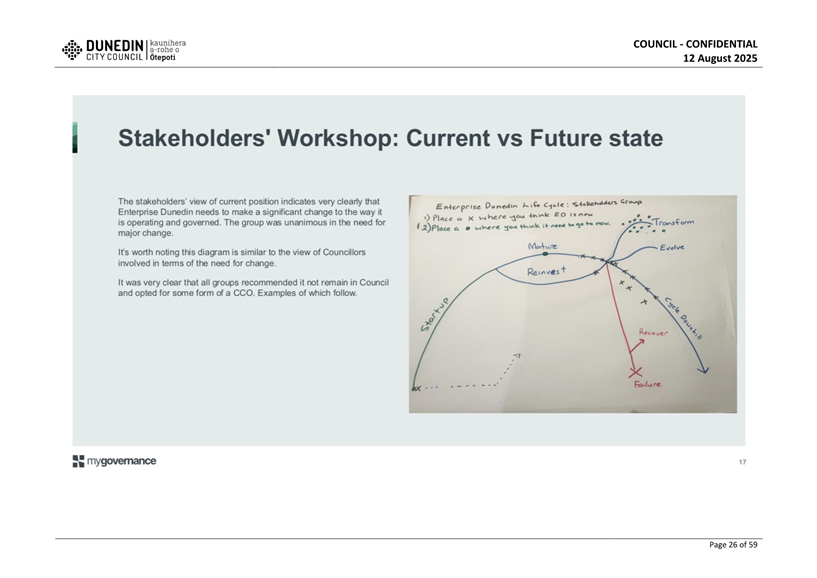
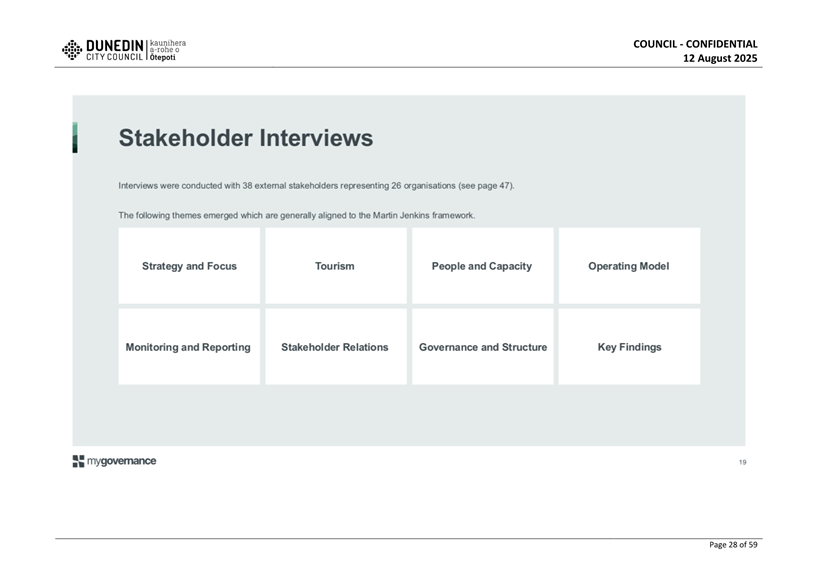
13 In 2025, an
external review was commissioned by Council to examine alternative models
(“My Governance Review”, attached in Attachment 1). That review
proposed several options – ranging from minor tweaks to a full transition
to an external agency – based on a need for greater agility and
partnership-building in delivering economic development.
14 On 12
August 2025 Council passed a resolution to formally evaluate two primary
options (enhanced in-house vs. CCO) and compare their implications
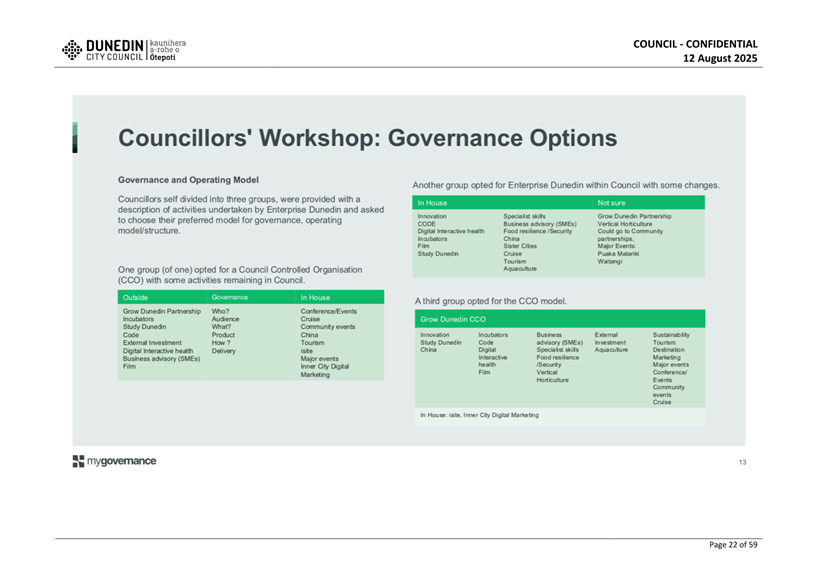
Moved (Mayor
Jules Radich/Cr Andrew Whiley):
That the Council:
a) Notes the
MyGovernance Review Report into Enterprise Dunedin;
b) Requests staff
develop an impact assessment and business cases for the following two
options:
i. A CCO with
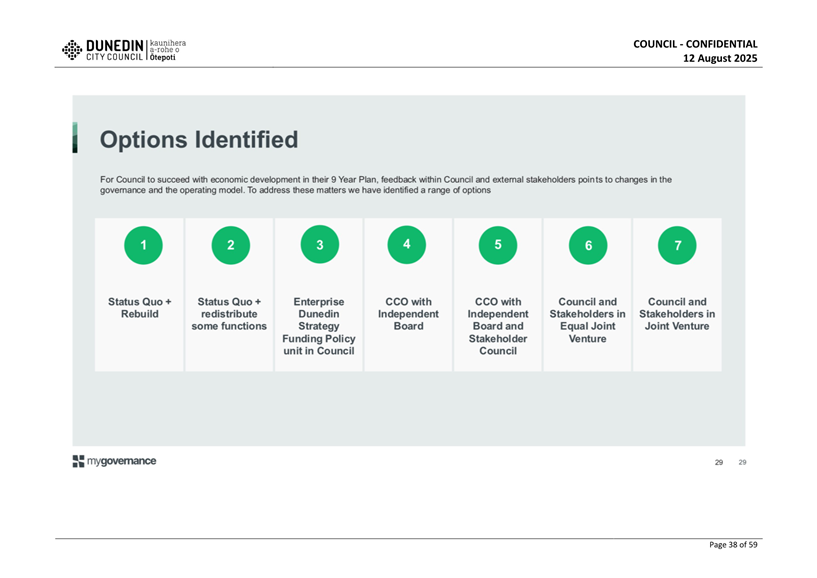
a standalone advisory Group (option 5 from MyGovernance);
ii. An
enhanced status quo option including possible internal redistribution across
the Council Group (Option 2 from MyGovernance).
c) Notes that
the report on the impact assessments and business cases for the two options
will be presented to a Council meeting on or before December 2025.
d) Engages with the
Grow Dunedin Partnership as part of the business case process.
Division
The Council
voted by division
For:
Crs Bill Acklin, Sophie Barker, David Benson-Pope, Christine Garey, Kevin
Gilbert, Carmen Houlahan, Marie Laufiso, Cherry Lucas, Mandy Mayhem, Jim
O'Malley, Lee Vandervis, Steve Walker, Brent Weatherall, Andrew Whiley and
Mayor Jules Radich (15).
Against: Nil
Abstained: Nil
The division was declared CARRIED by 15 votes to 0
Motion
carried (CNL/2025/206)
15 The assessment
of the two options has involved several components:
a) Research:
Drew on analysis in previous reviews and stocktakes of Enterprise Dunedin from
2018, 2020 and 2025 and reviews of economic development arrangements in other
regions.
b) Portfolio
Impact Assessments: Detailed analyses were prepared for each ED portfolio,
outlining what the portfolio does, its dependencies (both within Council and
with external partners), and how each governance option might affect its
delivery.
c) Benchmarking:
Governance arrangements for economic development in other New Zealand cities
and regions were studied – including for the main centres of Auckland
(Tataki Auckland Unlimited, Christchurch (ChristchurchNZ) and Wellington
(WellingtonNZ), and other comparable models. Their experiences (both positive
outcomes and challenges) provide insight into what might happen if Dunedin
shifts to an arm’s-length model, or by staying in-house.
DISCUSSION
16 Enterprise
Dunedin’s mission is to drive economic growth and diversification for
Ōtepoti Dunedin. The table below summarises ED’s main delivery
portfolios, their core purpose, and key dependencies (further details are
provided in ‘What we do’ in Attachment 2):
|
Portfolio
|
Purpose
|
Key Dependencies /
Partners
|
|
Economic Development
|
Support business growth, sector development, and
investment facilitation.
|
Relies on alignment with Council city development,
corporate policy, Māori partnerships, communications and marketing,
community development, procurement, and waste and environmental teams.
Relies on long-term partnerships with mana whenua,
tertiary sector, central government, investors, and local business networks
and groups.
|
|
Destination Management
(destination marketing, including trade tourism, and events)
|
Promote Dunedin as a
visitor destination and support business events, major events and community events
that enhance the city’s profile
|
Depends on collaboration with
Dunedin Venues, and Council marketing, communications and digital teams.
Works closely with tourism operators, event organisers, Tourism NZ, Cruise
industry, regional partners and national events network.
|
|
Study Dunedin
|
Attract and support international students.
|
Works with Council’s Māori Partnerships
team and external partners such as the University of Otago, Secondary
Schools, Education NZ, and national education associations.
|
|
Film Dunedin
|
Position Dunedin as a
screen production hub.
|
Requires efficient Council
permitting processes through alignment with city development, transport, parks
and property teams, and partnerships with the film industry and other regional
film offices.
|
|
Good Food Dunedin
|
Advance sustainable food systems and the local food
economy.
|
Works with several Council teams including
environmental health, planning, zero carbon, property, community
partnerships, and parks and recreation. Has external relationships with Otago
Regional Economic Development, food producers and growers, entrepreneurs, and
organic and sustainability networks.
|
|
Project China
|
Maintain sister-city
relationship with Shanghai for trade and cultural links.
|
Depends on support from
Council leadership and civic relationships team. Requires partnerships with
education and research institutions, central government agencies, the Chinese
community in Dunedin.
|
|
isite Dunedin Visitor Information Centre
|
Delivers visitor information, local business
promotion and events support.
|
Works with external partners, including Tourism NZ,
isite New Zealand, Cruise industry, local tourism and hospitality operators,
Department of Conservation, and events and education partners.
|
17 Enterprise
Dunedin currently operates within DCC’s Arts, Culture and Economic
Development Group. The Manager of Enterprise Dunedin reports to a General
Manager (and ultimately through the Chief Executive to Council). Being part of
Council means ED leverages shared services (finance, HR, IT), and its staff are
Council employees.
18 For the
2025/26 financial year, Enterprise Dunedin has an operating budget of
approximately NZ$11.7 million. Attachment 3 provides a summary budget and
current staff number information. (Noting that $4.350m is allocated for
grants administered by the unit e.g. DVML Event Attraction Fund, CODE, Start Up
Dunedin funding etc.) so is not part of the unit’s operational budget. A material
portion of the non-staff budget goes into destination management, marketing and
promotions. There is limited discretionary funding for large new projects or
investment attraction initiatives (Enterprise Dunedin must seek external grants
or one-off Council approvals for those).
19 Enterprise
Dunedin’s expenditure is comparable to other economic development
agencies in New Zealand. Setting aside expenditure on events and isites (as not
all EDAs deliver these services), economic development and destination
marketing spend per capita and as a proportion of Council total income lies in
the middle of other relevant EDAs. Similarly, the proportion of personnel costs
to total expenditure is around the middle of other relevant EDAs.
20 Enterprise
Dunedin has around 35 FTE staff (breakdown shown in attachment 3), covering
management, advisors for each portfolio, marketing specialists, and support
staff. Staff wear multiple hats – for example, a single advisor might
handle both business support and investment inquiries.
21 The large
majority of Enterprise Dunedin’s funding comes from DCC general rates
(94% in 2024/25). Aside from specific event sponsorships, the occasional
central government grant for a project, and modest income from things like
iSite merchandise or conference fees, there are few outside income streams.
Council’s budget capacity and competing priorities can be a limiting
factor in embarking on new initiatives or to scale successful programmes. In
practice, Enterprise Dunedin often must “do more with less” or find
creative ways to extend its reach. Core council funding for the unit is a
relatively high proportion of total funding compared to other EDAs in New
Zealand (this typically ranges from 50% to 85%).
22 Several
structural and operational constraints have been identified in Enterprise
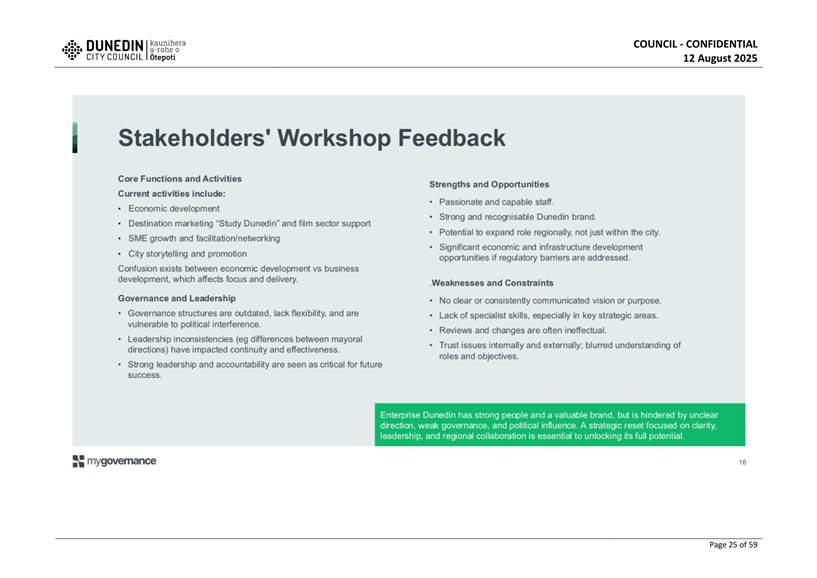
Dunedin’s current state (based on the 2025 review by My Governance and an
earlier 2020 stocktake and 2018 review) as follows:
a) Structural
and governance limitations: Roles between the Council, ED, and external
partners overlap or lack clarity. There isn’t a strong, independent board
ensuring a commercial focus or holding the unit to account on outcomes. The
intended skills-based advisory board (Grow Dunedin Partnership) never reached
its potential – a clear mandate, recommended in 2018, was not
implemented.
b) Strategic
focus and planning gaps: The city’s Economic Development Strategy
(2013–23) is overdue for a refresh. Enterprise Dunedin has been operating
without an up-to-date, consolidated strategy or implementation plan, weakening
focus.
c) Operational
constraints: It is perceived that as an internal Council unit, operates
within Council processes impacts on agility. Examples given included slow
hiring and procurement processes, and risk-averse decision-making that limits
nimbleness in responding to opportunities.
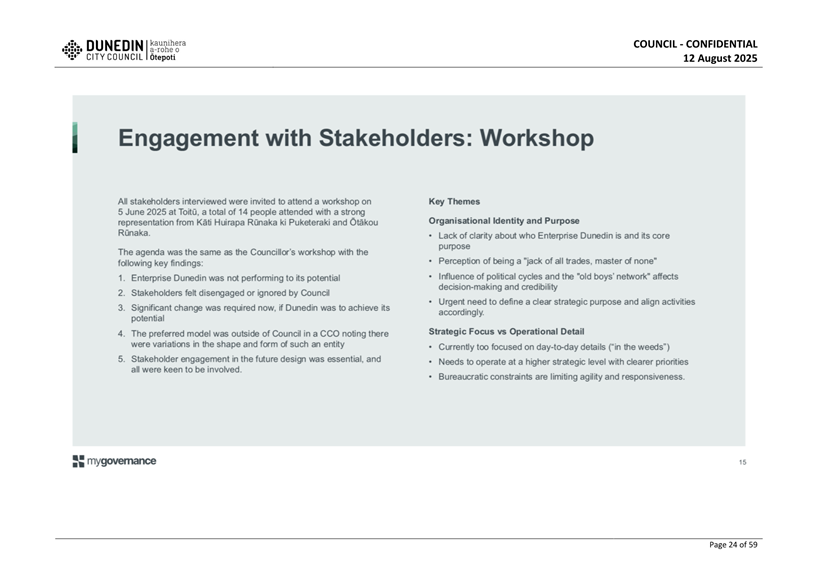
d) Stakeholder
engagement and credibility issues: External stakeholders (especially in the
business and tourism sectors) perceive shortcomings in how Enterprise Dunedin
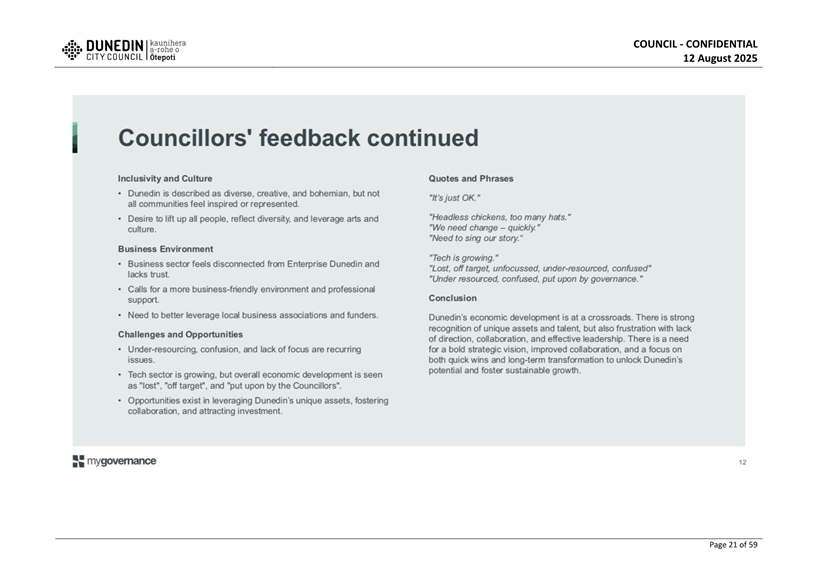
engages and represents them. The 2025 My Governance review found many partners
desire a more independent and responsive entity. Feedback indicated that there
is an unclear “voice” for industry input, and a sense that being
part of Council blunts its credibility and visibility in the private sector.
e) Resource
constraints: Stakeholders have noted that important opportunities (for
example, major event bids or investment proposals) sometimes cannot be fully
pursued due to limited capacity or the need to juggle multiple roles. In
effect, the current in-house model has not unlocked significant new funding
streams and relies on ratepayer funding.
OPTIONS
23 This
section examines the two main governance models in detail. It describes how
each model would function, list its pros and cons, and consider mitigations for
key risks.
Option One – Council-Controlled Organisation (CCO
with Independent Board)
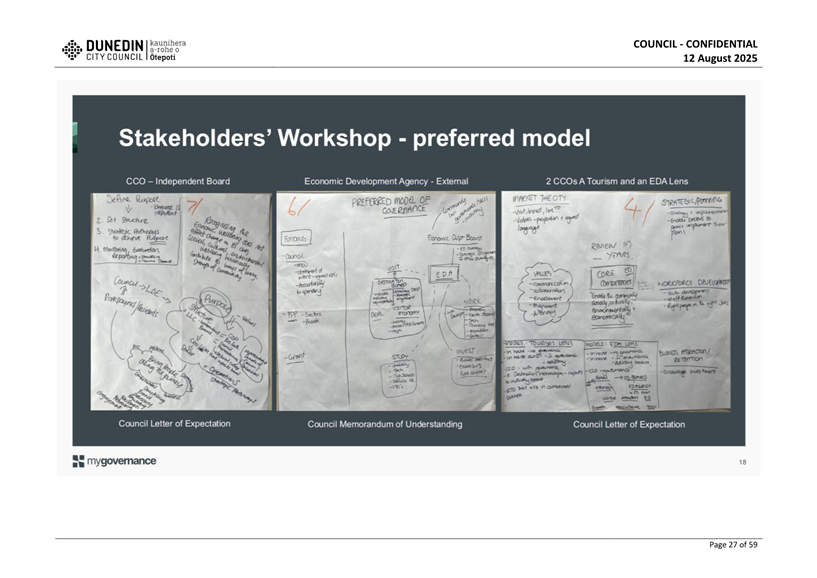
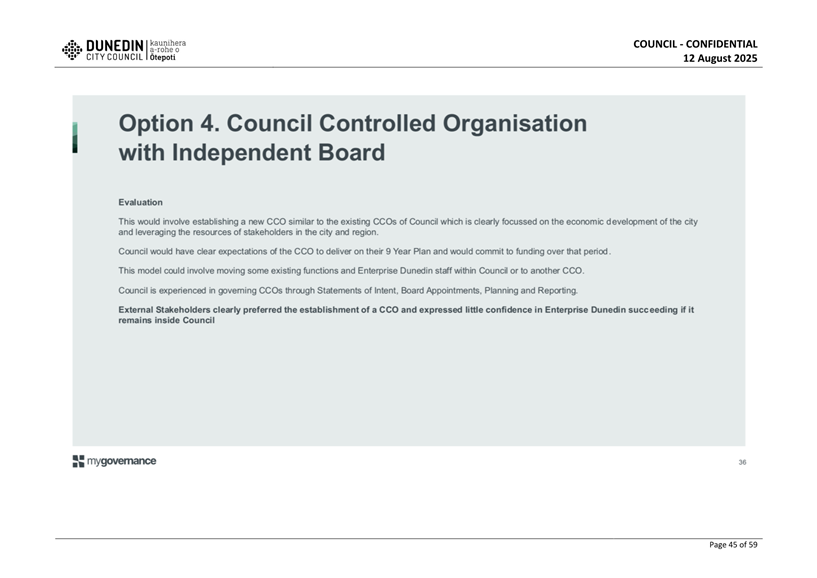
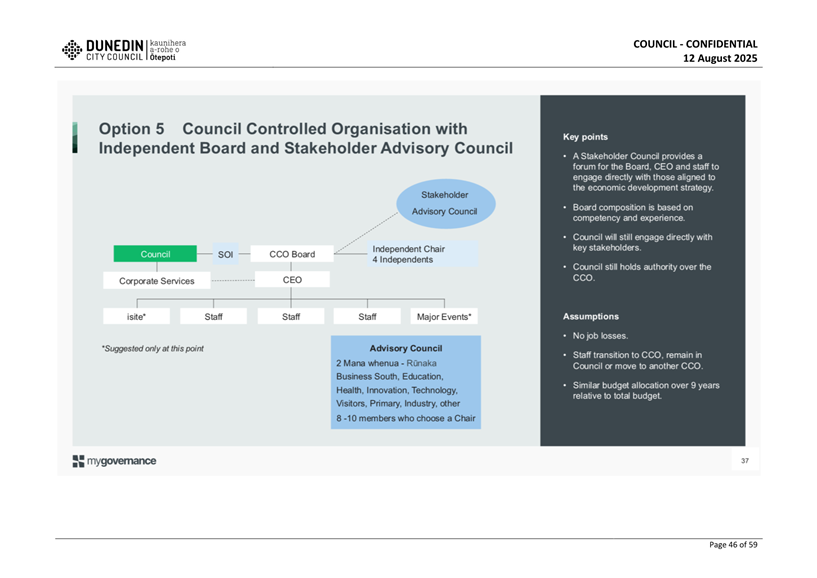
24 This option
is option 5 from the My Governance report which was their recommended option to
establish Enterprise Dunedin as a Council Controlled Organisation. The
key points noted in their report for this option were:
a) Independent
commercial board (composition based on competency and experience)
b) A
stakeholder council provides a forum for the Board, CEO and staff to engage
directly with those aligned to the economic development strategy
c) Council
to still engage directly with key stakeholders and maintain authority over the
CCO
The assumptions with this option
were no job losses , staff to transition to the new entity and a similar budget
allocation as current.
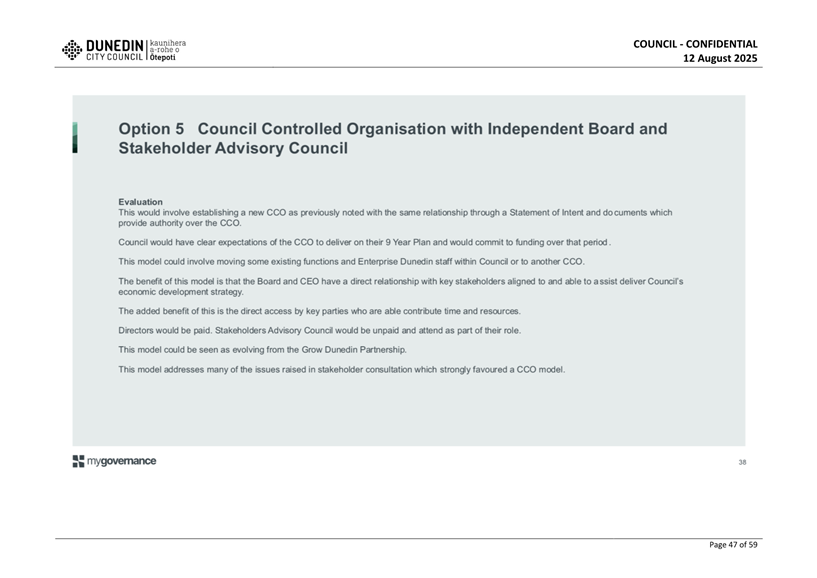
25 Establishing
Enterprise Dunedin as a CCO would initially be the quickest way to shift
stakeholder perception and creating a reset for the operation. Appointing
a board and advisory council could create the opportunity to strengthen ties
back to stakeholders. Feedback gathered during My Governance’s
review did suggest an external agency would be more likely to be
supported. This may be a reflection of perceived leadership and
governances issues.
26 This option
reduces council’s direct influence across this function. Strategy for the
unit would be directed and owned by the Board. Delivery and relationship with
council managed through the letter of expectation/statement of intent process.
Understanding this, the roles of council and the Stakeholder Advisory Council
would need to be clearly set out to avoid overlap and ensure alignment of
purpose.
27 The budget
assumption from the My Governance report indicated an allocation similar to
existing. Whilst placing this operation under a commercial board structure may
lead to a better more targeted governance structure it is unlikely this would
come without additional cost. A paid board, executive salary expectations
and establishing support functions (should the decision be taken to create a
completely stand-alone entity) would add to existing cost structure.
Advantages
· Agility
and flexibility: Commercial board and clear processes may create faster
decision making, sign off and agility of process. CCO would have the
ability to refine processes to suit its operation rather than be part of the
larger council institution.
· Enhanced
partnership potential and fund-raising ability: Some stakeholders,
including private investors and central government agencies, prefer dealing
with a dedicated entity, with separation from politics. This can include
sponsorship deals, charging for certain services, securing government grants,
or even leveraging assets (if it manages venues or property for economic
purposes). The CCO could also more easily joint venture with other
regions’ agencies or the private sector for projects. The net effect
could be a larger resource pool for ED activities than relying on rates alone.
Based on analysis of existing EDAs across New Zealand this should be viewed as
supplementary rather than a replacement for rates.
· Credibility
and perception: Based on feedback gathered by the My Governance review
establishing a CCO is likely to shift industry perception and generate stakeholder
buy-in - many businesses indicated they would perceive an independent ED entity
as more credible and focused.
· Specialist
governance and innovation: Establishment of a commercial board creates the
opportunity to appoint subject matter experts and specialists. This could
push the organisation towards innovative practices and provide industry
connections and mentorship to the operation. This high-level guidance and
networking could enhance the unit’s effectiveness.
Disadvantages
· Disconnect
from Council: a CCO could create distance from other council departments
and processes. Current informal interactions and direct influence may not
be replicated and service level agreements likely to be set up to govern
interactions may not be as effective as the current direct interactions.
· Setup
costs: Creating a CCO involves a range of tasks and associated costs:
registering a company or trust, developing a constitution or trust deed,
preparing SOI, transferring and recruiting staff (and associated costs),
appointing a board, setting up new IT and financial systems (even if using
Council’s systems under contract, some separation is needed), designing a
brand, establishing a separate website and communications channels, etc. These
costs would either need to be absorbed by Council or by the new entity’s
budget.
· Other
transition costs: It will likely take at least 12 months from decision to
get the CCO operational, during which time staff may be distracted by
transition work. It is also possible that the development of a new organisation
will result in a loss of expertise and networks from ED (some staff might opt
to leave rather than move to the new entity). It may also result in disruption
to existing economic development activities. If the focus drifts to the
reorganisation itself, ongoing projects could suffer. If there are changes in
staff, it will take time for the new CCO to build up the capability to deliver
some services at least as effectively and efficiently as the ED unit. The
experience of EDAs in New Zealand is that it takes at least three years to get
a new EDA up to full and effective operation.
· Need
for formal oversight mechanisms: Council will have to govern through more
layers. Ensuring alignment with Council priorities will rely on governance
documents and periodic discussions, rather than daily control. There will be
upfront work to draft a robust Letter of Expectation and SOI each year with
clear targets, and possibly additional agreements on how the CCO and Council
will work together (communication protocols, emergency management, use of the
city brand). If these aren’t done well, the CCO could either become too
constrained (defeating the purpose of independence) or too autonomous (leading
to misalignment or duplication of effort).
· Additional
operating costs: The CCO may need its own corporate services (for example,
for finance, HR, audits). While some of these could be used from Council via a
support services agreement, that would involve paying Council for those
services (less directly than currently). Even if the CCO remains operating
within the Council building and uses Council systems, there is the potential
increase in overhead. In addition, there will be new director fees associated
with the Board of the CCO.
Risks and risk mitigations
· Sustainability
and Alignment: Experience from other New Zealand economic development CCOs
shows that maintaining strong alignment with Council priorities requires
deliberate governance and engagement structures. Over time, activities can
diverge from Council objectives if oversight mechanisms are not actively
maintained. This can include perceptions that successes are not sufficiently
attributed to Council investment, which may prompt reviews or adjustments to
arrangements. Clear mandates, measurable KPIs, and regular engagement between
the CCO and Council are key to ensuring alignment and managing reputational
risk.
· Financial
Considerations: Establishing a new CCO involves both setup costs and
ongoing operational funding requirements. Standalone economic development CCOs
in New Zealand, such as ChristchurchNZ and Great South, typically rely on a
combination of Council funding, government grants, and some commercial or
sponsorship revenue. In practice, Council contributions remain the majority of
funding, often exceeding 70–80% of total budgets, while private revenue
streams (sponsorships, venue hire, event revenue) contribute a smaller but
strategic portion. A key assumption for a new CCO — that it will generate
substantial external revenue — may not be fully realised initially,
particularly if economic conditions are challenging. Multi-year funding
agreements and clearly defined revenue expectations are important to support
financial stability. The prospect of rates capping further complicates
Council’s ability to sustain funding, making realistic assumptions about
revenue generation is critical in planning the entity’s scope and
operations.
· Stakeholder
Communication: Transitioning functions from Council to a CCO can create
temporary uncertainty among stakeholders. A structured communication strategy,
ongoing engagement forums, and transparent reporting are essential to maintain
clarity and confidence.
· Governance
Structure: The introduction of a CCO Board alongside any stakeholder
advisory group requires clarity of roles. Advisory groups in other regions
typically provide input on strategic initiatives rather than operational
oversight. Clear terms of reference and alignment with strategic projects, such
as a refreshed economic development strategy, are necessary to prevent
confusion or duplication.
· Scope
and Focus: Experience from other regions indicates that external agencies
can expand their activities beyond their initial remit. To maintain focus and
avoid duplication with Council or other entities, the CCO’s scope should
be clearly defined at establishment, with governance oversight mechanisms to
monitor adherence.
· Emergent
Contextual Option – Leveraging DVML: As an alternative to
establishing a new CCO, the existing CCO DVML could potentially integrate
functions currently undertaken by Enterprise Dunedin, particularly in
destination management and major events. Consideration would be required as to
whether additional economic development functions could be incorporated. This
option may provide efficiencies by utilising existing structures, responding to
stakeholder demand for change, and mitigating transition risks. It has emerged
in response to contextual changes, including the potential for rates capping,
and is not a formal recommendation at this stage.
28 If a CCO is
pursued, establishment should be accompanied by a clearly defined purpose,
governance and oversight mechanisms, active stakeholder engagement, and
realistic financial and operational expectations.
Option Two – Enhanced In-House Model
29 Under this
option, Enterprise Dunedin remains an internal unit of DCC, but with some
internal reorganisation to address current shortcomings. Essentially, it is a
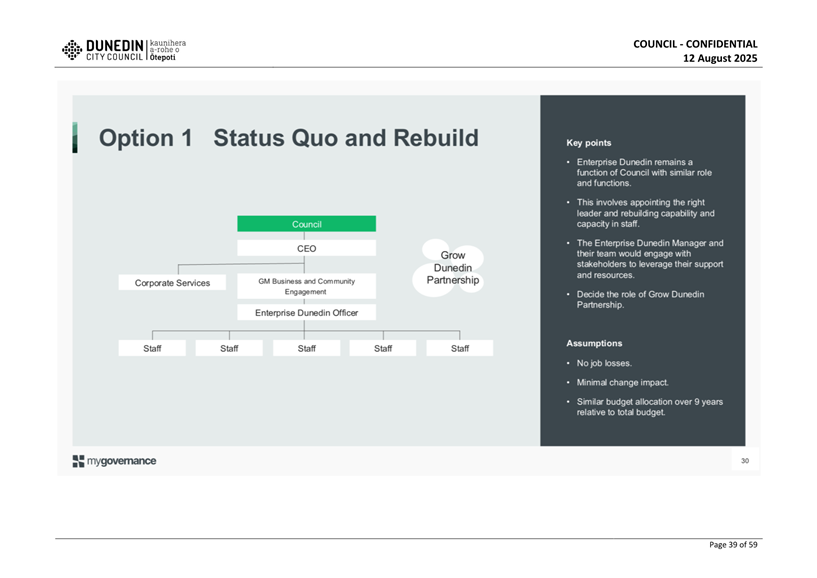
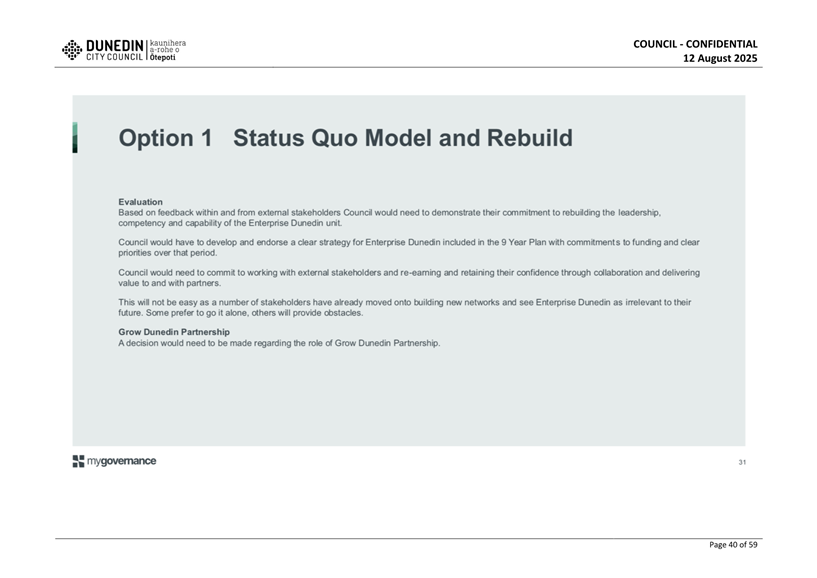
“retain and improve” approach. The My Governance report
suggested that Enterprise Dunedin would remain a function of Council and staff
would continue as Council employees. However, certain functions would be
redistributed or refocused. The idea is to eliminate any internal
fragmentation. The assumptions with this approach were no jobs losses and a
similar budget allocation.
30 Reporting
and accountability: Enterprise Dunedin would continue reporting through
Council’s structure with updates on work programmes and outcomes. Annual
plans and the Long-Term Plan would set budget and high-level objectives.
Council’s performance frameworks (for example, KPIs in the Annual Report)
would include relevant measures. In short, the direct line of accountability to
elected members remains, Councillors can interrogate performance directly, and
any shortcomings are ultimately the responsibility of the DCC Chief Executive
to address.
31 Operational
characteristics: This model relies on integration. Under this model, the
unit would continue to collaborate with other teams and groups – for
instance, working with the Transport and City Development teams on CBD
improvements that help businesses, or with the Environmental Health team on
initiatives for green technology. The internal status ensures its voice is
present in cross-department meetings.
Advantages
· Continuity
and stability: This option avoids the disruption associated with setting up
a new entity although if chosen there would need to ensure priorities (and/or
work portfolios) are reset to drive improvement.
· Internal
leverage: Enterprise Dunedin can leverage other parts of Council relatively
easily. For example, the Council’s legal team is available for legal or
contract advice; the Council’s information services can provide GIS data.
In an external model, such support might be slower or need to be defined by contracts.
· Maintaining
Council economic capability: Enterprise Dunedin currently provides the
Council with internal economic expertise. Moving this outside of Council will
reduce the Council’s economic capability (for example, advising on
business cases). Increasing internal economic capability was one of the reasons
why Auckland Council recently brought the core economic development team from
Tātaki Auckland Unlimited back into Council.
· Lower
Cost: There will be no additional governance or overhead expenses. Ratepayers
are not paying for a separate board or duplicate corporate services under this
model. It also avoids transitional costs associated with staff redeployment or
legal processes (like transferring contracts to a new entity), although there
may be some minor transition costs if events and iSite staff are transferred to
new Council units.
· Direct
accountability: there is more direct accountability to Council and a better
line of sight on the operations of ED and financial data with an internal unit.
· Council
industry and national relationships: if implemented effectively, including
ensuring a revitalised Grow Dunedin Partnership, an internal unit can help
build Council knowledge and relationships with industries and the business
community and links to national economic development and tourism agencies.
These relationships are arms-length with an external agency.
In summary,
the enhanced status quo maximises collaboration with Council’s operations
and keeps accountability straightforward.
Disadvantages
· Potential
for slower decision making: Remaining within Council could mean that
Enterprise Dunedin faces some procedural delays, such as multiple levels of
sign-off for a new marketing campaign, formal re-budgeting for mid-year
changes, or longer timelines for hiring specialists or contractors. These
processes are designed to ensure transparency, fairness, and accountability,
but they can occasionally slow the pace of action.
· Potential
constraints on external funding: For example, private sector or
non-government sponsors may want to deal with an independent organisation or a
central government agency may have a fund for which only an independent entity
is eligible (ED as part of Council might not be).
· External
perceptions and relationships: For stakeholders who view Council as
bureaucratic or politically driven, ED may not escape that perception even if
there is a desire and actions to improve business relationships. Some key
stakeholders have indicated they may continue to disengage if they feel ED
cannot deliver swiftly or isn’t flexible.
· Potential
for lower effectiveness: Although reallocation of functions may result in
more focused attention on core economic development activity, the
redistribution of ancillary activity may lessen the effectiveness of delivery
and the resources available to do so. ED already has a strong, collaborative
relationship with DVML and our teams currently work together on
attraction/delivery of major events to the city. DVML’s focus is
attracting events for the venues that they manage. Allocating Major Events to
DVML does create the potential for conflict between chasing events for the
venue versus those for the city and dilutes the connection to city brand
pillars and destination marketing. Similarly, DRL are a tourist operator.
Assigning the iSite to this operation is contrary to the agnostic approach the
operation currently takes to promote all tourist activity for the city.
Attachment 4
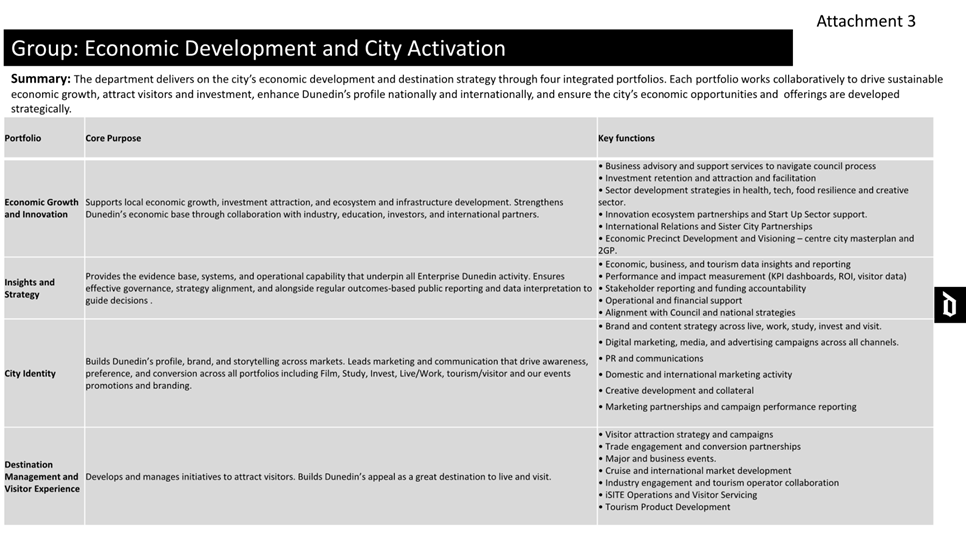
outlines a proposed portfolio approach for Enterprise Dunedin as an enhanced
status quo to focus on improved delivery of the currently assigned
functions. If the desired approach is to deliver this activity via an
in-house unit, a better option is to group the activities as outlined to make
best used of the resourcing and budget.
Risks and risk mitigations
· Strategic
drift: While currently ED is aligned with Council’s strategies,
there’s a risk that future political changes (new Councils with different
priorities) could shift focus in ways that disrupt ED’s long-term projects.
In an external model, a board may be able to buffer political swings (though
ultimately Council still sets funding).
· Slower
decision making: With clear internal processes, delegated authority, and
proactive planning, Council can maintain agility and responsiveness. Staff can
still pursue innovative projects, particularly if Council supports risk-aware
experimentation and fast-tracked approvals where appropriate. While there may
be some limits compared with an external entity, careful design of internal
processes can allow ED to remain competitive and responsive to emerging
opportunities.
· Operational
Bottlenecks: If Council-wide processes don’t evolve, ED will continue
to face bottlenecks. Under Council processes, taking advantage of immediate
economic development opportunities in a timely manner can be difficult, which
is a risk to achieving outcomes.
· Funding:
Local government reform and potential rates capping could create challenges in
funding the unit and delivery of activity.
· Stakeholder
frustration: if stakeholders do not believe improvements within Council are
possible and disengage, ED will lose touch with its key client base.
Ensuring
that the benefits of being in-house are fully leveraged, while taking
deliberate steps to address the drawbacks could include: internal service-level
agreements to speed up processes (for example, for ED to get priority for
procurement for vital projects); committing to additional stakeholder
engagement and communication with regular stakeholder feedback about this;
reinvigorating the Grow Dunedin Partnership, including quarterly meetings, to
bring in more private sector guidance, and seeking Council approval for
reallocation of resourcing to build capability in critical areas (like funding
an investment facilitator position).
32 A summary
of the comparison between the Status Quo and CCO models across key dimensions
is provided in the table below:
|
Dimension
|
Enhanced
In-house
|
CCO
(Arm’s-Length)
|
|
Governance and
Accountability
|
Direct line to Council, internal
reporting through Council committees and management structure. Councillors
have immediate oversight.
|
Governed by independent
board; Council oversight is mediated via Statement of Intent and shareholder
meetings. Elected members less directly in control day-to-day.
|
|
Strategic
Alignment
|
Largely
automatic – ED is embedded in Council planning, so its work naturally
aligns with Council strategies and policy.
|
Must be
codified – alignment achieved through clear shareholder expectations,
SOI targets and frequent communication to ensure CCO’s plans reflect
Council priorities.
|
|
Operational Efficiency
|
Uses shared Council
services (finance, HR, IT), avoiding duplicate costs. However, flexibility is
constrained by Council processes and hierarchy.
|
Has autonomy to set up
fit-for-purpose processes, hire quickly, and pivot as needed. Gains
flexibility but may have some duplicate administration costs and may need to
establish its own systems.
|
|
Financial
Profile
|
Funding is
within Council’s budget (rates-funded); more limited ability to earn
outside revenue
|
Has a separate
budget. Still primarily rate-funded via Council contract but can retain
earnings and raise external funds (sponsorships, grants, loans) to
supplement. Responsible for its own financial sustainability.
|
|
Risk
|
Low structural change risk:
no disruption from reorganisation. Continues under Council risk frameworks.
However, faces risk of limited improvements being made within existing
structure. Perceived political interference in governance. Stakeholder
perception of unit
|
Higher transition and
establishment risk initially. Ongoing risk requires robust monitoring.
|
|
Stakeholder
Engagement
|
Familiar
interface – stakeholders know it’s the Council they are dealing
with. However, external stakeholders have indicated that they lack confidence
in the ability of Enterprise Dunedin to achieve its potential within Council
and could remain disengaged. Perception will be difficult to change. Internal
stakeholders (staff, departments) readily collaborate.
|
Needs to build
its own identity and relationships. Some external stakeholders might engage
more due to perceived independence; internal collaboration with Council
relies on MOUs and goodwill. Advisory group ensures structured input, but
role needs to be clear and well managed.
|
33 Both
options face the risk of being affected by the Government’s ongoing local
government reforms. Economic development will likely be a service under review,
meaning changes implemented over the next 12–24 months could need
adjustment, creating uncertainty and potential duplication of effort.
34 Part of
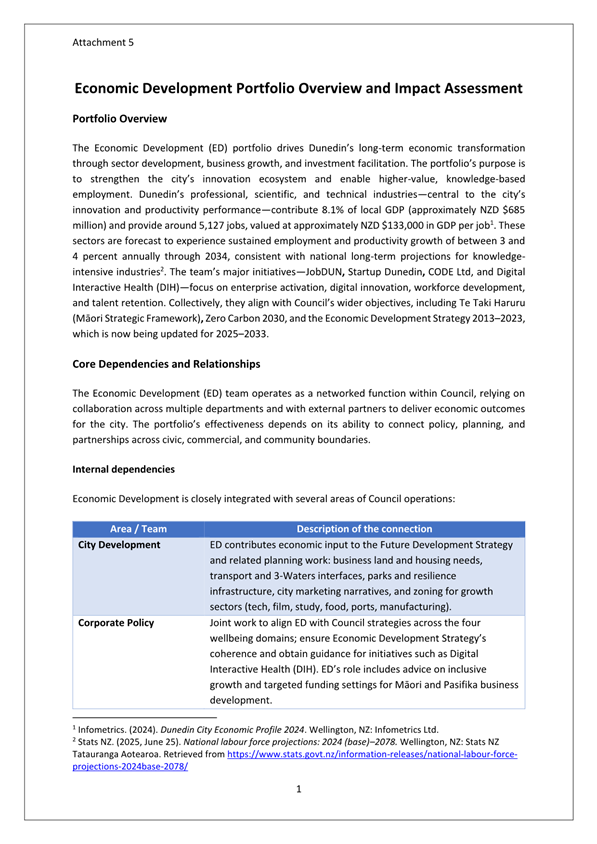
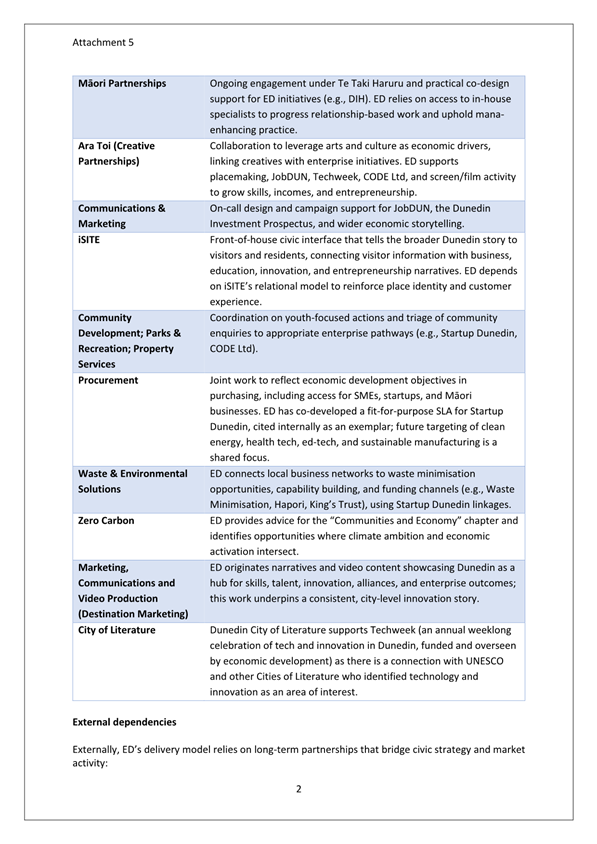
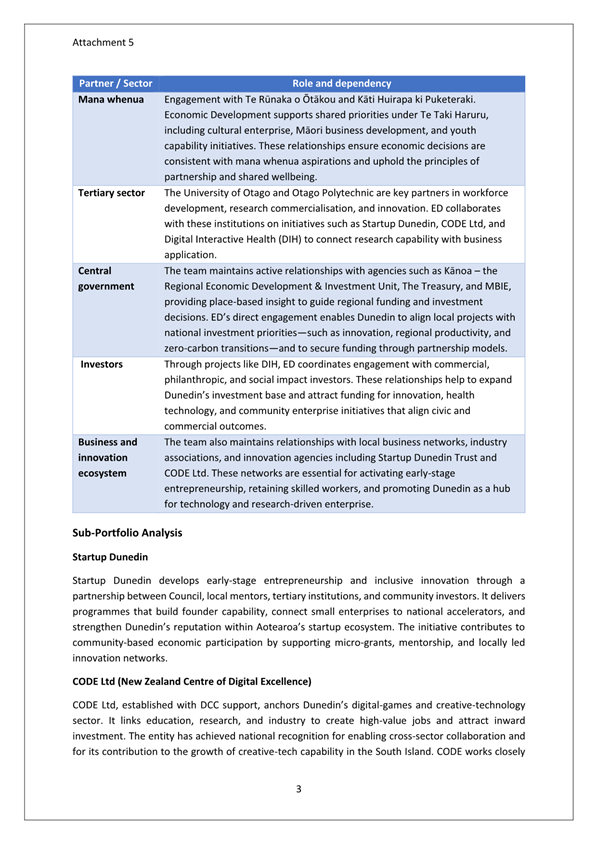
this assessment was understanding how each governance option might affect the
specific portfolios and services ED delivers. This is detailed in Attachment 5.
In summation, ED functions can succeed under either model if they are
well-resourced and focused. The CCO unlocks some extra potential if alignment
is maintained but risks reducing the effectiveness of functions that rely on
core Council functions and the Council sanction.
35 These
assessments have helped identify some portfolios or parts of portfolios that
may be better retained in Council even if the CCO model is implemented (for
example, community events, Film Dunedin and Project China). If a decision is
made to move to the CCO model, further consideration of how these functions
would be managed would be part of the planning and transition phases.
36 The
critical consideration is that whichever model is chosen should be flexible and
resilient, capable of aligning with a possible regional approach if required.
Designing with this strategic context in mind will help ensure that any
investment in ED structures delivers long-term value rather than being quickly
superseded by reform.
NEXT STEPS
37 Both
options are viable paths with the potential to deliver on Dunedin’s
economic development goals, but each comes with distinct trade-offs:
a) The
Enhanced In-House model preserves what is working (seamless integration into
Council’s strategies and operations) and avoids disruption, but it will
require sustained effort to overcome bureaucratic limitations and to build
credibility with the private sector and other stakeholders. It is essentially
an evolutionary approach. This model may be better in the short-term for
continuity and while the Council responds to the local government reform
process. However, there is a risk that some of the underlying issues (like
agility and external perceptions) will persist unless truly addressed by
Council through more extensive reforms and possibly greater investment.
b) The CCO
model offers a bold change that could re-energise economic development efforts
and unlock new resources and partnerships. It aligns with the general approach
used in other regions. If implemented well, it could accelerate outcomes in
areas like investment attraction, sector growth, and tourism recovery through
greater agility. It comes with short-term costs and risks and requires robust
governance to ensure it doesn’t lose alignment with Council and public
interests. The transition would need to be carefully managed over 12–24
months to avoid loss of momentum.
38 Ultimately,
the decision lies with Council’s prioritisation of what it wants out of
Enterprise Dunedin. If the key concerns are maintaining direct control,
minimising risk, and ensuring alignment with Council, the improved status quo
option is a sound choice (with the caveat that continuous improvement, improved
capability and improved engagement with the private sector must be delivered).
If the Council, informed by stakeholder voices, values agility, external
credibility, and potential growth in impact, and is willing to invest effort
and resource in a transition, then setting up a CCO is a move that could yield
significant benefits in the mid to long term.
39 One approach could be a
phased strategy. For example, Council could decide to initially
strengthen the in-house model (with some quick wins on process and stakeholder
improvements), while laying groundwork for a future transition to a CCO if
those improvements don’t yield the desired results or if external
conditions favour it. Alternatively, Council could decide the time is right for
a structural change now, given stakeholder appetite and the changing economic
landscape and move to establish the CCO by, say, mid-2027 after necessary
consultation and planning. This would require allocating transition funding and
focusing managerial effort on making this effective.
40 From a
timing perspective, creating a CCO will invoke a Special Consultative Procedure
under the LGA because it changes how a significant activity is delivered. This
could be done as part of the 2027–37 Long-Term Plan process.
Alternatively, a decision to remain in-house with changes can be implemented by
Council resolution without external consultation (assuming no significant
change in levels of service).
41 Whichever
path is selected, change management and communication will be key. If Council
decides for a CCO, a detailed implementation roadmap should be followed (a summary
approach is attached in Attachment 6). If Council decides to keep ED in-house,
it should still develop and commit to an implementation plan and announce how
ED will be ‘revamped’, so stakeholders understand that their
feedback has been heard and things will improve.
Signatories
|
Author:
|
Mike Costelloe - General Manager, Arts, Culture &
Economic Development
|
|
Authoriser:
|
Sandy Graham - Chief Executive
|
Attachments
|
|
Title
|
Page
|
|
⇩a
|
MyGovernance Report
|
20
|
|
⇩b
|
What we do
|
79
|
|
⇩c
|
25/26 Budget Analysis
|
83
|
|
⇩d
|
Proposed Portfolios
|
84
|
|
⇩e
|
Impact Assessments
|
85
|
|
⇩f
|
Transition Plan
|
104
|
|
SUMMARY OF CONSIDERATIONS
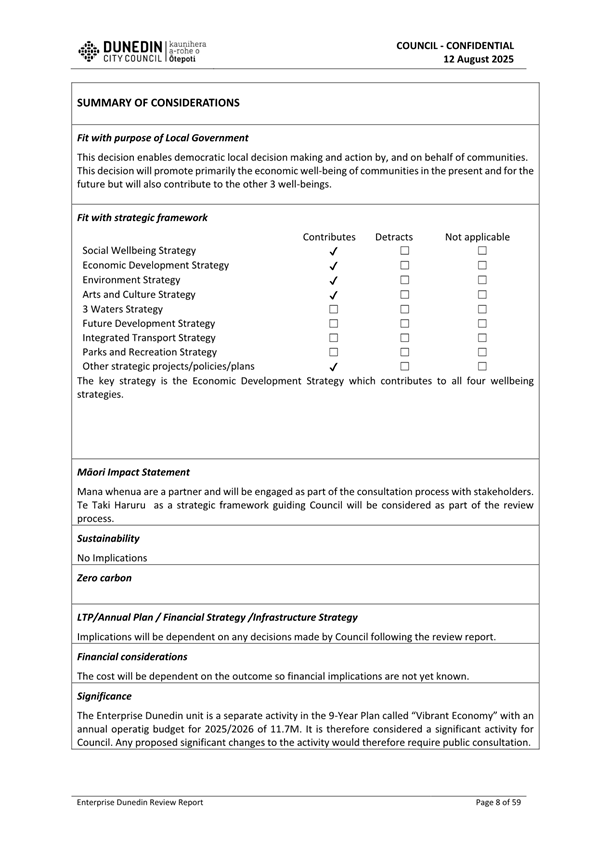
|
|
Fit with purpose of Local Government
This decision enables democratic local
decision making and action by, and on behalf of communities.
This decision promotes primarily the
economic well-being of communities and contribute to the other three
wellbeings.
|
|
Fit with strategic framework
|
|
Contributes
|
Detracts
|
Not applicable
|
|
Social Wellbeing Strategy
|
✔
|
☐
|
☐
|
|
Economic Development Strategy
|
✔
|
☐
|
☐
|
|
Environment Strategy
|
✔
|
☐
|
☐
|
|
Arts and Culture Strategy
|
✔
|
☐
|
☐
|
|
3 Waters Strategy
|
☐
|
☐
|
✔
|
|
Future Development Strategy
|
☐
|
☐
|
✔
|
|
Integrated Transport Strategy
|
☐
|
☐
|
✔
|
|
Parks and Recreation Strategy
|
✔
|
☐
|
✔
|
|
Other strategic projects/policies/plans
|
☐
|
☐
|
☐
|
The key strategy is the Economic Development Strategy
which contributes to all four wellbeing strategies.
|
|
Māori Impact Statement
Mana whenua are a partner and have been engaged as part of
the review process with stakeholders. Te Taki Haruru as a strategic framework
guiding Council will be considered as part of the process.
|
|
Sustainability
No implications.
|
|
LTP/Annual Plan / Financial Strategy /Infrastructure
Strategy
Budget and levels of services may be impacted by Council
decision.
|
|
Financial considerations
The financial implications will be determined by the
decision made. Overall impact on budget however is still to be determined.
|
|
Significance
Enterprise Dunedin is a separate activity in the 9-Year
plan called “Vibrant Economy with an annual operating budget for
2025/26 of $11.7m. It is therefore considered a significant activity
for Council. Any proposed significant changes to the activity would
therefore likely require public consultation.
|
|
Engagement – external
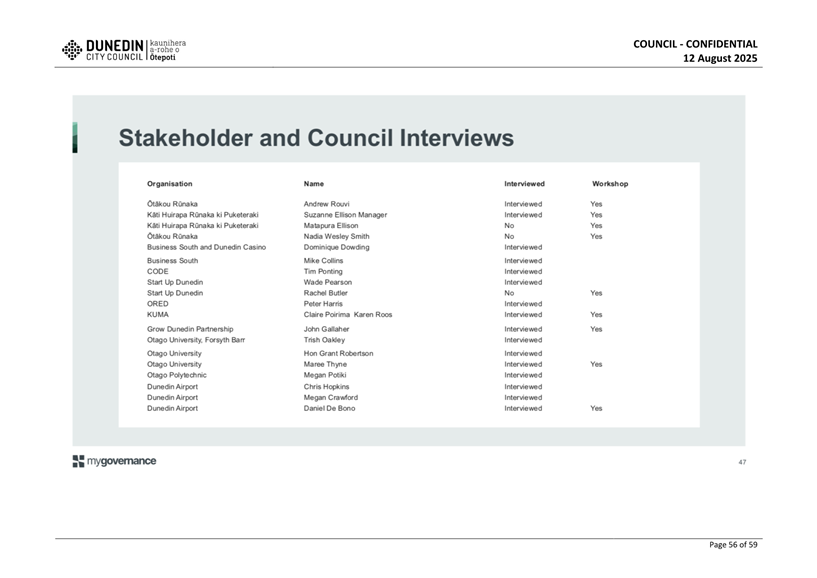
A wide range of stakeholders have been engaged as part of
the review process for the previous report on this matter including mana
whenua, business, education, tourism and hospitality sectors.
|
|
Engagement - internal
Councillors and staff have been engaged throughout the
process.
|
|
Risks: Legal / Health and Safety etc.
Full implications are still to be finalised however
employment matters will be encountered should the delivery of functions be
assigned away from the current model. Depending on the decision
appropriate engagement of staff will be undertaken to ensure employment
obligations are met and supported.
|
|
Conflict of Interest
No known conflict of interest
|
|
Community Boards
No specific engagement with community boards.
|