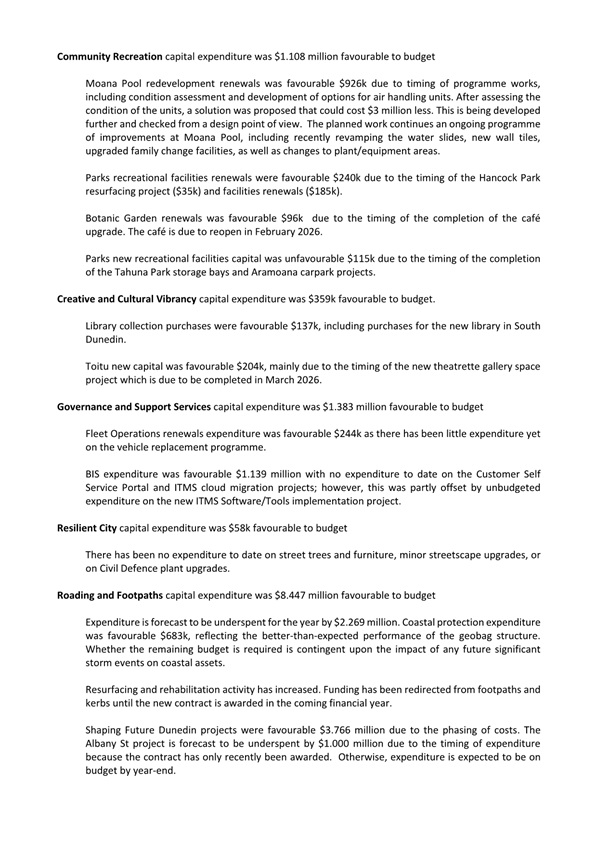
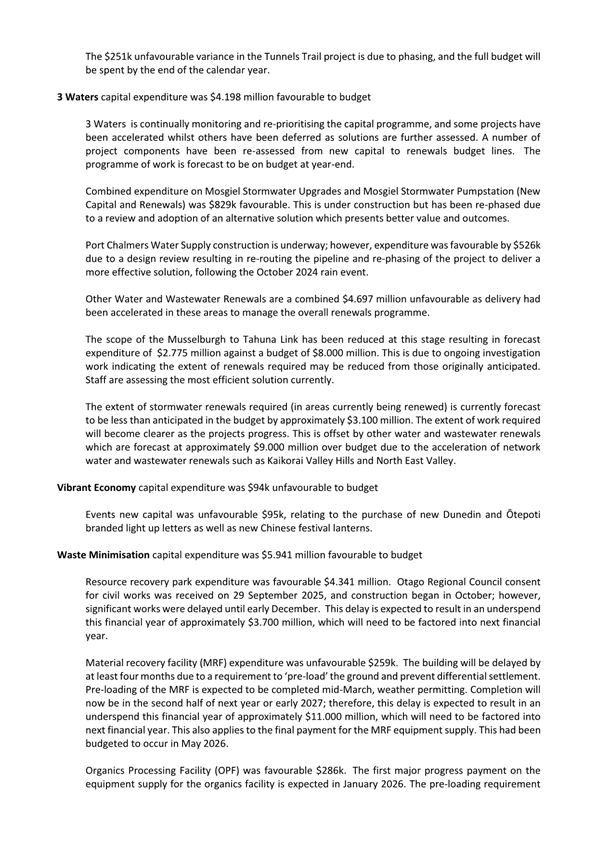
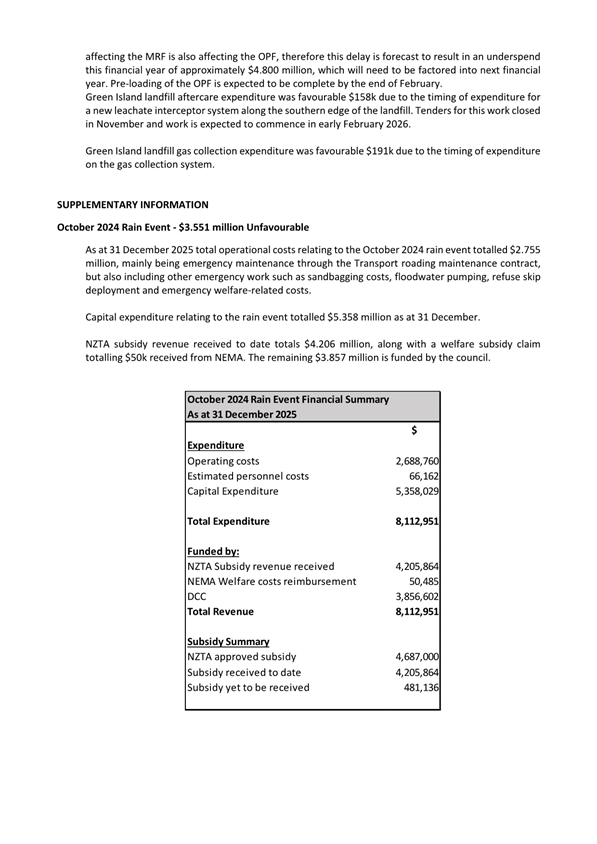
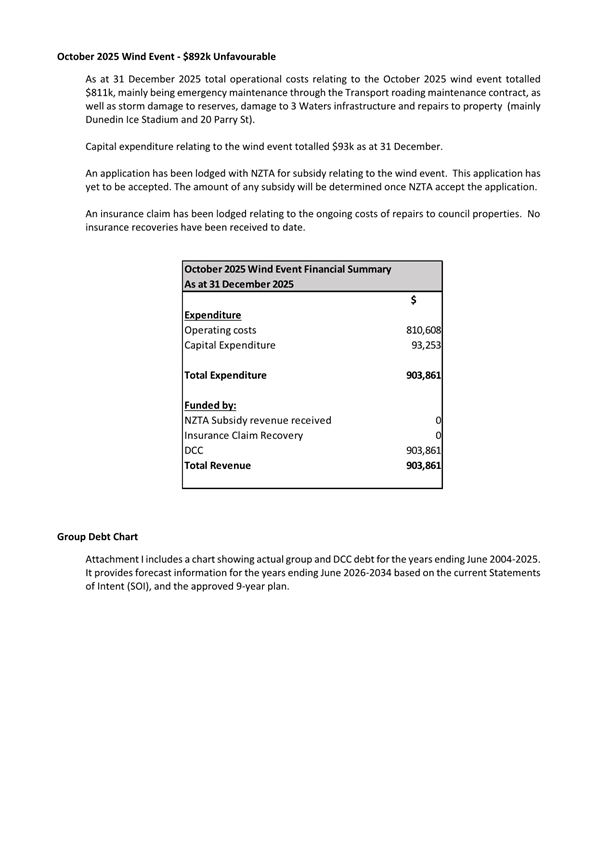
|

|
Council
12 February 2026
|
13 February 2026
Committee Secretariat
Environment Committee
Parliament Buildings
Wellington
Email: En.Legislation@parliament.govt.nz
Tēnā koutou
SUBMISSION ON THE PLANNING BILL AND NATURAL
ENVIRONMENT BILL
The Dunedin City Council
(DCC) welcomes the opportunity to submit on the Planning Bill and the Natural
Environment Bill, part of the wider resource management reforms aimed at
replacing the Resource Management Act (RMA) 1991.
The DCC acknowledges that
replacing the RMA is a significant undertaking, and has a keen interest in RMA
reforms, as these will fundamentally change the way in which local government
delivers resource management functions across New Zealand.
This submission has been
prepared on behalf of the DCC to reflect the experience of staff in delivering
resource management functions, councillors’ experience as hearing
commissioners, and the views of council members. Staff from a range of
departments across the DCC have been involved with the drafting of this
submission, and the comments in this submission reflect the recent experiences
of staff in developing the Dunedin City Second Generation District Plan (2GP),
several variations and plan changes to the 2GP, and the more recent development
of the Future Development Strategy (FDS). Our submission also includes feedback
specific to the local context of Ōtepoti Dunedin (Dunedin).
This submission focuses
primarily on the Planning Bill (the Bill), as this is the principal piece of
legislation through which the DCC would work to deliver its resource management
functions. However, the submission also touches on broader themes that apply to
both Bills and the resource management system overall.
1 Introduction
1. Dunedin
City Council (DCC) recognises that change is needed within the resource management
system and acknowledges the scale and complexity of reform. DCC supports key
elements of the proposed system – particularly a strengthened role for
spatial planning and clearer national direction – where these improve
coordination, provide certainty, and enable more consistent approaches to
genuinely nationwide issues.
2. However,
DCC considers several aspects of the current proposals create significant
governance, delivery and cost risks for local government and communities. These
risks are substantial enough that, without amendment, they may undermine both
the effectiveness and affordability of the new system.
3. DCC’s
key concerns are:
· Regulatory relief:
The proposed regime would impose significant, uncertain and potentially
unquantifiable financial liabilities and resourcing demands on councils, which
conflicts with the Government’s stated intention to reduce rates and the
proposed rates-capping policy. DCC recommends these provisions be removed or, if
retained, accompanied by clear funding mechanisms and amendments to ensure the
regime is workable and fair.
· Transition
sequencing, timeframes and implementation funding: The proposed timeframes and
sequencing are not realistic for producing high-quality spatial plans and
land-use plans, particularly while national direction, standards and
methodologies are still being developed. Rushed implementation increases the
likelihood of rework, dispute, and poor outcomes, and creates immediate
pressure on council budgets that may not be provided for in Long Term Plans
(LTPs).
· Local democratic
decision-making and public participation: DCC supports national consistency
where appropriate but does not support a model that removes local policy
judgement and reduces local government to implementing centrally determined
settings regardless of local evidence, constraints, and trade-offs. National
direction and standardised provisions must include sufficient flexibility to
reflect genuine variations between places.
· Affordability and
deliverability of infrastructure and the cost of growth: The new system must
explicitly enable growth to be sequenced and directed in a way that is
infrastructure-efficient and financially sustainable for communities. Without
clear ability to consider infrastructure affordability, funding pathways, and
long-term operational implications, councils risk being pushed toward
inefficient servicing decisions that increase costs to ratepayers and undermine
delivery of agreed infrastructure priorities.
· Fragmentation of
environmental management across two Bills: DCC is concerned about the division
of environmental effects management between the Planning Bill and the Natural
and Built Environment Bill. Where effects span both regimes, the current framework
risks gaps, duplication, and uncertainty about which matters can be considered,
when, and under which statutory tests. This fragmentation is likely to increase
complexity, litigation risk, and administrative cost for councils, applicants,
and communities, and may result in important cross-cutting effects not being
appropriately addressed within either regime.
· Impacts on Iwi
Māori: the Māori interest goal is too narrow and results in an
insufficient focus on matters of concern to Māori. Further, the absence of
a specific Treaty provision risks diluting the commitment to giving effect to
the principles of the Treaty of Waitangi.
· Economic
competitiveness and place outcomes (amenity, landscape and heritage): DCC
considers the current approach underweights the tangible contribution that
amenity, landscape and heritage make to Dunedin’s visitor economy and its
ability to attract businesses and skilled migrants. DCC recommends these
matters be retained but tightly framed around evidenced economic contribution
and outcomes.
4. DCC’s
detailed submission focuses on amendments that improve workability, legal
coherence, and delivery certainty, while ensuring the system remains affordable
for councils and communities and maintains appropriate democratic accountability.
2 Roles
and Responsibilities in the New System
2.1 Role
of local government
5. Dunedin
City Council supports the intent of the Planning Bill to establish a more
integrated, nationally consistent planning system with clearer outcomes and
limits. However, the effectiveness of the new system will depend critically on
the clarity, feasibility, and appropriateness of the role assigned to local
government, as councils will be the primary institutions responsible for
implementing the system in practice.
6. Local
government should not simply be a delivery agent for national policy and
pre-determined regulation. Councils are democratically accountable bodies with
statutory responsibilities for land use planning, infrastructure provision,
service delivery, and community wellbeing. They hold detailed local knowledge
and are responsible for managing the long-term financial and infrastructure
consequences of planning decisions. Local government’s role in the new
system should reflect their democratic accountability to their communities for
land use decisions, infrastructure investment, and long-term financial
sustainability. The planning system must respect the role of elected members in
setting strategic direction and making trade-offs within nationally defined limits.
7. For
the new system to function as intended, the role of local government must be
more clearly defined, realistic in scope, and aligned with councils’
function, organisation, and funding.
8. The Bill
shifts a significant proportion of substantive policy making from regional and
district planning processes into the development of national instruments. While
this may streamline local planning processes, it also compresses complex policy
debates into nationally led processes that may be less accessible to local
communities and councils.
9. National
instruments will be expected to resolve difficult trade-offs (for example,
between development capacity, environmental protection, infrastructure
constraints, and amenity effects) at a national level. However, these
trade-offs often have place-specific implications that are best understood and
tested locally. There is a risk that nationally set solutions will not reflect
local evidence or lived experience, particularly in smaller or slower-growing
regions.
10. The
DCC is concerned that the proposed framework narrows the scope for councils to
exercise professional judgement and local democratic choice, even where locally
tailored solutions would better achieve the objectives of the legislation.
11. The
establishment of spatial plan committees introduces a new governance layer that
cuts across existing council decision-making structures. While collaboration is
supported, there is a risk that poorly defined governance arrangements will
create uncertainty about decision-making authority or undermine councils’
ability to discharge their statutory responsibilities. There is also concern
about the ability of local authorities to influence matters outside of the
local areas where there is no tangible effect on their local area – for
example it makes no sense for Dunedin elected members to influence the planning
for Queenstown (over 250km away) or vice versa.
12. The
Bill also often assigns responsibility to local government without sufficient
clarity, sequencing, or resourcing. For regional spatial plans, councils are
required to make decisions and commitments in advance of national direction,
environmental limits, and funding clarity. This places councils in a position
of bearing delivery risk for matters outside their control and blurs
accountability between central and local government.
13. These
matters are also discussed further in Section 0 (Spatial Plan provisions).
14. Recommendations:
a. Reconsider
implementation sequencing and timelines to ensure local authorities are able to
implement national direction within a complete and settled framework. Also
ensure councils are not required to make binding decisions or commitments until
relevant national direction, limits, and methodologies are in place. This will
ensure councils are not required to “fill gaps” in national policy
or bear disproportionate delivery risk.
15. Provide
clearer statutory direction on the establishment of spatial plan committees
including how their role interacts with elected councils’ statutory
decision-making responsibilities and make the relationship with the Long Term
Plan (LTP) and its ability to delegate authority clear. This is necessary to
avoid friction and delay during establishment, and improve confidence in
decision-making processes.
a. Ensure
that Councils have enough influence in the system to manage the costs of growth
in a way that ensures long-terms infrastructure delivery is affordable to
communities. This is best done by including this outcomes within the goals of
the Bill and giving a strong role to strategic spatial planning and appropriate
ability to decline unanticipated growth that may undermine that outcome.
2.2 Management
of biodiversity
16. Under
section 221 of the Natural Environment Bill, management of indigenous
biodiversity will be the responsibility of regional councils. This represents a
change from the current RMA framework, under which indigenous biodiversity is managed
jointly by territorial authorities and regional councils.
17. DCC
acknowledges both benefits and drawbacks to the proposed management approach.
As a positive, having indigenous biodiversity solely managed under the Natural
Environment Bill would provide clarity, as both landowners and councils would
only need to refer to a single piece of legislation. It would also reduce
duplication of roles and responsibilities between regional councils and
territorial authorities, offering a simpler and more transparent framework for
indigenous biodiversity management.
18. However,
there are potential drawbacks. One key concern is that applicants may now be
required to obtain a consent from both the territorial authority and a separate
permit from the regional council for a development in a significant natural
area. Under the current system, they may only need a single consent from the
territorial authority. This change could increase the consenting burden and
result in higher costs for both applicants and the local authorities involved.
2.3 Links
between the Planning Bill and the Natural Environment Bill
19. The
Planning Bill is primarily focused on enabling development and regulating land
use, while the Natural Environment Bill is directed at managing the effects of
natural resource use and protecting the natural environment from harm. The
scope of the “environment” addressed by each Bill differs: the
Planning Bill applies to the “built environment,” while the Natural
Environment Bill applies to the “natural environment,” both of
which are defined terms within their respective Bills.
20. There
is a risk that some activities may generate effects that fall outside the
defined “environment” regulated by either Bill. For example, when
considering land use consent applications under the Planning Bill, local
authorities may be unable to assess adverse effects on the natural environment
or indigenous biodiversity, as these matters do not appear to fall within the
scope of the “built environment.” Therefore, if a separate consent
is not also required under the Natural Environment Bill, there is a risk that
such effects may not be able to be considered at all.
21. A
further issue arises from the reciprocal exclusions in each Bill. Under the
Natural Environment Bill, decision-makers are prohibited from considering
effects regulated under the Planning Bill (s14(b)). Similarly, when exercising
functions under the Planning Bill, decision-makers are precluded from
considering “any matter where the land use effects of an activity are
dealt with under other legislation” (s14(1)(j)). This creates a
potentially significant gap, particularly where matters overlap across both
regimes (for example, natural hazards), as decision-makers will be unable to
consider effects that are regulated under the other Act.
22. For
example, under the NE bill, regional councils can only consider the effects of
natural hazards on natural resources. Effects on natural hazards as they relate
to land-use are managed by territorial authorities. So, if a permit is sought
to discharge stormwater to a stream, it appears that regional council will not
be able to consider the potential impacts on the discharge on flooding of
houses downstream. This is a concerning gap that needs to be remedied.
23. A
further potential example could relate to zoning new growth areas that will
require an on-site wastewater solution. The impacts of the wastewater discharge
would be considered at the subdivision or development stage, through the need
for any resource consents under the NEA. However, the ability of the area to
absorb future wastewater discharge should be considered at the zoning stage,
before any time and money is invested in its redevelopment. However, the effect
of wastewater discharge cannot be considered under the Planning Act.
24. While
the regional spatial plan should identify any environmental limits (such as
ability to absorb wastewater discharges), to allow this to be considered at the
rezoning stage, as outlined later in this submission this will not be possible
for the first regional spatial plan. Even for later spatial plans, it is
possible that the appropriate limit is not identified because new housing is
not anticipated in a particular area or because the level of information
required cannot be collected at a regional level efficiently (it requires site
level soil testing). Therefore, there should be an ability to consider effects
under the NEA when making zoning decisions under the Planning Act.
25. DCC
recommends that further consideration be given to the interface and alignment
between the two Bills. In particular, consideration is needed as to whether
dividing the environment into two distinct subsets is appropriate. Further work
is also required to ensure that all significant environmental effects of an
activity can be considered, including effects that fall outside the defined
scope of either Bill, and to avoid circumstances where activities or effects
are effectively excluded from consideration under both legislative frameworks.
26. DCC
holds a similar concern with the relationship between other non resource
management legislation, for example where the Heritage New Zealand Pouhere
Taonga Act 2014 applies and requires an archaeological authority, then the land
use effects of that activity – e.g., adverse effects on significant
historic heritage – might be out of scope, despite the objectives of each
legislation being significantly different.
27. This
clause requires rephrasing to ensure that it only applies where the effects are
being managed to address the same issue or achieve the same outcome, for
example minimum floor levels under the Buildings Act to manage natural hazards
effects.
28. DCC
recommends that this clause is deleted or reworded as “(j) any matter
where the land use environmental effects of an activity are managed
dealt with under other legislation to achieve a similar
outcome.”
3 Implementation
29. The
DCC appreciates the Government’s desire to fast-track reform, however, it
feels that the pace of reform is both unnecessary given other changes that have
been made (such as fast-track consenting) that are being used to address issues
with the pace of certain consenting and because the risks and costs of rushing
reform do not outweigh the benefits.
3.1 National
direction
30. The
proposed system relies heavily on the timely development, sequencing, and
quality of national instruments. DCC is concerned that delays, gaps, or future
changes in national instruments could significantly disrupt development of the
new plans that will be required under the Planning Act. This could result in
local planning processes being stalled or constrained while councils wait for
national instruments to be developed or finalised. Future amendments to
national instruments (e.g. if there were to be a change in government) could
require repeated changes to the new combined plans, and would result in
additional uncertainty and cost.
31. Furthermore,
councils may be required to implement national standards that assume levels of
resourcing, data availability, or infrastructure capacities that simply do not
exist uniformly in different areas of the country.
3.2 Sequencing,
time frames and funding implications
32. The
proposed development of national instruments, the regional spatial plan and
land-use plans is swift. While timely transition is supported, the proposed
sequencing needs further consideration to ensure speed does not come at the
cost of quality.
33. The
time allowed to prepare the regional spatial plan is insufficient unless the
first generation of spatial plans are limited to a ‘stapling
together’ of existing FDSs or equivalent spatial strategies with only
limited changes to the contents.
34. The
draft regional spatial plan for each region must be publicly notified within 15
months after Royal Assent of the Planning Act, or 6 months after the first
national policy direction is issued. This includes setting up new and complex
governance arrangements for regional spatial plan development. The national
policy direction will be critical in developing the regional spatial plan, so
the timeframe for developing the regional spatial plan is realistically 6
months, not 15.
35. DCC
considers that this timeframe is impractical and unworkable and is not
consistent with the time taken to develop similar documents under the RMA. For
example, development the Dunedin Future Development Strategy (FDS) took around
18 months to notification, excluding time required to set up governance
arrangements.
36. Meaningful
spatial planning requires substantial technical analysis, modelling, engagement
with mana whenua and communities, coordination with infrastructure providers
and central government agencies, and internal governance and assurance. As the
first major instrument being produced under a new statutory regime, there will
also be unavoidable implementation overheads as establishing committees,
delegations, secretariat arrangements, work programmes, and shared evidence
bases.
37. It
is unrealistic to expect local government to scale up early ahead of enactment
given the levels of uncertainty and risk of change. The proposed timing also
creates funding issues in that existing Long Term Plans are unlikely to have
identified funding for significant work on new regulatory plans within this
time period (the regional spatial plan is expected to be developed during 2026
and 2027, with notification in the third quarter of 2027).
38. Further,
these expectations to do more work faster (and commitment of significant
additional expenditure towards developing regional spatial plans) comes at a
time when councils face significant workforce constraints, financial pressures,
and multiple concurrent reform programmes. Without realistic assumptions about
capacity and resourcing, most councils will not be able to deliver the quality
and consistency of outcomes expected under the new system.
39.
Significantly more time should be provided to develop the first regional
spatial plan. In order to understand the new requirements and comprehensively
develop them, DCC recommends a minimum of 12 months from release of the
national policy direction, all relevant national standards and confirmation of
environmental limits. This would allow plans to be developed that are of
sufficient quality and detail to provide robust, defensible direction for
regions as the remaining parts of the system are implemented.
40. Alternatively,
the scope of the first regional spatial plan should be reduced significantly.
3.2.1 Sequencing with respect to environmental limits
41. Development
of the regional spatial plan is particularly problematic. Schedule 2,
cl.2(2)(a) of the Bill requires a regional spatial plan to be consistent with
environmental limits. However, environmental limits are established either
through the natural environment plan (ecosystem health limits), or by the
Minister in national standards (human health limits). Ecosystem health limits
must be determined using a methodology provided by the Minister in national
standards.
42. This
sequencing creates both legal and practical difficulties. Regional spatial
plans cannot be required to be consistent with limits that are not yet
identified, yet these cannot lawfully be set because methodologies are not
available, or are not sufficiently advanced to shape spatial decisions.
43. The
likely consequence is either councils must “guess” at limits and
constraints (creating risk of misalignment and rework), or they must use
placeholders and caveats, reducing the usefulness of the documents and creating
interpretive uncertainty. Either approach increases the likelihood of rework,
legal challenge, and loss of public confidence when the first generation of
regional spatial plans must be revisited.
44. Land
use plans must be notified within 9 months of decisions on the regional spatial
plan. While acknowledging that the new land-use plans will be simpler and
incorporate more standardised material, DCC considers that the timeframes given
in the Planning Bill are simply not possible to meet, and recommends that these
timeframes are reviewed to provide councils further time to develop these
documents.
45. DCC
recommends that the statutory framework is re-sequenced so that regional
spatial plans are prepared after all necessary national direction is released
and environmental standards confirmed. This would require release firstly of
national direction that sets environment limits methodologies, development and
confirmation of those limits, then development of regional spatial plans.
46. DCC
further recommends that sufficient time is allowed to complete every step,
particularly for development of the first regional spatial plan. DCC recommends
a minimum of 12 months following confirmation of environmental limits or a
reduction in the scope and expectations for the first regional spatial plans,
or alternatively 24 months from Royal Assent.
47. This
would:
· ensure regional
spatial plans are meaningfully informed by confirmed environmental
limits/outcomes
· reduce the need
for rework, improve legal coherence, and create regional spatial plans that can
credibly guide subsequent instruments and investment decisions.
· acknowledge
real-world implementation timeframes, and avoid creating a cycle of
non-compliance or rushed processes.
· allow appropriate
budget to be included in LTPs to fund development
3.3 Preparation
of regional spatial plans
48. As
outlined in Part 3 of the Bill, all local authorities within each region must
agree on how they will work together in relation to preparation of a regional
spatial plan. This will include appointing a spatial plan committee, who will
be responsible for development of the regional spatial plan. Under s69, there
must be a publicly available document which will outline how the local
authorities will work together in relation to various matters on development of
the regional spatial plan.
49. From
reading the Bill, DCC is of the view that the provisions do not preclude the
option of each local authority being able to focus on specific parts of the
regional spatial plan that are relevant to their district. This was a point
that the DCC strongly supported in its Going for Housing Growth submission.
50. DCC
considers it would be inappropriate for Dunedin to be involved in Queenstown’s
spatial planning or vice versa. Given the strong focus on integrating land use
and infrastructure planning, district councils must take the lead role in
spatial planning for their districts and only those districts who are part of
any urban area should be involved in planning for that urban area. Having said
that, DCC supports working together, including across districts, on matters
that extend beyond urban areas or cross local authority boundaries.
51. Section
71 outlines the requirement of local authorities in a region to have a spatial
plan committee. This committee must appoint “a chairperson and a
secretariat in accordance with regulations” in section 71(3).
52. It
is unclear when these regulations will be made available. Since the timeframe
for regional spatial plan development currently starts from Royal Assent, any
delay in receiving the regulations after Royal Assent will reduce (the already
short) timeframe, as spatial planning committees and secretariats cannot be
established and work cannot commenced.
53. The
Council is concerned that the Bill provides insufficient statutory guidance on
the practical establishment and operation of spatial plan committees, including
membership and representation, voting/decision-making arrangements,
delegations, and how potential tensions between councils are to be managed. The
role, function, and composition of the secretariat also requires clarification.
It is assumed that it would comprise council staff responsible for the
day-to-day development of the regional spatial plan; however, this is not
explicitly stated. This uncertainty creates problems with planning, resourcing
and funding the preparation of the regional spatial plans.
54. Recommendations:
a. Explicitly
enable and encourage efficient work allocation, including an approach where
each council leads the spatial planning work for its district, with
collaboration focused on cross-boundary and region-wide matters.
b. Amend
the Bill so that the timeframe for preparing the regional spatial plans
commence from the release of any regulations governing the set-up of the
spatial plan committee and the secretariat.
c. Clarify
the role, function, and composition of the secretariat.
55. This
would:
· improve
efficiency, respect accountability, reduce unnecessary duplication, and support
better-quality spatial planning grounded in local knowledge
· avoid delay in
establishing appropriate working relationships and commencing work on the
regional spatial plan
· enable effective
resourcing, role definition, and project mobilisation
3.4 Inconsistency
in timing of decisions on regional spatial plans
56. There
appears to be an inconsistency in the Bill regarding the timeframe for which
decisions must be made on the regional spatial plan. Schedule 2, cl.21(3) requires
that local authorities must make decisions on the recommendations of the
independent hearings panel within 12 months of the date on which the draft
regional spatial plan was notified.
57. However,
Schedule 1, cl. 5(4)(b) states that a draft regional spatial plan must be
decided within 6 months after it is publicly notified.
58. This
inconsistency is presumably due to clause 5 in Schedule 1 being specifically
related to the first set of national instruments, and that the timing in
Schedule 2 would apply for subsequent regional spatial plans. If so, it seems
counter-intuitive that a shorter time is allowed for decisions on the first
regional spatial plan, which arguably will be more complex and time-consuming
to develop at each stage than a subsequent regional spatial plan review.
3.5 Costs
of implementation
59. The
DCC is concerned about the significant costs associated with implementing the
new resource management system. These costs are expected to include the
evidence gathering, changes to IT systems, preparation of new regional plan
chapters, governance and operational arrangements, updates to processes,
templates and guidance documents, changes to administrative systems, and
additional staff training and resourcing. There will also be legal costs including
those borne due to litigation risk in the system. While there has not been time
to appropriately estimate these costs, it is considered that the cost
assessments in both the Supplementary Analysis Report[1] (published November 2025) and
the Regulatory Impact Statement[2]
(published March 2025) are too low.
60. At
this stage, it is unclear what proportion of these substantial implementation
costs will be borne by local government, as this will depend on Government
decisions regarding any implementation funding package. However, councils
across the country are already operating in a fiscally constrained environment,
which is likely to be further exacerbated by the proposed rates capping. In
this context, DCC has significant concerns about the affordability of the
reforms and strongly urges the Government to carefully consider the funding and
support mechanisms that will be required to enable local government to
implement the new system effectively.
61. DCC
encourage the Government to provide an appropriate funding package that
includes a centrally procured e-planning system that efficiently and
economically enables not only delivery but effective data capture for
monitoring and ongoing system improvement; and centrally procured robust and
comprehensive independent science and economic assessment to support
appropriate management approaches that will achieve social and cultural
well-being, environmental sustainability and economic prosperity.
4 Purpose
/ Goals of Planning Act and changes from the RMA
62. The
DCC understands and has sympathy for the Government’s intent to reduce
the costs of regulation within the land use planning system, however, it
considers that the costs of the removal of some areas of regulation have not
been well-enough considered or communicated to the public so that the costs and
benefits of these changes can be appropriately considered and weighed. DCC also
considers that there are less-extreme options that could achieve similar levels
of benefit with less significant costs to the quality of our cities and places.
4.1 Removal
of visual amenity
63. A
key concern is the proposed changes to the matters managed under the new
system, particularly the removal of visual amenity from the system (Section
14(e) which excludes the consideration of effects of any activity including:
“the visual amenity of a use, development, or building in relation to its
character, appearance, aesthetic qualities, or other physical feature”.
DCC is concerned that eliminating amenity as an element of the planning system
could undermine the ability to create attractive well-functioning urban
environments that continue to support New Zealand’s tourism economy, its
reputation as an attractive destination for skilled migrants, and general
liveability outcomes for residents. DCC does not believe that this change has
wide-spread public support and that it represents a ‘baby out with the
bathwater’ response to a much narrower problem of ensuring that public
submissions and processes do not inappropriately constrain or delay
development.
64. The
removal of amenity from the system will allow both urban and rural areas
(including key tourists routes and vistas) to become cluttered by commercial
hoardings and other signage as common in other western countries where signage
is not regulated.
65. The
removal of the ability to manage landscape values (where not
‘outstanding’) will remove DCC’s ability to manage the design
of new development on areas identified as significant landscapes including
important natural backdrops to the urban environment, such as ridgelines and
headlands. In Dunedin, this will affect the management approach to new
development in over 28,000 ha of significant natural landscapes, and a further
1,878 hectares of natural coastal character. Landscape vistas affected would
include the Silverpeaks, Mahinerangi, and the lower slopes of both Mt Cargill
and the Otago Peninsula. A large number of coastal areas would also be
affected, including the entire southern coast from Taieri Mouth to Tunnel
Beach, Aramoana, Blueskin Bay, and Waikouaiti.
66. It
will also prevent requirements such as the screening of outdoor storage and the
management of fences in front yards; evidence indicates that this will result
in unattractive neighbourhoods that invite crime and anti-social behaviour such
as tagging.
67. It
would also prevent the ability to schedule protected trees which most plans
have, and which many communities support as part of maintaining attractive
urban places.
68. Our
initial analysis indicates that no other countries in the Organisation for
Economic Co-operation and Development (OECD) have completely excluded public
amenity outcomes from their planning frameworks and most of the world’s
most attractive and successful cities manage it more strictly than New Zealand
has. DCC considers that management of visual amenity is a critical element and
should be reinstated in the new system albeit with appropriate limits on
notification / rights to submit and scope to consider to prevent its use for
NIMBYism or to delay development. DCC considers that there has been a lack of
attention to, and proper analysis of, the importance of amenity to New
Zealand’s tourism economy, as well as its ability to attract skilled
migrants. DCC recommend that the matter of visual amenity be narrowed to focus
on the tangible contributions this matter makes to the visitor economy and
migrant attraction, rather than being removed.
69. For
example, national planning standards could still set rules for fence heights,
signage in different zones, screening of outdoor service areas/storage, and
allow for the scheduling of protected trees but restrict public submission
and/or appeal rights to ensure efficient processes.
70. There
is also a lack of clarity as to how certain aspects of amenity that have been
signalled as not being removed – such as shading and noise amenity still
fit into the system. The content of the Bill appears to be inconsistent with
the accompanying commentary to the Bill (for example New-Planning-System-factsheet-05-Making-it-easier-to-build-and-renovate-your-home.pdf
and New-Planning-System-factsheet-08-Simplifying-residential-development.pdf),
both of which explicitly refer to shading and state that effects such as
shading will continue to be considered through the consent process.
71. It
is noted that the management of shading or noise effects does not appear to fit
clearly under any of the goals other than the vaguely worded “land use does
not unreasonably affect others, including by separating incompatible land
uses”. This goal statement is ripe for litigation as it is not clear
about: what effects are captured (and does it include adverse effects on land
values), how what is ‘unreasonable’ should be interpreted –
is it what the land owner things is reasonable or unreasonable or someone else
opinion of reasonableness and what factors are considered in determining
reasonableness, and finally who is captured by ‘others’ –
neighbours, communities, visitors?
72.
While ‘amenity’ by nature has a degree of subjectivity it is still
more clear of a concept then what unreasonably affects others.
73. Finally,
if the management of shading effects is intended to be maintained – this
seems to be precluded by Section 14 (and the transitional provisions), which
remove the ability to consider the “external layout of buildings on a
site”. Where buildings are placed on a site is a key determinant of
shading effects, but this exclusion limits the management of shading to height
limits. To ensure clarity, Section 14 should specifically state
‘excluding height in relation to boundary where this results in shading
effects’ to avoid legal challenge for rules that manage height and
distance from boundary together.
4.2 Removal
of management of quality of homes
74. DCC
is also concerned about the proposal to remove the management of the quality of
homes for future residents, including the provision of minimum areas of outdoor
living space. It is a fallacy that these effects are born by the property owner
and therefore not an externality, as in many cases the builder of a home is not
the end occupier, and in many cases that future occupier is a tenant.
75. DCC
accepts that if any plans genuinely prescribe the direction of a television, as
claimed, that that is inappropriate and that only aspects of housing quality
that have scientific research that indicates a tangible impact on health
outcomes should be managed.
76. DCC
is particularly concerned that the removal of appropriate requirements for
outdoor living space will have detrimental impacts on people’s health and
wellbeing and add to the cost of living (for example, by removing access to
secure outdoor areas to dry clothes). This view is supported research.
77. There
are a wide range of studies that explore the positive relationship between both
public and private outdoor green spaces, with increased health and wellbeing.
This includes Cervinka et al.[3]
who concluded that domestic gardens mitigate health deprivation more
effectively than public green space at all levels of urbanity apart from the
most rural areas. Brindley et al.[4]
undertook a population-level survey which showed that garden size played a
significant role in self-reported health, with areas with small gardens
displaying greater income-related health inequalities. This study highlighted
that garden access and quality may play a key role in the buffering effect of
nature regarding health and wellbeing. Collins et al.[5] highlighted that access to a
private garden substantially reduces the predicted probability of poor mental
health issues in men, regardless of their access to local public green space.
They also showed that having access to a private garden for older women reduces
the predicted probability of poor mental health. These studies represent only a
sample of the research literature available that have linked private outdoor
space to improvements in health and wellbeing.
78. Access
to quality outdoor living areas is recognised as important in a number of
jurisdictions, including in Australia. For example, in Melbourne, outdoor
living areas have quantifiable minimums and qualitative design guidance. New
medium density rules strengthen garden / open space requirements beyond the
conventional Residential Code minimums. Emerging provisions (Medium Density
Codes) replace the older “outdoor living area” with consolidated
primary garden area requirements (typically 20 – 40m², scaled to lot
size) as part of amenity requirements for townhouses and terraces. These
provisions require a larger outdoor area than the previous rules. Landscaping
and soft landscaping/tree canopy targets are also introduced to improve amenity
and outdoor quality. Design guidelines have been prepared to support these
provisions.
79. DCC
is concerned that the proposal to remove management of the quality of homes,
particularly the provision of outdoor living space requirements, will lead to a
number of adverse effects for future residents and lead to tangible adverse
health outcomes for people and associated costs to the health sector. DCC
recommends that quality of homes is an important matter that should continue to
be managed under the new resource management system. DCC strongly encourages a
more robust, wide-ranging and objective cost and benefit analysis that analysis
of international best practice and evidence before proceeding.
4.3 The
management of historic heritage
80. Dunedin
is considered Aotearoa New Zealand’s premier heritage destination. The
high quality and extent of Dunedin’s built heritage is unique amongst
Aotearoa New Zealand’s cities. Our heritage buildings greatly contribute
to Dunedin's liveability, vitality, and economy. Both residents and visitors
highly value the city’s heritage. A 2023 resident survey indicated strong
support for heritage buildings and their protection, while tourism surveys show
that Dunedin’s historic heritage is a key factor contributing to the
city’s distinctiveness relative to other destinations. DCC considers that
there has been a lack of attention to, and proper analysis of, the importance
of heritage character to New Zealand’s tourism economy as well as its
ability to attract skilled migrants, for example in places such as Dunedin,
Oamaru and other parts of Otago, and other locations in New Zealand such as
Napier. DCC recommend that management of historic heritage should recognise the
tangible contribution this makes to the visitor economy and migrant
attraction.
81. DCC
supports the goal of protecting identified values and characteristics of sites
of significant historic heritage from inappropriate development
(s11(1)(g)(iii)), subject to the threshold for significance being appropriately
set to enable not just the most notable buildings, but also those buildings
that cumulatively contribute to the collective heritage value of a broader
area. While DCC recognises that not all heritage can be cost-effectively
conserved, or in some instances its loss is necessary to achieve more
strategically important goals or projects (for example, the loss of the Cadbury
factory for the new Dunedin Hospital), those trade-offs or cost benefit
assessments are very context specific and not the same city to city, or place
to place. Therefore, any future definition of significance in the national
direction must not set the bar too high to support the achievement of the goal.
It is better to set an achievable threshold to identify historic places that
meet the criteria of significance, and provide robust policy direction to
assess trade-offs and the costs and benefits of protection on an individual
basis, than to make country-wide assumptions about those costs and benefits and
set the bar too high.
82. In
terms of more minor comments DCC notes the following.
83. The
drafting of s11(1)(g)(iii) includes the phrase “sites of significant
historic heritage”; the inclusion of the word ‘sites’ appears
to conflict with the definition of historic heritage. The definition of
historic heritage includes a variety of terms, specifically “historic
sites, structures, places, and areas”. To avoid confusion, DCC recommends
that the word ‘sites’ should be removed, or the sentence be
reworded to include a term such as ‘item’, e.g., ‘Items of
significant historic heritage’ to provide clarity to the definition.
84. In
addition, the new act is an opportunity to simplify the term used to describe
heritage. Both the RMA and the Planning Bill use ‘historic
heritage’ For simplicity, this submission recommends ‘historic
heritage’ be referred to as ‘heritage’ in the Bill. DCC notes
the Heritage New Zealand Pouhere Taonga Act uses the term
‘heritage’ (e.g. Heritage List), noting that the purpose of that
Act is to promote ‘protection… of the historical and
cultural heritage of New Zealand (s3 HNZPT). Removing the word historic
from the title of the definition clarifies that the places specified in (b)
(i), (ii), (iii), and (iv), include both historical and cultural heritage. The
word historic is repeated as a prefix to ‘sites, structures, places, and
areas’ in the definition which is a tautology.
85. DCC
note that the ‘qualities’ in the definition of historic heritage in
the Bill are the same as those in the RMA. However, they are a subset of the
criteria identified in the Heritage New Zealand Pouhere Taonga Act 2014 in
s66(1). For consistency and to avoid confusion, both pieces of legislation
dealing with heritage protection should be consistent.
4.3.1 Suggestions relevant to future national direction on
Heritage
86. DCC
also acknowledges that further direction on the protection of significant
historic heritage will be provided through national instruments. DCC would like
to highlight several matters that could be usefully clarified or explored
through the national policy direction or national standards. Clarification on
these matters would ensure consistency of heritage protection across the
country and reduce debate and litigation around whether places are
‘significant’ heritage and should be protected.
87. These
matters include:
a. The
process and information requirements for undertaking a heritage assessment.
b. How
significance is to be determined, and what the threshold for
‘significant’ is, for each of the qualities (archaeological,
architectural, historical, etc.).
c. The
weighting to be given to other planning matters when proposing heritage
protection.
d. Guidance
on assessing significance at a local or regional level, and methods for doing
so. While Heritage New Zealand Pouhere Taonga provides guidance on applying
its criteria and thresholds, these do not carry through to local heritage, as
they relate to national significance[6].
Additionally, as noted above, the Heritage New Zealand Pouhere Taonga criteria
differ from the qualities in the Bill.
e. Guidance on
identifying the protected parts of a place. Best practice is to protect the
entire place (the interior and exterior of a building, and the setting, for
example). Guidance should identify circumstances in which it is appropriate to
omit part of the place from heritage protection.
f. A
definition or method for identifying the ‘surroundings’, to support
the definition of historic heritage clause (b)(iv). The method will need to
anticipate a broad range of scenarios, with specific guidance for both individual
places and groups of interrelated places with collective significance and their
surroundings.
g. For
heritage areas containing an interrelated group or groups of historic places, a
method for identifying collective significance (for example, as an area or
precinct), and quantifying the significance of buildings within that group,
i.e. whether contributing, neutral, or detracting.
h. Clarification
about whether heritage protection is to be ‘tiered’ as it is
currently in many district plans (e.g. class I, class II), or whether
‘significant’ is a single category.
4.4 Removal
of effects on retail distribution
88. The
DCC is concerned that the Bill’s removal of the ability to consider
retail distribution effects in planning decisions (refer s14(1)(c)) will have
detrimental implications for Dunedin’s transport network and parking
management, and the vitality and vibrancy of the CBD and centres (which are
important to overall economic performance of retail and hospitality in the
city).
89. Firstly,
with respect to parking management, DCC provides for a wide range of parking
options across the city, including on-street paid parking and time restricted
parking, along with off-street parking spaces and parking buildings. As would
be expected, parking provision is primarily concentrated in areas that are most
frequently visited by people, i.e. the CBD and other local centres around the
city. Under the current district plan, retail is generally concentrated in
these centres, enabling more efficient public transport, active transport, and
car-parking opportunities. If DCC can no longer consider retail distribution
effects, then there is potential that retail activity could become more widely
dispersed across the city, resulting in increased private vehicle trips, increased
congestion, inadequate parking options and increased costs for parking
management, less effective public transport, and negative implications for the
Council’s environment strategy and zero carbon aspirations.
90. The
DCC also highlights that concentrating retail locations in specific areas (CBD
and centres) is fundamental to maintaining the vitality and vibrancy of these
areas. Having a vibrant and successful CBD and centres directly contributes to
the overall economic and social wellbeing of the city. Additionally,
concentrating retail activities in these areas also acts to provide space for
other activities that cannot easily locate in the CBD and centres. Research[7] undertaken in
Auckland demonstrates that where retail activity is located within a city
strongly shapes urban form and influences how efficiently people travel and use
their time. Retail distribution also influences other patterns of land use,
including those that contribute to the vitality and viability of centres that
function both as key commercial hubs, and as places of social interaction which
provide important community amenities and social infrastructure for the
populations they serve. DCC received evidence[8]
at its district plan hearings that a more permissive commercial environment
does not necessarily result in better economic outcomes. For example,
commercial activity may locate where land is cheapest, leading at a dispersal
of activities, loss of agglomeration benefits, a decrease in the depth and
breadth of the retail offering in the CBD, a consequent reduction in the
attractiveness of the CBD as a destination and its social amenity (leading to
adverse effects on remaining businesses), and less efficient travel patterns.
Each individual out-of-centre commercial development has a small, but
cumulative effect on centres, typically aggregating to significant effects over
time.
91. The
DCC recommends that the ability to consider the effects on retail distribution
should remain in the Planning Bill, due to the implications this has on parking
management, transport, the vibrancy and vitality of the CBD and centres, and
the general contribution towards economic prosperity.
4.5 Effects
on significant landscapes
92. The
Planning Bill excludes consideration of effects on landscape, apart from
outstanding natural landscape and features (s14). DCC is concerned that this
proposal is too ‘broad brush’ and that consideration of effects on
highly valued (but not outstanding) landscapes is excluded.
93. DCC’s
district plan contains a landscape classification of ‘significant natural
landscapes’ (SNLs). These areas are intended to give effect to Section 7
of the RMA, which requires that the maintenance and enhancement of amenity
values and the quality of the environment are given “particular regard
to”. There is currently 28,000 ha of land identified in the district plan
as SNL. The DCC considers that the distinctiveness of Dunedin is not just about
its key or outstanding features and landscapes. Rather, it is the broader
landscape fabric of the city and surrounds, of which SNLs are an important
part, that gives Dunedin its unique sense of place.
94. A
planning framework that focuses only on quantifiable environmental outcomes without
requirements to consider wider landscape character and amenity is likely to
fail to protect the things that give places their unique identity and quality.
These include landscapes that are not ONLs and ONFs, but remain highly valued.
The quality of the broader landscape character values of Dunedin is important
to residents and is a key attraction for tourists. The erosion of landscape
character values has the potential to undermine strong tourism premiums based
on Dunedin’s distinctive landscapes.
95. At
present, SNL areas cover large areas of the hills that surround the Otago
Harbour and form the backdrop to the inner Otago Peninsula bays and West
Harbour settlements. Combined, these areas provide a significant proportion of
the setting, visual containment, and skyline for the harbour, which is enjoyed
by residents of Dunedin and thousands of tourists who are attracted to these
landscapes. The removal of SNL landscape planning provisions risks undermining
the landscape values of these highly valued places.
96. In
Australia, there are several comparable examples of regulatory controls on
visual and landscape amenity. For example, the Sydney Harbour Foreshores
and Waterways Area Development Control Plan enforces height limits and view
corridor protections around Sydney Harbour. In addition, Heritage Conservation
Areas (e.g. The Rocks, Paddington) and foreshore building setbacks and public
access requirements manage different aspects of the visual quality of the
harbour surrounds. These controls have been implemented with an understanding
that Sydney Harbour’s visual quality underpins its global branding and
tourism and that a strong visitor economy (cruises, events, hospitality) relies
on managing landscape character and visual amenity.
97. Similar
protections are implemented in other regional and tourism focused cities such
as the following:
· Byron Bay: height
and character controls to protect coastal town identity;
· Hobart: heritage
and waterfront controls to preserve historic character; and
· Noosa: low-rise
and vegetation protections to support premium tourism.
98. As
identified by the New Zealand Institute of landscape Architects (NZILA) in
their submission on the Proposed changes to RMA National Direction, through Te
tangi a te Manu (the Institute’s landscape assessment guidelines) it is
identified that people’s relationships to landscape are expressed as
place-specific character, attributes and values, all of which are necessarily
ascribed by people and recognised by communities. This understanding extends
beyond places of national importance (ONLs and ONFs) and across ordinary
everyday landscapes where people mostly live, work and play.
99. DCC
agrees with this NZILA submission, which notes that while addressing such
qualitative and intangible matters can generate contested planning issues,
effective resource management must continue to engage with communities and
support positive relationships with place as an integral planning outcome
(NZILA submission on changes to RMA National Direction, 25 July 2025).
100. As
discussed in the introduction, DCC considers that there has been a lack of
attention to, and proper analysis of, the importance of landscape, amenity and
heritage to New Zealand’s tourism economy as well as its ability to
attract skilled migrants. The DCC recommends that these matters be narrowed to
focus on the tangible contribution these matters make to the visitor economy
and migrant attraction, rather than be removed. This would narrow the focus of
decision-making on evidence related to the positive effects of protection on
the broader economy rather than NIMBY concerns, thereby addressing the root
problem to the efficient operation of the resource management system (the
ability of the system to be hijacked by NIMBY issues) while maintaining the
ability to consider aspects that have broader potential economic effects.
101. For
identified landscapes values (other than outstanding) this could be achieved
by:
a. Amending
Section 11(1)(b) to read “to support and enable economic growth and change
by enabling the use and development of land and by protecting values that
are important to economic activity:
b. Amending
Section 14(2) by adding a new clause (f) “amenity, heritage and landscape
effects where these significantly contribute to the visitor experience or
migrant attraction.
4.6 Lack
of clarity around the exclusion of “the type of residential use”
102. Section
14(1)(f)(i) excludes consideration of the type of residential use. It is
unclear what this means and whether it captures anything that has a residential
use component, for example air b and b, hotels and motels, working from home
(and to what degree), supported living facilities, private hospital, nursing
homes etc. There is a risk that it could be argued that the density of
residential use falls under this concept.
103. This
exclusion needs to be more specifically and accurately defined.
104. DCC
recommends that this exclusion is more specifically worded and that s14(2)
clearly indicates that it does not preclude management for Reverse sensitivity
effects or density of residential use.
4.7 Lack
of clarity around the meaning of “demand for or financial viability of a
project unless it is a matter to which section 11(1)(b) or (d)
relates”
105. While
it is assumed that the meaning of Section 14(1)(d) is intended to capture the
financial viability of a project for a developer/applicant with regards to the
costs borne by them, this is not clearly articulated. It is recommended that
this be spelt out to avoid litigation which may seek to argue that any public
costs of a project cannot be considered, for example, the capital or
operational costs of infrastructure that may fall on ratepayers, which should
be able to be considered, particularly in light of the Government’s
desire to reduce rate increases.
4.8 Lack
of clarity around the management of safety
106. Section
5 of the RMA sets out the purpose of the Act, which is to promote the
sustainable management of natural and physical resources. Section 5(2) expands
on the meaning of sustainable management, which includes “managing the
use, development, and protection of natural and physical resources in a way, or
at a rate, which enables people and communities to provide for their social,
economic, and cultural well-being and for their health and safety”.
107. As
a result, safety is a matter that is currently managed through RMA plans,
including in the Dunedin District Plan. Safety considerations apply to a wide
range of matters, including transportation (e.g. how activities may affect the
safe operation of the roading network for example standards requiring minimum
sight distances for a new vehicle access from roads), people’s health and
safety from hazardous substances (e.g. ensuring that their type, volume and
location ensure that they reduce risks to health and safety), high levels of
noise or emissions, and other land-use activities (e.g. ensuring appropriate
setbacks are in place to provide a buffer from potentially dangerous activities
such a bulk fuel storage).
108. DCC
is concerned that the Planning Bill does not include any goals that explicitly
refer to safety, other than safety in relation to natural hazards. While safety
could likely be considered as a general “adverse effect” under s15
(Considering adverse effects of activities), or through the duty in s25(1) to
avoid, minimise, or remedy adverse effects on the built environment, this is
not explicitly stated. Although the definition of “built
environment” includes people and communities, DCC considers that greater
clarity could be provided to ensure that public health and safety, including
transportation safety, can be clearly and consistently managed under the new
planning system.
109. DCC
therefore recommends it important that safety is expressly identified as a
matter that can be managed under the Planning Bill. This could be achieved
through the inclusion of a specific goal relating to the promotion of public
health and safety, including transportation network safety, in in Section 11.
110. This
will ensure that aspects of development including high fences and other
boundary treatments that may impact on visibility for people and traffic
entering and exiting driveways and the placement of driveways can continue to
be managed.
111. On
a related matter, an area of plan development that resulted in a number of
appeals on Dunedin’s district plan was to do with the management of
hazardous substances and the relative roles of the Hazardous Substances and New
Organisms Act 1996 (HSNO) and Health and Safety at Work (Hazardous Substances)
Regulations 2017 legislation and the RMA.
112. Appellants
argued that the district plan should not include rules relating to hazardous
substances as these are covered by HSNO. DCC’s position was that
additional controls may be required to, for example, manage potential effects
on sensitive activities and sensitive natural environments, the effects of
substances not managed by HSNO, cumulative risks and reverse sensitivity
issues.
113. Different
district plans have taken different approaches to managing hazardous
substances. Clarity is required as to the appropriate approach. DCC recommends
that the Act, and any national direction clarifies this matter.
4.9 The
need to manage growth based on long-term affordability of infrastructure to
communities and the ability to efficiently deliver infrastructure to meet
housing and business demand needs
114. Finally,
DCC is concerned that it is not clear if the Planning Bill provides for effects
of growth and development on the affordability of infrastructure (and therefore
the financial sustainability of Councils) or the efficient delivery of
infrastructure to be considered.
115. Firstly,
the wording of the goal in Section 11(1)(e) to plan and provide for
infrastructure to meet current and expected demand is vague and open-ended and
ripe for litigation. Dangerously, it could be interpreted to mean that if any
developer for any development “demands” infrastructure a Council is
obliged to provide it with no ability to consider whether it is affordable to
provide or operate.
116. Further,
DCC recommends that the planning system enables the consideration of the cost
of infrastructure (beyond which will be paid directly by developers or
landowners in a growth area directly) and for growth proposals that are
inappropriate to service due to relative cost to service or impact on the
ability to deliver other infrastructure according to priorities agreed in the
regional spatial plan be able to be deferred through transition zoning
mechanisms or, if more appropriate, declined.
117. DCC
recommends that Section 11(1)(e) is rephrased as “to enable the effective
and efficient provision infrastructure to support growth and
development.”
4.10 Climate
change
118. The
DCC is concerned that the Planning Bill does not clearly or strongly address
matters relating to climate change. While the Bill’s definition of
‘natural hazard’ includes the effects of climate change, aside from
this there are very few references to climate change.
119. From
the perspective of climate change adaptation, the DCC notes that the effects of
climate can extend significantly beyond natural hazards, for example effects on
primary production (e.g. agriculture, forestry, fisheries) and water
availability for both urban and rural land uses.
120. The
DCC recommends the Bill should contain a goal that explicitly relates to
climate change adaptation. The National Climate Adaptation Framework includes a
commitment to amend the Climate Change Response Act, to require local governments
to prepare adaptation plans for certain priority areas. If these adaptation
areas must be included in regional spatial plans, then inclusion of a goal that
relates to climate change adaptation would help promote and strengthen the
links between the different legislation and would help ensure that adaptation
planning is specifically considered through the hierarchy of resource
management documents.
121. The
Planning Bill should also include a goal related to Climate Change mitigation.
DCC notes that RMA requires decisions on regional and district plans to have
regard to any emissions reduction plan (prepared under s5ZI of the Climate
Change Response Act). DCC recommends an equivalent provision should be included
in the Planning Bill.
4.11 Enjoyment
of land
122. The
purpose of the planning bill is ‘to establish a framework for planning
and regulating the use, development, and enjoyment of land’. The phrase
‘enjoyment of land’ also appears in Schedule 3 cl.66 in relation to
assessing the materiality of impact when developing a regulatory relief
framework.
123. DCC
is concerned firstly that the term ‘enjoyment of land’ is vague and
subjective. Secondly, it is odd that only one aspect of ‘use’ is
pulled out and seemingly creates an expectation that ‘enjoyment of
land’ must be planned and regulated. Furthermore, it fails to
recognise that that allowing one person greater development rights on their
property (‘enjoyment of') can be at the expense of the property rights of
neighbouring properties. For example, permitting taller buildings may result in
increased shading for adjoining properties, adversely affecting these
neighbours’ ability to use and “enjoy” their land and
potentially depreciating its value for development. This may lead to arguments
around effects on (private) amenity being replaced by arguments around
“enjoyment” of land.
124. DCC
recommends that the term is removed and the purpose is simplified to “a
framework for planning and regulating the use, and development,
and enjoyment of land. DCC considers that if there is a desire to have a
goal around being able to enjoy land that should be appropriately worded in the
goals section.
4.12 Procedural
principles
125. DCC
supports the inclusion of procedural principles in the bill. These will assist
in the efficient functioning of the resource management system and benefit all
users. However, DCC is concerned that the 5th principle –
‘act in an enabling manner (for example being
solution-focused)…’ is open to interpretation, and has the
potential to create more complexity and argument, which seems contrary to the
reason for including principles.
126. While
providing an example: ‘being solutions-focused’, is welcome,
additional guidance is required as to how this phrase should be interpreted.
This should be provided through national direction at an early stage,
alternatively this principle should be removed.
5 Impacts
on Iwi MĀORI
5.1 Appropriate
wording of Māori interests goal
127. DCC submits that the Māori
interest goal is too narrow and results in a reduced focus on matters of
concern to Māori. The lack of provisions equivalent to RMA sections 6(e)
(in part), 6(g), 7(a), 7(d), 7(f), 7(g), and 7 (j) within the Bill highlights a
significant gap in the consideration and understanding of the relationship
Māori have with the environment and reduces the focus on environmental
protection and sustainability that is imperative for mokopuna-focused thinking.
128. The
Bill, as it stands, does not cover the broad, holistic viewpoints of Māori
interests or reflect the appropriate relationship needed to work with mana
whenua (through iwi and hapū) in developing regional and national
instruments and plans.
129. To ensure that Māori values
are appropriately considered through development of the various planning
documents, DCC recommends that goal 11(i)(i) is amended to read
‘Māori participation in the development and decision-making
on national instruments, spatial planning …’.
130. DCC also notes the drafting of
s11(i)(iii) may mean that sites of significance to Māori is interpreted
too narrowly. For example, sites of significance include mahika kai and
nohoaka. For clarity, DCC recommends that the wording of s11(i)(iii) is amended
to “the identification and protection of sites of significance to
Māori (including, but not limited to, wāhi tapu, water bodies,
or sites in or on the coastal marine area)”.
5.2 Absence
of a specific Treaty provision
131. Section
8 of the Planning Bill outlines how the Treaty of Waitangi is provided for
within the new system. This includes a Māori interest goal in s11, and
requirements around the development of regional spatial plans and land use
plans.
132. However,
unlike the RMA (s8), the Planning Bill does not contain a specific Treaty of
Waitangi provision that requires all persons exercising functions under the Act
to take into account the principles of the Treaty of Waitangi. DCC understands
this is because “…the provisions required interpretation and, along
with other aspects of the RMA, created uncertainty and complexity” (p. 33
of the consultation document[9]).
133. However,
in DCC’s view, the available legal jurisprudence and case law do provide
an understanding of the principles of the Treaty of Waitangi. DCC agrees with
the original Expert Advisory Groups (EAG) recommendations to include a general
Treaty principles clause, similar to that in the RMA. This submission also
highlights that the RMA has been criticised in the past for not being
treaty-compliant, despite the requirement of s8 outlined above. DCC is
concerned that the Planning Bill dilutes these commitments even further and
represents a step backwards in giving effect to the principles of the Treaty of
Waitangi.
134. DCC
recommends that a general Treaty of Waitangi clause is reinstated into the
Planning Bill.
5.3 Opportunities
for iwi participation
135. DCC supports provisions that allow
for meaningful engagement, recognising Kāi Tahu rakatirataka, that is
undertaken in good faith. However, the consultation requirements (including
time available for engagement) outlined in the Bill are minimal, and DCC
questions whether this level of engagement will in fact be meaningful and
enable iwi and hapū to undertake their role as kaitiaki. This approach is
reflected in the use of the term ‘participation’ in goal 11(1)(i).
The language used and the consultation requirements should be strengthened to
ensure engagement is undertaken appropriately.
136. In relation to regional spatial
plan development, s70 requires only that iwi authorities are provided with a
copy of the draft regional spatial plan prior to notification and that their
views on it must be sought. There is no requirement to involve iwi in
development of the regional spatial plan. In addition, there is no mandatory
iwi representation on spatial planning committees. This would ensure that
Māori values were considered during the preparation process. DCC
recommends that these requirements are strengthened.
137. In relation to land use plans,
territorial authorities must only ‘have regard to’ iwi management
plans and statutory acknowledgements (s80(4)). DCC recommends that these
documents are ‘taken into account’ (the requirement in the RMA in
relation to iwi planning documents) to allow them to better inform planning
outcomes.
138. DCC
also recommends changing references to “iwi” to “iwi and
hapū” to recognise how different iwi structures interact with
central and local government. For example, Section 15(2) of the Te Rūnanga
o Ngāi Tahu Act 1996 states that “where any enactment requires
consultation with any iwi or with any iwi authority, that consultation shall,
with respect to matters affecting Ngāi Tahu Whanui, be held with Te Rūnanga
o Ngāi Tahu”. It is the acknowledged practice of Te Rūnanga o
Ngāi Tahu (TRoNT) that consultation in the first instance is with Papatipu
Rūnanga (hapū rūnaka), rather than with TRoNT.
5.4 Sections
9 and 10 – Treaty Settlement Redress or Arrangements
139. DCC notes ss 9 and 10 of the Bill
state that Treaty settlement arrangements will operate to the same or
equivalent effect “...to the greatest extent possible…”. DCC
supports the intent to uphold these agreements, preserving the rakatirataka of
mana whenua. However, the wording could create uncertainty and potentially
allow settlement redress to be diluted if it is inconsistent or incompatible
with the new system. It is unclear how "equivalent effect" will be
measured.
140. DCC therefore
recommends that national instruments provide further direction and guidance on
what ‘the greatest extent possible’ means in practice. It is
critical that the context these agreements were entered into is not lost.
6 Regional
Spatial Plan Provisions
141. The
role of the regional spatial plans will be critical in the new system. DCC
supports the purpose and contents of regional spatial plans, including s67(d),
which states regional spatial plans must support a co-ordinated approach to
infrastructure funding and investment by central government, local authorities,
and other infrastructure providers; and s67(e), which promotes integration of
development planning with infrastructure planning and investment.
142. In
particular, DCC is supportive of the integration of regional spatial plans with
the transport planning and funding provisions under the Land Transport
Management Act (LTMA) through the requirement for consistency between regional
spatial plans and regional land transport plans, and the requirement that the
Minister of Transport takes into account regional spatial plans when developing
the government policy statement on land transport (sections 67(d), 68(1)(c)
& (d), Schedule 11 changes to s14 and 67 of the LTMA).
143. DCC
also supports the ability of spatial plan committees to make minor amendments
to the regional spatial plan, as provided for in Schedule 2, cl.35. This will
enable the efficient correction of minor errors.
6.1 Incorporation
of information from RMA plans
144. Schedule
2, cl.6 allows the incorporation of information from operative land use and
natural environment plans into a regional spatial plan, without the need to
consider submissions on this information (unless the environment has changed).
The DCC supports this approach, as it provides for efficient use of information
previously approved in these documents, without unnecessary reconsideration or
formality.
145. DCC
considers that this provision (with the same caveats) could be extended for the
first regional spatial plans to allow councils to incorporate operative parts
of a plan made under the RMA, when such material is broadly consistent with new
national direction. This incorporation should be a reasonably straight-forward
exercise, without the need to provide onerous evidence or re-analysis beyond
that undertaken at the time provisions were originally incorporated into the
RMA plan.
146. Such
an amendment would help ease the transition from current RMA plans to the new
regional spatial plans, reducing costs and timeframes, avoiding duplication and
ensuring continuity. Efficient regional spatial plan preparation will be
particularly important given the tight timeframes in which they must be
prepared (see above).
147. Specific
examples where this would be helpful is the mapping of areas of outstanding
natural landscapes (ONLs) and sites of significance to Māori, which have
gone through a public process under the RMA, and will continue to be managed
under the Act. Having to produce new comprehensive assessments of these would
not be possible in the timeframe allowed for the first regional spatial plans.
Provided the methodology used to identify them is broadly consistent with any
new national direction, then a direct transfer this mapping into the regional
spatial plan, without the ability for submissions (where the site/details have
not changed), would improve the efficiency of regional spatial plan development
and approval. For the sake of clarity, this process should allow Councils to
choose to review any of the provisions/mapping and if changed, allow for
submissions on those changes.
148. DCC
recommends that Schedule 2, cl. 6 is extended to also apply to operative
material in RMA plans, provided this is generally consistent with any national
direction produced under the Planning or Natural Environment Acts.
6.2 Affordability
testing / financial feasibility
149. As
outlined in Schedule 2, cl.3(1)(d) and (e), regional spatial plans will be
required to include existing and future key infrastructure, and other infrastructure
that may be needed to serve future urban areas. While the broad intent of this
is supported, DCC is concerned that the Bill does not explicitly require any
affordability testing or financial feasibility assessments as part of the
spatial planning process. While scenarios must be considered for the purpose of
testing options, without explicit consideration of financial feasibility, there
is potential that regional spatial plans could commit councils to
infrastructure obligations that are unaffordable, creating legal, political,
and practical pressure on council finances in the future.
150. This
is a critical concern in the current fiscal and infrastructure context, where
councils are managing significant renewal burdens and resilience challenges and
must prioritise investment within constrained funding envelopes. Spatial plans
that identify infrastructure without explicit attention to affordability and
funding pathways risk becoming aspirational documents that raise expectations
but cannot be delivered. That undermines trust and creates pressure for growth
in locations that may be inefficient or impractical to service.
151. DCC
recommends that the Planning Bill explicitly provides for affordability testing
of any infrastructure identified in regional spatial plans. Alternatively,
explicitly allow councils to decline or defer infrastructure commitments where
funding is uncertain or unavailable. This will better align spatial planning
with deliverability, improve credibility, protect financial sustainability, and
reduce the risk of implied, unfunded mandates.
6.3 Relationship
with water services strategies
152. Section
68 outlines how regional spatial plans integrate with other statutory
documents. Long-term plans must set out steps to implement or progress the
actions for which the local authority is a lead. However, under the
Government’s Local Water Done Well reform programme, the enduring
regulatory framework for the management and delivery of water services
infrastructure is now contained in the Local Government (Water Services) Act
2025. Amongst other requirements, this legislation will require that water
service providers complete a water service strategy every three years, which
will replace the water-related aspects of the LTP prepared under the Local Government
Act.
153. While
Schedule 2 cl.5(2)(a)(viii) of the Planning Bill states that the spatial plan
committee must have regard to water service strategies prepared under the Local
Government (Water Services) Act 2025, there is no equivalent reference to this
document in s68.
154. Recommendation:
155. DCC
recommends that explicit reference to water service strategies prepared under
the Local Government (Water Services) Act 2025 is included under s68 of the
Planning Bill.
6.4 Mandatory
matters
156. DCC
supports the mandatory matters listed in Schedule 2 cl.3, subject to a
clarification.
157. Item
(g) includes ’infrastructure supporting activities‘. DCC interprets
this as activities that support infrastructure, such as roads that might
provide access to power lines (rather than infrastructure that supports
activities). However, it would be useful to clarify this.
158. DCC
recommends that a definition for ‘infrastructure supporting
activities’ is added to the Planning Bill (even if that definition refers
to a definition that will be provided in relevant national direction).
6.5 Authority
to notify the Spatial plan and decide on IHP recommendations
159. Under
s73(e) and (f), the spatial plan committee has the powers to recommend public
notification of the draft regional spatial plan to local authorities and also
to provide advice to the local authorities in the region on the independent
hearings panel’s recommendations on the draft regional spatial plan after
submissions and hearings. Under Schedule 2 cl.12 the local authority approves
public notification, and under cl.21 it decides whether to accept the
recommendations from the independent hearings panel.
160. DCC
is concerned that this approach is inefficient, given the representation of all
local authorities on the Spatial Planning Committee, and a clear directive for
consensus decision-making. It is not inconceivable that, despite the
spatial planning committee agreeing on the regional spatial plan content, one
or more individual local authorities decide not to notify it. Likewise,
different local authorities may chose to make different decisions on the
IHP’s recommendations on regional spatial plan submissions. While a
dispute resolution process is provided for in Schedule 2, this process may take
a significant amount of time to complete. If a decision cannot be reached
through that process, the matter must be referred to the Minister, which is
also likely to introduce further delays. Given the Government’s desire
for rapid implementation of RM reform, such delays would mean the roll-out of
the new system could take significantly longer. This could have significant
knock-on implications for councils’ work programmes.
161. DCC
considers that it would be preferable, and more efficient overall, that any
disagreement at a local authority level on the content of the regional spatial
plan is addressed through submissions and, if necessary (and provided for),
appeals.
162. DCC
therefore recommends that the decision to notify the regional spatial plan, and
that IHP recommendations on the regional spatial plan, rest with the spatial
planning committee.
163. Further,
the Act explicitly provides for local authorities to make submissions, and
pursue appeals, on the regional spatial plan content. This will be particularly
important in cases where costs of regional spatial plan implementation may be
borne primarily by one Council who is out voted on a decision relating to that
infrastructure.
7 Enabling
the effective provision of municipal infrastructure
7.1 Infrastructure
delivery
164. The
DCC supports the broad intention of the Bill in relation to enabling delivery
of high-quality infrastructure for the future. One of the Bills’ goals
(section 11) requires that all persons exercising functions under the Bill
“plan and provide for infrastructure to meet current and expected
demand”. This sits alongside supporting economic growth and
well-functioning urban (and rural) environments. The DCC supports a system that
may reduce unnecessary barriers and regulatory uncertainty as this can have
negative impacts on infrastructure investment and delivery, as long as that
improved efficiency of process does not prevent the appropriate management (and
protection) of important natural environmental values.
165. In
Dunedin, the proposed Smooth Hill landfill provides a local example of how
difficult and time-consuming the nature of consenting essential infrastructure
has been. Initial studies for a new landfill location were undertaken in the
late 1980s and early 1990, and the Smooth Hill site was identified. This site
was subsequently designated in the 2006 Operative Dunedin District Plan, and
this designation was carried over into the Proposed Dunedin City Council Second
Generation Plan (2GP). The resource consent application was first lodged in
2020, and further information supplied in 2021. The application was publicly
notified in late 2021, with a public hearing being undertaken in mid-2022.
Approval for the application was received later in 2022; however, two appeals
were received by the Environment Court relating to this decision. By mid-2023,
the final appeal had been resolved and the DCC is now able to proceed with
progressing the project. However, the costs and timeframes have been
significant. Measures that would enable this process to be more efficient,
cost-effective, and provide more certainty to applicants, while still ensuring
appropriate management of adverse environment effects is undertaken and public
input considered, are supported.
166. The
DCC also supports the Bill’s provisions on regional spatial planning (and
specifically the relevant matters listed Schedule 2, cl.3(1)) to require better
consideration of existing and future key infrastructure, in order to better
coordinate forward infrastructure planning with future urban development areas.
In addition, the integration of regional spatial plans with other legislation
as detailed in s68 of the Bill.
167. The
Bill’s provisions on designations are also supported, with the
designation process set out in the Bill intended to enable effective
infrastructure provision and reduce the cost and complexity of the process. The
ability to secure designations through the spatial planning process is
particularly supported, as this allows spatial planning to better consider and
integrate infrastructure, both existing and planned.
7.2 Growth
and the affordability of infrastructure
168. Dunedin
faces significant infrastructure challenges, particularly in its 3 waters
network. Many of these constraints stem from the age of the city’s infrastructure
– some areas have pipes over a century old, with much of the network
exceeding 50 years in age. There is a consequent lack of capacity, particularly
in wet weather, and there is considerable work planned over the next 10 years
(and beyond) to maintain or restore minimum levels of service and performance,
as well as to provide for the development capacity that is enabled within our
existing residentially zoned areas.
169. Due
to these constraints, providing for 3 waters infrastructure to service growth,
and in particular to new greenfield growth areas, is often more complex and
challenging that simply extending existing pipes. Catchment wide programmes of
works are often required.
170. DCC
is concerned that the new planning system does not provide for an ability to
say ‘no’ to growth where infrastructure constraints may make that
growth unaffordable (in the short term due to capital upgrades and/or longer
term in terms of increased operational costs) where sufficient alternative
growth options are available that provide a more affordable outcome for
communities. This will likely lead to urban expansion in locations where
infrastructure is unable to be efficiently or cost-effectively provided, or
where provision will delay other planned works from being achieved due to
limited resources (money, plant, personnel). Such an approach risks undermining
efficient public investment. Further, if this policy drives up the cost of
infrastructure provision by limiting council’s ability to strategically
plan for growth in a way that considers infrastructure affordability, then
housing costs will ultimately increase.
171. While
privately delivered infrastructure is an option for some growth areas,
DCC’s experience is that privately delivered infrastructure is typically
designed to meet the needs of a specific development and often lacks
integration with broader network planning. In many instances urban expansion,
unlike intensification and infill, results in fragmented and inefficient
infrastructure systems (for example, subdivision-level schemes for stormwater
management, local wastewater detention and/or pumping, pumping water supply to
higher ground), which are less efficient than broader catchment-wide solutions,
or have higher long term operational and maintenance costs that cannot be
funded through developer contributions.
172. For
example, in the case of 3 waters, responsive planning is likely to result in
pressure to establish small-scale, stand-alone water and wastewater treatment,
reticulation and disposal systems that are disconnected from larger
metropolitan systems. Or alternatively, require long network extensions for 3
waters servicing of rural areas that have been rezoned, distant from the urban
boundary. Both of these approaches are less cost-effective or
“infrastructure efficient” when compared to intensification of existing
urban areas, rezoning within urban limits or at urban-rural boundaries. For
example, growth in outlying townships and settlements of Dunedin may need major
upgrades to network infrastructure that is likely to be difficult to finance
due to relatively low rates of growth and development due to the limited market
for people wanting to live that far from the main urban centre. This means that
development contributions or similar funding is not an efficient means of
paying for a large upfront capital investment where growth is slow and higher
operational costs have no proportionate increase in rates in the area. The net
effect of this change from a 3 waters perspective would be high levels of
infrastructure capital costs relative to the number of services properties, and
disjointed and fragmented infrastructure with higher costs to operate and
maintain for the future.
173. Given
Dunedin’s already substantial programme of required 3 waters upgrades,
and the city’s relatively modest growth – all of which can be
accommodated within existing zoned areas – it is essential that
development should able to be directed towards locations that represent the
most cost-effective long term infrastructure outcomes (considering both capital
costs for new infrastructure and long term operating and maintenance costs).
While 3 waters represents the largest infrastructure cost, other infrastructure
provided by councils such as roads, parks, recreation, public transport etc
also all represent significant costs.
174. Providing
for unanticipated or out-of-sequence development proposals can significantly
affect the funding and delivery of public infrastructure. If Councils no longer
have discretion to decline such proposals based on infrastructure or only
approve them if they are fully funded (capital and operation) from the
landowners without subsidising from other parts of the city, there is a
heightened risk of inefficient and costly infrastructure solutions that may
have an impact on rates for decades.
175. From
a transportation perspective, growth in outlying townships and settlements and
even in many parts of the urban-rural fringe is usually not affordable to
service by public transport under current Government funding and cost sharing
policies meaning those growth areas become car dependent and lead to increased
traffic volumes that require roading upgrades to maintain safety and efficiency
in the network.
176. The
need to ensure infrastructure is cost effective to operate and has effective
means of financing capital costs particularly relevant in light of central
government’s proposal to implement a rates cap for councils. While this
is currently proposed to exclude water charges, provision of other
infrastructure still represents a considerable expense for councils. In Dunedin,
the forward capital programme for infrastructure provision/upgrades over the
next 10 years is substantial, and rates costs are projected to increase. These
costs would be increased further still if Council was now required to service
growth that requires expensive infrastructure upgrades and extensions and
higher costs to operate. Now, with the potential for a rates cap, the reality
is that DCC will simply be unable to afford the necessary infrastructure
upgrades.
177. DCC
considers that, if growth and urban expansion is to be promoted, there must be
an ability to decline inappropriate and inefficient growth areas, and that
there are suitable funding and financing mechanisms available, as discussed in
the next section.
178. However,
it is noted that even if appropriate funding mechanisms are in place, physical
infrastructure upgrade works on the ground can still be constrained by what is
delivered by the market. This matter is amplified when the infrastructure
upgrades might be undertaken in a piecemeal and isolated manner.
179. It
is recommended that Section 11 of the Planning Bill include a goal “to
support the cost effective delivery of infrastructure and public services by
government and communities” (preferred) or, if that is not supported,
that this concept is included in a definition of a well-functioning urban
environment that is national direction which presumably will define this term
that is used in Section 11.
7.3 Funding
and financing mechanisms
180. The
DCC supports managed growth where this occurs in infrastructure-appropriate
locations (refer to the discussion in section 0 above) and endorses the
principle that growth should pay for growth. However, this support is
conditional on the availability of effective and flexible financing options to
fund the infrastructure required to support growth. proposals
181. Many
infrastructure projects deliver both private and public benefits, which creates
funding challenges. Councils have limited mechanisms to fund the public share
of infrastructure costs. For example, infrastructure must be included in the
Long Term Plan (LTP)—updated every three years—to be eligible for
Development Contributions. If not included in the LTP, projects must be added
through the annual plan process—an administratively complex approach,
particularly for smaller projects. The system must provide Councils the ability
to fund upgrades in a timely manner.
182. A
recent example in Dunedin illustrates the funding challenges associated with
infrastructure delivery in submitter-proposed growth areas (i.e. responsive
planning). Four landowners sought a relatively large expansion to the urban
boundary that was likely to require infrastructure upgrades. A transition zone
was applied, subject to several technical studies to be completed (particularly
related to stormwater management and discharge to a flood prone waterway). The
integrated transport assessment showed the need for an intersection upgrade
outside the site, which would have both public and private benefits. Funding
for that project was included in the LTP. However, at the point of requesting
the transition zone uplift, the landowner identified that the internal roading
also had public benefits and requested a Council funding contribution. Because
this public component of internal roading was identified too late for inclusion
in the LTP, determining a funding mechanism for the public share presented a
challenge.
183. As
the proposed reforms are resulting in a far more permissive planning system, it
is crucial that Councils are equipped with appropriate funding tools to deliver
infrastructure. The costs (and fair distribution of costs) of servicing growth
will vary by location, and there must be an ability to recover higher costs
from growth areas which have higher infrastructure costs. While targeted rates
are one option, in our experience they are often administratively complex and
burdensome. Any new funding mechanisms introduced should be simple to
implement, adaptable to different situations, and capable of providing timely
and reliable funding.
184. DCC
also consider it essential that Councils have an ability to discount (or cap)
development charges in certain areas. In our experience, smaller rural
townships located outside the main urban area often incur significantly higher
infrastructure servicing costs compared to growth areas within or near the
city. If full infrastructure costs were passed on, charges in these townships
would likely be prohibitively high—effectively preventing development. To
ensure growth remains viable in these smaller communities, Councils must retain
the discretion to limit the infrastructure costs charged in such circumstances.
7.4 Stormwater
infrastructure and increased run-off
185. Section
14(1) outlines the effects outside the scope of the Act. Of note, s14(1)(a)
includes that the internal and external layout of buildings on a site (for
example, the provision of private open space) is excluded. Currently the
Dunedin district plan requires a minimum amount of outdoor living space be
provided, which works in conjunction with rules related to maximum building
site coverage, and maximum areas of impermeable surfaces to manage effects on
the stormwater network. These is effectively a win-win type framework as it
ensures that parts of the required areas of impermeable surfaces (which are
necessary to avoid pluvial flooding – a widespread issue in Dunedin) are
able to be used for outdoor living and/or contribute to street amenity. This
win-win outcome presents minimum additional costs on housing development then
just having areas with gravel soak pits for stormwater that have no co-benefit for
amenity or outdoor living.
186. Further,
if local authorities no longer have the ability to require a minimum amount of
outdoor living space as is proposed in the Bill currently, then it will be
critical that impermeable surfaces standards are designed to deliver the same
outcomes for stormwater management (the definition of impermeable surface does
not allow for compacted gravel or other surfaces with poor permeability).
However, a better outcome would be to keep the win-win of the required areas of
permeable surfaces also contributing to housing amenity and liveability
outcomes.
8 Regulatory
relief provisions
187. The
proposed regulatory relief provisions are a matter of particular concern for
the DCC. Requiring councils to provide regulatory relief where a
‘specified rule’ in a plan has a ‘significant impact on the
reasonable use of land’ represents a substantial and impractical
departure from the current planning system.
188.
To be clear, regulatory relief means compensation in one form or another. Under
the Public Works Act 1981, councils are already required to compensate
landowners if they need to purchase land for a public work. However, here,
regulatory relief would apply even though no land is being acquired or taken.
This would be a new and unfunded financial obligation on councils.
189. DCC
strongly opposes these provisions for the following key reasons:
a. Financial
impact on councils – It is unclear how councils will be expected to
fund regulatory relief as there is no obvious funding mechanism. If the funding
is to be through rates, then there would be less funding available for other
council services, especially if there are rates caps.
Councils are already
operating under constrained budgets, and providing relief to a potentially
large number of landowners would impose additional costs. This concern is
further amplified if the proposed rates cap is enacted, placing additional
pressure on council finances.
There is no doubt
that regulatory relief would have a significant financial impact on local
authorities. In addition to the costs of relief/compensation itself, there
would be substantial staff costs to implement the regime, costs for valuations
and other costs.
The uncertainty and
unquantifiable nature of regulatory relief is highly problematic for
councils’ financial planning. DCC is already facing significant financial
challenges that will need to be addressed as part of the next long-term plan
(2027-2037).
b. Conflict
with councils’ statutory obligations – There is a conflict
between councils’ regulatory responsibilities and compensatory
obligations. While councils will be required to regulate and manage matters
such as outstanding natural features and landscapes, the obligation for
regulatory relief is a potential disincentive for environmental and other
protections. Councils will obviously need to meet their statutory obligations,
but regulatory relief has the potential to disincentivise councils from doing
more than the bare minimum in terms of protecting the environment.
c. Unfairness
to councils through requirements in national standards – Through the
development of national instruments, central government may require councils to
manage and protect certain matters. However, if these requirements constitute a
‘significant impact on the reasonable use of land,’ councils would
still be obligated to provide regulatory relief, despite having no discretion
over these centrally mandated measures.
d. Unfairness
to councils through regulations – Although councils are tasked with
developing a regulatory relief framework, that framework must comply with
regulations that councils have little to no control over. The regulations can
include methodologies for defining levels of impact within a relief framework,
classifying types of impact, setting the types of relief for different types
and levels of impact, and identifying impacted landowners.
e. Scale
of regulatory relief – The potential number of landowners eligible
for regulatory relief is substantial. In Dunedin alone, there are:
· 915 scheduled
heritage buildings
· 1,335 ha of Areas
of Significant Biodiversity Value (ASBV) on private land
· 144 ha of Urban
Biodiversity Mapped Areas (UBMA) on private land
· 56,289 ha of
Outstanding Natural Landscape (ONL) on private land
· 17 ha of
Outstanding Natural Coastal Character (ONCC) on private land
· 424 ha of High
Natural Coastal Character on private land.
· 32,517 ha of
wāhi tupuna (sites of significance to Māori) on private land.
This demonstrates the
potentially enormous scale and corresponding cost associated with implementing
regulatory relief.
f. Retrospective
nature – The Planning Bill applies to specified rules in a proposed
plan or plan change, and retrospectively where the requirements in
clause 68(7) of Schedule 3 in the Planning Bill apply. DCC opposes the
retrospective nature of the regulatory relief framework as it is
administratively burdensome and the rules in the RMA operative plan have been
through a robust process that involved public notification, hearings, and
rights of appeal to ensure that the rules were appropriate. Repeating work
seems counter-productive. It would be time-consuming and costly.
g. Administrative
burden – The work required to assess every individual property
affected by a specified rule is enormous. Apart from the cost of providing
regulatory relief itself, there will be substantial staff costs associated with
developing a regulatory relief framework, checking the history of ownership of
each individual property that is potentially affected, assessing the impact on
the “reasonable use of land”, considering applications for review,
and managing objections to the Planning Tribunal. There will also be other costs,
such as title searches and consultants’ costs (such as valuers and
potentially planning or economic experts). This volume of work and the
associated costs should not be underestimated. Resourcing is likely to be a
major issue.
h. Potential
effect on other council services – As mentioned above, funding
regulatory relief through rates would mean less funding availability for other
council services, especially if there are rates caps. Funds for regulatory
relief would need to be diverted from other council services, such as
libraries, parks, pools, waste collection, roading etc.
i. One
sided nature of the regime – Although regulatory relief would allow
landowners to be compensated if specified rules have a significant impact on
the reasonable use of their land, there is no corresponding payment by
landowners to councils when a landowner gets the benefit of a planning rule
(e.g. if rural land is zoned residential).
j. Potential
for increased disputes and litigation – Given the contentious nature
of regulatory relief, it is highly likely that disputes will arise, leading to
litigation. This would create additional costs and uncertainty for both
councils and landowners.
Disputes and
litigation have the potential to arise in relation to many aspects of the
process. For example:
· There may be
judicial review of the regulatory framework itself. It is difficult to know how
a court would approach this given that the regulatory framework would
inevitably involve decisions by councils regarding the competing allocation of
public funds. This is an area where there has traditionally been judicial
restraint, which is appropriate if councils are having to choose between
funding for regulatory relief and funding for other public services (such as
libraries, parks, pools, waste collection, roading etc).
· There will
inevitably be disputes around what is “reasonable use”, what is a
“significant impact” and what is “reasonably likely”.
Although the regulatory relief framework will need to identify what is “a
significant impact on the reasonable use of land”, the councils’
decision on this will be subject to judicial review and will probably not be
consistent across New Zealand.
Given the Planning
Tribunal will have the ability to alter the regulatory relief awarded to
landowners, there is again financial uncertainty for councils.
k. Voluntary
incentives - Regulatory relief has the potential to disincentivise
landowners from applying to voluntary incentives (where Council has some
ability to ensure that funds are used for the intended purpose) as this will
adversely affect their access to regulatory relief. DCC (directly or
indirectly) has several voluntary incentives, and the benefit of these is that
the funds must be used for a specified purpose. It is unclear whether a
regulatory relief framework could include such requirements for the funds to be
used for a specified purpose. For example, the Dunedin Heritage Fund makes
grants in relation to specified works intended to strengthen or enhance
heritage buildings.
l. Heritage
buildings – As mentioned earlier in this submission, regulatory
relief has the potential to adversely affect New Zealand’s heritage
buildings. This is a matter of particular concern for DCC as Dunedin is
renowned for its historic buildings, and this attracts visitors to the City.
The financial burden associated with regulatory relief (i.e. compensation) has
the potential to discourage the identification of significant historic
heritage, which may lead to some properties not being recognised in the way
that they should.
m. Status
quo – Even without all the above downsides to regulatory relief, it
is questionable whether regulatory relief can be justified given the
uncertainties and financial risk for local authorities. There are already some
mechanisms in place to prevent unreasonable planning rules (e.g. through
application to the courts). Also:
· Clause 105 of the
Planning Bill partially overlaps with Part 4 of Schedule 3.
· Landowners are
already compensated, at least to some extent, as rates are predominantly based
on land values. If a planning rule impacts the value of a property, then this
will often be reflected in the property’s rateable value, which means
that those landowners pay less rates than they otherwise would.
190. Given
the above, DCC recommends that:
a. Section
92 and Part 4 of Schedule 3 of the Planning Bill should be removed in their
entirety. They are highly problematic.
b. If
the regulatory relief provisions are to remain (which is not supported), then
they should be funded by central government, or there should be clear funding
mechanisms available to councils (other than rates), for example the ability to
collect funding where land is rezoned to enable higher levels of development.
c. If
the regulatory relief provisions are to remain and be funded by councils (also
not supported), then:
· Regulatory relief
should only apply to new specified rules in a proposed plan or plan change. The
relief regime should not be retrospective, as it will involve
relitigating existing plan provisions. It is arguably unworkable. At best, it
will stretch resources and divert funding from other council services.
· The onus should be
on landowners to apply for relief. A portion of the population may support the
rules or at least not be concerned about the rules applying to their land.
· It should be clear
that compensation will only be payable once in respect of a property. For
example, if a landowner is compensated and then that landowner sells their
land, the new landowner should not be entitled to compensation. It would be
helpful for councils to have the ability to have a memorial on a record of
title recording that compensation has been agreed/paid so a subsequent
purchaser is aware of this prior to purchase.
· There should be
greater clarity and guidance around what will constitute a “significant
impact on the reasonable use of land”. For example, does
“reasonable use” in clause 105 mean the same thing in Part 4 of
Schedule 3? Why is “materiality” rather than “significance”
used in clause 66(2) in Part 4 of Schedule 3. Are they intended to mean the
same thing? What is an “impact”?
· There should be
consideration of aligning the language in clause 105 with the language in Part
4 of Schedule 3. Otherwise, there will be disputes regarding the difference and
whether they mean different things. For example, why does clause 105 refer to
“severely impair” whereas Part 4 of Schedule 3 refers to
“significant impact”. Are they intended to be the same level of
impact?
· Clause 68 in Part
4 of Schedule 3 should be amended so that:
o Clause 68(1)(a) refers to
“…land that is significantly impacted….”
o Clause 68(7)(c) refers to
“…land is significantly impacted….”
· To avoid
duplication and “double dipping”, there needs to be alignment
between clause 105 of the Planning Bill and Part 4 of Schedule 3. For example,
while clause 105 accounts for any relief granted under Part 4 of Schedule 3,
there should be an equivalent requirement so that Part 4 of Schedule 3 accounts
for any relief granted under clause 105.
9 National
Planning Direction
191. The
DCC is, in principle, supportive of a resource management system that is more
accessible to developers and communities and recognises that standardisation
can help contribute to that outcome.
192. DCC
also support standardisation where it can reduce unnecessary variation (e.g. to
manage effects that are the same in all contexts) both for plan usability and
to reduce the cost of plan making. An example is the cost to Councils that have
occurred to develop standards for things like renewable energy generation and
network utilities, Port activities, construction vibration, Māori land,
roading and railway activities, and storage and use of hazardous substances
that have been contentious and costly around the country.
193. However,
for some issues there are advantages of flexibility in planning to enable
bespoke provisions that can most effectively manage site level issues and
effects with the least administrative and regulatory costs. Moving to a coarser
set of options inevitably will lead to situations where the choice gets limited
to either a too lenient regulatory approach which may unacceptable or the next
option being something that is more strict/regulated then necessary. Care is
needed so as not to reduce options so much that plans end up over-regulating as
there is no ‘in-between’ option.
194. A
common example is determining and appropriate zone for sites with historic
lawful activities that are out of place with the surrounding zone. For example,
in Dunedin there was a plan appeal for a site containing an historic brick
works that was being used for a range of light industrial activities but was in
the middle of a residential environment near a school. It was inappropriate to
do a ‘spot’ industrial zone as the effects of a broader range of
industrial activities would have been unacceptable in the residential
environment but some light industrial with limited heavy vehicle movements
could continue. The land owner appealed the residential zoning to enable them
to have flexibility for future tenants and a bespoke structure plan with
specific rules was agreed through the plan appeal mediation process.
195. Another
example was a former air force base outside Mosgiel that contained a mixture of
residential and light industrial activities (due to variance in buildings and
sites) that were managed through a bespoke zone and structure plan provisions.
196. There
is also a risk with standardisation – that if you do it once you need to
do it right, otherwise instead of problem that only effects one district that
can be resolved through a change involving a single community – a problem
that sits at the national level will affect the whole planning system and
potentially require a more expensive and lengthy process to resolve, and one
that is far less likely to be agile and responsive in a timely way to the issue
it has created.
197. If
a nationally standardised system is to succeed the development of the national
framework, including national planning standards must have a comprehensive
internal quality assurance process with appropriate input from experienced
practitioners and critical reviewers and must be subject to effective
submissions and hearing processes.
9.1 Need
for options for standardised plan provisions
198. DCC
is highly supportive of opportunities for territorial authorities to choose
from options and / or set content from within parameters set out in national
direction. Having some choice or variation in standardised plan provisions will
better allow these provisions to be applied and potentially tailored to a local
context. For example, plan provisions that are suitable for high growth areas
(e.g. Auckland) may be far less suitable for lower growth councils such as
Dunedin and even less so for small towns.
199. The
DCC is concerned that the focus of much of the standardised plan provisions
would be designed to address problems in fast growing parts of the North Island
and will mean that less time and attention will be given to addressing issues
that are important for towns and cities in the South Island. For example, even
a detailed matter such as appropriate building height planes should account for
the different sun angles, shorter winter days, and colder temperatures in the
lower South Island compared with other parts of the country.
200. Another
key example is impermeable surfaces provisions – there need to be a range
of settings for impermeable surfaces limits and other provisions to manage
stormwater discharge from sites. These options need to include the ability to
require no change from the status quo (for example through on-site detention)
in areas that are currently or likely to become increasingly prone to pluvial
flooding or that may exacerbate flooding issues down stream. This is critically
important for places like Dunedin whose topography and infrastructure age makes
stormwater management particularly challenging.
201. Overall,
DCC would strongly support national instruments providing options and variation
to different territorial authorities, in order to better account for the local
contexts in which the standardised provisions would need to be applied. DCC
also request meaningful opportunities to submit on national directions to
ensure flexibility is provided appropriately.
9.2 Bespoke
provisions
202. DCC
is supportive of the ability for councils to be able to make bespoke provisions
in land use plans (s79) and is also generally supportive of the need to support
introducing such provisions through a justification report, explaining why a
departure from the national approach is necessary.
203. As
alluded to in the above section, DCC considers that bespoke provisions will be
important to allow land use plans to respond to local issues and contexts. This
matter is important not just for councils, but also for developers. To
illustrate this, Dunedin’s district plan contains a number of structure
plans, which have been developed through recent plan changes and appeals, which
contain site-specific rules and controls for individual growth areas. In many
cases, agreement of these bespoke rules was critical for enabling a particular
growth area to be included in the Plan, and without individual structure plans
it is likely that a majority of these areas would be considered as unsuitable
for development due to the presence of site specific environmental constraints.
204. While
the Bill appears to allow structure plan type rules to be incorporated into new
plans via bespoke provisions, DCC also considers that it would be beneficial
and cost effective if there was a mechanism to transfer certain existing
bespoke provisions (e.g. structure plans) over from RMA plans through to the
new land use plans made under the Planning Bill. These structure plans are
often complex, and have been agreed between multiple parties through a time
consuming and expensive process, in some cases with a final determination by
the Environment Court. Having to re-justify (and potentially re-litigate) such
provisions would be extremely costly, for both councils, developers, and
relevant other parties (e.g. s274 RMA parties in the case of appeals). DCC
recommends that consideration should be given to providing a mechanism to
transfer over certain provisions (e.g. structure plans for discrete growth
areas) into the new land use plans without having to go through a
(re-)justification process in cases where this might be appropriate to do so.
10 Designations
205. DCC
supports the ability to secure designations through the spatial planning
process outlined in Schedule 5 Part 4. However, DCC would like more clarity
around the provisions related to construction project plans in Part 5. At the
time of regional spatial plan development, key infrastructure may be identified
that is needed to support future growth; however, this infrastructure may not
be intended to be delivered in the short term, and will generally require
business case development, securing investment and detailed design before a
construction project plan could be developed. Rather than having construction
project plans as a requirement for all proposed designations (albeit with an
ability to waiver), DCC recommends that the provisions could be amended to
require that only projects planned to be delivered in the short term would be
required to produce a construction project plan at the time of designation.
Other designations (not delivered in the short term) could have a period of
time to produce a construction project plan and, if not completed within an
applicable timeframe, the designation could lapse.
206. DCC
also recommends that, for the avoidance of doubt, the definition of
infrastructure in Schedule 5 cl.1(h) should be amended to “structures for
transport on land by cycleways, rail, roads, walkways, or any other means, and
also structures over water including bridges, boardwalks, and ferries (where
these exist as a substitute for bridges)”.
207. Amending
the definition in this way would allow designations for a wider range of
relevant transportation infrastructure (e.g. the Tuapeka Mouth Ferry). As part
of adaptation to climate change it may become increasingly difficult to provide
roads to some coastal communities, and alternative options including the use of
ferries may be necessary to provide a transport connection.
11 Transitional
provisions
11.1 Amendments
to s104 of the RMA – language used
208. Schedule
11 of the Planning Bill outlines proposed amendments to other legislation,
including amendments to s104 of the RMA, which provide for the proposed
transitional arrangements. These amendments list a number of effects that a
consent authority must not have regard to when considering a resource consent
application during the transitional period. The intent of these amendments is
to provide consistency with s14 of the Planning Bill, which identifies effects
that are outside the scope of the Planning Bill.
209. However,
the amendments to s104 of the RMA introduce language and terminology that is
not currently used in many operative RMA plans. This will lead to uncertainty
as to how these terms should be interpreted and applied in practice, and so
introduces litigation risks and costs for councils. Three examples of this are
discussed below.
210. Firstly,
the term ’significant historic heritage’ (s104(1A)(g)(iii)) is not
used in section 6(f) of the RMA or in current plans (including the 2GP).
As a result, there could be delays, costs and potentially litigation in
determining which of the protected heritage items in district plans are
’significant‘ historic heritage, during the transition period.
211. DCC
recommends that it is made clear that all protected heritage buildings and
areas in RMA planning documents are considered ’significant historic
heritage’ during the transitional period, until a new methodology is
released that provides a clear pathway for how ’significant‘
historic heritage is identified and assessed and this is implemented through
the first land use plans (unless there is time to implement this reassessment
built into the regional spatial plan stage).
212. Secondly,
’Areas of high natural character within the coastal
environment…’ (s104(1A)(g)(i)). In the 2GP, there are three
categories of coastal character overlays:
a. Natural
Coastal Character;
b. High
Natural Coastal Character; and
c. Outstanding
Natural Coastal Character.
213. These
have all been identified because they are special areas, important to the
community, and are worthy of protection. While Outstanding Natural Coastal
character areas and High Natural Coastal Character (HNCC) areas could be
expected to fit meet the classification of ‘Areas of high natural
character’, without a methodology or direction as to what constitutes a
‘high natural character’, it is uncertain as to whether the
2GP’s Natural Coastal Character areas would meet the threshold, and
therefore how they should be treated in consent processes.
214. Similarly,
DCC recommends that until guidance is issued to clarify how these new terms are
to be used and interpreted in the context of existing RMA plans and these
changes are implemented through the first land use plans (unless there is time
to implement this reassessment built into the regional spatial plan stage), any
existing mapped area of coastal character should be captured by s104(1A)(g)(i).
215. Thirdly,
‘sites of significance to Māori’ (s104(1A)(g)(iv). Sites of
significance to Māori in the 2GP are called ‘wāhi tupuna’
and have been identified by mana whenua. However, without clear understanding
or guidance on how sites of significance are to be identified, or what they may
comprise (see comments in Section 0 of this submission), it may be open to
challenge whether these areas (which are more than just ‘wāhi tapu,
water bodies or sites in or on the coastal marine area’) meet this
classification. DCC recommends that the legislation is clarified to ensure any
sites or areas of significance to mana whenua identified in existing RMA
planning documents are included under this clause, regardless of the titles
used.
216. DCC
further recommends that the drafting of s104(1A) of the RMA should include
wording such as ‘or equivalent provisions / terms’, to ensure that
relevant plan provisions and overlays that use different terminology, but have
the same intent and effect, can be appropriately recognised.
11.1.1 Processing of consents during the transitional period
217. The
Planning Bill proposes a transitional period for the processing of resource
consents until the RMA is fully replaced. That includes making amendments
to section 104 of the RMA, requiring certain effects to be disregarded (which
almost exactly follow the effects outside scope listed in proposed s14) when
deciding a consent application lodged during the transition period.
218. Firstly,
one month between Royal assent and commencement of this transitional period is
extremely short, particularly when processes, templates and documents need to
be reviewed and updated to accommodate the changes.
219. More
importantly, this change seemingly only applies to the substantive
decision. There does not appear to be any accompanying amendments
changing the adverse effects that can be considered when making the
notification decision. DCC recommends that any relevant changes to the
substantive decision are replicated for the notification decision, noting also
the concerns above about the interpretation challenges with these provisions.
12 Consenting
Process
220. This
section of the submission examines the proposed consenting process in greater
detail. While it addresses a range of consenting-related matters (some of which
are also discussed elsewhere in the submission), the primary focus is on
consent processing and how this is expected to operate in practice, given that
this will be a core function of DCC under the new resource management system.
12.1 Consenting
– context and overarching comments
221. The
resource consent system under the RMA is often described as being overly
complex, costly and slow. The DCC’s view is such criticism is
unfair and often focusses on a small number of anecdotal examples. In
Dunedin, the majority of resource consents get processed smoothly, very few
proceed to a hearing, and it is extremely rare for applications to be declined.
222. The
new consenting regime will be a significant departure from the current one
under the RMA, which will potentially be disruptive for both applicants and
Council staff during the transition. Past the transition period, it is
important that the consenting system is designed correctly from the beginning,
to minimise the need for large changes subsequently. Continued monitoring
of the new system needs to be undertaken, with a view to implementing regular
incremental improvements over time. Use of regulations to prescribe
certain consenting processes is supported, as they are much easier to update,
but proper consultation with those expected to implement and follow those
regulations needs to occur.
223. Best
practice in consent processing is dependent on many things beyond the
legislation itself. To make the new consenting system work as expected,
the DCC recommends that:
· National rules
(being the equivalent of national environmental standards) are drafted so that
they are clear, simple and easy to understand and to avoid any ambiguity or
risk of different interpretations. National standards should never seek to rely
on clarification through user guides as these are not considered by the Court
to have legal standing. All drafting must be critically reviewed by experienced
legal practitioners with a view to minimising any litigation risk.
· It should be a
mandatory requirement for any national rules that permit, restrict or prohibit
activities to be included in the land use plan. That is to reduce
complexity and inefficiency by ensuring applicants and Council staff only need
to refer to one document to determine whether planning consent is
required. (A less preferred alternative would be a requirement for the
land use plan to have cross references in all appropriate locations to relevant
national rules.)
· Ongoing support
should be given by central government to the interpretation of national rules
and standardised plan rules. That support should include the ability for
councils and applicants to apply for a determination as to the correct
interpretation of a particular provision (similar to the determination process
under the Building Act 2004), and for this to be shared amongst all councils.
· Drafting of
standardised plan provisions is undertaken to reduce the areas of contention
that might arise during the consent process. That includes ensuring
information requirements for consent applications are precisely defined, making
extensive use of notification and non-notification provisions, and having clear
assessment criteria.
· Standardisation of
consent application forms, assessment templates and decision reports across the
country, along with standardised conditions of consent. This will help
ensure consistency between applicants and amongst councils.
224. The
proposed nationwide digital planning and consenting platform is supported,
particularly as it will remove the burden of having to maintain our own
consenting database. However, it needs to be built in a way that
integrates with the Council’s property database, GIS and filing systems.
225. One
other thing that needs to be appreciated is that allowing one person greater
development rights on their property can be at the expense of the property
rights of neighbouring properties. For example, permitted greater building
heights may result in increased shading for adjoining properties, adversely
affecting these neighbours’ ability to use and “enjoy” their
land. The Council often gets caught in the conflict between these competing
parties, and this may increase under the new regime where fewer consents will
require neighbour involvement. The drafting of national rules and
standardised plan provisions needs to minimise the need for Council staff to be
drawn into ill-founded disputes, for example by being absolutely clear about
effects on neighbouring properties that will and will not be considered.
12.2 Specific
comments relating to planning consent processing
12.2.1 Quality of planning consent applications
226. One
key frustration in the current system for both applicants and consent
authorities is the level of information required in a consent
application. There is an inherent tension between applicants wanting to
avoid unnecessary costs when preparing their consent documentation and councils
needing to ensure that they have all the information required to process the
application.
227. Unfortunately,
the information requirements in Schedule 6, specifying what needs to be
included in planning consent application, is unlikely to significantly resolve
this tension. Having standardised consent application forms that have
greater detail than the current prescribed form for resource consents (Form 9
from the Resource Management (Forms, Fees, and Procedure) Regulations 2003)
will help. However, to address this issue effectively, land use plan
rules should also be required to detail what information is required for an
application under that particular plan rule (for example, the situations under
which a specialist report is needed, the methodology for its preparation and
the required content of the report). This is particularly necessary given that
consents required under the Planning Bill are expected to be more towards the
complicated end of the scale.
228. Examples
of this type of requirement (Special Information Requirements) can be found in
Dunedin’s 2GP (district plan). The use of these types of provisions
removes uncertainty for applicants and means consents are processed faster.
229. Section
119 of the Bill requires the consent authority to consider the cost and
feasibility of obtaining further information before requesting it. DCC
considers this provision as unworkable as it is not in the position to assess
the cost of commissioning a report or the availability of specialist staff.
Additionally, it is presumed that the consideration of cost and feasibility of
obtaining the information in proposed s119, along with the additional
requirement to consider the scale and significance of the matter, would need to
be documented by the Council, which creates an administrative cost to councils
that would need to be passed on to applicants or covered by rates.
230. Instead,
if the intent is to reduce unnecessary or unreasonable further information
requests, a better solution is the one offered above, as this both ensures that
the type of information required is clear, removing uncertainty for the
applicant and allowing them to consider the cost of preparing the application
before making it, and it ensures councils receive adequate information to
process the application and reduces the chance of applications being declined
due to lack of information. Furthermore, it allows the appropriateness of
requiring that information to be assessed and submitted on as part of the
development of any national standards (or bespoke provisions if used).
12.2.2 Mandatory application of the permitted baseline
231. Sections
95D(b), 95E(2)(a) and 104(2) of the RMA state that a consent authority may
disregard an adverse effect of an activity if a rule or national environmental
standard permits an activity with that effect. This is known as the
‘permitted baseline’ and it can be applied when deciding whether to
notify an application and when deciding whether to grant consent. Its
purpose is to allow effects that are permitted on the site as of right to be
disregarded or discounted in the assessment of the application, meaning the
focus is only on the additional effects that will be generated.
232. Sections
127(2)(b), 128(3) and 138(1)(c) of the Planning Bill propose to make the
application of the permitted baseline mandatory for both the notification and
substantive decisions when processing a planning consent. That removes
the current discretion that councils possess to apply or not apply the baseline.
233. The
DCC supports this change, provided firstly that it explicitly incorporates the
current exclusion of fanciful activities as established by under the RMA (refer
to the Court of Appeal judgment in Smith Chilcott Ltd v Auckland City
Council [2001] NZCA 210). otherwise, uncertainty and potentially
litigation will result.
234. Secondly,
it needs to be recognised that more permitted activities will be allowed in the
new land use plans. This will potentially create multiple permitted baselines that
must be considered when assessing a planning consent application. This
could make the assessment process more complicated and less efficient than it
needs to be.
235. To
help address that, the DCC recommends that Schedule 6 in the Planning Bill,
which specifies information requirements for planning consent applications, is
amended to require the applicant to detail the permitted baseline in their
application, and for the effects assessment to be carried out against that.
236. Thirdly,
that exceptions to the permitted baseline can be identified in plan provisions
in cases where it is considered they are inappropriate to apply. For example,
it is uncertain whether plans will still be able to contain scheduled permitted
activities, which are often historic activities that do not have current
consents but are difficult to manage under existing rights provisions (for
example quarries). It would be inappropriate for these permitted activities to
set a permitted baseline for future activities (for example for a new quarry to
set up adjacent to a neighbouring sensitive activity).
237. Finally,
careful drafting of the standardised plan provisions is required, so they are
explicit about the adverse effects of concern. For example, the restricted
discretion for a height limit contravention could be written as “adverse
effects of shading from exceedance of maximum height limit”,
essentially incorporating the baseline into it. For discretionary
activities, assessment criteria can tease out the key effects for
consideration.
12.2.3 Consideration of affected persons
238. In
terms of affected persons, the Planning Bill excludes the consideration of
certain effects under proposed s14, and s128 raises the threshold for affected
persons to only adverse effects that are more than minor. This means that
fewer people will be involved in the resource consent process.
239. However,
deciding whether persons are to be treated as affected will still be a
difficult decision and one that potentially exposes the Council to the risk of
challenge (whether that be an informal challenge, judicial review in the High
Court, or a review in the Planning Tribunal as proposed under the Bill).
To help mitigate this, considerable effort needs to be made in the drafting of
the standardised plan provisions, particularly in the liberal use of rules
determining whether particular applications must be processed notified or
non-notified, or determining how affected parties are to be decided.
240. One
aspect that does not appear to be covered in the Bill nor in the existing RMA
is the situation where a decision is made for targeted notification to
identified affected persons, and written approval is received from one or more
parties prior to the request for submissions being sent out. There is a
legal argument that once a Council’s notification decision has been made,
it cannot be later changed or altered, as the Council is said to be functus
officio. Specifically allowing notification decisions to be rescinded
and replaced with a new decision could help resolve this.
241. Another
matter that has arisen under the RMA is how does affected persons approval work
in the case of natural hazards provisions where an argument is mounted that
risk to property or safety is borne by the landowner and therefore that effect
should be disregarded if affected party approval is given to oneself. It would
seem illogical that this should be allowed and then a property on-sold to a
person who is unaware that the consideration of risk was effectively waived.
242. DCC
recommends that provisions specifically address, and prevent, this situation.
12.2.4 Disregarding of effects that are less than minor
243. Clause
15 provides that a less than minor adverse effect must not be considered unless
the cumulative effect of 2 or more such effects creates effects that are
greater than “less than minor”. Clause 15(5) defines a "less
than minor adverse effect" as meaning an adverse effect that is
"acceptable and reasonable in the receiving environment with any change
being slight or barely noticeable".
244. DCC
is concerned that the definition of less than minor adverse effect lacks
clarity, and the use of the subjective terms “acceptable” and
“reasonable” introduces uncertainty and is likely to result in
inconsistent interpretation and increased litigation.
245. DCC
also notes that determining whether less than minor effects may cumulatively
lead to more significant effects as part of the assessment of planning consents
could be challenging and time consuming. This assessment must be made for both
the notification decision and the substantive decision, and it is only at the
end of the effects assessment, once cumulative effects have been considered,
that any less than minor effects can be disregarded.
246. To
reduce uncertainty and focus the assessment on key matters, DCC recommends that
restricted discretionary activities in the standardised plan provisions should,
where practicable, identify which cumulative effects must be considered and
assessed, noting that this must be flexible enough to deal with spatial
variation of issues. For example, breaches of impermeable surfaces rules may
have a low risk of less than minor effects accumulating into a significant
effect in some parts of an urban area, but a high risk in other areas where
pluvial flooding is already an issue. This clarification should make it
easier to dismiss certain less than minor effects in restricted discretionary
activities. For discretionary activities, solutions are not so clear, but
having assessment criteria guiding the cumulative effects process could be
beneficial.
12.2.5 Time limit for the processing of non-notified planning
consents
247. Section
117 of the Bill amongst other things specifies a maximum processing time frame
for non-notified planning consents of 45 working days, irrespective of whether
there is a hearing.
248. This
provision is supported for non-notified planning consents without a
hearing. Under the new regime, more activities will be permitted, meaning
those that need consent are likely to be more complex in nature. The
existing 20 working day time limit in the RMA can sometimes be insufficient for
complicated proposals, so increasing the time frame to 45 working days is
appropriate.
249.
For non-notified applications that do need to go to a hearing, the 45 working
day limit is too short. Under the RMA as currently, two time frames are
specified. The date for the commencement of the hearing must be within 35
working days after the date the application was first lodged. And the
notice of the decision must be given within 15 working days after the end of
the hearing. That totals 50 working days, not including the time for the
actual undertaking of the hearing that has no time frame assigned to it.
250. Mandatory
evidence exchange is not required under the RMA for non-notified hearings, but
it is best practice because it enables the matters of contention between the
applicant and the consent authority to be narrowed beforehand. Submitters
are not involved if it is not notified, but the need for the officer’s
recommending report to be provided well in advance, and for the
applicant’s response to be provided 5 or 10 working days prior to the
hearing can add about 15 working days to the process. Accordingly, DCC
recommends that a timeframe of around 60 working days for non-notified
applications with a hearing would be more appropriate.
12.2.6 Obligation to hold a hearing
251. Section
135 of the Bill states that hearings must not be held for deciding a planning
consent unless various exceptions apply.
252. The
provision appears to have been drafted dealing with planning applications that
have been notified, whether that be public notification or targeted
notification. For non-notified applications, it is unclear how the clause
is intended to apply.
253. DCC
staff do not have the delegation to decline non-notified applications.
That means that if an officer recommendation is to decline, the application has
to proceed to a hearing (in theory, it could be considered on the papers by an
independent commissioner, but it is more likely that the commissioner would
still require a hearing for natural justice reasons). In such a case, the
applicant would not be the one requesting a hearing. As to whether the hearing
can proceed, this then comes down to the consent authority deciding whether the
hearing is the “most effective and efficient means to test the
information”. DCC recommends that further guidance should
be provided on this subclause. For example, would a lack of staff delegation to
decline non-notified applications be sufficient to mean that a hearing is the “most
effective and efficient means to test the information”?
254. The
clause could also be improved by having separate criteria for non-notified and
notified planning applications. For non-notified applications, it should
be because the applicant has requested or agreed to the hearing, or because the
consent authority considers it necessary. The reasons for the consent
authority to require a hearing do not need to be spelt out in the legislation,
but can include situations such as diverging views between the applicant and
council staff in terms of policy interpretation, the requirements of council
departments (for example, in regards to servicing requirements), or the general
imposition of conditions.
12.2.7 Consideration of planning consent application
255. Section
139(1)(a)(ii) of the Bill requires the consent authority to have regard to “the
built environment”. This is to a certain degree similar to the
requirement in section 104(1)(a) of the RMA the requires regard to be had to “any
actual and potential effects on the environment of allowing the activity”.
256. Case
law under the RMA has established that the environment that should be
considered is the “existing and reasonably foreseeable future
environment”, both in relation to the subject site and to surrounding
properties (refer in particular to the Court of Appeal judgment in Queenstown
Lakes District Council v Hawthorn Estate Ltd [2006] NZCA 120). The
existing environment includes lawfully established activities; the reasonably
likely future environment includes activities permitted as of right in the
plan, and unimplemented resource consents where they are likely to be given
effect to.
257. If
the intention was for this case law to continue to be relevant, then the clause
should be amended to say so, and outline what the existing and reasonably
future environment includes. That will provide certainty to applicants
and consent authorities as to what must be assessed when processing the
planning consent.
258. Section
139(1)(b)(i) of the Bill requires the consent authority to have regard to any
effect that is positive. It is noted that the intention under the
Planning Bill is for less than minor adverse effects to be dismissed (refer
s15), however in terms of positive effects, no such restriction has been
imposed. That could mean undue attention being put on slight or barely
important positive effects in the assessment. It is accepted that this is
more of an issue for discretionary activities, because the positive effects for
restricted discretionary activities will not be relevant unless they are
included in the discretion.
259. For
fully discretionary activities, it is uncertain whether the positive effects
are expected to be considered in such a way that they allow an overall
judgement or balancing approach against the adverse effects. This should be
clarified. The expected role of positive effects in the consent
assessment needs to be properly described when drafting standardised plan
provisions for discretionary activities.
260. In
regards to Schedule 6, which specifies the information to be included in a
planning consent application, this makes no mention of positive effects.
This should be rectified, to ensure that applicants include a statement on
positive effects where relevant, with that statement presumably needing to be
connected to the Planning Bill’s goals in s11. It is not clear if it is
intended that positive effects are also meant to be covered by the excluded
effects listed in s14. This seems improper as an application, for
example, may have a positive effect in enabling the preservation of a heritage
building that has not yet been assessed as significant, or on landscape values
(for example through provision of landscaping) and these positive effects
should be able to be considered.
261. On
a broader matter, there is potentially a disjunct between the decision making
matters and in the information requirements in Schedule 6, which should be
reviewed.
262. For
discretionary activities, proposed s139(1)(d)(ii) requires regard to be had to any
relevant provisions of the regional spatial plan. That requirement is
understandable where there is a regional spatial plan and either no land use
plan, or the land use plan does not implement the regional spatial plan.
However, if the land use plan does indeed implement the regional spatial plan
as required by proposed s12, it is unclear what benefit looking at the regional
spatial plan would be (and it appears to contradict proposed s12(3)(b) that
states the provisions of a higher order instrument must only be considered if
the instrument beneath it does not address the relevant matter).
12.2.8 Issuing of record of title for separate allotment on
existing survey plan
263. Schedule
7 clause 31(2)(c) of the Bill is from section 226(1)(e) of the RMA (which in
turn comes from prior legislation). The clause allows the
Registrar-General of Land to issue a record of title for a separate allotment
shown on an existing survey plan, if the council has provided a certificate
confirming the allotment is in accordance with the requirements of the land use
plan.
264. The
existing provision in the RMA is problematic, and the Planning Bill makes no
improvement.
265. In
terms of the problems with the provision, firstly it does not make any mention
of the balance land having to comply with the requirements of the land use
plan. When the Registrar-General issues a new title for the certified
allotment, a second title is automatically generated for the balance land but
no certificate is required for it. That means that land owners can obtain
title for that balance land that does not comply with the land use plan, and
might be undersized, unserviceable or unsuitable for future use.
266. Secondly,
the provision does not describe what “the requirements of the
land use plan” are. Is it all provisions of the plan that
happen to apply to that site? Or is it intended to be for things like
minimum lot size and shape factor, infrastructure servicing, and legal and
physical access? What if there is an existing land use non-compliance,
authorised by way of resource consent or existing use rights? What if the
provisions in a proposed land use plan have not come into legal effect, do they
need consideration as well?
267. A
third issue is that natural hazard considerations are not available to be
considered for either the certified allotment or the balance land under
proposed s146 that allows refusal to planning consent because of natural hazard
risk. That is because the process does not involve a subdivision consent.
268. In
terms of potential solutions, one option is to remove the provision completely,
because a normal subdivision consent should be a very simple process if the
land use plan is being complied with. Alternatively, the provision in the
Bill could be amended to specify precisely what is meant by “the requirements
of the land use plan” and to ensure that a certificate is also
required for the balance land as well. Another possibility could be to
make it a mandatory requirement for the land use plan to identify the specific
provisions that need to be met for the provision to be used.
12.2.9 Establishment of Planning Tribunal for objections to
consent processing procedures
269. The
RMA currently allows consent applicants to object to the Council against
various determinations or decisions made during the processing of an
application. That includes objections against conditions that might be
imposed on a consent, or to additional charges for the processing of consents.
270. Once
a consent decision is released, the consent authority has no ability to rescind
that decision, other than to correct minor mistakes or defects in the consent
(currently this is allowed under section 133A of the RMA; the equivalent
provision in the Planning Bill is s174). The scope for making amendments
is extremely small. In our experience, the vast majority of objections to
resource consent decisions are for very minor matters that happen to fall
outside the scope of a minor mistake or defect. These are dealt with
quickly under delegated authority without any contemplation of a hearing, with
minimal information required from an applicant, and with no application fee.
271. The
new proposal will take away the ability for simple objections to be easily and
cheaply resolved between the applicant and the Council, and it is unclear
whether that has been properly considered in the proposed establishment of the
Planning Tribunal. One option would be to amend the Planning Bill so that
objections to conditions could be lodged initially with the Council if the
Council agrees. Otherwise, to avoid having to involve the Planning
Tribunal, applicants might encourage consent authorities to process consent
variations for free, or relodge their application requesting a re-issue of the
consent for a nominal fee, however both of these alternative options are
inefficient and inevitably more costly to both the consent holder and the
Council.
272. Schedule
10 clause 16 of the Bill allows certain parties to challenge the decision made
by a consent authority to notify or not notify a planning consent. This
is a significant departure from the existing situation whereby such challenges
have to be made by way of judicial review in the High Court.
273. The
DCC understands why this change is being made, and sees how it allows applicants
and third parties to hold the Council to account when it makes notification
decisions on resource consents. However, the DCC is concerned about the
time and cost that might be involved in defending such challenges, and whilst
the Planning Tribunal might be able to award costs to the successful party,
those are unlikely to cover full expenses.
274. The
number of consents might be less under the new regime, but the test for
involving third parties will be higher, meaning more potentially aggrieved
neighbours wanting to review the notification decision. If those
challenges are frivolous or vexatious, significant time could be diverted to
those matters, taking staff away from the processing of consents.
275. To
help minimise this situation, the standardised plan provisions need to
liberally include rules specifying what consents must be notified and what
consents must be processed non-notified. When it comes to affected
parties, if these are required, rules should either state which third parties must
provide written approvals, or specify a clear methodology for determining
those. That will help reduce unjustified challenges, and provide
certainty for everyone in the process (the applicant, third parties and the
Council) about who can participate.
276. One
thing that is not clear is what happens in the situation where a challenge to
the notification decision is lodged prior to the final decision on the planning
consent being made. Clarification as to whether the Council is required
to continue processing or not would be beneficial, and what the impact on
statutory timeframes would be.
12.2.10 Changes to permitted activity rules
277. DCC
supports the continuation of the permitted consent category. However, unlike
the RMA, the Planning Bill (s38 and s180) now requires that permitted activity
rules must require an activity to be registered (unless it relates to a matter
described in section 151 or Part 1 of Schedule 7). In addition, the person
carrying out the permitted activity must either provide written approvals
and/or certificates demonstrating compliance with specified standards and/or
pay a fee and/or meet any other specified requirements.
278. Before
an activity subject to a permitted activity rule can take place, the person
undertaking it must notify and register the activity with the consent authority
(s180). The consent authority must then consider the information provided to
ensure that the permitted activity rule will be met, notify the applicant, and
carry out any monitoring required. This appears to be an extension of boundary
activities currently in the RMA. No effects assessment is required; instead,
there is a verification process to ensure the required matters have been
supplied or completed.
279. The
definition of ‘permitted activity rule’ is ‘a rule that
specifies conditions for carrying out a permitted activity (see section
30(a)(ii))’. It appears, therefore, that two types or permitted
activity may be intended – those that are subject to ‘permitted
activity rules’ (i.e. the requirements outlined above) and those that are
not. However, this is not explicit and needs to be clarified.
280. DCC
broadly supports the proposed permitted activity rules for straightforward
activities that currently require consent, as they enable simple development
proposals to be dealt with efficiently, provided all relevant parties have
given their approval. However, as discussed below, DCC does not support
activities that are currently permitted with minimal effects to be subject to a
more onerous registration and compliance process.
281. The
benefits of a more enabling approach to straightforward development include:
a. Councils
are informed of an activity before it proceeds, and can check on it then,
rather than having to deal with complaints after the development has commenced
or been completed; and
b. Councils
can charge a fee for monitoring the activity, and for the fee to be easily
collected.
282. However,
the DCC’s support of this is subject to:
a. Extending
the proposed 10 working day time limit in s180, which would be difficult to
meet if information needs to be checked by Council departments;
b. Requiring
the applicant to tell Councils when they intend to start work;
c. Enabling
Councils to ensure that the fees paid by the applicant are sufficient for
Council to cover its costs for both the checking of the initial registration
and the required monitoring; and
d. Clarification
about what happens if an activity fails to comply with the requirements. One
option would be for it to become a restricted discretionary activity.
Alternatively, each permitted activity rule would need to be written in a way
to accommodate that situation.
283. However,
as noted above, DCC does not support requiring minor activities that are
normally permitted (including those permitted where performance standards are
met) to be subject to this process. The requirements for these activities are
significantly more onerous than the current approach, which requires no
involvement from consent authorities.
284. For
example, erecting a fence is typically a permitted activity subject to a height
limit under RMA plans. A permitted rule with a height condition would appear to
meet the definition of a ‘permitted activity rule’ under the
Planning Bill, and so would also be subject to the other requirements under
s38. Under the RMA, someone can simply build the fence, ensuring the height
limit was met. Under the Planning Bill, they would have to file a notification
with the Council, potentially pay a fee, obtain approval from the neighbour,
wait while Council considers the notification and issues a determination, build
the fence, and then potentially obtain a certificate from a qualified person
that the fence complies with the rule. This is not efficient or effective
compared to the status quo and so will not achieve the aims of the reform to
remove red tape and enable development.
285. DCC
is concerned that, unless the ‘permitted activity rule’ approach in
s38 is limited to activities that currently require resource consent under the
RMA, it will be frustrating and bureaucratic for landowners undertaking
low-impact activities, and their costs will increase. Councils will also need
significantly greater resources to process these activities.
286. DCC
recommends that s38 / s180 are amended, so that either:
a.
it is clear that there are two types of permitted activity – those
subject to the requirements in s38 and those that are not (in this case DCC
suggests using clearly different terms); and/or
b. clarifying
that permitted activity rules may contain requirements for registration,
fees etc, and that these powers are applied lightly when permitted activity rules
are drafted.
287. A
further alternative (which may be simpler for plan users to understand), is to
reinstate the controlled activity status (with minimal or no effects assessment
required), and identify activities that genuinely require registration and
additional scrutiny (those that typically require consent under current RMA
plans) as controlled activities, while permitted activities remain as they are
under the RMA.
288. DCC
also notes a further issue that should be considered in relation to permitted
activities. If more activities are permitted or have simplified pathways, this
is likely to result in an unplanned increase to infrastructure load. Permitted
intensification and simplified consents may not provide councils with the
information required to assess infrastructure impacts, particularly with
respect to 3 waters and transport.
12.2.11 Removal of non-complying status
289. Under
the Planning Bill, activity classification will be one of four categories:
permitted, restricted discretionary, discretionary, and prohibited activities.
This change means that the new system will no longer include the current RMA
categories of non-complying and controlled activities.
290. Under
the RMA (s104D), consent for a non-complying activity can only be granted if
the adverse effects of the activity are minor, or the activity will not be
contrary to the objectives and policies of a plan. A non-complying
activity status has a number of benefits. Firstly, it signals to applicants and
affected parties that an activity significantly departs from the intent of the
plan provisions. Secondly, it provides a clear statutory test for decision
making, and ensures that activities with potentially significant adverse
effects are more rigorously assessed.
291. Removing
the non-complying activity status eliminates a key mechanism for distinguishing
activities of higher risk or strategic importance in the planning framework.
Having a non-complying status gives applicants a clear indication of how these
types of activities will be assessed and decided upon. Removal of this category
may undermine the ability of plans to drive outcomes consistent with broader
strategic objectives and policies, and may undermine environmental outcomes.
292. While
the Planning Bill will retain prohibited activities (s33), no application for
planning consent may be made for these types of activities. This means that
activities which would previously have been non-complying under the RMA, will
now likely be reclassified as discretionary or restricted discretionary under
the Planning Bill. These activity statuses represent a less onerous hurdle for
approval compared to non-complying activities in RMA Plans, and may lead to
worse environmental outcomes. Additionally, if prohibited status becomes the
only mechanism to absolutely preclude activities from occurring, then there is
potential that this activity classification will be over-used.
293. Overall,
the DCC recommends that maintaining a non-complying activity pathway has
benefits to both applicants, councils, and the environment, and that
reinstatement of this activity status should be considered.
12.2.12 The ability to apply for plan changes via consent (s98,
s144) areas
294. Under
s144 of the Planning Bill, a consent authority may, if certain conditions are
met, grant a planning consent that authorises a change to the plan provisions
that apply to an area in accordance with s98. Section 98 allows, in certain
circumstances, a territorial authority to change its land use plan provisions
to those authorised by the planning consent, where the change would result in
plan provisions that are more appropriate for the area than the operative plan
provisions that apply to that particular area. Essentially, under the proposal,
it would become possible to amend a land use plan via a planning consent.
295. DCC
is concerned that allowing changes to plans via consent risks undermining the
role of the regional spatial plans in strategically considering overall growth
needs and future land use patterns and integrating that with infrastructure
planning and funding. It also undermines the land use chapter plan-making
process as the primary mechanism for plan changes with appropriate decision-making
and public participation processes.
296. As
detailed in Schedule 3 of the Planning Bill, the process for preparing and
changing plans is significant, and includes broader consultation, notification,
strategic evaluation, and generally integration with wider infrastructure and
funding considerations. On the other hand, consent-based pathways are generally
inherently site-specific and more effects-focused. Allowing for consent-driven
plan changes may reduce transparency, weaken wider community input, and over
time lead to piecemeal decision-making that can cumulatively erode plan
coherence and long-term certainty for councils, infrastructure providers, and
the community.
297. DCC
is supportive of retaining the ability for applicants to undertake private plan
changes as detailed in Schedule 3, Part 2, but are concerned, and do not
support, the ability for applicants to change land use plan provisions through
the consenting process unless this is purely to align plan provisions with
pre-existing lawfully established land use activities.
12.2.13 Miscellaneous matters
298. Below
are brief comments on a range of miscellaneous matters related to consenting
for consideration.
299. Section
122 of the Bill allows applications to be returned to an applicant as incomplete
if the applicant takes too long to respond to further information or report
commissioning requests, to pay additional charges or to provide written
approvals. This provision could potentially be moved to regulations,
making it easier for the list of matters to be extended or altered in the
future. In addition, the requirement for there to be an agreed date for
paying of additional charges and to provide written approvals should be
removed. This is because the need for the applicant to agree to a date will
sometimes be unachievable, and will render the provision ineffective.
Furthermore, the requirement regarding additional charges should be extended to
the more usual situations where extra fees are required for a deposit to
proceed with public or limited notification, which is different from additional
charges that can be sought over and above a deposit.
300. Section
152 of the Bill essentially repeats the process in section 107G of the RMA
where applicants can make a request to review draft conditions of
consent. Both the existing provision and the proposed provision are
silent as to what happens if the applicant and/or any submitters do not provide
comments by the date specified by the consent authority. DCC recommends
that this is clarified.
301. Section
165 of the Bill relates to the lapsing of unimplemented consents (similar to
s125 of the RMA). It is noted that the caselaw on “given effect
to” is confusing and open to interpretation. Consideration should
be given to trying to clarify or amend this. One option would be to
provide a date for commencing establishment of an activity and another date for
completion, not dissimilar to the implementation of building consents under the
Building Act 2004. Both the proposed provision and the existing RMA are
silent on whether a consent can be given effect to in part. This needs to
be resolved. Consideration should also be given to amending the
provisions to make it clear that an application to extend a lapse period must
be lodged prior to the lapse date, but the decision to extend can be made by
the Council after that.
302. Section
177 of the Bill states, like section 87BB of the RMA, that the Council can
treat an activity as a permitted activity if there is a marginal or temporary
non-compliance with conditions or requirements. However, there is no
definition of ‘marginal’ or ‘temporary’. The
Ministry for the Environment publication A Technical Guide to Deemed
Permitted Activities (2017) indicates that the policy intent was for
‘marginal’ to mean “barely exceeding minimum
requirements”, with ‘temporary’ intended to mean “of
a short duration rather than less than permanent”.
Incorporating these into the Bill should be considered.
303. Schedule
7 clause 29 of the Bill requires a certificate for cross lease and unit title
subdivisions confirming that buildings will comply with the Building Code in
respect of fire rating and access requirements. Consideration should be
given to whether freehold subdivisions that involve new boundaries being
created closer to existing buildings should be assessed in terms of fire
rating.
12.3 Enforcement
304. The
provisions in the Planning Bill relating to compliance and enforcement are
largely a carry-over from provisions already in the RMA (including recent
changes from the Resource Management (Consenting and Other System Changes)
Amendment Act 2025), and provisions that were in the Natural and Built
Environment Act 2023. These changes are supported, particularly as they
provide a wider range of enforcement tools to DCC staff for dealing with
non-compliance. Additionally proposed s272 which requires councils to prepare
and publish a compliance and enforcement strategy is also specifically
supported.
305. Whilst
not part of this Bill, part of the wider reform process is the proposed future
transfer of local authority compliance, monitoring and enforcement functions to
a national regulator. For the record, the DCC does not support that
proposal. Investigation of complaints and non-compliances involves
examining records held in our files, liaising with other internal Council
departments, and dealing with the public. As such, DCC is best placed to
carry out these tasks. Instead of transfer to a national regulator, DCC
recommends that providing stronger support and guidance to the councils that
need it most would lead to better outcomes. The new required compliance
and enforcement strategies will also help ensure consistency and performance in
compliance and enforcement, reducing the need for a central regulator to take over.
13 Plan
making
13.1 Legal
effect of rules in proposed plans
306. Schedule
3 clauses 57 to 61 deal with the legal effect of rules in proposed plans and
are largely identical to the existing provisions in the RMA.
307. Clause
61(1)(a) states that rules in proposed plans that have no submissions in
opposition are treated as operative from the day after the submission period
closes. This is similar to RMA section 86F(1)(a). This has proved
problematic where there have been many submissions lodged on a plan or plan
change as it is time consuming to work through them to identify whether they
are challenging a rule or not. Submissions opposing objectives or policies can
also be deemed to be challenging the rules associated with those provisions.
That means it is not possible to make an immediate determination on what rules
are operative (and what previous rules are inoperative), leading to a period of
uncertainty for applicants and the Council.
308. Amendments
to the provision therefore need to be considered. One option is to set a
later date after which rules with unopposed submissions are deemed
operative. Logically that could be the date upon which the call for
further submissions is made, being no later than 20 working days after the
closing date for submissions. Consideration could also be given to making
it mandatory for submitters to identify all rules that they are opposed to, if
they are challenging an objective or policy in the plan.
309. An
alternative is to reconsider when rules in proposed plans come into force.
Requiring that all rules have legal effect upon notification of the land use
plan would have benefits in that it would allow weight to be given to land use
plans earlier in the transition to the new regime. Another option is to
delay all rules having legal effect until the issue of decisions on the plan or
plan change. While this would be easy to administer, that benefit may be
outweighed by the delays in the effect of changes.
13.2 Clarity
of submissions
310. Schedule
3 cl.18 outlines requirements for the form and content of submissions. DCC
recommends that these provisions could be expanded to better manage the detail
provided within submissions. DCC has had difficulty assessing submissions on
its district plan in the past where requests for changes are vague, for example
requests to rezone a poorly defined area of land, or to “schedule the
remnant podocarp trees at X address” without providing a map or other
detail on which trees. These have caused delays and confusion as the exact
nature of the request is confirmed. In addition, submissions without adequate
supporting information are difficult to assess and provide an informed
recommendation at the hearing. Time is wasted as hearings are adjourned to
allow time to assess evidence or additional detail provided late in the
process, particularly where technical review of evidence is required.
311. These
issues could be avoided by including minimum requirements for submissions and
supporting information. The details around timing of exchange of evidence, and
any requirement for council officers to provide a report and recommendations
(similar to s42A of the RMA), do not appear to be in the Bill, and will
presumably be provided through national instruments. These should include, for
example, all submissions relating to an area of land, or seeking a change that
is best described spatially, to include a map; and all submitters to provide
adequate supporting information in a timely manner prior to a hearing, to
enable submissions to be assessed appropriately. This would improve the
efficiency of the submission and hearing process, reducing costs for councils
and submitters, and avoid time wasted on submissions that contain insufficient
information to be properly assessed and decided on, and that in the past have
be used by some to provide a pathway to an appeal (and mediation process) that
puts pressure on councils to carry the costs of assessment rather than a
genuine attempt to provide evidence to support a submission at a hearing.
14 Miscellaneous
clarifications and errors
312. Section
73(f) currently says ‘see section 18’. This should be “see
clause 18 of Schedule 2”.
313. There
is a wording issue in s14 (1)(j) where it refers to “any matter where the
land use effects of an activity are dealt with under other legislation”.
This is poorly expressed grammatically as the subject of the sentence
“any matter” is not clear with respect to “where the land use
effects of an activity are dealt with under other legislation” as it could
be an unrelated matter. Instead reword so the subject is clear, for example:
“An effect of land use that is managed under other legislation”.
15 Conclusion
The
DCC thanks you for the opportunity to submit on the Planning Bill. Please do
not hesitate to get in touch if you would like to clarify any of the issues or
comments raised in this submission. The DCC looks forward to working with the
Government and other entities on this new chapter of resource management reform
in New Zealand.
The
DCC wishes to be heard in respect of this submission.
Nāku noa, nā

Sophie Barker
MAYOR
DUNEDIN CITY COUNCIL
|

|
Council
12 February 2026
|
Grants Review
Department: Community Services
EXECUTIVE SUMMARY
1 This
report consolidates the findings of the 2025 Dunedin City Council (DCC) Grants
Review and seeks Council approval of core policy settings.
2 Options
related to the six core policy settings are summarised in Attachment A
‘Summary Table of Grant Options’.
3 The
review confirms that DCC’s grants system would benefit from improved
clarity, transparency, consistency, and stronger alignment with Council
strategy.
4 Community
and sector feedback emphasised the need for a high‑trust, partnership‑oriented grants system that supports long‑term outcomes while
reducing administrative burden for applicants and staff.
5 A
clear grants policy foundation will ensure future operational decisions are
consistent, transparent, and defensible, and that future updates to the DCC
Grants Management Policy (2019) reflect Council’s intent.
6 This
report asks Council to agree core policy settings for grant‑making and agree the
proposed next steps.
RECOMMENDATIONS
That the Council:
a) Agrees the core policy
settings for Council grant-making, including:
i) A definition of what constitutes a Council grant;
ii) Council’s role and purpose in grant-making;
iii) Council’s priorities for grant-making;
iv) Council's preferred approach to delivering grants;
v) Council’s preferred governance structure for grant
decisions; and
vi) Council’s preferred method for determining the
overall grants budget.
b) Notes that the agreed
policy settings will inform the update of the Grants Management Policy (2019)
and associated governance and operational arrangements.
c) Agrees the proposed next
steps as outlined in this report including directing staff to prepare further
options on strengthening alignment between grant-making and Council’s
community outcomes through the next Annual Plan process, where supported by
Council’s agreed policy settings.
BACKGROUND
7 The
2025 Grants Review was initiated to assess whether DCC’s grants system
remains fit-for-purpose. Feedback was gathered through community hui, a sector
survey, and facilitated workshops.
8 The
review highlighted strong support for Council’s ongoing role in funding
the community sector, alongside consistent feedback that the current system
would benefit from:
· Greater
clarity and transparency;
· Improved
alignment with Council strategies and outcomes;
· Reduced
fragmentation across grant categories;
· More
consistent governance and decision-making; and
· Increased
ability to provide multi-year, sustainable funding.
9 Feedback
also indicated that while the grants system is valued and broadly effective, it
lacks a coherent policy foundation. DCC currently operates ten grant
categories, only some of which are clearly defined in the Grants Management
Policy (2019), resulting in strategic and operational inconsistency. Current
grant categories and 2026/27 budgets are summarised in Attachment B.
10 On 11
December 2025, Council resolved to direct staff to continue the grants review
and return with options on:
· The preferred
approach to determining the grants funding quantum;
· Grant categories
· Governance
and decision-making arrangements (including the Grants Subcommittee); and
· Timing of
procurement for a grants management system.
11 Under
DCC’s 9-Year Plan (2025-2034), grants are administered across seven
services and activities:
1. City
Properties
2. Community
recreation
3. Creative and
Cultural Vibrancy
4. Resilient
City
5. Treaty
Partnership
6. Vibrant
Economy; and
7. Waste
Minimisation
12 There is
one level of service under the Resilient City activity that relates
specifically to contestable grants and is reported on annually (Dunedin City
Council (2025) 9-Year Plan 2025-2034, P .152).
DISCUSSION
13 This report
seeks Council to agree core policy settings to ensure that grant-making
decisions are aligned with Council’s strategic intent and administered in
a consistent, transparent and defensible manner.
14 The six
core policy settings for Council’s considerations are:
i) Definition
of a Council grant – what qualifies as a grant and how it differs
from other funding tools.
ii) Council’s
role and purpose in grant-making – the intended function and
responsibilities of Council as a funder.
iii) Council’s
priorities for grant‑making
– the outcomes and focus areas Council wishes to advance.
iv) Council's
preferred approach to delivering grants – how grants are structured
and administered.
v) Governance
structure for grant decisions – who makes decisions and at what
thresholds.
vi) Determining
the overall grants budget – how the overall grants quantum is
determined.
15 Options
related to the six core policy settings are summarised in Attachment A ‘Summary
Table of Grant Options’.
I. Definition
of a Council Grant
16 A clear
definition of a Council grant is essential to improve transparency, ensure
consistent practice, and distinguish grants from other forms of financial
support such as contracts, sponsorships, and procurement.
17 Across New
Zealand local government, grants are widely recognised as a strategic
governance tool rather than a transactional funding mechanism. While wording
varies, best practice definitions consistently emphasise:
· Public
benefit over private gain;
· Non-repayable
funding (except in cases of non-compliance);
· Clear
purpose and accountability;
· Alignment
with Long-Term Plan (LTP) outcomes;
· Primary
focus on not-for-profit organisations, with limited and controlled exceptions.
18 Most
Councils restrict grant funding to not-for profit (NFP) or voluntary
organisations to ensure public funds are directed toward community outcomes
rather than private profit. Some Councils, however, permit limited eligibility for
for-profit (FP) entities where:
· The
funded activity delivers a significant public benefit;
· The
activity would not be commercially viable without support;
· The
community benefit is clearly defined, subsidised and reported; and
· Public
funding does not underwrite private profit margins.
19 Examples
include free public events, sustainability initiatives, or capacity-building
projects with demonstrable community impact.
20 Drawing
from common practice, an optimal definition typically includes:
a) Non-Repayable
Status – Grants are not loans or investments and do not require
repayment if conditions are met.
b) Public
Benefit Requirement – The primary purpose is for public good, with
transparent reporting.
c) Purpose-Specific
Use – Grants are tied to funding a defined activity, with
accountability mechanisms for unspent or misused funds.
d) Strategic
Alignment – Grants advance LTP priorities (e.g., wellbeing,
sustainability, resilience).
e) Clarity
on Applicant’s Legal Status – Grant criteria should clearly
state whether eligibility is based on an organisation’s status (NFP or
FP) or on the nature of the activity being funded.
21 Two options
are presented for consideration. Option One (excludes FPs), prioritises
simplicity, consistency, and risk management. Option Two (includes FPs), offers
greater adaptability but requires stronger governance controls to maintain
public trust and ensure ratepayer funds deliver demonstrable community benefit.
22 If Option
One is preferred, FP entities may continue to receive Council funding through
other mechanisms, such as contracts, sponsorship, or service agreements.
23 Under both
options, Council grants are:
· Approved
by Council or its delegate;
· Provided
to external organisations;
· Non-repayable,
except in cases of non-compliance; and
· Focused
on delivering community benefit.
24 For both
options to be effective, they need to be clearly defined, consistently applied,
and supported by robust assessment and accountability mechanisms.
Option One: Excludes
For-Profit Entities
“A grant is a
non-repayable financial contribution to an external not-for-profit organisation
for a specific project that advances strategic goals the Council cannot deliver
alone. It supports community-led activities and services that deliver a
measurable public benefit, as outlined in the Council’s Long-Term Plan,
without expectation of commercial return.”
Advantages
· Clear
and simple eligibility criteria.
· Strong
protection against private gain.
· Aligns
with common practice across NZ Councils.
· Minimises
reputational and legal risk.
Disadvantages
· Limits
flexibility for innovative or emerging community solutions.
· Excludes
some high impact projects delivered by social enterprises or small businesses.
· May
require parallel funding mechanisms for similar outcomes.
Option Two: Includes For-Profit Entities
in limited circumstances (Status Quo).
“A grant is a non-repayable financial contribution
to an external organisation or individual for a specific project that advances
strategic goals the Council cannot deliver alone. It supports community-led
activities and services that deliver a measurable public benefit, as outlined
in the Council’s Long-Term Plan, without expectation of commercial
return. While primarily targeting not-for-profit organisations, grants may
support for-profit activities where a clear and distinct community benefit is
delivered and is demonstrably separated from private gain.”
Advantages
· Greater
flexibility and responsiveness.
· Enables
innovations, pilot projects, and sustainability initiatives.
· Reflects
practice used by some large councils for targeted funds.
Disadvantages
· Increased
complexity in assessment monitoring.
· Higher
risk of perceived or actual subsidisation of private profit.
· Requires
strong safeguards, clear criteria and transparent reporting.
· Greater
administrative and reputational risk if boundaries are unclear.
II. Council’s
Role and Purpose in Grant-Making
25 Council’s
role in grant‑making
is one of strategic investment rather than gifting. Two role‑statement options are
presented for consideration, reflecting different approaches used across Councils.
Option One: Governance‑Focused Role
Council’s role is:
1) Stewardship
– ensuring public funds are allocated fairly, transparently, and
strategically.
2) Accountability
– maintaining oversight and alignment with Council’s priorities.
Advantages
· Clear,
simple articulation of Council’s core responsibilities
· Strong
emphasis on prudent investment and risk management
· Clarifies
Council’s relationship with funded organisations.
Disadvantages
· Less
supportive of community‑led
innovation.
· May
be perceived as transactional rather than collaborative.
· Limited
emphasis on reducing barriers for applicants.
Option Two: Partnership-
Focussed Role (Status Quo)
Council’s role is:
1) Stewardship
– ensuring public funds are allocated fairly, transparently, and
strategically.
2) Partnership
– working with community organisations as co-deliverers of community
outcomes.
3) Enabler
– reducing barriers and administrative burden.
4) Accountability
– maintaining oversight and alignment with Council’s
priorities.
Advantages
· Encourages
collaboration and strengthens community relationships.
· Supports
innovation, flexibility, and community‑led
delivery.
· Reduces
administrative barriers, improving accessibility for smaller organisations.
Disadvantages
· Requires
stronger relationship management and clearer expectations.
· Higher
administrative effort to balance partnership with accountability.
· May
increase perceived or actual risk if partnership boundaries are unclear.
26 This
framing aligns with common practice across New Zealand local government and
reinforces the legitimacy of Council’s investment via grant-making in the
community sector.
27 If
approved, the grant definition and role statement will inform the update of the
Grants Management Policy.
III. Council’s
Priorities for Grant-Making
28 The DCC
currently operates ten grant categories (Attachment B). This structure provides
stability and continuity over time and has supported a wide range of community
organisations. However, the current framework is relatively fixed and can be
challenging to adapt in response to emerging priorities or changing community
needs. Alignment between existing categories and the community outcomes
in the 9‑Year Plan
is also not always explicit.
29 Of the
total grants budget, $3.39 million is available through fully contestable
grants processes, with the balance largely committed through longer term commissioning
or ongoing arrangements. While this approach provides certainty for essential
services and facilities, it limits that proportion of funding that can readily
redirected toward new initiatives, innovation or areas of emerging need.
30 Current
grants predominantly provide partial operational funding to organisations
delivering services, programmes, venues, and events that contribute to
community wellbeing. These grants play an important role in sustaining the
city’s social and cultural infrastructure and often enable organisations
to leverage funding from other sources. While these investments support the
Council’s community outcomes, their contribution is frequently indirect
and not always clearly attributable.
31 Key
Policy Question: Does Council wish to place greater emphasis on developing
grant approaches that more directly advance its community outcomes, and, if so,
is Council open to refining grant structures and budget settings over time to
support this direction?
32 Decision sought: That
Council confirms whether it wishes staff to further explore options to
strengthen the alignment between grant-making and Council’s community
outcomes.
33 Subject to
Council direction, if supported, staff will prepare a detailed options report
for Council’s consideration as part of the next Annual Plan process. This
report would outline potential approaches, implications, and transitional
considerations.
IV. Council’s Preferred Approach to Delivering Grants
34 Developing
a clear process for delivering grants is essential to improve transparency and
consistency for grant applicants. Three options are presented:
Option One: Retain Current Grant Categories (ten) with
Minor Refinements (Status Quo)
Maintain current grant categories.
Advantages
· Familiar
to applicants; minimal disruption.
· Allows
targeted investment in priority areas.
· Improvements
can be implemented quickly.
Disadvantages
· May
not address core issues around consistency and administrative burden.
· Does
not move toward the collaborative or commissioned models supported in feedback.
· Some
duplication and gaps remain.
Option Two: Consolidate to Four Broader Grant Categories
This option consolidates existing
grants into four categories:
1. Contestable
(includes Discretionary)
2. Commissioned
(includes all Service Level Agreements, Property Arrangements, Other Grants,
Grants to other DCC owned companies/trusts)
3. Grants
funded by other agencies and
4. Legislative
grants.
Advantages
· Simplifies
the system.
· Reduces
fragmentation and administrative burden.
· Easier
to align grant sub-categories with outcomes.
Disadvantages
· Risk
of losing specialist focus for niche sectors.
· May
require additional training or capacity building.
· Transition
may cause uncertainty for existing recipients.
Option Three: Consolidation and Include New Community
Outcome Grants
A third option retains our
existing grants but includes dedicated partnership-based funding to progress community
outcomes, such as youth wellbeing or housing support. This approach reflects
strong feedback for high-trust, long-term investment, but requires more staff
capability and a clearer governance framework.
Advantages
· Aligns
strongly with review feedback on partnerships and long-term outcomes.
· This
approach supports multi-year, strategic investment in key community services.
· More
impact-focused and reduces uncertainty for critical services.
· Increases
flexibility for staff and applicants.
Disadvantages
· May
require additional staff capability and capacity to design and manage
partnerships and commissioned grants that focus on community outcomes.
· Budget
implications will occur with this option as ‘new community outcomes
grants’ have not been included in the 9-Year Plan.
V. Governance and Decision
Making
35 Four
governance models are presented, ranging from reinstating the Grants
Subcommittee through to Council‑wide decision‑making, with two
hybrid options combining staff delegations, Grants Subcommittee oversight, and
Council approval for larger or multi‑year grants.
Option
One: The Grants Subcommittee and delegations are re-instated for the primary decision-making
role.
The Grants Subcommittee makes
allocation decisions for all grants above staff delegations, if any.
Advantages
· Maintains
continuity and specialist governance.
· Smaller
group enables more consistent decision-making.
· Can
build expertise over time.
Disadvantages
· Feedback
indicated the former Grant Subcommittee’s composition may need to be
reviewed for consistency.
· Less
visibility and broader political input than Council or Committee of the Whole.
· May
limit diverse perspectives depending on the Grant Subcommittee’s
composition.
Option
Two: Council or a Committee of the Whole determines all grant allocations
(Status Quo)
All councillors are involved in
funding decisions related to grants above staff delegations, if any.
Advantages
· High
transparency and broad political mandate.
· Ensures
alignment with broader Council priorities.
· Helps
address concerns about governance legitimacy.
Disadvantages
· More
resource-intensive; slower decision-making.
· Risk
of politicisation of grant allocations.
· Potential
for inconsistent decisions due to diverse perspectives.
Option
Three: Hybrid Model One – Grants Subcommittee + Staff Delegations +
Council Oversight
Under this option:
a) Staff
allocate small grants under delegation.
b) A
Grants Subcommittee allocates mid-tier grants.
c) Committee
of the Whole approves multi-year or large grants.
Advantages
· Balances
efficiency, governance oversight, and transparency.
· Supports
a tiered, principle-based system.
· Aligns
with feedback seeking stronger governance and reduced administrative burden.
Disadvantages
· Requires
clear, agreed grant thresholds and criteria for small, medium and large grants.
· More
complexity in governance structure.
· Still
requires review of who sits on the Subcommittee as representatives.
Option
Four: Hybrid Model Two – Staff Delegations + Council Oversight (No Grants
Subcommittee)
Under this option:
a) Staff
allocate (small-medium) grants under delegation.
b) Council
or a Committee of the Whole approves all other grants including multi-year or
commissioned agreements.
Advantages
· Provides
governance oversight and transparency.
· Supports
a tiered, principle-based system.
· Aligns
with feedback seeking stronger governance and reduced administrative burden.
Disadvantages
· Requires
clear thresholds and criteria.
· More
complexity in governance structure.
· May
reduce opportunities for diverse community perspectives in decision making.
VI. Council’s
preferred method for determining the overall grants budget (quantum).
36 Historically,
the grants budget has been set through the Annual Plan and LTP processes. While
there have been occasional adjustments to individual grant categories, such as
the introduction of the Event Attractions grant category, the overall structure
has remained largely unchanged.
37 Some grants
have been reduced or removed through the 9‑year
plan process. For example, Rates Relief Grants were reduced from $711,000 to
$525,000. However, most grant budgets have remained static for many years, with
no inflationary adjustments.
38 This
creates pressure on contestable grants when new priorities emerge, either from
Council or from community need.
39 To support
clearer decision‑making,
staff have identified two options for how Council could determine the overall grants
budget.
Option
One: Maintain Current Annual Allocation Approach to Grants (Status Quo)
Council sets funding levels for
grants annually through its Annual Plan budget.
Advantages
· Flexible:
funding can respond to emerging priorities or financial pressures.
· Simple
to administer; fits existing budgeting processes.
· Retains
political discretion year-to-year.
Disadvantages
· Uncertainty
for community organisations; limits long-term planning.
· Contestable
pool sizes may fluctuate, reducing stability and impact.
· Misalignment
with the review feedback seeking multi-year predictability.
Option
Two: Establish a Fixed Baseline Quantum for a Three-Year LTP Cycle
Council sets a fixed contestable
funding quantum for the duration of each Long-Term Plan (LTP), with only
inflationary adjustments.
Advantages
· Provides
certainty and stability for applicants and staff.
· Enables
multi-year funding commitments.
· Supports
strategic alignment over longer timeframes.
Disadvantages
· Reduces
Council’s year-to-year flexibility.
· Requires
strong forecasting to avoid underfunding during periods of increased demand.
· More
difficult to adjust quickly in financially constrained years.
40 Council
is asked to assess each grant policy setting and determine which option most
effectively aligns with its strategic vision for the city.
41 In
relation to Council’s resolution (11/12/2025), the remaining matter of
procurement timing for a grants management system, will be considered once the
core policy settings have been confirmed.
OPTIONS
42 Option
One: Council agrees the proposed policy settings (with or without
amendment), enabling staff to proceed with the next steps set out in this
report.
43 Option
Two (Status Quo): Council does not agree on one or more of
the proposed policy settings, in which case the current grants framework and
policy setting will remain in place until further direction is provided by
Council.
NEXT STEPS
44 The
next steps will depend on Council’s preferred options:
a) Update
the Grants Management Policy (2019) to reflect Council’s agreed policy settings,
ensuring future grant-making decisions are consistent, transparent, and
defensible. Public consultation may be required under the Significance
and Engagement Policy, depending on the scale and nature of the changes.
b) Develop
implementation plans including transitional arrangements where required.
c) Draft
and update governance delegations and terms of reference, including any changes
to committees or subcommittees, for Council consideration.
d) Undertake
pre-procurement analysis to identify suitable technology options for a grants
management system, informed by the agreed policy settings.
e) Prepare
indicative timelines implementation, including any structural or budget
implications to be considered through future Annual Plan and Long-Term Plan
processes.
Signatories
|
Author:
|
Gina Hu'akau - Community Partnerships Manager
|
|
Authoriser:
|
Nicola Morand - Manahautū (General Manager Community
and Strategy)
|
Attachments
|
|
Title
|
Page
|
|
⇩a
|
Summary of options
presented
|
154
|
|
⇩b
|
Grants 2025-2026
|
156
|
|
SUMMARY OF CONSIDERATIONS
|
|
Fit with purpose of Local Government
This decision enables democratic local
decision making and action by, and on behalf of communities.
This decision promotes the social,
economic, environmental and cultural well-being of communities in the present
and for the future.
|
|
Fit with strategic framework
|
|
Contributes
|
Detracts
|
Not applicable
|
|
Social Wellbeing Strategy
|
✔
|
☐
|
☐
|
|
Economic Development Strategy
|
✔
|
☐
|
☐
|
|
Environment Strategy
|
✔
|
☐
|
☐
|
|
Arts and Culture Strategy
|
✔
|
☐
|
☐
|
|
3 Waters Strategy
|
☐
|
☐
|
✔
|
|
Future Development Strategy
|
☐
|
☐
|
✔
|
|
Integrated Transport Strategy
|
☐
|
☐
|
✔
|
|
Parks and Recreation Strategy
|
✔
|
☐
|
☐
|
|
Other strategic projects/policies/plans
|
✔
|
☐
|
☐
|
Identifying grant policy settings will strengthen the
administration and decision‑making
processes for grants, thereby supporting the outcomes outlined in the above
strategies.
|
|
Māori Impact Statement
Identifying grant policy settings will strengthen the
administration and decision‑making
processes for grants, thereby supporting the outcomes outlined in Te Taki
Haruru for Māori.
|
|
Sustainability
Identifying grant policy settings will strengthen the
administration and decision‑making
processes for grants, thereby supporting sustainability outcomes as committed
to by the DCC.
|
|
LTP/Annual Plan / Financial Strategy /Infrastructure
Strategy
Depending on which option Council selects, there may be
implications for the Annual Plan or LTP budgets in related to the grants
budget.
|
|
Financial considerations
If Council agrees to include new grants, then this will
have implications on the current grants budget. Any new grants that are not
detailed in Attachment B, will be unbudgeted.
|
|
Significance
Updating the
Grants Management Policy (2019) to align with Council’s policy intent
may require public consultation under the Significance and Engagement policy,
depending on the scale of the proposed changes.
|
|
Engagement – external
Limited public engagement has occurred to date, as the
primary focus has been on determining Council’s intent in regard to
grants, and identifying its core policy settings.
|
|
Engagement - internal
Engagement with staff from the seven activity and service
areas that administer grants, has been undertaken during the grants review
process. Finance provided budget data for Attachment B.
|
|
Risks: Legal / Health and Safety etc.
There are no known risks associated with this report or
with seeking Council’s decision on its preferred options related to
grants.
|
|
Conflict of Interest
There are no known conflict of interests risks in relation
to this report or with seeking Council’s decision on its preferred
options related to grants.
|
|
Community Boards
Community Boards receive an annual grants budget from the
DCC. Depending on the options selected by Council there may be implications,
however, their grant budgets are expected to remain unchanged.
|